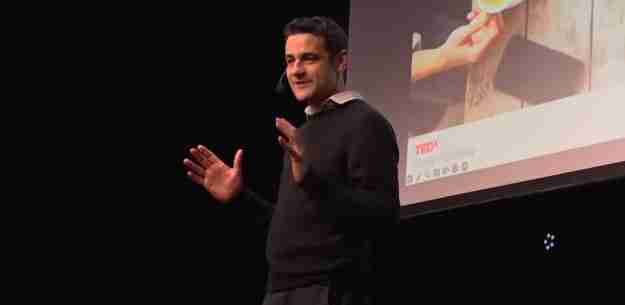
Read the full transcript of communication expert Lawrence Bernstein’s talk titled “The Trick to Powerful Public Speaking” at TEDxRoyal Holloway conference on January 27, 2024.
Listen to the audio version here:
TRANSCRIPT:
LAWRENCE BERNSTEIN: Good afternoon everybody. Everybody here has been incredibly kind and welcoming. I parked the car, I came out of the car park, and somebody immediately came up to me, asked me what I was up to. Said she’d look after everything, and then she said, “I hope it goes well.”
And I thought, “I haven’t really focused on going well,” what it actually means here today. And I guess if you’re not feeling terribly positive, it means not forgetting what you’re going to say, which would be quite helpful. It means nobody laughing at you, unless you’re trying to tell a joke. And it means not looking over and seeing people falling asleep, looking at their phones or generally ignoring you. And those are, by the way, three of the biggest fears of people, subconsciously, when they’re about to speak in public.
So I’m going to set my sights just a tiny bit higher than that and say that I would love it as the only thing you take away from this talk that next time you have to give a speech or a presentation or you’re talking in a seminar or whatever it might be, that you just remember those two cups of coffee. And for the non-coffee drinkers amongst you, peppermint tea, even a beer is absolutely fine.
The Challenge of Memorability
Because the sad truth is that however hard we work at what we’re going to say, however much we learn the facts and the figures and all these things that a typical member of this audience tomorrow, this time tomorrow, I will be amazed if you remember more than one thing I’ve said. Or more than one thing that any of the other amazing speakers with their brilliant stories have said, because we just live in such a phenomenally noisy, busy world.
We’ve got WhatsApps and streams and apps and things to watch and things to do and things to learn, and we’ve got dates to go on and games to go to. By this time tomorrow, these talks will be a distant, distant memory. And it’s extraordinary how our brains are relatively selective about what we remember.
The Fear of Public Speaking
Now this doesn’t help, and I include myself in amongst this, this doesn’t help the nervous public speaker. Now that fear is a real problem, because it means that we approach our speeches already worried about how we’re going to look and sound. And it’s why often we do things that are a bit unlike us. Some people just start talking really quickly, and they get through their content and they can’t stop. And other people freeze and they just stand absolutely still and all the energy drains from them and they start to talk in a monotone. Isn’t so great for being heard.
This is the fight or flight response. And it means that when we are under pressure and we feel that spotlight on us, we just start to behave in very unnatural ways.
The Coffee Shop Test
Now this is where I come back to the cup of coffee. Because if after this, I bump into one or two of you at the canteen, we have a chat and you ask me what I’m doing for the rest of the weekend, I hope, if you had a football shirt on, I might say I’m looking forward to watching a game on telly, and I might give you the absolute highlight of what I’m up to. See if it connects, see how you react. I might say, “I’m knackered after all that prep for TED. I’m going to spend the rest of the weekend watching boxsets on TV.”
What I probably wouldn’t say is, “Thank you so much for asking that question. I’m going to break the weekend down into 12 points, and I’m going to talk through each point one by one and break the weekend into segments. But before I do that, I’d like to introduce the concept of the weekend, and I’d like to talk about the weekend as a post-industrial concept, because it didn’t really exist before the Industrial Revolution.”
If I talk like that, would you think I was slightly, slightly unusual? And we sort of laugh about this stuff, and I laugh about it a lot. But actually, when we are under pressure, particularly in a professional situation or a student having to give a seminar that really matters, we start to talk in that way.
Real-life Examples
Let me tell you about two jobs I’ve done relatively recently, and I will keep the names and the places anonymous to protect the innocent.
So a few months ago, I went to another university campus where the human resources team had asked if I would help six of them develop their communication skills. And it was one of those days. Sometimes people in these groups don’t really want to go on a course, they’re very busy, you can get quite a frosty reception because people don’t want any sense of criticism. But on this day I turned up and the sun was shining and I arrived and the head of human resources came up to me, phenomenally friendly, she did everything but hug me. She offered me a drink, she took me inside. She told me a story about one of her kids had dropped ink all over her school uniform before she’d left that morning. She made me feel completely at ease, and I knew instantly it was going to be a great day.
And she introduced me to her colleagues, and we all had a chat about worries and what we had to do when we spoke in public. And then I said, “Right guys, it’s time to do it.
Let’s each of you, you’ve got a minute or two to prepare, but could you for one minute talk to me about something important that’s going on at work at the moment? And the other five will be your audience. And I will also pull out a camera, and the camera is going to film you just to put you under that little bit of pressure.”
We’ll call her Jane, the head of HR. I said, “Jane, would you like to go first?” She said, “No, not really.” So I said, “Go on, you’re the leader here, Jane.” And this is what happened to this charismatic woman. She said, “Well, there are a number of reasons we’re here today, and I’d really … the important thing is the LRUs. And I’m going to talk about the needs of LRUs and what they need …” And she went on like this for a minute, and at the end everyone gave her a little polite round of applause.
And I turned to her colleagues and said, “Guys, what is an LRU?” And I got some blank faces and said, “Jane, what is an LRU?” And she went, “Oh, it’s a learning receptor unit.” Now anyone know what a learning receptor unit is? Guys, you are all learning receptor units right now. A learning receptor unit is somebody on a course or a delegate at a talk in the small print in the HR department of this place. And what had happened is Jane had turned from this incredibly charismatic speaker having coffee with me beforehand, but she had failed the coffee shop test. When she was under pressure, she started speaking like some sort of corporate robot.
Now I get paid to do some very odd things. And a little before that, I was asked by one of the big transport providers in the country if I’d go and sit in their boardroom where 30 very stern-looking, middle-aged people with laptops and notepads receive presentations of five minutes each from a bunch of very senior engineers. And each engineer is coming in to ask for money for a new project. And this group has to decide. It’s like the gladiators in the amphitheater. That means they get the money and they go on, and that means you have to go and find something else to do.
The first guy, call him Jim, wasn’t his name. Jim walks in and he flusters around and he puts up a slide which has got notes and graphs and numbers and charts and God knows what else. And again, I’ll paraphrase, but he stood there and just went, “Well, I’m going to talk about the footbridge. We’ve got to get through a number of — there’s a number of reasons we need it. I’m going to talk about the background. I’m going to give you an introduction to the subject.” And he went on and on. And with about 4.5 minutes gone, he then said, “And what really matters is the type of material we use to build the bridge.” And to be honest, it was beyond me at this point, but it was something steel or aluminium or iron or some choice. And then he finished.
And there was an intense debate for about two minutes amongst two of the team, the board of this organization, about which type of metal would be better. And at the end of the session they had a vote. Poor old Jim, he’d asked for a million pounds to keep his team busy building this footbridge. And after the session had finished, I went down to their canteen. I spend a lot of time in coffee shops. And I saw him sitting alone, looking a bit miserable. And I said, mate, do you mind if I just have a quick chat about how it went? So why did you need the footbridge built?
And he said, “Because there’s a junction on a bend near this very, very busy transport system, and it sits between the housing estate and the local school. And every morning our CCTV catches kids sprinting across the junction trying to get to school because they haven’t got time to go up the road another half mile to go over the footbridge that’s already there. And we reckon in the last couple of months three kids have almost died. They’ve been inches away from dying. And this footbridge would have saved their lives.”
And I said, “Why didn’t you tell them that?” He said, “No, but you have to be more professional than that. You have to go through all the detail.” And this board clearly didn’t have a clue that this was the reason. And they turned down something on the basis of the material he would have used for a footbridge, and they weren’t even engineers, rather than the need to save children’s lives. Again, he’d failed the coffee shop test.
The Importance of Human Connection
And ultimately, the more pressure we are under and the higher the stakes are, be they your friend’s 21st birthday party, be they a job interview where you’re speaking to a panel, be they a TED Talk, where you’ve been planning to get your great idea over to the world for years and years and years, you’ve got to appeal to people’s human side. And what we do in a coffee shop completely naturally is we think about our audience, and we are relevant to them and to their needs. We think entirely about using — we don’t even think about using our natural charisma because it happens. We just appeal to their better nature. We tell them things they think they will enjoy.
And that starts with stories. Even the most complicated subjects come to life when we tell a story.
The Power of Storytelling
And I’m sure recently, all of you are aware of the Post Office scandal that’s gone on in the UK. Everyone know what I’m talking about, and the Horizon software that has ruined the lives of people who were working honestly in post offices, these subpostmasters. You’d think this was news, but actually this has been going on for 20 years. And you know, I like to try and keep up with current affairs, but I couldn’t miss, this thing has been in “Private Eye,” it’s been in Sunday newspapers, it’s gone through the high courts. It’s been inside the papers, but always on a very technical, mathematical, legal basis.
All that’s happened in the last two months is there was a TV show about it. But the TV show didn’t focus on the facts and the figures at the beginning anyway. It focused on people, an emotional connection to those people. And we saw how these lives, through storytelling, had been completely and utterly transformed. And within weeks, the Prime Minister is promising hundreds of millions of pounds of compensation without even having a vote in Parliament. That is the power of storytelling.
Now I’m not saying the detail doesn’t matter, and some of you, I’m sure, are doing the most phenomenally complex academic subjects that you’re going to need to talk about as you graduate and go into careers. But still, the way you would describe that subject to a friend over a coffee is a brilliant way to introduce it to an audience who may need you to give them a lot of information, but still need to be hooked in, in this busy world where they are so easily distracted.
And the coffee shop thing continues again and again and again, it’s a benchmark for everything. When we talk to our friends, we look at the benefits of a problem rather than its features. So I went to the GP some time ago. I’d had a tummy ache that had been going on for days, and I just began to get a bit worried about it. And the GP does what GP’s do and prodded around and asked me questions. It was all a bit mucky. And then typed some stuff into his computer and then looked at me and said, “Mr. Bernstein, I think you’ve got a problem with electrolytes and pathogenic bacteria.”
And I can promise you, my sort of mild state of worry turned into complete panic. I can remember the hairs on the back of my neck stood up. I thought, “Oh my God, this is it, I’m finished.” I said, “What does that mean?” And he said, “Well, I think it’s food-related.” And I said, “Well, I’m not going to die of food poisoning?” “No, no, no, I think you’ll be fine by the weekend.”
Now, what he had done is used his technical knowledge to give me the facts before he’d actually explained the context and the benefit to me. And had he gone about it the other way and said, “Mr. Bernstein, you’re going to be absolutely fine. I think it’s food-related.” I would have said, “What is it?” He would have told me all about his electrolytes, and I would have been fascinated. But in a coffee shop, the first thing you ask your friend is how they are. And they will either say they’re great or not so great. They won’t go into the technical medical detail, and if they are, you probably wouldn’t be having a coffee with them in the first place.
Get to the Key Message
The other thing we do when we go into a coffee shop is we talk about our key message. We talk about the subject. We don’t leave it until 10 minutes before we’re due to leave. We let them know that we’re going to talk about the match, or we ask them if they saw the TV show, or we ask how their date went last night before we get into the minutia of what they might have worn or what they had for their starter.
Again, we get to the key message and in my case, the key message is simply that we waste too much time worrying about the symptoms of public speaking worry, which are things like shaking and looking like this and breathing too quickly. And we try and cure those when in fact they’re not the problem. It’s a bit like going to the doctor when you’ve got hay fever and lots of sneezing and saying, “Can you help me?” And he says, “Get a softer tissue.” It doesn’t really stop you sneezing. What you want is the antihistamine.
Conclusion
And for public speaking, the antihistamine is your content. And if you talk to a group of people the same way you would talk to a friend, you will find your natural charisma and energy comes to life. You’ll start to move your hands without thinking about it, because that’s what you do when you’re on the telephone to a friend, and you will find that instantly, thinking about those cups of coffee will relax you and make you more confident next time you have to go and speak in public.