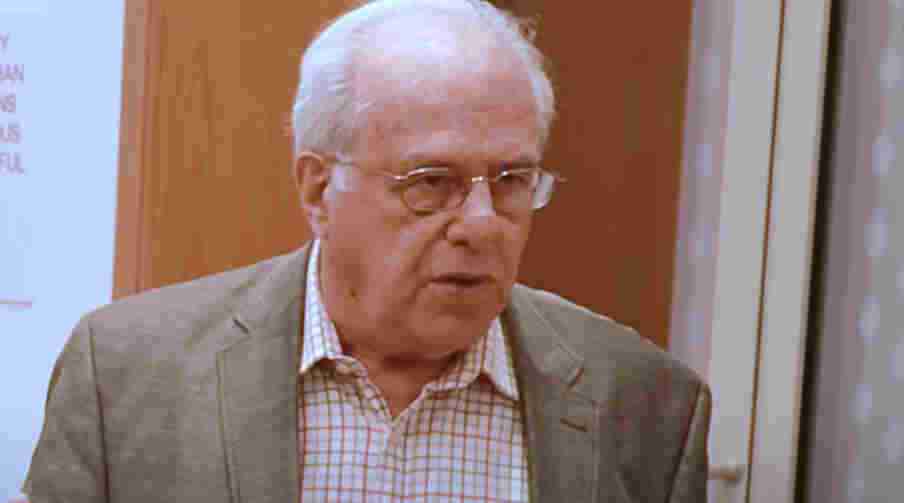
Read the full transcript of American Marxian economist Richard Wolff’s talk titled “Global Capitalism: What Trump 2.0 Means” at Democracy at Work and The Left Forum’s special live. (Jan 23, 2025)
Listen to the audio version here:
TRANSCRIPT:
A Time of Decline
RICHARD D. WOLFF: I want to thank all of you. I won’t repeat all the thanks. All the other speakers have done that. You all should be proud that you’re here together because it means that we are here together.
And that’s what everybody’s going to tell you. They’ve already done it. I’ll repeat it at the end. I take as my task here to answer some questions about what the election and the new government coming in on Monday, what it’s going to be doing and why it’s doing it and what we can expect.
And so I want to begin by telling you that partly what I’m going to say is going to upset you. And so I want you to remember that I’m just the messenger. I didn’t make these things happen. But I do want to honestly tell you, if you would like a much more comfortable version of this, then just turn on your television or radio whenever you have a free moment on the toilet, and you can hear the make-believe.
Because we live now in a weird time. Weirder and in different ways from what we were used to. This country is, as Dr. Leon, I keep wanting to call him Wilmer because we’ve gotten to be friends, but as he pointed out, we live in a time of decline.
And then when an empire declines, which is something we hadn’t gone through, because empires don’t decline very often. So, but let me tell you from the history books, a little bit we can tell, it’s not fun to be in a declining empire. Much more fun when the empire is going up, which was the last century or a century and a half of this country, the ride up. We are now on the ride down.
We haven’t been prepared, because we have leaders who cannot say a word about that. I want to just drive that home, because the split in this country is really about that.
A Nation Divided
So let me start with the split in the obvious way. This Monday, we are having a national celebration of two key events. One that you hear about every day, all day, the inauguration of a new president. It’s also the anniversary of the assassination of Martin Luther King. Same day. Wow, how different.
One celebration from the other. Who’s celebrating what? You might say, and you wouldn’t be far wrong, that those celebrating Mr. Trump are probably also celebrating the assassination of Mr. King. And those that are mourning one are likely also mourning the other one of those two events. But it’s a country split between those on the one side of that and those on the other. And that split is everywhere now.
And if you haven’t noticed it yet, you will, because it’s going to impact your life in all kinds of ways.
The Reality of Decline
So one of them, one of them to start, is a little bit about what a declining empire means, just to give you the context. The United States lost the war in Vietnam. When I say that in my classes, my students look at me, they’ve never heard such a thought.
America, as they know from the comic books they read as children, only wins wars. It doesn’t lose wars, but we lost. The war was fought against the Communist Party of North Vietnam, which has been running that country since the United States was driven out in 1975. Go check all of this, you will find I’m not making it up.
After we lost the war in Vietnam, we went and had a big war in Afghanistan, which we also lost. That war was against the Taliban, which now runs that country, which is a good sign that you lost. We lost the war in Iraq. We are in the process of losing the war in Ukraine.
But the split of the country is, if I were in certain audiences, I wouldn’t dare say what I just said, because they couldn’t hear it. They could not hear it. And I wouldn’t be able to get anything else across, so I couldn’t start that way. I’m a teacher. I’m not going to try to lose my audience before I begin. But it is the reality. Let me give you a couple of more just bits of getting what decline means.
The Rise of the BRICS
Last week, something happened on the part of a country called Indonesia. I don’t know if you’re familiar with it. It’s a remarkable country in Asia, made up of 18,000 islands in the Pacific. It’s a huge country. The population of Indonesia is 280 million people, makes it one of the largest countries in the world.
Let me remind you, the population in the United States is 330 million. 280 isn’t that far less than 330. It’s an enormous thing what they did. They joined the BRICS. They joined the full partner of the BRICS. BRICS, by the way, means it’s the first letters of the countries Brazil, Russia, India, China, and South Africa. A dozen years ago, they began to form an alliance of what came to be called the Global South, to be independent, relatively, from the domination of the United States. And the core economy there, the biggest one, the most powerful, is, sorry to tell you this, I know it’ll come as an upset, the People’s Republic of China.
Remember, I’m the messenger. I have no responsibility for this at all. China and the BRICS, Indonesia joined them. Together now, the BRICS, built around China, have as the population of the countries that are part of the BRICS, about 22 countries now altogether, they have about 55 to 60 percent of the population of the world are members.
What is the percentage of the world’s population of the United States?
We in economics have this little game. We ask, what is the total output in goods and services in a year of a country? Gives us a kind of rough idea of how big a country it is, how important its footprint is in the world. Okay, so if you take the BRICS together now, they are about 35 percent, maybe a bit more, total output of the world.
If you add up each of those countries’ total output in a year, and you add them up, they account for 36 percent, more or less, of the world’s output. Now let’s compare that to the United States and its major allies. Those are called the G7, the group of seven. United States, Japan, Canada, Britain, France, Italy, and Spain, and Britain, excuse me.
Okay, that used to be the dominant player of the world. That used to be what world trade meant, what they did. Together they, that’s all of them, now account for about 28 percent of the world’s output. Do you understand the BRICS is now what the United States was, but is no more.
Now if you’re looking to where the wealth is, you go east, not west. If you’re a poor third world country, as we used to call them, and you need money for a railroad, or you need to find places to sell your exports, you direct your diplomats first to go to Beijing, because that’s where it’s at. If you can’t get a good deal there, well, you might go to London or Washington, but whatever you are doing, you’re going to play them against each other. You’re going to say to the Americans, “Oh, that’s the best you offer? Let’s go the other place, see what they offer.” You want to know why most of the railroads being built in Africa today are being built by the Chinese? There’s your answer. They got a better deal.
Everything is changing because of this, except here, where the make-believe is the way this country is dealing with this. Denial, you know, we ought to ask Dr. Fra to help us with the understanding psychologically. We all know it from our personal lives, right?
When we’ve lost a friend or a lover, and we had to wait until all our friends told us what we couldn’t face ourselves. Well, we are the friends in this country who are being unable to vent. That’s why what Indonesia did last week is something I’m not going to ask how many of you noticed it, because nobody will raise their hand. How could you?
Make-believe made sure that that was not on the newspaper’s front page or in most newspapers on any page ever. How many of you know that the Chinese are now the fast-growing dominant economy in the world? We’re not. We haven’t been for a while.
Every major high-tech firm in this country has an analog, sorry, has an analog in China. When we heard earlier that there was an offer by China and by Russia to work with the United States earlier, which the United States turned down, that’s part of denial. They didn’t just turn it down then, they turned it down now.
The Electric Vehicle Revolution
One more example, and then I’ll stop and tell you what this all means. 15 years ago, every automobile company on this planet went to work trying to develop what they understood was the next wave in that business, which was putting aside the gasoline-powered car and substituting an electric-operated car or truck. By the way, not a rational response, because it’s terribly wasteful to have that vehicle, which those of you who have it notice, sits on the street or in the garage most of its life. That’s kind of, let’s use a fundamental word, stupid. It’s stupid.
It’s a waste of resources. That car could serve 20 people each day if it were managed properly. What do I mean managed properly? Well, like a car rental business, that’s how they would manage that.
Or those bicycles we can now just take off the rack and put back on. That’s a rational way. If you want to avoid killing people, which private cars do, if you want to avoid air pollution, cars are the major cause of it, and on and on. Rational would be to go from the private car to a mass transit efficient system.
A beautiful train every five minutes, a beautiful bus, even more beautiful, every three minutes, everywhere. That’s it. Infinitely cheaper, much more efficient. And none of you have to worry about it, because wherever it’s parked in the central lots, which we call car rental centers, there would be paid mechanics who make sure they’re in proper condition.
So the car would be in better shape, better cared for. The whole thing is nuts. And who is the person who invented this crazy bad solution to the fuel burning car? That genius who did this terrible thing, Elon Musk.
That’s what he did. He found the way that automobile companies could make a profit by taking us out of gas cars into electric cars. So 15 years ago, all the electric, all the car companies said, hooray, here’s how we hold on to our profits by making these private cars for everybody. And they all went to work to compete.
And there was a winner. As of three years ago, one company figured out how to make the best quality electric cars and trucks at the lowest price. This is what competition is supposed to result. And I’m sure you all know the name of this company. It’s the BYD Corporation. Let me do that again. B as in boy, Y as in yellow, D as in dog. BYD.
Now your faces give you away. You never heard of this place or this thing. What is it? Well, what did I just tell you? They won the competition for the entire new wave of cars and trucks moving across this planet every day by the millions. And you never heard of them. Why? Because they move everywhere except to you.
If you go to Europe right now, you’ll see them all over the roads. BYD. And by the way, other, there’s several Chinese car companies. They’re not the only one. They’re just the ones who did it best. Why don’t you see them? Because we have a tariff started by Mr. Trump, raised by Mr. Biden. The tariff on the Chinese electric vehicles is 100 percent. So let me explain quickly what that means.
The Chinese produce this wonderful thing, this electric vehicle, and let’s take a simple number. $30,000 is what they cost for the car. You’re an American. You need, therefore, to come up with $30,000 if, for example, you’re a company that uses electric trucks to do part of your business. It’s an input.
You’d have to come up with $30,000 to get the truck. And then you’d have to pay 100 percent. Another $30,000 will go into Uncle Sam, Uncle Sam, who put the tariff. Tariff is just a word for a tax. It’s a word for a tax on an imported good or service, something that’s produced out of the country but brought in here for sale. That’s what an import is. And tariff is the name of the tax you put on imports. We have been putting taxes on imports as a nation from the beginning, although throughout the history of the country, nothing new about it.
But it’s 100 percent, which means an American would have to buy that truck by giving China $30,000 for the truck, and Uncle Sam another $30,000, and so with $60,000 you get the truck. But of course no one does that. Why? Because Ford and General Motors and Tesla will sell you an electric car or truck for a mere $40,000 or $50,000 or something like that.
So who’s helped by this? Ford and General Motors, they wouldn’t be able to sell their crappy cars otherwise. We would none of us buy a $40,000 or $50,000 electric car if we’re going to do that, and give BYD $30,000 for a better car rather than $40,000 or $50,000 to General Motors, however patriotic we might feel. And you know who knows it?
Ford and General Motors. So they went to the president and they said, put that tariff there. It’ll protect us. Of course they didn’t say our profits, which is the truth. It’ll protect jobs. Whenever you hear a capitalist tell you about what they’re doing to protect jobs, hold on to your wallet. Someone’s reaching. Why is it false?
Because this is a terrible act for most American producers. Think of yourself as a maker of shirts or chairs or software programs. You would like to buy the trucks you need to bring in your inputs to sell and distribute your outputs. You’re going to have to buy electric trucks.
You’d like to buy the best one at the lowest price. Of course, you’re competing with enterprises in France and in Germany and in Brazil and in Nigeria and fill in the blank. They’re all buying BYD cars at $30,000. You have to pay $40,000 or $50,000 to General Motors.
You know what that means? They’re going to defeat you economically. You’re going to be a loser. And when you lose, you’re going to lay off your workers because you can’t compete with the companies that can buy the biggest, the best, and the cheapest electric vehicle.
Now multiply this by dozens of other commodities. China is winning. We are losing. Don’t tell anyone.
The Decline of an Empire
Because you live in a country which is pretending to itself that none of this is going on. It’s either never discussed or we turn it around and we say the Chinese are becoming aggressive in the world. They’re doing what exactly we did. You know how the United States became a big, powerful country? By doing to Europe what the Chinese are doing to us. It’s not new. It’s not different. The only question is why would it be surprising?
What a strange behavior is going on here. Now where is this taking us? And I have a few things and that’s all I really want to tell you. Mr. Trump is a problem. You’ve probably already noticed that. One of the ways he’s a problem is that he has come this far as a politician. He had a different life before.
It’s known as a playboy. So he went from a New York playboy to a national politician, maybe even an international politician. And he did it in one basic way. He understood, maybe it’s not clear, he understood that America was in such trouble that the mass of people here were remarkably alienated from the conventional Republican and Democratic parties.
They didn’t feel those parties were doing much for them, which is true. That those parties weren’t protecting them from a decline they couldn’t quite pinpoint, but they felt, particularly over the last 30 years, their budgets were squeezed. You might have noticed that 40 years ago the level of household debt in this country was small. Nowadays, everybody is loaded with debt.
I can add, if you’re interested, that corporate debt is at a higher level than it’s ever been in our country, and government debt. In other words, we are a country in debt on a scale we didn’t imagine 10 years ago, let alone think we would have now. There’s a name for companies that have been for several years so deeply in debt that they don’t make enough profit, ready, to service their debt. That is to pay the interest and the portion they have to repay.
Zombie Corporations and National Debt
Now we have a special name in economics for them. I kid you not, I didn’t make this up. Zombie corporations, because they’re dead. They’re economically defunct.
You know how they manage to survive when their profits aren’t enough to cover their debts? They take on more debt to pay the debt they couldn’t otherwise cover. Uh-oh, that makes them more zombie-ish next year than they were this year, which is what’s happening. You might wonder, who lends money to all these indebted people, businesses, and government?
Well, let me start with the government, because if you thought the world was crazy before, wait till you get this. The two biggest creditors of the United States government are Japan and China. Japan number one, China number two. A few years ago, it was the other way. China was number one, Japan was number two. The United States is the biggest debtor country in the world, by countries. The second biggest creditor of the United States is the biggest debtor, is the People’s Republic of China. Do you understand?
The United States owes China 850 billion dollars, roughly. It has to pay interest, of course, on that debt like it has to pay on others, which means I’m here to tell you that a portion of the taxes every one of you in this room pays when you buy a bottle of beer, or you smoke a cigarette, or you pay your taxes, a portion of that money, you should be very pleased, is collected by the United States government, not used for houses, or medical care, or student loans, but shipped to China as interest on the debt to enable them to build their military capacity to fight the United States. Hello, I didn’t make this up. On the other hand, think of it this way.
These kinds of loans from Japan, from China, enable the United States government to spend all the money Dr. Leon told us about in Ukraine without having to tax us, because you know what would bring the war in Ukraine to an end in about 10, maybe 11 seconds? If Americans had to pay for it, but we don’t. The Chinese and the Russian, and China by the way, supports Russia against Ukraine, but lends government money to the United States, which pays for the Ukrainians.
Whoa. You think you ought to pay respect to a system working like this? Think. We are in a completely different world than we once were.
The Shifting Global Power
The empire is declining. We are not strong. We are weak. We don’t produce the bulk of the world’s output. We don’t control the bulk of the world’s trade. The U.S. dollar, which in 1950s, 60s, 70s, was the global currency dominating all others, isn’t anymore.
Central banks around the country, which used to hold dollars as backing for their own currencies in their own countries, because the dollar was as good as gold, it isn’t anymore. So the dollar from being 70, 80 percent of the reserves held by central banks is now about 40 percent. Still important. We’re still in a big industrial power, but nothing is as important as the nothing like we were.
Now, Mr. Trump understood that in this changing world, Americans were being squeezed, and he was right about that. And you should understand that we’re still in that situation, and Mr. Trump is president because of it.
Here’s how it works. Every empire, as it goes down, has the following procedure of handling it. The people at the top, the rich and the powerful, respond to the decline by saying, oh, this is terrible, but not for me. But not for me.
The top always offloads the difficulties and burdens of a decline onto those people less powerful and less rich than themselves. The emperor in Rome didn’t suffer the way the average people did. The emperor in Persia or the emperor in Greece, it doesn’t matter. All the empires show the same phenomena. Those at the top hold on, work harder than they used to hold on, because they know damn well it’s going down. And who can’t do that are the people who don’t have much power and the people who don’t have much wealth. And so the working class has to be, one way or another, squeezed as you go down. And we, you, me, we’re all being squeezed.
And in our naivete, we turn to the Republican and Democratic parties that protect us. They can’t. Oh, they’ll tell you whatever you want to hear. You know that. We live in that. But they can’t do anything. Because the only real thing to do would be to say honestly to the people, our empire is going down. It’s going to be a hard thing. And maybe we all ought to get together to try to get through this difficulty together. Oh, that would be an interesting idea. We’d have a name like, I don’t know, socialism. That would be rational.
But we don’t live rational. How do you squeeze the mass of people? A lot of ways. It’s a little bit like that famous poem, you know, how do I love you? Let me count the ways. How am I going to screw the working class? Let me count the ways. So for 40 or 50 years, we make sure that unions can’t function.
They can’t do what they were invented to do, help the workers get a better deal. Not going to get that. We’re going to demonize unions. We’re going to make every union look like it’s, you know, that movie on the waterfront, a bunch of crooks that are grabbing your dues every week, etc., etc. You’ve been living your life in that kind of an environment. It’s changed the last few years as working people begin to get it. And they are.
That’s part of what this meeting is a sign of. Beginning. The Starbucks workers are beginning and the Amazon workers are beginning. The labor movement is kind of coming back to life. But it’s coming late in the process of squeezing the working class. Here’s another way you squeeze the working class. You have this thing which you say is some kind of mystery. It’s called an inflation.
The Reality of Inflation
So what? An inflation sounds like something you do to a balloon. What is it inflation? In economics it just means prices are going up. But now let’s be a little bit more careful. If you know anything about the inflation of the last few years, here’s a little statistic. The inflation has gone up faster than average wages and salaries of people. Okay, now I’m going to do this very difficult arithmetic.
If for the money you have to spend, your wages and salaries are not going up as fast as the prices, they’re going to be things you can’t afford anymore. You know, really special expensive things like eggs. Right? What? But will someone honestly tell you that the inflation is a way of squeezing the work? Not. You look long and hard. You won’t get it. The inflation of eggs is due to bird flu. Huh? What? What?
Look, I’m talking to people. I’m not going to be mean. But half of you believe that. And the other half of you think it might be true. Here’s what an inflation is. It’s a decision made by some people to jack up the price you have to pay for the things they can control the prices of. Who sets prices in a capitalist economy? Answer. The employer. Those of you who have had jobs all your life as workers, do you ever recall being called into an office to add your opinion as to what the price should be of what you help to produce? Never happened. The United States census tells us 3% of Americans are employers.
Welcome to the other 97%. That’s you and me. The employers set the prices. We pay them. When they jack up the price, that’s because they want to give us fewer of whatever it is they make for the money we have to give them. It’s a way of screwing the working class. And that’s how it’s been used in the last few years. And all these economics professors, including many of mine, and people I know, sit around debating how are we going to control the inflation?
What is it? How does it happen? I sit there. I’m one of their students. And I really want to run up there and hit them over the head with a ping pong paddle. What are you doing? What is this noise coming out of your mouth? And then their decision, which really at this point, I hope I’m getting to you, you’re getting upset.
Their decision is we’re going to deal with it by raising interest rates. Oh, wow. This is wonderful. Who gets screwed when you raise an interest rate? In case you’re not rich yourself, I’m going to tell you, it’s not rich people. They don’t give a flying, boom, boom. Whether the interest rate is 2%, 6%, they’re rich. That’s what it means to be rich.
You don’t care. But you have to care because it’s going to mean that little bit of money at the end of the month that you have to pay on your credit card is going to be bigger than it was before. And everything works like that. The rich don’t care. You know what that’s like? It’s like, I’m going to stick it to you now for a moment, congestion pricing. Oh, good. We have a problem in New York with traffic.
This should come as hot news since it’s only been true for a century. And we’re going to finally do something. Oh, really? Yeah, what? We’re going to tax everybody the same. What? The same. A rich person who will not give a damn and the poor person for whom this adds up as an extra buck or two every time you do something, if you have to come in and out of Manhattan, etc., etc. Only an American politician who’s just seen what inflation has done to people would come up with that solution. And by the way, raising interest rates, because I can see it perked some of your interest, is that the only way to deal with an inflation? Of course not.
Why did you ever think it? Answer, because that’s what you were fed all the time in all the media. The last time the United States had an inflation as bad as the one a couple years ago was back in the late 70s and 80s. We had funded the war in Vietnam by printing a lot of money, because otherwise the people would have revolted against it if you’d said that everybody were having a war in Vietnam is going to cost every family a couple thousand a year.
Whip, end of war. So we borrowed. We printed money and we borrowed. And then we had the terrible inflation.
Nixon’s Wage-Price Freeze
And then a conservative Republican president, Richard Nixon, went on the television, August 15, 1971, and said, “I’m going to do something about this terrible inflation.” Oh, good. There was tremendous suffering in the country and a lot of pressure. And put that together with the problems with the war.
He had to do something. So he declared a wage-price freeze that day, 15th of August. As of tomorrow morning, he said, this conservative Republican president who became president by becoming the champion of anti-communism. As of tomorrow morning, he said, any business that raises its prices, we will come for you, we will arrest you, and you go to jail.
Guess what? The next morning, inflation vanished. Amazing. Are you surprised? Shouldn’t be. Is this a story about how you control an inflation? Yeah. Did it work? Yeah. Did it happen in the United States? Yeah. Do you know about it? No. No. And the people at the Federal Reserve who decide interest rates, they made sure not to ask about it, not to talk about it, not to debate it.
World War II Economic Strategy
Let me give you another example, because I think I’ve perked some of your interest. In the early 1940s, the United States decided to enter and fight World War II. And the economists, who, by the way, included a significant number of Marxists and socialists, because in the 1940s, they would be hired by President Roosevelt at the time, because they were considered the most reliable anti-Nazis, anti-fascists. So people like Galbraith, whose name you may know, Paul Sweezy, Harry Magdoff, people, very important people on the left of American economics, were working in Washington.
And they went to Roosevelt, and they said, “Okay, you’ve got a problem. You’re about to fight a war. You’re going to move all these resources, factories, railroads, to work on a war, to supply the army, supply the navy, and fight a war. And those resources are, therefore, not going to be available to produce food, clothing, shelter, consumer goods. So we’re going to have a shortage of consumer goods, since we’re using these resources, a large number of them, to fight a war.”
And here’s the problem with that, President. If there’s a shortage of goods for the mass of people, who presumably will still want to buy underpants, and shoes, and coasters, and all the other things of life, with a shortage, we’ve got a problem. And the President said, “Well, what’s our problem?” He said, “The market system.”
The President was confused. He said, “I thought we were supposed to be for that.” “Yeah, but we can’t afford it in a war.” “Why not?” They had to explain to him, just like I’m doing now with you. If there’s a sudden shortage, then there won’t be enough toasters, or ice cream cones, or fill in the blank. And you know what happens in a market economy, when there’s scarcity of goods? The people with the money offer more.
You’ll come with your dollar to the ice cream vendor in the park, and you’ve got your two little kids with you, and you want to buy them an ice cream cone, and you hand them two bucks for the two cones, and he looks at you and says, “I only got four cones left.” And before you can respond, the person next to you, who you can tell by his outfit, is much better healed than you are, says, “I’ll offer you five dollars for each cone.” Guess who gets the cones?
If you have a shortage, a market system is a system that allocates whatever is scarce to the people with the most money. Those of you who think of yourself as moral or ethical ought to think about why you support a market system that does what I just said. Really? That’s what you want? You want to live in an economy that distributes whatever is scarce to people with the most money?
You know what that means? It means that the little bit of milk will be purchased at a high price by the nice, rich couple who gives it to their cat. But it will not be affordable to the poor couple who needs it for their children. It’s how the market works, Jack.
You’re supposed to love the market. You’re supposed to believe it’s efficient. It never was. That is, that kind of argument is what we in academia call bullshit.
Trump’s Rise to Power
But it works. Mr. Trump has become president because he knew that the mass of the American people were being squeezed and that the conventional Republicans and Democrats weren’t doing squat about it. And he said, “I’m different. Watch me. I’m going to call all Mexicans rapists. I’m going to be outrageous. I’m going to say the things that were quoted earlier.”
“I’m going to be a misogynist, not quietly and under the table, the way it’s usually done, but big and loud and open. All about it. Watch me. I’ll say all those racist and other things that other politicians believe, but know, have learned. Don’t say that, or at least don’t say it in public.” Um, and he, he, he convinced American, a lot of them, not all, but a lot of them. He’s different. And when you’ve got two parties that aren’t doing anything for you, and you’re feeling very squeezed, you give your vote to somebody different.
After all, why not? The Democrats had the equivalent. You all know his name, Bernie. He was the different on the other end. The politician who, for the first time in half a century, didn’t run away from the name socialist. Had he run, he would have picked up that same different. Maybe let’s go with him. But the Democrats shut down their only chance and look at them.
They suffered the results. Mr. Trump, there’s no reason for any of us to imagine he’s going to change. He’s going to be Mr. Different. That’s what he does. And you can already see it. You can see it in what, what he did to Mr. Netanyahu. Bye-bye. Bye-bye, Mr. Netanyahu. Your life is probably over, career almost certainly. For those of you who don’t understand it, it’s again American craziness. The Israelis made a decision to hitch their wagon with the United States. They made that decision many years ago.
The Israel-Palestine Conflict
Fateful decision. Good in the short run, a disaster in the long run. And that disaster has now come full circle. They’re identified in the whole world as a complicit partner in what was done in Gaza.
The Israelis went into Gaza to defeat and destroy Hamas. Didn’t work. To defeat or eject the Palestinian people didn’t work. And all that happened two days ago was a decision by the United States, upon which it depends, to cut its relationship with a losing proposition. It’s ugly all around. It will not save the United States from being identified as complicit with all that happened there. And the books and articles and documentaries about it will be with us for the next generation. And Hamas, it will inherit the rage and the fury of two and a half million residents of Gaza who have watched their mother, their father, their children.
The young people that are coming are going to be a much greater danger to Israel than the old Hamas ever was. This is a disaster. And most of the world sees it. That’s why the boats in the UN are lopsided. 150 countries on the side of the Palestinians, 25 abstentions of the United States, Israel, and the Canary Islands. I mean, it is silly. It’s a silly spectacle. But that’s another sign of a country going down.
The Ukraine Conflict
Last example, Ukraine. The problems in Ukraine begin with the dissolution of the Soviet Union back in 1989-1990. Ukraine, a major part of what used to be the Soviet Union, particularly important in grain growing, very, very rich soil, so forth. A lot of finagling of the countries of the West, NATO moving eastward, threatening Russia and all that.
I won’t bore you with the re-history. And then to stop what was happening after NATO took over in Poland and Czechoslovakia and all the rest, Mr. Putin and the Russians said, no, not Ukraine, not the eastern part of Ukraine, which is majority Russian, Russian speaking, Russian language, Russian culture, and so on. And the United States says, “Oh, oh, good, you invaded. That’s a bad thing. We can mobilize the whole world around the bad thing of a big country invading a little country.” That sounds good. That was already a mistake.
Because what was Afghanistan? A big country invading a little poor country. What was Vietnam? A big country invading the position of the United States as going to war around the principle of a big country shouldn’t invade a little country.
Sounds a little hollow coming from the United States, except, of course, here, where the denial is the governing spirit of the country. Just like we’re going to be denying on Monday, the Martin Luther King Association, while we talk endlessly about the Donald Trump Association. So the war. And the United States decides to go in front and round up the usual Europeans to go with you.
Okay. How do you fight the war? And this goes to something said before, and I want to conclude with. The United States is caught in the decline, discovering that the decline trumps everything else. And I don’t mean to be clever by using the word trumps. The nuclear weapons of the United States are useless. The enormity of them, useless. Why? Because if you dared use them in new trade, the other side has them too. And we’ll use them. And that made that quite clear. So you can’t, because it’s self-destructive.
So that’s out. But what do you have? Conventional warfare. But then you’ve got another problem. The Russians are better equipped for that than you are. The Russians also have a history. In case you’re not familiar with this, Napoleon thought he could defeat Russia. He couldn’t. Hitler thought he could defeat Russia. He couldn’t. Invading Russia has turned out to be, or fighting Russia, a really bad idea. But the United States, used to fighting such powerhouses as the poorest countries on earth, Vietnam, Afghanistan, didn’t make the adjustment.
So it can’t fight. It realized that within months. So it came up with the great plan, the genius of Mr. Blinken, or Jake Sullivan, or other people who I hope whose names mean nothing to you. Because they sure mean nothing historically. Here’s what their great strategy was. A war of sanctions. Oh, we will get the Russians. We will, I’m now quoting President Biden, reduce the ruble to rubble. Somebody with poetic genius gave him that one. The ruble will become rubble and Russia will fall to its knees. Wonderful images right up there with Mickey and and other mouses in the American consciousness.
And they did. They stopped the Europeans, if you know the story, stopped buying oil and gas from Russia, which is a major export of the Russian economy. That would cripple Russia. It was the idea. Problem. Russia is part of the BRICS. And the Russians went to the Chinese and the Indians and said they won’t buy our oil and gas. We need to sell the oil and gas. How about you buy our oil and gas? “Done,” said Mr. Modi. “Done,” says Xi Jinping.
And thereby the American strategy went, along with everything else, into the toilet. Didn’t work. Total failure. Russian rubles? Fine. Russian economy, in case you don’t know, has grown faster over the last two years than the American economy has, which should surprise no one. Because remember how we as a nation got out of difficult economic times known as the Great Depression? We went to war in World War II.
We took half our unemployed people and put them in uniform. And we took the other half of the unemployed and gave them jobs and make them a uniform. And that’s how we did it. Turns out war can help solve economic problems.
The Limits of Political Influence
We should have known because that’s what we did. But we couldn’t imagine it. These failures of imagination, these are the signs of economic powerful decline. So if you really want to understand where we are, it doesn’t depend on anything Mr. Trump does. That’s the important thing to understand. Don’t get caught up in that. Mr. Biden’s influence on the economic conditions of our society are marginal. Mr. Trump said his first presidency were marginal. Most of the things he boasted about he couldn’t do.
He built a wall, you know, along the Mexican border. More Mexicans came, not fewer. That was a hundred percent bust. Right? Now he’s proposing, as you probably know, and I’ve heard as I was coming over here today, that ICE is going to be raiding the cities across America and throwing people into Mexico. Yeah, he may do some of that. Maybe he’ll do a lot of it. Who knows?
He doesn’t know. He, you know, he talks however he feels, moment to moment, like certain jerks we all know. Right? What difference does it make?
The Potential Impact on Mexico
If he actually does it, if he actually takes the 10 to 15 undocumented immigrants in the United States and puts them into Mexico, we’re going to have meetings like this only it’s going to be about Mexico. Mexico lives off the remittances, the money earned by Mexican people here that they’re sending back to their mother, their father, their children back home. And that flow of money is an absolute blessing to Mexico. It doesn’t have to sell anything.
It doesn’t have to export anything. It just gets the money shipped by its expatriates here. Imagine that suddenly gets stopped because they’re not here anymore. They lost their job and they were deported back to Mexico. But it gets worse. They’re arriving in Mexico at a time when Mr. Trump is threatening them or hitting them with tariffs, which is killing the market Mexico had in the United States, its biggest buyer of its output, including many automobiles made by Ford and General Motors in Mexico for export here. Those goods are not going to be able to come in here without a tariff, which means we’re not going to be buying them, which means the Mexicans are going to be laying people off.
When? When the money from remittances isn’t coming and the millions are coming looking for the work that will not be there. You know what that’s going to make out of Mexico? A disaster that’s going to remind everyone else of the sad country of Haiti.
A disaster of gangs and American tourism there. Bye-bye. That’s the kind of chaos that’s coming out of the denial. The war in Ukraine is lost because the Russians can fight forever.
And for those of you who pay attention, you may have noticed, you should have, that the Russian army is many, many miles into Ukraine. It’s very clear who’s winning and very clear who’s losing except here. So my parting final words. Most of what’s about to happen is not about Mr. Trump or what he does or doesn’t do. His capacity for saying one thing and doing another is already legendary. You don’t need me to remind you of it. But whatever he in fact does is marginal.
Global Influences and Domestic Response
Most of what is going to happen to you and me is going to depend on two things. One, what the rest of the world does as it watches and navigates the decline of the American empire. So it’s actually more important what Xi Jinping and Mr. Modi and Lula in Brazil and so forth and so on.
And that remarkable woman who’s now the head of Mexico, who has her work cut out for her. She has a very famous Hispanic name. Scheinbaum is her name. But she’s the one to watch because what she does faced with what I’ve just described to you, that’s going to be powerful, whatever it is.
So it’s the outside that’s going to affect us more than our own political leaders because we don’t have the power and they don’t anymore. Plus we are so lost in denial that we don’t know what we’re doing. That’s why we miscalculated in Ukraine. They’re out of touch, not just with the American people, but with the world reality.
Watch them. This morning I read a story in a major American financial newspaper about the International Monetary Fund saying that the United States would grow 2.7 percent in the year 2024 and thereby lead the world economy. I couldn’t believe it. It’s so gross. By the way, the number is correct. 2.7 percent is what the IMF has now said, but that’s not leading the world economy. That’s lousy. Chinese growth this year will be five percent and the Indian growth will be seven.
The United States isn’t leading anything except here in its own weird mentality. And what’s the other thing, the second thing, beside the outside dominating the inside? It’s you. And that has been said by both of my fellow speakers. We are the unknown. Will the American people allow themselves to be the ones who get screwed as this empire passes? It’s the same question that the British working class had to face when the British empire collapsed over the last century. We, whether women building up or formerly incarcerated people, will they get together?
Will they make movements? Will they make demands? Would they make coalitions with one another to realize those demands? That’s the wild card everywhere. By the way, there are think tanks all over America that are asking the same question. They’re worried. Is the labor movement waking up in a way that could change all of this? People were being worked at unbelievable stress in Amazon warehouse for years or in Starbucks coffee shops for years.
But in the last two or three years, enough is enough, no more, we’re gonna, we’re gonna. That remarkable group, Chris Smalls and folks out there in Staten Island, that’s a remarkable and has had effects everywhere else. The Boeing workers on the West Coast rejected three contracts before they accepted the one that they found, which was better than the ones that they had rejected. The labor movement, that’s the question.
The Importance of Collective Action
That’s why this meeting and that’s why this building and that’s why these efforts and that’s why the speakers are really very, very important. If this gives you a swell head, that’s my point. It is more in your hands than you think of, because in addition to saving yourselves, if it’s a time of decline, if the people who run this society are so busy denying it, refusing to face it, as I’ve tried to show you, then we are stronger than we might suspect and they are weaker than they might feel confident about, and that’s a good time for us to act. The conditions are pretty good, not terrible, as some of my fellow leftists are worrying about.
Of course, we have problems and difficulties, I don’t, I’m not pretending otherwise, but we also have an historical moment. I was having a conversation with one of you in the audience just before I made my speech, and she pointed out quite rightly that the old Cold War mentality, that everything to the left is evil, bad, won’t work, is dead. That generation died and took it with them. Young people today don’t have that mentality.
They’re much more open to what it is. If anything that I have said strikes you as reasonable and logical, linked together, and makes a point, then you might take some comfort in knowing that this is what I say. I do radio, television, advertise, appearances every day. We have 450,000 subscribers to our YouTube subscribers to our YouTube channel.
The audience, for what I have to say, is enormous, and these are people who are not offended or disgusted or anything else. The questions we get from email are all perfectly reasonable questions that people have about something they disagree with or something they, you know, want more information about. So we shouldn’t worry. This country is split.
This is not a Trump country. This is a country in split, and when the leaders recognize it and they come up with plans and gimmicks to make us think we’re all together, like suggesting that we suddenly reverse course and reacquaint ourselves with colonialism, we are going to snatch Greenland, and we’re going to take back the Panama Canal, and we’re going to make Canada the 50th. But careful, this is Mr. Trump articulating the tough guy in charge.
That’s what he’s, that’s what’s gone. So since you can’t do it, bullshit about it, and that’s his plan, but that’s not much. So thank you for your attention, but the most important thing is to do what all of the speakers, every one of them, stress. Build on what you got.
Take advantage of this wonderful location of the people you’ve already gathered. Work with us, with everybody else. That’s what, that’s what can make an enormous difference at this time, and it couldn’t be that we needed it more. Thank you.
Related Posts
- Tucker Carlson Show: w/ Ken Silva – Attempts on Trump’s Life (Transcript)
- Pod Force One Interview: w/ Donald Trump – June 2, 2026 (Transcript)
- Jimmy Dore’s Interview on Tucker Carlson Show, June 5, 2026 (Transcript)
- Transcript: Trump Remarks on American Agriculture at Wisconsin Roundtable
- President Trump Remarks on Beautiful, Clean Coal – June 4, 2026 (Transcript)