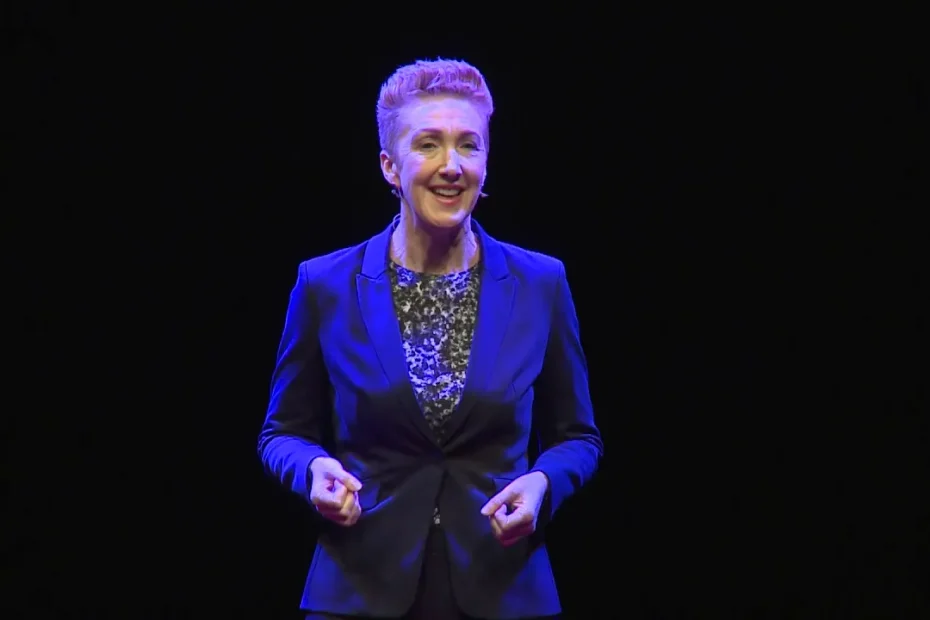
Read the full transcript of social entrepreneur Megan Gilmour’s talk titled “How robots are getting sick kids back to school” at TEDxCanberra 2018 conference.
Listen to the audio version here:
TRANSCRIPT:
The Power of Connection: Robots Helping Sick Kids Stay in School
How robots are getting sick kids back to school via mobile robots – or telepresence monitors
Have you ever experienced something in your life that could derail all of your hopes and dreams, only to discover that it raises you to your finest hour? This is a story about the healing power of connections. We humans are hardwired to connect, and we’re hardwired to connect because our survival depends on it. What does that have to do with a robot and a boy?
Well, you see, in 2010, my then vibrant, healthy 10-year-old son Darcy took a rapid slide into critical illness. Three rare blood disorders, the last pre-leukaemia, saw him fast-tracked into a bone marrow transplant, a treatment that kills if it doesn’t cure. The hospital became Darcy’s home and his school, and harsh treatments and painful procedures filled his days.
As did the trauma of watching other kids suffer, many of whom didn’t make it. Darcy missed almost two years of school, and this seemed to hurt him the most. While he was prepared to endure the illness and all the frightening things that were happening to him, against his will, he wanted us to know this. He missed his friends, he missed learning and playing with them, and he wanted to know what was happening at school. But Darcy’s school moved on without him. And at around the 18-month point, after fighting so hard, he started to give up. I could see him opting out. What was all the suffering worth if the life he loved and was fighting for had already disappeared?
And it was then that I realized that saving a life is about more than saving a body.
The Challenge of Keeping Sick Kids Connected
And I wondered what I could do to show him he was going to survive, that he had a life worth living, and that he had a future. And I turned to his school, thinking I hadn’t done enough to keep him connected into his learning community. And as I tried harder, I encountered one barrier after another, and I felt so powerless. The school said they didn’t offer distance education and that schools are busy places, and Darcy could pick it up when he returned. But I didn’t know if he was going to return. And the thing was, it mattered to Darcy then, and it was a matter of life and death.
Now, don’t get me wrong, I don’t think the school was singling me out for special treatment here. It was clear to me that the school didn’t know what to do.
And the school didn’t know what to do because they didn’t see it as their job. And I got to wondering, why is that? And as I looked at it through the lens of my professional experience in social and economic development across 24 countries, some work in government, my systems thinking, certainly my world view, and my conscience, and just a slight tendency to diverge from the status quo, I mean, seemingly all of my history seemed to interconnect like a jigsaw, and there I was, uniquely qualified to see, to see that this wasn’t really the failing of a school, but the failing of a whole system in which the school operated.
And I imagined that kids like Darcy all around Australia were unseen in their need for connection to their schools for learning.
And given their struggle, this seemed to me to be the cruelest expression of low expectations. And I promised myself I wouldn’t turn my back on their needs.
The Birth of Missing School
So in 2012, I joined with two other mums in a Canberra lounge room and we started an organization called Missing School, an organization dedicated to keeping students with serious illness and injury connected into their classrooms. Gina and Kathy had sons who had similar experiences to Darcy, and they too were overlooked in their need for school connection. And when we came together, we started asking ourselves, how many kids are in this situation in Australia? And how much school do they actually miss? And what are the models of support in place for them? And whose job is it to put it all together? But nobody could answer these questions for us.
So we went to St George Foundation and got a grant, and we commissioned and co-wrote Australian First Research. Weary but unsurprised, here’s what we found. We found that no-one was actually counting this cohort of students, nor how long they missed. There seemed to be no evidence-based, comprehensive models of support across Australia for them. And we did find that it is actually the responsibility, the legal responsibility of our education departments through our schools.
And did you know that across Australia, more than 60,000 kids with serious illness or injury are sitting at home or in hospital, watching from the sidelines and missing school? Some miss days and weeks, and others miss months and even years. Now, we know that this hurts their academic performance. We know it disrupts their relationships with their friends, peers and teachers, and we know it diminishes their engagement for learning and school.
But it’s the isolation from their school community that can lead to profound lifelong effects on social and emotional wellbeing and a wound productive capacity in adulthood. Add that disconnection to the sometimes insurmountable burden of illness that they’re facing, and here’s what I know for sure. They fight hard. We have to make sure that fight is worth it.
Taking Action: From Research to Solutions
So, in 2015, we took that research and we put it onto a national agenda in Australia for the very first time.
We got the Prime Minister’s attention and the attention of media all over the country. And as the media died down and nothing very much happened, we… we asked ourselves what we could do. But the government came to us and asked, what’s the solution? Now, imagine this. We were three mums in a volunteer organization with not very much funding and trying to rebuild our lives.
I mean, what should we do? Should we wait? Should we watch? Well, the answer’s no, because it is my choice to do this. It’s a choice that the kids don’t have. So… we know also that when it’s a problem, a big problem for us, it is we who connect the solutions to what we need. And so, with our backs against the wall, courage before confidence, we would leap, not lag.
We knew the solution needed to include presence in the classroom because presence is really the only cure for absence. And it turns out that keeping students with serious illness connected into their classrooms can mitigate risk and harm. It can add normality to difficult days, keep them up to date with their learning and their friends and help them transition through their toughest times. Connection, in this case, is hope. Hope manifest.
And it’s the kind of connection that can heal whole systems by working on ease, not just disease. The kind of healing that can ripple out from a child to their siblings, their family, their schools and hospitals, our education and health systems across our states and our country and even the world.
A Global Perspective: The Churchill Fellowship
And in 2016, I was awarded a Churchill Fellowship to study this issue overseas, and I travelled to Finland and Sweden, the Netherlands and Belgium, the UK and Canada. And while I was on my Churchill Fellowship, I got to pitch to St George Foundation, and I pitched for a national telepresence robot pilot to keep students with serious illness connected into their classrooms. And won. Won the first Inspire grant of up to $600,000 over three years. Now, I’m not exaggerating when I tell you that this opportunity came out of the blue.
I pressed send on the application, slammed my laptop shut and ran to my boarding gate to fly to Europe. Breathless. St George Foundation are here and I was in Europe, and the only way that I could pitch this was via telepresence. This grant has been game-changing for Missing School and me, but life-changing for sick kids in Australia. Because I learned so many amazing things in those countries to do with solutions for this.
And do you want to know the country that was connecting up all of the essential elements into a full system of support for these students? That country doesn’t exist. At least I haven’t found it. And I got to wondering, what if Australia could be that country? The best. And I thought, what if I make that my mission by 2020?
Enter the Robot: A Game-Changing Solution
Enter the robot.
These telepresence robots, like this Omnilabs robot, stand in the classroom for sick kids when they can’t be there and enable them to dial in, to see and hear their teachers and peers and be seen and heard. They can take their lessons in real time with their classmates in their own classrooms. They can even move the robot around via their laptop keyboard from hospital or at home. It’s a bit like Skype on wheels. These robots are cool for school, they’re so affordable, not really much more than a laptop, and they just make sense.
Since we started, we’ve been moving through hospital schools to connect up our education departments. And one by one, our state education departments are coming on board. And by coming on board, I mean they’re adapting their networks so that these robots can work in public schools.
We’ve also been working in Catholic and private schools as well. And in a year, we’ve taken more than 70 applications, actually, and dozens and dozens more inquiries, and we’ve so far connected up 30 kids to robots in their classrooms. We’ve been working across kindergarten to year 12, a range of illnesses and injuries, and, as I said, across all education systems across our country. And people from all around the world are contacting us to ask how we’ve done it, and we have to say we haven’t done… we haven’t got very many people on our team. We’ve just accessed all of the capacity that exists in our education and health systems, our schools and our hospitals. The capacity is already there. And in this respect, it’s more a social innovation than a technological one. And we’re getting ready to scale.
Because all of the connections that I’ve needed have come into my orbit at the perfect time. The perfect people, opportunities, support, ideas, even the perfect obstacles. And the obstacles have been so critical in showing us the way, the way to think differently to get this done. And I couldn’t be more grateful and thrilled for what these robots are allowing us to mobilize. And I’m so grateful because I’ll let you in on a little secret. At least once a day since I’ve started this, I’ve wanted to give up. Honestly, it’s been hard. There have been lots of tears. But this idea, this concept, has been shining such a bright light for me. And I wish you could be there for that moment when that student who’s absent dials back into their classroom to see the joy on everyone’s faces.
It’s priceless, and it makes every bit of that struggle to get here worth it. And we’ve created an Australian First. Australia may even be the first country in the world to use this exact type of mobile robot technology across a whole country, across all illness and injury groups, for this purpose. And my dream is coming true. To put myself out of a job and to complete my own healing.
Because this is too important to be left to charity or chance. It has to live and thrive in our systems so that all sick kids can get access to it across Australia. And I won’t stop until the job is done.
A Vision for the Future
And I imagine a time when a robot like this could be in every school in Australia, a time when our governments put policy into place so that these students can participate in their education fully on equal terms to their peers, a time when governments pay for robots and professional practice changes in our schools and hospitals forever. A time when Australia could be that best country in the world. Because we have to do more than save bodies. We have to save hearts and minds as well.
And the best thing for me is that Darcy survived. And he’s here today with his sister Mia. And Darcy and Mia, what started with you is now helping kids and siblings and education and health systems and schools and hospitals all across our country. Imagine robots making futures brighter. And I hope the world keeps watching.
And I hope that you keep watching too. Watching for connections, as I did, that only you can see. Making connections to the things that you are uniquely qualified to do. Because you can cast your gifts into the pond of a problem and watch lasting solutions ripple out and out and out, rising to your finest hour, believing, being strong and never giving up. Because connection to our whole healing depends on us.