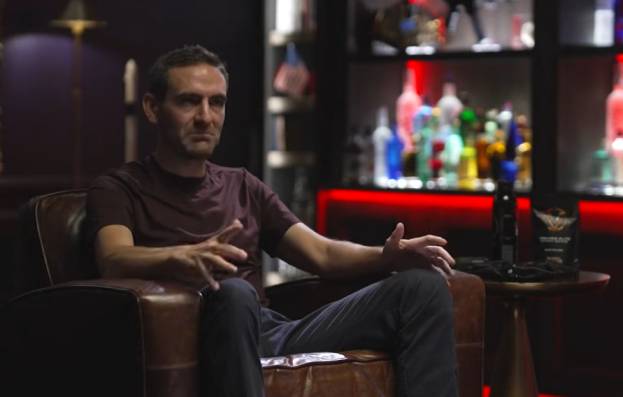
Read the full transcript of Skydio co-founder and CEO Adam Bry’s interview on Shawn Ryan Show (SRS #258) episode titled ” Why China Fears Skydio’s Rise in AI Drone Technology”, December 2, 2025.
In this episode of the Shawn Ryan Show, Skydio co-founder and CEO Adam Bry reveals how his company is transforming drones from manually piloted gadgets into fully autonomous AI-powered robots used across defense, law enforcement, and critical infrastructure. He breaks down the capabilities of Skydio’s latest platforms like the X10 and new R10 indoor tactical drone, showing how they can clear buildings, inspect complex facilities, and even survive being shot in the line of duty. Bry also explains why China’s dominance in low-cost drones is a strategic threat, how U.S.-built autonomous systems can change modern warfare and public safety, and what the next decade of AI flight will look like.
Adam Bry Introduces Skydio’s Revolutionary Indoor Tactical Drone
SHAWN RYAN: Adam Bry, welcome to the show, man.
ADAM BRY: Very excited to be here, Shawn.
SHAWN RYAN: Very excited to have you. What do we have? Oh, we have a third joining us.
ADAM BRY: So this is the Skydio R10. So this is our brand new indoor tactical drone designed to get into dangerous situations. You don’t have to send a person. And as you can tell, it’s got a speaker on here. It’s detected a threat.
DRONE: Attention, attention, please exit the area immediately. I repeat.
SHAWN RYAN: Is somebody behind that or is that programmed in there so you can do two-way communication?
ADAM BRY: So you can actually perch this thing and establish two-way communication if you’ve got a barricaded suspect or something like that, or you can just have prerecorded audio where it says whatever you want it to say.
SHAWN RYAN: No shit. So in case you haven’t figured it out, we’re talking about all things drones today.
ADAM BRY: Yeah, I mean we basically built it because a lot of the most dangerous work that our customers do happens indoors. In law enforcement, you got a barricaded suspect, you don’t know what’s in there, you don’t know if they’re armed or not.
And typically you’d have to send a police officer in gun drawn. They don’t know what they’re heading into. And this is the root cause of a lot of tragedies. So if you can send a drone, you get perfect situational awareness. You can de-escalate the situation, you can establish two-way communication.
So the general mantra is send the robot, not the person. So this is a brand new product for us.
SHAWN RYAN: Dude, that is cool. Can you put a gun on that thing? I know you can. I know you can.
ADAM BRY: Well, in the US it is illegal to put any kind of weapon on a drone.
SHAWN RYAN: Well, that’s dumb.
ADAM BRY: And fly it in civilian airspace.
SHAWN RYAN: Just kidding.
ADAM BRY: But you should talk to our friends at Axon about the possibility of putting a taser on it.
SHAWN RYAN: Axon, I think we have talked to them maybe.
ADAM BRY: Yeah, they’re the inventors of the taser and body camera.
SHAWN RYAN: Dude. So nobody’s seen this yet?
ADAM BRY: Well, this product is brand new. We just announced it about a month ago. And it’s just getting into customer hands now, so it’ll be a steady build. But it’s actually flown real missions in the hands of some of our early access customers.
SHAWN RYAN: Congratulations. Who is the market for this? Is this going to be in everybody’s home? Shopping malls?
The Market for Autonomous Indoor Drones
ADAM BRY: Yeah, initially it’ll be heavily law enforcement. And right now drones are used by SWAT. Indoor drones like this would be used by high end SWAT teams. And we certainly expect that the R10 will be used by SWAT teams in high stakes situations.
But our real goal with this is to build something that’s much more accessible for everyday patrol officers because they’re the ones that oftentimes find themselves in the most dangerous situations. They don’t have backup, they’re out there by themselves. And so this thing really becomes like a flying robot assistant.
So we expect it to be heavily adopted in law enforcement. But we also are seeing incredible interest in critical infrastructure inspection. So we work with energy utilities that have all kinds of gnarly indoor infrastructure in generation plants and so on, where they have to do really dangerous, slow, expensive inspections.
They have to shut the whole plant down, they have to build scaffolding. Somebody has to go and climb around to look for cracks and defects. And so for them just being able to put a drone in the air, fly around, see this stuff super quickly, super efficiently is a total game changer.
And then over time we also expect this to be adopted by the military for confined space type situational awareness work.
SHAWN RYAN: Wow. Wow, man. Your customer base, we talked about this off camera right before the interview, but my old buddy Jake Johnson.
ADAM BRY: Yeah.
SHAWN RYAN: Who apparently did some work for you guys. I mean he gave me a little bit of inside baseball on everything you guys are doing. Your customer is pretty much everyone and anyone. It seems like, I mean from inspecting naval ships for rust to power lines, to cell phone towers, to SWAT teams to clearing buildings. It’s crazy, man. Yeah, I mean you have so many markets.
Serving the Critical Industries That Civilization Depends On
ADAM BRY: The thing that is exciting to me, the way that I think about it, we really serve the critical industries that our civilization depends on. And historically Silicon Valley has generally been oriented towards tech and finance and social media and that stuff is all important.
But I think there’s really something very special about building technology to serve the hardcore physical industries and the people that do hardcore physical work. And that’s really what our products are all about.
The most basic fundamental piece is digitizing the physical world, putting sensors in really important places, get useful information to help people make better decisions and get better outcomes. And that applies across a very broad range of sectors.
And it’s just an amazing set of people to get to work with that I think have historically been underserved by technology. And we’re in a position now where we’re building this cutting edge AI robotics. I mean, really the bleeding edge of tech, but we’re deploying it to these traditionally slower moving physical industries. And it’s just a super fun thing to get to work on.
SHAWN RYAN: Man, I love what you’re doing. I love what you’re doing.
ADAM BRY: Appreciate it.
Introducing Adam Bry: Visionary Engineer and Drone Pioneer
SHAWN RYAN: Everybody gets an introduction here, so let me give you yours. Adam Bry, co-founder and CEO of Skydio, America’s leading drone company, revolutionizing autonomous flight technology. Visionary engineer who turned a passion for robotics into a unicorn enterprise valued in the billions.
A former Google X innovator contributing to Project Wing. Testified before Congress in 2021 on autonomous drones’ role in national security and in 2024 on countering China’s strategy in semiconductor shipbuilding and drones. Driving force behind drones that fly themselves, making them safer and more accessible for military, public safety and commercial applications.
You’ve been building stuff that can fly since you were five years old. Quite the intro here. And later on in this interview, we’re going to have some pretty badass show and tell, which we already did.
ADAM BRY: Already did. Lots more flying to come. I always like to say that the flying robots are the real stars of the show. So we’ll have lots of flying robots.
SHAWN RYAN: Apparently I’m a threat now.
ADAM BRY: I think your crew suggested that that was how we should address you.
SHAWN RYAN: Yeah, well, they might not be wrong. I’m just kidding. But dude, that thing is super cool. Yeah. So all right, I got a couple of things to knock out before we get in the weeds on the interview. So one, everybody gets a gift. I got you a couple here, Adam. First, those are Vigilance Elite gummy bears.
ADAM BRY: Bears.
SHAWN RYAN: Made in the USA. Still legal in all 50 states.
ADAM BRY: Awesome.
SHAWN RYAN: Should be good to go. And you’re in California, right?
ADAM BRY: I am.
SHAWN RYAN: All right, we got you a special model SIG here.
ADAM BRY: All right.
SHAWN RYAN: California compliant. Go ahead, open it up. It’s not loaded. You like firearms, right?
ADAM BRY: It’s been a long time since I’ve shot a firearm, but I was very into it in summer camp.
SHAWN RYAN: Good deal. All right, so that is the SIG P365 Legion. It’s all metal, it’s got those little slits up front, the barrel. Up top, up top. There you go for gas dispersion. Helps with the muzzle flip.
It’s actually the normal version has 17 rounds in the magazine, plus one. I don’t know what the California compliant model has. I think it might be 10, but it’s got a little cut there if you want to put an optic on there. Anyways, that is the latest and greatest everyday carry gun. That’s the rage everybody’s going on about. And so we thought you might like that.
ADAM BRY: That’s amazing. That’s my one. Yeah. I really appreciate it, Shawn.
SHAWN RYAN: My pleasure.
ADAM BRY: I am allowed to take this back to California with me.
SHAWN RYAN: Well, yeah, at least right now you are.
ADAM BRY: All right, great, great.
Range and Flight Distance of Skydio Drones
SHAWN RYAN: And then I have a Patreon account. It’s a subscription account. We’ve turned into quite the community. They’ve been here with me since the beginning, and they’re the real reason that I get to sit down with you today.
So one of the things I do is offer them the opportunity to ask every guest a question. So this is from Leland King. What kind of range or flight distance do drones like Skydio 10 or X10D have during autonomous missions?
I’m curious about this because I often consider how challenging it would be to have a swarm of drones launching and landing at your position while attempting to conduct reconnaissance on a nearby enemy force without being detected.
ADAM BRY: Yeah. So the military variant of our product, the X10D, is what’s called a short range reconnaissance system. So the typical range is out to six, seven miles. Max flight distance, max flight time. Most of the missions are shorter than that. Most of the missions tend to be in the 1 to 2 mile range.
In the civilian sector, our drones fly with LTE modems on them, and so they can basically go anywhere that you have LTE coverage.
SHAWN RYAN: Okay.
ADAM BRY: And we’ve done flights that are 10, 15 miles in LTE conditions.
SHAWN RYAN: Wow. Yeah. Well, before we, these are all autonomous. I mean, nobody’s controlling this.
The Future of Autonomy: Drones That Work for You
ADAM BRY: So you can fly them in a bunch of different ways. You can fly them quite manually. You can hold a controller, you can push around the joysticks, or you can operate them autonomously. You can give them a mission, they’ll fly out and do waypoints. You can give them a task like follow this person or thing, inspect this area, map this structure.
So there’s a whole bunch of different ways that you can control the drone. The thing that we’ve really invested heavily in, and what we really see as the future of the industry is just more and more autonomy.
We say the drone should work for the person, not the other way around. So one person should have five, 10, 50 drones doing useful work on their behalf. And the only way you’re going to get there is with AI and autonomy, making the thing smart enough to fly itself. And so that’s what we’re really focused on.
SHAWN RYAN: Right on. I was going to say, before we get too deep into it, I have a gift for you.
ADAM BRY: Oh, well, I love gifts.
A Drone Shot in the Line of Duty
ADAM BRY: So what you see here is the R10, which is a new drone. This is our flagship drone. This is the Skydio X10. So this thing is out there kicking butt at scale in the world today. But this is a very special X10. This is not a normal X10. So you see that there? Yeah. So that’s a bullet hole.
And this X10 was shot in the line of duty. So this was used by the Oklahoma City Police Department, and it was shot serving a homicide warrant.
SHAWN RYAN: No kidding.
ADAM BRY: So it kept flying. It completed the mission. But honestly, when we see stuff like this, when we see a drone that’s been shot, that is great news. Right? Because it’s better the drone gets shot than a person. So we thought you might like to have this.
SHAWN RYAN: Throw it with a Purple Heart.
ADAM BRY: Dude, this is cool. So what was this doing on the mission?
ADAM BRY: So it was serving a homicide warrant, so they were going out to arrest somebody. And it’s actually surprisingly common that our drones get shot at in the context of law enforcement, because oftentimes you’re going after a bad guy, the bad guy’s got a gun, they see the drones show up and they start shooting at it.
But as I said, from our perspective, it’s all good news. That’s the whole point of the drone, is that it can take the risk and get the awareness rather than having to put a person in harm’s way.
SHAWN RYAN: Man, that is cool, man. Thank you.
ADAM BRY: Yeah.
SHAWN RYAN: Being here, I guess we’ll hang it from the ceiling. Yeah. This is awesome.
ADAM BRY: Put it wherever you want.
SHAWN RYAN: Thank you. Very cool.
ADAM BRY: Very cool.
SHAWN RYAN: And this is the X10.
ADAM BRY: Yeah, the Skydio X10.
SHAWN RYAN: Man. That’s cool. Thank you.
All right, so I want to do a little bit of backstory on you, see what captured your interest in drones and stuff anyways and, you know, and talk about all the products that you guys are coming out with, what they do and all that kind of stuff. And then you know, and then there’s a lot of discussion about, you know, what’s going on in Ukraine with the drones and especially China. So I’d love to probably end with a decent chat about where China’s at with drones and kind of what drone warfare looks like in the coming years.
ADAM BRY: Yeah, you’re getting all of it.
Growing Up in Colorado and Early Fascination with Flight
SHAWN RYAN: Cool. So where did you grow up?
ADAM BRY: So I grew up in Denver, Colorado. My mom grew up in Colorado Springs and her father served in the Air Force, so he was stationed in Colorado Springs. So she wanted to have kids in Colorado.
And I’ve really been obsessed with stuff that flies since I was a very young kid. I think some of it came from my grandfather, my mom’s dad. But really from as early as I can remember, I was building the little balsa wood airplanes, the rubber band powered stuff, and then I got into radio controlled airplanes, which are really the predecessors to drones, when I was 10 or 11 years old.
And I was just obsessed with it. I mean, I spent most of my childhood in my basement building the things and then out at the flying field flying them. I took it way too seriously. I traveled all over the country.
SHAWN RYAN: You won some national championships, right?
ADAM BRY: Yeah. Most people don’t even know that this world exists.
SHAWN RYAN: I didn’t, I didn’t know.
ADAM BRY: It’s kind of a niche hobby within a niche hobby. But it’s pretty cool. I mean, you’re basically building aerobatic airplanes and then you fly set sequences of maneuvers and you get judged on how precisely you do everything. And it’s a little bit like NASCAR where it’s like, it’s a combination of how good is the machine and then how good are you at flying it.
And so I got very into like optimizing every little detail of building these things. And then I also, I mean, in order to be good at it, you just like anything else, you spend a lot of time practicing. So I got, you know, very good at flying these systems. And I, you know, I wasn’t doing it at the time because I thought it was going to be a career. I thought it was just like fun, cool stuff to be working on.
SHAWN RYAN: How old were you when you started that?
ADAM BRY: So I was like, I think I probably first flew when I was 8 or 9 years old. And then I like, they call it soloing, like being able to fly completely by myself. I think I was maybe 10 or 11. And then I started competing when I was 13 or 14 and then won national championships. I think when I was 16.
So I was like in that world, I was kind of a little bit of like the child prodigy, you know, like kind of coming up, coming up, flying these things. But I think I was just, I was super fortunate because I got exposure to this stuff at a very young age and really developed before I had a formal engineering education. I developed like a really deep intuitive sense for how these things work and how flight dynamics work.
And you know, when you’re flying it yourself, the control system is all in your head. But that kind of like deep intuitive understanding is one of the things that I think has enabled me to do both the research that I later did as a grad student and then do some of the things that we’re doing at Skydio. Like, one way that I think about what we’re doing is we’re building the skills of an expert pilot into the drone. And the foundation of that for me really started with like my skill as a radio controlled airplane pilot.
SHAWN RYAN: Wow. When did you start thinking about autonomous drones versus, you know, versus RC planes?
The Path to Autonomous Systems
ADAM BRY: So, so I, it was pretty obvious like basically from the beginning that I was going to be an engineer. I mean, I loved building and flying RC airplanes and I also loved kind of physics and math. And I had some formative experiences in high school, really where I first got exposure to this idea that you can do kind of like theoretical analysis and math and optimization that results in something cool happening in the physical world.
So everybody does the high school physics bridge competition where you build the bridge out of popsicle sticks to see how much weight it can support. And I had some experiences on that, figuring out how to optimize this thing and make it really efficient.
I think probably in undergrad and engineering was the first time that I got to write software that does something in the physical world, which I at the time and still today find to just be a magical experience. When you sit there and write code, you give the computer instructions, and then you see those manifest in real world with the behavior and action of a robot.
So the first robot that I worked on was a tractor. It was an autonomous tractor that could drive itself around in an orchard, which is a very fun project. And I learned a lot doing that.
And then I was a grad student in the computer science and artificial intelligence lab at MIT, which is where I met my co-founders for Skydio. And that’s where I really got exposure to writing software for autonomous systems. And this was like the research program in the lab that I was in, started in like 2007, I got there in 2009. So it was before drones were really seen as a major technology category. The only drones that really existed at the time were the very high end, expensive military systems.
And that, that was just completely addicting to me. I mean, writing software and transferring a lot of this kind of intuition that I built as a human pilot into AI systems that could fly these things and then seeing what that could create in the physical world was just amazing. Like the main output of my master’s project at MIT was an airplane that could fly itself around in a parking garage, which the culmination of that was kind of 2012. So it was still before the drone industry really existed.
SHAWN RYAN: Wow. So you, you started flying, you said 8 or 9 years old.
ADAM BRY: Yeah.
SHAWN RYAN: And then took maybe a small detour with the tractor and then right back into flight with autonomy. Right? Yeah, that’s crazy. That’s. Yeah, that’s pretty.
ADAM BRY: My hope.
SHAWN RYAN: I mean, there’s not that many people that focused, I’ll say that. You know what I mean?
ADAM BRY: Well, it’s one of these things, you know, in hindsight it all lines up perfectly. And I look, I’m super lucky in a bunch of ways. Like my dad, my dad had wanted to do radio control airplanes when he was a kid and his parents just weren’t that into it and they didn’t really support him in it, so he didn’t get to do it.
And so he had a ton of pent up energy of like wanting to do radio controlled airplane stuff which he took out on me, which was incredible, you know. So I did it with my dad growing up. Like, you know, we spent a ton of time building and flying these things together.
And then I was just fortunate to be starting grad school right around the time when you could take radio controlled airplanes. I mean the, a lot of the hardware that goes into drones really grew out of the radio control airplane, the RC helicopter kind of the toy industry. So I was starting grad school basically when you could take, you know, radio control airplanes and the computers and sensors were getting light enough and cheap enough and powerful enough that you could put them on RC airplanes.
And then, and then the big unlock once you do that is you can write the software to get the thing to fly itself. And so, you know, I think I’m. It was like just a fortunate kind of series of timing and exposure at the right moments to be into this stuff that’s enabled now what we’re doing at Skydio.
Meeting the Co-Founders at MIT
SHAWN RYAN: Damn. So how did you. I mean, so how did you meet your co-founders?
ADAM BRY: So our CTO, our Chief Technology Officer at Skydio, Abe was my lab mate at MIT and he was the senior person in the lab when I got there. So he’d already been at it for three years. So he was one of the first people I met when I was starting in the research lab.
And it’s actually so he is. I mean, he is the most gifted problem solver I’ve ever met in my life across any domain. Hardware, software, radios, cameras, anything. I mean, he’s one of these people that can just intuitively, like, figure out how the system is working, how it needs to work, how to fix it.
And he’s also an incredibly nice guy, but he has kind of a rough edge. And so my first experience with him in the lab was feeling like, you know, who is this guy? And I don’t know what I’m doing. And he’s kind of, like, scary and intimidating. And so it was kind of like a rough first intro.
And it’s actually funny now because I get to see this play out constantly at Skydio. Like, every time we hire a new engineer, they’re like, they’re kind of freaked out and scared of Abe. And I’m like, yeah, yeah, Abe is wonderful. You’ll get used to it. So I can empathize with him though, because I’ve been on the other side of it.
And then our third co-founder, Matt, was actually in the MIT Media Lab, which is adjacent to the computer science and artificial intelligence lab. And so he was working on a lot of human computer interaction stuff. And the bet for the company was just kind of a combination of the hardcore science and robotics combined with different user interaction paradigms would be an interesting recipe to try to build the next chapter of what drones could become.
SHAWN RYAN: Damn. So all you guys share, obviously, a fascination with drones.
ADAM BRY: Yeah.
SHAWN RYAN: So how did the. So what was the original concept of Skydio?
The Birth of Skydio and Early Product Development
ADAM BRY: So the original concept—Abe and I were lab mates together through 2012. After that, we got the opportunity to go and start Google’s drone delivery program, Project Wing. So the two of us, along with our professor, our advisor from MIT, moved out to California, started working on the drone delivery stuff. This was like 2012.
And that 2012, 2013 were kind of the era where people were starting to think about, yeah, maybe there’s this new category of drone thing emerging. You know, like electric propulsion autonomy. It seems interesting. And we were then in Silicon Valley working at Google, and I think we just started to look out there and see that there was a lot of excitement around drones for all kinds of different applications—for capturing cool video, for doing critical infrastructure inspection, for delivering packages, for public safety, sort of maybe a new wave of drones for defense.
And we felt like the possibilities of what the tech could do were incredible. Like, the impact that could be had was amazing. But none of it was going to work the way that people really wanted if you needed to have expert drone pilots flying the thing the whole time. It’s just a very high barrier to entry. And I knew this because I was one. You know, I grew up and I spent thousands of hours becoming a skilled pilot, but it’s just not accessible and it’s not going to be useful in the way that you want it to be.
And we knew a ton about the autonomy technology from our research at MIT, and it just felt like that was going to be a foundational layer, kind of a big unlock to move the industry forward. And that was really it. I mean, the big bet that we made was that computer vision, AI autonomy would be kind of a foundational tech layer that would make the products more useful to more people in more places.
The First Consumer Product: Skydio R1
The first product that we built was a consumer product, basically like a flying GoPro that could follow you around and weave its way through obstacles and capture amazing video. And we did that because we felt like the consumer market was probably going to develop first because there’s just less that has to come true. Like, you don’t have to convince a big enterprise to change the way they work and adopt some new system. You can just say, like, hey, there’s a cool thing that you can go and buy and capture some cool video with and it’s going to be fun. So it’s a little bit of like a lower friction entry point.
And then we also felt like the consumer product ethos of small and light and integrated and easy to use, rather than kind of like big and clunky and complex would be the right foundation to serve other industries as well. And, you know, I think we were right about some of that, maybe wrong about other pieces of it, but the vision—I was actually reading the blog post that I wrote when we announced the company in 2014. I would say the vision has really stayed exactly the same since the beginning of like, make these things super smart to make them more useful to more people. You know, it’s always hard to imagine when you start, like, where you’re going to end up. But the central kind of bet was the same.
SHAWN RYAN: Yeah. So, I mean, how did you—I mean, how did the customer base develop into what it is? I mean, actually, before we get to that question, I mean, how many other drones were out there at this time period that were, you know, able to follow people and dodge?
The Competitive Landscape and Technical Challenges
ADAM BRY: Well, so this is one of the interesting aspects of the drone industry—it’s always very easy to imagine the concept of like it would be great to have a drone that does this. And it’s typically pretty easy to make some kind of marketing video that shows what that might look like. And so at the time and still today, there’s always a ton of companies that are talking about various aspects of this.
So when we started, there were probably like 30 other companies out there that were talking about like sort of a follow and film type drone. And I think a fair assessment is basically none of it worked. We were the only ones that were able to solve the hard technical problems that it actually took to make this thing come together in a reliable, scalable way. And the technology foundation that we developed there has served us extremely well as we expanded to serve other markets.
So we started in 2014. We decided we were going to do the consumer product first. It took us four years to develop the first product. One of the things that I think people don’t understand about this stuff is it really is a cutting edge aerospace device. I mean it’s small, but it’s got aerodynamics and propulsion and vibration and thermals. And we’ve got the whole computer vision and AI system. Like a lot of the software and hardware is similar to what you find in a self-driving car. We’ve just had to shrink it down to something that weighs a couple of pounds, which actually makes it even harder because you have less margin to work with.
So it’s a very hard technology build. It took us four years to get to our first product, the Skydio R1, which was kind of the first instantiation of a consumer follow film drone. And I kind of described the R1 like it was a technology success but a commercial failure. Like everybody that saw it said like that thing’s amazing. I can’t believe you guys pulled that off. But nobody bought it.
SHAWN RYAN: Why do you think that is? Too expensive?
ADAM BRY: It was too expensive. So it was $2,500, which is a lot for a consumer product. And it also had too narrow of a feature set. Like we basically—and this was an intentional decision—we focused very narrowly on the autonomy system. On this thing needs to be mind-blowing and awesome and do things that nothing else in the world can do. But the wireless range was not very good. The camera that went on it that actually recorded the video was not great. The breadth of different things you could do with it was pretty narrow.
And all these things were intentional choices. And honestly I would probably make the same trade-offs again because when you’re a startup, when you’re doing something new, unless you can break through in some way and do something that is really better and different than everything else out there, there’s just no reason for anybody to care at all about what you’re doing.
So we had this kind of huge spike in autonomy capability, which we used to raise money from venture capitalists and attract the team and kind of get the whole flywheel spinning. And then, you know, it’s a period of years afterwards to kind of build out everything else that has to be great to have a great drone, like the radios, the cameras, the form factor, the propulsion system, and so on.
The Pivot to Skydio 2 and Enterprise Interest
But, yeah, we were in kind of an interesting position in 2018 because we launched this product. Everybody thought it was amazing. Nobody bought it. We had just enough money in the bank to develop a second version of it, which became the Skydio 2. And so we really had our backs against the wall there for like 18 months or so, where it’s like, just enough money to get through, take one more shot at this, take everything that we’ve learned, and turn it into a better version of the product.
And this was also when we started to get a lot of inbound interest from enterprise customers. You know, it’s kind of been a steady build in enterprise. Like in 2014, the big companies were talking about using drones, but very few of them were actually doing anything. It was all kind of slideware. By 2018, more of them were kind of starting to poke around and actually had started some drone programs.
And so when we launched the R1, even though it was a consumer product, I think a lot of the leading enterprises in law enforcement, defense, as well as energy, utilities and so on, they kind of saw this and said, like, that thing isn’t designed for us, but the technology in it looks like it could be very relevant for us. And so we started to get a lot of inbound interest, which started to impact what we were doing from a product perspective. So when we launched Skydio 2, it was still mainly aimed at consumers, but there was more kind of enterprise thinking built into it.
SHAWN RYAN: What enterprises were reaching out? What did they want?
Early Enterprise Adoption
ADAM BRY: Well, we started to hear from the DOD, and that was one of the big opportunities that got a lot of attention, and we spent a lot of focus on. You know, that’s a—we could talk about that whole trajectory. So that was a big one. You know, there were insurance companies that wanted to use the drone for inspection of houses and other assets. There were our first law enforcement kind of interest came inbound because they saw the capabilities of the R1.
And I think they probably imagine, like, if you could take the R1 and make what has become the R10, like, that would be an incredibly powerful thing for us. So it was very broad, which was actually great, because just having this kind of core technology that got a lot of people’s attention exposed us to a lot of the needs and opportunities that people had and were wanting to do with drones.
SHAWN RYAN: So, I mean, what specifically are they asking for? I mean, are they asking, like, when you’re talking about—so here’s what goes through my mind when you’re talking about, you know, a drone that does inspections for an insurance company, I’m thinking like roofing inspections after hurricane sh*t like—
ADAM BRY: Exactly.
SHAWN RYAN: I mean, I wouldn’t think you would have to make very many modifications to the drone to be able to do that. I mean, it’s just here’s a drone with a camera on it. Yeah.
Customization and Autonomous Software Development
ADAM BRY: I mean, it depends on, you know, how you want to do it and how well you want to do it. But it’s true. And one of the cool things about drones is that it is really a technology platform. You know, it’s like a laptop or a phone or something where you can use it for a ton of different stuff. And with different software, you can specialize it for different tasks.
So one of the general patterns is that, you know, the hardware is very general purpose, and if you’re flying it manually, you can do a lot with it, because the adaptation for the application basically comes from the pilot. You know, the pilot’s like, okay, I want to inspect this thing. And so I will do the things that I need to do flying it manually to inspect this thing.
If you want to automate it, you typically need to write more custom software for different applications. And so we did both those things. Like, we would enable our customers to operate it manually, to do whatever they wanted to do, but we’d also, as they were operating it manually, we’d learn, like, all right, what are they actually doing? What kind of algorithm is running in their head? And how can we turn that into autonomy software such that we can do it in a more reliable, scalable way?
So one of the examples of this, we have a product called 3D Scan that we built because we basically saw that one of the fundamental kind of primitives that many of our inspection customers were doing was basically digitizing a 3D structure. And it could be a bridge, could be a cell tower, could be a crime or an accident scene even. And so we built a piece of software where basically you just say like, here’s the thing that I care about. And then the drone will autonomously explore and map and capture high resolution imagery of the whole thing.
And so that was kind of an example where you could do it manually, but the better way to do it is autonomously. And it took us a little while to write the custom software to do it autonomously. You can almost think of it like apps on your phone, right? Like the phone is general purpose and then you get specialized software to do different specialized tasks.
SHAWN RYAN: Makes sense. Makes actually that makes a lot of sense. So how many, I mean, how many different models of drones do you have?
Skydio’s Product Line: X10, R10, and Future Platforms
ADAM BRY: So right now we have three major products. We’ve got the X10, which is the flagship, and we’re huge believers in that category of drone, the kind of medium class quadcopter. It’s small enough that you can take it with you anywhere, but it’s big enough to be super versatile, super powerful. It carries great sensors.
So it’s got a thermal camera, it’s got a zoom camera that can read a license plate at 800 feet.
SHAWN RYAN: 800 feet, yeah.
ADAM BRY: So for that size of drone, it’s crazy, the level of optics that you can get in there. So the X10 is kind of like the workhorse platform. But now that we’ve done that and for a long time, our product strategy in the enterprise was like, we need to nail that thing that’s going to cover the most applications for our customers. It’s going to deliver the most value. We’ve got to get that thing great. It’s got to be awesome and reliable.
And we’ll probably look at some of this stuff later. There’s other accessories around it that enable even more exciting capability. But now that we’ve got that amazing core of technology and it’s out there in the world, operating at scale, we can kind of take a lot of the core pieces of it and reconfigure it into different form factors.
So the R10 is the next major example of this, where we’ve basically taken a subset of the hardware from X10 to get it into a smaller, lighter, less expensive package. So this is designed for indoor operation and then maybe I’ll leave it until we see it live.
We’ve got another thing that we’re working on, which is still in prototype form that unlocks much longer range, much longer endurance kind of missions. And I really, I think those three together we think of as sort of the family of robots that solve the vast majority of the data capture needs that our customers have.
SHAWN RYAN: Wow. So can we go through each one? And what all of the purpose of each application for these drones are?
X10 Applications: Law Enforcement and Autonomous Deployment
ADAM BRY: Sure. So the X10 is really the workhorse and it’s used, I mean, it depends on the industry that we’re serving. So for law enforcement, it’s used in two major modes of operation. One we call kind of “drone in the trunk,” where you put these things in patrol cars. And if somebody’s out there and they run into a situation where aerial situational awareness would make a difference, they can take it out of the trunk, launch it in the air and just kind of get real time awareness of whatever they need to see.
The other mode of operation, which is really the future, where all this stuff is going is having the drone live in what’s called a docking station, which we’ll see here in a bit. And the dock turns the drone into a fully autonomous device. So the dock is a network connected charging base station. It’s got a whole HVAC system in there, so it can be out in any kind of weather and basically keep the drone ready to fly at a second’s notice.
And it’s super powerful. And this is a big part of autonomy and making these drones useful to more people. Because you can have somebody who’s just in an op center somewhere and say, like, oh, there’s a 911 call here, I want to send a drone. They just click a button. Drone autonomously launches, gets there in a few seconds and can oftentimes change outcomes.
SHAWN RYAN: So are these, what cities are using these?
ADAM BRY: A bunch. I mean, all over the US at this point. So really New York City, Philadelphia, San Francisco, Oklahoma, Albuquerque. I mean, most major cities in the US are in some stage of deploying Skydio drones as part of law enforcement.
SHAWN RYAN: Okay. Are these cameras?
Technical Breakdown: Cameras and Navigation Systems
ADAM BRY: They are, yeah. So the hardware there. Yeah. So the thing on the front is the gimbal. So we call those the user cameras. So those are the cameras that capture the data that our customers are going to see. That’s like, there’s a thermal camera, there’s a zoom camera, and then there’s kind of a wider field of view camera and it’s on a, if you can pop off that red clip. Yeah.
So the gimbal, you can kind of wrench it out of the gimbal there. You can pull it out of the red thing out of the, yeah. So the gimbal is three axis stabilized. So there’s three motors that keep it perfectly stable. So even as the drone is moving around, those things are stabilized. They’ll stay locked on to whatever you want to look at.
But then the other cameras, good observation. There’s three on top and then there’s three on bottom. So those are navigation cameras.
SHAWN RYAN: Okay.
ADAM BRY: And this is the part, this is basically like the self-driving car part. So those are fisheye cameras. They have a 200 degree field of view. So the top three see the whole top hemisphere of the drone, the bottom three see the whole bottom hemisphere. So the drone has, you can basically think of, it’s got eyes that see everything in every direction.
It’s got a very powerful Nvidia CPU GPU on board, which is running all of our AI software. And it’s basically doing like what a self-driving car does. Like as it flies, it’s constantly mapping the space around it, predicting into the future, avoiding obstacles, and doing all the things that a skilled pilot would do.
Deployment Strategy: Docking Stations and Response Times
SHAWN RYAN: So when these, so do these cities, I mean, so obviously they are connected to law enforcement dispatch. So do they have these staged all over the city in various locations?
ADAM BRY: Yeah. So we actually, we have some examples we could look at if you’re up for it.
SHAWN RYAN: Yeah, we’d love that.
ADAM BRY: What this actually looks like.
SHAWN RYAN: Let’s do it.
ADAM BRY: So the way this works is you have the drones in the docking stations, and then as you say, you distribute these all over the city. Typically they go on the roof of fire stations, because fire stations are kind of nicely spread out for faster response time. And they typically are installed in what we call hives, where you have like three docks on one rooftop, because that gives you capacity to respond to more calls.
Like, it ends up being driven very similar to just how you staff an agency with officers based on the call for service volume. That’s how you staff it with drones too. So if you have a high crime area or a high density area, you need a lot of drones in that area to respond to all of the incidents. And it just becomes part of the 911 dispatch flow.
SHAWN RYAN: How do you make that determination of how many drones a precinct would need?
ADAM BRY: Yeah, it’s a great question. So this is actually something I’m very passionate about. So I come from an engineering background. I love data and algorithms, and so I don’t get to do as much engineering on the drone itself anymore. But we got asked this question all the time by cities, like, how many drones do I need? Where should I put them?
And so I actually wrote a simulator where you can ingest historical 911 call data. So you get like time, location, priority, and then we can simulate through it, like, literally second by second and say, like, all right, if we had a drone here, here’s how long it would take to respond. And that’s become a useful tool for us to work with our customers on. Like, here’s where we should put them.
And the real output that we care about is the response time curve. Like, what percentage of calls are we going to get to, how quickly? And so based on the crime patterns and the call data, we can sort of optimize that whole thing.
SHAWN RYAN: So are you just going off of, well, I shouldn’t say just, are you going off of previous 911 calls or population size? Mixture of both.
ADAM BRY: So 911 calls are the primary driver because that’s the primary job of the drone, is to respond to calls for service and respond to incidents. Even though I love the data and the tool, at the end of the day, the judgment of the experts, of the people who live in that city is the thing that matters most.
So we kind of use that as a starting point. But there’s always just infinite kind of local knowledge within the police department of like, oh, yeah, this is a tough neighborhood and this is, you know, if we put this here, we’ll be able to respond to this kind of incident. And so that ends up being, in most cases, kind of the primary factor at the end when we’re fine tuning these things for what the deployments look like.
Real-World Applications: Life-Saving Responses
SHAWN RYAN: What kind of 911 calls are they responding to?
ADAM BRY: So we should look at, so it’s all different times. I mean, it’s basically as diverse as 911 calls are, which cover a huge range of things. So if we look at a couple of examples here. So this is from the Oklahoma City Police Department.
SHAWN RYAN: Is this…
ADAM BRY: No, this is not here. This is not the one that was shot. But so this was a situation where there was a train operator that called 911 in a panic, afraid that they might have hit somebody who was on the tracks. So they launch the drone. They get there in a few seconds, they can fly up and down the train. This is like a multiple mile long train.
So it would have taken like 15, 30 minutes, an hour maybe with the drone they saw. Unfortunately, there was a homeless person asleep on the tracks. But they found him in just a couple of minutes. And because they found him so quickly, they could guide in first responders. And they saved this guy’s life because of the drone. Because, you know, in these situations, the seconds matter. So that’s kind of one example.
We’ve got another one here. This is from the San Francisco Police Department. So same situation. Drone is launched from a rooftop. This was one where there was a stolen vehicle. So they had a report of a stolen vehicle, they launched the drone, and now they can just go out and follow a stolen vehicle from the air. And this guy has no idea that he’s being followed.
So they knew that oftentimes these folks would steal license plates. It’s called cold plating. But they never actually caught anybody in the act with the drone. They see him like pull up, steal the plates off the vehicle. And then, you know, once he’s got the new plates, he’s going to put them on the car. He actually holds the plate up here so you can read it from the drone.
SHAWN RYAN: Holy shit, man.
ADAM BRY: So he puts the plates on. Now he’s window tinting it. So he went down a dead end street and he’s putting window tint on. And this is like, this is the beginning of bad news, right? This is a crime spree. It’s a stolen vehicle, he’s cold plated it, he’s tinting the windows. Like he’s going to go off and do a bunch of bad stuff.
But they know exactly where he is, they know exactly what he’s doing. They send out a plainclothes unit, they roll a spike strip so now his tires are flat and it’s basically game over. He can’t go very far. They go in and pick him up.
And videos like this I find just deeply satisfying where the criminal is just kind of screwed. You know, it’s like there’s just a huge asymmetric advantage that the officers have. And it’s safer for everybody. I mean, it’s safer for the officers, it’s safer for the community. It’s honestly even safer for the perpetrator because there’s a much lower chance that the officers are going to need to use force when they get to pick the time and the place to intervene.
So it’s like, for me and, you know, for our customers, it’s pretty awesome to see this stuff. And like, the impact in San Francisco is incredible. I mean, San Francisco has had a rough run over the last three or four years. And fortunately the voters voted to allow drone technology. And since they’ve deployed this along with some license plate reading cameras around the city, I mean the statistics are staggering. I think crime is down overall like 30%.
SHAWN RYAN: No kidding.
ADAM BRY: Yeah.
SHAWN RYAN: Properties, how long of a time frame?
ADAM BRY: Like less than a year.
SHAWN RYAN: Holy shit.
The Game-Changing Impact on Law Enforcement
ADAM BRY: I mean you just can’t get away with it, right? Like there’s, they, you know, they will find you, they will follow you with the drone and they will stop you before you can do anything more. So it really just completely changes the game. We hear this, they like “game changer.” We hear that all the time from our law enforcement customers.
Like, you know, we had people say it’s the biggest change in policing since the invention of the radio because it just totally changes the nature of first response, man.
SHAWN RYAN: I mean any, is this another example?
Real-World Impact: Saving Lives Through Autonomous Response
ADAM BRY: Yeah, we’ve got another example here. So this was really like a tragic situation. This was in Albuquerque. So these are a couple of nine-year-olds in their parents’ backyard with a gun. And they were, you know, the neighbor basically reported that there were shots fired in the backyard.
So they sent the police out because they have the drone. They know exactly what’s going on. So they can see that it’s a couple of kids rather than adults. They can use the information from the drone to de-escalate the whole thing. So you’ll see they do a couple things here to distract the kids and kind of pull their attention away.
And there’s just no mystery for them, right? Like they’re watching this live feed the whole time. They know exactly what they’re dealing with and they can use that to make better decisions. Like rather than guessing, they know exactly what they’re dealing with. So the officer goes in there, grabs the gun and the sheriff actually said if not for the drone, they probably would have had to shoot these kids because they wouldn’t know what they were dealing with. But with the drone, it’s just a completely different situation, man.
SHAWN RYAN: I mean, what about violent crime? Like I don’t know, some type of, you know, domestic call?
ADAM BRY: I mean, yeah.
SHAWN RYAN: Are these responding to stuff like that?
ADAM BRY: They’re responding to everything. Like I, you know, this isn’t public, so I probably can’t say the customer, but I was visiting a customer a couple weeks ago where they had a guy in kind of a low-income apartment complex. He was drunk. His neighbor was playing ping pong in the parking lot, which was pissing him off apparently. And he shot the guy.
Fortunately, he didn’t kill him, but he shot him. Everybody heard the shots, they called 911. The drone got there in 20 seconds and it got there 20 seconds. Yeah, it got there just in time. Just in time to see the guy with the gun walking back towards his apartment, putting it away and walking into his apartment complex.
And so the difference in response here is transformative. Right. Without the drone footage, all the officers know is that somebody got shot. They have no idea who did it, they have no idea where he is, they have no idea if he’s still armed. So they probably need to lock that whole place down. They probably need to go door to door, guns drawn. The chances of something tragic happening is non-trivial. Right.
But because of the drone, they knew who it was, they knew where he was, they knew that he was still armed. So they basically can just surround his apartment complex, yell at him, tell him that he’s busted, he has no options, and he eventually came out and surrendered himself.
And stuff like that is happening all the time. So we, by the end of this year we will be doing close to a million flights per year rate. So close to 100,000 flights per month. And so it’s literally like almost every minute something like this is happening somewhere in the country where the drone is responding to an emergency.
Expanding Applications: From Stadiums to Military Operations
SHAWN RYAN: I mean, I just feel like these, I mean that while one, this would have totally alleviated the Charlie Kirk assassination. Yeah. Be great if it was it Salt Lake.
ADAM BRY: Was Salt Lake in Utah.
SHAWN RYAN: Yeah. Salt Lake or Park City. Which one? But yeah, it’d be great if they invested in Skydio for the next, you know, outdoor event.
ADAM BRY: Yeah.
SHAWN RYAN: But I mean, so I mean I just see so many uses for the stadiums, shopping malls. Yeah. Outdoor parking lots, police stations, soft. Any military unit that’s going to clear a building or a ship or…
ADAM BRY: Yeah, I mean, yeah, it’s, you’re 100% right. I mean you’ve got exact high speed.
SHAWN RYAN: Chase goes too long. Then I mean what are the, what’s the flight time on these?
ADAM BRY: So max flight time’s up to 40 minutes. Practical real-world conditions, it’s closer to 30 minutes. And then the top speed is 45 miles an hour. So it can keep up with cars in kind of urban and suburban areas. But it’s not going to keep up with a car on a highway. It’s not fast enough for high-speed chases.
But that is one of the motivations for the kind of the other form factor that we’ll look at in a bit here to fly much faster, much longer range, much longer endurance. Because the, you know, the only stories that I don’t like in when we’re looking at what’s happening in public safety is where the guy gets away and the cases where we see that happening now is where somebody just gets on the highway and speeds away. And so we’re building another drone to take care of that.
SHAWN RYAN: Right on, man. I mean, and then, I mean, these, so these can just switch each other out too. Yeah, it’s taken too long.
ADAM BRY: Exactly.
SHAWN RYAN: Yeah. Switch each other out.
ADAM BRY: Yeah. Which is…
SHAWN RYAN: Or whatever.
From First-Person Control to Strategic Command
ADAM BRY: With the autonomy, it really, one of the ways that we think about it is historically flying a drone has been like playing like a first-person shooter video game or something, right? Where you’re like, you’re in the character, you’re driving it around.
And we want to make it more like playing a strategy game where, you know, you’ve just got a lot of assets and you can say, like, I want to look at this thing here, I want to inspect this at this time of day. And the drones just, they just figure out how to do it. So you can kind of, the humans can operate at a higher level of abstraction, at a higher level of judgment, and that’s exactly what we see happening now.
So this whole concept is called Drone as First Responder. Using drones to respond to emergencies. DFR is what people call it kind of in the law enforcement world. And DFR is at the leading edge of all of these themes of like using AI and more automation. And it’s, it’s honestly, it’s kind of surreal to see it. I mean, it’s something that we’ve held as kind of the focal point of our product vision for like the last six or seven years. And it’s really only in the last 18 months or so that I’ve seen, we’ve really seen it take off, man.
SHAWN RYAN: I mean, so are these, are these just responding to calls or are they, is there a presence?
Transparency and Public Acceptance
ADAM BRY: I would say it’s 99% just responding to calls. It’s ultimately up to the discretion of the agency. And different agencies have different policies, different states have different rules on this. You will see sometimes where if, you know, if there’s going to be a parade or a demonstration or something, they will do some like, some proactive work around that.
You know, I am, one of the things that I think is fundamental here is transparency around operations. Because, you know, the idea of having like AI-powered drones flying all over US cities is kind of crazy, right? And honestly, like six, seven years ago, I thought that public acceptance of this stuff was going to take a very long time. And I actually thought this was going to be one of the last markets to develop.
This is one of the big things that I was wrong about. I thought all the other like infrastructure inspection stuff would happen at much larger scale before we had drones responding to 911 calls. Because it does sound kind of nuts that we’re going to have like AI-powered flying robots with cameras flying over cities.
I think the thing that has really made it work and the credit goes to our customers is just the investment in transparency and community communication around like, what they’re doing and why they’re doing it. And it’s one of those things where when you see these examples of what the drone can do, it’s very difficult to argue with it. It’s very difficult for somebody to say, like, no, I wish they didn’t have a drone in that situation and I wish that guy got away. Or, you know, I wish that they couldn’t tell that those were nine-year-olds rather than adults and de-escalated.
I mean, when you see these specific examples, it’s, I feel like it’s basically just irrefutable that it’s providing incredible positive.
SHAWN RYAN: Well, I mean we’re, we’re all under surveillance pretty much 24 hours a day anyways, right? So, well, this is, what’s the difference whether they’re just static cameras or roving cameras.
Privacy, Civil Liberties, and Technology
ADAM BRY: This is something that I think a lot about. You know, I, this, I really view this as my life’s work. You know, I’ve been working on this stuff since I was a little kid and I want to be working on it for the rest of my life. And I don’t want to be a part of building this kind of like dystopian future where we’ve got, you know, drones following us around all the time.
And so I think there is a balance to be struck and I think the best way to do it is through very aggressive transparency of, you know, like, here’s when we’re flying, here’s why we’re flying. And drones, I think are actually, they’re visible and they get people’s attention because, you know, everybody’s like, oh man, there’s like a drone. What’s it doing?
But I actually think they’re one of the least invasive forms of surveillance because it’s very reactive to emergencies. Like rather than just blanketing a city in cameras that are going to capture everything, you’re just putting the camera exactly when and where you need it at like the most important moment in time in a very targeted, precise way.
And I actually, I think that this is sort of a general theme, but I, you know, there’s always this tension between like public safety and privacy and civil liberties and technology. I think is the thing that enables us to make better and better trade-offs of like protect privacy and civil liberties while also improving public safety.
Like if this is one of the thought experiments I do, like if you imagine a world with extremely primitive technology, like you could achieve high degrees of public safety by basically just locking everybody in their house all the time. Right with, with no technology and inventing better stuff like autonomous drones enables you to I think actually have like extremely high levels of public safety while also protecting extremely high levels of civil liberties and privacy.
SHAWN RYAN: I mean with the rise of crime in some of these cities, I think people would be, I would think some, some of these cities would be begging for you guys to show up.
ADAM BRY: This has been, this has been probably the most positive surprise that I’ve had in building the company is the generally extremely positive public perception. And we see this all over the place where you know, it’s not to say there aren’t like some folks with concerns and I think in general there are reasonable concerns to be had, but there’s a huge amount of enthusiasm typically for bringing this kind of technology to a city or a community because of the impact that can happen.
And especially when people see the examples. You can kind of be concerned about it in the abstract, but once you see the specifics, it’s almost hard, it’s almost impossible to argue with.
SHAWN RYAN: Are any cities using these as is like a roving presence patrol?
ADAM BRY: To my knowledge, like more of, more…
SHAWN RYAN: Of like a deterrent. Like hey, we see you.
Efficiency and Mundane Calls
ADAM BRY: I haven’t seen that it could be happening in some places and I think there’s, there could be positive impact to be had there. I just think you want to be careful with it and you know, whatever you’re doing, I think you want to like, you want to be transparent with the community about like what you’re doing and why you’re doing it.
One of the things that, that so you know, the highest, highest impact stuff are the examples that we looked at where it’s like a life or death situation. The drone gets there, it changes an outcome there. The reality of policing is that it’s like most of the time, it’s pretty f*ing mundane. Right. It’s like somebody called, you get there, there’s nothing really happening. It’s kind of a waste of time.
And one of the real beauties of this is that it also enables you to take care of all that stuff. So, you know, we’ve had situations where there were, like, you know, there were a couple of youth, like, hanging out at a car dealership and loitering and annoying them and they shouldn’t be there. And rather than having to send an officer and taking like an hour of an officer’s time, they send a drone. It’s got a speaker on it. You can talk to them through the drone, tell the kids to, like, go do something else, and the whole thing is taken care of in five minutes.
And so it saves the officers time to actually be doing something that’s like, that’s really high impact. And so there’s a huge efficiency piece to it as well on just sort of like the more mundane calls of like, somebody’s parked in the wrong spot or there’s like a noise complaint from a neighbor or something. You can clear a lot of that stuff from the air without any officer on the ground.
SHAWN RYAN: Yes. I get the privacy concern, and I don’t want to pretend like it’s not there.
ADAM BRY: I know.
SHAWN RYAN: You know, I mean, look, if there was a drone flying around my house every day, I’d be like, what the… I would shoot it down.
ADAM BRY: Put another bullet hole in it.
SHAWN RYAN: I would put a couple of them in there. Yeah, but I mean, you know, when you think about, I mean, everything. I mean, there’s Ring cameras on probably at least 50% of the homes in America at this point. Yep. You know, but I mean, when we’re talking about, you know, car dealerships, like, you were just car dealerships, stadium, shopping malls, just all, you know, gas stations, anywhere where there’s, you know, where you see theft, crime, all these things.
I mean, it seems like, I don’t know what these things cost, but if these are landing in a, in some type of base station to recharge, weatherproofing, all that kind of stuff can come back out and rove around. I mean, it seems like every car dealership, every stadium, every shopping mall, every Walmart, Target grocery store, I mean, you name it, should have these just 24 hours a day, seven days a week, 365 days a year, roving their properties.
You know, not only as a “we got you,” but as a deterrent. Because they’ll chase, they will chase a criminal.
ADAM BRY: Yeah, I agree with you.
SHAWN RYAN: I think that the, is anybody doing that?
ADAM BRY: It’s, you know, the future’s here. It’s just not evenly distributed. So we have customers that are like, everything you just described is happening. It’s just not happening everywhere all the time yet. But we have retailers that are installing these things for security and patrol. You know, we have like, military bases are using them for security patrol. You know, data centers are using them. These like massive facilities with really high security stakes.
So yeah, I mean, I think we’re headed for a world where these things. So one of the ways that I think about this stuff is I would…
SHAWN RYAN: I would think high net worth individuals with properties as well will be using this.
ADAM BRY: Yeah. Yeah.
SHAWN RYAN: Who is your biggest customer?
ADAM BRY: Our single biggest customer. It’s actually pretty close. Historically it’s been the US Army and just using the kind of ISR intelligence surveillance reconnaissance drones on the battlefield. Although they are starting to do more dock stuff now. Although the big cities are getting close now to the US Army in terms of like, you know, the scale that they’re deploying drones, man.
SHAWN RYAN: I mean, so why, why do you, it sounds like that you are not, you’re wanting more people to express interest. What do you think is in the way of that? Is it, is it marketing, advertising?
ADAM BRY: I mean, the bottleneck right now is how quickly we can install them. Really? Yeah, the demand is very, very high. Very, very high. And it’s basically how quickly can we build and install these things. Wow. And I think it’s…
SHAWN RYAN: That’s pretty, it’s a good problem to have.
ADAM BRY: Yeah.
SHAWN RYAN: How, how quickly can you build and install?
ADAM BRY: We’re ramping it up. I mean, we have what I think is the largest drone factory in the US. Certainly for this class of drone. We’ve always built our stuff in the US, which is a whole other. I mean, I’m very proud that we, a lot of people thought it was impossible 10 years ago, so we’re cranking.
SHAWN RYAN: That’s awesome, man. I love hearing that too. So these are 100% manufactured in the…
American Manufacturing and Supply Chain Strategy
ADAM BRY: U.S. Well, we like, we have global supply chains. We’re getting parts and components from all over the world with a couple notable exceptions like China. But you know, we work with companies in Taiwan and Japan for different parts and components. But all the manufacturing, assembly, testing is done in the US in our facility.
That’s it really is awesome. It’s like, when we started in 2014, the conventional wisdom at the time, especially in Silicon Valley, was like, one, you probably shouldn’t do hardware to begin with because, like, hardware is hard and it’s, you know, it’s dirty and expensive and all this stuff. And then two, if you are going to do it, you should just outsource it to a contract manufacturer in Asia.
And we actually honestly started down that path. You know, we started down the path of working with a contract manufacturer. It was a great company based in Taiwan. But basically what became clear was that we didn’t know how to build a drone yet. They didn’t know how to build a drone. It was fundamentally new technology and it just wasn’t working. Like, we didn’t know what to do, we didn’t know how to tell them what to do.
And the only way to do it was to pull it in house and just figure it out ourselves and just get like the really fast iteration cycles of having engineering and manufacturing basically right next to each other. And so at the beginning, it was really just a practical thing of like, this is the way that we’re going to get the best product the fastest. And, you know, in the back of our minds, we probably thought at some point, at some level of scale, we’re probably going to have to outsource this.
But a couple of things happened. One, like, we got better and better at it. And then two, it’s really become clear that these things are like, they’re critical infrastructure. I mean, when you’re installing these things in docks and they’re talking to the network and they can fly themselves anytime that they need to, and they’re taking instructions from the cloud. I mean, these are incredibly powerful robotic devices.
And even when we’re selling to civilian customers, I think the national security stakes are extremely high. And I think there’s increasingly broad recognition of that, that there’s, you know, this is among the most critical technology in the world. And so being able to manufacture it in the US has become a massive strategic imperative.
And at this point, I mean, we’re all in, like, we just keep investing in our factory and making it bigger and better and more automation. And it’s an awesome thing to get to be part of. I mean, it is. It’s really. I kind of think of Skydio as like a, you know, we kind of have like, components and raw material comes in one end and autonomous drones come out the other end.
And we do all the design and manufacturing and write all the software and sell them ourselves and support them ourselves. And it’s very cool to have all those things under one roof because it basically means you can do anything, you know, you can. Any crazy product concept that we come up with, there’s nobody to tell us no, you know, we can just, we can do all the engineering across all the different disciplines, build it ourselves and get it out there in customers’ hands.
SHAWN RYAN: That is awesome. So how does, how does it know, how does the system know how to respond to different scenarios?
AI and Human Judgment in Drone Operations
ADAM BRY: So I, so I’m a big believer in AI and autonomy and I think we’re, I think this is like the most exciting moment in human history. I mean, I think the technology that we’re building and where it’s going. As much as I believe in AI, I also believe that there’s really no substitute for human judgment.
So we’re not trying to, we’re not trying to take the human completely out of the loop. We’re basically just trying to give them the tools to like really efficiently exercise their judgment. So there’s still a human in the loop today of deciding to send a drone. Like they have all the context in our software.
So we integrate with what’s called a CAD system, Computer Aided Dispatch. So all the calls show up in our software on a map so you can see location, priority description. And we’re actually integrating now. There’s some really interesting companies doing kind of 911 innovation to make that even faster and have AI insights from the call.
So all that stuff comes into our software. It’s still a human judgment that says I want to send a drone to this for this kind of call, this kind of incident. I think it’s worth getting real time, situational awareness, but all they have to do is click one button and away it goes.
I think at some stage we might get to the point where we would provide customers the option to automatically launch, like if you hear certain keywords like “shots fired” or “fleeing suspect” or something. On the 911 call itself, you could automatically dispatch a drone and then, and then still have the people kind of like consume the video stream and make decisions on it.
SHAWN RYAN: I mean, why not? It wouldn’t hurt anything, right? No, it’s just an extra asset involved in us in an, in a unfortunate situation.
ADAM BRY: Yeah, I agree. And I think the part of the beauty of these things is that the, you know, the marginal cost per use is basically zero. Like it costs nothing to. And if, you know, the worst case scenario it’s like a false positive or something, you just send the drone back.
And so I think that there’s also an adoption thing. Right. Like, law enforcement’s been doing things one way for 40 years. It takes some time to adapt the way that you do it. But I think we’re headed towards a place where there’s kind of a default expectation that any call of any kind of significance, you’re going to send a drone just in case.
And one of the things that we hear all the time from our customers, actually, all over the country, is once they’ve been doing this for a little while, the officers hate responding on the ground without a drone because they feel like they’re just going in blind. They have no idea what they’re headed into. They don’t feel as safe. They’re not as confident.
And so I think we will get towards a place where it just becomes kind of a default expectation.
User Experience and Skill Development
SHAWN RYAN: I have just random questions that don’t really fit in anywhere. This indoor drone. Yeah. So, I mean, let’s say I’m, I’m like, hey, I want to buy this for my personal residence or right here in my studio, I buy this drone. How much setup is there involved? How much, how much, how much do I need to learn? Or is it just, here’s the base station, set it over on the counter, put the drone on it, and it just figures it out?
ADAM BRY: So you’ll, you’ll get the chance to fly these here. Our goal is to make it so that anybody who can use an app on a phone should be able to, like, very quickly feel comfortable flying one of these systems. And the autonomy system is a huge part of that. Like, they see everything in every direction. They avoid obstacles, so it’s pretty darn safe and easy to get up and running.
But like anything, there are different depths of skills that can unlock different things. And, you know, like, for example, our, the San Francisco PD drone pilots are, no offense to any of our customers. The SFPD ones are the best that I’ve seen, and they have some guys that are just wizards flying these things. I mean, they’re like, they’re video gamers, and the things that they can do and the speed with which they do it is incredible.
So, like, anything, like, it’s, the barrier to entry is extremely low, but the people who are great at it can unlock some special things. Gotcha.
SHAWN RYAN: Gotcha. You want to take a break and go look at some of these things?
ADAM BRY: Let’s do it.
Skydio X10 Demonstration
SHAWN RYAN: All right, we’re out here. This is the X10.
ADAM BRY: Yep. So this is a flagship drone. This one doesn’t have a bullet hole in it, so it’s good to fly. And we’ll get to show you what it can do. So I just put it down on the ground here and then I’m holding the controller. So this is how we fly it.
I’m just going to swipe up to take off. So this is kind of like the typical manual flight experience. So I’ve got joysticks. I can move the joysticks around, and it’ll just respond to my commands.
Now, the fun part here is with the autonomy system. So I’ve got it lined up at a tree there, and I’m just going to jam the joystick forward. So I’m going to go full forward, and it’s just going to weave its way through the trees. So this is basically autonomous flight. All I’m telling it to do is go forward.
SHAWN RYAN: That’s it. It’s just doing all that on its own.
ADAM BRY: Doing all that on its own. So now I’m going to go backwards. I can’t even look where I’m going, right. And it’s just going to weave its way through, keep itself safe. So it comes up to the tree wall here. It’ll find its way through that gap.
And this is just a huge difference of what it’s like to fly a drone. Right. Like, normally, the normal experience of flying a drone is like, I’m looking at that thing. I’m trying to figure out where it is in relation to the tree. I’m worried about crashing it. And here, just don’t give a f*. Just full stick forward.
SHAWN RYAN: Holy shit, dude.
Camera Capabilities and Thermal Imaging
ADAM BRY: We can turn around here. This will give you a sense of what the cameras can do. So here we are looking at ourselves. So right now, I’m on kind of the wider field of view camera. If I punch in, so you’ll see a transition here to the zoom camera. So I can like…
SHAWN RYAN: Wow. And it shows the thermal right next to it.
ADAM BRY: Exactly. Yeah. So there’s my Skydio logo and punch back out. We’ve got the thermal feed. So we’re obviously going to pop on thermal.
SHAWN RYAN: I got to be honest, I don’t like seeing myself.
ADAM BRY: Not your best angle.
SHAWN RYAN: Looks like a AC-130 Spectre gunship is targeting us right now. Yeah. What’s the thing sticking out of the side?
ADAM BRY: Yeah, so the thing on the side is an attachment. It’s a speaker. So we’ve got four attachment ports. You can put anything you want on there. So we’ve got a spotlight, we’ve got night sense, which gives it the ability to basically have night vision. And the speaker enables you to talk to people on the ground.
So, for example, do you want to, like, you know, get somebody’s attention? “Attention, attention, please exit the area immediately. I repeat, please exit the area immediately.” I think we’ve got…
SHAWN RYAN: That’s great. Oh, nice, nice.
ADAM BRY: Always a fan favorite. We actually, so Miami Beach Police Department, they requested that they’re one of our great drone and surface responder customers. They deal with, like, huge drunk crowds around spring break. And this has become a very useful tool for them to communicate with the spring break folks.
Hands-On Flight Experience
So if you want, you can fly it here. So it’s a little bit like playing a video game. So you were asking about how hard are these things to fly. So the right stick is going to move you around. So the first thing to get familiar with, if you push that right stick forward, that’ll push you forward and then back will go back and then you can go side to side and to…
I always recommend to get comfortable with the autonomy system, just, you know, jam the stick forward into some trees and see what happens. Yeah, so that’s how you turn left stick.
SHAWN RYAN: You’re that comfortable. Just…
ADAM BRY: Just do it.
SHAWN RYAN: Here we go. Yeah, get the f* out of here. It’s going to go through all that.
ADAM BRY: I mean, it has a tolerance for how close it’ll let you get, but yeah, I mean, this, so you’re like your, how far into flying it? Like one minute into flying it. This is like world class drone pilot stuff, like flying at high speed through obstacles. And with the autonomy system, it’s just…
SHAWN RYAN: Look at that shit.
ADAM BRY: It’s a piece of cake. And the, you know, the real point of it, it’s like, it’s fun to watch it weave through obstacles, but the point of it is that you can focus on the mission.
So, like, if, you know, if you were a cop or an energy utility worker, like, you’d be looking down at the screen, right? Because you’d be wanting to do an inspection on something and you can totally comfortably fly just looking down at the screen without worrying about, like, where the drone is or crashing into anything.
So it’s actually so like, if you look down so you can like, you can see what it sees. You’ve got the left wheel here will control the gimbal. So if you can look, you don’t have to look at the drone because it’s not going to crash. So you can push the wheel down below. See this thing?
SHAWN RYAN: Oh, yeah.
ADAM BRY: So if you, so that controls gimbal pitch and then on the right one, it controls zoom. So the right wheel will zoom you in and out. And this is the point is you just focus on the mission. Like I want to inspect a damaged conductor. You can just perch yourself next to it, zoom in and see whatever you need to see. And then when you’re done, do you want to land it or you want to keep flying it?
SHAWN RYAN: Yeah.
ADAM BRY: You can test the obstacle avoidance on yourself.
SHAWN RYAN: That’s wild, Ben. Yeah. All right, here we go. Let’s play some chicken.
Advanced Features and Connectivity
ADAM BRY: Make sure you get it properly lined up in the crosshairs there. So you’ve got a bunch of telemetry here telling you what’s going on. Like you’ve got your altitude, your heading, it’s estimating the wind speed. It’s flying over what we call Kinect Fusion.
So right now it’s got a point to point radio. So there’s antennas here that are talking to the drone, but it’s also got cellular built in. This has a cellular modem in it. The drone has a cellular modem in it. And it’s using Kinect fusion to fuse both those two things together.
SHAWN RYAN: So…
ADAM BRY: The quality of the video link is basically the, like the sum of the point to point radio plus the cellular, and it can fly on either. So, you know, you could fly this thing out 10 miles, the point to point radio connection would go away, but it would just keep going based on cellular.
You can, I’m sure with your background, you can imagine this being a useful capability on the battlefield. Like from a soldier’s perspective, it basically just removes the mystery of what’s happening around you. You know, you can go out a couple miles, get real time awareness, know exactly who’s coming, what they’ve got, where they’re moving.
And this, so this is actually a good example. You see these power lines? Like, this is the kind of work that our energy utility customers do. Like they would inspect those things, they would stop at every tower and zoom in or out and look for damage, or if there was an outage or something, they could find what the issue was and direct the responding folks on the ground.
Autonomous Return and Tracking Features
So when you want, so typically what I would do here is you can just, when you want it to come home, if you tap that button there. Okay, so you just tap. I can do it. You tap that and say return to launch. If you tap launch, so it’ll now autonomously come back home.
It uses a thing we call Pathfinder. So basically it has its own local map that it’s building, but it also has access to global data about where the buildings are, where the terrain is. And it uses all of that to plan, like, the safest autonomous path to come home.
SHAWN RYAN: No way. Where is it?
ADAM BRY: It’ll show up here in a second. Where is… Probably coming back.
SHAWN RYAN: Oh, shit. It’s way up there? Yeah, dude. How f*ing sick is that shit?
ADAM BRY: So the other thing we can do. Can I… Yeah, go back here for a second. So it will recognize people. So if I turn and face it here. I can go into the skills mode here. Activate subject tracking.
So it’s now showing me on screen all the people that it sees. Yeah. So if I, I’ll zoom in a little bit. So if I tap on you, so it’s now following you. So if you run out that way.
SHAWN RYAN: Is it following me?
ADAM BRY: So it’s, it’s basically just going to stay in place and look at you.
SHAWN RYAN: It is, yeah.
ADAM BRY: So I don’t, I don’t have it. I could set it to move, but…
SHAWN RYAN: Right now what does it do if I go inside?
ADAM BRY: It’ll basically just like sit there and look at you and then when you come back out, it’ll re-identify you and keep tracking. So you can see on this screen here, so it’s locked onto you and you know, like, if you move over there, like it’ll just keep staring.
We’re about to ship a feature where it’ll actually like move itself to…
SHAWN RYAN: Oh, really?
ADAM BRY: Yeah. So then when we’re done, I can just hold down on that button. It’ll find itself a safe landing place. So it’s using computer vision to find a good, safe place to land and it just sets itself down and that’s it.
SHAWN RYAN: Dude, that’s awesome. Yeah, that is awesome.
ADAM BRY: It’s an amazing set of technologies that come together to make all that possible.
The Skydio Dock System
SHAWN RYAN: What’s this thing? What’s this robot thing over here?
ADAM BRY: Yeah, so everything that we just did I kind of think of as like the classic experience of flying a drone. Like, you’ve got the controller, you’re on the ground, you can do some incredible stuff. And the autonomy system makes it much easier.
You know, like you’d never flown a drone of this class before. Literally a few seconds you were comfortable flying at high speed through obstacles, so it’s great. But the next chapter is dock and remote operations and that’s what we’ve got here. So this is really the future. This is where the industry is going.
So this is the Skydio dock. This is basically like the network connected charging base station for the X10. So it’s got wind sensor, rain sensor on top. It’s got everything it needs to keep the drone ready to fly 24/7. So it’s got a heating system, a cooling system, it can melt snow and ice off of it. And it’s basically designed to operate in as extreme weather conditions as possible. So it opens up here, it’s got the X10 inside.
SHAWN RYAN: What?
Autonomous Dock System and Remote Operations
ADAM BRY: So this is what turns the drone into a fully autonomous device.
SHAWN RYAN: So this is what’s staged all over all these cities?
ADAM BRY: Exactly, yeah. Because of these things installed, like, infrastructure and, you know, it kind of turns the drone into like a cloud server or something where the people that use it never have to touch it. Right. It’s just out there ready to do useful work. You guys can kick off the mission whenever you’re good to go.
So we’ve programmed an autonomous mission here. So this could just be running on a schedule. Like if you had a security patrol that you wanted to fly, you just say, these times of day, I want it to take off and do its thing. And then the drone will just, in the background, fully autonomously run this mission.
So, you know, it’s up there now, and the person who’s controlling it can be 100 miles away, 1,000 miles away. Anybody with an Internet connection can access it and fly it.
SHAWN RYAN: Wow, that’s awesome.
ADAM BRY: So if we come over here. So this is what the drone is seeing. So you had the controller experience. This is basically the web flight experience. So this is just a standard, normal web browser. Anybody with an Internet connection and of course, the security credentials to access it can fly the drone.
And it’s flying this mission where we’ve given it, like a set stuff to go and look at. So we’ve got a good shot of the American flag there. So, for example, our utility customers are using this to inspect all of their infrastructure continuously. So they’ll say, like, you know, these transmission lines, these distribution poles, I want to go and see from these angles on this schedule. And the drone will just go off and capture the data.
And then, you know, you were mentioning all the kind of security patrol use cases at corporate campuses and so on. Same deal. Like, you can say, these are the locations that I care about. The drone will go take the same shot from the same location.
And one of the ways that I think about the drones is it basically enables you to simulate having as many cameras as you want in as many different locations, because it’s fully software defined. So you just tell it what views you care about, and it’ll go off and get them.
Threat Detection and Autonomous Landing
SHAWN RYAN: So let’s say I have one of these for this property here and goes out middle of the night. It’s using thermals, and it sees, I don’t know, a couple people hiding in the bushes.
ADAM BRY: Yep.
SHAWN RYAN: Then what happens?
ADAM BRY: So this is still stuff that we’re working on, but basically it has the ability to detect people. Right. So you saw, like the tracking technology. So anybody, any person or vehicle that it sees, it’ll detect. And then our software has APIs. So now it’s finished its mission. It’s going to come back and do a landing sequence. We should go and check out the land.
But basically it’ll just send a push notification out to any system that you want to send an alert of like, hey, here’s what’s happening and here’s what you’ve got. So now the dock has opened itself up the alignment slides. And so the drone is using computer vision to detect the dock, the yellow and blue QR codes there.
So it’ll come down, it does a precision landing. You can see the slides come in to align it. And then right at the back there, there’s a charging pin that’ll insert as the roof is closing over the top. And that’s it.
SHAWN RYAN: Dude, that is awesome.
ADAM BRY: It’s pretty wild. Yeah, yeah. And it’s a. I mean, to me, the exciting. It’s, it’s amazing technology. I mean, it’s incredible stuff to get to work on and build, but the point of it is the work that it can do for our customers and the capability for them to be able to deploy these things anywhere that they need sensing and then to be able to run it remotely and autonomously. I mean, it’s just a paradigm shift in the way all these physical industries operate.
SHAWN RYAN: Wow.
ADAM BRY: It gives them. I sort of think about it, you know, our identity as a company is building flying robots that give people superpowers. And this is a superpower.
SHAWN RYAN: You’ve done it.
Introducing the F10 Fixed Wing Drone
ADAM BRY: Yeah. Wow. So everything you just saw, like these are products that are currently at scale in the wild. What we’re going to show you here is still a prototype, but we were talking earlier about high speed chases and long range response. We see this really intense need from our customers to have something that can cover much longer distances at much higher speed, which was the motivation for building this thing.
And we figured the best way to sort of show it in prototype form was to integrate it into a Cybertruck. So this is the Skydio Cybertruck. And in the back of the truck we’ve got a robotic arm that can pick up a fixed wing vehicle.
SHAWN RYAN: What?
ADAM BRY: So it’s all the same core technology that goes into X10, but now we’ve got it in a fixed wing drone that’s launched by a robotic arm. So that thing’s got a gripper on it and it can pick it up out of the truck.
SHAWN RYAN: Holy shit, look at that thing.
ADAM BRY: So the beauty of the robotic arm is that you take all of the complexity of launch and land. And you put it on the ground so the vehicle itself can be as sleek and light and aerodynamic as possible. So the vehicle itself is literally just a flying wing, like the most efficient shape you can possibly get. And it’s just got a fin sticking off the bottom of it.
So it’s using the same computer vision technology to detect the Cybertruck here. So it’s got those same yellow and blue QR code looking things. Landing.
SHAWN RYAN: What?
Robotic Takeoff and Landing Technology
ADAM BRY: Yeah, the future is sick. So historically people talk about vertical takeoff and landing and we think of this as kind of a whole new category of robotic takeoff and landing, where the launch and the land is robotically assisted. And eventually our goal is to be able to do this at speed. So have the drone or the arm be able to throw it just like you’d throw a paper airplane or something, and then catch it in an autonomous way. And when it’s done, it stows it back in there. And that’s it. Wow.
So right now we’ve got this integrated into a Cybertruck, but we’re building a dock for it. So just like we’ve got a dock for X10, there will be a dock for F10, which is the fixed wing drone. That’ll probably hold three of them. So you’ve got three of them in there and then one robotic arm to launch and catch them.
And it’s going to be an incredibly powerful capability because this thing will have 100 mile an hour top speed, over an hour of endurance. So with one dock and three wings in there, you will be able to have two drones in the air continuously 24/7, 2 flying, 1 charging with, you know, 40, 50 mile an hour or 40, 50 mile coverage radius from that, which we’re, we’re super, super excited about.
SHAWN RYAN: That’s. So would these be in the back of patrol cars all over the city?
ADAM BRY: So these we anticipate, you actually don’t need that many of them because they have such long coverage range. So I think most of our cities would probably have dozens of the X10 docks across the cities and maybe just like one of these in one location for high speed chases.
But the other thing that this does is it opens up the possibility of drone as first responder to much sparser population areas. So like rural counties where you couldn’t afford to have docks everywhere. But because this can cover so much more land area, you can have a few of these things and then same thing for our infrastructure customers, like being able to inspect long power lines.
You know, these folks have thousands, sometimes tens of thousands of miles of transmission line. And it’s not feasible to put docks everywhere along that for with the extend with the quadcopters, but with the fixed wing it is so you can have like one of these things that covers a shit ton of infrastructure.
So we got the full family of robots. We got the R10, the X10, and then the F10, which is coming next year to cover long range, high speed, fully robotic launch land system. Dude.
SHAWN RYAN: Awesome, awesome innovations. Thank you. Congratulations.
ADAM BRY: Thank you. Super cool. It’s a huge team effort. Hundreds of people at Skydio working to make this stuff come to life.
SHAWN RYAN: Very cool. Thank you.
ADAM BRY: Thank you.
F10 Development Timeline
SHAWN RYAN: All right, Adam, we’re back from the break, and that was an awesome break, by the way. But so we flew the. The X10. The F10.
ADAM BRY: Yep.
SHAWN RYAN: And so when. When you say F10 is a prototype.
ADAM BRY: Yeah.
SHAWN RYAN: How long do you expect for that to take before it’s main mainstream?
ADAM BRY: So we have made super fast progress on it to get to where we are now. So everything that we just flew was about six months of work. The team is incredible, and they’ve just been absolutely blitzing in it. My goal is, end of next year, to have that thing starting to scale up in customer hands. I think we’re going to be pretty close to that. We’ll see.
The most important thing, really, is getting the product right. And so we move as quickly as we can. But these things need to be reliable. They need to have all the right capability, and you can’t rush that. But it’s moving pretty quickly.
And one of the. One of the great things about the position we’re in now is we can do collaborative development alongside of our customers. I mean, we’re already showing our customers these prototypes, getting their feedback and what they want to do with it, and it oftentimes really feels like we’re just on the same team with them trying to solve these. These problems, which is super fun.
SHAWN RYAN: So will that. I know we talked about it out there a little bit. I can’t remember if it was on camera or off camera, but. Will the F10 replace the X10?
Quadcopter Versatility and Capabilities
ADAM BRY: No, definitely not. I think that the quadcopters are beasts in terms of their versatility and capability. And, you know, with our public safety agencies, they’ll fly X10s out at 200 feet to respond to a call. But then, if need be, like, we had one in San Francisco the other week where the guy went down to the pier, jumped into the water and was hiding under the pier, and they got that X10 down to literally, like, 5 feet off the water, staring under the pier to figure out where he was and guide in the responding officers.
And so the versatility to do that is just incredible. You know, you can go all the way from 400 feet down to, like, negative 2 feet if needed. And that’s the kind of thing you can only really do with the quadcopter. So I expect the X10 will remain kind of like the workhorse platform, but we think of them as really complementary systems. You know, if you have something that’s like going to become a high speed chase or you need to cover a really large area, that’s a job for the F10.
SHAWN RYAN: How fast did you say the F10 will move?
ADAM BRY: 100 miles an hour.
SHAWN RYAN: 100 miles an hour, that’s an FAA limit. There’s a, you know, for this class of drone there’s a regulatory limit at 100 miles an hour. So that’s what we’ll develop towards.
SHAWN RYAN: Gotcha. And the other, the X10 is 45 miles an hour.
ADAM BRY: Up to 45 miles an hour. Yeah, man.
F10 Deployment and Public Safety Applications
SHAWN RYAN: So where do you see the F10 being deployed?
ADAM BRY: Initially we’re gearing very heavily towards public safety because we just see a really acute need there for these high speed chases which are super dangerous. You know, agencies, they have, they call them pursuit policies. And every agency is a little bit different, but they have rules about when they’re allowed to follow a suspect and when they’re not.
And it’s a terrible set of trade offs because oftentimes you’ve got somebody who could be a violent criminal who’s getting away from the cops. But because high speed chases are so dangerous, oftentimes the policies will say they’re not allowed to pursue under XYZ conditions. And you know, when they do pursue, they’re taking a ton of risk.
And so it’s just a, you know, it’s one of these situations where it’s a terrible set of trade offs. And if you can just send a drone, I think you can basically eliminate the need for high speed ground pursuits. Because if the, you know, the drone’s in the air, in most situations the person won’t even know that it’s there following them. And you can follow them for as long as you need to to end the thing. So that’s a major motivation.
And then large area coverage, like in urban and suburban areas, the X10 is unbeatable for coverage because you have enough incident density that you can justify having multiple docks in different locations. But if you need to cover like a 2,000 square mile county, as many of our customers have, you’re not going to be able to put docks over that whole thing. And so you need something that’s got longer range.
So those are the two initial areas that we’re quite focused on. But then the long linear inspection stuff we’re also very excited about. So rail lines, roads, power lines, you know, the areas where oftentimes now people are flying helicopters which cost a couple thousand bucks an hour and are also quite dangerous. You can, you should be able to do all of that with F10s.
Autonomous Patrol and Target Following
SHAWN RYAN: Wow. You know, when you, when you, when, when we’re talking about. You may have answered this already, but when we’re talking about, you know, when it does a roving patrol and you had had the X10, you had me targeted out there, that little green.
ADAM BRY: I wouldn’t say targeted. I would say, you know, yeah, followed, followed, followed.
SHAWN RYAN: So is the, so I think it’s, I’m fairly certain that you are the ones that made me the target or the follow.
ADAM BRY: Yeah, I snapped on you on the thing.
SHAWN RYAN: And so kind of what I’m asking is, is let’s say I bought one of these for this property. Somebody came on the property left, would it follow them? Would that be, would that be a human decision for them to follow them or does the brain tell it to do?
ADAM BRY: Yeah, so it’s basically all defined through software and you can kind of do whatever you want. I think a typical workflow for the kind of security patrols is going to be you basically give the set, you give the drone like rules of engagement kind of, you know, it’s like I want you to like follow this area and if you see anything that matches this description, which could be as simple as like any person or vehicle, I want you to look at them, ID them, follow them around, and send me a notification so that I can decide if I want to do anything else based on that.
I think that’s going to be like a very typical kind of workflow for the security patrol kind of stuff. And all of that is very easy to build on software and we’ve got all the sort of building blocks there and we can do it. We also have third party developers that are building on top of the platform and enabling capabilities like this.
And that’s frankly is like relatively easy to do. The hard part is like making the drone reliable and autonomous and having the AI to detect this stuff. It’s relatively easy once you have that to compose it into different kinds of capabilities for different mission sets.
Market Applications and Privacy Considerations
SHAWN RYAN: Man, I just, you know, I just can’t seem, I can’t think of anybody that wouldn’t want this. Yeah, I mean, it’s just there’s so many businesses, venues, events, stores, parks, neighborhoods. I mean, you know, and I know that there is a, you know, I know, I know there’s like a. There’s a concern. There’s a privacy concern, but I mean, and I could just think of a lot of places where there isn’t a privacy concern. I mean, every grocery store and department store parking lot.
ADAM BRY: I mean.
SHAWN RYAN: Yeah, and how is that a privacy concern?
ADAM BRY: And the stadium.
SHAWN RYAN: How is that a privacy concern? A mall.
ADAM BRY: The privacy stuff can also be managed, I think, in really sophisticated ways with the technology. I mean, you can do things like this stuff already exists. You can blur out and recorded to you. You can blur out faces and license plates and any kind of identifiable information. So there’s all kinds of controls that you can put in place to make it such that it’s really just targeted towards whatever the particular security objective is.
And I agree with you. I think that we’re. Everything you just described is happening today in some form with, you know, one or two customers in some cases. Like, you know, we have a customer that is using these for major events and venue overwatch and security, and they’re having incredible success. I mean, they have. When you get these big events where.
SHAWN RYAN: You have f*ing schools.
ADAM BRY: Yeah.
SHAWN RYAN: I mean, school, school, active shooter every other week in this country. Yeah. I mean, the school could just deployed one or two of these things to rove the campus.
ADAM BRY: We have. I mean, we have a number of college campuses and some high schools that are customers today. You know, I think that it’s again, it’s all there. Kind of. Some of this stuff is getting a larger scale, like law enforcement is getting up to larger scale. I think a lot of the other applications are still relatively nascent, but the value is just so obvious and so strong.
I mean, one of the things that we see over and over again is that oftentimes the drone pays for itself on, like, the first mission. You know, there’s like one incident where somebody stole something worth $50,000, and the drone is there and interdicts or Caltrans, California’s Department of Transportation, they had a great one where they installed it at a bridge.
And literally the first inspection that they did from that drone would have cost them probably like $50,000 of scaffolding and manual time to go and inspect that bridge. And so I think there’s an inevitability to it. It’s just kind of a speed of adoption kind of thing of like, how quickly can organizations figure out how to adapt themselves to the tech and how quickly can.
SHAWN RYAN: I feel like even farmers could use this? I mean, I’m being serious.
ADAM BRY: Yeah, yeah, we have a.
SHAWN RYAN: We have.
ADAM BRY: We have some investors that own a lot of property and have ranches and whatnot, and they’re on the leading edge of using these to like, count cattle and things like that. But yeah, anywhere. You know, the fundamental thing is like anything where you care about what’s happening in the physical world and you just want to be able to, with very low friction, deploy sensors to figure it out. The autonomous drone is just an unbeatable platform for that because it can be anywhere, it’s network connected and it’s all automated. So it’s all software defined. Man.
Pricing and Product Options
SHAWN RYAN: Can I. What is the cost of these things, if you don’t mind me asking?
ADAM BRY: So there’s. We have a few different packages. The dock, it really depends on, like, what you’re doing with it and like, what hardware and software configuration we’re doing. It’s on the order of like, tens of thousands of dollars per year for everything for, like the dock, the drone, the software, installation, maintenance, support, like, everything it takes to just give you sort of a complete solution that’s up and running.
This drone by itself without the dock is more affordable, but, you know, because the dock is a more expensive thing for us to build, and also it delivers quite a bit more value. The R10 is our least expensive product right now. And for the hardware, it starts at $6,000. So it’s $6,000 for the drone and the controller to fly it and then.
SHAWN RYAN: And that will autonomously go inside of whatever structure you put it in.
ADAM BRY: Yeah, you can fly it around in any indoor environment. And we’ll keep adding more software capability on top. So it’s, you know, these things are not yet. I mean, there’s a whole other category of consumer drones which we used to be in, which are our consumers, understandably, are very price sensitive. You know, they’re looking for things that cost like $500 or $1,000.
We don’t have anything today in that price range. But the more scale we get up to, the lower our costs are and the more market we can reach. And I’m very interested in, for example, making a dock for this thing. And to have something that rather than tens of thousands of dollars a year for dock solution is thousands of dollars a year.
And I think that’s when you can start to get into more of the private security and every store everywhere where one of these things could be useful. And eventually I think it will come down to residential security. We just need to keep making the tech better and better and making it more and more affordable so it’s more accessible to more people.
SHAWN RYAN: I mean, tens of thousands of dollars a year doesn’t sound terrible to me when you’re talking about schools, businesses.
ADAM BRY: It’s not. And as I said, I mean the demand is.
SHAWN RYAN: A lot of people spend that on home security systems.
ADAM BRY: Yeah. And the demand is faster than we can keep up with right now. I mean, the bottleneck is how quickly can we build and deploy them, especially with the docks, because the value is just so high there. And you know, as I said, there’s many instances where it pays for itself on literally the first mission because it can do things you can do any other way.
Deployment Recommendations and Operational Logistics
SHAWN RYAN: When you guys are making recommendations for customers with the X10 in the dock, how many? I mean, so what are your suggestions? Are your suggestions that there’s a drone in the air 24 hours a day or is your suggestion? I mean, how fast does it recharge when it comes? Got a 40 minute run time, up.
Drone Deployment and Operational Efficiency
ADAM BRY: To 40 minute flight time. Typical flight time is more like half an hour. And then right now charges in about 20% longer than flight time. So if you fly for 30 minutes, it’ll charge for like 35 to 40 minutes. We have a hardware update which will retrofit into all of our existing docks and all the new ones will ship with it. That’ll take it down to 20% less than flight time.
So you fly for 30 minutes, you charge for like 20, 25 minutes, which is a really big deal because that means the percentage of time you can spend in the air is that much higher. So it depends on the industry. And one of the things that I actually really enjoy about what I get to do, what we get to do now, is really getting into the details of how does the Department of Transportation work and what are their mission sets and what are the key cost drivers to them and what matters to them from an efficiency standpoint. And then how can we best tailor our products and then also how we deploy our products to meet those missions.
So in law enforcement, for example, one dock drone can respond to roughly 2,000 to 3,000 calls per year, as a rough rule of thumb. And so you can use that as a guidepost. And on average there’s roughly one call per citizen per year. So the U.S. population, whatever, 330 million. There’s roughly 300 million 911 calls in the U.S. per year.
And so you can basically for any city, do quick back of the envelope math of like, all right, it’s a 100,000 person town. They’re going to get about 100,000 calls for service per year. If we want to respond to the most important, say 20% of those, so 20,000 calls for service per year, you’re talking like roughly 10 docks. For a big city like New York, you’re talking hundreds of docks.
And so it scales like that. And so there’s rules of thumbs like this, but every customer and every city and everything’s always a little bit different. So one of the things I’ve learned is you never want to be too rigid on these things. You want to be very adaptable to the particulars of a location, a geography and the needs there.
SHAWN RYAN: How long do they last?
ADAM BRY: The docks are designed for heavy, heavy life. Five year lifespan. Heavy, heavy use, five year lifespan.
SHAWN RYAN: Okay.
ADAM BRY: So typically when we’re deploying these, we’re doing five year contracts. We’re flexible on this. We can do different things, but typically it’s a five year contract and then we’ll replace the drone actually halfway through. The drone at heavy use has a two to three year lifespan. So you get a new drone halfway through, but the dock should last five years.
SHAWN RYAN: Right on. So okay. Wow. That’s pretty good.
ADAM BRY: Yeah.
SHAWN RYAN: Nice. Nice.
ADAM BRY: Well, let’s.
Drone Warfare in Ukraine
SHAWN RYAN: I know you, so let’s move on. Just drones in general. You’re the, I mean, you are the drone guy. So, you know, I know you guys went over to Ukraine.
ADAM BRY: Yeah.
SHAWN RYAN: What does drone warfare look like today? Where’s it going?
ADAM BRY: Yeah.
SHAWN RYAN: What did you guys learn over there?
ADAM BRY: I mean, there’s a lot in there. So even before Ukraine, the U.S. Army I mentioned is our biggest customer and was actually our first kind of non-consumer big customer. So we went from being a pure consumer company to consumer plus the U.S. Military as the rest of the enterprise stuff filled out.
I mean, the first thing I would say is that what the Ukrainians are doing just in general is incredibly impressive. And there’s a sense of, which makes sense, but there’s a sense of kind of national unity and purpose there that is really awe inspiring to see, especially coming from the U.S. and the west, where I think we’re lacking that in many ways now. It’s a tragic set of conditions that’s created it for them, but it’s still incredibly impressive to see.
And look, the macro headlines are all true. I mean, drones are everything there at this point. The majority of the strikes are carried out by drones. All the reconnaissance and surveillance is done by drones. And the pace of innovation is just wild on both the Russian and the Ukrainian side. I mean it’s just a continual back and forth hardware and software.
And I think the Ukrainians have done just an incredibly impressive job in an incredibly scrappy way of building some incredibly impressive systems that do all different kinds of things. One of the really obvious and I think really important things that you can see there is just the inherent dual use nature of the technology, especially for reconnaissance drones.
The vast majority of what they’re using at the small scale are basically consumer quadcopters and unfortunately most of them are still coming from China. But it’s just that it’s an incredibly dangerous dependency for them because they’re essentially at the whim of these Chinese companies. And there’s a back and forth there where the Chinese companies keep locking them down in ways to try to make them not useful for the Ukrainians. The Ukrainians have to keep cracking them.
And there’s constant fear that flying a Chinese drone is going to give away your location and the Russians are going to use that for targeting. So I think there’s a bunch of different lessons to be learned there.
Learning from Combat: The X2 to X10 Evolution
And we’ve had a journey ourselves. So we won a program in 2021 to be the Army Short Range Reconnaissance Drone. That was a program of record. It was a big competition. We basically went all out to try to win this thing. We were a consumer company at the time. It seemed like a great opportunity, both from a business perspective and from an impact perspective.
And we were very naive. I mean we didn’t know anything about working with the military. We didn’t really understand kind of user needs landscape at the time. And so we basically built our first enterprise drone X2, largely informed by the requirements of this program, the Army Forward Reconnaissance Program. And we did a bunch of customization to the hardware and the software to meet the requirements.
When the conflict in Ukraine started, everybody needed drones and we sent a bunch of X2s and they basically didn’t work on the front lines. And the painful thing was like not only were the things that we did to meet the U.S. Army spec not helpful, in many cases they were unhelpful. It actively made the system worse.
Like we integrated a radio that operated basically on one very narrow set of frequencies. It turned out to be extremely easy to jam. There was nothing in the requirements about being able to navigate without GPS, even though that turned out to be critically important.
And it was a super painful, I mean, one, it sucked that the drones didn’t work. And it was a painful moment for us as a company to just be facing this situation where we were selling drones to the military, the U.S. Military, which is great. But when it turned out, you know, the situation where they actually needed to be used, they weren’t meeting the need.
And ultimately that’s what led me to visit myself a couple of times to just kind of see firsthand, like, what’s going on here, what technology needs to exist. And we built all of that into X10, which is the successor to X2, and got to a place where the systems perform extremely well in the harshest conditions and electronic warfare, GPS jamming, all the different things that matter.
And now, through mainly European partners, we’ve deployed thousands of these systems into Ukraine, which is still relatively small scale compared to the scale of drone use that they’re going after. But I think is pretty unique among Western companies in our class to have systems that are actually meeting the need on the battlefield and surviving electronic warfare.
Electronic Warfare Capabilities
SHAWN RYAN: Yeah, I mean, so are all of your drones surviving electronic warfare? Are these the ones that you’re sending over there? So they’ll have this capability.
ADAM BRY: There’s some variation, there’s some differences between the X10 and the X10D. In general, a lot of this stuff, you’ll hear this term “dual use,” which I don’t know if you’re familiar with, but basically it means that something that can be used for civilian purposes or for military purposes. In this class of drone, a lot of the stuff turns out to be strikingly dual use in nature.
So one of the things that we’ve really focused on is GPS denied navigation, being able to use computer vision to fly the drone autonomously, such that if GPS is jammed, it can still be stable, it can still return home, and so on. So that really matters on the battlefield. It also matters flying through the urban canyon in New York City, because GPS is oftentimes completely unreliable when you’re flying in urban settings. And so there’s a lot of things like that.
I would say the biggest difference is the radio. So we integrate a different radio for X10D, which is the defense variant, which operates on a wider set of frequencies now and can do frequency hopping. And we’ve done a bunch of innovation there. And then we’ve also done a bunch of software work on top to be able to do automated missions and intelligent missions in the face of jammed or partially jammed communications and jammed or partially jammed GPS.
So we went through kind of a philosophical shift as a company where we went for our defense business from being oriented towards the Army’s requirements to frankly kind of putting less weight on that and putting a lot more weight on, like what’s the reality on the ground in Ukraine? Let’s make it awesome for that with the bet that one, the mission there matters and then two, whether they realize it or not, that’s what all of our defense customers are eventually going to need.
And that’s been a journey. We have lost some major programs in the U.S. because we weren’t sort of going after the specs that they were putting out there. But we’ve actually then come back and over time been pulled back in because our drones were the ones that actually work and meet the need and deliver the capability in the situations that they care about.
And at this point I have a very deep commitment to that. Philosophically, for us as a company, we want to make systems that really work and really meet the need of the end user. And we’re willing to take business risk on particular military programs to potentially risk losing them in favor of just building the thing that we think is actually going to work and meet the need.
And it’s frustrating to have to make those choices, but I think for our identity as a company and ultimately I think it’s the right thing to do, that’s the way that we approach it.
SHAWN RYAN: Now where, I mean, what capabilities are the U.S. Army interested in?
Competition with China in Drone Technology
ADAM BRY: So you mean that like might be divergent from. So one of the things, I mean, a lot has been said and written about military acquisitions and what works and what doesn’t. The thing that I find is that it’s fortunately we are not in a large scale active conflict today, which is great. But it also means that all this stuff is a little bit theoretical and it’s very easy to get wrapped around the axle on things that don’t actually matter that much.
I mean, one of the things that I like about selling to our civilian customers, like law enforcement and others, is that it’s very real. You know, you sell a drone to a cop, they’re going to fly it later that day on a real mission and if it doesn’t work, they’re going to call you and be pissed and like, you know, you better f*ing fix it or you’re out. And that kind of immediacy doesn’t really exist or it’s not the default state in the military because fortunately we’re not at war.
So, you know, one example of this is they’re very interested in having kind of common hardware and software to control any drone, which in theory I get. You know, it’s like, it’d be great to have one remote that can talk to any drone and standard interface to the whole thing. But if you imagine kind of a, imagine if every TV had to work with a government designed universal remote control, the chances that that would be a good reliable experience is pretty low.
Even under the best of circumstances, universal remote controls are not very good. And when they’re dictated by government requirements, the chances of it being good is even lower. And so this is, it seems like a small thing, but it’s a real thing. It’s like that’s how you interface with the drone. And if you have to work through third party hardware and software, it’s just harder to make a really awesome reliable experience.
And so, you know, that’s one of the things where, and I understand where it comes from. Like in theory it kind of makes sense, I think in practice for the way technology works and what it takes to build good reliable systems, it’s not the best way to get there. So we do a bunch of work to make it so that our system can play nicely with third party stuff and you can get all the data you need out and you can fly it from a third party controller, which sometimes some people are going to need to do.
It’s just, you know, it’s not the default way to get the best experience. So there’s a lot of stuff like that that I think kind of looks good on paper. Seems like it makes sense in theory, but in practice is not the way that you’re going to get the best capability to the end user. And at this point we’re really just focused on that and we will, you know, we’ll try to work with anybody to steer things in a direction that’s going to result in great capability.
But we’re also less afraid to sometimes just say like, sorry, we don’t think that’s really going to work and we don’t want to put a system in somebody’s hands that’s not going to do what they need it to do.
SHAWN RYAN: Let’s move into the competition with China and drone warfare. Who’s ahead right now?
China’s Dominance in Consumer Drones
ADAM BRY: Well, look, I think historically China, especially at the lower end of the market in consumer drones is dominant. And when we started in 2014, a lot of people thought the prospect of trying to build a US company at all to compete with Chinese companies was insane.
I think if you think about what goes into a drone from a hardware standpoint, you can sort of think of it as like a mobile phone, like processors, cameras, radios combined with a radio controlled helicopter. You know, at the most basic level from a hardware standpoint, that’s what you’re talking about. And both of those devices, radio control, helicopters and phones, consumer electronics have been built in China.
And it’s not an accident that that has happened. I mean it’s the result of very intentional policy actions on the part of the Chinese government to favor local manufacturing and build up their industrial base and you know, do things that make it very difficult for other countries, not just the US but other countries to compete based on some of the things that they do to kind of favor their own companies and subsidize manufacturing and so on, which you know, you can’t necessarily fault them for. They’ve got their strategy and they’re going to do it.
I just think everybody in the west has to be aware that this is what’s really going on. So they, from a hardware standpoint, they had the right ingredients. And DJI, which is the leading Chinese company that we compete with in civilian markets, has done a phenomenal job from an engineering standpoint of capitalizing on that and building incredible hardware systems at extremely. Now they’re doing so with quite a bit of government support, both explicitly and implicitly. But from a technical standpoint, they are, especially on the hardware, they are formidable.
And the vast majority of US drone companies over the last 12 years have just not been able to survive in the market. The reason why I think we have been able to get to where we are is because we weren’t. Our strategy was not to try to kind of copy what they were doing or just compete head to head with the same thing.
We really focused, like we think of the drone as more of a flying robot. It’s got a bunch of sensors, it’s got AI, it’s got autonomy, it’s going to be smarter, it’s going to be able to do more stuff. So we really focus on that as a core differentiating technology and really the direction the market was going. And I think that’s how we’ve been able to survive and now thrive by building products that are differentiated. You know, it’s where the puck is going, it’s not where it’s been.
Growing Political Will Against Chinese Drones
And then we are also the beneficiary, I think, of just a ton of momentum in this country towards realizing this is a critical industry. So, you know, a lot of our customers, they like buying from a US company and they’re willing to pay more for a US product, which we deeply, deeply appreciate and benefit from.
And increasingly now at the federal government level, there’s a recognition that this is critical technology. Depending on China is untenable. And you know, we’re beneficiaries as well of the political will to kind of push back against China. There’s an increasing series of kind of restrictions on Chinese drones. It started with federal government. Some of that has trickled down to state and local government. There’s a potential ban now on the whole consumer market as well.
SHAWN RYAN: No kidding.
ADAM BRY: Yeah.
SHAWN RYAN: DJI. Yeah, we’re going to ban DJI drones.
ADAM BRY: It’s a possibility. Which is a very. So this is a whole, you know, this is obviously a big deal in the drone world and it’s become very polarizing for us. And actually a lot of people especially in the drone enthusiast community now see us as the enemy because they blame the DJI ban on us, even though we really did have nothing to do with it.
I mean we are. Everything that I’m saying now I would say in any forum. And I think the Chinese drones pose a real risk. We’ve advocated for policies to restrict them, especially in critical markets. But DJI has kind of successfully turned us into the boogeyman in many circles, at least from a PR standpoint.
So nobody knows exactly how this is going to play out and honestly I don’t know exactly what the right answer is, but I think the national security stakes I do think are pretty objectively clear. Like if you think about Operation Spiderweb, the Ukrainian operation where they snuck a bunch of drones into Russia and then use them to launch an attack. I mean without sounding too destroyed.
SHAWN RYAN: Billions in dollars.
ADAM BRY: Yeah, destroyed. Yeah, it’s like, I mean we are willingly importing Chinese drones right now that are Internet connected and take instructions from the cloud. The threat surface area in the worst case scenario is really, really bad.
The National Security Threat of Connected Drones
SHAWN RYAN: I mean, can you elaborate on that a little bit? I mean that are connected to the network taking direction from the cloud. I mean, what could that look like?
China’s Strategic Threat and Supply Chain Warfare
ADAM BRY: Look, I don’t, you know, I would put like work. So you saw the dock, right? The dock drone. So that thing can be flown remotely and autonomously and it’s a network connected device. So ultimately we do a bunch of things to make that link as secure as it possibly can. You can’t hack into it, but ultimately you have to trust the person that’s making it.
DJI has a dock. And I would pose the question of does it seem like a good idea to install dock drones all over our cities, all over our critical infrastructure that ultimately are running software on the drone that is controlled by an adversary? You know, the Chinese government at the end of the day has control over their companies and whatever they tell them to do, they will do. Whatever the management, the company thinks at the end of the day doesn’t really matter. And so I think the, you know, that’s like kind of the worst case scenario.
But even aside from that, I mean one of the things that I think about like historically, and this is much bigger than just drones historically, like in the peak of the Cold War in the 60s, the federal government kind of had a monopoly on cutting edge technology. Like 70% of the R&D spending in the U.S. was directly funded by the federal government in the 60s. And you know, all the cutting edge stuff of like nuclear missiles and submarines and fighter jets, I mean that was the cutting edge technology of the day. And most of it was funded by government research.
And today it’s completely flipped now it’s like 80% R&D spend is funded in the private sector. And generally I think that’s great because we all benefit from it. We’re surrounded by technology companies that are spending tens, hundreds of billions of dollars a year to build products that are basically just awesome for us and make our lives better.
But it also means that the government has kind of lost its grip on cutting edge tech. And all the cutting edge stuff now tends to be kind of civilian or consumer first. And we need a strategy for that because it still matters from a military perspective. I mean, something outside of drones, like AI technology, large language models, I mean these things are incredibly powerful from a defense standpoint, from a war standpoint, national security, but they’re not originating in like a government controlled company or a defense contractor.
And so there’s different approaches that you can have there. Like you know what Anduril is doing, what SHIELD is doing, which I think is phenomenal. Like these companies I sort of think of, and I think they would probably say the same thing, like they’re standing up defense focused companies that are trying to harvest and integrate the best of the, like the cutting edge civilian technology.
We’re a little bit different in that we are pure, we are dual use ourselves. I mean, the same kind of core drone that we sell to a energy utility is very, very similar to like what a soldier needs on the battlefield. And so as a country, I think it’s really important that we have a strategy to harness the best of the civilian tech for defense purposes.
And then the other thing is that if all this stuff is going to be developed in the private sector, outside of the government’s direct grip, you know, where it ma, where it’s developed and the supply chains that lead into it are also incredibly important. And it really is a technology. I mean, I think that the technology battle with, with China I think is the number one battleground, like who’s going to control the chips, who’s going to control AI, where are the drones going to be made, what servers are they going to call home to?
And even all the tech that’s like developed and sold into civilian markets has enormous national security implications. Because if you like, you know, if you buy a Chinese drone, and I don’t mean this in, you know, it’s like there’s nothing wrong with somebody going to Best Buy and buying a Chinese drone or, you know, police agency buying a Chinese drone, but you are basically funding military technology of an adversary. I mean, that money is going to China to help them build better drones. So that’s one risk.
And then the other is they can cut it off anytime that they want. So you can. There’s just being able to maintain supply is not guaranteed. And probably when you need it most is the time when they’re going to pull the rug.
Sanctioned by China
SHAWN RYAN: They tried to pull the rug on you, didn’t they?
ADAM BRY: They did, yeah.
SHAWN RYAN: So I have AGI specifically.
ADAM BRY: Well, the Chinese government.
SHAWN RYAN: The Chinese government, yeah.
ADAM BRY: So we, last year we had the great honor of, I think, and I think we were really like the first U.S. Drone company to be sanctioned by the Chinese government.
SHAWN RYAN: Congratulations.
ADAM BRY: Thank you. And I was named personally. So now I’ve been personally sanctioned by Iran and the Chinese government.
SHAWN RYAN: Nice.
ADAM BRY: So I haven’t gotten Russia yet, but yeah. And they. So their stated reason for sanctioning Skydio was that we had sold drones to Taiwan. The only drones that we’d sold to Taiwan at the time went to the fire department. So, you know, I think the stated reason is likely not the real reason.
I think the real reason is that we are now quite successfully competing against DJI, their leading company, in, in the market, and we’re taking market share away from them. And then two, the U.S. Government is starting to restrict DJI. And so I think it was kind of a retaliatory move against that.
And it, it’s been extremely aggressive. I mean, they have. So we, we knew that we had risk. Right. And we, we didn’t start life as a military company. So we didn’t start life saying, like, all right, we can’t get any components from China. We started life saying, we want to build, like a really great drone. We’re going to build it in the U.S. you know, we had a preference away from, from using Chinese components, but we still had a few of them in the drone, the biggest of which was the battery.
So on the day that they announced the sanctions, they showed up at any component vendor we had in China. Literally, government officials showed up and shut them down, took the tools and equipment that they were using to build Skydio stuff. In some cases, they actually took people into custody.
SHAWN RYAN: No kidding.
ADAM BRY: Yeah. And over the last year, they’ve basically been doing everything they can to put us out of business and second and third level dependencies in our supply chain. Even so if we work as a supplier, even if that supplier isn’t, isn’t directly using any Chinese material in our component, the Chinese government will try to use it as leverage against them to, if they have, if that supplier has any other dependence on China to get them to stop doing business with us.
And we’re fortunate to have a bunch of, you know, a bunch of awesome suppliers that, that, that are going to do, you know, that want to do the right thing and are, are, are still working with us outside of China, obviously.
SHAWN RYAN: So China is very concerned with you.
The DJI Threat and Early History
ADAM BRY: Yeah, yeah. I mean, it’s a, it’s a global, it’s a battlefield for technology. Right. And they, DJI is a formidable company. Like from a technical standpoint, they’re incredibly impressive. And you know, the Chinese government, you can tell they want to maintain that kind of stranglehold on the market. And the more gets challenged, the more that they try to fight back.
We actually. So I haven’t, I haven’t told this story broadly, but we have some interesting history here. So when we started the company in 2014, and shortly after we started, we were approached by DJI about wanting to license our technology to go into their drones. And this was a different world back then. I mean, this was really before the geopolitical tension had exploded and we were like three people in a basement.
They weren’t as big of a company as they are now, but they were still a very big kind of behemoth organization, certainly from our standpoint, like being three people in a basement. So we, you know, we went and visited them and we, we basically felt like there was, there was just kind of a different vision of the future from what they had. Like, they were very focused on building these manually flown drones.
And we felt like there was just an op. This autonomy presented a fundamentally new opportunity. It wasn’t just sort of like a checkbox feature. It was like a different paradigm. You know, it’s kind of the shift from like a flip phone to a smartphone or something. It’s just sort of a different way of operating. And we ultimately just felt like that wasn’t the direction they were going. And that’s really what we wanted to do. So we decided not to do it.
And when we decided not to do it, they made it very clear that they were going to try to crush us. You know, they basically said, like, “If you don’t do this, like, you know, we’re going to come after you with everything that we got as a company.” And they implied, you know, with the support of our Government, “We’re going to try to kill you.” And they basically have been since we started, you know, since 2014.
SHAWN RYAN: How’s that feel?
ADAM BRY: Well, it feels, you know, it feels awesome to be where we are. I think one of the things, look, I’m super proud to be doing what we’re doing in the U.S. I think the national mission is incredibly important. I’m also a very competitive person and so I’m, you know, there’s lots of motivators for me.
I love the impact that we have with our customers. I love working with our team, I love building the product. I also love competing and so I love the feeling that, you know, we’ve got, we’ve got competitors, we’ve got adversaries out there and you know they’re going to try to beat us and we’re going to try to beat them and we’re, you know, we’re going to, for me personally, I’m going to do everything I can to make this stuff as awesome as it can be and have it be the best in the world.
The Future of Consumer Drones
SHAWN RYAN: Do you, I’m just curious, do you see yourself going back to a consumer product?
ADAM BRY: Yeah, we get, we get asked this question a lot now. I, I think that the impact and the opportunity for the kinds of customers that we serve in critical industries is just so big and so important that it really demands our full attention. And I think consumer drones, it’s painful for me. We had a consumer product, I used it myself, I loved it. Consumers did all kinds of amazing things with it.
But I just think that the work that we do and the mission that we have with our enterprise and government customers is just so important. I mean it’s really life saving stuff now on a daily basis that people are doing with our drones that for the stage that we’re at as a company, I still think that deserves our full focus and attention because I think it’s still so early.
I mean all the things like you get it, you know, you’re talking about like these, you know, you should have Doctrones at every shopping mall and every school and people can be using them for personal security. Like I agree with all that stuff and we’re like 1% of the way there today. And so I think that’s, that’s, that, that’s for where we are right now. I think that’s really where we need to be focused.
I would love to find some kind of way where, you know, if DJI really does get banned, we can enable somebody to build a great consumer drone, maybe with some of our technology or something, because I do think there’s a need there.
Manufacturing Capacity
SHAWN RYAN: And how fast can you make these things? I mean, I want one. I’m not f*ing around. I’m being serious.
ADAM BRY: So this takes security seriously. Yeah. Well, like, how fast can we develop a new drone?
SHAWN RYAN: Yeah, I mean, how, how fast can you pump out these X10?
ADAM BRY: Okay.
SHAWN RYAN: Because when I was asking, you know, I think I had asked what, what the. We’re at about the biggest hurdle and I believe he said manufacture.
ADAM BRY: So we’re at about a thousand drones a month coming out of our factory today. The docks are, the dock is like a more complex thing and we’re earlier in the ramp cycle there, so the dock is like hundreds a month. But we’re ramping up there and we’re getting better and better at it.
I mean, this product, the R10, this whole thing, from concept to what you see here, like functioning awesome drone was like six or seven months. It’ll probably take us another three or four months to get to the point where we’re really ready to scale it from a manufacturing standpoint. But as a company, we really got the flywheel spinning now. We’re, you know, for any sort of flavor of quadcopter, we can do really awesome stuff really quickly.
And with this thing, the demand for this has been through the roof since we announced it. Luckily, we decided to kind of over invest in automation for the factory line, mainly just because we knew we needed to get better at it. And we wanted to use this as kind of like a trial balloon to deploy a lot more automation.
So the assembly of this thing will be by far the most efficient we’ve ever had. Like our goal, my goal, which I’m pushing the team towards, I think we’ll get there is less than an hour total of human operator time to build one of these from like raw parts to all the way through. Which if you get into like the details here, it’s pretty remarkable. I mean, if you were to do all this stuff manually, you’d be talking about like five or six hours of like gluing and screwing stuff together.
So the assembly of this is going to be very, very automated for the level of complexity. And we’re going to, you know, every time we do a new product, we take step forwards on stuff like that to be able to build more of them and have them be more affordable.
SHAWN RYAN: And who are the main, who are the main customer for the indoor drone?
ADAM BRY: Initially it’ll be law enforcement, law enforcement and then indoor infrastructure inspection. So like anywhere where you have to put a person into a confined space to like, see if there’s a crack or see if something’s healthy. A lot of energy generation stuff, like a lot of power plant kind of inspections.
SHAWN RYAN: Gotcha. So what would law enforcement use these for? They use these for hostage situation, active shooter, or will this be, I guess it wouldn’t be law enforcement, but I mean, why aren’t these going to be roving around in malls? So being serious, it’s just a, it’s a moving, active deterrent. Yeah, everybody knows you’re on camera. And malls and casinos and stadiums and all this all the time. But that I think, active, like, yeah, we’re following you. If you do anything.
Future Applications in Public Spaces
ADAM BRY: I think eventually we’ll get there. One of the things with this, which is a very practical consideration, it’s pretty noisy. Because one of the key sort of considerations in designing a drone is what’s called the disk loading, which is basically if you, so this thing’s got four rotors, and if you look at the area swept out by all of these rotors, that’s the disk area. And then if you divide that by the weight of the drone, that’s called the disk loading.
And so the higher the disk loading, that basically means you’ve got a very low rotor area that’s supporting a lot of mass, which means that the rotors are going to have to spin really fast and they’re probably going to be pretty loud. So in order to make this thing small, we’ve got a pretty high disk loading.
Over time, we’ll figure out ways to make it lighter and lower the disk loading, which will make it quieter. And I think that’s for some of these applications. Like, if you want the thing really operating around people, it needs to be a quieter system, like another one. You know, there’s a bunch of, in retail, there’s a bunch of work you can do just counting inventory in a store.
I mean, stores, they call it shrinkage, but they lose like 5 or 10% of their stuff to, like, theft or being misplaced. And having one of these every, like, day just fly around all the aisles of the store and just count what’s there. I mean, it sounds kind of mundane.
SHAWN RYAN: Wow. But that’s like, that’s an inventory too now.
ADAM BRY: Well, we’ve dabbled in it. I’d say we’ve got a product that’s decently well suited to it with our X10. I think at really large scale, you need something that would be super quiet so it could operate around people. But this is what I say. I mean, I think this is why we’re focused. You know, I think we’re still 1% of the way there in terms of all the things that these can be used for in an industrial enterprise, government setting. And, yeah, we’ve got a lot of work left to do to realize the full opportunity. Man.
SHAWN RYAN: How big is your team?
Building a World-Class Team
ADAM BRY: The company now is getting close to 1,000 people, including, that’s everybody. That’s people that build them, design them, sell them, support them, which is, people hear that and they think it’s either big or small for the complexity of what we do. It’s an incredibly small team and I have a very talent centric view of business.
I think that if you have the right people, you can do almost anything. And if you don’t have the right people, you can do almost nothing. You know, it’s like you could have the grandest strategy in the world, but if you don’t have amazing people, you’re not going to make it work. And you can have a shit strategy and have amazing people and they’ll, like, figure out that the strategy is shit, they’ll fix it and then they’ll make it work.
And so from the beginning, we’ve invested a huge amount of time and energy into trying to really get like the best people in the world for all the different disciplines we cover under one roof. And that’s really the magical piece of it. And that for where we are right now, that’s one of the most fun pieces, is we’ve just got an incredible team.
We’ve got engineers and engineering leaders that have been with us since almost the beginning. So folks that have spent the last 10 years at Skydio, that have been through all the product cycles together, and, you know, it’s like any team, like, you spend enough time together, you know everybody’s strengths and weaknesses and we know what we’re good at. We’ve got a bunch of shared learning and shared history together. And so because of that, we’re able to just move faster and faster on everything that we’re doing.
SHAWN RYAN: Man, you have put something really special together.
ADAM BRY: I appreciate that.
SHAWN RYAN: Impressive.
ADAM BRY: It’s a big team effort.
SHAWN RYAN: I can see your team too out there. Everybody’s stoked to be here. Excited. Moving. Yeah.
ADAM BRY: Look, I’m not neutral on this, but it’s hard for me to imagine anything that’d be more fun in the world to work on. I think the combination of the technology and the customers that we serve and getting to the feedback cycles of getting to build this thing and then put it out in the world and see what people do with it and see the impact that it has.
We’ve already had these deployed on some actual indoor operational scenarios just a month after we announced the thing. I think that is a unique set of circumstances that we’re in where we can move incredibly quickly on cutting edge technology that’s having incredible real world impact.
Customer Acquisition and Market Expansion
SHAWN RYAN: How are people finding you? How are law enforcement agencies, is this word of mouth?
ADAM BRY: It’s heavily word of mouth. I mean especially in the law enforcement community. They all know each other, they all talk. We do the standard stuff. I mean we go to events. We have a big annual event that we host ourselves. We love having our customers out and that’s where we unveiled all the new products a few months ago.
So we do all that kind of stuff and then in the new industries, it’ll oftentimes start with a real innovator at the customer. You know, there’ll be somebody at a concert events venue for example that recognizes like hey, I bet we could use, just like you had the insight, I bet we could use drones for this.
And you know, it oftentimes starts with somebody who’s really innovative and forward thinking at a customer in an industry we’re not even in reaching out to us and then that just kind of starts the cycle where we’ll learn what we can about what they’re doing. If we think our existing products meet the need, we’ll typically sell them or demo a couple and then we’ll just get in there and start learning and working with them to figure out what do we need to do to make this thing really scale and work for your application.
And so we’ve got core industries that we’ve hired deep industry experts into like law enforcement, military. We’ve got a bunch of former operators on our team. Energy utilities got a bunch of folks that have worked in the energy insurance company. And so we have a deep level of expertise and focus.
But then we also have kind of these frontiers which are the new applications where we’re working alongside innovators in those industries to figure out exactly the right recipe. And then as we find it, it really starts to scale and we’ll lean in behind it and we’ll do the sales and marketing activities to go and get to every oil and gas company or every college campus and so on. Man, you got a lot of work to do. I agree. You’ve got a lot of work to do. It’s all consuming, but it’s a fun set of stuff to work on.
SHAWN RYAN: How do you lead your team?
Leadership Philosophy
ADAM BRY: Well, there’s different dimensions to it. I think one of the traps that I fell into early on, so when we started the company, I was 27 years old, and I actually came to realize we hired our first 10 employees, and we were all at lunch one day, and I realized I was the youngest person at the company.
And I think I fell into the trap early on of my job as the leader is I need to have all the answers. Everybody’s looking to me. They’re betting their careers on this place, and I better know the answer for everything we’re doing in every situation.
And one of the ways that I feel like I developed as a leader is just the more I do it honestly, the more I feel like I get humbled by all the people around me and the speed with which we’re learning. And so I try to approach everything that we’re doing with a great deal of humility. And I’m just constantly learning. I’m learning from all the people that we’ve hired. I’m learning from our customers.
And I kind of see myself as just trying to be a conduit for the best information. You know, there’s always at the high level. You think like, oh, the founder builds the company. One of the things that I’ve come to believe is that the company also kind of shapes the founder.
And when I’m here showing you this stuff, I’m representing the work of 1,000 people. The best ideas that I have are oftentimes coming from other people on our team. And so I really try to be like a conduit and an amplifier for the best ideas anywhere that they can come from, from a customer, from internally.
And then, as I said, I have a very talent centric view of this stuff. So I place enormous focus on trying to get literally the best people in the world for every function that we’re going after. And I’m fortunate enough, and I think we’re fortunate enough as a company now to have an incredibly strong leadership team.
And I’ve actually become more technical over the last couple years. I mean, when we were in the basement together, at the start, I was writing code, and I’m an engineer at heart, and as the company has gotten bigger and we’ve gotten more operationally sound, I actually can spend more time on the technology.
And the two things that I really love doing, where I feel like I can add the most value is being in the field with customers, seeing what’s working, seeing what’s not, making sure if something’s not working, we’re on track to fix it, but then also seeing what’s possible and feeding that back into our product development machine and working with our engineering teams to make it come to life.
And so it’s a, you know, it’s really an incredible thing to get to be a part of, to have this great organization that builds these things with the expertise that we have. And I get to kind of float around, spot opportunities, spot problems, and then dive in very deep to either try to fix them or realize a new opportunity.
SHAWN RYAN: Man, I am, like, blown. I’m blown. I am blown away at, like, what you guys are doing. And, and I mean, it’s just very cool. Very, very cool.
ADAM BRY: I appreciate that. And it is a huge team effort. And I think that’s true of every company. And I think oftentimes too much gets ascribed to the founder or the CEO, but it’s, you know, all this stuff is possible because we just have an amazing group of folks.
SHAWN RYAN: You can go anywhere you want. I mean, there’s so many people that are interested in this. I mean, just in the couple hours that we’ve spent together here. I mean, you know, I was thinking police, defense, you know, that kind of stuff. But I mean, the possibilities are legitimately endless. I mean, I don’t think you could scale this company fast enough to cover all this stuff. I don’t even know how you’re picking which direction to go in.
ADAM BRY: It’s a hard problem.
SHAWN RYAN: That’s. You’re talking oil and gas, defense tech.
ADAM BRY: Yeah.
SHAWN RYAN: Law enforcement. I mean, these are big, big, big, big.
The Future of Robotics and Flying Machines
ADAM BRY: Yeah, they’re all problems. They’re big problems. They’re big industries. And I think we are at kind of a transition moment in civilization. Like, I think robotics is going to be really the most important industry ever. You know, having robots that can do useful work in the physical world, I think is going to be the biggest industry ever.
And flying robots are in many ways the first instantiation of that. They’re the first robotics category to reach substantial scale and real world impact. And it’s very real today, but it’s still very small compared to what it eventually will be.
SHAWN RYAN: And you’re at the cutting edge on it.
ADAM BRY: Yeah.
SHAWN RYAN: F*ing awesome, man.
ADAM BRY: Yeah.
SHAWN RYAN: Congratulations.
ADAM BRY: It’s sweet.
SHAWN RYAN: Well, Adam, I wish you the best of luck. I hope to see you again. And seriously, man, congratulations. I love what you. All right.
ADAM BRY: Thank you, Shawn. This is great.
Related Posts
- Transcript: Elon Musk’s Interview on People by WTF w/ Nikhil Kamath
- Technology Ethicist Tristan Harris on The Diary Of A CEO Podcast (Transcript)
- Transcript: We Have 900 Days Left – Emad Mostaque on The Tea with Myriam François
- Fireside Chat: Elon Musk at Ron Baron’s 32nd Baron Investment Conference (Transcript)
- Why eSIMs Are the Smart Choice for Mobile Businesses