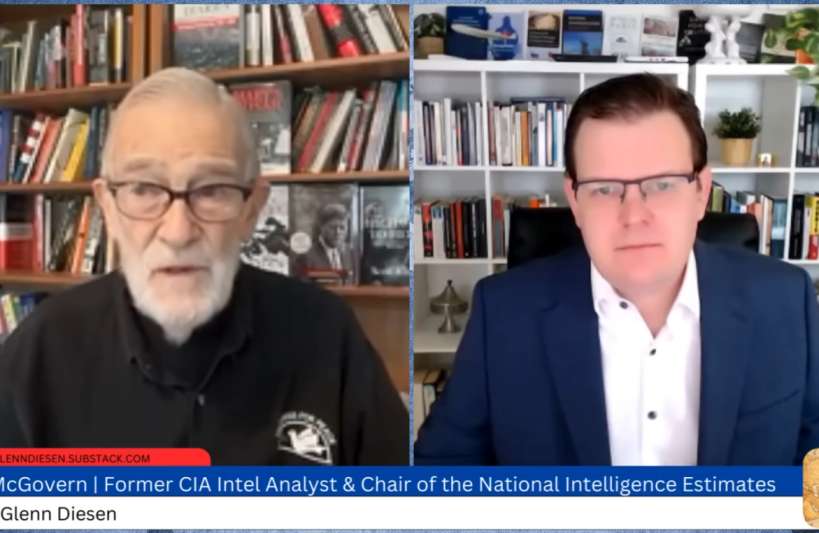
Here is the full transcript of former CIA officer Ray McGovern’s interview on The Greater Eurasia Podcast: “Global Arms Control and U.S.-Russia Relations”, January 17, 2026.
Brief Notes: In this episode, Glenn Diesen is joined by former CIA officer Ray McGovern to discuss the precarious state of international stability as the framework for global arms control continues to dismantle. Drawing on his decades of experience in the intelligence community, McGovern provides a historical lens on past diplomatic successes while analyzing the modern threats posed by the collapse of treaties like New START. The conversation offers a deep dive into U.S.-Russia relations and the impact of the Ukraine conflict on global security. Ultimately, they explore the vital importance of pursuing mutual security to avoid catastrophic escalation in an increasingly unpredictable geopolitical landscape.
Introduction
GLENN DIESEN: Welcome back. We are joined today by our dear friend Ray McGovern, who spent 27 years as a CIA officer, chaired the National Intelligence Estimates, and prepared the President’s Daily Brief. So thank you for coming on. It’s, you know, it seems every few weeks now, the world looks like a completely different place.
RAY MCGOVERN: Yeah.
GLENN DIESEN: In this context, I was hoping if you could perhaps shed some light because your experience from the intelligence community is quite extensive. And, you know, as we now move towards possibly several large wars, maybe with Russia, Iran, even China, I was wondering if you see any continuity in this regard in terms of U.S. strategy and the wider approach to the world, to Eurasia, or are we seeing something completely new at this point in history?
The Evolution of U.S.-Russia Arms Control: A Historical Perspective
RAY MCGOVERN:
Really good question, Glenn, as usual. Let me just interject that if you want continuity or discontinuity, you came to the right place when you’re 86 years old and you started focusing on the Soviet Union in 1959 and then professionally in 1963. Well, I’ve been around.
One of the things in my bio I probably should polish up is the fact that I not only prepared the President’s Daily Brief together with a team for Nixon and President Gerald Ford, but I briefed it one on one, early in the morning, physically, downtown in Washington, D.C. during the first four years of the Reagan administration, namely 1981 and 1985. That was the acme of my career. There was nothing quite as good as that.
One on one, I could tell Reagan’s most senior officials, and I’m talking Secretary of State, Secretary of Defense, Chairman of the Joint Chiefs, the assortment of National Security advisors, some of whom ended up in jail, the Vice President, Vice President Bush. Man, that was heavy duty. We worked in a team every other day. So three days a week, I would have that privilege. I never abused it.
But when someone like Shultz asked me for my personal opinion, I was delighted to give it to him. Because I knew something about the Soviet Union, I knew something about Gorbachev. I knew the best honest analysts within the CIA. And when I could tell Secretary Shultz, “Look, we believe that Gorbachev is not just a clever Commie, like you’re hearing from our bosses. We believe he’s the real deal. We think we can deal with him.”
Now, Shultz took that to the President, who usually slept in during these briefings, and Weinberger fought it tooth and nail, but the Vice President supported Shultz. And that’s why we had real progress toward détente and arms control during those years. I mean, let’s face it, from the evil empire, Gorbachev became somebody that Reagan could and did deal with.
The SALT Talks and Nixon’s China Strategy
Going back even farther into the Middle Ages, when I was less than 30, I was appointed chief of the Soviet Foreign Policy Branch at CIA in early 1970 as the START, the Strategic Arms Limitations Talks were starting. Okay. They were held in either Vienna or Helsinki. They alternated.
And I had the privilege of appointing one person from my branch to be with the delegation to be able to brief them and in turn receive interesting information as to what was going on. I had another one on my branch that dealt with the specifically collection authorities and the strategic arms people who know about weaponry. And yet another person in my branch would report to Director Helms at that time and the muckety-mucks in Washington as to the state of the relationship.
Suffice it to say that I had terrific help. But we did support Kissinger and Nixon because we saw that they were on the right course. The Russians were really scared. What were they afraid of? They were afraid. Look, Nixon goes to Beijing in January of 1972. Beijing, for God’s sake. He toasts with Mao Zedong and Zhou Enlai. What was that all about?
Well, the Russians were suspicious that that was all about the Chinese stealing a march in a cordial relationship with the U.S. The Russians had to do something. Okay, now what did they have to do? They had to make sure that the Chinese didn’t get ahead of them on this.
The SALT talks, Strategic Arms Limitation Talks were in the middle of the negotiation process. What happened? Again, it was a privilege as chief of the Soviet Foreign Policy Branch to see the Russians cave on a piddling matter. No, on the quadripartite agreement on Berlin. For God’s sake, this is early 72.
And we could tell Kissinger and Nixon, “Look, it’s working. The Russians not only were interested in strategic arms limitations on its merits. They don’t want to be spent out of existence, but they’re afraid that the Chinese are going to get a more aggressive, more decent relationship with you than they could.”
The Anti-Ballistic Missile Treaty: A Cornerstone of Stability
So I had the privilege of being in Moscow May 1972 for the signing of the key, the pivotal agreement on strategic arms.
Both sides were building not only offensive weaponry, they could knock out the rest of the world three times over, but they’re building defensive shields. Reagan had this notion later about a way to prevent any ballistic missiles coming in. And they call it Star Wars. Right? Okay.
Now at that time it all seemed feasible. Not to us. I’m no expert, but we had experts you couldn’t believe. We had experts you could believe. Okay? And they said this would never work. It’ll never work. See, if we get an ABM treaty with the Russians and it reduces the emplacement of anti-ballistic missiles to two sites in the capitals and somewhere else. Okay, why only two?
Because then neither side, neither side could be even tempted to make a preemptive strike without realizing that they would suffer incredible consequences in retaliation. Okay. There’s sort of a balance of terror, but it was a balance, right? So two sites. And then two years later they said why do you need two sites? I mean the whole thing is just for show. Let’s just reduce it to one site.
Now I’ll just close this thing. I didn’t mean to go into this but I think it’s interesting in terms of how this arms control thing evolved. The big thing was could we verify it if the Russians cheated? Okay. Kissinger came to us, he says, “Ray, are the Russians going to violate this treaty?” I can’t tell you yes or no of that. Okay, when will we know? When will we know if they violated?
Well, I couldn’t tell you that either. But I’ll tell you about, I’ll tell you tomorrow. Go back to the people who are running a satellite and all these sophisticated collection mechanisms and how long? About a week. Go back to Kissinger. About a week. Good, that’s enough. “Doveryai, no proveryai” — trust but verify.
Verification in Practice: The Krasnoyarsk Radar
Now footnote here. Did the Russians cheat? Yeah, they cheated. Did we find out about it? Yeah, we did. Within a week. Yes. Well they did. They built this God awful radar. Could only be an ABM radar. Where the hell out in Siberia in a place called Krasnoyarsk. If memory serves, how they thought that we would miss that is beyond me.
But we got the photos, we showed them to Reagan. He said okay, show them to the Russians. So we did. And the Russians, “Nah, nah, it’s not an ABM radar.” Well then Gorbachev came in and says, “All right, that’s an ABM radar, we’ll tear it down.” That’s the first thing they tore down because of Reagan’s insistence. Actually it was not until Bush that they actually tore it down.
So what I’m saying here is that there was common sense and some sort of political acumen to our negotiating these kinds of agreements, despite all the impediments, despite raised eyebrows in the Senate and House. How can you deal with the ChiComs? The ChiComs, the Chinese Communists. How can you expect Gorbachev or even Brezhnev and Kosygin. They’re Communists. They’re not going to.
So they had that to deal with, but they had all manner of other things, like bureaucracies. Right. And even the delegations themselves. And we knew this because we were there. We were inside the delegations. Even the delegations were at loggerheads. I mean, oh, you can’t imagine you have generals saying that in the State Department. Yeah.
Kissinger’s Diplomatic Maneuvering
So anyhow, Kissinger did something by himself. He did it because they said, “Yeah, go ahead and do it.” Now, Kissinger was, you know, he was not the Secretary of State yet. He was just Nixon’s guy for the National Security. So he did it. He did it by flying into Moscow, not telling anyone, including Ambassador Beam. I was there. I heard this story, okay?
And flying out to Helsinki and then calling Beam and said, “Oh, hey, Ambassador, I meant to tell you that I’ve been talking to Kosygin and Brezhnev on Wednesday and Thursday. Just want to, just so you know.” Now, State Department was enraged. My God, who the hell is this? We do that kind of thing, right? Right.
Well, Kissinger was smart enough to realize that he could do it by himself. And he was smart in most kinds of things. And the epitome, I mentioned this. I don’t think I’ve told you this before, but I was in the embassy there in May, June, July, August of 72. And when I walked into the men’s room in the political section, up above the urinals was a great big banner, and it said, “Kissinger was here.” The old “Kilroy was here.” Okay? “Kissinger was here.”
The embassy and the State Department were in high dudgeon. What did Ambassador Beam do? Jake Beam, old timer, at the end of his career, he said, “All right, everybody into the bubble.” Went to the bubble there. I’m not revealing any secrets now, okay?
Beam says, “Look, Kissinger is doing this on behalf of the President of the United States for whom we serve. Okay? Whom we serve. Now, look, all this business about, well, they never tell us anything. They never tell us anything. Well, that reminds me of the naval attaché in Berlin when I was there in 1936 and the storm troopers and the Nazis were marching up and down and collecting Jews and everything else. And the naval attachés used to say, nobody tells me anything about what was going on, so forget about it. You’re told what you need to be told. No more bitching about what Kissinger is doing without telling us. It’s our job just to do it.”
Anyhow, that’s a long kind of story. We were interested in arms control by sensible people. The Russians were interested for two reasons: cap the arms race and not let the Chinese get ahead of them in their race for good improvement with us. And then that kind of varied.
Reagan’s Transformation and the INF Treaty
Reagan, when he came around, right when he came around from this evil stuff that he called the Russians, 1983 was key. But then a couple of years later, Reykjavik, and then Gorbachev says to Reagan, when they have a decent relationship, he says, “Look, we can kill each other several times over. You’ve put Pershing missiles in Western Europe. We have these SS-20s that give us about 10 minutes, 9 minutes instead of the 35 minutes we have with the intercontinental ballistic missiles or the sea launch. Look, do we really need these intermediate nuclear weapons?”
So Reagan asked us, do we need it for deterrence? No, for the people making tons of money and building these things. They did them. Well, what happened was Reagan said, “Okay, that’s a good idea.” I was surprised as hell because a whole class of intermediate and shorter range ballistic missiles was destroyed in place under this treaty called the Intermediate Nuclear Forces Treaty.
My good friend Scott Ritter was the first on the ground to “doveryai, no proveryai” to monitor the implementation with two years in this God awful place called Votkinsk for God’s sake, where they chopped up these SS-18s. Okay, so that was possible. And it happened.
The Dismantling of Arms Control Under Trump
Okay, what happened later? Oh, Trump comes in and he’s got this guy John Bolton kind of advising him. And Bolton said, we don’t need that ABM treaty. And then, you know, so they get out of the ABM treaty that was 30 years, the cornerstone of strategic stability. And then when Trump comes in the first time, the same kinds of people say, “Look, you know, the INF treaty.” And so in 2019, on his way out of office, Trump said, we’ll get out of the INF treaty.
So finishing up here. And I’m sorry to carry on so long, but I know this stuff and not many other people do. Here it is. There’s only one treaty left. It’s called New START. Is it good? It is really good. It limits the offensive missilery to 1,550, if memory serves, on each side. Okay, now when does it expire? Expires on February 5th. Do the math. I think that’s about three weeks away.
Putin’s Offer and Trump’s Silence
What did Putin do to try to make sure there were some constraints left after the treaty expires? It was already extended once. It cannot be extended again under the treaty provisions. The START Treaty, New START Treaty is dead. But here’s what Putin said in a very formal way at a National Security Council meeting on TV. He said, “Look, date, September 22nd.” That’s a while ago, huh? September 22nd.
“Look, we think that this is really necessary to have these kinds of constraints. We offer to abide by those constraints for yet another year, even though the treaty expires, if the U.S. will act likewise.” 22nd of September.
Now, what has Trump said about that? Oh, two weeks later, he said somebody, journalist asked him, “What about that New START Treaty offer?” He said, “Oh, yeah, it sounds like it.” More recently he said, “Well, if it expires, it expires.”
As of yesterday, the presidential spokesman in the Kremlin, Dmitry Peskov, says, “Please, please, will you give us something official on that? Give us something official. It’s really easy. You don’t have to negotiate anything. It’s a yes or no. You can even do it silently if you will. But please give us an answer on that. The time is running out.”
The Litmus Test for Trump
Okay, so what’s the implication of this? And I will close with this. Putin doesn’t really know whether Trump is his own man. He does know that Trump is extremely irascible, unpredictable, mercurial and dangerous. More recently, one cannot avoid the conclusion that he might not be fully compos mentis.
I believe that Vladimir Putin, having spent the last 25 years rebuilding Russia, doesn’t want it all to be destroyed. So he’s treating Trump with kid gloves. Okay, yeah, you should have had the Nobel Prize. Yeah, you’re doing everything. But this is the litmus test. Okay?
Even if Putin thinks that Trump would really like to, thinks it’s a good idea for the treaty to be renewed, at least the limits that were on there. Well, if he can’t do that, if he can’t deliver, he’s not his own man. And there’s one other situation much akin to that will be we can go into further. That is the attack on the state residences near Valdai. You’ve been in Valdai, but I perhaps wasted enough of our video right now to have the decency to stop. Thanks for letting me go on.
The Foundation of Mutual Security
RAY MCGOVERN: I just pick up on that, Glenn, and say that there is no security without mutual security. That’s the whole name of the game here. The Russians did what they did in Ukraine because mutual security was being endangered by NATO moving into Ukraine and upsetting the balance, at least in Europe.
So, you know, when you come down to it, actually this concept was concretized in the Organization for Security and Cooperation in Europe documents. As you know, no country is allowed to increase its own security at the expense of the others.
Now I go back to John Kennedy. It was John Kennedy that I listened to in his inaugural address. I was a senior in college. And he said, look, if you have something special, think about what you might do for your country rather than what your country would do for you. That sounded great.
I learned that there was this new CIA. I learned that it would report directly to the President without treating the intelligence. “Treated intelligence” is Truman’s word and it’s why he set up the CIA. So I was really happy to join.
Kennedy’s Masterful Speech and the Cuban Missile Crisis
Now, two months after I entered on official duty with the CIA, John Kennedy made a masterful speech at American University. It was so masterful that Khrushchev had it printed in Pravda in its entirety. You never saw that except for a Soviet leader’s speech. He had it all printed. Why?
Khrushchev and Kennedy had been at each other’s throats because Khrushchev decided he wanted to unbalance the strategic situation by sending offensive middle range ballistic missiles to Cuba. My God, did we detect it? Yes, but we didn’t have the mechanisms we have now. We had U2 aircraft and they could only fly or they could only take photos when there were no clouds. And so they got them in there pretty much without our knowing it.
We told John Kennedy, look, these are emplaced in Cuba. Now he says, are they armed? Do they have nuclear weapons? And we said, we don’t know, but I think you have to assume so because they don’t make a lot of sense without nuclear. But we don’t know. Well, we know now, they were armed.
Anyway, long story short, what Khrushchev had done was face Kennedy with a painful choice between abject surrender and using nuclear weapons. And in his speech eight months later, in John Kennedy’s speech at American University, he said, look, this is the one thing that we learned, that we should never give another nuclear power a painful choice between humiliating retreat, was his word, humiliating retreat, and using nuclear weapons.
Now fast forward to what’s happened in Ukraine and for the first time since that speech in 1963, there was the chance that one or the other side would use nuclear weapons because one of the superpowers with a nuclear capability was challenged.
A New Start: Kennedy’s Vision
So what Kennedy said, interestingly enough, and I’ve heard this speech many times, but I gave a presentation, the last week I looked at it again, he said, he talks about a new start. Let’s have a new start. He wasn’t talking about the New START Treaty, but interesting in language, right. What we’ll have is a new start.
And as an earnest of our good intentions, says Kennedy, on June 10, 1963, I’m going to send my negotiators to Moscow. The British are going to do the same. We’re going to negotiate a test ban treaty, and we’re going to do that as quickly as we can. And meanwhile, we’re not going to test any nuclear weapons in the atmosphere.
Now, everyone said, oh, my God, you know, he’s never going to get it. Look at the Senate. They know these guys are coming. He said, come on. Well, Kennedy was an adroit politician. He sent his minions out throughout the country. He made speeches throughout the country. And within two months, shorter than two months, Russia had ratified the Limited Test Ban Treaty.
So it can be done. People just have to be educated. And that’s the lesson, perhaps, out of all this. Americans are not educated. They are indoctrinated to believe that Putin and the Russians are incarnate evil. They can’t be trusted. And that’s the real damage from this Russiagate hoax and from all the other things that the mainstream media has propagated. People are indoctrinated.
And so the situation is more labile, as the Russians would say, as the Germans would say. It’s more tentative, more dangerous, I would suggest, than before.
The Current State of Arms Control
So let me assess. Will Trump be able to respond? Yeah, let’s keep those limits on for another year, or will he not be able to do that? Maybe he doesn’t want to. If I’m Putin, it doesn’t matter. He might love me to death. But if he can’t deliver on this key issue, if he can’t simply say yes to prolonging these limitations, my God, we have to guide ourselves accordingly.
We don’t want the kind of arms race that would be in store. But we faced this before, and we’ve developed a whole array of missiles, like the Kinzhal and what is the Poseidon and the Burevestnik. We threatened to develop these weapons systems back in 2016 and 2018. Putin had a State of the Union address, for God’s sake. Did a show and tell. Six of these weapons systems. We’re developing this. They’re going to work this way.
And guess what? Five of those six now are online. So the Russians will adapt. They’re not going to build an ABM Golden Dome or whatever, because that will never work. It will always be defeated. Which is what we told Reagan way back when he started thinking of Star Wars.
Unfortunately, the guys that had worked for Northrop Grumman and Raytheon and those folks in the White House persuaded old President Reagan, you know, if you agree with Gorbachev to eliminate nuclear weapons, you won’t be able to protect the United States with your Star Wars. That’s how bad it was, Glenn. I was there. I saw it happen.
GLENN DIESEN: Yeah. I spoke with Ambassador Jack Matlock on this podcast, and he was making this point as well, that when him and Reagan wanted to start to negotiate with the Russians, eventually negotiating an end to the Cold War, the main obstacle first was getting the green light, essentially from the war hawks in Washington, because the assumption was always that this was a display of weakness and you couldn’t trust the Russians.
So all the stories we put out there to explain how bad the Russians are, eventually, well, the story lesson essentially also started to buy into their own propaganda. But as you said, the historical records say something very different.
Working with Jack Matlock
RAY MCGOVERN: But let me interject on Jack Matlock, who happens to be a really good friend of mine, whom I admire greatly, who entered into this Russian studies field for precisely the same reasons I did, just captivated by Russian history, language and so forth. He at Duke, me at Fordham. He’s 10 years older than I, but he and I really worked very hard.
He was chief of the Soviet desk at the State Department. As I said, I was chief of the Soviet Foreign Policy Branch at CIA. We worked hand in glove to make sure that sensible people, you know, sensible people like Kissinger and others realized what the stakes were and how their own policy, playing China off against Russia, could and would and in the event, did work.
Now, I’ll just comment that this was very unusual for me. Usually we were telling the administration, ah, that’s crazy, or, you know, the skunk, the proverbial skunk at the picnic for this or that initiative. But this time we could legitimately say, whoa, yeah, it’s working. I even have a commendation from Kissinger on that.
And it was Jack who was instrumental in getting me over there for the signing of the treaty. And I’m indebted to Jack not only for that, but for so many other things. You picked a good person to interview.
The Collapse of Arms Control Treaties
GLENN DIESEN: Oh, no, yeah, I met him in person as well. We were on the same panel in Tbilisi in Georgia, well, last year. Full of energy for, you know, his age. Excellent, brilliant guy.
But the point I want to make is when arms control falls apart, it has real consequences for us. And they’re never really discussed. So you mentioned this Anti-Ballistic Missile Treaty of 1972. When the US withdrew unilaterally back in 2002, the Russians warned that they feared this would make nuclear weapons, give it an offensive purpose by being able to intercept its secondary strike capabilities.
In 2011, you even had President Medvedev saying, if the strategic missile defense of the US ever gets the potency to threaten Russia, then it would launch a first strike on this missile defense. Not nuclear strike, but on the missile defense architecture. But of course, this is not something they want. This would trigger possibly a world war.
So instead they developed these hypersonic missiles and given that they can have nuclear weapons on them, that would shorten the time dramatically and nobody really gains. But this is kind of what happens. And you can say the same about the INF Treaty, which was also abandoned. Even the Conventional Armed Forces in Europe Treaty, the CFE Treaty, it was never modified because all the countries used to be Warsaw Pact moved over to NATO. But they never changed the numbers and the Open Skies Treaty was abandoned.
With every one of these, there will be consequences. And as you said, next month with New START.
Indivisible Security and NATO Expansion
But I also like how you put the indivisible security, the security architecture into this, the arms control, because it follows the same logic. When we came up with a Charter of Paris for a New Europe in 1990 and the OSCE in 1994, the key idea was indivisible security. As you said, one side should not enhance security at the expense of the other.
But then we essentially threw away this. I wouldn’t necessarily conceptualize it as arms control, but it’s a security agreement by saying, well, let’s expand NATO instead. But that is exactly the opposite. That is one side enhancing its security at the expense of others.
So you see now the Russians over the years develop all this Poseidon and doomsday weapons, essentially where they can have these nuclear tsunamis wash over the coastline of the US. These are horrible weapons, but whenever they are addressed, it’s almost presented as a confirmation about how evil the Russians actually are and why we should fear or hate them. But it’s never put in the context that this is a reaction to something.
It’s very frustrating. And even now, the Trump administration, it treats international law and treaties as something that prevents the US from asserting its greatness. It’s a source of decline, its weakness.
The Challenge of Discussing Root Causes
I mean, it’s quite disheartening to see a security architecture which requires all this diplomacy just fall apart and being replaced by sheer stupidity, because somehow we believe that recognizing that what we have done causes a reaction on the other side, that this is, you know, legitimizing or supporting what Russia has done. So we all have to pretend as if it happens in a vacuum.
How can we possibly get back to arms control? How can we have a stable security architecture? Or essentially, how can we end the Ukraine war? Because the Russians say this is a direct response to what you have done. So address the root causes.
But it’s pretty much treasonous to discuss root causes in Europe now. At least that’s what I’ve discovered. If you try to say, well, we threatened the security concerns of the Russians, now they will take whatever actions they see necessary to restore their security. Well, now you’re supporting invasions, you’re supporting this and that.
You can’t say the basic facts, the basic reality which you need in order to actually enhance mutual security. I don’t know. It’s extremely frustrating to watch what’s going on.
The Saving Grace: Putin’s Strategic Restraint
RAY MCGOVERN: Well, it is if you know what’s going on. But my main point is most Americans don’t know what’s going on. Mutual security, well, in layman’s terms, it’s the golden rule. Don’t do to others you would not have them do to you. And on a nuclear plane that goes in space, as Kennedy said, you know, the worst thing you can do is face another nuclear power with a choice between humiliating retreat and using nuclear weapons.
Now, what’s the saving grace? Well, I’ll say it, and I hope people won’t be shocked. The saving grace is a fellow named Vladimir Vladimirovich Putin. What do I mean? He’s a statesman of the kind I have never seen before in Russian or Soviet history. He is cautious. He is hell bent on building up his own country, and he’s not going to take the slightest risk of getting involved in a set to that will destroy the country that he has been so instrumental in building up.
That’s why he’s doing everything he can to make sure that Russians are ready, but that they will not have to rise to whatever provocation might come as the terribly unpredictable Trump or his minions. Are they ready? Sure as hell they’re ready. Back in 2018, as I already said, they showed how ready they would be when Putin and that State of the Union address demonstrated all these new weapons. And one of them goes around South Pole, the other one, I mean, we all looked at this and said, oh, yeah, right, they’re going to do all that. Well, now they have.
The Indoctrination of American Public Opinion
Okay, so mutual security is the key. I think that this business about unprovoked invasion of Ukraine is something that Americans just have been so indoctrinated. I’ve said brainwashed in the past, but then somebody reminded me about some film that don’t say brainwash anymore. Just say indoctrinate. Okay, so everybody’s indoctrinated to believe the worst of the Russians.
Putin knows this, and Putin knows that even though Trump knows how he was sabotaged by the deep state during his first term. As Putin looks on now, well, Trump has been president for almost a year. How many of those traitors have been brought to justice? Oh, well, one of them was indicted. Oh, yeah. Then Trump appointed an attorney who knew about chasing ambulances, and she was very pretty, by the way, and then she screwed up.
So Comey so far has walked. How about John Brennan? Guilty as sin for this whole Russiagate thing? Well, somebody said that the legislature, the Congress, has nominated him to be subject to grand jury, an indictment, you know, but I haven’t heard anything else about that.
So what I’m trying to say is here I’m Putin. I’m looking at this. I said, I mean, this guy can’t even move against the people who the public record now shows tried to sabotage him, sabotage him at every turn. People say, well, Putin, when Trump says something like he did just this week. Okay, who’s sabotaging progress on Ukraine? Trump says, Zelensky. And the New York Times says this is what Putin says. It also happens to be true, but that doesn’t matter.
The Truth About NATO Expansion
Okay, so this whole business about blackening the Russians, it’s going to take a lot of work. And Putin, I think, has to come up with, has to recognize that Trump doesn’t have the kind of people who are adroit enough to work with the media to the degree it can, to dispel this myth and say, look, it’s the golden rule that applied in Ukraine.
Yeah, the Russians invaded Ukraine, but look why they invaded Ukraine. I wonder why. Was it unprovoked? Well, no, actually, the Secretary General of NATO admitted before the EU Parliament two years ago that it was. Well, what he said was the Russians told us that they would invade Ukraine if we tried to get Ukraine in NATO. That’s what they said. And we said no. And so they invaded Ukraine, but we got NATO enlargement because Finland and Sweden became members. So we had two new members.
Meanwhile, half a million Ukrainian youth have been killed on the battlefield. What kind of leadership is that in NATO? Luckily, I expect we’ll get into this later. NATO is falling apart. The more so since the Danes now are also sending five or six soldiers to Greenland. I think even Norway is contributing together with its Scandinavian neighbors to show how strong they are by sending a battalion or maybe a platoon or company to Greenland.
NATO is falling apart. Now, did Putin plan all this? No, he didn’t plan all this, but he has to deal with it. And I see him sort of gloating with compatriots, saying, look, let’s not rub it in. It’s going just fine. NATO is falling apart. If Trump tries to take Greenland by force, well, what’s going to happen there? I mean, it’s unthinkable.
These things that are happening, to whom do they benefit? To the Russians who are just sitting back and say, okay, we’re winning it in Ukraine. We’d like to have the bigger deal that takes into account our interests, our core interests. But if we don’t get that, okay, we’re still winning and we’ll have to deal with that in a different way.
The Drone Attack on Valdai
So here we have Witkoff and Jared Kushner going back off to Moscow as far as the reports say, in another week or so. Why? Well, because Trump apparently wants Putin to think that he really would like to have a deal on Ukraine. And my belief is that he would.
And even in these provocations, Glenn, can you imagine, let’s take the attack by 91 drones on what the Russians call the state residence near Valdai. Again, you’ve been at the Valdai conferences. Well, the 28th, 29th of December. My God, what’s going on there? Were they really targeted on the presidential residence there? Yes. How do I know that? Well, the Russians, as you know, have retrieved some of the components, the control devices, and they show exactly where the targeting was.
And the Russians are given one of these parts in a very ostentatious ceremony to the U.S. defense, army attaché in Moscow. When was that? Oh, it was a week ago. Has Trump or Rubio or anybody responded? I don’t know. Maybe they chose to respond in secret channels, but I hope they have responded.
If I’m Putin and they haven’t responded, there again, I say Trump is not his own man. In my view, that technology shows where the target was, and it was this residence, otherwise the Russians wouldn’t have given it to them. So who has it in the United States? Oh, imagine they gave it to the CIA. Oh, CIA is always reliable. And yeah, sure, they know all about weapons of mass destruction and yellow cake uranium. Oh, their record is great.
I jest, of course, but is this what happened? In other words, did the White House give it to the CIA and then sort of put a little foot down and say, now see if you can fix this up so we can say that Putin lied? Well, I don’t rule that out.
Okay. Or maybe Trump will say, well, all right, you guys told me it wasn’t targeted, but this shows it. So in other words, there’s another litmus test. I’m watching. I’m waiting for a response, not only on New START. I’m waiting for a specific response as to whether these drones were targeted to kill me or to kill or demolish the control center here. And now the parts are there and you’ve had time to review them.
Putin’s Calculated Patience
My associates say Putin, I mean, yeah, I’m dispensable. Nobody’s indispensable. But they’re really saying, hey, Vladimir Vladimirovich, come on, for God’s sake, they’re trying to kill you. Now, are you going to still deal with these people? Well, most people would have thought that the answer would be no.
And yet we have Lavrov, the foreign minister, on the same day that these drones were shot off, 91 of them toward Valdai, same day. Now, this is not to prevent us, this will not prevent us from having bilateral discussions with the United States. It’s the Ukrainians that do this kind of thing. We will take after the Ukrainians. We’re still willing to talk to the United States. And that’s been reiterated by Lavrov again, about five days ago.
So how do you figure all this out? Maybe this is simplistic, okay, but here’s the syllogism. Putin doesn’t want a nuclear war. He’s not going to take any chances that Trump will be provoked or somebody will be provoked into a nuclear war. Therefore, we have to be really careful about this. And if we can work out a deal on Ukraine, do that. If we can avoid hostilities over Venezuela, for God’s sake, or Iran, we’ll do that too. We can’t do much about Venezuela, but we can help the Iranians.
The Starlink Disruption in Iran
And that’s the interesting thing about that Starlink down. Okay, what did that mean? That meant all the best laid plans of MI6 men, and I’m talking about MI6, the MI6 men, CIA, okay, to have an insurrection in Iran, were dashed by technology, which I can’t prove it, but I think it probably came from the Russians because we know they have that technology. Starlink’s down, all the assets sort of broken off.
So there’s a lot going on. But when I said the saving grace is Putin, I genuinely believe that he’s not going to be provoked when he has to. When his own people, when Russians are being killed in Ukraine and he realizes that, you know, this is just the start, I mean, this is just the beginning of more encroachment by NATO, then he moves.
And you know, if anybody says, oh, has nothing to do with NATO, for God’s sake, you have the head of NATO, Jens Stoltenberg, I think you probably know him, Glenn, I think he’s one of your countrymen saying, “We were told by the Russians that they would have to invade Ukraine if we kept getting them into NATO. And we said no, and so he invaded Ukraine.” Those are his words. Look it up.
GLENN DIESEN: The foolish thing though is that, you know, they kept saying over and over again, the invasion has nothing to do about NATO expansion. But then he had a different talk at the EU, but this was about Finland and Sweden joining NATO.
RAY MCGOVERN: So.
GLENN DIESEN: And because he had to do his victory lap, the whole thesis was, you know, NATO told us, now Russia told us no more NATO expansion, and yet what they got was even more NATO. And this was kind of the thing, you know, haha, we put his face in it. But then of course he contradicts himself because then he outlines all the talks the Russians had. They’re warning, you know, if you try to expand NATO further, we’re going to use military force. And you know, so it is, it’s quite extraordinary, this narrative control.
The Question of Trust in U.S.-Russia Relations
RAY MCGOVERN: People don’t know this. That’s the point. And I can every interview mention and quote Jens Stoltenberg, but it just seems to. And you get the Rachel Maddows of this world who are from a much bigger audience than those of us and you know, maybe we ought to say just a word about trust and something that comes up with respect to warning time.
You mentioned it. We mentioned it in terms of the Intermediate Nuclear Forces Treaty which would have reduced warning time to about 10 minutes. In other words 10 minutes for Pershing missiles to hit Moscow or Moscow ICBMs and SS-20s. 10 minutes. So they get rid of all that. Okay.
And then all of a sudden you have the U.S. building radar places, anti-ballistic missile sites in Poland and in Romania. Whose idea was that? It was the idea of Robert Gates, the Secretary of Defense who by the way was one of those people I had worked with for me back in early ’76. He didn’t get a very good efficiency report because he was so blatantly ambitious that he was disruptive influence on the branch.
Anyhow, it was his idea. And then when the Czechs said well, we don’t want to be involved in this and the Poles and the remedies, oh, we’ll put them on ships. Oh yeah, we’ll put them on ships. We’ll put them on ships. And then somebody said, won’t the Russians object to that? Gates’ famous answer to that, which is in his diary, which I have to read all this stuff. It’s here he says “making the Russians happy has never been atop my to-do list.”
Just a little vignette. I met Gorbachev before he died 10 years ago in a ceremony at the Kremlin. And I introduced. I couldn’t. It was with one bodyguard. I went up to him, I said, I’m Ray McGovern, I work for the CIA. And the name Robert Gates came up and he said, oh, you know Robert Gates? Yeah. Which means, yeah, give my regards. That was the end of the conversation. So the Gates was of the flame.
The Missile Defense Dilemma
Anyhow, getting back to INF. Okay, you have these things in Romania and in Poland now what’s the big deal there? Are they ABM sites? We don’t know. Do the Russians know? No, they don’t. Why? Well, because they’re God awful things. But they have caps on them. They stand up straight, they have caps on them and you can’t see what’s in them.
Oh, what about the dimensions? Oh, there’s the dimensions. Oh, yeah, they have some ABM things, but they also. The same dimensions for cruise missiles, the same dimensions for all manner of other kinds of missiles. So the short answer is the Russians can’t know what’s in those canisters. Okay, now again, Poland, Romania.
And I’ll just mention one more time, I think I have mentioned this, but this was the supreme dishonesty, it seems to me, the lack of trust. When negotiations were going to start before the Russians invaded Ukraine, Biden and Putin had agreed that they would start in Geneva on the 9th and 10th of January 2022. They had talked about that and agreed to it in mid-December 2021. Okay, we got that right.
The Broken Promise Before the Invasion
What happened was on the 30th of December, Putin talked with Biden and Putin said, look, before these negotiations start in January, could we, could you just give us assurance that you’re not going to do what you’ve done in Poland or Romania, you’re not going to do it in Ukraine. We looked at the map. Ukraine, that would give us maybe five minutes warning. So please, could you, Mr. Biden, please give us a reassurance.
Okay, well, he did. Why? Because Tony Blinken and Jake Sullivan were out Christmas shopping or it was Christmas time. Biden was home alone. Okay? So he gave that assurance. And Ushakov, you know about him, okay, he was waxing eloquent on New Year’s Eve. He said, oh, wow, the Americans are finally getting some respect for our core interests. This is the agreement. And that was the readout.
Well, as you know, they reneged on that. Lavrov hunted down Blinken in Geneva on 21 January and said, what about that, Tony? What about that, Tony? And Tony said, forget about it. We weren’t with the President. Neither was Sullivan. Forget about it. We’re not going to.
Well, now that was 21st of January, on the 12th of February, 2022, right before the invasion. What was the last talk between Biden and Putin? And the readout again by Ushakov says that the U.S. side refused to talk about the commitment not to put offensive strike missiles in Ukraine and the U.S. refused to talk about not letting Ukraine into NATO. 12th of February, less than two weeks later, you have the invasion of Ukraine.
It wasn’t the only reason, but this was trust, okay? There was no trust between the senile Biden regime and Putin.
Trump’s Approach and Putin’s Calculations
When Trump came in, my God, you know, he said he was interested in all these things. He decided to circumvent the bureaucracy, not let Marco Rubio near the Russians, but appoint Wyckoff and Jared Kushner. So there was some hope on that.
But I’m trying to trigger my mind now and say if I’m Putin, and I see that Trump is either unwilling or unable to say yes to prolonging the limitations on New START Treaty just for one year, and if he’s not willing to own up to the fact that technology, Western technology, almost certainly developed by the Department of Defense in the United States, was responsible for trying to kill me, and Trump is not willing to acknowledge that, well, then I think Putin’s got to say, well, you know, we’ll still try to figure out something on Ukraine, but we can’t trust this guy because even if he wants to deal with us, he’s not his own man. And that’s really, really big.
GLENN DIESEN: Well, that’s the thing I’ve heard as well that either they will see Trump as being deceitful or he’s, yeah, he’s not in control of his own foreign policy. Either way, there’s nothing to be trusted anymore.
RAY MCGOVERN: Could be both.
GLENN DIESEN: Yeah, it could. It could be both. Well, I hope so today that Trump got his Nobel Peace Prize medal Machado gave to him. So I hope he’s happy now with his, you know.
Trump’s Nobel Prize Ambitions
RAY MCGOVERN: Glenn, on the Nobel Peace Prize, I’ve said, and I’ll continue to say that, you know, the obvious, and that is that Trump is not only delusional, but he is a narcissist such as we seldom see in this world. Now, would he be motivated and dealing on Ukraine by some sort of wish to get the Nobel Peace Prize this time around? I mean, call me crazy, but I think the answer to that is yes.
Okay, now, he didn’t get it last time around, and he has Trump, he has Putin and others saying, oh, yeah, we think, we think he could have gotten. We should begin. Well, is Trump motivated in part by appearing to be a peace president? And let’s face it, if he were able to work out a decent relationship on Ukraine, he would be a candidate.
Now, my friends say, all right, yeah, so he invades Venezuela X, Y and Z. Come on, Ray. I don’t know if he’s a narcissist and if he can discriminate between these other things. I think part of his motivation. I think part of his motivation in trying to settle this, what, 8th, 9th, 10th war. Give me a break is partly to be a peace president and to get his name not only on the medal that was given to somebody else, but to get his name on a new medal this year.
Now, do I think that that’s a controlling sort of thing? No, but I don’t think it can be overlooked because of the man’s narcissistic out of, you know. Well, what do I. A narcissistic will do it as adjective because that is the origin of many black things.
Signs of Shifting Narratives
GLENN DIESEN: Well, thank you for letting me pick your brain for an hour. And no, it’s difficult to keep on track everything that’s going on these days and it’s all happening too fast. And I can’t believe all the things only happening a week or, yeah, actually a weekend, at least the first two weeks of January. This has been a bit of a wild ride, but I had feeling Trump isn’t really slowing down.
But I am somewhat hoping that there could be some good news coming in, though, especially then with the European seems to be accepting that they’re losing. I saw even Merz make the point that, well, Russia is a part of Europe, we have to engage them. I don’t think this is going to result necessarily in a peace agreement, although Zelensky said that Trump’s peace agreement could be signed in Davos next week. I seriously doubt that, but at least there’s something changing in the narrative. So perhaps if it’s possible to even recognize the value of arms control, maybe there’s hope.
RAY MCGOVERN: Yeah.
GLENN DIESEN: Thanks, Ray.
RAY MCGOVERN: Thank you, Glenn. Thank you very much.
Related Posts
- Peter McCormack Show: AI’s Five Kings and Their 8 Billion Tenants w/ Liberman’s (Transcript)
- TRIGGERnometry: w/ Sir Antony Beevor on Russian Mindset (Transcript)
- Transcript of John Kiriakou’s Interview: This Past Weekend #661
- PBD #812: w/ Mehdi Hasan – Iran War, Qatar/China DARK Money (Transcript)
- SRS #310: w/ Josh Duhamel – Survival Skills, Off-Grid Living, Billionaires Building Bunkers (Transcript)