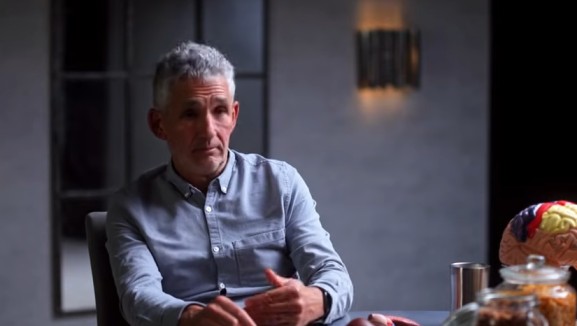
Editor’s Notes: In this DOAC episode, world-leading gut health expert Professor Tim Spector reveals how conditions like dementia, depression, anxiety, and even Parkinson’s may actually begin in the gut rather than the brain. He explains the powerful two-way connection between our microbiome and mental health, and why inflammation and metabolism—not just “chemical imbalances”—sit at the root of many brain diseases. Sharing his eight core rules for gut health, Spector lays out practical daily habits, from eating 30 plants a week to improving oral health, sleep, and stress, to protect your brain and boost mood and energy. He also discusses the surprising roles of ultra-processed foods, coffee, nuts, GLP-1 drugs, fasting, sauna, social life, and even flossing in shaping long-term brain resilience. (Jan 26, 2026)
TRANSCRIPT:
The Personal Story Behind the Research
STEVEN BARTLETT: Professor Tim Spector, who is this lovely lady and how does she tie into the work you’re focused on right now?
TIM SPECTOR: That’s my lovely mum, June, who is still with us, age 93, but for the last seven years has been in a home in London after suffering a stroke and then developing dementia. And so, yeah, that’s changed some of my views on life.
She was really pro-euthanasia and signed every paper possible that if this ever happened to her, she would be able to end her life. But unfortunately, that didn’t come true and under UK law, it’s not possible to help her in that because she lost capability and mobility very early.
So she’s still there, but she no longer recognizes me. And it’s a reminder of our potential future life and how so many people are going to end up with dementia. That wasn’t the case 50 years ago.
If I can do something to reverse this epidemic of dementia, then that’s really motivating for me and in a way, one reason why I’ve started to research the brain much more than I’ve done in the past.
The Rising Dementia Crisis
STEVEN BARTLETT: So is dementia increasing or is it that we know of it more now so we’re better at diagnosing it?
TIM SPECTOR: It’s increasing for a number of reasons. So some of it is the age demographic. We’re living longer, but we’re not living healthier. So our health span hasn’t really increased, but our lifespan has. We’re good at keeping elderly people alive longer. That’s definitely true.
But there’s also stats to show that it is increasing even when you take that into account, so that more people are developing dementia than ever before, even when you account for the demographics and those other changes.
So it is a major worry and I think it’s one of the major fears that all of us have. Obviously you’ve got cancer as one fear, but I think the other really bad one is ending up with dementia, because nearly everyone knows somebody with dementia.
STEVEN BARTLETT: Did this inspire you to go get your own brain scanned?
TIM SPECTOR: Yes. I’d had, as you know, problems with my brain before. I’d had a mini stroke back in 2011 and never really worked out the causes of that. I knew I had some white spots in my brain. I wanted to see if they were still there, if there are any signs of that.
And at the same time, I wanted to get a checkup to see was I likely to end up like my mother or not, and did I have the genetic form of the disease? Was it straight for Alzheimer’s or was it more the vascular type that my mother had? Well, probably has.
And so, yeah, partly it was motivated out of my medical curiosity and partly for self-interest.
STEVEN BARTLETT: And what did you find?
TIM SPECTOR: I went to this specialized clinic in London that does these dementia screens. So I know if I had the risk genes for Alzheimer’s, which luckily I don’t, but I do have bad genes for diabetes and heart disease, which predispose you to the vascular side of things.
STEVEN BARTLETT: What’s vascular dementia?
Understanding Vascular Dementia
TIM SPECTOR: There’s several types of dementia, but the two main ones are Alzheimer’s, where you get these protein folds in the brain, you get local inflammation, these protein tangles, and that then causes damage to the bits of the brain. That’s a very specific type of dementia.
Then you get more generalized dementia, which is usually called vascular dementia, where you’re just getting clogging up of the arteries supplying the brain just like you do in the heart, and that knocks off other bits of the brain in a slightly more random way than happens with Alzheimer’s. It’s slightly less predictable. But that accounts for about a third of all dementia, this vascular type.
I’m predisposed to it because after this weird episode in 2011, my blood pressure went up. So anyone with high blood pressure generally has slightly stiffer arteries than most people, and that impacts the arteries in your brain. So you are slightly more at risk.
And with these diabetes genes that I’ve got, thanks to my grandmother, I am more at risk of vascular dementia. And so what I wanted to do was learn about that in order to optimize all the things I could do to postpone it or prevent it as much as possible.
The Gut-Brain Connection Discovery
STEVEN BARTLETT: Over the last five years or so, your interest in the brain has increased. What is the variance in your views of the brain now versus five years ago, before you started doing research and getting interested in it?
TIM SPECTOR: I think I saw the brain as a rather distinct organization that was the domain of psychiatry and perhaps gerontologists who look at dementia. That wasn’t really part of the major picture and certainly wasn’t within my domain of expertise.
I think I still believed in this, the Cartesian view of the difference between the mind and the brain, the mind and the body, these two separate entities.
So I was interested in it, but I didn’t realize this huge connection I’ve now discovered, really, that has really excited me. And I think the thing that triggered it was some of our own experiments, which happened a bit by chance.
So when we started Zoe, we did a number of trials, and we gave our participants apps so they could report how they felt. In every study we did, we started getting back these incredible results of people saying when they started the Zoe diet, for example, the first thing they noticed was their mood and energy improved and their hunger got less. And that was before any blood changes, before any gut changes.
And so initially, we slightly discounted it, but it happened in every study we did. We looked at the menopause. And again, the most dramatic change, when people were improving their gut health through food with menopausal symptoms, was on mood and energy.
Because originally I’m a rheumatologist and was really interested in inflammation. I’d never put that connection between what was inflammation in the body and in your joints with what was going on in your brain.
And suddenly the latest science, when I’m going away doing my reading, is making it all so much clearer. It’s really become this new idea of things like depression, things like mood changes, things like fatigue and energy, which I hadn’t really thought about as, in a way, a malfunction of the brain responding the wrong way to signals from the rest of the body.
But it suddenly all comes into focus about how holistic the whole system is and how really the brain is just another organ. And this link with the gut is absolutely crucial because that’s where it gets most of its information from.
We have this vagus nerve that goes from our gut to our brain, the longest nerve in the body. And 80% of the signals go gut to brain, only 20% go brain to gut.
So all these things together have just made me realize how important what’s going into our gut is, our diet is, and how that influences many things in our brain that I didn’t put together before. And I don’t think most of the medical world have put together before.
And we’ve all put the brain on a pedestal, I should say. We think it’s this unique thing that’s driving our bodies, but actually it’s not. It’s just responding to them just like any other organ.
Diet’s Direct Impact on Mood
STEVEN BARTLETT: It made me reflect on the days that I’ve had good and bad moods and how much it’s linked to my diet in the preceding couple of days. How I feel if I sleep is such a big exacerbating factor in how I feel.
But if I’m slept and I still don’t feel good, it’s typically linked, I think, to something I’ve been eating or something I’ve eaten very recently, maybe in the last 24 hours.
So when you talk about how there’s this holistic picture and how my brain might be, I think, I can’t remember the words you used, but it sounded like you said my brain is receiving signals from other parts of my body and it’s malfunctioning based on those signals, which is causing depression, anxiety, bad moods, whatever.
That I think is really interesting because people think of mood as a separate thing. We don’t think of mood connected to my gut.
TIM SPECTOR: No, it’s your own fault you’re in a bad mood. “Why are you in a bad mood?”
STEVEN BARTLETT: Something happened externally, so someone cut you off in traffic or whatever it might be.
TIM SPECTOR: All these studies, we’ve got four studies now where we’re changing people’s diets and they’ve been on generally bad diets, we’ve moved them to good diets. That mood, particularly energy levels, is the first thing they notice improving.
And they never linked, just like you, their mood and energy levels with things like diet. It was just inherent. They thought, “Oh, it’s just because my life’s shit” or whatever it is.
An extreme example is some families we’ve been working with doing a Channel 4 series at the moment called “What Not to Eat.” And we visit four families and they’ve got terrible diets and we transform them, give them a gut-friendly makeover diet. Look at them after six weeks, the first thing they all notice is their mood and energy is dramatically increased. They were napping all the time, they were asleep all the time during the day.
STEVEN BARTLETT: What were they eating?
The Ultra-Processed Food Trap
TIM SPECTOR: Crap food, highly processed crap food. And snacking late at night. Bars of chocolate, sodas, chicken nuggets, pot noodles. Rubbish food, right?
So these were worse than your average. But still there’s millions of people like that doing this and they had no clue that it was linked to them feeling terrible and tired all the time.
And again, the first thing that improved was what was going on in their brains, and they suddenly felt alert again. And once people realized there’s a connection, then in a way, you have this feedback loop to say, “Okay, I’m not going to eat this shit food, because I know it’s making me feel so sick.”
But until you make that connection, you’re not going to know. You’ll just be in this constant state saying, “Well, I’m just overweight. That’s why I’m tired. Or I’m not exercising. That’s why I’m tired.”
STEVEN BARTLETT: There’s a bit of a vicious cycle here with eating something bad, then being low energy and sleeping all day, not feeling good. So you eat something bad and the cycle continues. Because if I don’t feel good, I probably want to eat a chocolate bar.
TIM SPECTOR: In our Zoe studies, we found that people who had a bad night’s sleep desperately craved some sugary crap in the morning. Right? It’s the first thing. You don’t go for a healthy breakfast. It’s like there’s some little evil thing in your brain saying, “Okay, I need a quick fix. I don’t care about the rest of the day. Just get me through the next hour.”
STEVEN BARTLETT: Do you know what? I had someone posit on my podcast that that was because your body’s basically under a form of stress. So from an evolutionary perspective, if you’re waking up in the middle of the night for some reason or you weren’t sleeping properly, it might be because you were under threat. So your brain wants energy.
The Physiological Impact of Stress and Depression
TIM SPECTOR: There are a lot of studies now that stress, which we thought of as a sort of external psychological event, is actually a physiological one and is actually driving inflammation. It’s directly affecting your immune system, which is then sending these signals to your brain to change your behavior.
And this, I think, is very much the heart of what seems to be happening in depression. What I’ve been finding out is that it’s detecting a change in immune system. It’s switching onto this stress mode. And the stress mode then triggers these different behaviors in your brain.
And very often it’s not real stress. I mean, most of the stresses we get every day are not like our ancestors had. We’re not being chased by wild animals or being burnt out of our village.
What really interested me was this whole link between what happens when you have a vaccination. During Zoe, we looked at a million people’s responses to the Pfizer vaccine and the AstraZeneca vaccine. And what was really interesting was that people were actually depressed during that time. So you had about 24 hours of depression, which was mimicking a more constant threat.
And this suddenly brought home this idea that you can trigger depression through a little shift in your immune system. There’s a really growing theory about people who have long term depression is that their immune changes are switched on so that they’re getting the equivalent of this constant tickling of the immune system by a vaccine.
So that, to me, was a really important thing because I have vaccines, I have regular vaccines. I’m a big believer in vaccines. But they do make you feel a little bit down. That makes sense because your blood test will show a spike in your proteins for inflammation. Your immune system’s kicking in. That sends signals to your brain. Your brain says, okay, looks like I’ve got an illness coming here.
That illness behavior in some people then gets carried on for months or years. And this is now developing this whole new theory of why people are depressed, which isn’t the old theory of it’s just due to a chemical imbalance. It’s actually your body responding abnormally to a normal response. It thinks it’s under attack. Your brain thinks it’s under attack. It should then shut down and protect you.
Inflammation and the Immune System’s Role in Brain Health
This I find fascinating that we’re now linking so much to the immune system. And the immune basis of things, of mental and brain diseases, is becoming incredibly important. I’m sure you’ve talked on the podcast a lot about inflammation and the role of controlling the immune system.
Because if your immune system’s out of control, your inflammation levels are high, your body can’t repair itself. So aging happens faster in the brain. All of these things are pointing to inflammation being crucial to everything, but particularly in all aspects of brain health.
And when I went and looked, you can really find that the immune system has a role in every brain disease they’ve ever looked at. And yet we’ve missed it because we’ve been so obsessed with the way that Prozac works by it just being about serotonin or dopamine. And for 40 years, we’ve been going down the wrong path and missing this holistic view that actually it’s about inflammation paired with metabolism.
Because the other big player here is, and the reason a lot of people get dementia is blood sugar is not well controlled and the energy supply to the brain is not well controlled. So those two things for me, have transformed my view of brain health.
And I used to study genetics as you know, and it was always interesting that when we looked at twins, which were usually very similar for most things, when we looked at brain diseases, there was very little similarity in the twins. So the genetic command was always quite small. Apart from a few diseases, most of them were really low level, what we call heritability.
And there was a massive study in Sweden. They looked at several million sibling pairs and looked at all their mental health, or brain diseases, I prefer to call them. And there was no gene that really came out, even in several million people, that explained these diseases, other than a general tendency to get any type of brain disease.
So they called this factor P. If you had this general susceptibility, you could get any disease, but that could be mania, depression, bipolar, ADHD, it could be Alzheimer’s, it could be schizophrenia, which suddenly changes your whole view of these diseases.
We’ve said these are individual diseases that should always be looked at separately. And if you start thinking of this as the brain, as an organ, just like anything else, like it was the liver, you say, okay, we talk about liver disease. How do you prevent liver disease? We never talk about that in brain disease.
We just say, okay, you got to treat manic depression differently to ADHD or personality disorder or epilepsy or whatever it is. But it turns out that not only have they similar genes, but really similar risk factors as well.
Parkinson’s Disease: A Gut-Brain Connection
STEVEN BARTLETT: I’ve heard you say that you think Parkinson’s disease starts in the gut as inflammation in the gut.
TIM SPECTOR: Yeah, that’s a great example of how my view of these diseases is changing. There’s really good epidemiology data now.
STEVEN BARTLETT: Epidemiology data.
TIM SPECTOR: Epidemiology data is data in large populations. So you study the cause of disease by studying populations. That’s essentially what epidemiology is.
And what these studies have shown is that if you follow susceptible people and find out who at the end ended up with Parkinson’s disease, you will see that about 90% of people who end up with Parkinson’s disease had some gut problems 10 years before.
And you might say, okay, well, might not be related, might be two separate things, but they’ve actually found the same protein changes in the brains. In people with Parkinson’s disease, this particular protein that gets misfolded, it’s a bit equivalent to Alzheimer’s, but it’s a separate type of protein, alpha synuclein, and it gets folded and you get this characteristic thing you can see post mortem called a Lewy body. But it’s the protein folding that’s important.
If you look in the gut, not only do these people have constipation and bloating and problems 10 years before, really sluggish intestine, but they have the same proteins that are misfolded that you can find in their gut. And they think that it takes 10 years for these proteins to go slowly up the vagus nerve into the brain and then it causes the problem there.
So this is the latest theory behind Parkinson’s disease, that it actually starts in the gut and it’s related to inflammation in the gut. So these proteins start folding when the gut is not happy. Which means that you could potentially prevent Parkinson’s disease by a gut friendly diet. It looks like the evidence is building that that’s going to be pretty concrete soon.
If that’s true, then you may think what other diseases might have that origin there that we really don’t understand? What about multiple sclerosis? That might happen there first. And it really starts to bring all of these brain diseases back into the domain of the rest of the body and what’s going on there and these metabolic problems.
Diabetes is the number one risk factor for so many of these conditions as well. So if you’ve got type 2 diabetes, you’re like four times more likely to have a brain disease. Not only depression, but also bipolar, schizophrenia, epilepsy, all of these ones. So clearly they’re linked. What goes on in your body, what you’re eating, what your immune system is doing has this amazing knock on effect.
The Eight Rules for Gut Health
STEVEN BARTLETT: So what do we do about it? What does the average person do about it? What the average diet looks like in the western world. If we want to have optimally healthy brains and avoid dementia, Parkinson’s and some of these other disorders that are linked to the gut, what is the most important thing the listener right now should be thinking about and doing?
TIM SPECTOR: Well, I like to say we got, I’ve got a list that’s getting longer, but I’ve got the eight rules for gut health which pretty much work for all health. Because to treat the brain, it’s no really different to treating the rest of your body. If you treat that well, you’re going to be fine.
So the first thing is to be mindful of what you’re eating. Don’t just put any old sh*t in your mouth. I mean, stop for a bit saying, is this what’s in it? Is it any good for me? How’s it going to make me feel?
STEVEN BARTLETT: You mean checking labels and stuff?
TIM SPECTOR: Checking labels or even just taking a second to think. Don’t just blindly eat in front of the TV without thinking what you’re eating, as most of us do.
Second, and probably the key thing is, I think is to eat a diversity of plants, 30 plants a week. These 30 plants give you the diversity of chemicals to act as fertilizers for getting as many good bugs as you can into your system.
STEVEN BARTLETT: How can you explain that to someone that doesn’t know much about the gut?
Understanding Your Gut Microbiome
TIM SPECTOR: When I’m talking about your gut, I’m talking about gut microbes. And there are 40 to 100 trillion of these guys in your main or large intestine that are mini pharmacies. And we have thousands of different species, all of which highly selected to eat only certain foods. There’s one that only likes coffee, for example, called Lawsonibacter.
STEVEN BARTLETT: A bug that only likes coffee?
TIM SPECTOR: In my belly, it’s just waiting for you to drink coffee.
STEVEN BARTLETT: And when I drink coffee, what happens?
TIM SPECTOR: It has a party, has sex, has babies, multiplies, and then produces certain chemicals in response by breaking down that coffee into other ingredients, which might then help your immune system and in some way explain why coffee is good for your heart.
So you’ve got to imagine that you’ve got lots of bugs like that that are highly specific, waiting for you to have not only coffee, but maybe it’s seaweed or maybe it’s baobab, or maybe it’s things you don’t often have. And so that we can expand our list of good bugs.
STEVEN BARTLETT: So if I stop eating a particular food like coffee, if I stop having coffee, will that bug die?
TIM SPECTOR: It probably goes down to very low levels. Because actually what’s interesting is even if you stop drinking coffee, you’re surrounded by coffee drinkers and their droplets of saliva and kisses and greetings mean that you’ll be getting some of that, either those bugs themselves or you’ll be getting some bits of coffee in the air, a coffee aroma.
STEVEN BARTLETT: Okay, so the bugs go up and down in population.
TIM SPECTOR: Yes. So even in non coffee drinkers we do see tiny amounts of this Lawsonibacter. But in countries that don’t drink coffee at all, there are a few African countries, for example, where it doesn’t exist. In tribes you don’t see it at all.
But I think it’s important to imagine it’s a bit like having a rare animal you’ve got to feed in your zoo. You don’t want to give them all the same food, you’ve got to give them this diversity so that all the rare animals can get out there.
And we know that the more good bugs you’ve got, the better your immune system. The more you dampen inflammation, the more you can prevent all these problems that we’re seeing. So our aim is to build up the good bugs. And the more you build them up, they squash out the bad bugs, the ones that like eating the burgers and the bad food and the terrible quality fats and the artificial substances.
So you’re squashing them out by starving them and you do that by feeding them properly. That’s the concept, if that makes sense.
The Benefits of Coffee for Brain and Heart Health
STEVEN BARTLETT: And on that point of coffee, doesn’t it restrict blood flow to your brain?
TIM SPECTOR: No, not as far as I know.
STEVEN BARTLETT: Oh really?
TIM SPECTOR: I’m talking, I know about coffee at the epidemiological level. So there have been multiple studies, like I was saying, when coffee drinkers, non coffee drinkers, seeing what happens to them 20, 30 years later, and drinking between two and five cups of coffee reduces your risk of heart disease by about 25%.
So there may be other studies showing it does something to your brain. But generally everything I’ve seen is beneficial. I’ve not seen anything negative, although there are some people who react to caffeine badly. So there’s always a personalized element to it.
STEVEN BARTLETT: Sleep disruption and stuff.
TIM SPECTOR: Yes. So you might be a slow metabolizer, it doesn’t metabolize quickly in you, so that caffeine is hanging around longer. So they’re the only downsides to it for some people.
STEVEN BARTLETT: Can it make you more anxious?
TIM SPECTOR: I think it can make some people more anxious, yes. And that’s why things like Matcha are better than coffee, because they have an extra chemical in there that can calm you down.
So like anything, any food, it’s all personalized. And so when we talk about epidemiology, we’re talking about the average person. Doesn’t mean there aren’t exceptions. So I’m not saying that everybody in the world needs to have coffee, but coffee used to be demonized as something that would give you heart attacks and arrhythmias.
And in fact the opposite is true. Epidemiologically you can actually, you get less heart abnormalities, arrhythmias when you drink coffee for reasons we still don’t understand.
STEVEN BARTLETT: So the first point of the eight was being mindful about what you eat.
The Power of Plant Diversity
TIM SPECTOR: Second was eat 30 different plants. And that was the basis of our Zoe product, the Daily 30, which has 34 mainly freeze-dried whole plants in it. And we recently added some more. So we added some seaweed, some algae and some kombucha in there. So they’re rare ingredients. We’ve got seven different types of mushroom that you wouldn’t normally have.
STEVEN BARTLETT: It’s worth me saying that I’m an investor in Zoe and let me take a look. So you just, you take this out and you sprinkle it on top of your food? Typically, yes.
TIM SPECTOR: You add it to food. So it’s different to most of the other sort of supplements you might see. It’s not instead of food. It looks more like food than most of the other common supplements out there that look like green powders.
We did a big trial of this with about 340 people comparing it to a probiotic and a dummy one. And over six weeks you get really quite dramatic improvements in your gut microbes with eating this. So you really push up the good bugs and squash out the bad bugs about several times more than you would get just by having a traditional probiotic.
So this fertilizer approach does seem to work. And this is the study where we also showed the improvements in mood after a few days, which surprised me because I wasn’t even thinking about that when we planned the study.
Study Results: Beyond Gut Health
STEVEN BARTLETT: So the key reported findings in that study were a gut microbiome improvement, an average increase of 5 points in their Zoe Gut Microbiome Score. Digestive system: 70% of people reported improvements in overall digestive symptoms and it increased fullness by 41.5%, satisfaction by 21.6% and energy by 43.3% and reduced hunger and desire to eat versus the meal alone. About half reported increased energy and 45% reported improved happiness in the main study.
TIM SPECTOR: So we weren’t expecting that. That was my point really, on these, because we thought it would just be gut, it would like, okay, do I go to the toilet more often? Is it improving my gut microbes? And so it was a real bonus to see these brain effects.
STEVEN BARTLETT: And did you do stool tests on those people to see the change in the bugs in their stomach over that period? Was it six weeks?
TIM SPECTOR: It was around six weeks, yeah.
STEVEN BARTLETT: And what did you see change in their gut bugs?
A New Way to Measure Gut Health
TIM SPECTOR: So we’ve got a new scoring method for gut bugs which we published last month in Nature. And so we used to talk about diversity and on previous podcasts I think we’ve talked about diversity, which is the number of different species.
But we’ve got a better way of looking at that now, which is to take 100 most important bugs that change with diet that everybody’s got. Because we’re all different. It’s very hard to compare your bugs with my bugs because we only share 20%.
So this looks at 100 common bugs that we’ve both got, 50 good and 50 bad. And what we want in an intervention is to see the good bugs that are associated with good diet and good health outcomes, good blood tests going up and the bad bugs associated with inflammation, poor diets and bad health outcomes going down.
And that’s exactly what we saw. We saw a change in roughly 40 of these microbes with the prebiotic, the Daily 30. Whereas with the probiotic, which we know works from other studies, we saw only a change in about four or five of the bugs.
STEVEN BARTLETT: Okay.
TIM SPECTOR: So they both worked, but the prebiotic was working better than the probiotic, which has sort of changed my mind about what’s more powerful.
Prebiotics vs. Probiotics
STEVEN BARTLETT: So prebiotic being what and probiotic being what?
TIM SPECTOR: Prebiotic is like a fertilizer for gut microbes. It’s giving them food.
STEVEN BARTLETT: Yeah.
TIM SPECTOR: So that in an indiscriminate way, because we’re giving out a wide variety of foods in these 34 plants. Each of them has hundreds of chemicals, so there’s thousands of different things for them to feed on.
Whereas a probiotic we used, Lactobacillus rhamnosus, which is a well-known one that’s been studied in hundreds of trials. It’s a live microbe that lives generally in foods like yogurt and things like this, in a concentrated form in a capsule. You give that and it improved the gut microbe, but much less.
STEVEN BARTLETT: So prebiotic gives them food. Probiotic actually just puts bugs in there.
TIM SPECTOR: It puts bugs in there. We used to think it was like a seed, so it was, you know, so fertilizers and maybe seeds. But we now know that that bug will never really seed in your gut microbiome. And so the science and our thinking has changed. We think the probiotic is really tickling your immune system as it’s going down.
STEVEN BARTLETT: Okay.
TIM SPECTOR: So it’s probably working higher up in the small intestine, which is further up in the gut.
A Tour of the Digestive System
STEVEN BARTLETT: Where is the gut?
TIM SPECTOR: Yes. So most people, if you ask people to point to the gut, they always think of their stomach. Yeah, that’s not your stomach, you see, that’s your intestines. So your stomach is up here, able to take away the, your liver.
If you imagine we’ve got a body here, mouth, food goes in there through the esophagus, which is a tube that leads to the stomach. And this is the stomach here, which is highly acidic. And that leads into the duodenum through a little valve. And that is where food starts getting mushed around into little balls.
And it goes into the small intestine here, which is badly named because the small intestine is really the largest bit of the gut. And it’s endless coils of guts, there are lots of crypts, there’s little nooks and crannies everywhere. And so the surface area is really huge. It’s several tennis courts, if you laid it out, just one in one human.
And that’s because that’s where most of the nutrients get absorbed. They get extracted from the food and absorbed that way, so that all the trace elements and things we’re recycling, we’re like a recycling factory.
And then from the small intestine, it then goes into the large intestine, which is also called the colon. And that’s where most of the gut microbes are. So 99% of the gut microbes are in that final part, the large intestine, which is a couple of meters long and varies widely between people.
And this is the spot where fiber goes, things that hasn’t been digested in the early part of the gut. And that’s because the microbes mainly feed off fiber. And so that’s where they do the good. They convert that fiber into products such as short-chain fatty acids, which are the really beneficial chemicals that are good for our immune system.
And it’s important to realize that across both the small and the large intestine, you’ve got huge amounts of nerves. You’ve got what’s called the enteric nervous system, which is our second brain. And it was actually the first brain to be formed.
So when we were little embryos, we started as a little tube. And the nervous system that formed around our intestine was actually the first bit, first brain of our body. And in a way, we developed the second one on our head as a bit of an afterthought, which is quite fun way of thinking about it, but just shows how important the nerves are in our gut to the way we function.
And as we were talking earlier about this connection between the two, and there’s also immune cells. So 70% of our immune cells are in the gut, most of them in the large intestine, but also in the small intestine. So our immune system is here, and a huge amount of our nervous system is here.
STEVEN BARTLETT: Why? Presumably, the bugs are all through the body.
Bugs Beyond the Gut
TIM SPECTOR: They’re everywhere. So they’re also in your… Yes, I should point out we’re covered in bugs. So every bit of the human body has some bugs in it.
The second biggest place where we have them is in our mouth. So the oral microbiome in our saliva and in our teeth and our gums. And that’s why poor hygiene, if you’re not flossing properly, you double the risk of getting dementia as well.
Interestingly, because there’s a real link between microbes here that if they’re eating plaque or other stuff that you’re leaving around in your gums gets inflamed, that creates an environment where nasty microbes that love inflammation live. And for reasons we don’t know, they seem to pass from your mouth into your brain and trigger inflammation in the brain, which then increase your risk of dementia.
STEVEN BARTLETT: So you’re not flossing.
TIM SPECTOR: Yes, this is really new science showing that just how important these getting the right bugs in the right place and avoiding the ones who are in the wrong place really is.
Why Do We Need Microbes?
STEVEN BARTLETT: Why do we need these bugs? Why didn’t evolution design us so that we could just do all this stuff without the need of these little workers, these little bugs in our bodies? It seems super weird to me that, you know, you think of the human body as being this one organism, but actually it appears to be many millions and millions and millions of organisms.
TIM SPECTOR: Well, you’ve got a sort of human-centric view of the world, Steve. We evolved from microbes.
STEVEN BARTLETT: We are one. We used to be one.
TIM SPECTOR: We used to be one. And it turns out that most of our body are remnants of microbes. Microbes obviously fuse to cause human cells. So that was the whole origin of how multicellular creatures came together.
These single-celled microbes, some of them fused to do that, others stayed as single cells. There was always this link between the single-celled guys and their multicellular ancestors, if you like. And so as we co-evolved into more complicated beings, the two are always together.
And it turned out that again, as we’re formed as embryos, the gut is the first thing that this tube is the first thing that comes out of the design system and it’s designed to have microbes in it that serve a crucial purpose in training our immune system to recognize what’s harmful and what’s beneficial. And it’s also shown to be crucial for our brain development.
But it is fascinating when we start thinking about our origins and think of, we essentially start as microbes because also we don’t think of our body. We’ve always historically thought God’s creation as body had nothing to do with anything else. We were the masters of the universe.
And I think it’s quite humbling to realize that so much of us comes from microbes. And I learned something recently that also blew me away, is that all our cells have these powerhouses in them called mitochondria. And it turns out they do much more than just supply batteries for the cell. They’re fighting inflammation, they’re for gene expression, they’re good for metabolism.
And it turns out the origin of these things is little microbes that got trapped in our bodies. They are essentially microbes that were good at creating energy. And at some point in our distant past, we fused our multicellular microbes that were going around doing stuff. They said we could do with some more energy.
And so by chance, they fused with these energy microbes and slowly and slowly became incorporated into our bodies so that we now have these mitochondria in all our bodies whose ancestors are also microbes.
STEVEN BARTLETT: And we have them in every cell of our body.
TIM SPECTOR: Yes, we do. And they’re turning out to be quite crucial as well in brain health.
The Meaning of Life
STEVEN BARTLETT: Do you spend much time wondering, or have there been periods in your life where you’ve wondered about the meaning of all of this and why there’s living organisms? Because it doesn’t appear to be a great need for living organisms. You know, you could just have rocks and water on these planets. I don’t know why you need humans necessarily, as it relates to the contribution we make to the environment.
TIM SPECTOR: Well, I think as soon as you add life, whether it’s plant life, I mean, you’re thinking perhaps of animal life, but things like lichen on rocks were one of the first forms of life and something that was needed to get energy, nutrients from the rock.
And then they, for some reason just wanted to survive. And I think that’s the point, that life is about getting enough nutrients so you can keep living or pass your genes on to someone else. It’s that concept. Once that was started, maybe it was lichen. Everything else came from that. And that could have just been a chance event.
But it is always humbling to think that we’ve probably come back from some lowly point like this as we emerge from rocks and water. But, yeah, philosophy is not my strong suit. But I just get so much pleasure from finding new facts that are all around us.
And I think it’s fascinating that we’ve spent so long as humans looking up at the stars, whereas looking inside us at things like microbes, and their origin is to me, far more exciting and maybe explanatory as to, you know, we’re looking at stars inside for answers.
STEVEN BARTLETT: Maybe explanatory as to, you know, we’re looking at stars for answers when maybe we should be looking inside.
TIM SPECTOR: Yeah, we look at the stars, oh, where do we come from? You know, what about the big bang, all this kind of stuff. Whereas actually studying what’s in ourselves and where do they come from? We could learn a hell of a lot more about ourselves, if you follow me.
STEVEN BARTLETT: You probably heard me talk about hiring more so than anything else. You probably see me on behind the Diary, which is our other YouTube channel, talking about how obsessed I am with the hiring process.
And this really brings me to a recommendation I’d love to give you, which is to check out our sponsor, LinkedIn. If you’re having hiring difficulties, their new AI assistant filters out applications for you based on the criteria you’ve set for that specific job, surfacing only the best matches. That way you’re not left having to hunt through a mountain of different resumes.
It’ll recommend 25 candidates daily who fit what you’re looking for that you can then invite to apply for the role. LinkedIn is where we go to find the long term A players that I have in my team. In fact, employees hired through LinkedIn are 30% more likely to stick around for at least a year compared to those hired through other job networks.
Hire right the first time by posting your job for free at LinkedIn.com/doac. Then use the promotion feature to access LinkedIn jobs’ new AI assistant. That’s LinkedIn.com/doac. Terms and conditions apply.
All I had to do was brain dump. Imagine if you had someone with you at all times that could take the ideas you have in your head, synthesize them with AI to make them sound better and more grammatically correct and write them down for you. This is exactly what Whisper Flow is in my life.
It is this thought partner that helps me explain what I want to say. And it now means that on the go, when I’m alone in my office, when I’m out and about, I can respond to emails and Slack messages and WhatsApps and everything across all of my devices just by speaking.
I love this tool and I started talking about this on my behind the scenes channel a couple of months back. And then the founder reached out to me and said, we’re seeing a lot of people come to our tool because of you, so we’d love to be a sponsor, we’d love you to be an investor in the company. And so I signed up for both of those offers and I’m now an investor and a huge partner in a company called Whisper Flow.
You have to check it out. Whisper Flow is four times faster than typing. So if you want to give it a try, head over to WhisperFlow AI to get started for free. And you can find that link to Whisper Flow in the description below.
So that was the second point of the eight, which is eat 30 plants. And so a Daily 30 is an easy way to do that and a tasty way to do that. What’s the third one?
Eat Fermented Foods
TIM SPECTOR: Eat fermented foods and try and get three portions of ferments in your diet every day.
STEVEN BARTLETT: Every day?
TIM SPECTOR: And I wouldn’t have said this three years ago because the science wasn’t really strong enough to support this. But a study three years ago by a group in Stanford of 28 people showed giving—they gave them five portions a day for about a month and showed that you can get a reduction in blood inflammation levels about 25% in that time compared to a fiber diet.
And that blew me away because this was the first really good study in this therapy because there’d been lots of studies, but they’re not good quality. Suddenly someone doing daily bloods, they looked at 20-odd proteins in the blood and suddenly you’ve got this link between a food and directly affecting inflammation in the blood, which as we’ve been talking about, has big knock-on effects on the brain and the rest of the body.
STEVEN BARTLETT: That’s like kimchi and stuff like that?
TIM SPECTOR: Fermented food is any food that’s been transformed by microbes into something better, which means it tastes better, it’s more complex, it lasts longer, so you don’t need a fridge. That’s why our ancestors did it. And it’s been chemically transformed and is generally more nutritious.
STEVEN BARTLETT: Give me some examples.
TIM SPECTOR: So yogurt from milk, all you’re doing is adding—
STEVEN BARTLETT: Zero fat Greek yogurt?
TIM SPECTOR: Oh, I never have zero fat Greek yogurt. Why do you want to drink that?
STEVEN BARTLETT: I don’t know, I just, I was just—
TIM SPECTOR: No, no, that means it’s heavily processed, you don’t want that. But there’s still good microbes in it. And all you’re doing is transforming something rather average like milk, which adults don’t really need. It’s not particularly beneficial, milk. And just by adding the microbes to it, you make it something healthy for the body. And that’s now been shown by these kind of studies.
STEVEN BARTLETT: What do you mean by what’s wrong with this zero fat Greek yogurt? It says zero fat. So that sounds like it’s—
TIM SPECTOR: Well, we need fat to live, so fat is good. And in fact, just a few days ago, the USDA have changed all their guidelines, which used to be about saying don’t have fat and have low fat products to saying actually fat is good. All that advice we said in the past is wrong.
STEVEN BARTLETT: So why did they label things zero fat?
TIM SPECTOR: Because the public still believe they’re healthy and the companies that make them save money by calling it—by having zero fat. They replace the fat with starchy, artificially made fillers, basically. So it’s usually more sugary by having zero fat in it. But if it says zero fat, it’s a sign it’s unhealthy. You should avoid it.
STEVEN BARTLETT: So what are those fermented foods then? You were going to say, you said—
TIM SPECTOR: Well, should I just give you a quick list of all of them so people know what I’m talking about? So we’ve got yogurt, we’ve got cheese. And virtually every cheese has live microbes except American cheeses. The more artisan, the bigger the number.
Milk kefir, which is like a super yogurt, often has 10 to 20 types of microbe in it. The krauts. So I think of the 4Ks. So we’ve got, we’ve done kefir. The kraut is like a sauerkraut. So we got fermented cabbage. Cabbage is pretty boring on its own. You ferment it, the tastes are amazing and it has these health benefits.
Then you’ve got kimchi, which is a spicy kraut, and the staple diet of Korea. And they’re pretty healthy. And even though it’s got salt in it, people who have kimchi have lower blood pressure than people that don’t have kimchi. And I love kimchi now. I hated it at first, but I’m now a real addict.
Then you’ve got kombuchas. You see those in most supermarkets and stores. That’s fermented tea. And the good ones can have 30 or 40 of these. There’s another type, water kefir, which isn’t as popular, but I think we’re going to see more of it. Tibicos is the other name for it. It’s grains with lots of microbes in it, a bit like milk kefir but with fruit added.
And then you’ve got all the misos you get in Japan, miso soup, miso paste, tempehs, all these ferments around the world. There’s hundreds of different ferments in nearly every continent has their own type of ferment. In Africa there’s all kinds of fermented beers and porridges.
And of course we got, these are the live ones, but they’ve also got lots of dead ferments. Obviously bread is a dead ferment. Everybody makes sourdough, then you’ve got wines and beers.
And interestingly, again, very new science, dead ferments actually have some health benefits. So I used to be very dismissive of products like kombuchas that you would see in stores in America that say “lightly pasteurized.” And I’d say, well, that’s a load of rubbish. There’ll be nothing good about that.
But it turns out that even dead microbes, when you do a randomized trial, have some benefit for the host. You’re looking a bit skeptical, but these are against placebo studies and enough of them now that you definitely believe. I know some of the researchers, they were surprised, but it’s just genuine.
STEVEN BARTLETT: Why is that? What’s going on?
TIM SPECTOR: We think again, if you go back to the vaccine discussion we were having, it looks like although it’s not alive, the microbe still has a cell wall and it has proteins in the cell wall. So it’s like the debris of these dead bodies that you’re ingesting.
We think they’re tickling your immune cells as they go through the small intestine and it’s giving a signal to the immune system to calm down, reduce inflammation. That’s our best understanding of what this phenomenon is about.
So live microbes are best, but it looks like dead microbes, which are called postbiotics or zombie biotics, are probably also good for you. So I think all fermented foods, even those that I would have dismissed three years ago, are probably good for us and that’s really the best way to reduce your inflammation levels.
We did a big study in Zoe. We asked 9,000 people who are Zoe members who weren’t taking ferments to try and see how they get on taking three ferments a day. How do they feel? I think about 3,000 dropped out, didn’t fancy it, but nearly 6,000 continued and did the two weeks taking it after a one week run-in period.
And around half of them noticed improvements in mood, energy and had less hunger. So anyone out there who hasn’t tried this, I think it’s a great simple way to see what you can improve just by changing what you’re eating and going for some of these ferments that you might not have thought about.
Pivot Your Protein
STEVEN BARTLETT: What’s number four?
TIM SPECTOR: Number four is pivot your protein. At the moment, protein’s all in the news. Everyone wants to have more protein. Big controversy about whether you need more. Most studies showed 90% of us are getting enough protein. Probably doesn’t do too much harm, other than it’s really hard to get lots of protein in your diet.
And most people are focusing on eggs and meat when they think about protein. So what I think people should focus on is that many other sources of good quality protein, like beans, like legumes, like mushrooms, like whole grains, like quinoa and pearl barley instead of rice, that if you’re thinking about it, you can get your protein and get your fiber because 90% of us are deficient in fiber.
And if you want to look after your gut microbes, you really need to be giving them the fiber, otherwise you’re starving them just by having a protein drink. Next one. Which one are we now on?
STEVEN BARTLETT: Number five?
Think Quality, Not Calories
TIM SPECTOR: Number five is think quality, not calories. The whole idea of assessing food by calories is wrong. We’ve discussed this in the past. You should never really go for low calorie products. You should go for ones that are whole foods that have their initial structure in them, that have all those original nutrients. It’s all focusing really on high quality foods that haven’t been tampered with.
STEVEN BARTLETT: Why not calories?
TIM SPECTOR: Because it’s not a good way to assess food. Calorie restricted diets have been shown for the vast majority of people not to work. And we know, particularly through GLP-1 drugs, that as you restrict your diet and calories, your hunger signals go up. And hunger is the main driver of obesity.
So all you’re doing is losing some weight short term. Long term, it will bounce back as your body does that. So calories should be ignored on any labels, really. You should be looking to get high quality food that supports your gut. And that’s an important change in mindset for many people.
But the next point is the crucial one which links to that, which is avoiding high risk processed foods because they damage your gut and your body in a number of ways. The first obvious one is that they have lots of additives and chemicals to transform them into something edible.
And those ones, things like emulsifiers, preservatives, gums, colorants, flavorings, artificial sweeteners are all things made by the food companies to trick your body into thinking these are tasty. And they often are, but they will damage your gut microbes, who in their billions of years of evolution have never come across these products because they don’t exist in nature in that form.
STEVEN BARTLETT: So like the cereal bar I have here?
TIM SPECTOR: Yes. So this has got flavored fillings, whatever that means. Glucose syrup, glycerin, wheat, fruit juice concentrate, vegetable fiber, natural flavorings, oatmeal and soya. Well, this one doesn’t look too bad. I’m not quite sure what flavored filling is, though. Flavored filling.
STEVEN BARTLETT: What about this? Was it like corn flakes or something?
The Truth About Processed Foods and Brain Health
TIM SPECTOR: Corn flakes, yes. So they would be something I would regard as highly processed and probably a moderate risk. At Zoe, we’ve created a new scale because in the past we’d have grouped all of these together as the same. But I think we now need to think of these as zero, mild, moderate, high risk depending on whether they have them. That’d be high risk.
STEVEN BARTLETT: Okay.
TIM SPECTOR: Because this is designed by the people that make them. It’s got preservatives in it. So this will be the same in a week’s time. We can still be playing with it. It’s not going to change or get moldy. It’s got emulsifiers to keep it together. It’s got extra sugar in it. It’ll have a really amount of salt in there, probably, and sugar and I got some fat in here. So it’ll be hyper palatable.
STEVEN BARTLETT: What does that mean?
TIM SPECTOR: That means that you can eat a lot of it before you get full. So it makes you overeat.
STEVEN BARTLETT: For anyone that can’t see, we’re talking about white bread, just normal white bread that you’d probably get in the supermarket.
TIM SPECTOR: Yeah. And it’s got a special structure that’s different. That also means that it takes very little chewing. So you put this in your mouth, you don’t really have to chew it. It’s like baby food. Whereas a real bread made with high fiber, it takes several chews to get it down.
There’s lots of features of these foods that alert you to them being unhealthy. So not only ingredients which are bad for your gut microbes and disrupt them, the additives, you’ve got the fact that it makes you overeat. So all those potato snacks and things you get, they just dissolve in your mouth. They’re designed, you can eat them so fast.
STEVEN BARTLETT: Is there a good bread or preferable bread?
TIM SPECTOR: Yeah, there are. There’s not many things like rye breads and spelt breads, ideally sourdoughs, the German style breads, the Scandinavian breads, they’re pretty good for you because they still have the whole grain intact, and that means it’s got the nutrients. Also means it’s harder to eat them quickly and they fill you up.
If you eat this bread, it just doesn’t. Makes you hungrier. I used to have this all the time when I was a junior doctor. Every ward had toasters and cheap bread, courtesy of the NHS. And you eat them, they give you a little kick, but you just feel just as hungry an hour later having eaten four of them.
And I think this is the problem. Many people don’t realize that this food is not only making them sick, making their gut microbes sick, but it’s actually making them overeat. And studies show it makes you overeat by about 25%, which really adds up every day of your life.
The Gluten Intolerance Myth
STEVEN BARTLETT: A lot of people, including me, have gone through their life thinking that because when they eat this stuff they get stomach pains and sometimes they have gas or they’ll have toilet related issues, that they are gluten free, like they are gluten intolerant or whatever. I was one of those people. I thought, because if I eat this, if I was to eat this piece of bread, I’d feel it for the next two days. So I assumed I was gluten free. But when I think we spoke last time, you told me that almost nobody is gluten intolerant. Has a gluten. What’s the term? Well, there’s gluten intolerance.
TIM SPECTOR: Gluten intolerant.
STEVEN BARTLETT: Yeah, but that’s not…
TIM SPECTOR: When you test them directly. I mean, there are some, but most people who think they are, are not. And that’s because generally when you eat a sandwich in the US or the UK, you’re getting crap bread, terrible filling, all kinds of other additives and chemicals which are probably disagreeing with you. So when you give up eating sandwiches, you might feel better.
STEVEN BARTLETT: So roughly up to 30% of people believe gluten is a problem for them, but only 1% actually need to strictly avoid it.
TIM SPECTOR: I think it’s a great example of we love to have a simple solution. So gluten came in, said, right, everyone can think about gluten, let’s just get rid of that and all our problems are solved. Rather than thinking, what are all the other things in a cheap bread sandwich that you might be reacting to?
It also could be the emulsifier that is gluing that bread together or is in the mayonnaise that you’re having. It could be some of these colorants that are making the bread white or making that sauce bright yellow that you might be intolerant of. The more things that these manufacturers add to these foods, the more likely there is one that is disagreeing with you.
And your favorite sandwich suddenly becomes your worst enemy because they’re just created by brilliant scientists to all they care about is you find it irresistible and keep eating it. If you eat the healthy stuff, you don’t have these problems.
The Power of Nuts for Brain Health
STEVEN BARTLETT: What about these almonds, some walnuts in there as well. What do you think of almonds?
TIM SPECTOR: I love almonds. They’re good for you. And lots of studies showing they’re good for your cognition, even some mild effects on other aspects of brain health and mood. These are good for gut health. They’ve got all kinds of really good fats in them. These omega 3s are in nuts. So they’re a fantastic snack that do fill you up and generally recommend them.
Probably more data about walnuts than almonds for brain health that I’ve read about. So there are studies of people take a lot of walnuts, they help, but I think the idea shouldn’t be there’s only one type of nut that you should eat that’s going to help your brain. We should again go back to this concept of diversity. And so mixed nuts really are your best way of helping your brain health by eating these things.
And we used to demonize nuts because they had fat in it certainly when I was, you know, 20 years ago, you can’t have peanuts and nuts. They’re really bad for your heart. Now we’ve totally reversed this and I just think it just shows how much has changed in this field in a relatively short time.
Rule Seven: Eat the Rainbow
STEVEN BARTLETT: What’s number seven? So that number six was avoid high risk processed foods.
TIM SPECTOR: Important when you’re picking food to try and get as many colors on your plate as possible because that’s a sign that they contain these chemicals called polyphenols.
STEVEN BARTLETT: Natural colors.
TIM SPECTOR: Yes. Yeah, exactly. Not the blue colors you get that we really want to avoid, which are bad for you. So natural colors are a sign that these foods are good for you. So we’re talking bright berries, we’re talking raspberries, blackberries, strawberries, we’re talking rossololo lettuce. We’re talking about cabbages that are purple. We’re talking really all those bright colors because they contain chemicals that are from this family, broadly called the polyphenols, which act as fuel for your gut microbes and that allows them to then in turn produce things like short chain fatty acids and keeps them healthy.
So it’s a sign from nature that we’re eating these foods. And it’s a signal probably our ancestors knew. And the other sign, which we can’t tell from looking at it, but we get to know, is bitterness. So bitter plants tend to be much healthier than bland ones. That’s the broccoli story. That’s why extra virgin olive oil is so good for us, why coffee is also good, why red wine and dark chocolate. It’s those polyphenols in there that are really giving us, our microbes a boost.
Rule Eight: Give Your Gut a Rest
STEVEN BARTLETT: And the eighth one, last but not least.
TIM SPECTOR: Last but not least, give your gut a rest.
STEVEN BARTLETT: Fast.
TIM SPECTOR: Yes. So time restricted eating. This has been shown to help your gut recover in a proper circadian rhythm. It’s a bit like getting a good night’s sleep for your gut. So we all know the benefits of sleep for us, but we often disregard our gut. Many people have a late night snack, a kebab, going home from the pub or whatever it is. It’s completely the wrong thing to do for your gut health.
12 to 14 hour overnight fast. Trying to restrict your eating time to 10 hours really has been shown to have metabolic advantages for you and improves your gut lining so it’s less likely to leak and cause inflammation, and allows the cleaning team in your microbes to come out and clean up your gut. The number of studies now showing that it does have these metabolic advantages.
But I’m not pushing it so hard these days because we did do another massive citizen science study with Zoe. With over 100,000 people doing this, we asked them to do 14 hour time restricted eating. A third gave up. They said, I can’t do this, I feel too hungry all the time. I need to be snacking something like almonds. A third loved it and they’re still doing it two years later. And a third was sort of, yeah, I’ll do this. Sometimes I feel better on it.
So I think there’s a personalized element to it. But if you can do it, it is really important. And I would urge even the people that find it tough, if you can avoid that unhealthy late night snack that can have a really big impact on your gut and your brain.
Becoming Keto Curious
STEVEN BARTLETT: You’ve become more open to keto in recent years.
TIM SPECTOR: Yes, I would say I’m keto curious.
STEVEN BARTLETT: You’re keto curious. What’s made you keto curious? Because I don’t think you were very keen on keto before.
TIM SPECTOR: No, I think when we discussed it, I was pretty anti it, you know. But reading about the brain, how important metabolism of the brain, brain energy is and doing more research has slightly changed my mind because what we discovered is how amazing it is for childhood epilepsy. It is still used as the main treatment for drug resistant childhood epilepsy.
STEVEN BARTLETT: The keto diet.
TIM SPECTOR: The keto diet. So for people who don’t know what we’re talking about here is you’re changing the energy supply of the brain from glucose to ketone bodies, which is a switch that we’ve always had in evolutionary terms, when we couldn’t get food. So after about two days of not having food, we used up our glucose reserves, we used it up from our muscles and you switch to this other form of energy and it’s a survival mechanism.
But what it tends to do is reset the brain. And so in epilepsy, that’s what they think. It’s a bit of a like rebooting your computer. Epilepsy is rather strange because it used to be thought of as a mental illness, as I said, because you can get hallucinations, delusions, it’s associated with depression all the same, you can have all the same symptoms, you get all mental illnesses, interestingly. And it can be cured by keto.
So that made me curious as to what else is going on. So in theory, some of the other mental health issues could be improved by keto. At the moment, there isn’t sufficient good evidence. There’s lots of anecdotal stories, studies of seven patients, open label, not convincing enough for me to say, let’s do it. But I think definitely worth doing some real studies. But also suggesting that even if you don’t go as far as keto, just by improving the metabolism and how the brain is getting its energy could be really important.
The Ketogenic Diet and Mental Clarity
STEVEN BARTLETT: I think the interesting thing about the ketogenic diet, as someone that kind of cycles in and out of it, actually I showed you earlier, I have this ketone monitor in my arm which is monitoring my ketone levels at all times and connected to my phone. I think the interesting thing is in the world we live in, where there’s a lot of food noise, they call it, everywhere you go there’s temptation to eat something bad. You’re going down the high street, there’s takeaways and junk food stores and stuff like that.
What I think keto does, which you’re probably never going to see in a study, I don’t know if you would, is it helps the craving, it dampens the food noise. So this is part of why I think cycling in and out of it is quite useful for me because it means I have several moments in the year where my cravings for this junk food, some of which we have on this table, just appear to vanish for a while, even if it’s just for a week or two weeks or three weeks or four weeks.
And that allows me to kind of reset and kind of take back control of the steering wheel, whereas it’s very easy, especially in modern life, when you’re working really hard or you’re traveling, you’ve got sleep disruption to get into that exact spiral we talked about, where you get cravings for sugar and then you eat sugar so you feel a bit more tired and you lay down a bit more and then you miss the gym and then you kind of, you have the same downward spiral. Keto continually snaps me out of the probability, the chance of that.
TIM SPECTOR: How long for, though?
STEVEN BARTLETT: Probably the longest I’ve done it is maybe six weeks or eight weeks. But even doing it for, let’s say one week for me will then mean the preceding four, eight weeks are much healthier in every regard. So even when I come off it, I’m much healthier, you know what I’m saying?
TIM SPECTOR: That’s why what’s interested me because I think being on a long term keto diet is never going to work. Right. It’s just too brutal and it’s incompatible with keeping your gut happy. So to me that’s, I mean, very few people can tolerate it anyway, as you know, it’s tough.
If we can come up with a regime that every three or every six months you had a few days of going into keto, just enough to reset your body and your brain and at the same time you protected your gut, say by taking daily 30 or other things that weren’t going to get you out of keto but could keep your gut in the right place, then I think we could potentially have something of practical use for brain health issues. And I’d love to do more. I’m planning at some point later in this year to test myself, see if I can do a week of keto whilst keeping my gut microbes happy.
STEVEN BARTLETT: Have you ever done keto?
TIM SPECTOR: Not properly, no. If you’ve done a 24 hour fast for a colonoscopy, you are just about getting into keto at the time you’re doing it, but you’ve got other things to worry about without going to the toilet to distract you.
STEVEN BARTLETT: I think this is really it because we talked about how holistic the whole picture of the body is and how it’s so interconnected and how the brain is so connected to the gut and all these things. And there’s something about doing the ketogenic diet which just, it feels like I get control back in a way that then has this bigger holistic effect on my life.
My ability, everything in my life, my ability to articulate myself as a podcaster. I had actually Joe Rogan say the same thing. Heard him say that words to the effect of the fact that when he’s in ketosis, it’s so profound, his ability to articulate himself and think as someone that does four hour podcasts, that he would almost stay in it forever just for that particular cognitive benefit of mental clarity.
And I always say to my team that when I’m in the keto diet, I feel like I’m looking at the world like this. Like everything’s high definition and my mouth and brain are like, I always say, my mouth and brain are connected suddenly.
TIM SPECTOR: Yeah, well, I’ve heard other people say this, that they do get this sort of clarity, which could be a more exaggerated way of feeling. That benefit of a long overnight fast when you come in after 14 hours without eating and you’re doing a podcast like this. Yeah, I definitely do feel better than if I’d had a big English breakfast just before.
But I think the danger is that if people disregard their gut microbiome and do this, any advantage would be wiped out so quickly by the problems of what’s happening to your immune cells and everything else in your body. So if we can find this intermittent middle way while you can still look after your gut, then I agree that would be cool.
But I couldn’t find any good data on this, apart from anecdotes of fanatics who will obviously say it’s great for their patients, but without any control group because must be a big placebo effect as well. It’s very hard to not have a placebo effect when you’re doing that, when you’re struggling so hard to do things that, as I said, people get keto headaches and they get all. As you go into it, people say it can be quite rough, so you can’t double blind yourself.
But I think it is fascinating that in the same way that reversing type 2 diabetes improves your mental health, it makes sense that if you’re switching energy levels in the brain, you could also do things, and let’s not forget things like ECT, still an effective treatment. That’s a brain reset. Sometimes we may end up going back to the old era of psychiatry where before we got into this obsession with neurochemicals, to have this holistic view, which I think is really fascinating.
Microplastics and Environmental Health
STEVEN BARTLETT: And when you did that brain scan, you found that you’re in the highest 20% for levels of environmental microplastics in your blood.
TIM SPECTOR: Yeah, that was a bit scary. They divide the microplastics into two groups, the sort of, the dimensions of them. I was concerned was I eating a lot of microplastics? It turned out that the higher levels I had were actually the smaller ones that you get through the lungs, which probably means a life, having lived a life in London, you know, six decades in London probably wasn’t very good for getting all this dust and things in there. That was a bit of a worry. And that’s probably because I cycle around London a lot in the last 30 years.
STEVEN BARTLETT: Have you changed anything in that regard?
TIM SPECTOR: I still cycle. I don’t like wearing a mask. I know I sort of probably should. And I’ve put a new water filter in my home to take out some of these chemicals and at least some of those plastics. I’m still not totally convinced on how bad they are. And the science, I don’t think really we’ve resolved that issue yet, but it’s something I’m looking at closely and I think if there’s something easy you can do, I try and avoid plastic containers, I try and avoid plastic bottles and I think that’s good for the planet as well.
STEVEN BARTLETT: Is there a way to take these microplastics out of our body once they’re in there?
TIM SPECTOR: Anecdotally, they say things like plasmapheresis. You know, you can go to a spa in LA and get your plasma taken out and filtered and put back into your body. This is from your blood. But I don’t think there’s any real clinical trials that satisfy me that would be worth. And they cost. I think they’re sort of $10,000 a go, so it’s not a cheap process to have that done, so wait and see.
But at the moment, yeah, it’s a worry. But I think there are other things in the environment probably worse, you know, dust, pesticides. Is it better to have organic food rather than worry about plastics? We don’t know the answer to these problems.
GLP-1 Drugs and Weight Loss
STEVEN BARTLETT: How is your views on GLP-1s, like Ozempic and Wegovy or whatever it’s called these, these injections and I think now tablets people are taking for weight loss. How has your views on those evolved? Are they good, bad and different?
TIM SPECTOR: They’re going to be a part of our life anyway, so they’re going to transform medicine and obesity in a way we can’t imagine at the moment, especially now, this year, that the pills are available and it’s coming off patent in many countries, so it’d be much cheaper.
I think, for people who really need them, they’re an incredible drug. The only problem is you can’t really come off them. So they’re pretty much for life. My first worry is that a lot of people take them without supervision and they are not told to change their diet. I’d love people to go take the drugs. The hunger signal gets switched off. They can then be mindful about their food. They could do something like have the Zoe app or some other educational program to change their food habits forever in that window of opportunity.
And that I think is where we should be doing. And that’s being completely ignored at the moment. Virtually nobody’s getting that lifestyle advice as well as the drug. And so they’re failing, they’re going back in it, they’re yo-yoing and they’re getting the worst of the world.
The other slight worry we need to keep an eye on is the long term effects on the brain. So far the data suggests that it does reduce your chances of getting dementia even beyond reversing diabetes. So it looks like it’s brain protective, probably because it might have anti-inflammatory effects. It reduces things like gambling and addictions. So we don’t really know how it does that.
But if it takes away some of those drives, those basic drives to say I like to take risks, you know, I like to take drugs, I like to smoke, I like to gamble on horses. Is it in some way changing you as a person long term in that you might be less good as an entrepreneur, for example? So that is something I think that’s really interesting to follow.
But in general, I think from a public health perspective, this could save health systems hundreds of billions long term and we ought to be taking it much more seriously and integrating it into holistic and educational advice.
Sauna, Socializing, and Brain Health
STEVEN BARTLETT: And as it relates to brain health, you also have a sauna routine as part of your brain health regime.
TIM SPECTOR: Yeah, I’ve been impressed by some of the science coming out of this and the fact that I quite enjoy, just actually enjoy it from a hedonistic point of view. So I try and have a sauna twice a week if I can do that, ideally with a cold plunge afterwards. But the science isn’t sure whether that makes a big difference. It’s just a workout for your blood vessels in your body and your brain. So I think that the science is quite compelling and yeah, it makes me feel good. Which always should be part of anyone’s health routine. Something you enjoy doing is always easy.
STEVEN BARTLETT: And regular socializing is part of your brain routine.
TIM SPECTOR: Yeah, if you look at the happiest long lived populations on the planet, they’ve all got really good social lives. They are always dining with friends going out often that does involve a little bit of alcohol in most of these societies, but that doesn’t seem to adversely affect them.
The idea of having a key group of core friends you see regularly, I think is really good for your mental and brain health. And loneliness has got to be one of the worst things for your brain health. So really important to maintain your good friends.
STEVEN BARTLETT: What is the most important thing as it relates to brain health or overall health that we haven’t talked about, that we should have talked about?
TIM SPECTOR: I think we haven’t talked about early life experiences and stress.
STEVEN BARTLETT: What trauma?
The Connection Between Trauma, Stress, and Brain Health
TIM SPECTOR: Yeah, so one thing. And we haven’t talked about talk therapies and conventional treatments. So if you look at all these brain diseases, virtually all of them, if you go back in time, if you’ve had emotional, physical, sexual trauma in early life, you’re much more likely to have brain diseases later in life. And this is across all of them. Again, coming up with the idea that they’re all related in some way.
And so we’ve moved on from the Freudian idea that the mind is different from the brain. If you take this holistic idea, how does this fit into this inflammatory brain metabolic theory of brain health? I think it now does because they’ve done studies showing that following trauma or stress, you can trigger your immune system to be permanently raised.
So again, you get this consistent stress that the thermostat doesn’t go down to baseline. So you have a period of a year, a terrible period as a kid, they do tests later in life. They’ll find your inflammation levels in your blood are raised from people who had a nice, gentle, quiet childhood.
And I think this starts to link all these different components together and these cross all these early life traumas. You see the same thing in people with chronic pain, chronic back pain, fibromyalgia, irritable bowel syndrome, epilepsy, schizophrenia, everything. But it doesn’t really matter where the source of the stress was. It’s caused some physiological problem.
So I think that is really interesting, so that we could pick up people who, if we had better tests of that stress and inflammation, we could start to help those people earlier on, before the brain started to struggle. I think that’s really interesting. And of course, we want to do most to reduce the problem in the first place.
They’ve also done studies on talk therapies. So obviously psychiatry is compartmentalized into the talk therapists and the drug therapists. And there’s quite a lot of evidence that talk therapy does reduce inflammation levels and help your immune system. So just in the same way possibly that talking to friends has that effect.
So talking to your therapist long term will reduce your stress. And you can see that in blood markers as well. The whole thing is starting to come together. All these different ways of treating it can be working through similar pathways that look so different, through the fact that we’ve got so distracted by Descartes Freud treating the brain as something so different to the rest of the body.
What Are You Uncontainably Excited About?
STEVEN BARTLETT: We have a closing tradition on this podcast where the last guest leaves a question for the next, not knowing who they’re leaving it for. And the question for you is, what are you uncontainably excited about?
TIM SPECTOR: I’m uncontainably excited about the idea that we can dramatically improve our lives and our health just by making the right food choices. This is really driving me to talk about it so much, to do the studies, to do the science, to spread the word, because we’re seeing all the time the dramatic effects.
And I was talking about the TV program was doing with these families that are really suffering. It just shows you what you can do if you start treating food like you would treat medicine, take it really seriously and experimenting with it and noticing those differences.
And I get the feedback all the time because the books and the media people telling me how their lives have been transformed. And so that feedback keeps me excited on this topic. And so I’ve never had that in my career before. And it’s super exciting.
The Psychology of Discipline and Food Choices
STEVEN BARTLETT: It’s really hard though, isn’t it? And this is, I guess, the part we don’t talk about much, which is the psychological part of what some might call discipline in the world we live in, where you go into a gas station or a petrol station or whatever you call it in different parts of the world and the options are very ultra processed and you live a stressful life.
You’re on your phone all day, you’re getting your dopamine fried by watching short form videos, back to back to back to back to back. You may be, people are lonelier than ever before. So making the right choices when we’re controlled by our neurology and our hormones and how we feel is often easier said than done.
So even in the case of that family that you met, do you think much about the psychology part of discipline when it comes to making the right choice? And is there any advice there on how to be more disciplined with our food choices? Or do you just think that knowledge is power in this regard?
TIM SPECTOR: Well, knowledge is power, but it’s not the only thing you need tricks. We’re fighting a food environment. Multibillion dollar industry wants us to eat this crap food. Your gas station, they’re being bribed to fill their everything around you with the worst foods. The worst the food, the more they pay the supermarkets to have it in a point where you’re going to buy it.
So you need to have tricks to counteract that. And not going to a supermarket is often one way to avoid doing that. If my house was filled with crap food, I would probably be snacking in it. I find it really hard to throw stuff away. You go to workplaces and you see people with piles of biscuits and M&Ms. There, they should be banned.
So there are certain things you say we need to fight back by changing the rules a bit. Just like you wouldn’t have glasses of vodka in an office for people just have a swig if they fancied. You shouldn’t have candies and sweets and these things in the current environment where we’re fighting a battle.
They used to have cigarettes that were free everywhere. And they changed that environment so the cigarettes are now really hard to get at. That makes it easier for people to fight the habit.
STEVEN BARTLETT: And we often beat ourselves up because we think of ourselves as being weak because of this, we think ourselves being ill disciplined because we end up reaching for the wrong things. But it is really, really hard. And it’s really, really hard even, I sit here all day, every day, speaking to people that are experts on these subjects.
And you’d think that would mean that I made perfect decisions because I probably interviewed more people than the average 99.999% of the population on this subject. But I’m a human with emotions and hormones and life to deal with. And so even I have to, regardless of how much I know about this stuff now, I still have to give myself the best possible chance by thinking proactively about my environment, my food environment at home and even in the car and even at the office.
I have to think really proactively, put systems in place to avoid the possibility that I get really, really hungry, really, really late at night and my only options are shit, for example, which has been a big change.
Forming New Habits
TIM SPECTOR: It’s forming habits. And that’s the other thing. So it’s yes, you’ve got knowledge, then you’ve got these tricks, tricks to avoid often the worst offenders. And then you’ve got to come up with these new habits that you make that are going to break the old one.
So rather than reaching for your breakfast cereal in the morning, you’ve got a different one ready to go. Often we’ve found that if you can change that first meal of the day, it becomes a lot easier because that’s the one you’re mainly in control of and realize when the other risky events are.
STEVEN BARTLETT: Tim, you’ve written many, many books. I’m going to link them all below. This is the newest one. I know you work on one specifically about the brain, but I’m very excited for that one. But this is the newest one called Ferment, unsurprisingly, a number one best seller yet again.
But there’s a whole stack of books here. The Diet Myth, the real science behind what we eat, Spoon Fed. Why almost everything we’ve been told about food is wrong. And this book, which has been extremely successful, The Food for Life Cookbook with 100 recipes created by Zoe. I’m going to link all of them below for anyone that wants to check them out. And thank you so much once again.
TIM SPECTOR: Been a pleasure. As always.
STEVEN BARTLETT: You’ve kept my audience very, very healthy and they’re very appreciative of that. I remember just the amount of people that come up to all over the world and slightly conversations we’ve had in the past and how that’s been the thing for them that has helped them to change their life. And it’s pretty remarkable.
It’s really remarkable how many people you must have fundamentally caused to create different food and dietary decisions through the work you’ve done yourself, through the books, through Zoe. And that’s a really special thing. So thank you on behalf of all of them.
TIM SPECTOR: Hopefully we can do millions more.
Related Posts
- Mel Robbins Podcast: w/ Dr. Brennan Spiegel on Gravity Intolerance (Transcript)
- FO518 Raj Shamani: w/ Neuroscientist Vidita Vaidya – Billionaire Brain & Addictions (Transcript)
- The Forgotten 5,000-Year-Old Science of the Human Body w/ Dr. Vasant Lad (Transcript)
- Mel Robbins Podcast: w/ Dr. Tara Narula on Building Resilience (Transcript)
- How to Maintain Optimal Blood Glucose Levels – Dr. Michael Snyder (Transcript)