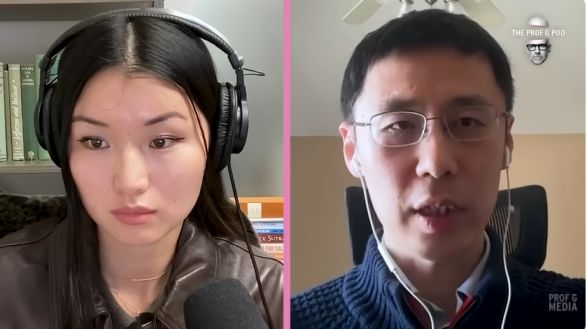
Editor’s Notes: In this episode of China Decode, Alice Han and James Kynge examine the “stunning” news of a near-total decapitation of China’s Central Military Commission, highlighting the unprecedented purge of top generals and its implications for Xi Jinping’s grip on power. The discussion explores how this internal military upheaval might delay a potential showdown over Taiwan by disrupting operational experience and combat readiness. Beyond military maneuvers, the episode also covers the strategic “spinning off” of TikTok’s U.S. operations and the current state of China’s economy as it navigates weak domestic consumption and record trade surpluses. (Jan 27, 2026)
TRANSCRIPT:
ALICE HAN: Welcome to China Decode. I’m Alice Han. In today’s episode of China Decode, we’re discussing Xi’s purge at the top and the shock to China’s military command, TikTok after China. Plus, I’ll chat with Houze Song about China’s economic reality. That’s all coming up.
Market Update
But first, let’s do a quick check in with how the Chinese markets are starting the week. On Monday, the Shanghai A share index closed down 0.1%. The Hang Seng eight share index rose less than 0.1%, ending the day slightly in the green despite starting the day down nearly a full percentage point.
Precious metals mining company Zijin Mining Group closed up more than 4% as investors around the world rushed to buy gold and other safe haven assets. And Hong Kong property companies, Hongkai Properties, Hanglong Properties and CK Asset Holdings all rose more than 3% after a Morgan Stanley analyst published a bullish outlook on the Hong Kong housing market.
Unprecedented Military Command Shakeup
But we’ll get right into the first topic. China just detonated the top of its military command. Beijing has placed Zhang Youxia, Xi Jinping’s longtime confidant and the PLA’s second most powerful figure under investigation alongside another top general. This is unprecedented.
For context, Zhang Youxia was vice chair of the Central Military Commission or CMC, which is both a state and party organ that oversees China’s combined military. So the near total decapitation of the Central Military Commission leaves Xi effectively alone at the apex. The move signals extreme insecurity at the top and raises real questions about cohesion, readiness and Xi’s grip on power.
ALICE HAN: James, there’s so much to discuss. I want to throw it straight to you. What were your takeaways from this incident over the weekend?
A Stunning Development in Xi’s Tenure
JAMES KYNGE: Yeah, well, first of all, my first takeaway was wow. I mean, this really is, I would put it in the category of stunning news coming out of China. I think it’s certainly in terms of shock value, it’s certainly the biggest, the most shocking piece of news that I’ve seen in Xi Jinping’s tenure that started way back in 2012, 2013. I’m not saying it’s the most consequential piece of news, but I think it is. It did shock me more than any other.
The other important thing to say, I think, is about Chinese elite politics, and that is that it is a complete black box. When things like this happen, when a really big event like this happens, we get all kinds of interpretations and rumors flooding across social media and in the media all over the world. And I think, therefore, the important thing at times like this is to not exceed what we know for sure.
I can honestly say in more than 35 years of China journalism, and 18 of those years were in China itself, I think I only knew one Western journalist who could count on regular sources at the very top echelon of the Chinese Communist Party. I’m not saying that there weren’t others that I didn’t know that had that kind of access, but that kind of access really is extremely rare.
What We Know For Sure
So what I would say at this moment is, these are the bare facts of what we know, according to the official Chinese media, that Zhang Youxia, who was vice chairman of the Central Military Commission, which as you’ve just said, Alice, is the premier body in charge of China’s army, navy and air force. And this guy Zhang Youxia was China’s most senior uniformed officer. He has now been placed under investigation.
And when an investigation is announced like this in China, you can be pretty much sure that your fate is sealed. It’s not a case of you’re going to be found not guilty by the legal system. You are going to be taken down.
We can say that pretty much for sure. Part of what he is charged with was corruption. But that’s not so interesting because frankly, there have been hundreds if not thousands of cases of corruption in China’s military going back over the last decade. The really fascinating line or phrase in terms of what he is being investigated for was that he had, quote, severely trampled on and damaged the chairman responsibility system. Effectively, what that meant is that he had gone against Xi Jinping politically in some way. It could have been anything from disobedience to treason to plotting or something else. We just don’t know exactly what that means.
The chairman responsibility system, though, is absolutely clear. That is that the chairman of the Central Military Commission, which as we’ve just been talking about, is the top military body, commands all of the Navy, the Army and the Air Force. And this person has exclusive and supreme authority over the whole of the People’s Liberation Army. In other words, whatever Xi Jinping says goes in the Chinese military. He has the final say. And it was this that General Jiang trampled on and damaged.
Just as a little follow up, there was another senior military official called General Liu Jianli, who was also put under investigation. And he was also a member of the Central Military Commission, which previously had seven members and now only has two, Xi Jinping and another man called Jiang Shengming.
The Scale of China’s Military Power
Let me just give a few metrics on the People’s Liberation Army because it really is huge. The PLA has over two million soldiers and four million if you include paramilitary and reserves. The PLA Navy has the world’s largest navy with over 780 ships and vessels. And the Chinese military has around 600 nuclear missiles, including those that are launched by land, sea and air. And some of these missiles are powerful enough to reach the entire territory of the United States.
Like I say, I don’t want to exceed what we know. But what seems to be the case here is that we have one man in charge of the world’s largest military. And this military is obviously a rival to the US and to other countries in the West. I’d leave it at there, Alice, and throw it back to you for your take on this. I mean, you know, it is complex, obviously, and it’s delicate as well. What would you say?
ALICE HAN: Extremely delicate. I definitely agree with you on that front, James. And it’s funny, I highlighted the same section because I think the wording of it is so precise and so idiosyncratic. The wording of, you know, trampling on the responsibility system of the chairman of the CMC. That is wording that I haven’t seen in previous investigations of other generals that have been purged.
Historic Scale of Military Purges
We’ve had a total of 17 generals purged in the PLA since Xi Jinping came to power in 2012. That is the largest purging at the general level since Chairman Mao. And that is a significant indication of his not just anti-corruption drive through the military, but his unhappiness potentially with the loyalty and unity of his generals.
Now, I suspect, as you do, James, that this is a personal matter. What is interesting to me is that Zhang Youxia, he is a brother, not in a literal sense, but a brother in the sense of coming from the same hometown, Shanxi, to Xi Jinping. Their fathers were comrades who fought in the civil war in the 1940s in China and were also Shanxi natives. So this is a guy, General Zhang, who has been a long time childhood friend and close ally to Xi Jinping. Xi Jinping kept him around after 2022, even although General Zhang had already reached the retirement age. He was 72 at the time because he believed he needed a close confidant ally in the military.
And so Zhang was effectively the second in command at the CMC. The CMC is the Central Military Commission. Just for context, it is both a state and a party organ that oversees both the PLA, People’s Liberation Army, as well as the police, the People’s Armed Police and the militia. So this is an extremely important decision-making body that has the powers to decide the military operations, procurement campaigns, and would be completely germane in a Taiwan context, which I’ll get to in just a bit.
The Factional Reading of Military Purges
My reading of this, James, and I wonder if you had similar theories, is a factional reading, which is when I look at the configuration of the seven members of the CMC, five of them have been purged. The only two remaining are Xi, who is the chairman. Xi Jinping remains the chairman, as well as his number two now, who was the anti-graft guy at the CMC. And this guy, Zhang Shengmin, he’s still around. The other five have been eliminated.
And the other five were largely, I think, evenly divided between two factions. There was, on the one hand, the Fujian faction of generals who largely came from the Fujian region. So He Weidong, who was ousted a couple months ago back in October from the party as well as the PLA. He was also a co-vice chairman of the CMC. He was in a rival faction to Zhang Youxia, who was the Shanxi faction leader and potentially led the Shanxi faction within the CMC and the PLA.
All this is to suggest, I think, there was a balance of power. Xi Jinping decided to get rid of one of these rival factions, the Fujian faction, by getting rid of a lot of these generals. He then realized that his longtime friend Zhang was way too powerful, because he was effectively the only general left standing of weight and standing in the CMC, and decided to take him down as well after he must have crossed him personally, hence the wording of the PLA party readout, as well as the People’s Daily readout about the investigation.
So we don’t know the details, but I’m very skeptical that the Wall Street Journal is correct in their line, speculating, for instance, that it could be secrets leaked to the US, nuclear secrets. I’m skeptical of that. The Chinese PLA and government don’t have a habit of leaking high-level nuclear secrets in this regard. I think it’s much more personal, and I think it was a decision to have a complete clean slate of the CMC going into the 21st Party Congress, which is in 2027, when Xi will have to bring in more people to replace the empty chairs.
Implications for Taiwan
That materially, and this takes me to my conclusion, which is materially it matters for the timeline and probabilities of Taiwan, because right now that he’s gotten rid of his most experienced military commanders and generals, he doesn’t have the operational experience or combat readiness now to go in and take Taiwan, let alone do a quarantine or a blockade. So I think this probably delays a Taiwan showdown for the next couple of years.
But my concern, and I saw that Bill Bishop had this view, too, of cynicism. My concern is that if we look to beyond 2027, and the new generation that you got, so to speak, of generals, might we end up with an outcome in which we have wolf warriors in the CMC and the PLA that are going to be much more bellicose and ready for a Taiwan showdown. That is my concern.
But I think, markets shrugged it off, the CSI 300 was in the green today. It’s not an economic, I think, issue, but it certainly is a military geopolitical issue, and at its heart a political issue about Xi Jinping’s security and longevity as the president.
Consolidation of Power and Succession
The second thing that I’ll end on is that I certainly think that this further reinforces his power, and it delays any talk about a succession, because he’s effectively wiped out any contenders for that role. Yes, I would agree with that last point.
And just coming back to the Taiwan question, I mean, I have also read the idea that this could make China less likely to launch some kind of military adventure against Taiwan, you know, in the near-term horizon. And yeah, I mean, you know, that seems to be fair as an analysis, but I just feel that we know so little about how decisions are really made in the Central Military Commission and at the top levels of the Chinese Communist Party that it’s a bit of a leap even to have an interpretation like that. I mean, it could equally well be, it seems to me, that if Xi Jinping is the only man in charge then, and he wants to launch a military adventure against Taiwan, then maybe he gets his way. So I think you could read that both ways.
I think the only takeaway that I have from this whole thing that I’m sure of is that the opacity of the system is the risk. The opacity of China’s political system, and particularly the military decision-making system, you know, it being a complete black box is a great risk for us in the West because we just have no way of tapping into it. I don’t think any government around the world, including the US, has regular high-level contacts with the People’s Liberation Army or any other military body in China. And so to me, that is the key risk here, and it’s just so hard to know how to call it.
I also saw that the price of gold, I think today, went above $5,000 an ounce. I’m not sure if that’s connected to this either, but that may be a bit of a stretch. But I must say, you know, we so rarely focus on military issues. This one came out of left field, as it were, but I’m glad that we’re focusing on it today because it is one of those sort of lurking risks in the Chinese system that, now that it’s come to the fore, I think it at least deserves a good look at.
Yeah, certainly. I think the gold story might be more associated with American waning influence and dollar weakness. Maybe it’s a risk-off attitude that people have to US assets.
Historical Parallels to Mao’s Purges
To sort of add to what we were discussing about power and the military, I think it can’t be overstated how important this is and how – I hate using this word, but I have to use it – unprecedented this is in modern Chinese history. I don’t think I was looking back into previous episodes of this, going as far back into the 1940s, and the only other real analogue is what happened during the Great Leap Forward, as well as the Cultural Revolution, with two key generals, Peng Dehuai and Lin Biao, who were both really close to Mao Zedong but were effectively purged and killed. This was, again, succeeded by a massive purging of the PLA by Chairman Mao.
I think history is repeating in certain respects. My big takeaway is that this suggests that Xi feels insecure about the combat readiness and about the loyalty of the military advisers and guys around him. This should be seen as a sign of weakness, at least from my perspective, but certainly, to your point, James, is going to be really, really crucial in terms of the Taiwan probabilities and Taiwan scenarios. I think we may disagree there. I think it probably gets delayed by a couple of years, but certainly we need to keep our ears to the ground in terms of seeing who comes in as the new god.
Yeah, absolutely. I was also thinking about Lin Biao. I mean, you know, he was purged after he attempted to assassinate Chairman Mao by sabotaging the train that Chairman Mao was riding on in the early 1970s. So, you know, this type of thing does happen in China and I think most of these stories we simply never hear about. So you know, that’s my kind of payoff line in this.
The system is so opaque that it really is so hard for anyone to find out what the true situation is and what the true stories are behind, in this case, the downfall of Jiang Liu Xia, Xi Jinping’s old friend and comrade-in-arms, as they say.
SPEAKER: Yeah, exactly. Okay, we’ll be back with more after a quick break. Stay with us.
The TikTok Deal
ALICE HAN: Welcome back. After six years of bans, court fights, and superpower brinkmanship, TikTok finally has a deal. ByteDance is spinning off a new U.S. TikTok controlled by American and non-Chinese investors led by Oracle and Silverlake, just in time to avoid a congressionally mandated ban. The agreement is meant to sever Beijing’s influence, safeguard user data, and settle national security fears.
Well, James, this is a big victory for ByteDance and TikTok, and I would say Trump, who was definitely in support of this deal.
Effectively, it creates a joint venture structure, which is funny because you often hear about this in the Chinese context, but here we are in the new age where the U.S. is mimicking aspects of Chinese industrial policy. So effectively, this joint venture allows TikTok USA to subsist in accordance with American rules. This is a big victory, I think, for both sides. What is your takeaway from this?
JAMES KYNGE: I would say it’s certainly a big victory for ByteDance and, as you said, probably for Trump. But to me, the really key issue here is, have the risks to the American people been truly expunged? I mean, does this really mean that ByteDance’s control, especially over the TikTok algorithm, has been severed or not? And I think, you know, obviously it’s a crucial topic. I mean, TikTok has more than 170 million users in the U.S. and it’s no longer just young people who are looking at TikTok. Even oldies like me, I think, according to the latest statistics, are all on TikTok, glued to TikTok.
ALICE HAN: Are you using TikTok, James?
JAMES KYNGE: Yeah, you betcha.
ALICE HAN: What are you using it for?
JAMES KYNGE: I have a bit of an addictive personality, it turns out. I’m finding out rather late in life. I just scroll, doom scroll through TikTok the whole time, you know. There’s all kinds of things, food, animals, pets, all kinds of stuff that I’m looking at.
The Algorithm Question
So the question to me is, has ByteDance’s control over TikTok been reduced or severed? And I would say it’s been reduced. In fact, I would go a little bit further than that. I would say that this deal effectively means that the ownership of the car that is TikTok in the U.S. has been given to a U.S. company, this joint venture that we’ll get into in a minute. But the engine of that car remains in the hands of a Chinese company called ByteDance. When I say the engine, of course, I’m talking about the algorithm.
So just a few bare bones of the deal. So ByteDance transferred the majority of its U.S. operations to a new entity. That entity is called TikTok U.S.D.S., Joint Venture LLC. And that company, the joint venture, is led by Oracle, Silverlake, MGX. All of those are American companies. They hold over 80 percent of the ownership of the equity in that joint venture. But ByteDance owns 19.9 percent. So the Chinese company remains a pretty significant shareholder.
Now, the really important thing, I think, about these companies, and in the case of the TikTok U.S. joint venture, it is also the most important thing, is the algorithm. The TikTok business is nothing without the algorithm that underlies it. And although Oracle is now responsible for securing the data of American users and overseeing the retraining of the recommendation algorithm using American sources, you know, so American data will be used to retrain the algorithm, the control of the algorithm will remain in the hands of ByteDance. And it will lease the algorithm to the American joint venture, TikTok joint venture. And it will get payments for that of around 20 percent of the American entity’s revenue.
So this, to me, means it is ByteDance that remains in control of the algorithm. That’s the key point, because it means that presumably ByteDance can tweak the algorithm any time it wants without informing the U.S. entity. And it gives ByteDance an operational relationship with the company in the U.S. Do you see it like that, Alice, or am I being too kind of reds under the bed about this?
Economic Interest vs. Security Concerns
ALICE HAN: No, I have a similar view, but I would delineate it this way. I would say that Trump and his coterie of billionaires have put economic interest above the interest of everyday American state of security and privacy. The reason that, Pafaka, the act was put into place was because people in Congress were scared that this tool, ByteDance, could be used to spy on everyday Americans. It could be part of a political interference or surveillance campaign. Now, we don’t have evidence, I think, to fully corroborate those views.
But if you’re an American congressman, I think you’re looking at this deal and thinking it solves none of the issues, the national security, data security, privacy issues that we have conveyed and voiced. And ultimately, it rewards the billionaires who now have a seat at the table and can milk this cow for all it’s worth. That is my view. And this is why I think ultimately the Chinese and ByteDance see this as a victory because they’ve been able to keep the algorithm, which from day one was a key national security priority as per their data transfer laws. But at the same time, it benefits Trump because it’s a great political platform for him. It benefits the billionaire donors around him who now have a seat at the table, have equity in this joint venture. So I agree with you, James, but I would frame it somewhat differently. And I think it then begs the question, what happens to these other Chinese apps that are not considered the political golden goose for Donald Trump?
You know, when we think about Xiaohongshu, which is Red Note in the West, or we think about Taimu or XIN, some of these other platforms, Chinese platforms in the US context, are they up for a similar kind of regulation? And what is interesting is that this creates this TikTok USA joint venture framework, I think creates a template for future deals potentially that is somewhat similar to what we saw historically with Western companies going into China and signing joint ventures. They can, if you recall, James, back in the day, they could never own more than 50 percent. That was the whole point of a joint venture. And they had to partner with a local Chinese company. That is happening now in the reverse, but still the Chinese have all the cards because to your point, James, all they’re really sacrificing is the data security, which is going to be stored locally.
But there, I mean, I talked to any all kinds of data experts or national security experts. There are all kinds of backdoors that they really wanted that data. And secondly, it’s the algorithm that is the most of interest to the Chinese government. One thing that I will end on is Project Clover in the EU and what the EU is going to do. I think the EU is watching this. I’m not sure, maybe you have a better view, James, what the EU is going to do to regulate ByteDance. But the EU has the same concerns I think the Americans have had towards ByteDance from a national security, data security perspective. I’m not sure if they’re going to get the act together and enforce that in the way that the Americans have done. But that remains to be seen. What do you what’s your thought?
A Pandora’s Box for Chinese Tech Companies
JAMES KYNGE: No, I think that’s such a good point. I think this opens a Pandora’s box for virtually any Chinese tech company that’s collecting data in foreign markets. This sets a template or at least an example of what might be done, what should be done, what could be done in order to increase data security that these Chinese companies are collecting either in the US market or the UK or European market or anywhere else in the world. And I think it’s so right of you, Alice, to point to what Western companies had to do in China. And for me, the main example was the way Apple in 2018 had to transfer its mainland Chinese iCloud user data to a joint venture called Guizhou Cloud Big Data that was situated in the southwestern province of Guizhou.
And at the time, I think, you know, we all wondered why that was happening, why that had to happen. And it’s purely because the Chinese state wanted to be sure that Chinese people’s user data was not going to be used by Apple and taken abroad. It wanted control over the user data and it seems to me that if you’re a Chinese car company working in Europe, let’s say BYD, you’re collecting data.
If you’re a Chinese internet company like Shein or the other ones, even Alibaba and AliExpress, you know, you’re collecting data. So many Chinese companies are collecting data around the world. Surely there has to be now some thinking that goes into the security of the data that they collected and whether or not they need to set up joint ventures to allow authorities to ensure that let’s say European data stays in Europe, doesn’t go back to China and vice versa for the US. So I think this is a big moment in the treatment of the data that Chinese companies are collecting abroad.
Now paradoxically, this may be seen as a barrier to entry by Chinese companies into Western markets. But maybe it’s one of those things that once it’s overcome, actually smooths the entry of those companies into the European, US or other markets around the world. So it’s a big topic. I think this will run and run for the next few years.
Definitely. And I mean, we’re just scratching the surface because if you think about it, with the Internet of Things, with embodied AI, you know, humanoid robots using world models and spatial intelligence, and then we get into the realm of autonomous vehicles collecting real time data on the streets and geolocation data. There are so much more data out there to mine and Chinese companies are just scratching the surface.
We’re just seeing one instantiation of it, which is social media. But it’s only a matter of time where we see Chinese companies come in and do autonomous vehicles, humanoid robots in Western markets. And I sense that there’s going to be a bigger public debate in Western economies about how you regulate the data associated with those companies. So I think we’re just in the first innings of a global reframing of Chinese companies, you know, going global in terms of collecting data and using data.
Okay, let’s take one last quick break. Stay with us.
China’s Economic Strategy at Davos
ALICE HAN: Welcome back. As the U.S. openly turns its back on globalization and leads harder into tariffs, China is pitching itself, at least rhetorically, as the grown-up defender of global multilateral trade, even as its own economy shows real signs of strain. Joining us now to talk with us about this is Houze Song, China economist and director of China research at 22V Research. Houze, thank you so much for joining us today and welcome to China Decode.
HOUZE SONG: Thank you for inviting me, Alice.
ALICE HAN: I wanted to start with something that is topical this week, which is Davos. I think a lot of attention was paid to both the Trump and Carney speeches. But the day before Trump came to speak at Davos, we had He Lifeng, Vice Premier He Lifeng, who is the trade and economics are talking about China’s position in all of this. He was critical of the, quote unquote, “tariff style law of the jungle” and seemed to defend the WTO liberal trade order and multilateral institutions like the WTO and IMF.
This is coming at a time where we’re seeing record Chinese trade surplus around 1.2 trillion last year. And it seems like China will not be escaping this manufacturing led growth. So how did you interpret that speech and China’s trade and economic policy going to 2026?
HOUZE SONG: I would say in terms of what they have been saying, the message has been pretty consistent. For example, if you compare Vice Premier He’s speech with the speech President Xi gave before the pandemic of 2018, the message, especially the part on the global order and global trade systems are basically essentially the same. So the signaling from Beijing has been pretty consistent.
On the other hand, in terms of what they have been approaching and also China’s trade policy, it has been quite different compared to, say, eight years ago when President Xi made his speech during the Davos. For one thing, China was essentially running a balanced trade back in 2018. China’s trade surplus was less than one percent of GDP. In contrast, last year China made a record $1.2 trillion trade surplus. And that part of it reflects Beijing’s basically manufacturing first economic policy, but also a greater part probably has to do with the fact of weak domestic demand.
China’s Consumption Challenge
ALICE HAN: And do you think going into 2026, we’ve got the March NPC, the Lianghui, as well as the new 15th five-year plan, that that strategy of, as you were alluding to, using trade and manufacturing to drive growth will shift? Or is China still wedded to this strategy in the midst of, I would say, still pretty weak consumption growth? And if you could also describe to us why has it been so difficult for the Chinese government to try to boost consumption, even though it does identify it as a key economic problem?
HOUZE SONG: I would say, especially in terms of weakness, Chinese consumption weakness, there’s both a cyclical component, there’s also a secular component.
The secular component being that historically the share of income in China that goes to the household sector is much lower than other compared to other major economies. And also on top of that, there’s the ongoing cyclical adjustment, basically triggered and amplified by the ongoing real estate hard lending. So as to why the Chinese central government not providing more help to the household sector and the economy broadly, there are a couple of reasons. The first is that the China’s central government’s priority, in terms of their priorities, growth is no longer the top priority. Growth is probably, at best, secondary. So, for example, China’s long-term growth targets through the year 2035 basically implies that Beijing is aiming for an average growth rate of 4% point for the next 10 years. And on top of that, basically the ongoing US-China tension means that Beijing needs to double down on its strategy, manufacturing a technology-first strategy to pursue tech independence, to reduce reliance on both U.S. and as well as Western technologies.
So I think while that the current, that U.S.-China relationship is expected to be broadly stable this year, but probably most people as well as Beijing believes that this more likely to be transitory, meaning that Beijing still needs to aggressively push for its tech independence initiative to prepare the longer-term potential conflict and confrontation with the United States.
ALICE HAN: Yeah, I want to touch on that aspect, the tech self-sufficiency in just a bit, because there is an argument that that drives some of the anti-involution campaign because it’s created an oversupply in certain goods that has led to price deflation. But before I go into that, I wanted to touch on the property sector, which you alluded to. We’re probably five years into this slump in the property sector. Now, there’s a debate as to whether it’s a hard landing or a soft landing, but what is clear, and I think you’ve mentioned this in multiple instances in the past when we’ve spoken, is that there is a macro knock-on effect of the property sector on consumers, on household spending.
How do you think about it now that we’re five years in, the impact of the property sector on households and their spending patterns? And number two, do you expect that there will be some kind of policy support going into the March NPC in response to continued double-digit negative contraction in the property sector?
HOUZE SONG: Good question. I would say that first, that in terms of interplay between real estate and household expenditure, there has been some shift, being that initially, like 22 to 23 period, that you can say basically that real estate decline was a trigger or was a cause of weak household sentiment as well as expenditure. But more recently, I would say that the ongoing real estate property weakness, probably more a reflection and outcome of the broad growth weakness rather than a cause.
Weak Job Market Drives Consumer Weakness
The being that I think that currently that really the root cause of a weak household consumption is really the weak job market, both that the unemployment rate being elevated and also the fact that the job security that, for example, close to a third of Chinese urban workforce are essentially gig workers. So basically, they’re really not very sure that they will still have a job, say, in two months or three months from now. I would say that right now, it is really the labor market weakness, especially this feeling of insecurity, probably has a bigger role in terms of limiting Chinese household expenditure.
ALICE HAN: And is it the case that we’re going to see maybe more slackness in the labor market moving forward if you expect that AI will continue to decrease the demand for some of these gig workers or even graduate students entering the job market? There’s a lot, I think, of apprehension amongst new grads. We had a record 11 million last year going into the workforce. There’s apprehension that they might not be able to find jobs in an economy that is slowing down and where jobs are increasingly getting automated or replaced by AI.
How do you see that debate play out in China as being distinct from what we’re seeing in the US?
HOUZE SONG: I would say comparatively speaking, the balance is much more in favor of technology and the capital compared to labor when it compares to, for example, debate and also the public opinion in US and other Western countries. There has really, the Chinese government doesn’t seem to really take into the job effect of AI and automation into considerations when they draft those AI and robotics-related policies. And I would say that actually they are much more encouraging about the AI and the robotic and its economic impact. So that’s kind of like understandable because it seemed to me that really that the technology advancement, especially how it helped to China to boost its international standing or also its national security position probably at this moment matters more for the Chinese government than really gross job.
Looking Ahead: The Five-Year Plan
ALICE HAN: And to zero in on this more concretely, what are your expectations in the new five-year plan for 2026 to 2030? And if you’re advising investors or people following China closely, what are these sort of green shoots or hotspots in the economy or even in the financial markets that you think we should be following in the next five years?
HOUZE SONG: I think Chinese government is clearly double down on its advanced manufacturing and technology initiatives. I think that’s fine. As long as they’re also taking care of the broad weakness of the Chinese economy, I don’t see there’s a fundamental tension between pursuing both initiatives that they are on the one hand, just for example, either through providing more income transfer to the household or other means to boost the overall economic growth as well as job creation. And on the other hand, they can continue to find those manufacturing initiatives. There’s really no fundamental tension between those two initiatives.
So the surprise is really not that they are doubling down on manufacturing. The surprise seems to most people, myself included, is that they continue to be very reluctant to really to stimulate the economy, to reflate the Chinese economy.
Investment Implications and Market Valuation
HOUZE SONG: I would say in terms of investment implications, one is really the, I would say the most clear implication is the relevance for the Chinese equities. Basically since late 24, that Chinese equities has enjoyed a pretty solid rally that the eco-weighted A-shares has been basically up by close to 50% since late 24. And in the meantime, the curious thing is that the fundamentals of corporate earnings has not improved much. So as a result, basically what suggests the much more expensive valuation, the PE ratio of Chinese equity indicate that the investors have taken a categorically more optimistic view about the outlook of the Chinese economic future.
I think, but the next step question is really that whether the coming year, the Chinese economy performance can validate or disprove this, the current quite optimistic expectation investors already price in. Here I see really kind of like risk or tensions between the fact that on the one hand, the Chinese government continue to be very reluctant to stimulate the economy. And on the other hand, the Chinese equities being at a really historically high valuation level.
ALICE HAN: And I think I share your view on this, that there has been a reluctance to do fiscal and monetary stimulus. We saw that in 2025. Now you could argue that, especially in the first half of the year, they did this to reserve the firepower if tariffs got really bad, but even then they were reluctant to deploy that in the second half of the year.
Thank you so much for your time, Houze. This is an increasingly important subject. I know everyone’s focused on Davos, but we’re in a sprint until March where key decisions will be made in the second largest economy in the world. So thank you so much for sharing your time and insights.
HOUZE SONG: My pleasure.
Prediction Time
ALICE HAN: All right, James, you know what time it is. It is prediction time. As you peer into the future this week, what do you see?
JAMES KYNGE: My prediction this week is in more of a general vein. I don’t have any specific numbers or statistics that I’m going to throw at you, Alice. I would just like to say that I think that in relation to our previous conversation about the way in which the US is trying to control data that Chinese companies are collecting in the US, we’re going to see a very similar effort in the EU this year. That’s the European Union. In fact, I would say that 2026 will be a landmark year for the European Union led by the European Commission strengthening resilience against foreign cyber threats. And that includes all types of Chinese technology. I think we’re going to see this in many different areas, including cars, including cellular modules, including wind farms maybe, and some of the other areas in which Chinese companies collect data throughout Europe. That’s my prediction. What about you?
Alice’s Prediction on Chinese Tech Companies
ALICE HAN: James, just cheekily I’d say, I do feel very sorry for the Europeans because if you recall back a couple of years ago with the PRISM scandal during the Obama administration where European data were transferred to American authorities without European permission, and that obviously caused a bit of fracture in the transatlantic relationship. Now they’re going to have to go through it all again with China and it’s going to be even more complex. So I do feel very sorry for the Europeans.
So my prediction is following up on a previous prediction I made about Chinese tech companies moving more to Singapore to Singapore wash or at least de-sinicize their companies in order to go truly global, get global investors and have more of a global reach in terms of marketplace. This is prompted by the Chinese cyber administration now looking into Manus and whether or not the Manus meta deal basically meta buying Manus violates Chinese tech transfer laws. And I have a sneaking suspicion, although I’m not entirely confident, that they may try to kill this deal or delay this deal, because this is an AI company. I mean, it does agentic AI, so it’s not directly national security dual use related. But I sense that with AI getting even more charged as a topic in China domestically, there could be some spanners in the works, so to speak, for META, and mainly because I think it’ll make Mark Zuckerberg’s life a little bit worse. So let’s see if that actually happens.
All right, that’s all for this episode. Thank you for listening to China Decode. Make sure to follow us wherever you get your podcasts so you don’t miss an episode and talk to you again next week.
Related Posts
- Andrew O’Donohue’s Graduate English Address – Harvard Commencement 2026 (Transcript)
- Zohran Mamdani’s BMCC 2026 Commencement Address (Transcript)
- ‘I Am The Son Of Immigrants’: Astronaut Jonny Kim At Harvard Alumni Event (Transcript)
- Hamza Masoud’s Speech: Harvard Class Day Ivy Oration 2026 (Transcript)
- Daniel Pink 2026 Commencement Address: Columbus College of Art & Design (Transcript)