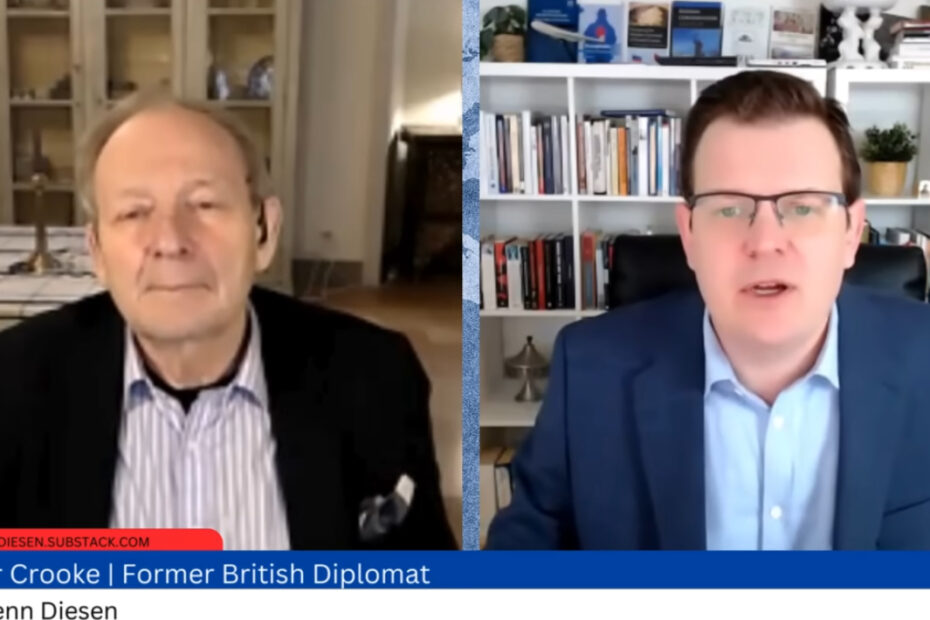
Editor’s Notes: In this insightful interview, former British diplomat Alastair Crooke joins host Glenn Diesen to analyze Iran’s strategic response as the war against Iran enters its third day. Crooke explains how Iran is meticulously targeting American military bases and radar systems in the Persian Gulf to systematically degrade US and Israeli capabilities and eventually evict the United States from the region. He further discusses the profound miscalculations regarding the assassination of Supreme Leader Khamenei, arguing that rather than triggering a regime change, the move has unified Iranians and ignited massive anti-American protests across the Middle East. Ultimately, the discussion explores how this conflict is forcing a radical shift in the global geopolitical landscape, potentially signaling the end of Western military hegemony in West Asia. (Mar 2, 2026)
TRANSCRIPT:
GLENN DIESEN: Welcome back. We are joined today by Alastair Crooke, a former British diplomat and negotiator who worked for decades on conflicts in the Middle East. He’s also the founder and director of the Conflicts Forum. So make sure to read his Substack and I will leave that link in the description. So thank you very much for coming back on.
ALASTAIR CROOKE: It’s always a pressure. You don’t have to, you don’t have to ask.
Iran’s Military Strategy: A Phased Approach
GLENN DIESEN: Well, we are now way into the third day of this war against Iran and Iran is retaliating in a big way. If you look at Iran’s strategy or structure, how do you read it? Do you see the retaliation organized in phases or is it planned properly, or how do you make sense of this?
ALASTAIR CROOKE: Yes, I mean there are two sort of separate components to it. But the first component, largely because of the array of missiles that they have in their possession, was always going to be — and I think I may have said this at times to you — the main focus was always going to be on American bases in the Persian Gulf area. And why I say it depends on the array is because they can be reached. They have a large stock of drones, a big stock of drones and short range missiles, missiles that can’t reach or easily reach Israel. So it made sense, if you like, to focus to begin with on the Gulf, on the American bases.
Ali Larijani has emphasized again that this is not an attack on the Gulf states per se, but on the American bases and CIA facilities that take advantage of Gulf states to pursue their conflict against Iran. So that was one element.
The second element is likely related and has three phases. The second element, which is more focused towards Israel — of course, the first component of this is attacking the radar systems, the radar systems that allow America and Israel to see into Iraq. And they’ve done that, taking out major radar bases in Gulf states, in Qatar and in other places, in Bahrain too I think, I can’t remember, but they’ve taken out a large number of major radar sites belonging to the Americans in the Gulf states.
So the first exercise is focused on the radar, which also incapacitates or limits — it’s not incapacitates perhaps — Israeli missile systems and their attack on Iran. And then the second phase is to continue to use older missiles and drones to draw out and to deplete the Israeli air defense intercept capability, to wear it down, to reduce it to the minimum.
And you can see that — I mean this is pretty obvious. You’ve probably seen the videos, or anywhere you can see the videos of Israeli strikes into Tehran, although now they’ve moved to the faster, into the higher, more sophisticated missiles in some cases. But you can see that the Israelis are using huge numbers of intercepts against each single incoming strike and missing, mostly missing. So you see easily 8, 10, 12 used against every arriving missile strike.
Depleting Gulf State Air Defenses
So where we are now is at this sort of stage. Stage three: the Gulf states have almost exhausted entirely their ADAPT system. So there are signs — you can see Iranian drones, they fly freely over Dubai and other sites. They have used all their air defenses. And so the Iranians can at their leisure destroy, continue to destroy American bases. And they are destroying American bases to a very large extent.
I think they’re evacuating a number of bases — I don’t know exactly which ones — but they’re evacuating bases, particularly in Bahrain. In Bahrain, there’s been huge damage done to the facilities of the Fifth Fleet, the US Fleet.
But going back then to the phases: with Israel, the aim is to use older, slower missiles to deplete their intercept capabilities, and then the next phase — the next stage of the plan — is to move to the more modern and more sophisticated and faster missiles. I think they say — and I’m not a military expert at all, not at all — but they say that the air defenses of Israel can’t cope with anything above Mach 4. So anything that’s faster than Mach 4 is not likely to be intercepted. And of course hypersonics are moving much faster than that.
So eliminating those, reducing those, is the priority. And then the third stage that the Iranians have — and we don’t know anything about — is that they say they have new weapons. I think we have had a glimpse. I don’t know if it’s all of their new weapons, but we have seen now a hypersonic missile with multiple warheads arriving. Certainly, while I don’t know if there’d be more than that, there have been new weapons because we haven’t seen them with sort of cluster warheads before, to my knowledge at least. As I say, I’m not a military nerd, I may be wrong, but I think I’m pretty much right about that.
The Broader Strategic Objective: Evicting the U.S.
from the Middle East
So that’s essentially the plan. And the objectives of it, really, ultimately I think are to drive the United States out of the Middle East, which is underway. I’m not sure that, as things stand, if it continues in this way, the United States will be able to keep their presence, maintain their presence in the Gulf states. I mean, they are being hammered by these drones only.
And I think the second element, of course, with Israel is to degrade the Israeli military capacity such that it can no longer really threaten Iran as it has done — to degrade it sufficiently that it is no longer a threat to Iran.
I think the other objectives are to impose a price on the United States and on Europe, an economic price. And the economic price is the price that comes from the closing of the Strait of Hormuz. Well, they’re not entirely closing it, of course. I mean, because what they’re doing is allowing vessels from states that have not been complicit in the attack on Iran to pass — Chinese vessels, for example, pass without hindrance — but not vessels of the United States or vessels from states that are associated with large American bases in the area.
Geopolitical Realignment and Energy Corridors
So the economic costs are an important element, and I think there’s more to it. I mean, this is my own speculation, I have got no support for it. But in a sense, in the bigger geopolitical picture, we have seen how the United States is taking control — trying to take control of choke points, if you like, seaborne choke points — and trying to control the passage of tankers reaching both China and Russia by attacking and seizing tankers which they say are part of the shadow fleet of Russia or of China, or that are sanctioned in connection with Venezuela, Chinese vessels sanctioned in connection. I mean, what the legal position of that is is beyond me. There’s no Security Council resolution. I mean, this is just again the United States just stating it and doing it willy-nilly without any sort of legal basis. I can’t see on what basis America can claim the legal right to seize Chinese vessels at sea, but they do it.
So I think in this context, what we’re seeing actually is perhaps a retaking of some of the, if you like, the energy infrastructure — that is the energy infrastructure of the Persian Gulf — and perhaps also that whole West Asian area, taking it back first of all under Iranian control, more broadly under BRICS control. So I think it is an element also in sort of maneuvering and reorganizing, and countering the American attempt to dominate oil and gas corridors itself, by showing that the BRICS are going to dominate some of its corridors, of course only in their geography.
Economic Consequences: Energy Prices and Market Disruption
So I think yes, pain is going to be a very important element, and you can see it already. Gas prices — because of course it’s not just oil, I mean gas from LNG, from Qatar and so on — gas prices for Europe have already, I don’t know what they are at this very moment, but they shot up already by 40% overnight, and well over the weekend from that. Oil prices are up substantially and markets are crashing quite widely. So there is a big economic cost as well as a political cost of losing the bases.
The Gulf States: A Permanent Shift?
I do think also — I don’t know quite how you term it or how you put a cost on it — but I don’t think the Gulf states will ever be the same again. You know, they had a certain, shall we call it, a certain Gulf brand, which was markets, AI, hotels, tourism, fun hotels, the easy flyer and airlines, and revenue from airlines — a major contribution to prosperity. I think that this is changing.
I don’t think we will see — because we have telephone calls reaching us from people in Dubai saying, “We want to get out, we want to get out,” and kind of taking taxis across the six-hour desert drive to Oman to catch a flight. I don’t know if they got their flight, but anyway, that is — I mean, some people will stay of course — but a lot of security-conscious Europeans I think will probably move on or take up permanent residence somewhere else if they can.
So I think that’s changed. I think also the question is what happens to the wealth and how they are going to look at the future. I mean, the Iranians have said to them: “You have been attacked because you chose to facilitate Israel and the United States and to have bases and CIA offices on your territory.” In the case of Dubai, which has been attacked — so do they then shift and move and decide they would like to have a different relationship with Iran, and they will prefer not to have American bases in the future? We’ll have to see.
I notice even the British have been warned by Greece that you’re not allowed to use your base for anything but humanitarian reasons. You can’t join in providing defense for Israel and the United States from the Akrotiri base or your other base in Cyprus. So I mean, I think that’s just — it’s not in itself serious — but it’s a harbinger that the change might come, and people would say, “Well, if you’re going to be here, it’s not going to be for military purposes, intelligence purposes.”
A Geopolitical Shift Unfolding
And so all of that — sorry, a long answer — but all of that seems to me to suggest a geopolitical shift, potentially, is unfolding, and that is the intention. And of course, then we look at what might be the case, what will happen with Israel, and of course it’s too early to draw any real conclusions from that.
At that point, then we look at the United States and we can draw a few early conclusions, I think, from that and from the headlines in the US even today, saying that the Pentagon is in panic mode and they are very worried and they think that the whole thing is out of — there’s a risk of the whole of this exercise getting out of control. It is out of control, actually. It is definitely out of control, actually.
They don’t want to see dead Americans coming back, and what are they going to do? And it seems that American officials are scrambling around to sort of change again — what was the justification for this war, and who started it? Was it Iran that started it, was it Israel? It wasn’t us anyway. We didn’t do it. So you can see that already — this is the problem.
And the second one: one is a public relations problem, a presentation problem, and the second big problem is how long will Israel’s intercept capacity last. And my guess is that by Friday, they may be in trouble.
The Killing of Khamenei: Miscalculation and Its Consequences
GLENN DIESEN: Well, on the American side, the strategy appears to not be going well as they had hoped. I was wondering how you interpret — the —
ALASTAIR CROOKE: That’s an understatement.
GLENN DIESEN: Understatement. Yeah. Well, the killing of Khamenei — I was wondering how you see the significance here, because it appears in the American calculation that they would, you know, kill the highest religious authority in Iran and somehow the people would then be liberated and take to the streets and celebrate their American liberators. I’m not sure exactly why this would trigger a regime change or what the calculations were, but how do you assess the killing of Khamenei? What it was, what they hoped it would achieve, but also what is actually happening.
The Killing of Soleimani and Its Consequences
ALASTAIR CROOKE: An incredible error, if you take it on its own merits of what it was supposed to do. A complete error of judgment, which shows how the heat, cognitive dissonance of not understanding who he was or what he meant at all, and just seeing him in the sort of crude terms of Trump calling him and his colleagues thugs and murderers.
And so what it has done — it has done two things. It started a fast stunt around the reach, a real fast game around the reach. New, I’m sure, been seen in the massive protests over the weekend against the American Embassy in Baghdad. The Green Zone is being stormed by protesters. There were protesters attacking the consulate in Pakistan. In Bahrain there may be the first regime change of this whole operation, because between 70 and 80% of Bahrain is Shia and the ruling emir is a Sunni, and he has surrounded himself with a Sunni protective defense of course, and there’d be massive protests and they’re trying to imprison green leaders and stock at. But they’ve been again besieging Bahrain as the state by the protest already.
And then you have this in Iraq with the Gurachis attacking the American air defenses in Erbil and hostile. It is really father everywhere, because he was either the first or the second — depends who you ask — most important in the Middle East, hugely significant as a religious leader, as a scholar and religious leader. And they killed him, murdered him. He was killed in his office at work on Saturday morning.
And it’s pretty clear to me that he actually deliberately chose this. I mean, of course he could have been in some protective place somewhere else. But as he himself said, he is — I made you sick, I’m semi crippled. He said, “I have. The only thing I possess really is my dignity and that comes from you. And so my life is more significant than those.” So I think he just stayed working, and he must remember clearly, given the sort of mentality of the Americans and the Americans that are supporting Israel and of Israel, they would surely come and want to kill him. And he thought maybe that was in the best interest of Iran.
The Deep Animosity Between Israel and Iran
So I do think they completely misunderstood. You open up a very important question, but one which really is probably beyond this program to get into, which is — what are the roots of this deep, deep bitter hatred that exists amongst those elements that were determined that the supreme leader would be killed? Why were they so vicious and against them, and dancing in the streets that he’s dead — not in Tehran but in Tel Aviv?
You know, this is something to do with psychology and western ways of thinking that would have to be explored a bit further. But there was enormous — there is something very deep. But even Yuval, there was a journalist, an Israeli journalist working on the 972 magazine, and she was writing about how she sort of put up a post about the killing of all those school girls with a fire bomb attack that killed many, many school girls in Iran, and how many — she was inundated with hate messages saying “good, we’re pleased.” I mean, it’s really — there is a sort of ugly side to just sort of vicious animosity. Not saying that that isn’t in other parts of the world and other places too. But it’s very pronounced at the moment in this geography between Israel and Iran.
Israeli Intelligence Failures
Anyway, one of the biggest messages that comes out of this, I think most clearly, is that we all have been told how wonderful Israeli intelligence is. The Mossad, so clever technically — when it comes to exploding pagers, maybe they are. But when it comes to understanding the region, how badly they have done — three times in this last period.
They assumed that the whole of Iran was just waiting to erupt against the state, to take it over and to turn it into a pro-Western Pahlavi government. I mean, do they not do due diligence on their analysis? I mean, it’s so — it was so obvious. I mean, I don’t think you experienced this sort of vicious anger against the supreme leader while you were there. I certainly didn’t — it didn’t happen over the years I’ve been in Tehran at all. In fact, mostly they love him, and Rubyheim, and he’s a highly respected person. He’s very humble. As I knew — I went to stay at his house, of course, at one point. Not Iran — I think it’s the one he would probably kill him. I don’t know too sure. Very simple, very, very, very basic. Very simple. Clean, empty house. I mean, he was not a man of potential.
Iran’s Strategy: Evicting the U.S. from the Middle East
GLENN DIESEN: Well, you mentioned now that it seems the main Iranian strategy is to push the United States out of the Middle East — of course hitting its bases, imposing some casualties, weakening the Gulf states, imposing a cost for hosting American bases, going after economic interests, and of course degrading Israel would be a key aspect. But I was wondering to what extent might there be an unintentional — well, let’s call it achievement. That is, how do you see this war impacting the relationship between the United States and Israel? Because this seems to be more tension in this relationship than has been — well, at least in my lifetime.
ALASTAIR CROOKE: Oh, you make a very important and correct point. I mean, it is going to change this whole question. I mean, first of all, the miscalculations that I’ve just been describing — the idea that regime change was sort of likely. And this was the third time after all. There was a decapitation strike first of all in June. Then there were the protests that were supposed to — where militant trained insurgents were put in to give the impression of a state that was collapsing in January. And then now again, they’ve killed and tried to do a second decapitation strike — not quite as extensive, but a decapitation strike — including the supreme leader, in the supposition that this changed the whole state and that it could become a pro sort of ally of Israel.
I mean, really, the Israeli part of it — it’s unbelievable what you see. Gashky statements about how “a new world is opening up before us with the United States on our side,” and that very soon we will have a new coalition working with Israel — a new westernized Iran and India taking on all the radical Islamists from both Shia and Sunni. I mean, fantasy, really. Fantasy.
Trump’s Political Vulnerability
So yes, it is going to affect the United States, because I think Trump is not going to recover from this. I mean, even if he finds — I think it’ll be very hard for him to find an exit, a quick exit, as he usually likes. The Iranians are not open to negotiations — maybe no, thanks, no negotiations. So he’ll find it hard to get out.
And already, I think if you look at the American press, you see many of those in the Pentagon now sort of trying to say, “Well, we warned — we, you know” — avoiding blame, or the retribution that might come back from what will be a humiliating extraction from the dark. They’re already throwing the leadership under the bus and saying, “We told him. We told him that we couldn’t guarantee there would be regime change. We told him we couldn’t guarantee there’d be no casualties. We told him you can’t guarantee a quick in-and-out type that Trump likes. And we told him it wasn’t going to be like Maduro and Venezuela.” So already this is starting to come out.
And so yes, I think there’s going to be political consequences. And I think if you look at the MAGA reaction, they are strongly against the Israeli-first policy and the betrayal by Trump of his repeated promises. He was not here to start wars. He was here to stop wars, and there would be no more forever wars. And it was only in — I think it was May, he was in Saudi Arabia — or was it March? May or March. But earlier this year, he was in Saudi Arabia proclaiming the end to regime change. He said, “There will be no more. That’s over, that era. It failed. It wasn’t successful. There will be no more.” And he said that in Riyadh: “There will be no more regime change.”
So I think there’s going to be quite profound consequences in the United States on this, especially among the base. And the consequences could be very serious, because the popularity for this war was never high, even before we breached this point. It only had something like 21% support, I believe — and switch polar — but the ones I saw was about 21%. Of course, higher support in the Republican Party. But the end of it is, he is likely to lose the midterm election.
I mean, of course, midterms — a week in politics is a long time, and this isn’t until November. But his ratings and everything signal very clearly he could lose the House. But if he loses the House and the Senate, then I think he will risk impeachment or even imprisonment. So it’s very serious from that point of view, and he recognized that. And he said that literally — I’m quoting — he said, “If we lose the House, I could be finished. But if we lose the House, we lose both Houses, then I’ll be in court, and that won’t be pushing.” That’s what he said. Those were his words.
The Future of the U.S.-Israel Relationship
So this carries weight. Now, people will say, “Oh yeah, but the Democrats will come back and they’ll make peace with the Israelis and it’ll all be back to normal.” I mean, it’s early days, but I see something different taking place. I see something slightly different, in that I think even in the Democratic Party, people are saying, “We Democrats, we have to have a thorough discussion about the future relationship of the United States and Israel and how they interact.” Clearly that hasn’t happened yet. You know, it would be wrong to sort of try and guess what it’s going to be. But I think even there, there is the thinking that this will have to be radically reviewed — about exactly how we relate as the United States with Israel. So yes, big changes.
The Legal Basis for War — and the Pentagon’s Betrayal
GLENN DIESEN: My last question is about the possibility of walking this back, or putting an early end to this war. Because — well, first let me say, in regards to what you said about the Pentagon — I thought that was interesting, because if domestically Trump wants to make this legal, I think he has to make the case that this was an imminent threat by Iran, which he had to respond to. But when the Pentagon comes out and tells Congress there was no immediate or imminent threat from Iran, they are literally throwing him under the bus here. It’s — well, and by the way —
ALASTAIR CROOKE: Sorry to interrupt you, just quickly on that point, because they’ve even gone further now. I can’t remember who it was — I think in the briefing to the Gang of Eight — I may be wrong, but I think it was in this briefing — when questioned, American officials said, “No, we have no assessment that Iran will preemptively attack Israel. There’s no assessment that they would preemptively” — of course there was no assessment of any threat to the United States. But they specifically, I think, said in that briefing — and it’s been reported — they said there was no intelligence to suggest, or assessment, that they would attack first.
And quite clearly, the attack by Israel had been talked about at the end of the year and agreed — and even the timing agreed — at that meeting at Mar-a-Lago on the 29th of December. So the legal basis of the action is on very, very shaky ground.
And the language coming out — from I think it was Rubio — saying, “Oh yes, it’s absolutely right. I mean, they’re building ICBMs, they’re going to threaten the United States.” I mean, I don’t think even in the sort of heightened atmosphere of politics today in the United States, anyone believes that, and certainly there’s no evidence of it or work that can be produced.
So yes, the legal grounds are indeed very shaky. And that’s why I say the difficulty is — he has not sought permission from Congress, and he has taken the initiative to kill a head of state without congressional consultation. I mean, I can’t remember the exact times — the Gang of Eight people who are reviewing it are the eight most key congressional leaders of the United States, from both Congress and Senate, from the House and from the Senate — the leaders of the Houses and so on. The eight most senior institutional placeholders get special briefings, classified briefings, which are not available to other members of the Senate or Congress. And it was out of that meeting I am still pleased comments came.
So he is on sh*y grounds, which could easily provide — if they can’t find a better reason — would find, whether it will proceed or not, whether it will be turned down or not — another matter — would be prima facie the basis of —
Trump’s Dilemma: A Quick Victory or a Prolonged Conflict?
GLENN DIESEN: But it seems, based on the previous conflicts over the past year, that Trump’s main approach is, well, he sees the weakness and relative decline of America to be caused by weakness, and he sees this in leaders such as Biden and Obama. So that this, to have a show of strength, go in, don’t get drawn in over a long period of time. So a quick victory, ideally regime change in Iran, but of course, if going to walk away with some other trophy to give him credibility at home, but also to, I guess, strike some fear into other adversaries on the international stage, this would be ideal, but it’s not playing out as he had hoped.
And I think the longer this goes on, the more the advantage shifts to Iran in terms of being able to absorb these different blows and being able to dish it out. But I’ve heard some comments now that, at least I expected, if Trump wanted to put an end to this, he would make statements that, well, the Iranians want to talk. They’re coming to the table. There’s something along the lines to make it.
ALASTAIR CROOKE: Well, he said that. He just said that. I mean, the Iranians want to talk and they got held to wherefore by the Iranians when the Italians brokered, rather broke, a ceasefire.
GLENN DIESEN: But what does this mean then, if Trump wants to put an end to this war? Is it possible, do you think the Iranians would let that happen? Or do they have other objectives they want to achieve before they’re willing to let Trump walk this one back?
Iran’s Distrust and Confidence on the Battlefield
ALASTAIR CROOKE: No, they won’t. They won’t let, they won’t help him out. I mean, first of all, he’s deceived them twice. And this is a long history of deceptions, because the killing of Qasem Soleimani was a deception too. He was coming, he’d been invited, it being all set up. And of course, the Americans knew about it — it was for a discussion about peaceful relations between Iran, I think it was Saudi Arabia or something that was going to be. And he was there on an official visit, coming on a commercial airline, and he was shot down with a missile as the Iranian official delegation was standing at a meeting.
So, I mean, deception after deception have permeated into Iranians’ thinking about how they should behave. And I think they know that they are in the Dragon Sea. There are things that are important that perhaps people are not seeing very much, but it is not going well.
I talked about interceptors, but there are only a limited number of Tomahawks. We keep hearing the talk about, “Oh, Tehran has been bombed badly.” It’s like, well, when people talk about being bombed, they imagine aircraft going over and dropping bombs. That’s not what’s been happening. There are no signs of Israeli aircraft in the Iranian airspace at all. And in fact, what we’ve seen actually are signs of aircraft being shot down. One could have been in Iranian airspace, but three may have been taking off from Kuwait and were locked on by the range F-15s and were shot down. They say it’s plenty far, but plenty far for three aircraft taking off at the same time when they don’t have much up — I don’t know.
Anyway, there are no visible signs up to now, despite the Defense Minister Katz saying, “We’re going to have a corridor, we’ve got air superiority, dominance of the skies across Tehran, we can fly where we want.” There’s actually all of the evidence pointing to the opposite — that they cannot fly back because they are frightened. And obviously things have changed in the last seven months, because Iran seems — I mean, you just take the evidence of drones — all 22 drones that have been flown over, pilotless drones of course, flown over into Iranian airspace, all have been shot down, 22 being destroyed by the Iranians. So something is working, something is working quite well. These were some of the most advanced that the United States and Israel has.
So this means Iran feels pretty confident with the position. Yes, of course, it’s paying a certain price, but then so is Israel, and so they are quite confident they’re changing the geopolitics of West Asia, of the Gulf states.
The Conditions for Any Diplomacy
And so if you say to me, what would it take to start diplomacy again — come on, they’ve been through this, and what end twice? They sat down with, or were about to sit down with the Americans, and they get attacked. I think this is going to have wider repercussions on Russia and Ukraine talks as well — about what is the point of talking with Trump? I’m not saying that won’t happen, but I’m just saying it is going to make people reflect carefully about the whole approach there.
What would they take? Well, I have no idea, and I’m not saying that on the basis of some information I’ve got, but I would say anything less than a complete lifting of sanctions, tariffs, and the return of all the Iranian frozen assets in total, all at once — now, they might consider that.
GLENN DIESEN: Yeah, well, I can understand why the Iranians wouldn’t want to simply put an end to the fighting and wait a few more months for the next attack or the next stage of escalation. So I guess shifting realities on the ground in terms of pushing the Americans back, or ideally out of the region, or getting some proper diplomatic victory — it’s just that’s going to be very hard for the Americans to swallow after 35 years of hegemony and being able to dictate all outcomes, and to simply accept this. It’s —
ALASTAIR CROOKE: Yeah.
GLENN DIESEN: I’m curious.
The Risk of Desperation
ALASTAIR CROOKE: It is, you know, there is a certain risk in this. I mean, I don’t think they had anticipated what’s happened in the Gulf. I don’t think beforehand they thought this was a possibility. But they are sure, and people can do dangerous things or unwise actions when they’re desperate, in those circumstances, and feeling they will otherwise be humiliated. So of course, but what we’re talking about then is splitting a course into territory to which it’s not really sensible to speculate, because it’s not possible to speculate sensibly.
GLENN DIESEN: Well, thank you for taking time out of your busy schedule. I appreciate you sharing your insights.
ALASTAIR CROOKE: My pleasure. Thank you for inviting me on further.
Related Posts