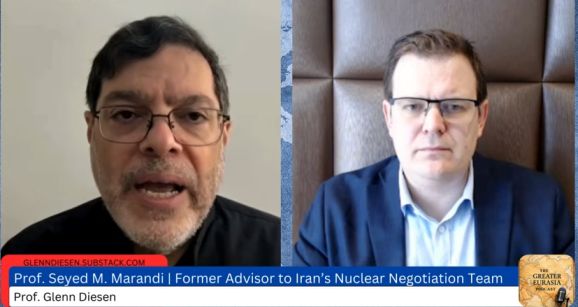
Editor’s Notes: In this insightful interview, Professor Seyed M. Marandi joins Glenn Diesen to dismantle prevailing Western narratives and analyze Iran’s military strategy amidst escalating regional conflict. The discussion explores Iran’s tactical focus on targeting U.S. logistical infrastructure and the profound risks a prolonged war poses to the global energy supply and economy. Marandi argues that decades of U.S. miscalculations have failed to account for Iran’s true military resilience and the strategic depth of its defensive capabilities. Watch this full analysis to gain a rare perspective from Tehran on the geopolitical realities and long-term consequences of the current crisis. (Mar 3, 2026)
TRANSCRIPT:
Introduction
GLENN DIESEN: Welcome back to the program. Today we are joined by Seyed Mohammad Marandi, a professor at Tehran University and a former advisor to Iran’s nuclear negotiation team. So thank you for coming back on the program.
We are now well into the fourth day of this war, and we’re starting to get, I guess, a clear overview over the ability of each side to essentially inflict pain on the other side, but also the ability to absorb pain. I was wondering, what are your assessments of where we are heading and how the war is being fought?
The West’s Flawed Narrative on Iran
SEYED M. MARANDI: Well, thank you very much for inviting me, Glenn. It’s always an honor.
I think that by now it should have become clear to the West, the collective West, the elites in the West, that things are not going as planned. And as I’ve been saying for many months, and as some others, including mutual friends of ours, have been saying for a very long time, the calculations that Washington makes and its allies make is based on a narrative that is inaccurate. And that narrative that is inaccurate and false and misleading — it leads to policymakers formulating policies that ultimately fail and create misery for people across the region, if not across the world.
The idea that the Islamic Republic of Iran is unpopular, that it is collapsing, that it is imploding, that it’s a house of cards, that it’s corrupt — that narrative may make Western leaders and policymakers and journalists in the mainstream media feel good, but it doesn’t reflect reality.
In fact, I did a program on Al Mayadeen last Friday, on a program that I do on a weekly basis called Demystifying Iran. Because of the war, I won’t be doing it this week, but last Friday I did a program that people can watch. In the first few minutes, it becomes clear — I was comparing the narrative on Iran, this forever, imminently collapsing Iran, this narrative of Iran being on the verge of collapse. It’s been ongoing for 47 years.
And I give some examples of the late 1980s and the 1990s and the beginning of the century. If you take those pieces from the New York Times and the Washington Post and put them into today’s New York Times and Washington Post and other outlets, you won’t notice the difference. Back then, they were saying that the revolution has failed. Another revolution is brewing. The youth — this is like 30 years ago — the youth who did not witness the revolution, they are seeking something else. All the things that we hear today in the Western media. The same narrative existed 35, 40, 45, 25, 20 years ago. So it’s always collapsing, but it never seems to collapse.
And you would think that by now, especially after the twelve-day war where they were expecting Iran to fall like a house of cards, you would think that they would rethink those policies. Of course, I don’t think we expected that to happen because we all have a lot of experience with the West.
And of course, when the riots in Iran happened on the 8th and 9th of January, they were reinvigorated and they were saying that the so-called “regime” — they love to call Iran a “regime” — it’s about to fall and collapse. Which again, we were saying that this is nonsense and that popular legitimacy is high in the Islamic Republic according to all polls and the presence of people on the streets.
Popular Support for the Islamic Republic
SEYED M. MARANDI: And of course, after this war, we saw the same thing. Trump wanted people to come to the streets. He was fantasizing based on those narratives that Western media produces, Western think tanks produce. People did come to the streets — for the exact opposite reason: to condemn him, to commemorate Ayatollah Khamenei, who they see as a martyr.
And not only are they coming to the streets, Glenn, they come to the streets under fire, under bomb attacks. So at nights — last night and the night before — across the country there were huge rallies, which I’m sure you’ve seen online. And I put some of them, the ones in Tehran, in my Telegram channel. But the night before last, in Tehran alone, there were, I think, 20 gatherings, and each of them were in the tens or hundreds of thousands. And the same was true last night.
And you can see in some of the footage that people are on the streets as anti-aircraft missiles or anti-aircraft fire — you can see it. But people don’t move, they don’t budge, they don’t run away, they don’t hide, and they chant slogans against Trump, against Netanyahu, against the Israeli regime, and in support of the Islamic Republic. That’s the reality.
And for me it was obvious that this was what was going to happen. But the miscalculation in the West is never-ending. And I think until there’s some sort of change in the West — which I think may be coming soon because of all the multiple crises that the West and the United States are now facing — until that happens, I don’t think that the United States will learn.
But Iran is determined to punish the enemy, and they are determined to inflict a strategic defeat on Trump and Netanyahu.
Western Media’s Misreading of Iranian Society
GLENN DIESEN: Yeah, I saw some media reports as well, some Western ones, who suggested — because they had some pictures and videos of some women walking without their hair covered up — and they said that this was an indication of the people standing up against the regime, because they think that women are compelled to cover up their hair. So for this reason, they thought that this was a sign that the government was falling.
But this is a key problem — this self-delusion and misinformation — because if you want to get along with Iran, you need to be properly informed. If you want to even defeat Iran, then you also do need to know something about it. So it’s very strange, this self-delusion.
I did want to ask how you see the war between—
SEYED M. MARANDI: One thing I’d like to add: the very fact that they divide society between those who cover their hair and those who don’t is so utterly childish. It is unbelievably childish. In my own, among my own relatives, I have women who haven’t been wearing the hijab for years in private and family gatherings and so on, and they’re hardcore supporters. And I do know women who wear the full hijab who don’t support the Islamic Republic at all.
GLENN DIESEN: But it’s become the indicator journalists often use to gauge support for the government. I know it doesn’t necessarily have to make sense.
Iran’s Military Strategy: Targeting U.S. Logistics
GLENN DIESEN: But in terms of how the war is fought, how do you see the focus on logistics? It appears that the Iranian strategy attempts to go after logistics — that is, all the warships and all the material of the United States, they have to dock somewhere and refuel, rearm. And it appears that Iran is going after a lot of these ports, especially Bahrain’s Fifth Fleet — sorry, the Fifth Fleet, America’s Fifth Fleet, but located in Bahrain. Do you see the same focus on logistics, or how are you interpreting the Iranian strategy here?
SEYED M. MARANDI: Yes, I think that what Iran is doing is that it’s destroying the infrastructure that the United States built across the Persian Gulf, which is very easy for Iran because it doesn’t even have to use those long-range missiles. They can use drones. Most of the drones and missiles that are being used right now are the old generation — some of them are 20 years old. So they’re using those to destroy these bases, their logistical capabilities, as well as their warehouses.
A lot of their assets were destroyed in Kuwait, and they are targeting American soldiers too. A lot of the soldiers and people linked to the armed forces of the Trump administration — they’ve sought refuge in hotels, and the Iranians said that we are not going to close our eyes to that. Wherever they are, we’re going to hunt them. And so if at times you see that there are areas that are struck that do not have anything to do with the military bases, those are places which Iran considers to be U.S. assets or places where the U.S. armed forces are using for the time being.
So Iran is not going to pull any punches. It is striking the Americans.
Gulf States’ Complicity and the Risk of Escalation
SEYED M. MARANDI: But also, Iran sees all these countries — these family dictatorships — as complicit. The three airplanes that we saw shot down in Kuwait — now, whether it was friendly fire or they were brought down by Iran, doesn’t make much of a difference, actually. I think when they claim it was friendly fire, it sounds worse, because it just shows how incompetent they are and how their weapon systems are not reliable.
But the fact that they were shot down over Kuwait, which is very close to the Iranian border — and U.S. planes and Israeli planes don’t fly into Iran, they fire missiles from outside of Iran — but the fact that they fly over Kuwait shows that the Kuwaitis are allowing them to use their airspace. And of course, the Saudis are allowing them to use their air bases. Oman and Jordan are allowing them to use their air bases. And across the Persian Gulf, it’s the same.
Turkey, while it continues to transport oil to Netanyahu to help him continue his genocide, also now allows a NATO AWACS plane to fly over Turkish territory to get information about Iran and the resistance. And they also allow U.S. bases in Turkey to be used to help offensive and defensive capabilities. So all of these countries are in the American camp, and all of them are complicit in this war.
Iran’s Control of the Persian Gulf and the Global Economic Stakes
SEYED M. MARANDI: And the countries in the Persian Gulf in particular should not expect Iran not to strike. And as you know, right now oil and gas is not leaving the Persian Gulf. Iran has told ships to stay put. And those who, under pressure from the United States, do make a move to leave — they are hit. So far, I think seven or eight ships have been hit. The others are staying put.
Iran does not want to halt the flow of oil. Iran does not want the destruction of oil facilities or gas facilities in the Persian Gulf, nor does it want the tankers to be destroyed. Iran didn’t want this war in the first place. But Iran is putting pressure on the United States and these regional family dictatorships, which have been complicit in this war, so that it will come to an end sooner.
But if the war escalates, then I have no doubt that at some point these tankers and oil and gas installations will be destroyed. And when they’re destroyed, if there is a ceasefire, then subsequently there will be no tankers or oil to go through the Strait of Hormuz. So the smart thing to do would be for the countries in the Persian Gulf to put pressure on the United States to bring this to an end, because I think ultimately they’re the ones who are going to be hurt more than anyone else. Their own survival is at stake.
And Iran does not want — is not directing its hostility towards them — but the United States is pushing the region towards this situation. And if that happens, then we will have a global economic meltdown, in my opinion, worse than 1929. And especially when it comes at a time when the United States needs cheap energy for its AI project, which is very energy intensive.
And this is the most foolish thing. I mean, it’s utterly immoral and murderous. Just this morning we had a very large funeral for the roughly 165 children that the Americans murdered in Menop City. And the Western media — BBC and CNN and all the others — they’re just stenographers for the Epstein class.
But Iran does not want escalation. It is simply defending itself. So if these regimes are successful in forcing the Americans to retreat, it’s good for everyone.
The Rules of War and the Risk of Wider Conflict
GLENN DIESEN: Yeah, the attacks on the hotels is an interesting area, because under the rules of just war, you have — divided into two — the right to go to war, the jus ad bellum, and then you have the rules when you are in war, the jus in bello. And on the rules of war, it does suggest that whenever you have soldiers or weaponry going into a civilian area, then this becomes essentially a legitimate target — which is a crime then by the people who put the military in the civilian area.
But you mentioned this escalation, and I read that there was some pressure from the United States for some of the Gulf states to join in directly, especially Saudi Arabia. But also there are some news stories that the British and the French will also send some weapons down to the region. They say it will be used indirectly — that is, to shoot down the Iranian retaliatory strikes.
How do you see the possibility here for this war to spread even more? Because it could go both ways. On one hand, the Gulf states could put pressure on the U.S. to end the war, but on the other hand, the U.S. can also put pressure for them to join in.
Iran’s Military Strategy and Vulnerabilities of Gulf States
SEYED M. MARANDI: What could these countries in the Persian Gulf actually do in a war? I mean, if Iran seriously wants to undermine them, they can do it very easily. All Iran has to do is destroy their oil and gas facilities and destroy their key assets. And they are all completely dependent on energy. They’re not like Iran. They’re not like some of the other countries in, let’s say, in Central Asia or in the Caucasus. They are completely dependent on energy. They have nothing else. The Emirates, the Saudis, the Qataris, Kuwaitis, what else do they have? They have nothing. So they’re very vulnerable. Just a few missiles and drones in the right places would bring everything down.
Not something that Iran wants to do. Iran did not start this war. Iran does not host bases of countries hostile to other countries in the region. Iran has no foreign bases. No foreign country has bases in Iran. So the smart thing for them to do in order to survive would be to convince the United States to back down. And the United States has to retreat. Going away would be, of course, a major defeat for the United States. But Iran is going to see this through. Iran has no plans to end the war, and it will escalate when necessary. And we’ve seen that Iran’s capabilities are very substantial.
The fact that the United States does not have the ability to destroy our missile and drone underground bases is the reason why the United States and the Israeli regime are bombing hospitals. They bombed the hospitals in Tan. They bombed the hospital in Sad, in Kistan and elsewhere. They bombed schools. They bombed the central emergency — I don’t know what it’s called in English, but in Tehran, the National Center for Emergency, like where people, when they need ambulances, they call and, you know, where people, first responders go to help people — they bombed that building. They bombed the central building for the Red Crescent Society.
They do double tap strikes. One of my friends witnessed this in Ferdowsi Square. They struck buildings. And then when people went to save or to find survivors, they struck them again. And they did that also in another square in Tehran, and they’ve done it in other cities. So this revenge killing and taking revenge on ordinary Iranians is because they’re incapable of striking Iranian key targets.
Most Iranian underground bases have not been used yet. The overwhelming majority have not even been opened. They don’t even know where they are and where their gates are. They’re using a series of underground bases that they used in previous wars and a few that are directed towards the Persian Gulf. But the vast majority of Iran’s capabilities have not even been revealed. And Iran is, as I said earlier, using older missiles and older drones. So Iran is in this for the long haul. It’s more than prepared to fight for a very long period of time.
With regards to the Germans or the French or the British, I think that their armed forces are a joke and their capabilities are not something that Iran takes seriously. I think they have more than enough problems already in Ukraine, and the problems in Ukraine will probably get much worse under the current circumstances — that all these air defenses are being depleted in the Persian Gulf region and in Palestine. We’re seeing Iranian missiles going right through the defenses in Israel. Obviously they’re running out of air defenses, and the air defenses aren’t very good anyway. And the same is true in the Persian Gulf.
The drones and missiles we’ve been watching this morning — heavy strikes, a very heavy strike early this morning — I think took place against the US base in Bahrain. So their air defenses are clearly not very good. And they’re also being depleted. And that’s not good news for Ukraine either, because the Ukrainians are desperate to get more air defense capabilities from the West. I don’t take any of that seriously. Neither the Persian Gulf countries, which are very vulnerable, nor the Europeans, which have already run out of weapons and whose armed forces can’t fill a stadium within their armed forces.
The Strait of Hormuz and Iran’s Energy Strategy
GLENN DIESEN: We mentioned that the Gulf states are, well, let’s say excessively dependent or completely dependent on energy exports. We’ve also seen over the past days that Saudi oil installations have been hit as well as in the United Arab Emirates. In Qatar, they suspended gas production, the LNG. And of course, all this complicates even further when you look towards the shutdown or partial shutdown of the Strait of Hormuz. So how do you see this — is this a key component then of the Iranian strategy, that is to shut down their energy as the economic instrument to distance themselves from the United States, or is it more to shake the ground beneath them, to challenge their ability to continue after what they’ve done in the past?
SEYED M. MARANDI: Well, the Iranians have said that they did not carry out the drone attack on the Saudi Aramco facility. And we heard — I didn’t watch the Tucker Carlson interview, but we heard from him — that the Israelis were attempting to carry out bomb attacks in Saudi Arabia and in Qatar. So it’s unclear what’s the real story with the energy facilities.
And Iran does not — if Iran wanted them destroyed, they would have destroyed them. If Iran wanted the tankers destroyed, they would destroy them. I don’t know if you saw the footage of Iran firing a missile at a tanker that was disobeying orders to stay put. And that missile was just — someone was filming it, and they were filming it — just going right by the different tankers that were sitting beside each other. They clearly didn’t want to touch any of those tankers. The missile was just going right through these different tankers and leaving them untouched. Only the tanker that wanted to leave the Persian Gulf under pressure from the US armed forces, the US government — that was struck, and a series of others that were struck for the same reason.
So Iran doesn’t want anything damaged, but it is shutting the Strait of Hormuz for the most part right now to put pressure on the United States to bring an end to this war, to put pressure on consumers in the United States so that they would put increasing pressure on to bring an end to the war. If there is ultimately escalation, it would be as a result of the actions of the United States and the Israeli regime. Just as the problems that we have, they are to blame. If anyone is upset about the natural gas prices suddenly shooting up because of Qatar not being able to send gas through the Strait of Hormuz, it’s because the United States — it’s because Trump and Netanyahu started this war. If they had not started the war, that energy would have been on its way to Europe or wherever else it was supposed to go a few days ago.
Iran’s Conditions for Ending the War
GLENN DIESEN: Well, there have been some reports that obviously Trump didn’t get the quick regime change war he had been hoping for. And there were some reports that he had used some channels, I think through the Italians, to ask Iran to agree to a ceasefire, to put a quick end to it. But then they got a negative reply back again. I’m not sure if it’s true. I haven’t a way of verifying it, but it does open up an interesting question. That is, if the United States believes that they made a mistake, either they want to walk this back permanently or more likely temporarily and try again in another few months — how would Iran respond to this? I mean, what are Iran’s demands and requirements to put an end to the war now that it’s already ongoing?
SEYED M. MARANDI: The United States has to be punished, and Iran is not going to accept some ceasefire. That’s not happening. The Iranians have to reach a stage where they feel that in future the security of this region will not be threatened by the United States. And so the Iranians are prepared for a very long war.
And remember, they were saying — I think it was Netanyahu that said Iran had like 2,000 missiles or like 1,800 missiles. Well, I think, and I’ve always been saying that this is nonsense. The number of Iranian missiles that have been prepared to strike Israel — you’d have to multiply the 2,000 by a large number and you get to the real number. And then the missiles and drones that have been produced and are ready to fire towards American assets in the Persian Gulf and the Indian Ocean, they’re much larger than the number of missiles that are prepared for the Israeli regime.
So Iran is more than prepared to continue this war for a very, very long time. And it will make sure that the United States regrets this war. The smart thing for the United States to do is to accept failure and back off sooner. But if it does not, it will have to accept failure at a much higher cost. The Iranians are not going to accept a situation where the Americans can regroup six months from now, eight months from now, ten months from now, and then try their luck again. That’s not going to happen.
Expelling the US from the Region or a New Security Arrangement?
GLENN DIESEN: I’m a bit surprised by how surprised people are by the capabilities of Iran and how they’re using these capabilities. Because, well, anyone who’s been watching this podcast was speaking with you as well as other guests have pointed out that Iran has a very vast amount of missiles, drones, but also how Iran would respond — that is, if it was attacked again by the United States, it would be seen as an existential threat and they would then essentially hit all bases across the entire region. This should have been common sense. But if you’re going to accept that common sense, then you first have to accept that Iran would consider this to be existential. And I think a lot of media and politicians, they can’t accept it because they insist they’re just promoting democracy or defending themselves, or something along these lines.
But in terms of the United States backing off, do you see the main or possible objective being to expel the US from the region or some kind of a security arrangement where Iran’s security is respected? Or do you think any diplomatic pathways are now impossible given that the JCPOA was dumped? Iran has been attacked twice now during negotiations. Is there anything that can be achieved through diplomacy or will this just be resolved on the battlefield?
SEYED M. MARANDI: I don’t think anything can be achieved through diplomacy. Iran has no interest in speaking with Americans. We have already seen how the Americans behave. Trump negotiated, and those negotiations were a sham — both during the previous war and during this war — and his opposition have no problem with that. This is important. The Democrats don’t have any problem with murdering Iranians and betraying and lying about the negotiations and having fake negotiations. They hate Trump. But during the State of the Union address, the only place where the Democrats and the Republicans all got up and clapped like seals was when he was attacking Iran. So you cannot trust the United States. And I think countries across the world are recognizing this too. They see what’s happening.
So Iran is going to fight it out, and ultimately the Americans are going to have to find a way to retreat. That’s the only solution that will be acceptable to Iran. If the Americans retreat faster, that’s smarter. But if they don’t, it’ll come at a heavy price.
But I think the decisive strategic defeat that Iran wants to inflict on the United States would be as such that the United States never again thinks about doing this to Iran. That’s what Iran wants — to make sure that the United States is weakened and punished in a way where it doesn’t do this again. And I think that’s already happening, by the way, Glenn.
The fact that for four days, Iran on its own — and so far, Yemen has not been engaged, Iraq mildly engaged, Hezbollah mildly engaged, increasingly being engaged — but Iran’s allies are still waiting. And the Iranians can do much more than they’re doing now. They haven’t even been using their key assets. They haven’t even touched them yet.
So what people across the world are already seeing is the superpower and its sidekick — or maybe the sidekick is the superpower — but the two of them, their forces combined with the support of the entire West and their regional proxies, including Erdogan, they failed. Iran is hammering them for four days. And I think that already is destroying this image of the United States as this invincible superpower, which I think will have major implications in the future — regardless of the economic toll that this is going to have for the Americans and the fact that it’s going to make the economic situation in the United States substantially worse, far worse than before. But that aside, the world is seeing that this single country is striking day and night. And that does not make the United States look strong.
Long-Term Implications and the Collapse of U.S. Soft Power
GLENN DIESEN: We’re in a very unique time, I think, in history, that is after the hegemonic era or the unipolar moment after the Cold War, when there’s only one central power. I think for the US as well as the wider political west, wars is something that would happen in, you know, faraway countries. And, well, overall, it’s the assumption that as long as there’s a will, then the US could dictate every outcome everywhere in the world.
I think as we speak, we now have two wars in which both in Ukraine against Russia and as well against Iran, where there’s not an ability to essentially impose the desired outcome. And again, I think it’s a wake up call that the international distribution of power has shifted.
But it kind of takes me to my last question, which is, what do you see as being the long term implications of this war? Because if it would simply end today, you can argue it might be limited. But given that it would likely drag on for some time now, how do you see this impacting the global alliance systems, energy partnerships, trade. How do you see this war shaping, well, essentially the world?
SEYED M. MARANDI: Well, one thing that I should point out here, which is anecdotal is my experience, and that is that some of these young people who were influenced by the west and were on the streets rioting in January 8th and 9th, sorry, our calendar is different from your calendar, so I get confused. I think it was January 8th and the 9th. Some of them, or at least let’s say three of them have approached me directly and said, “We want to help.” And sort of an indirect way, some more direct, some lesser, they were trying to say that we regret what we did. Now we want to see what we can do to help. And I told them to go and see if they need volunteers on the streets to protect the people and so on.
And I was speaking to a colleague of mine who was very active online in the Iranian cybersphere, and he was saying that there are strong indications that many of those people who are deeply, you know, whose worldview was shaped by the west, those liberals and so on, that their mood has changed because they did not think that the Americans would strike schools and hospitals and destroy the Red Crescent society and carry out double tap strikes in different cities, including multiple ones in Tehran, and destroy people’s homes and murder ordinary people who are just sitting at home waiting for this war to end.
So they have consolidated the Islamic Republic. And Ayatollah Khamenei, his status has gone through the roof. And not just in Iran, across the region and beyond, you see that what the Americans did has been the absolute reverse of what they intended. They made Iran and the whole movement much stronger.
And of course, as we discussed before, Islam in particular, the Shia ideology of supporting the oppressed and standing up against the oppressor and Karbala and Imam Hussein — if American intellectuals, or elites, to be more precise, and policymakers had studied a bit about this sort of thing, they would have known that they’ve chosen the wrong country to pick a fight with.
And so I think that in the long run, what is going to happen is that despite all the harm, despite all the deaths, despite the destruction of civil infrastructure and more is to come in the days ahead, Iran will emerge ever stronger and that Iran’s adversaries are going to be weaker. And I think that the consensus among Iranians about building stronger ties with the non-Western states and ignoring the west altogether, that narrative is going to be much stronger. I already see that happening.
The United States and those that have been with the United States are seen as unforgivable. So the United States has even demolished that small but still significant segment of society that was looking to them — naive and young liberals believing that they were a symbol of hope and freedom and democracy and so on. They destroyed that base. And I think that for a generation or two, that will just make the United States no longer able to have any influence in Iran. But I think by then the US Empire will have collapsed much, much sooner than that. And I think that the war against Iran is pushing forward that collapse very swiftly.
GLENN DIESEN: In the literature of political science in the 1990s and 2000s, a lot of these articles and books focused a lot on the power of the United States, not just being the military and the economy, but the soft power — that is the appeal even by its adversaries, the assumption that they would follow certain rules, uphold certain values, that this had a gravitational force which was considered not to be as easy to measure as economic power or military power, but nonetheless immensely powerful.
Well, many people began to argue that this was being squandered 20 years ago with the attack on Iraq, but obviously from Gaza now to Iran and all these other wars, I think it’s a very precious asset which the Americans have thrown away at their own peril. So, no, it doesn’t make any sense in any of this. Why they thought the attack on Iran would work, why they thought that killing the highest religious authority in Iran during Ramadan would cause people to take to the streets as if they’re finally liberated by American bombs — I mean, all of this is just too wild to accept as being real.
But I think a lot of mistakes have been done. And hopefully, if someone learns from this, perhaps more peaceful relations could be established in the future. But for now, it doesn’t seem any peace is coming in the near future. And it seems all sides appear to escalate. So, troubling times ahead. But as always, thank you very much for taking the time.
SEYED M. MARANDI: Thank you very much for having me, Glenn. It’s always a pleasure.
Related Posts