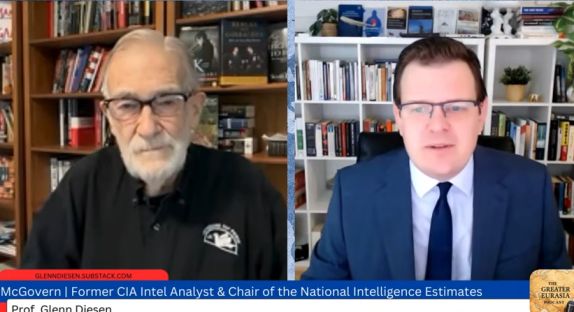
Editor’s Notes: In this interview, former CIA analyst Ray McGovern joins Glenn Diesen to discuss his assessment that Israel has already lost its war with Iran and may consider the use of nuclear weapons as a last resort. The conversation delves into the “Samson Option” and the existential risks facing the region as conventional military strategies falter. McGovern also critiques the role of the U.S. administration, intelligence failures, and the tragic humanitarian cost of the ongoing conflict. This deep dive provides a sobering look at the lack of strategic planning and the potential for a catastrophic global escalation. (March 13, 2026)
TRANSCRIPT:
Introduction
GLENN DIESEN: Welcome back. We are joined today by Ray McGovern, who was a CIA analyst for 27 years, who chaired the National Intelligence Estimates and also prepared the President’s Daily Briefs. So thank you for coming back. It’s been a while.
RAY MCGOVERN: Glenn, thank you for having me.
Israel’s Vulnerability and the Origins of the War
GLENN DIESEN: So, well, this war against Iran, we see this treated almost as a U.S.-Iranian war, but in reality, it’s already a regional war. However, one actor we hear surprisingly little about, given that they’re the one who fired the first shot, is Israel. I guess part of the reason is we don’t get much video or information about the damages which are being done in Israel. But I thought it could be a good place to start to discuss how vulnerable you think Israel is in this war. And I guess, overall, how is the war going for Israel?
RAY MCGOVERN: Well, Glenn, as usual, you asked the right question. I was going to start out with this if I could, and now I can. This is an existential war for Israel. Iran’s going to survive this in one way or another. The US hopefully will. But Israel has put all its eggs in this one basket. They’ve twisted Donald Trump in such a way that they started this thing.
And by the admission of our Secretary of State, Marco Rubio, who also is the National Security Advisor to Donald Trump — which means, by the way, that he’s the funnel through which all intelligence comes. In other words, the CIA, they report through Marco Rubio, the National Security Council director. And so what Trump gets, he gets through Marco Rubio. That explains part of it.
But if people don’t know this, Marco Rubio admitted that Israel said, “Oh, we’re going to attack.” And then they did. And we were afraid that the Iranians would say, “Oh, maybe the US is guilty of this,” and they would attack us back. And so we had to preempt Iran’s retaliatory attack — Iran retaliating because Israel attacked it. He said that. It’s right out there.
No Plan, No Reason — A Conversation with My Daughter
RAY MCGOVERN: Okay, my God. Well, just to reduce this from the sublime to the mundane, we have an adult young girl who helps us out here, and she was here this morning. I said, “Please, Rosanna, tell me, what are your friends all saying about this war?” And she said, “Oh, well, they don’t like it at all. And the thing that they don’t like is there’s no plan. There’s no plan at all. And how can they do this without any plan?”
I said, “Okay, fine, well, why did he do it?” Now, my daughter is really smart. She went to college and all that kind of stuff. She’s like, “I don’t know.” So what do your friends say about that? They don’t know. All they care about is Trump won’t rule out sending troops — our troops, our children, our sons, our brothers.
But why did he do it then? Don’t know. It’s crazy. It’s crazy.
And I said, “Rosanna, you don’t know it because the majority of American people don’t know it, even though the Secretary of State of the United States has said it.” Because Israel attacked Iran and mousetrapped us into doing precisely the same thing — when we were this close, this close to a deal.
The Omani Mediation and the Collapsed Deal
RAY MCGOVERN: Now, how does McGovern know that? Come on, McGovern. I don’t see that in the New York Times. Well, there was a mediator in these very crucial talks in Geneva between the Americans and the Iranian foreign minister. And when the mediator — the Omani foreign minister, that is the foreign minister of Oman, who was an honest broker here dealing with the two — when that session was finished, he got on a plane and went to Washington and said to the vice president, “We almost have a deal. The Iranians have really backed off on their requirements about enrichment. They’re making all kinds of concessions. As a matter of fact, we might even get UN inspectors there for the first time in history.”
So it was close. And then I think because he smelled the rat, he went on with Margaret Brennan, the CBS person, and told her the same thing: “We’re really close.” Now, that was the 27th of February. It was the 26th that they had met in Geneva with this same Omani foreign minister mediating.
Okay, what happened? All of a sudden, within hours after getting this news, there was the attack on Iran. So how does this figure?
The latest complaint is that the Omanis and others think that Witkoff and Kushner lied when they gave their report to the President, saying, “No, no, the Iranians are in transition.” I don’t rule that out. The two of them are — in the Bronx, we call them shysters, okay? They can’t be trusted.
But in any case, the deal was this close. All of a sudden, Rubio, and maybe Hegseth for sure, maybe the vice president said, “No, no, Bibi has already launched his attack. We’ll do it for Israel.”
So I said to my daughter, “You ought to ask the last question.
An Existential War — and a Delusional President
RAY MCGOVERN: Now just let me tie up this dissertation here. For Israel. Now, it’s an existential war. That means that they are about to be obliterated — pardon the term — okay? The Iranians have the wherewithal to do that. That was proven in June.
And that’s why I naively thought, well, this would never happen. I mean, would Trump want to risk obliteration of Israel, closing of the Strait of Hormuz, losing the election in November, having gas prices of $10 a gallon? I mean, of course he wouldn’t be so stupid or dumb to start a war against Iran. And he did it.
So two things. Here we have a president — not only a delusional narcissist, but I’d suggest that he’s Wahnsinnig. Now I know you Norwegians don’t like to use German terms and all that. All I know is “tusentakk” in Norwegian, okay? “Wahnsinnig” in German — just off your rocker, okay? An inflated kind of thought that you could do what the hell you want. “Wahnsinnig” is almost as bad as “sehr verrückt,” which means really crazy — and which, when I lived in Germany, you could be convicted for calling somebody “verrückt.” Well, I’m not in Germany. That’s what we have here.
Kremlinology and the Limits of Logic with Trump
RAY MCGOVERN: And just to tie this up, I’ve spent a half century trying to put myself in the shoes of Kremlin leaders. I know that they have an equivalent of the branch we had — now it’s a division in the CIA — which did, at a distance, psychological profiles. You can’t interview Trump, but you can get all the information together. And even though the psychiatrists don’t like to do this without having access, well, you do it anyway. Why? Because the stakes are so high.
Now, when I was on board at the CIA, we had wonderful people working on this. I had biographical profiles on Chernenko and Andropov and later. So the Kremlin, I’m sure, has this kind of unit.
It boggles my mind to put myself in the place of a Gorbachev-era presidential daily brief briefer — which I was, one-on-one during Reagan’s first term, 1981 to 1985. What are they going to tell Putin? Well, we know this guy is unreliable, that he’s deceitful, and that he tells a lot of lies and he’s kind of narcissistic. But now we know he’s Wahnsinnig. Now we know he’s — what will he do?
Last thing here. Maybe I’m projecting here, but I thought they would never do this stupid thing for precisely the reasons of what’s happening now. So when people talk about putting boots on the ground or threatening to use a nuclear weapon, I say, “We’ll never do that. Because, because, because.” But the becauses don’t matter anymore. The logic does not obtain.
And maybe this is — I’ll just add this in Kremlinology. We had a very sustained, orderly way of analyzing public media. And when people were saying things like XYZ would be preconditions for negotiations or for a settlement, and then all of a sudden all they said was X, and they didn’t mention Y and Z — wow. That meant — and I can tell this is accurate — that meant that they were willing to deal on intermediate nuclear forces, and that deal was made and it obtained for 32 years.
We saw that they were backing off from public statements. But it doesn’t work with Trump. Trump can say, “We require A, B, C, and D,” and then he says five times, “We require A,” and doesn’t mention the rest. And his vice president says, “We require A,” four times in four minutes on Fox. McGovern thinks, “Oh, my God, maybe there’s a little bit of hope there.” Forget about it, McGovern. Kremlinology and logic do not obtain in analyzing Donald Trump. And that is a real burden for the presidential daily briefers of Vladimir Putin. I think you will agree.
Could Israel Use Nuclear Weapons?
GLENN DIESEN: Sorry, but when you say it’s existential for Israel — you know, that’s usually a word you don’t want to hear when it comes to powerful states. Because once something is existential, they can’t afford defeat. Which then begs the question, what might Israel do?
Because we’re in a very difficult position. The Iranians as well consider this to be an existential threat. And they can’t just let the US walk away and then reopen the Strait of Hormuz, and then in six months the US and Israel are back yet again. And given that none of the underlying problems have been resolved, the objective will remain to knock out Iran from the Eurasian chessboard.
So given that this is the case, Iranians can’t afford to just let this one go and go back to the old status quo. So what does this mean for Israel? Because if they risk being decimated here, they have nuclear weapons. They don’t strike me as the most restrained of countries, as we’ve seen in all of the wars currently ongoing as well.
So what do you think Israel is going to do if the pain becomes too great? At the moment, we’re not seeing any pictures coming out of Israel. They won’t project the idea that they’re taking big losses. But this could flip at some point, where they want to do the exact opposite — show how much destruction Iran has done. At that point in time, one risks starting to hear more about the possible nuclear weapons retaliation. You know, “Israel has a right to survive,” essentially the right to exist.
There are a lot of crazy things happening these days. This doesn’t seem that crazy — that it would happen, if not with strategic nuclear weapons, at least something limited, with tactical weapons, just to essentially force the arms of the Iranians to do as they’re told, to capitulate essentially. Do you see a pathway there towards actual use of nuclear weapons?
The Samson Option: Could Netanyahu Use Nuclear Weapons?
RAY MCGOVERN: Glenn, that’s your second most interesting and appropriate question. That’s what I was going to say. Yes. You know, when I look at Netanyahu and Trump, but in this case primarily Netanyahu, I asked myself, okay, given what you know about this fellow McGovern and what he’s willing to do in terms of genocide, forced starvation, when he’s been given to believe that he has some sort of handle on Trump, maybe it has a lot to do with Jeffrey Epstein, but anyhow, he’s confident that he has his handle on Trump. Well, would he accept defeat? Would he say, okay, it was a bad idea? I don’t think so. And I don’t think the Iranians would let him do that now that they have the upper hand.
And that’s the big new reality. I think it’s been proven now that the Iranians have more weapons, more rockets, more missiles, and the Iranians are going to prevail in this thing. Not to mention the damage that is happening to the whole world because of the closure of the Strait of Hormuz, which was entirely predictable. So what’s Netanyahu going to do?
Well, Sy Hersh wrote a book a couple of decades ago about the Samson option. The biblical narrative being that when Samson pulled the temple down, rather than capitulate or whatever, he just pulled the whole temple down. Netanyahu do that and thinking that maybe he could fly off to Berlin again and hide in one of those little shelters, I don’t know. But I think the chances are more than even, and this is scary as hell, that he would not stop before he used, not just threatened, but used a nuclear weapon or two.
And whether that would work or not, I just don’t think it would. And the opprobrium he would become, he would be crowned as the rogue state of the world forever if he did that. And nobody would cooperate with him, I don’t think, unless maybe people like neocons coming out of the woodwork that supported both the war in Iraq as well as this war in Iran would support Netanyahu.
So yeah, as a long-winded answer to say that four weeks ago I drew a parallel. I said, look, I think that Netanyahu would probably use this nuclear option in extremis. Okay, fancy words for Israel having its back up against the wall. That’s why it’s new.
The Cuban Missile Crisis Parallel
Glenn, as you know as a historian and I know as an old guy, not since the Cuban Missile Crisis has any nuclear state been forced in extremis. Now John Kennedy, one of my idols, President John F. Kennedy, who brought me down to Washington together with a whole bunch of really great people saying, well, we think there’s something for our country, and some of us are still around. What he said in his major speech at the University of Maryland in early 1963 was this: the thing that must be avoided in our relations between two nuclear powers, i.e. the US and the Soviet Union at the time, is never ever to force a choice on a nuclear power — a choice between humiliating retreat and using those nuclear weapons.
Now why do you say that? Because it almost happened. If he hadn’t been adroit enough to dismiss his generals and go with his brother Bobby and other people like Llewellyn Thompson, the previous ambassador, they said, look, Khrushchev is willing to do a deal, talk to him directly. And they did. And there was no war. And you and I today get to talk about these things. It was that close.
So that was September, October 1962. Here John Kennedy is on June 10, 1963. Count the months between, and now he says, look, we’ve been through the worst. I know what it’s like to think about blowing up the world. The last thing you want to do is have to give another nuclear power the choice between humiliating retreat and using nuclear weapons.
Now, Slava Bogle, thank God, Khrushchev was adroit enough to say, okay, if we make it look like a deal that you’re pulling the Euro missiles out of Turkey, yeah, I could talk to my military and say, well, we got a deal. And that happened. So Kennedy was hell bent and determined not to let that happen again. So he reached out to the Russians, he said, look, our children breathe the same air. We want the same good things for our children. We, among all the powers of the world, Russia and the United States have never been at war together, almost uniquely. So let’s deal.
And of course he said, we’re going to cease testing nuclear weapons. And within months, because of adroit political actions, the Senate confirmed a partial test ban treaty. So what I’m saying is that this goes back to the beginning of the real nuclear confrontational age. And since then, since 1962, there has been no likelihood that the US or the Soviet Union would overstep that red line and threaten the other with a humiliating retreat.
Russiagate, Ukraine, and the Nuclear Dimension
Now what was the next big issue? Russiagate. Now, as you know, my friends and I and Veteran Intelligence Professionals for Sanity knew that that was a distrustful, dishonest thing from the get go. Well, one of my colleagues said, “Ray, you know why you keep focusing on this? You’re a one-act pony.” And then a radio guy said, why do you keep pounding on it? I said, because Russia has nuclear weapons, that’s why. Because Ukraine was judged to be an existential threat to Russia. And we know how that’s coming out. Luckily that’s not going to be a nuclear explosion.
So all I’m saying here is that this is unique since the Cuban Missile Crisis. Do the math. That was 1962, what is it, 2026 now? So we have a state now that stole nuclear technology from the United States, whose Prime Minister was one of the thieves that stole that technology. And one of the reasons that John Kennedy was so disliked by our military and by our Zionists was because he wanted to prevent Israel from getting a nuclear weapon.
Kennedy, Angleton, and Israel’s Nuclear Program
Some people think, and I think there’s some evidence for this, that that’s one of the reasons they got rid of him. Let’s face it, the chief plotter, who was the CIA counterintelligence master, was the liaison with Israel. And nothing I or any of my colleagues or my branch people wrote, if it mentioned Israel, even if it was just about Sino-Soviet relations, if it just mentioned Israel, we had to get it cleared with this guy. So he was the one that was the ringleader of all this. And of course he was like this with Israel.
So there’s ample evidence that Angleton, James Angleton, was involved in both of these escapades. So close to Israel and so much a part of getting rid of John Kennedy, partly because of his resistance to Israel getting a nuclear weapon. There’s even evidence that Angleton was participating in at least turning a blind eye to the provision or the stealing of nuclear technology behind Kennedy’s back.
Trump, Netanyahu, and the Epstein Factor
So just to rest my case here and say, look, if very educated 50-year-old children of mine are just completely adrift, saying, “Oh my God, there’s no plan, there’s no plan, and why did they do this?” — they don’t ask why he did it. They always say, oh, it could be this, our boots on the ground, or oh my God, you know. But none of them have time to ask why Trump did this. And why Trump did this was because he’s subservient to Israel. And that may include this heinous talk about moral turpitude. Well, you got it in spades with Epstein and the people that Trump has been associating with.
And the fact that Netanyahu is certainly not above bringing his own little portfolio of photos and videos to Mar-a-Lago, saying, “We just want to remember that the FBI is able to block out a lot of this stuff, but we have it. We’ll protect it, Mr. President, unless you don’t cooperate.” That’s a mafia-type approach. And would Trump be above that? I don’t think so.
So sorry for this long explanation, but I feel really strongly about this because Israel has had this hold on us to the tune of shooting up 34 US sailors on the USS Liberty during the 1967 war and never being held accountable. Then of course they learned without any doubt that they could literally get away with murder, and the Senate and the House and even the US Navy would cover it up.
The Fracturing of Trump’s Coalition Over Israel
GLENN DIESEN: The US-Israeli relationship is quite interesting, not just in terms of understanding a lot of US foreign policy, but it’s also interesting now to see what’s happening in the domestic politics. Because I think especially, well, not just on the Republican, but the Democrat side, there is this split. You see now that the sympathies towards Israel have declined so much. And also within Trump’s own camp, this whole idea of America First — I think it united a very broad variety of people. And a large part of this group believed that America First meant that US interests will be put before Israel. So now that they see this war, which they can’t really explain without talking about Israel, it’s something that also divides the home base of Donald Trump.
What Are the US Options Now?
But you said something interesting, though, that yes, it’s an existential conflict for Iran and for Israel, but for the US it’s not really existential. However, that being said, there’s a lot at stake here that is its credibility as a superpower. Also, if this war is lost, the Gulf states might no longer be viable frontline states. They could be swept away. Or alternatively, if they want to survive, they might come to the conclusion that being a frontline state does not make you safe, it makes you more vulnerable.
If this happens, the whole petrodollar system begins to fall apart. Without these recycled dollars, the AI bubble, the AI race comes to an end. Alliance systems around the world could be challenged. Also in domestic politics, this would be a disaster for Trump. He already declared victory — a little bit like George Bush’s “mission accomplished” moment, which he came to regret, of course — and his ego on top of all of this.
So I can’t imagine Trump accepting defeat. That being said, I can’t imagine him using nuclear weapons either. But he has other options, though. What I’m getting at is, I saw two comments come out, I think on the same day — that is, “we’re going to hit Iran 20 times harder,” but also “we’ve run out of targets to hit,” which then suggests, how do you bring Iran to the negotiation table, make them make concessions? It just sounds like they need the Gaza treatment, that this is the direction that the US might go.
Anyways, that’s too much of my thoughts. I was wondering, how do you see this? What will the US do now that it didn’t get the regime change, it didn’t get the people standing up and going against the government, the army did not collapse? The Iranians are able to absorb pain and also to bring pain to the US, the Gulf states, and Israel.
The Gulf States, Arab Alliances, and the Shifting Balance of Power
RAY MCGOVERN: Well, let’s deal with the Gulf states, the Arab states first. Putin got on the phone just two days after the attacks and talked to each and every one of them. What was that all about? Well, I think he knew what was coming and said, look, recall that you’ve been real cozy with the United States and buying all the weapons and all that stuff. You have this deal where they’re going to defend you, huh? Watch next couple days and see what happens. I’ll call you back later.
God, that deal has fallen apart because the defense against Iran has completely been gone. Iran has full reign now, and they are doing it. They are attacking all these US bases and trying to reassure the Gulf states that, look, it’s not about you. It’s just about your stupid policymakers who thought that the US could protect you and they can’t. So what are you going to do now, huh? So what are you going to do now? You do have a lot of riches. Who are you going to trust to deal with? Well, see what happens the next couple days.
Okay, well, the next day you have Lavrov getting up. This is really interesting. He’s in a meeting with other Arab Gulf leaders, right? And he says, so very clever. I will use an old Bedouin expression. “Have you not learned that you cannot ride two camels at the same time?” I don’t know who gave him that line, but it was exactly the right line.
Okay, so as far as I’m concerned, the US are not going to get bases back in these Gulf countries. The Gulf countries still have their oil to the degree that they’re not obliterated, these sites. So they still have the wherewithal to persist. But are they going to throw their lot in with the United States? Certainly not in the way they used to.
The Iraq War Deception and Its Parallels to Iran
Okay, now I forgot what else you got into, but I had some comments on your other remarks. I mentioned, once you mention this, that one of the things that most Americans do understand — because many were not of age in 2001, 2002 and 2003 — all they know is about 9/11. Right. And then they know, or think they know, that we had to go after people who might have been responsible for 9/11 and the Afghans. Well, that was your own thing. But we tried to identify the head of Iraq, Saddam Hussein, with 9/11. And how did we do that? We said that Saddam Hussein had ties, active ties with Al Qaeda. 75% of the American people in 2002, 2003, thought that to be true.
Okay. Colin Powell spoke authoritatively at the UN and he talked about a, quote, “sinister nexus between Baghdad, Saddam Hussein and Al Qaeda.” Colin Powell knew that he was lying. He said it anyway.
What was the other thing? Oh, yes. Iraq had weapons of mass destruction. Now, we — veteran intelligence professionals for sanity — set up our unit in January of 2003 in full knowledge that they didn’t have weapons of mass destruction, that our former colleagues were lying through their teeth to get promoted and bonus awards, which they got for writing that terrible estimate October 1, 2002.
So what happened? Well, they falsified the evidence. Let me just quote the Senate Intelligence Committee report. Now, this was five years in the making. In June of 2008, they finally came to their conclusion and it read, quote, “the intelligence used to justify the attack on Iraq was uncorroborated, unsubstantiated, contradicted, or even non-existent.” End quote. Non-existent. What the hell does non-existent intelligence look like? Well, I don’t have to tell you. It was manufactured.
So why do I raise all this stuff? It’s happening again. And most people are not cognizant of the fact because the press has concealed it. And no one was ever held accountable for Iraq. So it’s worth mentioning. What we’re saying now is, of course, depending on who you listen to, Iran is close to getting a nuclear weapon. Okay, what are they going to do? They’re going to give it to those terrorists. All those terrorists — which I call resistance forces, according to international law, in Lebanon and elsewhere — those terrorists are going to get those nuclear weapons.
The Downing Street Memo and Intelligence Fixed Around Policy
And again, don’t take McGovern’s word for this. We had the real good fortune of having a copy of the authentic notes of a briefing given by Sir Richard Dearlove, head of Britain’s MI6, to Tony Blair on July 23, 2002. And what was that all about? Well, Tony Blair had been recruited by Bush to join in this war. It’s going to be a great war. Early Europeans — well, they weren’t real. The Germans and the French, forget about them. We can do it by ourselves.
Okay, but you know what? When you’re planning war, you like to be more than just telephone contact with the other plotter, right? So even though Bush was calling Blair or vice versa once a week, Blair said to his intelligence chief, look, would you go over and talk to George Tenet, which was his opposite number, Director of Central Intelligence, head of all intelligence agencies. Talk to him because he’s so close to Bush, he’ll know the real scoop. Can you talk to him? Well, Tenet didn’t want any border. They said, no, I don’t. And Bush insisted. And so I know there were people I know there on the 20th of July, 2003, at CIA headquarters in Langley. And Sir Richard Dearlove was thoroughly briefed, got on the next aircraft, went back home to London, and three days later, at a meeting of the cabinet — Blair’s cabinet meeting with all the major dignitaries — Sir Richard Dearlove, please tell us what the real scoop is.
And this is what it was. This is a quote from the most operative paragraph: “George W. Bush has decided to attack Iran. It will be justified by the conjunction of weapons of mass destruction and terrorism.” My comment — translation: we’re going to say that Saddam Hussein has weapons of mass destruction and he’s going to get them to the terrorists. Okay, and then the final sentence of this paragraph: “But the intelligence and facts are being fixed around the policy.” Period, end quote.
So the intelligence and the facts were being fixed around the policy. What’s my lesson here? An unnecessary war, completely unnecessary, intelligence fixed around the policy. That’s what we have now with respect to Iran. Why? Because no one was ever held accountable. Those senators that wrote that bona fide, accurate, authentic report saying some of the intelligence was non-existent never held anybody accountable. George Tenet was allowed to go to his shelter in New Jersey and still get lots of money from the corporate entities that he ostensibly works for. No one is held accountable. The people who wrote that National Intelligence Estimate of October 1, 2002 got pay increases and pay bonuses.
Iran’s Nuclear Program: What the Intelligence Actually Says
So now it’s not quite that bad. Because what’s really interesting here with respect to Iran is that after that debacle, people who had some sense in Washington saw that the neocons — Cheney and Bush — wanted to do Iran next. Matter of fact, the neocons were openly saying to everyone who would listen, “Real men go to Tehran, not to Baghdad.” Right? They had the plans. They were going to justify it by the same reasons.
And what happened? Somebody said, let’s get a National Intelligence Estimate done. Now, I think I’ve said this on your program before, but long story short, they got an honest guy from the State Department named Tom Fingar. He came in with his own people. They worked for a whole year. They benefited from some luck with new intelligence. And they said Iran stopped working on a nuclear weapon at the end of 2003 and has not resumed work on a nuclear weapon. We say that unanimously — all 16 intelligence agencies at the time — and we say that with high confidence.
Now, the good news is that the intelligence community has reiterated that judgment, to include the fact that nuclear weapons are prohibited by the Supreme Leader — recently deceased — by a fatwa, which means a hell of a lot more than an encyclical or any other high-sounding religious statement.
Okay, now, how long did they stand by that reasonably judged, authentic judgment, after all the pressure from the lobby? As recently as last March, the end of March, Tulsi Gabbard, the National Intelligence Director, repeated verbatim what the US intelligence community had been saying since November 2007, namely, that Iran — if it had a nuclear program at all — stopped at the end of 2003. Unanimous, high confidence, no reversion of the fatwa. She said that under oath in congressionally required testimony in March of last year.
Where is Tulsi Gabbard? A friend of mine did a little cartoon with a milk carton — you know, a half-gallon milk carton — “Missing: Tulsi Gabbard. If you see her, let us know.”
So what’s going to happen now? That is congressionally required. What will happen when they come before the Senate, do their oath, and are asked, well, what do you think now? Did Iran start working on a nuclear weapon? And the honest answer would be no, they don’t need a nuclear weapon. They have the kind of hypersonic missiles that can deliver heavy warheads. And I dare say, Glenn, that they’ll be doing precisely that in the next few weeks.
Iran’s not going to stop. And as Alex Craner, one of the best analysts in all this, when he talks about the closure of the Strait of Hormuz, he says, “You ain’t seen nothing yet.” And that’s going to hurt all of us. But it’s going to hurt especially what Trump thinks he can do, because he can’t do much. The only thing he could do, presumably — but maybe not — is restrain Netanyahu from using the ace in the hole, which you correctly called attention to: using a nuclear weapon or two.
Regime Change: Is It Still Possible?
GLENN DIESEN: Look, just one final brief question — that is the hopes of regime change. Is this out the door now? Because again, the core of a regime change operation would also entail winning the hearts and minds of the people and have them turn against their own government. But after killing their leader — which was not celebrated as it was, for some reason, believed it would be — and also as the US runs out of military targets, we see more civilian targets to put pressure on the government.
So we saw the attacks on the desalination plant, the fuel depots, which then will pollute and destroy the air, essentially, in Tehran, the destruction of the capital. And Trump also, just to really drive the point home, went out on Truth Social and wrote that they would hit Iran so hard that the nation itself would be destroyed, that it would be unable to rebuild. And, of course, I assume accidentally, but of course, the killing of those 168 young girls as well, and then lying about it in such an obvious way — is regime change completely out of the question?
RAY MCGOVERN: Well, any kind of regime change is out of the question if you’re thinking about a more malleable management there in Iran. You don’t have to be a crackerjack analyst to figure it out. The new Supreme Leader was in the house, and he was injured when his father was killed. His wife was killed, his teenage son was killed. He was spared, but apparently he’s still in the hospital. That’s why you don’t see him.
Okay, so under those circumstances, and under what was said in his name or what he said yesterday, there is no give at all in the Iranian position. They have the upper hand now.
The Military Mindset and the Neocon Influence
You know, when you talk about our military leaders, I’ll tell you one thing that comes from Larry Wilkerson, who worked with Colin Powell not only as his Chief of Staff in the State Department, but also when Powell was Chairman of the Joint Chiefs of Staff and when he was National Security Advisor to Bush — the first Bush. So what he said was, you know, at one point, Powell turned to me and he said, “Larry, the worst thing you can do is make an Air Force general head of the Joint Chiefs of Staff, because all they know is bombing, bombing, bombing, and then sailing off again and bombing some more.” And if we didn’t learn that from World War II, if we didn’t learn that from Vietnam, if we didn’t learn that from Afghanistan and Libya, my God. So never pray for an Air Force general to be head of the Joint Chiefs of Staff.
Now, where did Trump get this guy? Well, the smart people say, well, he was retired. But before he retired, he appeared in this nice blue uniform, except he didn’t have his cap on — he had a MAGA hat on. And Trump said, oh, my God, we took a shine to him right away.
What’s this guy like? If he has an ounce of honesty in him, he’s got to tell Trump, look, my colleagues on the Joint Chiefs warned that this might not work. But I don’t know whether he has an ounce of honesty in him. It’s not working. Okay. And if the military can’t restrain Trump in his present mind, my God, I don’t know who can.
We have neocons now appearing — Wurmser, David Wurmser. We have Douglas Feith — the brain trust, so to speak, behind Cheney’s war against Iraq — coming out and making idiot pronouncements. So the neocons still live, they’re still given a lot of leeway in the press, and they get their op-eds printed.
So I’m a little bit forgetting now exactly what your point was. Let me ask you if you could repeat your main question there and I’ll try to be more brief.
Accountability and the Path Forward
GLENN DIESEN: Yeah, no, if regime change is now out of the question.
RAY MCGOVERN: Well, if it’s out of the question and the Iranians are not willing to deal with Trump, and you can understand why they might not be willing to deal with Trump. I mean, two times right away, while negotiations were nearing completion, they were tricked into — there was an attack. Okay, two times. So was it that George W. Bush said, “Oh, fool me once, fool me twice” — he couldn’t get it right, right.
Well, yeah, the Iranians, to say “fool me once.” Well, we never thought you’d try to fool me twice. But you did. But we’re ready this time. We’re ready this time. Fool me thrice, fool me three times. Give me a break.
So they have the upper hand now. Are there forces for moderation here? And there are. The Russians and the Chinese can come in and support the new ayatollah, the new supreme leader. He’s not quite an ayatollah yet, I’m told. And say, “Look, Mr. Trump, when you called me,” says Putin, “when you called me just three days ago, I made the best of it. I had Ushakov say that we had a businesslike and a constructive and also an open, frank discussion. So I’m not cutting off ties with you. But you know what? This is crazy. We’re not going to let this happen.”
“You say, oh, please use your good offices with Iran. Forget about it. You say, please don’t give Iran intelligence that they need. Mr. Trump, have you heard, do you know what the word karma means? Look it up. Karma. What are you guys doing with the Ukrainians, huh? We’re not going to stop our aid to Iran.”
So we’re going to have to make a deal now. Short term, midterms, that’s one thing. A topsy-turvy in the economy with the Strait of Hormuz continuing to be closed — that’s bedlam. Okay, so Mr. Trump, we can help you, but you’re going to have to lay off and you’re going to have to restrain Israel. Now.
We, the Russians, says Putin, have a unique chance to mediate this thing. We have good ties, reasonably good ties with Israel. I mean, there are 2 million Russians in Israel. And of course, we have very good ties with Iran, good ties with China. We have a lot to offer here. But you’re going to have to, however we kind of make this look better than it is, you’re going to have to back off. And the sooner you back off, the sooner you lose less in the midterm elections. So we’re willing to help, but Iran doesn’t want any help from us or anybody else right now. They’re winning.
So, well, let’s wait a while and, yeah, come back to us and we will try to be honest brokers. Now, can they do that? Well, you know, they almost had a mutual defense treaty with Iran. The Iranians said, “No, God’s sake.” Now, let’s reflect on that. The Russians wanted to make their strategic treaty with Iran a mutual defense treaty. And it was the Iranians that said, “No, no, we’re not ready for that.” I think they probably regret that now, but that shows how important Iran is to Russia. I mean, it’s the soft underbelly through which all kinds of terrorism and other threats come.
Okay, so that’s one thing. The other thing — oh, yeah, well, you know, they abstained on this resolution at the UN. Yesterday, I was appalled. I mean, you can’t vote against a measure that criticizes Iran and doesn’t even mention that they were attacked. But why do they abstain? Well, I think that they’re just trying to preserve what’s left of an image of being able to be honest brokers. They want to be in a position to be able to say, “Okay, you know, we might have vetoed that thing, but, you know, we’re trying to work things out.” And the stakes are very high.
In Memoriam: The Little Girls of Minab
Not least of which, of course, is the continued human destruction exemplified by those little girls in Minab, as well as the threat that Netanyahu will be tempted to use. When it was worth thinking about Minab, Glenn, I had a poem that I had from Daniel Berrigan, a good friend of mine, that I recited on another platform, but I have another one now from a very close Iranian woman poetess. Her name is Avide. It would take about a minute, minute plus to read. She is addressing the little girls of Minab. I don’t know if we have another minute where I could.
GLENN DIESEN: No, of course it’s okay.
RAY MCGOVERN: Okay. The title is In Memoriam.
Where were your dreams? Where were your hopes? Sweet little girls of Minab, were you to be the new blooms of the tulips or the daffodils? Sweet little girls of Minab, were you fasting, hungry, thirsty? Sweet little girls of Minab, when the Tomahawk blew you to smithereens and burnt you to ashes without leaving a trace of you? My angels, my beautiful, sweet little girls of Minab, tell me who has the heart, who has so much hatred in their hearts to burn to ashes sweet little girls of Minab with hopes and dreams as tulips and daffodils, swaying under the blue dome of the sky, innocently hoping and waiting for a new spring to arrive. Tell me who has so much hatred, who has so much hatred in their hearts.
Accountability for the Deaths at Minab
Now, from the sublime to the mundane. We know how that happened. We know who killed the sweet little girls of Minab. His name is Hegseth. He calls himself the Secretary of War. Why can I pin the blame on him? Because he deleted the unit in the Pentagon that verifies that there’ll be no civilian casualties in this target list. Blaming the Defense Intelligence Agency or outdated target lists does not suffice. There was a way to check on those things. There was a procedure. And Pete Hegseth, Secretary of War, who says “have no mercy,” deleted that unit.
Now, how do I know that? Scott Ritter knows chapter and verse on this, and he has pointed out that there were four strikes from Tomahawks and then another one had the ability to loiter over the scene, send back photography to the control tower. The control tower wrote back, “Yep, there are other people coming in.” Oh, look, there are a lot of people. These were the little girls going into the prayer shelter. Okay. And the parents coming to pick them up, vaporized. Why? Because there were thermobaric capabilities within that fifth Tomahawk.
So, you know, it’s okay to be a little bit angry about this thing. And when I see the President of the United States say, “No, the Iranians did it themselves” — that was a physical, that was a temporal impossibility. And I could say that because this was the first wave of the attack on February 28th, the same wave where the Supreme Leader was killed in his own home, not in a deep shelter. The same wave that happened before the Iranians even knew there was something coming. So the Iranians are going to be firing off inaccurate missiles at a school before they even know they’re under attack. Give me a break.
So what we have is a meretricious — that’s a nice way of saying a lying son of a gun — as president. And Hegseth saying, “Oh, no, we’re investigating.” Right. Hegseth is going to investigate what he himself is personally responsible for. A man who gives no quarter and who says, “Show no mercy.” That’s what we become. And American citizens need to realize that, need to apportion blame where it belongs. And when you kill 163 little girls between the ages of 6 and 12, you must be held accountable.
Imperial Decline and the Celebration of Brutality
GLENN DIESEN: I very much agree. That’s one of the startling things, that the brutality is so celebrated now, that this idea that Hegseth says even following the rules of engagement is somehow politically correct, something which prevents us from being strong. It’s quite grotesque. And if you’re on Twitter, if you follow the White House, every day almost they put out the little videos where they make clips of video games with bombing of Iran — it is war porn. It’s a celebration of violence. It’s something very ugly, especially coming from the White House. But, yeah, here we are. It looks like imperial decline can be ugly indeed. So thank you very much for taking the time.
RAY MCGOVERN: Thank you for inviting me, Glenn. Much appreciated.
Related Posts
- TRIGGERnometry: w/ Sir Antony Beevor on Russian Mindset (Transcript)
- Transcript of John Kiriakou’s Interview: This Past Weekend #661
- PBD #812: w/ Mehdi Hasan – Iran War, Qatar/China DARK Money (Transcript)
- SRS #310: w/ Josh Duhamel – Survival Skills, Off-Grid Living, Billionaires Building Bunkers (Transcript)
- Diary Of A CEO: w/ Mathematician John Lennox – June 4, 2026 (Transcript)