There’s a very large Japanese-Brazilian population. The connections may not be very well publicized, but they’re very real. And again, you have a market because both Japan and Brazil are now going to be increasing their defense spending. Japan is one of the premier practitioners of capital-intensive precision machine building, and that includes weapons. And how can the United States object to a U.S. ally rather than China becoming the source of Brazilian military modernization?
I mean, I think the knock-on effects of this thing are just beginning to become apparent — or at least predictable and speculative, perhaps. And the Chinese are in the middle of a lot of this.
Russia’s Role and the Trump-Putin Call
GLENN DIESEN: The other great power, though, which the U.S. obviously has to consider would be Russia. And we know that Trump just called Putin. We don’t know too much about the call. There’s been some comment from the Russian side based on all the wording they use. It sounds as if it was not friendly because they never used the word “friendly.” They used “frank,” “businesslike” — that usually implies there were more disagreements at least.
But how do you see what the Russians are after and to what extent are they willing to actually do something? In the past, or you can say still to some extent, Russians have always been close to Israel — from the liberation of Auschwitz in the Second World War to the amount of Russians who reside in Israel. But I think the Ukraine war, with Israel’s help to Ukraine, created quite some divisions between the two countries.
Meanwhile, on the Iranian side, it seems from the common fighting they did in Syria, they looked towards opportunities to go from this limited common interest to some strategic partnership, to develop this greater Eurasian concept where their economies are more closely linked.
And also, of course, the United States is still fighting a war against Russia in Ukraine. I saw that Trump said that Russia thinks we’re helping Ukraine, that’s why they might help Iran a little bit — which I found to be an incredible statement. But, be that as it may. So to summarize my question, how do you see the U.S.-Russia talks contributing to or affecting this war against Iran?
CHAS FREEMAN: Well, of course, we don’t know really what was in the conversation, as you indicated, but I think it’s pretty clear that it was an effort by President Trump to seek Russian assistance in ending this war with Iran. And we know there have been other approaches to the Iranians to end the war. And they have firmly said that they’re not going to accept a ceasefire or any negotiation with the United States until their conditions have been met — their objectives. And those objectives are essentially to do to Israel what Israel has been doing to them for decades, namely to deter or destroy them.
Israel posed an existential threat to Iran. Iran is now posing an existential threat to Israel. And its essential aim is the decolonization of West Asia, including the destruction of the Zionist state, the removal of American forces from the Gulf and so forth.
The Russia-Iran Parallel: Bombing Campaigns and National Resilience
The conversation with Putin apparently, according to President Trump, included Putin’s recognition of the intensity of the bombing campaign — an impressively intensive bombing campaign the United States has mounted against Iran. I don’t know whether it also included advice based on the experience of Russia, which is quite relevant.
If you consider for a moment — let’s assume, and I think it’s correct, that there are many in Iran who fear and loathe the Islamic Republic and would like to see it changed. We don’t know how many, because these people to some extent are manipulated and funded by foreign forces, but they’re probably a substantial group. The experience of Russia is very relevant in this regard. When Germany invaded Russia, I suppose there were very many Russians who feared and loathed the system that Stalin had put in place, and even Stalin himself. And yet they loved their country more than they hated the system. And I think we’re seeing this also in Iran.
Iran, Russia, and China Drawing Closer
Of course, Iran had been helpful to Russia with the Shahed drone — a technology transfer which is now built in Russia in stupendous numbers. And I think Iran has received considerable help this time around, not before the June 2025 war, from Russia in the form of technology transfers. We know that there are aircraft transfers going on and air defense systems and the like, also from China.
Neither China nor Russia wishes to see Iran subjugated by Israel. Both of them have a stake in maintaining good relations with the Gulf Arabs. And so they abstained on the resolution in the Security Council, which was one-sided in its condemnation of Iran’s attack on the GCC countries and didn’t mention that Israel, assisted by the United States, had inaugurated the war. So they basically didn’t want to offend the Gulf Arabs, they certainly didn’t want to endorse the war itself, and they just abstained.
I think this war and the one last year have had the effect of drawing Iran and Russia closer. Historically they were not friends. They are now very cooperative, and in many respects I think Russian influence is growing in Iran. It will probably grow afterwards too — both Chinese and Russian influence — because the United States and Israel are doing huge damage to infrastructure, edifices, buildings and so forth in Iran, and it will have to be rebuilt.
Let me sort of end this by saying that there’s another element here, and that is Iran has officially demanded reparations for the damage, and it is insisting on sanctions relief, which of course it got under the nuclear accord, which Donald Trump tore up in 2018. And the sanctions are the source of a great deal — not all, but a great deal — of the distress of the Iranian people. So I think the Russians have a stake in this too.
Russia’s Strategic Windfall
Let me end by just saying of Russia that those Russians I’ve spoken with — not many — are chortling in their glee. Oil and gas prices are going through the ceiling. I understand the European Union has just decided to take the Arctic gas from Russia, despite its embargo on all energy from Russia earlier, which at least is pragmatic. Of course, the United States, in response to understandable demands from India and others, has suspended the oil sanctions on Russia for some purposes. Qatar has been removed temporarily, at least, as a competitor for Russian gas. Vladimir Putin is playing games with Europeans on the gas issue, and Russian revenues are going up.
Finally, this war is a blessing for Russia in terms of Ukraine, because the exhaustion of American weapons stockpiles means that there will be no weapons for the United States to sell to Europe for onward passage to Ukraine. So Ukraine is going to get itself disarmed to some extent at least, and that’s going to happen fairly soon.
So if you were sitting in Moscow, you might see this as very favorable. And indeed, one of the people I spoke with said he couldn’t imagine how lucky Vladimir Putin had been. Not only quoting Napoleon — Napoleon said, “If I must fight, let it be against a coalition,” meaning I can divide my enemies — but he doesn’t even have to do that, because Donald Trump is dividing the opposition to Russia and simultaneously diminishing American global power, prestige, authority, moral authority and leadership. What more could you ask?
So you said that you thought the conversation had not been friendly, but I’m sure that Vladimir Putin has plenty of reasons to want to encourage Donald Trump to do more of the same. It’s very good for Russia. It’s not good for the United States, and no one is going to come out of this war, in my view — except Russia, perhaps — better off than they were when we went into it.
Never Interrupt Your Enemy When He’s Making Mistakes
GLENN DIESEN: I think Napoleon also said, “Never interrupt your enemy when he’s making mistakes.”
CHAS FREEMAN: This has become part of the folklore of statesmanship and its wisdom is constantly demonstrated by the American administration.
The Possibility of Escalation into Europe
GLENN DIESEN: I’m thinking, though, that one could imagine a situation where suddenly Iranian missiles purchased or given by Russia would suddenly begin to fly towards Storm Shadow factories in Britain or some weapon complexes in Germany.
CHAS FREEMAN: It’s not impossible.
GLENN DIESEN: No.
The Iran-Israel Conflict: Strategy, Identity, and Escalation
CHAS FREEMAN: We have it in the United States right now — an example of our failure to understand our own double standards. There’s a great deal of condemnation: “Well, my God, the Russians are providing intelligence to the Iranians to enable them to attack Americans.” But what do they think we’ve been doing in Ukraine all this time? One ill turn eventually leads to another, I think.
So, yeah, we keep escalating, and the Russians have been very cautious actually. They have not responded in kind, and they have not given anybody targeting information in the UK, as far as I can tell. Or Germany. It’s not out of the realm of possibility that if Europeans press them hard enough, they will decide that the answer is drones.
I wanted to make a fundamental point here, which is that if you look at Moscow, look at Tehran, look at the Palestinians, they’ve all come to the same conclusion: there’s no point in negotiating with the United States. Diplomacy is useless. These issues are going to be solved on the battlefield, on the ground, or in the case of Iran and Israel, they’re going to be settled by the industrial capacities and inventories of weapons and defensive systems that each side possesses.
It’s very clear that, as I’ve said before on your show, the Iranians have adopted Muhammad Ali’s strategy of rope-a-dope — allow your opponent to punch you and exhaust himself before you deliver a knockout blow. We have just seen in the last day or two the beginning of Iranian use of heavy missiles with warheads of around 1,000 or 1,500 kilos, depending on how they’re loaded, aimed at Israel. These missiles are extremely hard to intercept, and they have clearly saved these — they’ve been in storage.
I think what we’re seeing is a very clearly articulated phased strategic plan on the part of Iran, in which each phase makes the success of the next phase more likely. And we’re now in a phase where the most destructive reserved weapons are beginning to be used. Apparently they’ve got another missile which they plan to use, which they have not fielded yet. That’s according to Israeli intelligence, which is quite fearful and has put the entire air defense system in Israel into its most intensive mode in anticipation of an attack by this so far undescribed new weapon.
So I think this war is proceeding along the lines of the war last year in terms of exhausting Israeli interception capability and American interception capability. It’s notable that on the very first day of the war, Iran took out the radars for the Theater High Altitude Area Defense system — they took out the radar in Qatar. That was basically the means of controlling the entire airspace in the region.
Iran has been very carefully focused on specific targets. They’ve even named them. They are now striking at the Israeli submarine force. They’re striking at Unit 8200, which is the signals intelligence and the digital command structure in Israel. They’re hitting the Israeli high command, and they’re aiming at the defensive infrastructure — radars and that sort of thing.
They have not yet, contrary to what might have been expected, as far as I can see, emulated the Israelis and the Americans by attacking civilian structures. They seem still to be focused. Whether that’s because they’re simply rationing their force or because they quaintly adhere to ethical standards is hard to say.
Nationalism, Regime Change, and the Limits of Western Strategy
GLENN DIESEN: Well, first you said something interesting before — this idea that one can come in and bomb a government to assist opposition. This is a very flawed idea, which tends to confuse — even if the public is opposed to an unpopular government. And I do think that we exaggerate how unpopular the government in Iran is. It does not mean that there’s not significant dissent, but this is very counterproductive.
Even the United States at one point also invaded the Soviet Union to an extent. They had an expedition force after the Bolshevik Revolution during the Civil War — one could call it an invasion. But anyways, the troops were sent in, and this was to help the Whites against the Reds, but it did the exact opposite. It turned the public, because the Reds were now the ones defending the homeland, standing up for sovereignty, while the Whites were plotting against their own nation with a foreign power.
Nationalism — even for the communists, who tried to transcend nationalism — is a powerful force deep in human nature. They’re defending the group, more or less. This should have been predictable from history that this doesn’t work. Especially if one deals with people like Reza Pahlavi, who is supposedly supposed to be this unifier. It seems like fantasy, but —
CHAS FREEMAN: It is fantasy. Not “seems like” — it is. You’re absolutely right. And I would say we’re beginning to hear anecdotal evidence — of course — but there are Western reporters in Tehran who can move around. Apparently they can interview people. Of course, those people are quite guarded under the current circumstances, but apparently some of them have openly expressed opposition to the Islamic Republic. So they’re not silenced.
But anecdotally, what’s also coming out is people saying, “Well, I thought when Donald Trump said he was going to come save us, that we were going to be liberated somehow, and instead we’re being killed. And I don’t like that.”
And this goes back to the defense of the Rodina. I don’t know what the word in Persian for that is, but I’m sure there’s an equally resonant word as that word is in Russian.
National Identity, Martyrdom, and the Myth of Origin
CHAS FREEMAN: There is a final point here, and that is that Iran, in a sense — the Islamic Revolution was the first of many uprisings, and one that was successful in West Asia, directed at ending Western tutelage, decolonizing the country, restoring its independence, and defending its cultural identity.
In the end, I believe there’s a hierarchy of national interests everywhere. And the supreme national interest is your identity as a people — your culture, your political culture, your traditions, your language, your beliefs, your religion. They’re all bound up in this question of national identity.
Iranian national identity, despite the many minorities, is that of a civilizational state which commands the loyalty of most. I think it’s bound up very much with Shiism. And Shiism is a religion that accepts martyrdom and glorifies it — in other words, it accepts contemporary suffering and turns it into strength.
My impression of Israel is that Israelis turn suffering into hatred, which is not a particularly auspicious or appealing approach to others. If you had to choose between strength and hatred, I think you would find strength more advantageous.
Anyway, this is a contest which, in the case of Zionism, also involves a national identity, culture, religion, traditions, and in the case of Zionism, the celebration of past victimhood and the desire for revenge against any non-Jew for that past suffering — which is real. Of course, the people who administered the suffering were nowhere in the Middle East. They were not Arabs, they were not Persians, last I heard. I think they were Germans, French, Poles — Europeans of one sort or another.
And so nonetheless, little Israeli school kids are taken to Auschwitz on tour, to keep the myth — if you will — the inspiration of the state alive. And they’re told, “Don’t talk to the Poles. They’re all anti-Semites.” Well, that’s of course total nonsense. But this is a society which has chosen to make the Holocaust its central myth of origin. And that’s very powerful.
I think we’ll see how well Israelis bear up under the suffering I think they’re about to experience. So far, the amount of destruction in Israel appears to have been less than in June last year. But it is escalating.
GLENN DIESEN: Yeah, that’s what struck me when I was in Iran as well — the celebration of martyrdom. Not a desire to die, but the honoring of people who make this ultimate self-sacrifice for the homeland. This is particularly strong for the Shiite.
So that’s why I thought killing Khamenei made so little sense — the idea that you kill the top spiritual leader and the result will be that people will pour into the streets welcoming Americans with flowers. It begs the question though: who is advising here? Because it just sounds so cartoonish. I don’t understand how this was the expectation.
But anyways, they say that we spent 20 years in Afghanistan to replace the Taliban with the Taliban, and in Iran we replaced Khomeini with Khamenei. A new one, of course, but this new one is not as moderate as his father. And of course his father was killed — his mother, sister, wife, son. And of course his country had been bombed. So I’m assuming that we’re going to miss his father if —
The Nuclear Question and the Collapse of Diplomacy
CHAS FREEMAN: Yeah, I think the objectives that have been stated for this war are incoherent and inconsistent. But two of them are directly affected by the murder of Khamenei Sr. — Ali Khamenei.
One is whether Iran will build a nuclear weapon. Khamenei was the principal opponent of that. He stood by the fatwa that said — and it had an out in it — but it said basically that weapons of mass destruction, chemical, biological, nuclear, are all forbidden by religion because they’re evil. He also said, however, that if the existence of the Iranian nation is at stake, this moral restraint can be set aside.
And there’s every reason to believe, on the basis of a great deal of information, that Mojtaba Khamenei, the son, now the supreme leader, is a proponent of going nuclear. So I think, as some of us have feared, we’re seeing a replay of the scenario in North Korea, in which implacable maximum pressure in the absence of real diplomacy — as opposed to performative diplomacy — combines to produce a nuclear-armed ICBM. And I think that’s what’s in the future.
The second objective, of course, in murdering him, was this ridiculous theory that if you kill the leader in a society with deeply embedded institutions and traditions, that somehow that’s going to produce the collapse of the government and the regime. That doesn’t happen anywhere, and it didn’t happen in Iran. In fact, quite the opposite happened. The regime is now strengthened — not only because protests are unacceptable to patriotic Iranians, but because the IRGC, the Islamic Revolutionary Guard, is now greatly strengthened.
The younger Khamenei is a patron of theirs. His father helped to build them. But the relationship between the younger supreme leader and the Revolutionary Guard — which is the hard-line defender of the Islamic Republic — is very close. So I think we’ve also shifted Iranian politics away from any mood to compromise.
We see that in the response of Ali Larijani and others to the apparent overtures from the Trump administration: “Let’s stop this war. Let’s — you agree to a ceasefire.” The response has not just been “no” — it’s been “hell, no, we’re not going to talk to you. Why should we? Look at who you send to talk with us — two real estate agents who don’t know what they’re doing and can’t deliver Donald Trump, and can’t keep an agreement or an understanding, and who lend themselves to deceit, to deception, and surprise attacks on us. We’re not going to talk to them again.” This is the line.
I suspect that in the end they will talk, but they will have to have achieved a great deal more than they have. They will be under pressure — the Iranians — from lost oil revenues, lost gas revenues, from the public, which is probably already pretty tired of this thing. But like the Israelis, they’re bent on revenge.
Now, Israelis are avenging crimes committed in Europe against Iranian surrogates. The Iranians will avenge themselves against Israel. And so we had a situation where Iran was a potential threat to Israel, and Israel was an actual threat to Iran. Now each is an actual threat to the other. How is this better?
The Purpose of War and Europe’s Shifting Posture
CHAS FREEMAN: I suppose the definition of the purpose of war is that offered by William Tecumseh Sherman, the American general in our Civil War, who said, “The purpose of war is to produce a better peace.” This may do that, but not without a great deal of destruction. He, by the way, was famous mainly for having destroyed everything in his path as he marched through Georgia and other parts of the American South.
I think we’re looking at a prospect which is very hard to define. What will all this mean? In the meantime, as I indicated earlier, geopolitical rearrangements are occurring. People are drawing lessons from this.
I think in the case of Europe, the willingness to pamper and propitiate — to appease Donald Trump, to flatter him in order to manage him — is becoming a little bit tired. I don’t see many people willing to do what Mark Rutte has done, which I’ve always thought was quite a bit much — calling Trump “daddy” and so forth.
GLENN DIESEN: Understatement of it.
CHAS FREEMAN: Yes. But I think the willingness — I don’t know, I mean, you’re sitting in Europe, I’m not — but I think the willingness of Europeans to abase themselves before the tyrant is running out.
Iran’s Strategic Shift Toward Russia and China
GLENN DIESEN: Yeah, no, it’s not. This subservience is not fun to watch because not just the security, political relevance and economics going down, but also all dignity and self respect. But I was wondering, a lot of Western observers, they kind of over the last few years expressed concerns that Iran was drifting more towards China and Russia through BRICS and SCO. However, I’m thinking now that perhaps we should be happy that they are growing closer with China and Russia simply because I think their friends and allies are the ones that would restrain Iran in terms of not wanting to, you know, let the thirst for revenge go overboard. But I—
CHAS FREEMAN: Sorry, no, I think that’s right. But there’s another factor here. Just as there is in Christendom, in the Christian world, a lot of thought about proper conduct during war, which is obviously the exception to what Christianity imagines God’s will to be. There is a similar tradition in Islam and a very strong one in Iran. And it’s pragmatic.
In the end, when you start a war, of course, as you know, first thing you do is state clear objectives, verify that they’re feasible, devote the resources to them necessary to achieve them, have a plan to end the war so that it doesn’t become a forever war. But you also need to bear in mind the need that after the war, the post war period, you’re going to have to reconcile people to the results of the war. And that means you have to behave in a relatively decent fashion and not gratuitously wreak violence on people.
In January, when he came into the Pentagon, Pete Hegseth, the self designated Secretary of War, Secretary of Defense, legally did a couple of things. One thing was he suspended the requirement for human intervention in targeting. And the girls school was targeted by an artificial intelligence with no human check on it. And Pete Hegseth, I think, could easily be found guilty of having enabled that war crime. Perhaps he didn’t order it himself. He has ordered other war crimes. The slaughter of people in the Caribbean after they have deserved rescue.
But he also has suspended all respect for international law, said that there should be no rules of engagement. He has altered, or basically eliminated, the requirement to judge targets with regard to the collateral damage to the innocent that striking them may entail. And we are back to the morality of Genghis Khan, who did not believe in either Islam or Christianity and was quite ruthless — I’m told, at least the Russians tell me so.
So I think the damage to decent world order, quite aside from how it’s rearranged in terms of regional hegemony or regional systems substituting for the global system which is dying — the UN is marginalized. And people are beginning finally to talk about what to do about that. But I think the moral order that the world’s great religions and philosophers have — I think of Immanuel Kant, of Grotius, people who have developed really very strategically based reasons for compassion in the midst of war — I think this has all been swept aside. We need to rediscover it.
Because in the end, as Rabbi Hillel said thousands of years ago in Babylon, “You should not do to other people what you don’t want them to do to you.” The same thought, by the way, was voiced by the Confucians. Jesus expressed it in the opposite way: “You should do to other people what you hope they will do for you.” But it’s a basic element in ethics and it’s been dismissed.
The Long Memory of Mongol Ruthlessness
GLENN DIESEN: Well, regarding your comment, I’m pretty sure the Russians did tell you about the ruthlessness of the Mongols. They do keep this alive. When I was teaching at the university there at Vishka in Moscow, our officers were at — or the university was at Malaya Odinka. Well, they’re still at the Malaya Odinka, but it means “the horde.” And this — this was on that same street where the Mongols would come right in to claim their tribute. So, you know, they don’t forget.
CHAS FREEMAN: No, they don’t. And it’s a good, you know, it’s a nice illustration of how if you do hateful things, you will be hated. And not just for one generation, but for many. This is something that the United States and more particularly Israel, which is a small country, basically a European dominated colony in the middle of a different culture, need to remember.
Israel’s Plan B: A Dangerous Endgame
GLENN DIESEN: Just as a last question, I want to circle back to the Israeli issue. Based on the American statements alone, it seems very clear that Israel pushed the United States hard for this. This doesn’t mean that, you know, Trump wouldn’t have done it otherwise — we don’t know. But at least Israel pushed for it. Now that Plan A, which I assume was regime change or dismantling of Iran, seems to have failed, where does Plan B go for the Israelis? Because, you know, Netanyahu has pushed for this war for what, 30 plus years. There’s no attractive alternative. So what do they do if they’re losing a war, but they can’t afford to let the war end? Or am I misreading it? How are you seeing this? Because it’s a very dangerous situation, it seems, when you have a heavily armed, nuclear armed country like Israel, which is not prepared to lose a war and they’re losing a war.
CHAS FREEMAN: Yes, I think that is a fundamental problem and it raises questions about whether the so called Samson option may not be exercised, because Iran is now actually providing an effective challenge to the very existence of Israel. We’ll see how many Israelis want to remain — those who have European passports or American passports, or South American passports or whatever they have. This is the Ashkenazim, not the Mizrahim, the Arab Jews who were forced out of Arab countries in reaction to the colonization of Palestine by European Jews.
So anyway, yes, big question. And the Israelis may in extremis think seriously about the use of nuclear weapons. So that is the main concern. But the broader question is, you’re quite right — what is Plan B?
Generally, Netanyahu spent almost four decades trying to find a president who was stupid enough to be manipulated into doing what Donald Trump has done. You know, this was a moment of glory for Netanyahu. He’s actually on videos, gloating about how he finally got the United States to do what he always thought we should do on behalf of Israel. And it isn’t working. And so Israel is going to be transformed one way or another by this.
What has been the motivation on the Israeli part has been twofold. One is to establish Greater Israel incrementally. They are trying to annex southern Lebanon in the middle of all this and expand their borders north, not just to the Litani river, but to the river beyond that. And second, they have wanted to ensure that nobody could attack them. Well, the best way to ensure that is to ensure that they have no incentive to attack you. But Israel constantly provides provocations which lead to attacks on it by oppressed Palestinians or those in Israel’s neighborhood who’ve suffered from its bombing and other campaigns.
This isn’t going to work. In the end, if you want to exist in a region like West Asia, you have to pursue peaceful coexistence with your neighbors and with others. And they have not done this. Will they now do it? I don’t know. But it’s clear that they’re overdue for a change of leadership.
This man Netanyahu is a brilliant politician and manipulator, very good at manipulating my own country and its politics. Strongly supported by billionaire plutocrats who are Zionists in the United States and some elsewhere. And he’s been a catastrophe for Israel. Not just in terms of the suffering on October 7th when Palestinians broke out of the concentration camp of Gaza and many Israelis died — probably about half of them from friendly fire, as it were, under the Hannibal directive — but still that was a terrible tragedy. And he was brought around by Netanyahu and he’s not been held accountable.
And the subsequent events — the conduct of genocide in Gaza by him and his cabinet full of people who make the Nazis look humane — it has destroyed Israel’s reputation entirely. And nobody wants to deal with Israel except those in the United States, and a few other countries who are beholden to it politically, or the Germans who are cursed with their own guilt for their terrible behavior in the 1930s and 40s.
So where does Israel go? How many Israelis are going to remain in Israel? Is Israel able to try any approach to living in its own neighborhood other than sniping at people, bombing them, contriving their violent death? What’s the answer? I don’t know. It’s an answer that Israelis have to find.
And I hope that my country — and this is the final point — one of the things Netanyahu has done with his pattern of behavior is destroy American support for Israel at the popular level. Even Republicans are now split. But Democrats are overwhelmingly favorable to the Palestinian self determination cause. And as part of this effort that Netanyahu has mounted, he’s destroyed the American constitutional restraints on the war power. He has damaged the civil liberties of Americans. We have censorship — corporate, not government imposed. Well, government imposed in the case of the inroads on academic freedom. This is tragedy and Americans will react to this. Israelis have to react to it.
We have to find a new basis for coexistence between Israel and the United States. And more particularly, Israel needs to find a way for peaceful coexistence with its neighbors. And it has not done so, but it’s clever enough to do so, I think, if it puts its mind to it.
The Specter of the Samson Option
GLENN DIESEN: Well, this is my concern — the possibility that Israel would use the nuclear option if it feels its existence is threatened. But when this point in time is, and whether or not there are the proper mechanisms in place to put an end to this war before that happens — because this should be front and center of the discussion. How, because Iran has to restore its deterrent, it has to make sure that this isn’t done again. On the other hand, any excessive retaliation, if that would trigger a nuclear response, is also not ideal. Because I’ve seen comments come out of Israel that “Iran will never be happy before Israel is exterminated.” That’s the kind of rhetoric you would assume would come before, well, essentially the Samson option.
CHAS FREEMAN: Yeah. And it may, given Israeli behavior at present, it may be true. I mean, after all, Israel has said it can’t continue without the destruction of Iran. This is not a promising path to long life in the Middle East, in my view.
But Iran, as I said earlier, was a potential threat, not an actual threat to Israel. Now it’s an actual threat. How the Israelis deal with this — if they deal with it with a bit of rethinking about the long term and their own interest in surviving as a state in an environment where they were implanted by colonialism and are not welcome, have not made themselves welcome — then maybe there’s hope. But I don’t see any evidence of that sort of thinking yet.
Cause and Effect: The Logic Being Ignored
GLENN DIESEN: No, I think first we have to accept cause and effect. I saw on Fox News a discussion about how the Iranian closure of the Strait of Hormuz essentially proved why this attack was necessary, which kind of puts the — yeah. But this is a little bit like in NATO we say, you know, the Russian invasion of Ukraine proves why we need more NATO, why Ukraine needs NATO. So everything is kind of put on its head. We don’t recognize that the Iranians, they were close to the Strait of Hormuz before they faced this surprise attack which threatens their existence.
CHAS FREEMAN: But again, in logic it’s called post hoc ergo propter hoc and this is fallacious reasoning and it deserves to be called out. And you call it out and God bless you for that. But I don’t think you get much applause for it.
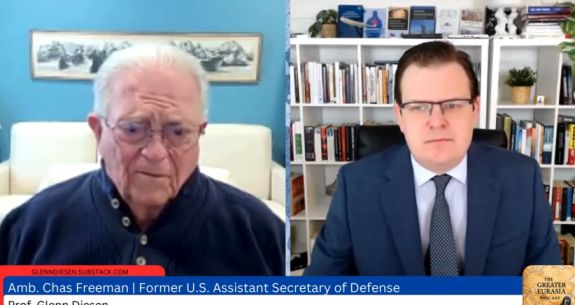
GLENN DIESEN: I sure do not. Well, Chas, as always, I look forward to our conversation, so thank you very much for taking the time.
CHAS FREEMAN: Have a pleasant evening and hope to see you again.
Related Posts