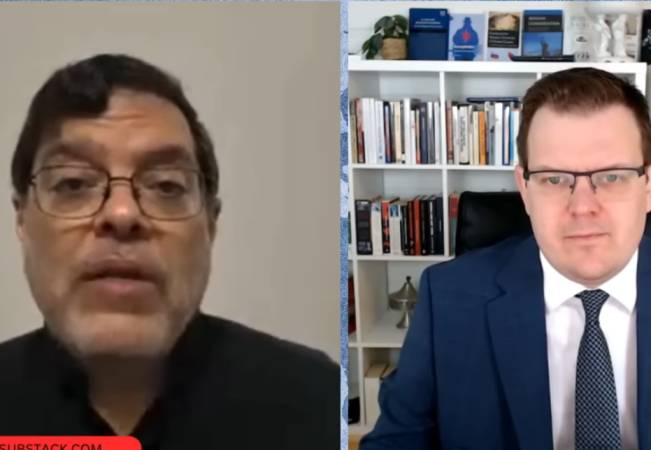
Editor’s Notes: In this compelling interview, host Glenn Diesen speaks with Professor Seyed Mohammad Marandi to analyze the strategic significance of Yemen joining the war and the looming threat of a Red Sea blockade. They explore the potential for further escalation by the “Axis of Resistance” and discuss how Western underestimation of regional powers like Iran and Hezbollah continues to shape the conflict’s trajectory. The discussion also examines the dire global economic consequences, particularly regarding energy and fertilizer supplies, as well as the deep-seated resilience of the Iranian people. This interview provides a critical look at the geopolitical shifts in the Middle East and the high stakes involved for all global actors. (Mar 29, 2026)
TRANSCRIPT:
Introduction
GLENN DIESEN: Welcome back. We are joined today by Professor Seyed Mohammad Marandi, professor at Tehran University and a former advisor to Iran’s nuclear negotiation team. So thank you for coming back on.
SEYED M. MARANDI: Thank you, Glenn. It’s always a great pleasure being with you.
Yemen Enters the War
GLENN DIESEN: Well, the last time we spoke, I asked you about what the likely steps would be that is up the escalation ladder, what we can expect to see as this war continues to spiral out of control. And you made the point that it was near certainty that Yemen would at some point also join the war and at some point also likely begin to shut down the strait that gives access to the Red Sea.
Well, the latter hasn’t happened yet, but Yemen has just entered the war. So far, it seems that it’s been limited to launching ballistic missiles at Israel. However, its participation in terms of who it targets, the objectives, can, of course, increase as well.
So I thought a good place to start would be to ask you about how you assess the significance of Yemen joining the war. I’ve heard from some American commentators that this could be the most important escalation in the war, but how important is it? And what other things could they actually do as the war continues again to spiral out of control?
Yemen’s Strength and the West’s Underestimation
SEYED M. MARANDI: It’s definitely very important. The United States waged war against Yemen last year and it failed and had to withdraw. Trump had to declare victory and walk away. So that itself shows how significant Yemen is. And in addition to that, now that the US is engaged in aggression against Iran, they will not be able to focus on Yemen the way they did last year. So that gives Yemen much more room for maneuver.
And then you also have the resistance in Iraq that is striking at US targets inside Iraq, but also increasingly beyond the borders. And we are still not very much up the escalation ladder. Yemen has joined, but its targets are so far limited. Iraq has been involved for weeks now, but again, it can go much further. There’s talk that, for example, the Iraqis may take Kuwait. They could enter the Arabian Peninsula. Yemen, too, could enter Saudi Arabia and of course, close the Red Sea, strike Saudi oil facilities.
Remember, I mean, I’m sure you remember, but during the seven years of genocidal war against Yemen, the Saudis, with their support of literally the entire world, or at least the west, was bombing Yemen day and night, slaughtering people. The Americans were patrolling the Red Sea, creating a food and medicine blockade. And actually, a former someone who was with the American forces once told me at a conference that he saw US forces stop these small boats and check them, and they saw that they had medicine, like they were importing medicine into Yemen. They would take that medicine and dump it into the sea. That’s the sort of strangulation that they were facing.
And even Qatar and Turkey were supporting this genocidal war until the Saudis and the Emirates raided the blockade against Yemen and then they tilted away. So with all that support, the Saudis failed after seven years. And ultimately what brought about the ceasefire was Yemen’s powerful strikes on the Saudi oil and gas installations.
Yemen’s Growing Capabilities
SEYED M. MARANDI: So today Yemen is far stronger and it could easily take out the oil installations and cut Saudi imports from the Red Sea completely. So it can blockade the Red Sea, it can strike Israelis, it can strike US assets in the Indian Ocean. We don’t know what weapons they now have. Obviously, during this past year, they’ve been developing their capabilities swiftly, just like Iran did, just like Hezbollah did.
And the west always underestimates you. I already had this discussion multiple times — how everyone was saying Hezbollah was defeated, Hezbollah was no longer a major force. But now we’re seeing that Hezbollah is striking the Israeli regime hard and with great effect.
And just like Iran too — the war was supposed to end in a day, the first 12-day war. Now during this Ramadan war, the current war, they thought it would end in a day or two. And then when that didn’t happen, they thought they’d take out the missile and drone capabilities in a few days. They kept saying they’re decreasing the number of attacks by Iran. Now we’re seeing after a month, Iran’s missile and drone strikes are increasing in effectiveness, especially during the last 10 days or so.
So this underestimation, this strong tendency for the west to underestimate, is something that we’re seeing across the board. They underestimated Yemen, they underestimated Hezbollah, they underestimated Iran, and of course Iraq. So we don’t know what potential Yemen has, but I’m sure it’s much greater than what it had before. And therefore this is not good news for the United States.
The Escalation Ladder and the Axis of Resistance
SEYED M. MARANDI: But the escalation ladder — we still have a long way to go.
And as we speak, Glenn, the shortage of energy, the shortage of fertilizer, the shortage of petrochemicals increases literally by the minute across the world. So the pressure from the international community on Trump and the anger towards the Israeli regime and Zionism and Netanyahu builds. And of course the pressures inside the United States, I would imagine, would be building too.
So the Iranians know exactly what they’re doing. Their allies know what they’re doing. But they haven’t yet shown their maximum capabilities — far from it. They’re just trying to manage the escalation. But I think there’s no doubt that they have escalation dominance.
Going to Tehran — A Road Not Taken
SEYED M. MARANDI: And you know, Glenn, one thing that I was thinking about just yesterday — I’ve been thinking about it a number of times during the past week. The United States could have taken a completely different route.
About a decade ago, there was a book written called Going to Tehran. I don’t know if you’ve ever seen it. It’s co-written by Flint Leverett and Hillary Leverett. They worked in the White House. Flint was the head of the Middle East at the National Security Council and Hillary was the head of the Persian Gulf. That’s where they met actually, and married. Hillary is Jewish, Flint is Catholic — different religions, different backgrounds, in the center of power.
And then when they left the White House, they wrote a book on Iran, which is actually a very good book. It’s about why the United States has to come to terms with the Islamic Republic of Iran. I would advise everyone to read that book, actually.
But if the United States had taken that route, we wouldn’t be in this critical situation today. We would be in a very different world. But of course, instead of policymakers reading this book and listening to them, they did the exact opposite. They listened to the Zionists, the oligarchy, the Epstein class. And we are in this critical mode.
So it’s not just Iran — it is the Axis. And now we’re seeing the Axis actually show its capabilities from the Mediterranean to the Red Sea, Iraq, Iran. The potential is there to create catastrophe for the United States. Already we’re seeing Iraq expelling NATO forces, US forces leaving — a form of liberation is already taking place there.
So Yemen’s entry into this war, even though it’s still not actively participating except for missile strikes on the Israeli regime, its potential is enormous. And if you shut down the Strait of Hormuz and shut down the Red Sea simultaneously, then I think the catastrophe for the west — I don’t think it can really be calculated.
The Pattern of Underestimating Adversaries
GLENN DIESEN: Yeah, what you said about underestimating Iran — I often make the point that this is a common theme against all essentially our adversaries or opponents. That is, we always underestimate Iran, we underestimate Russia, we underestimate China. The idea that they can be broken in economic wars or actual wars.
It’s an interesting phenomenon because it’s almost used as a loyalty test — that you have to proclaim that they are extremely weak and also exaggerate their threats. If you fail to do so, that is to say that they’re all very weak, so obligatory underestimation, and also a huge threat. Then if you fail to fall in line, that is indication that you’re taking the other side. So it makes you a traitor. So it’s a very dangerous thing to do, because even if the goal should be to defeat the Iranians and Russians and Chinese, you don’t want to underestimate your opponent. This is a very foolish thing to do.
Israel, the US, and the Question of Coordination
GLENN DIESEN: But I did want to ask you a bit about how you see the Iranian interpretation of attacks on it, but also Iran’s own targeting. Because we spoke before about when the US said it wouldn’t attack Iranian energy infrastructure, and then the Israelis allegedly attacked the south power stations all by itself.
Well, we saw something similar now — that is, Trump proclaimed we’re going to give it a 48-hour deadline until we start attacking. He delayed it, extended it to five days, then he extended it to 10 days. And suddenly, then Israel began attacking at the beginning of this period — the critical industries, the steel industries, for example, of Iran. And the argument was, well, it’s only the Israelis.
How do you see this, though? Is this just another diplomatic ruse or are they joined at the hip? How do you assess these constant efforts to argue that we want de-escalation while at the same time escalating?
Iran’s Military Strategy and the Strait of Hormuz
SEYED M. MARANDI: Well, I obviously don’t have access to what goes on behind closed doors in the United States or among the military staff here. But in general, here, the belief is that they are joint at the head and that it’s impossible. And military analysts in Iran, like retired officers who come on television or write articles online in Iran, they say it’s impossible for Israelis to carry out strikes without full coordination with the Americans and that this is a joint operation.
So the strike on the South Karse gas installation was a test. And since the Americans and the Israeli regime obviously were hoping that Iran would not retaliate, even though it promised that it would hit much harder if struck. They tested Iran and Iran did retaliate in the way in which it threatened to do. And that’s what made Trump back off.
And then of course, Trump, as you rightly pointed out, said he’s going to destroy Iranian critical infrastructure in two days, which is a crime against humanity. And no one in the West seems to care, meaning among elites and in the mainstream media, just like with Cuba, a sad tale in itself that’s also being ignored. The starvation of the Cuban people in order to bring it to their knees so they can take Cuba for themselves.
But first he gave 48 hours. Then I think it’s clear that he was afraid that Iran would actually carry out heavy retaliation. He did it for the markets. But then he of course extended it for another five days, which was again to control the market, which was pretty effective that week, which brought the price of oil down considerably. And then 10 days again.
He threatened to bomb Iranian critical infrastructure and the Iranian electricity power plants. That was again extended for 10 days. And that I think is basically for two reasons possibly. One is obviously to control the markets because Iran’s retaliation would be devastating for oil and gas and the capability for the Saudis and the Emiratis and the Kuwaitis and the Qataris to export in future.
So because right now, if there is a deal, let’s say at some point the Americans meet Iran’s demands and it comes to an end and they open the Strait of Hormuz. Energy can gradually be exported and it’ll take some time, but a lot of the problems will decrease over a year or so. Perhaps I don’t know the details or I’m not an expert, but if the fighting intensifies, obviously these installations will be destroyed and therefore opening the Strait of Hormuz at some point would be meaningless.
I think he backed off again, but I think he’s also waiting to see, waiting for the extra troops to come in and then he wants to carry out an assault. It was believed that it’s possible that he may carry out the attack during these nights or that he may wait till the other forces come in and then possibly he would strike critical infrastructure as he launches attacks to capture Iranian territory. So there are many different scenarios that are being discussed in Iran.
But I think that it’s clear that if there’s escalation on behalf of the Americans, the Iranians are going to de-escalate. And so just a couple days ago, when they struck the Iranian factories, the Iranians retaliated. They destroyed the aluminium complex, well, badly damaged it in the Emirates, in Bahrain, and it will continue. Or for example, they’ve begun to bomb Iranian universities, and they bombed an important university in Tehran. And so now the Iranians are saying, “We’re going to bomb American universities in the region, American and Israeli universities.” So the Iranians, every time they strike, they strike back. So that is a deterrence.
But again, we don’t know where this is going to go because Trump is constantly changing his opinion. And right after he said, “We’re going to wait for 10 days,” he didn’t strike. He hasn’t struck the electrical infrastructure, the electricity power plants. But they are attacking key factories and key infrastructure in Iran.
So there is no, you know, and this further strengthens the argument among Iranians that we just can’t do a deal with Trump. It’s not possible because he’ll say one thing today, he’ll do something else tomorrow. Just like the JCPOA, a US commitment. He tore it up. Just like the 12 Day War. We were negotiating, but he was secretly plotting against the country. This war, the same — we were negotiating, there was progress, he plotted, but he was not serious. Now he says, “We’re not going to strike.” And then Israelis strike.
And even if we conclude that the United States is not in control, that’s even worse. That means that if they’re not in control, then what’s the point of having negotiations? Because if the US is not talking on behalf of the Israelis, if the Israelis are the ones who are in charge, then what’s the point in negotiating? So no matter how you look at it, this reinforces the argument in Iran that now is not the time to stop the fighting. The facts on the ground have to change in order for us to feel secure in the future. Because the United States is obviously either unwilling to abide by its commitments or seems capable of doing so.
US Ground Troops and the Gulf Islands Strategy
GLENN DIESEN: Yeah, that’s an interesting point. The extent to which the US is in control, because you can have two competing hypotheses. That is either Israel is in the driving seat, that is it’s pushing for the escalation and pulling the US deeper into the war, or the US is just using Israel as a frontman, that is, it allows the US to play the good cop to Israel as the bad cop. So it’s hard to know. But I take your point. At the end of the day, that doesn’t matter if you can’t trust the one you’re negotiating with.
Hegseth though, he made this argument that a big strike would soon come and it seems likely that this would be coordinated by the use of ground forces to occupy something. Whether it’s Yemen islands, Iranian islands in the Strait of Hormuz or the actual Iranian mainland. We don’t really know. They could go for Kharg Island. It’s really unclear at this point.
But at the same time we see that of all the Gulf states, it’s the United Arab Emirates which seems to signal the strongest that they will join in on the fight against Iran. I thought this was interesting because the UAE claims these three islands of Iran which Iran took in 1971 and these islands could be critical in the future for the US to control the Strait of Hormuz. So the Americans are saying we have to control the Strait of Hormuz. The UAE has the islands or claims to islands which would allow the US to do so. Now you see the US talking about ground troops and the UAE seemingly very enthusiastic about joining in the war.
So I don’t know. I’m speculating. But still it seems as if there’s reasons to believe that going after these islands would be an objective. On the other hand, it’s very hard to see how they could actually — I think they could take them, but I don’t understand how they can hold them. You know, they would be like sitting ducks, it seems. So I was just wondering how do you assess the situation? The ground troops are coming. How can the Americans use them against Iran?
SEYED M. MARANDI: Well, I think the Emirates really isn’t important. None of the Arab regimes in the Persian Gulf are important. They’re not capable of fighting. The Emirates has — the citizens of the United Arab Emirates are a bit over a million people. That’s nothing. Or Qatar or Kuwait or Bahrain and Saudi Arabia. We’ve already seen that it could not fight against Yemen. And now the situation being as it is, they cannot fight against Yemen at all, nor Iraq, the Iraqi resistance, or Iran.
So it’s basically the US. What the Arab regimes do is they give the United States the ability to attack Iran. They allow them to use their territory, not just the bases. The Americans are all over the place and they use their airspace, they use their airfields, their air bases. So that’s basically the role that they play.
But Iran has said that if the United States assaults Iran’s mainland or carries out operations deep inside Iran — because that is also something that Iranians are preparing for. In fact, some believe that this talk about this island or that island may be an attempt to divert Iranian attention and then the Americans do something else. So Iran is preparing itself, has been preparing itself for two and a half decades at least. They’ve been preparing themselves for today.
And of course, America has miscalculated with the missiles and the drones. So I think they will probably soon find out that they’ve miscalculated about taking islands and taking Iranian territory or carrying out commando operations or special operations deep inside Iran. But time will tell.
But the problem for the United States is that even if they do take territory, maintaining it will be the problem. But more importantly, what are they going to do about the oil and gas?
The Oil and Gas Crisis: Iran’s Strategic Leverage
SEYED M. MARANDI: What will they do about oil and gas and fertilizer and petrochemicals if Iran doesn’t control the Strait of Hormuz? First of all, from the shores of the Persian Gulf or the Gulf of Oman, the missile bases and drone bases are hundreds of kilometers deep inside Iranian territory, and there are many of them. And the Americans have already failed to destroy them. There’s no reason to believe that they can take out all these bases.
And then if the Americans escalate, the Iranians will destroy the tankers and they’ll destroy the oil and gas installations and the assets and the other key assets in the Persian Gulf region that belong to these Arab family dictatorships who are complicit.
So let’s say, hypothetically, the US takes islands or some territory or carries out some operations against a missile base or a drone base, with success or failure, doesn’t matter. That’s not going to open the Strait of Hormuz, and that’s not going to prevent Iran from destroying and retaliating simultaneously.
So let’s say they are able to open the Strait of Hormuz somehow, which I don’t see happening — when there’s no oil, when there’s no LNG tankers, what’s the point? So the price of oil will go up to 200 a barrel, and then we’ll see economic collapse. And this is something that we’ve envisaged already, well before this war. I was saying that all this would happen. Up 100, that’s quadruple. That will bring down the economy again.
These mainstream Western analysts, they downplay everything. And by downplaying everything, you can’t make it go away. You just miscalculate. Just like with regards to Iran’s military strength, just like with regards to Hezbollah or Russia, as you pointed out, or China or Yemen and Ansar Allah, the Iraqi resistance. So any US attack on the mainland or on the islands is going to lead to greater disaster because you have further destruction, much greater destruction. And that means that the oil crisis and the energy crisis and the petrochemical crisis and the fertilizer crisis will be permanent.
US Military Vulnerabilities: Drones, AWACS and the Shifting Battlefield
GLENN DIESEN: Well, it seems besides the economic pressure, I very much agree it would only grow from here on and it can be intensified as well. But it’s often also pointed out that over time the military benefit will also shift increasingly in Iran’s favor. That is, simply because Iran can launch very cheap and effective drones and it has the ability to up the production of them. The production isn’t that centralized apparently. It’s very difficult to do anything about it. So Iran will continue to have massive access to these cheap drones.
But the Americans are forced to use very expensive million dollar interceptor missiles which they have few of. They’re expensive and even if they have money to throw at it, they don’t actually have the production potential. So it seems in terms of weaponry, it will go to the disadvantage of the US over time.
And well, we already seen something over the past 24 or 48 hours, which is Trump — Trump made this speech about the aircraft carrier. I think he said it was attacked from 17 different directions, which makes me want to question some of the official story that they had a fire in the kitchen. That’s why it had to be taken out of operation. I mean, this is not what Trump was communicating.
But we also saw over the past 24 to 48 hours, the destruction of the E-3 Sentry AWACS, that is the flying radars of the United States which are indispensable on the battlefield and they don’t have that many of them, at least none to lose. So one of these were destroyed at the US base in Saudi Arabia. Also a few more of those KC-135 aerial tankers which are also important to refuel any fighter planes or bombers because they have to keep a safe distance to Iran.
So how do you interpret this on the battlefield? Do you see the US becoming more vulnerable and what do you expect to see in the weeks to come? Because this especially, the Sentry AWACS, this is a very painful loss for the United States.
Iran’s Strategic Depth and the Possibility of Regional Escalation
SEYED M. MARANDI: Oh indeed. Especially since they’ve lost all their radar systems on the ground. They’re much more reliant on radar systems from the air. I think really the key issue here, Glenn, is that the Americans and the west, they’ve miscalculated Iran’s missile and drone capabilities obviously very badly.
But if they enter the battlefield on the ground, they don’t seem to recognize that Iran’s defenses will be deployed using weapons that have nothing to do with these missiles and drones that are being used. In other words, in addition to those missiles and drones that will be focusing on targeting Americans, there will be a host of other weapon systems and military units that will be targeting the United States with all sorts of other missiles that will target their helicopters, that will target their commandos on the battlefield.
And Iran has all sorts of underground bases across the region and in these mountain ranges and near the mountain ranges and near the shore that the Americans know nothing about. A lot of the underground bases that fire missiles, the long range missiles and medium range missiles, they still haven’t even been used, they still haven’t started operation. Most of Iran’s strikes on the Israeli regime and the Americans in the Persian Gulf are from a certain group of underground bases.
So just as these missiles and drones that are being used exist in many other places that have yet to become operational, the Iranians have planned and they have an elaborate plan for dealing with a ground offensive. And this is not something that they’ve been thinking about for the last few months. This is something that they’ve been planning for the last 25 years. So when they come in, who knows what sort of weapons the Iranians have to target the invaders. And of course you are going to only mobilize Iranians against the invaders.
And then Glenn, and again, this is just hypothetical, but I think it’s a serious argument. What if Iraqi forces, while the Americans are trying to invade Iranian territory, Iraqi forces and Iranian forces go into Kuwait and northern Saudi Arabia? What if Yemen enters Saudi Arabia from the southwest, then what do the Americans do?
So are the Americans going to be able to block Iran? They can also be surrounded by Iran because if Iran moves into Kuwait and Saudi Arabia, that will destabilize these family dictatorships in the Persian Gulf region very swiftly and then where are the Americans going to retreat to? I mean, it’s just a crazy project.
Even if the Americans bring in tens of thousands of military to invade Iran, when they invaded Iraq, they had, I think the second time, when they took the country, Iraq was broken. The regime was unpopular and the Americans had, what was it like, 200,000 troops? 160, 70, 80,000 troops. And they brought in heavy tanks and also they brought in everything into the region and they were using Saudi Arabia and Aden. Actually the only country in the region that actively opposed the U.S. intervention in Iraq, the invasion of Iraq, was Iran and Hezbollah.
The chief of Hezbollah spoke in Arabic multiple times against the war because they said we want freedom from this guy, from Saddam. But he was saying that whatever Saddam may be, the U.S. has no legitimate right to invade. So these countries were all assisting the US in invading Iraq back then.
Iran is much larger than Iraq. Iran has shown how capable it is. And Iran’s territory is mountainous. Iraq was flatland. There’s just no comparison. So the United States with a few 10,000 forces will not be able to do anything. But again, the Iranians could outflank them. The Iranians and the Iraqis and the Yemenis can enter the Arabian Peninsula.
So if things get really bad, if escalation goes up, you can envisage all sorts of things that people never thought about before. But I think they’re all quite possible now.
Yemen’s Resilience and Iran’s Will to Fight
GLENN DIESEN: Well, how do you assess the resilience on the Iranian side? Many American commentators especially say that Iran’s resilience will diminish as they killed a lot of their leaders, they hit a lot of the economic targets, they bombed the civilians to have social problems. What would you say to them?
And also if Iran’s troops are used against Yemen, they’re in a more exposed situation, it seems geographically than the Iranians, but still on the map they look very tiny and small, but their population would be about 34 million. I think in Saudi Arabia they only have about 24. So while it looks very big, it’s a lot of desert, and I think 35, 40% of its population are expats. How would you respond to them suggesting that Yemen will be a vulnerable target and Iran wouldn’t have the same resilience anymore?
SEYED M. MARANDI: Well, Yemen obviously won its war against the United States. It won the seven year genocidal war. Now, it’s much more prepared. And the United States can’t focus on Yemen because it has Iraq, Lebanon and Iran to deal with simultaneously.
And Saudi Arabia, they don’t fight their own wars. They basically have others do it for them. And now they just don’t have the sort of capability that they had before. And Yemen could strike their oil installations and create chaos in the country and then move in. They’re much tougher than the Saudis, and they’ve shown their resilience.
In the case of Iran, Glenn, and one thing that’s true about Yemen, Iran and Iraq, goes back to Islam and Shia Islam in particular. General Soleimani had a very famous speech where he said, “We’re the nation of martyrdom.” When he was threatening Trump, he was saying, “Don’t threaten us.” He told Trump not to threaten us. “We are the nation of martyrdom. We’re the nation of Imam Hussein.”
Imam Hussein is the grandson of the Holy Prophet. The resilience in Iran has a lot to do with Iran’s Islamic and Shia identity. In particular, this resilience, this resistance comes from there. And that is true about Hezbollah, that’s true about Yemen.
Just a while back, a Brazilian leftist friend of mine, he was speaking to me and a journalist, and he was saying that a very famous Brazilian communist was saying, “If Iran wins this war, I’m going to become a Shia.” Whether he does or not is irrelevant. But the point is that it just shows how people across the world are in awe at the resilience of the Iranian people. They were supposed to fold a long time ago.
Iran’s Leadership and the People’s Resolve
SEYED M. MARANDI: Ayatollah Khamenei was martyred. And for a week, we didn’t have a leader for a full week. The country was being run in accordance with the constitution, where the president and the head of the judiciary and a representative from the Guardian Council were leading. But that’s not ordinary. So during that week, it was basically the people that were holding the country together. They were on the streets every night in the millions. Things were calm and the armed forces were striking back. Things were working sort of like a watch on its own.
And now we have a leader. We have a new head of the chair of the Supreme National Security Council. Everything is in place like in the past, and they’ve largely failed in their assassinations. But even if they do murder people, they’ll be replaced.
It’s been a month and still people are out on the streets every night. Actually last night I had to go to a studio very far away from where I live, and I literally crossed Tehran and I went past four or five of these huge gatherings in different parts of Tehran to get to that studio. The point is that people are resilient.
We had heavy bombing last night, carpet bombing, and early this morning, and people were out. When I came back from the studio, it was like 1:30am. People on the streets waving flags and chanting slogans and listening to revolutionary music and singing with it. No, it’s not going to have any effect. The Iranians are prepared. They understand that this is a war for survival. This is an existential war.
They see that we’re the victim. They saw that Ayatollah Khamenei was right all after all these years, that the United States is just simply untrustworthy. They saw how the collective west antagonizes Iran, even those who are opposed to Trump. They’ll demonize Iran and antagonize Iran. Whether it’s CNN or the Guardian, or whether it’s sort of semi alternative media people like Mehdi Hassan and others, they’re extremely hostile towards Iran but they’ll criticize the U.S. government.
They see that the epistemic class, the oligarchy, the dominant narrative is basically the narrative that the Zionists want. And so the only way is to have self reliance and to not pin any hopes on the Democrats or the Labor Party in the UK or the Greens somewhere. It doesn’t make a difference. People here recognize that.
Western Propaganda and the Reality on the Ground
SEYED M. MARANDI: And what again the west fails to understand, because they believe their own propaganda. And you’ve been to Iran, so you know this. Iranians know exactly what’s going on. They watch Western media and some are fluent in foreign languages. They can watch satellite TV and see what the west is saying. But those who are not fluent, they watch the hundreds of Persian language media channels that are funded by Western governments, beamed into Iran and all full of hate and disinformation. So they know what the other side is saying. It’s not as if it’s a closed society.
But despite that, they’re on the streets. Despite that, when we didn’t have a leader for a full week, everything was calm. You can walk on the streets of Tehran right now as a woman alone at 12am, at 1am, and feel pretty secure. I’m not saying there’s no chance of robbery, but you can feel pretty secure.
So that analysis is based upon missing their own propaganda model, information that comes from their narratives. Just like Iran’s military capabilities, just like Hezbollah. I mean, Hezbollah is the best example of all. We were told that after the fall of Syria and the US control of Syria, we have US soldiers in Damascus and in Damascus hotels as we speak, you and I right now, although apparently they’re emptying those hotels because Iran threatened to strike those hotels, the Four Seasons and Marriott, I think.
But the year after the United States controlled Syria through its Takfiri proxies, and after the ceasefire in Lebanon and the Lebanese government under US pressure working against the resistance, everyone in the west and many people in the region were saying that Hezbollah was finished. But now Hezbollah is performing even better than it was before the ceasefire.
So these are things that the west simply cannot learn and they’re going to have to deal with it again. I have no doubt that when they invade Iran, there’s going to be propaganda from CNN. They’ll be saying, “We’re winning. We took this, we took that, we destroyed this place and we destroyed that.” And they’ll put out footage, and most of the footage that they put out, these are decoys.
Right now, most of the planes that they supposedly bombed, these are decoys that Iran has purchased from China. During the last eight, nine months before the war, Iran purchased a huge number of decoys from launchers from China. And the decoys are very, very good. They even generate heat. So the Americans have no idea what they’re dealing with.
The Western media for two or three days will say how successful they are. But I think after a week or so, just like the war itself, it’ll become clear that this was all a miscalculation.
The Strategic Vacuum and the Closure of Hormuz
GLENN DIESEN: I guess this goes back to my initial point that this is a key problem when there’s this tendency to not just exaggerate the threat, but also exaggerate the weakness of adversaries, because one often ends up then with the conclusion that well, something has to be done because they’re an overwhelming threat, but they’re also weak. If we just have the will to push a bit, then the whole house of cards will fall apart. And the problem is when it doesn’t happen, then one ends up in chaos.
And just to draw the parallel with the Chinese, when the semiconductor industry didn’t collapse after removing the access to semiconductors, once Russia didn’t collapse once by sending weapons and putting the sanctions on, or Iran, one is left in this strategic vacuum because this was essentially the only card to play, that is show enough power and the adversaries will fall apart.
And always that goes with all the small to medium sized countries bombed over the past 30 years as well. When there’s no exit strategy, it’s shocking that one keeps doing the same thing over and over again. But again, absorbing this mistake, that is the attack on Iran, this is something I don’t see how one can recover from, because this is the closure of Hormuz. I just don’t see an end to this war. Do you see any other possibilities than the US obeying Iranian demands, or is there a meeting point somewhere halfway?
The Path Forward: Iran’s Strategy and the Economic Pressure Campaign
SEYED M. MARANDI: Well, Iranian demands will have to be met. How they’re met, like how they would be negotiated, that’s a different issue. Some things the US could walk away from and say we had nothing to do with this. For example, Iran will demand reparations and the US will say, “I’ll never give them reparations.” Well, Iran can take it from Emirates and the Saudis and the Kuwaitis and the Qataris. So that won’t be a US problem.
Iran will not allow the United States to be able to use the Persian Gulf region as a platform to invade Iran or strike Iran. The United States could say, “Well, we won’t accept.” But in reality, Iran can force those countries in the Persian Gulf not to allow the United States to have the access that it had before. So the United States could say, “No, I’m still there and I’m going to remain there.”
Iran doesn’t have a problem with these countries having political relations or business relations with the United States. The issue is being a platform for murdering Iranians and destroying Iranian assets and infrastructure. So there are things that can be solved without the United States having to be humiliated. But there are red lines. There are things that Iran has to do.
For example, Iran’s allies in the region will be a part of the deal. There’s no doubt that Iran has declared that Hezbollah will have to benefit from it, Yemen will have to benefit from it, the Palestinians will have to benefit from it, the Iraqis will have to benefit from it. So certain things will happen whether the Americans like it or not, because if they don’t, Iran is basically inviting another invasion six months or a year, a year and a half down the road — and that has to end. So we have no option.
The Human Cost and Military Frustration
But I think this war — the real issue is not how many children they slaughtered last night. They killed a lot of people in Tehran and they just bombed houses. The last two, three nights they’ve been particularly vicious. And last night, not just in Tehran and elsewhere, they’re just bombing homes and killing people like in Lebanon and Gaza. I don’t know. It’s a type of — they’re trying to create fear, I guess, and they are frustrated that they can’t defeat Iran.
Last night, for example, they murdered an Afghan family of six to the south east of Tehran. They’re just slaughtering people. But all of this is, at the moment, costly and it’s putting a strain on the military and their resources. But that, I think, is the sideshow.
The Real Battleground: Energy and Economics
Iran can destroy US assets, but the real issue is the oil, the LNG and the petrochemicals and the fertilizer. That is where the United States is in serious trouble. So if the prices go through the roof, and if Yemen also strikes Saudi installations, then I don’t think war is sustainable anymore. The United States will have to — because there will be an economic depression, and I think there will be severe unrest in the United States. And I also think the United States won’t have the money to sustain war.
But Iranians recognize that, and that is their objective — to increase the pressure to a point where the Americans say, “Okay, let’s find a solution that is satisfactory to the Iranians.” And again, it can be negotiated in a way where the Americans would accept, in my opinion.
This again reminds me of the book Going to Tehran, which I advise your viewers to read, by Flynt and Hillary Leverett. The Americans could have had a very different type of relationship with Iran. They explain Iran’s history and they deal with many of the myths about Iran, the demonization of Iran — it could have been completely different. But now the United States is in a situation that is only going to get worse for everyone. And bombing Iran in the hope that people in Iran will submit hasn’t worked before and it’s not going to work now.
Time Is on Iran’s Side
Time is not on their side. This is what the Iranians understand very well. Time is on the side of the Iranians, because every minute the shortage of energy and petrochemicals and fertilizers grows. Every day it’s going to get worse. Next week the markets, I would assume, will begin to reflect this. And then the week after.
Different people say different things, but within three weeks from now, they say the situation is going to be very critical. And even in a week from now, they say it’s going to get pretty bad. We have to keep in mind that the ships that take oil and fertilizer and energy and petrochemicals — a lot of them take weeks to get to their destination, and then for everything to be taken to the market, it takes a further couple of weeks. It’s just now going to hit.
People are talking about some shortages here and there and prices rising, but pretty soon it’s going to get very bad. And the Iranians know that. The Iranians don’t want this. They didn’t start the war. But the only way to stop the Americans is to increase the pressure so that they back down. And I think pretty soon that pressure is going to be felt in a very big way.
GLENN DIESEN: Well, thank you for taking the time to speak with us and yeah, stay safe.
SEYED M. MARANDI: Thank you, Glenn. It’s always a pleasure being with you. And I hope and pray for better days for everyone. I know people across the world — so many people contact me and they say they’re praying for the Iranians. I know communists. I have communist friends who say they’re praying. So the world is indeed changing and views are evolving.
And although again, as I’ve said many times before, I am very optimistic about the future, even though I may not live to see that day. And while the days ahead may be darker and darker, I think that ultimately — I’m confident that ultimately it will be better than this.
Related Posts
- TRIGGERnometry: w/ Sir Antony Beevor on Russian Mindset (Transcript)
- Transcript of John Kiriakou’s Interview: This Past Weekend #661
- PBD #812: w/ Mehdi Hasan – Iran War, Qatar/China DARK Money (Transcript)
- SRS #310: w/ Josh Duhamel – Survival Skills, Off-Grid Living, Billionaires Building Bunkers (Transcript)
- Diary Of A CEO: w/ Mathematician John Lennox – June 4, 2026 (Transcript)