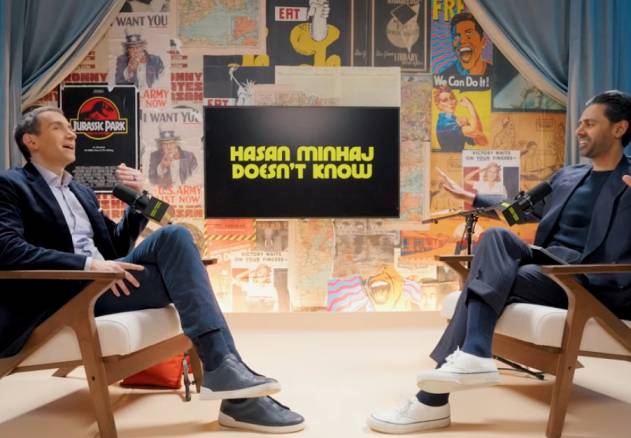
Editor’s Notes: In this compelling discussion, Hasan Minhaj joins CNBC’s Andrew Ross Sorkin to analyze whether the global economy is headed toward a modern-day Great Depression. Drawing from Sorkin’s book 1929, they examine the striking similarities between historical market behaviors and today’s landscape of AI-driven productivity and private credit risks. The episode explores how political volatility and shifting international alliances are challenging American financial hegemony. Finally, Sorkin offers a candid look at the “myth of brilliance” surrounding the world’s richest titans and what their influence means for the future of the market. (Mar 25, 2026)
TRANSCRIPT:
An Apology to Squawk Box
HASAN MINHAJ: I usually kick this off with a question, but today I want to kick it off with an apology. In 2022, I came on your show. Yes, I appeared on Squawk Box. I was wearing a black turtleneck. I was satirizing many of the people that appear on the Forbes 30 Under 30. Yes, I was on the show because I bought a bunch of BTC and SPACs during the pandemic because I was bored, and I lost a bunch of money.
ANDREW ROSS SORKIN: Do you invest yourself?
HASAN MINHAJ: Oh, I’ve lost a lot of money watching this show. And my therapist told me that I have to tell you in person that the reason why I lost a lot of money isn’t because of CNBC and Squawk Box. It’s because I’m an adult. I made my own decisions. And there’s no crying at the casino.
ANDREW ROSS SORKIN: That’s a very evolved view. So thank you.
HASAN MINHAJ: I just wanted to own that. I wanted to own my own —
ANDREW ROSS SORKIN: I appreciate that. Thank you. I did not — I thought we were — that’s great. Thank you.
HASAN MINHAJ: Yes.
ANDREW ROSS SORKIN: And that’s very nice of you to say.
HASAN MINHAJ: I have to own that and I have to carry the consequences that came my way in my Wells Fargo account.
ANDREW ROSS SORKIN: Did you get killed?
HASAN MINHAJ: I got destroyed.
ANDREW ROSS SORKIN: Really? Like — what are we talking about here?
HASAN MINHAJ: I don’t want to put it into a road mic, but I did lose quite a bit of money.
ANDREW ROSS SORKIN: I’m sorry to hear.
HASAN MINHAJ: And I shouldn’t have used CNBC and Squawk Box as a tool to build wealth. I should put my money into more reliable things like Poly Market and betting on UFC and the NFL.
ANDREW ROSS SORKIN: Are you doing that now?
HASAN MINHAJ: Occasionally.
ANDREW ROSS SORKIN: That’s maybe not a good idea either. Well, we can talk about that.
HASAN MINHAJ: We can talk about that.
Prediction Markets and Insider Trading
ANDREW ROSS SORKIN: I don’t know how I feel about prediction markets. I am assuming that the conundrum in the prediction market space is just how much insider trading is really going on. That’s to me the thing. Less so maybe in the politics — I think actually you could probably get a gauge of something from that. But if you’re betting on what Bad Bunny’s first song is going to be at the Super Bowl, I’m assuming the cameraman and the cheerleaders and everybody who’s in the stadium the three hours before halftime —
HASAN MINHAJ: So I have a theory that the state of the American economy is determined by our Super Bowl ads.
ANDREW ROSS SORKIN: Okay.
HASAN MINHAJ: The 2026 Super Bowl was pretty much brought to you by three things: AI, crypto, and weight loss drugs. Am I seeing this right? That the American economy is pretty much propped up by grifters, addiction, and low self-esteem?
ANDREW ROSS SORKIN: I think you got it pretty, pretty, pretty right. That should be a new index. We call it the Super Bowl Ad Index.
HASAN MINHAJ: Okay.
ANDREW ROSS SORKIN: But by the way, that’s true because if you go back and think two or three years ago, the beginning of all the crypto ads —
HASAN MINHAJ: Sure. The FTX moment.
ANDREW ROSS SORKIN: The FTX moment, all of that. Yeah. You can always look at the Super Bowl — it’s not a bad place to look.
HASAN MINHAJ: Do you ever see it as an indication of who is flush with cash and who’s trying to message, or basically paint a picture of what is —
ANDREW ROSS SORKIN: — to come in every instance? In fact, now that you’re saying it, I wish that I was — you say you don’t know. I think you know. That was a hot take.
HASAN MINHAJ: I just want to let everyone know.
ANDREW ROSS SORKIN: No, no, but I think I wish I had looked at it exactly like that. I think we often do look at the Super Bowl as — look, I’ve been, I’m always obsessed with the ads, almost oftentimes more than the game. And it usually is these companies that are kind of on the cusp that either have a lot of money, or frankly that don’t even have enough money, who are almost desperate to make a stand, show themselves.
And this is the year that AI is here. By the way, I think OpenAI did a big ad last year as well. And then the crypto guys — I think they started in this role a couple years ago. But yeah, you can totally sort of see the narrative arc.
The Super Bowl Ad Index and Market Optimism
HASAN MINHAJ: I felt that these commercials are a story about optimism.
ANDREW ROSS SORKIN: Yep.
HASAN MINHAJ: And over the past five years, the stock market has boomed. What is the optimistic story that the markets are believing?
ANDREW ROSS SORKIN: The optimistic story that the markets believe — and by the way, as we’re filming this right now, they’re not that optimistic.
They are betting to some degree right now on sort of this deregulatory environment where all the regs come off. Crypto becomes a thing you can do. If you want to do prediction markets or bet or gamble or trade, all that’s available to you. You want to merge — all that’s available. All of the things that some folks in the market thought were not there a couple years ago, they look and go, “Could happen.”
AI and the Job Market
HASAN MINHAJ: I have been struggling navigating the AI discourse, specifically in my industry. Hollywood AI discourse is either this vague optimism or vague doomerism. Every conversation that I’m a part of — “AI will replace your job.” Okay, which job? “I don’t know yet.” Or I’ll hear, “Trust me, AI is going to create so many jobs.” And I’m like, what job? And they’re like, “I don’t know yet.” Are you seeing any specific numbers that are showing that one side is winning over the other? Because that’s what I’m looking for.
ANDREW ROSS SORKIN: I think in the short term, there is no question, no question that once it starts to get to sort of escape velocity, it’s going to impact jobs. I can’t even see some other answer. So when people say — what I hear is, “Are we in an AI bubble? And we should worry about that.” And I say, yeah, but you should also worry about what happens in success.
Maybe there’s an AI bubble, and that probably is some kind of short-term duration mismatch between the amount of money that’s being put into this right now and how much money people are actually going to make off of it, at least immediately. I think longer term, I don’t see how we could have immediately more jobs. I think specifically we’ll start by having less jobs.
HASAN MINHAJ: It would start with — and then hopefully, fingers crossed —
ANDREW ROSS SORKIN: I think there’s a lot of YOLO here. I think there’s a lot of “let’s just see what happens” and hope, and there’s sort of a faith — and I don’t know, I don’t think I have this faith — but I think there’s a faith that we’ve always somehow figured it out on the other side. We had horse and buggies, we went to cars, we figured it out. TV didn’t kill radio, cable didn’t kill the movies — all that. Sure, though, maybe it is killing the movies. It is killing the movies for sure.
HASAN MINHAJ: Yeah. What would the past five years of stock market returns look like if Nvidia just was excluded?
ANDREW ROSS SORKIN: Oh, goodness. Not good. I mean, look, if you take out the top basically six or seven tech companies out of the S&P 500, you’re looking at something that looks like it’s flat to basically down. That’s what it looks like. Yeah. But that’s why this whole sort of tech revolution is — people are buying into this dream. That’s what’s going on. I would say flat. There’s a whole bunch of math you can do on it, but it would not look nearly as positive.
The Book: 1929 and Its Parallels to Today
HASAN MINHAJ: I think one of your great skills is creating parallels with the past. So let’s talk about the book.
ANDREW ROSS SORKIN: Okay.
HASAN MINHAJ: I want to put up one of the pull quotes from your latest book, 1929. I’d love for you to read it.
ANDREW ROSS SORKIN: “Lengthy, uninterrupted booms like the one in the 1920s produce a collective delusion. Optimism becomes a drug or a religion or some combination of both. People lose their ability to calculate risk and distinguish between good ideas and bad ones.”
HASAN MINHAJ: What parallels are you seeing between the moment that we’re living through right now in 2026 and the stock market crash of 1929?
ANDREW ROSS SORKIN: Oh, my goodness, so many. And look, when I wrote this book, I didn’t think that I was trying to write some kind of warning about the world today. That was not actually the point of it. But as I was writing it, I would see some headline, I’d clock it and go, “Yep, that just happened. Yeah, that just happened.” And so many of the things are the same.
HASAN MINHAJ: What was the inspo? I mean, for me, heterosexual men hit 40 and they either go World War II documentary —
ANDREW ROSS SORKIN: Yeah.
HASAN MINHAJ: But for you, do you just pick financial crises?
ANDREW ROSS SORKIN: No. What happened was, after writing Too Big to Fail, people used to ask me all the time about 1929. They’d ask me about the comparisons between 1929 and 2008. And the truth was, I never had a good answer because I didn’t know.
HASAN MINHAJ: So they would just turn to you to be like, “Break down the subprime mortgage crisis,” or “Break down what happened in the Roaring Twenties that led to the —”
ANDREW ROSS SORKIN: Yeah, yeah. They were —
HASAN MINHAJ: And you were just like, “I haven’t —”
ANDREW ROSS SORKIN: I would always walk out of whatever that conversation was with whomever it was and say, “I really got to learn about this. I really got to understand this period.” So then I was like, okay, I’m going to try to figure out how to do this.
HASAN MINHAJ: Were there particular characters where you were like, “Oh, I love the tea here. This was very interesting and titillating.” And these particular people had huge impacts on the world in shaping the global market?
ANDREW ROSS SORKIN: So I’ll tell you, there’s two guys, one woman who to me were just it. One guy’s named John Raskob. He really was like the Elon Musk of his era. He was running General Motors in 1919. Up until then, by the way — we’re talking about credit and debt and all this stuff, people taking all this debt — you didn’t do that in America. That was like a moral sin.
HASAN MINHAJ: Right.
ANDREW ROSS SORKIN: Proper people did not take on mortgages. Nothing.
HASAN MINHAJ: You wrote that credit was a new invention in 1929.
The Origins of Retail Investing and FOMO
ANDREW ROSS SORKIN: It was. Yeah. And 1919, John Rascob had this idea, how am I going to sell more cars? Run General Motors? How is he going to sell more cars? I’m going to lend people money so they can buy more cars. And that somehow, like, flipped a switch in the American public about their willingness to take on debt and what that relationship was even like. And then you had Sears Roebuck do that. And then you had a guy named Charles Mitchell, who’s a banker, who ran a bank called National City, which becomes Citigroup. He clocks all this and says, I can do this, too. I can do it on steroids. And I’m going to let people buy stock, democratize finance, and I’m going to loan them the money to do it.
HASAN MINHAJ: And that was the original kind of retail investor.
ANDREW ROSS SORKIN: That was the first retail investor. So Rascob did that. Then you had Mitchell jump on top of it. And my other favorite character is a woman named Evangeline Adams. Evangeline is an astrologer in New York City. Okay. And you laugh, but every Wall Street banker and trader went to visit Evangeline. She had an office up at Carnegie Hall. She charged $50 an hour.
HASAN MINHAJ: Wow.
ANDREW ROSS SORKIN: She had a newsletter, 100,000 subscribers. And she would tell you if the stocks were going to go up or down. And they would listen to her just the way they’d probably listen to whomever right now.
HASAN MINHAJ: Gwyneth Paltrow, Deepak Chopra, whatever. Some form of kind of astrological.
ANDREW ROSS SORKIN: That was what was going on in the 1920s.
The Psychology Behind the Debt Shift
HASAN MINHAJ: Everybody that I talk to, when they describe their grandparents, they describe how penny-wise Grandma and Grandpa were. How did these people convince Grandpa to say, “f* it, I’m going to put it on credit?” I mean, that is a huge consumer shift to happen. What did they do that kind of pressed those buttons that allowed our grandparents, who are famously risk averse, to go, “I’m all in?”
ANDREW ROSS SORKIN: Well, I think the phrase FOMO didn’t exist in the 1920s, but it should have. I think what happened was you had this sort of revolution taking place. People all of a sudden buying cars, getting their appliances from Sears, and people seeing this whole idea of keeping up with the Joneses or whatever. And so I think people saw people getting rich, getting wealthy. They’re coming also, by the way, from the country, if you will, to these cities like New York, and they’re seeing what wealth is and they want in. I think that’s what this was about in the 1920s.
And to some degree, I also think it was a shift in what the American dream was. And not just what the American dream was, but the very sort of conceit of how to get rich, which is not slowly, which is fast. The American dream became about the lottery ticket, became about sort of quick riches, the pogo stick.
HASAN MINHAJ: How do I level up?
ANDREW ROSS SORKIN: How do I level up quickly? And maybe that’s the only way to level up. Meaning if I do my day job, I’m never going to get there. So I got to be doing all this other stuff.
HASAN MINHAJ: Well, to have a callback to my opening apology to you — what got me into the SPACs and Bitcoin thing and made me kind of Internet addicted on Reddit was this feeling inside of me of like, am I missing out on something? Am I stupid? Because I’ve been chugging away this particular way my entire life, but there’s got to be something else. I keep hearing about this thing. So this idea that there’s this other level you have to unlock and these are the tools to do that — was that something that was also happening in the ’20s? Like, “don’t be a schmuck, everybody else is doing this. If you talk to my guy, there’s another way to get this done.”
ANDREW ROSS SORKIN: This is why infomercials exist. This is why Tony Robbins has success. Because everybody wants to find the path.
HASAN MINHAJ: Sure.
ANDREW ROSS SORKIN: They want to figure out how to do it. And by the way, you’re not alone, like with Bitcoin. But I’m not allowed to own individual stocks or equities or anything like that.
HASAN MINHAJ: Is that the CNBC thing? Because of your job?
ANDREW ROSS SORKIN: Because my job. Totally. You can move the market.
HASAN MINHAJ: Okay.
ANDREW ROSS SORKIN: I oftentimes know news.
HASAN MINHAJ: Is that through the Times or through CNBC? How does it work?
ANDREW ROSS SORKIN: Both.
HASAN MINHAJ: Oh, wow. Interesting.
ANDREW ROSS SORKIN: Across the board. Most financial journalists do not own individual equities of any sort. Mutual funds, sure. Maybe some ETFs, I don’t know. But the idea that you could be talking about a stock or something that you own, talking it up — it’d be like if I was talking up Bitcoin.
HASAN MINHAJ: Right. There’d be a huge —
ANDREW ROSS SORKIN: And I own Bitcoin. Right. Yeah.
HASAN MINHAJ: And if you want to do that, you have to get elected to Congress. I mean, that’s the way to trade individual stock.
ANDREW ROSS SORKIN: But I will tell you, there’s so many times where I’m like, looking at all of that and going, man, I missed out. Like, I knew. Of course I knew. In the same way you were saying — that is a natural human reaction to all of this.
The Risk Laundering Grift of 2008
HASAN MINHAJ: Well, that’s the theme of the first part of this conversation, which is this idea of optimism, FOMO, missing out. I want to talk about another theme, which is risk. And when I read your 2008 book, Too Big to Fail, what I took away from it is that fundamentally that crash was caused by a risk laundering grift. Am I thinking about that correctly?
ANDREW ROSS SORKIN: Right.
HASAN MINHAJ: And how did that work? What were the risks that they were hiding that caused the financial markets and the housing market to collapse?
ANDREW ROSS SORKIN: So there’s a whole bunch of different grifts going on. I don’t know which one you want to go to first.
HASAN MINHAJ: You lead us, Andrew.
ANDREW ROSS SORKIN: Well, look, I have a very complicated view of 2008. And the reason I say I have a complicated view is because on one end, you have Wall Street and the banking system effectively playing hide the ball, but sort of — because you had rating agencies that were completely conflicted, and you had these CDOs and sort of structures that people were creating, basically just like mountains of debt piled on top of each other and sliced in all of these sort of unusual ways.
And then on the other side, you had people trying to buy homes that they should not have been buying. And I say that because we don’t often talk about it like that. Interestingly, by the way, in 1929, after the crash happened, back then, people didn’t blame the bankers initially. In fact, if you read the diaries, they all blame themselves. They say, “I shouldn’t have done this, I shouldn’t have gotten sucked in, the FOMO got away from me.” 2008, it was like finger pointing. Everybody was at fault except for yourself. Nobody was saying it was their own fault. Everybody was participating. And I don’t think anybody —
HASAN MINHAJ: Certain parties had more power than others in this.
ANDREW ROSS SORKIN: Totally. And by the way, look, there’s no question, I would say that the banks in the end have more responsibility than an individual should. But I do look at the whole thing and say the whole thing was a little crazy. And by the way, you had also shareholders, the investor class, that was basically rewarding all of this and not saying this is too risky.
The Hidden Risks in Today’s Economy
HASAN MINHAJ: Are there any risks that are currently being baked into the economy right now that we’re not seeing, the same way you saw that with those bad mortgages?
ANDREW ROSS SORKIN: Okay. So the big risk today is actually a function of something that happened after the financial crisis. So after the financial crisis, we said, we have to regulate these banks. We cannot have these banks lending money like this anymore. As a result, we made it harder for banks to lend money, and we created or incentivized a whole other industry called private credit. Basically, banks hardly lend the money anymore. Now it’s basically private equity firms that are creating these funds and lending that money out.
Right now we have no transparency, no real look into what is going on inside these firms. And some of these guys are already running into trouble. Some of them have lent an extraordinary amount of money to software companies, some of these AI companies. Some of them are partnering with some of the biggest hyperscalers in AI, so Meta and others. And I do think that we are going to have some kind of reckoning in what’s called the private credit space. Now, what I don’t know is when that happens, if it happens, how much of it ultimately impacts the true real economy or hits the banks and then becomes an even bigger problem.
HASAN MINHAJ: If and when that were to happen, who do you think would get hurt the most? Would it be similar to 2008, where it hits Main Street very hard? Or would it just be these guys in Westchester and Greenwich?
ANDREW ROSS SORKIN: It’ll be some Westchester and Greenwich. But a lot of 401k plans and other things are now increasingly invested in private credit. And you have endowments invested in private credit. So I think it would be broader. I don’t think it’s just a one and done.
And also, the second you get into a credit contraction — so if this whole industry is lending all the money that’s going into the system and they stop and there’s a problem, that means they’re also stopping lending. Which means if you’re a corporation that relies on companies to lend so that you can go build your next thing, it means you’re not building your next thing, which means you’re not hiring all the people you were going to hire to build your next thing. And so that has a sort of broader economic downstream effect.
HASAN MINHAJ: Just so I understand it — when I walk through Manhattan and I see many of these tall buildings and they say JP Morgan, say Chase, they are these big banks.
ANDREW ROSS SORKIN: Yes.
HASAN MINHAJ: What you’re referring to is not those tall buildings that we see here on Wall Street or in Manhattan. You’re talking about essentially family offices, small private equity firms?
ANDREW ROSS SORKIN: No. So there’s a firm called Blackstone. Okay. In this business.
HASAN MINHAJ: Yeah, but they’re huge.
ANDREW ROSS SORKIN: They’re huge.
HASAN MINHAJ: BlackRock, huge.
ANDREW ROSS SORKIN: BlackRock, Apollo, Carlyle, all of them — something called Blue Owl, there’s something called Ares Management. All of them now are effectively in the lending business that used to be the banking business.
Corruption Then and Now
HASAN MINHAJ: Let’s talk about the third theme in the 1929 book. That theme is corruption.
ANDREW ROSS SORKIN: Yes, lots of it.
HASAN MINHAJ: Every banker in the book is running pump and dumps. Every politician is getting kickbacks. Now today, corruption in America — obviously booming. Grift is a growth industry.
ANDREW ROSS SORKIN: Yes.
HASAN MINHAJ: How does the corruption of today compare to the corruption that you write about in your book in 1929?
ANDREW ROSS SORKIN: Wow. Well, it’s different. It was probably a broader kind of corruption, frankly. I mean, these pump and dumps were like a regular feature of the market. It would be like if a couple of us got together every couple of weeks and we were the elites and we said, “Hey, see that stock over there? We’re going to run that stock for the next two weeks. We’re going to pay off some journalists to write some nice articles about what’s going to happen to it. We’re going to send in some traders, almost like actors on the floor of the New York Stock Exchange. I’m in for 120. No, I’m in for 140.” Everybody’s on the payroll.
HASAN MINHAJ: Got it.
ANDREW ROSS SORKIN: The whole thing, okay? They all know what the deal is. And what’s so interesting about it is — and then, of course, two weeks later, they know we’re going to pull the rug and we’re all selling on that date. The interesting part was that part of the public understood this. They knew this was going on. And they —
HASAN MINHAJ: In the twenties?
Financial Double Dutch: Market Manipulation Then and Now
ANDREW ROSS SORKIN: They were in the twenties. Some were aware because they talk about it as a pool operation. And so members of the public would be like, I’m going to get in on this. And if I can get in and out before they pull the rug, I can make a fortune on the back of these other guys. So you had all these people sort of laddering up in this sort of very crazy way. Of course, most of them would lose by the end of it.
ANDREW ROSS SORKIN: It really was a little bit like. Do you remember GameStop? Of course it was a little bit like that. Everyone’s saying diamond hands. Everybody knew that at some point the rug was going to. Right, it was.
HASAN MINHAJ: But that was a game of timing. The whole game was, can you get in and out?
ANDREW ROSS SORKIN: Can you get in and out? But that was happening every two weeks with different stocks because they thought that there was like some group of people who are going to do this little game, right? And they were going to. Everyone’s going to try to play the game on top of each other.
HASAN MINHAJ: So you’re saying since the 20s, people were trying to play financial double Dutch of like, if I just jump in and if I know when to jump out, I’ll be.
ANDREW ROSS SORKIN: I like that. Financial. I’m using that. Can I use that?
HASAN MINHAJ: Take it.
ANDREW ROSS SORKIN: I mean, everybody knows that I just took it from you, but yeah, okay. Financial double Dutch.
HASAN MINHAJ: It’s yours.
ANDREW ROSS SORKIN: That’s exactly. And they’re doing it now with meme coins, right? By the way. You go on Telegram, Signal. There’s people who have these message groups, and they’re all playing the same game. It’s just digital now. By the way, you go on Reddit, they’re doing it. You go on X, they’re doing it. And they’re talking about, I’m going to ladder up on this and ladder down on this. I think the corruption you’re talking about is what’s going on in the White House. But that’s at a different level.
Trump’s $3 Billion and the Outrage Gap
HASAN MINHAJ: I mean, the scale of that. How is this possible, Andrew, that Donald Trump made apparently $3 billion last year as President of the United States? I mean, I remember the good old days when if you became President of the United States, you would just get a $65 million book deal. Really? Just simple means as you exit public office.
ANDREW ROSS SORKIN: I can’t explain it. I mean, you and I probably have the outrage, but I can’t explain where the outrage is. Why is there not more outrage? It’s so obvious and blatant and in front of us that you would think that people would be. There’d be headlines every single day.
HASAN MINHAJ: Do you think it’s because that number is so Scrooge McDuck, DuckTales big? It’s like when you hear the word trillion. I mean, for me, I’m like, you might as well say bajillion when you get to trillion. It’s just a number that I can’t comprehend. So $3 billion as a US president.
ANDREW ROSS SORKIN: Part of it is crazy. I think part of it is that we’ve, I hate to say, been desensitized to all of this. And part of it is politically, when you have one party that basically runs the country — White House, Senate, House — there are no investigations, there are no hearings. Very rarely do you have sort of a true system of checks and balances. And so I think that plays a huge part in where we are right now.
Regulations After the Crash: Glass-Steagall and Its Legacy
HASAN MINHAJ: Well, that’s what regulations are for. Right. And you’ve written about government regulations and you talk about the government regulations that came down after the 1929 crash. But a lot of those regulations were repealed in the 1990s, and then the economy blew up in 2008, which you then wrote about. Was anything fixed after 2008 that would make another 2008 or 1929 moment less likely?
ANDREW ROSS SORKIN: I think it’s harder to create the kind of financial crisis we had in 2008 today. But I do want to say one thing about grift and sort of money and politics and all of this. One of the big laws that was written in 1933 was Glass-Steagall, which was this bill that broke up the banks. The idea that basically you were going to separate the investment bank — the casino — from the depositor money. Right. And then, by the way, that bill was effectively overturned in the 90s. And sometimes people look at that and go, well, if that bill was still in effect, maybe this wouldn’t happen.
HASAN MINHAJ: It was Clinton, right?
ANDREW ROSS SORKIN: Clinton.
HASAN MINHAJ: Yeah.
ANDREW ROSS SORKIN: If you go back — and this is in the book — and look at how that bill was written, it was as corrupt as anything you’ve ever seen. In fact, part of that bill in 1933 was not written by Carter Glass. It was actually written by a banker, physically. By a banker.
HASAN MINHAJ: Yeah.
ANDREW ROSS SORKIN: Who was trying to screw over another bank. In this case, J.P. Morgan. And the banker worked for Chase and he wanted to break up JP Morgan. That’s what this was like.
HASAN MINHAJ: That was the play.
ANDREW ROSS SORKIN: That was the play. And the play worked. By the way, Morgan Stanley is the investment bank that was separated from JP Morgan. Today, Morgan Stanley exists because JP Morgan was broken up into two, and that’s what Morgan Stanley is.
HASAN MINHAJ: Oh, wow.
ANDREW ROSS SORKIN: But the idea that the bill was written by a banker, and by the way, at the behest of Roosevelt, who was supposed to be this, you know, guy who hated the bankers.
HASAN MINHAJ: Yeah.
ANDREW ROSS SORKIN: He actually told Carter Glass, you have to put this part of the bill in.
HASAN MINHAJ: The bill was Roosevelt, and they were friends. Like, what I’m trying to understand.
ANDREW ROSS SORKIN: Roosevelt was in on this whole thing. It was wild. So you had. Everyone always thought Hoover was the bad guy.
HASAN MINHAJ: Right.
ANDREW ROSS SORKIN: Roosevelt was doing all sorts of wild things. By the way, Hoover and Roosevelt ran their Oval Office the way Trump does. More CEOs were hanging out on the couches of the Oval Office in the late 20s and early 30s than you could possibly imagine.
Pearl Clutching Then and Now
HASAN MINHAJ: So are we dummies for pearl clutching right now about dollar sign Trump meme coin when this has been happening for.
ANDREW ROSS SORKIN: Well, look, the distinction is I don’t believe that Hoover or Roosevelt were collecting money. I think. I don’t think that’s what was happening. I think they were influenced by people with money. And I can’t speak to how much money some of these folks were donating to their different campaigns or whatnot.
But there is no evidence, and I don’t want to suggest otherwise, that somehow Roosevelt had his own meme coin or the equivalent of. I don’t think that’s what was happening. But I only mentioned this because, at least in my sort of very naive impression of Roosevelt before I started writing this book, was that he hated bankers. He was like going after Wall Street. He was a really sort of. Maybe he was the pearl clutcher of sorts. And he was in with these guys as much as anybody, basically rewriting these bills.
The Power of Celebrity and Wealth in Shaping Policy
HASAN MINHAJ: Something that’s very interesting that we’re having in this conversation right now is you’re talking about the power of very charismatic, influential, famous people and their ability to shape not only public sentiment, but also shape policy.
ANDREW ROSS SORKIN: Right.
HASAN MINHAJ: You write about it in the book. Let’s take a look about the way people would slobber all over the rich.
ANDREW ROSS SORKIN: Oh, here we go.
“In an era that equated fortunes with brilliance, the titans of Wall Street and industry became household names. Magazines like Time, which started in 1923, and Forbes, which began in 1917, turned financiers into cover stars. The richest men in America were cast as visionaries, symbols of success in a nation enthralled by it.”
HASAN MINHAJ: Why does it sound like you’re describing the New York Times DealBook Summit that you host? This sounds like that.
ANDREW ROSS SORKIN: Oh, goodness. I have to take exception at that in a strong way.
HASAN MINHAJ: Okay, tell me.
The Media’s Role and the DealBook Summit
ANDREW ROSS SORKIN: Look, I think that if you go back and read these articles, these articles were puffery. There was no pushback about these people. You talked about sort of optimism in the country. And I spent more time than I would want in the stacks of libraries reading old copies of Business Week, which, by the way, started in 1929, interestingly enough.
When you read these kind of stories, you could understand why the public just did whatever these people said. There was no pushback. There was no people questioning what was happening. It almost felt like the media had bought into this whole thing.
I take the position — and you’ve seen those interviews at DealBook, and I think you’ve seen my other work — that my job is to ask the questions. Oftentimes, uncomfortably, yes. And so while there’s no question I’m trying to interview people of power and influence, the whole goal of the exercise is so that the public can actually see the way they think, why they think what they think, even if we completely disagree with the way they think. And you can really sort of get underneath who these people are and how effectively they are shaping our society and our world.
HASAN MINHAJ: All jokes aside, one of the things that I’ve noticed — and the reason why I watched the DealBook Summit on the big screen — is because you are going to see the oligarch crash out with Andrew Ross Sorkin. I mean, the meme material from what you do that entire day is pretty epic. How do you get these people to crash out on a live stream the way you do?
The Elon Musk Interview and the “GFY” Moment
ANDREW ROSS SORKIN: There was all of the criticism. There was advertisers leaving. We talked to Bob Iger.
HASAN MINHAJ: Hope they stop. You hope. Don’t advertise. You don’t want them to advertise?
ANDREW ROSS SORKIN: No. What do you mean? If somebody’s going to try to blackmail me with advertising, blackmail me with money, go f yourself. But go f yourself.
HASAN MINHAJ: Is that clear?
ANDREW ROSS SORKIN: I hope it is. Hey, Bob, you’re in the audience. I think that most of the people that I have had the opportunity to talk to on that stage — and you may disagree with this because you’re coming to the premise that they crash out —
HASAN MINHAJ: So I’m looking at it comedically, but these moments are quite entertaining.
ANDREW ROSS SORKIN: I think that a lot of them want to be understood. I actually think that’s a big part of it. I think, by the way, as a human condition, everybody in some way feels misunderstood. We all feel misunderstood in some way.
HASAN MINHAJ: I mean, I literally get on stage and tell jokes for a living.
ANDREW ROSS SORKIN: Right. We all feel misunderstood. And I think when you lead an organization and your picture’s on the cover of magazines and newspapers and on TV and whatnot, the public often projects all kinds of things on you — who you are, the way you think, and why you think what you think.
I believe that one of the reasons that people will sit with me is because they know that over a course of 45 minutes or an hour, people actually do get to see who they are. Now, it depends who’s sitting on the other side about what they think of that experience. Some people look at that and go — interestingly, I know a lot of people who watched that Elon Musk interview who said he killed it. That was amazing of him. And then I know other people who were like, oh my God, that was like — well, it’s a crazy town.
HASAN MINHAJ: It’s an economy Rorschach test, right? Where you are kind of positioned — because to me, the Elon in the World War II bomber jacket saying, “GFY, go f* yourself” — I mean, this is 2:00pm in Columbus Circle.
ANDREW ROSS SORKIN: Right.
HASAN MINHAJ: We’re in the middle of the afternoon, it’s broad daylight. I mean, this isn’t like a late night comedy set. He’s letting it fly like that and just being like, “Where’s Bob at?” I mean, he’s doing crowd work at that point. So I could see that if you’re Linda at Twitter, yes, you’re terrified.
ANDREW ROSS SORKIN: Terrified.
HASAN MINHAJ: But if you’re at Babylon Bee, clap emoji.
ANDREW ROSS SORKIN: Totally. And that’s what it is. I think there’s a group of people who watch these things on one side and a group of people who watch them on another. And that is the Rorschach test.
The Myth of Wealth Equaling Intelligence
HASAN MINHAJ: I’ll tell you why I watch. I told you this off camera — I’ll say it on camera, on mic. I watch the entire DealBook Summit because I think what you’re hosting is actually this day-long summit that is the story of American business. That’s what it is, with America’s biggest titans.
And the parallels I see between you hosting that and the book and current discourse that exists is there is this myth that continues to persist — that the richest people are also the smartest or the clearest people in their thinking and their thoughts and in their worldview. Why does that myth persist? I mean, you’ve gotten to sit with a lot of them.
ANDREW ROSS SORKIN: Look, it’s because we as a society project onto people success. We equate success with brilliance, and we equate money with brilliance. We equate the idea that if you’ve had success and you’ve had this money, not only are you brilliant at this one thing that you just did, but that somehow you may be brilliant at something else.
And historically, that’s what’s always so fascinating. You get these people who do it once and then they think, “Now I’ve got to do it again, and I’ve got to do it again in all sorts of other realms,” that maybe they’re —
HASAN MINHAJ: Multi-domain expertise — maybe they’re not really —
ANDREW ROSS SORKIN: — prepared to do that.
HASAN MINHAJ: Andrew, you’ve got to tell them everybody isn’t Deion Sanders. We all can’t go from football to baseball like that.
ANDREW ROSS SORKIN: Bo Jackson. Bo Jackson.
HASAN MINHAJ: I mean, but it’s rare. It’s really rare.
ANDREW ROSS SORKIN: Michael Jordan learned the hard way.
HASAN MINHAJ: Michael Jordan learned the hard way. Being a multi-domain GOAT is very tough.
ANDREW ROSS SORKIN: But for some reason — and you’re right — I think that’s what’s happened in this country. We do have such a reverence for, unfortunately, money, that we immediately look at the wallet, the pocketbook, the Forbes list or whatever it is, and go, “That person knows something.”
HASAN MINHAJ: Elizabeth Holmes — she gets it.
ANDREW ROSS SORKIN: And by the way, sometimes they do get it, and sometimes they get lucky, and sometimes they did something crazy to get there.
What Is Davos, Really?
HASAN MINHAJ: You were recently in Davos. For those of us who don’t go to Davos, what is it?
ANDREW ROSS SORKIN: Oh, that’s such a good question. I feel like there’s such a misunderstanding of what that even is.
HASAN MINHAJ: Yeah. What is it?
ANDREW ROSS SORKIN: Think of it as like a massive trade show. That’s a collection of —
HASAN MINHAJ: — world leaders —
ANDREW ROSS SORKIN: — both world leaders, like political class on one end —
HASAN MINHAJ: Yes.
ANDREW ROSS SORKIN: — and business class on the other. And by the way, I’m not going to suggest there’s corruption in this, but what’s so interesting is you have governors who will show up, right? Gavin Newsom shows up, Governor Whitmer will be there. There was a whole bunch of governors there this year. And I mention this because what are they doing there? They are there trying to attract business back to their state, so they’re having meetings all day long with CEOs trying to say, “Hey, California is awesome. Let me tell you why California is awesome. Michigan’s awesome.” And by the way, you have prime ministers of different countries who are there for similar reasons.
HASAN MINHAJ: Well, that’s crazy. Did you see Mark Carney, basically — totally, Greta?
ANDREW ROSS SORKIN: Yeah.
HASAN MINHAJ: Let’s take a look.
VIDEO CLIP BEGINS:
MARK CARNEY: We knew the story of the international rules-based order was partially false — that the strongest would exempt themselves when convenient, that trade rules were enforced asymmetrically. And we knew that international law applied with varying rigor depending on the identity of the accused or the victim.
This fiction was useful. And American hegemony in particular helped provide public goods: open sea lanes, a stable financial system, collective security, and support for frameworks for resolving disputes. So we placed the sign in the window, we participated in the rituals, and we largely avoided calling out the gaps between rhetoric and reality. This bargain no longer works.
VIDEO CLIP ENDS:
Mark Carney’s Speech: A Geopolitical Red Pill
HASAN MINHAJ: So this was super, super boring. But why was this so important to all my friends that read Foreign Affairs?
ANDREW ROSS SORKIN: I’ll tell you why it wasn’t boring. Because this was the one speech that called out everybody else. It was effectively a call-out of Trump. It was effectively a call-out of the United States. It was the first real speech you saw from an elected official of a major country say, “This whole thing doesn’t work, and the role the United States has played is no longer the relationship we have. The US is not what it used to be. We can’t count on these people, and we’re going to have to go our own way.”
That’s what he was effectively saying. And by the way, that may mean creating new alliances among themselves. The suggestion was that Canada might ultimately have to align itself in some way with China, which is like, you know —
HASAN MINHAJ: So this really was a geopolitical red pill moment — like, “Let me tell you what the matrix is.”
ANDREW ROSS SORKIN: Yeah.
HASAN MINHAJ: For the longest time, the United States had this thing called the rules-based order. You have the IMF, you have the United Nations, you don’t invade other countries, we use the US dollar.
ANDREW ROSS SORKIN: All of that.
HASAN MINHAJ: But we knew it was — but now every four years, 10,000 idiots in Wisconsin can throw this whole thing off because of the Electoral College.
ANDREW ROSS SORKIN: You didn’t say it exactly that way, but pretty much, yeah.
HASAN MINHAJ: And what is he then alluding to? Is this our WCW vs. NWO moment? I don’t know if you saw this during the 90s — when Hulk Hogan defected and then basically started his own thing.
ANDREW ROSS SORKIN: He became the heel.
HASAN MINHAJ: Correct. Is that what Carney’s doing right now, where he’s like, “Look, it’s time to pull up and see what Xi Jinping wants?”
ANDREW ROSS SORKIN: That was the message. That’s what he seemed to be trying to say. And by the way, I believe there was a continuation of that speech and that theme at the big security conference that takes place in Munich just a couple of weeks later. But yeah, this was the one — just being at Davos — this was the conversation everybody in the halls was having: “Okay, maybe the deal is over.”
HASAN MINHAJ: Why is Canada and these other countries — that were formerly aligned with the United States and what he was signaling — why is Canada aligning with China bad?
ANDREW ROSS SORKIN: Well, it depends on whether you believe that China is ultimately a long-term adversary of the United States or not. But the concept that we’ve spent the last 50, 75 years trying to build relationships and alliances with all these countries around the world, and now these countries are like, “You people are crazy. We can’t work with you. You keep changing your tune all the time. We can’t really depend on you. We don’t know whether you’re really our friend, our foe, our frenemy. We don’t know what’s going on.”
HASAN MINHAJ: Brother, it’s like dating in New York City. I don’t know what’s happening with the situationship, but I need stability. So what’s the long-term effect for the United States?
A Real Shift in Geopolitical Power
ANDREW ROSS SORKIN: So this was the first Davos I’ve been to where I really thought, “Okay, we could have a real sort of shift in geopolitical power.” I remember being there when Trump was first elected — first term — and everybody there sort of treated it like a one-off joke. “These silly people did this and it’s not going to ever happen again. Whatever happens, happens, and we’ll go back to the old way in 2020.” That was the conceit.
I think this time a lot of these countries are now saying, “This is what the people want. This was not some kind of aberrant —”
The Market as Trump’s Only Guardrail
HASAN MINHAJ: The fact that it’s Trump 2.0 is a definitive sign.
ANDREW ROSS SORKIN: That flag. Yeah.
HASAN MINHAJ: This is what the American public wants.
ANDREW ROSS SORKIN: This is what the American public wants. And if this is what the American public wants and this is not what we want, we got to figure out another plan. And I think that’s what is going on here to some degree.
Now what I don’t know is whether you hit 2028, maybe Democrat wins the White House. I don’t know. Does it all flip back again? Do people have short memories? Do they have long memories? What does that look like? I wish. That’s the part that’s so hard to really know. And whether a speech like that is a one off that we’ll forget about because the world will move back to what it used to look like, or whether that is really a defining speech that whoever writes the book about 2026, you know, will start that in the
The Iran Attack and Gas Prices
HASAN MINHAJ: prologue, the Mark Carney moment. As you know, the US recently attacked Iran. Now, maybe this is a war crime that will result in the destabilization of the entire world, leading to a global nuclear war that ends all life on Earth. But let’s stick to what people who watch CNBC really care about. How will this affect gas prices?
ANDREW ROSS SORKIN: One way they go up in the short term. I mean, I think right now the big worry, and I don’t know when this is all going to air, but the big worry right now is that gas prices are going to go through the roof. And they are going through the roof as we speak.
The idea that the Straits of Hormuz, which is basically — think of a lane on a highway, think of like a single lane on a highway getting closed, but this is the lane that all the oil is moving through — is blocked, means that we’re going to have a real supply shock. And that’s what the worry is right now.
HASAN MINHAJ: Everybody’s concerned about what’s going to happen tomorrow. Will nuclear war happen or not? And for that, I suggest people check out our amazing episode with Annie Jacobsen — it was an incredible episode.
But people also are looking to 2028 and they talk about how this current president has no guardrails. Donald Trump has no guardrails. He is completely unhinged. But other people argued that the stock market is his only guardrail. He will not allow the stock market to dip. Do you think the president sees that as the ultimate thing that he serves?
ANDREW ROSS SORKIN: Look, I’ve long thought that the only real governor on this president is the market. Sometimes that’s the stock market, sometimes that’s the bond market. It may very well turn into the oil market.
But when I look at the decisions that he’s made and the only times that he has really pulled the rope back, if you will, it has been because the reaction in the markets were poor. Tariffs 1.0 — you remember it came out with big headline numbers. Seemed like the bond market was about to do a nasty dance.
HASAN MINHAJ: Yeah, yeah. And let’s reel it back. Let’s reel it back.
ANDREW ROSS SORKIN: Psych. I didn’t mean it.
HASAN MINHAJ: Fall in the fall. Tariffs. China stock market tank. Yep.
ANDREW ROSS SORKIN: Undo send.
HASAN MINHAJ: Let me pull it back.
ANDREW ROSS SORKIN: The question about the situation with Iran is if the price of gas — which by the way is like a billboard for the economy on every corner of the street, and was a signature of something he spoke about a lot during his State of the Union — really spikes again ahead of the midterms. Thinking about the politics of this country, does he say, “You know what? I thought this was going to go on for four weeks, five weeks, maybe we’d put some boots on the ground, maybe we won’t.” I just don’t know. But I think that’s possible.
The Warner-Paramount Merger
HASAN MINHAJ: Why is everyone in my industry freaking out about this Warner Paramount merger?
ANDREW ROSS SORKIN: Well, I think everybody in your industry — which by the way is largely my industry too — is freaking out. They’re freaking out on a couple of levels.
One is that Warner is just one of the great historic, iconic franchises and businesses in Hollywood. So the idea that that’s going to disappear — that, I think, is a freak out. I think the idea that there’s going to be one less buyer for programming in the country, just unto itself, that’s a freak out. Meaning had it gone to Netflix, had it gone to Paramount, I think that unto itself is going to create pressure, even more pressure on an industry that feels like there’s extraordinary pressure.
If it had gone to Netflix, all my filmmaker friends were worried about what was going to happen to theatrical. Was anyone ever going to go to the theaters again? Are they ever going to make movies that they’re going to put in the theaters? Are they going to shorten the window so that the movies are there for a week or two, but then all of a sudden everyone knows they’re on Netflix anyway, so no one goes.
In the end, in the context of the Paramount transaction, there is a question — I think it’s more political — is what I think the issue is. I think that the view is that Larry Ellison and David Ellison are closer to this White House, to Trump. There’s the famous story about Rush Hour 4. Yeah, yeah, it’s back.
So I think that — by the way, in the news business, in this case CNN is going to be owned by the same people as CBS. And there are questions about how the news is going to be operated, the editorial independence, all that.
So I think it’s a combination of all those things. And I think one of the biggest ones about the Paramount deal, which is the deal that’s going forward, is that there’s going to be an extraordinary amount of debt on this company. Talk about loans, right? It is mind blowing — the tens of billions of dollars of debt that this company is going to have, which means that they’re going to have to pay it off. How are they going to pay it off? Well, they have to lower their own costs. How are they going to lower their own costs? They’re going to have to shed a lot of people. And so I think if you’re working around that business, that’s a complicated place to be.
HASAN MINHAJ: You’ve been covering mergers for a very long time.
ANDREW ROSS SORKIN: Yep.
HASAN MINHAJ: But what’s interesting about the Paramount Warner merger is — as someone who not only works in this business, covered this business, and then covered mergers at large — Warner’s as a property has been a hot potato for a quarter century.
ANDREW ROSS SORKIN: My goodness, yes.
HASAN MINHAJ: And again, I just recently — as you know, I’ve been only watching Squawk Box for the past five years. Your boy was bored during the pandemic and I dove in deep.
ANDREW ROSS SORKIN: Okay.
HASAN MINHAJ: But even in my preliminary research, it previously was owned by Time Warner, AOL, AT&T. I think Discovery Inc. was a thing. I didn’t even know what Discovery Inc. was.
ANDREW ROSS SORKIN: Discovery was a separate company.
HASAN MINHAJ: Separate company, but I didn’t know it was its own company.
ANDREW ROSS SORKIN: Right.
HASAN MINHAJ: I mean, it was a thing I would occasionally watch during college when my roommate wanted to get high. “Let’s watch Discovery Channel.” I didn’t know — it was Shark Week, of course, Shark Week — but I didn’t know it was going to be Warner Brothers’ daddy.
ANDREW ROSS SORKIN: Right.
HASAN MINHAJ: I didn’t think it was that big. So if it’s been this hot potato for a long time, was this inevitable? Is there ever going to be a story where Warner is turned into a property that can be a little bit more consistent and not have a new stepdad every five to 10 years?
ANDREW ROSS SORKIN: That’s a great question. I wish I knew the answer. I honestly wish these folks well. As a customer of these services, I want it to work. I’d love it to work. But this is going to be a tough one for them to make it really work. It could work, but it’s going to take a lot and there’s going to be a lot of pain along the
How Mergers Affect Everyday Americans
HASAN MINHAJ: way. For our audience that isn’t as dialed into this stuff — how do mergers affect Wall Street but also affect the American people at large? You obviously said there’s going to be some job layoffs in that particular company. But how should Americans look at these sorts of mergers? How will it affect their lives?
ANDREW ROSS SORKIN: Well, let me make it easy. Let’s say you are a subscriber to Paramount Plus and you’re a subscriber to HBO Max.
HASAN MINHAJ: Yes.
ANDREW ROSS SORKIN: It is unclear whether HBO Max ultimately will even exist. By the way, you talked about Billions being on Showtime — Showtime hardly exists anymore, it’s now part of Paramount Plus.
HASAN MINHAJ: Yes.
ANDREW ROSS SORKIN: So there’s just a consolidation of all of these things into one place. And then the question is, what’s the price of it? Are you, as the consumer, ultimately going to be spending more money for effectively the same product? More product, better product, worse product? I think that’s the big question.
Closing Thoughts
HASAN MINHAJ: Andrew, thank you for writing your book. Thank you for telling the story of optimism, of risk, of corruption. 1929 is available right now. You can get it at every Hudson newsstand that’s available. I’ve been doing a lot of traveling — your book is there. I saw it at the Charlotte airport. I also saw it at EWR.
ANDREW ROSS SORKIN: Wow. I feel like I just told the story of pessimism is what I just told.
HASAN MINHAJ: Andrew, thank you so much for joining us.
ANDREW ROSS SORKIN: Thank you for having us. This is a lot of fun.
Related Posts
- Death of the Middle Class Debate: Daniel Priestley v Nick Hanauer (Transcript)
- ANI Podcast #421: w/ Economist Neelkanth Mishra on India’s Economy (Transcript)
- Warren Buffett’s 1999 Lecture: How To Stay Out Of Debt And Live A Meaningful Life (Transcript)
- JP Morgan’s Jamie Dimon Interviews Elon Musk (Transcript)
- Scott Bessent’s Keynote Address @ Reagan Economic Forum 2026 (Transcript)