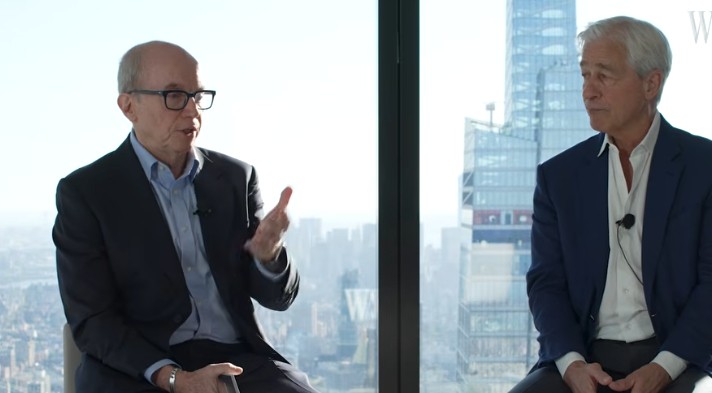
In this fireside chat hosted by the WSJ Leadership Institute (Oct. 7, 2026), JPMorgan Chase CEO Jamie Dimon sits down with Alan Murray at JPMorgan’s new New York headquarters to discuss the biggest risks facing the global economy, from ongoing wars and AI-driven cyber threats to sticky inflation, government deficits and supply-chain vulnerabilities in rare earths and semiconductors. Dimon also reflects on the first year of JPMorgan’s $1.5 trillion Security and Resiliency Initiative, working with governments, the state of American politics, and the leadership lessons from 20 years at the helm of America’s largest bank. Read the full transcript of this interview below:
Welcome to JPMorgan’s New Headquarters
ALAN MURRAY (00:00:23 – 00:00:33): Thank you all for being here. Thanks to all the members of The Wall Street Journal CEO Council who are here. It’s warming to see you all. And thank you, Jamie, for hosting us.
JAMIE DIMON (00:00:33 – 00:00:34): Thrilled to be here. Thank you.
ALAN MURRAY (00:00:35 – 00:00:36): Nice digs you have here.
JAMIE DIMON (00:00:38 – 00:00:38): We earned it.
ALAN MURRAY (00:00:39 – 00:00:39): Well, I was—
JAMIE DIMON (00:00:40 – 00:00:43): the bankers earned it. But I was— care of our people.
ALAN MURRAY (00:00:43 – 00:00:53): I mean, here you’re at the top of the world here. Your most important financial institution, tallest building in the city, most important city in the world. Does it ever go to your head?
JAMIE DIMON (00:00:54 – 00:01:03): Not really. First of all, I am thrilled to be here. I hope you all noticed the American flag when you come in blowing in the wind. I salute that every morning. And
ALAN MURRAY (00:01:04 – 00:01:04): you’re not joking.
JAMIE DIMON (00:01:05 – 00:01:28): I’m not joking. No. And it reminds me of the values that created this great country of ours that should be celebrated and taught everywhere. Freedom of speech, freedom of religion, freedom of enterprise.
A lot of these entrepreneurs Mike was talking about are from other countries. And how deeply they love this country. And they came here to be— to actually have the American dream, the American principles. And that is kind of foundational even to SRI, by the way. So
A Monument to the American Dream and the Patriots Bar
ALAN MURRAY (00:01:29 – 00:01:40): I want to talk about SRI, but this is a monument to the American dream in some ways. Is that the— I mean, you must feel some real emotion when you come in
JAMIE DIMON (00:01:40 – 00:02:12): here. And I just got back from London last night. And every morning I walk in, I just— I do. This is a labor of love. Remember, we were paper pushers. We move paper around and we move electrons around and money and stuff like that.
But the whole management team worked on this very building. The entryway, these spaces, the dining rooms, the first 8 floors are trading floors that trade $2 trillion, $3 trillion a day worth of securities. There’s security floors. There’s Morgan’s Pub on 13, which we— I insisted they put in. We actually get Guinness beer after 4 o’clock.
ALAN MURRAY (00:02:12 – 00:02:13): Pretty nice bar on 57.
JAMIE DIMON (00:02:13 – 00:02:59): There’s a Patriot— we call it the Patriots Bar. There are flags up there from the USS Constitution, which is the Revolutionary War boat. One of the flags is from the top of Pointe du Hoc, June 6th, 1944. And there’s a picture up there, the Rangers still taking prisoners. There are flags from Apollo missions, from Vietnam, from Revolutionary War.
A Black regiment, it was the 25th Regiment, I think was one of the first fighting regiments that actually helped take Richmond. It’s very touching. And the first event I did here was up there having cocktails for the veterans that work in this building. I’m telling you, there are a lot of tears in those eyes, both being thanked. They came from of all ages and it was extraordinary.
The Security and Resiliency Initiative at One Year
ALAN MURRAY (00:02:59 – 00:03:11): Well, it leads right into the Security and Resilience Initiative because that is about national security, right? Yeah. You look back at the last year, one-year anniversary, what are you most proud of that you’ve accomplished?
JAMIE DIMON (00:03:11 – 00:04:23): First of all, it’s really lifted up our people. I mean, Mike said it was for the purpose. And we have a couple of guys here, prior partners of mine, and they heard about it and said, “I’m coming back.” And Advanced— Matt Marcus over there in Advanced Manufacturing. But it’s also been an amazing learning thing. It’s been far more than we would’ve expected. Other companies are doing it. I think that’s great.
The purpose is security, resiliency. And it’s the breadth has just gotten bigger. We’ll blow way past that $1.5 trillion. I know Todd Combs is not here, but I see a bunch of his partners. That $10 billion is direct investing in security resiliency.
It also opened up a lot of other issues. One of the— we go to a lot of these vendors that Mike was talking about. Those companies have tons of vendors, the prime contractors, everyone in this space. A lot of those vendors need help. And often it’s not capital, they need the skills.
So the American dream is kind of another side of this part. This is actual security resilience in drones and space and missiles and advanced manufacturing and pharma and healthcare and grids and all the things that we all know we need. And obviously we should have done some of this before. But the other side is skills and training and small businesses and vendors and other things we can do.
ALAN MURRAY (00:04:24 – 00:04:33): So some of this stuff, I mean, you’re the biggest bank in the country, in the world. Some of this stuff is stuff you would have done anyway.
JAMIE DIMON (00:04:33 – 00:05:10): Yeah. So we really— and that came up from the start. And a lot of people didn’t want to announce it because of that. And I was like, “Just stop that crap. Just tell me what you’re going to do, why you’re going to do it, how you’re going to do it, what you hope to accomplish.”
So when we did the work— and we have published a little bit about this— it wasn’t Boeing. It was Boeing Military Division. It wasn’t Exxon or energy. It was LNG going to Europe because they need it for security. And security is different for every country. So it’s 29 industries, around 5. But it’s grids and power. It’s AI. It’s not all AI. It’s not AI for consumers. It is some of the AI for military.
ALAN MURRAY (00:05:10 – 00:05:14): Does it have a different hurdle rate than other things? Well, it’s a good question. Think about it.
JAMIE DIMON (00:05:15 – 00:07:10): Yeah. What I told the board is that, first of all, I’m a patriot and we can do things because we want to. We’re patriots. That is probably riskier and lumpier results, but it has this hopefully the same commercial outcome. And so we are doing things with companies at an earlier stage in JP than what we’d normally do.
These companies talk about death valley, they need money, they need to build the plant to satisfy the contract, but they don’t have the contract. And they can’t get the contract unless they can prove they can build a plant. And so trying to bridge some of that. So some of this stuff we would have done anyway is not risky, but some is slightly riskier. And it’s okay. We used to take risks. We’re quite good at it. We take it around the world.
And then we’ve extended it very importantly to Europe. So think of Germany, Italy, France, UK, Poland, and then Australia, Japan, South Korea, other countries that are basically allies of the United States. They all need it.
And we’ve set up— we have an advisory group that has really worked, including Jeff Bezos and Michael Dell and Condi Rice and Bob Gates and Connie’s doing something on the skills side and Paul Nakasone is doing stuff, a former general on the cyber side, which he ran. So everyone’s getting involved and the learnings are really high. Like you mentioned, the 4,500 companies. So we’ve hired a lot of bankers to cover them both in SRI and outside of SRI.
Policy is a big deal. How do you get the government to make purchases bigger? How do you get We did research, and this is great research, on the shipbuilding ecosystem, the chipbuilding ecosystem, the pharma ecosystem. And these ecosystems are far more complicated than build a ship. The chipbuilding one, you need chemicals from Japan, stuff from Korea, the ASML etching equipment from Netherlands. You have these extensive supply chains. You just can’t move stuff.
Wartime Industrial Policy and Rare Earth Supply Chains
ALAN MURRAY (00:07:10 – 00:07:23): But it almost— when you talk about it, it almost sounds like a wartime industrial policy. I mean, first of all, is that what it is? And second, does JPMorgan belong in the wartime industrial policy space?
JAMIE DIMON (00:07:24 – 00:07:30): Yeah, I’m a patriot, and I wouldn’t call wartime industrial policy, but I’d say is we should have been doing this anyway. And my view—
ALAN MURRAY (00:07:31 – 00:07:32): you were early. Yeah, we’re early.
JAMIE DIMON (00:07:32 – 00:09:07): Well, if you read my chairman’s letter last year, I spoke about some of it, and actually General George came to see me. Now he actually came to see me today and people like General Milley, who we do work with, and some other generals.
But it’s really Randy George said we need help on educating with these ecosystems, financing these ecosystems, getting Congress to have different ways to authorize purchasing, which they have done, by the way. They’re moving very quickly now. Whether it all works or not isn’t the point. They need to move quickly.
Then when you look at our weaknesses on rare earths, and these are the ones you fought, rare earths. We rely on China for— China is not an enemy. I wouldn’t rely on anyone for all of our rare earths. I wouldn’t rely— I mean, we know at JPMorgan, we got multiple supply chains. And it’s true for semiconductors, it’s true for active pharmaceutical ingredients, it’s true some of this advanced manufacturing that we sent out.
It’s an amazing— you know how much money we saved by outsourcing rare earths? Almost nothing. $500 million or some number like that. But it made sense at the time. You’re saving 5 cents a magnet, which could be $10 a car. People are trying to reduce costs. But we also, when we did that, we lost the ability to advance the IP. And so in advanced manufacturing, it isn’t just that you outsourced it to a cheaper place, you actually lost the ability, that IP was improved since we outsourced it 10 years ago.
And to me, if you look at it, I like to do postmortems and be self-critical. We should have done this way before China did. China was very strategic. All these years they’ve been planning for Straits of Hormuz.
ALAN MURRAY (00:09:07 – 00:09:08): Why didn’t we do it?
JAMIE DIMON (00:09:09 – 00:09:14): We’re just like a bunch of gangly teenagers who want to have a beer.
ALAN MURRAY (00:09:14 – 00:09:15): At the Patriots Bar.
JAMIE DIMON (00:09:15 – 00:09:32): At the Patriots Bar. And we just didn’t get— some people knew. There were warnings. There was— we just didn’t think it all through at the time. And the world was, for a long time, everyone was doing stuff and we’re doing fine. So, but the fact is, forget all that. My view is roll up your sleeves and get to work. And that’s what this is. But yeah.
A More Dangerous World and America’s Place in It
ALAN MURRAY (00:09:32 – 00:09:53): Yeah. Isn’t it also because the world has become a more dangerous place? I mean, we’ve got 2 wars going on. Neither of them seems to end. We’ve got this great superpower rivalry going on. The institutions that were created after World War II to create peace and prosperity are all deteriorating. How worried are you about America’s place in the world and the state of the world?
JAMIE DIMON (00:09:53 – 00:11:32): Yeah, so absolutely it’s more urgent today than 5 years ago, than 10 years ago, than 20 years ago. Absolutely. But when Ukraine was invaded, I wrote a little thing in my chairman’s— I like to write a chairman’s letter. I know they’re long to read sometimes, but that the world didn’t change that day. We were just reminded the world’s realpolitik and that peace was never at— always at hand, and bad people do bad things, and we weren’t prepared. So I’ve been ringing that alarm bell kind of since then.
Of course, in Ukraine, you’ve seen it’s gotten worse and worse, but you’ve seen how quickly this technology changes. And our military’s kind of on it. Now you travel around, you actually see enormous progress. Very quickly in space and drones and supersonic missiles and new small nuclear reactors and governments trying to quickly allow things to take place.
But absolutely, the urgency today, it is time urgent. We never should have been here, and maybe more time urgent than it was 10 years ago. But I don’t— again, I know that, and I’m not the kind of person I like to put my head in this and cry about. Wake up when I come in every day, roll up my sleeves, and get to work. That’s it. You can, is the urgency on a scale of 1 to 10, 5 or 7? Doesn’t matter to me. We should have done it anyway. It is far worse today.
And yes, the American lead, America still has 40 military alliances, trade agreements with I think 20 different countries. We’re still the leader of the world and they still rely on us. And this is why we’re also expanding this to the rest of the world. And so you can criticize some of the actions that we’ve done. But it is critical, in my view, to keep the Western world together properly, economically and militarily.
The Biggest Risks: Wars and Cyber
ALAN MURRAY (00:11:33 – 00:11:36): What’s the biggest risk you see out there right now?
JAMIE DIMON (00:11:38 – 00:12:35): Probably there’s 2 I’ll mention. One is these wars develop in a way that you don’t expect, and they can cause huge disruption to populations, to who allies with who. And obviously it’s the world economy.
And the second is cyber. We’ve always known about cyber and obviously cyber, again, I wrote about cyber this year. I said, and I meant it, it’s our biggest risk. And that was a couple weeks before Mythos. And now it is our biggest risk by far. And I put that. Now we always had cyber on the list for this thing.
But you guys have seen even these fiber cables. So a lot of your companies move a tremendous amount of data across these fiber cables. They’re all vulnerable. Russia cut some in the Baltic Sea. You can cut off a whole country and that traffic cannot be replaced by satellites. Some of these things are asymmetric. If they do that, you can do it back. But some aren’t, as you see with the drone warfare.
Working With the Administration
ALAN MURRAY (00:12:35 – 00:12:47): I want to come back to cybersecurity in a minute, but I wanted to ask you first, because you are now so deep into policy and national security, are you working closely with the administration on this?
JAMIE DIMON (00:12:47 – 00:13:10): I wouldn’t say closely. What we do is we deal with these guys. I mean, we deal a lot with all the government agencies and we try to help them to the extent we can. They’re not going to always support us or vice versa, but we are deeply there. And yeah, that’s always been true. We try to help our government and governments around the world get their jobs done. We have to deal with the politics of that. But absolutely, we’re trying to.
Racial Equity, Climate and Changing Political Trends
ALAN MURRAY (00:13:10 – 00:13:30): But some people raise the political piece of it. I mean, in 2020, when George Floyd was killed, You stepped up and said, we’re going to devote $30 billion to racial equity. A couple of years later, you stepped up and said, we’re going to devote $2.5 trillion to fighting the climate crisis. Are those things driven in part by changing political trends?
JAMIE DIMON (00:13:31 – 00:14:44): Well, no. George Floyd was murdered. I wouldn’t put that in the political trend category. And I think we should— again, you got to take everything in context. I think it’s good that the world said that stuff has got to end and we can do more for the Black community. We still reach out to the Black community, the gay community, the female community, the Hispanic community, every community. That hasn’t changed. The law has changed how you do it. I think some people overdid it and some didn’t.
And the climate stuff, we were always very clear. We were not— we knew exactly some of this stuff was stupid, some was smart, and that we can help the smart and not the stupid. I think we’ve been very good on that. And so I think climate’s a problem. I think, you know what’s going to solve it? It wasn’t our policies were terrible. We wrote about it, we talked about it. Even some of these things I said, if you don’t have proper government policy and proper innovation, it is not fixable with the current stuff we have.
And a lot of the stuff we did was counter climate. For example, I think this number may be roughly accurate. Our CO2 per input to GDP is down 50% or something. Half of that, which was you outsource dirty stuff to other people. And so people taking victory laps here, and it didn’t do a damn thing for CO2.
ALAN MURRAY (00:14:44 – 00:14:45): Just pushing it offshore.
JAMIE DIMON (00:14:45 – 00:15:04): Both steel, rare earths, aluminum, just name it. A lot of that was being done by coal over there and something cleaner here. And some of these policies, they were thoughtless. A lot of policies, we put in place policies that often have the opposite effect. So I think we’re going to conquer CO2. I still think we should. We can reduce that. I think it’s going to be AI that does it.
ALAN MURRAY (00:15:05 – 00:15:09): But there’s clearly value to you to being in line with the current administration.
JAMIE DIMON (00:15:10 – 00:16:16): We’ve never been in line with the current administration. We’ve always tried to help the current administration. And I’m never embarrassed about that.
My daughter, years ago when Trump became president, I went on the Business Council thing. She wrote me a long letter, beautiful, elegant, thoughtful, ending with, “How could you, Dad?” Ending with the quote from Martin Luther King from the Birmingham Jail. And then my other 2 daughters and my wife said, “Ditto,” and, “Don’t come home for dinner.”
And I wrote them back a note. I said, “Well, Julia, you got everything right except for one thing.” She said, “What’s that?” I said, “The conclusion. Martin Luther King would’ve gone to the White House every day to further what he thought was the interest of his goals and his values.”
So the notion when people get pushed around by the press, they get pushed around, don’t do that, Forget all that. What’s the right thing to do? And then do it. And of course, the press will attack you from the left to right. So we’ve always been that way. We’ve always tried to support the American government. And the American government, all of them have attacked us in various ways. And I’m used to that. And that was true under every president. Tried to help them and they attacked us.
Meeting New York’s New Mayor
ALAN MURRAY (00:16:17 – 00:16:27): I’ll leave politics in a minute. But you have built this amazing building here in the middle of New York City. So you must have some kind of a relationship with the new mayor. What do you think?
JAMIE DIMON (00:16:27 – 00:16:32): Well, we’ll see. I’ve— but I’ve— my view is I had him here, by the way, and I saluted the flag down after you took
ALAN MURRAY (00:16:32 – 00:16:34): him to the Patriots Bar.
JAMIE DIMON (00:16:34 – 00:18:39): I didn’t. I think I hadn’t. I gave him it. I didn’t do it, but I had someone take him, I think, there. But I saluted the flag when I came in and I said, “Mr. Mayor, I just want you to know that my grandparents were Greek immigrants who didn’t finish high school. 3 of them came here right after World War I. And I salute that flag every day. And my grandparents came for the same reason your parents came, this country and its freedoms.” And I’m quite serious about that.
And we spoke, I was very open about it. And I’m not— someone wrote an article about that too, Jamie. I know I told him exactly what I think about stuff, including I am against racism of any type, including anti-Jewish, anti-Muslim, anti-gay, anti-whatever you want to call it. And that antisemitism is anti-Jewish. Okay, you don’t have to like what the Israeli government is doing. I don’t like what the Iranian government is doing. I’m not anti-Iranian. And I think people have to be quite clear what they mean by these things.
And he listened. We had a nice conversation. And I told him my experience with all CEOs, but it’s true for governors and mayors and prime ministers, that good policy affects— gets things done, and that I’ve seen people grow into the job. They get good people, they attack it. And it’s not ideology. Our potholes our crime, our hospitals, our schools, our subways is not ideology. Getting affordable housing is not ideology. If you confuse ideology with those things, somehow you have a better moral position. But most of the policies you do around those things don’t work.
And then in the Work Skills Initiative, which is in our American Dream Initiative, I think we spend $1 trillion in K-12. But we never say, I mean, it never happens that it fails. And not everywhere. A lot of your kids go to public schools that are fine. Your schools are fine. Don’t worry about it. But in a lot of inner cities and rural areas, it fails. Why can’t we just acknowledge it’s not working? It’s intergenerational. What can we do to fix it? And there are things to do to fix it.
And by the way, it’s free. Good policy is free. I think we can grow our economy 1% more free. Don’t have to raise taxes. Don’t have to spend more money.
Business, Civic Responsibility and Good Policy
ALAN MURRAY (00:18:40 – 00:18:43): You need a functioning political system, though, to get to that.
JAMIE DIMON (00:18:43 – 00:18:45): Yes. And functioning policies. Yeah.
ALAN MURRAY (00:18:45 – 00:18:56): And how do we get to that? I mean, we got an election coming up, but we have increasingly have a situation where people of goodwill from both sides can no longer get together and get things done.
JAMIE DIMON (00:18:56 – 00:19:49): Well, that’s been true for most of our history, by the way. Yeah, look, my only, again, my view is if you read history, I love reading history. That’s true in a lot of places and some people get it and some don’t. And people need to be involved. And to take some responsibility.
So people ask, should JPMorgan be involved? Yes. We lift up society because we bank city schools, states, hospitals. We do a lot of stuff. We do a lot of philanthropy, mostly to catalyze important stuff. But of course you should want to lift up your society. The founding fathers, it’s not constitutional, but they always spoke about civic responsibility, including business civic responsibility.
So the thing about business, they should get involved. In my view, like the BRT, but it can’t be about your personal thing. It can’t be about ethanol taxes or carried interest taxes or bank regulations. It’s got to be about policies that help your country. Like President Kennedy said— Did you
ALAN MURRAY (00:19:49 – 00:19:51): get the BRT to make that change?
JAMIE DIMON (00:19:51 – 00:21:12): The BRT is very effective and it’s hard. You got to get involved in all these things. But the BRT has policies around immigration, taxation, regulation, healthcare, affordable housing, security, work skills initiatives that really would drive a lot of growth in America.
And by the way, the other thing is we don’t— and Scott Bessent mentioned 3%. I agree with him. We have done 2% for 20 years. Why didn’t we ever say we owe our people 3% and we can accomplish it? And I think we can accomplish it with no new spending and no new taxes, just by changing immigration, education, permitting, all these various things you constantly read about.
And we think it’s funny. Well, it took 12 years to get a permit to build a broken bridge. It’s not funny. It’s a disgrace. It’s embarrassing the country. It’s one of the reasons the American population doesn’t trust the effectiveness and competence of government.
And so I think business can play a helpful hand by collaborating with them to fight for what’s good for the country with policies that a lot of you already know and understand because we have to deal with it all day long. And politicians, even the good ones, need They want help. And we always— then the press, of course, when you see the press, it’s often the people on the— I call them the wingnuts, but it’s often the people on the sides. There are a lot of people in the middle, senators and Congress folks, who actually want to get the policy right.
ALAN MURRAY (00:21:12 – 00:21:13): Fewer than there used to be.
JAMIE DIMON (00:21:14 – 00:21:37): You can judge that. I’m not sure. Yeah, I think the press may give too much. The press— I mean, I was with Hakeem Jeffries recently, said, “DSA is going to be 5 congressmen.” Yeah. Right. And that’s all the time the press spends on it. And I just immediately tell the truth, the whole truth. But we’ll see. Well, let’s talk. But in any event, again, don’t cry over spilled milk. Roll up your sleeves and try to help.
ALAN MURRAY (00:21:38 – 00:21:39): Yeah.
JAMIE DIMON (00:21:39 – 00:21:42): Because talking about it theoretically doesn’t do a damn thing.
The State of the U.S. Economy
ALAN MURRAY (00:21:42 – 00:21:55): And let’s talk a little more about the economy. I mean, what is your analysis of where we are right now in the economy? Obviously, there are a lot of good things going on, but there’s some concerns. You see it in the bond market. You see it other places.
JAMIE DIMON (00:21:55 – 00:23:45): Yeah. So we already talked about the wars, and obviously that can dramatically affect the economy and a whole bunch of different stuff. So I’ll talk about non-the war. I think that creates a huge amount of additional risk and not completely controllable risk or understandable risk, because I said things happen you don’t expect, particularly in wars.
And so look, the American economy is kind of booming right now. It’s good times, corporate profits way up and good news. So, and that’s it. I don’t like guessing about the economy. I like looking at the factors that drive it. And then you can add probabilities to it.
Corporations are not overleveraged. Consumers are not overleveraged. Unemployment is really low. You can argue whether wages are going up enough for the lower end, probably not, but they have jobs. And that is the single, sole most important thing for most people, that they have a job, and they can go to work. And most people, contrary to what you hear, like their jobs.
And what are the negatives? Huge government deficits, which the best way to reduce it is to have more growth. AI is adding to the growth because it’s spending money. It’s not like the way it shows up in the economy is not an investment per se, because that’s— it’s people being hired to build data centers and steel and servers and roads and cement. And that is kind of spending. So it may be a little inflationary at this point before it may have a deflationary effect. And we don’t know.
And then inflation is just— it’s been there for 5 years, folks. It’s sticky. The numbers themselves aren’t particularly good. So I think we should investigate how those numbers are calculated. And I think that some of these future events are inflationary. Ongoing deficits globally, remilitarization of the world, restructuring of trade, healthcare, immigration. Proper immigration would actually— if we allowed merit-based proper asylum, more people working, seasonal workers, that actually would grow the economy and reduce inflation.
Boom, Bust and Preparing for the Next Cycle
ALAN MURRAY (00:23:45 – 00:24:03): But so let’s take that the next step then. I mean, you’re a student of history. You look closely at it when you see what’s happening with inflation, when you see interest rates going up, when you see the level of investment that’s going into data centers. We’ve seen this sort of thing sort of boom before, and it usually is followed by a bust.
JAMIE DIMON (00:24:04 – 00:24:32): I don’t know. I mean, look, when you read history, that’s— you’re trying to make it a binary outcome, which you guys always do in the press. Life isn’t binary. And it might be it sorts itself out. Obviously, it’s reason to be concerned. Things are very good. Of course, one day we will have a cycle. So the notion— and I could give you all these reasons why it would be earlier, why it would be later. We will one day have a cycle. And then people attribute that cycle to the one thing or the other.
ALAN MURRAY (00:24:32 – 00:24:34): These people want you to put a date on it, if you don’t mind.
JAMIE DIMON (00:24:34 – 00:25:26): No, of course, I can’t. And the way JPMorgan looks at this is, We analyze to death all these risks and we can handle higher rates, lower rates, inflation, stagflation, equity markets down 40%, bond credit spreads gapping out 2 or 3 times. And because we want to serve our clients in bad times, we aren’t guessing about that.
And if you and I said we all sat here, some of us think the probabilities of something bad happening in ’27, some of you might think it’s ’26, some of you might think it’s going to be ’28. Eventually there’ll be a downturn. Eventually, it’ll be driven by a confluence of events that today you can’t guess what they are. You can throw stuff on the wall and make believe, but— and so we’re prepared for all that so we can serve our companies, so we can serve our communities, so we can serve our country, so we can continue SRI. And those things will continue regardless of the economic environment.
AI Safety, Opportunity and Cyber Vulnerabilities
ALAN MURRAY (00:25:26 – 00:25:34): And where are you on the great debate over AI safety? 10% chance that it’s the end of humanity.
JAMIE DIMON (00:25:34 – 00:26:56): Okay, well, maybe I’ll be like a broken record here. I think the big picture is AI. We’ve been using it since 2012, okay? And we have 1,000 use cases and risk, fraud, marketing, design, note-taking, hedging, customer errors. And I can go on and on and on. And I think it’s the tip of the iceberg. I think it literally will, over the years, cure a lot of diseases, some cancers, Less people die on the roads, things will be taken care of, you have more robots doing tasks that humans don’t want. I think that’s all true.
And on the risk side, I think there are real vulnerabilities. And AI, and you’ve seen them, folks, I don’t have to repeat Hugging Face and this thing and that thing. And there are a lot of vulnerable units. So we spend a lot of money in cyber. Banks are rather well protected, as are other ones. But their whole unprotected industries who are also critical. Water, parts of transport, some tech companies, or smaller banks.
We all have vendors. One of the lessons when these guys go through vendors is that if those vendors don’t have the people to double their production to help one of the prime contractors, or if they go down because of a cyberattack, either one could be bad. Yeah, we have huge vulnerabilities. We have set up the— we already set up Before me, Tom Fanning started the Alliance for Critical Infrastructure.
The Alliance for Critical Infrastructure
ALAN MURRAY (00:26:56 – 00:26:57): You’re now chairing it.
JAMIE DIMON (00:26:57 – 00:28:52): I’m chairing it, but that’s only temporary. I think I don’t care who chairs it. I hear about the effort. And Chuck Robbins is doing a lot of heavy lifting, Jane Fraser and all that. 50 big companies by industry. And we’re starting— we’re already doing vetting and clearinghouses of open source code, certain policy issues. And we have to disseminate that information. It’s got to be done by industry at one point. And this is a new— it would try to double down the effort.
We have an extremely good board. It’ll morph over time and we’ll be adding industries and companies. ‘Cause I get a lot of calls, “Why not us?” Well, I got to start somewhere. We had to start. So we’re starting this way. But over time, as we get more manpower and more capability, we’re going to try to probably add industries and companies.
And then I also think, take the banks, we should obviously work among ourselves, make sure our vulnerabilities cross industry, our vulnerabilities to telecom and water, our main vendors, think of SWIFT and CHIPS and Fedwire, and I give you thousands of those big ones, but also smaller ones. And then help our brethren, smaller banks and related who have different vulnerabilities, different vendors. And that could be just training, all these various things about— and a lot of things everyone should be doing today.
Today, they shouldn’t— you should go back if you haven’t done it and start today. Network segmentation, Identity access management, use the most powerful AI models you have to look for these vulnerabilities that will find 20% of them. Learn how to patch very quickly. Make it part of your management meetings so that if you’re running this part of the company, you know the ones you need to fix.
There are things people should start today to get ready to prepare for cyber. But it is really vulnerable. And I don’t think anyone disputes that, by the way. You could dispute, again, on the scale of 1 to 10, is it 10 extinction or 8.5? Where
ALAN MURRAY (00:28:52 – 00:28:52): would you put it?
JAMIE DIMON (00:28:53 – 00:28:55): I don’t know. My view is—
ALAN MURRAY (00:28:55 – 00:28:56): It’s rising.
JAMIE DIMON (00:28:57 – 00:29:36): It is definitely rising. And it will change over time. So the efforts you’re making here is to build the muscles to combat the bad guys. Remember, the bad guys could be states, terrorists, insiders who don’t like your company. Ransomware criminals. They’re all— and they all like to do different things. And so we need the muscle.
And then maybe one day you talk to some of the big AI guys and LLM guys, they say we also are going to try to build models that are good defense. So if it has these thousands of agents, they’re little persistent agents that try to attack you now, you could build— maybe you’ll have an AI system that offsets every agent that’s trying to attack you. Kills it. Yeah, we’ll see.
Leadership Lessons From 20 Years at the Top
ALAN MURRAY (00:29:37 – 00:30:03): I want to talk about leadership because that’s why the Wall Street Journal Leadership Institute exists. And that’s why a lot of our CEO Council members are here. We’ve been talking about it. Of course, everything you’re doing in SRI is part of your approach to leadership. But you’ve been doing this 20 years now, running this bank. Not many people make it for 20 years. I guess Warren Buffett did. Jensen Huang. What— to what do you attribute your success? How have you been able to do this?
JAMIE DIMON (00:30:03 – 00:34:43): Yeah, I look, I don’t. Really know. And I’ve seen a lot of very successful people, a lot of different things. To me, I’ll tell you the important things. You got— I work hard, and I’m relentless. People in this room know that. I just don’t let go. And I love it. And I have the energy. When I don’t have the energy, I shouldn’t be doing it anymore. It has purpose for me.
When I grew up, you had to— the values were work hard, have purpose, Everyone’s got a different set of skills, or different sets of types of skills. And what’s your— I think everyone’s got it in different degrees. So you all have different mix of skills.
And I’ve seen people when they get a big job, their insecurity comes out. They start to cover up. You got to— don’t embarrass the boss. The people who work for them is make the boss happy. The job of no one at this company is to make me happy. The job of this company is to do the right thing for the company, the clients, the community, and the country. And I could see the difference when they talk to me. I’m not interested in you making me happy. Sometimes, actually.
Trust, Grit and Heart
But here are the things that are important. People’s analytical skills. But I think the real one for leadership is the various EQs. And EQs are a funny one. Do people trust you? And a lot of people aren’t. People just don’t like having them in the room. They bulls***. They’re always looking around. Who’s saying what to who? How can they get away with it?
Do you have grit to do the right thing when it’s tough? And do you deal with a tough issue? Do you put the dead cats on the table? Do you have a little heart? People don’t want to work for people who are a**holes or mistreat people.
And I look, I made that mistake where you promote the guy who’s the best or lady who’s the best trader, best banker, and they’re a disaster, because they didn’t have these other skills. And then some people get in these jobs and all of a sudden all these other skills come to light, how they manage people, how they take care of conflict situations. Everyone wants to call them up and everyone wants them part of the team.
And then I’ll give you a heart. I mean, when I first came to JPMorgan, they all had read the stories about me, tough on expenses, which I am, I hate waste, but waste is not tough on expenses. Certain expenses are good expenses. And— but they had outsourced all the guards and janitors. And the head of the SEIU wanted to come see me to complain, I guess, about that. They didn’t want me to do it. I saw him. They thought he’d be taping me and use it against me somehow.
And he said, “You outsourced the janitors. The same person comes back for the same job at the same pay.” The reason you guys did it is because the outsourced people took your benefits package for— if they have a family, it’s of course $30,000. That’s medical, predominantly medical and retirement. And they cut it in half. Let’s say $15,000. They let you have $7,500 of that. And they took $7,500 of the services provided.
And I went to see the person who did it. I said, “Never do something like that again. We’re not going to build JPMorgan a great company off the backs of our guards and janitors. That is not cost cutting.” And I said, “I want them back by the end of the week. I don’t want any negotiation. I don’t want to talk about it. I don’t care what consultants told you. I don’t care what other companies do.” And heart, those things matter to people.
Teamwork Lessons From Sports
And so then you let people do their jobs and it’s a very, but the other one is teamwork. And people love sports. Sports is clarity, but when you see a team and they’re playing together, they don’t have to be friends by the way, but they play properly. Remember the Spanish team passing, taking their time, thinking about it, moving together, and you all know it, a basketball team or a football team or, That it’s a beautiful thing to watch.
Well, business is the same. It lacks 2 things. Okay? One is the clarity. BSers could BS endlessly. So you don’t have the, did they win or lose? Now we know that person’s a BSer, but we don’t do anything back because they’re a good salesman or something like that.
But it is the same thing when you see a company that works as a team. They support each other. They help each other. They give ’em a swift kick in the a** sometimes. Everyone does their part. Everyone does their homework. Everyone shows up. Everyone reads the tapes, every— and that, and then you have leaders like Peyton Manning or, I always love when Peyton Manning and Tom Brady come here and we have a conversation about leaders.
They go through all this and they both will say the same thing. “I didn’t have a very good arm and I couldn’t run.” 2 of the greatest quarterbacks of all times, but they talk about the work ethic and caring about the frontline. Tom Brady took less money so he could pay the front line more money. And there are things like that that people don’t focus on. But that’s team. And I think sports— I think a big company or small, you can have the same bad behavior in a small company, too, by the way.
What Ted Lasso Teaches About Leadership
ALAN MURRAY (00:34:44 – 00:34:45): So you’re a Ted Lasso fan? Yeah,
JAMIE DIMON (00:34:46 – 00:34:46): I love Ted Lasso.
ALAN MURRAY (00:34:47 – 00:34:49): Yeah. What have you learned from Ted Lasso?
JAMIE DIMON (00:34:49 – 00:36:05): He— first of all, it’s funny, but it’s— he comes in and he doesn’t know anything about football. And he’s just gracious, but he’s working the people, their insecurities, their bad behavior, their work ethic, and he’s getting them to function as a team. And he’s not arrogant. He’s not— he always approaches things in a— not a humorous way, just an easy way to try to explain it. He’s patient with people, but he wants to have a winning team. And so, and it’s that, it’s just the psychology of how he’s working that all the time. To create that kind of atmosphere.
And I’ve seen that in corporate America, some terrible companies, I can’t name them, who get a new CEO and they just go about fixing that. Because most of these companies have huge capabilities and IP and great people. And a lot of big companies, they’re political and bureaucratic, you know all that. But the people would like to get out of that, most of them. And some of the bad people want to keep it— they’re like autocrats. They want to keep it suppressed because they benefit.
And the good leader over time figures it out, removes some of the bad ones, and the place starts to shine. And it can take some time because I would say these bulls***ters have been doing it for 25 years and they’re usually pretty good at it. It’s hard to notice in real time.
Saying What’s on Your Mind
ALAN MURRAY (00:36:05 – 00:36:20): And the reason you’re so much fun to interview is because you say exactly what’s on your mind. And I think it’s only recently that I realized that’s not just a personal trait. That’s a management tactic on your part. You say what’s on your mind, but you expect everybody else to do the same thing.
JAMIE DIMON (00:36:20 – 00:36:58): Yeah, so if CEOs are saying stuff like how great they are or something like that, the whole company hears it and they start playing to it. And companies know when you aren’t doing a good job. And so I say sometimes, “We’re not doing this particularly well,” ’cause I want everyone to know. I’m not pointing a finger at the people not doing a good job. I think we should all help them do a better job. But to BS about it, you will deny your problems and stuff like that.
And so— But just so you know, our people, in PR and GR are exceptional, and they do take me through some of the stuff, and they want me to be direct and forthright, just not say it a certain way.
ALAN MURRAY (00:36:59 – 00:37:06): Well, I was going to say, I mean, you’re a big personality. There’ve got to be people who, when you say something, they just say, “Okay, yes sir.”
JAMIE DIMON (00:37:07 – 00:37:16): The thing they say the most when I’m walking up on stage is they say, “No cursing, press is here. Be a statesman.”
Proudest Decision, Biggest Mistake and Favorite Books
ALAN MURRAY (00:37:17 – 00:37:18): Single decision.
JAMIE DIMON (00:37:18 – 00:37:19): I have to remember that.
ALAN MURRAY (00:37:19 – 00:37:22): Okay. Some quick ones. Single decision you’re most proud of over the last 20 years?
JAMIE DIMON (00:37:23 – 00:37:33): Oh, I mean, there’s none. I mean, just helping build this great company. I think it was hard to merge Bank One and JPMorgan. I mean, that was a big deal for both parties.
ALAN MURRAY (00:37:34 – 00:37:36): Biggest mistake over the last 20 years?
JAMIE DIMON (00:37:37 – 00:37:51): It’s always the same nature. I mean, if I made a list, it’s always people mistakes where when I made that mistake, I tortured our people. And it takes a while to figure it out. The torture goes on for a while, they got to replace them, and that is usually a big setback.
ALAN MURRAY (00:37:52 – 00:37:55): You’re a big reader. What’s your favorite book that you’ve read recently?
JAMIE DIMON (00:37:56 – 00:38:34): Well, the one I mentioned is, there’s one written by the granddaughter of Ike Eisenhower about how Ike led. I’ve read a lot of military books that General Milley gives me. I read a lot of stuff, but that one, she— and it’s very good— she actually goes through how he handled all the problems he had. And it is about teamwork. Look what he did. I mean, very good. Got excellent people around him.
People who are responsible for making decisions, but get the tough decisions to the table, get the right— that’s the— get the right people working on it, have a decision process. It’s amazing how many mistakes you avoid and how much respect you earn around the world. And so that is just a good— it’s both a great history book and a great kind of management learning book.
The CEOs and Innovators Dimon Admires
ALAN MURRAY (00:38:34 – 00:38:37): CEO other than yourself that you most admire?
JAMIE DIMON (00:38:38 – 00:39:44): Look, there are lots I admire. I think Doug McMillon did a great job at Walmart. I think Frank Blake did a great job at Home Depot, a great company. I’ve got the guys who built Walmart and Home Depot, but there are tons of them all around the world.
And now I get to meet this— one of the things Mike kind of said— where’s Mike? One of the things that Mike kind of said is that I meet these companies and we go to Silicon Valley. I’ve been to— I just met this guy, Celsius Astro, an Iranian who loves this country, moved here right before the revolution with almost no money. His parents didn’t come back, who could have been killed, but they came here 17 years later. He’s building satellites, both commercial and military. And it blows you away.
You go to Anduril, you go to SpaceX, you go to Impulse Space, you go to Atomic, you go to— whoa. I mean, that innovation machine is extraordinary and very uplifting. And it always reminds me we should be a little more innovative, a little more aggressive, and invent a little bit more stuff. And so, and it’s true for the big companies, it’s true for the smaller companies. Read the book Freedom’s Forge about how the American, the arsenal of democracy got turned on after Pearl Harbor.
Would Jamie Dimon Run for President?
ALAN MURRAY (00:39:45 – 00:39:55): We’ve spent the last 45 minutes talking about national policy. I mean, you can’t help but ask, you sure you wouldn’t think at some point about running for president?
JAMIE DIMON (00:39:55 – 00:40:05): I’m pretty sure. I love what I do. I have a real job. I can affect policy from here. Most people who do that, they— that’s what they wanted their whole life. I have to give this up for a quixotic thing. You
ALAN MURRAY (00:40:05 – 00:40:08): think you couldn’t possibly win? You can do it better here.
JAMIE DIMON (00:40:08 – 00:40:40): I think I can add a lot of value here to all the company, the employees, the country, the free Western democratic world, even China. We do business in China and I would like to see China do well. And so India. So, yeah, it uplifts me that we’re doing all those things. I am proud of what this company does. Everywhere— cities, schools, states, hospitals, SRI, American Dream, just the innovation economy, which we did before SRI. Yeah, I love that. I love getting involved in the policy and things like that. So I couldn’t possibly win a primary. So,
ALAN MURRAY (00:40:41 – 00:40:42): Jamie, thank you so much.
JAMIE DIMON (00:40:42 – 00:40:45): And thank you. Really appreciate it both. Thank you.