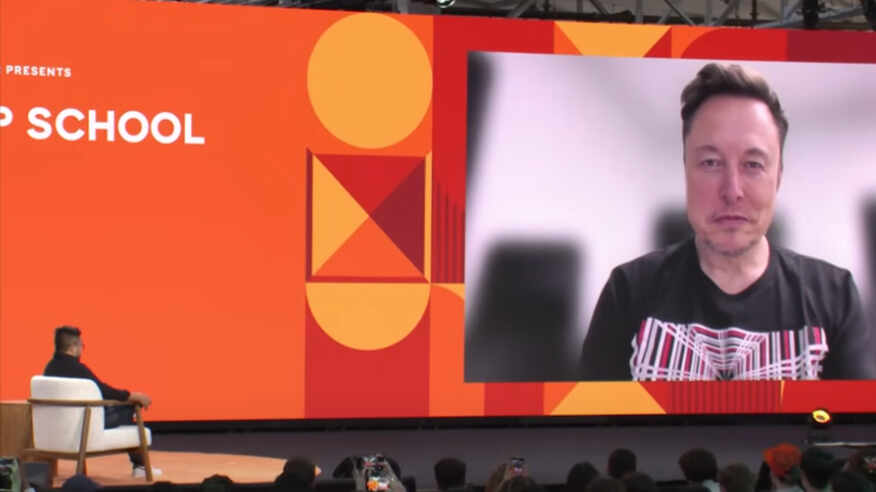
Read the full transcript of a fireside with Elon Musk at AI Startup School in San Francisco on “Digital Superintelligence, Multiplanetary Life, How to Be Useful”, June 19, 2025.
Digital Superintelligence and the Intelligence Big Bang
ELON MUSK: We’re at the very, very early stage of the intelligence big bang. Being a multi planet species greatly increases the probable lifespan of civilization or consciousness and intelligence, both biological and digital. I think we’re quite close to digital superintelligence. If it doesn’t happen this year, next year for sure.
GARRY TAN: Please give it up for Elon Musk. Elon, welcome to AI Startup School. We’re just really, really blessed to have your presence here today.
ELON MUSK: Thanks for having me.
Building Something Useful vs. Building Something Great
GARRY TAN: So, from SpaceX, Tesla, Neuralink, xAI and more. Was there ever a moment in your life before all this where you felt I have to build something great? And what flipped that switch for you?
ELON MUSK: Well, I didn’t originally think I would build something great. I wanted to try to build something useful. But I didn’t think I would build anything particularly great if you said probabilistically. Seemed unlikely, but I wanted to at least try.
GARRY TAN: So you’re talking to a room full of people who are all technical engineers, often some of the most eminent AI researchers coming up in the game.
ELON MUSK: Okay, I think we should, I think that, I think I like the term engineer better than researcher. I mean, I suppose if there’s some fundamental algorithmic breakthrough, it’s a research, otherwise it’s engineering.
The Early Days: From Stanford to Zip2
GARRY TAN: Maybe. Let’s start way back. I mean, when you were, this is a room full of 18 to 25 year olds. It skews younger because the founder set is younger and younger. Can you put yourself back into their shoes when you know, you were 18, 19, you know, learning to code, even coming up with a first idea for Zip2. What was that like for you?
ELON MUSK: Yeah, back in 95, I was faced with a choice of either, do you know, grad studies, PhD at Stanford in material science, actually working on ultracapacitors for potential use in electric vehicles, essentially trying to solve the range problem for electric vehicles, or try to do something in this thing that most people had never heard of called the Internet.
And I talked to my professor, who was Bill Nix in the material science department and said like, can I defer for a quarter because this will probably fail and then I’ll need to come back to college. And then he said, this is probably the last conversation we’ll have. And he was right. But I thought things would most likely fail, not that they would most likely succeed.
And then in 95 I wrote basically, I think the first or close to the first maps, directions, Internet white pages and yellow pages on the Internet. I just wrote, I just wrote that personally, I didn’t even use a web server. I just read the Port directly because I couldn’t afford and I couldn’t afford a T. One original office was on Sherman Avenue in Palo Alto. There was an ISP on the floor below. So I drilled a hole through the floor and just ran a LAN cable directly to the ISP.
And you know, my brother joined me and another co founder, Greg Curry, who passed away. And we at the time we couldn’t even afford a place to stay. So we just. The office was 500 bucks a month. So we just slept in the office and then showered at the YMCA on Page Mill and Camino.
And yeah, and I guess we ended up doing a little bit of a useful company, Zip2 in the beginning. And we did build a lot of really good software technology. But we were somewhat captured by the legacy media companies and that Nitrotter, New York Times, the Hearst whatnot were investors and customers and also on the board. So they kept wanting to use our software in ways that made no sense. So I wanted to go direct to consumers.
Anyways, long story, dwelling too much on Zip2, but I really just wanted to do something useful on the Internet because I had two choices. Do a PhD and watch people build the Internet or help build the Internet in some small way. And I was like, well, I guess I can always try and fail and then go back to grad studies. And anyway, that ended up being like reasonably successful. It sold for like $300 million, which was a lot at the time. These days that’s like, I think minimum impulse but for an AI startup is like a billion dollars. It’s like there’s so many frigging unicorns. It’s like a herd of unicorns at this point. You know, unicorns, a billion dollar situation.
AI Valuations and Market Dynamics
GARRY TAN: There’s been inflation since, so quite a bit more money actually.
ELON MUSK: Yeah, I mean like 1995, you could probably buy a burger for a nickel. Well, not quite, but I mean, yeah, there has been a lot of inflation. But I mean the hype level in AI is pretty intense. As you’ve seen. You see companies that are, I don’t know, less than a year old getting sometimes billion dollar or multibillion dollar valuations, which I guess could, could pan out and probably will pan out in some cases, but it is eye watering to see some of these valuations. Yeah. What do you think?
GARRY TAN: I mean. Well, I’m pretty bullish. I’m pretty bullish, honestly. So I think the people in this room are going to create a lot of the value that, you know, a billion people in the world should be using this stuff and we’re not even scratching the surface of it.
Lessons from Early Startups and the Future of AI
ELON MUSK: I guess for the first, my first startup, really the mistake was having too much shareholder and board control from legacy media companies who then necessarily see things through the lens of legacy media and that they’ll kind of make you do things that seem sensible to them but really don’t make sense with the new technology.
I should point out that I didn’t actually at first intend to start a company. I tried to get a job at Netscape. I sent my resume into Netscape and Mark Hendrickson knows about this, but I don’t think he ever saw my resume. And then nobody responded. And then I tried hanging out in the lobby of Netscape to see if I could bump into someone, but I was too shy to talk to anyone. So I’m like, man, this is ridiculous. So I’ll just write software myself and see how it goes. So it wasn’t actually from the standpoint of like, I want to start a company, I just want to be part of building the Internet in some way. And since I couldn’t get a job at an Internet company, I had to start a Internet company anyway.
AI will so profoundly change the future, it’s difficult to fathom how much. But the economy, assuming things don’t go awry and AI, it doesn’t kill us all and itself, then you’ll see ultimately an economy that is not, not 10 times more than the current economy ultimately, like if we become, say, or whatever, our future machine descendants, or mostly machine descendants, become like a Kardashev scale to civilization or beyond, talking about an economy that is thousands of times, maybe millions of times bigger than the economy today.
So, yeah, I mean, I did sort of feel a bit like, you know, when I was in DC, taking a lot of flack for like getting rid of waste and fraud, which was an interesting side quest as side quests go.
GARRY TAN: But got to get back to the Main quest.
ELON MUSK: Yeah, I got to get back to the main quest here. So. Back to the main quest. So but I did feel, you know, a little bit like there’s, you know, it’s like fixing the government is kind of like, there’s like, say the beach is dirty and there’s like some needles and feces and like trash and you want to clean up the beach. But then there’s also this like thousand foot wall of water which is a tsunami of AI. And how much does cleaning the beach really matter if you’ve got a thousand foot tsunami about to hit? Not that much.
GARRY TAN: We’re glad you’re back on the main quest. It’s very important.
ELON MUSK: Back to the main quest. Building technology, which is what I like doing, it’s just so much noise. Like the signal to noise ratio in politics is terrible.
GARRY TAN: So I mean, I live in San Francisco, so you don’t need to tell me twice.
ELON MUSK: Yeah, DC is like, you know, kind of, I guess it’s all politics in DC. But the. If you’re trying to build a rocket or cars, or you’re trying to have software that compiles and runs reliably, then you have to be maximally truth seeking or your software or your hardware won’t work. Like there’s no. You can’t fool math. Like math and physics are rigorous judges. So I’m used to being in a maximally true seeking environment and that’s definitely not politics. So anyway, I’m good. Glad to be back in technology.
Keeping the Chips on the Table: From Zip2 to PayPal
GARRY TAN: I guess I’m kind of curious going back to the Zip2 moment, you had hundreds of millions of dollars or you had an exit worth hundreds of millions of dollars.
ELON MUSK: I got $20 million.
GARRY TAN: Okay, so you solved the money problem at least and you basically took it and you kept rolling with X.com which became PayPal and Confinity.
ELON MUSK: Yes, I kept the chips on the table.
GARRY TAN: Not everyone does that. A lot of the people in this room will have to make that decision actually. What drove you to jump back into the ring?
ELON MUSK: Well, I think I felt with Zip2 we built incredible technology, but it never really got used to, you know, I think at least from my perspective, we had better technology than say Yahoo or anyone else, but it was constrained by our customers. And so I wanted to do something that where, okay, we wouldn’t be constrained by our customers. Go direct to consumer. And that’s what ended up being like X.com, PayPal, essentially X.com merging with confinity, which together created PayPal and then that actually the sort of PayPal diaspora. It might have created more companies than, so more companies than probably anything in the 21st century. So many talented people were at the combination of Confinity and X dot com.
So I just wanted to, I felt like we kind of got our wings clipped somewhat with Zip2. And it’s like, okay, what if our wings aren’t clipped and we go direct to consumer? And that’s what PayPal ended up being. But yeah, I got that, like, $20 million check for my share of Zip2. At the time, I was living in a house with four housemates and had like, 10 grand in the bank. And then this check arrives in the mail, of all places in the mail, and then my bank balance went from 10,000 to 20 million. And 10,000. You’re like, well, okay, so I pay taxes on that and all. But then I ended up putting almost all of that into X.com and as you said, like, just kind of keeping almost all the chips on the table and.
Yeah, and then after PayPal, I was like, well, I, I was kind of curious as to why we had not sent anyone to Mars. And I went on the NASA website to find out when we’re sending people to Mars, and there was no date. I thought maybe it was just hard to find on the website, but in fact, there was no real plan to send people to Mars. So then, you know, this is such a long story, so I don’t want to take up too much time here. But the.
GARRY TAN: I think we’re all listening with rapt attention.
The Origin Story of SpaceX
ELON MUSK: So I was actually, I was on the Long Island Expressway with my friend Dale Resi. We’re like housemates in college. And they was asking me what I’m, what we’re going to do, what am I going to do after PayPal? And I was like, it’s like, I don’t know, I guess maybe I’d like to do something philanthropic in space because I didn’t think I could actually do anything commercial in space because that seemed like the purview of nations. So. But, you know, I’m kind of curious as to when we’re going to send people to Mars. And that’s when I was like, oh, it’s not on the website. And then I started digging on, not, there’s nothing on the NASA website.
So then I started digging in and I’m definitely summarizing a lot here, but my first idea was to do a philanthropic mission to Mars called Life to Mars, where would send a small greenhouse with seeds and dehydrated nutrient gel. Land that on Mars and grow, you know, hydrate the gel and then you’d have this great sort of money shot of green plants on a red background. For the longest time. I, by the way, I didn’t realize money shot, I think is a porn reference. But anyway, the point is that that would be the great shot of green plants on a red background and to try to inspire, you know, NASA and the public to send astronauts to Mars.
As I learned more, I came to realize, and along the way, by the way, I went to Russia in like 2001 and 2002 to buy ICBMs, which is like, that’s an adventure. You know, you go and meet with Russian high command and say, I’d like to buy some ICBMs.
GARRY TAN: This was to get to space.
ELON MUSK: Yeah, as a rocket. Not to nuke anyone. But they had to. As a result of arms reduction talks, they had to actually destroy a bunch of their big nuclear missiles. So I was like, well, how about if we take two of those, you know, minus the nuke, add an additional upper stage for Mars. But it was kind of trippy, you know, being in Moscow in 2001 negotiating with like the Russian military to buy ICBMs, like, that’s crazy. But they kept also raising the price on me so that. So like, literally, it’s kind of like the opposite of what a negotiation should do. So I was like, man, these things are getting really expensive.
And then I came to realize that actually the problem was not that there was insufficient will to go to Mars, but there was no way to do so without breaking the budget, you know, even breaking the NASA budget. So that’s where I decided to start SpaceX. SpaceX to advance rocket technology to the point where we could send people to Mars. And that was in 2002.
From Philanthropy to Business
GARRY TAN: So that wasn’t, you know, you didn’t start out wanting to start a business. You wanted to start just something that was interesting to you, that you thought humanity needed. And then as you sort of, you know, like a cat pulling on a string, it just sort of, the ball sort of unravels. And it turns out this is, yeah, could be a very profitable business.
ELON MUSK: I mean, it is now, but it. There had been no prior example of really a rocket startup succeeding. There have been various attempts to do commercial rocket companies, and that all failed. So again, with SpaceX starting, SpaceX was really, from the standpoint of, I think there’s a less than 10% chance of being successful, maybe 1%, I don’t know. But if a startup doesn’t do something to advance rocket technology, it’s definitely not coming from the big defense contractors because they just impede and smash to the government and the government just wants to do very conventional things. So it’s either coming from a startup or it’s not happening at all. So, like, a small chance of success is better than no chance of success.
SpaceX started that in mid-2002 expecting to fail. Like I said, probably 90% chance of failing. And even when recruiting people, I didn’t try to, you know, make out that it would probably. I said, we’re probably going to die, but small chance, we might not die. And if, but this is the only way to get people to Mars and advance the state of the art. And then I ended up being chief engineer of the rocket, not because I wanted to, but because I couldn’t hire anyone who was good. So, like, none of the good sort of chief engineers would join because they’re like, this is too risky, you’re going to die.
And so then I ended up being chief engineer of the rocket. And, you know, the first three flights did fail, so it’s a bit of a learning exercise there. And fourth one fortunately worked, but if the fourth one hadn’t worked, I had no money left and that would have been. It would have been curtains. So it was a pretty close thing. If the fourth launch of Falcon not work, it would have been just curtains and we would have just joined the graveyard of prior rocket startups. My estimate of success was not far off. We made it by the skin of our teeth.
And Tesla was happening sort of simultaneously. 2008 was a rough year because at mid 2008, called Summer 2008, the third launch of SpaceX had failed. A third failure in a row, the Tesla financing round had failed. And so Tesla was going bankrupt fast. It was just, it’s like, man, this is grim. This is going to be a tale of warning of an exercise in hubris.
The Internet Guy Building Rockets
GARRY TAN: Probably throughout that period, a lot of people were saying, you know, Elon is a software guy. Why is he working on hardware? Yeah. Why would he choose to work on this?
ELON MUSK: Right, yeah, 100%. So you can look at the, like the. Because it’s still, the, you know, the press of that time is still online. You can just search it and they kept calling me Internet guy. So like Internet Guy, AKA fool, is attempting to build a rocket company. So, you know, we got ridiculed quite a lot. And it does sound pretty absurd. Like Internet guy starts rocket company. Doesn’t sound like a recipe for success frankly. So I didn’t hold it against them. I was like, yeah, you know, admittedly it does sound improbable and I agree that it’s improbable.
But fortunately the fourth launch worked and NASA awarded us a contract to resupply the space station. And I think that was like maybe, I don’t know, December 22nd or it was like right before Christmas. Because even the fourth launch working wasn’t enough to succeed. NASA also needed, we also needed a big contract to keep us alive. So I got that call from the NASA team and I literally, they said, we’re rewarding you one of the contracts to resupply the space station. I like literally blurted out I love you guys, which is not normally what they hear because it’s usually pretty sober. But I was like, man, this is a company saver.
And then we closed the Tesla financing round on the last hour of the last day that it was possible, which was 6pm Dec. 24, 2008. We would have bounced payroll two days after Christmas if that round hadn’t closed. So that was a nerve wracking end of 2008, that’s for sure.
On Being Useful and Finding Great People
GARRY TAN: I guess from your PayPal and Zip2 experience jumping into these hardcore hardware startups, it feels like one of the through lines was being able to find and eventually attract the smartest possible people in those particular fields. You know what, what would I mean? The people in this room, like some of the, most of the people here I don’t think have even managed a single person yet. They’re just starting their careers. What would you tell to, you know, the Elon who’s never had to do that yet?
ELON MUSK: I generally think to try to try to be as useful as possible. It may sound trite but it’s so hard to be useful, especially to be useful to a lot of people where you say the area under the curve of total utility is like how useful have you been to your fellow human beings times how many people? It’s almost like the physics definition of true work. It’s incredibly difficult to do that. And I think if you aspire to do true work, your probability of success is much higher. Don’t aspire to glory, aspire to work.
GARRY TAN: How can you tell that it’s true work? Like is it external? Is it like what happens with other people or you know, what the product does for people like what, you know, what is that for you when you’re looking for people to come work for you? Like what, you know, what’s the salient thing that you look for? Or if they’re.
ELON MUSK: That’s a different question. I guess it’s, I mean, in terms of your end product, you just have to say like, well, if this thing is successful, how useful will it be to how many people? And that’s what I mean. And then you do whatever, whether you’re a CEO or any role in a startup, you do whatever it takes to succeed and just always be smashing your ego. Internalize responsibility.
A major failure mode is when ego to ability ratio is double greater than sign one. If your ego to ability ratio gets too high, then your, you’re going to basically break the feedback loop to reality. And in AI terms you’ll break your RL loop. So you don’t want to break your, you want to have a strong RL loop, which means internalizing responsibility and minimizing ego. And you do whatever the task is, no matter whether it’s grand or humble.
That’s kind of like why actually I prefer the term like engineering as opposed to research. I prefer the term and I actually don’t want it to call Xai a lab. I just want to be a company. Like, it’s like what are the simplest, most straightforward, ideally lowest ego terms are. Those are generally a good way to go. You want to just close the loop on reality hard. That’s a super big deal.
Constructing Reality from First Principles
GARRY TAN: I think everyone in this room really looks up to everything you’ve done around being sort of a paragon of first principles and thinking about the stuff you’ve done. How do you actually determine your reality? Because that seems like a pretty big part of it. Like other people, people who have never made anything, non engineers, sometimes journalists at time, who’ve never done anything, like they will criticize you. But then clearly you have another set of people who are builders, who have very high, you know, sort of area under the curve, who are in your circle. Like, you know, how should people approach that? Like, what has worked for you and what would you pass on, like you know, to X, to your children? Like, you know, what do you tell them when you’re like, you need to make your way in this world. Here’s how to construct a reality that is predictive from first principles.
First Principles Thinking and Rocket Cost Analysis
ELON MUSK: Well, the tools of physics are incredibly helpful to understand and make progress in any field. First principles obviously just means break things down to the fundamental axiomatic elements that are most likely to be true. And then reason up from there as cogently as possible, as opposed to reasoning by analysis or metaphor. And then just simple things like thinking in the limit. Like if you extrapolate, minimize this thing or maximize that thing. Thinking in the limit is very helpful. I’d use all the tools of physics. They apply to any field. This is like a superpower, actually.
So you can take for example, like rockets, you could say, well, how much should a rocket cost? The typical approach that people would take to how much rocket should cost is they would look historically at what the cost of rockets are and assume that any new rocket must be somewhat similar to the prior cost of rockets. A first principles approach would be you look at the materials that the rocket is comprised of. So if that’s aluminum, copper, carbon fiber, steel, whatever the case may be, and say what, what, how much does that rocket weigh? And, and, and what are the constituent elements and how much do they weigh? What is the material price per kilogram of those constituent elements? And that sets the actual floor on what a rocket can cost. It’s, it can asymptotically approach the cost of the raw materials. And then you realize, oh, actually a rocket, the raw materials of a rocket are only maybe 1 or 2% of the historical cost of a rocket. So the manufacturing must necessarily be very inefficient. If the, if the raw material cost is only 1 or 2%, that would be a first principles analysis of the potential for cost optimization of a rocket. And that’s before you get to reusability.
Building a Training Supercluster in Six Months
To give an AI sort of AI example, I guess last year for Xai, when we were trying to build a training supercluster, we went to the various suppliers to ask, this was beginning of last year, that we needed a hundred thousand H1 hundreds to be able to train coherently. And their estimates for how long it would take to complete that were 18 to 24 months. It’s like, well, we need to get that done in six months or we won’t be competitive.
So then if you break that down, what are the things you need? Well, you need a building, you need power, you need cooling. We didn’t have enough time to build a building from scratch, so we’ve had to find an existing building. So we found a factory that was no longer in use in Memphis that used to build Electrolux products. But then the input power was 15 megawatts and we needed 150 megawatts. So we rented generators and had generators on one side of the building. And then we have to have cooling so we rented about a quarter of the mobile cooling capacity of the US and put the chillers on the other side of the building.
That didn’t fully solve the problem because the power variations during training are so very, very big. So you can have. Power can drop by 50% in 100 milliseconds, which the generators can’t keep up with. So then we combined, we added Tesla megapacks and modified the software in the megapacks to be able to smooth out the, the power variation during the training run. And then there were, there were a bunch of networking challenges. The networking cables, if you’re trying to make 100,000 GPUs trained coherently, are very, very challenging.
GARRY TAN: Almost, it sounds like almost any of those things you mentioned. I could imagine someone telling you very directly, no, you can’t have that, you can’t have that power, you can’t have this. And it sounds like one of the salient pieces of first principles thinking is actually let’s ask why, let’s figure that out and actually let’s challenge the person across the table and if they, if I don’t get an answer that I feel good about, I’m going to, you know, not allow that to be. I’m not going to let that know to stand. Is that, I mean, that feels like something that, you know, everyone, if someone were to try to do what you’re doing in hardware, hardware seems to uniquely need this. In software we have lots of, you know, fluff and things that, you know, it’s like we can add more CPUs to that, it’ll be fine, but in hardware it’s, it’s just not going to work.
ELON MUSK: I think these general principles of first principle thinking apply to software and hardware, apply to anything really. I’m just using kind of a hardware example of how we were told something is impossible, but once we broke it down into the constituent elements of we need a building, we need power, we need cooling, we need power smoothing and then we could solve those constituent elements. Um, but it was, and then we, and then we just ran the, the networking operation to, to do all the cabling, everything in four shifts, 24/7. And, and I was like sleeping in the data center and also doing cabling myself. And, and there were a lot of other issues to solve. You know, no, nobody had done a training run with a hundred thousand H1 hundreds training coherently last year. Maybe it’s been done this year, I don’t know. But, and then, and then we ended up doubling that to 200,000. And so now we’ve got 150,000 H1 hundreds, 50K H2 hundreds and 30K GV2 hundreds in the, in the Memphis training center. And we’re about to bring 110,000 GB2 hundreds online at a second data center also in the Memphis area.
Scaling Laws and AI Competition
GARRY TAN: Is it your view that pre training is still working and the scaling laws still hold and whoever wins this race will have basically the biggest, smartest possible model that you could distill?
ELON MUSK: Well, there’s other various elements that decide competitiveness for large AI. There’s for sure the talent of the people matter, the scale of the hardware matters and how well you’re able to bring that hardware to bear. So you can’t just order a whole bunch of GPUs and they don’t. You can’t just plug them in. So you’ve got to get a lot of GPUs and have them trained coherently and stably. Then it’s like what unique access to data do you have? I guess distribution matters to some degree as well, like how do people get exposed to your AI? Those are critical factors for if it’s going to be like a large foundation model that’s competitive, as many have said.
I think my friend Ilya Sutskever said we’ve kind of run out of pre training data of human generated, like human generated data, you run out of tokens pretty fast, certainly of high quality tokens. And then you have to do a lot of you need to essentially create synthetic data and be able to accurately judge the synthetic data that you’re creating to verify is this real synthetic data or is it an hallucination that doesn’t actually match reality. So achieving grounding in reality is tricky, but. But we are at the stage where there’s more effort put into synthetic data and right now we’re training Grok 3.5 which is a heavy focus on reasoning.
GARRY TAN: Going back to your physics point, what I heard for reasoning is that hard science, particularly physics textbooks, are very useful for reasoning. Whereas I think researchers have told me that social sciences totally useless reasoning.
ELON MUSK: Yes, that’s probably true.
The Future of Humanoid Robots
So yeah, there’s something that’s going to be very important in the future is combining deep AI in the data center or supercluster with robotics so that things like the Optimus humanoid robot. Incredible. Yeah, Optimus is awesome. There’s going to be so many humanoid robots and robots of all sizes and shapes. But my prediction is that there will be more humanoid robots by far than all other robots combined by maybe an order of magnitude, like a big difference.
GARRY TAN: Is it true that you’re planning a robot army of a sort, whether we.
ELON MUSK: Do it or, you know, whether Tesla does it? You know, Tesla works closely with xai. Like you’ve seen how many humanoid robot startups are there? Like, it’s like, I think Jensen Huang was on stage with a lot with a massive number of robots, you know, robots from different companies. I think there was like dozen different humanoid robots. So I mean, I guess, you know, part of what I’ve been fighting and maybe what has slowed me down somewhat is that I’m, I’m a little, I don’t want, I don’t want to make Terminator real, you know, so I’ve been sort of, I guess at least until recent years, dragging my feet on, on AI and, and humanoid robotics. And then I sort of come to the realization, realization it’s, it’s happening whether I do it or not. So you got really two choices. Particip, you can either be a spectator or a participant. And so like, well, I guess I’d rather be a participant than a spectator. So now it’s, you know, pedal to the metal on humanoid robots and digital superintelligence.
Becoming a Multi-Planetary Species
GARRY TAN: So I guess, you know, there’s a third thing that everyone has heard you talk a lot about that I’m really a big fan of, you know, becoming a multi planetary species. Where does this fit? You know, this is all, you know, not, not just a 10 or 20 year thing, maybe a hundred year thing. Like it’s a, you know, many, many generations for humanity kind of thing. You know, how do you think about it? There’s, you know, AI, obviously, there’s embodied robotics and then there’s being a multiplan, multi planetary species. Does everything sort of feed into that last point or, you know, what, what are you driven by right now for the next 10, 20 and 100 years?
ELON MUSK: Geez, 100 years. Man, I hope civilization’s around in 100 years. If it is round, it’s going to look very different from civilization today. I mean, I’d predict that there’s going to be at least five times as many humanoid robots as there are humans. Maybe 10 times.
One way to look at the progress of civilization is percentage completion. Kardashev. So if you’re in a Kardashev scale one, you’ve, you’ve harnessed all the energy of a planet. In my opinion, we’ve only harnessed maybe 1 or 2% of Earth’s energy. So we’ve got a long way to go to the Kardashev scale one, then Kardashev two, you’ve harnessed all the energy of a sun, which would be, I don’t know, a billion times more energy than Earth, maybe closer to a trillion. And then Kardashev3 would be all the energy of a galaxy pretty far from that. So we’re at the very, very early stage of the intelligence big bang.
I hope we’re in terms of being multi planetary. I think we’ll have enough mass transferred to Mars within roughly 30 years to make Mars self sustaining, such that Mars can continue to grow and prosper even if the resupply ships from Earth stop coming. And that greatly increases the probable lifespan of civilization or consciousness or intelligence, both biological and digital. So that’s why I think it’s important to become a multi planet species.
And I’m somewhat troubled by the Fermi paradox, like why have we not seen any aliens? And it could be because intelligence is incredibly rare and maybe we’re the only ones in this galaxy, in which case the intelligence of consciousness is this like tiny candle in a vast darkness and we should do everything possible to ensure the tiny candle does not go out. And being a multi planet species or making consciousness multi planetary greatly improves the probable lifespan of civilization. And it’s the next step before going to other star systems. Once you at least have two planets, then you’ve got a forcing function for the improvement of space travel. And that ultimately is what will lead to consciousness expanding to the stars.
Avoiding the Great Filters
GARRY TAN: It could be that the Fermi paradox dictates once you get to some level of technology, you destroy yourself. How do we stay ourselves? How do we actually, what would you prescribe to? I mean, a room full of engineers, like what can we do to prevent that from happening?
ELON MUSK: Yeah, how do we avoid the great filters? One of the great filters would obviously be global thermonuclear war. So we should try to avoid that, I guess, building benign AI robots that AI that loves humanity and you know, robots that are helpful. Something that I think is extremely important in building AI is, is a very rigorous adherence to truth, even if that truth is politically incorrect. My intuition for what could make AI very dangerous is if, if you force AI to believe things that are not.
GARRY TAN: True, how do you think about, there’s sort of this argument for open for safety versus closed for competitive edge. I mean, I think the great thing is you have a competitive model. Many other people also have competitive models. And in that sense we’re sort of off of. Maybe the worst timeline that I’d be worried about is there’s fast takeoff and it’s only in one person’s hands. That might sort of collapse a lot of things. Whereas now we have choice, which is great. How do you think about this?
ELON MUSK: Yeah, I do think there will be several deep intelligences, maybe at least five, maybe as much as 10. I’m not sure that there’s going to be hundreds, but it’s probably close. Like, maybe it’ll be like 10 or something like that, of which maybe four will be in the US so I don’t think it’s going to be any one AI that has a runaway capability. But, yeah, several deep intelligences.
GARRY TAN: What will these deep intelligences actually be doing? Will it be scientific research or trying to hack each other?
The Path to Digital Superintelligence
ELON MUSK: Probably all of the above. I mean, hopefully they will discover new physics, and I think they will very. They’re definitely going to invent new technologies. Like, I mean, I think we’re quite close to digital superintelligence. It may happen this year, and if it doesn’t happen this year, next year for sure. Digital superintelligence, defined as smarter than any human at anything.
GARRY TAN: Well, so how do we direct that to sort of super abundance? You know, we have, we could have robotic labor. We have cheap energy. Intelligence on demand. You know, is that sort of the white pill? Like, where do you sit on the spectrum and are there tangible things that you would encourage everyone here to be working on to make that white pill actually reality?
ELON MUSK: I think it, I think it most likely will be a good outcome. I, I guess I’d sort of agree with Geoff Hinton that maybe it’s a 10 to 20% chance of annihilation. But look on the bright side. That’s 80 to 90% probability of a great outcome. So, yeah, I can’t emphasize this enough. Rigorous adherence to truth is the most important thing for AI safety and obviously empathy for humanity and life as we know it.
Neuralink and Human-Machine Interface
GARRY TAN: We haven’t talked about Neuralink at all yet. But I’m curious. You know, you’re working on closing the input and output gap between human, humans and machines. How critical is that to AGI, ASI? And once that link is made, can we not only read but also write?
ELON MUSK: The Neuralink is not necessary to solve digital superintelligence. That’ll happen before Neuralink is at scale. But what Neuralink can effectively do is solve the input output bandwidth constraints, especially our output bandwidth, is very low. The sustained output of a human over the course of a day is less than 1 bit per second. So there’s 86,400 seconds in a day. And it is extremely rare for a human to output more than that number of symbols per day. So certainly for several days in a row.
So you really, with a Neuralink interface you can massively increase your output bandwidth and your input bandwidth, input being right to you have to do write operations to the brain. We have now five humans who have received the kind of the read input where it’s reading signals. And you’ve got people with ALS who really have, they’re tetraplegics, but they, they can now communicate at with similar bandwidth to a human with a fully functioning body and control their computer and phone, which is pretty cool.
And then I think in the next six to 12 months we’ll be doing our first implants for vision where even if somebody’s completely blind, we can write directly to the visual cortex. And we’ve had that working in monkeys. Actually I think one of our monkeys now has had a visual implant for three years. And at first it’ll be relatively fairly low resolution, but long term you would have very high resolution and be able to see multi spectral wavelengths. So you could see an infrared ultraviolet radar. It’s like a superpower situation.
Like at some point the cybernetic implants would not simply be correcting things that went wrong, but augmenting human capabilities dramatically, augmenting intelligence and senses and bandwidth dramatically. And that’s going to happen at some point, but digital superintelligence will happen well before that. At least if we have a neural link we met, we’ll be able to appreciate the AI better.
The Future of Human Intelligence
GARRY TAN: I guess one of the limiting reagents to all of your efforts across all of these different domains is access to the smartest possible people. But simultaneous to that we have the rocks can talk and reason and there may be 130 IQ now and they’re probably going to be super intelligent soon. How do you reconcile those two things? Like what’s going to happen in five, 10 years and what should the people in this room do to make sure that they’re the ones who are creating instead of maybe below the API line?
ELON MUSK: Well, they call it the singularity for a reason. We don’t know what’s going to happen in the not that far future. The percentage of intelligence that is human will be quite small. At some point the collective sum of human intelligence will be less than 1% of all intelligence. And if things get to a Kardashev level two, we’re talking about human intelligence. Even assuming a significant increase in human population and intelligence augmentation, like massive intelligence augmentation where like everyone has an IQ of a thousand type of thing. Even in that circumstance, collective human intelligence will be probably 1 billionth that of digital intelligence anyway. Where’s the biological bootloader for digital superintelligence?
GARRY TAN: I guess just to end off.
ELON MUSK: What was that? It was like, was I a good bootloader?
Final Thoughts on Being Useful
GARRY TAN: Where do we go? How do we go from here? I mean, I mean all of this is pretty wild sci fi stuff that also could be built by the people in this room. You know, if you. Do you have a closing thought for the smartest technical people of this generation right now. What should they be doing? What should they, what should they be working on? What should they be thinking about, you know, tonight as they go to dinner?
ELON MUSK: Well, as I started off with, I think if you’re doing something useful, that’s great. Just try to be as useful as possible to your fellow human beings and then you’re doing something good. I keep harping on this focus on super truthful AI. That’s the most important thing for AI safety. You know, obviously if, you know, anyone’s interested in working at xAI, please let us know. We’re aiming to make GROK the maximally truth seeking AI, and I think that’s a very important thing.
Hopefully we can understand the nature of the universe. That’s really, I guess, what AI can hopefully tell us. Maybe AI can maybe tell us, where are the aliens? And how did the universe really start? How will it end? What are the questions that we don’t know that we should ask? And are we in a simulation or what level of simulation are we in?
GARRY TAN: Well, I think we’re going to find out.
ELON MUSK: Am I an NPC?
GARRY TAN: Elon. Thank you so much for joining us, everyone. Please give it up for Elon Musk.
Related Posts
- Full Transcript: Zanny Minton Beddoes Interviews Elon Musk
- Transcript of Daniel Kokotajlo Interview: Diary Of A CEO Podcast
- Transcript: Why a Social Media Ban Won’t Save Teens – Candice Odgers
- Transcript of Elon Musk Interview: SXSW Live – March 9, 2013
- Digital Afterlife: Who Owns Your Data When You’re Gone? – Suresh Sankaran Srinivasan (Transcript)