Share & Care!
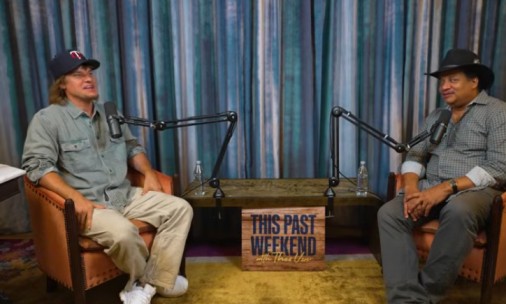
EDITOR’S NOTE: Comedian Theo Von sits down with astrophysicist Neil deGrasse Tyson for their second conversation on This Past Weekend, recorded in Tyson’s hometown of New York City. The two range across evolutionary psychology, tribalism, the ethics of space privatization, alien contact, and the everyday physics of life in zero gravity, all anchored around Tyson’s new book, Lost in Space: 5,000 Facts for Navigating the Universe. Along the way they trade jokes, AI-generated costume mashups, and a shared reverence for Carl Sagan’s Pale Blue Dot. This episode was premiered September 16, 2026.
TRANSCRIPT:
Catching Up in New York City
THEO VON: (00:00:00 – 00:00:46): He’s the most famous astrophysicist in the world, and maybe in some other worlds, we don’t know. You know him from his show StarTalk. He has a new book, Lost in Space: 5,000 Facts for Navigating the Universe. We caught up in his hometown of New York City. I’m grateful for his return. Today’s guest is Neil deGrasse Tyson.
We gotta ship some of this badass out into space, man. That’s what I’m saying, dude.
NEIL DEGRASSE TYSON: (00:00:46 – 00:00:51): Race, you know it’s expensive though. That’s the problem. Yeah, there’s a lot— there’s more talk than action.
THEO VON: (00:00:52 – 00:00:56): No time like the present, man. Neil deGrasse Tyson, good to see you.
NEIL DEGRASSE TYSON: (00:00:56 – 00:00:59): Thanks for having me back on. Oh my gosh, it’s been a few years.
THEO VON: (00:01:00 – 00:01:00): Yeah, it’s a pleasure, man.
NEIL DEGRASSE TYSON: (00:01:01 – 00:01:02): And you’re in my town now.
THEO VON: (00:01:02 – 00:01:09): Yes, I was going to say. Yeah, we’re New York City, we had a chauffeur on and he talked about he was from the Bronx and he talked one time about—
NEIL DEGRASSE TYSON: (00:01:10 – 00:01:10): Say it right—
THEO VON: (00:01:10 – 00:01:11): The Bronx.
NEIL DEGRASSE TYSON: (00:01:11 – 00:01:12): There you go.
THEO VON: (00:01:12 – 00:01:18): Yeah, he was from the Bronx. And it’s— I heard it’s a lot of Asians over there too, so from the Bronx.
NEIL DEGRASSE TYSON: (00:01:18 – 00:01:20): Well, not when I was growing up. Okay. Yeah, yeah.
THEO VON: (00:01:20 – 00:01:30): Well, he said that there was a time in the ’70s when they used to bring swimming pools over there, like a pool, like semi-trucks into his neighborhood.
NEIL DEGRASSE TYSON: (00:01:30 – 00:01:49): I, I don’t remember that, but I do know that Occasionally, if you had a charitable fire department, they would open the fire hydrants and you can— there are these sort of covers with holes in it and it would put spray onto the street so that you could play in the street.
THEO VON: (00:01:49 – 00:01:50): So they’d crack open the fire hydrant?
NEIL DEGRASSE TYSON: (00:01:50 – 00:02:00): Crack that open. But I’m looking at your images now. No, I don’t remember those. Oh my gosh. And I was in town at that time. Is this in the Bronx? Yeah, that’s cool.
THEO VON: (00:02:01 – 00:02:04): Yeah, this is the Bronx. It says this is 1970. So that’s—
NEIL DEGRASSE TYSON: (00:02:04 – 00:02:07): Yeah, I’m around. I’m old. I’m an old fart. So—
THEO VON: (00:02:07 – 00:02:15): But you were barely alive. No, you were barely alive. But yeah, I was just— I didn’t know if maybe you’d remember that from growing up, you know?
NEIL DEGRASSE TYSON: (00:02:15 – 00:02:29): Yeah. I mean, hot times in the city, you know, the tarmac, you know, the street gets hot and it’s just hot in the summer and no one’s in school. And so I think it keeps keeps emotions tamped down so that there’s no unrest.
THEO VON: (00:02:29 – 00:02:40): Yeah. Last thing we want, huh? That’s so true. You have a new book, Lost in Space: 5,000 Facts for Navigating the Universe.
NEIL DEGRASSE TYSON: (00:02:40 – 00:03:10): Yeah, it’s co-produced with— between my podcast, StarTalk Podcast, and National Geographic Books. It’s like our 4th collaboration. It’s gorgeous. And it’s 5,000 facts in all categories. And it’s— but they’re not just facts because you can just Google facts. Yeah. They’re StarTalkified. Oh, I see. A StarTalkified fact. So I’ll give you an example. All right. Okay? Instead, ask me, how big is the sun?
Lost in Space: 5,000 StarTalkified Facts
THEO VON: (00:03:11 – 00:03:11): How big is the sun?
NEIL DEGRASSE TYSON: (00:03:12 – 00:03:23): I could say it’s 864,000 miles, but you can Google that. Or I can say, take 100 Earths and line them up. That’s the width of the sun.
THEO VON: (00:03:23 – 00:03:24): Wow, really?
NEIL DEGRASSE TYSON: (00:03:24 – 00:03:36): Or if you’re hungry, I can say if the sun were a sesame seed bagel, Earth would be the size of one of the sesame seeds.
THEO VON: (00:03:37 – 00:03:37): That big guy.
NEIL DEGRASSE TYSON: (00:03:38 – 00:03:43): So I’m just saying the facts are just a little more pop culture infused.
THEO VON: (00:03:43 – 00:03:45): I see. And a little more pizzazz.
NEIL DEGRASSE TYSON: (00:03:45 – 00:03:53): Yeah, yeah, just, just so that you will never forget it. Yeah. Okay, you’re not going to forget the sun and the earth right now. I know they have bagels in Nashville.
THEO VON: (00:03:53 – 00:03:58): Yeah, well, also my brother is deathly allergic to sesame seeds.
NEIL DEGRASSE TYSON: (00:03:58 – 00:03:59): Well, then there you go.
THEO VON: (00:04:00 – 00:04:02): So I’m not going to forget that at all.
NEIL DEGRASSE TYSON: (00:04:02 – 00:04:02): Don’t forget that, dude.
THEO VON: (00:04:02 – 00:04:08): I actually— I read in your book that yeah, I was perusing through it, man. It’s a— it’s like, yeah, it’s just an engaging book.
NEIL DEGRASSE TYSON: (00:04:08 – 00:04:11): Yeah, yeah, you just— you pick it up and open it and there it is.
THEO VON: (00:04:11 – 00:04:29): Open it to wherever you’re— and you’re in it.
NEIL DEGRASSE TYSON: (00:04:29 – 00:04:31): Yeah, it’s, it’s impressive. Yeah, that—
THEO VON: (00:04:31 – 00:04:35): So is our brain more complex than like a galaxy?
NEIL DEGRASSE TYSON: (00:04:36 – 00:05:23): I would say so. Why do you— why can’t I say so? I’m going to say so. All the stars are interacting with each other with the force of gravity. But in your brain, there’s like chemical reactions, there’s electrical reactions. They’re being influenced by other reactions that happened before. These are your memories. There’s, there’s sometimes you get like an earworm, a song gets in your head, you can’t get it out.
It’s firing all by itself. Yeah. Or you have these emotions that make you tear up or bring joy. Yeah. The universe inside your head. Is surely more complex than the universe itself. Which brings the question, how is it possible that the universe can make something more complex than itself?
A Universe More Complex Than Itself
THEO VON: (00:05:24 – 00:05:27): Wow. Is that possible?
NEIL DEGRASSE TYSON: (00:05:28 – 00:05:47): It has happened. So unless you want to say God did it, but then that’s kind of a little bit of a cop-out because then I’d say, well, who made God? Then you have to say, well, God always was, or God— you have to I could ask you questions and put you in a place where you’re stuck saying something that you just have to assert to be true.
And so—
THEO VON: (00:05:48 – 00:05:48): But there had to be a beginning.
NEIL DEGRASSE TYSON: (00:05:49 – 00:05:52): Well, we have a Big Bang, but that pushes the question earlier.
THEO VON: (00:05:52 – 00:05:53): But who lit the match?
NEIL DEGRASSE TYSON: (00:05:53 – 00:07:41): Exactly, who it was before the Big Bang. And only in the last couple of decades did we look at our equations that give us the Big Bang. And there’s data that support it as well. But you look all the way back, They say, wait a minute, these equations are popping out other universes.
So maybe there’s not just a universe, maybe there’s a multiverse. If there’s a multiverse, then our universe is just one of some uncountable number of other universes. So then you have to ask, what was around before the multiverse? And here’s another one that’s a little bit mind-blowing. You go far enough back, there’s Earth and then the universe.
Well then, no, Earth is just one of 8 planets around the sun. Well, the sun, there’s something special. No, those dots of light in the night sky are just like the sun. Like, damn. The Milky Way galaxy, there it is. Then Hubble discovers in 1925, ’26, there are other galaxies in the universe.
Just like the Milky Way. So everything we thought there was one of, there isn’t. There’s countless others among them. But we got one universe. Hmm. Maybe not. Maybe there’s a multiverse. Well, if the universe never makes anything in ones, could there be only one multiverse? Okay. Is there, is there a network of multiverse?
Is it a metaverse? You know, we’re running out of adjectives there. Yeah, but it’s, it’s, it’s— to think about it is very— is humbling. Yeah. And not enough people are humbled in their life. Some people need, need a dose of humbling.
THEO VON: (00:07:41 – 00:07:47): Well, as far as I can tell, I think you have to think to be humbled, and a lot of us aren’t doing that.
NEIL DEGRASSE TYSON: (00:07:47 – 00:07:57): You know, you think, you think, and half the time, myself included, Or they act before they think and then they regret it, or they, or they try to justify it after the fact.
THEO VON: (00:07:57 – 00:08:04): Oh yeah, look, yeah, I mean, you’ve been reading my diary. But what makes us able to think?
Why Evolution Wired Us to Think
NEIL DEGRASSE TYSON: (00:08:06 – 00:08:09): Well, if you talk to evolutionary biologists, they will—
THEO VON: (00:08:09 – 00:08:11): Which I haven’t, and I’ll let you know that straight up.
NEIL DEGRASSE TYSON: (00:08:11 – 00:08:12): I have.
THEO VON: (00:08:12 – 00:08:15): So yeah, I’ve been talking to my buddy Red, right?
NEIL DEGRASSE TYSON: (00:08:16 – 00:08:19): And he’s neither evolutionary nor biologist, right?
THEO VON: (00:08:19 – 00:08:21): Well Honestly, he’s been doing Duster.
NEIL DEGRASSE TYSON: (00:08:22 – 00:08:22): Oh, okay.
THEO VON: (00:08:22 – 00:08:27): Yeah, he’ll be fine. But back to where we are. But yeah, I’m just saying, I have—
NEIL DEGRASSE TYSON: (00:08:27 – 00:08:29): I value objective reality.
THEO VON: (00:08:29 – 00:08:30): Okay. Yeah.
NEIL DEGRASSE TYSON: (00:08:30 – 00:08:43): And the brain barely works as it is, right? So to start stirring chemicals and say, let me do more, do something else with my brain— I don’t want to be that far removed from what is objectively true in this world.
THEO VON: (00:08:44 – 00:08:50): Oh yeah, he’s been, he’s been hitting that keyboard cleaner, you know. The dude’s got a spacebar in his head now, dude.
NEIL DEGRASSE TYSON: (00:08:50 – 00:09:05): Right. So the question— what was the question? It was— oh, so evolutionary biologists would say our thoughts, when they evolved, were just sufficient to not die and stay alive long enough to make babies.
THEO VON: (00:09:05 – 00:09:09): Like, what do you mean by that? So the first thoughts were just like, okay, I need to stay alive.
NEIL DEGRASSE TYSON: (00:09:09 – 00:09:09): Yeah, yeah.
THEO VON: (00:09:09 – 00:09:11): Oh, and I need— and I need to procreate.
NEIL DEGRASSE TYSON: (00:09:11 – 00:09:31): If I do not run away from this lion, I will die. Well, okay, let’s say you have 3 kids. One of them said, oh, I wonder what that is rustling in the brush. Let me go find out. It’s a lion. They get eaten. Yeah, that curiosity is removed from the gene pool.
THEO VON: (00:09:32 – 00:09:33): Okay. Oh, that’s a good point.
NEIL DEGRASSE TYSON: (00:09:33 – 00:09:54): Yeah. And the people say, I don’t know what that is, but I’m a little bit afraid. Let me go the opposite direction. They live another day. They have babies. So curiosity is not always a good thing for your survival if you’re curious about things that could kill you. So that’s first fact. And plus, you want to make more of yourself, so sex matters.
THEO VON: (00:09:55 – 00:09:55): Yeah.
NEIL DEGRASSE TYSON: (00:09:55 – 00:10:01): All right, so these are simple thoughts. And you know that thing where someone throws up and you smell their throw up and you want to throw up too?
THEO VON: (00:10:02 – 00:10:05): Oh yeah, what game is that called? It’s one of those challenges, I think, on TikTok, isn’t it?
NEIL DEGRASSE TYSON: (00:10:05 – 00:10:06): Oh, is it really?
THEO VON: (00:10:06 – 00:10:07): Oh, okay, it was.
NEIL DEGRASSE TYSON: (00:10:07 – 00:10:45): Why wouldn’t it be? It’s TikTok, right? Yeah, but There’s an evolutionary reason for that. We’re a tribe. We’re here. You ate something before the rest of us did and you just threw up. I’m— I don’t— I’m— I don’t want to eat what you just ate. What’s my body’s best way to tell me that?
I want to throw up just the way you did. So that triggers— that’s a chain reaction in your tribe back in the cave. So we all throw up and we’re all better because it happened to you. Okay. And so It’s why we react in these ways. So the evolutionary biologists would say we have thoughts that are for this reason.
Okay, I’ll give one more and I’ll bring it into the present.
THEO VON: (00:10:46 – 00:10:50): But some of the first thoughts were for to keep us surviving.
NEIL DEGRASSE TYSON: (00:10:50 – 00:10:51): Yes.
THEO VON: (00:10:51 – 00:10:51): Okay, got it.
NEIL DEGRASSE TYSON: (00:10:51 – 00:10:53): Okay, so now, now watch how that unfolds.
THEO VON: (00:10:53 – 00:10:54): Okay.
NEIL DEGRASSE TYSON: (00:10:54 – 00:11:08): Okay. Okay, and we, we care about our tribe. Okay, we all kind of look the same. We smell the same because we’re like eating the same things. We’re wearing the same clothing. We’re hanging out in the same place.
THEO VON: (00:11:08 – 00:11:09): Yeah. On Earth. We’re buddies.
NEIL DEGRASSE TYSON: (00:11:09 – 00:11:18): We’re buddies, right? It’s all of that. Okay. Here’s another one. You go off and you come back with the, you know, the food for tonight.
THEO VON: (00:11:19 – 00:11:19): The deer, the buck.
NEIL DEGRASSE TYSON: (00:11:19 – 00:11:22): The deer, whatever that is. Yeah. Okay.
THEO VON: (00:11:22 – 00:11:23): Sack of donuts.
NEIL DEGRASSE TYSON: (00:11:23 – 00:11:37): And I go out and I don’t come back with anything. But you come back with the elk. Okay. Well, you had some abilities that I didn’t. The women want to have babies with you.
THEO VON: (00:11:37 – 00:11:37): Hmm.
NEIL DEGRASSE TYSON: (00:11:39 – 00:11:41): Let me say that more precisely.
THEO VON: (00:11:41 – 00:11:44): Well, say it again. No!
NEIL DEGRASSE TYSON: (00:11:44 – 00:12:25): Let me say that more precisely. Those who it didn’t matter who they have babies with, if I really have some inability to bring home the bacon, and we start having babies, my offspring doesn’t have that ability either. We simply die off. We starve. Whereas your branch of the tribe thrives. If it’s not enough food for everyone, your branch will thrive.
So there is evolutionary selection to, to favor women who seek out— we call it the alpha male, but it’s the male who brought back the food.
THEO VON: (00:12:26 – 00:12:30): But in the end, you’re saying that whoever could think and recognize that. So that’s why—
NEIL DEGRASSE TYSON: (00:12:30 – 00:12:38): You wouldn’t even have to think. Suppose I don’t care who I’m going to want to have babies with. And then we all have babies and none of us can feed ourselves. We simply die.
THEO VON: (00:12:38 – 00:12:38): Right.
NEIL DEGRASSE TYSON: (00:12:40 – 00:12:56): You die and your gene pool does not propagate. So this behavior that survives this very, very— you can think of it as unfair, but it’s favoring the fittest.
THEO VON: (00:12:56 – 00:12:57): Okay.
NEIL DEGRASSE TYSON: (00:12:57 – 00:12:58): Okay. That’s what it does.
THEO VON: (00:12:59 – 00:12:59): Right.
NEIL DEGRASSE TYSON: (00:12:59 – 00:13:18): Evolution is about not only your survival, but the death of everything else that did not fulfill that moment for its survival. Here’s my point. All of these things that mattered to our survival back then. In modern days, you just go to the grocery store to bring home food.
THEO VON: (00:13:18 – 00:13:18): Yeah.
NEIL DEGRASSE TYSON: (00:13:19 – 00:13:22): Nobody’s bringing home the elk on their back, the deer. And so—
THEO VON: (00:13:22 – 00:13:25): But if a girl sees you with a bag of Takis, she’ll pull up.
NEIL DEGRASSE TYSON: (00:13:25 – 00:13:26): So what I’m saying is—
THEO VON: (00:13:27 – 00:13:29): I mean, yo no sé.
NEIL DEGRASSE TYSON: (00:13:30 – 00:14:01): What I’m saying is these elements in our behavior have been hijacked in modern civilization. Okay, so you care not that the person brought home the deer, but they’re bigger than life. They’re bigger than the other. So what today is bigger than life? Somebody— a movie star, someone famous. Famous people have hijacked that element of our tribal behavior.
THEO VON: (00:14:02 – 00:14:10): I see what you’re saying. So it used to be the person who was able to provide, and like the way with like actual— with a skill, a skill and the thing, they’re bigger than life. Life and survive.
NEIL DEGRASSE TYSON: (00:14:10 – 00:14:19): Today you don’t even need that, but the urge is still there, right? And famous people are doing that, which is why famous people, you know, it’s—
THEO VON: (00:14:20 – 00:14:21): Yeah, they get Celsius deals.
NEIL DEGRASSE TYSON: (00:14:23 – 00:14:36): I mean, I see what you did there, but no, Celsius is my word. I just want you to know. Okay, it is a temperature scale. Okay, whatever else it is on your show, I’m a scientist, it’s a temperature scale.
Tribalism, Fame, and Hijacked Instincts
THEO VON: (00:14:37 – 00:14:41): So, but you’re saying so that like some of the things that were like inaugural in our—
NEIL DEGRASSE TYSON: (00:14:42 – 00:14:43): Yes, and like, good word—
THEO VON: (00:14:43 – 00:15:03): Our most primal sort of abilities that helped us to survive and advance. Yes, some of those and that also were mechanisms to help us to procreate and move forward. Yes, that those have been hijacked by these by these like superficial practices.
NEIL DEGRASSE TYSON: (00:15:03 – 00:16:38): The urge is still there even though society has made it irrelevant. It’s biologically there. So, so when I talk about these tribes back then and you have a little watering hole, wait a minute, somebody’s coming over the horizon. Who’s that? Well, they smell different. They look different. What? They want my watering hole?
I’m not— that’s not going to happen. And so we’re going to fight. Okay. That’s a survival thing. Today, water comes out of the frickin faucet. Yeah, but we still have tribal urges. And the tribal urge is out of control. It’s like even when people look alike, they’ll still tribalize. Well, you pray to this god instead of this god.
You look, by the way, the two of you look identical. Okay, just look at, remember Ireland? We had Catholic Irish and Protestant Irish. They pray to the same God out of the same Bible, but there’s two branches and they’re fighting each other. The Shiites and the Sunnis, they’re both Muslim fighting each other.
So it is so deeply within us that even if we were the same, we would find ways to tribalize against it. Well, you have long hair instead of short hair, you have red hair instead of blonde hair, you’re tall instead of short. And if you are all of that but you found something else to tribalize behind, Like where you’re born, your skin color, again, or who you worship, what, what’s your sexual preference.
That becomes a thing, and then people fight over that. So I’m surprised we have survived this long.
THEO VON: (00:16:38 – 00:16:40): Oh, you think we’re hitting— about to hit a cul-de-sac?
NEIL DEGRASSE TYSON: (00:16:40 – 00:16:42): I’m sad. I’m just sad.
THEO VON: (00:16:42 – 00:16:43): Are you really?
NEIL DEGRASSE TYSON: (00:16:43 – 00:16:52): Oh yeah. Yeah. People, it’s like they’re only happy when they have someone else they can be angry with. How is that so?
THEO VON: (00:16:52 – 00:16:55): But do you think it’s serving us as humans?
NEIL DEGRASSE TYSON: (00:16:55 – 00:17:13): No, no, no. Of course, there are more humans now than ever before. So clearly it hasn’t hurt us that badly. But as our weapons, the power of our weapons grow and we still have tribal feelings, it’s going to— I don’t think it’ll end well.
THEO VON: (00:17:14 – 00:17:32): The toughest part, I think, is that the people, the populace, are at a different space than the governments now. But it feels like we’re at a place now where It’s not even the people that want a lot of that, but it’s like we’re just sitting here almost like heading wherever the government’s going to take us.
NEIL DEGRASSE TYSON: (00:17:32 – 00:17:35): Which is unfortunate because it’s supposed to be a government by the people, of the people, for the people.
THEO VON: (00:17:35 – 00:17:35): I agree.
NEIL DEGRASSE TYSON: (00:17:36 – 00:18:09): And if it’s not that, then I don’t know what we mean when we say 250th anniversary of our democracy. I know. You know, and it’s— people say freedom. It actually was not 250 years of freedom. Because women didn’t vote until like 1920 or something. So they were not part of— half the population was not participating in the leadership.
So what it is for 250 years, it’s not a democracy and not a— it was only recently a democracy. But what it has been is kingless for 250 years. And I like that.
THEO VON: (00:18:10 – 00:18:10): Yeah.
NEIL DEGRASSE TYSON: (00:18:10 – 00:18:35): I don’t want anyone who by birthright claims they have power over me just because whose vagina they came out of. Yeah, I don’t— I, I’m sorry, you got to earn this. You got to show me that you’re someone worth following. Yeah, that you’ve earned my respect and my loyalty and my devotion. And if you haven’t done that, go home.
So I, I proudly say as an American, 250 years without a king.
THEO VON: (00:18:37 – 00:18:55): Yeah, I don’t know how we’ll get out of this kind of space that we’re in. I don’t want to get into like a woe is us kind of space, but it does feel like kind of a scary— it feels like a scary space because everyone’s fighting all the time. But do you think they’re fighting because they want to be, or do you think a lot of it is that they’re being programmed to fight?
NEIL DEGRASSE TYSON: (00:18:55 – 00:19:08): Yeah, they’re only happy if they’re fighting, right? And plus, social media is an outrage engine. You go anywhere and it’s, hey, what are they doing? I hate that. And it just— it feeds it. And then you come back for more, and advertisers love it.
THEO VON: (00:19:09 – 00:19:09): Yeah.
NEIL DEGRASSE TYSON: (00:19:10 – 00:19:15): They love it. So it’s feeding your tribal urges.
THEO VON: (00:19:15 – 00:19:16): We’re a little trapped.
NEIL DEGRASSE TYSON: (00:19:16 – 00:19:27): And think about advertisers. What do they put in an ad? Okay. They put in someone you want to have sex with, and then you’ll do whatever they say because you want to procreate and make more babies.
THEO VON: (00:19:27 – 00:19:28): Yeah.
NEIL DEGRASSE TYSON: (00:19:28 – 00:19:38): Okay. And you do it because it feels good. But evolutionarily, It kind of had to feel good to make more of you. I mean, otherwise we’d go extinct pretty quickly.
THEO VON: (00:19:39 – 00:19:39): What are you saying?
NEIL DEGRASSE TYSON: (00:19:40 – 00:19:41): What?
THEO VON: (00:19:42 – 00:19:44): What are you talking about?
Manipulated by Algorithms and Advertisers
NEIL DEGRASSE TYSON: (00:19:44 – 00:19:44): What?
Manipulated by Algorithms and Advertisers
THEO VON: (00:19:44 – 00:19:45): What are you saying right now?
NEIL DEGRASSE TYSON: (00:19:45 – 00:19:49): What am I saying right now? Yeah. I’m saying that we are being manipulated.
THEO VON: (00:19:49 – 00:19:50): Oh, yes.
NEIL DEGRASSE TYSON: (00:19:50 – 00:19:56): By advertisers. And they know these primal evolutionary urges and they exploit them.
THEO VON: (00:19:56 – 00:20:23): Yes. They’ve got the spear to a sharp tip, Neal. You know, and that is spooky because it’s this new sort of survival in a way where it’s like it used to be the lion in the woods that you were, and now it’s sort of this like— it’s this algorithm, it’s this black hole for your attention.
And once your attention is gone and it’s not on you and your well-being, someone else is manipulating it.
NEIL DEGRASSE TYSON: (00:20:23 – 00:20:37): Yeah, yeah, it’s dark. Yeah, so I worry. So So if aliens arrived, I would ask— I wrote a book about aliens too a few months ago. Yeah, like if you’ve— your first encounter with an alien, it sets you up for that.
What First Contact With Aliens Might Look Like
THEO VON: (00:20:37 – 00:20:38): Okay, what is it, like a how-to-do?
NEIL DEGRASSE TYSON: (00:20:39 – 00:20:40): Like, yeah, yeah, it’s a complete—
THEO VON: (00:20:40 – 00:20:41): Like a first date type of—
NEIL DEGRASSE TYSON: (00:20:41 – 00:21:06): Yeah, yeah, yeah, yeah. So for example, if an alien— oh yeah you know, lands and walks up to you and there happens to be some appendage sticking out, don’t grab it and shake it. Yeah, because you don’t know what part of the alien that is. Oh yeah, you probably don’t want to find out, I’m guessing.
That’s a space branch. If an alien came down and they had technology that got them here, my— one of my first questions would be, how did you survive yourselves?
THEO VON: (00:21:06 – 00:21:08): Like, what do you mean yourselves?
NEIL DEGRASSE TYSON: (00:21:08 – 00:21:13): Yourselves. How? Oh, will their own technology, right?
THEO VON: (00:21:13 – 00:21:14): Because we may not.
NEIL DEGRASSE TYSON: (00:21:14 – 00:21:27): We may not. We may not survive our own technology. And maybe they’re all just peace-loving aliens. Peace, love, and, you know, make love, not war. Well, I mean, you know, the evil alien trope. Is so common. Evil aliens just want to—
THEO VON: (00:21:28 – 00:21:35): Well, that’s because I think that that’s been how they’ve been. I don’t want to say aliens have been pigeonholed, but I do feel like they have been.
NEIL DEGRASSE TYSON: (00:21:35 – 00:21:51): Yes, they have. But what do you think? We get that. I think we get it because they have a more advanced technology, obviously, because they got here and we haven’t visited them. At any time humans with more advanced technology have encountered other humans with less technology, it has never boded well.
THEO VON: (00:21:51 – 00:21:51): Yeah.
NEIL DEGRASSE TYSON: (00:21:52 – 00:22:22): For the— they’ve been enslaved, killed, tortured molested. And so I think the evil alien concept is our own fears placed upon them in our storytelling. It’s a mirror to how we know we would behave in that situation. And that’s unfair to the aliens because they could just be peace-loving aliens for all we know.
THEO VON: (00:22:23 – 00:23:05): Yes. I’ll tell you what I think the aliens are. I think we end up in this space where you, you don’t use your body as much anymore, right? You’re you’re, you’re on screens, you’re digital, things get technological. Maybe they put a chip in you or whatever, and your body, after just like, like eons of non-use and thousands of years of non-use, just starts to like turn into this sort of shape and your eyes, which are the things that like you still are pulling information in from.
And maybe they put a contact lens in that then expands over time. And then I believe that we just become the aliens. So all we’re seeing, the aliens are just us in the like coming to visit.
NEIL DEGRASSE TYSON: (00:23:05 – 00:23:12): Interesting, because like an older us, because the aliens are hardly ever jacked when they come down. They’re usually thin.
THEO VON: (00:23:12 – 00:23:41): Yeah, well, they quit lifting weights centuries ago. And here’s the crazy part. I think aliens that come here, like, if you see an alien, like, ship in, like, in on Earth, yeah, I think it’s almost like, like an alien family somewhere else. Like, they’re like, the parents took them on, like, a shitty trip for, like, summer or whatever.
And it’s like they could go to anywhere else in the galaxy and they’re like, fucking mom, we gotta go to Earth, you know? And so that’s why we don’t even see a lot of them, because it is like some jacked up alien tourist destination.
NEIL DEGRASSE TYSON: (00:23:41 – 00:23:46): So this is a low attraction point in, in the book. Right. Okay.
THEO VON: (00:23:46 – 00:27:35): Unfortunately, I think that that’s a possibility.
NEIL DEGRASSE TYSON: (00:27:43 – 00:27:57): You know what else? Hmm. Elon Musk this month might be passing 12,000 satellites in orbit around the Earth.
THEO VON: (00:27:57 – 00:28:00): Oh, and you know where they’re launching them out of, don’t you?
NEIL DEGRASSE TYSON: (00:28:00 – 00:28:03): Well, they, they’re going to— Florida and Vandenberg, California.
SpaceX, Satellites, and Starbase Louisiana
THEO VON: (00:28:03 – 00:28:04): Well, Louisiana.
NEIL DEGRASSE TYSON: (00:28:04 – 00:28:07): Is Louisiana making a bid to launch?
THEO VON: (00:28:07 – 00:28:08): Yeah, pull that up. We just got it.
NEIL DEGRASSE TYSON: (00:28:08 – 00:28:08): We—
THEO VON: (00:28:08 – 00:28:11): I think we just got a big deal down there, down in Pecan Island, baby.
NEIL DEGRASSE TYSON: (00:28:11 – 00:28:13): Is that very— that must be very far south.
THEO VON: (00:28:13 – 00:28:24): Yeah, man, it’s like, yeah, bro, they going to have dudes down there like, man, they got Man, you never going to believe this, y’all. They done launched a ship out there, man.
NEIL DEGRASSE TYSON: (00:28:25 – 00:28:25): An island.
THEO VON: (00:28:26 – 00:29:00): 10 rocket launch pads will be built in Vermilion Parish Monday. Those who hunt and fish in the area shared complicated feelings. Wow. Construction on what is slated to be the world’s largest rocket launch site is expected to begin in rural Vermilion Parish next year. Those who live, visit, and play nearby have mixed feelings about the development.
Pecan Island is the closest residential area to the proposed site of Starbase, Louisiana. It is made up of— sorry, it’s just, it’s such a crazy dichotomy. It’s such a—
NEIL DEGRASSE TYSON: (00:29:00 – 00:29:16): Well, Texas was in the running for this, and— but we got that big so apparently you— it landed there. So what’s important is that east of the island— I don’t know the map, but It’s important that there’s water east of the launch pad.
THEO VON: (00:29:16 – 00:29:17): Really? Why is that?
NEIL DEGRASSE TYSON: (00:29:17 – 00:29:26): Because as it launches, it wants to orbit the Earth. Typically it goes east. If something bad happens and it blows up, it then falls in the water, not on residential property.
THEO VON: (00:29:26 – 00:29:32): Oh yeah, bro, they got a lot of like boats. They got people sleeping on each other’s backs down there, baby.
NEIL DEGRASSE TYSON: (00:29:32 – 00:29:38): Well, then they got something to look at at night. Oh yeah, launches— there’s nothing like a rocket launch, let me just tell you. Oh, they never get old.
THEO VON: (00:29:38 – 00:30:01): You gotta have Boosie written on them bitches. It’s going to be— let’s see Pecan Island is made up of mostly hunting and fishing camps with about 100 permanent residents. SpaceX plans to use the site to support thousands of Starship flights a year. There will be 5 launch facilities within, with 2 launch pads each. How many shuttles will go up a day, does it say?
NEIL DEGRASSE TYSON: (00:30:01 – 00:30:08): Well, I mean, so right now, I mean, Starship carries people. He’s got his Falcon launch you know, hundreds a year.
THEO VON: (00:30:09 – 00:30:11): So every few days there’s a launch, and it’s going to be people on it.
NEIL DEGRASSE TYSON: (00:30:12 – 00:30:37): Starship is designed for people. But so it could— that could be where he launches people to go to the moon. Who knows what the future that’s going to look like, bro. So here’s what happened in Huntsville, Alabama. When the government says we got to compete with the Russkies because they’re going to— they, they got German rocket engineers, we got Wernher von Braun.
Let’s build a rocket, dude. They put him in Huntsville, Alabama.
THEO VON: (00:30:37 – 00:30:37): Rocket City.
NEIL DEGRASSE TYSON: (00:30:38 – 00:31:07): Well, not yet. It’s some backwoods place in the South. And he says, I need engineers, I need mathematicians. And so people moved there and they didn’t want to send their kids to the local schools. They built new schools. Industries followed it. And that section of Alabama is like it landed from space. It’s a, it’s a high-tech corridor in Alabama, unlike other areas of Alabama.
So that would completely change the economy of southern Louisiana.
THEO VON: (00:31:07 – 00:31:20): Oh, it’s going to be wild down there, man. Yeah, they’ll have definitely unique style rockets. You probably have a pecan-crusted rocket, you know, a little bit of— a little bit of crawfish. I’m on rocket. They’re going to have it all down there.
NEIL DEGRASSE TYSON: (00:31:20 – 00:31:21): I haven’t had crawfish in a long time.
THEO VON: (00:31:21 – 00:31:27): It’s going to be beautiful. But I’ll say this, if they just let strangers jump on them rockets, bro, You’re going to have—
NEIL DEGRASSE TYSON: (00:31:27 – 00:31:36): There won’t be strangers after they pay $10 million. I mean, if it’s tourists, it’s still really expensive, but they’re going to have like a, you know, something for lower income.
THEO VON: (00:31:36 – 00:31:37): They’ll probably have like a—
NEIL DEGRASSE TYSON: (00:31:37 – 00:31:38): Oh no, no, see, here’s how you do a lower income.
THEO VON: (00:31:39 – 00:31:41): They’re going to have an EBT seat on that bitch, you know that.
NEIL DEGRASSE TYSON: (00:31:42 – 00:31:54): Here’s what you do when— for low income, you just have a lottery and everybody pays $10 for a ticket. You sell enough tickets, somebody wins that lottery and they go up. And they don’t have to be rich for that.
THEO VON: (00:31:54 – 00:32:00): Oh shit, Robo Show going to be on that rocket. Sherman going to be on that rocket, bro.
NEIL DEGRASSE TYSON: (00:32:01 – 00:32:01): That’ll work.
THEO VON: (00:32:01 – 00:32:03): That’s going to be amazing, dude.
Would Neil Ever Fly to Space?
NEIL DEGRASSE TYSON: (00:32:03 – 00:32:07): By the way, I don’t mind going to rocket, but it depends on where, where it’s headed.
THEO VON: (00:32:07 – 00:32:08): Okay.
NEIL DEGRASSE TYSON: (00:32:08 – 00:32:14): I don’t want to boldly go where hundreds have gone before. Send me somewhere— moon, Mars, beyond— I’m signed up.
THEO VON: (00:32:14 – 00:32:16): Have you ever been offered to go to space?
NEIL DEGRASSE TYSON: (00:32:17 – 00:33:02): I was— no. Actually, no. But— and space, what people say space is, you know, you got the Bezos-Branson billionaire boys space race, but they just go up and fall back to Earth. The whole trip is within 30 minutes. They don’t go into orbit, but they go above this magical place called the Kármán line, where if you go above that level of the atmosphere, then daytime sky turns dark because there’s not enough air to turn blue.
And so they call that the Kármán line. So if you go above that, you’re classified as an astronaut. And I’m just saying, I’m an astrophysicist. If you’re going to send me into space, send me somewhere. And if— I don’t know if you knew that, take Earth and shrink it down to a schoolroom globe.
You can ask, how high up did they go?
THEO VON: (00:33:02 – 00:33:03): Down to a schoolroom globe?
NEIL DEGRASSE TYSON: (00:33:03 – 00:33:07): Yeah. So here’s Earth, a schoolroom globe. How high up is the space station?
THEO VON: (00:33:07 – 00:33:07): Okay.
NEIL DEGRASSE TYSON: (00:33:08 – 00:33:12): Space station is less than half an inch. Above the surface.
THEO VON: (00:33:12 – 00:33:13): Okay.
NEIL DEGRASSE TYSON: (00:33:13 – 00:33:25): And then the Bezos-Branson trip, they’re the thickness of 2 dimes above Earth’s surface. You remember that crazy dude that jumped out of a balloon for Red Bull? Felix Baumgartner?
THEO VON: (00:33:25 – 00:33:26): Yes. Okay.
NEIL DEGRASSE TYSON: (00:33:26 – 00:33:32): A few years back, his balloon— he died recently, by the way, doing one of these stunts. Damn, it’s tough.
THEO VON: (00:33:32 – 00:33:33): RIP.
NEIL DEGRASSE TYSON: (00:33:33 – 00:33:54): Yeah, he jumped the thickness of 1 dime above the Earth. So None of this is really going anywhere for me, an astrophysicist. Send me somewhere— the Moon, Mars, and beyond— and I’m good. And if Elon says ride one of my rockets, I’ll say, Elon, I want you to fly your mother first and bring her back safely. Yeah, then I’ll go.
THEO VON: (00:33:54 – 00:33:55): That’s fair.
NEIL DEGRASSE TYSON: (00:33:55 – 00:33:56): Yeah, that’s fair. That’s totally fair.
THEO VON: (00:33:56 – 00:33:58): I think that’s very fair. You got a mom test it.
NEIL DEGRASSE TYSON: (00:33:58 – 00:33:59): Yeah, yeah.
THEO VON: (00:33:59 – 00:34:02): But surely someone’s reached out and offered you—
NEIL DEGRASSE TYSON: (00:34:02 – 00:34:32): Said oh, so I, I was once given a opportunity to ride in the Vomit Comet. You know, there’s a plane that goes up and falls back down, and you’re waitlisted for a little bit of time. Pepsi was going to offer me a spot, but I had to wear a Pepsi jumpsuit, and because they were advertising zero-calorie Pepsi, and this was a zero-gravity ride, and I could be photographed and end up in an ad.
And I say, it ain’t worth that much to me. I ain’t giving my So, so no, so I haven’t.
Celebrities in Space
THEO VON: (00:34:32 – 00:34:36): But have Katy Perry and those people, have they actually been to space or they’ve just been above the Kármán line?
NEIL DEGRASSE TYSON: (00:34:36 – 00:34:37): Well, well, that’s—
THEO VON: (00:34:37 – 00:34:39): And so technically, technically they’ve been in space.
NEIL DEGRASSE TYSON: (00:34:39 – 00:35:12): Katy’s been in space. And I thought they got a bad rap on that. People cashed shade on that launch and, well, Katy, she’s got a new album out and they all want to make sure they’re pretty with the makeup and everything. And I’m thinking, chill. First of all, when planes were invented, the first people to go were famous and rich people.
Yeah, and the press wrote about it. And so this is kind of interesting, let’s keep doing this. And the industry grew till it became its own thing. And so the aviation industry was birthed in exactly the same way.
THEO VON: (00:35:13 – 00:35:27): I see. So you got to use celebrities to advertise it. But, but I think here’s the thing, like you’re saying, it didn’t make sense in anybody’s mind. Like, I can’t even get from here to Hoboken, right, in a half hour.
NEIL DEGRASSE TYSON: (00:35:27 – 00:35:28): That’d be hard, right?
THEO VON: (00:35:28 – 00:35:38): I’m not going to think they can get to space and come right back. And then it kind of looked bizarre, and then they like over there, like the door was kind of open. There was a lot of stuff that didn’t— they didn’t help their own cause.
NEIL DEGRASSE TYSON: (00:35:39 – 00:35:44): Oh, okay. Well, I’m just saying, celebrities in space, I— that’s where I drew the line, and that there they are.
THEO VON: (00:35:44 – 00:35:44): Yeah.
NEIL DEGRASSE TYSON: (00:35:44 – 00:35:47): And the fact that we’re talking about it now is evidence.
THEO VON: (00:35:47 – 00:35:47): Good point.
NEIL DEGRASSE TYSON: (00:35:48 – 00:35:52): Even if you’re, you know, if it’s just an advertising thing, then yes. Yeah.
THEO VON: (00:35:52 – 00:35:52): Right.
NEIL DEGRASSE TYSON: (00:35:52 – 00:35:54): Even if you’re going to be a dick about it, they’re still talking about it.
THEO VON: (00:35:55 – 00:36:02): But that’s brave of those people to just be like, I’m going to trust this thing is going to make it into space and come back, and then come back and land safely.
NEIL DEGRASSE TYSON: (00:36:03 – 00:36:09): Yeah, yeah. Like I said, if I’m going to put my life at risk in that way, I want to go farther. Give me some place to go.
Who Would You Bring to Space?
THEO VON: (00:36:09 – 00:36:10): Who would you take into space with you?
NEIL DEGRASSE TYSON: (00:36:10 – 00:36:16): You gotta bring family if they agree. I don’t know if they’d agree, but you bring family for 2 days.
THEO VON: (00:36:17 – 00:36:17): Oh, oh.
NEIL DEGRASSE TYSON: (00:36:18 – 00:36:19): Okay, I see what your point—
THEO VON: (00:36:19 – 00:36:28): Okay, ain’t nobody bringing family to space, bro. Hey bro, you don’t bring sand to the solar system, cuz, you feel me?
NEIL DEGRASSE TYSON: (00:36:28 – 00:36:35): Okay, I get it. Okay, but so you want to bring like, you know, your— who— your boys you hang out with, you know?
THEO VON: (00:36:35 – 00:36:39): They’re just— yeah, who would you bring? Like if you had to bring kind of like a little gang up to space, who do you go with?
NEIL DEGRASSE TYSON: (00:36:39 – 00:36:45): Yeah, I don’t— I haven’t thought about that. Okay, I hadn’t thought of— because that would mean I’d be focusing on them when I’m really focusing on the the universe.
THEO VON: (00:36:45 – 00:36:46): That’s fair.
NEIL DEGRASSE TYSON: (00:36:46 – 00:36:47): Yeah, that’s what I’m saying.
THEO VON: (00:36:47 – 00:36:52): So maybe bring— yeah, I’m trying to think. Yeah, it’s actually a good question because you might— it might take your energy.
NEIL DEGRASSE TYSON: (00:36:52 – 00:37:09): You know what I’d want to bring? Hmm. A poet and a comedian. Hmm. I’d bring you because, because you, you look around and you say some funny shit. There’s some, there’s, there’s some funny stuff to be experienced.
THEO VON: (00:37:09 – 00:37:13): Oh yeah, Saturn looking thick. Yeah, yeah, dude.
NEIL DEGRASSE TYSON: (00:37:13 – 00:37:38): No, I highly value the lens through which comedians observe the world, especially if it’s a world you have not seen before. So you know what happens? Everything up there comes through your lens and you’re going to think about it in the context of all of your life and all the crazy people you grew up with and all the stories you tell.
That’s going to happen through this lens and that’ll keep me entertained the whole way.
THEO VON: (00:37:38 – 00:37:44): Oh, thanks, bro. Yeah, that’d be cool to be up there. And then I will bring Duncan Trussell. Do you know him?
NEIL DEGRASSE TYSON: (00:37:45 – 00:37:45): No.
THEO VON: (00:37:45 – 00:37:54): He’s an amazing comedian so I would bring him. And he has a great mind that loves to think about like unique stuff.
NEIL DEGRASSE TYSON: (00:37:54 – 00:38:00): Okay, weird stuff. Yeah, you need— and then you need a mind like that that thinks, thinks outside of any other parameters.
THEO VON: (00:38:01 – 00:38:11): He is a poet of sorts as well. And then low-key, I bring a couple little space candy, you feel me, bro?
NEIL DEGRASSE TYSON: (00:38:13 – 00:38:13): Okay.
THEO VON: (00:38:14 – 00:38:17): And you know, that’s between us, but—
NEIL DEGRASSE TYSON: (00:38:17 – 00:38:22): Well, something you need to know. Yeah. I’m duty-bound to alert you of this.
THEO VON: (00:38:23 – 00:38:25): I’d bring a couple ladies, that’s what I’m saying.
NEIL DEGRASSE TYSON: (00:38:25 – 00:38:26): I get that. Okay.
THEO VON: (00:38:26 – 00:38:27): I understand why you think it was drugs.
NEIL DEGRASSE TYSON: (00:38:27 – 00:38:28): I totally understood.
THEO VON: (00:38:28 – 00:38:29): Okay.
NEIL DEGRASSE TYSON: (00:38:29 – 00:38:31): And which leads me to say—
THEO VON: (00:38:31 – 00:38:32): I would bring a little bit of drugs.
NEIL DEGRASSE TYSON: (00:38:32 – 00:38:40): That in space, you might not need them. Because you was high as fuck in space.
Sex and Vomit in Zero Gravity
THEO VON: (00:38:40 – 00:38:40): You’re lying.
NEIL DEGRASSE TYSON: (00:38:41 – 00:39:11): No, no, I’m just saying you are in space. Oh yeah, usually you do on Earth. You say, I want to escape my moment here and float somewhere else. You are literally floating in space and you’re going to say I need drugs to now transcend that? That’s a waste of drugs. Leave the drugs for people still on Earth, A.
B, if you bring in some arm candy, I just— I’m duty-bound as a physicist to tell you that sex in space is very different to execute.
THEO VON: (00:39:11 – 00:39:12): I’m into some shit.
NEIL DEGRASSE TYSON: (00:39:12 – 00:39:17): I’m just, I’m just saying most things you do in on Earth.
THEO VON: (00:39:17 – 00:39:17): Yeah.
NEIL DEGRASSE TYSON: (00:39:17 – 00:39:18): While having sex.
THEO VON: (00:39:18 – 00:39:18): Yeah.
NEIL DEGRASSE TYSON: (00:39:19 – 00:39:25): Would you— would careen and bounce off the back walls of the spaceship if you’re in zero-G?
THEO VON: (00:39:25 – 00:39:28): Would even like— what about even oral sex? Is that possible in space?
NEIL DEGRASSE TYSON: (00:39:28 – 00:39:40): Yeah, okay, but what I’m saying, but you’re floating, and so, you know, on Earth you’re in the same place at the same time. In space you have to be strapped down, is my point.
THEO VON: (00:39:40 – 00:39:42): So you have to bring kind of straps with you?
NEIL DEGRASSE TYSON: (00:39:42 – 00:39:45): You have to— it’s the way you said that.
THEO VON: (00:39:45 – 00:39:48): Or you have to bring something.
NEIL DEGRASSE TYSON: (00:39:48 – 00:39:51): Oh, I have to bring straps? Yeah, I would have done that anyway.
THEO VON: (00:39:52 – 00:39:52): You gotta—
NEIL DEGRASSE TYSON: (00:39:52 – 00:40:06): I mean, I’m just saying, like, yeah, yeah, you have to Strapped because you’re on Earth, you’re assuming the person is there every time you’re in body contact. Oh, but in space, in zero-g, body contact sends someone careening off the wall.
THEO VON: (00:40:06 – 00:40:19): So you see, say if you were engaging in some type of sexual activity and you— and one person was to kind of like pressure their body or thrust their body against someone else’s body, they’re going to bounce off and hit the wall, right?
NEIL DEGRASSE TYSON: (00:40:19 – 00:40:29): It’s just you have to rethink all the moves and all the motion and all the positions. That’s all I’m saying. If you’re going to— if you’re going to bring the candy, there it is.
THEO VON: (00:40:30 – 00:40:40): I’m bringing you a piece, cut. But it’s good though. Ah, dude, yeah, thanks for thinking about this with me, man.
NEIL DEGRASSE TYSON: (00:40:40 – 00:40:44): It’s just physics at that level.
THEO VON: (00:40:44 – 00:40:53): Yeah, but also it takes you, you know, it makes you— I’ll just tell you this immediately right now, we just had a lot of people who aren’t going to want to be astronauts.
NEIL DEGRASSE TYSON: (00:40:53 – 00:41:18): I’ll tell you that, bro. Also, if you get like stuck, if you’re sick to the stomach, you know, okay, you ever either been in a roller coaster or driving on a country road and there’s like a, a short hill and you come down off it, you feel— yeah, you feel a little thing in there.
Well, that’s because you’re sort of weightless going over the hill. ‘Cause you go up and then it falls right back down and your organs are not accustomed to that.
THEO VON: (00:41:18 – 00:41:18): So that happens a lot there?
NEIL DEGRASSE TYSON: (00:41:19 – 00:41:39): In space? It’s the entire feeling. Nuh-. Yes. And you have to just get used to that. And until you get used to that, you are throwing up. And so the last thing you want to do is vomit in zero-G. It’s bad enough when you see the splatter pattern on the outside of bars. You know, that’s bad enough. You say, you know, who would—
THEO VON: (00:41:39 – 00:41:40): Oh yeah, that little Busch Light Rorschach.
NEIL DEGRASSE TYSON: (00:41:41 – 00:42:06): Right. Yeah, it’s a Rorschach. The vomit Rorschach outside of bars. So in space, there’s no Rorschach because it doesn’t fall down. It just goes everywhere and it gets in your hair and in the vents and everything. Unless you— unless you got a bag to barf into. And you have to make sure that it has forward velocity so that it gets into the bag.
It can’t just come up into your mouth because then it wouldn’t know where else to go.
THEO VON: (00:42:06 – 00:42:09): So it could hypothetically be pumped, but like your stomach—
NEIL DEGRASSE TYSON: (00:42:09 – 00:42:11): Oh yeah, your stomach pumps.
THEO VON: (00:42:11 – 00:42:15): Can convulse it enough to get it to your mouth and then— You would have to spit it out.
NEIL DEGRASSE TYSON: (00:42:15 – 00:42:39): They call it reverse peristalsis. They call it where all your, your digestive organs, it says, I got to get this out of here. And by the way, think about it, when you’re throwing up, it’s going against gravity to begin with. It was in your stomach and now it’s here. So you were already working against gravity.
So in zero-g, you would have no trouble doing that. I’m just saying you wanted to have some projectile velocity to get into the bag.
THEO VON: (00:42:39 – 00:42:40): Oh, for sure.
NEIL DEGRASSE TYSON: (00:42:40 – 00:42:47): Otherwise it’ll just kind of hang out all around your face. Just things to think about because, because you’re thinking about going in space, dude.
THEO VON: (00:42:47 – 00:42:49): Well, you think you’re making me think about it.
NEIL DEGRASSE TYSON: (00:42:49 – 00:42:51): That’s what I said, I would take you. That’s why.
THEO VON: (00:42:51 – 00:42:56): You think I’m not going to think about it when you walk in the room? What are you talking about?
NEIL DEGRASSE TYSON: (00:42:56 – 00:43:10): Reassert, they’re comedians I love, but they come more from my life experience. And it’s fun if they say something that I might have thought of, but I’m going to tell you, you have a completely different life experience. Than I ever had or dreamt of, and I value that.
THEO VON: (00:43:11 – 00:43:15): Oh, thank you, Neil. Well, I appreciate it. Same about you, dude. I feel lucky to be able to talk with you today.
NEIL DEGRASSE TYSON: (00:43:15 – 00:43:19): No, well, you’re in my town. I can’t let you come through town without me finding you.
THEO VON: (00:43:19 – 00:43:25): And that’s the truth. I appreciate it, man. I really do. Yeah, this is fun, dude. I’ll say this, you make communicating fun.
What Makes a Great Communicator
NEIL DEGRASSE TYSON: (00:43:26 – 00:44:05): Oh, well, thank you. Yeah, you know, I thought about it. If there’s a professor at the front of a class and they’re like writing on the chalkboard or whatever the board is made of these days, They’re expecting you to meet them at the chalkboard. They don’t care how you learn. They’re just putting it out there.
So they’re being a professor, but they’re not being an educator. Okay? They’re not being a communicator. An educator or communicator turns around, looks at their audience, and wonders, how is your brain wired for thought, for learning? And I’m going to shape my information to reach in there So I can access everybody in the room.
THEO VON: (00:44:05 – 00:44:05): Hell yeah.
NEIL DEGRASSE TYSON: (00:44:05 – 00:44:16): And I’m going to meet you 90% of the way to where you are. And that’s more effort. Otherwise you’re just putting stuff up and leaving. Oh yeah, it’s more effort. So thank you for noticing that.
THEO VON: (00:44:17 – 00:44:19): Yeah, I see the shapes you’re making, Daddy. I see it.
NEIL DEGRASSE TYSON: (00:44:19 – 00:44:20): I love it.
THEO VON: (00:44:20 – 00:44:26): I love it, man. I, I read actually in your book, it’s— I said I read somewhere that you can’t even smell in space. Is that true?
Why You Can’t Smell in Space
NEIL DEGRASSE TYSON: (00:44:26 – 00:44:27): Yeah.
THEO VON: (00:44:27 – 00:44:29): So space Tell me a little bit more about space.
NEIL DEGRASSE TYSON: (00:44:29 – 00:44:34): Yeah, yeah, yeah. Space, there’s no, you know, the molecules are very sparse.
THEO VON: (00:44:34 – 00:44:35): Okay.
NEIL DEGRASSE TYSON: (00:44:35 – 00:44:49): It’s the world’s best vacuum. Okay. And so when you smell, you are inhaling molecules that connect to your olfactory glands and they connect in ways that give you a taste, give you a smell. I mean, they’re all related.
THEO VON: (00:44:49 – 00:44:52): So if I smell something, it’s actually a molecule that lands inside.
NEIL DEGRASSE TYSON: (00:44:52 – 00:44:53): Yes.
THEO VON: (00:44:53 – 00:44:54): And that sets off the senses.
NEIL DEGRASSE TYSON: (00:44:54 – 00:44:58): Or if you taste something, it’s a molecule that attaches to your taste buds. Same phenomenon.
THEO VON: (00:44:58 – 00:44:58): Got it.
NEIL DEGRASSE TYSON: (00:44:58 – 00:45:06): Now here’s something interesting. Some molecules twist this way and other molecules twist the other way.
THEO VON: (00:45:06 – 00:45:10): I know which ones twist the other way, cuz. You know what I’m talking about?
NEIL DEGRASSE TYSON: (00:45:11 – 00:45:12): So watch.
THEO VON: (00:45:12 – 00:45:14): I know a couple of them boys.
NEIL DEGRASSE TYSON: (00:45:15 – 00:45:31): So the molecule that gives you the flavor of mint twists— it’s exactly the same molecule, except in space it twists the opposite way from the molecule that gives you the flavor of caraway.
THEO VON: (00:45:32 – 00:45:33): What is caraway?
NEIL DEGRASSE TYSON: (00:45:33 – 00:45:35): Caraway, that’s the seed that’s in rye bread.
THEO VON: (00:45:36 – 00:45:36): Okay.
NEIL DEGRASSE TYSON: (00:45:37 – 00:45:59): So caraway and mint, if you write down the chemical equation, it’s identical. But if you build them, they, they turn in opposite directions. And so that tells you that it’s not just the chemical, It’s how it’s configured so that it attaches to your taste buds. And in one way you taste mint, the other way you taste this— it’s a caraway seed thing.
Yeah, it’s, it’s— I think it’s caraway.
THEO VON: (00:45:59 – 00:46:01): So it’s just because of the way that it moves that the taste—
NEIL DEGRASSE TYSON: (00:46:01 – 00:46:08): The way that it attaches the configuration of the molecule to the configuration of your taste buds.
THEO VON: (00:46:08 – 00:46:08): Wow.
Olestra and the Chemistry of Everything
NEIL DEGRASSE TYSON: (00:46:09 – 00:46:21): It— if it can lock in, then you’ll taste it. Otherwise it goes right on by. Do you remember? You’re old enough to remember. There was this, this thing that Lay’s potato chip— did they invent it? It’s called Olestra.
THEO VON: (00:46:21 – 00:46:22): Oh, I remember that.
NEIL DEGRASSE TYSON: (00:46:22 – 00:46:23): Remember Olestra, bro?
THEO VON: (00:46:24 – 00:46:25): Remember that?
NEIL DEGRASSE TYSON: (00:46:25 – 00:46:26): Do you remember Olestra?
THEO VON: (00:46:26 – 00:46:27): Booty chips.
NEIL DEGRASSE TYSON: (00:46:27 – 00:46:29): Yeah, exactly. So they—
THEO VON: (00:46:29 – 00:46:30): It’s booty chips.
NEIL DEGRASSE TYSON: (00:46:30 – 00:46:43): It’s oil, and they fry the chips in this oil, but that oil, man, we don’t have— we don’t have enzymes to digest that molecule.
THEO VON: (00:46:43 – 00:46:44): Man, Neil, man.
NEIL DEGRASSE TYSON: (00:46:45 – 00:46:56): And so it— so it has— couldn’t handle it, the flavor of the oil, but you, you can’t digest it. So it does not get pulled into your body. It moves through your intestines.
THEO VON: (00:46:56 – 00:46:58): Man, people was doodooing everywhere.
NEIL DEGRASSE TYSON: (00:46:58 – 00:47:08): So, so remember on the bag of chips it said one, don’t eat too much, it may cause anal leakage.
THEO VON: (00:47:08 – 00:47:14): First time ever those words were on a bag of potato chips, and the FDA approved it.
NEIL DEGRASSE TYSON: (00:47:14 – 00:47:29): Yeah, well, yeah, so is anal leakage. So the point— my point is, that is something that did not configure to our ability to digest it. We didn’t have the enzymes for it, so it just went right on through.
THEO VON: (00:47:30 – 00:47:36): I just want to see— yeah, Olestra may cause abdominal cramping and loose stools. Olestra inhibits the absorption of some vitamins and other nutrients.
NEIL DEGRASSE TYSON: (00:47:37 – 00:47:38): Abdominal cramping.
THEO VON: (00:47:38 – 00:48:04): Yeah, yeah. You may remember them as WOW chips. Frito-Lay, they used them in there. Lay’s used olestra in versions of Lay’s, Ruffles, Doritos, and Tostitos. Pringles also had light fat-free version using the ingredient. A serving of WOW chips was marketed as having about half the calorie of standard chips and no fat. But it didn’t have fat because I think it just ran right through your body, so it didn’t even Well, but it’s fat that you could not digest, right?
NEIL DEGRASSE TYSON: (00:48:04 – 00:48:13): So it normally— what happens if you eat fat and you eat it? It becomes fat. You’re fat, right? Or a source of energy for you. We, we could not interact with it chemically.
THEO VON: (00:48:13 – 00:48:14): Oh yeah.
NEIL DEGRASSE TYSON: (00:48:14 – 00:48:46): So we are a sack of chemicals that either do or do not interact with what we put in, in our mouths or what we smell or what we taste. So I’m, I’m just saying that people say, I don’t like food that has chemicals in it. Everything is chemicals. You are chemicals. Have you ever seen like the list of medicines at a pharmacy?
There’s a book called the, the PDR, Physician’s Desk Reference. It’s, it’s this thick. Okay, it’s 4 inches thick. It’s filled with all the medicines that exist that we take.
THEO VON: (00:48:47 – 00:48:47): Yeah.
NEIL DEGRASSE TYSON: (00:48:47 – 00:48:52): Why do they work at all? Because we are sacks of chemistry and so are these medicines. There it is.
THEO VON: (00:48:52 – 00:48:52): Got it.
NEIL DEGRASSE TYSON: (00:48:53 – 00:48:55): And we didn’t start living longer until we figured that out.
THEO VON: (00:48:56 – 00:48:58): You know, well, we don’t know that.
NEIL DEGRASSE TYSON: (00:48:58 – 00:49:00): No, no, I’m going to tell you. I’m going to tell you.
THEO VON: (00:49:00 – 00:49:01): We don’t know if that’s true.
NEIL DEGRASSE TYSON: (00:49:01 – 00:49:04): Yeah, I’m going to tell you. Sorry.
THEO VON: (00:49:04 – 00:49:05): No, it’s fine.
NEIL DEGRASSE TYSON: (00:49:05 – 00:49:07): It was fun doing that. I don’t know.
THEO VON: (00:49:07 – 00:49:07): No, it’s good.
NEIL DEGRASSE TYSON: (00:49:07 – 00:49:09): We’re having a good time, man.
How Long Did Humans Really Live?
THEO VON: (00:49:09 – 00:49:13): We don’t know that because there is— there’s stories in the Bible where they say people lived 1,000 years.
NEIL DEGRASSE TYSON: (00:49:14 – 00:49:21): No not 1,000. The oldest was who is it? He lived 969 years.
THEO VON: (00:49:21 – 00:49:23): Well, come on, man.
NEIL DEGRASSE TYSON: (00:49:23 – 00:49:28): Yeah. Methuselah lived 969 years.
THEO VON: (00:49:29 – 00:49:32): Methuselah? Dang. Yeah, shorty was trying to meet somebody.
NEIL DEGRASSE TYSON: (00:49:33 – 00:49:39): Yeah, yeah. So Noah was, I think, 700-something. Yeah, everybody back then. Yeah, look at those ages.
THEO VON: (00:49:40 – 00:49:41): So they were living—
NEIL DEGRASSE TYSON: (00:49:41 – 00:49:42): Oh no, 950. Yeah, so they—
THEO VON: (00:49:42 – 00:49:45): But also they only had a few people, so they had to stay alive.
NEIL DEGRASSE TYSON: (00:49:46 – 00:49:47): Oh, is that how that works?
THEO VON: (00:49:47 – 00:49:48): I would guess, right?
NEIL DEGRASSE TYSON: (00:49:49 – 00:49:57): So I think people started living normal quote, normal age, biblical normal ages after Noah. Yeah, that’s when the ages came back down.
THEO VON: (00:49:57 – 00:50:00): Yeah, once the pets showed up, people are like, we can chill, you know.
NEIL DEGRASSE TYSON: (00:50:01 – 00:50:34): But if you look at like the, the archaeological records, which are not what’s in the Bible half of everyone born in caveman days were dead before they were 30. Okay, fast forward to 1840, 1850, half of everyone born in the world was dead before they were 35. Hmm. That’s 10,000, 20,000 years. And you know, everyone over that time drank clear water, breathed pure air, they ate organic, right?
THEO VON: (00:50:35 – 00:50:38): Hmm. Because sometimes we romanticize the idea.
NEIL DEGRASSE TYSON: (00:50:38 – 00:50:44): They romanticize it. I do not want to go back to that time. Plus, I’d be someone’s slave anyway, right? So no, I don’t want to go back to that time.
THEO VON: (00:50:44 – 00:50:45): Not at my place, you wouldn’t.
NEIL DEGRASSE TYSON: (00:50:46 – 00:50:47): Oh, thank you, sir. Love you.
THEO VON: (00:50:47 – 00:51:07): So, so now you’d have to do something. I’m just saying, we all got to help out, you know what I’m saying? You have to do the dishes once in a while, but we all will have our, our day to do them. Anyway, sorry, I shouldn’t have said anything. I’m just saying, I got you, bro. Anywhere we go in time, I got you, y’all.
NEIL DEGRASSE TYSON: (00:51:07 – 00:51:12): Thank you, thank you. So so what happened between 1850 and like 1950?
THEO VON: (00:51:13 – 00:51:16): And that’s the truth. So it was ’30s, maybe ’34 you said, until like 1850.
NEIL DEGRASSE TYSON: (00:51:17 – 00:51:18): Well, for 30,000 years.
THEO VON: (00:51:18 – 00:51:19): That’s how long—
NEIL DEGRASSE TYSON: (00:51:19 – 00:51:21): Since cavemen through the middle of the 19th century.
THEO VON: (00:51:21 – 00:51:22): That’s how long people lived.
NEIL DEGRASSE TYSON: (00:51:22 – 00:51:57): We increased the life expectancy by 5 years. Okay. Half of everyone born in 1840 was dead by before they were 35. A lot of that was infant deaths as well. We just gotten way better at that. But also there are 3 things: vaccines, antibiotics, and sanitation. Those 3 things doubled our life expectancy within decades, and now we’re damn near triple that when you have other medicines and anti-cancer treatments and this sort of thing.
It’s not odd to have someone live to be 90-something. Yeah, that’s not even weird.
THEO VON: (00:51:57 – 00:52:07): But now we’re also— I think it seems like we’ve gotten into a place where some of these things have become compromised or got— like greed has become such a big thing, corporate involvement has become—
Science, Trust, and Modern Medicine
NEIL DEGRASSE TYSON: (00:52:07 – 00:52:10): Well, it’s always been, but Right, but I think it’s big.
THEO VON: (00:52:10 – 00:52:12): It seems like across the board—
NEIL DEGRASSE TYSON: (00:52:12 – 00:52:13): You mean greed over your health?
THEO VON: (00:52:13 – 00:52:13): Yes.
NEIL DEGRASSE TYSON: (00:52:13 – 00:52:33): Yeah, sure, that can happen. And whatever that is, it’s not as big an impact as the positive impact realizing that we are sacks of chemistry and we can interact with us chemically to get rid of ailments, to cure disease. Oh, for sure. To, you know, so I’m just saying, I’m giving a shout out to modern medicine and science.
THEO VON: (00:52:33 – 00:52:33): Yeah.
NEIL DEGRASSE TYSON: (00:52:33 – 00:52:38): Because that’s what People take science for granted because it’s kind of hidden, you know.
THEO VON: (00:52:38 – 00:53:01): Well, I think more, more recently what has given it a bad rap probably are during COVID— and we don’t have to go into any of this, but I’m just saying some of the things that have, I think, have given it a bad rap even more specifically, probably during COVID I think, to me anyway the, like, the whenever they had the opioid epidemic and those people didn’t get held liable, that was like a big thing.
NEIL DEGRASSE TYSON: (00:53:01 – 00:53:07): Not about science in general, but just about That was a medicine that a medical company made. I mean, right, right. A pharmaceutical company.
THEO VON: (00:53:07 – 00:53:15): That stuff. And then like now there’s a lot of like skepticism because there’s a lot of ownership by like the— of news and media. There’s a lot of entanglement.
NEIL DEGRASSE TYSON: (00:53:15 – 00:53:34): So yeah, yeah, it’s, it’s, it’s a problem. And I think life expectancies have stalled a little bit and the opioid— the opioid epidemic actually impacted that. So did COVID, by the way. Our life expectancy stalled during COVID but I’m saying overall, are you living a life with science or without science, right? I’m picking science.
THEO VON: (00:53:34 – 00:53:35): Yeah.
NEIL DEGRASSE TYSON: (00:53:35 – 00:53:38): Okay. And we gotta, you know, make sure it’s working for us.
THEO VON: (00:53:38 – 00:53:39): Yeah.
NEIL DEGRASSE TYSON: (00:53:39 – 00:53:39): And not against—
THEO VON: (00:53:39 – 00:53:50): I think that’s where we are in the space now, hopefully, is that there’s going to be some purification of a lot of processes that maybe have probably gotten compromised in different places, and some that haven’t and have been accused of being compromised.
Mars Rovers and the Next Eclipse
NEIL DEGRASSE TYSON: (00:53:50 – 00:54:01): Yeah. All I’m saying is people say, I’m just saying science— this— you realize we can We, we landed a rover, an SUV-sized rover on Mars that carried a helicopter with it that, that flew around the surface of Mars.
THEO VON: (00:54:02 – 00:54:03): But they lost it.
NEIL DEGRASSE TYSON: (00:54:04 – 00:54:06): No, it died. The helicopter died.
THEO VON: (00:54:06 – 00:54:07): But that rover, that thing is missing.
NEIL DEGRASSE TYSON: (00:54:08 – 00:54:09): Oh, is it? I haven’t checked that.
THEO VON: (00:54:09 – 00:54:10): I think it is. Is it?
NEIL DEGRASSE TYSON: (00:54:10 – 00:54:10): Is that right?
THEO VON: (00:54:11 – 00:54:12): Did they ever get that rover back?
NEIL DEGRASSE TYSON: (00:54:12 – 00:54:13): You can’t lose that.
THEO VON: (00:54:13 – 00:54:14): I’m not calling you out on it, Neil. I’m just—
NEIL DEGRASSE TYSON: (00:54:14 – 00:54:21): You can call me out. I, I don’t know. It’s full knowledge of everything in the whole universe. They got it there. That’s what I’m saying. This is what I’m saying.
THEO VON: (00:54:21 – 00:54:28): Yeah, so, and most people can’t get their kid to pick up their toys from the living room, and science is putting one onto Mars.
NEIL DEGRASSE TYSON: (00:54:28 – 00:54:30): No, NASA main rovers have not gone missing.
THEO VON: (00:54:30 – 00:54:34): Curiosity and Perseverance really remain operating.
NEIL DEGRASSE TYSON: (00:54:34 – 00:54:35): Yeah, those are the—
THEO VON: (00:54:35 – 00:54:36): Those are their names.
NEIL DEGRASSE TYSON: (00:54:36 – 00:54:40): Yes. Okay, they get named by, by middle schools. NASA—
THEO VON: (00:54:40 – 00:54:49): Well, I’m just going to say they were named by urban middle schools, I think. Curiosity and Perseverance remain operating. Operating on Mars. Older rovers such as Spirit—
NEIL DEGRASSE TYSON: (00:54:49 – 00:54:52): What, those words too big for you? What are you saying?
THEO VON: (00:54:52 – 00:54:57): I’m just saying that those names have more ambiance to them.
NEIL DEGRASSE TYSON: (00:54:57 – 00:54:58): Oh, so they’re more abstract?
THEO VON: (00:54:59 – 00:55:02): Yes, than like Matthew and Susan.
NEIL DEGRASSE TYSON: (00:55:02 – 00:55:02): Gotcha.
THEO VON: (00:55:02 – 00:55:03): That’s what I am saying.
NEIL DEGRASSE TYSON: (00:55:03 – 00:55:03): Gotcha.
THEO VON: (00:55:04 – 00:55:11): And that is the truth. Curiosity and Perseverance remain operating on Mars. Older rovers such as Spirit and Opportunity ended after NASA lost contact with them.
NEIL DEGRASSE TYSON: (00:55:11 – 00:55:22): Yeah, because their batteries died. That That’s fine. So no, we’re still in contact. All I’m saying is, yeah, you know, as a matter of fact, it is rocket science. As a matter of fact, yeah, you got to work hard to get the right answers.
THEO VON: (00:55:22 – 00:55:23): Science is done.
NEIL DEGRASSE TYSON: (00:55:23 – 00:56:07): And, you know, last year, this year, and next year, there’s a total solar eclipse. I can tell you the exact second it will begin and where you need to stand to see it. This is an event in the future of the moon moving through space coming between Earth and the Sun. We know what’s going on.
If I didn’t tell you how we figured this out, the scientists would be the gods of this Earth. If you don’t behave, I’m going to get rid of the Sun tomorrow at 12:35. Yeah. And you’re dead. And the Sun starts disappearing. You’ll be groveling at my feet trying to get the Sun back.
And I’ll say, yeah, okay, I’ll bring it back just this one time. And it comes back.
THEO VON: (00:56:07 – 00:56:10): I bet there was a lot of perverted action going on.
NEIL DEGRASSE TYSON: (00:56:10 – 00:56:15): But we tell you how we know this. We write books. You can learn to do that too.
THEO VON: (00:56:16 – 00:56:26): The old missing son trick, huh? I bet a lot of ladies and some dudes fell for that. I bet they fell for that. But you’re right.
Christopher Columbus: Scientist or Trickster?
NEIL DEGRASSE TYSON: (00:56:26 – 00:56:32): You know, if you needed another reason to think Columbus was a dick, okay, on his 3rd voyage— or might have been 4th—
THEO VON: (00:56:32 – 00:56:34): How many voyages did he get?
NEIL DEGRASSE TYSON: (00:56:34 – 00:56:34): Huh?
THEO VON: (00:56:35 – 00:56:35): He got more than one?
NEIL DEGRASSE TYSON: (00:56:36 – 00:56:38): Oh yeah, multiple voyages.
THEO VON: (00:56:38 – 00:56:39): Oh, I thought he did it.
NEIL DEGRASSE TYSON: (00:56:39 – 00:56:40): He came back multiple times. No.
THEO VON: (00:56:41 – 00:56:42): Oh, I thought he did it on the first try.
NEIL DEGRASSE TYSON: (00:56:42 – 00:56:56): No, no, no, no, on the third or fourth. There’s— is he in Jamaica or Hispaniola, one of the larger Caribbean islands? And he’s ready to, to go back to Spain. And oh, he’s got 4 voyages. Good.
THEO VON: (00:56:57 – 00:57:01): So Between 1492 and 1504, he made 4 voyages across the Atlantic.
NEIL DEGRASSE TYSON: (00:57:01 – 00:57:37): Yeah, there you go. So on his 4th voyage, it was he was headed back to Spain and he didn’t have enough food for his crew. And so he went to the locals and said, I need— can you spare me some food for this trip back? He says, no, we only grow exactly what we need for to get through the winter, so we can’t do this.
You know what he did? He went, looked up his tables, science tables, and said, if you do not give my crew food, my Christian God— because they’re all heathens, right? Because they’re running around, they’re not Christian.
THEO VON: (00:57:37 – 00:57:37): Right.
NEIL DEGRASSE TYSON: (00:57:37 – 00:57:58): “My Christian God will make the moon disappear six days hence if you do not obey.” Wow. And some were rightly skeptical, but others were kind of spooked. And 6 days come, the moon starts disappearing because he knew there was a total lunar eclipse happening, and they just brought on the food.
THEO VON: (00:57:58 – 00:57:59): Dang.
NEIL DEGRASSE TYSON: (00:58:00 – 00:58:14): And I don’t know, we didn’t check back to see if they survived the winter, but, but they definitely— yeah, if you needed another reason to think Columbus was a dick, that— there goes one. But if you’re using the laws of physics known to the Europeans, was he a dick or was he a scientist?
THEO VON: (00:58:14 – 00:58:17): You know what I’m saying? But I’m just saying he used trickery.
NEIL DEGRASSE TYSON: (00:58:17 – 00:58:35): He used knowledge of the rhythms of the heavens as trickery. Yes. And I’m saying, so, so that’s the case. If scientists did that today, we would rule the world, right? But no, we let politicians rule the world for reasons that remain mysterious to scientists, right? But we tell you how it’s all done.
THEO VON: (00:58:36 – 00:58:37): Mysterious to everybody, I think.
NEIL DEGRASSE TYSON: (00:58:37 – 00:58:38): Oh yeah, okay, there you go.
THEO VON: (00:58:38 – 00:58:42): It’s a mysterious place that we’re in, you know. That’s why I’m here today.
NEIL DEGRASSE TYSON: (00:58:42 – 00:58:48): I’m telling you that comedians make it bearable. Thank you for existing in this world.
THEO VON: (00:58:49 – 00:58:50): Well, that’s nice of you to say, Neil.
NEIL DEGRASSE TYSON: (00:58:50 – 00:59:19): I think you guys carry the soul of a, of a society, of civilization, because you, because you, you have to be smart enough to know what’s there to make fun of, make fun of it, and hand it back to the people who, who would otherwise get angry because you’re making fun of them, but say, hey, that’s kind of— oh, you, you shed some light on something I didn’t even know I was doing or I was thinking or I was saying.
And so, yes, you make the world bearable.
THEO VON: (00:59:19 – 01:02:20): Let’s take a break right there for a second. You got to pee or anything? You— yeah, dude, you know what I was just thinking the other day was I wish they made pants, right? And they, they should have these that you can— they have a built-in like liner in between.
Pee-Proof Pants and Bedwetting
NEIL DEGRASSE TYSON: (01:02:20 – 01:02:21): Oh, don’t you just pee down the leg?
THEO VON: (01:02:21 – 01:02:22): That you can pee into the pants.
NEIL DEGRASSE TYSON: (01:02:22 – 01:02:29): Yeah, they kind of have that, and the pants hold it. Spacesuits can do that. Yeah, really? If not diapers, they used to have these, these—
THEO VON: (01:02:29 – 01:02:32): Well, this is a portable urinal.
NEIL DEGRASSE TYSON: (01:02:32 – 01:02:33): Stadium Pal, there it is.
THEO VON: (01:02:33 – 01:02:51): That’s a portable urinal though. I’m talking about pants where it just fills up in the leg. And then you don’t want to fill it up, like dump the stuff, dude. I don’t want to be caught dumping it or whatever. And what if you get caught by the city or whatever? I want to just fill it up and then drop it, like, yeah, put it at home or put your leg over the toilet.
NEIL DEGRASSE TYSON: (01:02:51 – 01:03:01): This is for people who are drinking beer at a ball game and are too freaking lazy to get off their ass and go to the bathroom.
THEO VON: (01:03:01 – 01:03:04): Yeah, they have— yeah, this is— yeah, this is—
NEIL DEGRASSE TYSON: (01:03:04 – 01:03:05): You’re looking at it.
THEO VON: (01:03:06 – 01:03:12): This is just some dude who’s just taped a bunch of plastic to his leg and he’s literally just peeing in it in this commercial.
NEIL DEGRASSE TYSON: (01:03:14 – 01:03:18): In that ad, there’s pee going in it. That— no, that ain’t right.
THEO VON: (01:03:18 – 01:03:19): Yeah, of course it’s not.
NEIL DEGRASSE TYSON: (01:03:19 – 01:03:20): So be discreet.
THEO VON: (01:03:21 – 01:03:26): Of course, be discreet. And look at the guy, you know that.
NEIL DEGRASSE TYSON: (01:03:26 – 01:03:31): No, I, I don’t mind getting up and moving my muscles every, you know, however, a couple hours.
THEO VON: (01:03:31 – 01:03:33): If I have pee in my body, I want it to get out.
NEIL DEGRASSE TYSON: (01:03:34 – 01:03:36): You said you were a bedwetter as a kid.
THEO VON: (01:03:36 – 01:03:37): Oh, yeah, I was.
NEIL DEGRASSE TYSON: (01:03:37 – 01:03:37): Yeah.
THEO VON: (01:03:38 – 01:03:38): I wet.
NEIL DEGRASSE TYSON: (01:03:38 – 01:03:40): I was just— When did it go away? Is it still a thing?
THEO VON: (01:03:40 – 01:03:42): No, it’s not. I’m non-practicing.
NEIL DEGRASSE TYSON: (01:03:42 – 01:03:43): Non-practicing bedwetter.
THEO VON: (01:03:44 – 01:03:45): But yeah, but I’m not currently active.
NEIL DEGRASSE TYSON: (01:03:46 – 01:03:57): So I was not a bedwetter, but it’s not like I never did wet the bed. And the times that I did wet the bed, I can count them. I was dreaming that I was in the bathroom peeing.
THEO VON: (01:03:58 – 01:04:00): Oh, wow. Yeah. Sometimes that would happen to me.
NEIL DEGRASSE TYSON: (01:04:00 – 01:04:00): Yeah.
THEO VON: (01:04:00 – 01:04:02): But other times I would just pee all over.
NEIL DEGRASSE TYSON: (01:04:03 – 01:04:06): Wait, in your dream you’re just peeing everywhere you are?
THEO VON: (01:04:06 – 01:04:22): Oh dude, I would remember. Yeah, a lot of them. But because I would have dreams and for some reason I was— sometimes I was like a— like it wasn’t like a detective or whatever, but it was like somebody who like had to have information or something. And people would ask me the information and my answer was always just to pee all over in the dream.
Like it would be like—
NEIL DEGRASSE TYSON: (01:04:22 – 01:04:23): It was a response?
THEO VON: (01:04:24 – 01:04:39): Yes, it was a response. Wow. And so then I would pee in real life. Look up what What type of child— is there like a, is there a like a demographic or a gender? Like, what type of kids wet the bed like the most or for the longest, I wonder?
NEIL DEGRASSE TYSON: (01:04:40 – 01:04:43): I don’t know if they’ve got that figured out, but they later found some medicine that I heard.
THEO VON: (01:04:43 – 01:04:44): Oh, I took it.
NEIL DEGRASSE TYSON: (01:04:44 – 01:04:45): Oh, you did? Okay.
THEO VON: (01:04:45 – 01:04:47): Oh dude, I’ll tell you about something else that they got.
NEIL DEGRASSE TYSON: (01:04:47 – 01:04:47): What?
THEO VON: (01:04:48 – 01:05:00): So I finally got a pill, and they— you get a pill and you don’t wet the bed, but you got to take the pill. And sometimes you forget or whatever and you just wet the bed. But the other thing that can happen is my mother—
NEIL DEGRASSE TYSON: (01:05:00 – 01:05:19): That pill, somebody invented that pill, okay? I mean, before that there was no pill, and then there’s a pill. So I’m just saying, that’s a— oh, here’s the statistics. Yeah, so the bedwetting drops, you know, as you get into your teens. Yeah, it’s hard to—
THEO VON: (01:05:19 – 01:05:31): Yeah, at age 5 it’s 15 to 20% of kids, and then it drops a couple of percent here and there until age 10, it’s 5 to 6%, and adulthood about 2% in some estimates.
NEIL DEGRASSE TYSON: (01:05:31 – 01:05:31): Yeah.
THEO VON: (01:05:31 – 01:05:49): Scroll back up a little bit. Bedwetting, clinically called nocturnal enuresis, after age 5 is about 2 to 3 times more common in boys than girls. In one U.S. Sample of 8 to 11-year-olds, it affected 6.21% of boys versus 2.15%.
NEIL DEGRASSE TYSON: (01:05:49 – 01:05:50): Yeah, more than twice.
THEO VON: (01:05:51 – 01:05:57): Race itself is not a useful standalone explanation for why an individual child bedwets or will wet the longest.
NEIL DEGRASSE TYSON: (01:05:57 – 01:06:03): Yeah, so it’s— I mean, I’m just saying, we’re a sack of chemicals. We give you a pill, that goes away.
THEO VON: (01:06:03 – 01:07:05): Well, listen to what happened to me, dude. So my mother, for my birthday one time saved up a little bit of money and she got me these electric buzzer underwear, right? And it was an underwear that had a buzzer in the front And when the when pee hits it, when the pee hits it, it makes a like— so it wakes you up, wakes you up, right?
But dude I ended up— so I would go over to my grandparents, right? I’d go stay there when I was really, when I was really like probably 4 or 5, and they let me drink as much apple juice as I could, right? And you— and I would piss big on apple juice, right?
If I was drinking apple juice, I knew I was wetting the bed, okay? And the second it hit my lips, I couldn’t stop drinking it. So I would drink like one of the big ones at night Dude, and then my grandparents didn’t know I had these underwears. And so in the middle of the night, I’m laying there buzzing, I’m dead asleep.
My grandfather has no idea what’s going on, dude. I wake up, he’s on it, his groin is buzzing. He thought I was getting electrocuted. He’s on a chair with a broomstick pushing it against my body like that, trying to get me to be, be awake. Scared, crying.
NEIL DEGRASSE TYSON: (01:07:06 – 01:07:07): Yeah, with a broomstick?
THEO VON: (01:07:07 – 01:07:11): Yeah, because I guess he thought wood wouldn’t travel energy.
NEIL DEGRASSE TYSON: (01:07:11 – 01:07:14): Unless he thought you— the devil was in you, was he trying to exorcise you?
THEO VON: (01:07:14 – 01:07:17): I mean, look, he might have been trying to touch me with a stick, who knows.
NEIL DEGRASSE TYSON: (01:07:17 – 01:07:26): So maybe the person who— pervert— maybe the person who invented the pill was given that gift as his grandma. He said, I’m not doing this, and it changed it.
THEO VON: (01:07:26 – 01:07:27): And then science helped him figure it out.
NEIL DEGRASSE TYSON: (01:07:27 – 01:07:29): There you go. Yeah, yeah.
Can You Ejaculate in Space?
THEO VON: (01:07:29 – 01:07:35): What about this, dude? Can you ejaculate in space? Would that be the same as vomiting, kind of? Like, is it the same? Like, can you ejaculate?
NEIL DEGRASSE TYSON: (01:07:35 – 01:07:38): Yeah, yeah. I mean, the muscles do that all by themselves. So the way to test it.
THEO VON: (01:07:39 – 01:07:39): Yeah.
NEIL DEGRASSE TYSON: (01:07:39 – 01:07:46): Here’s how to test it is because when they first sent astronauts in space, they— there was the question, can you swallow in space?
THEO VON: (01:07:46 – 01:07:46): Yeah.
NEIL DEGRASSE TYSON: (01:07:46 – 01:07:55): What will— will phlegm just gather in your throat? But there are all these questions and it’d never been tested. But you could sort of test it.
THEO VON: (01:07:55 – 01:07:55): Yeah.
NEIL DEGRASSE TYSON: (01:07:56 – 01:08:59): You can say, okay, on Earth, can you ejaculate standing up? Clearly, yes. Okay can you ejaculate horizontally? Clearly. Can you ejaculate upside down? Now that’s harder to test, but there’s no reason why you think that wouldn’t happen. Well, if you can ejaculate vertical to gravity, horizontal to gravity, and opposite gravity, then no gravity should be no problem.
For that action. And sure enough, yeah, you can ejaculate in space. Women ovulate in space all the normal things, because the body doesn’t know if you’re horizontal or vertical. It’s got to be able to do it all by itself. Veins sending blood you know, why doesn’t blood collect in your— down here? Because you have veins and arteries that help move the blood through your system, get it back to the heart.
So—
THEO VON: (01:08:59 – 01:09:01): ‘Cause otherwise blood would just gather all in your feet?
NEIL DEGRASSE TYSON: (01:09:01 – 01:09:02): You know, correct. Without that.
THEO VON: (01:09:03 – 01:09:03): ‘Cause of gravity?
NEIL DEGRASSE TYSON: (01:09:03 – 01:09:18): Here’s what happens. Yes. Here’s what happens in space. Your brain doesn’t know how to get rid of the blood as efficiently as other parts of your body. So people, their heads can swell up a bit.
THEO VON: (01:09:19 – 01:09:19): Really?
NEIL DEGRASSE TYSON: (01:09:19 – 01:09:25): In zero-G, yeah. And they can put this pressure on the eyeballs. So it’s not a picnic.
THEO VON: (01:09:25 – 01:09:26): How do they relieve that in there?
NEIL DEGRASSE TYSON: (01:09:26 – 01:09:46): I don’t know all the ways that they figured this out. So, you know, the solution? Rotate the space station. Like any sci-fi movie you’ve ever seen, it rotates and it creates an artificial gravity, and then you don’t have to worry about it. Get on with your life. So NASA still hasn’t gone there, even though all science fiction has. So I’m very disappointed.
THEO VON: (01:09:47 – 01:09:48): That’s fascinating, man.
NEIL DEGRASSE TYSON: (01:09:48 – 01:09:52): Oh, by the way, in Lost in Space, there are chapters on every one of these subjects.
Relativity, Aging, and Twin Astronauts
THEO VON: (01:09:52 – 01:09:55): Oh yeah, that’s what I’m saying. Yeah, yeah, there’s everything in there.
NEIL DEGRASSE TYSON: (01:09:55 – 01:09:55): There’s every—
THEO VON: (01:09:55 – 01:10:00): There’s on space exploration, what, what, you know, like half of the stuff we’ve been talking about are things out of there.
NEIL DEGRASSE TYSON: (01:10:00 – 01:10:02): But also it’s like, that’s right, that’s right, it’s all a bunch of like—
THEO VON: (01:10:02 – 01:10:17): It’s so many different facts and things that are kind of conversation starters, man. I read one thing I read in there was that that you, you, you’ll be younger in space. Or that— does space make you younger?
NEIL DEGRASSE TYSON: (01:10:17 – 01:10:23): Yeah, it doesn’t make you younger. You— well, okay, it depends how fast you’re moving.
THEO VON: (01:10:23 – 01:10:23): Okay.
NEIL DEGRASSE TYSON: (01:10:23 – 01:10:27): If you’re moving really fast, you will age more slowly than people back on Earth.
THEO VON: (01:10:27 – 01:10:28): Okay.
NEIL DEGRASSE TYSON: (01:10:28 – 01:10:46): And so it’s just Einstein’s relativity. So you don’t reverse so much as everything ticks slower. Your heart rate, your watch, everything is normal to you. And you look to Earth and everybody’s kind of moving faster. It’s a relativity problem. It’s not— so it’s a fascinating fact.
THEO VON: (01:10:47 – 01:10:48): And wait, explain it to me a little bit better.
NEIL DEGRASSE TYSON: (01:10:48 – 01:10:50): Well, there’s not— it’s, it just is.
THEO VON: (01:10:50 – 01:10:53): I mean, but like, if you come back, will you have aged as much?
NEIL DEGRASSE TYSON: (01:10:53 – 01:11:00): That’s the famous twin paradox, right? So you send off your twin and they go and travel at the speed of light, or half—
THEO VON: (01:11:00 – 01:11:02): They did that, was it Mark and Scott Kelly? Yeah, the twins, right?
NEIL DEGRASSE TYSON: (01:11:03 – 01:11:16): Yeah, they’re twin astronauts and they sent— they’re identical twins and they sent one into onto the space station for like a year or so. And then the other one stayed here on Earth. And when they came back, then they tested their DNA. They looked at their health. There they go. We got good pictures of them.
THEO VON: (01:11:17 – 01:11:17): What’d they learn?
NEIL DEGRASSE TYSON: (01:11:18 – 01:11:29): I think I had Scott Kelly on my podcast and I said, so which twin are you? He said, “I’m the good-looking one.” That was a fun reply. He’s probably been asked that 100 times.
THEO VON: (01:11:29 – 01:11:32): Oh yeah. I don’t even believe in twins, but I believe that they—
NEIL DEGRASSE TYSON: (01:11:32 – 01:11:37): That people Well, so I have no idea what you meant by that, that you don’t believe it.
THEO VON: (01:11:37 – 01:11:38): It just makes me very nervous.
NEIL DEGRASSE TYSON: (01:11:39 – 01:11:39): Okay.
THEO VON: (01:11:40 – 01:11:46): And I don’t, I don’t have, I don’t hold any edge against people that are twins. I love them. But, but it makes me very skeptical.
NEIL DEGRASSE TYSON: (01:11:46 – 01:11:47): You’re creeped out?
THEO VON: (01:11:47 – 01:11:51): No, skeptical of the reality of it.
NEIL DEGRASSE TYSON: (01:11:52 – 01:11:52): Okay.
THEO VON: (01:11:52 – 01:11:53): And maybe the science.
NEIL DEGRASSE TYSON: (01:11:53 – 01:11:58): So here’s what I said. The good thing about science is, yeah, it’s true whether or not you believe in it.
THEO VON: (01:11:58 – 01:11:59): Right.
NEIL DEGRASSE TYSON: (01:11:59 – 01:12:03): So, right. So whether or not you believe in it has no effect.
THEO VON: (01:12:03 – 01:12:04): Oh, let them cook.
NEIL DEGRASSE TYSON: (01:12:05 – 01:12:09): But I’m just saying, if they show up like that, you’re a little creeped out.
THEO VON: (01:12:09 – 01:12:11): No, I’m just—
NEIL DEGRASSE TYSON: (01:12:12 – 01:12:14): You don’t believe this can happen?
THEO VON: (01:12:14 – 01:12:18): I want to see the paperwork. That’s what I’m saying. I want to see the VIN numbers.
NEIL DEGRASSE TYSON: (01:12:20 – 01:12:20): You want to see—
THEO VON: (01:12:21 – 01:12:24): I want to see the Carfax. Okay, that’s—
NEIL DEGRASSE TYSON: (01:12:25 – 01:12:26): Show me the Carfax.
THEO VON: (01:12:26 – 01:12:27): That’s what I want to see, Neil.
NEIL DEGRASSE TYSON: (01:12:28 – 01:12:39): By the way, by the way, by the way, Okay, twins have different fingerprints. Hmm, there’s their VIN.
THEO VON: (01:12:40 – 01:12:40): That’s fair.
NEIL DEGRASSE TYSON: (01:12:40 – 01:12:52): I refuse to say VIN number because the N in VIN stands for number, so I refuse to say that. Okay, okay. It’s like people said, where’s the nearest ATM machine? The M in ATM stands for machine.
THEO VON: (01:12:53 – 01:12:54): I respect that.
NEIL DEGRASSE TYSON: (01:12:54 – 01:12:57): Okay, so, so the VIN is is their fingerprint.
THEO VON: (01:12:57 – 01:12:57): Got it.
NEIL DEGRASSE TYSON: (01:12:57 – 01:13:00): There you go. It’s 2 different, 2 different fingerprints. Huh.
THEO VON: (01:13:01 – 01:13:02): Do they have the same DNA?
NEIL DEGRASSE TYSON: (01:13:03 – 01:13:03): Identical DNA.
THEO VON: (01:13:04 – 01:13:07): What? So one of them could do a murder and you could think it’s either one?
Chimeras and Merged DNA
NEIL DEGRASSE TYSON: (01:13:08 – 01:14:00): Depending on the— yes, yes, you wouldn’t know. Yes, it could be the twin who did it. But you know what’s crazier than that? There’s some people who are— what’s the word? They’re chimeras. There’s some people that can see at night. No, that’d be good if you could. There’s some people where the zygote— something in there in their fertilization merged 2 different DNAs into one life form.
I think it’s star— I, I don’t— don’t quote me on this. I think it has to do with 2 that might have been fraternal twins But the yolks merged. So when you come out as an adult, if I take a DNA sample of your arm, I’ll get a different DNA than if I get a DNA sample from some other part of your body.
And they’re called chimeras.
THEO VON: (01:14:01 – 01:14:13): Let me see that. A chimera is a single organism, object, or concept made up of completely different parts, genotypes, or origins. A single organism whose body contains cells from 2 or more distinct zygotes.
NEIL DEGRASSE TYSON: (01:14:13 – 01:14:14): Yes.
THEO VON: (01:14:14 – 01:14:19): It can happen when 2 fertilized eggs fuse together early in the womb. Or through cell exchange into—
NEIL DEGRASSE TYSON: (01:14:19 – 01:14:39): Right, it’s 2 separately fertilized eggs. So they would be— it’s not a twin. It’s not an identical twin. So, but it can show up in the same body. So it means if I do commit a crime and I leave DNA on the scene and then they get DNA off my cheek or something and it’s not the DNA that I left, they, they wouldn’t implicate me.
Yeah, it’s pretty wild.
THEO VON: (01:14:39 – 01:14:40): That is wild.
NEIL DEGRASSE TYSON: (01:14:40 – 01:14:44): It’d be a good murder mystery if you want to just throw in some chimeras. They’re very rare people.
The Privatization and Debris of Space
THEO VON: (01:14:44 – 01:15:00): Just throw a couple in. Well, what we’ve been talking about people going to space, right? And space travel and what’s going on. And and it’s kind of become this privatized thing now, it seems like, in a way. Like, you know, Elon’s trying to get there, Bezos is running it.
NEIL DEGRASSE TYSON: (01:15:00 – 01:15:00): Yeah.
THEO VON: (01:15:01 – 01:15:17): Do you— are— what are your fears about about like space? And like, do you think it’s going to get gentrified? Like, I know in your book you, you talk about how much stuff is getting left in space. Like What are your fears about like the privatization of space?
NEIL DEGRASSE TYSON: (01:15:17 – 01:15:25): Yeah, yeah, so it’s the space debris is a whole separate issue. There’s not only all the satellites, as I said earlier, Elon is now rising through his 12,000th satellite.
THEO VON: (01:15:26 – 01:15:27): Wait, wait, tell me about that again.
NEIL DEGRASSE TYSON: (01:15:27 – 01:16:14): Well, no, he’s launched 12,000. He has 80% of all satellites orbiting the Earth were launched by SpaceX. Okay, so aliens coming to Earth and they see not only how many satellites are orbiting it, But the level of debris that’s left over from destroyed satellites and paint chips and rocket boosters and things, I think that’s why we haven’t been visited by aliens.
What the hell are you doing down there? And they just move on because it’s a trash heap. And it doesn’t become a trash heap until it’s every trip you take, you encounter trash. You know, you go in the wilderness, you toss a candy wrapper over, No one’s ever going to see that again.
They’re not going to come arrest you. But if 1,000 people do that and the candy wrapper’s everywhere, you’ve destroyed the wilderness.
THEO VON: (01:16:14 – 01:16:14): Oh yeah.
NEIL DEGRASSE TYSON: (01:16:14 – 01:16:19): So, so space is kind of approaching that.
THEO VON: (01:16:19 – 01:16:19): Really?
NEIL DEGRASSE TYSON: (01:16:20 – 01:16:28): But dude, check this out. So this is a video of debris orbiting the Earth.
THEO VON: (01:16:29 – 01:16:31): Mm-mm. And this is real Earth?
NEIL DEGRASSE TYSON: (01:16:31 – 01:16:51): Yes. And NASA tracks this. This is just what NASA tracks. The military tracks even more. Earth is in the center of that. And the low Earth orbiting debris is what’s directly on the surface. The rest of that are, like I said, satellite— this is just the debris, not even the satellites we care about.
THEO VON: (01:16:51 – 01:16:52): How are we going to fix it?
NEIL DEGRASSE TYSON: (01:16:53 – 01:16:54): Look at— we’re zooming in. Look at this.
THEO VON: (01:16:55 – 01:16:59): Nuh-. Yeah, huh? Well, how can planes even be out there? What is this?
NEIL DEGRASSE TYSON: (01:17:00 – 01:17:02): Well, because that’s orbiting in space. Planes are much, much lower than that.
THEO VON: (01:17:03 – 01:17:04): Dude, how do you know it?
NEIL DEGRASSE TYSON: (01:17:05 – 01:17:06): How do I know what?
THEO VON: (01:17:06 – 01:17:07): This is real?
NEIL DEGRASSE TYSON: (01:17:07 – 01:17:19): Yes, it’s as real as twins. This is— this is the debris that we are actively tracking. Dang.
THEO VON: (01:17:19 – 01:17:22): Okay, bro, look, if you— and some of y’all cannot see this at home, it is—
NEIL DEGRASSE TYSON: (01:17:22 – 01:17:24): Some of your people just listen to the podcast.
THEO VON: (01:17:24 – 01:17:25): About half.
NEIL DEGRASSE TYSON: (01:17:25 – 01:17:33): About half. We’re looking at a NASA video of all of the this looks like a snow globe inside out. Snow globe, I love that.
THEO VON: (01:17:34 – 01:17:38): You have to go look at this. But do we know that this is factual, Neil? How do they get this information?
NEIL DEGRASSE TYSON: (01:17:39 – 01:17:52): We’re tracking it. You can track the debris. Oh yeah, in fact, sometimes launch windows are affected by whether there’s a hunk of debris that might collide with the thing you’re trying to launch.
THEO VON: (01:17:53 – 01:17:56): Well, at this rate, how could they launch anything with this much debris going on?
NEIL DEGRASSE TYSON: (01:17:57 – 01:18:02): It’s dangerous and you’re taking a risk. Space is very empty. You’re looking at this compressed onto a screen.
The Kessler Effect
THEO VON: (01:18:02 – 01:18:02): Got it.
The Kessler Effect
NEIL DEGRASSE TYSON: (01:18:02 – 01:18:28): So usually you don’t hit any of it. But if this gets worse, which it will, there’s something called a Kessler effect. Ooh, let me hear you go, ooh. Ooh. Okay. The Kessler effect. It’s where there’s so many satellites These are going 18,000 miles an hour, multiple times the speed of a rifle bullet. Okay?
THEO VON: (01:18:28 – 01:18:29): Okay.
NEIL DEGRASSE TYSON: (01:18:29 – 01:18:42): And if you’re hit by one of those bits and pieces, they’re small. It’ll destroy your— you break into pieces if you’re another satellite. So one piece can break a satellite into, let’s say, 10 pieces.
THEO VON: (01:18:42 – 01:18:43): So they’re hitting each other all the time?
NEIL DEGRASSE TYSON: (01:18:43 – 01:19:06): Well, not yet. The Kessler effect is there’s a threshold. Above which, if a single satellite gets destroyed, there are enough other satellites ready to be destroyed by its debris that it systematically destroys 100% of the satellites in orbit. That’s called the Kessler effect. And you don’t want to ever get near that.
THEO VON: (01:19:06 – 01:19:07): Really?
NEIL DEGRASSE TYSON: (01:19:07 – 01:19:09): Yes. In fact, the movie—
THEO VON: (01:19:09 – 01:19:11): The movie Armageddon?
NEIL DEGRASSE TYSON: (01:19:11 – 01:19:17): No, Gravity was basically the Kessler effect. Do you remember that where the debris just started taking everything out?
THEO VON: (01:19:17 – 01:19:31): It says number of rocket launches since the start of the Space Age in 1957, about 7,320. Number of satellites these rocket launches have placed into Earth orbit, 27,490.
NEIL DEGRASSE TYSON: (01:19:32 – 01:19:32): Wow.
THEO VON: (01:19:32 – 01:19:35): Number of these still in space, 18,800.
NEIL DEGRASSE TYSON: (01:19:35 – 01:19:42): Of those 18,000, about 12,000 to 14,000 are are SpaceX. Wow.
THEO VON: (01:19:43 – 01:19:48): And about 2,500 of those, or 2,800 of those, are not even functioning anymore, but they are still out there.
NEIL DEGRASSE TYSON: (01:19:48 – 01:19:59): Now here’s the next one: space objects regularly tracked and maintained in their catalog, 46,000. Okay. Wow.
THEO VON: (01:20:01 – 01:20:06): And then this is wild: total mass of all space objects in Earth’s orbit, 17,000 tons.
NEIL DEGRASSE TYSON: (01:20:07 – 01:20:07): God, yes.
THEO VON: (01:20:07 – 01:20:10): I’m not going out there. I’m not going out there.
NEIL DEGRASSE TYSON: (01:20:10 – 01:20:11): Stay here on Earth.
THEO VON: (01:20:11 – 01:20:13): Oh yeah, unless it gets weird, man.
NEIL DEGRASSE TYSON: (01:20:15 – 01:20:20): Isn’t it already weird? What is your threshold for weird if it hasn’t gotten weird enough for you yet?
THEO VON: (01:20:20 – 01:20:20): We’re there.
NEIL DEGRASSE TYSON: (01:20:21 – 01:20:21): Thank you.
Elon Musk and the Outer Space Treaty
THEO VON: (01:20:23 – 01:20:40): We’re— I think we’re even past there. Yeah, do you start to think about that? Like, what do you think’s going on? What do you think that these elites are trying to do? Because Obviously going into space is Elon’s big thing, right? Like, is it just him show— like having a blast? So because he has unlimited ideas, like it’s like a kid who can—
NEIL DEGRASSE TYSON: (01:20:40 – 01:20:41): He’s got the money, right?
THEO VON: (01:20:41 – 01:20:49): He can do whatever he wants. Like, or do you think we will need colonization? Like, do you think there’s something coming that they’re not letting the rest of us know about?
NEIL DEGRASSE TYSON: (01:20:49 – 01:20:52): I’m not authorized to comment.
THEO VON: (01:20:53 – 01:20:54): If you make it in and I don’t, dude—
NEIL DEGRASSE TYSON: (01:20:54 – 01:21:02): Ah, I said I’m taking you with me! Didn’t I already say that, my boy? You’re my first call. Okay, I’m coming.
THEO VON: (01:21:03 – 01:21:05): Thank you, dude. Thank you, bro. And I’m going to hold you to that.
NEIL DEGRASSE TYSON: (01:21:05 – 01:21:15): Yeah, no, no, I will be there banging on the window. Hey, Neil I got you on tape saying—
THEO VON: (01:21:15 – 01:21:17): Didn’t they have that space treaty? What was—
NEIL DEGRASSE TYSON: (01:21:17 – 01:21:20): Well, there’s the original Outer Space Treaty from 1967.
THEO VON: (01:21:20 – 01:21:21): Yeah, what was that about?
NEIL DEGRASSE TYSON: (01:21:22 – 01:21:25): And that was peaceful cooperation in space.
THEO VON: (01:21:26 – 01:21:27): Amongst different countries, right?
NEIL DEGRASSE TYSON: (01:21:27 – 01:21:40): All the space, because it came out in 1967. We’re about to land on the moon. We’re trying to beat Russia. And it says we’re all going into space and that’s the next frontier. We should do it together peacefully. Now, here’s my rebuttal to that.
THEO VON: (01:21:40 – 01:21:40): Okay.
NEIL DEGRASSE TYSON: (01:21:40 – 01:21:58): Okay. If you can go into space with all these countries and be peaceful and kind to one another, then don’t— go ahead and do that on Earth. What, what do you mean you can’t do that on Earth but a treaty is going to make us do that in space?
THEO VON: (01:21:58 – 01:21:58): I know.
NEIL DEGRASSE TYSON: (01:21:59 – 01:22:05): Show me that you can do it on Earth, then I’ll have evidence that this will work in space, because I don’t believe you.
THEO VON: (01:22:05 – 01:22:05): Type shit.
NEIL DEGRASSE TYSON: (01:22:06 – 01:22:07): I don’t believe you for a minute.
THEO VON: (01:22:07 – 01:22:09): Space don’t want us, dude, if this is how we’re acting.
NEIL DEGRASSE TYSON: (01:22:09 – 01:22:50): Well, plus it’s very hostile to human physiology. Space is space. Yeah, yeah, you— there are 100 ways you can die. People say, oh, going to Mars, that’s like Columbus going to the New World. No, it’s not. You know why? Because when Columbus came to the New World, the trees where he landed are made of wood just like the trees in Spain where he built his ship.
So he can repair his ship. Oh, what else? He steps off the ship, he can breathe the air. He steps off the ship, there are other human beings there to greet him and to feed him. Yeah, on Mars, no such luxuries. If you crash on Mars, you dead.
THEO VON: (01:22:50 – 01:22:51): Dang.
NEIL DEGRASSE TYSON: (01:22:51 – 01:22:54): If something breaks on your ship, you dead. Unless you have like a 3D printer.
THEO VON: (01:22:55 – 01:22:57): Okay, and what, you could just print you up a little something?
NEIL DEGRASSE TYSON: (01:22:57 – 01:22:59): Yeah, print up a nut or a bolt or something, you know.
THEO VON: (01:22:59 – 01:23:00): Oh, that’s a good idea to bring.
NEIL DEGRASSE TYSON: (01:23:01 – 01:23:01): I know.
THEO VON: (01:23:01 – 01:23:06): From now on, when people say, what do you bring into an island? I got it.
NEIL DEGRASSE TYSON: (01:23:06 – 01:23:10): So, so you— what you do is you preload the Martian surface with these things you might need.
THEO VON: (01:23:10 – 01:23:39): Understood. The Outer Space Treaty— these are the rules. This is hilarious. No weapons of mass destruction are allowed in space, right? No ownership. Yeah, no ownership. No nation can claim sovereignty or ownership of outer space, the moon, or other planets. Peaceful use— celestial bodies must be used only for peaceful goals. Military bases and weapons are banned there.
Space is open for exploration and use by every country equally.
The Artemis Accords and Space Resources
NEIL DEGRASSE TYSON: (01:23:39 – 01:23:49): Right. So there’s a later version of this called the Artemis Accords, where in the Artemis Accords, we wrote it. It’s the same as this.
THEO VON: (01:23:49 – 01:23:49): Okay.
NEIL DEGRASSE TYSON: (01:23:50 – 01:23:57): It’s the same, but it allows you to maybe make a business case for mining an asteroid.
THEO VON: (01:23:58 – 01:23:58): Nuh-.
NEIL DEGRASSE TYSON: (01:23:59 – 01:23:59): Okay.
THEO VON: (01:23:59 – 01:24:00): The Artemis Accords?
NEIL DEGRASSE TYSON: (01:24:01 – 01:24:02): Yeah. Artemis Accords.
THEO VON: (01:24:02 – 01:24:12): A non-binding set of principles established by NASA and the U.S. Department Department of State in 2020 to guide civil space exploration and cooperation on the Moon, Mars, and other celestial bodies.
NEIL DEGRASSE TYSON: (01:24:12 – 01:24:31): So it leaves open business cases. Okay. Now, here’s the thing. I’ve— something, 100-something-odd countries have signed it. You know who hasn’t signed it? Russia, China, North Korea, and Venezuela. Wow. So that’s the treaty in progress right now. India is not spacefaring. They have a rover on the Moon.
THEO VON: (01:24:31 – 01:24:31): Oh, they do?
NEIL DEGRASSE TYSON: (01:24:32 – 01:24:32): But let me—
THEO VON: (01:24:32 – 01:24:36): I bet it’s picking up other people and driving them somewhere. That’s right.
NEIL DEGRASSE TYSON: (01:24:36 – 01:24:38): Just—
THEO VON: (01:24:36 – 01:24:41): Is that crazy? I’m just joking, India.
NEIL DEGRASSE TYSON: (01:24:41 – 01:24:44): Can you still tell jokes like that? Oh yeah, yeah, you can.
THEO VON: (01:24:44 – 01:24:45): Okay. And I’m just joking.
NEIL DEGRASSE TYSON: (01:24:45 – 01:24:47): This side of the tracks, you can tell those jokes.
THEO VON: (01:24:47 – 01:24:49): And my Indian friends will love that joke.
NEIL DEGRASSE TYSON: (01:24:49 – 01:24:50): Okay, that’s—
THEO VON: (01:24:50 – 01:24:51): Because I love them.
NEIL DEGRASSE TYSON: (01:24:51 – 01:24:54): Yeah. Okay, so here’s something that—
THEO VON: (01:24:55 – 01:24:56): That’s wild though.
NEIL DEGRASSE TYSON: (01:24:56 – 01:25:07): Here was such a dick move that I only thought Americans would have done, but the Indians did it, and I was just so sad. Okay. Because, you know, India and Pakistan have got this thing right there.
THEO VON: (01:25:07 – 01:25:08): They don’t get along.
NEIL DEGRASSE TYSON: (01:25:08 – 01:25:10): They don’t get along. They’re right there. They don’t get along. Okay.
THEO VON: (01:25:10 – 01:25:10): Be buddies.
NEIL DEGRASSE TYSON: (01:25:10 – 01:26:20): Okay. Watch. India on their rover, on the rover tracks, they imprinted their flag with the Indian Space Research Organization, ISRO. They have a little logo, their flag, and that logo is on the tracks of the rover. So as the rover moves, along the surface of the moon, the Indian flag gets repeated there.
And it’ll stay there for 1,000 years because there’s no weather, there’s no wind, nothing’s going to erode it. Now, here’s the dick move. You ready? Someone on social media, I can’t blame the whole country for this. Some dick on social media said, Pakistan has the moon on its flag because it’s got the, the moon and the star, the Islamic symbol, whereas India has its flag on the moon.
Really? Did you need to do that? You’re already ahead of them in all these ways and you gotta like cash shade? Really?
THEO VON: (01:26:21 – 01:26:22): That’s a cheap dig.
NEIL DEGRASSE TYSON: (01:26:22 – 01:26:23): That’s a cheap dig. I thought it was punching down.
THEO VON: (01:26:24 – 01:26:26): Yeah, and also India was clever.
NEIL DEGRASSE TYSON: (01:26:26 – 01:26:29): Yeah, it’s a clever joke. Yeah, but it was like—
THEO VON: (01:26:29 – 01:26:35): But it’s like, you are the meditation guys, like, and you’re saying— good point, you know, good point.
NEIL DEGRASSE TYSON: (01:26:35 – 01:26:40): You’re the ones that’s supposed to be cool and copacetic, but at least they’re not attacking other people with missiles.
THEO VON: (01:26:40 – 01:26:45): So I think I would take the first, you know what I’m saying? Okay, I would take that over—
NEIL DEGRASSE TYSON: (01:26:45 – 01:26:50): But it’s still not conducive to peaceful cooperation in space.
THEO VON: (01:26:50 – 01:26:54): Well, I’ll say this, it does— it does break the Outer Space Treaty.
NEIL DEGRASSE TYSON: (01:26:56 – 01:26:57): Don’t be a dick in space.
THEO VON: (01:26:57 – 01:26:59): Yeah, I think that’s kind of what the treaty said.
NEIL DEGRASSE TYSON: (01:26:59 – 01:27:00): It does.
THEO VON: (01:27:01 – 01:27:04): And what was that second one that allowed the business? The Artemis Accord. Can you just show me that one more time?
NEIL DEGRASSE TYSON: (01:27:05 – 01:27:11): It’s worded in a— the way I should say it, it’s worded in a way that does not preclude business interests.
THEO VON: (01:27:11 – 01:27:12): Yeah, that’s what I want to just read.
NEIL DEGRASSE TYSON: (01:27:13 – 01:27:19): So there it goes. And look at all the countries that have signed it. There it is. That’s huge.
THEO VON: (01:27:19 – 01:27:21): Half these countries never getting into space. No, no, but they might.
NEIL DEGRASSE TYSON: (01:27:21 – 01:27:25): It’s— would you like Be ambitious, dude.
THEO VON: (01:27:25 – 01:27:26): You’re right.
NEIL DEGRASSE TYSON: (01:27:26 – 01:28:21): Give them a— let’s give them a dream. You’re right. Please go back to— go back to the— if you go back to the table of contents: registration of space objects, scientific data, space heritage, space resources. Space resources. How’s that for a code word? Let’s go to page 4. Utilization that can benefit humankind by providing critical support for safe and sustainable operations.
The extraction and utilization of space resources recovery from Moon, Mars, comets, asteroids should be executed in a manner that complies with the treaty. Safe, sustainable activities. They affirm that the extraction of resources do not inherently constitute national appropriation. See, it’s, it’s very loosey-goosey there, but it opens the door because we have a lot of space enterprise ready to space industry ready to just jump, jump on.
THEO VON: (01:28:21 – 01:28:22): Do we have that?
NEIL DEGRASSE TYSON: (01:28:23 – 01:28:23): Yeah.
THEO VON: (01:28:23 – 01:28:27): I mean, is there a lot of things that are like kind of like in the hopper that if we—
NEIL DEGRASSE TYSON: (01:28:27 – 01:28:38): Yeah, when we land, when Artemis lands on the moon, it’ll be supported by 3 or 4 or 5 different large space industry companies, space industrial complex, right?
THEO VON: (01:28:38 – 01:28:40): So we talked about that last time, didn’t we?
Generation Ships and Modern-Day Saviors
NEIL DEGRASSE TYSON: (01:28:40 – 01:28:53): What was it? Oh yeah, no, yeah, we talked about generational yeah, that, that’s an interesting subject because if the destination is too far and it takes longer than your lifetime, then you just— they have what’s called generational ships in science fiction.
THEO VON: (01:28:53 – 01:28:54): We talked about them last time we were on.
NEIL DEGRASSE TYSON: (01:28:55 – 01:28:56): Okay. Yeah, yeah.
THEO VON: (01:28:56 – 01:28:58): And you thought maybe you weren’t really sure about it. Do you—
NEIL DEGRASSE TYSON: (01:28:58 – 01:29:05): I don’t want to be born on a ship that’s predestined to go somewhere with— because someone 3 generations before me mandated that.
THEO VON: (01:29:05 – 01:29:09): But what if we need you when we land?
NEIL DEGRASSE TYSON: (01:29:10 – 01:29:10): We need me when I—
THEO VON: (01:29:11 – 01:29:17): What if we need you? What if you’re out there for a purpose? Because somebody’s going to be born on a ship in space and have to save us.
NEIL DEGRASSE TYSON: (01:29:18 – 01:29:29): You think that’ll be how that goes? That’s a good science fiction story, right? Someone— so they are the chosen one, they are the savior, they’re the one, they’re Neo in The Matrix.
THEO VON: (01:29:29 – 01:29:31): It’s got to happen, don’t you think?
NEIL DEGRASSE TYSON: (01:29:32 – 01:29:34): That’s a modern-day Jesus. Jesus was the savior.
THEO VON: (01:29:34 – 01:29:39): You know, the story of a hero always repeats itself, it feels like. And it feels like we, we need one, a savior.
NEIL DEGRASSE TYSON: (01:29:40 – 01:29:54): Yeah, yeah, yeah. So all these private companies are participating and they’ll each do what they do best, and you bring it all together and you get the best of private enterprise, which runs efficiently, and they’ll bring the cost down.
THEO VON: (01:29:54 – 01:29:58): So, but if they have a damn Jenny’s Ice Cream on the moon or whatever, I’m going to fucking—
NEIL DEGRASSE TYSON: (01:29:58 – 01:30:00): What’s— why you got a problem with that?
THEO VON: (01:30:00 – 01:30:07): I don’t know. In our town where I live at, they took a lot of the like mom-and-pop stuff and they put in the bigger stuff. It’s okay.
NEIL DEGRASSE TYSON: (01:30:07 – 01:30:12): Oh, you want Okay, well, if it’s a frontier, maybe mom-and-pops will be the ones who do it.
THEO VON: (01:30:12 – 01:30:14): Yeah, you’re right. That’s a good point.
NEIL DEGRASSE TYSON: (01:30:14 – 01:30:15): So it usually starts that way.
THEO VON: (01:30:15 – 01:30:16): That’s true, right?
NEIL DEGRASSE TYSON: (01:30:16 – 01:30:20): Right, because it’s not a big enough industry yet for the big companies to buy everybody out.
THEO VON: (01:30:21 – 01:30:21): That’s true.
NEIL DEGRASSE TYSON: (01:30:21 – 01:30:31): And I joke about this, you know, on the moon, if they have— they want to have a colony on the moon, have restaurants, right? But you have to cook a little differently because the gravity is different and the air is, you know.
THEO VON: (01:30:32 – 01:30:35): And yeah, you have that whole chapter on gravity and yes, yes, a whole thing.
NEIL DEGRASSE TYSON: (01:30:35 – 01:30:38): Yeah, a whole thing. But, but here’s, here’s my bad dad joke.
THEO VON: (01:30:38 – 01:30:39): Okay.
NEIL DEGRASSE TYSON: (01:30:39 – 01:30:40): Okay but you have to promise to laugh.
THEO VON: (01:30:41 – 01:30:41): Okay.
NEIL DEGRASSE TYSON: (01:30:41 – 01:30:46): Okay, that wasn’t very confident. That was like, really?
THEO VON: (01:30:46 – 01:30:47): No, I got you.
NEIL DEGRASSE TYSON: (01:30:47 – 01:31:00): Okay, I got you. You got my back on this one? Yes. Okay, so restaurants on the moon would surely have an interesting menu. They just won’t have any atmosphere. Is that an authentic laugh?
THEO VON: (01:31:00 – 01:31:01): I thought it was pretty good.
NEIL DEGRASSE TYSON: (01:31:01 – 01:31:01): Okay.
THEO VON: (01:31:01 – 01:31:03): Yeah, I’ll tell that to someone.
NEIL DEGRASSE TYSON: (01:31:03 – 01:31:05): Okay. Restaurant with no atmosphere.
THEO VON: (01:31:05 – 01:31:07): Yeah, yeah, I’ll tell that to someone.
How SpaceX Cut the Cost of Access to Space
NEIL DEGRASSE TYSON: (01:31:07 – 01:31:27): So a lot of what Elon Musk, you know, people, you know, he’s sometimes he goes off the rails and off the chain, but I think he literally goes off the rails sometimes. What he has done through his efforts is reduce the cost of access to space, and that enables whole industries to jump in and play.
THEO VON: (01:31:27 – 01:31:28): How has he done that?
NEIL DEGRASSE TYSON: (01:31:28 – 01:31:42): Well, so So one, for one, he’s reusing his rockets, okay? He has boosters that go up and there’s— he leaves a little bit of extra fuel in the booster, and then the computers take over and the boosters fall back to Earth and they land on pads.
THEO VON: (01:31:42 – 01:31:44): Damn, they going to hit a shrimp boat down there.
NEIL DEGRASSE TYSON: (01:31:46 – 01:31:55): Well, actually, so depending on the, the trajectory, they’ll either come all the way back to Cape Canaveral or they have a landing pad out in the ocean and they’ll land on the land.
THEO VON: (01:31:56 – 01:31:58): Oh, they going to miss that bit. They going to miss that.
NEIL DEGRASSE TYSON: (01:31:58 – 01:31:59): That’ll be bad.
THEO VON: (01:31:59 – 01:32:06): Yeah, but I’m telling you, you know how many shrimp boats are going to be out there suddenly? You know how many new LLCs are going to be formed in Louisiana? People waiting.
NEIL DEGRASSE TYSON: (01:32:06 – 01:32:08): They want to be hit by— they want—
THEO VON: (01:32:08 – 01:32:13): No, no, waiting for that booster to hit them, bro. Waiting for that rocket, bro.
NEIL DEGRASSE TYSON: (01:32:13 – 01:32:18): So it’s gorgeous. It comes down and then the legs come out and then it lands. It sticks the landing.
THEO VON: (01:32:18 – 01:32:23): Oh, Larry got hit by that rocket, huh? Larry got hit by that rocket.
NEIL DEGRASSE TYSON: (01:32:24 – 01:32:34): So think about it. If you flew to Europe and every time you did that, they pushed the plane off a cliff and rolled out a new one, your ticket would be very expensive.
THEO VON: (01:32:34 – 01:32:34): Right.
NEIL DEGRASSE TYSON: (01:32:34 – 01:32:40): But they reuse the planes. And if you reuse the rockets, that’s one way to cut it down, among others that they’re working on.
THEO VON: (01:32:40 – 01:32:46): So we talked about— we mentioned gravity a second ago. Is gravity changing at all, like over time?
NEIL DEGRASSE TYSON: (01:32:46 – 01:32:46): No.
THEO VON: (01:32:47 – 01:32:47): At all?
NEIL DEGRASSE TYSON: (01:32:47 – 01:32:51): Well, if you go to a mountaintop, you will weigh less on the mountain than at sea level.
THEO VON: (01:32:51 – 01:32:52): Oh really?
NEIL DEGRASSE TYSON: (01:32:52 – 01:32:56): Yeah, because you’re farther away from the center of the Earth. But if you’re just sitting here, gravity’s not changing.
THEO VON: (01:32:56 – 01:33:07): Okay. No. All right, let’s get into this. Let’s, let’s chat a little bit more. And I do want to say too, I know the holidays are kind of coming up, they’re not here yet, but I think your book’s a good holiday gift.
Lost in Space as a Holiday Gift
NEIL DEGRASSE TYSON: (01:33:07 – 01:33:09): Thank you for saying that.
THEO VON: (01:33:09 – 01:33:09): I hadn’t thought about that.
NEIL DEGRASSE TYSON: (01:33:09 – 01:33:12): Yeah, just because it’s so beautiful.
THEO VON: (01:33:12 – 01:33:13): Yeah, it’s nice. It’s like a nice—
NEIL DEGRASSE TYSON: (01:33:13 – 01:34:00): It’s like something you can get, you could tap in at any moment, and you’d gift it and It’s, you know, most coffee table books you open, there’s a pretty picture. You might read the caption, you close it. This one, you open it and it pulls you in. I think I wrote it. So should I be saying that?
I don’t know. Yeah, but every next fact, because it’s been StarTalkified, the fact has been brought to life with another way to think about that information. Then it means more to you. And there’s a whole chapter on stuff that people hope they would never have seen again. There’s a whole chapter on the periodic table of elements.
Hmm. So, for example, okay, do you know the symbol for lead on the periodic table? Do you know what that is?
Periodic Table Trivia: Lead, Helium, and Radon
THEO VON: (01:34:01 – 01:34:01): Na.
NEIL DEGRASSE TYSON: (01:34:02 – 01:34:03): That’s sodium.
THEO VON: (01:34:03 – 01:34:06): Damn. White lead, they call it.
NEIL DEGRASSE TYSON: (01:34:07 – 01:34:11): Interesting. Yeah. Yeah. So Pb.
THEO VON: (01:34:11 – 01:34:12): Pb.
NEIL DEGRASSE TYSON: (01:34:12 – 01:34:32): Pb. Well, Pb, where do you get that? How do you get that from lead? Well, Pb is plumbum, which is lead in Latin. Plumbum. Plumber. Plumbers used to work in lead. All pipes used to be lead. Ah, that’s how plumbers get their name.
THEO VON: (01:34:32 – 01:34:33): Plum.
NEIL DEGRASSE TYSON: (01:34:34 – 01:34:43): Pb on the periodic table. That’s— there you go. I got another one. There’s an element we discovered on the sun before we discovered it here on Earth.
THEO VON: (01:34:45 – 01:34:51): I think it’s called— what is it?
NEIL DEGRASSE TYSON: (01:34:51 – 01:34:57): We we named it after the Greek sun god.
THEO VON: (01:34:58 – 01:34:58): Radon.
NEIL DEGRASSE TYSON: (01:35:00 – 01:35:05): Helios. Is the Greek sun god. And that element is helium.
THEO VON: (01:35:06 – 01:35:06): Hmm.
NEIL DEGRASSE TYSON: (01:35:07 – 01:35:07): There it is.
THEO VON: (01:35:08 – 01:35:08): Helium’s good.
NEIL DEGRASSE TYSON: (01:35:09 – 01:35:15): Yeah. Radon. That was discovered by Marie Curie. First radioactive element. She died of cancer. It was sad.
THEO VON: (01:35:15 – 01:35:17): She didn’t discover mercury?
NEIL DEGRASSE TYSON: (01:35:17 – 01:35:19): No, mercury’s been around forever.
THEO VON: (01:35:19 – 01:35:26): You’d think she would have. Why? Marie Curie? Oh, maybe not.
NEIL DEGRASSE TYSON: (01:35:26 – 01:35:27): So I have to laugh at that joke?
THEO VON: (01:35:28 – 01:35:31): Maybe not. Maybe I’m off. Okay.
NEIL DEGRASSE TYSON: (01:35:32 – 01:35:34): Okay, you laughed at my joke, I’ll laugh at that one.
THEO VON: (01:35:34 – 01:35:35): Okay, that’s fair.
NEIL DEGRASSE TYSON: (01:35:35 – 01:35:38): Okay, then we cut to me. Okay, that was good. I see what you did there.
THEO VON: (01:35:38 – 01:35:55): Okay, we’re even, dude. Let’s talk about just a couple more like little things, and then I want to, I want to get a few more things about your book, and then we’ll get you on your way. And thanks so much for hanging out, Neil. Sure, I appreciate it. But I’m saying, I think it’s a good holiday gift, and it’s not a lot of pressure.
Some books you pick it up, it’s a ton of pressure, like, but this is like—
NEIL DEGRASSE TYSON: (01:35:55 – 01:36:04): It’s good. And personally, I’m not a big reader. If someone hands me a 500-page book, you know, when do you start it? When do you stop? What? And while busy—
THEO VON: (01:36:04 – 01:36:06): Where do you hide it?
NEIL DEGRASSE TYSON: (01:36:06 – 01:36:16): No, but this is not that. It’s, it’s biscuits of information that just, just rise up and then you can’t not reach for another one.
THEO VON: (01:36:16 – 01:36:19): It’s galactic biscuits, man. Starbohydrates. Okay, that’s bad.
NEIL DEGRASSE TYSON: (01:36:20 – 01:36:21): That’s a good one. No, that’s good. I could be—
THEO VON: (01:36:21 – 01:36:22): I damn well would.
NEIL DEGRASSE TYSON: (01:36:22 – 01:36:24): Starbohydrates. Yeah, good, good one.
Halloween and Neil’s Inner Nerd Protector
THEO VON: (01:36:25 – 01:36:29): Thanks, thanks. What are you going to be for Halloween? Let’s get into that.
NEIL DEGRASSE TYSON: (01:36:29 – 01:36:39): I was never a Halloween person. Come on, Neil. Because you know why? Once I learned why people dress up, I said, that’s why I don’t dress up.
THEO VON: (01:36:39 – 01:36:41): Why? Do you think it’s sacrilegious, kind of?
NEIL DEGRASSE TYSON: (01:36:41 – 01:36:55): No, no, no, no, no. People dress up because it’s the one day where they can be something in their fantasies. Okay. And I never had fantasies. I never had— I was a very literal kid.
THEO VON: (01:36:56 – 01:36:58): I was just a reality-based—
NEIL DEGRASSE TYSON: (01:36:58 – 01:37:19): Yeah, I was completely reality-based. And so to dress up like something and pretend to be that, I was just myself. I didn’t need to pretend. So I was a literal kid, and it was— I was much later before I would really appreciate what it was, what it is to be fully human. Which is you got feelings, emotions, you cry, you—
THEO VON: (01:37:20 – 01:37:21): That came later in life for you?
NEIL DEGRASSE TYSON: (01:37:21 – 01:37:22): Later in life. Later in life.
THEO VON: (01:37:23 – 01:37:23): Wow.
NEIL DEGRASSE TYSON: (01:37:23 – 01:38:00): In my life, I have never— we used to have telephones with handsets. I’ve never slammed down the handset. That’s an emotion that I’ve never— I’ve never slammed a door out of anger. I just never had that, which is weird because I used to wrestle. I spent 8— I was captain of my high school wrestling team.
So, but it was I— if someone beat me, it was like, good, now I know I need to get better. It wasn’t, I’m angry, let me run. No, I’d never had emotions like that. So I’m enchanted by Halloween, but I never had the urge to dress up. Now you can say, if I did dress up, what would it be?
I’ll tell you.
THEO VON: (01:38:01 – 01:38:01): That’s fair.
NEIL DEGRASSE TYSON: (01:38:01 – 01:38:56): I’ll tell you. I would be Nerd savior man. Okay, I don’t have an— I don’t have a word for it because in high school, because like I said, I used to wrestle. I was 190 pounds in high school, captain and undefeated. But I went to a geeky high school, so everybody’s a geek.
And there’s a high school across the way that would take our lunch money every time. Okay, and I wanted to fight against that, so I had this fantasy that first I could fly, and that if there’s a geek in trouble, they’d beam like digits of pi on the sky. And the more digits of pi, the more serious the situation was.
And I’d see it in the sky, and I’d fly, and it’d come down, and, you know, the, the kid would be wedgie’d or something on the hook, or, you know, something that cool kids did to geeky kids.
THEO VON: (01:38:57 – 01:38:57): Yeah.
NEIL DEGRASSE TYSON: (01:38:57 – 01:38:59): And I would just pummel the shit out of them.
THEO VON: (01:38:59 – 01:39:00): Yeah.
NEIL DEGRASSE TYSON: (01:39:00 – 01:39:06): And I’d say, and I’d And I’d say, go forth in freedom! But I’m a geek too, so I’m a geek protector.
THEO VON: (01:39:06 – 01:39:07): But you a boss geek.
NEIL DEGRASSE TYSON: (01:39:07 – 01:39:10): Yes, I could— I was a kick-ass geek protector.
THEO VON: (01:39:10 – 01:39:11): Yeah.
NEIL DEGRASSE TYSON: (01:39:11 – 01:39:47): And to this day, if I see geeks getting, you know, abused in the street or because they’re not as cool, they’re not dressed as nice, I will intervene. And because I know I can kick some ass if I have to. Plus, I used to study martial arts more as a curiosity thing, but And I wanted to be Bruce Lee, you know not for Halloween, but you’d have been good.
Hey, yeah. So the moral to that for me is just I, I don’t like seeing people harmed or abused just for being who they are.
THEO VON: (01:39:48 – 01:39:52): Amen. Yeah, I agree with you though, right, right on that. Yeah, it’s not good.
NEIL DEGRASSE TYSON: (01:39:52 – 01:39:52): Yeah, it’s just—
THEO VON: (01:39:52 – 01:40:03): It’s— well, I mean, it’s not good. Of course it’s not. But yeah, I agree with you that Yeah, there’s something about like, they didn’t do anything to you. They didn’t. And they’re already the underdog, right? Right.
NEIL DEGRASSE TYSON: (01:40:03 – 01:40:07): Sometimes. Yeah, right. Now, you know, a lot of that changed in my life. I don’t know, I’m a little older.
THEO VON: (01:40:07 – 01:40:08): A lot has changed in our life.
NEIL DEGRASSE TYSON: (01:40:08 – 01:40:16): Yeah. Yes, it has. Because the, the bullies learned that the geeks know how to program their computer.
THEO VON: (01:40:16 – 01:40:17): Yeah.
NEIL DEGRASSE TYSON: (01:40:17 – 01:40:21): I could help them with the math homework. And, and now the world is run by geeks.
THEO VON: (01:40:21 – 01:40:22): Run by geeks.
NEIL DEGRASSE TYSON: (01:40:22 – 01:40:22): Yes.
THEO VON: (01:40:22 – 01:40:24): Yeah. Yeah. I’m trying to just—
NEIL DEGRASSE TYSON: (01:40:24 – 01:40:27): In other words, the most powerful people in the world are geeks. On the spectrum, half of them.
Geeks, the Spectrum, and Social Media’s Blind Spot
THEO VON: (01:40:28 – 01:40:29): Yeah, I think half of them are on the spectrum.
NEIL DEGRASSE TYSON: (01:40:29 – 01:40:29): Yes.
THEO VON: (01:40:29 – 01:40:30): Do you believe that?
NEIL DEGRASSE TYSON: (01:40:30 – 01:40:48): 1 out of 6. I, I’m not clinically authorized to make this diagnosis, but based on being around my colleagues my whole life, I would say 1 in 6, 1 in 5 is on the spectrum in some way. Perfectly happy in the lab. Eye contact is a little difficult.
THEO VON: (01:40:49 – 01:40:56): But do you think that that’s why we’re starting— like, we create more stuff that that like is tech, but there’s not a— that we’re losing the connection because—
NEIL DEGRASSE TYSON: (01:40:56 – 01:41:10): Oh, interesting point, because they, they’re very focused and they can build stuff, but they sometimes lack an element of being able to read certain— like, that’s deep, and I, I’d have to do the research to conclude that. But let me restate what I think you just said.
THEO VON: (01:41:10 – 01:41:10): Okay.
NEIL DEGRASSE TYSON: (01:41:11 – 01:41:26): If geeks on the spectrum are inventing the next wave technology, should we be surprised that that next wave technology has no understanding or sensitivity to the human element, the interpersonal human element.
THEO VON: (01:41:26 – 01:41:26): Right.
NEIL DEGRASSE TYSON: (01:41:27 – 01:41:30): Because that wasn’t in the people who invented it in the first place.
THEO VON: (01:41:30 – 01:41:30): Yeah.
NEIL DEGRASSE TYSON: (01:41:31 – 01:41:35): That’s, that’s deep. I wonder if that’s true.
THEO VON: (01:41:36 – 01:41:40): Because here we are and we’re letting these guys do some stuff.
NEIL DEGRASSE TYSON: (01:41:40 – 01:41:41): Right.
THEO VON: (01:41:41 – 01:41:42): And we’re all— it’s hurting.
NEIL DEGRASSE TYSON: (01:41:43 – 01:41:46): It’s hurting. And, and they didn’t want it to hurt on purpose.
THEO VON: (01:41:46 – 01:41:46): No.
NEIL DEGRASSE TYSON: (01:41:46 – 01:41:47): They just didn’t have the need for themselves.
THEO VON: (01:41:47 – 01:41:47): Right. They didn’t understand.
NEIL DEGRASSE TYSON: (01:41:49 – 01:41:49): Right.
THEO VON: (01:41:50 – 01:41:51): So why would they incorporate it?
NEIL DEGRASSE TYSON: (01:41:51 – 01:42:20): Right. Why would they even know that you would become so addicted to your social media and how you look to other people? What’s it called? The— your, your self-image. It’s, you know, that you enter a depressed state because you’re not as beautiful as other people who are online curating their, their presence, right?
You don’t even know that these that they’re not even real. Yeah, we’re not— they’re not authentic, I should say.
THEO VON: (01:42:20 – 01:42:23): Yeah, so the creators don’t understand that because they don’t have that software.
NEIL DEGRASSE TYSON: (01:42:23 – 01:42:28): Maybe that’s intriguing. I’d be curious to see what research says about that.
THEO VON: (01:42:28 – 01:42:30): And I’m not saying all people that are on—
NEIL DEGRASSE TYSON: (01:42:30 – 01:42:32): No, no, but it’s a hypothesis worth testing.
THEO VON: (01:42:32 – 01:42:39): Oh, I like that, dude. Now we’re doing something together. That’s exciting. Yeah, I was trying to think of some good— what is this one right here?
NEIL DEGRASSE TYSON: (01:42:40 – 01:42:43): Oh, pie in the sky. There you go. That’s a— that would be a serious—
THEO VON: (01:42:43 – 01:42:45): Bro, you look tough, Neil.
NEIL DEGRASSE TYSON: (01:42:45 – 01:42:48): Oh, I didn’t create that. That’s somebody—
THEO VON: (01:42:48 – 01:42:51): I don’t know who did, but still, that looks good. What about Michael Jordan?
NEIL DEGRASSE TYSON: (01:42:51 – 01:43:05): We are now looking at AI-rendered version of me with a pi superhero outfit with a cape, stars on it, and there must be 500 digits of pi in the sky. That’d be terrible. That means the world is about to end.
THEO VON: (01:43:05 – 01:43:13): And I think that’s current. What about a Halloween costume, Mike Degrass Tyson? See if you can put that in AI. See what happens. No.
NEIL DEGRASSE TYSON: (01:43:14 – 01:43:20): Well, the thing about science is, you know, and then there’s the supermodel Tyson Beckford.
THEO VON: (01:43:21 – 01:43:43): Ooh, here you go. Oh, oh, let’s go. Oh, oh, dude. And let me say, what’s it say on my arm there? Trick or knockout. Oh, I’d say What about Tyson chicken nugget? That would be good if he was a little— if he was a little nugget. Oh, that’d be good. You’d eat yourself too, probably, you know. Who wouldn’t?
NEIL DEGRASSE TYSON: (01:43:43 – 01:43:45): That works until you die. Yes.
THEO VON: (01:43:45 – 01:43:59): Okay, that’s true. But hey, if you’re starving, that’d be a risky moment, wouldn’t it be? That’d be a risky moment. Oh, that’s cute, Neil. You do not look happy about it. No, no, but you would definitely probably have a little bit yourself.
NEIL DEGRASSE TYSON: (01:43:59 – 01:44:00): Chicken tender.
THEO VON: (01:44:00 – 01:44:01): Chicken tender is good.
NEIL DEGRASSE TYSON: (01:44:02 – 01:44:06): No, let me see with Tyson Beckford because he’s a supermodel. Yeah, let’s see if—
THEO VON: (01:44:06 – 01:44:06): Let’s at least—
NEIL DEGRASSE TYSON: (01:44:06 – 01:44:07): If I look hot.
THEO VON: (01:44:08 – 01:44:13): At the very least, if I could look hot with Tyson Beckford. Or Neil deGrasse Tyson too. Put that in there.
NEIL DEGRASSE TYSON: (01:44:14 – 01:44:16): That’s you don’t mean the Degrassi High?
THEO VON: (01:44:17 – 01:44:17): Yeah, remember that?
NEIL DEGRASSE TYSON: (01:44:18 – 01:44:22): That’d be weird. How are they going to— they can’t— they can’t mash that. That doesn’t—
THEO VON: (01:44:22 – 01:44:26): You know, it’s science. There you go.
NEIL DEGRASSE TYSON: (01:44:27 – 01:44:28): Why am I in a wheelchair?
THEO VON: (01:44:29 – 01:44:31): Because that character was in a wheelchair. Drake’s character.
NEIL DEGRASSE TYSON: (01:44:32 – 01:44:33): But Tyson Beckford?
THEO VON: (01:44:34 – 01:44:35): No, no, this is Degrassi.
NEIL DEGRASSE TYSON: (01:44:35 – 01:44:37): Neil Degrassi. Oh, oh, oh, gotcha, gotcha.
THEO VON: (01:44:37 – 01:44:37): Neil Degrassi.
NEIL DEGRASSE TYSON: (01:44:38 – 01:44:38): You stepped ahead of me there.
THEO VON: (01:44:38 – 01:44:39): Yeah, this is Neil.
NEIL DEGRASSE TYSON: (01:44:39 – 01:44:40): Oh, that looks innocent enough.
THEO VON: (01:44:40 – 01:44:41): Yeah, it looks good.
NEIL DEGRASSE TYSON: (01:44:41 – 01:44:44): Yeah. Oh, let’s go!
THEO VON: (01:44:45 – 01:44:59): Oh, let’s go! Oh dude, that’s awesome, man. Well, look, there you go. Look, I’ll say this. You got some great costumes that come— that just because you exist, some cool new universes can show up in the world.
NEIL DEGRASSE TYSON: (01:45:00 – 01:45:04): I officially give you my permission to post these that you just created.
THEO VON: (01:45:04 – 01:45:04): Okay, thank you.
NEIL DEGRASSE TYSON: (01:45:04 – 01:45:06): Of me in there.
THEO VON: (01:45:06 – 01:45:06): Okay, thank you.
NEIL DEGRASSE TYSON: (01:45:06 – 01:45:11): Okay. Oh, there he goes. Yeah, that was Drake. I forgot that was Drake.
THEO VON: (01:45:11 – 01:45:16): Yeah, that was him, man. Yeah, he’s talented. Let me see, where can we—
Would You Want to Be Abducted?
NEIL DEGRASSE TYSON: (01:45:16 – 01:45:21): Did you ever want to be abducted by aliens? Do you fear them, or do you—
THEO VON: (01:45:25 – 01:45:30): I more than ever would like them to come get me.
NEIL DEGRASSE TYSON: (01:45:31 – 01:45:31): Really?
THEO VON: (01:45:32 – 01:45:36): Yeah. And that’s the truth, I think. And I don’t mean that in any like I’m scared for my life way or anything like that, or I’m going to—
NEIL DEGRASSE TYSON: (01:45:36 – 01:46:01): Yeah, but so my same sentiment is maybe for a different reason. I, I want to be abducted ever since I’ve been Ever since I was 10 years old, I wanted to be abducted, not because I wanted to leave Earth, but that I wanted to see what the rest of the universe was like.
And if they could abduct me, they clearly have access to the universe in ways that I don’t. So it was because I’ve been— I was a curious, cosmically curious kid.
THEO VON: (01:46:01 – 01:46:01): Hmm.
NEIL DEGRASSE TYSON: (01:46:02 – 01:46:02): Wow.
THEO VON: (01:46:02 – 01:46:03): That’s pretty cool, man.
NEIL DEGRASSE TYSON: (01:46:03 – 01:46:04): Yeah.
THEO VON: (01:46:04 – 01:46:07): Did you ever feel like they might not abduct you because of your skin color?
NEIL DEGRASSE TYSON: (01:46:08 – 01:46:12): Never. Never. They’re aliens, for goodness sake.
THEO VON: (01:46:12 – 01:46:13): I didn’t mean that in a bad way.
NEIL DEGRASSE TYSON: (01:46:13 – 01:46:13): No, no, I know.
THEO VON: (01:46:14 – 01:46:20): No, I, I had no such thoughts because, because I’ve had Black friends that are like, aliens don’t abduct us, and this type of shit.
NEIL DEGRASSE TYSON: (01:46:20 – 01:46:24): Oh, there was the, the Key& Peele skit, huh? You know the Key& Peele skit?
THEO VON: (01:46:24 – 01:46:24): -.
NEIL DEGRASSE TYSON: (01:46:24 – 01:46:27): This was hilarious. It’s a suburb, suburbia, right?
THEO VON: (01:46:27 – 01:46:28): They’re so funny.
NEIL DEGRASSE TYSON: (01:46:28 – 01:46:59): And, and there’s zombies coming up the street, and, and they turn to this home where Black people live And it goes around back and they’re barbecuing. And then the zombie just, like, recoils and it goes back to the street and chases the white people. So these are, like, racist zombies. It’s a whole skit.
It’s an entire skit. And so all the Black people just hanging out on lawn chairs and the white people are just going crazy.
THEO VON: (01:46:59 – 01:47:00): Oh, dude.
NEIL DEGRASSE TYSON: (01:47:00 – 01:47:35): So I had no such thoughts that Alien would somehow see me as a Black human. Just as a human. But I knew because I’m old enough to remember the Apollo program, the Mercury 7 astronauts and all these guys. None of them look like me in the slightest. Not only that, on Broadway was the number one hit musical Hair.
And none of these guys had hair longer than an inch, an inch on their head. All these crew cuts. So I was interested in space, not because of the Apollo program. Because it looked like there was nothing in there for me.
THEO VON: (01:47:35 – 01:47:35): Wow.
NEIL DEGRASSE TYSON: (01:47:36 – 01:47:42): And it was more pure curiosity with the universe. And me and the aliens, we’ll take it. Yeah.
THEO VON: (01:47:42 – 01:47:42): Wow.
NEIL DEGRASSE TYSON: (01:47:42 – 01:47:42): Yeah.
Race, Aliens, and the Betty and Barney Hill Case
THEO VON: (01:47:43 – 01:47:55): If you got in there, right, say they come and get you, okay, they’re doing a special, right, and they want to get different types of folks up there, you know, the whites aren’t cutting it anymore.
NEIL DEGRASSE TYSON: (01:47:56 – 01:48:44): Well, no, just think about it. Ask yourself this, okay? Okay, when you look at pigeons, are you grouping them into kinds of pigeons? No, you’re not, because they’re just pigeons to you. But if you really did it, some surface patterns of their feathers are different. Okay, and when you look at an alligator, do you even know who’s a female and who’s a male alligator?
No, no, you don’t. And do you know what the pat— you don’t even care because you were so different from the alligator. You’re not focused on how alligators differ from each other. You’re focused on the fact that it’s a freaking alligator. Yeah. So if you’re an octopus and you look at humans, are you saying, oh, this human has a different color skin than this human?
THEO VON: (01:48:44 – 01:48:45): No.
NEIL DEGRASSE TYSON: (01:48:45 – 01:48:58): You’re a creature that swims in the ocean with 8 legs. Okay. All you’re going to see are these humanoid things that have a head, only 4 limbs and not 8.
THEO VON: (01:48:59 – 01:48:59): Okay?
NEIL DEGRASSE TYSON: (01:49:00 – 01:49:14): And you’re living in the air, not in the water. That will preoccupy your awareness of them. If humanoid aliens came, which is all Hollywood can think of creating, the octopus will not distinguish between us and them.
THEO VON: (01:49:15 – 01:49:15): Yeah.
NEIL DEGRASSE TYSON: (01:49:15 – 01:49:23): Because they always have have 2 eyes, a nose, a mouth, a head, shoulders, neck, arms, legs, torso, feet, arms, hands, and fingers.
THEO VON: (01:49:23 – 01:49:23): And that’s it.
NEIL DEGRASSE TYSON: (01:49:24 – 01:49:38): That’s what we— do you know, do you realize that all life on Earth has common DNA and that bananas have 25% identical genes to human beings?
THEO VON: (01:49:38 – 01:49:38): Nuh-.
NEIL DEGRASSE TYSON: (01:49:39 – 01:50:12): And because of that, if you get an alien from another planet that has no DNA at all or has DNA, but none of it is in common with us, it should look at least as different from humans as bananas and humans look from each other. And all Hollywood depictions are them walking, they’re talking and walking, coming down, whistling.
Well, you know, so, so I had no such thoughts that aliens will notice my skin color. And I’m pretty sure any future aliens would feel the same.
THEO VON: (01:50:13 – 01:50:20): I just didn’t know because a lot of abductions seem like it’s a lot of times often a guy that seems kind of white.
NEIL DEGRASSE TYSON: (01:50:20 – 01:50:29): Yeah, well, actually, one of the first and most famous abductions— you can look this one up— is the Betty and Barney Hill case. Barney Hill was a Black man.
THEO VON: (01:50:29 – 01:50:30): Was he?
NEIL DEGRASSE TYSON: (01:50:30 – 01:50:31): Betty Hill was a white woman.
THEO VON: (01:50:31 – 01:50:32): Let me see him.
NEIL DEGRASSE TYSON: (01:50:32 – 01:50:34): Oh yeah.
THEO VON: (01:50:34 – 01:51:08): Oh yeah, he looks kind of Black. Yeah, yeah, Barney and Betty Hill were American couple and civil rights activists who claimed they were abducted by extraterrestrials in a rural portion of the state of New Hampshire from September 19th to 20th, 1961. The incident came to be called the Hill Abduction and the Zeta Reticuli Incident because 2 ufologists connected the star map allegedly shown to Betty Hill with the Zeta Reticuli system.
The story was adapted into the best-selling 1961 ’66 book The Interrupted Journey and the television film The UFO Incident.
NEIL DEGRASSE TYSON: (01:51:08 – 01:51:13): And that television film James Earl Jones played Barney Hill.
THEO VON: (01:51:13 – 01:51:14): Did he really?
NEIL DEGRASSE TYSON: (01:51:14 – 01:51:35): Yeah, yeah, it was pretty cool. Very cool. But so anyhow, so, so you obviously played James Earl Jones. This is CNN. So, so so anyhow, so So aliens early on have been abducting Black people, but not in the numbers that they do with white people.
THEO VON: (01:51:35 – 01:51:44): But this is an early mixed couple. That might have been why they got them. Oh, you know what I’m saying? It might have been. Who knows? And they look like a beautiful couple.
NEIL DEGRASSE TYSON: (01:51:44 – 01:51:46): Yes, they’re very well groomed, I think, is the way.
THEO VON: (01:51:47 – 01:51:51): They look like a beautiful couple, and I’m glad they got brought back. Did they get brought back? Yeah, yeah, yeah. Okay, good.
NEIL DEGRASSE TYSON: (01:51:51 – 01:52:23): Yeah. And so it’s— so I’m just saying There’s precedent for at least some Black people to be abducted, but you are correct, the overwhelming majority are white people and English-speaking people. If you look at a map of all reported UFO incidents in the world, they go MUFON, M-U-F-O-N, they’ll have a map mapped there.
UFO sighting maps. That’s it. Whoa, okay, notice hardly any in Mexico. Every dot there on this map—
THEO VON: (01:52:24 – 01:52:24): Wow—
NEIL DEGRASSE TYSON: (01:52:24 – 01:52:31): Is a reported UFO sighting. Now, it could be that if you don’t speak English, you don’t know where to report it. That could be so, I get it.
THEO VON: (01:52:32 – 01:52:39): But you could just tell your friend. Difference here is, you know what I’m saying, bro?
NEIL DEGRASSE TYSON: (01:52:39 – 01:53:02): Now rotate the map or go to some other place. Can you rotate the map? There you go, rotate around. Look at that. Okay, a little bit in India. Keep turning. England. There you go. And then right across the, the, the channel. Okay, now come down to Australia. Okay, well, Australia doesn’t have many people to begin with, but in all the major cities they’re reporting sightings. Correct.
THEO VON: (01:53:03 – 01:53:06): And what about China? Are they reporting them? They’re not allowed to, are they?
NEIL DEGRASSE TYSON: (01:53:06 – 01:53:37): You know, it’s— I’m just saying this UFO thing is such an American phenomenon. And so either the, the aliens just like English-speaking people, or, or no one else gives a shit, or it’s just— it’s the English people know better how to report their sightings than other people do, or we’re more gullible in thinking that something is aliens when it’s just some natural phenomenon.
So this, this, this map is staggering, I think.
Black People vs. Aliens
THEO VON: (01:53:38 – 01:53:46): And, and dude, I’ll tell you this, honestly, I think that The final war on the planet is going to be Blacks versus aliens.
NEIL DEGRASSE TYSON: (01:53:47 – 01:53:47): Black, really?
THEO VON: (01:53:47 – 01:53:49): Black humans versus aliens.
NEIL DEGRASSE TYSON: (01:53:49 – 01:54:01): Yeah, really. So that’s not— that’s a movie that looks like it’s going to be in the sequence with Predator versus Aliens. I mean, Predator v. Aliens humans v. Aliens, Black people v. Aliens.
THEO VON: (01:54:02 – 01:54:09): Okay, because somebody going to have to battle them. Oh, and I don’t—
NEIL DEGRASSE TYSON: (01:54:09 – 01:54:26): Let me, let me cut you off here. It’s— is it like, wasn’t there some movie called Jason Takes Manhattan and someone did a parody on that? Jason tries to take Harlem. Jason comes up with this mask and a hatchet.
THEO VON: (01:54:26 – 01:54:27): Boom!
NEIL DEGRASSE TYSON: (01:54:27 – 01:54:32): Get out of my— get out of my backyard! Black people are not going to stand for this.
THEO VON: (01:54:32 – 01:54:45): They’re not. Black people at a certain point are not going to stand for aliens’ bullshit. Yeah, yeah. And I think more of a white society will just fall into it too easy. At a certain point, Black people are going to detect this bullshit.
NEIL DEGRASSE TYSON: (01:54:45 – 01:54:54): We’ve all seen the videos of people trying to, to scare Black people with Halloween tricks. Like someone pops out of the can, get punched. Yeah, it’s just—
THEO VON: (01:54:54 – 01:54:55): Yeah, stay in the can.
NEIL DEGRASSE TYSON: (01:54:55 – 01:55:10): Stay together. Yeah, I can— so I see. That’s interesting. So all the white people in the world would have acquiesced to the demands of the aliens and would have just gotten absorbed. And Black people are holding out. Yeah. And it’ll be the final battle.
THEO VON: (01:55:10 – 01:55:14): Yeah. I think that they end up being the saviors of the world. Wow.
NEIL DEGRASSE TYSON: (01:55:14 – 01:55:14): Wow.
THEO VON: (01:55:14 – 01:55:16): Because I think it’s just like—
NEIL DEGRASSE TYSON: (01:55:16 – 01:55:17): That’s a movie.
THEO VON: (01:55:17 – 01:55:19): Because every great story is the arc, you know?
NEIL DEGRASSE TYSON: (01:55:19 – 01:55:45): No, that, that missed its time. That should have come out like 1973, that movie, with Black exploitation films where Black people are kicking ass and it was okay for everybody. To do that. Even white people said, okay, we’ll give it to you because we’ve been so hard on you all these years. Well, you kick our ass for a few, for a few years in the movies.
That would have been the good time. Black people versus— but I’m talking about that one had the movie Blacula. Did they have that? Yes, Blacula.
THEO VON: (01:55:45 – 01:55:46): Oh damn.
NEIL DEGRASSE TYSON: (01:55:46 – 01:55:52): Yeah, yeah. So that, that was the era where this movie should— who is that?
THEO VON: (01:55:52 – 01:55:54): It’s not Richard Pryor, is it?
NEIL DEGRASSE TYSON: (01:55:54 – 01:55:58): No, no, no, no, no. It was a serious movie. It looks like it would be a joke, but no.
THEO VON: (01:55:59 – 01:56:16): I would love to see that. And look, there he is biting some white chick. I’ve seen that before. But no, I think— I’m not even joking, Neil— I believe that that is going to be the— that’s going to be the battle. And I believe that that they saved the planet. That’s what I believe.
NEIL DEGRASSE TYSON: (01:56:16 – 01:56:21): Somebody is going to hear this podcast and is going to write that script.
THEO VON: (01:56:21 – 01:56:28): We need it. We need it. I mean, I’m at a point like, we need— that’s what— because I don’t know what else can save, save everything.
NEIL DEGRASSE TYSON: (01:56:28 – 01:56:40): Yeah, yeah. Another thing, they come down to these badass spaceships and here we are getting our guns out of the cabinet and shooting at— really? Like, don’t you just see what has happened here?
THEO VON: (01:56:40 – 01:56:44): The bullet will like absorb into their ship and it will become part of their ship.
NEIL DEGRASSE TYSON: (01:56:44 – 01:56:45): Yeah, for example, right?
THEO VON: (01:56:46 – 01:56:46): Yeah.
NEIL DEGRASSE TYSON: (01:56:46 – 01:56:58): Do— can you just extrapolate Wait, what’s happening here? So that’s right. So the Black people, we don’t have as many guns as the white people do, but we would know the guns would be pointless. We’d have to find some other way to get them.
THEO VON: (01:56:59 – 01:56:59): They’ll figure it out.
NEIL DEGRASSE TYSON: (01:57:00 – 01:57:01): Yeah, maybe barbecue.
THEO VON: (01:57:02 – 01:57:10): You think? That seems racial. That seems racial to me, dude, after all the stuff we’ve said.
NEIL DEGRASSE TYSON: (01:57:11 – 01:57:13): I know, they’ll listen to our music. They’ll listen to jazz.
THEO VON: (01:57:13 – 01:57:16): Jazz will Oh, now we’re talking.
NEIL DEGRASSE TYSON: (01:57:16 – 01:57:19): Yeah, and then the aliens just be chilling, smoking.
THEO VON: (01:57:27 – 01:57:32): Dude, that’s how though. There’ll be some way, but that’s how, that’s how it’ll be.
NEIL DEGRASSE TYSON: (01:57:33 – 01:57:35): It’ll be their muse.
THEO VON: (01:57:35 – 01:57:35): I believe that.
NEIL DEGRASSE TYSON: (01:57:36 – 01:57:38): It’ll be there. That’s—
THEO VON: (01:57:38 – 01:57:45): I’ve always believed that. How long have I said that for, Nick? That which calms 26 years ago. How long ago? 2 to 6 years ago. Sorry.
NEIL DEGRASSE TYSON: (01:57:46 – 01:57:53): That which calms the inner beast of the alien is some smooth jazz.
THEO VON: (01:57:54 – 01:57:59): Your book— before you go yeah, anything, any thoughts about aliens? Or we can go into your book, has a chapter on the Zodiac.
Take Me to Your Leader and Alien Science
NEIL DEGRASSE TYSON: (01:58:00 – 01:58:57): So thanks for giving my alien book a shout out. Came out earlier this year, back in May. Take Me to Your Leader. Yeah, yeah, that It’s a small book, very fits-in-your-pocket kind of thing. And that book is like everything you need to know for your alien encounter. And it’s grounded in physics. I mean, so it’s not— it’s to try to anchor the conversations people are having about what they see, what they think they see, what they want to see.
It’s in there. There’s a chapter on alien intelligence, alien technology, alien powers. What powers do Aliens show in a movie that might be possible on Earth, even if it’s beyond our current technologies. So it’s a very serious but fun exploration in that. So thanks for giving that a shout out. Yeah. And, but the Lost in Space, like I said, that’s a big fat old 5,000-fact book.
Yeah. National Geographic, they don’t do ugly. Yeah. Right?
THEO VON: (01:58:58 – 01:59:07): Oh yeah, some of the images and just like, yeah. It’s a nice journey of like kind of information and— Yeah, enjoying yourself. You’re laying on the couch. Yeah, enjoying something.
NEIL DEGRASSE TYSON: (01:59:07 – 01:59:09): You got to dip, dip in.
THEO VON: (01:59:09 – 01:59:10): Yeah, put a dip in.
NEIL DEGRASSE TYSON: (01:59:10 – 01:59:35): Yeah. Yeah. And, you know, for my podcast, I wanted it to have a tagline, but our marketing person nixed it. I wanted— because you come and you have fun and you learn something. So the tagline was, learn something for a change. That’s what I was going to say. And they said, no, that’s too off-putting.
That was too And so in this book, it’s like, learn something for a change. Yeah. Yeah.
THEO VON: (01:59:35 – 01:59:37): Last question before you go, I guess.
NEIL DEGRASSE TYSON: (01:59:37 – 01:59:37): All right.
THEO VON: (01:59:37 – 01:59:48): Could aliens bring new elements and stuff and new science here that we haven’t seen? Like, would it alter the fabric of our science? Does that make sense?
NEIL DEGRASSE TYSON: (01:59:48 – 02:00:27): Yeah, it’s a great question. So in the chapter Alien Powers and Alien Science and Technology, I explore the science that we have discovered on Earth that applies across the universe and across time. They are beholden to that. But then there are— there’s other things about the universe that are mysteries to us that they might have harnessed, like dark matter, dark energy, wormholes.
You know how to make a wormhole? You need a negative gravity material. It’d be a substance. Normal things have gravity. This is negative gravity.
THEO VON: (02:00:28 – 02:00:29): Like what, mud or something?
NEIL DEGRASSE TYSON: (02:00:29 – 02:01:03): No, no, no, it’s just— it doesn’t exist. We don’t know it. But maybe an alien figured out how to make it. And if you can make a negative gravity thing, instead of bringing things together, which gravity does, it pries things apart, which is what you need to make a wormhole. Yeah. So, but here’s the thing, if they master wormholes, then they connect where they are to where we are and they just step through they wouldn’t need spaceships.
They would step through like, like Rick and Morty. You know, Rick has a— he opens a portal. Or who’s this dude on— in the Avengers? Doctor Strange.
THEO VON: (02:01:03 – 02:01:05): You just step through and they would just be here.
NEIL DEGRASSE TYSON: (02:01:05 – 02:01:16): Then you’d just be here if it’s a proper wormhole, right? It’s not a whole tube that you pass through. You just step through. So, so if they mastered that, then they would not be seen in spaceships.
Wormholes and the Center of the Galaxy
THEO VON: (02:01:17 – 02:01:18): Where would you go if you could wormhole?
NEIL DEGRASSE TYSON: (02:01:21 – 02:01:37): Oh, center of the galaxy. That’s got to be badass. There’s a supermassive black hole there. I would need radiation protection because there’s a lot of lethal electromagnetic energy coming out of there. But yeah, the center of the galaxy feels cool to me.
THEO VON: (02:01:37 – 02:01:38): How many people have we sent there?
NEIL DEGRASSE TYSON: (02:01:39 – 02:01:46): Zero. Ever? To the center of the galaxy? Yeah, what do you mean? We, we’ve only been to the moon like 6 times.
THEO VON: (02:01:47 – 02:01:47): Oh man.
NEIL DEGRASSE TYSON: (02:01:47 – 02:01:49): So what do you mean go to the center of the galaxy?
THEO VON: (02:01:49 – 02:01:50): Is like, fuck, it’s good.
NEIL DEGRASSE TYSON: (02:01:50 – 02:01:52): Yeah, 30,000 light years away.
THEO VON: (02:01:52 – 02:01:53): I didn’t know that.
NEIL DEGRASSE TYSON: (02:01:54 – 02:01:56): Oh, galaxy, dude. Galaxy.
THEO VON: (02:01:56 – 02:01:57): Oh, I don’t know.
NEIL DEGRASSE TYSON: (02:01:57 – 02:02:15): Okay, well, Earth, Earth and the planets and the sun, solar system. Okay, we and 400 billion other stars, Milky Way galaxy. Okay, we and thousands of other galaxies, the Virgo Supercluster of galaxies. Other superclusters combine the universe.
New Elements and the Periodic Table’s Limits
THEO VON: (02:02:16 – 02:02:18): They keep renaming this thing and making it bigger, bigger and bigger.
NEIL DEGRASSE TYSON: (02:02:18 – 02:02:20): Yeah, as we discover it.
THEO VON: (02:02:20 – 02:02:25): Yeah, as we discover it. It’s like they just kind of give you a little more bread each— a little more breadcrumb.
NEIL DEGRASSE TYSON: (02:02:25 – 02:03:26): Well, yeah, incremental discovery. Make new telescopes. So, so is there new physics? There could be, but the physics we know is not going to be different for So, so our physics would have to apply to them? Certain aspects of our physics, yes, because we’ve tested it on Earth and across the universe. Got it.
So the periodic table of elements, which you saw in your chemistry class, that is full. It used to have gaps in it, and we said, wait, there’s a gap here, there must be an element. Let’s look for it. Let’s synthesize it. Let’s create it. Bada-bing, here’s the element. The first element— this is in the book— the first element that was manufactured because there was a gap in the whole element.
Do we see this in nature? No, nature doesn’t make this element. Let’s make it ourselves. That’s how badass we are. We made this element and we named it after the prefix we use for things that are artificially made. Do you know that prefix? Tech. It’s called technetium.
THEO VON: (02:03:27 – 02:03:27): Technetium.
NEIL DEGRASSE TYSON: (02:03:27 – 02:03:32): We invented that. And wow. I—
THEO VON: (02:03:32 – 02:03:33): And that’s a real element?
NEIL DEGRASSE TYSON: (02:03:33 – 02:03:38): Yeah. In fact, this has very important and significant medical applications.
THEO VON: (02:03:38 – 02:03:41): And can you just buy it, or is it like a—
NEIL DEGRASSE TYSON: (02:03:41 – 02:03:49): I’ve never tried. There are labs that can synthesize it, but wow. Yeah, you can’t— no. What are you going to do? I mean, what would you do with it if you—
THEO VON: (02:03:49 – 02:03:52): I don’t know, just have some, I guess. I don’t even know.
NEIL DEGRASSE TYSON: (02:03:52 – 02:03:52): I mean, yeah, yeah, no, yeah.
THEO VON: (02:03:52 – 02:03:53): I didn’t know it existed.
NEIL DEGRASSE TYSON: (02:03:53 – 02:03:54): Right, right.
THEO VON: (02:03:54 – 02:03:56): So there’s Yes, you can buy technet—
NEIL DEGRASSE TYSON: (02:03:56 – 02:03:56): Technetium.
THEO VON: (02:03:57 – 02:04:03): Technetium. But it is strictly regulated and very difficult for private individuals to obtain in pure form because it is radioactive.
NEIL DEGRASSE TYSON: (02:04:04 – 02:04:04): Yes.
THEO VON: (02:04:04 – 02:04:05): Never mind.
NEIL DEGRASSE TYSON: (02:04:06 – 02:04:07): Radioactive.
THEO VON: (02:04:07 – 02:04:07): Do not want that.
NEIL DEGRASSE TYSON: (02:04:08 – 02:04:09): Want to keep your gonads.
THEO VON: (02:04:09 – 02:04:09): Yeah.
Knicks Trivia and Old Selfies
NEIL DEGRASSE TYSON: (02:04:10 – 02:04:19): So, so the, the element is full. When the Knicks were in the playoffs, they hadn’t been since I was in middle school.
THEO VON: (02:04:19 – 02:04:21): Wow. Okay, 52 years or something.
NEIL DEGRASSE TYSON: (02:04:21 – 02:04:48): Yeah, yeah, some— yeah, I was a I’m an old fart. And so I— while they were in the playoffs, I tweeted, I said— I forgot the exact number, but it’s approximate— I said, the last time the Knicks won the championship, the periodic table had 11 fewer elements. Just, just to measure time by our rate of discovery of these elements.
So we’re up to 118. Nature only makes 92 of them.
THEO VON: (02:04:48 – 02:04:48): Wow.
NEIL DEGRASSE TYSON: (02:04:49 – 02:04:56): We’ve manufactured all— so we got the periodic table. That is what the universe is made of materially.
THEO VON: (02:04:57 – 02:04:59): What I looked like last time you were at Knicks Finals championship. Look at you, boy.
NEIL DEGRASSE TYSON: (02:05:00 – 02:05:19): Oh, yeah. See, I’m very geeky. I got a camera. That, that was one of the world’s first selfies, it turns out. You know who selfied this before me? Is, is Colin Powell has a photo of himself in a mirror. So I just thought this would be a cool thing to do when I was 14 or something.
THEO VON: (02:05:19 – 02:05:20): Dude, that’s cool.
NEIL DEGRASSE TYSON: (02:05:20 – 02:05:25): So that’s one of several posts, but— and I have like a karate kimono thing.
THEO VON: (02:05:25 – 02:05:25): Yeah, I can see that.
NEIL DEGRASSE TYSON: (02:05:25 – 02:05:27): Yeah, yeah. So if you—
THEO VON: (02:05:27 – 02:05:28): You had some cool hobbies.
NEIL DEGRASSE TYSON: (02:05:28 – 02:05:31): Yeah, yeah, I developed my own film and I was a geek kid, like I’m saying.
THEO VON: (02:05:31 – 02:05:33): Can there be more elements though?
NEIL DEGRASSE TYSON: (02:05:34 – 02:05:52): So no, because those elements are just how many protons are in the nucleus. There’s an element with 1 proton, that’s hydrogen. 2 protons, helium. 3, lithium. 4, boron. 5, 6 is carbon.
THEO VON: (02:05:53 – 02:05:53): Yeah.
NEIL DEGRASSE TYSON: (02:05:53 – 02:05:55): 7 is nitrogen. 8 is oxygen.
THEO VON: (02:05:55 – 02:05:55): Good.
NEIL DEGRASSE TYSON: (02:05:56 – 02:06:10): They all have names and they’re in sequence. There’s no room to fit any other element because we’re counting protons. At the high end, we’re up to 118 proudly. But maybe the aliens have under 19, 20, 120. Yes.
THEO VON: (02:06:11 – 02:06:12): What about kryptonite?
NEIL DEGRASSE TYSON: (02:06:12 – 02:06:15): That’s entirely krypton. That’s a gas.
THEO VON: (02:06:15 – 02:06:16): And we have it?
NEIL DEGRASSE TYSON: (02:06:16 – 02:06:17): That’s a gas.
THEO VON: (02:06:17 – 02:06:17): Do we have it?
NEIL DEGRASSE TYSON: (02:06:18 – 02:06:18): Oh yeah.
THEO VON: (02:06:18 – 02:06:19): Fuck yeah.
NEIL DEGRASSE TYSON: (02:06:19 – 02:06:22): Oh yeah, krypton is a noble gas.
THEO VON: (02:06:23 – 02:06:23): Good.
NEIL DEGRASSE TYSON: (02:06:24 – 02:06:45): Not that anybody asked, but in the time that has elapsed since the Knicks last won a championship, we’ve discovered 8 new subatomic particles. The, the J/ψ meson, the tau lepton, the bottom quark, the gluon, the WZ boson, the top quark, the tau neutrino, and the Higgs boson. Nobel Prizes all around.
THEO VON: (02:06:45 – 02:06:48): And they are all entering the portal as well this week, probably.
NEIL DEGRASSE TYSON: (02:06:48 – 02:07:07): What’s the next one? Not that anybody asked, but the last time the New York Knicks won a championship, Steven Spielberg had not yet made a feature-length movie about aliens. That’s how long ago that was. That’s all I’m saying. So whatever they make their craft out of, it’s got to be these ingredients.
THEO VON: (02:07:07 – 02:07:07): Got it.
NEIL DEGRASSE TYSON: (02:07:08 – 02:07:35): So I can talk about these ingredients that they have. Maybe they may have some fancy alloy, sure, but they’re made of these ingredients. Can they— do they have negative gravity substance? Maybe. I don’t know. I’m not going to preclude that. Maybe they figure that out. Can they read your mind? If they get close enough, maybe, because you— your brain is electromagnetic signals.
THEO VON: (02:07:36 – 02:07:36): It does?
NEIL DEGRASSE TYSON: (02:07:36 – 02:07:50): Yes. And that’s why you can put electrodes on your head and read your brain waves. So yes, in principle, yes. We don’t know how to do that yet, but I give that to them. Yeah, I’ll give it to them. They’re more advanced.
THEO VON: (02:07:50 – 02:07:51): Sure. They came all the way here. They came over here.
NEIL DEGRASSE TYSON: (02:07:51 – 02:07:52): Give it to them.
THEO VON: (02:07:52 – 02:07:52): Yeah.
NEIL DEGRASSE TYSON: (02:07:52 – 02:08:17): So there’s a whole conversation there about powers they have, but I’m not giving them the physics that we’ve already established. Got it. We’re, we’re good with that. Yeah. And we know that because we can measure atomic phenomenon in other stars and other galaxies across space and throughout time. And so we’re good there. Be proud of that. Yeah.
Genetic Engineering and Playing God
THEO VON: (02:08:17 – 02:08:27): Amen. What do you think’s like the next biggest realm of discovery in science? Like, where, where is science really going to start to I think we’re going to get in our genome and start messing—
NEIL DEGRASSE TYSON: (02:08:28 – 02:09:04): We’re going to start playing God, I think. Oh, you want to play a piano with 12 fingers? Let’s put in the gene that gives you a 6th finger on each hand and then compose something that’ll do that. I think who we are and what we look like might become boutique-y, okay? And that’s— I hope that doesn’t happen because so much of what makes life interesting is working with what you’ve got, how inventive you need to be to work with how you are and what—
THEO VON: (02:09:05 – 02:09:06): Right. It gives us a purpose.
NEIL DEGRASSE TYSON: (02:09:07 – 02:09:08): It gives you, let me work with this.
THEO VON: (02:09:08 – 02:09:09): Right.
NEIL DEGRASSE TYSON: (02:09:09 – 02:09:10): Let me see what I can do here.
THEO VON: (02:09:10 – 02:09:10): Strategy.
In Praise of Being Unreasonable
NEIL DEGRASSE TYSON: (02:09:11 – 02:10:06): And this urge to be normal I think every interesting thing that’s ever happened in civilization was created or imagined or assembled by people who are not normal. If everybody were normal, nothing would happen. Think about that. Yeah. So in praise of being abnormal, there’s a famous quote. I think it was George Bernard Shaw.
Reasonable people follow rules and do what they’re told. Unreasonable people break rules and do things that they’re not supposed to do. So all advances in civilization have come about from the work of unreasonable people. Wow. If you only do what you’re told, you will never make a discovery.
THEO VON: (02:10:06 – 02:10:17): Amen. I mean, that goes back to even some of the stuff. It’s like the person that’s different, the person that’s the, the, that’s going to do things at a beat of a different drummer or whatever, right? That’s the per—
NEIL DEGRASSE TYSON: (02:10:17 – 02:10:19): Like, celebrate that.
THEO VON: (02:10:19 – 02:10:25): Yeah, that might be the savior, and that might be the liaison, it might be the patriot that gets us to the next level, the link there.
NEIL DEGRASSE TYSON: (02:10:26 – 02:11:19): And here’s just an interesting fact I don’t know what percentage of the public is trans. Some numbers put it in low single digits. And then if you’re like a normalist, you will say, well, fix that, they’re not normal, they’re abnormal. There you go. Okay, do you realize that 98% of all atoms in the universe are hydrogen and helium? 98%.
Everything that is what we care about and love is enabled by what’s in that 2%. The iron, the oxygen, the silicon, the nitrogen, the phosphorus, the everything else is what makes this universe what it is. And it’s in that 2%.
Tribalism, Difference, and Common Ground
THEO VON: (02:11:20 – 02:11:20): The variety.
NEIL DEGRASSE TYSON: (02:11:21 – 02:11:21): There it is.
THEO VON: (02:11:21 – 02:11:22): The cadmium.
NEIL DEGRASSE TYSON: (02:11:23 – 02:11:24): That’s in there too.
THEO VON: (02:11:24 – 02:11:24): Is it?
NEIL DEGRASSE TYSON: (02:11:25 – 02:11:25): Yes.
THEO VON: (02:11:25 – 02:11:29): Yeah, dude. Yeah, man. You got to have variety. You got to have difference.
NEIL DEGRASSE TYSON: (02:11:29 – 02:11:42): And, and also, it’s the, it’s the, it’s the forces we put on ourselves to try to make people conform to what is normal or average. So that, that disturbs me. I, I want people to celebrate being different.
THEO VON: (02:11:42 – 02:11:42): Yeah.
NEIL DEGRASSE TYSON: (02:11:43 – 02:11:46): Not be sad that they’re not the same. Right.
THEO VON: (02:11:46 – 02:11:55): Yeah. Amen to that, dude. Yeah. And a lot of it is like the— is like stuff like media, online stuff That just— it’s created to create the fight.
NEIL DEGRASSE TYSON: (02:11:55 – 02:11:56): Oh yeah.
THEO VON: (02:11:56 – 02:12:01): Because in the end, I think people— you walk up to anybody, somebody— most people would take care of each other.
NEIL DEGRASSE TYSON: (02:12:02 – 02:12:03): I’d like to think so.
THEO VON: (02:12:03 – 02:12:03): I think that’s—
NEIL DEGRASSE TYSON: (02:12:03 – 02:12:06): But generally they would do so if you’re the only 2 in the boat.
THEO VON: (02:12:06 – 02:12:06): Hmm.
NEIL DEGRASSE TYSON: (02:12:07 – 02:12:08): And all you have is each other.
THEO VON: (02:12:09 – 02:12:09): Hmm.
NEIL DEGRASSE TYSON: (02:12:10 – 02:12:26): But if you’re with a clan of 100 people and there’s 3 people who are different out there, it’s way too easy to reject them. It almost comes naturally within us to protect what’s in group and reject what’s out of group.
THEO VON: (02:12:27 – 02:12:33): Well, hopefully we don’t get into a place where people are like, you know, things are getting that rough out there, you know.
NEIL DEGRASSE TYSON: (02:12:34 – 02:12:37): I hope not. I mean, it definitely has happened that way in some parts of the world.
THEO VON: (02:12:37 – 02:12:38): Oh, for sure.
NEIL DEGRASSE TYSON: (02:12:38 – 02:12:38): Definitely.
THEO VON: (02:12:38 – 02:12:50): I’m not saying that it hasn’t, for sure. Yeah, but I mean, I hope it doesn’t get to like where at the— like where things get so like dystopian out there and and stuff. I don’t think that’s going to happen. In the end, do you think that existence wins? Like that good wins?
Carl Sagan’s Pale Blue Dot
NEIL DEGRASSE TYSON: (02:12:51 – 02:12:56): So in that vein, there’s a paragraph I want to read from Carl Sagan’s Pale Blue Dot.
THEO VON: (02:12:56 – 02:12:56): Okay.
NEIL DEGRASSE TYSON: (02:12:57 – 02:13:10): Okay. And it encapsulates so much of what my people feel as astrophysicists, because we see Earth not just as living humans on the surface. We think of Earth from space and from deep space.
THEO VON: (02:13:10 – 02:13:11): Okay.
NEIL DEGRASSE TYSON: (02:13:11 – 02:13:13): And what does it look like? What does it feel like? What are you thinking?
THEO VON: (02:13:13 – 02:13:13): Okay.
NEIL DEGRASSE TYSON: (02:13:13 – 02:14:27): “And there’s Earth, just this orb adrift. What are you thinking? Earth is a very small stage in a vast cosmic arena. Think of the rivers of blood spilled by all those generals and emperors so that in glory and in triumph they could become the momentary masters of a fraction of a dot. Think of the endless cruelties visited by the inhabitants of one corner of the dot on scarcely distinguishable inhabitants of some other corner of the dot.
How frequent their misunderstandings! How eager they are to kill one another! How fervent their hatreds! Our posturings, our imagined self-importance, the delusion that we have some privileged position in the universe are challenged by this point of pale light.” So I think about that all the time. You will not find legions of astrophysicists leading soldiers into battle.
Yeah. That is not ever going to happen.
THEO VON: (02:14:28 – 02:14:30): You would think we could do better. And I think most of us want to.
NEIL DEGRASSE TYSON: (02:14:31 – 02:14:32): Yeah. Yeah.
THEO VON: (02:14:33 – 02:14:33): You know?
Marriage as a Peace Treaty
NEIL DEGRASSE TYSON: (02:14:34 – 02:14:57): Well, you know what, you know what it has to be? It has to be what I found the most potent way to, to get someone to accept someone else is to have your kids want to marry one another. I mean, think about it. Historically, marriages were like pacts between countries to bring peace. Yeah, among them. They marry the royalty off, and now you gotta be friends, right?
THEO VON: (02:14:58 – 02:14:59): So that’s the truth.
NEIL DEGRASSE TYSON: (02:14:59 – 02:15:01): Maybe there’s deep truth in that.
THEO VON: (02:15:01 – 02:15:16): Oh, I’ve always said beige power, man. I think it all ends It all ends really beige, man. I’ve always said beige power, dude. Neil deGrasse Tyson, thank you so much, brother.
AI Costumes and Saying Goodbye
NEIL DEGRASSE TYSON: (02:15:16 – 02:15:29): Thanks for having me back. I mean, I enjoyed our last time together, but we— I can’t— I’m not leaving until we both look at this babyfied version of us when you asked me a question and I answered it. Okay, look at this.
THEO VON: (02:15:29 – 02:15:31): That sounds fair. Let’s check it out right here.
NEIL DEGRASSE TYSON: (02:15:31 – 02:15:34): This is like like, I think what AI was intended for.
THEO VON: (02:15:35 – 02:15:39): Oh yeah. Is outer space gay or straight?
NEIL DEGRASSE TYSON: (02:15:39 – 02:16:02): Okay, so I’m going to give you an answer. Are you ready? Yeah. Is outer space gay or straight? Practically everything we see and measure in space, not only objects but temperature, size, density, is on a spectrum. So for you to say, is the universe gay or straight, I’m going to tell you, whatever the universe is, it’s on a spectrum.
THEO VON: (02:16:02 – 02:16:12): So it’s bi. Yeah, I never even seen that, dude.
NEIL DEGRASSE TYSON: (02:16:12 – 02:16:14): You haven’t seen that? You don’t see your own stuff?
THEO VON: (02:16:14 – 02:16:17): Sometimes I do, sometimes I don’t. My mother sends me stuff sometimes.
NEIL DEGRASSE TYSON: (02:16:17 – 02:16:18): Yeah, yeah.
THEO VON: (02:16:18 – 02:16:30): Okay, it was fun, dude. Our last, our last conversation was fun, man. I’ve listened to it a couple times over the years and just grateful to have you back and just grateful that you keep— thank you— just contributing to the world. Sharing and opening your heart up and sharing things that are—
NEIL DEGRASSE TYSON: (02:16:30 – 02:16:32): Whoever will listen, I’m there for it.
THEO VON: (02:16:33 – 02:16:36): You’ve done a great job over the years, man. So thank you so much for your contribution.
NEIL DEGRASSE TYSON: (02:16:36 – 02:16:41): He was laughing, and I meant that. In space. Yeah, you, you knock on the door, I’ll let you in.
THEO VON: (02:16:42 – 02:16:47): And hey, and if you do that, then I won’t be lost in space. How about that?
NEIL DEGRASSE TYSON: (02:16:47 – 02:16:48): You’ll have a guide.
THEO VON: (02:16:48 – 02:16:55): Yeah, I will. Lost in Space: 5,000 Facts for Navigating the Universe. That’s your new book. Yeah, it’s a beauty. It’s a—
NEIL DEGRASSE TYSON: (02:16:55 – 02:16:56): Thanks for the shout out.
THEO VON: (02:16:56 – 02:16:59): Yep, you bet, man. And thank you so much, Neil. I appreciate it.
Related Posts
- Transcript: Elif Shafak and Robert Macfarlane Interview on Writing w/ David Perell
- Transcript: How Does Your Brain Know Where You Are? w/ Edvard Moser – World Science Festival
- Transcript: Should A Democracy Control the Right to Protest – Arghya Sengupta vs Saurabh Kirpal
- Transcript: Sebastian Kurz Interview on Figuring Out With Raj Shamani
- Transcript: ‘China’s AI Revolution under Xi Jinping’ – Kevin Rudd’s ANU CIW Lecture, 2026