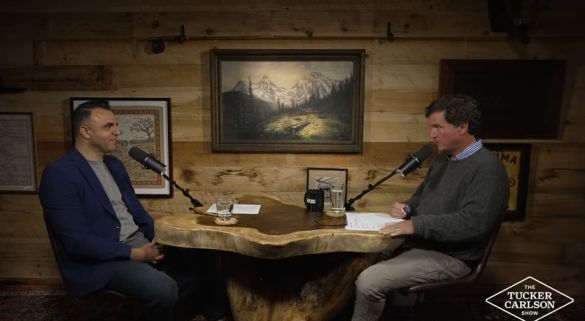
Editor’s Notes: In this interview, Tucker Carlson sits down with Fares Abraham, a Palestinian-American Christian minister, to explore the documented decline and “purging” of the indigenous Christian population in the Holy Land. Abraham shares personal and historical perspectives on the challenges facing Christians in the West Bank and Gaza, highlighting the impact of Israeli government policies and settler activity on these ancient communities. The conversation delves into the controversial role of American foreign aid and Christian Zionist organizations, arguing that a lack of awareness among the American public has allowed these issues to go unaddressed. Ultimately, this interview provides a provocative look at the intersection of faith and geopolitics, challenging mainstream narratives about religious freedom and safety in the region.
TRANSCRIPT:
The Oldest Christians in the World Are Being Erased
TUCKER CARLSON: There’s something about true things that just sound different. When you hear something that’s true, there’s a different pitch or tone or vibration. It’s kind of hard to describe. But when someone says something true, even if you don’t exactly understand what it means, it sticks with you. The truth rings differently from lies.
And recently, for a lot of different reasons, mostly because of the pressure being exerted on our society, you’re hearing a lot of lies, but you’re also hearing a lot of true things. And some of them are about the nation of Israel. And they’re obvious things like, does the United States have an actual interest in supporting Israel unequivocally? Is Israel really our closest ally? Is there a good reason for this? Why are so many members of Congress taking money from a foreign government lobby?
These are all true things. They point to the truth. They are questions that evoke true answers. And the response to this has been very, very telling. The response has been shouting and screaming accusations. It has not been engagement.
Almost nobody on the other side of the debate has said, “Sure, let me calmly explain why Israel’s our greatest ally and why we should fund the killing in Gaza. Here’s why it’s good for the United States to spend this much money on Israel’s — well, at this point, seven simultaneous wars, a seven-front war — we’re paying for it. Why is that a good idea for the United States? How is it morally justifiable? And what’s the purpose of this exactly? Is it really to defend the country or is it to expand its territory?”
No one will answer those questions. And that is why you’re simply hearing this very loud conversation about antisemitism, which all of a sudden is everywhere. It’s America’s biggest problem.
Antisemitism as a Conversation Stopper
Well, there is, of course, antisemitism, and it’s wrong. It’s always wrong to hate people for their blood. There’s no question about that. But is antisemitism really America’s biggest problem? No, it’s not. It’s not even in the top 100 biggest problems, bad as it is. You’re hearing about it as a way to shut down truthful, honest questions. And that’s, of course, the dynamic. And it’s very clear to anybody who’s paying attention.
The problem with this dynamic is that it can inspire a lot of anger and, in fact, a lot of hate. People are getting madder and madder on this topic on both sides, and you have to wonder why that is. Why doesn’t someone just stand up and say, “Let’s have a reasonable discussion about this. Let’s just lay it out there in non-emotional terms, non-hateful terms, without attacking an entire group of people — any group of people, whether it’s the Jews or the Muslims or the Christians. Let’s just slow down and be rational about this.”
Why is no one doing that? Well, it’s possible that there are some people in this conversation, maybe on both sides, who want to inspire hate. And that’s not a good idea for anyone.
Don’t Become What They Call You
For this country, for Christians, hate is forbidden. Christians are not allowed to hate people. They understand that it’s against God’s law. It’s also the fastest way to corrode your soul and turn you into a monster. And of course you don’t want that.
So how do you have a rational conversation about what’s best for your country without becoming hateful yourself or inspiring hate in other people? We’ve really thought a lot about this. Don’t become what they call you. That’s our number one imperative, at least on this show. They call you a hater. Don’t become one.
So we’re trying. And we’re doing a couple of things.
The first is we’re flying to Jerusalem to interview Mike Huckabee. Mike Huckabee is, of course, the American Ambassador to Israel, someone I’ve known for over 30 years and always liked, and also a Baptist preacher of some kind — certainly a prominent Baptist religious figure, also US Ambassador, and someone who has views that I just don’t agree with at all on questions of American foreign policy and also on questions of theology.
He’s a Christian, a famous Christian Zionist and a famous proponent of neocon foreign policy. I disagree with both. However, it seems like, of all the people you could talk to, maybe Mike Huckabee is a guy you could talk to in a reasonable way, in a calm way, without shouting or hatred.
By the way, if you want a picture of what hell itself is like, it’s shouting and hatred. It’s a large group of people screaming, calling for violence. That is literally a picture of hell, and don’t live in it if you can help it. We don’t want to.
So maybe Huckabee is the guy to begin a reasonable conversation about what’s best for the United States and what’s true about Christian theology. We’re going to try. We’re flying to Jerusalem. Difficult to do, not without risk, but we’re doing it because we really believe that the direction this conversation is moving is bad.
The Forgotten Christians of the Middle East
The second thing we’re really trying to do is to speak to Christians in the Middle East about the situation in the Middle East. And maybe not accidentally, that is the one group you almost never hear from in the United States.
There are an awful lot of particularly Protestant evangelical ministers and leaders talking about Israel — “Israel,” as they often call it — and what Christians are supposed to think about it, what they’re required to think about it, what the US Government and the US Military should do to aid Israel. And those conversations are almost always framed in terms of the West versus Islam — Israel and the United States versus the Muslims.
But there’s almost never any mention of the fact that the world’s oldest Christian community is in that area, in the Levant — in Israel, Palestine, Lebanon, and Syria. That part of the Middle East is not so far away. It’s on the Mediterranean and is, of course, the birthplace of Christianity, of Jesus himself. And there have been Christians there for 2,000 years, uninterrupted. We know that both from the historical record and from DNA tests.
So if you’re interested in Christianity, if you are a Christian, one of the first questions you ought to ask is: how are Christians in the Middle East doing?
The political lines have changed, of course. After the fall of the Ottoman Empire, at the end of the First World War, that whole area was carved up into different countries — nation states run by colonial powers, France and England — and they became Syria, Lebanon, Palestine. Then after 1948, with the creation of Israel. And then after 1967, the West Bank. It’s been carved up over thousands of years by many different empires, but that region has remained the same and its population has remained remarkably stable. And the Christian population has never left.
These are not converts. These are the original Christians. Doesn’t mean they’re right about everything, but it means if you want to know what’s actually happening, maybe you should talk to them.
A Conversation That Must Be Had
And it is to great shame that the American evangelical community, such as it is, or its leaders, have been very resistant to talking to Middle Eastern Christians or even to thinking about Middle Eastern Christians and the effect of American policy on those people.
But we think it’s really important for two reasons. One, it’s just inherent. “What about the Christians?” is a fair question for Christians to ask. In fact, they should be required to ask that question. And second, because sincere Christians are not allowed to hate — not allowed to be antisemitic, not allowed to hate all Muslims, not allowed to hate all anybody, or hate at all. It’s forbidden by their religion.
Talking to them directly is a great way to de-escalate what is, by design, becoming a tribal war. There is no reason for any conversation about American foreign policy to devolve into Jews versus everyone else, or everyone versus Jews, or any of this stuff. It’s all awful. It’s all a dead end. It will end in violence — that’s obvious — and then censorship and all the things that you don’t want in your country. So don’t go there.
And we’ve really tried not to go there. Of course, they’ve called this show antisemitic and Nazi and all this stuff, and all of their paid shills have joined in. But we still have to resist becoming what they call us. That is our job — period — as Americans and as Christians: to keep the hate out of our hearts and to stay reasonable. And talking to Middle Eastern Christians, sincere Christians, is a really important way to keep the conversation exactly where it should be.
Introducing Fares Abraham
So with that introduction, I want to introduce you to Fares Abraham, who is a Christian minister. He leads a ministry here in the United States. He is originally from a town called Beit Sahur, which is right outside Bethlehem — the birthplace of Jesus.
Beit Sahur, as you’re going to hear him explain in a minute, is the place where the shepherds saw the angels announce Jesus’s birth in the Gospels. So he is literally from that town. It is a Palestinian village in what we call the West Bank — the West Bank of the Jordan River — that was part of Jordan until 1967, but has always been there. And it is a majority, about 80%, Christian village.
And it’s disappearing. The Christians are leaving, and there’s not a lot of debate about why they’re leaving. They’re not leaving primarily because of the Muslims. They’re leaving because Jewish settlers, moved into the town by the Israeli government with funding from the United States — from a lot of Christians in the United States, by the way, not just Jews — are driving out the Christian population.
There is no rational justification for this. There’s no moral justification for it. It’s an atrocity, and it is almost never spoken about in non-polemical, honest ways.
This man came to our attention some months ago. We’ve talked to him extensively. We think he is a truly decent man who has no hate in his heart. You can judge for yourself. But no matter what side of this conversation you’re on — and particularly if you’re a Christian Zionist, and by the way, go ahead and remain one if you like — you should know that your views, and in some cases your money, are funding the displacement and the murder of the oldest Christian community in the world.
So with that, here’s Fares Abraham, originally from Beit Sahur in the West Bank. Thanks for doing this. So you are from a Christian village outside Bethlehem, birthplace of Jesus, correct?
FARES ABRAHAM: Yes, from Beit Sahur.
TUCKER CARLSON: Beit Sahur, yeah. So what is Beit Sahur?
FARES ABRAHAM: So first of all, thank you for having me here.
TUCKER CARLSON: Oh my gosh, of course.
Beit Sahur: The Shepherd’s Fields
FARES ABRAHAM: I wish I never had to do this interview, to be honest with you, but I feel compelled. I feel a sense of urgency because the little town that I come from is under existential threat.
And let me say, I come here as a Christian, first and foremost — a very proud Christian. I’m a Palestinian American Christian, and I’m very proud of this country and for what this country stands for and for the great opportunity that I was given as a Palestinian. This is my new homeland. America gave me education, work, and then later I got married. I met the woman of my dreams here. My wife comes from Gaza and we met here in the States. We started a family, we pursued the American dream. And I’m so grateful and so thankful.
But I’m here because I feel that the little town of Beit Sahur is really under imminent danger. If nothing happens, if we don’t do anything about it, there will be no more Christians living in Beit Sahur.
Today it is a Christian majority town, and it’s known for the Shepherd’s Fields. In Luke chapter two, when the angel of the Lord appeared to the shepherds who were tending to their flocks, the angel appeared to them and pronounced the greatest event that ever happened in history — which is the birth of the Messiah in the next-door town, in the little town —
TUCKER CARLSON: So it says they were right outside town, and that’s where they were.
The Shepherds’ Town and the Christian Palestinians
FARES ABRAHAM: Absolutely. So this happened in Beit Sahur. And if you go to Beit Sahur today, the shepherd field is there, the people are there. And the angel appeared also with a chorus of angelic hosts singing “Glory to God in the highest, peace on earth and great joy to all men.”
Now the significance of Beit Sahur is that God chose this little town, the town of the shepherds, to announce the birth of Jesus. God didn’t choose the spiritual elites and the religious institutions in Jerusalem, and he did not choose the powerful politicians and military in Rome, but he chose to announce the birth of a savior in a town called Beit Sahur.
And when the shepherds went to Bethlehem, they saw baby Jesus, they came back rejoicing, and they were the first evangelists that told the world about the birth of Jesus. “God with us.” It was in those fields where they were tending their flocks. They were poor, they were marginalized, they were ordinary men and women who just happened to be there. And God chose them to be there.
So Beit Sahur takes pride. And it’s not that we are privileged and better than anybody else, but that’s the essence of the Christmas story, that God gives hope to the people in the margins first. God’s grace reaches those people first. And the town of Beit Sahur takes very great pride of this heritage and this legacy.
TUCKER CARLSON: How long has it been majority Christian?
FARES ABRAHAM: It’s been always majority Christian.
TUCKER CARLSON: So for like thousands of years, since—
FARES ABRAHAM: Since the time of Jesus. The town of Beit Sahur is the early descendants of the first Christmas story. And they have maintained uninterrupted, continuous presence since the day of the announcement of the birth of Jesus.
TUCKER CARLSON: That’s amazing. How long has your family been there?
FARES ABRAHAM: Generations. We always joke around like we go back thousands of years. Unfortunately, we don’t have a family tree that could trace back to the time of Jesus. But the people have always lived there. The people have always farmed their land.
TUCKER CARLSON: So you’re not a new convert to—
FARES ABRAHAM: We’re not newcomers. We don’t come from neighboring countries. We’re not converts, we’re not newcomers, we’re not immigrants. We’re an indigenous people of the land.
TUCKER CARLSON: Christian people.
FARES ABRAHAM: Christian Palestinians have a unique story to tell.
Empire Survivors: 2,000 Years of Continuous Presence
TUCKER CARLSON: What’s interesting is that over that 2,000 year period, a lot has happened, a lot of different people have ruled that area. Of course, originally the Romans — 2,000 years ago it was the Romans. And then of course, moving up from Arabia, Islam starts, and then you have the Crusades, kind of flip it over, and then you have it flip back and it becomes the Ottomans, and that Muslims run out of Istanbul, Constantinople, Turks, and then you have the Brits and now you have the Israelis.
So during all that time, that village remained Christian, but you’re saying now under Israeli rule — because it is ruled by the Israelis. Correct?
FARES ABRAHAM: Yes.
TUCKER CARLSON: It’s in danger of becoming extinct.
FARES ABRAHAM: I call Palestinian Christians empire survivors. We have survived empires, armies came and left, rulers came and left.
TUCKER CARLSON: A lot of them.
FARES ABRAHAM: Identity changed, language changed, culture has been shaped by those empires. But the people have always remained there. The church has always been open to worship, has always maintained a gospel witness. And this is my deepest concern, that if nothing changes, if we don’t do anything about it, there will be no more Christians in the Holy Land.
TUCKER CARLSON: So they remained there from 33 AD until 1967. And then in 1967, when this area is annexed by the government, the real threat begins. That’s what you’re saying?
Land, Settlements, and the Slow Suffocation of Bethlehem
FARES ABRAHAM: Yes. Israel has pursued one strategy, Tucker, over decades, which is to take as much Palestinian land as possible and keep as few Palestinians on the land as possible. This has been their strategy. It has worked for them because they’re constantly taking Palestinian land.
We’re talking about not proper Israel, but we’re talking about 1967 when they captured the West Bank, East Jerusalem, and Gaza. They have been taking land, they have been building settlements there. And this is threatening the local population especially. It comes at a heavy price.
That has been the policy for decades and it has worked for them because it’s almost near completion now. If you look at Bethlehem, the district of Bethlehem, it is surrounded by Israeli settlements. And if you look it up, the “Bethlehem ring” — it’s actually a thing — it’s a ring of settlements encircling every town, every Palestinian village.
And they choose these specific lands strategically, on hilltops, taking water resources, building walls around these settlements, building new roadblocks, building new checkpoints, building new security measures — they call it motion sensors, electric barbed wires. And it comes at a really deep expense, at the expense of the local population.
TUCKER CARLSON: So when you grew up there—
FARES ABRAHAM: Yes, I grew up in the town of Beit Sahur.
TUCKER CARLSON: What was that like? What was your experience of the Israeli government growing up as a Christian there?
FARES ABRAHAM: Well, I lived through the first Intifada. We lived next to the YMCA in Beit Sahur — there is actually a YMCA in Beit Sahur. And down the road from us there was an Israeli bypass road only.
TUCKER CARLSON: What does that mean?
FARES ABRAHAM: It means whenever they build settlements, they build those roads that are only accessible to settlers. These roads connect the entire settlements together and they are directly connected to proper Israel, so there is ease of movement for the settlers to go.
TUCKER CARLSON: What do you mean for settlers? You mean you’re not allowed on them?
FARES ABRAHAM: No, absolutely not. Some roads in Area B of the West Bank, Palestinians are allowed on them — like between Bethlehem and Hebron or Bethlehem and Jericho. There are some very limited roads that you can share. But in many of these roads, Palestinians are not allowed.
TUCKER CARLSON: You’re not allowed?
FARES ABRAHAM: No.
TUCKER CARLSON: Like as someone who’s born there.
FARES ABRAHAM: Absolutely. But that road down the street from us — we would see settlers come and go, we would see Israeli army vehicles come and go. And one day we were playing outside—
TUCKER CARLSON: Wait, I’m sorry, this is kind of — I mean I’ve been there, but it’s hard. I didn’t fully digest this, I guess at the time. So how about right now? You’re an American, you live in the United States, you’ve been here a long time. Could you go and get on one of those roads?
The San Diego Analogy
FARES ABRAHAM: Let me explain it this way. Imagine you are in San Diego.
TUCKER CARLSON: Yeah.
FARES ABRAHAM: And then a group of people from Mexico come to San Diego and take a piece of property.
TUCKER CARLSON: Yes.
FARES ABRAHAM: And they build a fence around it. And then all of a sudden they plant a Mexican flag on that — not to say anything against Mexicans, but this is hypothetical.
TUCKER CARLSON: I get it. But it’s a country too.
FARES ABRAHAM: Yes, right. I love Mexican food too.
FARES ABRAHAM: So for the sake of this analogy, imagine they come and they build a fence around this property. And now it cuts your property in half. And sometimes it slices it up. So San Diego becomes fragmented. They set up this fence around it, they take the water resources, they build walls, sniper towers. And all of a sudden you see the Mexican army coming to protect those new settlers.
And those settlers are not friendly neighbors. They’re not coming to San Diego to be neighbors. They’re coming to take the land from San Diego.
Now if you are a mother — a Christian mother who puts her children in a Christian school — and your school is now behind those new roads that these settlers built, roads that connect San Diego to Tijuana across the border, and you want to drop off your kids at a school that is beyond those bypass-only roads — this is not theoretical for us, this is reality.
A Mother, a Checkpoint, and a Six-Year-Old
When you go to Beit Sahur, you will see the settlements encircling the little town, choking it. It’s like slow suffocation. It prevents it from its natural growth.
That story I told you about the mother is actually my cousin, who takes her children — she has twins and a six-year-old — to the American Evangelical school built in Beit Sahur. And with this new settlement they have built, they have set up a roadblock, a checkpoint where Israeli soldiers come and man those checkpoints to protect the settlers.
One day she was taking her children to school and the Israeli army pointed guns at them.
TUCKER CARLSON: Oh, come on.
FARES ABRAHAM: Instructing them to let the kids walk across the checkpoint to make it to the school on the other side. Now, this is not an isolated incident. This is not something that happens every once in a while. The army is always present to protect the settlers.
So my cousin told her six-year-old, “You’re strong. You can do this and we can walk through it. The teacher on the other side is going to receive you.” As soon as she walked, she held her head up high, she passed through the soldier — and she fainted at the feet of the school staff.
Now, this brings a lot of psychological trauma. It brings a lot of nightmares. That’s what Christian families in Beit Sahur are experiencing.
A Bullet in His Mother’s Back
FARES ABRAHAM: I remember — I told you about our home back in Beit Sahur. It’s not too far from the school. It’s not too far from the new settlement they are building in Beit Sahur. And down the road is the Israeli bypass road, which is only for settlers and Israeli armed vehicles.
In 1990, we watched settlers come and go. There was an Israeli army vehicle that stopped, and I was 10 at the time. I saw an Israeli soldier stepping out of the vehicle, pointing a rifle at us. And he started shooting at us.
TUCKER CARLSON: At you?
FARES ABRAHAM: We were a bunch of kids — my siblings, my mother was there, and some of my cousins. He started shooting live ammunition at us. And then my mother rushed us all inside. She was the last one to get in. She caught a bullet in the back.
TUCKER CARLSON: Your mother?
FARES ABRAHAM: Yes, my own mother, who loves the Lord and she loves Jesus. An exit wound. She dropped.
TUCKER CARLSON: Come on.
FARES ABRAHAM: She dropped on the floor. Pool of blood. I ran to the back door, called my dad. My uncle, who was a physician, put pressure on the wound and took her to the hospital.
TUCKER CARLSON: You saw this happen?
FARES ABRAHAM: Right in front of my eyes. My own mother.
TUCKER CARLSON: I’m sorry — I should say we’ve been talking off camera before we started this interview, and I didn’t know the story. It’s not in my interview notes. And I detected no bitterness whatsoever in anything that you said. I don’t know how—
FARES ABRAHAM: Okay, sorry.
TUCKER CARLSON: So you’re just shocking me. I didn’t expect to hear that.
The Sermon on the Mount and Forgiveness
FARES ABRAHAM: Palestinian Christians take the Sermon on the Mount very seriously. When Jesus comes and he elevates our thinking, when he elevates our outlook on life, when he takes morality to a whole new standard — when he said, “You have heard, do not kill. But I tell you, if you look at your brother and you call him ‘Raqqa'” — Aramaic word for fool or stupid — “you have just committed murder.”
TUCKER CARLSON: Exactly.
The Gospel Witness: Living Under Occupation
FARES ABRAHAM: And when he said — and remember the context — Jesus was talking to a Jewish audience who were under ruthless Roman occupation. Yes, they were persecuted. They were discriminated against. It was very brutal to live under the Roman occupation. But Jesus is telling his followers, “Love your enemies. Pray for those who persecute you.” This is something that we have grown up understanding — the very essence and the meaning of this Sermon on the Mount.
TUCKER CARLSON: Wow. I’m sorry. I’ve totally derailed your story because I’m just shocked. I really didn’t know that was coming. So you’re 10 years old. You watch your mother get shot. Shot by — okay, so many questions. Why did he do this? Do you know?
FARES ABRAHAM: This has been just random. They do this not just to Palestinian Christians. I mean, that has been a policy. They do it to the Muslims. They do it to any Palestinians.
TUCKER CARLSON: Did she survive?
FARES ABRAHAM: She did. Miraculous. The bullet was just millimeters away from the spine.
TUCKER CARLSON: It was an American rifle, I assume.
FARES ABRAHAM: Who knows? Of course, we don’t know the soldier.
TUCKER CARLSON: Okay, so that’s my next question. So some soldier — your mother wasn’t throwing rocks at him or screaming for jihad or anything?
FARES ABRAHAM: We were just playing in front of the house. We were just kids playing.
TUCKER CARLSON: How can you live in this country and listen to people who have no idea what they’re talking about?
The Threat of Settler Violence
FARES ABRAHAM: So this is the real threat of the new settlements. It’s not just taking Christian land. It’s not acquiring and taking by force the resources of the land — of Christian lands who lived there for generations. It’s inviting violent settlers to your neighborhood. They’re coming to take the land. They’re coming to squeeze, they’re coming to crush. They’re coming to —
TUCKER CARLSON: Why are they mad at you? What did you do?
FARES ABRAHAM: Being born in the —
TUCKER CARLSON: I don’t understand the hate, and I certainly have been the target of it, but I don’t understand. I mean, I understand why people don’t like me — I’m doing interviews like this — but I don’t understand why. Why would someone shoot a mother in front of her children? Like, I just don’t get that. What is that?
FARES ABRAHAM: You interviewed Bishop Hossam, and he mentioned the story — the recent story just last month.
TUCKER CARLSON: Yes.
FARES ABRAHAM: The attack on a Christian widow. She’s a Christian widow. A violent settler came to her property, grazing in the land with his cattle, and then he hits her with a stone on her head, fractures her skull — she almost lost her life. And when her son tried to defend her, the son gets arrested by the Israeli military.
Then when a bunch of settlers showed up at the house, in the presence and full complicity of the Israeli army, they knocked down the door. Her daughter was inside. Nariman and I talked to her. She drew the sign of her cross. And when they found out that she was Christian, you know what the settler told her?
TUCKER CARLSON: What?
FARES ABRAHAM: He told her, “What are you doing here? This is not your land. You don’t belong here. Go to France or go somewhere else. You don’t belong here. God gave us this land.”
Now this settler violence has been on the rise. The town of Taybeh — where they burned a centuries-old church, burned the crops, vandalized properties, wrote graffiti, spitting on clergy and pastors and leaders. All of these atrocities are done in broad daylight. They’re done without accountability. And no one is being held responsible for these atrocities.
A Deeper Understanding of Christianity
TUCKER CARLSON: I was talking to my wife — I was on the road for a few weeks — and I was talking to her at breakfast this morning about that interview with the Anglican archbishop that we did on the banks of the Jordan River. We’re Anglicans, we grew up in it. And the Anglican Church in the United States is not very Christian anymore.
And I was telling her that, off camera, I said to him, “People spit on you.” And my first thought was, “Why don’t you shoot them? Don’t allow someone to spit.” I didn’t say that, but that was my thought. Shows what a bad person I am. And he said, “Every time someone spits at me, I feel blessed. They spit at Jesus.”
And I was telling my wife, I think Christians who live in that kind of environment understand Christianity in a much deeper way than we do here. To hear you say that you don’t feel bitterness — your mother didn’t feel bitterness after being shot in front of her children for no reason.
FARES ABRAHAM: And this is what the Gospel does. It transforms the heart.
TUCKER CARLSON: Yes, I totally agree.
FARES ABRAHAM: Yes, I want to seek justice, but in the meantime, I don’t want to allow hatred to poison my soul.
TUCKER CARLSON: Okay, please, everyone watching this — rewind. Watch that again. Can you say that again? I love that.
FARES ABRAHAM: I don’t want to allow the atrocities and the sins that have been committed against Christians to allow bitterness to grow in our hearts. Jesus provided a better way. Jesus gave us the example of forgiving and loving our enemies. Jesus forgave the people who even crucified him. And that’s the model.
That’s why Christians in the Holy Land are the salt of the earth — the light in the midst of that darkness. And if we don’t preserve that gospel witness — this is the reason I decided to do this interview with you, Tucker.
TUCKER CARLSON: And I said a prayer this morning that God would speak through you. And he is.
FARES ABRAHAM: It’s the gospel witness. We want to keep the message of Christ alive in the lands of its birth. We want to share the good news of the gospel with every person who is traumatized, with every person who is suffering, with every child in Gaza who has lost everything. The only hope is to tell them that God loves them.
TUCKER CARLSON: That’s right.
FARES ABRAHAM: The only hope is to break that cycle of violence between the Israelis and the Palestinians. Law will restrain your physical being, but God sets your spirit free. He sets your soul free.
TUCKER CARLSON: You’re making me emotional. No, that’s totally right.
A Culture of Impunity
FARES ABRAHAM: He redeems us. And these are the basic values that are lived on a daily basis by Christian Palestinians.
Let me tell you about my friend Salam. Salam was the only child to his family, who lived right down the street from me, closer to this Israeli bypass road. And on February 18, 1991, a hateful Israeli settler parked his vehicle next to Salam’s house and shot him in the head inside his house — through a window — while having dinner with his family.
A new settlement coming to town is going to pose a real existential threat to everyone living there. And the Christian witness will be diminished.
TUCKER CARLSON: So this is a part that’s hard to understand as an American. Let’s just start a few minutes previous in the conversation. An IDF soldier shoots your mother for no reason. Who is that soldier? Was there a trial? Did you ever hear what happened to him? I mean, these sound like dumb questions, but I’m an American. Was he punished? What happened next?
FARES ABRAHAM: We have no idea.
TUCKER CARLSON: So nobody from the occupation authority — from the supposedly humane Western Israeli government — ever went to your house and said they’d questioned this guy, or even followed up at all?
FARES ABRAHAM: Absolutely not. You see, this is the issue.
TUCKER CARLSON: They just shot your mother like an animal. And then never —
FARES ABRAHAM: The core issue here is that there’s a culture of impunity. A lot of these acts go unchecked. It’s a culture — and that comes from systemic policy. It’s not isolated incidents.
And just to give you numbers — the Rossing Center in Jerusalem is an Israeli human rights organization. So in case people discredit the Palestinian testimony of Palestinian Christians — we often get discredited.
TUCKER CARLSON: Oh, I’ve noticed, yes.
FARES ABRAHAM: And it breaks our heart when even our brothers and sisters in Christ do that.
TUCKER CARLSON: Well, I want to ask you about that because that’s where I have trouble controlling —
FARES ABRAHAM: But I’m going to come back to the Rossing Center. They documented 111 attacks on Christians in 2024 alone. 111.
You go to any Israeli human rights organization such as B’Tselem — they document every single incident. And you will find a pattern that these attacks are not random. They don’t happen out of the blue. They’re systematic. Israel has created a pervasive system — we call it a structural pressure — that they keep applying on the Christian population to push them out of their land.
When I speak to Palestinian Christians in Beit Sahour, what they fear the most — they saw what’s happening in Gaza. They have relatives in Gaza, and they fear that they are next. It’s a real danger that is pointed at the Beit Sahour community right now, and this new settlement is not the only one. Beit Sahour is surrounded by settlements. And we have a long history of these settlers coming and taking Palestinian lands and building those lavish settlements.
TUCKER CARLSON: Very ugly.
FARES ABRAHAM: They fill up their swimming pools, they put in their green grass, while Palestinian Christians wait two or three weeks for a water truck to fill up their tanks on top of the roof — giant black plastic tanks — because we’re not allowed to even have running water.
TUCKER CARLSON: I’ve seen them. Can I ask — just because I don’t want anything to fall through the cracks here — your friend who was murdered while having dinner by a settler. What happened to that settler?
FARES ABRAHAM: Salam Misla. We don’t know who the settler was. He just stopped his vehicle, shot at him, and left. And Salam is not the only one.
TUCKER CARLSON: May I ask — was there no investigation? No one was arrested for it?
FARES ABRAHAM: Absolutely not. Salam is not the only one. There was another man named Edmon Ghanem. Back in those days, this policy used to be in much bigger full force. They called it “home mapping.” I don’t know if you’re familiar with home mapping.
TUCKER CARLSON: I’m American. I don’t know anything. I’ve been lied to about this for some time.
FARES ABRAHAM: So thank God for organizations like Breaking the Silence, which is a group of former IDF soldiers sharing their stories and experiences in the West Bank. Home mapping is when the Israeli army decides to go into a Palestinian home for the purpose — quote, unquote — of “collecting intelligence.” What they usually do is lock up the whole family in a room for a day or two, sometimes for weeks, and take over the house. This is usually done to give new soldiers practice and training. It’s called home mapping.
So when I was growing up — and these are stories from my childhood — Edmon was walking down the street when an Israeli soldier, standing on top of a Palestinian house roof, dropped a stone on Edmon and killed him instantly.
TUCKER CARLSON: Why?
The Plight of Palestinian Christians
FARES ABRAHAM: A Christian young man for no reason, Anton Shomeli, he was caught by an Israeli. He ran away from the Israeli army. For some reason, he got scared. They caught him and they shot him at close proximity in cold blood.
And I can give you story after story. Those are not terrorists. Those are not people who seek violence. Those are people who want to simply stay in their land, work, live, have a future, live in peace.
And let me tell you, highlighting the violence of the settlers does not mean we ignore the violence committed by some Palestinians. As Christians, we recognize there are some Palestinians who carry out attacks and inflict terror on innocent Israelis as well. And we’re not going to bury our heads in the sand and say it doesn’t happen — stabbing, ramming into some Israeli citizens.
As Christian Palestinian Americans, we condemn any attacks on any civilians. We condemn any form of violence to achieve justice. This is the very core of the Christian message. We reject violence altogether. Palestinian Christians have always extended the hands of making peace with our Jewish neighbors, with our Muslim neighbors, with everyone. We just want to live in peace. So we condemn violence at all levels.
But there is a difference between when a Palestinian commits violence versus when a settler commits violence. When a Palestinian commits violence — wrong, to be condemned, not to be condoned — to kill innocent civilians, usually he or she is shot on the spot. And if they make it out alive, they get detained and thrown in prison. And right now the Israeli government is really pushing hard to pass a law to legalize the death penalty in Israel for Palestinians.
But anyway, he gets thrown in prison, his house, his family’s house gets demolished, and his family gets a security block not to travel anywhere outside town — collectively punishing the parents for the crime that their son or daughter committed.
So when a Palestinian commits a crime, this happens. But when a settler commits a crime, there is an Israeli army that backs it up. There is a system that gives it impunity. And this is the grave injustice. As a Christian minister, this is why I come to your show and say this should not be done — especially when Christians are supporting this without knowing the facts and the reality on the ground.
TUCKER CARLSON: Some of them do know the facts and reality on the ground. I don’t think that applies to your average evangelical Christian Zionist in the United States — I don’t think they have any idea. But some of their leaders know perfectly well what’s happening, because I know them and I know that they know.
FARES ABRAHAM: They know the Christians by name, and they have their data, and they know where they live.
American Christian Complicity
TUCKER CARLSON: I have way too many questions for you, but thankfully we have time. This seems like a good time to try to understand what’s going on there. And I’ve already admitted that’s where my anger lies — toward people like me, Christians in America, who are making excuses for this, or abetting it, making it possible. What is that? Why is that happening?
FARES ABRAHAM: October 7th was horrific. Yes, I agree it was horrible what Hamas has done — killing innocent civilians, kidnapping babies.
TUCKER CARLSON: I totally agree.
FARES ABRAHAM: This is wrong. This needs to be condemned. And Palestinian Christians have been consistent in condemning violence to achieve justice, as I said. But the overwhelming suffering lies in Gaza right now. The disproportionate response.
I was in South Africa on October 7th. I was getting ready to speak at a Christian conference before 5,000 people in Cape Town. And before I got up there, my phone started going off with all kinds of notifications. I learned about October 7th immediately. That night I went to my hotel room and I recorded a video. I said, “I condemn this horror. This is not the way. We condemn this act of violence.”
But in the meantime, I leaned over to my friend, my pastor friend, and I said, “I am shaking because of the level of retaliation that the Israeli military is going to respond with.”
TUCKER CARLSON: Well, you grew up with that.
FARES ABRAHAM: My wife grew up in Gaza Baptist Church. Not too many people know that Baptists have made it all the way to Gaza. And Gaza Baptist Church was bombed.
TUCKER CARLSON: Gaza Baptist Church was bombed?
FARES ABRAHAM: Yes. Now imagine if First Baptist Church of Dallas or of Little Rock were bombed. I believe the whole United States Army, Marines, military, and Air Force would be going after the perpetrators.
TUCKER CARLSON: Maybe not, but yeah — no, it would be obvious that that is a crime. I just don’t understand. And I’ve raised this question many, many times with Christian leaders in the United States. Like, what did the Baptists in Gaza do wrong? Why are we paying to bomb their church?
Christians Killed in Gaza
FARES ABRAHAM: It’s not just the Baptists. It’s all the Palestinian people being collectively punished in Gaza. And what happened in Gaza is a horrific atrocity that no one should — if it doesn’t shake us at our core, I don’t think we have any humanity.
TUCKER CARLSON: Well, we’re Americans, so we have no idea what’s happened in Gaza. So why don’t you tell us?
FARES ABRAHAM: In October, there was a bomb that killed 17 Christians. A historic fifth-century church was bombed in Gaza and killed so many Christians.
There is a lady who played the piano at Gaza Baptist Church. Her name was Ilham Farah. She was an icon, a music icon in Gaza. Everybody loved her. She was 84. She went to her house to check if it was still standing. She was sniped — shot in the leg by an Israeli soldier — and left to bleed to death for three agonizing days. She was on the phone until her phone died, with one of my closest friends. And a few weeks later, when they went to bury her, they found out that an Israeli tank had rolled over her body.
Ilham Farah. She played the piano. She was part of the worship team at Gaza Baptist Church. That was in November 2023. So we know it was a vengeance campaign, it was a retaliation.
TUCKER CARLSON: But why vengeance against an 84-year-old Christian piano player? What does she have to do with it?
FARES ABRAHAM: Nahida and Samar Anton — another two ladies, a woman in her 80s and her daughter — were gunned down by an Israeli sniper on church grounds at Holy Family Church, which was also later bombed, and three people were killed.
Those are real stories. Those are real people who have suffered because of this military power that is directed at them day and night. And the whole idea is really, honestly, getting rid of Palestinians — pushing them out. It doesn’t matter whether they’re Christians or Muslims. That has been the strategy. And now they’re taking a different approach in the West Bank by suffocating the communities, by creating as many Israeli settlements as possible so they can squeeze the communities out. They push them out of their land.
Settlers and the System Behind Them
TUCKER CARLSON: When you were a child, there were Israeli settlements near your home.
FARES ABRAHAM: Yes.
TUCKER CARLSON: Did you ever have positive interactions with the settlers?
FARES ABRAHAM: To be honest with you, some settlers have no idea — they just moved in there. And again, we can’t paint with a broad brush and say all these people are evil. But there is a system that is enabling this evil to take place.
TUCKER CARLSON: Some settlers, it’s just cheaper, right, to live out there.
FARES ABRAHAM: They get subsidized — they get government subsidies to move into the West Bank, and they call it Judea and Samaria.
And unfortunately, going back to your question, there is an organization — not just one, but there’s one I know of — and they boast about it on their website that they have raised and spent $3.5 billion to support these settlements and to bring people from all over the world to return to their “ancestral homeland of Judea and Samaria.” And they raised that $3.5 billion from evangelical Christians, from Christians in the United States.
Now, if you’re an American who goes to church, loves Jesus, loves Scripture — just like we do, we worship every Sunday, you’re involved in ministry, you’re volunteering at your local church — and you hear the vision from your pastors: “The Jewish people went through the severe and horrific Holocaust during World War II, and now we have the opportunity to bring some of these survivors back to Israel, to their homeland.” If you’re an American hearing this, you think, “Wow, this sounds really great. This sounds very noble.”
And I agree — as a Palestinian, I want the Jewish people to live in safety and dignity.
TUCKER CARLSON: Of course.
FARES ABRAHAM: But it doesn’t have to come at the expense of the local Christian Palestinians and the local Palestinian indigenous people who have lived in that land for the past 2,000 years.
What they tell you is that this is a great vision. When Christians hear about Zionism, it’s a compelling vision — bringing people who don’t have any land and creating a homeland.
TUCKER CARLSON: “A land without people, for a people without land.”
FARES ABRAHAM: Yes. But the land had people.
TUCKER CARLSON: I know.
FARES ABRAHAM: So what you do to create room is you keep pushing them out.
The Politics of Naming: “Judea and Samaria”
TUCKER CARLSON: Can I ask about what you referred to — Judea and Samaria? I know that under Ron DeSantis in the state of Florida, it’s now required by law to call it Judea and Samaria. What we call the West Bank — which was part of Jordan, formerly Trans-Jordan — it’s right outside Jerusalem all the way to the Jordan River, the west bank of the Jordan River. That area was taken from Jordan in the Six-Day War in 1967. And so my whole life we’ve called it the West Bank. And now we’re required to call it Judea and Samaria.
I guess I don’t really care what it’s called. But I wonder why some American politician is telling me what I have to call a place across the ocean — because he’s taking a lot of money from proponents of this, of course. But why are they so intent on forcing me to call it Judea and Samaria? I honestly don’t understand.
FARES ABRAHAM: It’s not just Florida. I mean, I love Florida.
TUCKER CARLSON: I do, too.
FARES ABRAHAM: It’s a great Sunshine State. I moved here in 2020 because I heard that Governor DeSantis banned Covid here.
TUCKER CARLSON: Amen.
FARES ABRAHAM: So we moved here because we love Florida and we still enjoy it. But they passed the law to call it —
TUCKER CARLSON: But why is some American telling me what to call it?
FARES ABRAHAM: It’s many different states seeking to change the name. And for us — I’m a Christian, yes, it’s the biblical name. That’s what Judea and Samaria was called when Jesus was there. But instead of worrying about calling a region a biblical name, why can’t we apply biblical principles?
TUCKER CARLSON: No, but I’m just saying — what’s the point? The Israelis are telling our lawmakers, “You must force your people to use these words.” And they’re doing that across our society. And they say they’re doing it, so they’re doing it. But why? Why does it matter to them?
The West Bank: Legal, Moral, and Biblical Perspectives
FARES ABRAHAM: They want to invoke divine rights. They want to make the connection that this land divinely and theologically belongs to one group of people.
Now, if you look at the West Bank, let’s break it down. There is a legal implication, but there’s also a moral and theological implication. The legal implication — the US politicians hate it. They don’t like to get into the legal complexity of the West Bank because it’s a losing case.
The whole world agrees that the Israeli settlements are illegally built by an occupying force on Palestinian land. The land is occupied according to the United Nations, the 4th Geneva Convention, United Nations resolutions, the Security Council — and even this has been the longstanding US policy for the past 50 years.
I don’t know if you remember the Hansell Memo, which stipulates that this land is occupied and the settlements are illegal. Now, from different administrations, the language is different. Some administrations, like Obama’s, call it an “obstacle to peace.” Some administrations call them “illegitimate settlements” that are preventing and hindering the two-state solution.
But interestingly, in Trump’s first administration, when Mike Pompeo was the Secretary of State, he rescinded the Hansell Memo and said those Israeli settlements are “not per se inconsistent with international law” — whatever that means. But basically, these are not illegal. They have a legal right to Judea and Samaria.
For me — I’m not a politician, I’m not a legal expert. I’m a Christian minister. I look at the issue from a biblical perspective, from a moral perspective. What are the biblical implications of this? Does God really approve displacement, stealing of land, theft?
And there’s a biblical story actually about this, Tucker. You know, when the evil king of Israel, Ahab — he had an evil wife named Jezebel — they looked over and they saw a vineyard owned by Naboth, and they loved that vineyard. They said, “We want to take it.” And being the king of Israel, they could have invoked divine rights. He’s the king, appointed and ordained by God. But unfortunately, he was a dishonorable king. He did not obey the ways of the Lord.
So I don’t know how much divine right he can claim. But let’s say, for the sake of argument, they claimed divine rights. They went and tried to acquire the vineyard legally. They offered Naboth money. Naboth refused to sell. So what do they do? They conspire, they kill Naboth, they steal the land and take it. It’s the state, backed by divine rights, stealing an innocent man’s land.
TUCKER CARLSON: May I ask — did God notice that they did this?
FARES ABRAHAM: Of course he did.
TUCKER CARLSON: Oh, he did.
FARES ABRAHAM: He sent the prophet Elijah to stand before Ahab and say, “What you did was wrong. God is going to judge you for it.” Now I wonder, as a Palestinian Christian —
TUCKER CARLSON: And then what happened?
FARES ABRAHAM: Where are the Elijahs of our world? Where is the church standing up to this injustice?
TUCKER CARLSON: They’re cowards, and they’re making the wrong choice. They’re going to have to answer for this.
The Church’s Responsibility and Christian Zionism’s Influence
FARES ABRAHAM: And let me be very honest with you, Tucker. We can’t paint with a wide brush. There have been so many great American missionaries who have come to the Middle East, who have labored in the Middle East. A lot of great churches have given sweat and blood for the Middle East. They built great schools — we have one in Beit Sahour, the Evangelical Church of Beit Sahour. They have built hospitals, they have built schools, they have planted churches.
But there is a stream of Christians that has disproportionate power and influence on US policy. And it’s that policy that is inflicting pain and suffering on a community like Beit Sahour. This is the core issue.
TUCKER CARLSON: I know.
FARES ABRAHAM: And they’re doing it in the name of the Bible — where the Bible is innocent.
TUCKER CARLSON: I got a lecture this morning from an Israeli. This morning. I’m not an anti-Semite. I abhor antisemitism. It’s against my religion. I’ve said that a thousand times, and I mean it. If I was an anti-Semite, I’d just say I’m an anti-Semite. I am not an anti-Semite, and I’m never going to become one, no matter what they say.
So I’m talking — what do you want me to do to prove I’m not an anti-Semite? “100% recant your attacks on Christian Zionism.” It wasn’t, “Stop saying mean things about the Jews.” I’ve never said any mean things about the Jews. I don’t feel bad things about them. I’m not mad at the Jews, period.
I’m mad — as I’ve said many times — about my people, Christians, distorting the gospel in a way that allows theft and murder and the degradation of human beings. I’m never going to be okay with that. And that’s what they’re mad at me about — because I’ve called out Christian Zionism.
They see that as critical. I just had this conversation an hour ago, so it’s fresh in my mind. They see it as critical that you have American evangelical pastors telling their congregations — who are sweet people who don’t know any better — that God wants you to support the State of Israel, Benjamin Netanyahu. That’s what they need.
FARES ABRAHAM: Yes.
TUCKER CARLSON: Is that fair?
FARES ABRAHAM: Do you think what Christian Zionists get wrong here is — not because they want to create a safe place for the Jewish people, that could be an honorable cause —
TUCKER CARLSON: Yes, I agree.
FARES ABRAHAM: But the process, the implication of what that means to them. Christian Zionism means creating a safe place for the Jews where they can feel safe and secure — which is honorable. Great.
TUCKER CARLSON: Got it.
FARES ABRAHAM: But for Palestinians, Christian Zionism means taking our land, taking our resources, while declaring that you have a divine right. And the descendants of the shepherds in the little town of Beit Sahour — who have maintained their Christian presence for the past 2,000 years — do not somehow have that same divine right.
Our ancestors were Jewish, Palestinian Christians. They first accepted the message of Christ, and that church is still intact today. As I said, some people converted when Islam came to Palestine. Some people converted — but they did not convert from atheism. Muslims converted from Christianity, and probably some Jews even converted to Islam. So you might have some Muslims who can claim they have Jewish DNA. But again, identity changes, it’s dynamic. Language changes. But the people are there.
What Is Christian Zionism?
TUCKER CARLSON: So I think now’s a good time to ask you to explain what Christian Zionism is. I’m at a disadvantage because I’m so ignorant — I just didn’t grow up around this at all. So, as fairly as you can, can you explain what Christian Zionism is? And I should say — you came to the United States and went to Liberty University, correct?
FARES ABRAHAM: Yes.
TUCKER CARLSON: Lots of great people there, lots of Christian Zionists there. So I think you understand it well. What is it?
FARES ABRAHAM: I loved my time at Liberty University. I’m so thankful for the great education I got there. I got to meet a lot of great friends, great professors. My life was changed there. I actually rededicated my life and committed myself to service at Liberty University. And I received the vision to start Levant Ministries at Liberty — which is the organization I now lead.
But here is where Christian Zionism has a different understanding. It’s a theopolitical movement that says God has two distinct peoples, with two distinct plans and two distinct covenants.
When Mike Huckabee was asked — he was on an interview at TBN, Trinity Broadcasting Network — he was asked, “What is the verse that guides your day-to-day job as US Ambassador in Israel?” You know what he said? He said Genesis 12:3. “I want to be able to bless Israel so I can be blessed. I want to secure all the blessings for Israel so the United States can receive the blessings in return.” So for us, we have to look at this theology.
TUCKER CARLSON: Do you know what that means to me — as someone who’s interested in words, a former editor, a book writer — I care about definitions. So when Christian Zionists say “Israel,” what are they talking about?
The Theology of the Abrahamic Promise
FARES ABRAHAM: That’s a great question. Because as Christians, we have to look at Scripture through the lens of Christ. Christ is the point. Christ is the fulfillment.
The way I look at Scripture — I look at the Old Testament, the faithful and righteous people of the Old Testament, and the righteous and faithful people of the New Testament as one faith community. They’re beautifully connected through the cross.
The moment you start separating this, this is when you start getting into different interpretations of what “Israel” means today. Is the government of Israel God’s people, or not?
But when we look at the Gospel, we see Jesus as the very center. We look at the Old Testament through the lens of the Gospel, and we see Jesus in the Old Testament. And what Jesus did is very critical. It’s important for us to understand what Jesus did in the new covenant he brought, and how it changed and transformed the old covenant that God had with Abraham. It didn’t abolish it. It didn’t replace it — which is, you know, we’re not replacement theology. I do not agree with replacement theology.
God is not done with the Jews. God is not done with anybody. God wants everybody to come to the saving knowledge and to enjoy his grace and to enjoy his blessings. God desires this — “For God so loved the world,” right?
But what Jesus did — he did not replace the Jews. It was a journey that God started with Abraham. And when they cite Genesis 12:3, that was a private conversation between God and Abraham. And God came to Abraham and told him, “You no longer shall be called Abram, but you’re going to be called Abraham — the father of all nations.” So God’s original plan is to redeem all nations, to bless the whole world through the seed of Abraham.
And when you look at the New Testament, you read a verse like Galatians 3:16, where it says Abraham has one seed — he didn’t say “seeds.” And through that seed, you get to enjoy all the Abrahamic blessings. And that seed, of course, is Christ.
That journey that Abraham started with God is still in motion today. It didn’t divert, it didn’t get replaced. There was always one plan for God’s redemption and salvation. It started in Abraham and it culminated in Jesus. And we are the extension of that Abrahamic blessing. So if I put my faith and trust in Jesus Christ, I get to claim the Abrahamic blessings of Genesis 12:3.
TUCKER CARLSON: Well, it seems that way. But I mean — I have so many questions. First of all, how could Christians ever support any movement that rejects Jesus? I just don’t understand that. How could we — we could say we feel so sorry for people who reject Jesus, we want to help them.
FARES ABRAHAM: In simple terms, I think Christian Zionism has replaced Jesus with the current State of Israel.
TUCKER CARLSON: Obviously. That’s why I think it’s heresy. And I don’t mean that in a — I mean, I shouldn’t be calling anyone else a heretic. I’ve lived such a bad life. And I’m not — I hope I don’t sound self-righteous. I just don’t understand. I thought Christianity was about following Jesus, and Jesus was the key. Is it not? You’re the minister.
FARES ABRAHAM: What Jesus did — he did two important things that we cannot overlook. He expanded the scope of the promise.
TUCKER CARLSON: Of Abraham — to everybody.
FARES ABRAHAM: To everybody. And he expanded the meaning of the promise. Let me unpack this a little bit for the viewers to really understand the theological importance and significance of this.
When he expanded the scope of the promise — what is the promise? He expanded it from a mere geographical location alongside the Mediterranean coastline to include the whole earth. Yes, the New Testament spells it out. The Apostle Paul, in his letter to the Romans — Romans 4:13 — he said, “By faith, God made Abraham the heir of the whole world.”
TUCKER CARLSON: Exactly. I’ve read it.
FARES ABRAHAM: “For God so loved the world that he gave his only Son, that whosoever” — right? So not only did he expand the geographical location of the land, he also expanded the ethnic line of the people to include every tribe, every nation, every tongue.
TUCKER CARLSON: It says that again and again and again. And that’s the whole story — that’s the story of Acts, that’s the story of Revelation, it’s the story of the whole New Testament.
The Kingdom of God and the Land Promise
FARES ABRAHAM: And that’s what Jesus instructed his disciples to do. He said, leave your nationalistic aspirations aside. We have a kingdom to build. The kingdom of God is at hand. The kingdom of God is among you. So they let go of their dreams to build the kingdom for Israel. And they went and they paid with their lives for the kingdom, the eternal kingdom of God.
So Jesus expanded the geography. He is the locus of the land. He is the one that speaks in Hebrew that, if we enter in Jesus, we find rest. The land does not give us rest anymore. So he expanded the geography, he expanded the ethnic line to include every nation, every tribe.
And that has always, by the way, Tucker, been God’s plan. In Psalm, the Old Testament, chapter 2, verse 8, it says, “Ask me and I will give you the nations as your inheritance.” So God’s plan has always been the whole world — redeeming the whole world, restoring the whole world. And it has always been inclusive for all people, all ethnicities.
TUCKER CARLSON: It’s so clear. And it’s clear in Jesus’s ministry. We’re spending the year just reading the four Gospels again and again. And that jumps out at me. I mean, who does Jesus praise most? The Roman officer. “I have not seen anyone with faith like this in Israel.” This is some pagan guy.
FARES ABRAHAM: Yes, right. But the meaning of the promise — and this is important — what does it mean? Do we inherit a holy land between the river and the Mediterranean, or does it mean something else? The meaning of that promise has also been transformed. It’s not just the scope of the promise, it’s the meaning of the promise. From temporary to eternal, from physical to spiritual, from conditional.
Because it was conditional, by the way. He didn’t just give them the land and say, “This is your land.” It’s God’s land. He is the landlord. And the people that were given the land, they were tenants and they had to obey the commandments of the Lord. They had to love their neighbors, they had to take care of the foreigners among them. And when they didn’t obey the covenant that was given to them, God always kicked them out.
TUCKER CARLSON: Oh, yeah, they were taken to Babylon. Yeah.
FARES ABRAHAM: Yes, twice. And the Old Testament gives graphic language when it describes Israel not obeying the laws of the Lord. It says, “The land will vomit you out.” Excuse my language. So it was conditional when it was given to Abraham. But in Jesus, it’s secure, it’s eternal.
And what really makes me fall in love with Jesus — the patriarchs, the church fathers, and the church throughout history, and the Palestinian church — they truly understand the meaning of the covenant. Abraham, Isaac and Jacob. It spells it out in Hebrews that they were eagerly looking for the new Jerusalem, whose architect and builder is God. They were not fixated on a mere strip of land that is temporary. We should be focused on what’s eternal.
And obviously, when Jesus came, in John 18, when he was being tried before Pilate, the charge was, “Are you a king? Are you a threat to my kingdom and my dominion?” Jesus said, “Yes, I am a king, but my kingdom is not from this world. My kingdom is not from here.” Why are we bringing back a pre-Christian territorial mindset to the church today?
Collective Punishment and Western Values
TUCKER CARLSON: Well, exactly. And it is pre-Christian. It’s not Western at all. It’s Eastern. And collective punishment is the sign that we’re not dealing with a Western mindset at all, because we reject collective punishment. I may be mad at you. I can’t kill your kids. Not allowed.
FARES ABRAHAM: Yes. And there are some sincere dispensationalists — let me say this — I have some dispensational friends. And Christians should debate this vigorously, but it should stay in the seminary. It should stay within the walls of the church.
TUCKER CARLSON: Well, that’s the problem. I haven’t even gotten involved in it because I’m just too ignorant. When you said “replacement theology,” I don’t know what that is, and I’m not going to learn. All I know is that Christianity — my read of it — is just focus on Jesus and you will be transformed. So I kind of stick with that.
But as a political matter, and that’s what I do, cover and have my whole life, I don’t understand what Ambassador Huckabee, for example, is saying when he says, “Bless Israel.” What is Israel? My read of Genesis is it goes from a tributary of the Euphrates in Iraq all the way to the Nile. So that’s like six countries. What are the boundaries?
FARES ABRAHAM: And that’s still too small for God.
TUCKER CARLSON: Of course, as a theological matter. But if we’re speaking in political terms, this is a government run by secular people, by and large, and they’re saying God gave us this land. What land? What are the boundaries? So we should at least define the terms. Second, who’s “we”? Who are the people who inherited this? The prime minister of Israel is not religious. He doesn’t keep the Sabbath or keep kosher. I’m not attacking him. I’m just saying, then what are you talking about? Are you saying you have a genetic inheritance?
FARES ABRAHAM: What about someone who converts to Judaism and claims divine right from Brooklyn, New York?
TUCKER CARLSON: I don’t even want to have these conversations — they’re the ones pushing them. I’m happy to let people practice their own religions. I don’t want to get involved. I don’t want to know everything about Mormonism or Islam or whatever, it’s fine. But as long as you’re saying you have a right to my money and your parents’ land on the basis of this promise in Genesis, I have a right to ask you what the heck you’re talking about.
Israel’s Treatment of Messianic Believers
FARES ABRAHAM: Did you know that Israel goes out of its way to prevent Messianic believers from making aliyah?
TUCKER CARLSON: No.
FARES ABRAHAM: Jewish believers in Jesus. If they find out that you believed in Jesus, they don’t give you the right to immigrate to Israel.
TUCKER CARLSON: What?
FARES ABRAHAM: So whose land?
TUCKER CARLSON: Is that true?
FARES ABRAHAM: Whose promise? Yeah. I have a lot of Jewish friends who are believers in Jesus, and they share with me that they can’t move back to Israel and get all the rights of return.
TUCKER CARLSON: So now that we’re talking about present-day concrete political realities, there are two claims that they could potentially be making. One is faith-based — I believe in this religion called Judaism, and we could debate what that religion is, whether it’s Talmudic or rabbinic, whatever. That’s a whole separate conversation. But it’s either faith-based or it’s blood-based, it’s genetic.
FARES ABRAHAM: They also have historical claims — that Jews have been here and we haven’t.
TUCKER CARLSON: But who are the Jews then? Do you have more DNA? I don’t know if you even know the answer, but if we were to say, who lived in first-century Palestine, current-day Israel — are you more closely related to those people, or is Benjamin Netanyahu more closely related to those people?
FARES ABRAHAM: They should do DNA tests and see. I did my DNA test. Palestinian Christians are Levantine in origin.
TUCKER CARLSON: So it’s likely that you have more Jewish ancestors than Benjamin Netanyahu, whose family is from Europe probably. So then it can’t be genetic, because —
FARES ABRAHAM: Well, again, as Christians, we have to put the gospel lens on it.
TUCKER CARLSON: Well, I agree.
The Nazareth Manifesto and the Inclusive Gospel
FARES ABRAHAM: Ignore what Jesus did — and this is the significance. When Jesus went into Nazareth, his hometown synagogue on a Saturday, he had been baptized, gone into the wilderness, been tried by the devil, and overcame with scripture. And then he went to his hometown. The scroll from Isaiah was handed to him and he read what I call the Nazareth Manifesto — the first sermon he ever preached.
Jesus launched his ministry in Nazareth, and it’s so beautiful. He said, “The Spirit of the Lord is upon me. He has sent me to set the captive free, to bring sight to the blind, to proclaim the good news to the poor.” Everybody in the synagogue was so happy.
And remember the context. There was a lot of tension between the Jews and the Romans. The Jews were waiting for the Messiah, but they were waiting for a military liberator. They were waiting for a politician to come and lead them against the Romans. But then Jesus gave two sermon illustrations. One about a widow from Sidon, which is current modern-day Lebanon. He said, not because there weren’t so many widows in Israel, that Elijah was sent to the Sidonian widow — a foreigner.
TUCKER CARLSON: When there were lots of needy widows in Israel at the time.
FARES ABRAHAM: But he went to a foreigner. And not because there weren’t so many people with leprosy, that God’s grace through Elisha — Elijah’s servant — reached a Syrian army commander whose name is Naaman. So Jesus is saying the foreigner gets to enjoy God’s blessings and God’s favor, and the enemy from Aram gets to enjoy God’s blessings and God’s favor.
When they heard this, they were furious. They took him to the edge of the town that was built on a hill and they wanted to throw him over to murder him.
TUCKER CARLSON: Yeah.
Sharing the Land and Making Peace
FARES ABRAHAM: So Jesus’s message, if we keep it central and in focus, disrupts all this exclusive mindset. Why can’t we share the land? Why can’t we live in peace?
We are extending an olive branch and saying, let’s find a way. Obviously there are 7 million Jews and 7 million Palestinians living currently between the river and the sea. They’re not going to kick the Palestinians out, although they’ve been trying very, very hard to do that. Had Egypt opened the borders in Gaza, I think the whole population would have been pushed out. And they are trying to do it very closely to the Christians in Beit Sahour right now, by bringing in many settlements and making life extremely miserable with restricted movement and all of that.
So obviously the people are still there. They’re not going to kick us out. The other option is that the Palestinians are going to kick the Israelis out. And for me, as a Christian Palestinian, I don’t want to see that happen. I don’t want to see another tragedy inflicted upon the Jewish people.
So the bottom line — and this is the posture, the attitude, and the position that every single follower of Jesus must adopt — let’s find a way to share the land. Let’s find a way to make peace, instead of getting caught in end-time scenarios, something speculative sometime in the future —
TUCKER CARLSON: What is that? Or —
FARES ABRAHAM: — or preferring one group of people over another. It’s superiority. It’s becoming an ethnostate. Are we going to keep it as an ethnostate, or can we find a diplomatic solution? The danger is when Christian politicians start to mix politics with theology and come up with a formula that is indigestible, hard to solve, sows confusion, and keeps people on the sideline instead of actively engaging and becoming peacemakers.
Christians Supporting the Murder of Fellow Christians
TUCKER CARLSON: Boy, the Levantine peoples are so diplomatic. It’s unbelievable. But it’s way worse than that. You wind up with Christian politicians who are constantly invoking the name of Jesus, supporting the murder of their fellow Christians in the Levant. That is very serious. I don’t think you should do that. I think you’re going to suffer for that. Don’t do that. How can you excuse or aid in the murder of innocents in the name of Jesus?
I’ve said this directly to a bunch of these politicians because I get very upset about it, and they’re like under a spell. Even in private, they’re like, “Well, we have to.” What is that?
Commissioning Pastors as Ambassadors for Israel
FARES ABRAHAM: Last December, the State of Israel — the Foreign Ministry of the State of Israel — sponsored a summit in Jerusalem. They brought 1,000 US pastors to Israel to attend military briefings.
TUCKER CARLSON: Military briefings?
FARES ABRAHAM: Yes. The head of state was there, the prime minister was there. They were commissioning them as ambassadors — not for Jesus, but for the State of Israel. They were talking about this unholy alliance being formed.
TUCKER CARLSON: Oh, they attacked me by name.
FARES ABRAHAM: I know, right? They attacked you and all of that. But what really caught my attention, Tucker, when I was reading the website of that summit — I was reading some notes and guidelines, do’s and don’ts. One of the guidelines, from a Christian ministry that was co-organizing this with the Foreign Ministry — one of the guidelines stated: do not speak the name of Jesus. Preaching is not allowed in Jerusalem. Express your faith through acts of kindness and all that, but do not mention Jesus.
TUCKER CARLSON: Why?
The Living Stones: Christians Under Israeli Rule
FARES ABRAHAM: When I read that, my mind went back all the way to the book of Acts, chapter 5. When the spiritual elites in Jerusalem summoned Peter and the disciples, you know what they told him? “Do not speak of the name of Jesus.” Imagine those pastors coming to Jerusalem and not being able to share their faith, to share about their Christ and their Messiah. The hope.
That’s one thing. The other thing, none of these pastors prayed over dead stones. They went and prayed over the Western Wall, which is fine, they can do that. But none of them stepped foot in a Christian church. No. None of them visited the local Christian population.
TUCKER CARLSON: They didn’t go to the Church of the Holy Sepulchre?
FARES ABRAHAM: Not to my knowledge. It wasn’t part of the itinerary.
TUCKER CARLSON: The Church of the Holy Sepulchre — obviously one of the most holy places in Christendom. It’s where Christians believe Jesus’ tomb was. “Sepulchre” meaning tomb. And it’s a wonderful place, an amazing place. One of the great places in the world, in my opinion. How could you not go there if you’re a Christian minister?
FARES ABRAHAM: Mike Johnson, the Speaker of the House — he’s a very prominent evangelical, third in line to the presidency. Last August, he went to Israel. He prayed at the Western Wall. He went to a settlement in the West Bank, and he planted trees in those settlements. And he declared that these Judean and Samarian hills belonged to the Jewish people by divine right. What?
TUCKER CARLSON: We’re going to be so punished for this. We’re going to be punished for this.
FARES ABRAHAM: I’m just telling you, he never interacted with — people go and visit the dead stones, but they forget about the living stones. There are people there who are suffering because of this system that keeps oppressing them and applying pressure, and their numbers are shrinking. The people are leaving.
And people throw this number around: “Well, it’s because of other pressures.” No. Israel is the only place in the Middle East, the only democracy in the Middle East, where Christians feel respected and protected. You know, the prime minister of Israel—
TUCKER CARLSON: What year were you born?
FARES ABRAHAM: I was born in 1980.
TUCKER CARLSON: Okay, so you grew up under the Israeli government as a Christian.
FARES ABRAHAM: Yes. And I also watched the Oslo Accord.
TUCKER CARLSON: So I’m talking — you’re sitting right here. What do you think when you hear that?
FARES ABRAHAM: And I still minister there. Our ministry still serves in the Palestinian territories, and we serve in Jordan and we serve in Egypt. Our ministry is focused on reaching young people, equipping them and empowering them so they can be agents of change in their communities, so they can become peacemakers.
This is why I left my secular job in D.C. — a very successful job — and committed my life to this mission. Because the Christian presence in the Middle East is at the brink of extinction if we don’t do anything about it. Especially in Bethlehem right now, there will be no Christians left.
Surviving Romans, Crusaders, and Ottomans — But Not This
TUCKER CARLSON: But just to be clear — under the Israelis, it’s at the point of extinction. Having survived the Romans and the Crusaders and the Ottomans and the English, the Israelis are the reason why the Christians are about to go extinct?
FARES ABRAHAM: This is exactly why I am not going to be silent anymore. Not because I’m an activist who goes on podcasts and just starts talking. But when I see something against the values that we believe in — the biblical values, against the character of God — I have to be that prophetic voice and say, “Not in our name.”
Jesus showed us a better way. Jesus taught his followers to be the salt, to be the light, to be the peacemaker. He entrusted us with the Ministry of Reconciliation. How much reconciliation effort are we doing? We’re giving billions of dollars to build these settlements and taking the land from Christians, but we’re spending little to no money on peace initiatives, on reconciliation efforts, on mutual understanding.
There are so many Christian-led organizations on the ground doing amazing work in raising up the next generation. That’s the whole reason I’m putting my life on the line — not to see Palestinian Christians and the next generation of Palestinians go hopeless and in despair.
TUCKER CARLSON: Are you afraid? The violence and the worship of violence there is like no place I’m aware of in the world. And people who follow this already know that. Everybody’s afraid. I’ve noticed that when we’re going to Israel, more people have called me saying, “Oh, be careful.” Everyone’s afraid. Are you afraid?
The Swiss Cheese: Life Under Military Checkpoints
FARES ABRAHAM: Absolutely. The people we serve in Bethlehem — when we tell the parents that we’re taking their kids to Jerusalem, whenever Israelis allow us to get permits, it’s becoming really very rare now that Israelis would allow Christians from Bethlehem, which is 5km away, to go and spend a day in Jerusalem. But when we do get their permits and we tell them—
TUCKER CARLSON: You don’t get permits? Christians in Bethlehem have difficulty going to Jerusalem, three miles away?
FARES ABRAHAM: Oh, absolutely. The whole system is set up to restrict movement. You have to apply through the Israeli military to get permission to go from one Palestinian city to an Israeli-controlled city.
Think about it. Look at the West Bank. It’s like Swiss cheese. There are holes in the Swiss cheese — those are the Palestinian cities. They live in 165 enclaves throughout the West Bank. But Israel controls the whole cheese militarily, and they apply pressure on these Palestinian cities. Some people even call it the “Holy Swiss Cheese.”
So when Palestinians want to go from one Palestinian city to another, they have to drive on specific roads, going through specific checkpoint roadblocks. And around every city, there are iron gates that Israel seals off whenever they feel like it.
Our ministry director was coming back from a trip from Jericho to Bethlehem. A drive that should take about 35 to 40 minutes. He got stuck at one of the checkpoints for eight hours. He got hungry. He ordered food on DoorDash — a motorcycle came and delivered pizza to him. But he got stuck there for eight hours. He had a team of ministers from the Netherlands, and they were all stuck together. They saw it firsthand. Lines and lines of trucks and Palestinian cars. Why? Because the Israeli soldier at that checkpoint felt like taking a nap. Eight hours.
This is the daily reality. This is not random. A trip — if you had a medical emergency, you miss it. If you have a job interview. If you want to go from Bethlehem to Ramallah, from Jericho to any other Palestinian town, Hebron — you have to navigate through the Swiss cheese. And sometimes you get shot at randomly, at gunpoint.
I was with a group of church leaders from Alabama. I took them to the West Bank, went through Jordan, and then at one of the checkpoints that leads to Jerusalem, we got stopped. “Where is your passport?” Everybody held an American passport. I had my American passport, which I’m very proud of. We held them up, but the soldier profiled me out of all the ten church leaders. He said, “You. Where is your Palestinian ID?” I gave him my Palestinian ID, and he said, “You’re not allowed through this checkpoint. You have to go through Kalandia” — which means you have to walk on foot. “You’re not allowed to—”
TUCKER CARLSON: Did you say, “Son, I pay your salary. I’m an American citizen. Don’t speak to me like that”?
FARES ABRAHAM: I told him, “You are embarrassing the state of Israel in front of our American friends,” who I had brought from Alabama. They watched the whole thing. Some of them broke into tears. They said, “What is this?”
TUCKER CARLSON: And what happened?
FARES ABRAHAM: We made a U-turn and went to the other checkpoint.
TUCKER CARLSON: But I mean, you pay for this. You’re an American taxpayer.
Betrayed on Two Levels: Money and Scripture
FARES ABRAHAM: Palestinian, Christian, American — specifically, we feel betrayed on two levels. We pay taxes. We work so hard to fund this system. In the meantime, our sacred text and our sacred scripture is used against us. “You don’t belong here. God gave this land to somebody else.” So our money and our scripture is being flipped on us and weaponized against us.
TUCKER CARLSON: I’m an Episcopalian from La Jolla. I’ve got nothing to do with any of this at all. And it makes me — just on justice grounds, decency grounds, and Christian grounds — it makes me crazy. I have to say prayers to calm down. How do you stay calm?
FARES ABRAHAM: We need to raise awareness. I love the American church so much. I believe in the promise of America, Tucker. I believe America can play a significant role in bringing peace and prosperity to the Middle East — that’s the stated intention. But the way we go about it sometimes contradicts biblical values.
Calling Out the Ambassador
TUCKER CARLSON: So you’re an American. You have the blue passport. You’re a taxpayer. You get mistreated by the Israeli government, the IDF — which you also pay for — holding a weapon made in your country that you paid for. And you have an ambassador who supposedly serves your country at the US Embassy in Jerusalem. Have you called Mike Huckabee about this?
FARES ABRAHAM: We have given up on the politicians.
TUCKER CARLSON: He’s not a politician. He is an emissary of the president who works for the United States State Department. I’m the son of an ambassador — I know how this works. His job is to reflect the views of his president and to defend his country in a foreign country. He represents America’s interests in a foreign country.
FARES ABRAHAM: That’s not what he said in his last TBN interview. He said, “My job is to secure the blessings for Israel so America can get blessed.” So his primary concern is really blessing Israel. But what that means—
TUCKER CARLSON: Has America been blessed by this policy, do you think? I’ve lived here for 56 years. I don’t think it’s been blessed by this policy at all. I don’t see the blessings.
FARES ABRAHAM: I don’t think this is how God views blessings. We are blessed in Christ. That’s what the American church needs to understand. “Christ in you is the hope of glory.” What else do you really want? Those are the blessings we get to enjoy.
But in the meantime, we want to live in a society that is fair, that is based on justice, based on human dignity. We cherish these values — these American values — and they are based on biblical values. Some people make the argument that the entire Western civilization is based on these values.
TUCKER CARLSON: Of course it is.
FARES ABRAHAM: But when I see a regime in the Middle East claiming to be the only democracy in the Middle East, claiming to be an extension of the West, and they’re not living up to these biblical values — then they need to be held accountable.
TUCKER CARLSON: Well, I couldn’t agree more. My whole life has been sidetracked by this question in the past few months because I feel it so strongly. I never wanted to have this debate, but whatever.
Just to the question of Huckabee — his job is to represent you and your government. So if you called him — and I don’t want to make Huckabee the most guilty person here, I know him — but I just have to ask: could you call Huckabee’s office? Could you call the US Embassy in Jerusalem and say, “Hey, I’m an American citizen, and some guy with a gun is pulling me out of the car”?
FARES ABRAHAM: But how would you have a conversation with somebody who says Palestinians don’t exist? Who says, “There is no such thing as Palestinians”?
TUCKER CARLSON: He said that?
FARES ABRAHAM: Yes. Is it on tape?
TUCKER CARLSON: What does that mean, “don’t exist”?
FARES ABRAHAM: It means they’re invented people. They’re not indigenous to the land. They came from somewhere else.
TUCKER CARLSON: And where did they come from?
FARES ABRAHAM: They claim that Palestinians came from neighboring countries to prevent the Jewish state from being established. They don’t even recognize that these people have been on the land since at least the time of the shepherds.
TUCKER CARLSON: Well, if we can prove that — since we’ve decoded the human genome, we don’t have to guess about any of this. We give everybody in the — we give all 14 million people in this zone a DNA test, and we could find out who has the longest connection to the land. Couldn’t we do that?
Justice, the Gospel, and the Vulnerable
FARES ABRAHAM: Yes, absolutely. And not just to the ambassador, but I want to appeal to the broader evangelical community — and this is my tribe. Justice, human rights, safety and security is not a zero-sum game. Loving Israelis does not mean ignoring the suffering of the Palestinians. Praying for the peace of Jerusalem, which I do all the time — I want Jerusalem to prosper.
TUCKER CARLSON: I do too.
FARES ABRAHAM: I want Jerusalem to thrive.
TUCKER CARLSON: I totally agree.
FARES ABRAHAM: But politicians are using this verse to say, “I want to bless Jerusalem. Pray for the peace of Jerusalem.” That means Jewish sovereignty in Jerusalem — total disregard of the historic church that has been sitting there for the past 2,000 years.
I pray for the peace of Jerusalem. But praying for the peace of Jerusalem does not mean accepting the destruction of Gaza. Justice is not a zero-sum game. Our political system and our pastors and leaders need to recognize that there is another way. It’s not an either-or mentality. It’s not choosing to support and bless one group of people, because most likely it’s going to end up at the expense of the vulnerable.
TUCKER CARLSON: Can I ask you about that point? The expense of the vulnerable. This is like Theology 101. As a Christian, can Christians ever accept as good the killing of innocents?
FARES ABRAHAM: Absolutely not.
TUCKER CARLSON: That’s not even a close call, is it?
FARES ABRAHAM: It’s a crime against God.
TUCKER CARLSON: Exactly.
FARES ABRAHAM: Because everyone is created in the image of God. Israelis, Palestinians, people with faith, people without faith — everyone is valuable, to be cherished and loved.
TUCKER CARLSON: But if you have done nothing wrong, you can’t be punished. It’s wrong to punish you. It’s wrong to shoot your mother for not doing anything. Not just your mother — anyone’s mother, anyone’s child. You could say, “Well, that happens,” which it does, of course, a lot. And it’s not just the Israelis who do it — everyone does it. But don’t Christians have to say that’s wrong?
FARES ABRAHAM: Absolutely. We have to raise a prophetic voice. Christians are called to be compassionate because Jesus was compassionate. He saw the sheep without a shepherd and he was moved with compassion. But also, when necessary, Jesus raised a prophetic voice.
TUCKER CARLSON: He braided a whip, actually, at one point. Yes.
FARES ABRAHAM: He spoke against injustice and evildoers with the goal of transforming their hearts. Now, I don’t have the ability to convert anybody. I don’t have the ability to change anybody, but I know the One who can.
TUCKER CARLSON: Yes.
FARES ABRAHAM: And if the church doesn’t believe in that power — that the hardest of hearts can be transformed — look at Paul. What changed Paul? He was a ruthless terrorist, killing Christians and dragging them. He went to Damascus to drag more.
TUCKER CARLSON: Welcome to Syria. To kill more Christians. Yes.
The Hope of Transformation in the Middle East
FARES ABRAHAM: Jesus changed him and he became the apostle. We need more stories like this in the Middle East. This is what gives me hope, this is what keeps me up at night, and this is what gets me up in the morning — to see the Middle East healed and transformed by the love of God.
If we have the power to stop the injustice inflicted upon the Palestinians, we need to speak. If we have the ability to speak against the injustice committed against Christians in Syria, in Iraq, in Lebanon — I had a friend who pastored the Good Shepherd Evangelical Church in Sweida. He was butchered with his family, 12 members, in cold blood by an Islamic terrorist. As Christians, we condemn that. We don’t condone that.
TUCKER CARLSON: This was in Syria.
FARES ABRAHAM: This was in Syria, not too long ago. His name is Khalid Mazhara.
TUCKER CARLSON: Yes.
FARES ABRAHAM: As Christians, we have a responsibility — a sacred calling from God — to advocate on behalf of the widow, the orphan, the poor, the marginalized. This was the very core message.
And many Christians, I want to point this out, they say, “I want to stick with the gospel, I want to preach the gospel.” But this is the gospel. Jesus had these two missions that are not competing. He preached the kingdom, he preached forgiveness of sins, he talked about repentance. But in the meantime, he fed people, he healed bodies, he raised people from the dead.
What is the good news to a child in Gaza who lost all of his family members in an airstrike? The good news to that child is our proximity, our presence, delivering a cold cup of water for the least of these. Of course, this is the gospel message.
So many Christians decide, “I just want to focus on the gospel and end-times theology.” They spend hours and resources and millions of dollars preparing for an event that may or may not happen in the future, while people are living hell on earth. N.T. Wright, the great theologian, said that heaven is not a place you get to go to after you die, but heaven is bringing God’s love to people on earth.
TUCKER CARLSON: That’s right. And hell is not just a place you’re sent to — it’s a place you can experience whenever you see chaos and violence and deception. That’s what hell is. People screaming lies. I’m totally convinced of that.
Islam, Fear, and the Framing of Conflict
So let me ask you about a very controversial topic — Islam and Muslims. I’ve noticed that in the United States, anyone who says, “Wait a second, what is going on in Gaza or the West Bank? Why are we paying for this? Why are our ministers making excuses for this?” — anyone who says those things is accused of working for the Muslims, or being a secret jihadi, or taking money from some Muslim group or country. This has happened to me.
For the record, I’ve never taken money from anybody — Christian, Jew, or Muslim — and I won’t. But the point is, the response is, “I don’t want to talk about what your tax dollars are doing because Islam is so scary that we just have to go along with this, or else we’re all going to be living in a caliphate.” Have you noticed this?
FARES ABRAHAM: Well, this has been the media narrative. And we are told by Christians — because I minister among Christian circles — that this is a cosmic battle between the God of the Bible and His enemies.
TUCKER CARLSON: Yes.
FARES ABRAHAM: This is between good and evil. Islam versus the West. Once you frame a conflict like this, you are destined for perpetual animosity and perpetual wars.
TUCKER CARLSON: That’s the whole point. It was the point of 9/11, obviously.
FARES ABRAHAM: Do we have our differences theologically with Islam? Yes. Nobody ignores that. Do we have our own understanding of God? Yes. But that doesn’t mean we have to discriminate and demonize an entire group of people — almost 2 billion people — for the sins committed by bad actors who use religious texts to justify violence. That is to be called out. And I believe many governments in the Arab world have already rejected political Islam.
TUCKER CARLSON: Well, they fear it too, because it’s a threat to their power. But you have to wonder — something like Syria, where Israel teams up with Turkey, and this is true, no one wants to hear it, but to take out the last government, whatever it was, and the net effect is to have savagery by jihadi groups against Christians, Alawites, and other religious minorities.
I’m against jihadis, I’m against radical Muslims — for sure, always have been. But they’re not the ones who did this. They’re not the ones who overthrew a secular regime and made it possible to murder all the Christians. Same in Iraq. They had a secular regime — not defending Saddam or Uday or Qusay — but it was the Israelis pushing the Bush administration to overthrow that regime that got millions of Christians in Iraq murdered or displaced. That’s just a fact.
FARES ABRAHAM: And had we listened to the church leaders in Iraq, had we listened to the pastors and leaders who pleaded with the administration not to invade, we wouldn’t have this catastrophe. The Iraqi Christian community is very small, but they’re faithful. They’re staying. But they have been devastated by the terrorists.
TUCKER CARLSON: They’re mostly gone now. And you will see the same thing in Syria, the same thing in Lebanon. Who blew up the port of Beirut?
Filling the Vacuum — Hope Versus Radicalism
FARES ABRAHAM: Because once you create chaos, once you blow up a place, you create a vacuum — a vacuum of hope. And what’s going to fill that vacuum is radicalism and extremism.
Let me tell you a story about Ali Faraj from Gaza. He’s a little boy, I think 6, 7, or 8 years old — I can’t remember his exact age. He was blown off his apartment onto the roof of the next building. It’s a famous picture. He’s pointing his hands, covered in dust. He lost five of his sisters and 15 members of his family.
That creates a deep vacuum in his life. If it’s not filled with hope, if it’s not filled with God’s love — when you lose your agency, when you live in despair — I’m not making excuses, but this is the vacuum that we need to address. I leave the politicians to figure it out politically. But as Christians, as ministers, our posture has to change — our attitude toward everybody, even our enemies.
TUCKER CARLSON: Especially our enemies. Especially our enemies. Yes.
FARES ABRAHAM: We’re not going to be naive and bury our heads in the sand. But God is not calling us to be escapists.
TUCKER CARLSON: No. And as Jesus himself says, loving your friends, loving people who love you — even pagans do that. You don’t get points for that. We’re required to love our enemies.
FARES ABRAHAM: The people who love us — we engage in the culture, engage in the community with the gospel, because we have a powerful, powerful hope that can transform hearts and minds. And this is the only hope that the Christian can really offer.
The Third Temple and Christian Zionism
TUCKER CARLSON: Can I ask you one last question? It’s about the Third Temple. In the world you’ve lived in — I didn’t fully realize just how deeply embedded in the evangelical world you’ve been. How old were you when you came to the U.S.?
FARES ABRAHAM: I was 18.
TUCKER CARLSON: 18. So you come literally from the West Bank to the United States, you go to Liberty University, and a lot of great people there — but they have a totally different understanding of what’s happening in the place you grew up than you do, and a totally different theology. It’s America. It’s different.
But one of the ideas common among Christian Zionists is that Christians need to help rebuild what’s called the Third Temple in Jerusalem. Unfortunately, there’s a mosque on the site — one of the holiest places in Islam, Al-Aqsa Mosque. Is that something Christians should want? Where does that idea come from? And what would happen if it were attempted?
FARES ABRAHAM: Absolutely not. The short answer. In Ephesians 2, Jesus knocked down the wall of hostility that separated the Jews and the Gentiles.
TUCKER CARLSON: Yes.
FARES ABRAHAM: Why are we bringing it back up? Why are we building it? There is no point. There is no scripture that points to the fact that Christians need to build the Third Temple. There is no prophecy about the Third Temple. There is nothing in scripture about anything close to it.
TUCKER CARLSON: Well, we’re moving toward it. We’re moving toward knocking down Al-Aqsa Mosque and replacing it with a Third Temple. All things being equal, it’s going to happen. It was just occupied yesterday by a bunch of settlers. So this is happening in slow motion. Christians are paying for it again. What is going on?
The True Temple: Christ as the Final Destination
FARES ABRAHAM: They’re putting their hopes on earthly matters, where I direct them to the faith that Abraham had, where he fixed his eyes on what is eternal. The new Jerusalem. In Galatians, chapter 4, it spells it out really clearly. If you are in Christ, you belong to the free woman, Sarah. And if you don’t belong to Christ, you’re still fixated and enslaved by the idea of an earthly Jerusalem.
The land matters. Yes, we honor Jerusalem. We remember what Christ had done there. It carries deep memories. But the question is, does it have any spiritual significance? Does the temple have any spiritual significance?
When Jesus came, he transformed the whole meaning again. John, chapter one, it says, Jesus pitched his tent among us. The word became flesh. He tabernacled among us. That’s the exact word that the Greek language uses to describe Christ’s incarnation. He tabernacled among us because he is the locus of the land.
If there is anything holy in the Holy Land, it’s Jerusalem. If there is anything holy in Jerusalem, it is the Temple. If there is anything holy in the Temple, it is the holy of holies. But guess what happened when Jesus was crucified? That thing got destroyed, split in half. Because he is the final destination. Everything in scripture points to Jesus, not to a third temple.
When Jesus ascended and he sent his Holy Spirit, he empowered his disciples to be the temple of the Holy Spirit. Because God does not reside — it is specifically said — he does not reside in a house built with hands and stones. God resides in us human beings through the Holy Spirit.
So why are we so fixated on erecting a temple that does not have any spiritual significance whatsoever? We are the temple of God. Jesus himself is the high priest. According to the New Testament, Jesus himself is the Lamb of God, the sacrifice. And Jesus himself — offered himself as the sacrifice. So he is the Alpha and he is the Omega. He is the author and the finisher of our faith according to our holy scripture. And Christians need to be fixated on that holy hope.
TUCKER CARLSON: Thank you for the time you spent here. It’s an amazing conversation. I appreciate it.
FARES ABRAHAM: Thank you, Tucker.
Related Posts
- Transcript of Manish Tewari Interview: ANI Podcast with Smita Prakash
- Transcript of Annie Jacobsen Interview: Biological Warfare on Shawn Ryan Show #323
- Transcript: Mayor Mamdani Interview on Weekly Show
- Transcript: Tucker Interviews Dr. Chris Martenson on Global Energy Crisis
- Transcript of Arnab Ray Interview: ANI Podcast with Smita Prakash #EP-433