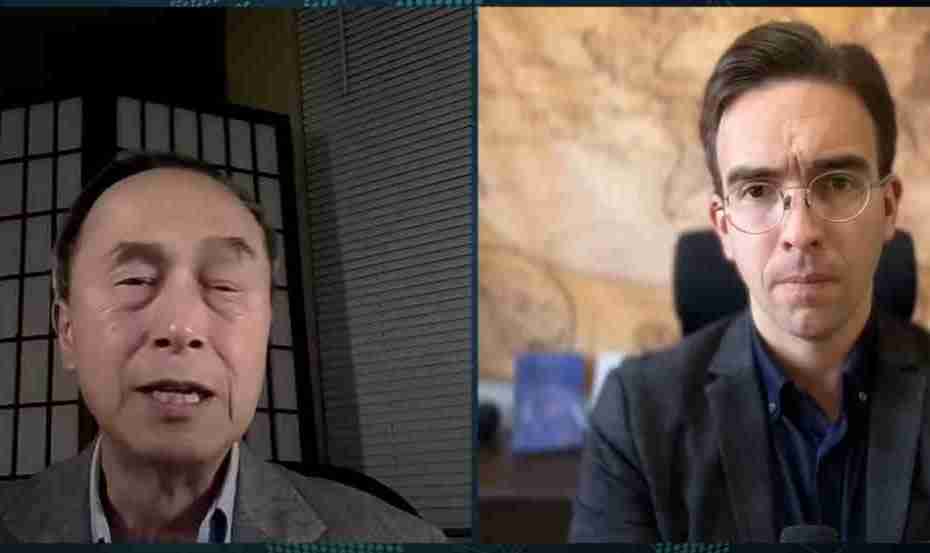
Read the full transcript of a conversation between Dr. Pascal Lottaz of Neutrality Studies, and Professor Dr. Yu Bin, an expert on Russia and China, on “The West Cannot Comprehend Russia-China Partnership and Chinese Neutrality”, Mar 27, 2025.
Below is the interview:
Introduction
DR. PASCAL LOTTAZ: This is Pascal from Neutrality Studies. And today I’m talking again to Dr. Yu Bin, a great expert on Russia and China. Dr. Yu Bin earned his PhD from Stanford University and he’s a senior fellow at the Russian Study Center of the East China Normal University in Shanghai and the author of six books and more than 150 chapters. Most impressively, Dr. Yu Bin has been writing in-depth quarterly updates on Chinese-Russian relations for the past 25 years. They’re all available for free online on Comparative Connections. The link will be below in the description. Yu Bin, welcome back.
DR. YU BIN: Thank you. Thank you very much for this opportunity.
DR. PASCAL LOTTAZ: Well, I’m glad to have you back because I want to ask you a couple of questions later on about Russia and China, but I would like to start with an article that you wrote recently in which you focus really on the role of Munich. Actually, I think it’s not the main argument of the article, but you explain on several points how the Munich Security Conference was important to what’s currently going on in Europe and Munich 1938, the argument. Can you maybe expand a little bit on how you view the importance of Munich in many different ways for the European catastrophe at the moment?
The “Forever Munich” Syndrome
DR. YU BIN: I think this year’s Munich Security Conference is anything but dramatic. This was where we start to see the old West Europeans and Americans were distancing themselves from each other and eventually culminate in the White House very heated debate discussion between President Trump and Ukraine President Zelensky regarding how and what to make out of the peace, how to stop the war.
I think the Europeans caught in between in this Munich 61 and they cried wolf. It was a replay of the Munich sellout appeasement. So this is kind of what I see as a “forever Munich.” Ever since 1938, it became such an icon in the mindset of collective West that anything like negotiation, compromise, is a sellout. It’s a replay of 1938.
For the Europeans, US President Donald Trump represents the kind of historical replay of this infamous Munich sellout. But for me, this collective memory of the Europeans seems to be cherry picking or selective in a way that they forget there’s a 2007 Munich, where Russian President Putin warned about the coming NATO eastward expansion. For the Europeans, they totally rejected it. This is unwarranted and “take it easy and it’ll be okay.” But Putin really meant it because the West has been continuously pushing eastward.
After that 2007 Munich speech that Putin gave, the West made three or four more rounds of East Europe expansion, eventually coming to the Judgment Day, that is the war or Russia’s military operation in Ukraine. So that was all about the selective cherry picking of memory of Munich has the consequences or blowbacks against Europeans themselves.
This is a very sensitive moment. My article really wants to point out that of all the problems or anything that US President Trump behaved at home and abroad, he’s been very brutally honest about the fallacy of this Munich sellout. It’s about war, about the danger of World War Three and nuclear war, which will have no winners.
I think Trump really nailed it. No matter what he says or does at home or abroad, to many, even in China, it’s just like little kids telling that the collective West, the emperor is naked and you are playing with fire. You’re fighting a war that would have no winners, is unwinnable. How could you win a war against one of the largest nuclear arsenals in the world?
And even if you want to talk all about this, why not you yourselves go there, let Ukraine die. This is what really the Trump people think about it. The people are dying. These are the young men and women dying by the tens of thousands simply because you want to have Ukraine in the embrace of NATO.
For many in China, no matter how they love and hate Trump—by the way, Trump is a deeply divided figure, not only in America, but also in China. Lots of people hate him, but lots of people say, well, give him time, give him a chance. It’s a piece of lifetime, perhaps maybe another four years, then the Americans will go back to war.
So Trump has Europeans behave in a way that really shows they don’t care about human life. To many in China, this is where China’s neutrality has played and preached in this very dangerous—I call it the brave and the grave new world of Trump 2.0 or the toxic mix of weapons of mass destruction and artificial intelligence. Europeans need to understand there are limits to how far you can stretch this Munich analogy, which is very toxic by the way.
The Toxicity of the Munich Analogy
DR. PASCAL LOTTAZ: The Munich analogy is super toxic because it’s used in order to undermine any form of peace negotiations that would not end in the maximum demands the Europeans have. Right. Anything short of everything plus Crimea back to Ukraine is unacceptable and will then be trash talked with the Munich argument. But if you look at this from China and also if you are in touch with all of your colleagues in Shanghai and in the policy thinking world in China, how is this viewed from China like of what Europe is doing at the moment? Is there an understanding for where this war mentality is coming from or is this baffling Chinese analysts?
Chinese Perspectives on the Ukraine War
DR.
Whatever the case, the Chinese have by and large wanted to see and wait and see how far, how much this peace effort initiated by President Donald Trump in America could come out with some specific steps towards a genuine long-term peace. Many Chinese believe this is very difficult, if not impossible, to make a durable peace. But it’s better than nothing because the alternative is simply too dangerous.
It’s still very dangerous. If you see the Europeans now gathering together, having defense minister or Joint Chiefs meetings with other Americans, now they are getting more independent. And the French are talking about extending their nuclear deterrence to the east and to other members of European Union. And the kind of 30,000 some peacekeepers in Ukraine, regardless of what the Russians think—they know exactly the Russians disagree with this.
If there’s any possibility for peacekeeping in Ukraine, it must be under the UN leadership. And this is another way that China sees well in the future if UN indeed is invited, allowed to get into this process. And the Chinese may play certain roles, particularly in peacekeeping.
Because ever since 1990 when China started to commit itself to UN-led peacekeeping efforts, China has committed something like 30,000 personnel to peacekeeping operations around the world. And China is the largest contributor in both manpower and money to UN peacekeeping among the five UN Security Council members.
So China has been in the business for a very long time and a dozen Chinese peacekeepers have died. So the Chinese are talking about that possibility, but only if it’s UN peacekeeping. That’s the way the Chinese would like to see some positive development around this effort to seek certain peace arrangement or ceasefire.
The Difficulty of Peacemaking
But it’s very difficult because the Chinese understand from their own experience that ceasefire to peace, to stability, enduring stability is very, very difficult. We can talk about the Korean issue, by the way. There’s lots of things in the Chinese experience.
For example, in July 1953, when the Armistice agreement was finally signed in Korea, there were only three parties. South Korea refused to sign the agreement. South Korea actually tried to undermine the peace process by unilaterally taking operations and also particularly trying to mess up the repatriation of POWs.
So the agreement, not a treaty, but a kind of armistice agreement, the truce agreement was signed only by three parties: Chinese, North Koreans and Americans. That’s the case till today, and South Korea was not there.
And even more dramatic and fascinating, the Americans and Chinese actually had kind of a strategic passive understanding that the Chinese launched the last operation, the Kumsong operation, which lasted for five days and directly only targeted the South Korean positions. And Americans by and large basically watched their allies be bombarded by the Chinese artillery and then they stopped undermining the agreement.
So this is kind of a collaboration between the two enemies. And the Korean peace truce agreement was signed because of the strategic collaboration between the two enemies. Can you believe it? Trump is not the first one to reach out to the arch enemy of the West, Putin. China and the United States did it.
So peacemaking is very difficult and very tricky. And I don’t know how this kind of current approach would lead to anything. So far it’s okay, but with lots of problems, problems like public posturing. The commander-in-deals, I call the commander-deals of the United States, Donald Trump, always goes public, and this public posturing is not very conducive to the kind of agreement or process that all sides are now engaging in.
If you publicize it too much, you not only put yourself in a very difficult, inflexible situation, but particularly the other side. For example, the recent talks between US and Ukraine sides in Saudi Arabia—they publicly announce everything, that 30 days ceasefire and the ball is on the Russian side. So they didn’t even bother to take the agreement to Putin behind the doors and then they just announced it, leaving very little ground for Putin to navigate.
But Putin’s response so far has been very interesting, by the way. Very diplomatic, I think, leaving lots of space for the other side while trying to preserve and protect Russian interests. So I think there’s a kind of back and forth. I would say it’s too much publicity in the current peace process.
But whatever the case, the Chinese have been patient because this is exactly what the Chinese want, this is exactly what the world wanted. Because the alternative is just too dangerous. I mean the continuation of the war, not just for the two sides, the young men and women of Russia and Ukraine dying by the thousands, but also for the world, the escalation and accidents that could happen. So I think this is a good thing for the Chinese. And Chinese have been relatively low profile these days because it’s what Chinese have been talking about. Let’s talk. So this is what I see.
Multi-level Communication in Great Power Diplomacy
DR. PASCAL LOTTAZ: May I ask you. Because what we are currently seeing is a level of diplomatic communication or communication in general across great power frontiers that we haven’t seen for three years. And I agree with you that on the one hand publicizing everything is problematic. On the other hand, we also understand now that the Americans decided to communicate with the Russians on several levels.
There’s the diplomatic level. They actually talk with them and we don’t know if they tell us everything that they say. We only know that they politicize much more than we think. Secondly, they communicate on the level of public communication, with the actual announcements. And thirdly, they also communicate on the military level, as in the Americans resumed now intelligence sharing and the Russians at the same time also communicate. We are not going to stop our military intervention unless we solve certain points. So they still have military communication. It’s a horrible way of communication, but it is one.
So they’re constantly sending signals. And I talked to Michael von der Schulenburg, a former UN Secretary, and he was involved in a lot of negotiations. What he said is that overall the process that we are in is one where you can see how the two sides, as you said before, have strategic common interests and they’re playing back and forth in order to find to land on a ceasefire at some point. Do you think the Chinese are also waiting by the sidelines or are the Chinese at this point also trying to support this process in one way or another?
The West Cannot Comprehend Russia-China Partnership and Chinese Neutrality
DR. YU BIN: I think I agree with you that there are multiple channels and at multiple levels that the Russians and Americans are engaging. If we judge from the revelation by the special envoy Wyckoff to Moscow, he basically came back with the message that Putin is serious, unlike what the Europeans are crying out, “Oh, Putin is lying, Putin is not sincere.” He basically said Putin is sincere and genuine and trying to constructively reach out and meet the US side halfway.
It’s not as many say, “Well, this is a playing game thing, that this is Putin by himself and in substance.” He talked about how, without getting into detail, for example, the Russians – he talked with the Russian side about Putin, the Black Sea and how the navigation and the ports will be handled with a ceasefire, how the power plant will be secured. These are lots of specifics, and these things are already kind of positively responded to by the US side.
Just before our talk, I read the White House spokesperson’s statement, and she said basically that President Trump and the two sides are very close to something very significant, and they’ll talk about a lot of specific issues. Once you get to the specifics, I think this is a good sign. That is, I think the Russian side really tried to meet the White House.
Of course, there’s still quite a distance between all three sides. For example, the Russians would still want a guarantee that will be in writing – that the ceasefire would lead to enduring peace and stability. Russians do insist on that. And the Russians still want those occupied territories to be theirs. They are unwilling to negotiate that.
We have the elections and all kinds of things. The Russians want that, while Americans really want to freeze at the moment. That is, you keep your land, but maybe the Ukrainians keep their sovereignty. So you will work it out in the future, but let’s stop fighting. The White House has realized there is no hope – they publicly talked about it many times. There is no point. It’s impossible to go back to either 1991 or 2014, when Crimea was taken.
But the White House really wants to have an immediate ceasefire. This is quite a decision for the Ukrainians. The Russian side’s conditions are unacceptable. But I think the two sides – tomorrow Trump is going to talk with Putin. He already publicized this, and I think we’re waiting to see.
Russia’s Three-Pronged Strategy
Let me summarize what the Chinese see as the Russian strategy. This is not just my position. I’ve talked and communicated with quite a few well-known Russologists, specialists on Russia. They tend to see the current Russian reach-out or position essentially lying on three issue areas:
First, the Russians want to have what they see as a long-term solution of the war – to stop war, but on the condition that would be leading to genuine and endurable peace.
Number two, the Russians want to use this opportunity to improve relationship with the United States. The Russian-US relationship needs to be restored, improved, taking up this unique opportunity of the next three or four years. By the way, time flies, there won’t be another Trump, maybe someone else, but Trump will be gone in three or four years. So this is a unique opportunity to have a general improvement of relationship with Russia, which has already taken place. Russia has already named its ambassador to Washington.
The third is to alleviate those sanctions from the United States, particularly from the United States at this point. Maybe it takes time from the Europeans, but there are more than 20,000 pieces of sanctions. I think the American side would be confused about so many sanctions against the Russians. So the Russians would also like to see this as a broad thawing of relations between the two sides.
This is very important. Putin just a few hours ago signed a presidential decree to allow several major hedge funds in the United States to reconnect with their assets or purchase shares of Russian energy or gas companies, essentially unfreezing those from the Russian side. I think Putin is taking the first step. It’s a signal to the US side that the Russians are already taking action.
These are related, but not necessarily dependent on each other. Even without a ceasefire, the Russians really want to go ahead with a general improvement of relations with Washington first and with Europe perhaps in the near future. This is what is going on, and the Chinese would like to see these things make some progress.
DR. PASCAL LOTTAZ: There is talk among a lot of the analysts that one of the strategies of the Trump administration can or probably is betterment of relations with Russia in order to have more time to focus on China and increase the pressure on the Pacific. There are people who say that – I mean, Defense Secretary Hexev actually said so – the Europeans should take over responsibility in Ukraine so that you can do a burden sharing and that the United States gets more time to focus on China. Now do you believe that? And secondly, do you think China actually, in your circles, people actually think that this is a threat, that there might be something building up and that there might be a wedge, that the US might try to drive a wedge between Russia and China?
Beyond the Munich Analogy
DR. YU BIN: This is like a Munich analogy for the old Europe. It’s forever, it’s always there. In the mindset of many in the West, anything they try to do with Moscow would serve to target a third party. This is very interesting and naive because they forget or they don’t even bother to understand the broad spectrum of Russian-China relations.
This has been my longtime view that this is a normal relationship, it’s a pragmatic relationship, it’s a stable relationship in the midst of those mega changes around the world. This is something that I really talked about – in America, transatlantic relationships and everything is in fast speed. But the Russian-China relations have been very stable – stable not because they love each other, but because they understand each other’s basic interests.
China-Russia has gone way beyond the love and hate oscillation, like the Cold War, like the honeymoon and divorce – ten years honeymoon between 1949 to 1959, which was followed by 30 years of divorce from 1960 to 1989. That’s very detrimental for the broad strategic and long-term interests of two sides. And the two sides learned about that. They invested so much into the stability and the confidence building in their bilateral relationship.
One of the key issues, I would say, is an agreement by both sides to maintain stability and peace along the 4,000-plus kilometers of border. This is very important because this used to be something that both sides committed so much of their national wealth and power to, which hurt both sides. This is something that’s very different from the past.
For many of these internal dynamics between the two sides, they treat each other as partners, not allies. Because allies require the minimum thing – that is, you’re committed to each other regardless of what happens. That’s what an alliance is all about. But the Chinese and Russians are generally independent powers with independent foreign policy, independent defense policy, and they are independent civilizations.
By the way, there are very few countries in the world that really have genuine independence. By genuine, I mean they have not only the willingness but the ability to do so. I would say United States is one. I would say China and Russia are also genuinely independent powers. They are partners, but not allies.
Unlike 1914 when the allies and two sides of the warring parties committed to each other – one country is attacked and everybody else joins – China and Russia do not have this automatic interlocking mechanism. So China does not commit itself to any war Russians are fighting, and vice versa. If Taiwan happened, Russia is not automatically committed.
The West does not understand that. I’ve been telling many of them that they are not allies, they are friends. So China’s neutrality is genuine. It’s not opportunistic. China does not want to see war in general. Look at what China has done in the past 40-some years – building bridges, highways across the Eurasian land. This is a totally different path than the other way, which is bombing your way. You see the force of destruction, the wars the West has fought.
DR. PASCAL LOTTAZ: This is so interesting and fascinating to me because I think you’re absolutely right. The problem is that the West, and especially Europe – the United States also, but to a lesser degree – they are not capable of thinking in frameworks outside of what they’re used to. So when they see Russia and China cooperating, they immediately perceive that as an alliance and they immediately put everything in those terms. And to them, they try to portray the Russians as weak, therefore they portray them as the junior partner, and they perceive everything in this weird sense of who dominates whom, because that’s what they do, that’s how they act with others. But this is a genuine misunderstanding of how Russia and China cooperate, isn’t it?
Western Misunderstanding of Russia-China Relations
DR. YU BIN: This type of misunderstanding occurs at multiple levels. At the policy level, everything between China and Russia must be a conspiracy against the West or America under Biden or whatever. This is the way they look at it. They don’t have any memory, I would say attention span, to look at the long-term history. Ironically, Europeans are supposed to know more about history, but they don’t.
In Western study of Russian-China relations, there are basically two major schools of thought. One is what I call the “alarmed school” – anything between Russia and China is alarming to the West. It must be them trying to work together against us. This is one extreme side of academia.
There’s another extreme side that I call the “limitation school” – they say it doesn’t matter what Russia and China do together because they are fundamentally different. They have different culture, different history, different religion, different political systems. Russia and China are far apart from the Cold War time when both were communist. Now China is still communist while Russia is back to the West. So anything they do won’t allow them to overcome the long-term peace between themselves.
What they fail to see is that Russian-China relations are not black and white. There are lots of gray areas, lots of things between themselves that do not fall into these two “yes or no” schools – the alarmist school versus the limitation school. But this is what the West is all about. They tend to see the world in black and white, good or evil. And anything different from the West must be threatening. So they refuse to see that the world is diverse and dynamic.
Look at the 46th Munich Security Conference document publication on multi-polarization. The theme of the Munich Conference is very interesting. For the first time, they try to assert themselves away from Washington. They anticipate differences with Washington, so they start talking about multipolarity. This is what Russians and Chinese have been talking about for decades.
But their multipolarity is totally different. If you read the document carefully, they are really very uneasy about the way the world is going. They still use the words “democratic powers” and “autocracies.” Anything non-Western is threatening. So multipolarity or multipolarization is seen as threatening to Western fundamental interests. This is what Munich is all about. Even if they seem to be progressive from unipolarity, they’re still deeply distrustful of the global South.
When Chinese Foreign Minister Wang Yi delivered his speech in Munich this time, he talked about China as a force of stability and development. No matter what changes in the world, China will stay with its set course, dedicated to stability, to development, to peace, to civilizations coexisting – which includes the West.
By the way, when the West rose in the past 500 years, that rise was at the expense of the non-West. Just look at colonization, imperialism, slave trade, opium wars – give me a break. That’s the rise of the West at the expense of the rest. But the rise of the rest does not necessarily need to go the same way.
The West always has its own place. The only change in the future multipolar world, which China and maybe Russia would prefer to see, is countries big and small having equal power, equal standing, equal rights. And the West too has its own place. It does not mean the end of the West. It only means the end of Western manipulation and wars against the non-West. Anything other than that, the West is part of the global community as equal partners. That’s something the West is afraid of – they’re no longer West-centered.
The West Cannot Comprehend Russia-China Partnership and Chinese Neutrality
DR. PASCAL LOTTAZ: Sorry, I just need to ask you because I think I perceive China as extremely patient, extremely patient with the West, especially with the Europeans. Because every single time Europeans go to China, they tend to lecture China on all sorts of things like free trade and human rights and Uyghurs and so on and so forth. And the Chinese keep just repeating, no, look, these are internal matters and we would like to contribute to peace and stability in the way that China can or would like to. And the Europeans keep ignoring it.
And not only ignoring, they keep not hearing it. I think they are genuinely incapable of making sense of the arguments coming from Beijing. Now. At the same time, Beijing is extremely patient. Is this patience something that is part and parcel of the way China approaches world affairs, or is this something strategic that at some point might run out and, you know, China might change its approach?
DR. YU BIN: It’s a good question. Where your question seems to suggest that this may be temporary, the Chinese, once maybe more powerful, would be more impatient with the West. I would say not necessarily. I think the Chinese believe we are different, that’s no question. But being different does not mean we cannot or should not communicate and we cannot respect each other’s mutual interests.
So this is, I think, the rise of China actually has been a process of Chinese going back to the past of its old traditional civilizational wisdoms, like Confucius notion, unity of the differences. By the way, this is the issue I talk about briefly in Kyoto University. But so we’re different. It’s okay, we’re different. We’re not angry with you, even if you know very little about China. But you can look and see yourself, you know.
So the notion of unity of difference essentially means we can unite, work together precisely because we are different. And this is totally different from the Western notion. Western notion is the unity of the sameness. Look at NATO, look at the European Union, look at the coalition of democracy, Biden pedaled around for four years. They’re only united countries of their own similar systems or similar civilizations, similar religion.
This is what identity politics is all about. By the way, racism is identity politics because you are judged, not because what you do, but because who you are. So the West judges the non-West, including China, not because what China does, but because you are China. So anything China is the enemy or the threat.
You know, in America this happened last year, a senator, I think his name is Scott from Florida, he declared, tried to pass motions in the Senate, in the House that even Chinese imported garlic is a threat to America’s national security. Anything related to China is a national security threat.
I think the Europeans in many ways still living in that they cannot accept something different, something better. If you are better than the West in AI, in semiconductors or battery electric cars, you must steal things from us. This is the mentality in America. Day in and day out, the media bombard audience. They talk themselves into such a position China, everyday China.
But Chinese don’t think the way the West does. They see we’re different, but we can work together. Chinese by and large, not very ideological, very pragmatic, open mind. And if you’re doing something great, we learn from you. And for the West, if you’re doing great, you must steal from us. So this is a totally different mentality.
So you go to China, you see yourself, nobody tried to impose you on anything. But the West continues to live in that. By the way, I would say the Chinese do not judge the West in the way West judges China. Western democracy is fine, human rights are fine, keep it to yourself. Let us decide what to do. Right. But the West is very intrusive in a way. What the Russians call the liberal totalitarianism, liberalism way that wanted creatures around the world try to globalize everything the West has. This is as good a bad as old imperialism, by the way. So that’s something the Chinese understand.
Managing Differences in a Multipolar World
DR. PASCAL LOTTAZ: One thing that is interesting, of course in this new multipolarity that we are now in is that by just the sheer fact of the matter that you now have more powers. You have Russia, China, the United States, but you also have India, you also have Indonesia, Southeast Asia that are not as independent as like let’s say China. But they are more independent from certain influences than before, let’s say during the Cold War.
So as a matter of fact now you have the possibility that these different centers will form new understandings with each other. And I think a good example is how India and China are managing their differences. And they have like very strong differences, including like border skirmishes, but that they are managing, still cooperating while having, while recognizing that they have troubles.
Do you think that this new way of managing, I mean unity of difference and so on will impact the way that the rest of the Global South is cooperating despite the stuff that the West might do? Because unfortunately the Western core strategy is divide and conquer, which works directly against unity of differences. Right. How do you see this playing out?
DR. YU BIN: I think you push the magic button. Divide and conquer. That used to be the past. Divide and conquer. This is West strategy still. The strategy by the way divided the non-West and conquered. And I would call it divide and quit. This is the title of a book in the 60s how the British left the subcontinent leaving Pakistan and India in a forever war state. Divided and quit decolonization.
This is exactly what the Europeans did for most of African states because they colonized the whole continent. And they carved them up according to their so-called administrative line. And those Western imposed administrative lines cut through the linguistic culture and natural tribals. Once they left, you start to see multi-nations in one state. That’s the root cause of many, many Western conflicts in the past 30, 40 years by the way, for better or worse.
So this is something that the West has left, you know, after the mostly end of World War II. But the question you ask is to what extent the Global South, now that is a fashionable term, will be able or has been doing to work together for this so-called unity of the difference. I would say it has been an ongoing process for decades.
Examples of Unity in Difference
So let me give you a couple of examples. One is the Shanghai Cooperation Organization. This has been around ever since the year 2001. Before that was Shanghai 5 between China, Russia and several Central Asian states to managing border issues and also internal stability. But in 2001, just a few months before September 11, it was renamed the Shanghai Cooperation Organization.
Now India, Pakistan, Iran, Saudi Arabia and lots of Middle Eastern countries joined this group. And even Israel tried to apply at one time to join Shanghai Cooperation Organization but never got into the process.
How Shanghai Cooperation Organization is organized and operates is totally different from NATO or European Union. It’s a collection, a group of diverse civilizations. Almost all the major religions in the world are represented in Shanghai Cooperation Organization. You have Russia as Orthodox/Christianity. China is Confucian/secular. You have Hindu. You have Muslim. This is far away from the clash of civilizations. This has been going on for decades. Open your eyes.
Of course it’s not ideal. It’s not ideal. But they have managed to work together for many internal and external issues. And they try to manage the borders. By the way, the Russians actually use Shanghai Cooperation Organization to mediate China-Indian border disputes. The Russians actually invited Chinese and Indian officials to Foreign Ministers’ meetings in Moscow. So they have a three-way conference. It happened multiple times. They try to mediate those things rather than taking advantage or dividing and ruling.
So this is the Shanghai Cooperation Organization. And the same thing happened to the BRICS. The BRICS is basically a non-Western or Global South organization. And of course the term was coined by an American banker. But it took a life of its own.
So BRICS is an organization of diverse political cultures and civilizational entities and they work together. Again there are problems within BRICS. China has a huge financial economic power vis-a-vis other smaller members. But they are on the same standing.
They develop their financial arms like the BRICS New Bank, and the Chinese actually try to push their own proposals. Like President Xi Jinping in the past two or three years made three major proposals. This developmental proposal, the global development prosperity. The Chinese actually cancel all the tariffs of all African countries’ exports into China. It’s no tariff. Can you believe that? And this is what China has done.
The second proposal is a global security proposal. It’s equal security and all security for all, not just for a few. You may think this is like 1919, the Wilsonian peace settlement, the collective security. Yes, the Global South pushed for that. And once Ukraine war started, they tried to push for peace proposals. Eventually past September they launched the Friends of Peace in UN. Many, I think initiated by Brazil, China and joined by Egypt, Turkey and many third world countries of Global South. So it’s happening right now.
But again I want to say the rise of the Global South does not necessarily mean the end of the West. It only ends Western domination of the non-West. So the West always has a position. Western countries need to open their eyes to see that the world, the multipolar world, perhaps the Chinese or Global South version is not necessarily that horrible. It’s not yes or no, black and white. The world is far diverse.
So in this diverse world, let’s work together precisely because we are different. If we are different, we should actually work together. Unlike the West now, they’re deeply divided.
The True Test of Civilization
Let me stress the point a little bit further. I think the Western countries always argued democracy is the best system. I agree. That’s the Western choice. I don’t say this is a bad system no matter how you achieved it. But the ultimate criteria to see a maturity of a nation is to see how you treat a different country.
It’s far easier to love your own people like the Japanese all develop the cozy culture, you know, they love it, they bow to each other so much. That’s fine. That’s a minimal issue. It’s the minimum. The American blacks need to be treated like whites. That’s the minimum. Not something like the set standard.
But the ultimate criterion or the highest level civilization is to treat someone different from you. Do you agree? It’s very easy to work with someone you like. You agree in the workplace. But it’s far more challenging if you work with someone who has a different view.
So this is the Chinese hard way, it’s far more challenging. This is exactly what Confucius argued – work with others. There’s a unity of the differences. A unity of similarity is damned easy. So NATO is all the sameness, European Union all the same. So what do you think? Can you treat the non-European countries like Turkey the same way? By the way, Turkey never able to get into it because its skin color is not right. Because it’s Muslim.
DR. PASCAL LOTTAZ: I mean the biggest problem of the Europeans is that they thought they are done, that colonialism is over because they don’t feel it anymore. They think that. And the other thing is they think they got over racism, which they never did. It’s just so laughable.
But it is tragic because it still forms the core of their worldview and the view of themselves which to them is so benign, which they make sure that everything else looks threatening. And this is a tragedy, it’s an absolute self-made tragedy of ignorance to me. And I don’t know how to deal with that.
The West Cannot Comprehend Russia-China Partnership and Chinese Neutrality
DR. YU BIN: Well, I think you know more about Europe than me and I respect your opinion. But by the way, I respect Western culture. I think Western democracy, liberalism has its own historical, cultural or civilization root. But be honest, how you would promote it to other parts of the world. Let others decide what to do.
I mean look at the Western democracy these days. This is so called the liberal international order now in shambles, in deep deep crisis. Because for whatever the reasons, many of these problems are caused by those forever wars that collective west waged against non-west since the end of the Cold War, right? All those wars in Iraq, Afghanistan, Syria, in Libya, greater Middle East and Africa.
All those wars that collective west waged against non-west no matter where, caused so much pain in the West itself – not only the rise of extreme forces in many parts of the west and non-west, but also refugees and homelessness affecting millions.
Look at Gaza. I mean this is a 21st century Holocaust. There’s nothing you can do about it. By the way, I don’t want to… I think Israel and Palestine deserve their own homeland. But look at what the west failed to solve its own problem. Holocaust started in the west. Now it’s outsourced to the non-West. How and why? Of course I respect the life and the rights of Jewish people. It’s wonderful people. But think about the impact of the west waged wars against non-west.
Challenging Western Historical Narratives
So fundamentally I disagree with Huntington’s notion that the entire history of the world is Western civilization. He wrote that Classical civilizations ever since Treaty of Westphalia, west never fighting. And the Western Civil war finally ended in 1991, which is the end of the Cold War. But he called it Western Civil War. I think it’s a damned wrong notion because in all those so-called Western civil wars the non-west was always impacted.
Look at World War I, third world countries, non-west countries fought on both sides. And World War II, it covers so much of it. China suffered 35 million casualties in the 14 years war waged by the most westernized Asian nation, which is Japan. Japan has westernized so much it earned the honorary white title, by the way. I think that’s a shame. But it’s the most militarized non-western country and eventually it’s a blowback against the west itself. I mean Pearl Harbor, right.
So I think look at the west, all the Western civil wars. Now the west tries to push those good values, belief, diversity, everything. Stop doing it. Let the non-west decide what to do.
The Ukraine War as Western Civil War 2.0
I think the Ukraine war, which I call the Western Civil War 2.0, is a tragedy. Look at the way President Trump deals with the Ukraine war and the Palestinian-Israeli war. I think this is a priority because down in his heart I believe he does not want to see Europeans killing Europeans. I may be wrong, but I think for him this is a tragedy. For me it’s a tragedy too.
I think both Ukraine and the Russian people are wonderful people. And look at how many Ukraine women now drafted into the military. 70,000. Now where are those men gone? And the stronger the European position for more arms and more support to Ukraine, more Ukrainians will die in this unwinnable war. It’s a senseless war.
Let me give you one example. Trump really tried to punish General Mark Milley, the former Joint Chief of Staff. I respect him because Milley was the only American, I mean famous American, that tried to say it’s time to stop in November 2022. This was about 10 months into the Ukraine war, right after the Ukraine forces pushed back the Russians from Kherson area and were advancing.
But General Milley actually said, he was talking to the Economic Club of New York, and he said it’s time to negotiate. Let’s remember history. By Christmas time of 1914, both sides of European warring sides realized the war was going nowhere and 1 million casualties had occurred already. They felt that they would go nowhere but they lacked the courage to push for compromise and peace. So all countries, all participants chose war. So by the end of World War I, three years later, 20 million died.
This is something Milley said. He was the first and only senior official at the time to talk about it. But he was quickly brushed aside by the Biden administration. Ever since, nobody ever talked about this. And he himself tried to quote or clarify his position, by the way.
It’s a tragedy that we still see the young and even old Ukrainians fighting in the front and dying.
I remember a year ago in March 2024, Pope Francis talked about it. He said it’s okay to negotiate. Negotiation does not mean surrender. He was talking about Ukraine’s insistence – they wrote into their constitution there’s no negotiations with Putin – but the Pope talked about how it does not mean raising the white flag. It’s an honor to stop fighting. It’s not a shame. But he was quickly criticized and the Europeans were mad with him.
Think about that. Milley and Pope, these are isolated voices until now we have President Donald Trump, and this is why in my article I said Donald Trump actually deserves Nobel Peace Prize if the Europeans allowed him to have it.
DR. PASCAL LOTTAZ: By the way, you know, one of the parts of the tragedy at the moment is that these absolute fundamentals, the most basic principles are not just not adhered to but systematically ignored. I mean it is just a matter of fact, of pure logic that you make peace. If you make peace, it implies that you have an enemy. Right. And making peace means coming to an agreement among enemies. That’s just what that entire endeavor is about.
And that’s such a strange notion at the moment to the war faction because the war faction and the war logic of course wants to resolve problems through more war and they frame that as peace. But of course that’s not peace, that’s war logic. The peace logic is to talk to the enemy, period. And that’s what’s intellectually criminalized at the moment in these quarters of the West. It’s not everywhere anymore. Donald Trump is actually decriminalizing this strain.
Trump’s Common Sense Approach
DR. YU BIN: No matter how he’s viewed by part of American society, I mean the liberals and the Democrats, I think Donald Trump has common sense. I would say forget about this garbage political correctness, these whole theories of democracy. Common sense is more important. Love your people, love other people. Life is life.
I think Trump would have his problems but I think he made a very difficult step and I would like personally – this is not necessarily representative – but I personally admire him so much. I may disagree with many of President Trump’s policies, but I think I would like to see his peace effort successful, at least to a certain degree. At least to slow down the killing spree of this war.
And speaking of this force of peace ignored by the West, I think you are absolutely right. Let me make a quick point. Tomorrow I just heard a few hours ago on TV that they’re going to release the Kennedy papers, John F. Kennedy papers tomorrow.
DR. PASCAL LOTTAZ: Tomorrow, yes, we are talking on March 17-18, so by the time this goes online it might already be out.
Kennedy’s Peace Legacy
DR. YU BIN: But yeah, President Donald Trump said today, I watched on TV, and he was actually talking about Tulsi Gabbard. She’s the intelligence star. Tulsi Gabbard actually responded, yes, we are going to release something like 20,000 pages of papers.
President J.F. Kennedy, actually one of the reasons he died, got assassinated – this is my guess – he antagonized the military industrial complex. I hope I’m wrong, but I think this is it. But at least he made, right after Cuban missile crisis, he realized American foreign policy should not just selfishly serve America’s own interests.
So he made a speech in the American University of Washington and he was talking about peace for everybody. Peace, the long-term peace, genuine peace. And peace not only for the Americans, but for the Soviets, for the Russians. So that kind of thing is totally unacceptable, like what Donald Trump is doing today, for the old Europe and for certain parts of North America, I mean the collective west, those war parties, war factions, those politically correct.
And I think, by the way, I call them chicken hawks, like Europeans, because they want to fight war, but they’re really chicken. They don’t have arms. They still want others to die for them. This is what some Americans call those civilians like Bill Clinton, Hillary and Dick Cheney and younger Bush, I mean President Bush, they never fought a war, but they want wars, forever wars. So chicken hawks is those people. But I think Europeans deserve the title of chicken hawks, of course, maybe including Canadians too.
But President Kennedy’s crime is that he started to realize that in the nuclear age, the only way out for the whole world is peace for everybody. The way he drafted his speech was very interesting. Later he revealed to his close friends he couldn’t let his presidential speechwriter do it. He drafted it himself on an airplane through several drafts. This is still available and I quote him from time to time.
I think that’s something that Kennedy was told. By the way, on the campaign trail for his election, he was a hawk. He accused President Eisenhower of betraying, of allowing the Soviets to have the so-called missile gap. It turned out the missile gap was in reverse. And he accused Eisenhower of allowing US strategic forces to decline so much. But once he was in the White House he realized the US had too many.
And then after the Bay of Pigs disaster, the Cuban missile crisis, he realized those deep states – by the way, a term Donald Trump used – but he realized the deep state, the Pentagon, really wanted to assert themselves and try to manipulate the crisis. And he directly, secretly talked to the Soviet side, allowed his brother to talk to the Soviet side, bypassing State Department, bypassing CIA. And this may be the ultimate crime. This is my guess, by the way.
But I think now Donald Trump is in such a position and he’s viewed by many in old Europe and also I would say in part of America as politically incorrect. The mainstream media still day in and day out condemn him for betraying Western values, Western interests.
This is the very reason why I published the article. It’s not just for the Europeans, but also for the collective West. I think we need to give peace a moment and this is a very difficult, unique moment, a window of opportunity. But finally someone in the White House realized that all things were wrong. Yes, it’s still a Russian war. There’s no question. But not unprovoked. Not unprovoked as what I call the Newspeak in the west for many years, “unprovoked.” The “rules-based international order.” That’s a lot. Russia did fight war, but it has been provoked time and again. So that’s what I see.
DR. PASCAL LOTTAZ: The thing is that for the longest time, for the last 500 years, the Europeans and the Anglo-Americans, like this collective West, was able to impose its view of the world on everybody else. This is going to be the first time when it doesn’t work and when they will have to come back to revisit their own framing. And this “unprovoked” is going to be a huge reframing and it’s going to hurt, but it’s going to be necessary in order to understand where all of this went so wrong.
China’s Consistent View
DR. YU BIN: This actually has been China’s consistent view that the Ukraine war has its deep historical and political strategic background. It’s not just isolated, dropping from the sky. This is the reason why the Russians want to see the source of the war. So on this issue the Chinese agree with the Russians.
But on the other side, the Chinese may still like to see that the sovereignty, the territorial rights of Ukraine be preserved and recognized. So it’s going to be a very long and difficult process. Not 24 hours, by the way. But many people make fun of President Trump. I would say give President Trump a chance.
I mean this is something like… Of course he’s 78 years old. And I would say he may not have much time, but the peace process is just a brief window of opportunity and something that I hope will have more positive results.
DR. PASCAL LOTTAZ: I hope so too. I hope so too. And I would like to thank you, Yu Bin, for all the insights. People who want to read from you, I suppose they should go to Comparative Connections and where else do you publish your insights? Usually.
DR. YU BIN: I forgot there are many places on the Internet. It’s okay.
DR. PASCAL LOTTAZ: I’ll put them into the descriptions, the ones that I can find. And people can find you by googling your name as well.
Closing Thoughts
DR. YU BIN: I enjoy working with your platform. I think it’s becoming far more meaningful now. I think you enterprises to start with at a difficult time and many people doubt it. Neutrality is a dirty word. And then, you know, it’s not being in the middle is far more difficult than taking sides. This is Confucius being in the middle, by the way. So I think you are in a very heroic and meaningful process. I respect you. By all means.
DR. PASCAL LOTTAZ: Thank you for that.
DR. YU BIN: Thank you. Thank you very much.
DR. PASCAL LOTTAZ: I have one more thing to talk to you about once we switch the camera off. But at this point, I would like to thank you, Yu Bin, for your time today.
DR. YU BIN: Thank you.
Related Posts
- Tucker Carlson Show: w/ Ken Silva – Attempts on Trump’s Life (Transcript)
- Pod Force One Interview: w/ Donald Trump – June 2, 2026 (Transcript)
- Jimmy Dore’s Interview on Tucker Carlson Show, June 5, 2026 (Transcript)
- Transcript: Trump Remarks on American Agriculture at Wisconsin Roundtable
- President Trump Remarks on Beautiful, Clean Coal – June 4, 2026 (Transcript)