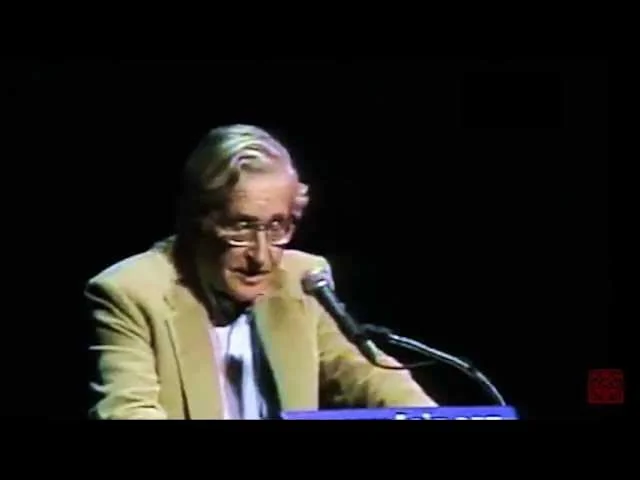
Read the full transcript of author, linguist, teacher, and crucial social critic, professor Noam Chomsky’s lecture titled “The History and Hypocrisy of the War on Terror”, which was given on the 15th anniversary celebration of the establishment of the Fairness and Accuracy In Reporting (FAIR) cooperative. The talk was given at the Town Hall Auditorium in New York on 1/22/2002, several months after the 911 attack on the World Trade Center.
TRANSCRIPT:
Noam Chomsky: Well, let me just begin by saying what I’m sure is obvious. It’s a genuine pleasure to be able to take part in this fifteenth anniversary celebration. What the Fair Collective, and the emphasis should be on the word collective, what it’s accomplished in these years is quite remarkable. There are many people, I’m definitely one of them, who are looking forward with eager anticipation to what’s sure to come next, to the insight, correctives, information, general enlightenment that doubtless lie ahead, and I would just like to congratulate the collective on its wonderful achievements and hope that many others will be encouraged to join in this vitally important work.
Well, on to business. The proper topic for an occasion like this, I suppose, is pretty obvious. It would be the question of how the media have handled the major story of the past months, and there’s no question about what that is. The question, the issue is the war on terrorism, so called, and specifically in the Islamic world. And so by media here, intend the term to be understood pretty broadly, so including journals of commentary, analysis, opinion, in fact, the intellectual culture generally.
It’s a really important topic. It’s been reviewed regularly by FARE, by others. However, it isn’t really an appropriate topic for a talk, and the reason is that it requires too much detailed analysis. So what I’d like to do is take a somewhat different approach to it and ask the question, how should the story be handled in accord with general principles that are accepted as guidelines, so principles of fairness and accuracy and relevance and so on. Let’s approach this by kind of a thought experiment.
Imagine an intelligent Martian. Incidentally, I’m told that by convention Martians are male, so I’ll refer to it as he. So suppose that this Martian, went to Harvard and Columbia Journalism School and learned all sorts of high minded things and actually believes them. How would the Martian handle a story like this? Well, I think, he would begin with some factual observations that he’d send back to the journal in Mars.
One factual observation is that the war on terrorism was not declared on September 11, rather it was redeclared using the same rhetoric as the first declaration 20 earlier. The Reagan administration, as you know, I’m sure, came into office announcing that a war on terrorism would be the core of US foreign policy, and it condemned what the president called the evil scourge of terrorism. The main focus was state supported international terrorism in the Islamic world, and at that time also in Central America. International terrorism was described as a plague spread by depraved opponents of civilization itself in a return to barbarism in the modern age. Actually, I’m quoting the administration moderate, Secretary of State George Shultz.
We, Reagan’s particular, the phrase I quoted from Reagan actually had to do with The Middle East, terrorism in The Middle East, and it was in the year 1955. That was the year in which international terrorism in that region was selected by editors as the lead story of the year in an annual AP poll. So, point one that our Martian would report is that the year 2001 is the second time that this has been the main lead story and that the war on terrorism has been redeclared pretty much as before. Furthermore, there’s a striking continuity. The same people are in leading positions.
So Donald Rumsfeld, who’s running the military component of the second phase of the war on terrorism, he was Reagan’s special envoy to The Middle East during the first phase of the war on terrorism, including the peak year, 1985. The person who was just appointed a couple months ago to be in charge of the diplomatic component of the war at the United Nations. This is John Negroponte, who during the first phase was supervising US operations in Honduras, which was the main base for the US war against terror in the first phase. In 1985, terrorism in The Middle East was the lead story, but terrorism in Central America had second rank, as the story of the day. Schultz, in fact, regarded the plague in Central America as what he called the most alarming manifestation of it.
The main problem, he explained, was a cancer right here in our hemisphere and we wanna cut it out, and we’d better do it fast because the cancer was openly proclaiming the goals of Hitler’s Mein Kampf. It was just about to take over the world. The, and it was really dangerous. The danger was so severe that on, Law Day, 1985, the president announced a state of emergency, a national emergency, which was because of the, how does he put it, the threat to the national security and foreign policy of The United States posed by this cancer. Law Day, incidentally, is the day that in the rest of the world is celebrated, as commemorated as a day in solidarity with struggles of American workers in The United States.
It’s a jingoist holiday, May 1. The cancer was so serious, and certainly this was renewed annually until finally the cancer was cut out. Schultz, Secretary of State, explained that the danger was so severe that you can’t keep to gentle means. His words, Negotiations are a euphemism for capitulation if the shadow of power is not cast across the bargaining table. He condemned those who seek utopian legalistic means like outside mediation, the United Nations, the World Court, while ignoring the power element of the equation.
The United States was in fact exercising the power element of the equation with mercenary forces based in Honduras under the supervision of John Negroponte, while it was successfully blocking pursuit of utopian legalistic means by the World Court, the Latin American countries, and of course, the cancer itself bent on world conquest.
They demanded, in their words, that we continue to send military aid to Latin style fascists no matter how many are murdered because there are higher priorities than human rights in El Salvador or anywhere in the region. That’s the Hawks. The Doves argued, on the other hand, that these means were just not gonna work, and they proposed alternative means to return Nicaragua, the cancer, to the Central American mode and imposed regional standards on it. I’m quoting the Washington Post. The Central American mode was the, and the regional standards were those of the terror states, El Salvador and Guatemala, which were at that time massacring and torturing devastating in ways I don’t have to describe.
So, gotta return Nicaragua to the Central American mode as well, according to the doves. The op eds and editorials in the national press were divided on this roughly fiftyfifty between the hawks and the doves. There were exceptions, but they’re literally at the level of statistical error. There’s material on this and print has been for a long time if you wanna look. In the other major region where the plague was raging at that time, the Middle East, uniformity was even more extreme.
Well, the intelligent Martian would certainly pay great attention to all of this, very recent history, in fact, with remarkable continuity, so that the front pages in Mars would report that the so called war on terror is redeclared by the same people against rather similar targets, although, he would point out, not quite the same targets. The depraved opponents of civilization itself in the year 2001 were, at that time, the freedom fighters organized and armed by the CIA and its associates, trained by the same special forces who are now searching for them in caves in Afghanistan. That they were a component of the first war against terror and acting pretty much the same way as the other components of the war against terror. They didn’t hide their terrorist agenda, incidentally. That began early on, in fact, in 1981 when they assassinated the president of Egypt and continuing.
That included terrorist attacks inside Russia, severe enough so that at one point they virtually led to a war with Pakistan, although these attacks stopped after the Russians withdrew in 1989, leaving the ravaged country in the hands of The US favorites, who turned at once to mass murder, rape, terror, the worst, generally described as the worst period in Afghanistan’s history, and they’re now back in charge outside of Kabul. According to this morning’s Wall Street Journal, they are now, two of the major warlords are now approaching what could turn out to be a major war. Let’s hope not. Well, all of this would be headline news in the Martian press along, of course, with what it all means to the civilian population. That includes vast numbers of people who have, are still deprived of desperately needed food and other supplies, although food has been available for months but can’t be distributed because of the conditions.
That’s after four months. Consequences of that, we don’t know, and in fact, we’ll never know, because there’s a principle of the intellectual culture that although you investigate enemy crimes with laser like intensity, you never look at your own. That’s quite important. So we can only give very vague estimates, say, of the number of Vietnamese or Salvadoran or other corpses that we’ve left around. The, well, as I say, this would be headlines in Mars.
A good Martian reporter would also wanna clarify a couple of basic ideas. First of all, he’d like to know what exactly is terrorism, and secondly, what’s the proper response to it? Well, whatever the answer to the second question is, that proper response must satisfy some moral truisms. The Martian can easily discover what these truisms are, at least as understood by the leaders of the war, what, the self declared war on terrorism, because they tell us, they tell us constantly that they’re very pious Christians who therefore revere the Gospels and have certainly memorized the definition of hypocrite given prominently in the Gospels. Namely, the hypocrites are those who apply to others standards that they refuse to accept for themselves.
So the Martian understands then that in order to rise to the absolutely minimal moral level, we have to agree, and in fact insist that if some act is right for us, then it’s right for others, and if it’s wrong when others do it, then it’s wrong when we do it. That’s the most elementary of moral truisms, and once the Martian realizes that, he can pack up his bags and go back to Mars, because his research task is over. He would be unlikely to find a phrase, a single phrase, in the vast coverage and commentary about this war on terrorism that even begins to approach this minimal standard. Don’t take my word for it. Try the experiment.
Well, I don’t want to exaggerate. You can probably find the phrase now and then way out at the margins, though very rarely. Nevertheless, this moral truism is recognized within the mainstream. It’s understood to be an extremely dangerous heresy, and therefore it’s necessary to erect impregnable barriers against it, even before anybody exhibits it, even though it’s so rare. In fact, there’s even a technical vocabulary available in case anybody would dare to engage in the heresy, to involve themselves in the heresy, that we should abide by moral truisms that we pretend to revere.
The offenders are guilty of something called moral relativism. That means the suggestion that we apply to ourselves the standards we apply to others, or maybe moral equivalence. That’s a term which was invented, I think, by Gene Kirkpatrick to ward off the danger that we might, somebody might dare to look at our own crimes. Or the term, or maybe they can be called involved, they’re carrying out the crime of America bashing or they’re anti Americans, which is a rather interesting concept. As far as I’m aware, the term is used elsewhere only in totalitarian states.
For example, in Russia in the old days, where anti Sovietism was the highest crime. If somebody were to publish a book in Italy, say, called The Anti Italians, You can imagine what the reaction would be in the streets of Milan and Rome, or in any country where freedom and democracy are taken seriously. But let’s suppose that, The Martian isn’t deterred by the inevitable tirades and stream of vilification and suppose he persists in keeping to the most elementary moral truisms. Well, as I said, if he does that, he can just go home. But suppose out of curiosity, he decides to stay on and look a little bit further.
So what’ll happen? Well, back to the question, what is terrorism? Important one. No, there’s a proper course for a serious Martian reporter to follow to find the answer to that, since look at the people who declare the war on terrorism and see what they say terrorism is. That’s fair enough.
And there is in fact an official definition, in The US Code and Army manuals elsewhere. It’s defined briefly, terrorism, as I’m quoting, is defined as the calculated use of violence or the threat of violence to attain goals that are political, religious, or ideological in nature through intimidation, coercion, or instilling fear. Well, that sounds simple. As far as I can see, it’s appropriate, but we constantly read that the problem of defining terrorism is very vexing and complex, and the Martian might wonder why that’s true. And there’s an answer.
The official definition is unusable. It’s unusable for two important reasons. First of all, it’s a very close paraphrase of official government policy, which, very close in fact. When it’s government policy, it’s called low intensity conflict or counter terror. Incidentally, that’s not just The United States.
As far as I’m aware, this practice is universal. So about, just as an example, back in the mid-60s, the RAND Corporation, a research agency connected to the Pentagon mostly, the RAND Corporation published a collection of interesting Japanese counterinsurgency manuals having to do with the Japanese attack on Manchuria in North China in the 1930s. I was kind of interested. I wrote an article about it at the time, comparing the Japanese counterinsurgency manuals with U. S.
Counterinsurgency manuals for South Vietnam, virtually identical. That article didn’t fly too well, I should say. Anyhow, it’s a fact, and as far as I know, it’s a universal fact. So that’s one reason. You can’t use the official definition.
The other reason you can’t do it is much simpler. It just gives all the wrong answers, radically so, as to who the terrorists are. So therefore, the official definition has to be abandoned, and you have to search for some kind of sophisticated definition that’ll give the right answers, and that’s hard. That’s why you hear that it’s such a difficult topic and big minds are wrestling with it and so on. Fortunately, there is a solution.
The solution is to define terrorism as the terrorism that they carry out against us, whoever we happen to be. As far as I know, that’s universal in journalism, in scholarship, and also I think it’s historically universal. At least I’ve never found any country that doesn’t follow this practice. So fortunately there’s a way out of the problem. Well, with this useful characterization of terrorism, we can then draw the standard conclusions that you read all the time, namely that terrorism is a weapon of the weak.
Of course, terrorism in the official sense is a weapon of the strong, like most weapons, But it’s a weapon of the weak by definition. Once you comprehend that terrorism just means the terrorism that they carry out against us, then of course it’s true by definition that terrorism is a weapon of the weak, So the people who write it all the time, you see it every time you open the newspapers or the journals, they’re right. It’s a tautology, and by convention. Well, suppose the, Martian goes on to defy what are apparently universal conventions, and he actually accepts the moral truisms that are preached, and he also even accepts the official US definition of terrorism. I should say, by this time, he’s way out in outer space.
But let’s proceed. If he goes this far, then there certainly are clear illustrations of terrorism. September 11, for example, is a particularly shocking example of a terrorist atrocity. Another equally clear example is the official US British reaction, which was announced by Admiral Sir Michael Boyce, chief of the British defense staff, reported in a front page story in the New York Times in late October. He informed the people of Afghanistan that The United States and Britain would continue their attack against them until they get their leadership changed.
Notice that that’s a textbook illustration of international terrorism according to the official definition. I won’t reread it, but if you think about it, it’s just perfect illustration. Two weeks before that, George Bush had informed the Afghans, people of Afghanistan, that the attack will go on until they hand over wanted suspects. Remember that overthrow of the Taliban regime was a kind of an afterthought brought in a couple of weeks after the bombing, basically for the benefit of intellectuals so they could write about how just the war is and so on. At that time, when, this of course is also textbook terrorism.
We’re gonna continue to bomb you until you hand over some people we want you to hand over. The US, at the very same time, the Taliban regime did ask for evidence, but The US contemptuously dismissed that request. Also flatly refused to even consider offers of extradition, which may have been serious, may not have been, we don’t know, because they were rejected. Well, the Martian would certainly report all of this, and if he did a little homework, he would quickly find the reasons, adding many other examples. The reasons are very simple.
The world’s rulers have to make it clear that they do not defer to any authority. Therefore, they do not agree, they do not accept the idea that they should offer evidence. They do not agree that they should request extradition. In fact, they reject UN Security Council authorization, reject it flatly. The US could easily have obtained clear and unambiguous authorization, not for pretty reasons, but it could have obtained it.
However, it rejected that option, and that makes good sense. It’s very, in fact, there’s even a term for this in the literature of international affairs and diplomacy. It’s called establishing credibility. Another term for it is declaring that we’re a terrorist state, and you better beware of the consequences if you get in our way. But of course, that’s only if we use the term terrorism in its official sense, as it’s defined in US government legal code and so on, and that’s of course unacceptable for the reasons I mentioned.
Well, let’s go back to the moral truism. According to official doctrine, which is almost universally accepted, in fact described as just and honorable, indeed, obviously so, According to that, The United States is entitled to conduct a terrorist war against Afghans until they hand over suspects to The United States, which refuses to provide evidence or request extradition, or in Boyce’s later terms, until they change their leadership. Well, anyone who’s not a hypocrite, in the sense of the Gospels, will therefore conclude at once that Haiti is entitled to carry out large scale terrorism against The United States until it hands over a murderer who’s already been convicted of responsibility for four to 5,000 deaths. No question about the evidence in this case. They’ve requested extradition repeatedly, most recently on September, right in the midst of all the talk about Afghanistan being subjected to terrorism if it doesn’t hand over suspected terrorists.
Of course, that’s only four or 5,000 black people. I guess it doesn’t count quite as much. Or perhaps they should continue to carry out massive terror in The United States since they can’t bomb, maybe bioterror or something, I don’t know what, until The United States changes its leadership, which is in fact responsible for terrible crimes against the people of Haiti right through the twentieth century. In fact, Haiti’s been the main target of US terrorist attack in the twentieth century, going back to Woodrow Wilson, and in fact it goes back for two hundred years, and what’s more, it’s still going on. Or certainly keeping out of moral truisms, Nicaragua has entitled, is entitled to do the same, incidentally targeting the leaders of the redeclared war on terrorism, same people often.
Recall that the terrorist attack against Nicaragua was far more severe, even than September 11. Tens of thousands of people were killed. The country was devastated, may never recover. It’s now the second poorest country after Haiti in the hemisphere. Also, this happens to be an uncontroversial example, so we won’t have to argue about it.
It’s uncontroversial because of the judgment of the world court condemning The United States for international terrorism, backed up by the Security Council in a resolution calling on all states to observe international law, mentioning no one but everyone knew who they meant, vetoed by The United States, Britain abstaining, or the concluded judgment of the general assembly and successive resolutions affirming the same thing opposed by The United States and one or two client states. The World Court ordered The United States to terminate the crime of international terrorism, to pay massive reparations. The US responded with a bipartisan decision to escalate the attack immediately. I already described the media reaction. All of this continued until the cancer was destroyed, and it continues right now.
So, in November 2000, there was an election in Nicaragua, 02/2001, sorry, last November. The United States, right, so right in the middle of the war on terrorism, The United States radically intervened in the election. It warned Nicaragua that The United States would not accept the wrong outcome and even gave the reason, the State Department explained that we cannot overlook Nicaragua’s role in international terrorism in the 1980s when it resisted the international terrorist attack that led to the condemnation of The United States for international terrorism by the highest international authorities. Well, here, all of this passes without comment in an intellectual culture that’s simply dedicated passionately to terrorism and hypocrisy, but I guess it might have had some headlines in the Martian press. You might look and see how it was treated here.
Well, you might also incidentally try out your favorite theory of just war in this uncontroversial case. Nicaragua, of course, had some defense against The US run international terrorism being carried out under the pretext of a war on terrorism. Namely, Nicaragua had an army. In the other Central American countries, the terrorist forces that were armed and trained by The US and its clients were the army. So, not surprisingly, the terrorist atrocities were far worse.
That’s the Central American mode that the doves said we have to return the cancer to. But in this case, the victims weren’t a state, and therefore they could not appeal to the World Court or to the Security Council for judgments that would be rejected and tossed into the ash can of history, except maybe on Mars. The effects of that terror were long lasting. Here, in The United States, there’s a good deal of concern, very properly, in fact, good deal of concern about the very wide ranging effects of the terrorist atrocities of September 11. So, for example, there’s a front page article in the New York Times this morning about the people who are beyond the reach of benefits and the tragedy that they suffer.
Of course, the same is true for those who are victims of vastly worst terrorist crimes, but that’s reported only on Mars. So, you might try to find a report, say, of a conference run by Salvadoran Jesuits a couple years ago. The Jesuits, their experiences under US international terrorism were particularly grisly. The conference report stressed the residual effect of what it called the culture of terrorism, which domesticates the aspirations of the majority, who realize that they must submit to the dictates of the ruling terrorist state and its local agents, or they’ll again be returned to the Central American mode as recommended by the doves at the peak of the state supported international terrorism of the ’80s. Unreported here, of course, maybe headlines on Mars.
Well, the Martian would, how much time do I have? Anybody have any idea? Who’s my monitor? Somebody is supposed to keep me honest. Yeah, okay, well, I’ll go on.
Yeah, let’s, yeah. Actually, the Martian might notice some other interesting similarities between the first and the second phase of the war on terror. In the year 02/2001, every terrorist state you can think of is eagerly joining the Coalition Against Terrorism. And the reasons are not hidden. So we all know why the Russians are so enthusiastic.
They want US endorsement for their monstrous terrorist activities in Chechnya, for example. Turkey was particularly enthusiastic, they were the first country to offer troops, and the prime minister explained why. This was in gratitude for the fact that The United States alone was willing to pour arms into Turkey, providing 80% of their arms in the Clinton years, in order to enable them to expedite some of the worst terrorist atrocities and ethnic cleansing of the late 1990s, and they were very grateful for that, so they offered troops for the new war on terrorism. Hence, none of this counts as terrorism, remember, because by the convention, since we’re carrying it out, it’s not terrorism. The, and so on down the list.
I won’t go through the rest. And the same incidentally was true of the first phase of the war on terrorism. So the announcement by Admiral Boyce that I quoted was closely, was a close paraphrase of words of well known Israeli statesman Abba Eban in 1981. That was shortly after the first war against terrorism was declared. Evan was justifying Israeli atrocities in Lebanon, which he acknowledged were pretty awful, but justified, he said, because there was a rational prospect that the affected populations would exert pressure for a cessation of hostilities.
Notice that’s another textbook illustration of international terrorism. The, in the technical, in the official sense, the hostilities we were talking about were at the Israel Lebanon border, overwhelmingly Israeli in origin, often without any, even a pretext, but backed by The United States, so therefore they’re not terrorism by convention, and they’re not part of the history of terrorism. At the time, with decisive US support, Israel was trying to, was carrying out attacks in Lebanon, bombing and other atrocities, to try to elicit some pretext for a planned invasion. Well, they couldn’t get the pretext, but they invaded anyway, killing about 18,000 people and continuing to occupy Southern Lebanon for about twenty years with many atrocities, but all off the record because The US was decisively supporting it. All of this peaked the post nineteen eighty two attack in 1985.
That was the peak year for Israeli, US Israeli atrocities in Southern Lebanon, what were called the Iron Fist Operations. These were large scale massacres and deportations of what the high command called terrorist villagers. These operations, under Prime Minister Shimon Peres, are one of the candidates for the prize of the worst international terrorist crime in the peak year of 1985. Remember when it was the leading story of the year. There are other competitors.
One of them, also early nineteen eighty five, was a bombing in Beirut, a car bombing. Car bombing was outside a mosque, timed to go off just when everybody was leaving to ensure the maximum number of casualties. It killed eighty people, wounded more than two fifty according to the Washington Post, which gave a pretty grisly account of it. Most of them were women and girls, but it was a heavy strong bomb, so it killed infants in their beds and all kind of other atrocities. But that doesn’t count because it was organized by the CIA and British intelligence, so therefore it’s not terrorism.
So that’s, you know, it’s not really a candidate for the prize. The only possible other competitor in the peak year of 1985 was the Israeli bombing of Tunis, which killed 75 people. There’s grisly accounts of it by, in the Israeli press by good reporters. The US cooperated in the atrocity by failing to inform its Tunisian ally that the bombers were on their way. George Shultz, Secretary of State, immediately called the Israeli Prime Minister, Saq Shamir, to say, inform him that The United States had considerable sympathy for this action, as he put it.
However, Schultz drew back from open support for this international terrorism when the Security Council condemned it as an, unanimously, as an act of armed aggression with US abstaining. Well, let’s continue to give Washington and its clients the benefit of the doubt, as in the case of Nicaragua, and let’s assume that the crime was only international terrorism, not the far more serious crime of aggression, as the Security Council determined. If it was aggression, then again, observing moral truisms, we move on to Nuremberg trials. Well, those are the only three cases that come anywhere near that level in the peak year of 1985. A couple of weeks after the Tunis bombing, Prime Minister Paris came to Washington where he joined Ronald Reagan in denouncing the evil scourge of terrorism in The Middle East.
None of this elicited a word of comment, and that’s correct because by convention, none of it is terrorism. Recall the convention. It’s only terrorism if they do it to us. When we do much worse to them, it’s not terrorism. Again, a universal.
Well, the Martian might notice that, even if it’s not discussable here. Actually, I got my favorite review in history when I did write about this some years ago. Was a review in the Washington Post, two word review, by their Middle East correspondent who described it as breathlessly deranged. I kinda like that. I think he was wrong about breathless.
If you read the article, it’s pretty calm, but deranged is correct. I mean, you have to be deranged to accept elementary moral truisms and to describe facts that shouldn’t be described. That’s probably true. Let’s go back to the Martian. He might be puzzled about the question of why 1985 is the peak year for the return to barbarism in our time by depraved opponents of civilization itself, referring to international terrorism in The Middle East.
He’d be puzzled because the worst cases by far of international terrorism in the region just are down the memory hole, like international terrorism in Central America, and lots of other cases, current ones, in fact. However, some cases from 1985 are remembered, well remembered, and rightly, because they are terrorism. The official prize for terrorism that year goes to the hijacking of the Achille Lauro and the murder of a crippled American, Leon Klinghoffer. Everyone knows about that one correctly. It was a terrible atrocity.
Now of course, the perpetrators of that atrocity, they described it as retaliation for the Tunis bombing a week earlier, vastly worst case of international terrorism, but quite rightly, we dismiss that excuse with the contempt that it deserves, and all of those who do not regard themselves as cowards and hypocrites will take the same principled stand with regard to all other violent acts of retaliation, including, for example, the war in Afghanistan, which remember was undertaken with the clear and unambiguous expectation that it might drive millions of people over the age of starvation, and as I said, we’ll never know, for principled reasons, or lesser atrocities, such as those in alleged retaliation in the Israeli occupied territories right now with full US support, as always, so they’re not terrorism. The Martian would surely report on page one that The United States right now is once again using the pretext of the war on terror to protect and probably escalate terrorism by its leading client state. The latest phase of this began on 10/01/2000. That’s when Israeli helicopters, which when you read that, that means U. S.
Helicopters with Israeli pilots provided in the certain knowledge that they’re gonna be used for what they’re used for. On October 1, the first day after the current intifada, US helicopters began to attack unarmed Palestinians with missiles, killing and wounding dozens of them. There wasn’t any pretext of self defense. Clinton did respond on October 3, two days later, by sending Israel the largest shipment of military helicopters in a decade, along with spare parts for Apache attack helicopters that had been sent in mid September. The press cooperated by refusing to report any of this.
Five minutes. Five minutes, yeah. Not failing notice, but refusing, they knew all about it. In December, and the story continues, since time’s short, I’ll be brief. Last month, the Martian press would certainly have headlined Washington’s intervention to expedite the further escalation of the cycle of terror there.
On December 14, The US vetoed a Security Council resolution calling for implementation of the Mitchell Report and international observers to monitor reduction on violence. Went at once to the General Assembly, where it was opposed by The US and Israel, also therefore disappears. None of this, you can check the coverage. A week earlier, there was a conference in Geneva of the high contracting parties of the Geneva Convention. They’re obliged by solemn treaty to enforce it.
That convention, as you know, was instituted after World War II to criminalize the atrocities of the Nazis. The convention strictly bars virtually everything The US and Israel do in the occupied territories, including the settlements that were established and expanded with US funding and full support increasing under Clinton and Barack during the Camp David negotiations. Israel alone rejects this interpretation. When it comes up at the General Assembly, The US abstains, apparently not wanting to take such a blatant stand in violation of fundamental principles of international law, particularly given the circumstances of their enactment. The media tell us that Arabs believe that the conventions apply to the territories, is not false, though there’s a kind of an omission of the Arabs and everybody else.
The December 5 meeting, including all of the European Union, reaffirmed the applicability of the conventions to the territories, the illegality of settlement, called on Israel, meaning The US and Israel to observe international law. The US boycotted the meeting, thereby killing it. You can check the coverage again. These acts again contribute to the escalation of terrorism there, including its most severe component, and the media contributed in the usual way. Well, suppose, finally, that we join the Martian observer, I’m skipping a lot of things I think are interesting.
You can ask about them if you like. But suppose, finally, that we join the Martian observer and we depart from convention radically, we accept moral truisms, If we can rise to that level, we can then, and only then, honestly raise the question of how to respond to terrorist crimes. One answer is to follow the precedent of law abiding states, the Nicaraguan precedent, for example. Of course, that failed because they ran up against the fact that the world is ruled by force, not by law, but wouldn’t fail for The US. However, evidently, that’s excluded.
I have yet to see one phrase referring to that precedent in the massive coverage of the last couple of months. Another answer was given by Bush and Boyce, but we instantly reject that one because nobody believes that, Haiti or Nicaragua or Cuba and a long list of others around the world have the right to carry out massive terrorist attacks against The United States and its clients or other rich and powerful states. A more reasonable answer, was given by a number of, from a number of sources, including the Vatican, and was spelled out, by the preeminent Anglo American military historian, Michael Howard, last October. Actually, it’s published in the current issue of Foreign Affairs, that’s the leading establishment journal. Howard has all the appropriate credentials, a lot of prestige, he’s a great admirer of the British Empire, even more extravagantly of its successor in global rule, so he can’t be accused of moral relativism or other such crimes.
Referring to September 11, he recommends a police, he recommended then a police operation against a criminal conspiracy whose members should be hunted down and brought before an international court where they could receive a fair trial, and if found guilty, be awarded an appropriate sentence. Well, that was never contemplated, of course, but sounds kinda reasonable to me. If it is reasonable, then it ought to hold for even worse terrorist crimes. For example, The US international terrorist attack against Nicaragua or even worse ones nearby and elsewhere, going up right to the present incidentally. Well, that could never be contemplated, of course, but for opposite reasons.
So honesty leaves us with a dilemma. The easy answer is conventional hypocrisy. The other option is the one adopted by our Martian friend who actually abides by the principles that we profess with grand self righteousness. That option is harder to consider, but imperative if the world is to be spared still worse disasters. Thanks.
What can we do as individuals and collectively do to change this pattern of US abuses and murder? How can we engage and inspire those outside this hall? This hall being full of the already converted and privileged? First of all, an apology. If I act as if I can’t see you, that’s because I can’t see you.
It’s all black out there. I assume there must be people but can’t see any faces. Actually, first of all, there are plenty of people outside this hall who are pretty much the same. In fact, it’s a very powerful current in the country and in fact throughout the world. There’s plenty of evidence for that.
As to how you as to what you can do about it, I think we all know the answer. I mean, ask yourself why we don’t live under feudalism or why we don’t have slavery or why women have some rights or, you know, why there’s some, finally, concern about trying to save the environment before we destroy it or anything else you can think of back through history. There are no magic answers. There’s only one answer. It’s dedicated, committed, hard work, educational organizing, find your, you know, the things that interest you, get involved in them.
There’s just no other way. That’s the way it’s been done all through history. It’s had a lot of progress. You know, things can make a lot of terrible things in the world, but it’s a lot better than it was. And those achievements have come by people who didn’t just ask the question but acted on the obvious answer, and there isn’t going to be any other answer.
There’s no point asking. If anybody had thought of an answer, would have heard it, and there isn’t any. The answer is, you know, just do it. And you know how to do it the same way everybody else does. If bombing Afghanistan is the wrong way of going about solving terrorism, then what is a better alternative?
Thanks. Yeah. Well, first of all, have to decide what we mean by terrorism. Do we mean by terrorism what the, say, US code means by terrorism? Or do we mean by terrorism the terrorism that they conduct against us?
Okay. Those are, depending on what we mean, there are different answers. So are we hypocrites or not? We gotta decide that first. Well, we’re not hypocrites, then one way to reduce terrorism, doesn’t solve it.
One way to reduce terrorism is not to participate in it. That’s an easy way. It doesn’t take, you know, I mean, it doesn’t take bombing, doesn’t take embargoes, it just means stop participating in it. If you wanna know what that means, let’s say today, just take a look at the list of leading recipients of US arms transfers in the world. Just run through the list, compare them with standard Human Rights Watch reports, and you’ll find a way to reduce terrorism enormously.
What about the terrorism of them against us? That is the minor part. Well, you know, the terrorism of the week does exist. It’s serious. Could get a lot worse.
If you look at official studies, you know, technical studies, some of them government, some strategic analysts, some in the technical journals, you’ll find that for years now everyone has understood that the major terror threat against The United States is not missiles. No country’s gonna be crazy enough to launch a missile attack against The United States and ask for instant obliteration, but there is a, so the missile defense business you can forget about. It’s just a cover for militarization of space projects which are extremely dangerous. But there are, there is a possibility of serious terrorist attacks and it’s not a joke. It doesn’t take enormous expertise these days to figure out how to bring the pieces of a nuclear weapon into New York and assemble them in a hotel room and set off a nuclear explosion.
In fact, you know, even people with limited talent of most of us could figure out how to do that, and a plutonium bomb, you know, weighs like 15 kilograms or something like that. And the same is true of bioterror and many other things. There are many possible weapons of the weak, and there’s a good chance that they’ll be used. That’s not the most, the biggest part of component of terrorism. In fact, it’s the smallest part, but it’s very serious.
Like what happened on September 11 wasn’t a joke. So, how do you deal with that? Well, there are a couple of ways. I mentioned a couple of ways at the end, and I think some of them are quite reasonable, won’t repeat, but the basic, somewhere along the line, if you want to deal with terrorism, you’ve got to think about the reasons for it. So, for example, take, say, one of the very few cases in which the weak actually did carry out terrorism against the strong, namely IRA bombs in London, which were not a joke.
I mean, at some stage, plan didn’t succeed in killing the whole British cabinet. Well, there was one possibility. I’m putting aside questions of feasibility, let’s put that aside. One possible reaction would say have been to bomb Boston, which is the source of most of the financing, I suppose. Well, okay, that would have been one response.
Another response would have been to flatten West Belfast. Okay, probably the RAF could handle that. Even feasibility aside, those have been lunatic responses. Those are the responses we’re doing now. A sensible response was the one that I quoted from Michael Howard.
Find the perpetrators. It’s a criminal act. Find the agents, the criminal act. Get evidence about them, bring them to a proper court tribunal, and sentence them, and then, he didn’t say this, and then look into the grievances that lie behind it. And there usually are grievances.
I mean, any criminal act you think of, whether it’s robbery in the streets or September 11 or even worse terrorist crimes, of which there are unfortunately numerous, gave a few cases, there’s usually something that lies behind them. And when you look at what lies behind them, there often are some of the grievances are quite legitimate, and they ought to be dealt with quite apart from terrorism, independently of terrorism. So, one of the things I didn’t get to talk about but could is the question, Why do they hate us? That George Bush’s plaintiff question, which has actually been asked for a long time, and we have answers to it. Back to the 1950s, from the internal declassified record, so Eisenhower, for example, raised exactly the same question back in 1958.
He said, look, secretly, discussion, said, there’s a campaign of hatred against us in the same area of the world, not by governments, but by the population. And what’s the reason? And the National Security Council gave him the reason, And the reason is that there’s a perception, which we can’t counter because it’s true, that The US supports a harsh and brutal status quo in order to pursue its own interests in obtaining the energy resources of the region, and therefore supports brutal and oppressive regimes. And we have a hard time dealing with this because the perception’s correct, and they say it’s natural that we should do that. Yeah, that’s not very different from what the Wall Street Journal reported couple of days after the September eleventh attacks when, to their credit, they began to do some studies, which long, should have been done long before, asking what’s, you know, what are people’s attitudes in that region.
Of course, they looked at a narrow sector, the sector they’re interested in, what they called moneyed Muslims, the rich guys. So they were thinking of bankers and professionals and international lawyers and people, businessmen, you know, tied up with US multinationals. People who were right in the middle of The U. S. System, you know.
And they found pretty much the same responses as back in the 1950s. And that perception still is correct, so it’s hard to counter. But it shouldn’t be correct. We should not be supporting harsh and brutal regimes, and we should not be blocking, as we have been for fifty years there, democratic options, possibilities of independent development, and we shouldn’t be carrying out the kinds of policies that really anger people, like supporting the Israeli occupation, which is now in its thirty fifth year and is harsh and brutal, or devastating the civilian population of Iraq while strengthening Saddam Hussein, and they remember, even if we prefer to forget it, that The US and Britain supported Saddam strongly, right through his worst atrocities. So, when you hear Madeleine Albright or Tony Blair or somebody saying, This guy is so awful, got to get rid of him.
He even gassed his own population. All of that stuff is exactly correct, except I’m missing a couple of words, namely he gassed his own population with our support, which continued strongly after he did it, because we didn’t care about the crimes. We cared about other things. We cared about exactly what the National Security Council was telling Eisenhower back in the 1950s. Well, you know, if we don’t wanna pay any attention to that, okay, then we’re just guaranteeing further terrorist acts.
Can’t predict what they’ll be, but you can be pretty sure they’ll come. Just as in the case of, say, Britain and Ireland, if they paid no attention to the grievances, it would go on. You know, there’s some chance of dealing with problems if you pay attention to what lies behind them. Otherwise, there isn’t. And there usually is something behind them.
What does the role of Central Asian oil and other resources play in the current operations in Afghanistan, specifically a pipeline through Afghanistan? Well, you know, anything that happens in that area of the world, there’s gonna be a, very likely there’ll be an energy connection, because that’s why that area of the world is important to the West. That’s true of Central Asia. It’s even far more true of The Gulf Region. However, that can’t be the reason why The US is bombing Afghanistan.
I mean, those interests are constant. They’ve been there a long time. They’re gonna stay there. They didn’t change on September 11. But now they certainly enter.
So, for example, George Bush’s representative in Afghanistan, Khalil Zad, he was, in fact, a consultant for UNICAL, and it’s not very surprising. UNICAL’s been trying to put a pipeline through there for some years. How important it is, you can debate. It’s probably not all that important, but of some interest to them. One consequence of the current war, which is very visible, and the Europeans are well aware of it, and in fact, it’s all over the business press, is that The U.S. is establishing, and it’s pretty obvious if you just look, The U. S. is establishing a military presence in Central Asia, supporting regimes which are scarcely different from the Taliban. It’s pretty hard to distinguish Uzbekistan from the Taliban, and that’s actually been reported honestly in the New York Times and elsewhere.
It’s, and it’s establishing a military presence there, linking up as usual with brutal, repressive, murderous states, you know, horrible attitudes towards women, the usual business, and it’s because it wants a position, you know, to take a position in what used to be called in the nineteenth century the great game, you know, the conflict over control of the region. Now that great game has different players, you know, then it was Britain and Russia, and different interests, because now a major interest is who’s gonna get access to the energy resources of the Central Asia region, which are apparently significant. As far as anybody knows, they’re nowhere near on the scale of The Gulf. Mean, Saudi Arabia, as far as anyone knows, remains by far the largest energy source in the world and Iraq second, but they’re not insignificant, you know, and control over them will be important. The Russians want to have control.
China wants a peace. The US wants a peace. There’s a lot of struggle over whether a pipeline should go through Iran the way the energy companies want because it’s the cheapest way, but the US government doesn’t want for reasons you know, or whether it should go through Turkey, which is The US, main US ally, and a lot of jockeying is going around, and a position of power. A military base in Central Asia would give The US some leverage on that, and that’s certainly one very likely outcome of the current war. Other things, well, you know, most of this stuff is secret, so we really don’t know, but it happened.
I was in India in November and passed through Pakistan for a couple days at the end, and I happened to be in Islamabad for a day, which was the same day as the meetings of the World Bank and the UN Development Fund on this late November on development projects for postwar Afghanistan. The Pakistani press, which is surprisingly free and open, at least surprised me, though I sort of knew it from reading Ekbal Ahmed’s work, but it’s true. They were reporting it pretty straight, and they quoted drafts of World Bank documents which are being presented at the meeting. Actually, I put one of them up on the internet if you’re interested. But what it said, mean, can’t check the original to see if it’s accurate.
These are internal documents of the World Bank and people like that. But it looked authentic. They were saying that the prime priority for the reconstruction of Afghanistan should be investment in the energy sector, including pipelines, and then it went on about that. You know, those are obviously not the priorities for a country that’s been devastated primarily by The U. S.
And Russia for the last twenty years and is a total wreck. But if this is correct, that’s the projection of the international institutions and their concerns. Maybe, maybe not. Until these institutions become transparent enough so that one can find out what they’re up to, we’ll just have to speculate and use what bits of information there are. But it wouldn’t surprise me.
That’s how this region has been viewed. So, yes, there are Central Asian energy interests related to it, and they’ll probably become more important in next, in the coming years with a very likely conflict among China, Russia, United States, other smaller, you know, participants and antagonists could be a difficult area. Can you speak about the current trend of equating protests with terrorism on how the media, government, and people of The U. S. View these protests?
For example, anti globalization protests? Well, you know, it was completely obvious the first moment after September 11. Have to say when I was first asked by reporters for comments within a couple of hours, the first thing that came to mind is what I suppose is obvious, that every harsh and repressive force in the world is going to use this as a window of opportunity to pursue their own agendas. I mean, it might be, say, massacring people in Chechnya, or it might be disciplining the population in The United States and trying to get them to shut up while we rich and powerful guys do whatever we want, like cut capital gains taxes and things like that. And that’s exactly what happened.
I mean, if anybody’s surprised, they’re just not living in this world. I mean, what do you expect powerful groups to do when they have an opportunity? Use it, of course. So in The United States, for example, the Bush administration has used the opportunity in a particularly crude and vulgar fashion, I mean exploiting the fear and anguish of the population, in order to ram through programs they know they could never get through if there was any discussion and debate. Their favorite programs.
I mean, you read the newspapers, I don’t have to run through it. What’s called anti globalization, which is a terrible word, incidentally. I mean, it’s a term of propaganda, remember. We should never use that term. There is nobody who’s opposed to globalization.
So, for example, in fact, the main, you know, the modern left, the left in the modern sense, the workers’ movement of the left, mean, after all, it began with and retains a commitment to globalization. That’s what the first international was about. What’s an international? I mean, was interested in international integration, but in a form which serves the interests of the general public, not a small sector of investors and lenders. What’s called globalization is a specific form of economic integration, which happens to be to benefit the interests of those who designed it, not very surprisingly, and the interests of everybody else are kind of incidental, you know, be harmed, benefited, it doesn’t matter.
Well, that’s called globalization, and therefore anybody who’s opposed to it is called anti globalization. So then they can be described as, you know, primitives who want to go back to the stone age or something like that. But that’s all just pure propaganda. I mean, question is what form of international integration do we want? So next week, there’s gonna be two meetings about this.
One of them in New York. That’s the Davos meetings. Another one in Porto Alegre in Brazil. It’s the World Social Forum. Davos is the people who the leading business journal in the world, the Financial Times, at their last meeting called The Masters of the Universe.
There was a touch of irony in that, but not very much. It’s pretty accurate. So there’ll be a basically secret meeting of the masters of the universe here in New York, and there’ll be a very public meeting in Puerto Alegra of popular groups from all over the world and so on and so forth. Jeff’s gonna be there, I’m gonna be there, lots of other people from all over the world will. Well, they’re all in favor of globalization.
The question is, what form should it take? So none of the people in Puerto Alegre are opposed to globalization, that is, they’re not opposed to the fact they’re going to be in Puerto Allegres, all right, which is a kind of globalization. These are terms of propaganda. We should drop them. The question is what kind of international integration should there be, you know?
And there are a lot of different ideas about that. Of course, those who want to ram through their program, people who will be meeting in the Davis meeting, they would like everyone else to shut up so they can do what they want without anybody paying any attention to it. And anybody who criticizes it can now be called anti patriotic or anti American or, you know, moral relativist or one of the other terms of abuse. But that’s just ludicrous. I mean, it’s, you know, it’s nothing, I mean, the first reaction of The US Trade Representative, Robert Zola, to the terrorist attacks was that if opposed to terrorism, you have to grant the president Stalinist style authority to reach international agreements without congressional involvement or public knowledge.
There’s a name for that. It’s called fast track or trade enhancement. It’s like the old Kremlin days. That’s the way you’re gonna make Osama bin Laden quake in his boots if you give the president that authority. And that’s what they, they managed to get it.
Know, they managed to ram it through Congress, I think with one vote, by pleading patriotism. Well, yeah, sure, that’s exactly what they’re gonna do. I mean, would do that if there was an earthquake, you know, whatever’s gonna happen, yes, they’ll try to use that opportunity. This one happens to be particularly vulgar, and in fact, things like the disgracefully named U. S.
Patriot Act, which is really reminiscent of Stalinism, including its wording, yeah, they’ll try to impose things like that using the current fear and concerns of the population naturally. That’s what you do if you’re in power. But there’s no reason why it should succeed. My suspicion is it probably won’t. But that’s in our hands, really.
You know, you just, are you gonna subject yourself to efforts at imposing submissiveness and discipline or not? There’s no more reason to shut up about things you think are important now than there were pre September 11. Certainly, people with power aren’t shutting up. They’re doing exactly what they always do, figuring they have a chance to do it even more easily under these conditions. What do you think the Al Gore response would have been to September 11?
Probably about the same. I can’t see. Don’t Is that enough of an answer? I mean I should say, you know these are distinctions that are, differences are awfully hard to make. I mean, like for example, in 1968, if you wanted U.
S. Troops out of Vietnam, should you have voted for Humphrey or Nixon? Well, you know, personally I didn’t vote. But my feeling was probably it would be more likely with Nixon. And in retrospect, I think it’s probably true.
You know, these are differences that are so marginal and subtle that to take a position on them is almost impossible. Is there credible evidence that some part of the U. S. Government was complicit in the September eleventh attacks? Well, that’s an internet theory, but it’s hopelessly implausible in my opinion.
So, hopelessly implausible, I don’t even see any point talking about it. I don’t think so. Has The U. S. Now found or created a satisfactory substitute for the Cold War?
That means, I presume, the war on terrorism. Well, you see, our, going back to our Martian, he could tell you right off that that can’t possibly be true, and the reason is because the war on terrorism was declared in 1981 with the same rhetoric and the same people, and we know how it was waged. Now, nobody wants to talk about that for a very good reason. If you talk about it, you come up with the kinds of answers that actually we all know that I reviewed, so therefore you can’t talk about it. But it’s a fact, nevertheless.
And in fact, you have to ask what the Cold War was. Well, know, one of the, the reason that they came up with the war against terror as the core of US foreign policy in the early 80s was because everybody realized the Cold War is not going to serve as a pretext for very long. You know, you’ve got to have to find other pretexts for the kinds of policies that are carried out before the Cold War, after the Cold War, during the Cold War for the same reasons. Let’s go back to Eisenhower. Things I was, you know, didn’t have a chance to quote them, but the things I was referring to about, you know, why do they hate us, here are the reasons from the National Security Council, that happened to be 1958.
It was a very important year in US and world history for a lot of reasons. Actually, US faced three major crises that year according to internal debate. We have a huge internal record on this. It’d be front page news in Mars because it goes right up to the present. Everything that happened then goes right up to the present.
The three, and we know a lot about it because it’s declassified, so any journalist who wants to find out, just open the official records. Same with any commentator. 1958, the Eisenhower administration identified three major crises in the world, all in Islamic states, all in oil producers. One was Indonesia, one was Algeria, one was the Middle East. What had happened in Algeria was that the French, which is an oil producer, the French were having a hard time suppressing a national independence movement despite huge massacres and terror and savagery, and that was bad.
In Indonesia, the problem was that the government was too independent and too democratic. It was allowing a party of the left to participate, a party of the peasants, and it was getting more and more it was gaining more and more, and in fact, it looked like they might actually take over the government or at least become influential. In The Middle East, what was happening was that Iraq broke out of the Anglo American condominium over energy. Iran had tried with a conservative nationalist government, but they were put back in their place by a US British coup. But Iraq actually got out.
It was assumed to be nacerite, that is independent nationalist. There was discussion internally, Instantly, every one of those three crises goes right up until today. The US reacted in Indonesia by organizing the biggest clandestine operation in postwar history to try to break up Indonesia and to take it over the outer islands where most of the resources are, failed, and led to things we don’t have to talk about. In The Middle East, it’s quite interesting what happened. Among other things, The U.
S. Sent troops to Lebanon. My wife, who does the New York Times crossword puzzle, asked me the other night around 01:00 in the morning what I thought the answer was to a seven letter blank space for a US peacekeeping operation in 1958. I tore my hair out thinking it can’t be this, but I said, well, maybe Lebanon. Lebanon was a US invasion, it wasn’t a peacekeeping mission, which said, in fact, The US troops that landed were authorized to use nuclear weapons, apparently.
It was connected with Iraq’s breakaway, and what happened in Lebanon afterwards, I don’t have to describe to you. This goes straight up to the Gulf War. You you take a look at the meetings between Britain and The United States, then they lay it all out. Okay, so right up to the present, same in Algeria. There’s monstrous terrorist acts going on, a lot of them by the government, a lot of them probably supported by French intelligence.
Very messy story. Anyway, they’re all going on ever since. There was discussion internally. It was naturally raised. What’s the role of the Russians in all this?
And the conclusion was nothing. Eisenhower, in fact, himself intervened, according to the minutes, vociferously to say there’s no Russian involvement in any of this. That’s very typical. If you look at the internal record, we have a rich internal record about intervention throughout the third world. Turns out the Cold War is mostly a pretext.
It was a pretext for, of course, you know, there’s a superpower conflict in the background, and each superpower, for completely cynical reasons, supported the opponents of the other, just like The US organized radical Islamic fanatics in Afghanistan in the 1980s. But that’s for cynical internal reasons, and nothing to do with the court. The actual struggles were different. The Russians used the Cold War as a pretext for intervention in their own domains. We used the Cold War as a pretext for intervention in our much broader domains.
That’s true in case after case. There’s no time to run through it, but the evidence case by case is quite substantial. So there the, it’s true that there’s a need for a substitute for the Cold War as a pretext. In fact, a month after the, this was obvious, a month after the Berlin Wall fell. Berlin Wall fell in November 1989.
Okay, that ended any. Oh, going back to why international terrorism, they were looking for something. What are we gonna use if the Russians aren’t there? So, you know, Hispanic narco traffickers, international terrorists, something or other. This came to a head in November 1989.
Berlin Wall fell, absolutely no possibility of pretending the Russians are coming. What happened right after? Well, the first thing that happened is US stepped up its terrorist attacks against Nicaragua. Another thing that happened is The US invaded Panama. Now it wasn’t as if the Panamanians don’t think this is particularly trivial.
Like for example, the Panamanian press, like everywhere, denounced the September 11 atrocities very harshly, but they added, as did many people around the world, were not unfamiliar with it. In Panama, they referred to the bombing of the Barrio Chirillo, a slum where, according to them, a couple thousand people were killed in one bombing raid. We don’t know whether that’s true because it’s a Western crime, so therefore it’s never investigated. That’s the same principle, but could be true. The US invaded Panama, certainly killed a lot of people, vetoed two Security Council resolutions.
The purpose was to kidnap a thug, minor thug, not Asaddam Hussein, who was brought to Florida, tried, and convicted for crimes that he committed mostly when he was on the CIA payroll. Well, you know, that’s like a footnote to history. You don’t even mention it. But it was after the Cold War, so it had to have different pretexts, and it did. It was to defend ourselves against Hispanic narco traffickers.
It wasn’t because the Russians were coming. Also, as the current human rights advisor to the National Security Council, Elliot Abrams, advised, he had just been kicked out of the government for crimes, he pointed out correctly that this is the first time that The United States can carry out an intervention without any concern that the Soviet Union might react somewhere in the world, you know, for their own reasons, but use the opportunity. So now we don’t have to worry about it. We can just intervene straight out. Other than tactics and pretext, it’s the same as everything else, and it continues that way right through the ’90s.
And in fact, it was that way before the Cold War broke out. I mean, Cold War began in 1918, you know. And, you know, right before that, Wilson had invaded Haiti and The Dominican Republic, devastating invasions, but that was to protect us against the Huns, because the Russians weren’t there yet. And so it goes. I mean, and we know that it’s mostly a pretext.
I mean, there’s a superpower conflict in the background, but pretext. In fact, that became extremely clear in, I mean, anybody who wanted to know anything about this would certainly have looked at a public document, namely George Bush, the first’s first presentation to Congress calling for a huge military budget after the fall of the Berlin Wall, right? There’s one every year. So the interesting one was, well, what about the one in March 1990? And it was interesting.
It was the same as all the others. You know, we need a huge military budget, but it wasn’t to defend ourselves against the Russians, because you couldn’t pretend that anymore. We needed a huge military budget because of, actually I’m quoting, the technological sophistication of third world countries. That’s what we needed. And then also we had to maintain what was called the defense industrial base.
That’s a euphemism for high-tech industry. I shouldn’t complain about it. It pays my salary for the last fifty years, but the way you make sure we need a tech industry is by socializing the cost and privatizing the gain, and one of the ways of doing that is under the cover of the military budget, So we have to maintain the defense industrial base to maintain the very dynamic state sector of the economy. I say we have to maintain the huge intervention forces, which had always been aimed at the Middle East and have to continue to be aimed at the Middle East, then came an interesting phrase. We have to maintain intervention forces aimed at the Middle East, now I’m quoting, where the threats to our interests that required intervention could not be laid at the Kremlin door, Kremlin’s door, okay?
So, but sorry folks, we’ve been lying to you for fifty years, but we still need them. And we need them for exactly the reasons that were brought up in 1958, and in fact throughout the whole period, because of independent nationalism and the threat that it poses. However, the clouds lifted at this point. You know, you couldn’t pretend anymore that it was the Russians. Incidentally, the threats could not be laid at Saddam Hussein’s door because he was a friend and ally at that time.
It was a couple of months later that he committed his first crime and disobeyed orders. But, and so there you have it, I mean, sort of spelled out, and everything that happened since supports it. In fact, you know, it’s not that the Cold War didn’t exist. You know, it’s not, in fact, came close to blowing up the world several times. It was real.
But it’s not primarily a superpower conflict. It was primarily what’s called a North South conflict. It used to be called imperialism in the old days. We don’t like that word anymore. So it’s what’s called a North South conflict, and the concern was primarily independent nationalism and what was called its virus effect.
You might have a virus that would infect others, you know. So Cuba, let’s say. The US, for years, the pretense was we have to carry out terrorist actions against Cuba, and they have been extremely severe, and an embargo which is very harsh, the harshest in the world, even food and medicine. And we need that because it’s a tentacle of the Russian Empire, you know, it’s gonna strangle us just like Nicaragua was gonna conquer the world. That’s why we needed it.
In 1989, that was gone, so we had to have some other reason for maintaining it. Notice that it all got harsher after 1989, so you need it with some other pretext. We also know why it started, because now we have the declassified records. So The U. S.
Decision to overthrow the government of Cuba, actually it was considered in the summer of nineteen fifty nine, that’s after about two months by the National Security Council, two months after Castro took over, but it was formally made in March 1960. There was no Russian connection. In fact, you know, they knew Castro was regarded as anti communist. The Kennedy administration came in. They were going to focus on Latin America.
So Kennedy naturally had a Latin American mission, which was headed by historian Arthur Schlesinger, you know. He submitted a report to the incoming president of the conclusions of the mission, and of course he discussed Cuba, and he discussed the Cuban threat. The Cuban threat is, the threat of the spread of the Castro idea of taking matters into your own hands. And then he pointed out that’s an idea that has a lot of appeal around America where impoverished people are facing very similar problems. He mentioned a Russian connection, namely, the Russians are hovering in the background offering development loans and presenting themselves as a model for development in a single generation.
It’s another case of the virus threat. Those are the reasons, you know? Then came the terrorism, the Bay of Pigs, the whole business. And if you look case after case, that’s what you find. It’s, you know, I can’t try to prove it now, but there’s a ton of stuff in print about this.
So what about a substitute for the Cold War? Yeah, well, you’re gonna have to have other pretexts. And the new phase of the war on terrorism, remember it’s twenty years old, is a search for some such pretext. It’s not that it isn’t real, terrorism’s real enough, some small part of it, but it’s real, But it is gonna be used as a pretext for everything else, whether it’s giving the president, you know, the right to negotiate agreements in secret, or, you know, cutting taxes on the rich, or forcing people to shut up, or intervening somewhere, or whatever. Yeah, it’ll be used for those purposes.
Related Posts
- Modern Wisdom: w/ Alex Petkas – The Rise of History’s Greatest Emperor (Transcript)
- Diary Of A CEO: w/ Ian Bremmer on 2026 Top Risks Report (Transcript)
- Transcript: How America Recovers From All This – Yale Conversations w/ David Brooks
- Transcript: Tucker on the New Religion of Trump’s America @ Tucker Carlson Show
- StarTalk: w/ Andy Weir on the Science of Project Hail Mary (Transcript)