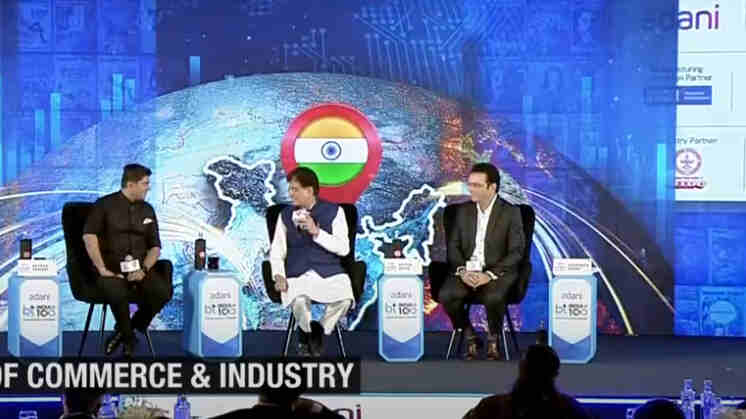
Read the full transcript of Union Minister Piyush Goyal’s interview on Trump Tariffs On India, Free Trade Agreements & More…
India’s Strategic Position in Global Trade
INTERVIEWER: Thank you very much. Sakshi Namaskar Piyuji, thank you very much for joining us at what is clearly a pivotal moment not just for the Indian economy, but for the global economy. You made time despite your busy schedule and have come here straight from Parliament.
What we want to do, Gaurav and I hope to navigate with you a set of questions that explains to our audience here as well as those who are tuning in all across India Today platforms, what the new trade order is going to look like and how and what is India’s strategic playbook.
Before I get into some of the questions, I want to relate to this audience here, my own personal experience. After years, I got the opportunity to go out on a reporting trip with Piyuji to Sweden. One of the things that I realized in that hall of people – there were a thousand people and the biggest industries that you could think of, including companies who have been investors in India for well over a century – was the amount of interest that event had.
I have been on previous such reporting assignments. I have covered commerce but I haven’t seen that kind of interest. So I wanted to tell the audience this and I want to begin from there. If that is the level of interest towards investing in India, how do you see the engagement with the world as we stand at this pivotal moment?
PIYUSH GOYAL: Thank you Siddharth. But before I go forward, just two data points.
First, I want to thank you for this outstanding initiative to suggest 100 big ideas. This is exactly what we are looking for. This is the need of the hour today. Before coming here, my last meeting was with CII where I was asking them for exactly this thing – what should we do so that we prepare India in the Amrit Kaal in our journey to Viksit Bharat to make life easier for businesses, to make it enjoyable to do work in India, for making it easier for the lives of the common man.
We want any and every idea to come on the table. We want to have out of the box ideas, we want to have outlandish ideas. We want to experiment with the bold. Thank you so much for this initiative.
The second point you just mentioned was you are thanking me for sparing my time. Maybe that thank you should go to Mr. Rahul Gandhi and the Congress because with Parliament not functioning as it should be doing – with debate and dialogue and discussion on bills, raising issues of public interest, taking up issues of concern, discussing the very sad tragedy in Uttarakhand, discussing ways to make India grow faster and better and bigger, working together for a better future for the children of India – we find them disrupting Parliament, making fake narratives.
But to your question, world keeps evolving, international trade keeps finding new pathways. What we are seeing today is possibly a churn that is bound to happen over every few years. Over every few years new countries come up, some countries go down. This is a part of history of nations and I think this is India’s time.
Navigating the New Trade Order
INTERVIEWER: You’re like a man on a mission. You’ve concluded a deal with the United Kingdom. You’re concluding a deal with the European Union. And you recently said “it’s so near and yet so far.” And of course there is the United States of America. 25% plus 25% imposed. How do you look at this challenge?
PIYUSH GOYAL: Remember 1999 when everyone thought the sky was going to fall on the world’s head? I am referring to the Y2K moment. 31st December 1999, 12 midnight – the whole world had assumed and were convinced, all the western developed world, very so-called evolved and intellectual people were all convinced that on the 31st of December 1999, 12 midnight, all systems will crash which they called the Y2K bug.
But look at what India achieved during COVID. My wife told me, and parents across Bharat witnessed – not one death due to starvation in the worst pandemic the world had ever seen and every state has confirmed this in writing to me. Not one person has died because of starvation.
80 crore people got twice the ration which means trains ran continuously, which means logistics systems ran, which means our farmers produced, which means electricity was available round the clock. Our trains are now running on electricity – 95%, almost 90-95%. Electricity companies ran, the coal mines ran keeping social distancing and all the COVID protocols right. We converted COVID to an opportunity.
India’s Economic Resilience
INTERVIEWER: This calls for a round of applause. But Piyuji, I want to ask you since you’re connecting previous challenges with how we dealt with it. How do you think we as a nation will deal with this challenge of de-globalization and how the trade order is being completely dismantled? What do you think is the playbook going to be? How are you going to tackle this? Including these penal tariffs on India imposed by the US?
PIYUSH GOYAL: I don’t see any de-globalization. I see countries restructuring their trade routes and their trade partners and I’m quite confident this year India will do more exports than we did last year.
INTERVIEWER: And you already have mitigated factors put in place?
PIYUSH GOYAL: Well, I think these are questions you should ask the honorable foreign minister. But I can only talk about trade and commerce – India’s exports in the current year will be more than they were last year.
INTERVIEWER: Piyuji, how do you describe the state of India’s economy?
Particularly because someone called our economy a “dead economy” recently.
PIYUSH GOYAL: I think it’s so sad. The whole world is looking up to India. The whole world recognizes us as the fastest growing large economy. We are contributing 16% to global growth. Our inflation is amongst the lowest in the world compared to other emerging market economies.
Our currency, our foreign exchange reserves, our stock markets, our macroeconomic fundamentals are the best. The world recognizes it. You said so yourself during your visit with me. The world wants to come and work in India. The world wants to work with these 1.4 billion young, dynamic, enterprising, aspirational Indians. They recognize the talent, the skill that young India has.
So India’s got a very bright future. I think parroting a negative narrative by the leader of the opposition is a matter of shame. I condemn him for that. And frankly, the nation will never forgive Mr. Rahul Gandhi for this kind of very, very demeaning comments about the great story that Bharat is demonstrating to the world.
Trade Agreements and Global Partnerships
INTERVIEWER: You recently concluded a very positive trade agreement with the United Kingdom, with the EU. If we were to get into some specifics because you said “so close and yet so far,” how do we speed up to bridge that gap?
PIYUSH GOYAL: First of all, negotiations are done in the negotiating room, so we won’t be discussing negotiations and negotiating strategy here. But I think any such statements like the one we referred to will automatically die if people like your channels – and you claim to be one of the highest viewed channels, right?
INTERVIEWER: The highest viewed, the best.
PIYUSH GOYAL: If you stop showing this fake propaganda and if you stop giving time to such negative stories or negative mindset that some people display, automatically this will be a dead issue.
As regards the foreign countries or other countries in the world, they go by facts and figures. They don’t even recognize the gentleman you were saying is making these disparaging comments despite being the leader of the opposition in India. I think somehow he has made up his mind that all his life he’s going to remain in opposition.
Vision for India’s Global Trade Future
INTERVIEWER: Piyuji, I want to turn the attention of our audience here and those who are tuning in currently to the broader vision with regard to our playbook for global trade. I think in the last one year you must have maybe had conversations with two dozen countries for global trade or more.
So if I were to ask you by 2030, 2035 or 2047, what would be the shape of India’s engagement with the global trading blocks and how many free trade agreements would we have? You have made it clear to us how the previous round of free trade agreements was with economies that were still developing and how you are now pursuing a developed strategy. Can you give us that overview?
PIYUSH GOYAL: Well, I think India today is much stronger, much more self-confident, much more respected. We have a decisive leader. Prime Minister Narendra Modi is amongst the tallest leaders in the world. Most respected.
We have today a country which produces the highest number of STEM graduates every year. We have a country which is already growing at six and a half percent a year which will only get better in the years to come.
We will of course have trading arrangements with other nations with whom we have complementarity rather than doing trade agreements with countries as was done by the UPA, which really didn’t help Indian business as much as it should have.
Whereas on the contrary, if you see our trade agreements, even Business Today and India Today could not find fault with it despite your best efforts. So UAE, Mauritius, Australia, the four nation EFTA bloc – Switzerland, Norway, Liechtenstein and Iceland. UK we are in dialogue with many other countries. Oman, EU, US, Chile, Peru, many others, New Zealand – many others want to start engaging with India.
So today the world recognizes the strengths of India, recognizes our demographic advantages, recognizes what 1.4 billion aspirational Indians bring to the table as demand. The aggregate demand that India has is a huge market. Why else do you think everybody is vying up to do trade or have better market access in India?
INTERVIEWER: Do you think, sir, that a trade deal with the United States is still possible?
PIYUSH GOYAL: As I said, we don’t do negotiations on the media stage.
Addressing Trade Deal Concerns
INTERVIEWER: You spoke of our farmers and our dairy. You spoke of the Prime Minister’s resolve. All your trading partners, they respect our sensibilities on agriculture. You said that we couldn’t find fault. I’m not asking you this question to find fault but to address some concerns that we have had.
During this event, sir, we have had sessions where a couple of points were raised. One, with regard to the UK deal specifically, that we have given them far too much access, including access into government procurement. That’s point number one. The second is that for certain sectors, including for example alcohol, there is again India, according to that view, has given far more than it should have. What would you say to these two specifics?
Government Procurement and Trade Benefits
PIYUSH GOYAL: In fact, whoever gave you both these comments needs to go back to school. As regards your first point on government procurement, we have obviously opened up a large government procurement in the UK for Indian entrepreneurs. So it’s a two-way traffic.
Whoever it is, if he thinks that everybody should open their markets to India and India will not do anything for them, is living in a cuckoo’s world. And in any case what India has done is protected all its MSME sector and the privileges or the priority given to MSME sector, that’s all entirely protected.
We have only agreed to allow UK companies to be considered as a Class 2 supplier, not Class 1. Whereas in return there’s a social value regiment in UK which would restrict Indian companies from bidding in UK government procurement. That will not be applicable anymore. So effectively we’ve opened up a larger opportunity for India’s businesses in UK’s public procurement. That’s to your first question.
Scotch Whiskey and Market Access
The second question is absurd and in fact it is these narratives which has held back India for the last 25 years. This UK trade deal has taken almost more than two decades to happen. More than two decades of lost opportunities. Mark my words, lost opportunities. Two decades of lost opportunities. Because this silly attempt to not allow alcoholic beverages to come to India.
Now mostly what UK exports are Scotch whiskey. That’s a GI product. It is made only in Scotland. There’s a limitation to how much they can make. It’s a labor intensive industry, a very high cost of labor in those regions. Scotland probably more than UK also, rather I mean more than the London or the England region.
And already if you see the statistics, more Scotch whiskey comes into the country through the duty free shops at the airports than actually imported as Scotch whiskey. The total import of Scotch Whiskey is probably 2 or 3 thousand crores. Can you believe it? 2 or 3 thousand crores is the total import.
And that also largely comes in bulk, which means it is bottled in India. It adds business to our bottling plants, it adds business to our blending plants or whiskey making plants. Jobs are created in India and instead of spurious liquor, there’s a joke going around. I don’t know how far it’s true and I have no way to verify it because I don’t drink Scotch whiskey. But I’m told there’s more Scotch whiskey sold in India than is produced in Scotland. I think you must have heard that.
So would you rather not have that? We open one or two sectors like this and in return get more than 99% access, my new friends. More than 99% access, preferential access in most cases, zero duty access to a large market like United Kingdom, which is almost as big as the Indian market with a per capita income of $50,000. People spending money at that level. What is entrepreneurs, startups. So I think it’s an absolutely wonderful deal.
Whoever has studied it, any economist, any newspaper, any editor, they have all appreciated that it’s a win for India in a big way.
Social Security Benefits for Indian Workers
In addition to that, what we have negotiated was beyond anybody’s imagination. We have about 1 lakh people working on short term visas in Ukraine and that number keeps growing. You are aware of that? Siddharth, you’re aware that the Social Security payment of these. Yes, largely young people who work in UK, mostly in the IT sector and other areas.
12 and a half percent is deducted from the employee salary. 12 and a half percent is paid by the employer. The purchase percent of your salary used to be paid to the UK Treasury. And since you didn’t stay there for 10 years, which was a minimum period to get pension, that money was gone forever. These people never got any benefit out of 25% of that person’s salary. They’re all Indians working there now.
And most of them go for 2 years, 3 years short peanut visa now for 3 years. This entire money instead of being paid in UK treasury can be deposited in the provident fund account in India which will earn 8% plus tax free interest for our youngsters. And that money will be yours. It will not be taken away by the UK Treasury. Social Security, Scotch whiskey.
INTERVIEWER: Scotch drinkers or gin drinkers.
PIYUSH GOYAL: Lake deal Karta processes, the Vijay Malias, the need of Modis and those legal processes.
The Art of Deal Making
INTERVIEWER: Since we are talking about, and you said that you are the Commerce Minister and therefore a trade negotiator. You’ve been to Harvard and clearly you know a thing or two about deal making. What I want to ask you here is what are your tips to all those people? And there are a lot of people from business and I’m sure many more who are watching us live right now who would want to learn a couple of tips from you. Maybe the top three tips about the art of deal making.
PIYUSH GOYAL: No. Then let me clarify. I’m a dropout. I had only gone for an OPM program which Kali has also done, but she’s successfully completed and graduated. I’m a dropout. I could only do one module in 2000.
INTERVIEWER: Many dropouts are billionaires.
PIYUSH GOYAL: I think what matters most, and this is for the young people who are listening in into this program. What matters most to be successful is to be sincere, is to be honest. Is to be upfront and remember in life that a deal can only work when it’s a win-win for both. It can never be a lopsided one-sided relationship. If you respect the other person you receive corresponding respect. And I think success in deal making is entirely a result of sincerity, sincerity of purpose, sincerity of objective and honesty in your dealings.
Democracy and Electoral Integrity
INTERVIEWER: And we don’t let any external power decide who our friends are, who we go to, who we deal with.
PIYUSH GOYAL: Boss, I know you are a veteran journalist and but I’m no rookie either true.
INTERVIEWER: Or apart from all these pressures. So people talk very highly of India as a democracy but then within our country there are those who say elections are rigged, election commission is rigged, election commission works at the orders of your party. Does that take away from the strength of our democracy?
PIYUSH GOYAL: How would you respond to those? I think these are such absurd comments that they only deserve to be condemned and not even responded to. Diamond mining people have also given up so they have decided to assist side Kabul side shows sideshows side shows kyoper koi time waste kartaning institutions go run down or election commission perfect system fair free or duplicate voter Mumbai said delete I’ve lost both my parents or a fake narrative other than your channel Koshaida Chi headline Miljati.
INTERVIEWER: Headlines.
PIYUSH GOYAL: Per fake narratives the Kanika bid out convinced specifically I challenge both of you.
INTERVIEWER: Well I think we’ll leave that challenge for some other time.
PIYUSH GOYAL: Matlab you don’t have anything to say and if you don’t have anything to say the least responsible channel like yours where people like Raj Chingapa are also editors will sift the truth from the fake narratives Fact check.
Investment Commitments in Trade Deals
INTERVIEWER: We are out of time but just one question and I wanted to take this and this is a very unique feature of one of the recent trade deals that we have done Massive amounts of committed investment that will happen into India. I just want you to take a minute to explain that before we end.
PIYUSH GOYAL: Friends see earlier we used to do free trade agreements and we used to think that duty concession is the only element normal duty economy and we are the fastest growing large economy in the world. Aging population economy, dollar economy Just a win-win situation. How do we balance benefits on both sides? Technology innovation yes Dairy, agriculture products, rice, wheat There is no free trade agreement in history Just may investment committed investment commitment without a bilateral investment treaty or ESSA commitment cast in stone I have a clawback clause Manufacturing innovation, research, financial services I taste stock market investment included FII investment foreign institutional investor FDI investment Sade artlag throat kick commit K this said direct jobs Indian partners ecosystem develop OGA infrastructure develop OGA investment is ACHE FTA direct, indirect or from first October IFTA agreement is going to come into effect.
INTERVIEWER: Thank you very much for explaining that and taking us on a journey as to what our trade engagement will be at a pivotal moment for the global economy as we move towards 2047. Thank you very much for your time and for giving us all those headlines today. Thank you. Thank you so much. Honorable Minister, can I please request you to stay back on stage While I request Ms. Kalipuri, Vice Chairperson of India Today Group, to please present a token of appreciation to our honorable guest here.
Related Posts