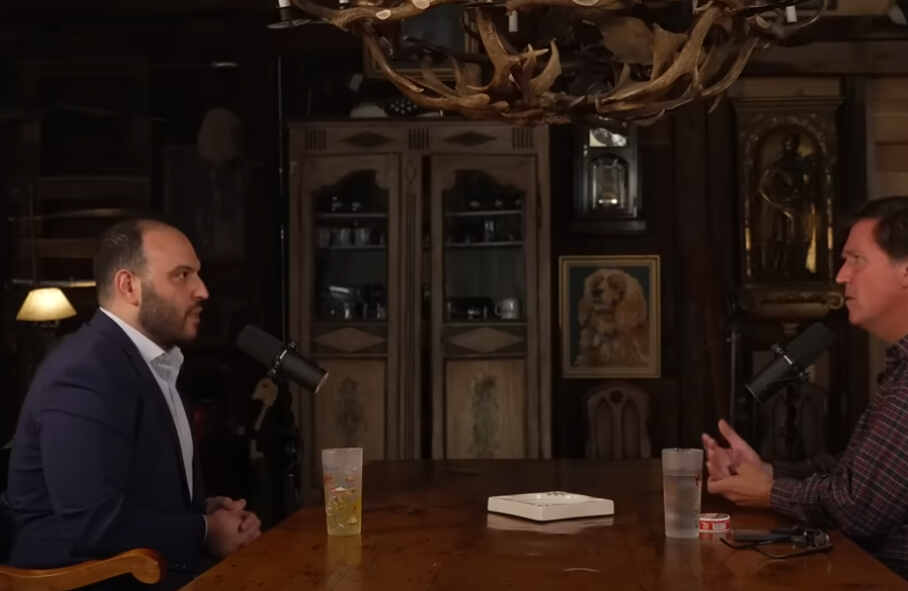
Read the full transcript of former U.S. State Department Press Officer Shahed Ghoreishi’s interview on The Tucker Carlson Show episode titled “Whistleblower Exposes the Real Puppet Masters Controlling the State Department and Plans for Gaza”, September 5, 2025.
The Role of a State Department Press Officer
TUCKER CARLSON: So you were marched out of the State Department two weeks ago. You left involuntarily. And I want to hear why. But first, what did you do there? What was your job at the State?
SHAHED GHOREISHI: I was a press officer in the Near Eastern Affairs Bureau. Started September 2024. Essentially, the main bread and butter role of a press officer is twofold.
One is preparing the spokesperson before they go on the podium and do their daily press briefing. And second, reporters ask questions all the time. So a reporter with XYZ Outlet submits a question and it’s our job to use cleared lines or cleared meaning approved lines, and send them back to the reporter.
And if you ever read an article and it says “a State Department spokesperson said X,” those are press officers taking those cleared lines and sharing it with that reporter.
TUCKER CARLSON: Who clears the lines?
SHAHED GHOREISHI: Good question. So a press officer will draft the lines. From there, it will go up a ladder, essentially. So there’ll be desk officers, leadership in the NEA press office itself, and then it goes up to the seventh floor, meaning the Secretary’s Policy Planning Office, the Deputy Secretary State’s office.
But it’s not themselves. Like you’re not going to get the Deputy Secretary of State looking at this. It’s going to just be like a staffer who represents that equity. So it becomes an inclusive process to make sure everyone has eyes on it. And if there are flags, they’ll let you know.
For example, you could be drafting a line on Israel, but it involves Lebanon. But there’s another press officer and a whole other desk and leadership working on Lebanon that might have an equity that you may not be aware of, that they’ll edit the line.
The Near Eastern Affairs Bureau
TUCKER CARLSON: So describe the bureau that you work for. Near Eastern Affairs.
SHAHED GHOREISHI: Yes.
TUCKER CARLSON: What is that?
SHAHED GHOREISHI: It’s. Well, it’s an old school name. Basically means anything involved in the Middle East. So it’s Morocco to Iran, the whole.
TUCKER CARLSON: Middle east, not just the Levant. Like the whole Middle East.
SHAHED GHOREISHI: Yeah, Near East. Yeah, it’s a. They need to update the name. I think people are aware. But yeah, it’s the entire Middle East. So it’s. They use all these acronyms. So Israeli Palestinian affairs is IPA or ispal. Saudi, Oman, Yemen, Bahrain. That whole grouping is ARP for Arabian Peninsula. And then North Africa is its own entity as well, from Morocco to Egypt, goes under na.
TUCKER CARLSON: Okay, so it’s the Levant, the Gulf, Iran.
SHAHED GHOREISHI: Yeah, Iran Africa.
TUCKER CARLSON: Huh. Interesting. And that’s all in the same bureau. So the State Department divides the world into bureaus.
SHAHED GHOREISHI: Correct.
TUCKER CARLSON: Which are often called desks.
SHAHED GHOREISHI: Correct, Correct. So from Canada down to Chile’s wha, Western Hemisphere Affairs. Asia is eap. Eastern Asia, East Asia, Pacific. So we have all these divisions. Europe, Africa. Correct. EUR for Europe, Africa’s af.
I was an nea and I was a press officer there originally covering Lebanon, Jordan, just for a couple months. And I quickly shifted to Ispal.
TUCKER CARLSON: Israel, Palestine.
SHAHED GHOREISHI: Israel, Palestine. Whoa.
The Israel-Palestine Desk Assignment
TUCKER CARLSON: So that’s the hottest of all desks, I would think.
SHAHED GHOREISHI: Yes.
TUCKER CARLSON: Most scrutiny, most at stake rhetoric, most closely supervised.
SHAHED GHOREISHI: I would.
TUCKER CARLSON: I’m just guessing, but.
SHAHED GHOREISHI: Right. Yes, it’s true. The press officer for Israeli Palestinian affairs, you’re on a stage constantly because you’re getting the most questions from reporters for good reason. The spokesperson is going to deal with the most questions at the podium about the topic.
And so it was a compliment, yet difficult for me to process the fact that it was requested from various people in leadership when the administration was changing in January, they said, “hey, I know you’ve only been here for a couple months, but we’re going to put you on this in this position.” Which was surprising. But I wanted to take on the challenge at the time.
TUCKER CARLSON: Really. So you were asked to do that by the incoming administration, by the Trump administration.
SHAHED GHOREISHI: It was, well, it was people from. It was leadership in nea, which some of them were civil servants, but there were experienced people that were. That recognized how heavy a topic it was going to be coming in.
Research and Information Gathering
TUCKER CARLSON: Huh. How do you get current on that? How do you do your research?
SHAHED GHOREISHI: So it’s multifold. So we do receive like in terms of standard mainstream media, we do get like copies of articles and coverage. And it’s not necessarily politically isolated, at least in the beginning it wasn’t. So I would see everything in my email inbox. Plus, personally. Right. I’m always absorbing things. And you’re only going to be a good press officer if you’re reading Twitter and the standard emails you’re getting through the inbox.
TUCKER CARLSON: Yeah.
SHAHED GHOREISHI: So you’re absorbing a lot of information. And it’s not just the details. Like, of course, if I have a question, I want to go to the Israel experts at the State Department. So if there’s a detail I don’t know, there might be a desk officer or someone like that that would know that those details, the numbers or the challenges that I need for a specific press line.
For me, though, as a press officer, my addition in those conversations is more stylistic.
So it was a stylistic endeavor from day to day and you don’t have full control because obviously the personality of someone at the podium is going to say it one way. Even though I was hoping this line would deliver this other way. Right. You don’t have full control, but you do have a.
The Spokesperson Structure
TUCKER CARLSON: Who’s the spokesman for the Near East?
SHAHED GHOREISHI: Well, right now it’s more the spokesperson of the entire department that I was briefing. So it was Tammy Bruce. She left. And then there’s deputies that are currently.
TUCKER CARLSON: Where did Tammy Bruce go?
SHAHED GHOREISHI: She’s going to the UN from my understanding.
Daily Operations and Press Guidance
TUCKER CARLSON: Okay, so were you given parameters like how do you get your orders? Like, we do say this, we don’t say that.
SHAHED GHOREISHI: So the main day to day activity that I think people may or may not be aware of, but are probably not aware of is that I have these packets called Press Guidance, called pg.
So on Tuesday and Thursday, which are the days that a spokesperson would go on to the podium, I would have all the sample questions and some of them are tasked from the main press office in. At the State Department. But I also would come up with my own questions, like, “hey, we’re getting this question a lot. We need to have lines for this. We can’t leave this alone.”
So I’d have create a packet, clear it through, through the building, like I was saying earlier, through the seventh floor, and then I’d present that brief the spokesperson about two hours before she went onto the podium.
Determining Official US Policy
TUCKER CARLSON: How do you know what the official US Position, especially on that topic, Israel, Palestine, I mean, that’s again, the most politicized area there is and it’s. The stakes are high. So how do you know what the official US Position is on that conflict?
SHAHED GHOREISHI: It’s a very good question, especially in the beginning of the administration. It’s a bit of an art. You’re taking. The gold for a press officer are lines from the principals. Essentially, if President Trump says something, if Special Envoy Wyckoff says something, I take those quotes and I’m like, “oh, that’s policy.” So if he’s talking about.
TUCKER CARLSON: And I think that’s literally true. Right. I mean, the president sort of unilaterally can form our foreign policy.
SHAHED GHOREISHI: Yeah. There’s no questioning like a quote that comes from a principle, especially President Trump or Secretary Rubio for the State Department is often the case. So I would take those lines and it would answer certain questions that would come up.
Where are we with the ceasefire? Oh, Special Envoy Wyckoff went on XYZ Sunday show so I’ll pull that line and I’ll brief the spokesperson and then she or he can quote Special Envoy Wyckoff at the podium. Again, because that’s the policy. That’s the easiest way of doing it.
You don’t always have quotes. So what would happen instead? Is it kind of. Did you ever get a question on that question on.
The Forced Displacement Controversy
TUCKER CARLSON: Well, I mean, if you say, you know, you should respond in this way and then cite the president or Steve Witkoff or Secretary Rubio, then that kind of, that kind of ends the conversation, right?
SHAHED GHOREISHI: It should end the conversation. What was surprising, and this will go back to why when I ended up departing and getting fired in August, was that on a specific question? One of the three events I think led up to my firing was on a Monday we received a question about forced displacement, which essentially ethnic cleansing and what our policy was about Israel intending to move Palestinians in Gaza to South Sudan. So.
TUCKER CARLSON: To South Sudan.
SHAHED GHOREISHI: Yeah, that was every two or three months. We had a new reporting would come out in the spring. It was, they’re moving Palestinians in Gaza to Libya. There was a rumor about Somaliland, even though we don’t recognize Somaliland. But there was reporting about are we going to do an exchange where we recognize Somaliland but they have to take on Palestinians. And then we had an Ethiopia round. And then the last round that I witnessed before I left was South Sudan. So.
TUCKER CARLSON: And so that appears in. Somewhere in the press.
SHAHED GHOREISHI: Appears somewhere in the press. And we received a question, “what’s your response to this reporting?” And then I, I came up with a line. Not. But it wasn’t a line that like I just came up out of the blue. It was something that President Trump and Special Envoy Witkoff had said. In other words, in the spring, I said, “we do not support forced displacement.” And why?
TUCKER CARLSON: What did they say about it? So that was your interpretation of what they said. Do you remember what they said, what Wyckoff and Trump said on that topic?
SHAHED GHOREISHI: So specifically special on why Witkoff said something we’re not saying said something along the lines of “we’re not trying to evict anybody.” Right. So from, as a press officer, there’s an art to it, right? You can sometimes do the exact quote or you can come up with a new line that reflects that quote.
TUCKER CARLSON: I think forced displacement and eviction are synonyms, right? Any fair person would say that.
The Forced Displacement Line Controversy
TUCKER CARLSON: Can you explain why they cut it?
SHAHED GHOREISHI: No, they. All I got, from all I heard, all I eyewitnessed was the acting spokesperson saying.
TUCKER CARLSON: So you were paraphrasing the envoy, Steve Wyckoff, and the president, United States, Donald Trump, when you said the United States does not support forced displacement.
SHAHED GHOREISHI: Yep.
TUCKER CARLSON: I don’t think we do support that, do we, by the way?
SHAHED GHOREISHI: I would hope so.
TUCKER CARLSON: Yeah, one would hope not.
SHAHED GHOREISHI: Right.
TUCKER CARLSON: And especially we’re not going to pay for that. And they cut that out, but didn’t explain why.
SHAHED GHOREISHI: Right.
TUCKER CARLSON: And then your supervisors came to you and said, hey, they’re complaining about you, basically.
SHAHED GHOREISHI: Right. And they didn’t. They only specified that line, just like the act of drafting it. And I was like, I have a track record. They asked me Thursday afternoon and Friday morning twice in a row, which is very odd for a random bullet. I was like, I have the evidence from July 28th of clearing this press guidance with that line. And here are the relevant quotes.
TUCKER CARLSON: Does anyone say, by the way, you may not know this, but the United States does support forced displacement.
SHAHED GHOREISHI: No one said that. No one said that.
TUCKER CARLSON: But by the way, sorry, I got it wrong. We’re all about forced displacement. Okay? We want it. We want to kind of want a trail of tears situation here because we’re for that.
SHAHED GHOREISHI: It’s tragic because it’s such a standard.
TUCKER CARLSON: So bonkers.
SHAHED GHOREISHI: Yeah. That’s something you would want to advertise. You want to put out there that we’re against this. Like, hey, we still have some moral standing somewhere. And when the Washington Post piece came out like yesterday, two days ago, saying there’s some plan involving the consultations of Tony Blair of moving Gazans out, but we may pay for something, a piece of it, I’m like, why?
So is this why I got fired? Is it because I was still sticking through this line and they saw me as some kind of obstacle, which I wasn’t because I was going through the exact procedures they wanted, but I knew that when I was fired as someone who was, again, close with political appointees and with civil servants and was pretty well established in NEA. Again, like I said earlier, you don’t get this role covering Israeli Palestinian affairs on a whim and it was suddenly pushed out. That means things are going to go into a very radical direction.
Addressing Partisan Accusations
TUCKER CARLSON: I should also say, because I know that you will be attacked and I’ll be attacked for speaking to you on the following grounds. This guy’s a partisan Democrat who liked Bernie. He was a saboteur, a wrecker. I know from our conversations off camera, at least. What you said to me was basically agreed with Trump’s foreign policy instincts, you know.
SHAHED GHOREISHI: Yeah.
TUCKER CARLSON: Fewer pointless wars, like, get along with more people.
SHAHED GHOREISHI: Yeah. That was fair. That’s fair. I’ve always been an advocate for ending endless war on a personal level. And so when President Trump is saying, hey, we don’t want to get into any forever wars, I’m like, that’s great. And we technically started with a ceasefire in Gaza and started the administration. That was something to. We could have expanded on. We were speaking to the Iranians, so there’s so many chances for true peace. But things went in the wrong direction, I would say. Somewhere in the summer.
Right. I remember listening to President Trump’s speech in Saudi in May where he was talking about.
TUCKER CARLSON: Amazing speech.
SHAHED GHOREISHI: Love that speech. I remember I was. I was like.
TUCKER CARLSON: I was cheering.
SHAHED GHOREISHI: Exactly. In my cubicle at the State Department. I was like, this is a great speech.
TUCKER CARLSON: I was, too. That was one of the best speeches ever given.
SHAHED GHOREISHI: And I was like, this is amazing.
TUCKER CARLSON: It was ballsy, too. Speech. Yes.
SHAHED GHOREISHI: Calling out neocons like, oh, I know. No one calls out neocons in DC. Right. We brushed that under the rug. We kept moving. Right. You still see him as an analyst here and there on TV, here and there.
TUCKER CARLSON: They dominate the biggest cable news channel. Yes, I’m aware. Yeah.
SHAHED GHOREISHI: Yeah. So, so glad to see that. But then why two weeks later were we sabotaging our own talks with Iran and then bombing them? Right. So the events, like the idea that I’m some partisan is. Is just wrong, I guess, on a personal avenue. I don’t want any more endless wars. And. But President Trump was in line with that, and I was going. I was doing my job in line with the procedures that were necessary every single day.
TUCKER CARLSON: Yeah. But it sounds like you agreed with him, so I guess that’s my point. If you. You like that, I mean, I don’t know. You know, a lot of these. Some of the labels are real, but some of them are also created and certainly sustained in order to keep people from listening to each other so they don’t discover they actually agree on a lot.
SHAHED GHOREISHI: Yeah.
TUCKER CARLSON: And if you love the Saudi speech and I love the Saudi speech, then we’re probably not too far from each other then, because I thought that. And that was a Donald Trump speech. And by the way, if you’re such a partisan Democrat, you’re admitting on camera that you loved a Donald Trump speech, you’re not too partisan, I guess. But anyway, I just want to say.
SHAHED GHOREISHI: Honesty matters. Yeah. It’s like. It’s the issues we have in foreign policy that matter that I care about. I don’t care about the labels per se.
TUCKER CARLSON: Well, I don’t either. Well, they’re clearly meaningless.
SHAHED GHOREISHI: Yes.
TUCKER CARLSON: If we’re both cheering on the Riyadh speech.
SHAHED GHOREISHI: So.
TUCKER CARLSON: Yes.
SHAHED GHOREISHI: Okay.
TUCKER CARLSON: I just wanted to establish that. So you start hearing from your bosses, like, hey, what is this thing that you put in there about opposing forced displacement?
SHAHED GHOREISHI: Yeah. Four or five days earlier, not even, like, the next day. There was a delay. Annoyance. It was weird, huh.
TUCKER CARLSON: So you said that there were three examples of this where they found problems with your work.
The Journalist Condolences Controversy
SHAHED GHOREISHI: Right. And some of this, it kind of made sense from hindsight because I didn’t like in the moment. I didn’t realize. But Sunday, Israel had struck a tent with several journalists living inside, including Anas, who had. Who millions of people had watched cover the events in Gaza. They all died. I drafted a line, a few lines. And by the way, there were not. Saw some softy lines. The only thing that was there that he didn’t like was I did share condolences, which is pretty standard policy.
TUCKER CARLSON: Condolences? What you mean?
SHAHED GHOREISHI: So I said we share condolences for the families of the killed journalists. That’s all.
TUCKER CARLSON: Well, that sounds. That sounds like hate speech to me.
SHAHED GHOREISHI: Yeah.
TUCKER CARLSON: Condolences to the families of people who got killed.
SHAHED GHOREISHI: Yeah.
TUCKER CARLSON: Non combatants killed in war.
SHAHED GHOREISHI: Yep. Yep. And what’s so disappointing, too, was that.
TUCKER CARLSON: Wait, wait.
SHAHED GHOREISHI: So what.
TUCKER CARLSON: So what happened when you put that in there?
SHAHED GHOREISHI: I was immediately told from a senior official that we don’t know what Anas did, essentially. And I was like, that’s odd. And what he did, like, we don’t know what his, like, conduct was like. We don’t know. We didn’t like. We need more information. He might. It was through the she or he was alluding to the fact that he may have done something or he’s a, he’s a problematic actor in some way, but it was weird.
TUCKER CARLSON: Okay, I, I. Let me just say I would be totally comfortable sharing condolences with Osama bin Laden’s family. I hate Osama bin Laden. On the other hand, if somebody dies, it’s okay to say I’m sorry to.
SHAHED GHOREISHI: His family that he had a toddler.
TUCKER CARLSON: That’s what I’m saying. Yeah. That’s immaterial. I would say that to the family of an executed murderer in a prison. It doesn’t mean I support the murder or the murderer. But this is family. Like, that’s okay. That’s called like human decency. And anyone who’s against that.
Deferring to Israeli Statements
SHAHED GHOREISHI: Yeah. And it seemed that we’re setting up this constant, this is, this is my issue that I noticed from the get go, a constant deferring to Israel. It was like waiting for some statement, like, let them speak first. And then on Monday, Israel said, all Hamas, which is a throwaway line they’ve used.
TUCKER CARLSON: All Hamas, meaning what?
SHAHED GHOREISHI: They’re journalists.
TUCKER CARLSON: Were all Hamas.
SHAHED GHOREISHI: Yeah. Or at least on us, if I remember correctly. And so they brushed that away. Were they? Look, my point when I heard that was what does our intelligence say? If they were like being super strict and said, hey, we’re going to, we’re going to triple check using our US Intelligence of who these people are. Maybe, Maybe. Right. I still don’t agree with cutting the condolences line, but sure. But why is there, oh, Israel said this. Done.
TUCKER CARLSON: We don’t have intel services.
SHAHED GHOREISHI: Right, Right. So what’s with the instinct to defer to Israel when we have the entire apparatus that could check that?
TUCKER CARLSON: And then by Tuesday, like 17 different intelligence services in this country that takes, you know, a trillion dollars a year, whatever the actual budget is. And we don’t consult them at all. We wait for the Israeli spokesman to tell us what reality is.
SHAHED GHOREISHI: Awful.
TUCKER CARLSON: That what you’re saying?
SHAHED GHOREISHI: Yeah. And how is that? America first. Right. This whole apparatus of like, of, of mirroring certain Israeli statements and waiting for them to comment first was something that I found tragic. It was, it was odd. And that’s what ended up happening by the press briefing that Tuesday. We’re like, we referred you to Israel, which was a line that popped up in my press guidance way too often.
State Department Deference to Israeli Positions
TUCKER CARLSON: Right. And that came up on any topic that was somewhat sensitive or waiting for Israel to make a move.
SHAHED GHOREISHI: Does the State Department have any position that contradicts the position of the Israeli government that you’re aware of?
TUCKER CARLSON: No. I think no. The closest I think on for US interests, we do, but in our current policy and posture, we do not. So not one. The closest we got.
SHAHED GHOREISHI: Do you have any siblings? I do. Do you love them?
TUCKER CARLSON: I love them.
SHAHED GHOREISHI: Do you have any sticking points with them? Is there something you don’t fully agree on?
TUCKER CARLSON: As many siblings do.
SHAHED GHOREISHI: Exactly. Exactly. So loving someone or having an alliance with someone or even like sharing the same parents as somebody doesn’t mean that you have to agree on every little point.
TUCKER CARLSON: It would be weird if you did. It would be weird. Yeah.
SHAHED GHOREISHI: Identical twins have disagreeable.
Attacks on Christians in the West Bank
TUCKER CARLSON: This is getting a little weird. Why is everyone acting like this? It’s very strange. And the closest we came and there was no follow through was when I actually liked the statement. It was a thousand other things. I had personal issues which was irrelevant.
But Ambassador Huckabee, when there was these attacks against Christians in West Bank, he did put out a statement saying, “These attacks are unacceptable. We call on Israel to investigate,” but there’s no follow through. Right.
SHAHED GHOREISHI: What do you mean?
TUCKER CARLSON: He had a statement that said, oh.
SHAHED GHOREISHI: I remember it very well.
TUCKER CARLSON: Yeah, there’s no follow through. And like, you’re like, “Oh, that’s a good statement. That’s oh, my God, you can’t attack Christians.”
SHAHED GHOREISHI: With US tax dollars. Sorry.
TUCKER CARLSON: Yeah. Yep.
SHAHED GHOREISHI: And not allowed.
TUCKER CARLSON: Yep.
SHAHED GHOREISHI: I don’t care who you are.
TUCKER CARLSON: And it was, it was just, it was one statement and there was no like. And if we got questions like, “Hey, what’s the status of the investigation?” We freed Israel, right?
SHAHED GHOREISHI: So, so no one at the State Department looked into it.
TUCKER CARLSON: Not that I saw.
Lack of Follow-Through on Investigations
SHAHED GHOREISHI: This is a majority Christian country, but nobody felt like that would be a good use of American tax dollars to find out what this was or ask anybody any questions.
TUCKER CARLSON: And that’s the thing. Each time there’s a call for investigation, a very rare opportunity that that’s in front of us, there’s no follow through. You, strong statement. We did the thing and you don’t hear about it for weeks and months.
SHAHED GHOREISHI: So there’s no one at the State Department who cared.
TUCKER CARLSON: Look, I don’t want to speak for the entire. I think there were people that cared. I think there are Christians, I care. And look, there are a lot. There are civil servants or political appointees, foreign service officers that see all of this and they’re concerned.
But it’s this style of constantly deferring to Israel that’s at the forefront. So we can criticize up to a certain point. And it’s awful because if we want Israel to investigate, then we should be following up and ask, “Hey, what happened? The investigation I thought you would investigate. Where are the prosecutions? Who did all the, who did this and why?” Yeah, yeah, but we never hear that. We never hear the follow up.
SHAHED GHOREISHI: So there’s no, as far as you’re aware, mechanism in the State Department to. Because you’ve described a relationship that’s unique. There’s no other country in the world that has this relationship with the United States. And a lot of resources go into supporting that country. But there’s no mechanism in the US State Department to like, follow up on this.
TUCKER CARLSON: Look, in the public realm, because I was working, I work as a press officer, right. So I’m always working with reporters and how, like this, the presentation, those things matter. So if there was a system of following up, I didn’t see it. It’s possible. Personally, I kind of doubt it.
SHAHED GHOREISHI: But on the point, followed up, you would have known about it. Because what if somebody asks you, right.
TUCKER CARLSON: And you would think that if there was follow up, you’d want to advertise it too, like, “Hey, we followed up,” but they were, they were. The preference was to defer and deflect and give.
SHAHED GHOREISHI: Nobody gives a shit. You persecute, you know, Christians with American tax dollars. Nobody cares.
TUCKER CARLSON: Yeah, yeah.
The Frustration of Inaction
SHAHED GHOREISHI: Sorry, you’re making me mad. No, it’s just frustrating. It’s frustrating.
TUCKER CARLSON: I know it is frustrating to see.
SHAHED GHOREISHI: People get shot because it’s not a neutral situation. Like, some people are winning and some people are losing. And if the losers are people that you, you know, didn’t do anything wrong. The Christians aren’t in Hamas. Like, what, what’s, what’s their crime?
TUCKER CARLSON: Look, the scenes, the scenes are horrific. So on a human level, it shouldn’t matter. But if that’s the whole thing of having Ambassador Huckabee be there, it’s like, at least maybe you’ll care about this. And then, yeah, you put a strong statement out but don’t follow up.
SHAHED GHOREISHI: Yeah, they don’t care at all.
TUCKER CARLSON: What’s the point?
SHAHED GHOREISHI: Yeah, right. The self described Christians don’t care at all about the Christians. And by the way, the whole justification for all this, you just said it. These journalists get blown up. “They were Hamas,” okay? End of conversation.
No one can plausibly claim that a Christian family are in Hamas. Okay, so, like, what? Tell me. You can’t claim that they’re in Hamas while simultaneously claiming that Hamas is, you know, group of jihadis, they’re Islamic extremists, which they also claim constantly, which I don’t, I don’t know if that’s true, by the way. It seems more like a political organization.
But whatever it is, they’re telling us constantly they’re Al Qaeda. So it can’t also be true that Christians are a member of Al Qaeda. Sorry.
TUCKER CARLSON: Yeah, yeah.
SHAHED GHOREISHI: So then we know they’re not in Hamas. So why did they get killed? Why was their church blown up? Why were they killed in that hospital? Like, what is this? And there’s not one person in the State Department who cares enough to get to the bottom of that question.
TUCKER CARLSON: Yeah, and all you saw, I mean, all I saw. President Trump did call Prime Minister Netanyahu. Netanyahu gave an apology for the church that was attacked in Gaza.
SHAHED GHOREISHI: One of many.
TUCKER CARLSON: But there’s never follow up. There’s never like, “Hey, this is the prosecution. This is where our investigation landed.” It’s this quick two hour brush on the rug. Put a statement out and then you don’t hear anything ever again. Yeah. Wow.
The Third Example: West Bank Stability
SHAHED GHOREISHI: Okay. The third example of work that you produced that your superiors were unhappy with and that led ultimately to your firing was what?
TUCKER CARLSON: So it was a Tuesday, so that’s a press guidance day. All the sample questions, it was actually arguably we said OBE, which meant overcome by events, which means that we’re like beyond its relevancy, but like it was still could come up. So I put it. I left it in.
There was a reaction to Speaker Johnson visiting the settlements in the West Bank. And I had a line, pretty standard and kind of not very specific, but it said, “We support stability in West Bank.”
SHAHED GHOREISHI: Stability.
TUCKER CARLSON: Yeah, we support stability. That’s all. So. And the last. Well, the last piece was comma, “which helps secure Israel.” Right. But the. I think the stable comment was, I don’t know, too much, because if we say we want stable west bank, are we accidentally being critical of something Speaker Johnson or Israel is doing? Right. So what is that?
SHAHED GHOREISHI: I flesh that out, if you don’t mind. Sure. I mean, I know. I know what you’re saying, but I’m not sure everyone does. That’s a good question.
TUCKER CARLSON: So why would the U.S. government. So the U.S. government is against extending condolences to the families of non combatants killed.
SHAHED GHOREISHI: Okay. Correct.
TUCKER CARLSON: And the US Government is also now in favor of the forced movement of large populations. Right. Okay. And now you’re saying the US Government is against stability. How are we against stability? Why is stability a bad thing?
SHAHED GHOREISHI: Now, stability is a word that’s used a lot. And we are on paper saying we support stability in the region all the time. But in this specific context, when discussing settlements, it will sound like we’re critiquing Israel indirectly by saying we support stability in reaction to a question about settlements. Right. So that was how I interpreted the issue.
TUCKER CARLSON: So in other words, that would. You might be suggesting that the US Government opposes radical demographic change in the West Bank.
Embassy Jerusalem’s Role
SHAHED GHOREISHI: Right. Now I have this line again, just like the forced displacement, it had cleared previously. But this is where. What was discussed when this first broke my firing in the Washington Post was that senior officials from Embassy Jerusalem, David Milstein specifically, would occasionally pop into my docs.
Now, it didn’t happen every single day. Pop into your docs like at a Google Doc. Right. Or a. It wasn’t a Google Doc. It was a. It was. I don’t know. The brand doesn’t matter.
TUCKER CARLSON: Like some internal.
SHAHED GHOREISHI: Yeah, an internal system I would share it with in the morning. The equities I was mentioning, One of the equities is Embassy Jerusalem.
TUCKER CARLSON: Okay. So an equity just for State Department speak. People haven’t heard it. Tell us what an equity is.
SHAHED GHOREISHI: It’s like someone has some stake in those lines. Okay. And I would say Jerusalem does, obviously, because they’re the ones that.
TUCKER CARLSON: The US Embassy in Jerusalem.
SHAHED GHOREISHI: The US Embassy in Jerusalem, American diplomats posted Israel on those press briefing days. I would share it with them for them to review the document and be like, “Okay, these are our press lines for these sample questions. Are you okay with them?”
Now it was interesting because they often did not clear, they didn’t reject it. They just. With a non response because the press officers there would defer up the chain to David Milstein and Ambassador Huckabee because they didn’t want to put their name on it. Because if it’s something they didn’t like, no one wants their name on a press guidance that wasn’t approved by these influential people.
David Milstein’s Background
TUCKER CARLSON: Who is David Milstein?
SHAHED GHOREISHI: He is the senior advisor to Ambassador Huckabee.
TUCKER CARLSON: And what’s his, how old is he? What’s his background? Is he a career diplomat or.
SHAHED GHOREISHI: He’s a. From my understanding he’s a political. I believe he worked on the Hill.
TUCKER CARLSON: Oh, did he work for Ted Cruz?
SHAHED GHOREISHI: Yes.
TUCKER CARLSON: Yes, you work for Ted Cruz.
SHAHED GHOREISHI: Okay. And he is the stepson of your best friend, Mark Levin.
TUCKER CARLSON: He’s Mark Levin’s stepson?
SHAHED GHOREISHI: Yeah.
TUCKER CARLSON: He’s working at the State Department.
SHAHED GHOREISHI: Correct.
TUCKER CARLSON: Interesting. So every head of household wants to keep the family safe. It’s your chief duty. Simply safe makes it easy to do that. Now, conventional wisdom suggests that a standard alarm that goes off during a break in is enough.
SHAHED GHOREISHI: Just have an alarm.
The Milstein Controversy: Editing Official Statements
TUCKER CARLSON: Well, it’s not enough. It’s not even close to enough. Think about it for a second. You don’t want people in your house in the first place. True security means preventing that before it begins.
So David Milstein is a political guy working now for Mike Huckabee in Jerusalem and he was going through your lines, correct? Okay.
SHAHED GHOREISHI: Now, on paper, he could be, but the way that he would edit my docs as aggressively as he would. And we can get into this, but the other statements and pieces that were reported in the Washington Post, he would push certain agenda that was very aligned with Israel that I found very problematic.
Now, in this specific example, because we’re discussing the third example of why I was fired was that he changed the stability line to “We commend Speaker Joss for visiting Judea and Samaria.” So we, as a government.
TUCKER CARLSON: Judea and Samaria, it’s a…
SHAHED GHOREISHI: It’s a term that is religious. It’s about Israel’s land grab of the West Bank.
TUCKER CARLSON: Are Judea and Samaria like administrative districts?
SHAHED GHOREISHI: No, it’s not.
TUCKER CARLSON: Is there a mayor of Samaria?
SHAHED GHOREISHI: Nope, doesn’t exist.
TUCKER CARLSON: Okay, so there’s no actual place called Judea and Samaria. We call it, like, the civil authorities don’t recognize Judea or Samaria.
SHAHED GHOREISHI: Nope. It’s the more extreme wing of the elements of the Israeli government. And Milstein was in line with that language and is designed to erase any legitimacy that this is supposed to be.
Biblical Terms vs. Diplomatic Reality
TUCKER CARLSON: So the point is, by using those terms, their biblical terms, they refer to regions described in what Christians call the Old Testament. And the point is to remind everybody that this land was promised by God to the Jewish people, to the Hebrew people, and that anyone who’s lived there subsequently for the last 3,000 years has no right to it.
SHAHED GHOREISHI: Right.
TUCKER CARLSON: That’s the point. But from a sort of government perspective, Judea and Samaria are not real places.
SHAHED GHOREISHI: In that they’re not recognized, not nation states.
TUCKER CARLSON: They’re not provinces. They’re not. And do they have clearly defined borders?
SHAHED GHOREISHI: Not from my understanding. I think they do not. And that would increase. That would give you the open door to more land grabs.
TUCKER CARLSON: But if a place doesn’t have a clearly defined border, then how can the US Government refer to it in any kind of official capacity?
SHAHED GHOREISHI: They can’t. And it’s scary, too, because if you look at the airstrikes that Israel is doing in Syria and they’re building settlements even outside the Golan Heights. It’s all part of this idea of a greater Israel that people are discussing that was beyond these borders. So it’s scary and it’s against the stability of the region that we’ve been calling for as a government for decades.
The Importance of Borders in Diplomacy
TUCKER CARLSON: So certainly in the modern era, definitely since the fall of the Ottoman Empire in 1918, you’ve had clear borders between countries. In fact, we’re fighting a war against Russia right now on the premise that they violated those borders by moving into eastern Ukraine.
So the US Government takes borders very seriously, obviously not including our own. But as a matter of statecraft and diplomacy, that really, really matters. So you would never use a phrase in an official communication that referred to a place whose territory you couldn’t define. That would be 100% crazy to do something like that.
SHAHED GHOREISHI: 100%.
TUCKER CARLSON: Okay. So you think this Milstein guy, who is Mark Levin’s stepson, you say it’s almost like you’re making this up. It’s like a joke. Who worked for Ted Cruz in the Senate, he added this to the statement.
SHAHED GHOREISHI: Correct.
TUCKER CARLSON: And then did it go out?
SHAHED GHOREISHI: So from that point, I cut it because I accepted most of his edits in the document. Because going to battle with him was a whole headache. Because he’ll call, he’ll push certain things. He was known for doing that. Like David Milstein’s phone call was not the favorite thing.
Milstein’s Aggressive Tactics
TUCKER CARLSON: What was it like? Tell us for those of us who don’t work with Mark Levin’s stepson at the State Department.
SHAHED GHOREISHI: Sure. So he would call and he would just push. “Why was that removed?” or “Why was XYZ done?” very often, and if you said no, there was a tendency to go up the chain in order for him to push the agenda of any given day. And this is something that I dealt with since very early.
TUCKER CARLSON: Where is his… Okay, so is he the DCM or what?
SHAHED GHOREISHI: He’s just a senior advisor to Ambassador Huckabee.
TUCKER CARLSON: He’s like an assistant to the US Ambassador to Israel.
SHAHED GHOREISHI: Correct. And sticking with the public reporting from Washington Post, he would push in one occasion, statements that were in the voice of Secretary Rubio, not even the spokesperson. And he drafted them. He would push them through. Like, “I want the statement out.”
TUCKER CARLSON: “I want the statement out.”
SHAHED GHOREISHI: Yeah. He would go through and be like, “I drafted this. This is the statement I want.” I would go through the process of clearing it, but he would fight for it. He’d be in the document getting arguments with people one by one in order to kind of overwhelm the process and get his agenda out there the way he wanted.
TUCKER CARLSON: I mean, that’s pretty cheeky behavior for a guy who’s an aide to Mike Huckabee, former cable news host.
SHAHED GHOREISHI: He’d call around the building. And it was very consistent and persistent.
TUCKER CARLSON: But he lives in Jerusalem.
SHAHED GHOREISHI: He does. And policy comes from D.C. This is obviously of influence and they have discussions, but the policy comes from D.C.
TUCKER CARLSON: What do you mean call around?
SHAHED GHOREISHI: You would go either laterally or up the chain and call various people and say, “Hey, Ambassador Huckabee wants this done” or for XYZ reason. And if that person didn’t pick up, it would go to the next person. So even if we’re discussing equities earlier, if one particular equity said we can’t do this, then he’d go up. “Well, I don’t care because this guy above you may clear it.”
TUCKER CARLSON: And how does he have everyone’s number?
SHAHED GHOREISHI: That’s what I was wondering. I don’t know.
Overstepping Authority
TUCKER CARLSON: But David Milstein, an assistant in the US Embassy in Jerusalem, that’s… I just want to restate. I mean, growing up around this, that’s not a high level post. He has zero authority to do anything.
SHAHED GHOREISHI: And is drafting a statement on behalf… This is very audacious to draft a statement on behalf of Secretary Rubio.
TUCKER CARLSON: The Secretary of State.
SHAHED GHOREISHI: Yes. In one occasion, again referring just to the public reporting, was the statement to condemn Ireland for considering a bill that would put economic sanctions on Israel.
TUCKER CARLSON: Condemn Ireland.
SHAHED GHOREISHI: As you can imagine.
TUCKER CARLSON: So David Milstein was demanding, in effect, the Secretary of State condemn Ireland because Ireland criticized the government of Israel.
SHAHED GHOREISHI: Yeah, actually if I remember correctly, “strongly condemned,” which in diplomatic speaking, that’s strong, but yes, strongly condemn Ireland as a nation. Well, the government, I guess. I don’t remember the language, but that was a rare occasion where it went up the ladder and it was eventually killed. But it required the European Affairs Bureau and NEA and everyone to… It took a lot of effort because he was so laser focused on getting that through.
TUCKER CARLSON: Would that be good for the United States condemning Ireland?
SHAHED GHOREISHI: It would be good for Israel. We’d use our political and diplomatic capital on this statement that would punish Ireland for considering something.
Milstein’s Pattern of Behavior
TUCKER CARLSON: Did you ever see… it sounds like you had a lot of contact or could see David Milstein at work a lot. Sounds like he was a pretty big figure in your office in D.C. though he’s an assistant.
SHAHED GHOREISHI: It was very sudden. You don’t hear from him for three days. All of a sudden you’re getting a phone call or a bunch of edits on something and they disappear again.
TUCKER CARLSON: Did he have your cell, the work cell? Yeah, he did. How did he get your number?
SHAHED GHOREISHI: Well, at that point, early on I think someone asked that I share with him. So that was on my end.
TUCKER CARLSON: But did you ever see David Milstein thinking about what’s good for the United States or getting aggressive on behalf of what our interests might be as distinct from Israel’s interests?
SHAHED GHOREISHI: I perceived a lot of his actions as very Israel first from my point of view, because that statement didn’t make sense. Those edits, the press lines didn’t make sense. And in particular with Judea and Samaria, that not only would not make sense for how dangerous it is for what that means because as you discussed, there’s no clear border to that, but it hurts our relationships to the region.
For example, we rely on Jordan for so many things, but if we start calling it Judea and Samaria, that undermines our military relationship, our relationship dealing with refugees in Jordan.
TUCKER CARLSON: Also, some of that land is in Jordan.
SHAHED GHOREISHI: Exactly right.
TUCKER CARLSON: So I mean you can’t… I mean if, yeah, that would cause problems.
SHAHED GHOREISHI: And that’s one example.
Regional Diplomatic Consequences
TUCKER CARLSON: This is diplomacy. This is the State Department of the United States of America, which is still a global superpower even now. And Jordan’s economy relies on US Aid.
SHAHED GHOREISHI: Yep.
TUCKER CARLSON: We provide that aid at the request of Israel because Jordan is filled with refugees from the 1948 war that created Israel and subsequent wars in ’67 and filled with refugees, including from Syria, a war that we fought on behalf of Israel. So we pay Jordan, we have to pay Egypt to keep them calm.
And now you’re saying he wanted to issue a statement saying to Jordan, “By the way, part of your territory and what you thought was a sovereign nation actually doesn’t belong to you.”
SHAHED GHOREISHI: Yeah. And it’s so terrible. And so we can go back to that day three, because I cut that line. And by the way, this isn’t a unilateral action by me. There are others who agree with me. So I’m not doing it with the backing of my own thoughts.
TUCKER CARLSON: Well, that’s not a hard one. Judea and Samaria, I mean, isn’t there… I mean, it’s been a long time since I was around the State Department, but I mean, I always thought there was like a protocol to things, which in some cases is silly, but some cases is real. Like do we refer to that region as Judea and Samaria or don’t we? Like this is something that’s been gone over before, correct?
The Influence of Embassy Personnel on U.S. Policy
TUCKER CARLSON: Did anyone ever ask Ambassador Huckabee, what land specifically are you referring to when you say that?
SHAHED GHOREISHI: Not from what I see in any.
TUCKER CARLSON: Because reporters are morons. That’s why. When someone asks like an obvious question like Judea and Samaria, where’s that? Can you draw it for me on a map? Show me the boundaries of this place you’re talking about.
SHAHED GHOREISHI: Well, even if they did ask, the lines wouldn’t even answer the question directly. Right. Because in person they should have asked him. Yes, I agree. Yeah.
TUCKER CARLSON: What are you talking about? Where is that? Yeah, no one will ever ask that question.
SHAHED GHOREISHI: And Ambassador Huckabee always had extreme comments, either in person or on his Twitter account. But for most of my time at the State Department, the response would be, “Well, those are Ambassador Huckabee’s words.” We do this dance.
But now that, especially after firing me, you’re getting an unleashed embassy Jerusalem. Because who’s going to do anything to stop them? Because they already have so much influence to begin with. But when I’m used as an example, they fire me as someone who did the very basic thing of cutting a line that did not make sense.
TUCKER CARLSON: It’s also inconsistent with long standing U.S. policy.
SHAHED GHOREISHI: Right. And if you want to keep your job, who in the future is going to want to.
The Milstein Connection
TUCKER CARLSON: Here’s where you’re confusing me. Now, I know that you say he’s Mark Levin’s stepson, but I mean, nobody takes Mark Levin seriously. And no one watches his show. And, like, he’s just not a real. Not a real person. He’s like an angry old man on Twitter. Who cares who stepson he is? Like, why doesn’t anyone say, “Hey, tell that Milstein kid to shut the fuck up?” Like, that’s not hard. Why doesn’t someone do that?
SHAHED GHOREISHI: Honestly, that was. That was my question. I did not know why people would. Like, people would acknowledge the pushiness, but that’s all I really got.
TUCKER CARLSON: No one ever told him to stop.
SHAHED GHOREISHI: It was difficult to say no to him in a lot of cases. Why? So people did say no, but it took a lot of effort. So from my vantage point, I’m wondering, why would someone have social influence? And why are people almost tiptoeing around it? Right.
TUCKER CARLSON: Sounds like they were right.
SHAHED GHOREISHI: And you’d have to take a group effort of, okay, this bureau, and this bureau don’t want to put this statement out. And then it would go away, but that was it.
TUCKER CARLSON: So is really a lot of this, you think, based on your experience, was coming from this one guy?
SHAHED GHOREISHI: Correct. Now it was him. Although you’re right that he does have limitations over his title. Right. He can’t. An advisor to Master Huckabee can’t fire me. But he does have particular people on the seventh floor. And what I mean by seventh floor is people around Secretary Rubio that, from my perspective, he looped in the neocons that were influential and they had the power to do so.
So he would rile them up on Israel or me or whatever issue there was, and they would come down. So my firing didn’t come from Milstein, of course. It came from the Secretary Rubio staff. And these are like a couple of Heritage foundation guys who are on foreign policy. You can say, “Oh, President Trump, you know, he’s going to have Heritage guys there. That’s his right as someone who won the election.” But if you listen to President Trump on foreign policy, it doesn’t make sense to have Heritage guys around you.
The Chain of Command
TUCKER CARLSON: So you said that Milstein, who is a nobody on the org chart, had sort of amazing power, including making personnel decisions effectively, because he would just go, everyone’s up over everyone’s head along the chain up to and including the seventh floor management level at the State Department, and had influence with people on Secretary Rubio’s staff. Do you know who?
SHAHED GHOREISHI: My understanding was that it was his deputy chief of staff that came down in order to essentially fire me.
TUCKER CARLSON: Now, I think that’d be Dan Holler, formerly of Heritage. Possible. Possible.
SHAHED GHOREISHI: Okay, yeah.
TUCKER CARLSON: So you’d heard that.
SHAHED GHOREISHI: I heard that.
TUCKER CARLSON: But it was pretty clear to you that it was David Milstein, this assistant to the US Ambassador to a foreign country, who was basically line editing statements out of State Department headquarters.
SHAHED GHOREISHI: Yeah, and it was another hint too was that I had flagged for the spokesperson’s staff the intention to add Judea Samaria. Just the FYI, if this happened. Right. And the next day, which was Wednesday, instead of like moving along, the staff asked, actually the acting spokesperson asked to speak with David Milstein about West Bank lines, but without me.
And then the next day is when. Thursday is when people started coming down on me. So the way I pieced it together was that that conversation about West Bank lines and Milstein being aware that I cut the Judea and Samaria line led to the Thursday Friday crackdown from the secretary.
The Problem with Non-Standard Terminology
TUCKER CARLSON: Just to be clear, again, putting Judea and Samaria in an official US government communication is like using the term Narnia or something. It’s not a real place.
SHAHED GHOREISHI: Right.
TUCKER CARLSON: This is fantasyland. And it’s beneath a great power to even have dumb conversations like this.
SHAHED GHOREISHI: It opens the door to instability. It opens door to hurting our relationships significantly with our partners. It doesn’t serve US interests at all. At all.
TUCKER CARLSON: Okay, did anyone else at the State Department share these views like that? That crosses just. As someone from D.C. I just like. No, that. That crosses like a bright, bright line.
SHAHED GHOREISHI: Yeah. Look, there. There are folks who might be close to that worldview, but from my personal interactions, Milstein was the farthest out there.
Family Connections and Influence
TUCKER CARLSON: Did I have to ask this? But I just want to be clear. I don’t think you should punish people for their relatives. So I’m not mad at David Milstein because his stepfather is a douche. I mean, that’s certainly not his fault at all. And neither is David Milstein Mark Levin’s fault. So I just want to be clear about that. I don’t believe in collective punishment. Unlike some other countries like Israel, which is big on collective punishment, I oppose it completely as a Christian, so I’m not engaging in it here. But did you ever see Mark Levin over there? Did he have any role in the operation of the State Department?
SHAHED GHOREISHI: I never came across anything. I think there was a lot happening above my head regardless, just even my firing. It’s like Embassy Jerusalem was contacting this guy who’s then trying to crack down on me. And then it’s a mystery for a day or two why that’s happening. And then it becomes clear so those conversations are concerning.
And it makes me question, like, if we’re talking about the Saudi speech in May of President Trump, how do we go from that kind of statement to these kind of policies? And so that is my biggest question out of all of this is why did this pivot happen and what does this mean for Israel policy moving forward? It’s already extreme to begin with. Is it going to become even more radical? It already has.
America First vs. Current Policy
TUCKER CARLSON: Does anybody else, I mean, are there other people at State Department? So, you know, you came in not as a former Trump staffer, but as someone who, as you’ve said, agreed with his basic impulse on foreign policy, which is like, hey, let’s have more peace, less war. There must have been other people there who were like full blown America First. People I would think would hope. Did any of them ever say to you, this isn’t really America First?
SHAHED GHOREISHI: It’s true. It’s, look, people were happy after Trump won when like, okay, we’re doing, we’re getting Trump too, but we don’t have John Bolton and Mike. Exactly. And Nikki Haley back again. Right. The issue is a lot of the personnel problems are still there, but at a more, it’s more subtle. An Ambassador Huckabee, to me, is still part of that same grouping in terms of the damage it can do in our foreign policy. Right.
Huckabee’s Controversial Statements
TUCKER CARLSON: So give me an example of the damage you think Huckabee has done to American foreign policy since you paid close attention to his statements and I really haven’t.
SHAHED GHOREISHI: Well, it’s the lack of accountability for, well, having Milstein around, I think. Judea Samaria, you know. Right. Like these are your trusted senior advisors. Right. And so there’s that, there’s the no follow through on what happened in Taipei, in the west, in the West Bank and what happened to the church in Gaza. It’s our entire Israel policy. He goes out there.
There were tweets from several weeks ago where he was attacking the UK Prime Minister. Ambassador was. He started calling the Prime Minister out for questioning Israel’s conduct in Gaza. And he said if you. Something along the lines of if it wasn’t for Dresden, you’d all be speaking German. So green lighting the slaughter of Palestinians, essentially saying it’s okay, which was horrific language.
TUCKER CARLSON: Endorsed Dresden.
SHAHED GHOREISHI: It’s on Twitter. It was horrific, the bombing of Dresden. Yeah, he was comparing, he was comparing Dresden to what’s happening in Gaza and.
TUCKER CARLSON: Saying, I don’t think there’s anybody. It’s hardly a pro Hitler. I’m anti Hitler. For whatever it’s worth. Just to be clear, it’s hardly pro Nazi to say that what the allies did in the British really mostly at Dresden, was a war crime. I mean, nobody would, so why should say otherwise? He endorsed the Dresden bombing.
SHAHED GHOREISHI: Who gives an ambassador the green light to poke at a allies Prime Minister? UK, a true ally. And two, like the, the, the nonchalant attitude towards like the slaughter of people both in Dresden or in comparing it to what’s happening in Gaza is that’s not so.
TUCKER CARLSON: Of course that’s not the Christian view. You know, murdering innocents is always wrong, period.
SHAHED GHOREISHI: That is the matter.
TUCKER CARLSON: Who does it?
SHAHED GHOREISHI: Foreign policy.
Lack of Oversight and Control
TUCKER CARLSON: I despise the UK and its Prime Minister, and I’m totally happy to urinate on both, but it should be from the perspective of what’s good for the United States, not what’s good for another country. Like, that’s bonkers. That’s really. Yeah. Does anybody say anything about that? Like, internally, is there any effort?
SHAHED GHOREISHI: All the time. You’re like, oh, cringe. People cringe at it when they see all those tweets.
TUCKER CARLSON: But, well, so typically in an administration, you know, the ambassador serves the president as his diplomat, you know, the chief diplomat in the country to which he’s posted. And, you know, there are a million examples all the time of the ambassador getting called back to Washington or getting a cable from D.C. “Whoa, that’s not our policy. You know, pull it in line with what the President’s view is,” because that’s who you work for.
SHAHED GHOREISHI: Right.
TUCKER CARLSON: So if, and did anyone do that with Huckabee?
SHAHED GHOREISHI: Never. You have. He’s representing Secretary Rubio. Secretary Rubio is representing the president. And no one is stopping Ambassador Huckabee from going fully unleashed. And that’s why my very basic edits and suggestions from that week was such a red flag. They had to get rid of me immediately. What that means is that if we’re not stopping Ambassador Huckabee at that level, that becomes policy.
TUCKER CARLSON: Yes, yes.
SHAHED GHOREISHI: Right.
TUCKER CARLSON: That’s right.
SHAHED GHOREISHI: Right. So that’s it. And if I’m going to be fired for lines of what were or should be and I think are President Trump’s views, then things are moving in a more radical direction. And they will.
America Last Foreign Policy
TUCKER CARLSON: Yeah, I mean, I guess I am for moving in a bunch of different radical directions, like banning high interest loans. I’m strongly for that. What I am not in favor of is moving in radical directions on behalf of a foreign country whose interests are not the same as ours, that are aligned on some things, diverge at other points, but they’re not the same. Why would you want to be radical on behalf of another country?
SHAHED GHOREISHI: Right. It makes no sense.
TUCKER CARLSON: Well, it’s unpatriotic. It’s totally wrong. And it’s America last. It’s also a form of treachery I think subverting our foreign policy on behalf of another country that I wasn’t not a citizen of that country. What are you. That’s my tax dollars. What are you doing? Right, right.
SHAHED GHOREISHI: And we did all of this. We’re burning diplomatic capital left and right. Australia, the UK Canada with all these US allies considering recognizing the Palestinian state. And we’re going out there attacking them one by one on behalf of Israel. Those are our partners. Is it worth.
The Real Plan for Gaza and the West Bank
TUCKER CARLSON: But we’re also not. I mean they’ve eliminated human rights in their own countries. All those countries have basically eliminated freedom of speech, freedom of movement, freedom of association. They’ve got political prisoners. It’s crazy what those countries are doing to their own citizens. We don’t say a word. But if they criticize another country then we attack them.
SHAHED GHOREISHI: Yeah. We have other issues we could discuss with them. But instead we choose to make Israel this odd red line. And it takes a lot of diplomatic capital to attack your allies. We need them for so many things. It doesn’t matter if it’s trade or war or some resolution at the U.N. This is terrific.
TUCKER CARLSON: So I just want to ask you a couple policy questions. I mean, if you don’t mind.
SHAHED GHOREISHI: Sure.
TUCKER CARLSON: Because they’re speculative. But I just want to draw on information that you gleaned in your job at the State Department. What is, as non-emotional and clinical as you can be, what is the plan here with Gaza and the West Bank? What do you think? I keep wondering like, okay, you know, every day it’s “no, we killed them, but it was a mistake” or “we thought they were Hamas.”
SHAHED GHOREISHI: Okay, got it.
TUCKER CARLSON: But like what is the plan? Are they really going to move 2 million people out of Gaza? Do you think that’s actually going to happen?
SHAHED GHOREISHI: That’s what I’m afraid about. From the West Bank, I think we were setting up annexation and I think the news from the past couple days shows that that’s true.
TUCKER CARLSON: What does annexation mean?
SHAHED GHOREISHI: There’s going to be an Israeli takeover of the West Bank. And basically Area C was supposed to be where the Palestinians have full control. The Israelis want to take over that and call the entire West Bank part of Israel.
TUCKER CARLSON: Do the Palestinians who live there get voting rights?
SHAHED GHOREISHI: These are all questions that they have not answered. And I don’t believe anyone wants to answer.
TUCKER CARLSON: Why? It’s such an obvious question.
SHAHED GHOREISHI: I know, what’s your plan?
TUCKER CARLSON: Why does no one ask that question?
SHAHED GHOREISHI: People, even the IDF on some occasions ask like, “hey, this is a military takeover. What are we going to do?” And the ministers don’t care, for whatever it’s worth.
Military Voices of Restraint
TUCKER CARLSON: It’s not my country and I’m not that interested. But I just notice that the IDF, for all the grief that it takes, it’s actually been a voice of restraint in Gaza and the West Bank, at least publicly. They’re like, “wait a second, you’re asking us…”
SHAHED GHOREISHI: Going into Gaza City? They’re like, “hey, this is going to be exactly the same thing.”
TUCKER CARLSON: They’re just a military with a bunch of reservists, some professionals, but lots of reservists. And like every military, they kind of want to know why they’re putting their lives at risk. That’s at least my read on it.
SHAHED GHOREISHI: Yeah, it’s true. And that’s a whole other discussion. But I am worried about the political direction of Israel. It’s going more and more extreme. And those guardrails are gone, but they’re taking over the West Bank. We don’t know what that looks like. And it’s extremely dangerous.
TUCKER CARLSON: But what’s the pretext? Because the residents of the West Bank had nothing to do with the attacks on southern Israel. Right?
SHAHED GHOREISHI: But it opens the door because you’re so focused on Gaza and this is…
TUCKER CARLSON: But is there a justification for it? Is it like, they don’t have any hostages in the West Bank, do they?
SHAHED GHOREISHI: No, no, there is no justification. What’s awful is that instead of focusing on securing the release of the hostages or just securing their own country, they’ve used this entire war – it’s nearly two years now – to pursue opportunities. “We’re going to bomb Beirut and kill all these civilians. We’re going to bomb Syria, kill civilians on too many occasions there.” The bombing raids on Yemen, start a potential war with Iran that if President Trump hadn’t ended it could have spiraled. And so it’s very dangerous that we’re letting Israel take the front seat of our U.S. foreign policy when we have the power to end these wars.
The Political Cost of Foreign Influence
TUCKER CARLSON: Well, we’re paying for them. We’re paying for them and we paid for the Israeli strikes on Iran. And I’ve said this to anyone who will listen, I think this will end the Republican Party. I don’t think they’re going to get elected to anything anytime soon after this if they don’t pull back and establish independence from Israel or any other foreign power. It’s not about Israel, it’s about any foreign country. Letting any other foreign country run your country.
SHAHED GHOREISHI: That’s…
TUCKER CARLSON: You can’t have that. Everyone hates it. It’s super unpopular and it’s very obvious. And if you want more Republicans in office, you can’t act like this. I think they’re blowing up the party over this. That’s my feeling. I’m saying this with love. I’m unlike you. I’ve been a pretty… I don’t vote that much, but when I vote, it’s Republican, you know.
SHAHED GHOREISHI: It’s true. They voted for America first.
TUCKER CARLSON: I wouldn’t vote for this. No way.
SHAHED GHOREISHI: Absolutely. And think about it. On one end, it’s the America first aspect that’s very disappointing because this is America last in every possible way. And on the endless war front, every campaign, every winning presidential candidate said, “we’re not going to get… we’re trying to avoid these wars” and they don’t follow through. And yet we’re now funding this disaster in Gaza.
The True Death Toll
TUCKER CARLSON: But do you think that those… So there, I mean, estimates vary? We don’t know how many people have been killed in Gaza. No one’s allowed to find out.
SHAHED GHOREISHI: Yeah, 60,000 is definitely…
TUCKER CARLSON: What do you think the real number is in Gaza?
SHAHED GHOREISHI: I’ve read other folks who give their estimates and it’s always 100,000 up to 200,000 even more. The numbers that I’ve seen on the estimate scale are perfect.
TUCKER CARLSON: Do our intel agencies have good estimates on this?
SHAHED GHOREISHI: I would imagine, but those haven’t percolated…
TUCKER CARLSON: Down to the State Department at your level anyway?
SHAHED GHOREISHI: Yeah, no, absolutely not. And I wish we could be discussing this. And I’m also horrified not just from the sheer numbers killed, it’s the lingering psychological effect on these poor civilians, like children who’ve lost limbs, children who lost parents. The damage is going to be decades and decades long for sure.
TUCKER CARLSON: And there will be radicalism and probably including violence. And I just pray it’s not directed against the United States, but I fear that it will be. But that leaves what, 2 million people still in Gaza? Palestinians, mostly Muslim, but also Christians. What happens to them? I just keep wondering what happens to them.
Plans for Population Displacement
SHAHED GHOREISHI: The policy, the comments, the policies have always shown a certain disdain. Like, “oh, we’ll pay them off for them to move out. They’re not actually starving.” It’s all these… not only are they getting bombed and lose their homes and their family members, they’re being thrown around like this annoyance, and it’s horrible. But just based on the reporting, it looks like we are trying to push them out to a different country. Every two months, there’s a new rumor. Seems like we’re talking to these other countries in Africa.
TUCKER CARLSON: The US Government is?
SHAHED GHOREISHI: Well, depends on each specific case. There has been reporting that Israel’s trying to do this on their own and if we’re involved. And there’s also been some reporting on whether our own government officials have spoken with the Libyan government as well.
TUCKER CARLSON: So do you think it’s possible that US Government officials have talked to foreign governments about accepting the population of Gaza as refugees? Do you think that’s possible?
SHAHED GHOREISHI: Yes.
TUCKER CARLSON: Do you think that happened?
SHAHED GHOREISHI: It’s probable.
TUCKER CARLSON: That’s disgusting. I mean, that’s just shocking to me. I don’t want to believe that could be true. Why are we doing that? What do we have to do with this?
SHAHED GHOREISHI: Right. And it’s always about our diplomatic power. Israel’s diplomatic power is limited. But who can get these objectives done? We can.
TUCKER CARLSON: So that’s our last act as a superpower.
SHAHED GHOREISHI: Yeah. That’s why these officials from Embassy Jerusalem are dangerous, because that connection’s being made.
The Coarsening of American Culture
TUCKER CARLSON: Well, first of all, Mike Huckabee endorsing Dresden. You know, I just refer you to the New Testament. That is not permitted for Christians to be in favor of that. It’s just not even close. So I don’t know why… I know Huckabee. I’ve always liked him. I don’t know what in the world, if he actually said that. I don’t know what he was thinking. I’m going to look it up the second we get off this interview. But that’s really shocking to me that he would say something like that.
But in general, there’s been a coarsening, I think, of people watching this stuff, celebrating pager attacks and people getting their dicks blown off. I mean, why would we celebrate that? But Ben Shapiro was on there jumping up and down with glee when that happened.
SHAHED GHOREISHI: No, it’s an indictment of our soul. Why did we lose this ability to empathize?
TUCKER CARLSON: If you think it’s thrilling that a country would indiscriminately detonate explosives in people’s pockets, but they don’t know who’s holding those things. Actually, they don’t know who’s standing next to them. If you think that’s great, you know, children died. Oh, I know. Anyway, I’m really sickened by it, and I’m infuriated by the requirement to celebrate it.
SHAHED GHOREISHI: Right now. Why are we in this era of celebrating these violent attacks and celebrating a new weapon that comes out, but each time there’s a diplomatic endeavor to end a war, it’s so controversial and so heavy and people… It’s sold to people in such a negative way. That dichotomy is a true problem.
TUCKER CARLSON: As empires die, people go crazy. This is one of the things that’s pretty consistent through history. They lose their sense of reality and they become violent, violence worshipers. And I just hate to see it happening to this country that I love so much and that I’m never leaving. But this is really dark. So dark.
SHAHED GHOREISHI: It is dark.
The Unclear Future
TUCKER CARLSON: So what… So you don’t know, bottom line, what the plan is for the population of Gaza or the West Bank?
SHAHED GHOREISHI: Yeah, I do know. They cut my line on forced displacement, and now there’s new reporting on them moving them out of Gaza, so it’s not headed in the right direction.
TUCKER CARLSON: So America is for forced displacement. I think this country was founded with… So bonkers. Okay, last question. What was your firing like? Did they explain to you why you were being let go?
The Firing Without Explanation
SHAHED GHOREISHI: Never explained anything to me. And tactically, I heard the NEA, my bureau affairs, tactically, never heard either, so it really came from up top. So very odd. They did ask me about that line. That’s the only hint that we have.
Look, the State Department, with all the issues that it has, does have amazing patriotic Americans working there every day. I worked with them. They’re trying their best. They’re doing their work. They’re smart. And I miss working with them. I do. I was someone that was well established in the building with political appointees and civil servants, and they just pull the rug out from under me, out of the blue over what I explained to you earlier, which was pretty basic stuff.
And on the Sunday, I believe it was August 17th, lost access. And then I got a text from my contractor letting me know.
TUCKER CARLSON: Did you call… Have you called David Milstein to ask what happened?
SHAHED GHOREISHI: I have not. I have not.
TUCKER CARLSON: Maybe we should call him after this.
SHAHED GHOREISHI: Good. We could. Look, this whole situation was so unexpected. I was living my life, going to work every single day, five days a week. I was doing a lot of overtime. I drafted tweets that Secretary Rubio put out, including… I was up at 11pm, 12am when the horrific killing of those two Israeli diplomats. I was the one who was up in the middle of the night drafting a tweet for that to come out.
TUCKER CARLSON: The ones who were murdered in the US? Correct. Yeah. Awful.
The Chilling Effect on State Department Colleagues
SHAHED GHOREISHI: So I was there for all these moments and working alongside people with different political backgrounds, and to know that these folks just without discussing with me, without getting to know me, without talking to me, saw those lines and they were gone. And it’s awful.
And just in the office itself, it just puts this chilling effect for everybody. So I will miss those colleagues, but they’re good people and are going to continue doing important work.
TUCKER CARLSON: I mean, the interest of the United States should be the beginning and the end of the concern of the State Department.
SHAHED GHOREISHI: Yes. Period. Absolutely.
TUCKER CARLSON: So I appreciate your taking the time to do this.
SHAHED GHOREISHI: Thank you for talking to me.
Related Posts
- Transcript of President Zelenskyy Interview: Diary Of A CEO Podcast
- Transcript of Megyn Kelly Interview: Cornell 7 Case on Tucker Carlson Show
- Transcript: Suhel Seth Interview – WTF Is Going On With India? – Azzallure Podcast
- Transcript: TRIGGERnometry Interview w/ Historian Andrew Roberts on Napoleon
- Transcript of This Past Weekend #688: w/ Candace Owens