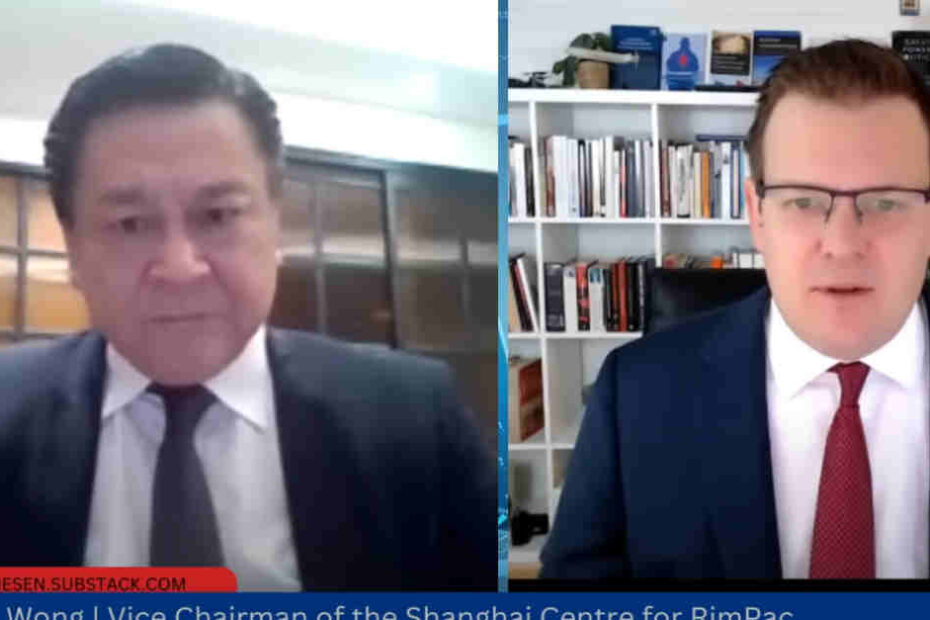
Read the full transcript of Vice Chairman of the Shanghai Centre for RimPac Nelson Wong in conversation with Norwegian political scientist Prof. Glenn Diesen on “Trade War & Chinese Economic Statecraft”, October 15, 2025.
Introduction
GLENN DIESEN: Welcome to the program. We are joined today by Nelson Wong, the Vice Chairman of the Shanghai Centre for RimPac and International Studies, also the Chairman and Managing Director of ACN Worldwide, and also being on the board of Recon Technologies. So thank you so much for taking the time.
NELSON WONG: Thank you, Glenn. It’s always a pleasure to be on your program.
The Economic War Between China and the United States
GLENN DIESEN: Well, I want to discuss with you the economic war we now see between China and the United States. Because as the Chinese economy continues to develop at very impressive speed, there’s always been two competing theories about how it would affect relations with the US.
One would be that this mutual dependence would increase as the economies become more and more intertwined, and trade imbalances would then be pursued through negotiations and diplomacy, assuming that both actors are interested in the absolute gain—what they both benefit from trading.
Now, the opposing theory is that because if China grows faster, the US becomes more reliant on China as opposed to China becoming too dependent on the US. The Americans would get worried about the asymmetrical interdependence—that is, the skewness of the dependence, that is the Americans becoming too dependent on China.
They would be worried about their economic competitiveness declining, not being able to compete anymore with China, and they would then favor more a brutal decoupling or a trade war due to its focus on relative gain.
I was wondering what are your perspectives on this? Is this the cause of the economic war the way you see it, in terms of how the United States is acting? Because one could expect in trade imbalances that you would have some negotiations and diplomacy, but we’re not seeing much of this. It’s all threats, it’s ultimatums, it’s bullying. How do you make sense of this?
China’s Preparedness and Strategic Response
NELSON WONG: Well, thank you, Glenn. A lot of questions, but they all come under the same umbrella. Well, let me put it this way. I think the clash between China and the US is inevitable. And this is something we have to admit.
And I think in terms of the ongoing clash, the—let’s call it the Trump war in trade or tariff—yes, it’s coming again. There are obvious signs that Trump has announced that he’s probably going to levy another 100% on top of what they already have on China.
Well, the thing is, I think on the one hand, the clash between the two countries is inevitable because the US is very much afraid that China might replace its position. Now, that’s a mental illness, I would call it, on the part of the US. Because China has repeatedly said over the—not the past year, but the past decade or so—that China never seeks to replace anyone because we come from a totally different culture and civilization.
We do not see things black or white. We’re not interested and don’t have any experience in terms of colonialism. Because our rise, China’s new rise, the economic rise, or the importance of the country’s position in worldwide context is totally different from that of Western countries.
So, in fact, the US or other European countries should not be afraid of China’s rise. I know it’s not something easy to understand from a Western point of view, because people in Western countries do come from a different background. They have different history. So what they understand is that “my rise means your downfall.”
So that’s a more philosophical topic to debate. But in terms of the ongoing war, I think China, as I wrote in one of my recent pieces, has had the last 10 years to prepare for this day. So when people say, “Well, China seems to be more calm, more resolute, more determined in tackling the tariff from the US,” yes. And this is only because China is fully prepared.
It’s not something that you have this idea or made up your mind overnight because the country has been preparing for this day because we know. I think the Chinese government is fully aware of what the US government has been doing over the last decade or even two.
And that’s why, on the one hand, the dependence on China’s export to the US has been reduced. In April, when Trump first launched its tariff war, China’s export to the US had already been reduced to about 15% of China’s total export. But as we’re speaking now, it is already below 10%. I’m not sure about the exact figure, but I think it’s somewhere around 8%.
So which actually means that even if it’s a complete decoupling, it won’t affect China’s economy in general. It won’t be the end of the day. But this is not something that China is aiming at. But it’s a matter of preparedness, that a country of China’s magnitude should be having. Actually, and it shows that the country’s governance is getting more sophisticated.
So on the one hand, China is continuing its dialogue with the US counterpart in terms of achieving a consensus to reach some kind of a balance in trade. There is absolutely no way you can reach absolute balance in trade between two countries, between any two countries.
So that’s why when Trump said he’s going to bring the balance, going to bring the trade balance to a different level, this doesn’t really make economic sense because the growth of the US economy, particularly after the Second World War, it’s not based on trade balance. It’s not based on trade balance.
So that’s why China has been negotiating with the US to try and reach an agreement because the two countries’ economies are interwoven, but it can be decoupled and this is the bottom line.
So to be sitting on a solid seat and to be calm and confident at a negotiation table, you have to be well prepared.
So and that’s why Trump should know this too well because he’s a businessman, right? So before sitting on the negotiation table, you should have contingency plans. You should be prepared for the worst case scenario. It’s not something that—I’m bluffing you, you are bluffing me? No.
So what China has been demonstrating over the last half year, I would say, has been quite impressive in a sense. It shows that the country is well prepared, is confident in handling its relations with the US. It’s not something that China is interested in having a clash with the US. So this is my general summary.
Strategic Autonomy and Diversification
GLENN DIESEN: Well, you mentioned preparations. I guess this can take form in terms of pursuing greater strategic autonomy or diversifying partnerships in terms of also then diversifying the supply chains, the access to resources, technologies, physical trade corridors, banks, currencies. Well, essentially all the economic activity. But what are the main actions the US has taken against China in these areas?
NELSON WONG: Well, I think the US has been quite—if you look at it from the surface, it seems quite improvising. But actually what they’re trying to do is to rescue the US economy, to put it back on track. It is not in a good shape and let’s face it, it’s not in a good shape.
So they’re trying to reduce the country’s dependence on import for everything. But this is how the US has been growing over the last, let’s call it 80 years or even more. And you want all the manufacturing to be back in the US. I wouldn’t say it’s impossible. Everything is possible, but it takes time. It’s not going to happen overnight. It takes time, but then what’s going to happen in between?
So you want to bring the manufacturing back to your own country. What about the cost of the production? So all these are against what we used to know, the globalization, the so-called globalization. But okay, if somebody like the US is going to change the game completely, I think because of the size of its economy, if he wants to make a decision to do something or to change the rule of the game, I think the rest of the world will have to adjust. You cannot ignore what the US is trying to do and let’s face that.
So yes, they’re trying to be less dependent on China and that’s a given. And I think not only other countries, but China itself fully understands that we’re not going to go back to the old days, that we can rely on export to the US market. So that’s why China is diversifying, has been diversifying its markets as well.
So that’s why when I said the export dependence on the US has been reduced to less than 10% now, which means that the country has taken some very effective actions. So in terms of the US trying to still put pressure on China, on the one hand, they want to sell their beans to China. Their farmers are crying out.
I read in the news that the US farmers have just sent another long letter of complaint or appeal to the US government, to the White House, asking the White House to find a way to help them. Because if China stops buying, who are they going to sell to? It’s not just one small container or a hundred containers. We’re talking about a huge amount of export.
So this is I think what a big market actually means to another country. So that’s on the one hand, but on the other, China has also taken a very firm stance in terms of its export control now on rare earth, which the US is getting very mad obviously.
So it actually shows that this is a very calculated move on the part of China because China fully understands what the US really needs. So it’s a good bargaining chip actually. Chinese government has, in trying to put the US or to calm the White House down.
The Strategic Importance of Tariffs and Trade Tools
GLENN DIESEN: Yeah, the areas one chooses to use as a hammer in a trade war or economic war, it does matter. That’s one of the things which frustrated me a bit here in Europe because when they want to go after the Russian economy, they say, “Oh, let’s sanction the energy.”
But it didn’t make sense because the Russians could diversify their export but Europe couldn’t diversify its import, so it ended up very predictably harming Europe more. While when you saw the Russians retaliating, they went for strategic industries which they knew that they had ability to build up.
So the agriculture, machine building, all these things where they made sure they put proper investment into because they had already the goal to develop strategic autonomy. They had a plan. But again, this—so it’s important to have something of a plan when you go through with this.
I mean, for the US, for example, rebuilding their shipbuilding industry, this seems like a sensible thing to do. But the tariffs, they can’t just be used as punishment. So Trump threatened Spain with tariffs because they’re not spending enough on military. This is not how a tariff can be used.
But you did touch on something very interesting, the rare earth, because this is how, of course, China is now responding. And there’s a certain amount of indignation in the United States now. “How dare China do what we’re doing, use economic tools to retaliate.”
But the rare earth—well, we can all say that China is unloading US Treasuries, but this might also be, I’m not sure if this is because it’s nervous about what was the seizure or theft of Russian assets. But with the rare earths, how important is this?
Because this is a key role both in terms of military development or in industrial production. But China has almost dominant monopoly, doesn’t it, in terms of extracting it, refining it. How significant is this? Because it seems as if Trump should have predicted this, but for some reason—
China’s Rare Earth Dominance
NELSON WONG: Okay, yes, it’s a very good topic. Actually, I’m not an expert in this particular field, but I have made some inquiries and I’ve done some initial study on that. Actually, not everybody knows that China’s plan, the original plan to look at rare earth and to do this strategic planning started in the 1950s.
So China realized, all the scientists realized the real importance, the strategic importance of rare earth. But it’s not about the rare earth itself, because rare earth is just a general term. It actually contains 17 to 18 key elements. But it’s a matter of processing. It’s a matter of processing and that takes a lot of time to develop in terms of the technology.
So China actually is mastering the entire technology of extracting and processing of the rare earth. And with the processed product, it is used in almost all of the sensitive and important industries, not only in the arms, the weaponry, the space exploration products, in missiles, in heavy weaponry, but also in chips as well.
So the application of rare earth nowadays is so big that when you do not have that—excuse me, if you don’t have that, it’s going to be detrimental. It’s going to be detrimental.
So right now, China controls—yes, dominant, but actually it is 80 to 90% of the processed rare earth. And in terms of reserve and deposits, China has 30% of the world’s total deposits.
So yes, we’ve seen the US government already striking deals with Pakistan, with other countries in West Asia, in Africa. They’re trying to start excavating, but that’s just the beginning. Experts say that it’s going to take at least eight to 10 years to be able to really realistically process the rare earth if you don’t have the technology.
And this is something that China now has total control. And of course we’ve seen new regulations from the Chinese government in forbidding the export of the technology and also the product. The export of the product is now under total control.
The European Dilemma in the US-China Trade War
GLENN DIESEN: It does seem that the Europeans are also getting pulled into some of this economic war. Over the past few days, we saw first the Dutch seizing control over a chip maker which is located in Netherlands but Chinese owned. And today there were some newspaper reports revealing documents that this wasn’t completely a sovereign decision.
Well, I guess it shouldn’t be a big surprise that it came under pressure from U.S. officials that if you want to be able to export and trade with the US, then you can’t. Then essentially seize control over this company. How significant is this though? Do you see the Europeans being pulled into the economic war between the Americans and the Chinese?
NELSON WONG: Well, I think the Europeans should not pour itself into a trade war between the US and China. I think we’ve been talking about European autonomy for ages actually. And this time I think Europe has totally woken up that they should not rely on the US any longer, not only in defense, but also in foreign policy as well.
So when it comes to trade relations with China, I think there are all reasons for China and Europe to continue to be good trading partners because our two sides do not actually have major geopolitical conflict at all.
So back to the China-US trade war. I don’t think that this is going to blow up by the end of the day because it doesn’t make sense. Yes, decisions can be made out of a hot-headed situation from time to time. But sooner or later people will still come back to reason.
So yes, China and the US delegations, they have met three or four times already and the delay of 90 days seems to be a norm. So now whether this is going to turn into a permanent or a de facto permanent seizure or a pause, a permanent pause, that’s something we’ll have to wait and see.
But back in my mind, I do have the impression that this is perhaps going to be the situation. On the one hand, yes, you see these two countries are bashing against each other openly. But because a total decoupling doesn’t make sense, we still have to come back to the logic.
So I think somehow diplomacy will have to come into play and we have to find a way out because it does nobody good. Even though China is well prepared, is strategically prepared to be totally decoupled by the U.S., but still, why should China do that? Because it is always good to have us as a trading partner. So I think it will come down, both sides will calm down eventually.
Europe’s Dependency Trap
GLENN DIESEN: Yeah, well, hopefully there’s a lot of self-harm going on these days. I think some of the source comes from the mere shift towards a multipolar system. Because as the world becomes more multipolar, the Europeans are recognizing that they’re not the center of the world anymore.
And the Americans, they have relatively few resources and they have a very different focus. So they want to look more towards Asia, for example. So the nervousness in Europe is that relations with the US could be fracturing as the US prepares to deprioritize Europe, which Europe says very openly.
So the assumption by many of our politicians seems to be if we just do as the Americans tell us, show enough loyalty or obedience, then we will win the affection of Washington and be rewarded. But I guess in reality what we’re doing is we’re cutting ourselves off from important critical trading partners such as China.
And in doing so we become excessively dependent on the US. And in this relationship where the US has more options and holds all the cards, they can demand anything from the Europeans. So we end up actually getting worse treatment the more we sever ourselves from other centers of power. But it doesn’t appear that the politicians have put two and two together just yet.
Will China Become Another America?
I wanted to ask you about the accusation often, or concern often coming from Washington. Now you discussed previously a bit that the Chinese thinking different than its Western counterparts. But often the fear from Washington is that, well, China would become another America. It would seek hegemonic solutions in the world.
And again, what to expect of the rise of China and Chinese economic statecraft. It’s a very divided topic for some. You have people like John Mearsheimer who assumes that China will just model itself, become another US, same kind of imperialist hegemonic ambitions.
And then you have the opposing view, often represented by people like Jeffrey Sachs, who argues that China is fundamentally a very different animal than the West. So, one can look for example towards the Western experience from the 16th century. We created our trade port empires by design. You cut off other alternatives to have a more hegemonic dominant role. This then turns into colonialism, empire.
And even today we see the US seeking dominance over maritime corridors for chokepoints. So it’s kind of the same model of dominance and hegemony. I was wondering your view there though. What should we expect of not a Chinese hegemon but China as it continues to become more and more prosperous and taking greater leadership in these key economic areas?
China’s Cultural Roots and Global Vision
NELSON WONG: It’s a very good question actually. I’ve been following and watching your interviews with John Mearsheimer and sometimes with Jeffrey Sachs as well, and I’m fully aware of the respective viewpoints of the two scholars. Between the two, I would prefer to say that I’m more on the side of Jeffrey Sachs when it comes to China’s rise, that China is not going to be a threat.
Now on that particular topic, I think perception, it’s all about perception. Perception is reality. Because if your mind is stuffed only with the kind of history that one superpower replaced another, is being replaced by another, and it’s a merry-go-round thing, then of course your vision would be that China is the upcoming power and is going to sooner or later surpass the US in terms of GDP and then it’s going to be the next America.
But no, this is actually not. You forget about the historical and cultural diversity of the whole world because the last 500 years the whole world has been dominated by Western culture. The west has been the leading force for our development worldwide.
But with the rise of China, because our roots are totally different, what we believed in is totally different from that of the west. Actually, and I always, and I often quoted my favorite saying, an old Chinese saying that’s actually from Confucius, is that “a real gentleman seeks to get along with others while he does not necessarily have to agree with them.”
And this is something that is very deep rooted in the mindset of us Asians, if not Chinese alone. We do not like things or saying like “you are either with me or against me.” What we believe in is that we can do business even if we do not agree on everything. But it doesn’t stop us from doing business or striking a deal with each other.
So when you understand that there is such a difference in culture, then you will be able to understand why China has kept saying that it does not want and will not want to be another US. Because there is also another belief that we have: if you don’t want to be treated a certain way, then don’t treat others the same way.
So that’s also the kind of things that this is our culture, why we keep using idioms, sayings. Because it’s in the blood. It’s in the blood. This is what we believed in. And so it’s not just competition, competition, competition. That my win has to be your loss. It’s not like the stock market. It’s a lot more complicated than that. A lot more complicated in world politics, in global economy. It is not as simple as it seems.
So in a sense, you pointed out that, yes, Europeans have been free riders under the US protection. And then all of a sudden, it seems that the big brother is going to be busy with something else and you’re going to be left alone to look after your own backyard. So, yes, change is the only thing that never gets changed. And let’s face the reality.
And personally, I do see that Europe is going to be and will remain an important force, both politically and economically worldwide, in addition to being the best destination for world tourism. Right. With your history, with your glorious culture, I mean, Europe is definitely going to attract people from all around the world to go and visit.
Of course, you may not want everyone to stay in Europe, but I don’t think everyone wants other people to stay in their home forever. But it doesn’t stop welcoming tourists, welcoming visitors. So let’s stay optimistic.
China is still going to be China. No one can change China. So when the US started establishing its diplomatic relations with China to contain, let’s call it the Soviet Union in the late 70s, yes, the policy of engagement was actually adopted to hopefully change China. Because this is the problem. I think the US government or their elites have the belief that everyone else wants to be like them. But it’s not. It’s not.
People will always want to be themselves. There are people who want to pretend to be someone they are not. But that’s not the majority. All right, so Chinese are forever Chinese. You can’t change that. So Chinese do not really want to be Americans. And so equally wrong is for the Americans to take it for granted that China would like to be the next USA. No.
Harmony: Different Interpretations
GLENN DIESEN: Well, we have a similar expression, by the way. “Do to others as you would have them do to you.” That’s also from the New Testament, the Gospel of Luke. So we should look that up again. That’s an important one.
But it is interesting what you mentioned because one often gets the impression that the concepts such as harmony, which often pops up in the Chinese thinking, that it’s different often from what has been developing in the west. Because when we talk about harmony in Europe, we often think about, well, for example, with European integration, we think of conformity, similarity and, yeah, so all mixing.
NELSON WONG: That’s a very good point. That’s a very good point you made.
GLENN DIESEN: But the Chinese harmony, though, it seems to be more organized around how what is different should coexist. So it doesn’t mean that you eliminate the differences. And I guess that’s what’s interesting as well with China’s ideas over this civilizational partnership where it focuses on maintaining civilizational diversity, given that there has to be different paths to development.
NELSON WONG: Absolutely.
The Global South’s Shift Toward China
GLENN DIESEN: Which tends to contrast with American universalist points where others should follow its lead. But given this though, how do you see, given that the US puts more conditions on the rest of the world, it acts more coercively. I mean, there’s this meme on the Internet which goes that China has an evil plan: it will sit back and relax while the United States destroys its own empire.
It does feel like a lot of countries now are flooding towards China as an alternative partner. It doesn’t take much effort given that a lot of this is simply a reaction to the US becoming more coercive. Do you see a restructuring of the global south organizing not necessarily around China, but with the new institutions such as BRICS, SCO, set up where China is a key player?
The Natural Development of Global Multipolarity
NELSON WONG: Well, I see that as a cause of natural historical development of mankind. It’s not because China is now economically bigger so that people would come towards China. No, I don’t believe this is the only reason.
You’ve rightly pointed out that a lot more countries are looking at China or are coming closer to China because of the pressure they have received from the U.S. Yes, the White House decisions does give the impression that they are a bit desperate. The Americans are a bit desperate and they are very much afraid of losing their control over the world, which they should not have believed in in the first place.
So also when you said Chinese harmony, the word harmony is actually different from what the U.S. or the west has been believed in. And I think that’s a very good point. Actually, it’s about coexistence. It’s about coexistence.
So even organizations like the BRICS, yes, it does represent the global south in political terms. But if you look at the flag of countries that still started this organization—South Africa, Russia, India, China, Brazil—they all come from different parts of the world with different historical backgrounds, different religions, different political systems and social systems. And why these five countries have come together and now BRICS has attracted a lot more countries to join. Why is that?
And I always said that to my friends in the west and I said, you have to think, give it some thought why this is happening because people are not happy for the way they have been treated or for the world to be manipulated by one voice. So diversity and coexistence is something I think will become the buzzword of today and tomorrow.
Because you cannot expect the world to stay static and without development anymore. That the U.S. is sitting on the top of the pyramid. It directs and decides what the rest of the world should do. So that’s how the globalization first came into in the business world, that I control the technology, I’m sitting on top. And then this is the pyramid. You’re going to do the screwdrivers, you’re going to do this, you’re going to do that.
This is based on the notion that nothing is going to get changed. But we’re not talking about one classroom or one company. We’re talking about human societies. And every country has the right to make themselves great or great again. So that’s why it is competition or more, it is coopetition—it’s cooperation and competition.
So I think, yes, organizations like the BRICS is getting more visibility, more and more people are coming to the realization that countries from the global south should not be neglected at all. And yes, there are figures that the BRICS economy is already, in terms of economy, it is already bigger than G7. But that’s not important alone. What is important is the potential, is the trajectory, is the trend that the world is developing towards. And if you do not grasp the trend, you’re going to be on the wrong side of history and that’s going to be regretful.
China’s Economic Evolution and Future Direction
GLENN DIESEN: What takes me nicely to my last question, what is the major trend, do you see now of China’s not technological but economic development? Because whenever we talk about the rise of China, it’s very different. China as we’re talking about, I mean the China from the 80s, 90s, 2000, even today, China today is very different than China 10 years ago in terms of the economic model, the priorities, the challenges. What I guess is a good way of looking at the current trend, I mean, where is the Chinese economy heading? Is it about mainly diversifying trade partners? Is it robotics? I mean, what is it that we should be looking for?
NELSON WONG: Well, as a country, China continues to develop itself, to be more prosperous, to allow its people to have a better life. And that’s for sure. It’s the vision and it’s the objective. But you have rightly pointed out that China today is different from China 10 years ago. Yes, every 10 years there is a big change because today’s China is no longer content for being the base of manufacturing worldwide. This is no longer the case.
China is looking to be a leader or a partner or a leading partner in science and development, because the future competition between big powers would be in science and technology, because that’s what leads a country’s economy in principle. So there is AI that you cannot deny. It’s artificial intelligence now being applied in almost every aspect of our life. So this is what China has reinventing itself all the time. It’s always reinventing itself.
It’s never content for being considered as something that you can label the biggest manufacturer or the biggest ship builder. Right. You might be the biggest ship builder today, but may not be the case tomorrow or 10 years later. Right. 10 years ago, China was not the biggest shipbuilder. So things will get changed.
Yes, today rare earth is so precious that people are almost ready to go into a war for rare earth. But will it still be the same in 10 years time? This is the kind of questions I think we Chinese always ask ourselves, always ask ourselves, what is next? What will be the future? What will be the future? So only by having this kind of a mentality, you can keep the country going and keep the nation developing.
So in terms of answering your question, I don’t think we can have a very simple, straightforward answer. China would continue to become, if I want to put it, I believe China will continue to strive to be an economic leader in the world, but not by manipulating others, but by partnering with others. And I think the ideal situation would be that it’s going to be a country that is constantly reinventing itself.
So I think this is the vision that we do not want to be monopoly in everything. We definitely do not want to become a hegemon because we have been the victim of hegemonic control. And that’s why we do not want to be what we hate.
Strategic Incentives Against Hegemony
GLENN DIESEN: There seems also to be a strategic incentive to avoid it. Well, also given just the realities of the other powers surrounding the system. For example, Russia now, which has become the most important partner, I think, of China. It’s super enthusiastic about Chinese leadership in a multipolar world that is driving it forward. But it would probably turn its back if it felt that there were some hegemonic impulses.
So I think it’s the mere idea that China is not a hegemonic power which makes its neighbors much more comfortable with its rise. Thus, instead of collectively balancing China, we see them instead encouraging the rise of China. So I think a lot of this is exactly because there’s not that hegemonic impulse there.
Anyways, I have already taken enough of your time. I know you’re in Vietnam on a business trip, so I’ll just say, yeah, thank you for taking the time and yeah, hope to speak with you again soon.
NELSON WONG: Thank you, Glenn. It’s always a pleasure to be with you.
Related Posts