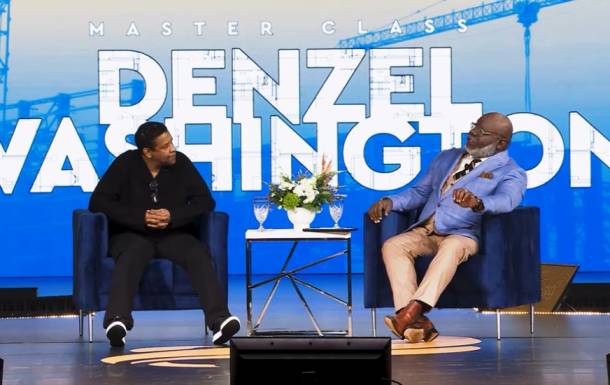
Here is the full transcript of American actor Denzel Washington’s interview on NXT Chapter Podcast with host Bishop T.D. Jakes, premiered November 21, 2025.
Brief Notes: Bishop T.D. Jakes sits down with Denzel Washington for an intimate, faith-filled conversation about purpose, calling, and the journey from a Mount Vernon barbershop kid to one of Hollywood’s most respected actors and leaders. Denzel shares how prophetic words, spiritual discipline, and his refusal to compromise shaped his career, his marriage, and the way he uses acting as a form of ministry and service. Together they unpack legacy, leadership, fatherhood, and the power of a great wife and strong spiritual grounding in a culture obsessed with fame, ego, and instant success.
Introduction: A Man Anchored in Faith
BISHOP T.D. JAKES: Hello, everybody. I’m T.D. Jakes and I’m extremely glad to have you here at my NXT Chapter podcast. It is so exciting and so fulfilling that you’re going to listen in today and learn something that may change your life or change your perspective as I present to you none other than Denzel Washington.
Today I’m joined by a man whose talent has inspired generations. An Academy Award-winning actor, director and storyteller. Beyond the accolades, Denzel Washington is a man anchored in faith, family and service.
In this conversation, we talk about staying grounded when fame and fortune is trying to pull you away from what truly matters, why less is more, and the power of having a strong partner. And he closes with a heartfelt prayer that reminds us where our strength really comes from.
Chapter One: Staying Grounded
BISHOP T.D. JAKES: I think there’s a whole section of people that didn’t come to hear me that came to see you.
I’m going to take you back to many, many occasions you and I have been in conversation. You might not remember this. You’re having breakfast. I think we were in Atlanta.
DENZEL WASHINGTON: Four Seasons, at the Four Seasons.
BISHOP T.D. JAKES: He’s just sitting there having breakfast like people. And I came down there to have breakfast. I walked past, I thought… And we entered into a conversation that I sat down and we enjoyed and we had great fellowship and great fun.
And you’ve always been a very touchable, down to earth person who seems to pay little attention to all the tremendous accolades that have been afforded to you. Is that part of the secret sauce that has kept you grounded and added to the longevity of your career, that you did not allow the hype to inflate the way you see yourself?
DENZEL WASHINGTON: My mother, God rest her soul, she made it to 97. She just passed this past year and she owned a beauty shop. A beauty parlor. Excuse me.
BISHOP T.D. JAKES: Okay.
DENZEL WASHINGTON: She owned a beauty parlor. Not a salon, a beauty parlor. And I had done one or two things and I’m feeling myself. And I came in, I said, “Ma, did you think all this was going to happen?” And, you know, I was…
She said, “What did you say? All the people been praying for you.” She started calling me superstar. So she said, “Okay, superstar, why don’t you grab that bucket and go clean them windows.”
BISHOP T.D. JAKES: Superstar.
DENZEL WASHINGTON: “When you finish with that superstar…” So I got the message, you know, I got the message that grounding is…
BISHOP T.D. JAKES: Something that’s rare today. We see people rise up like zeniths and then crash like nuclear bombs. You have the added advantage of looking back over decades and decades of being relevant.
Longevity is important to success. When you start talking about longevity, there are many, many people out here who want to have longevity, regardless of their profession, whether it is in corporate America, whether it’s in the faith realm, on the stage. Longevity on the stage. I tell people the lights are bright, but the heat is hot.
DENZEL WASHINGTON: Yeah, yeah, okay.
BISHOP T.D. JAKES: It’s been hot. It’s been hot on that stage. Many, many people who started with you melted. How did you make it?
DENZEL WASHINGTON: How do I what?
BISHOP T.D. JAKES: How did you make it?
DENZEL WASHINGTON: By the grace of God. I mean, I don’t take any credit for it. It’s nothing I did as special, you know. Been knocked down a few pegs and recognize it, but I just didn’t put me first. I just put God first, and he’s carried me through the ups and the many downs. You know, the things you hear about and the things you don’t hear about.
Creating Platforms for Others
BISHOP T.D. JAKES: You know, when you think about that… We were at Tyler Perry Studios for the dedication of the Tyler Perry Studios, and we were talking this Sunday morning. I spoke. I talked about the difference between people who walk through a door, which is an opportunity, and other people who turn that door into a platform through which other people are able to access their dreams.
Without question, you have had many doors open to you, but you have also created many platforms and introduced to the world many, many talented, gifted people without which your influence would not have happened. You didn’t have to go that extra mile to do that. You could have enjoyed the limelight of the door and walked away.
Is there a sense of fulfillment that you get out of creating that platform, or is it purely from a business perspective?
DENZEL WASHINGTON: I love seeing other people do well. Always have. I grew up in the Boys Club, now the Boys and Girls Club, and I was a counselor there. And I came up in the club first as a camper and then as a counselor. And I always enjoyed seeing other people do well.
It’s interesting that I ended up in this business where it appears that you’re out front.
The Business of Entertainment
BISHOP T.D. JAKES: You know, the funny thing about it is when you think about… When the public thinks about you, they think of you as an actor. When I think about you, I think about you not only as an actor and entertainer, not only as an icon in our community, but I also see you as a businessman because what the public doesn’t realize is that entertainment is a business.
And you have been successful not only at acting on screen, which a lot of people do, you have been successful at the business of entertainment. Can you talk to me about the business aspect?
DENZEL WASHINGTON: I tell people all the time they call it show business, they should call it business show. No business, no next show. Absolutely simple as that.
BISHOP T.D. JAKES: Explain it.
DENZEL WASHINGTON: No business, no next show. And you know, you have to deliver. I mean it is a business. It’s a dollars and cents business. And you have to deliver.
BISHOP T.D. JAKES: And you have to know your worth and you have to be able to negotiate from the perspective of knowing your own value. If other people know the value to want you, but you don’t know the value to know who you are yourself, it would appear to me it would be quite difficult to be successful if you don’t at least have some sense of the equity that has accrued behind your brand and consequently negotiate from the leverage of understanding that equity.
At what point did it hit you that I am worth more than how I’m being handled? And how did you negotiate into the next stream of opportunities without allowing people to prostitute what God had given you?
DENZEL WASHINGTON: I’m just not, I’m just that guy, you know, I’m not scared to say no, you know, and you have to say no sometimes, you know, and it’s the no’s that I said that have really gotten me, you know, I don’t know wherever I am now professionally.
And the money really didn’t scare me. You know, I’ve said it before, you never see a U-haul behind a hearse. You can’t take it with you. You know, no matter on your last day, it doesn’t matter how much money you have so that, that, you know, the Egyptians tried to take it with them.
BISHOP T.D. JAKES: Right?
DENZEL WASHINGTON: Yeah. All they got was robbed.
BISHOP T.D. JAKES: Right, Right. So…
DENZEL WASHINGTON: So you… But you can leave it here.
BISHOP T.D. JAKES: Yeah.
DENZEL WASHINGTON: And I’m not just talking about the money. I’m talking about what God has blessed me with. I can leave here, you know, and that’s what’s important to me is to at this point in my life just to be in that number.
Returning to the Stage
BISHOP T.D. JAKES: You appear on a lot of platforms. Professor Rooney entered the president of the college when he introduced you. Beginning to talk about, you started on stage not too long ago. My wife and I flew up to New York and saw you on stage.
DENZEL WASHINGTON: Iceman coming.
BISHOP T.D. JAKES: Julius Caesar.
DENZEL WASHINGTON: Oh, Julius Caesar. Fifteen years ago yeah, well… Seventeen years ago. Time flies. Time flies, yes.
BISHOP T.D. JAKES: That was just the other day to me. Now that’s a blur. You walked out on that stage and you were back at home again, back where you started from number one. What made you go back to the stage and did it… Was it nostalgic for you to be on that stage?
DENZEL WASHINGTON: More than that. As much as that. It’s the foundation. Had to get back to the, you know, like here on stage. The audience will tell you that night.
BISHOP T.D. JAKES: Right.
DENZEL WASHINGTON: How they feel about you and you know, it’s a humbling experience. And I just wanted to get back to the foundation. Between 1990 and 2005, I was doing the best I could to help my wife to raise our kids. And they were at an age where I couldn’t leave California for weeks at a time, you know, because you can’t commute when you’re doing a show on Broadway. So I just chose not to do any plays on Broadway for about fifteen years.
Chapter Two: Less is More
BISHOP T.D. JAKES: When I saw you in the car getting ready to leave the hotel in New Orleans, I think you were shooting Safe House at the time. To me, that was an amazing movie, largely because of the scenes that had no words.
Mind you, the greatest actors I have ever seen are people who can convey messages without script. And you are absolutely amazing at conveying an emotion.
DENZEL WASHINGTON: Thank you. You know, people don’t understand the hardest thing to do as an actor is to listen. Hardest thing to do as a human being. To listen.
BISHOP T.D. JAKES: So…
DENZEL WASHINGTON: And to be quiet and actually not do a whole lot.
BISHOP T.D. JAKES: Right.
DENZEL WASHINGTON: You know, we think, “Oh, the camera’s on. I got to…”
BISHOP T.D. JAKES: Yeah, yeah, act it up.
DENZEL WASHINGTON: Less is actually more.
BISHOP T.D. JAKES: Less is actually…
DENZEL WASHINGTON: Less is more.
BISHOP T.D. JAKES: Please write that down.
DENZEL WASHINGTON: Less is more.
BISHOP T.D. JAKES: One of the big mistakes that I think that church actors make is that they go overboard. The real pros understand that less is more.
DENZEL WASHINGTON: If it feels good to you, it probably isn’t any good.
BISHOP T.D. JAKES: Good.
DENZEL WASHINGTON: That’s the truth. If you’re feeling so good about yourself, then you’re too self aware.
BISHOP T.D. JAKES: Yeah.
DENZEL WASHINGTON: So you’re probably not as good as you think. Because you’re too busy thinking, “Oh, look at… Yeah, I’m acting now.”
BISHOP T.D. JAKES: That’s funny. And it shows.
DENZEL WASHINGTON: And it shows.
BISHOP T.D. JAKES: It shows to the audience. I was sitting there screaming at the TV set because I was just mesmerized. In fact, I teased you about it. I told you that you died so well that I was ready to commit your body to the ground.
DENZEL WASHINGTON: And that said, how yes. You know what? That’s my favorite death of mine.
BISHOP T.D. JAKES: You died, big bro. You died.
DENZEL WASHINGTON: That is Training Day. Those are two of my favorite deaths.
BISHOP T.D. JAKES: I started saying “ashes to ashes.” And for as much as the brother was dead, okay, this guy died for like five minutes. He just died. I see people die all the time. I thought he was dead. I got my robe. I got my sash, and I started…
He was gone. And you said to me at the time, you said, “I died too well, now they’re trying to do a sequel that can get me.” And we laughed about it and we talked about it. It was an amazing thing.
Introducing New Talent: Antoine Fisher
BISHOP T.D. JAKES: When you think of Antoine Fisher you introduced…
DENZEL WASHINGTON: Thank you.
BISHOP T.D. JAKES: What was amazing, not only did you produce it, you directed it. You brought new talent to the stage that we had not known. I think he delivered one of his greatest performances under your…
DENZEL WASHINGTON: Derek Luke.
BISHOP T.D. JAKES: Derek Luke.
DENZEL WASHINGTON: And people don’t realize a young woman in there by the name of Viola Davis.
Leadership and Casting Excellence
BISHOP T.D. JAKES: Listen, I was coming back. Oh, you was getting there. I’m sorry. Yeah, yeah. I realized Viola Davis got her start playing his mother. She plays his mother in the music.
DENZEL WASHINGTON: No lines.
BISHOP T.D. JAKES: No, no lines. No lines. No.
DENZEL WASHINGTON: She has one line. “You want something to eat?”
BISHOP T.D. JAKES: Yeah. That’s all she says. “You want something to eat,” but can’t nobody out cry Viola Davis. Listen, baby girl can cry until she can cry until I start crying. I don’t even know what I’m crying about.
BISHOP T.D. JAKES: How did you cast those two unheard of people and then direct them in a way that you got the best out of them? Because now the reason I asked this question, whether you are in film or interested in entertainment, this is really about how do you get the best out of the people you choose in the positions you hold?
So don’t just listen from an entertaining aspect, but from an informational aspect to understand. How do you choose people who are going to play a role in your organization? A and B, how do you get the best out of them should help every leader, every pastor, every manager, every entrepreneur in this room.
Because some of the time we suffer because we got the wrong cast, we hired the wrong people. Some of the times we suffer because we had the right people, but we lack the ability to get the best out of them. You have to do both of them in order to be successful. Teach us how to do that.
DENZEL WASHINGTON: Get out of the way.
BISHOP T.D. JAKES: It’s hard.
DENZEL WASHINGTON: That’s easy to say, but hard to do. I can’t play the part. Derek played the part. Viola played the part. Sometimes we want to do it all. Get out of the way, you know? Get out of the way.
BISHOP T.D. JAKES: That’s the modest answer. It’s a, I’m not going to let you off that easy. Okay. Because anybody can get out of the way. We can get out of the way. I understand that you are saying not to try to make the actor be you, but that ignores the fact that you had to select somebody who had that thing in them. How do you look at someone and see in them things that has yet to be unearthed out of them?
DENZEL WASHINGTON: When I’m casting, I always tell the casting people, I only need one. I only needed one Viola Davis. I didn’t need ten. So, and I know it when I see it. And I know it when I haven’t seen it. So when it walks in the room, then when she walked in the room, I knew so. And I knew so.
BISHOP T.D. JAKES: It’s a gut thing. It’s an instinct thing. More than I look for this, this, this and this. There’s just—
DENZEL WASHINGTON: Yeah. It’s not a checklist. It’s not a checklist. You know, I think I know what good acting is.
BISHOP T.D. JAKES: You got to know what you’re looking for, which is a note worth taking. You got to know what you’re looking for. Because I think a lot of times we don’t know what we’re looking for. We’re interviewing people, but we know the job description. We know the title, but we don’t know the temperament, the talent, and how well they will fit into the continuity of our organization. So we hire people who have the right education, but they are toxic in the organization.
Are you hearing what I’m saying? You have to know what the temperament is that you’re looking for. Again, you’ll know it when you see it. But whether you know it or not, you are casting in your office, in your church, in your choir, in your leadership. Anybody can come in the congregation. I don’t care. But whoever’s going to be on the team, I already know what temperament of person I need in that team.
And I’m not just looking at their bio. I’m looking at their body language, their personality, their work ethic, how congenial they are with people, how sensitive they are. I don’t need a drama queen running a conference. I don’t need you creating problems. I need you solving problems.
And so I can keep clearly delineate what I’m looking for in the individual. He has a list of criteria that he’s saying that he has, that he knows in his head that he’s looking for in the actor, and that he will know it when he sees it. You cannot regulate that over to somebody else.
Leading from Behind
DENZEL WASHINGTON: Nelson Mandela said, “A leader, like a shepherd, sends the fast, nimble sheep out front so that the rest will follow, not realizing they’re all being led from behind.” So a leader leads quietly from behind. You know, you don’t have to jump out front and I don’t have to out act everybody and out, you know, we want to do it all. Yeah, don’t get out the way.
BISHOP T.D. JAKES: Let me show you.
DENZEL WASHINGTON: You know. But that’s pretty good advice from Mr. Mandela.
BISHOP T.D. JAKES: Yeah. Yeah, I would think so. I would think so. Chapter three. Faith.
August Wilson’s Legacy
BISHOP T.D. JAKES: When you start thinking about August Wilson, the body of his work, the magnitude of his impact on the Broadway stage, off Broadway stage, at a time that black people were not being recognized, the body of his work ended up in your hands, of which Fences is one deposit. What made you make, yeah, yeah, give it up for Fences.
What made you make the decision to buy the body of his work or to own the body?
DENZEL WASHINGTON: The family came to me.
BISHOP T.D. JAKES: The family?
DENZEL WASHINGTON: Yeah.
BISHOP T.D. JAKES: His—
DENZEL WASHINGTON: His wife, widow Costanza, said, “We’d like you to take care of August’s plays for us and make films.” I said, “I’m just the man for the job,” you know, so that’s what I’m doing.
BISHOP T.D. JAKES: What made you give that answer?
DENZEL WASHINGTON: Because it’s the truth. What did somebody say?
BISHOP T.D. JAKES: What?
DENZEL WASHINGTON: Said you’re not conceited, you’re convinced.
BISHOP T.D. JAKES: Huh? Yeah.
DENZEL WASHINGTON: I mean, I’m not bragging. I mean, I was the right one at the, in the right place at the right time, with the right power, in the right position to get things done, you know?
BISHOP T.D. JAKES: And you got them done.
DENZEL WASHINGTON: I’m getting them done. I’m getting them done.
Decision-Making and Leadership
BISHOP T.D. JAKES: One by one, you’re getting them done. And then what made you make the decision to keep so much of his original cast and take them from the stage to the screen? These are disappointed decisions. What I’m asking him is, how do you make decisions? Because that has a lot to do with defining the success of your leadership. How do you make decisions? And some people hold positions but delegate decisions.
DENZEL WASHINGTON: Say that again.
BISHOP T.D. JAKES: Some people hold positions but delegate decisions. Okay. And while I want everybody’s input into the decision, my style of leadership, the final decision is going to be mine. Okay. I welcome your input. I’m not a dictator. I want to hear your input. And I will adjust my decision if your information shifts the outcome.
But at the end of the day, I don’t want people making decisions that I have to live with. Because at the end of the day, it’s not going to be your name in the paper, it’s going to be mine. That’s correct. And I want to know, am I right about it?
DENZEL WASHINGTON: Yes, you are.
BISHOP T.D. JAKES: They’re not going to write about your staff, they’re going to write about you. They’re not going to attack your staff, they’re going to attack you. They don’t know the name of your staff. They’re going to come after you. And so you want to be in, you want to hire people that are smart enough that they bring you brilliant ideas, but you have to decide, are those brilliant ideas worth the consequences of those ideas?
In my world, that’s how I do it. In your world, what made you make the decision to keep these people who had never been on screen, as far as I know, had always been on stage, and yet you brought them on stage. And then I’m going to tell you what they told me about you.
DENZEL WASHINGTON: You talking about Fences now? Well, because they were great actors. Viola Davis, Stephen McKinley Henderson, Michael P. Williams. They were all great actors. And I’m loyal. You know, we got the success that we had on stage together. Why should I? Now? We had to recast little girl because she, you know, and one other part because the kid grew up.
BISHOP T.D. JAKES: But—
BISHOP T.D. JAKES: They do that.
DENZEL WASHINGTON: Yeah, they do that. Funny how that works.
BISHOP T.D. JAKES: Yeah. It is relieving, actually.
DENZEL WASHINGTON: They keep coming back, though.
BISHOP T.D. JAKES: Mine are here, so I won’t comment. Now.
Faith on Set
BISHOP T.D. JAKES: You brought them to the stage. I interviewed them while I was doing a talk show in Hollywood. This is what they told me about you. They told me that you were as much director, producer as you were a pastor.
They said you started every morning—
DENZEL WASHINGTON: Oh, yeah, of course, prayer.
BISHOP T.D. JAKES: They said they were spiritually enriched under your leadership because of your consciousness of God.
DENZEL WASHINGTON: Well. Thank you.
BISHOP T.D. JAKES: Now, look, I’ve been on the set a few times myself. Not nearly, nearly, nearly, nearly what you’ve done. But it is not normal to start the day with prayer.
DENZEL WASHINGTON: It’s not? No, no, I didn’t hear what you said.
BISHOP T.D. JAKES: It’s not normal to start the day with prayer.
DENZEL WASHINGTON: Well, I don’t know what other people—
BISHOP T.D. JAKES: Do, but I mean on the set. I’m not talking about in your personal life, to have the boldness of faith to bring a crew together and say, “Let’s pray before we start.” I’m not seeing a lot of people do that in Hollywood.
DENZEL WASHINGTON: Or where are we, what town we in?
BISHOP T.D. JAKES: Or in Charlotte.
DENZEL WASHINGTON: But, you know, it’s funny. It’s funny. People talk about Hollywood like it’s a place where evil things happen. Los Angeles is a city. There’s no place called Hollywood. We don’t all get together and have Hollywood meetings. Hollywood is a street in Los Angeles. I’m in the movie business. I’m not in the Hollywood, I don’t even know what the Hollywood business is. I don’t know how to do that. I make movies, I do plays, I direct. And that’s that being said.
BISHOP T.D. JAKES: And that is absolutely true. And I’ve been on both sides of the street. I don’t demonize what is called, quote, unquote, Hollywood. I’m just saying, in the course of doing business, not every person in business brings the cast together and has prayer. That doesn’t happen. Why does that happen with you?
DENZEL WASHINGTON: Because I was raised right.
BISHOP T.D. JAKES: I don’t know.
DENZEL WASHINGTON: You know, my father was a minister.
BISHOP T.D. JAKES: I know your father was a minister.
DENZEL WASHINGTON: Father was a minister.
BISHOP T.D. JAKES: He’s a PK, y’all. Give it up, PK Days.
DENZEL WASHINGTON: Church of God in Christ.
BISHOP T.D. JAKES: Church of God in Christ.
DENZEL WASHINGTON: My mother grew up in, well, I, folks not old enough. Kelly Temple in, in, in New York City. My, okay. My mother grew up in that church.
BISHOP T.D. JAKES: And see you at home.
DENZEL WASHINGTON: I see.
Philanthropy and Faith
BISHOP T.D. JAKES: Evidently, being raised in the faith, you still are involved in the faith. You still have been a loyal supporter of West Angeles. You’ve done some amazing things down through the years. You have helped Bishop Blake in amazing ways. You have helped many people start and launch their careers. You have financed historically black colleges. You have been extremely philanthropic. You have a different rhythm in your soul. Is that coming from your faith?
DENZEL WASHINGTON: That’s sad that you say that. I have to even say that because that’s what we all should do. Yeah, it shouldn’t be. There’s nothing exceptional about should.
BISHOP T.D. JAKES: Emphasis on the word should. But, but you know, without sitting here talking about, to me that that is exceptional, that very few people have the kind of temperament, especially that lasts that long and started that young. We have not seen you. We’ve seen you do sexy scenes, but we have not seen your body. You have not prostituted yourself in any film at any time.
DENZEL WASHINGTON: Oh, you haven’t seen all the movies then. You ain’t a couple of them you ain’t seen.
A Great Wife
BISHOP T.D. JAKES: I saw you down to your draws, but I don’t recall. Okay, let’s keep it real.
DENZEL WASHINGTON: I did a little bumping and grinding.
BISHOP T.D. JAKES: Yeah, yeah, you did a little bumping and grinding, but you never… you, you, you.
DENZEL WASHINGTON: Yeah, that’s terrible. Yeah, yeah.
BISHOP T.D. JAKES: Edit this out the table. We’re going to keep it real for a minute. You didn’t put your everything out there. Let me say it like that, right, to get a role. Why didn’t you? And are you glad you didn’t?
DENZEL WASHINGTON: I had a mentor in college my senior year when I really just started acting. And he talked to me about never having to compromise, you know, myself.
And I remembered that, that, that wasn’t necessary. And I got that guy.
BISHOP T.D. JAKES: I mean.
DENZEL WASHINGTON: I just been blessed beyond measure. I found out early in college that I had this unique ability, so. And things that were happening in my life. I don’t know if some people maybe have heard me talk about a woman prophesied when I was 20 years old. She said, “Boy, you’re going to travel the world and preach to millions of people.” She didn’t say, “You’re going to be famous.” She didn’t say, “You’re going to win Oscars.” She didn’t say any of those things. She said, you know, you are going through traffic.
By the way, I was flunking out of college. I had a 1.7 grade point average. I was in my mother’s beauty shop. And the reason I was in her beauty shop was because I was not in school. I was not in school that semester. And this woman, Ms. Ruth Green, had this prophecy that is coming true.
BISHOP T.D. JAKES: It’s coming true.
DENZEL WASHINGTON: It’s coming true.
BISHOP T.D. JAKES: I talked to you on the phone. And I tell you that I believe that you have something down inside of you beyond acting from a spiritual perspective that is awakening.
If you agree with that, tell us what that feels like. And that has shown up in your work. It has shown up off camera. What is evolving in you now from a spiritual perspective?
DENZEL WASHINGTON: It’s just that it’s evolving, you know.
I remember talking to Bishop Blake years ago. I said, “Well, you know, should I become a preacher? Should I?” He said, “No, no, you have your pulpit.”
You know, and use it. So I do have a… everybody talk about a platform. I got a pretty, I guess, big platform or whatever you call it.
BISHOP T.D. JAKES: He got a pretty big. Yeah.
DENZEL WASHINGTON: So I try to… try to use it for good. Use it for good. Use it for good.
Chapter 4: A Great Wife
BISHOP T.D. JAKES: Warren Buffett says that if a man, toward the autumn of his life, and this is poor quote of it, but pretty close, has still maintained the respect and love of the people who matter most, he is a successful man.
You live and work in an industry where the falling apart of the home is the headlines of the week and people swap and swap in relationships all the time. It is a very difficult thing to be who you are and still be a father and still be a husband. And yet somehow you have been graced that the people who matter most still respect you.
DENZEL WASHINGTON: Tell us, all I have a great wife.
That’s the answer.
Listen, my wife is from right here, North Carolina. She was a child prodigy. She was the Van Cliburn competitor, one of the world’s best young pianists. At nine years old, she was the first black woman that was supposed to be Miss North Carolina at a time when they couldn’t let a black person be. She had gotten whatever it’s Miss runner up or first runner. They couldn’t even let her be first runner up because if Miss North Carolina fell out, she couldn’t go to all the places in this state that… Yeah, yeah.
So her father was an educator. They had one of the top… this was back in segregation, before integration. They had one of the top schools in North Carolina, the top debating team. One of the best schools in North Carolina was an all black school from Newton, North Carolina. Wow.
BISHOP T.D. JAKES: Yeah, I think that’s such a great answer. It’s one that I can really relate to. Having a great wife has a lot to do with whether you make it through the chore.
And it’s always nice when she’s cute.
But it’s not nice when she’s cute and not.
DENZEL WASHINGTON: Got a witness somewhere in it.
BISHOP T.D. JAKES: So a word up to the fellows. A lot of times you have more emphasis on cute than great. But what makes the relationship sustainable is great rather than cute. And I think that one of the problems that we have with longevity is that it is expensive to be a great woman.
In a world where women spend billions of dollars looking cute, it is more expensive to be a great woman. Because a great woman absorbs a lot of shock.
Lot of sorrow, a lot of pain. A great woman bites her tongue at times that other women speak their mind. It is expensive to be a great woman, to know when to speak and when to shut up and go the other way. A lot of women who started clapping when he said that, you have to really do inventory is even talking about you because, because, because I really do think a lot of the credit goes to holding things together. It’s unfair, it’s probably not right, but it still is true to having a great woman.
We come up sometimes and get the bow. But really, the woman is the glue. At least at my house, Serita is the glue. She is the glue. And the staples and the safety pins and the stitches. Everything else I give you, not I give you my.
DENZEL WASHINGTON: My wife. My wife is consistent.
BISHOP T.D. JAKES: Yes, consistent.
DENZEL WASHINGTON: Consistent. She made breakfast every morning. Yeah, for the children. They had a little Bible study every morning. She drove them to school every morning. So she… when I was out running, making the movies, you know, killing the lion and bringing the meat home. You know, but she was doing.
BISHOP T.D. JAKES: Might be our generation. But I could say that I could take your statement and put it right on Serita having prayer with the kids every morning, making sure everybody got something to eat and still doing her day and still doing her thing and still building her business and still went back and got her a degree and still supportive of me and still got her hair done.
You have to be a bad woman to be a great woman. Multi talented. In fact, a great woman is a corporation in one person. She is a corporation all by herself. If you are a great woman, you are a corporation. Whether you start a business or not, you are a complete corporation. Give yourselves a hand if you think you are great.
DENZEL WASHINGTON: Let me say this to the, to the guys, for the guys out there. You got to have vision to see potential.
Instead of, “Well, I ain’t working right now.”
BISHOP T.D. JAKES: Let me go over here. Right. Let me go over here. Let me go over here.
DENZEL WASHINGTON: You know. I huffed my wife’s pedigree.
Her pedigree, you know, she raised me up out the ghetto a little bit. You know, I had one foot in this, in the street.
So it’s a balance. Balance.
BISHOP T.D. JAKES: Tell the truth. Shave the devil. I’m with you.
DENZEL WASHINGTON: I was throwing rocks at the penitentiary now.
BISHOP T.D. JAKES: Yeah, no question. The thing about it is at different stages of life, you raise each other.
DENZEL WASHINGTON: Right, right, right.
BISHOP T.D. JAKES: At different stages of life, you parent your partner.
Depending on what is going on at that particular moment. And people have given up on parenting their partner because it has become popular to replace rather than to develop.
Chapter 5: Get Out of the Way
BISHOP T.D. JAKES: How much of who you are affects what you do? Let me say it like that.
DENZEL WASHINGTON: I don’t know. I mean, I don’t examine myself really. No, no, I don’t. You know, I know where I got it from. I know what I’m supposed to do with it and that’s good enough for me.
BISHOP T.D. JAKES: I don’t.
DENZEL WASHINGTON: I don’t keep notes or, you know, talk to myself too much about. I try to get out of the…
BISHOP T.D. JAKES: Way you try to get out.
DENZEL WASHINGTON: I try to get out of the way? Yeah. You know, man. Man goes down to the ocean, okay. Tries to fit all the knowledge over the ocean into his little brain. Instead of just jumping in the water and enjoying himself. Faith is jumping in the water.
Ego is… if I don’t understand it, it doesn’t exist. To think we can reduce everything to our level of understanding is ego on steroids. How dare any of us. “I know what’s best.” Oh, really? Okay. Good luck.
BISHOP T.D. JAKES: Yeah. You know, three times since we’ve been talking, you have said, “Get out of the way.” Oh, yeah.
DENZEL WASHINGTON: Okay.
BISHOP T.D. JAKES: And if I had to entitle this, this, this talk, this master class, I would have to call it “Get Out of the Way.”
And that is so simple and yet so profound and yet so difficult to do, because often we worship at the shrine of our own point of view.
DENZEL WASHINGTON: Say that again. We worship at the shrine of our own point of view.
BISHOP T.D. JAKES: Yes.
DENZEL WASHINGTON: Wow.
BISHOP T.D. JAKES: Yeah.
Ain’t going to be impressed with something I said. Come on now, give me drink. But really, I do think that that is actually… that is idolatry at its highest form, is to think that the way that you see it is the way that it is. What I try to do with my life is to understand your perspective.
While other people talk about what you do, I always wonder why. I always want to empathize, even with my enemy, to make sure that my enemy is not a friend in disguise or somebody who has been hurt in such a way that they react in a way that, yes, wounded me, but not intentionally. I try not to smack a patient.
DENZEL WASHINGTON: Pastor A.R. Bernard talks about that when people come to him or come at him or at anyone with anger.
BISHOP T.D. JAKES: Yeah.
DENZEL WASHINGTON: First thing you ask is, “Who hurt you?”
BISHOP T.D. JAKES: Yeah.
DENZEL WASHINGTON: Because that’s usually where it…
BISHOP T.D. JAKES: He’s brilliant. Yeah.
DENZEL WASHINGTON: That’s my man.
BISHOP T.D. JAKES: Yeah, he’s brilliant. Who hurt you? That is not generally the first thing we ask when we are offended, but it might be a good takeaway to take with you from this meeting instead of deciding, “I don’t do with her. I don’t like him. I can’t stand them. They’re ignorant. They’re stupid. They’re hateful, they’re demonic.” Maybe the first question to ask is, “Who hurt you?”
Because I think it’s easier to love things you understand. And if you can begin to understand the other person’s perspective, it changes how you pray for them, it changes how you handle them, and it, most importantly, leaves the door open.
The most amazing thing I’m going to preach to you, man. The most amazing thing about the prodigal son story, to me, it’s not the prodigal son. I know what it is to drift away. I also know what it is to be the elder brother and stay and feel ignored. I stayed in one ministry for seven years and only preached twice. And my big job was to clean about baptism pools. So I understand the elder brother. I understand the prodigal son, because I have gone on a few adventures in my life. I’ll keep them to myself, but I have.
But the star of the text is the father because he left the door open for the son to come home. And I find very few people in life leave the door open for change.
Chapter 6: Pass Him the Baton
The Baton Has Been Passed
BISHOP T.D. JAKES: You have, in a lot of ways, left the door open for other people to come behind you, for other people to experience change, for other people to have careers. You talked about the level of training that you have. I talked about the level of training, the scholarships that you’ve given to other people that created massive careers. His name escapes me right now. The guy who played in Black Panther that everybody—Yeah, yeah, yeah.
DENZEL WASHINGTON: It’s interesting you mentioned that because I was about to tell a story about it. No, I was on Broadway and they had a screening of Black Panther, so I told Ryan Coogler, the director, that I was going to come. So I snuck in because I didn’t want to deal with the red carpet. I’m low key person. I don’t take pictures and all that. So I went in the back way and Ryan Coogler and Chad were there talking, and he’s like, “Oh, you’re just the person I wanted to see.”
I said, “Yeah, I wanted to see you too,” because he owed me some money.
But when I sat in the audience, when I sat in the audience and watched that film, I understood that the baton had been passed. You know, I looked at the—I said, “Boy, these young boys are gone.”
BISHOP T.D. JAKES: Yeah.
DENZEL WASHINGTON: To the tune of a billion dollars that movie ended up making. I said, “They’re gone now.” You know when you run a relay race and you hand the baton off, you don’t stop. As soon as you hand it off, you run behind the person. So I handed it off and I’m running behind him, but I know I’m not going to make it all the way around the track.
BISHOP T.D. JAKES: Yeah.
DENZEL WASHINGTON: Now, none of us knew that Chad wasn’t—good right there. That’s good right there.
BISHOP T.D. JAKES: That’s good right there.
DENZEL WASHINGTON: That’s good right there.
BISHOP T.D. JAKES: Oh, that’s good right there, man. I’m ready to go over and throw twenty dollars on the altar.
DENZEL WASHINGTON: But I had to—
BISHOP T.D. JAKES: I had to.
DENZEL WASHINGTON: When I watched the movie, I had to shed a tear. I mean, I sat there and I shed a tear. I’m like, “These young boys are gone.”
BISHOP T.D. JAKES: Yeah.
DENZEL WASHINGTON: You know. Not make anything out of myself, but Sydney took it a certain distance. I took it a certain distance, and now they gone.
BISHOP T.D. JAKES: Yeah. Yeah. They gone. And I—I think—
DENZEL WASHINGTON: And my son’s one of them.
BISHOP T.D. JAKES: Yeah. Yeah.
DENZEL WASHINGTON: My son is one of them.
BISHOP T.D. JAKES: Yeah. Best. That’s the greatest feeling in the world.
DENZEL WASHINGTON: When you—and my daughter. Remember I said so.
BISHOP T.D. JAKES: Yeah.
DENZEL WASHINGTON: Olivia Washington, just remember I said so.
BISHOP T.D. JAKES: Yeah.
Coaching Who’s Next
BISHOP T.D. JAKES: To be at this stage now and not be jealous. To be at this stage and not be envious. To be at the stage and be glad to see younger men and women coming up and grabbing that baton while you are yet running.
DENZEL WASHINGTON: You.
BISHOP T.D. JAKES: You are not angry or jealous or competing with them. You’re kind of running to make sure they’re okay. Go on.
DENZEL WASHINGTON: Go on.
BISHOP T.D. JAKES: Go on. I enjoy coaching who’s next more than being who’s next.
Me, too. You, too?
DENZEL WASHINGTON: Me, too.
BISHOP T.D. JAKES: That stage, I find, is not always prevalent in our generation. Because some in our generation are still wrestling with who am I outside of what I do. And if I am not this, then I don’t see a role, but I see a clear path.
I’m happy to be Timothy’s Paul. I’m happy to be Ruth’s Naomi. I’m happy to be Elisha’s Elijah because I know what it is to be young and run and have no one to talk to and have no safe place to lay your head and have nobody to pull me over into the corner and say, “Don’t slap nobody on stage.”
You need somebody, and you’re not really a father until you care enough to chew me out. And you’re not really a son until you can be chewed out and still come back to my arms and understand father love doesn’t sound like mama love.
And we have a generation of people who have been raised to the tune of a mama love, and they don’t—anytime you say something harsh, they see you as an enemy and react and fight you rather than understand. It takes energy to care. It takes energy to argue. It takes energy to confront you.
You could have sat in your seat at the Oscars and let that go down, but you got out of your seat.
DENZEL WASHINGTON: No, I couldn’t have sat in my seat. No way. I could have sat in my seat.
BISHOP T.D. JAKES: No way you can sit in your seat. Tell me why.
DENZEL WASHINGTON: That’s just not who I am.
BISHOP T.D. JAKES: It’s not who you are, and that’s exactly my point. Okay, you just prove my point. That’s not who I am. You understand who you are, and you’re comfortable enough in your own skin that you’re concerned when another runner trips.
That’s exactly my point.
First of all, it’s good to see you.
DENZEL WASHINGTON: Good to be seen by you.
Friend of mine used to say that. I used to love that. Anytime somebody would say, “Good to see you,” so “Good to be seen by you.”
BISHOP T.D. JAKES: Yeah, it is good. It’s good to see you after the Oscars, after all the stuff you went through, after everything you handled. To jump on a plane, to fly out here on the red eye with no sleep and come up on the stage to talk to a group of people that you don’t need and you didn’t have to is absolutely stellar. I want to thank you for that. This is the—this is the—this is the—
DENZEL WASHINGTON: I don’t know if I said it when I was up here. Man gives the award. God gives the rewards.
BISHOP T.D. JAKES: Yeah.
DENZEL WASHINGTON: This is the reward for me, really. You know, awards are good, but this is better.
BISHOP T.D. JAKES: This is—
DENZEL WASHINGTON: This is—this is food for me.
BISHOP T.D. JAKES: Good. It’s food for us, is it not?
DENZEL WASHINGTON: Food for us.
Denzel’s Prayer
BISHOP T.D. JAKES: I hope it doesn’t put you on the spot, really, but I’m going to put you on the spot, and I’ll only ask you to do this because you do it every morning for your cast and your crew.
I am going to ask you to close this.
DENZEL WASHINGTON: Let’s bow our heads.
Let’s bow our heads.
Dear Father in heaven, we thank you. We know that to whom much is given, much is expected, much is required.
And we know that you require from each and every one of us our undivided love for you. You are our beacon of light in this darkness. And we say thank you. Thank you. And thank you, and thank you and thank you. And thank you not just for what you’ve done, but what you are going to do. What we can’t see. Thank you for guiding our steps. Thank you for protecting us when getting here and when we leave here today. Just thank you for all that you’ve done. And I pray, and I know that out there in this audience.
I just feel the people in this audience, Lord. I feel them, Lord. I feel them, Lord. Hallelujah. Hallelujah.
BISHOP T.D. JAKES: Hallelujah.
DENZEL WASHINGTON: I feel them, Lord. And I know that it’s—I know you want to touch them all. I pray that something we said up here touches them and makes their relationship with you stronger, better, tighter. Yes, Lord, more loving.
These things we ask in your son’s name and we pray. And we know. We know.
We know and we thank you. Amen. Amen.
BISHOP T.D. JAKES: You just got prayed for by the one and only Denzel Washington.
Come on. Well.
Thank you, my friend.
DENZEL WASHINGTON: It’s my pleasure. My pleasure.
Related Posts
- How Screens Stole Childhood — and How to Get It Back: Jonathan Haidt (Transcript)
- On Purpose: w/ Bridget Bahl – Choose Your Husband Like Your Life Depends On It (Transcript)
- The Simple Habit for a Happier Social Life – Nicholas Epley (Transcript)
- How Dementia Patients Taught Me To Live With Less Regret – James Lee (Transcript)
- goop Podcast: w/ Esther Perel on AI and Modern Dating (Transcript)