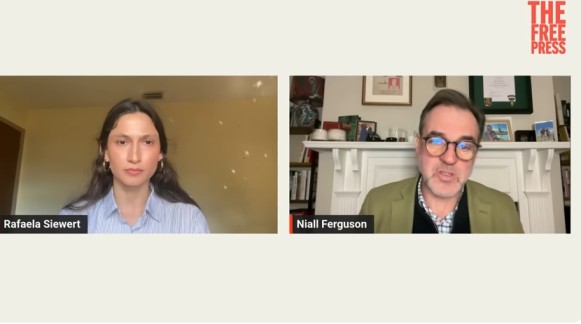
The Trump Corollary: Niall Ferguson on Maduro’s Extraction and the Return of U.S. Intervention in Latin America: An interview with historian Niall Ferguson on The Free Press, January 4, 2026.
Brief Notes: In this timely analysis, historian Niall Ferguson joins The Free Press to discuss the January 2026 extraction of Venezuelan leader Nicolás Maduro, an event he frames as a long-overdue application of the “Trump Corollary” to the Monroe Doctrine.
Ferguson contrasts this surgical covert operation with the massive military footprint required to overthrow Manuel Noriega in 1989, arguing that Maduro’s removal sends a decisive message of U.S. dominance in the Western Hemisphere. While acknowledging the immense challenge of rebuilding a failed state, he explores the geopolitical ripple effects on China and Russia’s regional influence and the potential for a broader “realpolitik” return to 19th-century-style diplomacy. Ultimately, Ferguson warns that America’s ability to maintain such global primacy depends less on its rivals and more on its own economic stability and rising national debt.
Introduction
RAFAELA SIEWERT: We’re now going to bring in Free Press columnist Niall Ferguson. You all know Niall from our pages, author of too many books to count and someone who is just so important in terms of understanding the global picture here. So, Niall, thank you for being here.
NIALL FERGUSON: Great to be with you and much to discuss. I was listening with interest to what Elliot had to say.
RAFAELA SIEWERT: I just want to start simple with your initial reaction. What did you think when you saw the news and were you surprised at all?
A Long-Overdue Application of the Trump Corollary
NIALL FERGUSON: My initial reaction was good, to put it very simply. You may remember that I wrote a piece three weeks ago in response to the National Security Strategy that you were just discussing there. And I said, the most important thing about this document is what it says about the “Trump Corollary” and the Western Hemisphere.
And I explained to those who perhaps had neglected their history of the early 1900s that the Roosevelt Corollary was the corollary to the Monroe Doctrine. The Monroe Doctrine said that Western European powers couldn’t intervene in the Western Hemisphere, which actually they did. And so the Monroe Doctrine was one of these things that was a dead letter in practice.
The Corollary that Theodore Roosevelt came up with was that the United States reserved the right to get rid of any government in Latin America that it didn’t like the look of. And that turned out to be real.
And so what I think was really interesting about the National Security Strategy—this November document, only a few weeks old—was that it explicitly said there’s now a “Trump Corollary.” And to me, that was a remarkable throwback 120 years to a time when the United States openly asserted its right to get rid of any government in Latin America, including the Caribbean, that it didn’t care for, that it thought was falling short of whatever standards it sought to apply.
And so for me, it’s long overdue that the government in Venezuela of Nicolás Maduro is overthrown because for a quarter of a century, the Chavistas—he’s the heir of Hugo Chávez—have been ransacking what was once a wealthy country and have turned it into a failed state. So my reaction was, good, great start to the new year.
Responding to Critics: The New York Times and the Case for Intervention
RAFAELA SIEWERT: I’d love to get your comment on the people who are sort of falling in line with the New York Times editorial board’s framing, which is that this was unwise and illegal. And the thing I’ll add on is that, you know, to try to characterize some of their characterization is that they look at the unintended consequences from U.S. intervention in Guatemala or Chile or Panama, and they say, we shouldn’t do this. So how would you respond to that line of thinking?
NIALL FERGUSON: Well, the New York Times has taken this line for about half a century, maybe longer, and it’s always denounced and criticized every U.S. intervention in Latin America. And it’s never noticed or acknowledged that when the United States has not intervened and it’s allowed leftist governments to gain hold of power, the results have been terrible and terrible for a very long time.
Cuba is the obvious case. Failing to overthrow Castro’s revolution meant that Cuba spent half a century under a tyrannical, undemocratic regime. Next up, Nicaragua, and then most recently, Venezuela.
So the truth is that when the United States says, “Okay, that’s life, the left control this country,” they really do control it, and they remain in control of that country for a very long time. People have been hoping that the Chavista regime of Maduro would be overthrown by internal opposition, but that hasn’t happened, because even when the opposition won an election, the regime stole the election and used repression against the opposition. Same story with Nicaragua, same story with Cuba.
Whereas when the United States has intervened, you can wring your hands and people have wrung their hands for many years about the brutality of, say, the Pinochet regime in Chile. Nobody condones the regime’s use of murder and torture against its opponents. But it didn’t last all that long, and it transitioned ultimately peacefully to democracy, leaving, incidentally, the Chilean economy as the strongest economy in the region.
So if you actually look at the cases when the United States has not intervened and the cases when it has intervened, I think you could make the argument that the Roosevelt Corollary is quite a good thing and shouldn’t have been allowed to fall into disuse.
The interesting thing is that because the New York Times and liberals generally have maintained this consistent drumbeat of criticism of every intervention, portraying them all as disastrous over time, Republicans and Democrats alike shied away from intervention, and we kind of gave up taking that kind of action.
I mean, the last time there was a really decisive intervention was the overthrow of General Noriega in Panama, and that was Ronald Reagan.
Subsequently, I think the United States’ approach has been increasingly a passive, fatalistic one.
And for Donald Trump to change that, to revive the idea of a corollary to the Monroe Doctrine, and then to act on it within weeks of announcing that to get rid of Maduro is a very, I think, very healthy thing. But, you know, I don’t agree with the New York Times’ view of the history of Latin America.
A Remarkably Surgical Operation
RAFAELA SIEWERT: You are our historian at The Free Press, so I’m hoping you can just give us a little bit on how this extraction and what we witnessed today sits in perspective and in comparison with other interventions. So the ones that we’ve been talking about in terms of, like, rank it in history in terms of its success and how it was carried out.
NIALL FERGUSON: Well, of course, it’s too early to tell how successful this is going to be, because a lot depends on what takes the place or who takes the place of Mr. Maduro. And if it’s just his number two, then that doesn’t really represent a huge success.
I thought it was interesting that in his press conference today, President Trump talked about the United States running Venezuela until a real transition had occurred. That didn’t sound like it was just going to be “meet the new boss, same as the old boss,” but we’ll see.
Obviously, the ideal from the vantage point of anybody who cares about the Venezuelan people and their country is that you get a legitimate, democratically elected government and it begins to undo all the incredible economic damage that Chávez and Maduro have done.
I think it’s worth pointing out that the number of displaced people from Venezuela is comparable with the number who were displaced by the Syrian civil war. This has been a huge catastrophe. That is when it became a failed state because of this regime. It will be very hard to fix that. So that’s a challenge. And we’ll have to see whether it’s possible to get a transitional regime that doesn’t simply become “meet the new boss, same as the old boss.”
But if you put it in comparative perspective, I’ll tell you what really strikes me. It is remarkable that the president, even if you regarded him as the illegitimate president of Venezuela, has been spirited out of his own country by helicopter and by boat to face justice in the United States for drug trafficking.
The last time a Latin American leader was given this kind of treatment, it was General Noriega in Panama. Twenty-seven thousand American troops were needed to achieve that operation. So this has been done with a remarkably small number of boots on the ground.
We don’t really know from what’s been said today who exactly did this. You’d have to assume Special Forces, CIA. But this was a highly successful covert operation, which bears comparison with a lot of covert operations in the history of CIA involvement in Latin America that did not go nearly as well.
And in fact, if you think back all the way to the Bay of Pigs, the history of American interventions in the region going back to the early ’60s has been pretty checkered. So this is, at least from the vantage point of the history of covert operations, this looks like a very successful one.
Extraction or Negotiation?
RAFAELA SIEWERT: There was some speculation, and I would love for you to weigh in. I think Sky News also actually reported this, that there was actually a negotiated exit. And the story about extraction is not that there was more negotiation here. Do you think that there’s anything to that or that? I mean, it’s purely speculative, but I’m curious how you think of that.
NIALL FERGUSON: One thing that I’ve learned as a historian is that no journalist ever accurately comments on a covert operation within 24 hours of its being executed. And it may be many years before we actually have access to the kind of documentation that would tell us what really happened.
We know that they were trying to do a deal. There was certainly a negotiation, and it had been going on for some months to try and persuade Maduro to go quietly. I took the president to mean in his press conference today that that had not come to fruition and that the extraction of President Maduro had happened despite Venezuelan defense measures. That was my interpretation of what he said.
But I’ve learned enough from the documents of the 1970s relating to CIA involvement in Chile and elsewhere to know that we don’t know now and we probably won’t know for some time. And anybody who kind of pontificates about what happened in the immediate aftermath is just winging it. Unless, of course, they have access to classified information, in which case they probably shouldn’t be talking about it.
The Challenge of Nation-Building
RAFAELA SIEWERT: We have so far just been talking about intervention in Central and South America. I think when a lot of Americans think about intervention, they’ll actually think about Libya or Iraq because that was—it’s more front in the American psyche and people think of the cautionary tales. I don’t want to exhaust this too much, but two questions I have for you. One is, are you confident in the administration and their ability to carry out a transition? Some people are saying, do they even have a plan? And then the second element to this question is any cautionary tales, you know, if you were advising the president that you can relay as they think about transitioning the government.
NIALL FERGUSON: Well, I do think it makes more sense to look at this in the context of the history of the Western Hemisphere and American interventions there, rather than to look at, say, Afghanistan and Iraq in the period after 9/11, because those were radically different operations a great deal further away from the United States.
If one looks at the history of everything since 1904, which was the year of the Roosevelt Corollary, it’s a mixed picture. I mean, some interventions were highly successful and succeeded in stabilizing countries that might otherwise have descended into Cuban-style revolution, others less so.
And so when I wrote the book Colossus, which was published back in 2002, in the aftermath of 9/11, I made the point that the United States had done a lot of intervening, particularly in Latin America and the Caribbean. And you couldn’t say that it was all bad, and you couldn’t say that it was all terrific.
Sometimes the New York Times would tell you that, for example, the CIA overthrew Salvador Allende and installed Pinochet as a dictator. But that’s not true. The CIA had tried to stop Allende becoming president in 1970, had utterly failed. And by the time of the 1973 coup, the role that the CIA played was minimal. It was largely a domestic coup against Allende.
So the history is complex. And I think the key lesson that I would suggest the administration needs to focus on is that it’s hard to get a country that has been taken into the abyss of economic crisis on its feet again unless you are prepared to provide significant assistance.
And what I think I see in this administration is a deep reluctance to deploy American troops to provide that kind of assistance. So I think the big question mark is going to be what exactly did President Trump mean today when he said that the United States was going to run Venezuela for some period of time until the political transition had been achieved?
History suggests that that is a hard thing to do without ending up having to run the country. And that can include a great deal of policing that can quite quickly get ugly. So I’m pretty sure the president wants to avoid that.
I thought it was striking today how quickly he pivoted to the domestic political implications of ending the Maduro regime. He started to talk about the Venezuelan gangs and their role in American crime and narcotics. That’s what he wants the public to think about, not, are we about to get bogged down in some very messy and protracted presence in Venezuela.
The last thought that I’ll offer is that it’s hard to get democratic institutions to take hold where they’ve never existed, but they have existed in Venezuela. It’s only really a couple of decades since the Chavistas took over and broke the institutions of Venezuela.
There’s a memory, in other words, a Venezuelan middle class that remembers how to have something resembling the rule of law and democracy. And that makes it actually a brighter prospect than, say, Haiti. Haiti is a classic example of a country where the United States has intervened periodically and never been able to fix it. And that’s because there’s really so little to build on in Haiti. It’s always been dirt poor and dysfunctional.
But Venezuela was once a very prosperous country because of its oil wealth. And therefore, I think the prospects for success there are much brighter.
The Political Calculus of Military Intervention
RAFAELA SIEWERT: And another way it differentiates it from people’s impulse to compare to some of the misadventures in the Middle East. One question I do have is, during the press conference, the question portion today, when Trump was asked about if there will be boots on the ground—I just want to go a little deeper on that point you made—he said, “We had boots on the ground last night and we’re not afraid of it.”
Do you think he has political capital, one, to have a larger U.S. presence to carry out this transition and the appetite to put American, a larger footprint of American troops on the ground?
NIALL FERGUSON: I’m skeptical about that. I mean, I think the days when the United States could deploy large armies for sustained periods of time lie in the past. Part of President Trump’s appeal when he burst onto the political scene ten years ago was that he was against the Forever Wars. He was as critical, in fact, of neoconservative foreign policy as Barack Obama had been, just from a populist right-wing standpoint rather than the progressive left-wing standpoint of Obama.
I also think that if you look at the president’s polling numbers, they’re flashing red lights on the dashboard because on fundamental economic issues—shorthand term affordability—he’s deeply underwater. And that is, I think, why in talking about the operation today, he kept emphasizing the domestic political implications because he really doesn’t want to have to pitch to American voters a protracted military involvement.
Yeah, there were clearly boots on the ground. You can’t do what just happened entirely from the air, but not many. And I think it’s my guess, and it is just a guess, that this is one of these illustrations of the extraordinary quality of U.S. Special Forces that we periodically see in recent years. And my lesson is that the most effective boots on the ground are those Special Forces, Green Berets, Navy SEALs. When you deploy them, you don’t need to use large numbers, but you’re using such skilled operators that they get the job done and they get it done quickly.
The American public is very supportive of military interventions that can be described as surgical strikes. They like these things to be done quickly. That was why there was no real grumbling from the MAGA base about the bombing attacks on Iran last year, because it was all over and done with in a very short space of time.
In the same way, I think if this is felt to be a surgical strike that got rid of Maduro and helped Venezuela transition back to economic stability, without that large-scale commitment of military force, then President Trump will get backing from the public. I don’t think he’ll get huge love because presidents in their second terms generally don’t get huge love for their foreign policy achievements. And that’s the tragedy of all second terms. The presidents turn to foreign policy because of what they can do without Congress, and they find that no matter how many rabbits they pull out of the foreign policy hat, the public is underwhelmed because these are not the top priorities for American voters, particularly in the midterm year.
The Question of Venezuelan Leadership
RAFAELA SIEWERT: His comments about opposition leader María Corina Machado were surprising to a lot of people. What did you make of them when he said that she doesn’t have the respect of the country or the support? And second to that, do you worry that Trump and this entire effort could lose the support of the Venezuelan people in the country based on his instinct to cut her out?
NIALL FERGUSON: Well, that certainly gave us reason to think that there is some kind of deal in the works with members of the existing regime, in which case you’ve just decapitated Chavism, but Chavism is still in power. I think that’s deeply disappointing to those people who have been working at considerable risk to their own lives for a democratic Venezuela.
But as I said earlier, one of the things that I’ve learned is you can’t know from the outside what is being done on the inside, and it’s premature to pass judgment on this. I suspect that it would be a tactical mistake for the president to back her at this point when the levers of power are still in the hands of Maduro’s lieutenants. So there’s a tactical consideration here.
Ultimately, presidents are not in the business of writing editorials. They’re in the business of making policy. And what obviously we would not want to see would be a descent into civil war. That’s the kind of nightmare scenario that any intervention can lead to. In a way, it happened in Iraq. If you want to think back to the way things went off the rails there, they got rid of Saddam Hussein. That turned out to be easy. But then the problem was that without the regime, the sectarian conflicts between Sunni and Shia and Kurds all rapidly escalated and the place became ungovernable.
It’s not exactly the same, for obvious reasons, but I think you can understand why at this early stage, you don’t want to alienate the people who have the guns. And the people who have the guns are the Chavistas.
The Challenge of Restoring Order
RAFAELA SIEWERT: Are you worried about—I mean, I guess to what extent are you worried about a similar situation where there’s just a lawless power vacuum? You obviously won’t see a split on religious lines, predominantly Catholic country, but more so just chaos.
NIALL FERGUSON: But it’s a lawless place already. I mean, I remember being in Caracas twenty years ago, early on when Hugo Chávez was in power, and I witnessed a homicide in the street in Caracas, and I was very surprised to see someone gunned down in front of me. And I said to the local guy I was working with, “What just happened?”
And he said, “Well, a guy tried to get a gun off of a police officer, and the police shot him.” And I very naively said, “Well, at least that’s better than if it had been the other way around and he’d shot the cop.” And the Venezuelan looked at me pityingly and said, “In Venezuela, the police are just another gang.”
And that was back in 2005, I think, twenty years ago. It’s only gotten worse because the criminals have been running the country with increasing impunity and brazenness. It’s hard to restore the law when it’s gone. It will take a long time for there to be something like the rule of law in Venezuela again.
But as I said, there is a memory of it. History shows that if you’ve had this kind of a regime for twenty-five years, there are still people who remember what it was like before. And that gives you a shot at the restoration of civil society as well as the rule of law.
Trump’s Nineteenth-Century Approach to Foreign Policy
RAFAELA SIEWERT: I want to just ask one more question about something that was said in the question portion of the press conference before we go to the global picture, which is, Trump said he was like, “We’re doing this because we want good neighbors and we want good energy resources.” He was very direct about that, which I found interesting, because for years, allegations have been, “U.S. meddles because they want to get to the oil.” Like, that’s always the line. And he’s like, “No, we do want energy.” What did you make of his directness around that?
NIALL FERGUSON: Part of President Trump’s charm, if you want to use that word, is that there’s no hypocrisy. He doesn’t pretend to be motivated by a desire to build utopia. He makes it clear that his foreign policy is heavily motivated by the profit motive. That’s been true in the negotiations to try and end the war in Ukraine. It’s been true in the Middle East, which is why he always pitches policy first to the wealthy Gulf states. And it’s true in this case, too.
One of the ways in which President Trump represents a throwback to the nineteenth century—in many ways, tariffs as well as his immigration policy, and now the Trump Corollary—is that in the nineteenth century, it was regarded as perfectly normal for public and private interests to be intermingled. My favorite example is the Rothschilds helping Disraeli to acquire British control of the Suez Canal.
So Donald Trump’s a nineteenth-century figure who’s not outraged or scandalized in the way that the New York Times always is by the idea that there might be some private economic motives involved in the U.S. intervention in Venezuela. Clearly, the oil majors have wanted to get back into Venezuela and to take advantage of its abundant reserves, and they’ve been unable to do so because of the Maduro regime.
So I find it refreshingly honest of Trump to say that that is part of what is being attempted here. It always struck me as one of the bizarre features of U.S. intervention in Iraq that it was so high-minded that the United States ultimately failed to gain any significant piece of the economic action with respect to the Iraqi oil fields.
But this is where Trump is a nineteenth-century figure. And I think the key misunderstanding that many commentators make is to try to think of him in twentieth-century terms. Hence all those silly analogies with interwar dictators. No, Trump has just stepped out of circa 1904. He’s a Gilded Age person for whom it’s absolutely obvious that foreign policy should also pay. After all, the business of America is business, in the famous phrase.
China’s Strategic Setback
RAFAELA SIEWERT: I think I’ll try to use the oil to transition us to the big picture, which is that China has significant investments in Venezuelan oil. And how do you see China responding to today’s events?
NIALL FERGUSON: With considerable misery and despondency because they had their own delegates arrive just hours before this thing kicked off. And I can’t believe that Secretary Rubio was unaware of that fact. China has kept the Maduro regime going. The Maduro regime is one of those clients of the authoritarian powers that are such a source of mischief to the world. And so not only China, but also Russia has been a source of support as the regime has sunk ever deeper into the abyss of criminality.
What’s great about this is that it so clearly sends a signal. President Trump made this clear to others. I thought that was an important part of his press conference when he said that other leaders in the region should pay attention. I think it’s a big reverse for China. China has been trying to build up its position in Latin America and the Caribbean economically for years. The investments have been on a pretty substantial scale, and they’ve been in pretty much every country.
This represents a decisive turning of the tide against that. And I’m not sure what exactly Xi Jinping is going to be able to do in response, because it’s pretty hard for China to play in America’s backyard if America decides to play hardball.
The Iran Connection and China’s Energy Vulnerability
RAFAELA SIEWERT: I want to bring in Iran also, because that’s the other big story. Elliot and I touched on it only briefly. Massive protests across the country. Also an oil distributor to China. Can you just connect all the dots for us here in terms of what this is signaling to Iran as the regime seems to be increasingly weaker and weaker by the day, and how China might step in in both places?
Because, I mean, my understanding is China’s biggest liability is that they’re not energy independent, and so they really rely on Iran and Venezuela and Russia as well—those three oil producers. So to lose Iran and to lose Venezuela would just be a tremendous loss for China. So can you just connect all those dots and explain that for us a little more?
China’s Energy Strategy and Cold War II
NIALL FERGUSON: Well, China’s not without its energy resources, but when you look at the hydrocarbons, it’s nowhere close to the United States and Russia. That’s why China has been investing so aggressively in solar and wind power, but also burning coal. And China is the biggest culprit when it comes to burning coal. It still needs oil, though, and it’s been getting its oil despite American sanctions from places like Russia and Venezuela.
The Chinese, in that sense, had a game plan, which was to diversify their energy resources, and they’ve done that pretty successfully. So that’s part of the story here. The United States, of course, has been able to recover from its big dip in the 1970s and 80s when it was heavily reliant on imported oil. It’s become a major oil producer again, as it was in the early 20th century.
So the US is back. It’s back as a producer of oil. It’s back as a producer of natural gas. It’s a hydrocarbon superpower. President Trump’s attitude is, and that’s enough. We don’t really need to worry about solar and wind. We’re going to make the most of the hydrocarbons, and indeed, we’re going to encourage the other hydrocarbon producers to “pump baby pump” and “drill, baby drill.” So that’s kind of the energy piece.
But none of this makes sense if you don’t set it in the context of the geopolitical and ideological rivalry between the United States and China. I’ve been saying for the last six or even seven years, we’re in Cold War II. China’s taking the place of the Soviet Union. The big difference between this and Cold War I is enormous economic interdependency of the US and China. But in other ways, it’s very clearly a cold war.
And as in the Cold War, there are regional flashpoints. There are places where indirectly the superpowers can contest. That’s Ukraine to a lesser extent, it’s the Middle East. It’s also potentially the Far East as well as the Western Hemisphere.
The Western Hemisphere First
The interesting thing about the National Security Strategy document that came out in November was that it put the Western Hemisphere first in the order of priorities. And that’s the first time that that’s been true in a very long time. We really have to go back to 1904 to see American foreign policy put the Western Hemisphere first.
But I think the United States has a pretty good game when it comes to the Western Hemisphere. It can really lean on the regimes it doesn’t like, and it can support the regimes it loves, like Javier Milei’s government in Argentina. It gets tougher the further away you are from home, because it’s just harder to project power.
And it’s especially hard when you get to the case of Taiwan, which, although it hasn’t come up yet, is in fact the big one. I think the United States has a reasonable chance of seeing a major crisis in the Iranian regime, if not this year, then certainly on President Trump’s watch, if only because Supreme Leader Khamenei is going to die. He’s a man in, what, mid to late 80s now. He’s going to go at some point.
And the regime is on its heels economically. So it seems to me that the US is quite well positioned to benefit from a crisis of the Islamic Republic without necessarily needing to do that much directly to interfere. Leave it to the Israelis. They’re doing a great job.
The Taiwan Challenge
The problem is Taiwan, because that’s in China’s backyard, and that’s the big prize as far as Xi Jinping is concerned. So the fact that on New Year’s Day, more or less, the Chinese conducted a major naval and air exercise in and around Taiwan was a reminder that two superpowers can play this same game.
And I do think that whatever’s just happened in Venezuela, and as I said, we can’t entirely know how this will turn out. There’s no question that what happens in Taiwan would be a much bigger deal economically. Venezuela potentially could export a lot of oil, that is true. But Taiwan currently is the principal source of the most sophisticated semiconductors in the world. And so a Taiwan crisis would be economically far, far bigger deal than any of the crises that we’ve seen.
RAFAELA SIEWERT: And just for the audience to make sure everyone’s on the same page, these semiconductors are in all of our iPhones, all of our laptops, some of our defense military equipment, and they’re predominantly manufactured by TSMC.
NIALL FERGUSON: The most important high end semiconductors are what’s propelling AI. You cannot run a large language model without Nvidia chips designed by Nvidia and manufactured by TSMC on the island of Taiwan. And that is the big issue that I think we’re going to hear a lot more about in the coming years.
Because although he may not be ready yet, Xi Jinping, I am certain, is preparing for a confrontation over that issue. He hopes that he can achieve peacefully what he already achieved in Hong Kong, which is to gain control of the place. The question is, what kind of military threat does he have to make to achieve that?
So my sense is that President Trump has achieved some significant wins in his first year back in office. Big one in the Middle East with the Gaza deal that got the hostages out. A big one in hitting Iran when Iran was in a very weak position, reasserting America’s dominance as a player in the Middle East. It looks like he’s just achieved another very impressive win by getting Maduro out of Caracas.
If he can achieve some kind of peace in Ukraine, I’ll be impressed because that’s really hard. Much harder. The big challenge, though, is going to come in Taiwan. At some point, Xi Jinping is going to put the question, is the United States willing to fight to preserve what remains of Taiwan’s autonomy? And I’m skeptical that President Trump would be willing to risk that kind of a war because that would have the potential to become a world war.
The Limits of US Intervention
RAFAELA SIEWERT: I just want to make sure I’m understanding one point of this answer, which is it was either yesterday or the day before. I believe Trump truth socialed, “You know, if Iran shoots and violently kills peaceful protesters, which is their custom, the United States of America will come to their rescue. We are locked and loaded and ready to go. Thank you for your attention to this matter.”
So I just want to make sure I’m understanding. Do you think that’s a credible threat? I mean, we obviously see that he is willing to intervene in Venezuela, obviously. As you know, what I’m getting from your answer, it’s much harder and has much more risk the further away the intervention is. But, I mean, it’s sort of a similar story with Nigeria, too. Like, he was tweeting that we were going to strike ISIS in Nigeria, and everyone said, no, it’s bluff. He’s not going to do it. And then he seemed to have some form of strike.
NIALL FERGUSON: So President Trump is well able to use the extraordinary military capabilities of the United States wherever he wants. He could certainly strike Iran again. I wouldn’t be surprised if at some point he did, as Iran is busily rebuilding its nuclear power plants.
But it’s very difficult to influence events like popular protests from the air. And ultimately, I think it’s very difficult even for the most skilled CIA agents to achieve all that much when it comes to revolutionary situations. President Putin would like to believe that the CIA is extremely good at color revolutions and is forever knocking off regimes. It’s actually very difficult to influence a revolution as a foreign agent.
So it’s hard for me to see that US intervention could be decisive in a revolution against the Islamic Republic from within. That’s a very different proposition from spiriting Nicolas Maduro away from Caracas, partly because of the distance, but also because the nature of the problem.
Interestingly, President Trump seems to have walked away from the option of killing or having the Israelis kill Khamenei last year. I think the Israelis were willing to try that, and my understanding is that the President said, no, you don’t. So there are limits to the extent to which President Trump is willing to act. In practice, there are no limits to what he’s prepared to threaten to do. On Truth Social, one should always therefore discount by something like 20 to 50% what is threatened on social media by President Trump.
Return to 19th Century Realpolitik
RAFAELA SIEWERT: As a closer, you know, what effect will this operation have on world’s authoritarian leaders? Psychologically, I think people thought we were in a phase of history that was post, you know, US coup or intervention of this nature. However, you know, the language we want to use, that appears to not be the case. It’s still very much part of the reality. What does that signal, you think, to Tehran and Moscow and even Beijing?
NIALL FERGUSON: Well, it’s been argued for some time that this represents a return to a 19th century world where might is right, realpolitik is dominant and the liberal international order that was created in 1945 is dead. And I could give you any number of articles in Foreign Affairs lamenting the decline of the liberal international order and predicting terrible things if we go back to 19th century balance of power policy.
I don’t really understand this argument because it’s not like the period after 1945 was characterized by peace and universal love. On the contrary, the so-called liberal international order was pretty disorderly and saw some extraordinary nasty conflicts, particularly in Asia, throughout what was of course the first Cold War.
So I’ve never really bought this idea that some wonderful system came into existence in 1945, in every way good, and wicked Donald Trump is unraveling it because that is just not the history that I certainly have studied of the period after 1945.
Whereas, if one looks at the 19th century world, what do you see? Between 1815 and 1914, there were relatively few major conflicts between the great powers. There were a lot of relatively small conflicts, but very few big ones. And so there’s something to be said for the ideas of the balance of power and realpolitik. Those of course were ideas associated with Henry Kissinger, deeply hated by the New York Times, but I think somebody whose wisdom on the subject of international order grows in its credibility with every passing year.
So, yeah, I’m not so scared of going back to a 19th century way of doing things. As long as the United States maintains that military superiority that makes it very intimidating to take it on. And that is the critical part of all of this, that one must not lose sight of.
Ferguson’s Law: Debt as the Real Threat
The United States can call the shots in the Western Hemisphere, in the Middle East, potentially in the Indo-Pacific, as long as it has military primacy. But it cannot maintain military primacy if it spends a rising share of its gross domestic product on interest payments and a shrinking share on defense.
I’ve been making this argument now for some time. It gave me the idea of Ferguson’s Law: If a great power is spending more on interest payments than on defense, it won’t be great for much longer. That’s the problem that the United States faces. Its major rival is not necessarily China. Its major rival is its own indebtedness, its own political economy.
RAFAELA SIEWERT: Well, Niall Ferguson, thank you so much for being here and for giving us your time to make sense of a very critical moment. We’ll be continuing to cover the story in The Free Press. Right now, live on our website is a piece by Eli Lake that I encourage everyone to go read: “How Trump Took Out Venezuelan Strongman.” That’s the title. And you’ll be seeing more pieces from The Free Press in the coming days. So big thank you to Elliott Abrams, who was on in the first half of the hour. Big thank you to Niall Ferguson. And we’ll see you, everyone, soon. So thank you.
NIALL FERGUSON: Thank you.
Related Posts