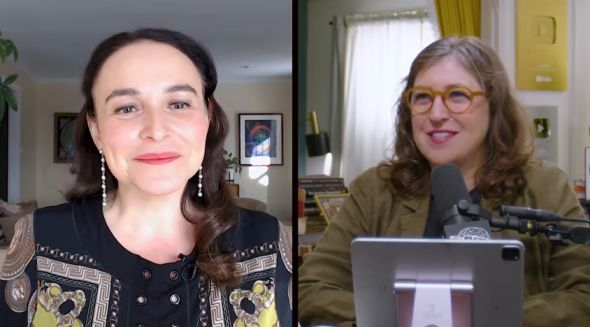
Editor’s Notes: In this captivating episode of Bialik Breakdown, host Mayim Bialik sits down with Yale psychiatrist Dr. Anna Yusim to explore the intersection of Western medicine and spiritual wisdom. They delve into profound topics such as intuition, “soul messages,” and the 99% of reality that remains unseen by the human eye. Dr. Yusim shares her unique journey of integrating spiritual traditions into psychiatric practice to help patients overcome self-sabotage and find deeper alignment. Whether you’re curious about extra-sensory perception or seeking a scientific perspective on the higher self, this conversation offers a transformative road map for understanding the unseen forces in our lives. (Feb 10, 2026)
TRANSCRIPT:
MAYIM BIALIK: Hi, I’m Mayim Bialik.
JONATHAN COHEN: And I’m Jonathan Cohen.
MAYIM BIALIK: And welcome to our breakdown.
JONATHAN COHEN: Welcome to our expansion into the psychic realm.
MAYIM BIALIK: What’s that I hear? Is it intuition?
JONATHAN COHEN: It may be one of the four Claires.
MAYIM BIALIK: Today we’re going to be talking about a variety of aspects of our spiritual experience that directly impacts our brains, our nervous systems and everything that we decide. If you’re not sure why spirituality touches every part of your life and existence, you’re going to want to hear this episode today.
JONATHAN COHEN: If you want to develop better intuition, if you want to feel connected to something greater, if you want to access your guides and guardian angels, this is the episode for you.
MAYIM BIALIK: If you’re rolling your eyes at the mention of guardian angels and guides, this episode is also for you. Because we’re going to talk about what is actually happening when we tap into information that is not available in any physical sense.
What does it mean to say that there is spiritual energy in the universe that surround us all the time? Why are some people able to tap into it and others roll their eyes at it? When we talk about the four Claires, as you may have heard of clairvoyance, but have you heard of claircognizance? Have you heard clairaudience? Have you heard of clairsentience? We’re going to learn about the four Claires and what it means to be in touch with information in the energetic and spiritual realm.
JONATHAN COHEN: And if you think this is a very out there conversation, we’re having it with a psychiatrist and an MD that has been trained at some of the world’s best academic institutions.
Meet Dr. Anna Yusim
MAYIM BIALIK: Who is the psychiatrist who is so deeply tuned into the spiritual realm? Her name is Dr. Anna Yusim. She’s an internationally recognized, award winning, board certified, Stanford and Yale educated psychiatrist and also a coach. She has clients including Forbes 500 CEOs, Olympic athletes and A Listers.
Her book is “Fulfilled: How the Science of Spirituality Can Help You Live a Happier, More Meaningful Life.” She’s a clinical assistant professor at Yale Medical School and the co-founder of the Yale Mental Health and Spirituality Program and Center which bridges the Yale Medical School and the Yale Divinity School.
She is an incredible expert on all things psychology, psychiatry and mysticism. She’s traveled to over 70 countries and has spent years studying all of the spiritual traditions to try and find what is in common and what can she bring to her western practice that can really transform lives. We talk about autoimmunity. We talk about depression, anxiety. We talk about trauma. Also included in this episode is a conversation about prayer.
JONATHAN COHEN: Be careful what you pray for because you may not like the results. She explains why the law of attraction may not be working for you.
MAYIM BIALIK: We’re going to have Dr. Yusim explain all of this and break all of this down. It’s a wonderful episode. We cannot wait for you to hear it. And please hop over to Substack because Dr. Yusim’s book also contains a ton of exercises and meditations and we’re going to feature one of those just for our Substack listeners.
So please go over to bialikbreakdown.substack.com for content you cannot and will not get anywhere else. Dr. Anna Yusim, welcome to the Breakdown. Break it down.
ANNA YUSIM: Thank you so much Mayim. It’s amazing to be here with you today.
The Intersection of Spirituality and Mental Health
MAYIM BIALIK: There’s so many different aspects of spirituality, of mental health, of psychiatry that you are an expert in. Before we get started, what would you say is the biggest misperception people have about spirituality and mental health?
ANNA YUSIM: It’s a great question. And I would say that the misconception is that the two are actually very separate and distinct and so-called strange bedfellows. And the reason people have that misconception is because often everything that is scientific and medical is seen as subject to experimentation, to double blind, placebo controlled trials. Something you can touch with your hands, hear with your ears. Very empirical.
Whereas spirituality is something that is deeply subjective, transcendent, very personal and hard to reproduce. You know, experimentation and replication. Which is why the science of spirituality is often such a paradox and a mystery to many. But I believe that they actually are so interlinked. And that’s what we will talk about today.
JONATHAN COHEN: Well, I think a lot of people want that intersection because they want proof, because it can be so subjective. And we talk about spiritual awakening, how people are often touched and their lives are transformed and they have miraculous health benefits, and yet people want a roadmap and there doesn’t seem to be one.
What have you discovered as you’ve studied this from a scientific basis? Is there a roadmap? What should people know is possible?
The Science Behind Spiritual Practice
ANNA YUSIM: That is also such a great question because you’re exactly right. People want certainty. They want something they can touch. What do I have to do to get better? A, B, C, D? I have to become spiritual? What does that even mean? What if I don’t believe in God?
The way that you can answer a question like that is twofold. One is to look at the science, because there’s been a ton of science at this point looking at how spiritual beliefs and practices could actually improve physical and mental health as well as well being. And there’s numerous studies showing that, for instance, going to church on a regular basis reduces suicide by up to five times. And so this is weekly church attendance. Humongous effect size on suicide reduction. Very interesting.
This is for both men and women. However, it’s not for every population. Do you have a sense of what population might not have that effect? The LGBTQ community. So it’s more the heteronormative communities. Churchgoing reduces suicide. LGBTQ, the opposite effect. Very interesting. Right, but the effect sizes for those people for whom it does reduce it very profound, very powerful, very real effects.
And then you look even deeper. What is it about churchgoing that reduces suicidality? Right. And there’s many different things. Is it the community? Is it beliefs about healthy living? Is it having, you know, something to do every Sunday at noon? Is it something, you know, much deeper? And there’s actually one primary thing that was at the root of it all that was the number one factor. Whereas all the rest also came into play, and it wasn’t any of the ones I mentioned. Any ideas what that is?
JONATHAN COHEN: I want to believe that it is some connection and feeling that you’re a part of something and that you matter in some way outside of the social connection. I want to believe that, you know, from a spiritual experience, we are touched in some way that we can’t ignore.
ANNA YUSIM: I think that that also is a huge, huge part of it. But interestingly, the number one factor is actually a moral prohibition against suicide that churchgoing instills in people.
MAYIM BIALIK: Wow.
ANNA YUSIM: So very interesting. Right. That was all the other factors, what you said as well, feeling that you have a connection to the divine being connected to your inner essence for the first time. How can that not be significant? And yet the number one thing is the moral prohibition.
And this is all based on Tyler VanderWeele’s research at Harvard’s Center for Human Flourishing. So it’s, you know, data like this that’s super interesting and super compelling. And they have this for recovery from cancer, recovery from addiction, so many other things as well. Depression, anxiety, et cetera. Spiritual beliefs and practices consistently having positive effects. But, you know, in nuanced ways similar to this.
Spirituality vs. Religion
JONATHAN COHEN: Let’s separate out spiritual belief and practice from religion, because it’s such a murky area for people. The institution of religion, as you mentioned, especially for people who may be not in the heteronormative community, the morality there or the judgment there can have a negative effect. So let’s talk without religion. What does it mean to have a spiritual experience?
ANNA YUSIM: Yeah. And I also love that you brought in religion and the distinction between the two. And so, according to the Pew Research Center and all the studies there, there’s four groups among us. We are either spiritual and religious, spiritual but not religious, religious but not spiritual, and neither religious nor spiritual.
And interestingly, over the past 25 years, two groups have been going up and two have been going down. The two that have been going up are both of the groups with spirituality. The two that have been going down are both of the groups with religion. Religion is going down in our community, in our country and our society and it’s being replaced by people wanting more of a spiritual belief.
So anything that is more orchestrated, ritualized with authoritative is starting to go down, replaced by a more personal connection to the divine, whatever that means to somebody, whether that is in a more religious way, because you can be spiritual through being religious, or in a more secular way, which is connection through yoga, meditation, something that is, you know, connected to you and your divine essence, such as a connection to nature, psychedelics, et cetera. All of these ways are ways in which people can connect to their spiritual essence and spiritual self.
MAYIM BIALIK: Jonathan and I are huge fans of Mud Water. I’m very into the turmeric latte and if you add a little agave makes it just a little sweet. It makes us feel energized without the jitters, which is a real problem for those of us who don’t like that jittery feeling. And I’ve noticed it makes a huge difference in Brain Fog. It’s the best tasting functional mushroom blend on the market and with the best results.
Also, Mud Water’s new Low Calf coffee is a great go to for an afternoon pick me up. It’s made with organic Arabica coffee, Swiss water, decaf, L theanine and functional mushrooms like lion’s mane and cordyceps. So you still get that rich, full bodied taste that coffee lovers crave, but with only 45 milligrams of caffeine because research shows low doses support focused mood and reaction time minus the crash or anxiety that comes with a full cup.
And if you want something even gentler, the original blend is still there for you. The coffee alternative made with cacao chai, turmeric and functional mushrooms plus chaga and reishi to support a healthy immune system and caffeine plus L theanine, one of the most effective cognitive stacks known in neuroscience. Every single ingredient in Mud Water’s products are 100% USDA certified organic non GMO, gluten free, vegan and kosher. There’s also zero sugar and no sweeteners added.
To use mud water, you just drop the powder into your favorite mug, pour some water on it, give it a mix. Some go wild and add creamer, honey or even CBD. There’s also caffeine free blends available. Ready to make the switch to cleaner energy. Head to mudwtr.com and grab your starter kit today. Right now our listeners get an exclusive deal. Up to 43% off your entire order plus free shipping and a free rechargeable frother which I love when you use the code break. That’s right up to 43% off with code break at mudwtr.com after your purchase they’ll ask you how you found them. Please show your support for the show and let them know that we sent you.
JONATHAN COHEN: A lot of people get to the end result of a spiritual experience through suffering of some kind.
MAYIM BIALIK: For sure, I just keep racking up the suffering and waiting for the spiritual awakening to happen.
ANNA YUSIM: We all are Mayim. Unfortunately you’re like, what’s on the other side? How do we speed that process up? Exactly. Where’s the roadmap?
Seeking Purpose and Understanding
JONATHAN COHEN: The other thing I think that happens is that people who have a spiritual experience or who are seeking it believe that there is some understanding of how the universe works, how to navigate life that they are missing. Right. Like it’s this multiple sided benefit.
Yes. There are physical benefits which we want to touch on. Yes. There are internal benefits like more inner peace, more clarity, less anxiety and depression. And then the third bucket is actually, I’m not saying life is going to be perfect, but there’s this belief that we are all here for some purpose and by increasing our senses we can navigate the world differently.
And I’m not saying we achieve X, Y or Z or have this many cars or anything. But there’s something where we are in acceptance and life unfolds in a way that seems to make some kind of sense instead of random chaos. Can you talk a little bit about the people who are seeking the third and then we’ll cover all of them.
Two Ways to Manifest
ANNA YUSIM: Absolutely, absolutely. And what this makes me think of, I talk a lot about manifestation. That’s a very popular buzzword these days. Right. And you think about how do you manifest? And I think that there are two primary ways to manifest.
One is deliberate action and intent, which some people may equate as the more masculine way of manifesting. You set a goal you say, I’m going to do this. You work very hard, you make it happen. Great. We all know how to do this. This is how we got through graduate school, medical school, became a neuroscientist, et cetera.
And then there’s the other way, which is not about doing, but much more about being. And in being, you essentially figure out how to embody the most joy and peace that you can possibly embody and essentially have this thing called a vibrational frequency. And have your vibrational frequency become a match for the vibrational frequency of whatever it is that you’re trying to draw in.
And in that state of being, you set your intention, you do what you have to do, but it’s very different. You don’t go out and make it happen. It’s like a surrender and receiving. And this is the two ways that I think that we as humans manifest. One is very action oriented, masculine, let’s do it. The other one is more feminine, receiving. Let’s be, let’s enhance our state of being and let’s receive what we can from the divine.
MAYIM BIALIK: You know, I think that there’s a certain amount of hand waving that sometimes goes on when people talk about raising their vibration. You know, it is something that does have a practical nature to it. In certain forms of yoga, we actually work on, I don’t know, I think working in these arenas of raising a frequency. But maybe Dr. Yusim could explain to us sort of what that means in terms of matching it with that of someone else.
Understanding Vibrational Frequency
ANNA YUSIM: Yeah, yeah. And you know, ultimately we are energetic beings and we also are matter. So we’re matter and energy. And as such we have a frequency as does all matter and energy. And you know, in a way, sometimes we have our own destiny, but we might want a destiny that’s a little bit of a different destiny. And in order to reach that destiny, we need to clear out whatever blockages we have within ourselves that lower our frequency.
And what are the things that lower our frequency. We can think about those things. And this is from my studies of Kabbalah way back in the day. You know, the manifestations of ego. So our anger, our jealousy, our hatred, our sadness, our depression, all of those things that are so human and that we’ve all felt and are so normal. And yet if we don’t know how to metabolize it, if those things become a part of it, they contract us, lower our frequency and prevent us from having the best life possible.
And so that’s one of the ways of increasing your frequency. And the other way is filling yourself with the positives, filling yourself with joy, peace, living with purpose and mission based, purpose driven, contented action in the context of your life, serving others, interacting with gratitude and awe. Which are the spiritually adjacent entities and states of being on a regular basis.
JONATHAN COHEN: It feels like this is the intersection of the spiritual language that is common and popularized and the quantum science, neuro physiology. Can we bridge these two? Because a lot of people hear this, I’m going to raise my frequency. And they’re kind of like, okay, sure. But is that just something that I’m thinking, is it in my body? Is it in my quantum field? Whatever that means. How do we bring these two different disciplines together to make this really understandable?
MAYIM BIALIK: What is the mechanism by which spiritual connection, manifestation is actually changing things about our hormonal profile, our physiology, our mood. What is the mechanism for that?
The Science of Spirituality
ANNA YUSIM: I think that’s a great question. And there’s people who are devoting their life to studying that. We have Dr. Mark Potenza at Yale, where I’m based. And we have Lisa Miller at Columbia. So the two of them together have done studies looking at the neural correlates of spiritual experience.
So there are certain regions of the brain that get activated when you think about God, when you pray, when you are in gratitude, when you feel aligned with your purpose. Right. And also, you know, because spirituality is something that is so encompassing and it can be secular or religious. For instance, a form of secular spirituality is meditation.
There are tons of benefits of meditation. Helping with hormones, with somatic processes, with anxiety, with your sympathetic and parasympathetic system. Balance with regulating your vagus nerve. Tons of studies showing all that and, you know, different meditation techniques showing subtlety and variation in that. But nevertheless, the finding is clear that meditation over the long term has a huge impact mechanistically.
So I think that to answer that question, we first have to say, what part of spirituality do we mean? And then looking at each part of spirituality, really look at what the science shows. And there is a lot of science.
JONATHAN COHEN: Circling back to frequency raising. How does that help us navigate life or get the life that is one step beyond or two steps beyond where we’re currently at.
From Contraction to Expansion
ANNA YUSIM: We’re talking about it, yes, at the quantum level, I do believe frequencies raise. But I talk about it really more mechanistically as a metaphor, metaphorically raising your frequency. And this is moving from a state of contraction to a state of expansion.
And we all know what it’s like to be contracted, right? To feel stuck, to feel scared, to feel fear, to be in those ego states that I mentioned. Control, fear and sadness, depression, anger, hatred, jealousy, all of those things. Nobody wants to be there. And we all know what it’s like to be in expansion, right?
So what do you do? How do you go from one to the other? And there’s many, many different ways. And I think that first the distinction has to be there’s things that you can do consciously and then there’s ways in which you have to work on your unconscious. Because there’s a lot of aspects of us that we can change everything consciously but still not be receiving in life that which we hope to receive.
And why is that? It’s because there’s something holding us back in our deeply held unconscious core beliefs that needs rectification and release and metabolism. And until that happens, whatever conscious work we do to raise our frequency and remove blockages is going to hinder us. So this is a very powerful, important step.
So doing unconscious work. And there’s many different ways to do that, from psychoanalysis to hypnosis to unconscious reprogramming, you know, through hypnotic suggestion with certain therapists who are trained in that, and psychedelics can do that for people as well in certain circumstances, certain trauma work can do that for people. And then at the conscious level, you align with expansion to the degree that you are able. And I can talk much more about all that too.
The Power of Surrender
JONATHAN COHEN: What comes to mind when you’re explaining this is like there could be a solution that you haven’t even thought about yet because you’re so worried about finding the solution that life can’t unfold and give you an opportunity. I want something so badly that I’m just going to force a solution versus sitting back and saying I have to have a little bit of trust in order for that solution to unfold, which can be a terrifying component.
ANNA YUSIM: I completely agree. And this is, I think, the most powerful part of faith, which is surrender, is that you do your, whatever it is that you are seeking to manifest or that you would like to have happen. You do your work in the physical world, you give 100% and then you have to trust and have faith and believe that there is also something greater that is supporting you. If you’re a spiritual person, if you choose to live this way, right?
And in doing so, when you surrender, you’re exactly right, that magic can happen. Things can come into your consciousness through synchronicity into your intuition, and you can see things in a new way or something can present that you never, ever would have thought that was a solution to a problem.
And this happens in magical ways. For instance, with mathematicians and artists who are trying to solve something in their mind. They do all their conscious work, and then finally they go to sleep and they wake up with a solution. That’s one way that that manifests and in other ways. People are trying really to solve a problem in their life, and then one day, a solution just comes from out of the blue. They’re like, I never would have thought of this. And they’re like, thank you very much. And, you know, they thank the divine for the intervention.
Redefining Spiritual Awakening
JONATHAN COHEN: It’s like, you’re mentally trying to solve this problem. You can’t figure it out. Finally, you give up, and you’re like, I’m just going to go get a coffee and enjoy myself. And you end up having a conversation with someone in line at the coffee shop where they say something, and all of a sudden the problem opens up for you, and you see it totally differently.
Mayim likes to joke, as she did earlier, that she’s just in the suffering part. But all the time she’s like, oh, I saw this differently. And if we try to help people understand what a spiritual awakening is, I think we have to dismiss the idea that it is somehow, all of a sudden, I’m floating on a cushion and I don’t touch the ground anymore because I’ve achieved such a grand state of enlightenment.
And instead, it is about these moments of shifted awareness that all of a sudden, I have a problem and I haven’t been able to figure it out, and a solution is available in a way that I hadn’t imagined before.
ANNA YUSIM: Yeah, I love that. And also, A Course in Miracles, which is a spiritual framework there. They describe a miracle as a shift in perception, just like you said. And that’s exactly it. We see the world anew, our mind expands, our life expands. Very powerful.
MAYIM BIALIK: You know, many of these things are generally kept separate from the fields of psychiatry, from the classic Western materialist perspective. I wonder, did you receive any pushback when you started incorporating some of this spiritual perspective into your practice and into your worldview? And how have you managed to balance that?
ANNA YUSIM: Yeah, so I anticipated receiving a great deal of that when I first wrote my book, which was integrating mental health and spirituality. But I also was very committed to writing the book in truth, based on my research and my experience.
And so I went to Stanford for undergrad, Yale for medical school, then NYU. Then I very deliberately chose not to be affiliated with an academic institution as I wrote my book and started my practice for the next X number of years.
And after I wrote my book, I started talking at different schools at Kripalu, Multiversity, all these different places. And when I went to speak at Yale, I saw my old professors, they liked my book and they actually invited me back on faculty. And that was like a shock and such an amazing revelation that here I put something out there that was really kind of out there.
And rather than dismissing it, Yale was ready for it. Like society was ready for that integration. And that was when in 2017, we started talking about the creation of this mental health institution, spirituality center, which would be at Yale, a bridge between the divinity school and the medical school.
And we started working on that. And we’re still working on that. We have the program now, we’re going to have the center when we have enough funds for that and eventually, God willing, an institute which will also grant degree granting programs at the intersection of mental health and spirituality.
So I anticipated having a lot more pushback, but because I think because I tried to approach it in the most scientific way I could and had wonderful colleagues in psychiatry stand behind me in my work, I think that was incredibly helpful. And Yale accepted it and has been super supportive of the work thereafter.
The Unconscious Mind and Self-Sabotage
JONATHAN COHEN: Here’s an area that has a lot of crossover between what I will call the spiritualist language and the medical psychoanalysis language. The notion that at an unconscious level there may be things happening that are running our perception, running our beliefs that we don’t even realize are happening that make it seem like the world is this horrible place that make it seem like we can’t get anywhere, that we’re stuck in some way. You mentioned doing this unconscious work. Can you talk a little bit about that level of programming that is influencing and filtering people’s reality?
ANNA YUSIM: Absolutely. And this was probably Sigmund Freud’s greatest contribution to the field of psychiatry was the understanding of the unconscious mind. And the idea of the unconscious mind comes from the fact that you have your conscious mind where you will certain things. But then you also see how you as a human being will self sabotage.
How certain things just for whatever reason don’t seem to work out. In certain parts of your life you have challenges. In my book, I call these our soul corrections or tikuns, those things that come up in our lives again and again and again, often much to our chagrin and dismay and despite our best efforts to change it.
Sigmund Freud call these your repetition compulsions. The same idea. It’s those things that are your particular self sabotage pattern. And so nobody wants to consciously self sabotage, but we do. So what is that unconscious process by virtue of being human, you will self sabotage.
Now the question is, what is your unique self sabotaging pattern? And it’s often through therapy, working with a professional, you can see how someone can hold a mirror to how this can work for you.
MAYIM BIALIK: Can you give us some examples? Just because, you know, there’s people who don’t want to cheat but end up cheating, or there’s people who, they don’t want to drink to excess, but they can’t seem to control their addiction. Am I thinking of good examples?
ANNA YUSIM: Those are great examples. It’s that you want to be faithful, but for whatever reason you can’t be faithful. That you make an intention, you make an intention to yourself, to your spouse, and then you don’t end up being faithful over and over. What is sabotaging you? What is the unconscious pattern that you are playing out?
And the same thing, you really want a relationship. You want a healthy, stable relationship with an amazing man or woman, and yet you keep drawing in emotionally unavailable men or women. And why is that? You want one thing, but you keep drawing in the other. So what is the delta? What’s the gap?
And there’s so many different reasons for that on both sides. Like we can, if you want, we can dissect and I can give you like the 10 reasons that this could happen.
MAYIM BIALIK: Just send me your bill and I’ll be happy to do that.
ANNA YUSIM: Exactly.
JONATHAN COHEN: People often think they’re like, well, it’s unconscious. I don’t know how to get to it. I don’t have all this endless time to circle around and discover it.
MAYIM BIALIK: Most people don’t have financial resources also to do that.
ANNA YUSIM: Absolutely. In which case bibliotherapy. Get some really, really good books and start drilling down and start understanding yourself through books. You know, and all the podcasts, all the amazing content that is put online. But often working with a professional, of course, is, if people are able, much better.
But let’s talk about that. Let’s talk about why somebody who says that they really, really want a relationship, let’s say a woman with a, she wants a wonderful man, a committed man with whom she could have a family. And who does she draw in? Train wrecks. She draws in train wrecks. One train wreck after the other. This guy is dating five other women. This guy she has to take care of, like she’s his mother. This guy ends up stealing from her.
MAYIM BIALIK: Now, she’s got to be polyamorous, but he’s the one who wanted it. She’s not even sure what polyamorous is, but okay, we’ll try it.
ANNA YUSIM: Exactly. Exactly. Right. And so, so many different ways to understand this. And this can be understood first from the lens of her own upbringing, that as much as she wants this healthy, stable relationship, she might not have the pattern for it. She might have the default pathway of something totally different based on what her parents are playing. So she might be running that old program without even realizing it. Option one.
Option two, which can coincide with option one. She really, really wants commitment, but there’s a part of her that’s also terrified of commitment. And so she also loves to be free, and she’s strong and independent. And so in being terrified of commitment, how better to avoid commitment than to constantly draw in emotionally unavailable men or train wrecks, things that don’t work out?
So those are just two, but there’s so many more. And as you go with somebody deep into this work, you can understand why they’re making the choices they’re making. And ultimately, as you start to look at intergenerational patterns, because usually the patterns that you observe with somebody are not just with this person. They go from their parents and from the grandparents.
You start to understand the intergenerational shifts. And in understanding those shifts, you then make the unconscious conscious. And suddenly, when the unconscious is conscious, you finally have control over it. You can make a different choice in a way you couldn’t before.
And in doing so, what you’re doing with the intergenerational pattern is the buck stops here. You’re done. You don’t pass this on to your children. You actually stop the intergenerational pattern because you have chosen to do the work, metabolize it and let it go. It’s very, very powerful work.
Breaking Intergenerational Patterns
JONATHAN COHEN: The pattern that I see is that when someone is continually ending up in the place that they don’t want, when they consciously want something else, what they end up doing is blaming the universe. But when you describe it, that there is this program running that they may not be aware of, the external reality of their lives is actually the perfect reflection of all the mechanisms, all the dominoes that are falling on the inside. They’re just falling in silence.
ANNA YUSIM: 100%. And I think that the first point that you made about blaming the universe and thereby making oneself the victim of the, you know, an evil protagonist or an evil God or an evil whatever, that does happen for many people. And that’s another subconscious pattern that for whatever reason, they learn that in being a victim, they somehow have righteous indignation of the victim, and so they seek out blaming the victim whenever they can. On an unconscious level.
They could have learned this somehow or another. They just came into the world and this was a pattern of theirs. And once they recognize that pattern, they can make different choices as well. And that’s a very powerful pattern that we, when something goes wrong, tend to internalize it. Oh, this was all my fault. Or we tend to externalize it. It was this person or my parents or an evil God or unjust circumstances.
And in different situations, it’s different. But usually people tend to sway one way or the other. And if people sway too much at blaming themselves, it’s actually good to externalize a little bit. But if you are the victim and have victim mentality, it’s good to start taking more responsibility. What did I do to get here? And what kind of control do I have to get myself out?
JONATHAN COHEN: The other component that you talk about is this idea of intergenerational patterns and, you know, the language that is familiar amongst people in the energy healing world is the notion that I’m going to do the work and break the cycle.
Let’s unpack that a little bit, because inherent in that is the work of Bert Hellinger and family constellation work. I want to talk about these intergenerational patterns, and we’ve heard about the epigenetics work with mice and showing that mice who go hungry will then multi generations later have, you know, physiological influence of that and impacts of that. So we’ve seen those studies.
But what you’re talking about is actually more pervasive, whereby a mother or father, or even grandparents, or even great, great grandparents, psychological profile, whether that be pain they’re carrying, broken relationships, not being able to accomplish something, fleeing war. Fear, intense fear, physical safety issues.
Those patterns, not only psychologically but, you know, energetically are imprinted on the individual. And the way that Bert Hellinger talks about it, and I’m curious how you interpret it, is that because you’re a member of the family and you’re connected to these people, the child will reflect those patterns, not because they think they have to, but almost as a reflection of being part of the system.
It’s like, hey, I understand. I speak the same language of this family energetically. Even if they never knew that the parent had an affair. Even if it was so buried in secret that there’s no possible way the conscious would ever have registered it. That these patterns exist.
And again, we struggle with the word in the energy realm because it’s hard to visualize. But it’s almost like there is this code of ones and zeros that are just surrounding us. In a similar way that Niels Thes, when we spoke to him, explained that everyone who lives in a house shares a microbiome in some way. Like that information is just passed back and forth.
The same is true with the informational data of our emotional experience and our psychological experience. And so you think, oh, I’m not anything like my parents. But you’ve received all of this information on a physiological level that you’re not even aware of.
ANNA YUSIM:
I completely agree. This is why I think Constellation therapy is super interesting. And doing genograms and seeing the patterns in families. And those patterns can be, it could be patterns of addiction or patterns of certain emotional things, or patterns of cheating. Or it could be patterns of more subtle patterns of the parentified child of somehow or another the child comes into the world having to take care of the parents because the parents are unstable mentally or physically, or weak mentally or physically, and the child is a strong one.
And then what that does in a family system is that actually reverses the family system. Because you’re supposed to have the grandparents, the parents, the child, and the energy is supposed to flow down. And the idea of the family system is even after people have passed, the energy is supposed to support you from your ancestors. And if you have the family system aligned in the right way, you get support from your ancestors to have certain processes and patterns work out in your life with the right energetic support.
And when that is not present, like a parentified child, that flips the, that has the energy flowing the wrong way. And so then you can energetically fix that. Or there could be a pattern of secrets that you know. And you’re exactly right. The most interesting thing is, like you said, this is imprinted at the energetic level. People might not even know about secrets consciously, but they just feel it. They know.
And children sense everything. Children are sponges. They pick up all of the things of their parents. The parents think the children don’t know. They know everything. They might not know it consciously. They might not know that they know, but they do know. It’s being imprinted in every single part of their being, their energetic being, their physical being, their spiritual being. That’s who we become.
And so to recognize what patterns exist and see what. Because in every family, there’s amazing patterns. There’s traits that we love and traits that we want to expand on. And there’s also traits that could be really problematic for your life in whatever way. So going through and doing this genogram, really understanding where you fit into the family system and then figuring out how you could do the rectification exercises with that very powerful work. And I’ve seen it in my practice create huge shifts with families.
MAYIM BIALIK:
What happens when there’s a conflict in a family? Can you explain a little bit from your perspective, especially as a psychiatrist? How do you manage the energetics of a family, let’s say, that is in conflict? How do you know when people should be brought back together? How do you know when people should be kept apart? And it also relates to some of the conversations you’ve had about sort of energy vampires. If you sense that someone, let’s say, in your life or in your family, is taking something from you energetically when you are with them, is there a way to remedy that? How do you work with that kind of energy conflict?
Managing Family Conflicts and Energy Vampires
ANNA YUSIM:
Great question. So I think we’ll take the first one first. So in working with families and couples, how do you know when people should be together and rectifying and when they should be apart? I would say that the goal in families, to the degree that’s possible, is always to rectify and to enable people to come together and metabolize whatever is going on and to have safe discourse and to create the space where people can openly discuss what it is that they are experiencing.
And the situations where people should be kept apart is if, first of all, if somebody requests that specifically, and then to understand the reasons for that. And second, if there is danger, danger to one’s safety or any sort of abuse, and in those situations, that could definitely be a different way of treating.
But with conflicts, you really want to bring people together. And because conflict is an inevitable part of life, it’s an inevitable part of families, of relationships, of being, of friendships. And for people to know how to rectify conflicts and be able to speak their truth in a way that is grounded and where they feel heard and where they can be compassionate. That’s a very powerful skill. If you can learn that in your family, you’re going to be very well suited for life.
That’s the first question, the second question about energy vampires. So it’s a very interesting thing because someone can’t be an energy vampire unless you let them take your energy. So it’s, to some degree. And so, and it could be that in certain families there’s a person who could be taking more energy and someone doesn’t know how to protect themselves. And then in those situations, the person who doesn’t know has to do everything they can to learn to protect themselves and to create really good boundaries.
And so I think that, because you can also think about energy vampires are the people who need to be taken care of and then they will pair up with the caretakers and there’ll be a perfect hand in glove relationship that, the energy vampires will be with the people who have so much energy to give and don’t know how to do anything but to give. So it could be this beautiful symbiosis until one or both parties decides it’s not, and then they decide to revamp things.
But if you really do feel that somebody is negatively taking your energy and you don’t want that to be a part of your life, there’s many different techniques that you can learn, which I talk about in my book, to be able to ground yourself and create the boundaries spiritually, energetically and physically to protect yourself and your energy.
JONATHAN COHEN:
It’s interesting. If you’re in a dynamic with someone who you feel draws a lot of energy from you, when you start to create those boundaries, all of a sudden they don’t want to be around you.
ANNA YUSIM:
Well, because you served a purpose in their life and you can no longer serve that purpose. And they really feel it.
JONATHAN COHEN:
Yeah, everything shifts.
ANNA YUSIM:
They need something from you. You can no longer give them what they need.
Understanding Clairvoyance and the Four Clairs
JONATHAN COHEN:
Let’s talk about clairvoyance. Tell us what you think about it, what your research is discovering.
ANNA YUSIM:
Yeah. So I think clairvoyance is one of the many forms of intuition. And what is intuition? So I love to just, intuition is an epiphenomena of consciousness. That’s one. An emergent property of consciousness. And another way of thinking about it is also the voice of the soul. It’s like your connection to the deepest part of yourself. So you can get messages through your intuition that are maybe even deeper than what you can get through your rational mind or more profound than what your emotions can tell you. So it’s a very deep voice.
And how can you receive intuitive information? There are the four clairs. Clairvoyance, which is when you can see things in your mind’s eye. Clairaudience, which is when you can hear a voice, like giving you information. Clairsentience, which is where you can feel something in your body. And claircognizance, which is when you just know, just by virtue of knowing. So those are four intuitive pathways that you can receive information.
Clairvoyance, I think, is super interesting. And to be clear, also, we talk about hearing voices and seeing things. Those can be incredibly powerful intuitive properties for us to develop in our lives. And this is what psychics and intuitives can do. And there are also people who are very sick and do not know how to control those very things. They can hear voices and see things and not stop it, and then be diagnosed with schizophrenia, be put on medication, and their life goes down a downward spiral.
And so I think that being able to develop those capacities within oneself in a safe, healthy way is an amazing thing and deepens one’s intuition. But it’s also important to recognize the other side, that it’s not always without its problems.
MAYIM BIALIK:
I’m sorry, I think everybody is entirely more comfortable with the notion that you could just, like, hear things than I am.
JONATHAN COHEN:
Let’s talk about the four. Let’s dive into it together. Because I love when you’re like, wait, what?
MAYIM BIALIK:
I’m like, everybody’s like, oh, you know how you can, like, hear things and it tells you what to do? No, that’s when you call the doctor and you say, I either need more pills or I’ll meet you at the ER.
ANNA YUSIM:
Totally, totally. No, and I always, I’m very intuitive, but I can never hear things. And I always want to hear things. And I’m always listening, thinking that today I’m going to hear it.
JONATHAN COHEN:
Well, each person has a different modality. Often that is their primary modality.
ANNA YUSIM:
Totally.
MAYIM BIALIK:
I’m so…
JONATHAN COHEN:
Wait, wait, hold on.
MAYIM BIALIK:
I’m not. Jonathan, I’m not ready for this. You’re telling me that there are people. I literally am this years old when I’m finding this out. There are people who hear things routinely.
JONATHAN COHEN:
Lee Harris, when he came on the show and talked about hearing information, that was a voice other than their own. Now that’s an external channel of some information in the universe, but other people have it as another version of their own voice.
MAYIM BIALIK:
Sorry, I’m literally this, I’m not. This is not me acting. I just, like, this hadn’t occurred to me because I know people, like, hear voices and, like, oh, it’s different than hallucinations. But I never thought of channeling as this kind of receiving in this kind of category. So you said clairvoyance is a visualizing. Clairaudience is a hearing. Clairsentience is feeling.
ANNA YUSIM:
Feeling in your body or knowing emotion, like an emotional knowing or feeling something in your body.
MAYIM BIALIK:
And then, claircognizance is…
ANNA YUSIM:
Is, you just know it. Like, it comes as a thought.
MAYIM BIALIK:
It’s a good knowing. Huh? These are new words for me. I like learning new words.
ANNA YUSIM:
They’re fun words. They’re very fun words. And I wouldn’t say that they’re necessarily scientific words and more in the spiritual community words. But I think that they’re relevant for how people receive intuitive guidance and intuitive information. And they also map on to schizophrenia and psychosis. The other side of this, you mentioned.
The Soul and the Infinite Field
JONATHAN COHEN:
The idea of the soul and intuition being a connection to our soul’s knowing. Where do you think this information lives? Is it us? Is it outside of us? Are we part of a big computer simulation? How do you imagine it?
MAYIM BIALIK:
Also, what is it? Like, what are we talking? I don’t mean to sound like Bill Clinton, but, like, what are we? What is “is”?
ANNA YUSIM:
Yeah. Okay, let’s first address what is “is.” Okay? So we exist here as human beings, but I think that we are not alone here. And there’s many different places to tap in for information. And one of the highest forms of places that you can tap in is the infinite field. And this is the, what people describe as an infinite field of knowledge. And it has information answers. It has, there’s this thing called the Akashic records, which is, if you believe in that.
MAYIM BIALIK:
We know it well.
ANNA YUSIM:
When people are hearing voices and seeing things, they’re tapping into very different things. Because some people are getting beautifully inspired, divine information helping them to make the most important decisions in their life in the right way. And other people are getting voices to kill themselves and kill others. Okay? So let’s be very clear that people are not always tapping into the same thing.
And where you are and where your frequency is, where your mind’s frequency is, is what you’re tapping into. So you want to get your frequency high. You want to get on the right channels. How to do that, so Al Powers at Yale, one of our scientists, neuroscientists and researchers is actually studying precisely that. He compares and contrasts voice healers or psychics with schizophrenics.
And he asked the question of, what is it about voice hearers that enables them to use this intuitive, clairaudient information in the service of themselves and their clients, whereas schizophrenics have no capacity to turn this off, and it could be completely overwhelming, and bad things could happen. So he’s looking at the mechanism of that, and it’s very different. But I’m not sure that Al would have a concrete answer to exactly where it comes from, but he probably would agree with me that it comes from many different places.
JONATHAN COHEN:
But there are all these call them radio stations, and it depends on where you are tuning your attention to know where you’re receiving that information.
ANNA YUSIM:
Totally. Totally. Yes, exactly.
MAYIM BIALIK: Since we’re talking about the Akashic records, an extension of this, I’m just going to ask. So the telepathy tapes came on the scene of podcasting last year and introduced this concept. And I always have to say this. We can set aside the conversation about facilitated communication, and for people who don’t believe in facilitated communication, we don’t have to talk about it. So I’m going to set that aside.
But the telepathy tapes, over the course of this season, proposed that there is a radio station that can be tuned into, that there is a field of consciousness that people who are not in the same physical space can access and commune in outside of their physical body. Is this notion of telepathy an extension of an understanding that there’s a field of knowledge all around us and we just need to learn to tune into it?
ANNA YUSIM: I think that that could very well be. However, I don’t know if we have the roadmap as to exactly how to tune in. And I have, very interestingly, have numerous patients who tune into precisely that. The hill that everybody who are nonverbal autistics meet on in order to commune. I have had patients like that who will describe going to spaces like this and being able to communicate with people like that.
Unfortunately, oftentimes those very patients, it’s hard to exist fully in this world because they’re very much in this other world. And so I have found that sometimes, if people are too tuned in to certain frequencies, it’s hard to be fully grounded. This has been my clinical experience with people I have treated like this.
Navigating Mental Health and Spiritual Experiences
MAYIM BIALIK: Okay, so what I’m thinking. And I’ve been seeing a psychiatrist since I was 15 years old. So if you go into a psychiatrist’s office in most places in a materialist world, and if you were to say things, they would put you on medication that would tamp down many of your systems. Meaning, this would be, by many psychiatrists, classified as problematic.
And I’m not saying that it is problematic, but to have a new perspective of mental health, of mental capabilities, and of the practice of psychiatry. I mean, it’s a tremendous opening to be able to say what information is there that this person is either communicating or receiving. How do you, as a psychiatrist, how do you decide? Is it your own intuition? Is it your own sense of, this is what I was trained as a medical professional to do, and this is what I’ve been trained as a human being to do.
How do you manage something that also has tremendous cultural variation? You’ve spent time in, I think, over 70 countries where there are people who are given special cultural designations which we cannot appropriate. But you know a lot about these practices. Where does it fit into a Western model?
ANNA YUSIM: Yeah, I think that’s such a great question. And with respect specifically to the nonverbal autistics or individuals who can have access to an inner world or an inner world connected to many other people that others don’t have, some of these cases have been, indeed, my hardest cases to treat.
And the reason is because within, as a psychiatrist with a psychiatric toolbox, if people are not able to really function in this world and are having those kind of symptoms, we have, as one of the tools, one of many tools in the toolbox, antipsychotic medications. And I have had people like this who I have treated with antipsychotics. It’s changed their life for the better, and they have really, really good, healthy lives now.
MAYIM BIALIK: But you turned off the voices. Maybe there was something in there.
ANNA YUSIM: Correct, correct. Yes. So in the cases where people were open to that, my experience has been very positive with helping people. There are also, I have had cases where people will have the voices and they’re not open to the medication. And actually, these people have been hospitalized before, and they were not open to the medication in the hospital. And they were discharged from the hospital because the hospital got frustrated with them after months and months of trying to convince them to take medication.
And these are individuals who are not sick enough to be hospitalized and not healthy enough to be functioning in society. And you can’t force anybody to take meds. And so they love the fact that they have this inner world and this inner world is what they have, but it also keeps them from being able to be fully functional.
So it’s a very, very complicated, difficult case or cases where you have to be in that in between space and you have to hold the space for the patient and the family to figure out what’s right. And you can’t force medications on anybody, nor do you want to. And you’re there in case of an emergency, in which case they can be hospitalized, of course. But it’s hard. It’s very hard because the family would like this person functioning in the way that they were before, and this person just is unwilling and unable.
Understanding Intuition
JONATHAN COHEN: Let’s bring this to the general population. Do you believe that it’s everyone’s unique capability as a human being to have a sense of intuition and to connect with it in whatever format it comes in?
ANNA YUSIM: Yeah, absolutely. And I think that, but there’s people who will value and rely on intuition much more and find much greater utility and use in their intuition and therefore seek to develop it much more because of how they’re wired, because of value placed on it in their society and family.
And then there’s other people who are super rational. And even if they are intuitive, their intuition comes through their rationality. And they wouldn’t even use the word intuition. It wouldn’t, you know, and let’s also define intuition a little bit broadly, a little bit more broadly.
When I think about intuition, I would think about three types of intuition, right? The first type is type one intuition, which you can think of as what Nobel Prize winner Daniel Kahneman, who wrote “Thinking Fast and Slow,” described as the fast thinking system, what he described more as instinct. It’s like a pattern recognition system where you know something and you don’t even know why. You know, you just recognize a pattern and boom, that’s type one intuition.
MAYIM BIALIK: Like, I was at the doctor the other day and she was mentioning different things. And like, when you make that face of like, I don’t want to do that, is that the same as intuition? Or that’s just, I don’t want to do that.
ANNA YUSIM: Yeah. And you know, for you, like that face, like that was, she made a face and you immediately knew what that was. You didn’t think, you didn’t have to think hard to figure out what that face meant. You intuitively knew that was like almost an instinct.
Type two intuition is the intuition that you’re sitting in a room with someone and it’s kind of like what you said, Mayim. It’s like you’re with somebody, but you know something without knowing why you know, and it’s not because they made a certain facial gesture. It’s like you’re reading the signs, but you don’t even exactly know why you know. It’s like you see somebody and you just have an intuition about that person.
So it’s through, an example of that is there are studies that have shown that people know when people are staring at them. So someone from behind you could be staring at you and you will know. Oh, and you don’t know why you know, but you just know. You just are able to pick it up. Right? So that’s type two intuition.
And type three intuition is like twin telepathy on the other side of the world. Or when a mother knows that something’s wrong with her child, 80, 100 miles away, you just feel something’s wrong. Are you okay, sweetheart? You know, something like that. So three different types of intuition, all technically with similar words, but very different meanings and phenomena.
MAYIM BIALIK: Jonathan gets intuitions all the time.
Developing Your Intuition
JONATHAN COHEN: I believe that we all have the capability to develop it. If someone wants to develop more intuition and feels like maybe they have the first experience, but they really want to get this third or fourth where it’s someone across the room or someone who they want to feel connected to, who they may not be in the same physical space, or they want answers. They want intuitive guidance on what should I do with my life? And they’re not sure that ChatGPT has the best answer, even though that’s what it’s used for. How do we begin to help someone develop their intuition?
ANNA YUSIM: That is such an important question. Because oftentimes intuition can indeed give you those answers that reason cannot. You can make your pro con list, but actually the answer is something much deeper than your pros and cons list. The pros and cons list helps you to weigh the options and weigh the possibilities. But it’s not necessarily the answer to should I marry this person? Or what kind of work should I pursue? The most important questions in life, and often those are questions of the heart and soul and not necessarily pro con questions.
And so I think that to help people develop their intuition, first you help them obviously develop their reason and create their pro con list for whatever question it is. But then you also ask the person to do whatever work they can to figure stuff out and then to please take a day or two just to put it aside, but to ask if they are open to guidance and whatever that they would want guidance from. From your ancestors, from God, from, you know, to ask for that guidance and to be open to how that guidance will present.
And that guidance can present as a meaningful coincidence. It could present as an intuitive insight. It can present it starting to see something anew. It could present as advice from someone that was unanticipated. You can see a movie that will put something into a new perspective for you. So I think that those are some ways that you do your maximum work yourself through your pro and con list and your reason. And then you put, you know, ask for help. You put forth the intention to have an intuitive insight, and then you become open to receive that insight.
JONATHAN COHEN: Well, I think it’s important that we’re not telling people to dismiss the logical mind when we think about intuition. It’s in conjunction. I’ve heard it described that the logical mind and the rational mind can see, it’s like driving at night. You can see is about that 200 meters that the headlights provide. But the intuition may be able to see multiple lengths beyond that because there’s things that haven’t happened yet that in the infinite field of awareness may be available to understand or to know.
The Seen and Unseen Reality
ANNA YUSIM: Precisely. Precisely. And these are, you know, spiritual and kabbalistic concepts. And the idea that that which we can see with our eyes and hear with our ears is 1% of reality. And the idea is that 99% of reality is unseen and unheard. And this is in contrast to the scientific universe where 100% of reality is seen and heard and subject to experimentation and, you know, all sorts of replication, et cetera. And so this is a very, very different way to see life. Is this all there is, or is this a little piece of all there is part of a much bigger puzzle.
MAYIM BIALIK: Well, and I think also, you know, this is the time to mention dark matter and dark energy, which actually, when you take a, you know, the perspective of the universe, close to 100% of what’s out there is actually unknown. Right? On this kind of other scale, absolutely.
JONATHAN COHEN: So it brings back the idea of how much of information is knowable outside of our five senses if only 1% is knowable through our eyes and ears.
ANNA YUSIM: Precisely. Which is why it’s so important to develop our other ways of knowing. And, you know, do you need to develop that? Are you going to be worse off if you don’t? Maybe or maybe not. Because in the world of science, which is the currency of exchange in the Western world, this is all there is. So you don’t necessarily need anything outside of it.
But there are some brilliant scientists who are deeply spiritual, like Francis Collins, et cetera, who really bring in a spiritual perspective. And if you can enhance your intuition, that often can help all aspects of your work because you can receive information in other ways, ways other than just through rational mind.
JONATHAN COHEN: Tell us what you’ve researched or your colleagues have researched that you’re aware of. You mentioned clairvoyance or people who are using mediumship. What can you tell us about those modalities as it relates to, you know, accessing the infinite field of consciousness for practical and tangible benefit, whether it be material benefit or emotional benefit?
ANNA YUSIM: Yeah. I mean, I can tell you in my own clinical practice that I have had patients who have lost loved ones, use mediums to connect with those loved ones. And oftentimes for my patients, and I’ve had maybe seven or eight patients like this over the course of 15, 20 years. And those experiences have never been neutral. They’ve been never negative, either generally positive or very, very positive that everybody, especially the doubters, because sometimes I have a doubter who is stuck after the loss of a loved one and can’t move forward.
And the medium is actually the person that opens things up for them a little bit. And they’ve had incredible experiences that really. And let’s also be clear, not all mediums are created equal. Not all mediums are real. But there are some out there who are incredibly talented and are able to connect and are able to provide people with deeply healing information. And so if you are going to do that, please make sure to use a medium that’s been vetted by somebody that you know and trust and, you know, somebody who’s very, very good.
JONATHAN COHEN: Without getting into specifics, what are some of the types of information that people are getting from these exchanges through a mediumship that are offering that kind of healing?
MAYIM BIALIK: I’m going to go ahead. I’m going to be a big devil’s advocate here. I’ve been to many channelers. I have. I’ve been to mediums. I’ve talked to psychics. Yes. I’ve gone to ones that might be more legitimate and others that might be less legitimate. I’m just here to say that usually they confirm that they are legitimate, which can be done any number of ways. Right. They usually tell you things that in theory they shouldn’t know.
But just to be Debbie Downer here, the message is usually, I’m sorry I hurt you. You’re going to do amazing things. I release you of any connection that’s painful. And I never meant to do that. It wasn’t my Soul’s intent, you’re going to be fine.
ANNA YUSIM: And was that when you have had those experiences, was that helpful to you in any way?
MAYIM BIALIK: No. I guess my question is what is the specificity that we can ask for if we’re trying to access information from beyond? Because I get it. Love, peace, coexistence. I get it. But I think people want to know personally, why am I sick? How do I get better? How does life not feel so difficult? And why is the world such a mess?
The Big Questions and Spiritual Guidance
ANNA YUSIM: Those are big, big questions, right? And I feel as though. Yeah, those are. They’re really philosophical questions. And I’m sure that a good channeler could give you guidance on that. But oftentimes those questions are also questions for us to answer, you know, and off. We’re the ones to make sense of our lives and the mess of why things happen, why things didn’t happen.
And could we get a elevated perspective from a psychic medium, Lee Harris, et cetera? Absolutely. Could we get an opinion from a really good elevated psychic? Absolutely. Could we also get someone to say something totally cliche that is meaningless to us? Of course, we’ve all had those experiences, as you have, you know, aptly pointed out, Mayim.
But I feel oftentimes, I don’t know if those are necessarily. You know, it’s very interesting because I have a talk I often give on spirituality. And I talk about the pitfalls or toxic parts of spirituality. And one of them is addiction to psychics and mediums. And there are people who become addicted to psychics and mediums that for a little bit of money, you give somebody control of your life in order for them to tell you back what is true and to give you certainty about something.
And does it end up being true or not? Maybe, sometimes. Maybe it does, maybe it doesn’t. Depending, you know. And there’s also some exceptionally good psychics out there. I’ve certainly met those. I’ve also met the opposite, as I’m sure we all have, you know, but it’s. I think that our difficulty in fully owning our lives and our desire to give over control and how addictive that could be when it appears that somebody can peek into the future and give you certainty.
And it’s essentially an addiction to psychics is an addiction to control. So it’s very important also kind of to realize now, with mediums, sometimes what happens is an individual has passed on and a person could be so stuck in grief that they cannot move forward. And sometimes a medium, by enabling that person to connect with the person who has passed and for the medium to prove the legitimacy of the mediumship enables this person to know, wow, this person has passed. But they’re still with me in some form and I still have a form of communication with them.
And that is for some people, really what they need to move forward. I’ve certainly had that. That’s not something I advocate or. But in times when there’s been a suicide, that also is very, very powerful.
The Addiction to Certainty
JONATHAN COHEN: The idea of being addicted to certainty, trying to get that. Some people pursue intuition because they’re just want certainty in answers. And the joke is that you’re never going to have certainty no matter how strong your intuition is. You may be led to the next best solution, but it still is likely not going to turn out exactly how you imagined or thought or wanted. There’s always this element of surprise in the world, in the world changing and evolving that we can’t escape.
ANNA YUSIM: It’s true. It’s true. You know, and if you want to go even deeper into that, you know, different psychics read different things. There are people who can read the Akashic records. There are people who can read you. There are people who can read you your third eye, or they can read your connection to the heavens. Reading these two different things will give you two totally different readings, you know.
So it’s you don’t exactly know what person, what people are reading, when they are reading, when they are reading you, you know, and where they’re getting their information.
MAYIM BIALIK: We talk to a lot of different people who do a lot of interesting things in the universe. I’ve never learned as much as talking to you about the things that people hear and read and see. People can read your third eye?
ANNA YUSIM: Yes.
JONATHAN COHEN: Tell us the difference between reading the crown and reading the third eye.
Reading the Third Eye vs. the Crown
ANNA YUSIM: Absolutely. So when people are reading your third eye, they’re essentially reading your own intuition. What do you feel? So you ask someone, what does this guy think about me? And what they’re going to read. They’re not going to go to the guy and to them that they’re actually going to go to you and read what you think that the guy thinks about you and then reflect that back to you. So that’s that as opposed to reading from the crown.
And if they can also read from their own crown and get a download from technically the divine or from their spirit guides. So there’s a lot of different ways. There’s a lot of different ways. And you can also have different spirit guides that might have a different opinion on a certain matter. So you might be getting, you know, different things coming in for that. So it’s very interesting.
JONATHAN COHEN: Reading your third eye is like being in a media echo chamber. You’re just being reinforced what you believe, and then you’re like, oh, my gosh, that psychic is so powerful. But what they’re doing is telling you what you feel instead of what an objective reality is.
ANNA YUSIM: Yeah, but. And to be clear, sometimes for somebody to reflect back to exactly what you feel when you didn’t tell them any of that could be so incredibly powerful. You might not even know that you feel it. And then they might reflect it back to you. And then you’re like, wow, that’s amazing. But that’s a very different reading.
JONATHAN COHEN: But that doesn’t make it true.
MAYIM BIALIK: I’ve been accused by more than one ex of feeling like I knew them better than they knew themselves, but I still think I was right.
JONATHAN COHEN: Maybe you were reading their third eye.
MAYIM BIALIK: That’s what I’m saying. We call it bossy, know it all, controlling girlfriend. Maybe it’s deeply, intuitively aligned with the universe. Girlfriend.
ANNA YUSIM: I like that. That’s much. Yeah, much more catchy, for sure.
Spirit Guides and Guardian Angels
JONATHAN COHEN: This touches on something that we actually talked to Thomas Campbell about, the notion of where to get information from. You can get information from the larger consciousness system. You can get information from an individual’s consciousness or from your own consciousness, and that information will be different. We think that, oh, if I go off and try to get intuition, that intuition will be objective.
But the same tuning, placing your consciousness is important because that information will be different. I’m fascinated what you said about guides and guardian angels. The first question would be, does everyone have guides and guardian angels? And the second question would be, why are their perspectives different? Are they not working towards some goal that is synchronized in some way?
ANNA YUSIM: I do believe that most people have some sort of angelic or guardian angels, archangels, you know, protecting them on some level, and different people to different degrees, given what their purpose is in the world and what they’re doing and how they live their life. And I guess what they need and. And I think that just different guides could provide different information.
JONATHAN COHEN: Maybe there’s a work guide and a love guide and a physical health guide. And you can’t ask all the guides the same questions.
ANNA YUSIM: Absolutely. That you have different. And, you know, you can think about everyone has different talents, abilities, interests, charms, and that. We essentially are kind of guided through that. And a lot of these things we don’t develop, we just kind of are coming to the world with them. And so we have guides that help us as one way of being, guides that help us to develop these ways of being in the world.
JONATHAN COHEN: Do you have a relationship with your guides? Did you develop that?
ANNA YUSIM: You know, I do, and I have. I often will ask them questions, but when I get my intuition, I don’t know who it’s coming from. I don’t know if it’s from my guides, if it’s from God, if it’s from myself. But I definitely know when I have an intuitive hit or insight.
JONATHAN COHEN: What’s your primary mode of knowing, Claire?
ANNA YUSIM: Cognizance. When I just know, without knowing how I know something will just come into my mind as a thought. And I think it’s because my thinking capacity so overdeveloped relative to my other capacities, that that’s the easiest way for information to come into my mind or into my being.
JONATHAN COHEN: You know, I’ve tried to develop relationship.
MAYIM BIALIK: With guides, but, you know, better than all of them.
Developing Relationships with Guides
JONATHAN COHEN: No, it’s never. I’ve never sort of gotten clarity when, after our episode with some people who have access to guides, I was like, oh, I do believe there are guides all around, and I believe that. And I have asked for guidance from guides, but I don’t believe that that information comes from a specific guide. I don’t have a sense of a council around me or different roles that they may play.
But I do feel like I get information often through auditory. Often through just a knowing or an empathetic sense that the voice that I hear is a version of myself, not someone else. I don’t hear a British voice communicating with me and telling me what’s up. You hear voices, Jonathan, not multiple voices. I hear a version of my own voice. Some people can call that a version of themselves. Maybe others call it a higher self.
I’m curious, Dr. Yusim, how do you understand a higher self? Is it the same as a guide or an angel? Is it just another part of our knowing? What is it to you?
ANNA YUSIM:
I love how you wrote or said another part of our knowing. I think that that’s what it is. We have all of our aspects of ourselves in one. You can think of it in the Freudian sense that it, ego and superego, right? The ID is our most primitive basic instincts. The superego is our morality, and the ego is sort of the intersection or the integration of those and the higher self also.
Is the part of us that already knows what is best for us in any given situation. And the idea is that you can tap into that part even in your current form, because there’s many different notions, but some of them are that time is a little bit of an illusion. So you can go forward in time to yourself that knows the future a little bit. You can go back in time and talk to that self. There’s a lot of inner child work. There’s working with younger parts of yourself. There’s parts work. So all of those are ways of being able to tap into all the different parts of yourself.
And so the higher self is the part that already knows the more evolved consciousness, conscious part that has already lived through and metabolized and grown through what you are going through now.
JONATHAN COHEN:
And potentially that part is outside of the influence of whatever unconscious programming we were speaking about before. It is free of some of the this lifetime karmic residue. It may have been the part of us that has stayed with us. If we believe in past lives, throughout many versions of our own, our existence.
ANNA YUSIM:
Yeah, it could be part of the transcendent soul. The part that’s transcendent that has gone on and on and is our solar spirit. That is the indefatigable part, the part that we will never lose and that keeps growing and expanding.
The Power of Mediumship
JONATHAN COHEN:
Always the conversation about mediumship and helping people see something differently. We spoke with Teresa Caputo, the Long Island medium. And in that episode she had a sense of something that she shared with me that really impacted me in a way that I had never considered before.
My family had a significant tragedy when I was 14 that marked the next 30 plus years of our lives. And what she discussed was something that happened in the non physical realm. For people who haven’t heard the story or the episode, my older brother was severely injured in a car accident and he almost died.
And what she talked about was when he was in that decision space between life and death, that my dad’s father intervened and helped send him back to be, to continue to be alive in this world. And that the role that he, that my grandfather played was really to support my father.
And as much as I had considered the family impact of that situation, I had mostly seen it from my brother’s perspective what it would mean to be injured. I saw it from my perspective. I had seen it partly from my dad’s perspective. But I never really understood the message that she provided in that moment.
And imagine thinking about something, experiencing it for 35 years and now all of a sudden, there’s a new angle to it that I’d never experienced before. Simply by this woman who knows where the information came from, sharing that little insight. It was very powerful.
ANNA YUSIM:
Wow, that sounds incredibly powerful. And it’s also, when you receive this information, did it feel, did you have a knowing that it was indeed true and did it fit within your scheme of how you understood the world, or was it an immediate expansion of your own system?
JONATHAN COHEN:
I had never considered it, and it was immediately integrated. My system did not fight against that information to say, oh, I don’t know, this feels off. It doesn’t. It was a, it’s like I never considered it. And when I received it, it immediately plugged in and expanded my understanding of the entire experience in a way that felt much more complete and whole.
ANNA YUSIM:
It sounds so powerful. And this is, we talked about the definition of a miracle being a shift in perception. And sometimes that kind of information that leads you to see something a little bit differently and changes your whole perception on something so vital and traumatic that happened in your life, changes your whole life. So that sounds like a miraculous thing that happened.
A Personal Awakening
JONATHAN COHEN:
Can you tell us a little bit about your personal awakening? Was there a time where you were purely a materialist without, without an experience of extra sensory abilities, intuition, without a relationship with your guides? How did you go from pre doctor Yusim now to the version of yourself you are today?
ANNA YUSIM:
Had anyone told me that I would be a spiritual person 25 years ago, I would have laughed. Spirituality was the furthest thing from my mind. And I went through my undergraduate training, studied biology and philosophy. Medical schooling, residency? No spirituality, because it just wasn’t who I was. I had too many things. I was studying for medical school. I was in a relationship. I was doing normal things, and then interesting things started to happen towards the end of my psychiatry residency that led me to start to think, wow, maybe the world works a little bit differently than I’ve always been taught.
I was getting interested in the concept of a soul because I met somebody at the time who I thought was my soulmate. He did not end up being my soulmate, but it definitely got me interested in this whole process. And I remember having gone to a synagogue and was listening to a lecture on the soul. And I was walking back home and I felt drawn into this ice cream shop to go have an ice cream. I was eating my ice cream. This psychic and a young child come up to me and the psychic says, I’m a psychic. I have a message for you. Can I give you a message?
MAYIM BIALIK:
No.
ANNA YUSIM:
And I said, okay, sure. Sounds relatively innocuous in New York City. So she sits down, and this woman starts telling me all of these deep truths about my life that she has no possible way of knowing, including the name of the guy that I had across. And it just comes out of her.
And after that, I was like, what in the world happened here? Because here, up until this point, I had been taught that all of our minds are separate and distinct. And I’m living in my world. You’re living in your world. And this woman, literally, I don’t know if she read my mind, if she read something up there, but she knew things that she had no. And it was, it wasn’t in my journal even. It wasn’t on Facebook. It wasn’t. There’s no way this woman could have known. And she knew.
MAYIM BIALIK:
Did you buy her an ice cream?
ANNA YUSIM:
Yeah. No. I ended up working with her for a while. That was kind of the beginning. And it was then that I also, these messages would start coming in. I had this dream of a sign that said, Kabbalah Revealed. And my mom had studied Kabbalah a while ago, and she’d sent me books. Maybe this is a book from my bookshelf. No.
And then a few weeks later, I’m walking to have dinner with a friend, and I saw the exact sign for my dream, Kabbalah Revealed. It was the New York Kabbalah Center. So I walked in, and I was like, okay, well, this is for my dream. I signed up and took a class, and the Kabbalah center started to give me a new framework for how to see and understand all of this stuff that I was learning. So the differentiation between the scientific framework that I had learned in the many years prior and this framework that I was just starting to learn. So very interesting.
JONATHAN COHEN:
Was there a moment where your intuition sort of opened? How did you go from sort of receiving and starting to receive that first reading and the signs and starting to be guided a little bit, it sounds like, through synchronicity into what sounds like a much more integrated spiritual life, where you are literally integrating spirituality and intuition on a daily basis?
ANNA YUSIM:
Yeah, that was very gradual. It was having these things happen in my life and then processing it and starting to understand what exactly is happening. How do I understand this? And then eventually, within seven years, gathering enough patient cases to write a book about it with 50 cases from my private practice, and then eventually publishing this and sort of rebranding myself as a spiritual psychiatrist, somebody who integrates psychiatry and spirituality and then doing this at Yale to start this mental health and spirituality center there.
So it was slow and gradual and it’s also continuous because there are people who are incredibly talented at receiving intuitive information. I’m intuitive and it does come to me, but I wish that I could further and expand my capacities and I’m always looking to do that.
Soulmates and Karmic Patterns
JONATHAN COHEN:
Do you believe that we have soulmates?
ANNA YUSIM:
I believe, certainly that, perhaps there have been past lives and perhaps there are other souls that we’ve come in contact with that have been important to us. And there could be certain lessons and certain karmic patterns and sure. And a soulmate. And just because somebody is a soulmate does not mean that everything’s going to be perfect and roses with this person. It means that there is a karmic pattern and it’s an important karmic pattern to figure out and understand.
And so absolutely, I like the very romanticized concept of soulmates, but I also don’t think it’s something that needs to hold people back from having love, joy and fulfillment in their lives.
JONATHAN COHEN:
How should people understand karmic patterns?
ANNA YUSIM:
So karmic patterns are based on the idea of lessons and lifetimes. It’s the idea that this isn’t our only lifetime that our soul has come in here with many past lifetimes before us and certain things that we have done and certain karma that we have accumulated that we clear out in this lifetime through our actions, through sometimes pain and suffering, and sometimes through positive choices and that there’s also people who believe that there’s no more karma, that you can just release all your karma, which is a beautiful notion if that’s indeed the case.
But the idea that we talked about repetition, compulsions and soul corrections and things that seem to come up in this lifetime over and over again as challenges or hardships, much to our chagrin and dismay and despite our best efforts to change it. Oftentimes those are our so called karmic patterns. They’re different words to describe similar things that we have to work through in this lifetime to move beyond.
Universal Spiritual Truths
MAYIM BIALIK:
You’ve studied so many different kinds of spiritual and religious traditions as sort of part of the foundation for the work that you do. What do you find is universal? You’ve studied in South America, in India, in Israel, all over the world. What are the common themes that you think in many ways science might be trying to catch up with and explain, but that seem to be thousands of years old. Universal truths, if you had to say, what are the top, top three things that you feel the great mystical spiritual traditions have in common?
ANNA YUSIM:
So I think that the three universal truths that are across religious and spiritual traditions are, number one, the universality of love as being one of the most important things, if not the most important things in this world. And the definitions of love are varied. And that includes self love, love of others, love of God. That’s number one.
Number two is the importance of service and being able to give of oneself and service through all the different means and service. As far as your uniqueness in this world, the way that you can be of service in a way that nobody else can, and also just a devotion to receiving for the sake of giving to others and ensuring that you have a way to create that flow in your life that you are always giving.
And the third thing is purpose, which has to do with giving as well, but it’s much deeper. It’s also just having a sense of why you are here, one’s purpose in life and the work that one needs to do in this world to actualize their full potential. So I think that those are three of the top universal truths that pervade different religious and spiritual traditions.
MAYIM BIALIK: That’s really interesting and very comforting. I had a feeling you’d say love also because, from a lot of the incredible psilocybin and therapy assisted, even ketamine, there’s a lot of evidence that once we stimulate the ability of the brain to let go and to kind of remove that veil of ego, remove that veil of the defenses and the organizing principles, the default mode network, once that veil is lifted, what is there is an openness that most of us probably don’t even remember because the last time we purely felt it, we were probably babies, right? Or infants for many of us.
So I knew that love would be there. But this notion of kind of service and purpose, I really love those two and I know there are many others. I just asked you kind of for your time, top three.
Kind of another adjacent question. Where do you see the use of psychedelics in terms of trauma processing? I’m talking to more and more people who have done the medication route and this one works, but then you don’t want to have sex or you can’t have an orgasm because of side effects and you kind of like keep going back to talk therapy. And it’s kind of like, well, this is what happened this week. I don’t know. And it’s not getting to some of that deeper stuff.
Many people don’t have the money to keep going to the kind of therapy or even to maintain the kind of medication regimen that many of us need. If something’s not working and you have to try something else. Many people are turning to psychedelics both to take, to kind of take the weight off of their existence. People are experimenting with microdosing, which you can do with psilocybin or LSD or other things as well.
But also people are taking larger journeys that, if you read the celebrity accounts, it’s like, I did ayahuasca in Ojai and my life is better. But what is your perspective on, is this a shortcut to spiritual growth? Is it a shortcut to mental healing? Is it the transformation that some people are needing and where does it fit into the practice of medicine as you were trained?
Psychedelics and Spiritual Connection
ANNA YUSIM: So I think that psychedelics offer not just a novel neurobiological mechanism for some of the most treatment resistant psychiatric and mental health conditions like alcoholism, depression, anxiety, et cetera, but for many people, they also offer a connection to spirit. And that is what makes them so unique.
And in that connection to spirit, there is something very innately healing and creating of wholeness which people so desperately desire. And oftentimes they come for precisely that. And there’s been many studies showing at John Hopkins that the greater the spiritual effect or connection, the greater the mystical experience, the greater the healing potential of that psychedelic journey for a person.
MAYIM BIALIK: Can you say that again?
ANNA YUSIM: There is work that’s been shown at John Hopkins and also at NYU showing that the greater the spiritual effect or mystical experience within a psychedelic journey, and this is specifically with psilocybin, but it’s possible that it also could be generalized, the greater the anxiety effect of the treatment or the greater the mental health benefit to the patient.
JONATHAN COHEN: Why do you think that is?
ANNA YUSIM: Because I think that we are ultimately biopsychosocial, spiritual creatures, biological, psychological, social and spiritual. And oftentimes people forget the spiritual part. And when they’re able to have that connection that reconnects them to spirit, they start to feel whole again.
MAYIM BIALIK: I have a, also, I mean, there’s also, mechanistic ways that we can explain some of that. You’re flooding a system, right? You’re flooding a system with serotonin. You’re flooding a system with oxytocin. So you’re kind of laying this neurochemical foundation for ease, right? So that when you’d normally go down that anxiety groove, it could be, and I haven’t looked up receptors in a minute in this arena, it could be that there are more receptors available for that positivity and there are less receptors available or taken or docked to prevent that.
So you’re looking to potentiate. That’s what these things are supposed to do. They’re supposed to potentiate a longer term health outcome. And that’s why, by contrast, Paul Stamets has one of the most fantastic examples. A lifelong stutterer, lifelong troubled soul. And he accidentally took like five times a hero dose of psilocybin by himself. He never stuttered again. And like his entire life opened up and he has stayed that way.
He had a profound spiritual awakening relating to that connection. For most people, it’s not that significant, but that notion that it can potentiate other positive decisions, other positive experiences, it’s kind of like when you meet someone and they’ve just fallen in love and everything is amazing to them and like everything tastes better and they look better. That’s what it is. It’s all of those goodies that that hormone is providing you with as well.
JONATHAN COHEN: And potentially sensing that there is a spiritual connection to our lives and accessing that is the key to helping that create all the neurochemical soup that we want.
Healing Through Psychedelics
ANNA YUSIM: I was actually just on a cruise with Paul Stamets and Rick Doblin in Antarctica. We went on this cruise for insider expeditions and there was 200 people all studying in some way psychedelics. It was the most interesting experience, an amazing, amazing experience.
And there was also, as one of the, kind of, as the entertainers, but also like a trainer on this trip was this incredible guy named Brandon who has the world record for holding one’s breath underwater. It’s almost like 30 minutes. Unbelievable. Yeah. And he taught, he was teaching us how to do this on this trip.
But Brandon, way back told me his story, which I think he’d be okay by sharing. He’s not a patient or anything. He had really, really bad OCD and one time he took a very high level or dose of LSD and it completely did away with it. And then eventually he microdosed it for six months and completely did away with his OCD.
So this is the examples that you gave is individuals with chronic lifelong conditions having healing effects from conditions that are very rarely healed. So it’s very powerful. I mean, these are obviously case studies. This is not every other person, but there is very powerful healing potential here.
MAYIM BIALIK: How long can you hold your breath underwater?
ANNA YUSIM: Well, thank you for asking that question, Mayim. I was hoping you’d ask. So I came in with about, like, two minutes. But then after working with Brandon for a few days, I’m almost up to four and a half minutes, so it’s like, huge.
MAYIM BIALIK: So hold on. I actually want to ask about this because I was thinking about this. Someone referenced it in another podcast. So most of us think, like, I can’t hold my breath for that long. Right. Like, that’s what you would think. But the fact is, it’s kind of, and I equate this to, like, natural labor, like giving birth without drugs. Most people, like, I can’t do that. Right. It’s like, well, yeah, everybody can. It’s just there’s some preparation involved, so you can learn to do things that seem difficult, impossible, whatever. So it has to do with basically calming your system.
The Power of Breath Work
ANNA YUSIM: Correct, calming your system and recognizing that, as Brandon said, that the urge to breathe is a biological drive to protect you, but you can overcome that with your will and with calming yourself. And he also is the kind of person, he’s like, I’m okay with all options. If you’re doing something like that, it’s invariably risky and he takes the risk. So he was the perfect person to hold this record. And it was fascinating. And he worked with Olympic athletes to help him expand their lung capacity. He’s just this brilliant, amazing man.
JONATHAN COHEN: Why doesn’t it cause brain damage?
MAYIM BIALIK: Well, lack of oxygen to the brain will cause brain damage. Sorry, I’ll let Dr. Yusim.
JONATHAN COHEN: Yeah. And if you’re not breathing for 30 minutes, explain the mechanism. Because laypeople are like, oh, we’ve been taught that the brain needs oxygen, and if you deprive it of oxygen for a certain amount of time, there’s going to be a consequence. How is this man holding his breath for that amount of time? Is it similar to the yogis who just slow all the systems of their body down?
ANNA YUSIM: Yes, that’s exactly what it is. And so you’re going to have to obviously talk to him and have him on, which I would highly recommend. But as I understand it, that’s exactly what is. First, he does a few exercises to maximize to the degree that we are able, our oxygenation capacity through certain breath work, he puts as much oxygen into our lungs as possible. And then he does he mentally as well as physically teaches a relaxation technique to enable us to go very, very deep into this breath holding.
MAYIM BIALIK: You’re like hibernating. You’re basically, you’re metabolically hibernating. So you’re not depriving the brain of oxygen in the same way. You’re also not requiring that the brain do tasks. The less you are making this sort of process, taxing. It’s like when you, if you’ve ever been in a critical accident, the more you freak out, the faster you’re going to lose blood. Right. Like calming the system down. And it’s not unlike labor. It’s like any of these very, very potentially excruciating situations. There’s a reframe that reframes not only your mind, but your physiology as well.
JONATHAN COHEN: How is it for you going those four plus minutes, did it have a spiritual component whereby you were transcending the perceived limits of your physical body and accessing something else? Like what, what was, what did it feel like for you?
ANNA YUSIM: You know, it was because Antarctica was that as well. Because I felt like for nine days I was in a space that I was breathing the cleanest possible air with no industrialization, no urbanization. And it felt so connected to nature, to the divine, to these amazing people on my boat. And it did actually feel that way in concert with everything else.
But it’s not something I’ve necessarily kept up. So I don’t know if today I were to do it, it would continue to, but it made me think that I really need to work with Brandon. And this is something that one day I really want to commit to and see what is the potential for. What is the human potential for that?
Fasting and Spiritual Practice
MAYIM BIALIK: Yeah, this leads to a question that I wanted to get into regarding Kabbalah and some of that specific spiritual tradition. But what made me kind of think of it is like, when we fast in the Jewish calendar, we do dry fasts. And there are two 25 hour dry fasts that we do. One is Yom Kippur and the other falls in the summer on Tisha B’Av.
But people always ask me, like, how do you do? You can’t live without food and water for a day. You must be starving all the time. And I remind people that when you fast like that, you’re not out like going to work, making three meals a day and two snacks. I mean, when my kids were little, I would do that and fast. But the idea is, what if you place yourself in an environment where less is required of you metabolically so that you can focus on not the external, but the things that are inside of you.
And our rabbi would always teach, like, you get to be like an angel, like angels don’t have to eat or drink. Like that’s what the, the experience, the spiritual experience of fasting and being in prayer and meditation in that time. Like that’s what it’s for.
I wonder if you can talk a little bit specifically about, we’ve had people mention Kabbalah here and there, and I mentioned Kabbalah here and there. But can you tell us specifically about what the specialness is for you of that particular spiritual tradition, especially in terms of the way you kind of see the world and the information that exists for you spiritually?
ANNA YUSIM:
Yeah, and my perception of the fasts that you describe are very similar to yourself, Mayim. And that was what really I learned in Kabbalah, that we don’t focus on the physical meals in order to have the internal spiritual meals. And we have five spiritual meals based on the five different prayers that you do throughout the course of the 25 hour period on Yom Kippur and then again for the other fast.
And I also think it’s just such a good, healthy, beautiful thing to cleanse your body of all food and water and give your body the opportunity to rest of that. And there’s many different cultures and traditions that use fasting in such powerful ways that are underutilized in our country.
In Russia, for instance, fasting was ways of getting rid of cancer and getting, it was really a reversal. And dry fasts were more powerful that. But with dry fast you have to be in nature. You can’t even shower with a dry fast. But there’s extensive books written about this and there’s a science to this. That’s not something that’s safely practiced here. Here we usually people will do a juice fast or those are also wonderful and healthy.
But in a world where there’s all of these toxins coming at us all the time through the food we eat, through our environment, vaccine and detox in general is such an important part, I think, of mental and physical well being. That’s often not talked about.
MAYIM BIALIK:
What is it specifically about what you’ve studied through the kabbalistic traditions that have provided you with information about our spiritual existence, or we are set to function in this world as spiritual beings?
Proactive vs. Reactive Growth
ANNA YUSIM:
Yeah. So I learned so many important lessons and so many things that I’ve passed on to so many patients and written about in my books. And one of the most important things is that all of us have essentially lessons to learn and certain things to get through in this lifetime. And there’s two ways in which we can grow as a person. We can grow proactively, or we can grow reactively.
Proactively is making choices to be the best versions of ourselves, to be able to go against our nature, do which is that which is more difficult. Have moral courage, act with integrity, look at the parts of us that maybe aren’t perfect and start to make shifts in the other direction. So that is proactive growth.
And whatever growth we can’t do proactively, we will do reactively. And that is growth through pain and self suffering. Pain and suffering are an inevitable part of life. And Kabbalistically, they believe that the more proactive growth you do, the less you have to do reactively through pain and suffering. So I thought that was a very interesting concept. It’s something that I often will pass along to my clients and patients so we can think together. What does proactive growth in this situation look like? What does going against your nature look like in this particular situation? What would be your default pathway and what would be the growth path?
MAYIM BIALIK:
I really like that notion also because it puts the power in your hands to the extent that you are able to have control over your agency. You’re not just allowed to say, well, whatever God wants, let’s see what happens. There’s legwork that we, there’s footwork that we have to do to sort of meet God or meet whatever you believe in. We’re partners with our higher power in this journey.
I think also the notion that suffering is sometimes an opportunity or challenges are an opportunity for growth. It also removes this polarity of good and evil, which I think other traditions sometimes weigh more heavily on. But this concept, I think, introduces the fact that we don’t always know what’s good or bad for us, but there’s a path that we’re on. And challenges don’t have to just be seen as punishment. They don’t have to just be seen as we did something wrong or we messed up. What’s the lesson to learn and what’s the growth?
So it’s kind of like, whenever people ask me about prayer, and I actually just wrote a series on Substack about prayer, be careful what you pray for. Praying for the things that I want would be if I’m God and I know what Mayim needs. What I usually try and pray for is being open to whatever God’s will is for me. And I don’t know what that is. If I think I want a job, I really want that job. That may not be what is in my path. So being open to this notion of if I’m unhappy, it can be an opening.
ANNA YUSIM:
I love that. And especially recognizing that we may think that we want what we want and need what we need. And we may think that we know what is best for us, but we only see a small part of reality. And maybe there is a higher order and maybe there is a being, God, who sees a little bit more and can give us what we really need.
Because it’s the idea of a directional purpose in this lifetime that all of our souls have come in to grow in certain ways and we don’t necessarily know what our growth path is or the way in which we’re supposed to open and expand and see things through a different perspective. So I love what you’re saying. I think that’s exactly right.
The Law of Attraction
MAYIM BIALIK:
You talk about the law of Attraction, which we sort of talked about towards the beginning of our conversation with you, but you have really interesting reasons why the law of attraction may not work from your perspective. Meaning why isn’t this working? And what you say is that there are four possibilities.
One is that you weren’t clear about what you asked for, which I’ve been told is important. Another is that you didn’t really believe that you could have what you asked for, which I think is really interesting. What you asked for may not be in the highest and greatest good of all involved. And finally, you weren’t able to receive it when the universe was trying to give it to you.
And I think of how many times I either said no when I should have said yes, or I said yes when I should have said no. This notion of what are we ready for? How do you help us frame that? How do you help your patients, your clients frame this? Why do bad things keep happening to me? Can you give us a little kind of positive send off in terms of what we attract and what we can deserve?
ANNA YUSIM:
Absolutely. And it’s true that we don’t know if we want something desperately and it’s not happening, there’s so many different reasons why that’s the case. And you have to look deep within to understand. Is it my unconscious? Is it my conscious? Is it that God’s will? Is it something else?
And so, as with everything, in Kabbalah, actually, they say that there’s three ways to manifest what you most deeply want. One is you do your maximum work in the physical world. So you want something, you figure out how to do it, you make it happen, you do your part. And number two, you also do your maximum work in the spiritual world. You pray, you ask for help, you try to change about yourself, what you need to change to become the person who can receive what you need to receive. And third, you have ultimate certainty. So one, two, three, if you can have those things, many people get what they want. And that’s sort of the Kabbalistic formula for it.
MAYIM BIALIK:
I love that because also to go back to why we sometimes attract unhealthy people, we also need to do the footwork. Where am I spending my time? What am I reading? What am I consuming? What am I doing with my downtime? Am I drinking? Am I taking drugs? Am I not getting regular sleep? Am I not taking care of the most basic things about my nutrition and my exercise? Because sometimes we kind of want to be looking everywhere for what went wrong when there’s so many things we could do to try and help us make it more right.
ANNA YUSIM:
Absolutely. Absolutely. That’s exactly right. And so it’s such a powerful lesson in accountability to be able to look at oneself and say, what control do I have here? And recognizing, doing everything you can control what you can, and then realizing that the control for the majority of the most important things is somewhat limited and that to some degree, you also have to surrender and be open to receiving what that much might be in your even greater good than what it is that you think that you want.
MAYIM BIALIK:
Dr. Yusim, really, thank you so much for being here with us. And I highly recommend “Fulfilled: How the Science of Spirituality Can Help You Live a Happier, More Meaningful Life.” And we didn’t get to do any of the, there’s incredible meditations and exercises in here. So Jonathan and I will head over to Substack and give some examples of some of the practical stuff that’s in the book.
The book is a really, really, it really is. It’s a lovely exploration of your particular and personal journey. And I especially love hearing about patients and the progress you’ve helped them have. But in addition, it’s a very practical book, and I appreciate that as well. Thank you so much for having this conversation with us.
ANNA YUSIM:
Thank you, guys. This was great. Thank you.
Reading the Third Eye
JONATHAN COHEN:
I’m reading your third eye right now.
MAYIM BIALIK:
I want to walk around with a band aid over my third eye so nobody can read it.
JONATHAN COHEN:
People are going to just be telling you what you think and feel.
MAYIM BIALIK:
They don’t even need to see it. This is the thing. I’m walking around the world with people like you and her. They’re just looking into my brain all the time.
JONATHAN COHEN:
We have to teach you how to read your crown. We have to extend your consciousness. When was this? Sometimes, here’s the problem with doing so many podcasts is that I remember us having a conversation about changing our consciousness. I actually think it was on a Substack live where I tried to lead you through a meditation.
And the meditation was fundamentally about what Anna was talking about, which is that we can set our consciousness to a frequency or to a location away from our own understanding into a larger, universal understanding. And you got very upset about that.
MAYIM BIALIK:
Oh, I told you. You’re bananas.
JONATHAN COHEN:
Dr. Yusim would be like, you know what, Mayim, clear yourself. Take your awareness.
MAYIM BIALIK:
You don’t know what she would say to me. Get out of her head, too. I can’t stop you. You’re just mind surfing everywhere. You’re everywhere.
JONATHAN COHEN:
If anyone’s listening and they want me in their head, let me know. I’m happy to take a look around and see what I see.
MAYIM BIALIK:
No, but now, honestly, true story, I am looking at a lot of this differently because I’m thinking of all those people that I see in my yoga class sometimes. Or they walk around, they walk among us, and you can tell these people are aligned something different. But doesn’t always seem the life is getting done the way I would think it should. But they’re walking around probably feeling very overwhelmed by the information they might be receiving. It’s like making me nuts. I don’t know how to wrap my head around this.
Navigating Extrasensory Information
JONATHAN COHEN:
Well, you bring up an important point because people want information for themselves, but it is something that you have to learn to navigate. When you start to receive extrasensory information from one of the four Claire, it can be very disorienting. You don’t know what to tune into. There’s people who don’t have good boundaries. Their filters are open too wide, and you just get overwhelmed. And how do you go and just go to the grocery store when everyone around you is overflowing you with information?
MAYIM BIALIK:
Your filters open too wide. That’s what I want to say to people. Get out of my third eye. Your filters open too wide.
JONATHAN COHEN:
You just focus on your own consciousness.
MAYIM BIALIK:
You know what I was thinking about? First of all, how much we enjoy doing Substack lives. Because I know that when we do the Substack live for this episode this week that this airs, that y’all are listening to this, people are going to lose their minds in the best way.
Also wanted to mention check out annayusim.com to learn about her psychiatry sessions and also coaching sessions. I kind of felt like I need to see her. I want her to be my person. I want her to tell me all the things. Read my third eye.
JONATHAN COHEN:
She pauses a lot after we speak.
MAYIM BIALIK:
Very patient woman.
JONATHAN COHEN:
And I wasn’t sure if it was the Internet, but it wasn’t.
MAYIM BIALIK:
She’s a psychiatrist. They teach them to do that.
JONATHAN COHEN: You know why you pause? You can’t receive one of the four Claire’s if you’re rushing.
MAYIM BIALIK: Oh, my God. That’s your new nickname, Claire. From our breakdown to the one we hope you never have. We’ll see you next time, me and Claire.
JONATHAN COHEN: It’s Maya Bialix, breakdown.
ANNA YUSIM: She’s going to break it down for you.
JONATHAN COHEN: She’s got a neuroscience PhD or two and now she’s going to break down.
ANNA YUSIM: It’s a breakdown.
JONATHAN COHEN: She’s going to break it down.
Related Posts
- TRANSCRIPT: Evidence For The Resurrection of Jesus: Dr. Frank Turek
- John Lennox: Science DOESN’T Explain What You Think It Does (Transcript)
- The Inspiration of Daniel In A Time of Relativism: John Lennox (Transcript)
- Bishop Robert Barron’s Speech at the National Eucharistic Congress (Transcript)
- Jonathan Roumie’s Full Speech at the National Eucharistic Congress (Transcript)