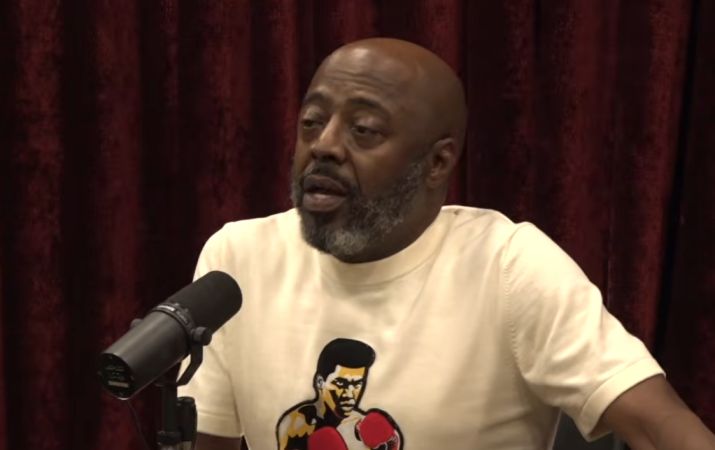
Editor’s Notes: In this episode of the Joe Rogan Experience #2455, comedian Donnell Rawlings joins Joe to discuss a wide range of topics, from personal health and aging to the intricacies of the comedy world. The duo dives into fascinating discussions about the controversial history of cigarette brands, the true origin of the “forbidden fruit,” and even the suspicious lottery win involving Jeffrey Epstein’s company. Rawlings also shares a candid story about the time he “borrowed” a joke from Rich Vos and the subsequent apology that followed. Throughout the two-and-a-half-hour conversation, they blend humor with deep dives into cultural phenomena and personal anecdotes, making for a truly engaging session. (Feb 17, 2026)
TRANSCRIPT:
Red Meat, Tito’s, and Getting Older
JOE ROGAN: Really? Red meat.
DONNELL RAWLINGS: It’s unfortunate. That’s just any form. I know it’s weird. If I eat a burger, it’s different. If I eat a steak.
JOE ROGAN: Steak is a problem.
DONNELL RAWLINGS: Yeah. I don’t know if my digestive system is just too old to f* with it.
JOE ROGAN: How old are you, Donnell?
DONNELL RAWLINGS: I’m 58.
JOE ROGAN: I’m 58, too. I eat mostly meat. I don’t think it’s age.
DONNELL RAWLINGS: What is it, then?
JOE ROGAN: Well, what are you eating it with?
DONNELL RAWLINGS: Tito’s.
JOE ROGAN: We’re rolling.
DONNELL RAWLINGS: Tito’s.
JOE ROGAN: Tito’s Vodka. It can’t be that, right?
DONNELL RAWLINGS: No, Tito’s. I’m eating a steak, and I wash it down with Tito’s and Tonic because it resembles H2O so much. Sometimes I get thrown off until I do it. Yeah, I think I’m better.
JOE ROGAN: Tito’s and Tonic resembles water?
DONNELL RAWLINGS: The look. The look of it is clear.
JOE ROGAN: That’s all that matters to you.
DONNELL RAWLINGS: Yeah. I know at some point I need to change my life. I’m at the age now where I look at certain food and I’m like, “Oh my God, it looks good, but you can’t handle that.”
I think this is when I really need to be in love. Because I need to be with somebody that understands when I go places and when I want to pig out, they have to be like, “He can’t eat that.”
JOE ROGAN: Like a handler.
DONNELL RAWLINGS: He’s going to be throwing up.
JOE ROGAN: But a female handler.
DONNELL RAWLINGS: A female handler. They call it geriatric. This is what the streets are saying. Most men get to an age — it’s a geriatric thing — where you just smash all the women you want to and everything. Now you’re going to have to worry about somebody helping you with your pill diet, helping you with your dietary needs and everything.
And they say that’s a lot of times when men fall in love — when they need somebody to take them to the Golden Years. When you’re about to be out of here, you need somebody to say, “Don’t do that. You have to mash this food up. You have to chop it up.”
But I’m having digestive issues sometimes with steak.
JOE ROGAN: Huh?
DONNELL RAWLINGS: It’s red meat, I want to say, and I’m a fan of it.
JOE ROGAN: So if you eat, like, pasta with the Tito’s — no problem?
DONNELL RAWLINGS: That’s not a problem.
JOE ROGAN: Interesting.
DONNELL RAWLINGS: But it’s definitely red meat. Red meat.
JOE ROGAN: You should go to one of those doctors that checks people for allergies.
DONNELL RAWLINGS: A voodoo doctor.
JOE ROGAN: Yeah.
DONNELL RAWLINGS: I don’t want one of them. I had to date a Haitian chick. They intervene really, really bad.
JOE ROGAN: Oh, yeah.
DONNELL RAWLINGS: Oh, yeah. They stab you with pillows and stuff. You wouldn’t have pain in your neck.
—
Black History Month and Coming Back on the Show
DONNELL RAWLINGS: Is there any particular reason, Joe, that I haven’t been here in a while? Is there any particular reason why I am doing your show during Black History Month?
JOE ROGAN: No. You asked to come on. You reached out to me.
DONNELL RAWLINGS: I reached out to you?
JOE ROGAN: You could have reached out to me in July. I would have said yes. You have an open invitation.
DONNELL RAWLINGS: I know that I have an open invitation, but this is what happened. I said, “Can I come on?” And you said, “I have a guest.” And then you called back. I don’t know if Jamie said, “You know what month this is, right?” And you caught me by that.
JOE ROGAN: I moved somebody for you. Because I knew you were coming here on a Monday, I had someone booked.
DONNELL RAWLINGS: Was it a Caucasian person?
JOE ROGAN: I don’t know. I don’t remember.
DONNELL RAWLINGS: Jamie, you know — was it a white man or a black man?
JOE ROGAN: It might have been Michael Jai White, because he’s here tomorrow. Yeah, so it was probably Michael. I just probably moved him a day.
DONNELL RAWLINGS: But I appreciate you being accommodating, because I felt like it was time for me to come back. I haven’t been here in a while.
JOE ROGAN: You can come on anytime.
DONNELL RAWLINGS: I really appreciate that. I hold that to be true.
JOE ROGAN: Come on.
DONNELL RAWLINGS: I know that you know I love you. Yeah. Can I get some of that gum, too, man?
JOE ROGAN: The neuro gum. Do we have any, Jamie?
DONNELL RAWLINGS: I have some.
JOE ROGAN: Yeah. That stuff’s the best.
DONNELL RAWLINGS: I know whenever you say something is the best…
JOE ROGAN: Yeah.
DONNELL RAWLINGS: Well, what can I do about my diet? I can’t do anything about it.
JOE ROGAN: Sorry — hit the mic. Yeah, you can. You should go to a doctor and find out. There might be something particular about you where red meat doesn’t agree with you, but it might just be what you’re eating with the red meat more than the red meat itself. That’s what I would imagine. I would imagine it’s not actually the red meat — I would imagine it’s what you’re eating with it.
DONNELL RAWLINGS: I’m going to check into it, because as they say in the streets, I’m of that big age when you have to be considerate of a whole bunch of things.
—
Exercise, Holidays, and Getting in Shape
JOE ROGAN: Do you exercise at all?
DONNELL RAWLINGS: A little bit. Usually sexual intercourse is when I get most of my cardio.
JOE ROGAN: Get your push-ups in.
DONNELL RAWLINGS: Yeah. And it’s not as strong. You ever get — I don’t know if this applies to everybody — you get to an age where you start looking at your history and you’re like, “Damn, 2000 was my best years.” Like right now, I’ll just give up.
JOE ROGAN: You give up?
DONNELL RAWLINGS: I don’t put any pressure. I give up. I start asking, like, “What’s your shoe size?” I’d rather go shopping than really try to pound somebody out for three hours. I’m at that age now where I have certain times. Like, you’re going to get a good workout.
JOE ROGAN: I probably shouldn’t give you that gum.
DONNELL RAWLINGS: It’s going to be a real problem on the microphone.
JOE ROGAN: Is it okay?
DONNELL RAWLINGS: People are going to get annoyed with you.
JOE ROGAN: All right. I don’t know what to do.
DONNELL RAWLINGS: Just chew it a little and spit it out.
JOE ROGAN: Okay.
DONNELL RAWLINGS: You’ll get the effects of it pretty quickly.
Anyway, I’m at the age where my best work is like holidays.
JOE ROGAN: Holidays?
DONNELL RAWLINGS: Like I’m an animal.
JOE ROGAN: Why don’t you hire a trainer? You’ve got some money.
DONNELL RAWLINGS: And what is the trainer going to do?
JOE ROGAN: Get you in shape.
DONNELL RAWLINGS: I think I need a therapist before I get a trainer. You have to take one step at a time. I have to get my mind right before I get my body right.
JOE ROGAN: No, getting your body right will help get your mind right.
DONNELL RAWLINGS: I think there’s some truth to that. I think you may be right about that.
JOE ROGAN: Oh, 100%. Getting your body right fixes your mind. Without a doubt.
DONNELL RAWLINGS: I will say I’m at my best — I’m at my peak — when it’s a holiday that’s celebrated because you’re rested. It’s more incentive. Like, if you want me to really perform well, consider it like Valentine’s Day, Christmas, Kwanzaa — you can get seven good days. But to expect me to be at my best on just a regular Tuesday or Wednesday, it’s not going to happen.
JOE ROGAN: Well, it’s also the drinking. You like to drink.
DONNELL RAWLINGS: Why would you say that? I know why you would say that.
JOE ROGAN: Come on, I’ve seen you. I’ve been with you. I’ve drank with you.
DONNELL RAWLINGS: Okay, then that’s a good point. You were there.
JOE ROGAN: You brought a pack with you, right? Those are not good.
—
Cigarettes, Nicotine, and American Spirit’s Lawsuit
DONNELL RAWLINGS: I saw one of your podcasts. I forget how you explained what made you not want to smoke anymore. What was that?
JOE ROGAN: Well, cigarettes are a cognitive enhancer. They are. That’s a fact. Nicotine is a cognitive enhancer — there’s no doubt about it. It does things to your mind. It stimulates your mind in a way that very few other things do. That’s why a lot of intellectuals, a lot of professors, use nicotine. A lot of academics use nicotine. A lot of people that rely on their brain — a lot of writers — use nicotine.
And there are different delivery methods that have different effects. Unfortunately, smoking has a very potent, instantaneous effect, and that’s why people like it. But it comes with a cost. The physical health repercussions of cigarettes are well known. Not good.
And also, you’re smoking Marlboros. We had a doctor on who thinks that American Spirits are not nearly as bad for you as regular cigarettes.
DONNELL RAWLINGS: I understand that American Spirits have some type of — I’m not even advocating for what you should or shouldn’t smoke — but they say that’s supposed to be the most natural, if there’s such a thing.
JOE ROGAN: It’s just tobacco, I believe. Actually, wait — what’s in there besides tobacco?
DONNELL RAWLINGS: I don’t know.
JOE ROGAN: They got sued. I don’t know how this lawsuit ended up, but they got sued for advertising it as additive-free and all that.
Did they? Yeah. Let’s look at it. Here’s the website about the lawsuit. On screen. Here we go.
“Lawsuit Questions Natural Claims. Natural American Spirit cigarettes are made by Santa Fe Natural Tobacco Company and parent company Reynolds America — RJ Reynolds. American Spirits has been sold in the US since 1985 under the original name, Original American Spirit Organic.”
Oh, you got us, you f*s.
“Unadulterated tobacco. The suit claims such marketing language has endeared American Spirit cigarettes to a core group of smokers who believe that the natural tobacco in the cigarette makes them a healthier alternative. Despite cigarette sales declining 17% between 2009 and 2014, American Spirit sales increased 86% over the same period.
A regulatory filing on the Reynolds American website states American Spirit is the leading super premium cigarette brand — a top 10 best-selling cigarette brand, priced higher than most other competitive brands, and is differentiated from key competitors through its use of all-natural, additive-free tobacco, including styles made with organic tobacco.
But words like ‘all natural’ and ‘additive free’ on American Spirit’s labeling, the suit says, belie the fact that Santa Fe Reynolds adds ammonia to their cigarettes to maximize the amount of nicotine a smoker receives, with the result that American Spirits contain significantly more freebase nicotine than other major cigarette brands.”
DONNELL RAWLINGS: So you’re actually getting high off of cigarettes?
JOE ROGAN: 100%. I get high off of them because I don’t smoke them all the time. If I smoke a couple of cigarettes a week, it’s a lot.
DONNELL RAWLINGS: And Newports are probably like 10 times worse — menthol cigarettes are probably 10 times worse for you.
JOE ROGAN: I was talking to Kat about that. I was asking him like, “Why do you like menthols?” And he was speaking on behalf of the black community. He said, “We like things that are more potent.”
The Menthol Effect and Targeted Marketing
DONNELL RAWLINGS: I believe that that’s possible. Part of it. But I also believe that back in the day, and this applies — I don’t know if I talked about this — it was certain brands that targeted certain communities just for the loyalty of it.
JOE ROGAN: Yeah.
DONNELL RAWLINGS: And I think Newport was targeted. When Newport came out, they were spending more ad money with advertising because — I don’t know if I shared this story with you — but Pepsi was a company that did that. They targeted the black community. So I think, even though we said more potent, I think it was something that was in our community, whether that was cheaper prices or whatever. And I think it’s generation to generation, like, “You need to do this because black people did this because it was cheaper.” I think that that might be the case with Newport.
JOE ROGAN: Probably both. What is the menthol effect? What is the difference with the menthol?
DONNELL RAWLINGS: Menthol. I sound like Katt Williams the next day. That’s one of the reasons I had to downgrade. Some people think that I started smoking Marlboro Lights because I started dating white women, which is more appealing — unless you date a white woman from the Midwest. Then she’s probably smoking Newports and drinking Pepsis and Coca-Colas just like you. But I got so many bad habits that I need to change.
JOE ROGAN: The menthol effect of cigarettes comes from the chemical menthol itself, which is added as a flavoring and sensory agent to the tobacco. Menthol is naturally found in peppermint and other mint plants, and can also be made synthetically in a lab.
Menthol activates cold-sensitive nerve receptors in the mouth, throat, and airways, creating a cooling sensation when you inhale smoke. It’s a mild anesthetic numbing effect that reduces pain and irritation from hot, harsh cigarette smoke, making it feel smoother. Menthol can suppress the cough reflex and dull early warning signs of airway irritation, which makes it easier to inhale more deeply and more often.
Menthol reduces the perceived harshness of nicotine and smoke. The minty taste and smell, plus the cooling feel, act as pleasant sensory cues that many smokers come to associate with satisfaction and craving. Menthol can also alter nicotine metabolism and the way nicotine acts on brain receptors, which may increase nicotine’s reinforcing, addictive effects.
In short, the menthol effect is not from nicotine but from added menthol, which cools and numbs the airways, masks irritation, and can make cigarettes feel smoother and more addictive — without making them any safer.
DONNELL RAWLINGS: So menthol cigarettes appeal to black people because it’s a “cool” cigarette.
JOE ROGAN: That’s cool.
DONNELL RAWLINGS: That’s what makes so much sense. Why the brand “Cool” cigarette? Because it makes it — that makes sense.
JOE ROGAN: That’s why they called it “Cool,” I bet.
DONNELL RAWLINGS: Damn, what white people do to destroy my community, man.
JOE ROGAN: They destroy everybody. They don’t give a f* about anybody. “Half ain’t wide, body ain’t soul, Mild ain’t bold, Cool ain’t cool.” Newport is — because that was like a…
DONNELL RAWLINGS: That makes sense — a take on Cools, because…
JOE ROGAN: People used to smoke Cools.
DONNELL RAWLINGS: Do Cools exist anymore? In jail?
JOE ROGAN: Only in jail.
Prison Currency and the Value of Cigarettes
DONNELL RAWLINGS: I think — I don’t know what the ratio is — what cigarette gets you more money in a dice game. But whenever I hear people telling war stories, they’re like, “Man, I got a carton of Cools for a bag of Doritos.” The value of a Cool cigarette is higher in prison.
JOE ROGAN: Isn’t it crazy that they give you cigarettes in prison? It’s like the only drug you can get in prison.
DONNELL RAWLINGS: Yeah. And those —
JOE ROGAN: You can’t get alcohol, right?
DONNELL RAWLINGS: Well, you can get hooch. You can’t get alcohol, but they make their own.
JOE ROGAN: But it’s all under the table.
DONNELL RAWLINGS: But I think in prison, the things that hold the most value — I think it’s Tang, right? That artificial flavored drink.
JOE ROGAN: That astronaut s*.
DONNELL RAWLINGS: Yep. Cigarettes. Doritos. I heard honey buns hold value, and candy bars too. But candy bars, you’ve got to be particular with that. Because if you offer — this is what I hear — if you offer a person a certain amount of candy bars, then what I understand is that you’re inviting them to have sexual intercourse with you.
JOE ROGAN: Interesting.
DONNELL RAWLINGS: Yeah.
JOE ROGAN: Candy bars.
DONNELL RAWLINGS: Yeah. Like — I don’t think…
JOE ROGAN: “Do you want some candy bars?” And that’s like code. Yeah, it’s like Pizzagate pizza.
DONNELL RAWLINGS: “Mr. Goodbar for this good bar.” I think this is only — not that I’ve had those experiences, Joe — but these are the times that I frequent the streets, which aren’t anymore, not too often. These are the stories that they tell.
JOE ROGAN: Interesting.
DONNELL RAWLINGS: Yeah. And these facts, you don’t need them for anything but barbershop talk. But these are the conversations that I’ve heard people have.
How Brands Target Communities
JOE ROGAN: It’s interesting how different brands market to different people. How do they figure it out? That’s where it’s evil, right? Advertising itself, I don’t have a problem with. But there is something weird about deceptive advertising that’s legal.
DONNELL RAWLINGS: Well, they do a history on what people like. I was reading a story about the people that started Forever 21. It was some Koreans from South Korea — not to be confused with Kim Jong-un and those people. But they were tailors or something. They started a small boutique. And what they would do is they would have these pieces of clothing and really pay particular attention to what colors people liked, what was selling the most, and that’s what they’d buy.
One of the things that made Forever 21 so popular was that these clothes weren’t expensive, but they were turning them over so quickly. People do case studies and see what people are attracted to. I know with black people, you put lemon pepper on anything, it’s going to go through the roof. Lemon pepper chicken wings, lemon pepper French fries, anything. I don’t know who started the whole lemon pepper craze, but lemon pepper anything — black people are going to buy it.
JOE ROGAN: That’s interesting. Like how white people are associated with very bland foods — macaroni and cheese, mashed potatoes, mayonnaise.
DONNELL RAWLINGS: And you know why you’re connected with that blandness? Because of the way you pronounced it — “macaroni and cheese.” You would never — if you tell somebody, if you say, “Hey guys, I’m coming to the cookout, and I’m bringing macaroni and cheese,” you’re going to get uninvited to the cookout. How should you say it?
JOE ROGAN: “Mac and cheese.” Yeah.
DONNELL RAWLINGS: You can’t say “macaroni and cheese.” Nobody ever does that.
JOE ROGAN: Okay.
DONNELL RAWLINGS: They would look at you as a spy. You would get invited and then uninvited.
JOE ROGAN: Well, I’m a different type of white person because I’m Italian. And we’re associated with spicy food, very strong flavors. But it’s different — Italian people don’t like bland food.
DONNELL RAWLINGS: Very spicy, very flavorful food. “I’m bringing baked ziti to the barbecue.” You’d be like, “I’m bringing ziti,” right?
JOE ROGAN: I would say “baked ziti,” yeah. Because there’s different kinds of ziti — there’s ziti that you bake, and then ziti that you just boil and put marinara sauce on.
Soul Food, Salt, and the Sugar Conspiracy
DONNELL RAWLINGS: But I will say this — as much as the community makes fun of white people and their lack of seasoning, that can actually save your life.
JOE ROGAN: Lack of seasoning can save your life?
DONNELL RAWLINGS: Yeah. When you think about it, you look at the most country, home-cooked soul food — the one ingredient that’s in everything, that you taste right off the rip, is salt. How good is it?
JOE ROGAN: Salt’s not bad for you at all.
DONNELL RAWLINGS: Then why do we think salt is bad? Is that all bullshit?
JOE ROGAN: Salt is an essential mineral. You need salt to survive. Salt is not the problem. They associate salt with high blood pressure — salt with this, salt with that. It’s not true. It’s bullshit.
DONNELL RAWLINGS: What type of salt? Is it a different salt?
JOE ROGAN: No, it’s not. Salt’s not bad for you. Well, first of all, there’s iodized salt, which is actually good for you because it contains iodine. But salt is not a bad thing. I mean, you shouldn’t have too much salt.
DONNELL RAWLINGS: If you eat —
JOE ROGAN: Look, if you eat enough salt to —
DONNELL RAWLINGS: Educate me on this. So all of these years —
JOE ROGAN: It’s a —
DONNELL RAWLINGS: These people getting their toes chopped off — that’s not why?
JOE ROGAN: That’s not why. If you’re getting diabetes, it’s usually from sugar.
DONNELL RAWLINGS: Okay.
JOE ROGAN: There’s been a lot of misinformation spread because of actual scientists that were bribed by the sugar industry. The sugar industry paid a bunch of Harvard scientists — I believe it was Harvard. They didn’t even give them a lot of money. I think it was in the 1950s or 1960s. This has all been outed now. What they did was they tried to associate saturated fat with being responsible for heart disease. They did that to try to get the blame off of sugar. Because sugar is f*ing terrible for you. It’s terrible in basically every way, especially added sugar.
DONNELL RAWLINGS: So why are all of these diseases that we speak of happening more in the black community than in the white community?
JOE ROGAN: It’s diet. It’s 100%.
DONNELL RAWLINGS: It’s processed food.
JOE ROGAN: Processed food. It’s diet, it’s sugar, it’s sugary drinks. If you drink a 1-liter Pepsi — let’s find that out — how much sugar is in a 1-liter Pepsi? If you drink several of these a day, I believe one of them is already more sugar than you’re ever supposed to have in a day.
DONNELL RAWLINGS: Pepsi is the one. And that’s why — well, it could be —
JOE ROGAN: Could be Coca-Cola, could be Pepsi, Mountain Dew. Pick your poison.
DONNELL RAWLINGS: I think it’s 100% Pepsi.
JOE ROGAN: Well, I don’t know if Pepsi has more sugar than Coca-Cola. You know, Coca-Cola is one of the only things that’s still flavored with cocaine leaf. Sugar content — 115 to 123 grams in a 1-liter bottle. That’s a crazy amount of sugar. 25 teaspoons, 35 sugar cubes. That’s 130 to 138% of the recommended daily value of sugar.
That’s where people are getting type 2 diabetes — from excess sugar, specifically excess sugar in liquid form. Your body does not know what the f* to do with that, because nowhere in nature do you get sugar in a liquid form like that. Even orange juice — people think orange juice is good for you, but it’s not. Drinking orange juice, yeah, you’re going to get some vitamin C, but you’re also going to get a gigantic dose of sugar that has no fiber in it.
DONNELL RAWLINGS: But is it a different type of sugar in fruits and vegetables than what you get off the counter?
The Bible, Mega Churches, and the Lottery Scam
JOE ROGAN: You get fructose rather than high fructose corn syrup. Look, sugar from fruit is the best sugar for you because it’s attached to fiber, and that’s a slow release sugar. Like if you eat an apple, apples aren’t bad for you. It’s a natural way that your body consumes sugar.
DONNELL RAWLINGS: Apples were bad for Adam.
JOE ROGAN: I don’t even know if it was an apple.
DONNELL RAWLINGS: It was a fruit.
JOE ROGAN: It was a fruit from the tree of Knowledge. The tree of—
DONNELL RAWLINGS: It was an apple.
JOE ROGAN: It was an apple, but it wasn’t an apple tree. What specifically does the Bible refer to as the fruit?
DONNELL RAWLINGS: Adam and Eve. Adam, you know the truth.
JOE ROGAN: Eve never talked to God. Adam talked to God. Adam told God not to eat the fruit. There’s nowhere in the Bible does it say that Adam went and told Eve.
DONNELL RAWLINGS: This is why we should start not just shutting women down, but listening to them. It all started.
JOE ROGAN: Genesis does not specifically specify what kind of fruit Adam ate, only that it calls it “fruit from the tree of Knowledge of good and evil.” So it’s not necessarily an apple. We call it an apple, but the text never names the species — apple, fig, etc. The Hebrew word is peri, a general term meaning fruit, without any botanical detail.
Over time, Jewish and Christian interpreters proposed many candidates, including fig, grape, pomegranate, citron, and others. The common idea that it was an apple developed later in European tradition, helped by wordplay in Latin and Old French, where the words “evil” and “apple” or “fruit” sounded or were spelled similarly. So it’s not necessarily an apple.
DONNELL RAWLINGS: I really don’t know what to believe. I feel like I get so much more information when I come here. I don’t know if people understand that.
JOE ROGAN: Well, the crazy thing is — and I found this out recently because I’ve actually been reading the Bible — there’s no reference whatsoever to Adam telling Eve that she’s not supposed to eat the fruit from the plant with the knowledge of good and evil.
DONNELL RAWLINGS: I never knew that. I just know it’s Adam, a white woman with an apple, and his sht got fed up after that.
JOE ROGAN: What happened was God created Adam — this is what Genesis says. God created Adam and then told Adam to go and name all the animals. And then when he was done with that, Adam made Eve. But it never says in the Bible that Adam told Eve, “Do not eat the apple.”
DONNELL RAWLINGS: Who’s giving us this misinformation?
JOE ROGAN: Well, the problem with the Bible is, first of all, that it was an oral tradition for a long time before it was ever written down. Then it was written down in a bunch of ancient languages — ancient Hebrew and Aramaic. And when you translate ancient Hebrew, first they translated it to Latin, then to Greek and all these others. Either way, the translations miss a lot of the language.
Ancient Hebrew is a very complicated language. Numbers double as letters in ancient Hebrew — ancient Hebrew doesn’t have numbers. All their words have a numerical value to them.
DONNELL RAWLINGS: What do you think makes people so connected to the Bible? Is it because of wanting to believe in something?
Why People Believe — From the Bible to Scientology
JOE ROGAN: Definitely. Definitely wanting to believe in something. And then specifically, if you look at the teachings of Jesus Christ, if you follow them, I think it’ll lead to a better life. I think it makes you a better person, makes you a better member of the community. It reinforces community. It’s a really good way to live your life. So I think people that actually live that way are better examples of human beings, and that reinforces it.
But there are also a lot of other religions that people believe in that don’t have those aspects to them. People want to believe in things. Even like Scientology — people deeply believe in Scientology, and we know it was written by a science fiction author who was a bad science fiction author. L. Ron Hubbard wrote some terrible books. That guy would just bang books out. He never rewrote anything. Everything was a first draft. He wrote more fiction than any human being that’s ever lived. And he also wrote Scientology.
DONNELL RAWLINGS: And people believe in it. I do believe — like you say — if your life is f*ed up, people want to be able to say, “Okay, this is my savior. If I believe in this, it’s going to get me on the right track.” And then with that, Drew Ski just did a skit that went viral where he was making fun of the mega churches and everything.
But these churches give people something to believe in, make them feel better — and they charge people. Do you think there should be a separation? If I inspire you, if my writings or my speeches inspire you to want to do something and change your life and be more financially secure, do you think these people are entitled to — almost like agencies — if I get you to work or get you there, should you hit me off? Or with the mega churches, is it so wrong for people to pour all their money into them if they’re giving these people something to believe in?
Mega Churches, Televangelists, and the Lottery Scam
JOE ROGAN: I think they’re preying on people’s need to believe in things. I think they’re very predatory. And I think that’s why they’re flying private jets and driving Rolls Royces and living in mega mansions on giant ranches — doing it all off of donations from people that are barely getting by.
I think it’s a scam that’s legal. I think if we were a just and righteous society, it wouldn’t be legal. You’re taking advantage of people when they need something to believe in and asking for all their money.
I remember watching this televangelist on TV once — televangelists are the worst. This guy was saying that if you are broke, you should borrow money to donate it to the church, and it will be paid back to you tenfold. That God will pay you back tenfold. And then he had all these examples of people that did it, and they would call in and say, “I was $1,000 in debt, but I borrowed $100 and donated it to you, and now all of a sudden I drive a Rolls Royce.” It’s all horsesh*t.
DONNELL RAWLINGS: But those are all desperate, desperate people.
JOE ROGAN: Desperate people.
DONNELL RAWLINGS: Those are the same people that are going to spend $30 on the lottery every day for like 50 years. That’s another scam.
JOE ROGAN: That’s another scam. And here’s the thing about the lottery — say everyone pumps money into it. Say you buy $100 worth of tickets, and Jamie buys $100 worth of tickets, and I buy $100. So there’s $300 in the lottery. There’s not even $300 available to pay out to win.
DONNELL RAWLINGS: Right.
JOE ROGAN: And then if you win, you don’t even get all the money. You get the money over a long period of time.
DONNELL RAWLINGS: Right, right, right.
JOE ROGAN: But if you take the lump sum option, it’s significantly less. Here’s a good example of it — speaking of the Epstein files.
DONNELL RAWLINGS: What do you mean?
JOE ROGAN: Speaking of Zorro Trust.
DONNELL RAWLINGS: Look me right in my eyes and say, “Speaking of the Epstein files.”
JOE ROGAN: We were talking about it before the podcast. He came to see you.
DONNELL RAWLINGS: No, he did not come.
JOE ROGAN: They loved your show.
DONNELL RAWLINGS: He was—
JOE ROGAN: He was your number one fan.
DONNELL RAWLINGS: First of all, I never—
JOE ROGAN: Look, they came to West Palm Improv because you’re a famous comedian and you were playing in the town where he lived.
DONNELL RAWLINGS: So what are you saying?
JOE ROGAN: Nothing. What I’m saying is — Epstein won the lottery. His company, Zorro Trust, won an $80 million lottery, and then they took the lump sum payoff.
DONNELL RAWLINGS: You mean the corporation bought a ticket? What do you mean when you say that?
JOE ROGAN: His company bought a lottery ticket. Yes. Zorro Trust won the lottery, which is very suspicious. Not only that, he won the lottery right after he was arrested and went to jail for having sex with underage girls — whatever he was arrested for.
DONNELL RAWLINGS: So there’s nothing wrong with underage—
JOE ROGAN: When they’re underage girls, probably not.
DONNELL RAWLINGS: Oh, I didn’t know that.
JOE ROGAN: So when he went and collected the lottery money, the company took the lump sum payoff. Out of an $80 million jackpot, the payoff was only $30 million. So if you want the money upfront, you take $30 million. Not only did they take $50 million out of the $80 million, but think about how many people spent money buying lottery tickets — way more than $80 million. So they make money off of that, and then they make money off of the fact that you want the payoff instead of the annuity.
DONNELL RAWLINGS: So it doesn’t matter what the jackpot becomes — they never can lose.
JOE ROGAN: They can’t lose because they’re taking money from people that are desperate. It’s legalized gambling where the house always wins.
DONNELL RAWLINGS: Right.
JOE ROGAN: Let’s find that out. Let’s find an average jackpot of Mega Millions and find out how much money actually goes into it — how much people spend versus how much the payout is.
DONNELL RAWLINGS: All lotteries are state regulated, right?
JOE ROGAN: I don’t know. I don’t know who regulates them.
DONNELL RAWLINGS: So say they get $100 million from people trying to win a billion dollars. Because it’s state regulated, do they have to pay taxes to the government on the money the lotto collects?
JOE ROGAN: No, it’s the state — the government owns it. And not only that, you pay taxes on your winnings. So say you take that $30 million lump sum payout — you don’t even get $30 million. You have to pay taxes on that $30 million. So they get money from that too. They can’t f*ing lose.
DONNELL RAWLINGS: But for a person that has barely ever seen $1,000, anything with “million” in it — they’re going to be excited about it and take it before they go.
JOE ROGAN: Exactly. And over time, most people are not going to win. So most people are just dumping money into it.
DONNELL RAWLINGS: There was a story of a young lady — I don’t know exactly what it was — but I think she won some type of lottery where they gave her two options. She would get a payout of like $2 or $3 million right up front, or they would give her like $20,000 every month for as long as she lived.
JOE ROGAN: Yeah, that’s how they do it.
DONNELL RAWLINGS: And she chose the monthly payments. People think that’s kind of crazy, but if you consider the fact that she was probably 20 or 21, her life expectancy — she was white, so she probably lived to 132. That was a smart move. A lot of people would not understand that that was a smart thing.
JOE ROGAN: I don’t think it’s for the rest of your life though. I think it’s until it reaches that number. I don’t think they’re going to give you money for the rest of your life.
DONNELL RAWLINGS: Well, maybe I was reading the headline wrong.
JOE ROGAN: Maybe it’s a different kind of lottery that I’m not aware of.
DONNELL RAWLINGS: Maybe. I think it was something like as long as she lives.
JOE ROGAN: That sounds crazy.
DONNELL RAWLINGS: Yeah.
The Lottery Scam, Whitey Bulger, and the Culture of Snitching
JOE ROGAN: All right, here it is. Typical Mega Millions jackpot run. Total ticket revenue is usually several times the advertised jackpot, but there’s no single fixed average because sales vary enormously with the jackpot size. Still, you can get a good ballpark.
So around 50% of ticket revenue goes into the overall prize pool. So the government makes 50% right off the bat. So if it’s a $100 million payout, they already made $100 million, so that’s $200 million is what they made. They throw in $100 million for everybody.
Of that prize pool, roughly 2/3 to 3/4 is allocated to the jackpot, with the rest funding lower tier prizes. So that means even if there’s $200 million out of $100 million, only 2/3 of it goes into the big jackpot. And that means the jackpot is typically in the order of one third of total ticket sales that run.
So say if it’s $100 million, or with the Epstein case, it was $80 million. He took the payout, which was $30 million. So they make $50 million on top of that, and then on top of that, you pay taxes on that $30 million. It’s a crazy scam.
DONNELL RAWLINGS: What do you do with the money?
JOE ROGAN: Whatever the f* they want.
DONNELL RAWLINGS: I think they probably, in certain neighborhoods, pump a certain amount of winning tickets into a neighborhood just to get you addicted, to keep going in there and spend your money.
JOE ROGAN: Well, it’s supposed to be random. I don’t know how much oversight there is. Look, if a guy like Jeffrey Epstein can win, I don’t know how much oversight there is. I know back in Boston when I lived there, Whitey Bulger won. See if this is true — I think he won the lotto twice, which is crazy.
DONNELL RAWLINGS: Whitey Bulger — who is that?
JOE ROGAN: Whitey Bulger was a South Boston mob boss in the 1980s and ’90s, when I lived there.
DONNELL RAWLINGS: A mob boss. Yeah.
JOE ROGAN: He was a dangerous, dangerous guy. He was the guy that movie was based on — the one that Leonardo DiCaprio starred in with Jack Nicholson. What was that movie, Jamie? Remember that movie that was based on Whitey Bulger? The Departed. Yeah, yeah, yeah. The Departed. That was based on Whitey Bulger.
DONNELL RAWLINGS: Okay.
JOE ROGAN: That was based on Whitey Bulger.
DONNELL RAWLINGS: He was a gangster.
JOE ROGAN: Oh, yeah. Terrifying gangster. Yeah.
DONNELL RAWLINGS: What was his demise?
JOE ROGAN: He was actually a f*ing FBI informant. Not only was he a gangster, he was working with the FBI, and they were letting him get away with things because he was throwing other people under the bus.
DONNELL RAWLINGS: I think there’s a difference.
JOE ROGAN: They wound up catching him in Santa Monica. There’s a documentary called Hunting Whitey about that. Whitey Bulger won the Mass Millions lottery around that time. Yeah, he won the f*ing lottery, man.
So this is what it says here. I think it was more of a scheme than they actually won. But it’s always about taking money. It’s probably a way to launder money. Oh, 100%. It’s a way to launder money.
So the way it would work was, say if you lived in the community and you won the lottery, maybe they would give you money for your lottery ticket. Then he would claim it, and that way it would show that’s where he got his income from. These guys would all own businesses, but the reason why they would own businesses is so they could explain why they drive a Cadillac, why they have a mansion, why they have all this — because they have legitimate businesses. But really, these businesses were scams.
DONNELL RAWLINGS: My father convinced my family that he was a real estate agent for years, and come to find out, he was a heroin kingpin in D.C. for years. All you needed was an excuse. “He’s selling real estate.”
JOE ROGAN: All right, that’s hilarious. So he ordered the real winner to sign the ticket over, with Whitey and two associates paying $2.3 million in cash for 50% of the winnings. Bulger himself paid Michael Linsky $700,000. Although Linsky lost money in the deal, he really had no choice. It came down to selling the ticket or risking his life. Yeah, so that’s how it usually works.
DONNELL RAWLINGS: So he was a snitch.
JOE ROGAN: Whitey was a snitch. Yeah, he was a snitch, and he got caught in Santa Monica.
DONNELL RAWLINGS: He was a snitch or a whistleblower? There’s a difference.
JOE ROGAN: No, he was a snitch.
DONNELL RAWLINGS: Whistleblowers are people that snitch on people in higher profile positions, like corporate America.
JOE ROGAN: No, he wasn’t a whistleblower. He was an actual snitch. Because he was turning other people in. He was a kingpin.
Snitching, Loyalty, and the Code of the Streets
DONNELL RAWLINGS: Is this true? And I don’t want to make everything about race, but is that phrase “snitches get stitches” more prevalent in the white community or the black community, or across the board?
JOE ROGAN: I think it’s across the board, isn’t it? The black community is famous for keeping their mouth shut when someone gets shot or when someone does something — like when cops come and question people.
DONNELL RAWLINGS: I don’t think that’s the truth anymore, because —
JOE ROGAN: Not anymore. But that was the thing with the mafia too. The mob would never rat guys out. They would just go to jail.
DONNELL RAWLINGS: What’s interesting now is I see, especially in my community, so many people rat. I’ve seen the paperwork and everything. And now it feels like that motto of being loyal is dead. People get in court, and the minute they get caught, they snitch on everybody.
JOE ROGAN: Right.
DONNELL RAWLINGS: And there’s no repercussions when they come home. I don’t see that as much anymore. I see so many people that are just saying whatever they want, and they’re still out here living their lives normally, like nothing happened.
JOE ROGAN: Well, with the mob, it was always like, if you ratted on the mob, you were a dead man. Your family was probably dead too. They burned your house down. And people kept their mouth shut because of that. Guys would go to jail all the time and never open their mouth. And they would be rewarded when they got out — they’d have a party for them, celebrate. That’s in Goodfellas. You kept your mouth shut, you never said nothing. That was the whole thing.
DONNELL RAWLINGS: But the whole thing I used to live with —
JOE ROGAN: That changed, though. Like with John Gotti. The government —
DONNELL RAWLINGS: No, Sammy the Bull.
JOE ROGAN: Sammy the Bull. And it wasn’t just them. Everyone was snitching on everybody. We had Donnie Brasco in the studio, from —
DONNELL RAWLINGS: From what?
JOE ROGAN: From that Johnny Depp movie. It was called Donnie Brasco.
DONNELL RAWLINGS: Okay.
JOE ROGAN: He —
DONNELL RAWLINGS: Why am I confusing that with something else?
JOE ROGAN: What’s Donnie Brasco’s real name? Joe —
DONNELL RAWLINGS: I’m not confusing it with A Bronx Tale, right? That’s not Joe Pistone. That’s nothing to do with A Bronx Tale, right?
JOE ROGAN: No, different story. That’s a different story. Yeah. So Donnie Brasco was the guy who was an agent, and he pretended to be a mob guy. He got in with the mob and was with them for, like, seven years. Did all kinds of things with the mob and then sold everybody out, and they all went down.
DONNELL RAWLINGS: Yeah. I don’t know. The culture, everything is — they used to be afraid. “Snitches get stitches.” Now, I don’t know if this is just everywhere, but everywhere I go, the most interesting thing selling on any platform, especially social media, is beef. And I don’t understand why people gravitate toward negativity more than anything that’s normal.
But you know what? It’s interesting — your platform is not known for that. Your platform isn’t. But I go to these other platforms, and I think these guys just sit back and say, “Okay, what can I say to make people upset, get them riled up?” And then they take advantage of the engagement that comes from it.
JOE ROGAN: They’re in a different game than me. Their game is trying to get engagement. My game is talking to people who are already engaged.
The Obsession with Beef and Exposing People
DONNELL RAWLINGS: But doesn’t that become destructive after a while?
JOE ROGAN: 100%.
DONNELL RAWLINGS: Have you noticed — especially with comedians, with podcasts — it used to be a time where a person would go on a podcast because it was interesting, they told funny stories, or they were good at their craft. But now it feels like all these platforms, and I don’t know if that’s just in my community, but it’s like the only way people find themselves interesting is if they talk shit about other people.
People are going away from being funny when they get interviewed. Every fing podcast I turn on now is somebody saying, “I’m exposing this person,” or “I’m going to tell you what you didn’t know.” And the one thing they’re not doing — especially as standup comedians — is being funny. Nobody gives a f about being funny anymore. Are those days over?
JOE ROGAN: No, no, no, no. Those people that do that are almost always not very — well, almost always. The only exception —
DONNELL RAWLINGS: So who are they fooling?
JOE ROGAN: The only exception to that is Katt. And I think what Katt was doing was different, because what Katt was doing was exposing what he thought were snakes and liars.
DONNELL RAWLINGS: Okay.
JOE ROGAN: It’s a different thing.
DONNELL RAWLINGS: Okay, okay, okay. This is my question. People can take it however they want. No disrespect or whatever to Katt, but — who asked you?
JOE ROGAN: Like Shannon Sharp did when he did that podcast?
DONNELL RAWLINGS: Shannon Sharp might have asked one question.
JOE ROGAN: But Shannon Sharp likes that. His audience, they find those questions. He’s got a sheet of paper.
DONNELL RAWLINGS: Joe, what do you do with those truths? What do you do with all that? I watched — and this is a horrible impression — but I sat there in the parking lot and I watched people go up into Diddy’s house, and they came down, and they were standing up. I’m trying to figure out, what the f* do you get out of that? What is the result of that?
You expose these people to say what? Hollywood is never going to fing change. You know what changes? What you do. I left fing Hollywood. Hollywood is not going to change. And I’m not saying I went to a Diddy party — first off, I was never invited. There’s a chance I would have accepted the invitation, with rules.
JOE ROGAN: Right.
DONNELL RAWLINGS: But what is the purpose of exposing something?
JOE ROGAN: I don’t think most people are actually exposing anything. What most people are doing when they’re being negative is they are jealous, and they are below the person they’re talking shit about. Whenever I see someone talking shit about —
DONNELL RAWLINGS: So Katt was jealous? You don’t think — you said they’re jealous, and you used Katt Williams as an example. So when you said they’re jealous —
JOE ROGAN: First of all, when Katt did it, it was very funny, which is —
DONNELL RAWLINGS: It was very funny.
JOE ROGAN: Katt’s a very funny guy. And when he was doing it, I think he was also being very funny while he was doing it, which is different.
DONNELL RAWLINGS: Well, you have to put a “LOL” on the end of it, because people might not understand his humor. Because this is the connection people have with Katt. This is what they say. They ride with him. They say, “Where is the lie? Where is the lie?” And all this stuff.
But I’m just trying to understand — what is the purpose of exposing all this? What do we do with this information? What do we do with the information that Diddy liked to have fing freak parties? What the f do we do with all this information?
JOE ROGAN: Well, Diddy’s in jail right now, so they did something with the information.
The Definition of Sex Trafficking
DONNELL RAWLINGS: Well, Diddy’s in jail for doing something that a lot of people — let me tell you something, Joe. I was riding with Diddy for once. I liked the music, he did everything. I don’t know Diddy like that. But when I first read the definition of sex trafficking —
JOE ROGAN: Uh huh.
DONNELL RAWLINGS: I’m sure you’re a well-versed person, you’re smart. The definition of sex trafficking is to transport a woman across state lines with the intent to have sexual intercourse with her.
JOE ROGAN: Right.
DONNELL RAWLINGS: When I heard that — when you’re paying them, it’s trafficking.
JOE ROGAN: That’s not actually —
DONNELL RAWLINGS: Really? This is my — Jamie, you can pull this up.
JOE ROGAN: Wait a minute. So if you are dating a girl and she lives in Minnesota and you live in California and you fly her to California, that’s sex trafficking?
DONNELL RAWLINGS: And I’m thinking about —
JOE ROGAN: I don’t think that’s true. I don’t think that’s true at all. You’re flying a girl in that you’re having a relationship with.
DONNELL RAWLINGS: They call it “flew out.”
JOE ROGAN: Yeah, but that’s normal. Everybody does that.
DONNELL RAWLINGS: But that’s the definition.
JOE ROGAN: Commercial sex — yeah, commercial. “Commercial sex act induced by force, fraud, or coercion.” Well, coercion is crazy because coercion is like, “Please, I’ll buy you a bag.” That’s sex trafficking?
DONNELL RAWLINGS: That’s it.
JOE ROGAN: So if there’s a girl and she’s like, “What are you going to do for me?” — you know those shoes you want? “I got those shoes for you. Let’s go shopping.” That’s kind of sex trafficking if that’s coercion for money. Like if a girl’s thinking about coming out to visit you and then you go, “Listen, listen, listen. What are you looking for? What do you want to buy? I got money. Come on, let’s go shopping.” That kind of would fall into that category.
But look, we’re getting off topic. Let’s go back to the topic originally at hand. The reason why these comedians are negative —
DONNELL RAWLINGS: I need to —
JOE ROGAN: No, no, no, no. You’re not going to get in trouble for sex trafficking. Listen, that’s all horseshit. But the reason why these comedians are doing it is because they’re never bigger than the comedians they’re shitting on. Never.
Coattail Riders and Career Envy
DONNELL RAWLINGS: 1,000%. And you know what it is, Joe?
JOE ROGAN: And they’re never good.
DONNELL RAWLINGS: You know what it is too, Joe, is that deep down inside they want to be that person, 100%.
JOE ROGAN: Or they want to be in the position that person’s in — that’s a better way of putting it.
DONNELL RAWLINGS: And I’ll use this — I’ll tell you this story. I realize that — not to say names, but so many people could be guilty of it. And this is the thing that I hear that disturbs me: a lot of these people that bitched the most, at some point in their career, they were favored by Hollywood.
JOE ROGAN: Yes.
DONNELL RAWLINGS: At some point in their career, they had these opportunities. At some point in their career, they had the agencies, they had the agents. And something happened in their career where they fell out of favor — for whatever reason, whatever you want to call that. Maybe something they did, the agency didn’t like them too much. And now everything that they wrote, everything they wanted to do — now it’s all gone. And the only way you get this opportunity, because it has to be sexual favors and all that type of — where do you draw the line?
JOE ROGAN: But it’s not even sexual favors. It’s like they criticize the work of the other person. That person ain’t that person.
DONNELL RAWLINGS: Can I — yo, here’s the thing. There was —
JOE ROGAN: Come on.
DONNELL RAWLINGS: You get this all the time because you ride with Dave, and Dave’s number one, right? So you always get this label. Even though you’re a great comic, you get this label of being a coattail rider, right?
DONNELL RAWLINGS: And guess what? Everybody does not have to be Batman. I don’t have a problem with being Robin. You know why? Because Robin got the same amount of screen time as Batman.
The Kill Tony Incident
JOE ROGAN: Kill Tony — you mean the greatest comedy show of all time in the history of the known universe?
DONNELL RAWLINGS: I know that, but there’s a lot of lies involved. Okay, listen, this is what they say.
JOE ROGAN: Don’t pay attention to what they say. Why are you doing that?
DONNELL RAWLINGS: You told — what are you playing?
JOE ROGAN: What are you playing?
DONNELL RAWLINGS: Things that the Kill Tony audience say about me.
JOE ROGAN: “Chappelle’s butt plug is acting up again.”
DONNELL RAWLINGS: Yo, I gotta deal with this. What is — no.
JOE ROGAN: Well, you gotta stop paying attention to it.
DONNELL RAWLINGS: It’s so hard. You know what?
JOE ROGAN: What would happen to me if I paid attention to all the haters that I have?
DONNELL RAWLINGS: Yeah.
JOE ROGAN: I would go crazy.
DONNELL RAWLINGS: You would. Do you think that you paid attention to those haters now? You’re in a position right now where you have so many reasons to say f* them. Did you feel like you had that same belief when you were first starting this? Did you engage them then?
JOE ROGAN: Well, I engaged online with a lot of people in the early days because I didn’t understand. What you’re doing is you’re engaging with people that don’t have happy lives.
DONNELL RAWLINGS: Right.
JOE ROGAN: And they’re negative. And there are some criticisms that are good for you because some criticisms make you evaluate what you’re doing and say, “Okay, what I need to do is be undeniable. So these critics mean nothing to me because I’m killing it. The audience loves me. I’m selling out everywhere. I’m doing great on stage.” You can’t pay attention.
DONNELL RAWLINGS: You know what? I hear you, Joe. I tried that with them on your shirt.
JOE ROGAN: You had a bad show. You had one bad show.
DONNELL RAWLINGS: I never had —
JOE ROGAN: You had a bad show. You had a bad show.
DONNELL RAWLINGS: Please don’t do this to me.
JOE ROGAN: You had that one bad show where you went back and forth. Did you walk off the show?
DONNELL RAWLINGS: Listen, man. Sit the f down. That’s it. Sit the f down. I can walk off this joke.
JOE ROGAN: You want me to play it back?
DONNELL RAWLINGS: Please don’t do this. You were a little drunk. Please don’t do this.
JOE ROGAN: Who is the comic? Who is the comic?
DONNELL RAWLINGS: I don’t know his name. We don’t need to be funny.
JOE ROGAN: Whoever that dude is, he’s funny now. You’re doing good.
DONNELL RAWLINGS: You know what you’re doing? You’re being provocative right now. You’re provoking me. We broke this down, and I don’t want to keep going.
JOE ROGAN: I didn’t think of this when I was wearing this shirt.
DONNELL RAWLINGS: I’ll change the shirt. No, it’s okay. Put something over it.
JOE ROGAN: I’ll wear a Benny the Jet shirt.
DONNELL RAWLINGS: Let’s break it down, Joe.
JOE ROGAN: We don’t have to if we don’t have to.
DONNELL RAWLINGS: You started this. All right, thank you.
JOE ROGAN: I’m going to change my shirt right now.
DONNELL RAWLINGS: I didn’t have a bad show.
JOE ROGAN: You definitely didn’t have a great show, right? When you walk off, it’s not good.
DONNELL RAWLINGS: Jesus Christ. I feel like Carrie — “They’re all going to laugh at me.” It wasn’t — for the last fing time, Joe. For the last fing time. And this is what’s so f*ing evil about this situation that some people call a bad show. I never wanted to do this show.
JOE ROGAN: But you came back on. You had a good show, right?
DONNELL RAWLINGS: I want to go back. Let’s rewind. And this is — you were a part of it.
JOE ROGAN: Hey, look, I changed my shirt. No more triggers. Shout out to Benny the Jet.
The Kill Tony Story — Setting the Record Straight
DONNELL RAWLINGS: Okay. I feel a lot better now. I need another piece of gum. I’m going to say this — say what it’s worth. First off, I did not want to — the first time I did it here in Austin, right? I didn’t want to do the show. And the reason why I didn’t want to do the show — now you’re not even paying attention.
JOE ROGAN: Do you want a cigar?
DONNELL RAWLINGS: Yeah, I’ll take a cigar. I didn’t want to do the show. And I’ll tell you why. Because the streets say I’m sensitive.
JOE ROGAN: You are a little sensitive.
DONNELL RAWLINGS: Can I not have your opinion and just listen to me, please? They know I’m sensitive. It was during the pandemic, Joe, you remember? People would still come to do your podcast because they know the benefits of it, and you had your thing going. They would come to your podcast and then they would leave because they didn’t want to catch COVID, and it would leave Tony stranded with no good guests. I was here, right? I’m talking about the time when Tony had an all-Black band.
JOE ROGAN: He still has a Black band.
DONNELL RAWLINGS: All Black. A couple of Black people in there now. Me too.
JOE ROGAN: I think it’s mostly Black, right?
DONNELL RAWLINGS: Okay. I want to tell this story. It’s the last time I’m going to tell it.
JOE ROGAN: This is the last time, Joe.
DONNELL RAWLINGS: I want to tell the truth.
DONNELL RAWLINGS: Look at the old — when it had no production, all that type of stuff. Tony is like, “It’s hard for me to get a guest. Would you stay?” And this is when you messed me up — the last time you weren’t playing fair.
JOE ROGAN: I wasn’t playing fair?
DONNELL RAWLINGS: No, I’m telling you when you weren’t playing fair.
JOE ROGAN: When was I not playing fair?
The Kill Tony Saga Continues
DONNELL RAWLINGS: Can I talk, please? All I want to do — I don’t know if I got a raise in my head — I just want to be able to speak. It is my month. It’s my f*ing month. So Tony said, “Would you stay? Come on.” I was like, you know… And I stayed.
JOE ROGAN: Right, okay.
DONNELL RAWLINGS: And I stayed. I was on his show for two and a half hours. I told him — this is where it gets all crazy. I told him I had something I was supposed to do later. There was another Black comic that was on his show. He started roasting me. I had no problem with that. I had no problem with him roasting me. But I felt off because it was only me and him. I was trying to give this guy some sound advice, but the only way he thought he was going to get off was by coming at me. So I was like, “Yo, why are you coming at me? We’re on the same team.”
What they did was look at the video. Okay, you see, I want you to slow it down, slow it down, slow the video down.
JOE ROGAN: It’s like a Zapruder film. You got to —
DONNELL RAWLINGS: You’re going to let me get my thought out, Joe.
JOE ROGAN: Sorry.
DONNELL RAWLINGS: It’s so easy for me to get distracted.
JOE ROGAN: You want another piece of gum?
DONNELL RAWLINGS: So if you look at this video, you see him saying something to me, and then when I leave, it’s two different comics on the stage. It’s a dude that I was roasting, and then they showed me the exit. And then these Kill Tony guys — I’m telling you, I’ll get past it — they made it look like I walked off. I didn’t walk off. I had somewhere else to be.
In our last episode, you and your boy Tony — he came on here and Tony doubled down on it and said, “No, that’s not what happened.” Of course, the comment section — the ones that be putting “cringe” on it — they rolled with it.
JOE ROGAN: Okay.
DONNELL RAWLINGS: Then I came back —
JOE ROGAN: — and had an amazing show. Tony said it was one of the best shows he’s ever done.
DONNELL RAWLINGS: You know why it was amazing?
JOE ROGAN: Because you were ready.
DONNELL RAWLINGS: I’m amazing.
JOE ROGAN: You are amazing. But also you wanted to get it back, right?
DONNELL RAWLINGS: You know what? This is what Redman said to me. Red Band. Redman. Whatever. The human changed too. I’m going to tell you about why I —
JOE ROGAN: He was in Wu-Tang.
DONNELL RAWLINGS: Let me tell you. I’m going to tell you the difference between him, and I’m going to tell you the similarities between him and Jamie a little later on, right?
JOE ROGAN: Okay.
DONNELL RAWLINGS: How they’re divas now. And I know you, Jamie.
JOE ROGAN: Jamie’s a diva?
DONNELL RAWLINGS: Yes.
JOE ROGAN: He has a false memory of something already. Jamie is the last thing from a diva. I will defend Jamie to the bitter end.
DONNELL RAWLINGS: Well, maybe you don’t know him. Yo, let me tell you — this is Jamie.
JOE ROGAN: I know Jamie better than his mom.
DONNELL RAWLINGS: I know, but this is the Jamie I saw at Kill Tony after.
JOE ROGAN: Sit down. You’re not on camera.
DONNELL RAWLINGS: Okay.
JOE ROGAN: It was also Saturday night.
DONNELL RAWLINGS: Okay. He had a leather jacket on.
JOE ROGAN: Jamie had a leather jacket?
DONNELL RAWLINGS: Whatever it was.
JOE ROGAN: You own a leather jacket.
DONNELL RAWLINGS: No, he doesn’t. Wait, wait, wait, wait. Your collar was — false memory, Joe. The collar was flipped up like Fonzie. And then he had his shirt — no breaks, Joe — he had the shirt open to this button right here.
JOE ROGAN: Oh, right. Gold chains.
DONNELL RAWLINGS: And he was sitting there. I don’t know what type of mousse Jamie had.
JOE ROGAN: Gold chains, mousse on his hair.
DONNELL RAWLINGS: Ponytail was popping. He had some type of mousse or something, right? And then he was just looking, and I was like, “What’s up, Jamie?” He was like… He had his hands in his pockets. It was giving — as they say — it was giving Fonzie attitude.
I knew. I knew that it had changed. But this is what Red Band said. He said after the show, “That must have been the most epic comeback in Kill Tony history.”
JOE ROGAN: The second episode was —
DONNELL RAWLINGS: You came back, fool. You know what you’re doing? I don’t know. I’m trying to use the right term. I don’t think this is passive wrestling, but you’re f*ing with my mental right now.
JOE ROGAN: No, I’m telling you — you’re a great comic and you’re funny as f*. And when you came back, it was amazing. The second episode was great.
DONNELL RAWLINGS: This is the point I’m making about what you’re doing, right? The first episode was great. It was doctored. It was Dr. Video, son. Dr. Video. You doctored it. But then here’s the thing — Red Band said, “That was the greatest comeback.” I was like, “It wasn’t a comeback.” You’re editing what it was. And this is what I did.
JOE ROGAN: You’re editing.
Donnell’s Return to Kill Tony
DONNELL RAWLINGS: This is what I did. And I’m not saying I think about the Kill Tony audience like that, but I thought about them. Because this is what I said — like you said, I’m a great comic. I know what I do. I said, “You know what? I don’t want to give them the opportunity to f* with me.”
So before I went back, I said, “Okay, what did you do last time that you’re going to do differently?” They want to say that the last one — “You had some drinks.” Well, I wasn’t able to do anything about that because I had some more drinks. But I tried to address what their concerns were, right? Which with them, it’s not going to make a difference.
Because I know that last episode — this is what I didn’t understand about Kill Tony. I didn’t understand the formula. I don’t watch it like that. The first time I ever did it, I was interrupting the one-minute part.
JOE ROGAN: Oh, okay.
DONNELL RAWLINGS: And Tony told me the first time I did it, he said, “D, only one rule — let them talk for a minute.” I said, “Tony, why do you have me on this show? You know I’m going to break the rules.” He knew that, right?
But then after, I understood how important it was to let those comics get that minute. So when I did it a second time with Rob Schneider, I didn’t interrupt. Sometimes my criticism could have been too hard. I was trying to be more supportive than anything.
If you watched the last one I did, I had nothing bad to say about people in a harsh way. Certain people I knew were up there just because it was a gimmick. And there were certain people I was like, “Oh man, they really got talent.”
Like this one lady — she was an older woman. I think she’s a regular there. I don’t know what she was, but I told her, “You know, it’s so awesome. When I watch you perform, I see passion. I see somebody going into a different career later in life, which is the hardest thing to do.” I made those points. I wasn’t trying to be an ahole.
And even I got caught up in one moment, and they ran with this. There was one act by the name of Juanita. Juanita is — what is it when you —
JOE ROGAN: Transgender.
DONNELL RAWLINGS: Yeah. You have a d*, but you’re a girl still. Yeah, yeah. Transgender, right? So she came up with this song, and she did a song — “We will praise you, praise you.” And I had a couple of drinks, right? And I was speaking like — you don’t have headphones on. What?
JOE ROGAN: What? Jamie just started playing it. Sorry.
DONNELL RAWLINGS: What? Oh, you geared up for that, huh?
JOE ROGAN: Put your headphones on.
DONNELL RAWLINGS: No, listen.
JOE ROGAN: Put your headphones on.
DONNELL RAWLINGS: Oh, God. Okay, go.
JOE ROGAN: Go.
—
VIDEO CLIP BEGINS:
DONNELL RAWLINGS: All right. Wait a minute. That’s Juanita’s version. Okay. Do you got Juanita’s version? So this is what happened, Joe. So I had a couple — 2, 3, 4, 5 Tito’s in. And I’m only looking at the artist with my peripheral. I’m not staring anybody down and looking at them through the pupils or whatever. So the performer — I’m going to say that because I don’t want to get anybody upset.
JOE ROGAN: The performer was like —
DONNELL RAWLINGS: Okay, now look how I’m not paying attention, right?
JOE ROGAN: You’re looking right at her.
DONNELL RAWLINGS: Shut the f* up. Okay, listen. All right, we’ll see. So it’s very strange when in 2008 —
JOE ROGAN: Okay. Oh, they had to cut it out too. Probably the song. That’s the gayest thing I’ve ever done.
DONNELL RAWLINGS: And I do analyze — I’ll do a remix of that song for any Black guy watching her right now. Yeah, we will. We will.
JOE ROGAN: You —
DONNELL RAWLINGS: It’s probably true. Until you find out she has a d*. Donnell.
JOE ROGAN: That is it. Keep it going. Gets even funnier. Okay.
DONNELL RAWLINGS: Are you just saying that so that —
JOE ROGAN: — he doesn’t find you and kill you?
DONNELL RAWLINGS: No, it’s — I’m just kidding. Oh, now I’m offended.
JOE ROGAN: No, I have been. I’ve been with one.
DONNELL RAWLINGS: He was half. Okay. He was half.
JOE ROGAN: Half Black. Okay.
DONNELL RAWLINGS: My career’s over. It’s over.
JOE ROGAN: Come on. That was funny.
VIDEO CLIP ENDS:
—
DONNELL RAWLINGS: No, wait a minute. It was funny, and I didn’t take — the funny thing about it was I did have a couple of drinks, right? People like, “How did you not know?” Like, I live in the Midwest. And what I really thought was — I know women that look just like Juanita. Sure. That in the face is kind of sketchy, like a Dollar General one-to-two. And I wasn’t offended, but it just caught me off guard.
Rob Schneider and the Kill Tony Dynamic
But going back to what I was saying about the Kill Tony thing — and this is another thing people said: “Donnell, you got upset because Rob Schneider was roasting you.” First off, that was the first time Rob Schneider was on the show, right? He didn’t really know too much about the Kill Tony platform. I knew a little more than he did. And at the beginning, he was kind of cold — not cold like not funny, but he just wasn’t warmed up to the flow.
And then I started saying things. I was alley-ooping him, right?
JOE ROGAN: Right.
DONNELL RAWLINGS: Basically, people can say what they want — I helped get him comfortable on the show. And then he started crushing. Crushing, right? He started crushing. And then — did anybody tell you that episode was amazing, right?
Friendship, Loyalty, and the Comedy World
JOE ROGAN: It was amazing.
DONNELL RAWLINGS: But this is the thing. This is what that platform is not a place for you to tell how you really feel about somebody. Right. And I owe Tony an apology, and I’ll tell you why. When Tony did the Republican National Convention, whatever. Remember when he did the roasting?
JOE ROGAN: Yes.
DONNELL RAWLINGS: For that. It was a very, very testy time. You know, politics. Everybody shouldn’t do this and everything.
JOE ROGAN: I told him not to do it.
DONNELL RAWLINGS: You told him not to do the show?
JOE ROGAN: Not to do the Republican Party thing.
DONNELL RAWLINGS: Here’s the thing. Just for the people that’s listening, this is what happened at the end of that Kill Tony with me and Rob Schneider. All I wanted to do — I had the question on where do you draw the line? Do you draw a line of what people think, how you’re supposed to respond to something? Or are you loyal to somebody, or how they treat you and how they are as a friend to you?
And Tony wanted me to do that show. And anytime I’ve called Tony, he’s picked up the phone. Vice versa. We’ve been there for each other. My publicist said, “I don’t know if this is a good idea right now. Because what you think is a nice gesture — you want to do the show — people are going to act like it’s a political stand.” I didn’t want that. So I had to make a decision.
JOE ROGAN: I hate listening to publicists.
DONNELL RAWLINGS: This is what I learned now, Joe. That was my inexperience, whatever. I kept calling her. I was like, “What if I do this?” Because I wanted to be reconnected with him. And I told Tony he was hot — in a good way, in a positive way. I felt so bad, I called him. I said, “Man, I really want to do this show, but I think people are going to take it the wrong way now.”
And with that, I felt bad about it. I stood up at your condo. I was on the balcony, and I watched motherf*ers going to the show. I felt bad about it. I didn’t do it.
And the only thing I wanted to do at the end of that Kill Tony episode was to apologize to him and say, as a friend, I probably wasn’t there. And he understood. I was like, “He’s never going to let me do the show again.” He said, “I’d love to have you there.”
The only issue I had with Rob Schneider in that moment — he didn’t have the sense of me trying to say something serious. He was getting a laugh off this one joke, and it was at my expense. I had this moment where I was talking about friendship and everything, and Rob kept on with this corny joke, and I didn’t want to flip out. And then people took that as, “Oh yeah, Rob roasted him.”
I was trying to talk about something real. And I had this issue — you might have the same issue — some people know people a certain way, and you know them a different way. And I’ll use an example, and I’m going to get heat for saying this or whatever.
JOE ROGAN: You’ve got to stop worrying about what other people think.
DONNELL RAWLINGS: Can’t do it. I can’t do it.
JOE ROGAN: You’ve got to stop worrying about what other people think. This is the conflict. You know how you feel. Just be yourself.
Kid Rock, Provocateurs, and Bridging Divides
DONNELL RAWLINGS: I’ll just say this — Kid Rock. You say that name for some people in certain places, and it’s, “Oh, him,” or whatever. I met Kid Rock some years ago when we were doing the Cornfield shows in Yellow Springs. And I tell people — we talked about this earlier — some people are provocateurs. I really believe Kid Rock doesn’t believe half the sh*t he says. But I think he knows it’s going to move the dial, it’s what’s going to make him be in the headlines.
JOE ROGAN: When we did that show in Nashville, remember, we hung out with him, went to his house.
DONNELL RAWLINGS: Yeah, exactly. And even when he came to Cornfield that time, this was the point where he had said some crazy sh*t. Nobody wanted to be around him or anything. You know, I do this thing called River Runs in Yellow Springs, Ohio. For some reason, I take people down the river, and it’s like a peace thing — like you’re in nature.
JOE ROGAN: Got a photo of you right outside the door.
DONNELL RAWLINGS: I know. I asked for that photo here too. It’s right outside the door. I love that. So now if you look at that photo, you’ll see the energy. That’s the vibe I was on.
Nobody wanted to get close to Kid Rock or anything. And I remember as a kid how the Black community accepted him in school. I’m thinking about that sh*t. We were riding down the river. Kid is over on one kayak, I’m on the other side. We’re smoking a joint. And he looked at me, and I know he was sincere. He said, “Man, it felt like I just had 13 hours of anger management.” And I was like, okay, I’m not trying to be a therapist or anything, but that felt good.
Then at the end, we stopped. He’s flipping burgers and sh*t. We got to know each other. We kept in touch. And he was doing a comedy festival in Nashville. He appreciated me as a comedian. He said, “Yo, D, I’m doing this.” I was like one of the first people he called. He said, “You want to do it?” I was like, “Why not?”
Then I thought about it again — what are people going to think? Seven comedians on the show, I’m the only Black guy. I knew what I was walking into. I knew it was going to be all MAGAs. It wasn’t going to be a gay person, it wasn’t going to be a midget, it wasn’t going to be a lesbian — nothing but bonafide, real red, white, and blue motherf*ers.
But I said, “Donnell, can you separate? Can you go up here, can you perform and be entertaining? Not shucking and jiving or none of that type of sh*t?” I went up there, last person on, got a standing ovation right at the end of the show.
This is what people might not understand. At the end of the show — Kid Rock wasn’t backstage, Bobby was — and he looked at me and said, “Man, I think we just brought this country back together.” And I said, “Well, don’t separate it, motherfer.” He said, “Okay.” Two weeks later, he does some other stupid sht.
When Trump got elected, I know people went to his page to see what his response was going to be. Was he going to gloat, be like, “F* y’all, this is America”? He did this video, which I thought was so dope because it showed two sides of him. It showed Kid Rock and it showed Bobby, and how they both responded to Donald Trump being elected.
The Kid Rock side was the crotch-grabbing motherfer — “F you, right?” Then he came out as Bobby, with shorts, no American flags, baseball cap, reading glasses or whatever. And I thought the dialogue he had with it was dope. He played the victory, but he said, “This is not a time to gloat. There’s so much stuff that we need to do. All sides want to get to a certain place, but we have different ideas on how we’re going to get there.”
I thought that, for whatever people want to think, that was showing another side. And I told him — because I would talk to him off and on — I said, “You know what song you should do? You should do Nina Simone’s ‘Misunderstood.’ Just sing that sh*t.” But I know he would never do that because the base that really likes and supports him might be like, “Oh, he’s soft now.”
Apologies, Friendships, and the Kill Tony Platform
The point I’m making — even with Tony and the situation — I consider Tony a good friend of mine for different reasons. That’s why I wanted to have that moment, to say that. But Rob Schneider, as much as they say I took away from moments on that show, he took away from that moment.
I wasn’t trying to be a b*tch. I wasn’t trying to be soft. But I wanted to say I apologize, because sometimes friendships have got to be stronger than that. And that’s where I was with that.
And as much as I don’t need the Kill Tony show — this is what I always say about that show — Kill Tony reminds me of the Def Jam era. When I say that, there was a platform for undiscovered talent, people that you’ve never seen. It’s such a spectacle, like Def Jam. There were people that didn’t have the skill set to go headline, but they were being seen. Same thing with Kill Tony.
JOE ROGAN: Is your phone dinging?
DONNELL RAWLINGS: Shut that sh*t off.
This is what I appreciate about this show. For whoever likes it or whatever, it’s a platform to get on. I traveled around the country. It used to be, back in the day, it was like, “Oh, I need to be on Letterman. I need to be on Carson.” Now it’s, “I’ve got to get on Kill Tony.” And in some cases, there’s some good and bad to that. There’s some people that were ready for it. There’s some people where it’s like, “You had two or three minutes worth of jokes. You’re not ready.” But it gave people some hope.
When I was staying at the hotel the other day, three people had traveled across the country with the hopes of getting on. So I know how important that show is.
The Comedy Cellar and Being Validated
For me, my whole career, Joe, I always wanted to be around the people and the places where they say the best comedians perform. When I started in New York, I wanted to get passed at the Comedy Cellar — not because I wanted to be a Cellar dweller. I didn’t want to be the guy in the back every weekend, just sitting there telling war stories. I was like, “If this is where the best comics perform, I want to be a part of that.”
Because when I got passed at the Comedy Cellar, it wasn’t a lot of Black comedians working the Cellar. It was Greer Barnes, Keith Robinson — RIP — Wim Stevenson, Patrice, Dave Chappelle. In fact, Barry Katz had a room, the Boston Comedy Club, and it was Black Night on Sundays.
The Black community looked at me like, “Where you going?” I was like, “I got a spot at the Cellar.” They said, “How the f* did you get in the Cellar?” The way I got into it was I put the work in. I hung out, got a couple of recommendations, and when it was time for me to showcase, I did my thing.
But the minute I got passed at the Cellar, I didn’t really care about working there all the time. I just wanted to be validated — like, this is the spot. Same thing with the Comedy Store. Same thing with what you’re doing here. It was that part.
JOE ROGAN: I get it.
DONNELL RAWLINGS: Same thing with the Comedy Store. Same thing with what you’re doing here. It was that part.
JOE ROGAN: I get it. Greer Barnes — probably one of the most underappreciated talents in the country.
DONNELL RAWLINGS: But you know what?
JOE ROGAN: I’ve known that dude for 30 years. He’s a funny motherf*er, and he’s been funny forever.
DONNELL RAWLINGS: It’s so funny that you said underappreciated, because when you talk about comedians that put the work in, it’s a phrase that people use — “underrated.” But then you’ve got to ask, who rated? You didn’t use those words. You said underappreciated. But he is. I don’t know.
JOE ROGAN: Sometimes you’ve got to ask yourself — he’s not underrated by comics. He’s underappreciated by audience members, for whatever reason. I think it’s a social media thing. I just think he doesn’t have a big presence on social media for whatever reason. He’s a solid, solid f*ing comic, though. Always has been. And a solid guy and a good dude.
DONNELL RAWLINGS: But that’s another thing. This is the era that we’re in right now. The most talented people aren’t getting the shots if you don’t know how to evolve.
Dave Attell and the Art of Comedy
JOE ROGAN: Well, it’s not even just that because, look at Dave Attell. I think Dave Attell is one of the funniest dudes who’s ever lived, ever, ever. One of the best comics ever in the history of comedy. And he mostly does clubs and theaters and stuff like that. He should be sold out arenas all across the country. But he does not promote himself. He’s not into social media, and I don’t think much other than specials.
DONNELL RAWLINGS: I think Attell would be petrified. Not that he couldn’t do it. Remember the show he had? The late night show. That was before anybody was doing it.
JOE ROGAN: Insomniac.
DONNELL RAWLINGS: Yeah, Insomniac. This is before everybody was doing it. I don’t think some people. I think he’s always going to make millions of dollars touring or whatever. But I think his comfort zone is, he’s not a club act, but he’s a club comic. I think the best thing for him, all he ever wants to be, is in front of 250 to 500 people.
JOE ROGAN: Well, he’s awesome in that. But when Burt does arenas, he does arenas, and he murders in arenas. I think the real thing with Dave is that he’s just focused on his craft only. And the props that he gets from other comedians on podcasts and things along those lines is what really fuels his popularity. And then when people go to see him, it’s just word of mouth.
DONNELL RAWLINGS: Do you think some people might be afraid of a certain level of fame that they don’t want to have?
JOE ROGAN: There is that. I don’t think he’s like that though.
DONNELL RAWLINGS: That.
JOE ROGAN: I just don’t think he thinks about it. I mean, he doesn’t even have a phone. He carries a flip phone with him all the time. He has an iPhone that he stores away, and sometimes he uses it. But when you text him, he texts you back on, well, you got to press forward, Joe.
DONNELL RAWLINGS: You know what it is, right?
JOE ROGAN: He doesn’t want to be distracted.
DONNELL RAWLINGS: He’s in the Epstein files.
JOE ROGAN: Yo.
DONNELL RAWLINGS: You got to have him distracted. You need a burner phone if you’re heavily in the Epstein files.
JOE ROGAN: No, I think he’s only in the Epstein files because he was on a lineup that Epstein was going to go see at the Cellar.
DONNELL RAWLINGS: I think David Attell and Louis J. Gomez.
JOE ROGAN: Is on that, too.
DONNELL RAWLINGS: I like him. I think Dave Attell’s ultimate happiness is being on —
JOE ROGAN: Shut your phone off, man. Put that s* on silent. Just put it on silent. Do you know how to do that? You don’t know how to do that?
DONNELL RAWLINGS: Disrespect me like that?
JOE ROGAN: Put it on Do Not Disturb.
DONNELL RAWLINGS: You know how to do it. Okay, it’s off, it’s off.
JOE ROGAN: Okay. Keeps dinging, you popular motherf*er.
The Craft of Comedy and Working New Material
DONNELL RAWLINGS: I think some people — my opinion — Dave Attell’s comfort zone is just being as incognito as he tries to be. It’s just like, oh, I came up with this. I don’t know anybody that turns over material like him. There’s certain comics you look at and you’re like, God damn, this motherf*er’s constantly trying.
When I work with Dave, he forced me to do that. Deon Cole is another guy. When I watch Deon Cole, he does the Hollywood Improv maybe three times a week. He’d just have a Monday night and he used it as a workout. Me, when I go into a spot, I’m trying to beat it up. So sometimes I get distracted on what I’m really there for, which is to work out new material.
There’s a different level where you just know, “I could deal with the silence. I could deal with something not working.” And when I watch people like him — there’s another comedian in LA by the name of Malik S that doesn’t have all that notoriety. But when I see him, I’m like, damn, every time I see this motherf*er, he’s working on something new and has the same passion. Everybody doesn’t have that.
That’s why Dave Attell will always give other comics something to try to achieve. Because you ain’t going to see him doing the same thing. It’s always a flip. And that’s what makes him who he is. And that’s why he gets so respected by so many.
JOE ROGAN: Well, he’s only focused on his craft. Whereas some people are really focused on social media and promotions. They have a guy that films them doing a bunch of wild things and edits it with music.
DONNELL RAWLINGS: I’ve never seen so many comedians have full-out production crews with them right on an intro.
JOE ROGAN: On stage they think that’s what they need to separate them. And it does get them attention. But what it takes away — it does draw some focus away from what you’re trying to do, which is work on your s* and come up with new stuff. Whereas Attell doesn’t have any of that.
Specials Aren’t Special Anymore
DONNELL RAWLINGS: But with that said, it takes away. But then it also lets you know who the special people are. My goddamn guy that services my pool, he’s got a special coming out. I don’t know who doesn’t have a special coming out. And the thing about it is, specials aren’t — if you really look at it, specials aren’t special anymore.
JOE ROGAN: It’s a weird word, right? Specials are a weird world. It’s got a new special — like no other art form calls it a special. If someone like Taylor Swift puts out a concert video, it’s a video of her performance. A musician puts out a video, it’s that. For a comic, we got a weird word — special.
DONNELL RAWLINGS: You know what special is now? When you get excited about a special, if people still do that, it’s who’s putting it out. It’s special people that do it. Sebastian doing a special — that’s special. Tom does a special — that’s special people where you know it’s special.
And a lot of them now, it’s just people doing 45 minutes worth of comedy. No beginning, no middle, no end, no point of view. You don’t know anything about them. It’s just like the same way they do photo dumps — it’s just joke dumps.
JOE ROGAN: Right.
Dave Chappelle’s Legacy
DONNELL RAWLINGS: But I’ll just say — and I’m not — people say I’m Dave Chappelle’s butt plug. But one thing I could say, however you look —
JOE ROGAN: Chappelle’s a what?
DONNELL RAWLINGS: No, I’m Dave Chappelle’s butt plug. I’m going back to — that’s what people say, you know.
JOE ROGAN: You got to stop listening to what other people say. So I’m segueing into a story.
DONNELL RAWLINGS: Is it about Jamie wearing a Fonzie jacket?
JOE ROGAN: He’s got them in all colors. He’s got them in all colors.
DONNELL RAWLINGS: He’s got a red, white and blue one.
JOE ROGAN: And people took it off before the show.
DONNELL RAWLINGS: People get so critical. But at a certain point, people evolve. People that you know a certain way — but then you’re talking about a person who’s got a 35 to 40 year career. People say, “Well, this last special so-and-so did wasn’t that funny.” But how long are you going to just be rip-roaring funny?
Some people have a position where when they talk, people listen. I use Dave as an example. If you look at all his specials 20 years from now — right, you’re having a Netflix and chill day or whatever — if you play all the specials he ever did, you would know exactly what was going on in the world at that time. You know what I mean?
JOE ROGAN: Right.
DONNELL RAWLINGS: Some people put out singles — they got one or two jokes. And some people put out albums. He’s one of those people. Sebastian is another one. You see how his comedy is — well, people get older, they have a different perspective on life, and that’s what you have to accept them for. But we don’t do that.
Beef in the Comedy World
DONNELL RAWLINGS: And another thing — I don’t know if this is prevalent in your community, and when I say that, your community is a lot of people. But my community, man, it’s just so much dumb beef. And I’ve only known about one white beef, and that’s yours.
JOE ROGAN: Mine?
DONNELL RAWLINGS: Yes.
JOE ROGAN: What do you mean?
DONNELL RAWLINGS: The beef that you had with —
JOE ROGAN: With Bensym?
DONNELL RAWLINGS: Yeah, years ago.
JOE ROGAN: Well, that was the same thing like with Cat. Some things just have to be exposed. That was a real problem, man. You weren’t around the Store back then, but it was a real problem. He had that show on Comedy Central after Dave left, and he was basically doing his version of Dave’s sketches.
DONNELL RAWLINGS: Do you think it was his version of Dave’s sketches?
JOE ROGAN: It was a lot of — like the one when he dressed like the white guy and had white paint on his face and wore the white wig. It was basically the same character that Dave was doing.
DONNELL RAWLINGS: Yeah, but if you look at the history of sketch comedy, I don’t think Dave was the first person to ever dress himself up to look like —
JOE ROGAN: Yeah, but it was right afterwards. Right after, same slot.
DONNELL RAWLINGS: Anything that came after Chappelle Show, they would have compared it.
JOE ROGAN: Dave was saying it.
DONNELL RAWLINGS: Yeah.
JOE ROGAN: Dave never talked s about nobody. He was like, “This motherfer’s doing my show.” Dave was saying it. Dave doesn’t talk s* about nobody.
DONNELL RAWLINGS: Right.
JOE ROGAN: But that was only one of the problems. The real problem was he would sit in the back room and watch open mic nights and take their material. Like when they would flash the light when he was in the room, so comics wouldn’t do their material — they would start doing crowd work.
DONNELL RAWLINGS: So why didn’t he get exposed before that? Why did it just come out then?
JOE ROGAN: Because nobody had the balls to do it.
DONNELL RAWLINGS: And then he had to because he —
JOE ROGAN: Was famous at the time. And look at what it cost me. I got banned from the Store. I lost my agent and I was famous. I was on Fear Factor. I was rich. I had a lot going for me where I could stick my neck out.
DONNELL RAWLINGS: But you came back stronger. I’ll give another example. Like the same situation with Dave and Comedy Central. As much as he went through that, he took a 12 year hiatus or whatever.
JOE ROGAN: What Dave showed in that is that he’s a real artist. Dave just said, “F it, I’m going to disappear for a while,” like a legend. He just disappeared. I remember hearing stories about Dave doing shows where he would set up a speaker in Seattle, in the park, and just start doing stand-up. And people were like, “What the f?” For no money, people would just show up and he would just do street performances.
Charlie Barnett and the Art of Street Comedy
DONNELL RAWLINGS: But you know what was kind of where he got it from? You’ve heard of a comic — I’m pretty sure of it — Charlie Barnett?
JOE ROGAN: 100%. Yeah, we played Charlie Barnett on the show. I knew Charlie.
DONNELL RAWLINGS: Charlie was like — if you ever thought you were funny, whatever, go. This is the art of it. The only people I’ve ever known that got a certain level of success with that were Charlie Barnett and Michael Collier, when he used to do Venice Beach. But people don’t understand how Charlie Barnett would go to a park, go to the center of Washington Square Park —
JOE ROGAN: And gather a crowd of people in the street.
DONNELL RAWLINGS: And it’s a certain technique. Not only that, you got to hold their attention for one joke. You got to get them involved, and you build this audience up. And it’s really all for one joke.
The Legend of Martin Lawrence & The Comedy Grind
JOE ROGAN: A lot of people don’t know that Charlie got Saturday Night Live, but he couldn’t read.
DONNELL RAWLINGS: Yeah, he couldn’t. And that’s what opened up the door. But he was so gangster. Like when they wouldn’t give him spots because, you know, he was probably a bit to deal with. He would go to the Boston Comic Cup and yell in there, “Don’t go in there. I’m doing my show in five minutes.” The whole f*ing club would come out. That’s how much power he had.
But then sometimes we become victims of our own vices, and everything destroys us more than anything. That’s why when people talk shit about, like, “Oh, Kevin Hart didn’t get out the mud.” You got funny, but funny isn’t everything. Okay, you’re funny. That’s not enough. So you got talent, but more importantly, it’s your work ethic. How do you take your God-given talent and your passion and turn it into more money?
You’re into music and everything. You probably could name a million saxophonists or whatever that didn’t get to do that. You could be like, “Well, listen to this.” But for some reason they didn’t have the business part all together.
And I’m going back — I’m probably talking in circles now — but this is what upsets me the most about my folks. These people that go on these platforms and talk shit about people. There was a comedian talking shit about Martin Lawrence. I saw Martin Lawrence in the casino. He’s like, “It’s not that funny.” I’m like, this motherf*er — he’s Martin Lawrence.
JOE ROGAN: Well, they didn’t know him in the 90s. I used to have to follow Martin Lawrence particularly.
DONNELL RAWLINGS: No, if you just know Martin Lawrence, period, that’s enough. Richard Pryor, before he passed away, when he was in a wheelchair, they damn near rolled him out on the stage to sold-out audiences.
JOE ROGAN: I followed him for six weeks. I followed him for six weeks at the Comedy Store when he was like that.
DONNELL RAWLINGS: Certain people, Joe — I look at this business — are made people. How dare you talk shit about this motherf*er.
JOE ROGAN: That’s a good way to put it. He’s a made man.
DONNELL RAWLINGS: Another thing, Joe — a legend. In this business you can have a career, but you have certain times where you just ruled. You had three years. Martin Lawrence — film star, movie star, comedy star. He had one period of five or seven years when it was just Martin everywhere.
How dare you, as a person just gets older, whether he has a good night or a bad night — how are you to judge? And you ain’t doing shit. How are you to judge a motherfer that, when I was coming up, Joe, every fing Black comic in the business wanted an audition? Everybody wanted to be Hustle Man. Everybody wanted to just get two or three minutes on Martin’s show because they knew what that would do for their career.
So you judge a motherf*er years down the road, where basically when Martin goes out, guess what? Martin’s not doing some tour saying, “I’m doing 45 minutes.” He’s like, “Y’all want to see me? Guess what — y’all going to see this young talent. You’re going to see this person. I’m putting people on.” How dare you even have that come out of your mouth and talk shit about that.
How dare you talk shit about Kevin Hart. How dare you talk shit about a dude that was rocking with Nate Smith — RIP. I remember when Kevin Hart was one of the motherfers doing those comment calls. “All right, all right.” I remember when Kevin Hart had 20,000 people on Twitter, and at the radio he was like, “Yo, Race says yo D, this apartment.” I seen the hard work. I seen him not just come to fing New York and do the Black rooms. He was doing the Black rooms, the white rooms, all of it.
Kevin Hart, Katt Williams & The JFL Showcase
DONNELL RAWLINGS: I’ll just say this and I’ll answer this — it ain’t no beef or not. This is what Katt Williams said about Kevin Hart: “I find it very strange that you just come from New York and then you have a TV show and a movie deal. How does that happen?”
You were in New York. I’ll tell you how it happens. You’re on the biggest showcase in comedy. And you know what that is? JFL — Just for Laughs. Kevin Hart was a product of that. Mo’Nique was a product of that. Dave Chappelle was a product of that.
So Kevin Hart wasn’t pounding the streets in LA, but he happened to be on a showcase. Back in the day when you did JFL, it was motherf*ers leaving there that probably had $500 in the bank, leaving with a quarter-million-dollar development deal just to do nothing. That’s the era it was.
So just because you weren’t in LA doesn’t mean you weren’t beating the pavement. And I don’t care — in LA, you got LA and New York. Nobody as a standup comic grinds as hard as a comic coming from New York opposed to LA. And the reason why is LA doesn’t have that many stages.
They used to tell you all the time: as a standup comic, if you’re trying to be an actor, go to LA. If you want to be a great standup comic, bang it out in New York. And this was the rule back in the day, Joe — let Hollywood call you. You just don’t go to LA to sleep on somebody’s couch. Some people had that story, but it was like, you grind, and back then —
JOE ROGAN: Everybody’s got their own path, dog.
DONNELL RAWLINGS: Everybody.
JOE ROGAN: You could do whatever the f* you want. It’s just — work on your act.
DONNELL RAWLINGS: That’s the point that I’m making.
JOE ROGAN: Yeah, everybody’s got their own path. The real problem in this conversation is what I said earlier — it’s worrying about what other people think. The more you spend time worrying about what other people think, the less you’re worrying about what you’re doing, what you’re actually trying to achieve.
DONNELL RAWLINGS: And I listen to what you’re saying, and I don’t listen to what you said. And the reason why I say that — every time I go into this rabbit hole, it’s like a Rogan angel right here whispering, “Don’t read the comments.”
JOE ROGAN: Yeah, but I’m right.
DONNELL RAWLINGS: I still read them. I know I shouldn’t, but I’m stopping. But this is another thing I didn’t know — white comedians actually have beef with each other. I did not know. Or at least you don’t hear about it.
JOE ROGAN: It’s rare. It’s more rare. And the ones who have beef are usually failures. People that aren’t doing well.
White Beef vs. Black Beef: A Comedy Store Story
DONNELL RAWLINGS: Usually people that aren’t doing well. Okay, I’m exposing the industry right now. This was so funny to me. I was at the Comedy Store about two months ago. I’m good friends with Bill Burr — we did the “I’m Rich, B*h” tour with Charlie Murphy, me, and Bill Burr years ago. And I know Marc Maron.
What I found out is I didn’t know Marc Maron the way white people know Marc Maron. When I see Marc Maron, I was like, “Oh, that’s the guy. One of the greatest podcasts out. That was one of the alternative comedy favorites.” So when I see Marc Maron, I have a certain level of respect.
So I was doing Natasha Leggero’s show, and I love that girl. I’m in the green room smoking a joint — I forgot who sponsored this weed, but it was incredible. I’m in there cracking jokes. Bill is right there. And then Marc’s over by the side of the door. I’m cracking jokes with Bill and everything, and I felt something — nobody was really laughing at my jokes.
All of a sudden a whole f*ing argument popped off. And it was like — it was a white argument, because it was so nice. They were so gentlemanly to each other. It was a whole bunch of, “Oh yeah, but you’ll never do my podcast.” It was like podcast beef. I’m right in the middle. I didn’t even know they had beef like this, but they were so gentle about it.
And I’ll tell you the difference between white beef and Black beef — I never felt like I was going to get shot. I felt so safe. If anything, I thought it’d be like lawsuits the next morning — defamation of character, slander. But I never knew that it was Caucasian-on-Caucasian beef like that. But it was entertaining.
Marc Maron, Bill Burr & The Bitterness of Falling Off
JOE ROGAN: This is an example. Marc Maron was doing really well at one point in his career, and now he’s not. Marc Maron had the number one podcast. And after a while, his podcast wasn’t even in the top 200. It dropped off. Bill Burr’s career took off — he’s doing arenas, he’s killing it. Marc’s not. And Marc finds reasons to criticize other people that are doing much better than him. He focuses on that because he thinks he should be getting more than he deserves.
DONNELL RAWLINGS: But do you think that’s going back to being a provocateur? He knows if he talks —
JOE ROGAN: No, no, no. I think it’s going back to being bitter and jealous. Thinking about other people instead of thinking about himself and why people don’t want to go see him anymore. He was upset when we left the Comedy Store because we took the crowds away. And it’s like, hey, you were on the f*ing marquee too, man.
DONNELL RAWLINGS: Right.
JOE ROGAN: They’re not coming to see you. And the reason why they’re not coming to see you is because you’re not doing well. And your podcast was number one. When it was at number one — by the way, this is why I always say about Marc Maron — he was great. Marc Maron was fun to hang out with when he was killing it, because he was happy. He was getting validation. He had the number one podcast. We were friends. I did his podcast, he did mine. We had a good time. I’d hug him when I saw him. We’d gone back and forth many times.
His problem — let me finish — his problem was when everybody else started doing really well and he started dropping off.
DONNELL RAWLINGS: Right.
JOE ROGAN: That’s what happened. There’s a story about Jon Stewart. Andrew Schulz came on the podcast and told the story about Jon Stewart and Maron, where Maron confronted Jon Stewart when Jon Stewart got some television show. He called him a f*ing sellout. He yelled at him, all this different stuff. Jon Stewart left the show — and they hired Maron to do the same show. The same show that he was calling Jon Stewart a sellout for doing.
DONNELL RAWLINGS: So how did you go from that to having one of the biggest podcasts at some point in your career? You had to be likable, or do you think people just wanted to do the show?
The Art of Podcasting and Staying Focused
JOE ROGAN: There weren’t very many podcasts back then. The thing that killed Marin’s podcast, my personal opinion, no hate, is that he has this rant at the beginning of his podcast that’s not entertaining. I don’t think it’s good. The rant was long and he would just ramble about himself — it was very self-obsessed and I just don’t think it was good. I think that was part of the problem. It’s also the problem was how he interviewed people. He had a very confrontational interview style, specifically with some comedians that he felt like were below him or that he could pick on.
DONNELL RAWLINGS: You would think that that style would work in this day and age.
JOE ROGAN: No, no, no, no. People always want to be comfortable. They want to like you, man. They want you to be a good person.
DONNELL RAWLINGS: People want train wrecks.
JOE ROGAN: They want train wrecks for 15-second or 30-second Instagram clips. They don’t want train wrecks to be their primary thing they’re listening to when they’re in traffic on the way to work.
DONNELL RAWLINGS: But the people that host these podcasts now, I think people go on these podcasts now thinking this is going to be clickbait. We’re going to go viral.
JOE ROGAN: Yeah, but they’re not that talented. That’s why they’re doing it — because that’s their only method of getting attention. If they were entertaining and interesting and fascinating, then their podcast would be about that.
DONNELL RAWLINGS: You know what, it’s all in what—
JOE ROGAN: —you’re trying to focus on. What I try to focus on with my podcast is who do I want to talk to. I never have someone on and go, “Oh, this would be great. It’d be very controversial. People hate them. It’ll be crazy. They’ll say wild sh*t.” I never do that. My podcast is only about who do I want to talk to. That’s why I have a lot of people on that aren’t even remotely famous — because they’re interesting.
DONNELL RAWLINGS: Right.
JOE ROGAN: I find them interesting. I find a book they wrote interesting, a documentary they made interesting. I want to know something about them. It stimulates my curiosity.
DONNELL RAWLINGS: Do you think there’s going to be a shift? Do you think these salacious interviews, these provocative interviews—
JOE ROGAN: You don’t think about it. That’s my key.
Not Thinking About the Noise
DONNELL RAWLINGS: I don’t think about it. You know what’s funny about what you said? I was with Dave a while ago and he echoed the exact same thing. I was having this conversation with him and he said, “D, I don’t even think about that sh*t.”
JOE ROGAN: Yeah, don’t think about it. There are other things to think about. I’ve said this too many times — if people have heard this before, I’m sorry. Think of your focus and your attention like a number. Think of it like you have a hundred points in a day to spend on things. If you spend 30 of those points thinking about haters, 30% thinking about bitter people, 30% thinking about other people that are doing better than you, that’s 30% that you’ve robbed from the hundred percent you have to focus on your life.
I have things to do, man. I have a family, I have friends, I have loved ones, I have interests, I have hobbies, I have comedy and podcasts and the UFC and all these different things that I like to do. And I think about those things. I don’t think about negative, stupid things involving people with bitter, angry minds who are concentrating on other people’s success and trying to tear them down all the time.
They’re trying to tear them down because they compare themselves to them and they don’t like how they stack up. They don’t like the fact that that person is doing better, that that person is more successful. So they try to take things out of context, or they try to misrepresent who that person is. They try to change public perception of that person to drag them down. And it’s transparent. The reason why it doesn’t work is because people inherently know what you’re trying to do. It might get people going, “Oh, there’s beef—”
DONNELL RAWLINGS: “Oh, there’s beef.”
JOE ROGAN: Those are simple-minded people that you’re always going to attract, but you’re not going to change people’s opinions of things.
DONNELL RAWLINGS: Right.
JOE ROGAN: It’s a trick, it’s a trap that you’re playing on yourself. It’s a waste of your precious resources. You only have so much time in the day. My time I spend on things that I think are interesting or beneficial, or things that excite my curiosity. And I think that is the way I like to live my life. Now, if you like to live your life constantly engaged in beefs, filled with anxiety and stress — okay. But those are bitter people. I don’t want to be a bitter person.
DONNELL RAWLINGS: In another life, could you have been a therapist?
JOE ROGAN: Well, I majored in psychology for the brief amount of time that I was in college. That was what I was interested in. But I was doing that because I was fighting at the time, and I was trying to figure out how to manage my mind. I was trying to figure out the inner workings of the human psyche.
DONNELL RAWLINGS: Do you think — and I’m not sure how to put this — do you think your success made you a more calm person, to not give a f*?
Success, Contentment, and Living Your Own Reality
JOE ROGAN: Well, it certainly helps, right? You don’t have to give a f* if you have enough money that you could just disappear off into the sunset and never have to worry about money. Because a lot of people are always worried about money, always constantly in this state of anxiety trying to get more. That helps. But it’s also — there are other things in life. I concentrate on my loved ones, I concentrate on my friends, I concentrate on things I enjoy doing, on fun.
This life is short, man. You and I are 58 years old. We’re more than halfway dead. Why would you spend time concentrating on people you don’t like? It’s one thing if someone’s wronging you — it’s one thing if you find out you have a business partner who’s been stealing money, or you have someone who’s lying about you. Like Dane Cook—
DONNELL RAWLINGS: No, I’m just saying, I know his—
JOE ROGAN: His own brother stole from him.
DONNELL RAWLINGS: Yeah, it’s very, very interesting. And I’m at a place right now — I was with Jon Hamm in San Francisco, and I had just done a show with Dave. It was interesting. He said something to me. He’s in the back with his wife and we’re kicking it. He used to come out to summer camp and everything, hang out with us. I don’t want to say we’re like super friends, but we have mutual respect for each other.
We’re in the green room, and this is after I just slayed this audience. I’m feeling good. And he said, “Don, what is it that you really want to do? What is it that you want?” I said, “What kind of question is that?” He said, “No, I mean, what is it — TV? Is it a TV show? Is it movies?”
I said, “John, I’m doing exactly what I want to do. For me to be able to wake up, not have to work for anybody, call my own shots, make a fair wage, take care of my family, enjoy my friends — and it’s me connecting with a God-given talent. Anything else is a bonus.”
I don’t look at it like I need the private jet and everything. Certain things you think, “You know, that would be nice.” But I just look at what this life has given me and I’m appreciative of that. I know so many people from my class, whatever, that aren’t doing nearly as well as I am. And even the ones that aren’t — that doesn’t mean they’re happy. So when he asked me that question, I didn’t think anything bad of it. I was like, “I don’t get caught up looking at somebody thinking they got this, they got that.” Am I happy? Am I comfortable? Do I get to do what I want?
So whether I get another film opportunity, whether I get another TV show, or any of that — I’m living what some people’s dreams are.
JOE ROGAN: Yes.
DONNELL RAWLINGS: And it’s not my dream, it’s my reality. And I also had to realize — and this is so easy for us to overlook — you can be so connected with somebody, and even with my situation, with my connection with Dave and everything, I’m a huge fan of Dave. He’s given me great opportunities and everything. But at some point in my life, I had to say, “You can’t be caught up in somebody else’s dreams so much that you forget your own reality.”
My reality is, whether I’m alongside him or doing my own thing, I’ve got to continue to be Donnell Rawlings. I’ve got to continue to support my family. I’ve got to continue to do the things that I do. It’s so easy to get caught up like, “I’m rolling with Dave, we’re on the jets, we’re doing this type of sh*t.” But then I’ll lose focus on who I am. And I realized that my career continues to grow when I know how to make that separation.
JOE ROGAN: Yeah. But the thing is, even when you’re caught up with Dave, you still love him and you don’t hate him at all. You’re not jealous of him.
DONNELL RAWLINGS: Not at all.
JOE ROGAN: You might get caught up in the wave because you’re hanging out with one of the greatest comics that’s ever lived, but it doesn’t mean that it’s a negative.
Mutual Respect with Dave Chappelle
DONNELL RAWLINGS: And another thing — and I’m not blowing my own horn here — but like you said, one of the greatest comedians ever lived. If you had a conversation with Dave Chappelle and asked him who’s in his top five comedians, my name is going to come up. So as much as people always try to pin me down and talk sh*t, I respect the fact that he respects me. I respect him. When we work together, we push each other. We make each other better.
What other people don’t understand is that he’s truly my friend. It’s not like I just worked on a show. He’s my friend. And some of my fondest memories, especially when I come here, are from when we were doing those f*ing shows.
JOE ROGAN: Yeah.
DONNELL RAWLINGS: When we were doing sh*t nobody else was—
JOE ROGAN: —when we were doing those lockdown shows. That was fun, yo.
DONNELL RAWLINGS: It was.
JOE ROGAN: That was wild times.
DONNELL RAWLINGS: It was. We already had a community. We all had mutual respect for each other. But the thing that made that so special was that nobody else was doing this.
JOE ROGAN: Right.
DONNELL RAWLINGS: That’s what made it. And one thing about the pandemic — it made you appreciate life a lot more than before.
JOE ROGAN: Yeah. It made you appreciate freedom. The freedom and ability to do shows.
DONNELL RAWLINGS: Yeah.
JOE ROGAN: Remember we did those shows outside and everybody was wearing a mask? It was so stupid.
DONNELL RAWLINGS: But we did it. But we—
JOE ROGAN: And they all got tested, too.
The Pandemic Bubble: Dave Chappelle’s Yellow Springs Shows
DONNELL RAWLINGS: We got through it. But I had so much fun during the pandemic, I was almost embarrassed to show the pictures. I wanted to show faceless shit. We would take pictures and people were like, “Look at him. He could kill my grandmother.” I’m like, all right, first of all, you did it.
Dave did it. People were like, “Oh, it must be nice to have rich friends that have testing machines.” I was like, you’re absolutely right. It is. It’s beautiful. It is the most amazing shit ever.
Dave Chappelle tested my nose for two summers in life. My A-row, when we were doing the shows in the cornfields and shit. But this is what people don’t understand. He took the opportunity — that village of Yellow Springs — he made it as safe as it could be. Any place we would go, hotels, everybody had an opportunity to get tested.
And I remember this was very interesting when the bubble popped. We did one — this was Bob Saget, R.F. Pete — we were doing these shows. And I think that before Bob passed away, when he came out to Yellow Springs and was hanging out with Dave and us and everything, it gave him some incentive to want to go back on the road and do it. He just got really excited about doing it again.
We did, like, 55 shows. The summer was over. The run was clear. We had no positives or anything. Dave extended the show another week. And that week was when the bubble popped. And now everybody’s freaking out, like, “Oh my God.” These same women that were being flown out in jets — they weren’t complaining then.
But Dave created the environment. He wanted his friends around. We were going to restaurants. We would have the whole spot. We were just doing all this stuff. Nobody was thinking about the possible consequences of that.
And I remember this one girl was like, “Oh my God, I don’t even know why I’m here.” Then I looked at Dave, I was like, “Yo, man, damn, we almost made it through.” He was like, “Donnell, it’s going to be okay.” He said, “You got to realize this is the reason why we test. When we got our first positive, had we not been testing, it could have been crazy.”
JOE ROGAN: And we got that first positive because some guys went to do somebody else’s podcast and they didn’t test. Remember that?
DONNELL RAWLINGS: I remember that. That was the day. It was so funny. Yeah, that was here. And it was like something was different because we had one positive. You remember that backstage used to be packed out? It started getting lower and lower. It was basically just me, Sipe, and somebody else in the green room.
And then Big J came back — that’s one of my good friends — Big J came back and he had this look on his face like, “It’s over.” He came in there and I looked at him and said, “Boss man got hit?” He’s like, “Yep.”
And another thing Dave could have done — this is why I respect his character — he could have just put on a mask, gone on stage, and kept going. He canceled the show. But the funniest shit — it’s a hole at Stubb’s, room is sold out. And then Cena comes back and Cena was like, “I need you to go out there and tell people that the show is canceled.”
I said, “You don’t need me to do that shit, because the minute I go out there, people are going to think the show is starting. And as a comedian, I’m not going to not tell jokes. And then I’m like, ‘Oh yeah, Dave’s not going to show up.'”
But the crazy thing about that — everybody at the Line Hotel was making jokes. They called it Covid Row because we had the whole floor locked down. And everybody on our team got it. But it felt like an old school chickenpox party. We got it, we got it.
When I tell you, man, everything was like, “Okay, make sure you had your vitamins,” all that type of stuff. But the beauty of it was, people were testing out at like eight or nine days. So we thought we were going to leave after a while. I was like, “Wait a minute, the next run is going to be in 10 days.” And for some reason, everybody went back to being negative. We closed, did more shows, and we got the f* up out of there. But it was a beautiful time, man.
JOE ROGAN: It was a beautiful time.
DONNELL RAWLINGS: It was fun to be alive.
JOE ROGAN: It was a fun time, but it was crazy.
DONNELL RAWLINGS: And then we did that joint — what was it — it was in…
JOE ROGAN: Tacoma. The Tacoma Dome. That was wild.
DONNELL RAWLINGS: 25,000 people.
JOE ROGAN: Whatever it was, we broke the Tacoma Dome record.
DONNELL RAWLINGS: I’ve never been in a place where the laughter was so hard. It felt like helicopters were flying overhead. It was crazy.
JOE ROGAN: It’s crazy.
Arena Shows and the UFC Walk
DONNELL RAWLINGS: This is what I respect about what you guys did. You got people saying they’re doing arenas, but no one—
JOE ROGAN: But that was pre-Covid, brother.
DONNELL RAWLINGS: It was pre-Covid.
JOE ROGAN: Yeah, that was pre-Covid, before everything popped off.
DONNELL RAWLINGS: What I will say about a real arena show — you got the arena show where a quarter of the venue is being used for stage, so it ain’t the true capacity. But the shows you motherf*ers were doing, it was in the round.
JOE ROGAN: Well, the wildest thing was walking through the crowd to get to the stage. That’s crazy.
DONNELL RAWLINGS: You experienced that from your UFC days, man. I’m so grateful for your friendship and everything. And for me, it was so special because I didn’t sell a ticket. You and Dave sold those tickets. But the best feeling for me, Joe, was when I go out and DJ Trauma introduces me — “You’ve seen him on HBO’s The Wire, you’ve seen him on BMF” — and then, “But you fell in love with him on Chappelle’s Show,” and them people go crazy.
I don’t care if you’ve ever been in a fistfight in your life. When you come through them tunnels, you feel like Tyson. Like, just give me a robe. Just give me a towel. I’m about to go out there. And every show we had, there was no room for being okay. You had to be on your game every time. It was good times.
JOE ROGAN: It was a good time. Well, that was when all that Covid stuff went down with me — when CNN turned my face green. That was because of a Nashville show that we were doing that we had to cancel.
DONNELL RAWLINGS: Yeah, I didn’t know that’s what that was.
JOE ROGAN: Yeah, we were supposed to do a show that weekend, and I got Covid. The previous weekend, I was doing an arena with Tony in Florida, and I got Covid in Florida. Then I made that video on like a Tuesday or a Wednesday — it was like the third day after I got Covid, where I got over it — and I was like, “I feel fine, but we have to cancel the shows this weekend.”
DONNELL RAWLINGS: Right.
JOE ROGAN: And that’s when all the craziness went down because I took Ivermectin. That’s what that was about.
DONNELL RAWLINGS: He has an answer for everything. If you don’t have the answer, at least he’s trying to find it.
JOE ROGAN: Well, whether or not I had the answer, the crazy thing is I was already better. And they turned my face green on CNN. That’s when we got to see how crazy the media really is. They didn’t want to hear anything except, “You have to take this vaccine.”
DONNELL RAWLINGS: And you have to do that.
JOE ROGAN: And if you didn’t take this vaccine, you’re a part of the problem.
Reflecting on the Pandemic
DONNELL RAWLINGS: As devastating as that time was, I just — how is it just, like, over now? Is it herd immunity? How is it just like that?
JOE ROGAN: Yeah, it’s also — everybody who got it, got it. You got immunity because of it. And then whatever variants are still left, they’re significantly diminished. That’s how viruses generally work.
DONNELL RAWLINGS: It’s like a cold strain now, right?
JOE ROGAN: Yes. That’s how viruses generally go. They become more transmissible but less potent over time. And that’s what happened.
DONNELL RAWLINGS: I’m going to tell you, there was a time, man, I even said, “Maybe we should do, like, once a year — just have a week of lockdown, just so you can get it together, man.”
JOE ROGAN: It makes you appreciate freedom, that’s for sure.
DONNELL RAWLINGS: It made me appreciate nature, bruh. I bought a house in Yellow Springs because I was like, “Trees, woods.” I don’t know if the streets can handle this, but I became a bird watcher, bro. I watch birds. You know what that does to my street credibility?
JOE ROGAN: What?
DONNELL RAWLINGS: To know the difference between a cardinal and a blue jay. Is that bad? It’s not the most — listen, a blue jay called — I can’t be in the streets talking about that.
JOE ROGAN: If you can’t appreciate nature, that’s whatever. That’s a ridiculous narrative.
DONNELL RAWLINGS: Here’s the thing — I didn’t crash out today. Didn’t crash out. I know people think I’m a crash out king. It’s not that. Sometimes I just need to—
JOE ROGAN: You mean on this show today?
DONNELL RAWLINGS: Yeah. What did I—
JOE ROGAN: No, no. You definitely accused Jamie of wearing a leather jacket.
DONNELL RAWLINGS: Jamie did have a leather jacket on, man. And I think he brushed his eyebrows too. It was everything. I was like, “I’ve never seen this sexy side of Jamie.” He had like a British accent. He was like, “I think you want to book your own show.” I was like, “Who is Eyebrows? Who the f* is this person, man?” It was something different.
JOE ROGAN: We definitely went through something that most people will never experience in their life.
DONNELL RAWLINGS: Nope.
JOE ROGAN: And most previous generations never experienced it — a nationwide, worldwide pandemic that everybody freaked out over. And we didn’t. Not only did we not freak out, we did shows. We had a good time. We hung out together. Those after parties when we’d go to the Line — you had a DJ — and we would laugh and laugh. We would laugh till 2, 3 o’clock in the morning.
DONNELL RAWLINGS: The girl I was dating at the time couldn’t believe it. She would be like, “So what do you do?” I was like, “Well, I was at the Line, kicking it with Dave and Joe.” “What y’all doing?” “Just talking and laughing till 3:30 in the morning.” They were like, “Get the f out of here. You were fing.” “No, no, I wasn’t. We were just on some brotherhood stuff.” It was just so much fun.
JOE ROGAN: And we also realized how special it was that we could do this while the whole world was locked down.
DONNELL RAWLINGS: I’m telling you, I was embarrassed to show pictures. My mother would call me, “You better be careful out there.” I’m like, “Man, I’m getting tested. We got tested more than probably anybody in the country.”
JOE ROGAN: I got tested every day because I was doing podcasts through the whole thing.
DONNELL RAWLINGS: I did your show during that one time. And then we didn’t — I sat down before I got the results. The last time I was there, you were like, “Did he get the test?” I’m like, “Please don’t come in here like, ‘Get this motherf*er out of here.'”
JOE ROGAN: Well, we definitely had a couple of people that tested positive. We had to get them out. And I tested positive once.
DONNELL RAWLINGS: But the thing about it — taking those precautions, you could isolate it. You knew where it came from, and you shut it down. That’s the thing. If you’re not doing that, it’s all over the place. Just think about it. Imagine if Jamie had got Covid. Then we would have never seen his sexy side.
Jamie, Zoom, and the Pandemic’s Unexpected Legacies
JOE ROGAN: Now, Jamie got Covid. He got Covid before any. He got Covid really early on when there was no vaccine, no treatment, no nothing. He had to take a whole week off.
DONNELL RAWLINGS: Maybe that’s why he has the attitude that he has. Yo, y’all get all this?
JOE ROGAN: Well, we did the Kanye podcast. You had Covid that week, right? Yeah, yeah, he missed the Kanye podcast.
DONNELL RAWLINGS: Yeah. But I’m sorry, Jamie, if you thought I said anything that was kind of disrespectful to your character.
JOE ROGAN: Well, it was just totally false.
DONNELL RAWLINGS: No, it wasn’t. I’m telling you, that fing ponytail. I don’t know what the f he did about it.
JOE ROGAN: A Steven Seagal ponytail.
DONNELL RAWLINGS: And not only that, but he put his hair back like this. Almost like a Diddy party. That’s how you start Diddy parties.
JOE ROGAN: Oiled up.
DONNELL RAWLINGS: Yep. I don’t want to say that, because I was — never mind. I never went to a Diddy party. I have a photo, but I never went to a Diddy party. Jesus Christ.
JOE ROGAN: Yeah. I think people are going to be wiser if something like that happens again.
DONNELL RAWLINGS: Could it ever happen again?
JOE ROGAN: Yeah, 100%. There are a lot of people that think they engineered that whole thing. They wanted it to happen because the largest transfer — upward transfer — of wealth in human history. So many small businesses went down. Look at big businesses — they made more money.
DONNELL RAWLINGS: Look what it did to Zoom.
JOE ROGAN: Yep. Zoom took off.
DONNELL RAWLINGS: Remember Zoom? I had a show in Naples, and I met this doctor who wanted me to be on his podcast. I was like, “How are we going to do this?” He said, “We can do it by Zoom.” This was when it was only for business people. It was really the nerdy thing.
JOE ROGAN: Yeah, that’s what it used to be.
DONNELL RAWLINGS: Yeah, it used to be. But the pandemic blew it up. It was like, now Zoom is the best way. You don’t want to talk to somebody on the phone, they call you — “Oh, I’m on a Zoom right now.” It is so embedded in everybody’s household, and that thing blew up. So many businesses did the same thing.
JOE ROGAN: Is anybody using that anymore?
DONNELL RAWLINGS: Zoom? Yeah, they use it as an excuse not to talk to somebody.
JOE ROGAN: Do they do Zoom podcasts anymore? I never hear that term. It used to be, “Oh, we’re going to do it on Zoom.” I don’t hear that anymore. A few other platforms exist now. I don’t even think people discuss it.
DONNELL RAWLINGS: Yeah, they had one — Clubhouse, whatever. All of these things.
JOE ROGAN: Oh yeah, Clubhouse was a big one. That was a big one where people were essentially doing podcasts. Like, anybody could just talk, chime in and talk.
DONNELL RAWLINGS: It was getting like a million followers in three days.
JOE ROGAN: Oh yeah, there was a lot of that. And a lot of people thought that was going to keep going — like, “Clubhouse is going to be the new thing.” I’m like, it’s just bad podcasting.
The Pandemic’s Cultural Impact: Versus Battles, Zoom, and New Businesses
DONNELL RAWLINGS: And there was only so many things that battled — the “Versus” battles they do now. It’s been mostly hip hop and R&B. I think it was Swizz Beatz and Timbaland who started this thing during the pandemic. It was “Versus,” right? Where you have an artist versus another artist in a competitive type of situation. They didn’t win anything, but it was just entertaining for everybody.
And it went from being so low level — people were in front of their computers, it was freezing up and everything — but it was what everybody was doing. Now that’s one of the biggest things. They did one at Madison Square Garden. It’s a big thing now, just like a competition. I think Cash Money and No Limit Records did one.
JOE ROGAN: But —
DONNELL RAWLINGS: It’s very popular. I don’t see any white “Versus” battles, but it’s a popular thing. And this started because of the pandemic.
JOE ROGAN: Well, so many businesses started during the pandemic because a lot of people got laid off. So they started their own businesses. A lot of online businesses started. A lot of people quit their jobs because they realized, “Look, they could just take this away from me at any minute. Why am I doing something that I hate when I thought there was security in it? There’s no security in it. I’m going to start my own business.”
DONNELL RAWLINGS: Even you — you’re an example of what happens when you finally realize that you don’t need Hollywood the way it used to be.
JOE ROGAN: No. Well, we figured that out a long time ago. We figured that out when the podcast started kicking off in the early 2010s. I realized, “I don’t need TV shows anymore.” We figured that out in 2013, 2014.
Hollywood vs. the New Era of Entertainment
DONNELL RAWLINGS: And Hollywood is not like it used to be. I’m a very old school guy. But I remember when I first started, you couldn’t make it in this business unless you were in New York or LA.
JOE ROGAN: Yep.
DONNELL RAWLINGS: There were no producers going to Toledo, Ohio. There was no way. That was a big deal.
JOE ROGAN: Well, there was no comedy community outside of New York and LA.
DONNELL RAWLINGS: No, not at all.
JOE ROGAN: Not a real community. There might have been a good club that had some good opening acts — Denver always had a good community. But it wasn’t a real hub like Austin is now. And that wouldn’t have happened if it hadn’t been for the pandemic. People wouldn’t have moved.
DONNELL RAWLINGS: They wouldn’t have moved.
JOE ROGAN: No.
DONNELL RAWLINGS: And you brought a whole community here. As much as this place was always big for music, there’s no way anybody can disagree with what you did. What you made appealing to a lot of people is that you could go somewhere else and get a better quality of life — and everything that comes with it.
JOE ROGAN: Lower cost of living, better quality of life, no traffic, nicer people, and no Hollywood bullshit. The problem with LA is it’s always going to be poisoned by the idea of going there to become famous. That whole idea was permeated in the culture of LA, and fame was like the number one commodity.
DONNELL RAWLINGS: But back then, that was the case.
JOE ROGAN: It was the case. But the problem is that’s bad for art, that’s bad for your ability to produce. I mean, you got great comics that came out of LA, but that was in spite of what LA had to offer.
DONNELL RAWLINGS: Right.
JOE ROGAN: It wasn’t because of it. Whereas Austin — the main reason people come here, first of all, is Kill Tony. Because like you said, Kill Tony is one of the rare places where you can be a comic that’s been doing comedy three or four years, or even just starting out, but if you’ve got some talent, you can have a real career, and it’ll launch. Look at Cam Patterson, who’s on SNL right now. You’ve got William Montgomery, David Lucas — they’re killing it on the road, selling out everywhere. Ari, Matty — these guys have a real career now.
Respecting the Grind: The Journey Nobody Talks About
DONNELL RAWLINGS: Another thing people don’t understand is — and I usually use you as an example — whenever you hear about somebody saying they want to do a podcast, the first thing is, “I want to be Joe Rogan.” And I’ve said this before: nobody wanted to be Joe Rogan 25 years ago. They didn’t want to put the work in. They want to see the accolades, the fortune you’ve built. They see that part, but nobody sees the hard work.
Even with Kill Tony — the fact that during the pandemic, when he could have let the whole platform fall apart, like, “We don’t know when we’re going to do it,” he dug deeper and figured out a way to just continue doing it. Nobody ever respects the journey.
And if you think about it, most successful people — and I know some very, very wealthy people — when they talk about their career, they hardly ever talk about the yacht they have or the mansion they’ve got in Paris. They talk about, “It was just me and my wife, and we drove a Toyota Corolla. We were down to our last 10 bucks, and she did this.” That’s the most interesting part of the story for most successful people. And people don’t understand that.
JOE ROGAN: They only think about where you got to. “I want to get there too.”
DONNELL RAWLINGS: They want to skip everything. I hear people right now saying, “I want to do stand-up.” So I’m like, “All right.” When I was doing HBO’s The Wire, this guy I knew — I grew up with him — he said, “Yo, D, what’s the number to The Wire? I want to call them. I want to be on The Wire.” Like there’s a Wire hotline. “Hey, is this David Simon? Yeah, I could be Omar.” And guess what? If I knew the number to The Wire, I wouldn’t give it to you.
JOE ROGAN: I’m not giving it to you.
DONNELL RAWLINGS: I want you to get that busy signal. Nobody ever wants to respect the grind. Everybody wants the rewards of the grind.
JOE ROGAN: But it’s not everybody. It’s just people who are missing what it’s all about. Kill Tony is a great example of that. I was there in the early days of Kill Tony. When Tony started out in 2013, there was no one in the crowd. There was no one there. It was a small show with a few comedians.
I was doing it back before I returned to the Comedy Store — I was still banned, so I was doing it from the Ice House. And he didn’t do it thinking it was going to be the number one show in the world and he was going to be on Netflix. He did it because it was fun and he wanted to do a great job and make it better every week. And he kept doing it and kept getting better at it.
It’s the same thing with this podcast. This podcast didn’t make money for years. It cost money.
The Craft vs. The Clout: What Success Really Means
DONNELL RAWLINGS: The most successful people — even when I first started doing comedy — you have some comedians that go out there like, “I want to do comedy. I want to get the money. I want to get the girls off of it.” When I first started, the only thing I wanted was to be good. I was like, “If I’m good, all those other things — the rewards of that — they will happen. But I have to be good first.”
And here’s the thing, especially with social media comedians — it’s kind of hard to tell somebody to work on their craft when they’re getting all the perks of what the craft can present them at a very early stage. It’s hard to tell somebody who’s only been doing it for two years and is making $50,000 or $100,000 a month off of monetizing something, “You need to get better.” They’re like, “Hello?”
JOE ROGAN: Well, they don’t have to. Do whatever you want to do. If you just want to do that, do that. And also, some of them are going to figure it out. Some of them are going to realize, “I’m not getting better — let me work harder at it.” There are going to be people that don’t figure things out. No matter what you do in this life, there are going to be people who have a distorted perception of what success is all about. It’s always going to be that way.
DONNELL RAWLINGS: What is your definition of success?
The Definition of Happiness
JOE ROGAN: Happiness. Happiness and doing something that you enjoy doing. Doing something that’s challenging.
DONNELL RAWLINGS: So what is the definition of happiness?
JOE ROGAN: Friendship, love. Doing something I enjoy doing. Doing it well. Doing it better all the time. Getting better at it. And struggle — you’re always going to have some kind of a struggle. And that struggle, hopefully, is you trying to be better at the thing that you’re doing.
DONNELL RAWLINGS: What gives you the incentive to always continue to want to perform? What gives you the incentive to always want to do Joe Rogan and Friends when you could just sit back and —
JOE ROGAN: Just because it’s fun. It’s fun. First of all, the green room on Tuesday and Wednesday nights at the Mothership — some of the funniest times I’ve ever had in my f*ing life. It’s so fun. We have so much fun there. There’s Ron White there, and Shane Gillis, and Tony. It’s fun. It’s amazing. I mean, it’s community.
DONNELL RAWLINGS: Sounds like you’re trying to give me the chance.
JOE ROGAN: Enjoy our times. Would you want to — come on.
DONNELL RAWLINGS: I gotta come till Tuesday.
JOE ROGAN: What are you doing tomorrow? Come on, Donnell. What do you got going on tomorrow? Where are you headed, back to Ohio?
DONNELL RAWLINGS: No, I’m going to L.A.
JOE ROGAN: Do you have a show?
DONNELL RAWLINGS: I got a son.
JOE ROGAN: Okay, well, that’s different. That’s more important.
DONNELL RAWLINGS: But I can just give him some Roblox money. I’ll give him some Roblox money. He’ll be cool. I might — because I haven’t had that experience.
JOE ROGAN: If your son’s cool with it, do it. If not, there’s always another time.
DONNELL RAWLINGS: This is another thing about me being an older dad. My son is really young — he could be my grandson. I don’t have time to instill all those values and morals. I’m like, will you just calm down? I’m like, yo, let’s go to McDonald’s or whatever. But yeah, I’m going to see. I would definitely consider that.
JOE ROGAN: Consider it.
DONNELL RAWLINGS: Yeah.
JOE ROGAN: But that’s what I like. I mean, I’m just enjoying my life. I like to do things that I find interesting and challenging. I like to have conversations with interesting people. And I like the fact that people still enjoy it.
Earning Respect Through the Work
DONNELL RAWLINGS: When I first met you, I already knew that you had the ultimate platform. And I never — this is me — I never want to be like, “Hey, Joe Rogan, I’m down here.” The only respect I ever wanted to get from my peers and people that were doing it was from the stage.
I always felt like, if we ever make the connection, I wanted it to be off of, “Yo, this motherf*er is funny first.” Not just like, “Hey, I rock with Dave and everything.” And I think that’s what happened. I never, even to this day, I just want people to respect me as a man and respect my character — but at the end of the day, what I love to do the most is stand-up.
I want you to be like, “Yo, this motherfer puts in work.” And then we can build everything off of that. That’s what I respect. I want the respect from the work I put in. If people can acknowledge that — that’s what built my relationships with all these guys. Bird, all of these people that I f with now. It ain’t because of anything other than, “Yo, he’s a dope comic.” And then you can find out that I’m a good dude after that.
JOE ROGAN: Yeah, it’s that. And then after that, it’s gotta be like, “Are you cool?”
DONNELL RAWLINGS: Right?
JOE ROGAN: Is he fun to hang out with?
DONNELL RAWLINGS: Right. Yeah, Barry Katz said that one time in one of his podcasts. He said one of the things that separates who goes on the road is if you’re good to hang with.
JOE ROGAN: Yeah. Oh, my God, that’s a good point.
Barry Katz and Being Undeniable
DONNELL RAWLINGS: I don’t know how many people quote Barry Katz, but I want to share this story. You said something earlier about being undeniable, right?
JOE ROGAN: Yeah.
DONNELL RAWLINGS: I remember when I first moved from D.C. up to New York. I was doing the chitlin circuit, the Black circuit. I was popular in the Black community. But I was like, “I don’t think this is going to be enough. I want to do the mainstream stuff. I want to do these other things.”
Barry Katz — Dave used to host this comedy night at a place called El Flamingo’s in New York. And Barry Katz saw me there one day. He was like, “I don’t think I’ve ever seen a comedian go in front of an audience that was ready to rip someone’s head off, and you could hear silence.” That’s the control I had with the audience. So we built a sort of respect for each other.
And I remember one time I was at the Comedy Cellar, and he was there. Back then, whatever you want to say about him, nobody had a roster bigger than Barry Katz in like ’97 or whatever. He had everybody. The list goes on and on. So I knew he was a fan of mine, and I said, “Barry, man, I’m trying to work these clubs, these mainstream clubs, but I’m having a hard time getting in and passing these clubs. Could you make a phone call for me?”
And he looked at me — and I probably do the worst Barry Katz impression. Everybody does a better Barry Katz.
JOE ROGAN: You gotta do Barry like this.
DONNELL RAWLINGS: Yes. Okay, I’ll try it again.
JOE ROGAN: He was like, “This is what you’re doing.”
DONNELL RAWLINGS: Slowing down. He said, “Donnell, just rip.”
JOE ROGAN: He said, “Yeah, be undeniable.”
DONNELL RAWLINGS: That’s what he said. He said, “Just be —” And this is advice I give people. They say, “Well, I need so-and-so to help me.” And I say, “I’m not talking about having one good set and four bad sets. I’m talking about the consistency where every time somebody sees you go on that stage, you’re blowing the roof off.”
Once you do that, managers are going to come to you. They’re going to hear about it. That’s one of the things a lot of people try to skip. They’re like, “Oh, how was your set?” “It was okay.” But I can’t talk to you unless you’re just straight-up destroying everywhere you go. Then you’ve got other things to work on.
JOE ROGAN: Yeah. There’s also a lot of people that are very delusional about how well they’re doing.
DONNELL RAWLINGS: Right.
JOE ROGAN: Because they want it all so much. They want it all to be about them. So they think they should have already had this, they should have already had that. “Why don’t I have a sitcom? Why don’t I have this, why don’t I have that?”
DONNELL RAWLINGS: And I always said — even with these lineups, when you do these shows — you always have time to have a defining moment if you’re in the room. And for some reason, if the room is on fire and everybody is ripping, you probably won’t stand out as much as that night when everybody was bombing.
You’ve seen rooms where everybody comes back saying, “That crowd was weird.” But then you got one motherfer back there like, “I don’t give a f what y’all doing. I’m going to elevate this.” Those are the times when you’ve got to stand up.
Late Night at the Comedy Store
JOE ROGAN: Yeah, we used to see that all the time at the Store. Late night at the Store in particular — because the way the Store works, the show starts at 8pm and it goes on till 2am. There’s a lot of people that get there at 8pm, like tourists who are in town, and they sit there for the whole show. They came to see the Comedy Store.
DONNELL RAWLINGS: Yeah.
JOE ROGAN: So by the time 12:30 rolls around, they’ve seen everything. And so you get this lull period, and then someone will go up and just tear that f*ing place apart.
DONNELL RAWLINGS: When I used to do open mics, I was so naive when I first started. We used to have open mics, and the open mic list would be like 25 people. The guy that was running it — they hated me so much because I used to talk sh in the audience — and they would keep bumping me down the list. And my dumb ass never got mad. I was like, “Yeah, they want me to headline.” 25 comedians. I was like, “Yay, I’m going on seventh.” I didn’t think about audience fatigue or anything.
JOE ROGAN: Oh, boy.
DONNELL RAWLINGS: I just was like, “Yeah.” But I’m telling you, I think that was one of the things that made me strong, because I was like, “I’m going to do what the next person does.”
700 People at the Hollywood Bowl
DONNELL RAWLINGS: There’s one story — and if you ask Dave Chappelle, this is one of the dopest sets he’s ever seen. I just happened to be a part of it. It was at the Hollywood Bowl, about three years ago.
JOE ROGAN: Was that when he got attacked?
DONNELL RAWLINGS: No, no. That was like the year before. Jeff Wills, Live Nation — shout out to Jeff. We’re doing a show at the Hollywood Bowl, 18,000 seats. Show starts at 7 o’clock. Jeff comes up to me and says, “Donnell, I got some good news and bad news.” I said, “What?” He said, “We’re going to start on time, but there’s only 700 people out there right now.”
You imagine what 700 people look like in front of an 18,000-seat venue. He said, “I can let you start now, or we can wait 10 minutes.” I was like, “Jeff, it’s not like 17,000 people are going to show up in 10 minutes. Give me the mic now.”
Big-ass stage. I jump off the stage. Dave and all these people are in the green room. I jump off the stage, I go into the audience, and I’m literally going to each person in the theater.
JOE ROGAN: Why didn’t they wait for the people to show up and sit down?
DONNELL RAWLINGS: That’s what I wanted to say. But they were just like, “The show has to continue.”
JOE ROGAN: I don’t allow that. I never allow that. They’ve tried to do that before with me. They say, “We’re going to have to pay more money if the show goes over.” I go, “Then the show goes over and we pay more money. Get the f* out of here.”
DONNELL RAWLINGS: But for me, it was a moment. Because most people would be like, “Oh, there was nobody out there” — so many excuses. I jumped off the stage. I was like, “No, I can’t be up here looking like I’m about to be auctioned off.” I go into the audience, I’m going to each person, and I’m f*ing killing it. It’s 700 people in front of 18,000 seats.
JOE ROGAN: That’s a great way to start a show.
The Art of Doing What Others Won’t
DONNELL RAWLINGS: But listen, and here’s the fed up thing about this — nobody’s going to know about it, because your fing phones are locked up, right? Yo, it was a moment. Dave, everybody from the green room came out. And Dave told me to this day, he said if he was doing a class on stand-up comedy, he would use this as an example of owning up to it. It was so crazy, man.
I remember another time I was working with — I think I was working with you. It was me, you, and Dave. I think it was a time we were doing an outdoor theater, and I was supposed to be on a break. It was supposed to be me, then I think you, Tony, or whatever. Then it was a break, and then it was going to be me and Dave. But it was still daytime, right?
JOE ROGAN: Where was this?
DONNELL RAWLINGS: I can’t remember the place. Jeff came up to me, and I was like, I already know I’m going to have to go in there. And I literally had to perform until it started getting dark.
JOE ROGAN: Oh, I remember this.
DONNELL RAWLINGS: And I was saying to myself, “Ain’t no way. They’re giving Rogan…” And it wasn’t that the crowd was bad — people just hadn’t come yet, right? I knew I was going to have to suggest something. I was like, nah, we had these two halves, right? And that was another example of, okay, you got to do what you got to do. I had to go up there. It wasn’t the spot that I expected, but for the sake of the show, I’m always like, what do we need to do to support this? We had to bring it down, buy some more time. And then by the time you got on stage, everybody was seated, it was dark.
JOE ROGAN: That was outside of San Francisco.
DONNELL RAWLINGS: I can’t remember that moment.
JOE ROGAN: That was California. That sh was fun.
DONNELL RAWLINGS: But I tell people all the time — it’s certain times where you got to do what the next person is not going to do. You can’t b about sh. At the end of the day, I know when I used to do these shows with Dave, I used to get the shtiest time slot — like 30% capacity. I’m like, “Man, half of these motherf*ers aren’t even going to see me.” But I looked at it like this: the people that are going to see me, they’re going to remember it. And you just got to keep on going.
JOE ROGAN: That’s a good attitude.
DONNELL RAWLINGS: Yep.
JOE ROGAN: Yeah, that’s healthy.
DONNELL RAWLINGS: See, I feel like this has been very productive. This conversation’s going to bode well with my mental health.
JOE ROGAN: Yeah, I think so too. Everything except the lies you told about Jamie.
DONNELL RAWLINGS: You know what I’m going to do? I’m going to start taking videos. I wish I would have had it.
JOE ROGAN: Yeah, I wish you did too.
DONNELL RAWLINGS: And the thing about it, you would —
JOE ROGAN: See, like, oh man, he didn’t even have a leather jacket on.
DONNELL RAWLINGS: And he wasn’t even talking to me like, “What is it?”
JOE ROGAN: I walked up and he didn’t even know who I was at first. Guess why?
DONNELL RAWLINGS: Why didn’t I know? I never knew that. I was like, “Who is this fake-ass Jamie?” It was almost like — remember when Family Matters had Urkel and then Stefan? Two characters — the geeky Urkel and then his alter ego, this cool guy. He was the same person.
JOE ROGAN: Whatever happened to that dude?
DONNELL RAWLINGS: Oh, he’s been around.
JOE ROGAN: Weed? Is he —
DONNELL RAWLINGS: He was. And his weed is really good.
JOE ROGAN: He’s got a weed —
DONNELL RAWLINGS: Urkel Purple. It’s the best. He got this joint, and he uses some type of Italian spiral noodle as a filter. I’ve spent a lot of time with him because he would come out to the cornfields. I’ve been seeing him. He’s got a talk show.
JOE ROGAN: Didn’t he get jacked? Is that him — Jaleel White?
DONNELL RAWLINGS: Yeah.
JOE ROGAN: I heard Urkel got in great shape.
DONNELL RAWLINGS: Yeah, he’s a good guy, man. But he’s another one of those celebrities I know that want to do comedy but don’t have the heart to always go through with it. I was like, “Do it.” He said, “No, no, no, don’t do that.” But he’s a great guy.
JOE ROGAN: It’s hard to start out already famous. That’s one of the things I really respect — Charlie was already famous when he was starting.
—
How Donnell Rawlings Launched Charlie Murphy’s Stand-Up Career
DONNELL RAWLINGS: Do you know who started Charlie? Me.
JOE ROGAN: Did you?
DONNELL RAWLINGS: And this is how it happened. When we were doing the Chappelle’s Show, nobody was really making money. In your contract, if your show just blows up, you got to stick to whatever you were getting in the original contract, right? So we weren’t making a lot of money doing the show. But I was like, “We’re too popular right now.”
At that time, it was me and Charlie — it was Dave, me, and Charlie — like the biggest names on the show. So this was Mike Berkowitz, who’s Dave’s agent and is now head of William Morris. He was a young agent at the time, coming up. I told Jason, my manager at the time — Jason Steinberg — I said, “Man, we got to do a tour or something.” I was like, “Yo, everybody’s talking about ‘I’m Rich, B.’ Let’s do an ‘I’m Rich, B‘ tour.” He was like, “That’s a good idea.” I said, “Me and Charlie can do it.”
At the time, Charlie didn’t have any material or anything. And I was like, “You know what? I want to do it because it was my idea.” I said, “I want me and Charlie, and we need another comedian.” At the time, Bill Burr was not making a lot of money doing stand-up. I’m not disrespecting him — everybody knew he was going to blow. But that was early on in his career. All Bill had to do was have a situation like he had in Philly, and everybody knew he was going to blow.
So I said, “Why don’t we do a tour — me, Charlie, and Bill Burr? That should be hot.” Charlie had never done stand-up. He used to always crack jokes, and I was like, “Yeah, you talk a lot, but once that microphone’s in front of you, your ass is on the line.” So Charlie was a guy — don’t threaten him with anything.
This was when they had the Laugh Factory in New York at Times Square. One of my friends was doing a show there. I was like, “Charlie, yo, we’re going to do this tour. You got to have at least 10 minutes.” At that time, Charlie was so hot, people would have just yelled out “Charlie Murphy!” for five minutes. He was the emcee. We just needed his face to be there. It would be Charlie, Bill Burr, and myself. And Charlie had no jokes.
And like you said — I don’t know if people understand how it is to be selling out as an open mic’er. He had to find his voice. And I was like, “Why did he never do this?” Part of it was probably because he never wanted to be compared to his brother. He never wanted people to say, “That’s Eddie’s brother.” He had his own style.
So we did this f*ing tour for about a year. And then I saw him start to grow. Sometimes he took some hits, but he became Charlie Murphy. He became, “I’m not my brother — I’m a storyteller.” He stuck to that. And one of the things I really appreciate — when Charlie Murphy passed away, nobody said “Eddie Murphy’s brother died.” They said, “Charlie Murphy passed away.” That show gave him that.
And when I tell you — one of the most stand-up, original guys. All of those stories — were they true? He told them straight. That was just part of the story.
Life on the Road with Bill Burr and Charlie Murphy
DONNELL RAWLINGS: Me, Dave, Charlie, and Bill built a relationship. We did something spectacular. But Bill Burr used to f* with us. And I’m going to tell you one thing he would do. We would be on the road, and all we used to do was argue and fight and just mess with each other.
One time, Bill Burr did something — I don’t want to call it racist or whatever, but it was very Bostonian. What he did was — I didn’t know until two years later — Bill Burr would buy a 12-piece of Popeyes chicken. He knew me and Charlie would devour that chicken and be in a sleep coma within the next 15 minutes. It was almost like he gave us sleeping pills. He’d get us the chicken, we’d be knocked out, and then he’d just go laugh at us. But that time was such a great time because you saw people’s careers being born.
Bill was already on the trajectory to be great. But at that time — and this is when I say the stories you remember — I’m pretty sure Bill still remembers this was the first time he was making regular good money every weekend. You know how it is to be a headliner doing $800 a weekend, or they give you a deal for $2,000, and then a $500 bonus when you sell out?
JOE ROGAN: 300 tickets, and you’re not working every —
DONNELL RAWLINGS: Weekend. And you’re not working every weekend. And then you got club owners like — your bonus was supposed to kick in at 300, and they’d be like, “Couldn’t give you that bonus. You were at 298.” I couldn’t lie — they lied about it.
JOE ROGAN: They lie about how many tickets you sold.
DONNELL RAWLINGS: They lied. And then they wonder why, when guys become big, they don’t want to come back. Because I remember that.
JOE ROGAN: Oh, I remember that. There’s a couple of club owners that they can go eat.
DONNELL RAWLINGS: And I tell people all the time — try doing a tour for a year and a half where every night you had to come behind Bill Burr. I had no days off. And I knew when I had a day off, I wasn’t hitting on all cylinders. That’s when they used to have comment cards, right? The comment cards. Like, “I don’t know why the white boy didn’t go last.” But that always kept me in shape. You don’t got no time to play around.
Because Bill was one of those comics who did the mainstream stuff, but he was also one of the only white dudes who would do the most grimiest spots ever. And I’m pretty sure he was always going to be a great comic, but I think that helped build his character. I think that was probably what put him in a position where he could go to Philly and say, “Yo, f* y’all.” Because he’d just done Donnell’s hood club in Brooklyn. If he could handle that, he could handle anything.
JOE ROGAN: Well, that rant in Philly was because he was doing the Opie and Anthony tour. And Opie and Anthony’s crowd were brutal. Their crowds were brutal.
DONNELL RAWLINGS: They were killed. That was before Teal Tony.
JOE ROGAN: Way worse. Yeah, way worse. They had sort of fed into that crowd — they fostered it. They called them the Pests.
DONNELL RAWLINGS: But even going back to what I was saying — in this career, sometimes you have situations that become a defining moment. And that was one of those things. I’m pretty sure everybody who went on before Bill was throwing in the towel, and he was just like —
JOE ROGAN: But what happened was Dom Irrera went on, and you know, Dom Irrera is a legend.
DONNELL RAWLINGS: How’s he doing, man?
Bernie Mac, Rich Voss, and Wrapping Up
JOE ROGAN: He’s hurting. Whatever that neurological condition is, it’s not good. I mean, I don’t want to speak out of turn about his health, but it’s not good. But Dom, they booed. They were just rough. They wanted you to fail. And Bill went up and said, “f* you.” And he just went into this crazy…
DONNELL RAWLINGS: You know who else had a moment like that?
JOE ROGAN: Who?
DONNELL RAWLINGS: Bernie Mac.
JOE ROGAN: Did he? Oh, on Def Jam.
DONNELL RAWLINGS: Yeah.
JOE ROGAN: “I ain’t afraid of you motherf*ers.” Yeah.
DONNELL RAWLINGS: You know how that was born?
JOE ROGAN: Why?
DONNELL RAWLINGS: First off, Martin Lawrence was the host. And that night, everybody was taking licks. And there was another comedian from DC named Butch Burns. He was very popular in DC. Butch Burns went on stage and bombed so bad. Motherf*ers were throwing shit. There was nothing that Martin could do. You know how sometimes you try and you’re just on your own? So Butch Burns had bombed. The room is going crazy. Martin couldn’t do anything.
Next on deck was Bernie Mac. Bernie Mac saw Butch Burns on the way out and told him, “Listen, man, hold your head up. The sun might not shine on your day, but you’ll have another opportunity to shine.”
And the reason he didn’t plan on “I ain’t scared of you motherf*ers” — Bernie had performed on Def Jam before. He dressed in a suit and everything. He was looking like a Chicago player, but he didn’t think he connected with a young audience like that. So if you even watch the way he was dressed from the previous show to the next one — the next one, he had more of a hip outfit, had graffiti on the jeans. He was dressed up for that part of it.
He had no idea “I ain’t scared of you” was going to happen. He did have the energy, and he had the connection he was going to have with the DJ. But what made it so explosive is that he said, “Y’all.” He did his joke, and that’s why you hear, “I ain’t scared of you.” It was because of the other comedian.
JOE ROGAN: Right.
DONNELL RAWLINGS: He said, “I ain’t scared of you. Kick it.” And it was such simple stock jokes.
JOE ROGAN: Powerful.
DONNELL RAWLINGS: So powerful. So powerful. The rhythm that he had, and the fact that you knew something special was happening — that’s why that audience was so charged up, because he said, “Y’all.”
JOE ROGAN: I saw Bernie live once at the Comedy Connection in Faneuil Hall in Boston.
DONNELL RAWLINGS: I remember that club.
JOE ROGAN: He was on fire.
DONNELL RAWLINGS: So powerful. First time I saw him was at Comedy Connection at Greenbelt. I used to do that club, and a couple of people would come through. I was like, these are the next level. It was him, and another person like that was George Wallace.
JOE ROGAN: Oh, yeah.
DONNELL RAWLINGS: You know another person that was like that? Rich Voss.
JOE ROGAN: Oh, yeah.
George Wallace, Rich Voss, and the One Joke Donnell Stole
DONNELL RAWLINGS: George Wallace — first off, I knew George Wallace was on the next level. I’ve never seen anybody go to a comedy club with a deal like his. It was 100% of the door. Everything. You just get your drinks, your chicken wings — 100% of the door. They had to give it to him.
And George Wallace, he was always an older dude. Somebody did a mama joke, and George Wallace ripped off about 30 mama jokes in a row. I felt so bad for that person.
And then Rich Voss. Rich Voss messed me up because I’d never seen a white comedian perform at that club. It was a Black club. Rich Voss came in with a ponytail similar to Jamie’s.
JOE ROGAN: He had Jheri Curls.
DONNELL RAWLINGS: No, Rich Voss had a ponytail, the same one that Jamie was wearing. And I saw Rich Voss go up there and destroy that crowd. I was like, this white dude — I don’t know what’s going on — and he f*ing killed it.
Now, we talk about joke stealing. I’ve never stolen a joke in my life — except once, and I apologize to Rich Voss. I was doing a show, and none of my jokes worked. I tried everything. And I said to myself, “What joke have you heard that will kill this audience?”
Rich Voss had this joke. He said, “You know what they say — once you go Black, you never go back.” Then he said, “Yeah, ’cause your father won’t let you back in the house.”
I stole that joke. I got the crowd laughing. I got them back on track. And then I had to call Voss. I said, “Man, I’m so sorry, bro. It’s going to get back to you, but I stole the joke.” He was like, “No problem.”
JOE ROGAN: Well, at least you admitted it.
DONNELL RAWLINGS: Yeah, I did.
Wrapping Up — Stay Out of the Comments
JOE ROGAN: All right. I think we accomplished a lot.
DONNELL RAWLINGS: This was therapy for me.
JOE ROGAN: I think it was good for you. Stay out of the comments.
DONNELL RAWLINGS: I’m going to stay out of the comments.
JOE ROGAN: Remember that podcast we did with RZA?
DONNELL RAWLINGS: No, don’t do that. They still talk shit to me.
JOE ROGAN: I grabbed you at the end of the podcast and said, “That was great. Don’t read the comments.”
DONNELL RAWLINGS: Exactly.
JOE ROGAN: That was a long time ago. I’ve been giving you that advice for a long time.
DONNELL RAWLINGS: You did. But the part of that story people don’t know is that I had done my podcast early that day. I hadn’t seen my son in about two and a half weeks. I was on a roll, and I came straight to the podcast. And then you were like, “You want to hang out?” This is what people don’t know. You invited me. You invited me.
JOE ROGAN: I did invite you.
DONNELL RAWLINGS: You said, “RZA is going to come.”
JOE ROGAN: I thought it’d be fun. We had done a podcast together, we were hanging out, and I said, “Are you going anywhere? I’m doing a podcast with RZA next. You want to hop on?” I thought it would be fun.
DONNELL RAWLINGS: I thought it would be fun too.
JOE ROGAN: It was fun.
DONNELL RAWLINGS: I would like to tell my side of the story.
JOE ROGAN: We already did. We’ve done this many times. Like every other podcast we do, you tell your side of the story.
DONNELL RAWLINGS: I’m never going to say this again, Joe. I was going to leave. I was like, “Man, forget Wu-Tang. I’m going to go see my son.” And I’m heading out to my car, and soon as I get ready to get in, RZA comes out and this motherfer said, “What’s up, Ash?” And I said, “F my son. I’m rolling with Wu-Tang.” And it was a good time.
JOE ROGAN: It was fun.
DONNELL RAWLINGS: But what people don’t understand is that before we did that, RZA said, “Yo, bong bong bong — I got this idea. I’m going to do these jokes.” He was trying to pitch jokes like he was a comedian. And I was like, “Please don’t do that.” And we sat down, and of course it went the way it went. I had a good time. But people were like, “You just ruined it. You ruined it.” But shout out to RZA.
JOE ROGAN: It was fun.
DONNELL RAWLINGS: It was a good time. And thanks for always being there whenever I call you.
I can’t tell people anything other than — yes, I’m on tour. Go to donnellrawlings.com, get the tour dates. And here’s my thing: a joke could be too soon, but it can never be too soon for a funny observation. And that’s what you’re going to get when you come to my show. Thank you, sir.
JOE ROGAN: Appreciate you, brother.
DONNELL RAWLINGS: I’m taking this gun with me.
JOE ROGAN: Stay sexy, son.
DONNELL RAWLINGS: Stay sexy. Bye, everybody.
Related Posts
- Seyed M. Marandi: Israel & U.S. Launch Surprise Attack on Iran (Transcript)
- Joe Rogan Podcast: #2461 w/ Robert F. Kennedy, Jr. (Transcript)
- Tucker Carlson Show: w/ Catherine Fitts on Control Grid, Banks’ Role in War (Transcript)
- Megyn Kelly Show: w/ Tucker Carlson on Epstein, Iran, America’s Gender Divide (Transcript)
- This Past Weekend: #642 with James Li (Transcript)