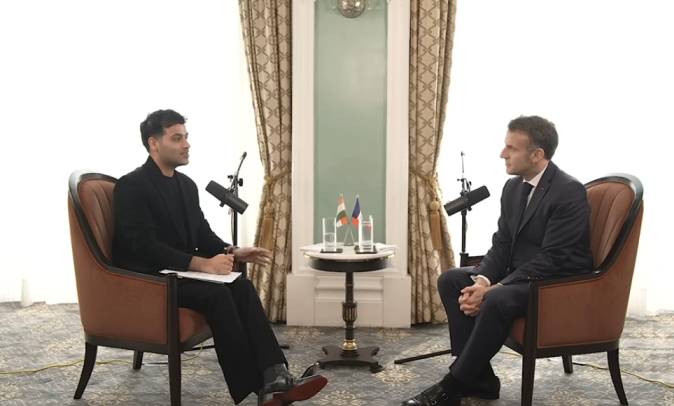
Editor’s Notes: In this historic episode, Raj Shamani sits down with French President Emmanuel Macron for his first-ever podcast appearance to discuss the deepening strategic and cultural ties between France and India. President Macron shares his candid views on global leadership, the pursuit of European strategic autonomy, and his vision for making France a global hub for quantum computing and AI by 2035. The conversation also explores the personal side of diplomacy, covering everything from his relationship with Prime Minister Narendra Modi to his commitment to fostering a vibrant ecosystem for young Indian students and startup founders. (Feb 19, 2026)
TRANSCRIPT:
Introduction
RAJ SHAMANI: Thank you so much for doing this and agreeing to do your first podcast with us. It’s a pleasure.
EMMANUEL MACRON: This is mine. Thank you for being here.
RAJ SHAMANI: Thank you.
EMMANUEL MACRON: I’m happy to be in Mumbai with you.
RAJ SHAMANI: Tell me, before we start, for the 0.01% of people who don’t know who you are and they’re watching you for the first time — they have no clue — what would you tell them about yourself in the next 30 seconds? Who you are and what do you do?
EMMANUEL MACRON: I’m a French guy here in Mumbai because I am invited by your Prime Minister — and happy to be here, by the way — involved in a very tricky, hard job for the past few years, and full of appetite and enthusiasm, especially for other cultures.
RAJ SHAMANI: Lovely. And you’re also an enthusiast. I saw that yesterday — you are the guy who loves breaking protocol and running around the streets to jog.
EMMANUEL MACRON: Right? Exactly. Yesterday morning.
RAJ SHAMANI: Yeah. How was that experience?
EMMANUEL MACRON: Wonderful. It was a little bit hectic.
RAJ SHAMANI: Okay.
EMMANUEL MACRON: Because of all the traffic in the city. But it was great. It was fun — first, as exercise, and second, to have interactions without too much security. You always have a little bit of security, but when it’s unexpected and not organized, you can indeed break the protocol. So early in the morning I went to jog, and later in the evening I went to the station as well to see your beautiful architecture — and not just the architecture, but the city.
France and the Global Technology Landscape
RAJ SHAMANI: Okay, let’s dive into the technology part, because I love what you’re doing these days. I went through so many of your speeches, and the reason that you’re here — I was reading a lot of history and I found out that France invented a lot of early technologies in the world. But today, if you look at the scenario, the largest technology companies in the world are either American or Chinese, and many of them are led by Indian-origin CEOs. What do you think? Where did France lack? What happened? Is it the culture, is it the taxes, or is it something about the way Europe thinks about failure and risk?
EMMANUEL MACRON: A mix of that, probably. But you’re right to say that we’ve had a lot of great researchers and scientists — we invented a lot of big innovations. Even if science is a global approach, and cooperation between academics and researchers all over the world is what makes sense, not just one country, we do have this culture of research, invention, and entrepreneurship.
I always remind people that “entrepreneur” is a French word — it was taken by the English language. “Entrepreneur” is a French word, and we are still extremely active. If you take Europe, probably the two main ecosystems in terms of innovation, startups, AI, and quantum are France and the UK, largely ahead of the others. And if you take math and a lot of disciplines, we are still in a very good position.
But it’s true that when you look at the tech sector, it’s largely driven by the US — the big seven companies — and the Chinese companies. Why? First, you have a question of scale. I really believe that Europe is the right approach, but in a lot of sectors we are too fragmented. So I think the missing point is, first, scale — not just for the French, but for all Europeans. We have to strengthen our single market to be sure that your domestic market is a 450 million inhabitants market, meaning Europe and not just France.
Second, capital. In the US you have a lot of capital, a lot of deep pockets, so they invest a lot of money. The paradox is that in Europe you have a lot of savings — much more than in the US — but these savings are not properly invested because of too many regulations in the banking and insurance sectors, and the structure of our financing system is unadapted to the tech industry. These savings are largely channeled towards the bond market, or they go outside Europe in search of profitability.
And the third point — you mentioned it, and I fully agree — is that we probably have to find more appetite for risk. We should be much more risk-taking. So: scale, money, and a risk-taking mindset.
The €109 Billion AI Investment and European Sovereignty
RAJ SHAMANI: So you are addressing these things in multiple speeches and conversations. I saw that you announced about €109 billion —
EMMANUEL MACRON: — billion euros, one year ago.
RAJ SHAMANI: One year ago, for the AI infrastructure, to lead technology forward. But here’s a question: you talk about scale, you talk about risk, and you talk about investments. Out of that almost €100 billion, €50 billion is coming from the UAE. So the money is foreign-funded, the infrastructure is going to be largely owned by the UAE, the technology and intelligence is coming from America and China — and you’re talking about building a sovereign Europe AI. What’s going to be sovereign about this when it’s actually a collaboration of the world, not just Europe?
EMMANUEL MACRON: This is a very good question.
One year ago we announced this €109 billion investment, which is a big bunch of money. We are deploying it, by the way — more than 60% is already deployed and we have plugged a lot of sites. It’s in order to build data centers.
You’re right, we speak about UAE and US projects. Why? Because the technology is largely in the US, but the data centers which will be deployed in France will be used as well by our own players. If you don’t have the computing capacities, you cannot deploy. And there is more cash today in the Gulf, and the technology for data centers is in the US.
But what we want to do is not to buy the solution. When you want to be more sovereign, more independent, you want to transfer technologies and attract foreign direct investment. This is exactly what we are doing. I created eight years ago an event called “Choose France,” where a lot of Indian players come every year. This event, plus all the reforms we implemented, made France number one in terms of attractiveness during the past six years.
And these AI data centers and all these investments are good for European sovereignty. Why? They are located in my country. Second, they can be used by my players, so it will improve my AI ecosystem. Third, it will transfer a lot of these technologies. And fourth, I have the guarantees that these solutions are compliant with European regulation.
What’s the alternative? As I don’t have the technology and the cash right now, the alternative is not to make this investment and to buy elsewhere. If you just buy solutions, you provide your data without any protection and without any tech transfer. So I think it’s a much better solution.
The winner takes all in this market, and the big winners were the US hyperscalers. So you have to work with them, but encourage — and sometimes force — them to comply with your markets. And in parallel, you have to accelerate the deployment of your own solutions. If you take LLMs, we have Mistral AI, which is definitely the best European player and a clear alternative to the US LLMs. So this is what we are doing.
Attracting Talent, Students, and Founders to France
RAJ SHAMANI: Interesting. So one more thing you would need in this is attracting talent, attracting founders from all around the world, and attracting students at the same time. Right now there are about 9,300 students from India in France, and you want that to go to 30,000. Every founder who’s watching this — you have announced “Station F” in France and made it a big startup hub for everyone. So if some founder is watching this, or a student who’s 22 years old is watching this and they want to come to France, what does France offer that the US and UK don’t offer for young startup founders or people who want to build for the future?
EMMANUEL MACRON: A unique ecosystem. First, I want to convey the message to Indian students: if you come to France, you can get access to the best quality universities and grandes écoles — from Polytechnique to Paris Sorbonne, from École Normale Supérieure to a lot of engineering schools.
Second, the language. Clearly, it is English — because I know that sometimes there is a misconception that you will be taught in French. That is totally wrong. You have the opportunity to have all these years in the English language, but you also get access to the diversity of language, which is very important. And when you are Indian, you know — given the number of official languages — that this diversity is a source of not just energy but creativity. You will have the best-in-class higher schools, English-speaking professors and research, and access to good ecosystems.
I really believe that France provides a unique mix of a mature economy with a lot of large companies and institutions, and at the same time the most vibrant startup and innovation ecosystem in Europe.
Third, it’s clearly a vibrant place in terms of creativity and culture. And I think that’s very important, because when you speak about innovation, never forget the place of culture, art, cinema, and so on. This is one of the links we have with India — we are extremely strong in creative and cultural industries, and I think this is a very important point. Not to forget to mention fashion as well.
This is a unique nexus where you have gastronomy, fashion, creativity, cinema, tech, entrepreneurship, and the great institutions — all in the same place. And France is a natural entry point to the rest of Europe and continental Europe. This mix of assets is quite unique.
The French Sense of Taste and Culture
RAJ SHAMANI: You know, French people and France in general definitely have something which we call here “taste.” That taste is very — the moment you talk to a French person, the way they think about arts and culture, and their ability to judge the finer things in life, is amazing. That’s something to be appreciated — and I’m sure the world appreciates it already.
EMMANUEL MACRON: Thank you for that. The French taste is indeed this capacity of mixing not just competences, but art, innovation, and life in general. And this is the approach — to say that life is something very special, being together is something very special, sharing moments and experiences is something very special in this world, given the current environment. Never forget that the most important thing is to share unique moments and experiences.
India’s Technological Leapfrog and France’s Moonshot
RAJ SHAMANI: True. Tell me — apart from culture, arts, and taste — we’re talking about technology. India leapfrogged in technology when it comes to DPI: our Aadhaar, UPI, DigiLocker, things like this. We created and escaped 10 years of financial exclusion and actually got so many people into the system. If you have to bet on one technology for France — your moonshot for 2035 — which technology would you bet on that France will lead and dominate the world in?
EMMANUEL MACRON: First, let me say how right you are when you mention India. Your country is super impressive in terms of leapfrogging and educating and training people. Today in India you train every year more engineers than in the US and Europe together. It’s such a resource — it’s unique. It means a lot of talents, a lot of people. On top of that, you leapfrog in terms of education and competences, and you have the same appetite of big emerging countries. You were right to mention the payment system and UPI — I’m obsessed by that, because a lot of people are super dependent on US solutions for payment. It happens that in France we do have our own solution as well, with the “Carte Bleue” system. But UPI reached such a scale in such a few years — it’s very impressive.
It’s very hard to say what a moonshot will be, because you never know. And especially as a president, it’s very hard to say “it will be this one” as a moonshot, because that’s not how innovation functions. You will probably lose several times, and the one you didn’t see coming will be the one to succeed.
I think the most important thing is to make sure that you provide the capacities and all the opportunities for a series of very disruptive innovations to succeed — and to make sure that one of them will succeed — while accepting that a lot of others will fail.
But if I accept the risk of your question, I would say probably quantum — quantum computing — would be where we can take the lead and have a leadership.
RAJ SHAMANI: Is there work happening in the back end?
EMMANUEL MACRON: Yes, I think so, because we have unique mathematicians, new capacities, and a lot of very high-performing startups and labs. I really believe that in this field we can deliver and have a moonshot. But more than that, I just want to convey a very simple message: when we speak about innovation and moonshots, it’s all about taking risk, and it’s all about accepting to lose.
RAJ SHAMANI: True.
France-India Partnership and the New World Order
EMMANUEL MACRON: And it seems to be super counterintuitive. But if you want to think and deliver big, you have to take a lot of risks. Except by chance, you never succeed the first time. So if you don’t accept to fail and to start again, you will never succeed.
And for me, the question for innovators — but it’s true for countries and so on — is not to have people being super successful the first time. It doesn’t exist. But it’s to make sure that we have people ready to lose eight times, but try nine times.
RAJ SHAMANI: Moving away from technology, because you said it right, it’s a mix of risk and accepting that you’ll fail. And yet even if you know there are five things which are popping right now, you can’t choose which one is going to dominate.
But one thing you seem to be very certain about, which is very reflective in your relationship with our country, is that France has been an all-weather friend for India. It’s not only a good-weather friend. You can see that when the world is against France, India stood up. Your relationship with Prime Minister Modi has actually deepened as well. And after the Indo-Pacific announcement in 2018, our relationship has gotten even stronger.
This kind of geopolitical certainty and friendship is rare to see in the world. Do you think this is going to be an example for the world that the new World Order is about multipolarity, where things are going to be balanced in friendships and not going to be one-sided? Do you think India and France are setting an example?
Delivering Together: The India-France Strategic Vision
EMMANUEL MACRON: I really believe that when we team up, we deliver. We launched together with the Prime Minister the Solar Alliance initiative. We delivered. We launched together during the G20 the IMEC. We are delivering and we will deliver. We decided together to deal with artificial intelligence in the global regulation and conversation. We are doing it — last year in France, doing an action summit, now in India.
So I think we clearly delivered concrete results because it’s based, with all our differences — because we are different as countries, as civilizations, our people — but I have indeed this great relation with your Prime Minister. And our countries have this great relation. Why? Because we have, beyond these differences, similarities: a taste for precisely culture, innovation, and diversity.
I would say when you speak to a French person, the relationship with language, with multilingualism, and the respect of Francophonie is super important. When I see your Prime Minister, he speaks in Hindi, and I know the diversity of your languages — it creates something very special. Because we don’t like uniformity.
Second, we don’t want to be dependent on one of the two big powers. We want to have good relations with the US and China. We have different relationships, by the way, with both of them, between India and France. But it was the whole rationale of the Indo-Pacific approach — meaning a third way, something which says, “I will not be confrontational with you, but I don’t want to be dependent on you.”
RAJ SHAMANI: True.
EMMANUEL MACRON: Let me build my own future in full respect. And based on that, this is the fact that we really believe — both India and France — that democracy, rule of law, multilateralism, and delivering concrete results makes sense. And we are supporters of this approach.
And in this world where the rule of law is very often replaced by the order of the strongest, I really believe it makes sense. And it’s super attractive too, because you can gather a lot of people, a lot of countries, a lot of goodwill. So this is where I really believe that this approach and our partnership is not just meaningful, but has much more potential than what we see today.
Strategic Autonomy: Europe, India, and the Path Forward
RAJ SHAMANI: True. Even Europe is realizing now that strategic autonomy is the way forward, not choosing one side. And PM Modi’s brand is about choosing strategic autonomy. We honor the Russian friendship, yet deepen the relationship with the US. We build a relationship with France and deal with the rest of the world. So he stood by it.
Do you think your way of thinking and Europe’s way of thinking is now also being inspired by India and PM Modi — that strategic autonomy is the way forward, not choosing sides anymore?
EMMANUEL MACRON: Look, I really believe that the fact that we are building this partnership and this free trade agreement between Europe and India is obviously due to this period of time where there is increasing skepticism or frustration vis-à-vis the US, given the recent attitude. And a lot of Europeans now see that India is the biggest place where we can build this new partnership.
But I really believe as well that I advocated nine years ago for a more sovereign Europe. I pushed this approach of strategic autonomy for Europeans. Some colleagues did follow me and wanted to cooperate. Some were super skeptical, thinking, “Okay, this is a French idea. It will never work.” And some were still in the certainty that the relationship with the US is something which will never change, and that this is a geopolitical umbrella and strong alliance which will always deliver. I mean, all this approach collapsed.
And not to say that we want to be confrontational with the US — the more intense the relation could be, the happier it will be. But having an ally, having a friend, doesn’t mean that you’re dependent on your friend.
And I really believe that when a lot of Europeans see that this approach is adopted by a country like India, it gives them more trust and they accept to be probably a little bit bolder. So I really believe in the potential of this relation as well, because it will increase what we want to do together — meaning being more independent.
And once again, why do we want to be more independent? First, because we are obsessed by this sovereign approach. What does it mean, sovereign? Our fellow citizens decide for themselves. If you are dependent technologically or regarding defense issues, you cannot guarantee your fellow citizens that they will decide. So in a certain way, it’s a bias in democracy — because I ask you to vote, but you will never decide if you go this way or that way, because you have no choice. So strategic autonomy is super important when you are a strong democracy.
And second, because we are — both of us, India and France — very much attached to diversity, as I mentioned, and the strength of this diversity. And we don’t want to be part of a big uniformity.
On Trump, Respect, and American Leadership
RAJ SHAMANI: We believe in this approach. But recently, Donald Trump shared your private messages — like on WhatsApp. He threatened to put 200% tariffs on you. You have called his administration anti-Europe. And there’s a lot of tension. What does it tell the world that one of the most powerful people in the world is sharing messages publicly? Do you think this conveys something about American leadership today? Should the world be scared?
EMMANUEL MACRON: I mean, I let you judge, and your question speaks for itself. I really believe that respect is part of leadership, and we have to provide respect to each other. You can share ideas or not, you can disagree, but you have to do it in a respectful way — between leaders, but within democracies as well.
This is why I’ve always been extremely committed to fighting against any sort of hate speech or violence in our societies. Because when you have democracy, you have the right to change your leadership. You decide who will take the law and pass the law on your behalf. So there is no need to be violent and disrespectful.
Respect was built — everything which goes with the civilization process was built years after years, decades after decades — in order to improve ourselves. And it’s a little bit surprising, I really believe, for people to see leaders going backward. And it’s not the right message.
The Dollar, the Euro, and a Multipolar Financial Order
RAJ SHAMANI: True. Do you think that dollar dominance is ending? Because India is now dealing in rupees, China is pushing the yuan, and you talk about energy trades in euros. Do you think dollar dominance in the world is now going to end?
EMMANUEL MACRON: I would be super careful today. The dollar is clearly dominating the world. I really believe in a multipolar order, and I will do whatever I can to strengthen the international role of the euro. What does it mean? We have to be more innovative, we have to be more competitive, we have to invest much more. We have to, on top of the trade agreements we sign, sign swap lines, have the euro as the exchange currency. And we have to make sure that the euro is seen by the key central bankers of this world as an alternative to the dollar — meaning we have to provide more euros as a safe and liquid asset.
We have everything to succeed in this strategy, and it will be one of the elements of a more sovereign and more independent Europe. I really believe it’s possible. We have a window of opportunity. But it would be wrong to say that it’s the case today. It is to be delivered, and I really hope we will be able to do so.
What Scares Him — and What Gives Him Hope
RAJ SHAMANI: Interesting. You talk about a window of opportunity, and that gets me to my last question. Your term will eventually end. You might be able to seize this window of opportunity, or you might not. You’re deepening ties with India, you’re uniting Europe more than ever, you have led France through uncertain times, and you’ve been the youngest president in French history. You’ve done it all.
But even after all these achievements, this window of opportunity may or may not be achieved — that is not certain. But what is certain is that your term will end. What scares you about the world right now? After your term ends, what is going to be the most worrying thought for you? And what about the world gives you a lot of optimism?
EMMANUEL MACRON: Look, what provides me a lot of optimism is the fact that more and more people are well educated. I really believe we have to do much more, because still you have hundreds of millions of inhabitants on this continent, in Africa, where we have to improve the level of education to allow them to have more opportunities.
But it has never existed before — to have such a world where so many billions of inhabitants have this level of education and training. And for me, this is a source of optimism, because it means that you have a lot of young people with brains and enthusiasm, and they will invent something better, for sure. For the world, in terms of innovation, culture, and how to deal with climate change and biodiversity — how to fix it. So I see that as a unique opportunity, to be cherished.
What scares me is the lack of a predictable and reliable framework in terms of defense and security. I think we have entered, during the past few years, into uncharted territories. The fact that Russia decided to launch this crazy war in Ukraine — having a permanent member of the UN Security Council with nuclear deterrence deciding to launch a war that is a 19th-century war, meaning revising borders and trying to adopt a sort of neocolonial approach — is totally crazy. But it triggered a series of reactions everywhere.
And I think the fact that today a lot of big countries and big leaders seem not to see international order and the UN Charter as our common code and common rules — and second, this race for more defense equipment, arms, and ammunition — is something very worrying.
And I think part of the work I have to deliver in the 15 months to come is obviously to make France credible in this race, but on the other side as well, to start engaging with a lot of countries to build a new framework in order to limit the capacity for misuse and inappropriate use of these arms and ammunition.
RAJ SHAMANI: Does it scare you that you might not be able to finish it in the next 15 months?
EMMANUEL MACRON: It doesn’t scare me. It pushes me to be more energetic and to do my best in order to just do it perfectly. So I’m always in action mode.
Closing Remarks
RAJ SHAMANI: I would say you are always in action mode. And I have to tell you, in the end, I loved that speech of yours where you said, “Plug, baby, plug.” That was so good.
EMMANUEL MACRON: That was one year ago.
RAJ SHAMANI: Yeah, I saw that.
EMMANUEL MACRON: The AI Summit. Yeah — “Plug, baby, plug.”
RAJ SHAMANI: It was really good. Thank you so much for doing this. I know we are short on time, or else I would have spent three hours digging deep into your mindset. But thank you so much for giving us this opportunity.
EMMANUEL MACRON: I want to thank you, and you can be very proud of what your country is achieving in all the different fields — in innovation, tech, culture — and the message you’re providing to the rest of the world. And it was great for me, here in Mumbai this morning, to share this conversation with you. So thank you for taking the time.
RAJ SHAMANI: Thank you so much. Thank you.
EMMANUEL MACRON: Hello.
RAJ SHAMANI: Hello.
EMMANUEL MACRON: How are you?
RAJ SHAMANI: Very good, sir. Pleasure meeting you.
EMMANUEL MACRON: My pleasure. Thank you so much for taking time.
RAJ SHAMANI: Thank you so much for agreeing to do this. Thank you.
EMMANUEL MACRON: You want me to sit down here? Yes, I’m fine.
RAJ SHAMANI: By the way — “Shamapel Raj.” That’s all my French.
EMMANUEL MACRON: Come on. And where do you live?
RAJ SHAMANI: India.
EMMANUEL MACRON: No, but where in India, my boy? Delhi or Mumbai?
Wrapping Up
RAJ SHAMANI: Mumbai. Now, I have a lot of my friends who took French as a subject in school.
EMMANUEL MACRON: Yeah, yeah.
RAJ SHAMANI: So they keep talking like, “Jama Pel, Kamodita Pel.” I don’t know. It’s difficult, but I’m glad I could do this with you. And they’re going to be jealous.
EMMANUEL MACRON: When did you start?
RAJ SHAMANI: Four years ago.
EMMANUEL MACRON: Four years. Right after Covid.
RAJ SHAMANI: Yeah.
EMMANUEL MACRON: How old are you?
RAJ SHAMANI: I’m 28 now.
EMMANUEL MACRON: Wow. Wow.
RAJ SHAMANI: And now we are heading towards becoming the world’s number one podcast. I think in the next 18 months we’ll get there. We are 25th in the world right now, and we’ll be number one. There’s no French, Indian, or Asian in the top 10 — there’s only Americans. We’re going to beat it.
EMMANUEL MACRON: I love this state of mind. I love this mindset.
Related Posts