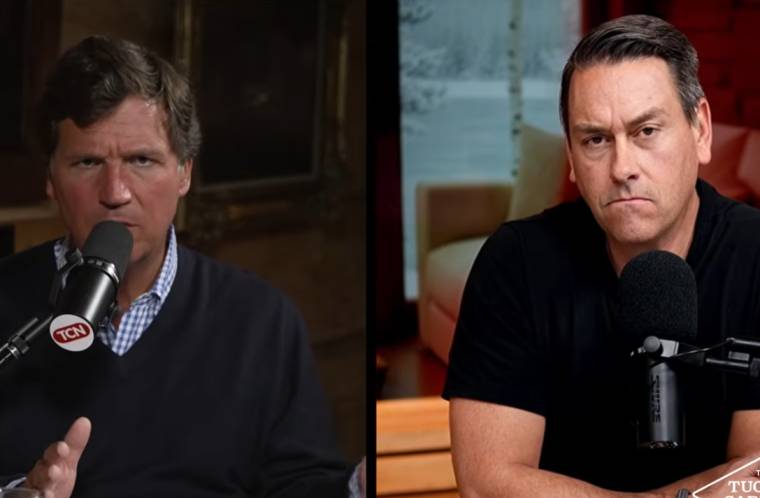
Editor’s Notes: This interview examines escalating tensions in the Middle East, focusing on claims that Israel is working to involve the U.S. military in a potential confrontation with Iran. Tucker Carlson speaks with Clayton Morris about how these dynamics could affect U.S. foreign policy and ongoing efforts toward a negotiated peace under President Donald Trump. The discussion explores alleged strategic calculations by Israeli leadership, the role of American political figures, and the possible consequences of a wider regional conflict. Viewers are invited to consider how these developments might shape future U.S.–Israel relations and broader security in the region. (Feb 26, 2026)
The Looming Iran War: What You’re Not Being Told
TUCKER CARLSON:
Well, between the Super Bowl halftime show and Epstein and the Winter Olympics, most Americans probably weren’t aware that we are on the verge of a massive regional war in the Middle East, if not a third world war. We are. The largest movement of American military hardware since 2003, the Iraq invasion, is now in or steaming toward the Persian Gulf off Iran, preparatory to what could be the aforementioned war. Now most people once again probably didn’t know this. Those who did know it weren’t for it.
Recent polls on this question — are you for a war with Iran? — it’s about one in five Americans who support it. The rest are probably asking, “War with Iran? Why do we have a war with Iran?” They said, “No idea.”
Trump’s Position on Iran
The president did address it last night in his State of the Union, in a press conference. And he said in public what he basically says in private. Trump being one of those rare public figures who’s pretty much the same behind closed doors as he is on stage, says pretty much the same stuff. It’s a little funnier in private, but basically he’s not a different guy. He’s the same guy.
And he’s been saying the same thing about Iran for a long time. Really two things.
One, Iran cannot have a nuclear weapon. They cannot have a nuclear weapon. He says it again and again. He really means it. That’s not a talking point. It’s completely sincere.
And two, “I would prefer a negotiated settlement. I prefer peace rather than war.” And that’s obviously true.
So to bottom line where we are right now at the end of February 2026 — this looming Iran war seems likely. We have all those aircraft carriers in the Persian Gulf, planes ready, missiles ready. But it’s not certain, because the president hasn’t decided to do it. And you may not get that impression from watching the news.
The Psyop of Inevitability
There is the sense that it’s inevitable, and that’s kind of a psyop, actually, designed to make you think there’s nothing you can do about it. No. Trump has not decided to do this. Again, it seems likely that all the momentum is in that direction, but the president is the sole decider on this question. He’s the commander in chief, and he’s showing no obvious signs of enthusiasm.
And why would he? There are a lot of reasons not to do this. The first being the one just mentioned, which is most Americans don’t want it. And though it’s not a direct democracy, it’s a form of democracy, and you probably shouldn’t commit history-changing acts without the support of your people. And Trump feels that way.
This is someone who pays very close attention to TV ratings. Why is that? Not just because he worked in TV, but because he thinks they’re a pretty good measure of what people are interested in. He cares about what people think, and he’s willing to listen to almost anybody.
So that’s a good reason not to do it. The public’s not behind you. Maybe you’ve got great reasons to do it that they don’t know about yet, but we haven’t heard those, and the president hasn’t really explained them other than to say Iran is bad. Yes. That’s been the official US position since 1979. Iran can’t have nukes. That’s always been the president’s position, and we would like some kind of settlement.
Why This War Would Be Particularly Tough
The reason he’s not eager to start this war is because he, in general, isn’t eager to start wars — hasn’t been anyway — but also because this would be a particularly tough war. This is the largest buildup since the Iraq war, but Iran is not Iraq. It’s much, much, much bigger and much more technologically advanced.
The population of Iran is about 92 million. In 2003, almost exactly twenty-three years ago, when we rolled into Baghdad, the population of Iraq was 25 million. So Iran is more than three times bigger. The landmass of Iran is six times bigger. It’s huge. It’s a huge, pretty advanced country compared to Iraq. So that’s a problem right there.
This is a serious thing — to start a war with a real country. Are we in a position to do that? Well, there’s some debate about that. The US military performs in a remarkable way under certain circumstances. But is the US military right now ready for a prolonged conflict with a big country? No. It turns out.
America’s Military Readiness Problem
And these are facts taken from open-source material that have been published on the Internet. You can look it up. None of this is classified. This is all out there.
Current estimates suggest that the United States is so low on some munitions — partly because we’ve used them in the defense of Israel already in the last twelve months — but whatever the cause, the United States is so low on certain kinds of munitions that were we to have even a brief but intense engagement with Iran, our military would not be ready for, like, ten years to fight a real war against a peer or near-peer adversary.
So out the window would go any hope of defending Taiwan.
So we are not in a position to have a lengthy engagement, and everyone at the Pentagon who’s gaming this out understands that. And again, this has been reported publicly, though not necessarily in the New York Times or the Washington Post, at least not on the front page, but it’s widely known.
The Real Downsides of War With Iran
So it’d be a tough war. We’re not in a great place to fight it right now, and the potential downsides are absolutely real. Lots of things could happen.
There are tens of thousands of Americans in the region, of course, in uniform and out. They could be hurt or killed. There’s Israel, our ally, which is probably a little more vulnerable than we pretend it is to conventional attacks from ballistic missiles. Do the math on how many missiles Iran is believed to have versus how many anti-ballistic missiles Israel has, or we have to defend Israel. They could be in trouble.
And then there’s a question of what happens to Iran. Does it fall apart? Does it disintegrate as a country? To be clear, as of tonight, there is no Israeli plan for what comes the day after we depose the Ayatollah. Knock out the leadership of the country — what happens then? Going to put in the former king’s son or something? No one believes that’s real. Will the country hang together with Pahlavi on the throne? Come on.
No one is thinking this through, because the people pushing this clearly don’t care what happens after. The point is to take out Iran as a coherent country — not to protect Israel, but in order to sweep Iran aside as a regional rival. Once Iran is gone, there’s no question as to who controls the Middle East. It would, of course, be the only nuclear-armed power in the Middle East — Israel, period. That’s the reason.
The Catastrophic Economic Consequences
The problem is, if the country were to disintegrate, the downstream effects would be profound for everybody else. You would likely have refugee crises. Where would they go? Well, Europe. They haven’t enough refugees. They might go right across the water to Qatar or UAE. That could be a huge, huge problem.
So why would they push for this? Well, you have to think that the people pushing for this are not stupid. They’ve thought through the consequences.
Let’s say the United States attacks Iran. Maybe Iran just says, “You’re absolutely right. We’re evil. We’re rolling over. Everybody in charge is going to retire, commit ritual suicide. We’re going to turn it over to some western democrat who brings in pro-choice politics and gay marriage. We’re cool. We’re going to join NATO at that point.” That’s great.
But what if Iran decides, “Better to die on your feet than on your knees,” and just unleashes its conventional arsenal against American assets in the region, against Israel, and critically, against energy infrastructure in the Gulf? What would happen then?
Well, you would see a global depression if they did that, if they were successful in doing that. If the extraction facilities and refineries and petrochemical plants in the Gulf were disabled, how expensive would oil be per barrel? How much would gasoline cost? What would steel go for? What would happen to liquefied natural gas, which goes to both Europe and China? What would happen to Europe if you disrupted the flow of LNG from the Gulf to Europe? What would happen if you closed the Straits of Hormuz, the choke point at the end of the Persian Gulf?
It wouldn’t destroy the world forever, probably, but it would tank the economy in the meantime for sure. And who would suffer most? Well, let’s see — the Gulf states, Europe, and the United States.
Who Is Really Pushing This War, and Why?
It’s kind of weird that anybody, especially an ally, would push for a conflict that’s almost guaranteed to hurt its so-called allies. Why would you do that? You can tell me you love me, but if you’re encouraging me to commit suicide, you’re probably lying.
It’s possible that we should judge people’s intentions by the effects of what they do, not by their own description of their motive. Is it possible that there is some hostility toward the United States, the Gulf states, and Europe from the people pushing this war? There’s a lot of hostility. And part of it makes sense.
The Gulf States — the six Arab oil-producing states called the GCC in the region — are, along with Iran, one of the main impediments to Israel’s regional hegemony. They are very rich. They produce something that the rest of the world needs. They’re also very good at diplomacy, particularly Qatar. They settle a lot of disputes internationally. They position themselves as the Switzerland of the Middle East, and have done a good job at it, actually.
And so they are a rival to Israel. You hear on Fox News, “They’re Hamas supporters.” No. No. No. That’s not their sin. Their sin is existing as a powerful, independent country in potential rivalry with the regional hegemon, Israel. So shafting them would be a very good thing from the Israeli perspective.
Is Israel Moving On From the United States?
But what about the United States, Israel’s benefactor, its closest ally? Why would they want that?
Well, maybe if you’re gaming this out a little bit, you’ve decided, “We need a new superpower. Public opinion in this country has swung against us so hard. This bipartisan consensus that we’re its closest ally is disintegrating before our very eyes, and let’s be honest with ourselves — this is not going to continue forever. We need another country to be aligned with.”
Now, how many big countries are there to choose from? It’s got to be physically large, big population, nuclear-armed. Not too many. In fact, the big ones would be China and India. But China, unfortunately, is a Han ethnostate, so you can’t really turn its population against itself in order to increase your own power. It’s not going to work. It’s resistant to manipulation. And that leaves India.
And it was probably no coincidence that the Prime Minister of India, Prime Minister Modi, spoke to the Knesset today about the ancient ties between Israel and India. Bottom line — yes, Israel is moving on from the United States at some point, probably sooner rather than later, to India.
And so weakening the United States in a war with Iran is not all bad. In fact, it might be good, because then there’s no rivalry at all in your region. It’s you, the only country with nuclear weapons, and everybody else. So you can kind of do whatever you want. You don’t have to worry about hostile neighbors. You can expand the size of your territory, for example. You can move your borders in all directions. Who’s going to stop you? No one.
The American Perspective vs. The Israeli Perspective
So if you game this out for a minute, the things that from an American perspective seem horrifying — real downsides. Holy smokes. We could tank the US economy. We could wreck the energy sector, at least temporarily. Some of our key Arab allies could be disabled by this. Those all seem very bad from an American perspective. Are they so bad from an Israeli perspective? No. They’re not, actually. They may be the point, long term.
Where Does This Leave Trump?
So where does this leave our president, President Trump? Well, it leaves him where he began, which is very resistant to starting big new wars. He, of course, ran for president both times — all three times — on the promise that he wouldn’t do that.
And he very famously in the 2016 campaign attacked Jeb Bush because of his brother’s invasion of Iraq. “That was idiotic,” he said, and of course he was right. And twenty-three years later, we know exactly how right he was. That war, which lasted twenty years, waged on behalf of our ally Israel, didn’t help the United States. It helped to impoverish the United States and sink this country deeper into debt, to weaken the dollar, and destroy a generation of young men — mostly from the flyover states, the most decent and patriotic among us — destroyed.
So from an American perspective, Iraq was a true disaster, and Trump was the first big political candidate to say that out loud. He knows this. He always has.
Could the War Start Without Trump’s Decision?
So why would he even be considering a war with Iran? Well, one way to think about it is the United States may not have a choice about whether or not this war starts, because of course the government of Benjamin Netanyahu could always act unilaterally, preemptively, against Iran and just do it. Just strike Iran.
What would happen then? Well, most likely the Iranians would strike Israel, and then potentially strike American assets in the Gulf, and then potentially strike energy facilities in the Gulf. And the United States would be, by definition, drawn in.
The Recycled Lies of American Foreign Policy
TUCKER CARLSON: So it’s possible that the US government, while not anxious to go to war with Iran, is trying to find a way to contain the behavior of its closest ally, Israel. Rather than sit back and wait for Bibi to do something that we have to clean up, that we’re implicated in and then sucked into, it’s possible that the US government is attempting to steer this in a less destructive direction. It’s possible.
None of this, of course, has filtered down to people paying attention, because all the noise has been about Iran’s nuclear weapons. They’re on the verge of building a nuclear weapon any day now.
Now if you’re semi awake, you may remember that it was only about eight months ago, back in June of last year, during the short but hot twelve day war against Iran, that the United States took out nuclear processing facilities deep underground and then announced, “We have ended the Iranian nuclear threat.”
And then without you noticing — well, you were on summer vacation, or going to your kid’s graduation, or bringing them back to school, or watching the Super Bowl halftime show with your jaw slack — you were not tuned in. All of a sudden, that threat out of nowhere reemerged. And there’s Benjamin Netanyahu on television, or at the White House for a seventh time in a single year, making the case that we’re right on the verge of a nuclear holocaust. Any day now, the Iranian government will have a nuclear weapon.
And by the way, as noted, the president does not want Iran to have a nuclear weapon. That is one thing he takes very, very seriously, and he said that to the Iranians. And unfortunately, turns out whatever sides you’re on, the current Iranian government is very hard to deal with. They’re disorganized. The head guy is eighty-seven years old. There’s almost no communication directly between the governments.
The supreme leader in Iran has never had a single phone call with the president of the United States. It’s unclear exactly who’s in charge. There are all kinds of factions. I mean, it’s a nightmare.
So the only people who’ve really been out there speaking in public about Iran’s nuclear program are basically Benjamin Netanyahu, prime minister of Israel, and his many accolades and paid shills in the United States.
Netanyahu’s Thirty-Year Warning
You may have seen this tape before, but in case you haven’t, it’s worth watching again, because it reminds us that Benjamin Netanyahu has been saying exactly the same thing about Iran — that they’re about to have a nuclear weapon any minute — since at least 1996. Thirty years. Here it is.
VIDEO CLIP BEGINS:
BENJAMIN NETANYAHU: Now they’re well into the second stage. And by next spring, at most by next summer, at current enrichment rates, they will have finished the medium enrichment and move on to the final stage. From there, it’s only a few months, possibly a few weeks, before they get enough enriched uranium for the first bomb.
UNIDENTIFIED SPEAKER: You talk about a network of terror. Are there any other nations that you would recommend that the United States launch preemptive attacks upon at this point?
BENJAMIN NETANYAHU: No. The issue is not — first of all, are there other nations that are developing nuclear weapons? Yes. Should we launch any other preemptive attack? First, let me say what they are, and then let me make a suggestion on how to proceed. Thank you.
The answer is categorically yes. The two nations that are competing with each other — who will be the first to achieve nuclear weapons — is Iraq and Iran. And Iran, by the way, is also outpacing Iraq in the development of ballistic missile systems that they hope will reach the eastern seaboard of the United States within fifteen years.
The most dangerous of these regimes is Iran, that has wed a cruel despotism to a fanatic militancy. If this regime, or its despotic neighbor Iraq, were to acquire nuclear weapons, this could presage catastrophic consequences, not only for my country and not only for the Middle East, but for all of mankind.
I believe that only the United States can lead this vital international effort to stop the nuclearization of terrorist states, but the deadline for attaining this goal is getting extremely, extremely close.
VIDEO CLIP ENDS:
Why Our Leaders Have No Credibility
TUCKER CARLSON: You could see why the government of Israel has such contempt for the United States, while they’re totally happy to tank our economy, stretch our military to its limit, degrade us in public. Why? Because our leaders put up with this. Some foreigner shows up at our capital every year for thirty years telling the same lies, and everyone in there just nods along — all five hundred and thirty-five of them.
“Oh, really? Iran’s about to get a nuclear weapon.” I ran into a senator the other day. It was like, “Iran’s about to get a nuclear weapon.” I mean, they believe it. How could you have respect for people who believe something that dumb? Well, you couldn’t, and they don’t.
And by the way, it’s not just the claim that Iran is seconds away from a nuclear weapon that they’re recycling here. It’s maybe the oldest lie in American foreign policy — you heard it in those clips too — which is, “We need to do this because it’s a despotic regime that is oppressing its own people.”
Now this line is older than you may know. And the reason it’s so distressing, it’s so cynical, is because it plays upon Americans’ best quality, which is decency. Americans hate despotism. They believe freedom is granted to them and all people by God. And so a regime that oppresses its own people is inherently illegitimate. Americans are born believing that, and God willing, they always will believe that, because it’s true.
So if you’re trying to sell an illegitimate war, waged for reasons that had nothing to do with human rights at all, you would use that line, wouldn’t you? Probably.
Sixty Years of the Same Lie
Well, American policymakers have used that line, and we pulled some. Want to hear some? This actually made me laugh out loud. So this goes back sixty-one years.
Here’s Lyndon Johnson, 1965, in a speech at Johns Hopkins, explaining that the war in Vietnam — which was just getting intense then, three years from Tet, from the height — he said this:
“Tonight, Americans and Asians are dying for a world where each people may choose its own path to change.”
So really, we’re doing this for the Vietnamese people. Okay.
Now then Bush — George W. Bush, son of George H. W. Bush — said this right before the Iraq war started, and we’re quoting:
“We have no ambition in Iraq except to remove a threat and restore control of that country to its own people.”
Right. We did that for human rights reasons. We just wanted democracy in Iraq. Did that happen? The Christian population was annihilated. Hundreds of thousands of people died, and political control was turned over to the ayatollahs in Iran. No. But he said it anyway.
And so did Dick Cheney, by the way. “My belief,” he said, in the lead up to the Iraq war, “is that we will be greeted as liberators. The vast majority of Iraqis would respond favorably to an effort to rid the country of Saddam’s regime.”
Well, someone who happened to be in Baghdad in December of 2003, the day we caught Saddam at Tikrit — I can attest to what you already know, which is that’s where the insurrection started.
But Barack Obama, even three years after getting elected president, having been thoroughly briefed — in 2011 said this about the bombing of Libya and the murder of our sometime ally and CIA asset, Muammar Gaddafi:
“This is a plea for help from the Libyan people themselves. They’re desperate for it.”
Regime change in Libya, said Barack Obama, would serve America’s “broader goal of a Libya that belongs not to a dictator, but to its people.”
I mean, what can you do but laugh? It’s so absurd. It’s such an obvious lie. It’s like Bibi Netanyahu saying, “They’re minutes away.” As long as people believe this, or are so polite they pretend to believe it, politicians will keep telling the same lies. You have to make them pick a new lie.
The Administration’s Approach and Israel’s Last Chance
Now what’s interesting is that the administration, I think to its credit, hasn’t done a ton of this. There’s been, you know, the “oh, we feel bad for the Iranians murdered in the streets of Tehran” — or some whatever, who knows what the number is. You can’t believe any number connected to any conflict in any country ever, because everyone lies about them all the time.
But some number of Iranians protesting the Iranian government apparently were killed by the government, and we feel bad about that. And we legitimately do feel bad about that. Is that a good reason to topple the existing power structure and just let the country devolve into whatever happens next? Probably not.
And the administration hasn’t really made that case, or really any case other than, “They can’t have nuclear weapons.” So you can at least feel satisfied that they’re not trying very hard to lie to you. They’re basically just saying, “Looks like we could have a war,” because everybody knows the only reason we’re having this war is because Israel wants it.
This is their last chance, they believe. This presidency is the last presidency where they’re going to have unequivocal bipartisan support, period. You can’t primary every Thomas Massie, and there’s a whole army of them coming at some point, because everyone can see what’s going on. And you could shut down X, and you can shut down the Internet. You can be like Great Britain and arrest people who protest Israel. But attitudes are not going to revert to what they were five years ago. Sorry. And they know this. So this is their last chance.
The Media’s Role in the Propaganda
What’s so amazing is that Israel, which at least is acting in what it perceives to be its own national interest, is joined by its shills in the United States, of course. But really, its only other ally in this is the American news media, whose job it is to tell you the truth and inform you as to what’s happening — to tell you, “Hey, wake up. The world could be changing, and it’s going to affect you and your family.” That’s their job.
And instead, they’ve been lulling you to sleep with the same variety of transparent lies and propaganda. So just for fun, we decided we would pick a cross section — and not just from liberal media or right wing media, but from all media — because it’s not a left-right question.
Chuck Schumer is every bit as much in favor of an invasion of Iran, a regime change war in Iran, as — I don’t know — pick a brain-dead Republican senator, which is almost all of them. They’re all for it, and so are all the Democrats. You don’t see Alexandria Ocasio-Cortez making a real case against it — a pro forma case, because she knows that all of her constituents hate it. But is she really working to stop this? Of course not. Because they’re all for it. Because they’re paid to be for it, and so are the media.
The Wall Street Journal’s War Drumming
So here’s a quick cross section. Now it goes without saying that the Wall Street Journal, owned by the Murdoch family, has been by far the most egregious and the most stealthy, because starting new regime change wars on behalf of Israel is, like, the whole reason to have the Wall Street Journal now apparently. But here’s just a few headlines.
“The Diminishing Risk of an Iran Attack.” Quote: “Two years ago, there was a strong possibility the region would spiral out of control. Not anymore.”
Really? Oh, really? What is the plan the day after we depose or kill the eighty-seven-year-old supreme leader, or President Pezeshkian? What’s the plan? Do you have a plan? No plan. But don’t worry — it will not spiral out of control. The Wall Street Journal assures you of that.
Here’s another: “A Fractured Iran Might Not Be So Bad.” Well, yeah, it could spiral out of control and break into different provinces, and it could become Libya or Syria or Lebanon. That’s not so bad. Because you know why? Quote: “Its borders are artificial.” Oh, they’re fake. And “a breakup would frustrate the interests of China, Russia, and others.” Okay. So our global rivals wouldn’t like it. Therefore, it’s good.
“Its borders are artificial.” As compared to whose borders? All borders are artificial. God didn’t draw them. Sorry, Mike Huckabee. They’re drawn by people. Artificial. I mean, what? No. It’s a country, has been for a while. And if you blow it up into constituent parts and ignite a civil war, there are going to be downstream effects of that — refugee crises into Europe and the Gulf States, probably the United States too. Since it is the iron law of American foreign policy that once you start bombing people, you have to let all their angry kids into your country. And that’s how, by the way, we got the Boston Marathon bombing and many other acts of terror. Thanks, neocons.
And then there’s this. John Bolton still exists, writing for the Wall Street Journal: “The Gaza ceasefire has diverted Western attention from the real threat, Tehran and its surrogates.”
You’d really have to be John Bolton to think that Tehran and its surrogates are even in the top hundred issues Americans are worried about at the moment. They’re not. This is knowable. It’s polled all the time by Gallup and others. Tehran and its surrogates are admittedly an issue of concern to Israel and to its shills here, but they’re not actually a problem for a continent-sized country separated from the world by two great oceans. Not a problem. As long as you don’t, like, start a war with Iran or something.
The Media Push for War with Iran
The New York Post’s War Drumbeat
But here is the greatest offender maybe of all, and that would be the New York Post, the scrappy New York tabloid famed for its rollicking crime headlines, “headless body in topless bar.” It’s a hilarious newspaper, always has been, up until two years ago when Lachlan Murdoch took full control of it. And now it’s like commentary. It’s like any other publication from a neocon think tank in Washington, just advocating for war and lying to you in order to get you to support it.
So here’s just a quick selection from the New York Post. “Memo to President Trump: Don’t miss this historic moment to strike Iran and end its terror regime.” This historic moment. “Iran’s rulers plainly fear US strikes. Trump should prove them right.”
“Mister President, you’re so strong and dangerous. You have a chance to prove that. They fear you.” Memo to self: never accept flattery uncritically, because it is deeply subversive. Attacks are straightforward. Flattery is reptilian. Flattery is the true danger.
“Oh, President Trump, you’re so strong. They’re afraid of you. Prove them right by killing them.” And then, “If Trump doesn’t strike Iran now, history will never forgive him.” If you don’t have a war with Iran, history will never forgive you. It probably depends on who writes that history, but hundreds of millions of Americans will forgive you. They’ll be grateful to you for pulling us back from the brink of something we don’t need and don’t want.
And then last, of course, Douglas Murray, the eminent historian everyone respects, Douglas Murray. He’s got a British accent. He’s not being paid to say this. Don’t worry. “Trump has a chance to end Khamenei’s reign of terror in Iran.” His reign of terror. Because if there’s one thing Douglas is concerned about, it’s human rights in Iran. He’s been there.
The New York Times and Brett Stephens
And now to the New York Times. And this is interesting if you’re a right-winger, because the New York Times is, of course, the most liberal publication in the world. It’s NPR on paper. It’s totally different from, say, Fox News. They’re poles apart. They have nothing in common whatsoever, except on a few questions like immigration and war and the basis of our economy, which is finance and real estate, the banks. Except on those issues, there’s some overlap.
There’s vigorous consensus. In other words, except on the issues that actually matter, that drive history, that determine whether or not your children thrive in this country or not — on those issues, they’re one and the same.
So here’s a section. We’ll put this one up on the screen because it’s so amusing. Here’s Bret Stephens. Three different pieces he’s written on this question, and he’s obviously a man with a great deal of credibility and authority on regime change wars, having advocated for all of them, none of which has worked.
“The case for striking Iran.” “Can we let Iran get away with mass murder?” “Israel had the courage to do what needed to be done.” “The case for overthrowing Maduro.” “The Syria opportunity.” “We absolutely need to escalate in Iran.”
And then my personal favorite, from 2023: “Twenty years on, I don’t regret supporting the Iraq war.”
Okay. Should you be admitting that? Twenty years later, “I am not ashamed to wear women’s underwear.” Well, actually, you should be ashamed. You should be embarrassed. If you don’t regret supporting the Iraq war, if that support occasioned no soul-searching in you, then you, my friend, have a spiritual problem.
All of us make mistakes. All of us support dumb things. As someone who supported the Iraq war, I can attest to that personally. So the acid test is not do you make mistakes. The acid test is do you admit that you did, and do you apologize?
But if you refuse to do either one of those things, and instead twenty years later are still bragging about the greatest disaster in modern American history as if it’s a badge of honor — hard to know if we have anything in common as people, because that’s contemptible and scary. It’s never occurred to you that the Iraq war was a mistake? Really? On what basis was it a success?
So if that’s really your view, maybe we shouldn’t trust you when you tell us that we have a moral obligation to attack Iran. Just throwing that out there.
Fox News and the War Agenda
So that’s where the print media are. But let’s be honest, it’s not really the print media who are driving this, because this is a Republican administration. And as everyone knows, Republicans have one main news source, and that’s Fox News.
I have some familiarity with the product, and I can say that even as Fox News’ reach and power and influence have diminished greatly — mostly due to technological changes, people go on the Internet, they don’t pay for cable — as it has diminished, it has not broken the stranglehold that Fox has over Republicans in Washington. They watch Fox. They want to go on Fox.
And so Fox has really driven this war, and if it occurs, you can thank Fox more than any other media organization, more than any other lobbyist, more honestly than any government, more than the government of Israel. Fox News has pushed for this war. Its owners personally have pushed for it, personally. And of course, its employees on the channel have pushed for it with such aggression and unanimity that as of tonight, there is not a single on-air Fox personality who is going to question going to war with Iran.
There are some who may have reservations. There was one on a weekend show who very bravely spoke up and said, “Is this a good idea?” That was the last time this topic was discussed on that weekend show. Because the order has gone down to Fox employees: we are in favor of this war. And that is very obvious if you watch it.
Lindsey Graham’s War Enthusiasm
Now, one of the main cheerleaders for an invasion of Iraq and every other invasion, and every other instance of the shedding of human blood — just killing in general — would, of course, be Senator Lindsey Graham of South Carolina. Now if you don’t watch Fox, you may have no idea what he actually says when he goes on Fox, which is all the time.
So we want to play you a short montage of Lindsey Graham. And watch, as you watch this, his eyes. You can see that he is maybe for the first time that day feeling elevated and light and happy, but also tantalized. You can almost watch his mouth fill with saliva. Some people feel this way in strip bars, others in bakeries. Lindsey Graham is excited by killing. And if you think that’s cruel, watch this.
VIDEO CLIP BEGINS:
LINDSEY GRAHAM: Change is coming to Iran. It’ll be the biggest change in the history of the Mideast to get rid of this Nazi regime. Hit Iran. They have oil fields out in the open. They have the Revolutionary Guard headquarters you can see from space. Blow it off the map.
There’s an opportunity to hit the Iran nuclear program in a fashion I haven’t seen in decades, and I think it would be in the world’s interest for us to decimate the Iranian nuclear threat while we can. Be all in, President Trump, in helping Israel eliminate the nuclear threat. If we need to provide bombs to Israel, provide bombs. If we need to fly planes with Israel, do joint operations.
So pray for our troops in harm’s way. There are risks associated with any operation. They join the military to keep their country safe and to make the world a better place, and taking on the Ayatollah does both.
If I were you, Mister President, I would kill the leadership that are killing the people. And to the Ayatollahs, you need to understand: if you keep killing your people who are demanding a better life, Donald J. Trump is going to kill you.
VIDEO CLIP ENDS:
Now, you can look at that and say, this guy’s risking his soul talking like this. This guy’s wrong on the evidence. This guy’s clearly a buffoon with some kind of psychosexual problems that we’re not qualified to diagnose, but that are totally evident.
But you should also keep in mind, as you watch Lindsey Graham, he’s taken very seriously by his colleagues in the Senate — not just the Republicans, but also the Democrats — and he’s taken very seriously by Republicans in Washington more broadly. Of course he is. He’s taken very seriously. This has an effect, and that effect could get us into certainly the worst war in twenty-three years.
Flooding the Information Zone
So the idea is to flood the zone — the information zone — to make sure that no Republican in Washington hears anything but that. And the proponents of this war are very intent on that. They’ve made no effort to convince you it’s a good idea. They are staying up night and day convincing the decision makers it’s a good idea.
And they’re trying, by the way, to shout down and threaten and defame and slander and exclude anybody who has a contrary view, who might pipe up and say, “Wait a second. Is this a good idea? What would happen if the energy trade gets shut down in the Persian Gulf? What would happen if Iran successfully lobbed some sort of armament into a US aircraft carrier and Americans died? What would happen if Israel felt threatened enough to use nuclear weapons against Iran?” — which is a possibility, despite what they tell you. That’s a possibility.
Once these things get going, you don’t know where they wind up, and anyone who says he does know is lying, obviously. So anyone who raises those questions must be called a Nazi and an antisemite, and accused of wanting to kill Jews. No. Don’t want to kill anybody. The game is to make sure that the only noise in the room comes from Graham and people like Graham.
Until, of course, someone pushes play, and it’s too late to stop it. And at that point, we can all pretend we were never for this, or that they just did it wrong, or whatever. We’ve seen this movie so many times. You know exactly what’s going to happen if it goes south.
And the truth is, it works, because people are intimidated. Donald Trump, to his great credit, listens to everybody — everybody. And by the way, in his speeches, when he starts rolling and ad-libbing, the weave as he calls it, he’ll often say, “I talked to this guy,” and he actually kind of listens to people.
But people around Donald Trump have been intimidated, understandably, by the level of pure aggression aimed at anybody who raises totally reasonable points about the downsides of a war with Iran. So they haven’t said anything.
So keep in mind — and by the way, this is a message to anyone who knows Donald Trump, has a good relationship with him, likes him, loves the United States — now is the time to maybe call and say, “Whoa. Whoa. Wait a second. I have some concerns here.” Now is the time. Right now. Because the decision has not yet been made.
Mark Levin’s False Claims
But it’s not just aggression. It’s also lying. So I’ll play one last clip before we go to Clayton Morris, who spent many years in the US media and has, I think, a more tactile sense of what’s going on here in the information world.
But one last clip, and this is from, I think, two days ago. This is from a man at Fox, a weekend show host called Mark Levin. And really nobody has elevated his own visibility to a greater extent, or worked harder to get the United States into war with Iran, than Mark Levin has. And he’s done it not through brilliant argument or incisive analysis, but basically through screaming.
But as we get closer and closer to the time where this war could actually start, Levin has decided to just make stuff up. The clip you’re about to hear is from his podcast, I believe, from two days ago. And it is grounds for dismissal from Fox News — immediate grounds for dismissal. And it’s also, at the very least, grounds for questions to him, like, “What are you doing? What are you doing saying something like this?”
This is Mark Levin telling his listeners, such as they are, that Iran has nuclear-tipped ICBMs aimed at the United States. Watch this.
VIDEO CLIP BEGINS:
MARK LEVIN: They’d slaughter a million of their own people if it meant retaining power. That’s not a government of a country. Those are terrorists that control a country. It is a police state that’s slaughtering its own people to stay in power, so it can slaughter us.
It believes, as the seventh-century primitive barbarians believed, that they must destroy civilization. They believe today that they must destroy the West — most prominently, the United States of America. Those nuclear ICBMs aren’t aimed for Tel Aviv or Jerusalem. They’re aimed for New York and Los Angeles and Chicago and everywhere in between and around the United States of America.
VIDEO CLIP ENDS:
The Enemies of Civilization
TUCKER CARLSON: The enemies of civilization. If you wake up in a world where Mark Levin is publicly identified with, quote, “civilization,” you were in an upside down world. Civilization begins with the acknowledgment that human life is sacred, that God created each person as an individual, that identity politics is therefore wrong, and that telling the truth matters because truth is absolute. You may get it wrong, but the idea that nothing is true is a form of nihilism, and that attitude is the enemy of civilization. And yet that’s exactly what you just saw.
Iran does not have nuclear tipped ICBMs, and they’re not aimed at the United States. That is a lie. It is a provable lie. Now why is he saying that? Not because he hopes to win an argument, but because he hopes to whip his listeners into such a frenzy of fear and rage that they will support something that will hurt them.
This will hurt the United States almost without question if it happens. This is not good for you. It’s not good for our actual allies, the energy producing countries in the Middle East, which are our actual allies. Israel is in no sense an ally in this. And yet Mark Levin will not, and none of these people will address that debate.
Instead, they’re just lying to scare people into supporting something that will hurt them. Mark Levin actually tweeted this. And if you’re old enough to remember the Iraq war, this is going to make you laugh. “Iran producing ballistic missiles with chemical and biological warheads. We mustn’t delay any longer.”
The WMD Lie, Revisited
The WMDs. Where did that information come from? Well, it came from the free press. No. I beg your pardon.
It did not come from the free press, though they probably repeated it. It came from another aligned publication in Washington. Is there any evidence? No. Of course, there’s no evidence of that.
And I’d be willing to bet my house that that lie originated in the same place the original WMD lie originated in 2002 before the Iraq war — in Israel, of course. Tell Americans, tell the Congress, tell the White House that the country we want you to spend your money and your lives to overthrow, so we can have a greater degree of control or hegemony in a region — that that country is a threat to you because they have weapons of mass destruction. That was a lie then. It’s a lie now, but they’re saying it.
And so if you followed Mark Levin’s Twitter feed, which I didn’t until today, but it’s an amazing thing, actually, you’ll see that he’s given up all argument. Any attempt to win anyone over, and instead repeating, “Kill Khamenei. Take out Khamenei. Take out Khamenei,” every single day.
Now what is this? Well, it’s really a kind of witchcraft, actually. It’s the idea that if you repeat something enough, you can will it into existence. The words alone will make it real. And by the way, that works. Unfortunately, that works.
If you repeat a lie enough, it assumes substance. God isn’t fooled, but people are. And so when you see somebody doing that, saying something that’s totally untrue, that contradicts the observations of your eyes and ears — you know that’s not true — and you see that person brush off the fact that it’s not true and continue to repeat it, you know that that person is trying to mesmerize you and put you under whatever kind of spell this is, and that person is scary.
And that right now, ladies and gentlemen, is most of the American media and most of the US Congress. So keep praying.
Interview with Clayton Morris: Media, War, and the Uniparty
TUCKER CARLSON: In the meantime, Clayton Morris, who once had a seat on the fabled Fox News morning show, joins us now for an update on what he thinks is going on with the media. Clayton Morris, thank you so much for doing this.
CLAYTON MORRIS: It was a dirty seat. It was.
TUCKER CARLSON: So are you — I mean, tell me if you think it’s fair to say that — not all, but most traditional left-right media are aligned. They have disagreements, of course, on the trans issue. But on this issue, whether or not we go to war with Iran, it seems like there’s complete agreement.
CLAYTON MORRIS: And there always has been. There’s no daylight at all between both of these parties. We call it a uniparty. That term gets thrown around quite a bit, this idea of the uniparty, but they are in lockstep on this issue as far as I see it.
Very few voices are speaking out about it. If they do, they get pushed out. I mean, look at Marjorie Taylor Greene, Matt Gaetz, questioning why we’re in Syria. How dare you? How dare you ask why we’re in Syria? Congressman Massey, Senator Paul — very few voices in Congress. But there’s very little daylight in these parties on this issue at all. They desperately want war.
TUCKER CARLSON: I was sitting here thinking, because you have the ideological push from Mark Levin — he doesn’t really care about the money. It’s the greater Israel project. That’s what his big push is. But Lindsey Graham and these others, is it really about Israel, or is it really about the money?
CLAYTON MORRIS: I think for most of these people, it’s probably about the money. It’s the massive military industrial complex. I got warned when I was on Fox — warned me about much, but that was one of the things — tread carefully when I was criticizing the massive buildup, the massive military industrial complex, the amount of money that we’re spending on this, to go to war in Iran or Libya or Iraq or Afghanistan or whatever other boogeyman of the week that you have, whether it’s Russia through Ukraine, weapons that wind up in Mexico. Shut up. Don’t ask those questions.
So we’re all just supposed to sit back. And then when you question it — why are we giving so much money to Israel? Why do we give all of our money to these different places? Shut up, because these weapons are made in our backyard.
The Military Industrial Complex in Your Backyard
CLAYTON MORRIS: As you know it better than anybody, the military industrial complex sits in the neighborhoods of most members of Congress. Whether you drive to Colorado Springs or you drive to Wichita, Kansas, inevitably there’s going to be some arm of Northrop Grumman or Boeing — name it, name it — Honeywell, it doesn’t really matter, who are all receiving trillions of dollars now as part of this massive boondoggle. So heaven forbid that they would ever question the money that’s flowing into the military industrial complex. So all of them are bought and paid for, and they’re all part of this big cabal.
And I think you bring up a great point about them all being in lockstep, because they want us to be fighting in this narrow structure. Have some culture war — whether it’s funny stories on Fox News about HOAs telling people to remove a Christian symbol, whatever it is. You just fight in this little bubble. But the real story is out here, and they want us fighting in there so it looks like they’re really at odds with each other, that AOC is really against Mike Johnson. And instead, they’re all in agreement. They’re all in lockstep.
Intel Agencies and Media Narratives
TUCKER CARLSON: When I read very little on this because it’s also misleading, but when I do read big media outlets on this question — and Epstein for that matter, but Iran this week — I really get the feeling that the intel agencies have some hand. I get the strong feeling, the overwhelming sense, that some government intel agency had a hand in shaping this coverage. That’s remarkable. That is a remarkable assessment. You think I’m being paranoid?
CLAYTON MORRIS: No. I think you’d definitely be on the right track. And of course, up until a few years ago, you would have been labeled a conspiracy theorist. This idea that the intel community has a hand in shaping our narratives, our coverage — we only learned about it through the Church Committee. By the way, one of the great, great Americans.
But go back to the JFK assassination, and Project Mockingbird before it ever became Operation Mockingbird, and the infiltration of reporters at the Washington Post, and the wiretapping of reporters to find out where information was coming from. That was sort of like the clandestine CIA operations then.
Then it morphs into the late 1960s and 1970s into Operation Mockingbird, where they were installing members of the intelligence community in newsrooms, particularly CBS News, The New York Times, and others. And then once that was exposed, it morphed into — well, now they’re just on the payroll of these networks.
You have people like Mike Pompeo. They’re not even hiding in the shadows anymore, like meeting you at the water cooler — “Hey, maybe you ought to not cover that story tonight, or maybe you ought to look at this angle of that story tonight. Wink, wink, nudge, nudge.” Now you just have people like Mike Pompeo on the payroll of major networks, or reporters who are embedded inside the Pentagon, who are just adjacent to people like Jennifer Griffin, who the other night, literally on Fox News, said, “It’s not a matter of if we go to war with Iran. It’s a matter of when.” That’s literally how she ended her toss back.
TUCKER CARLSON: Did she really say that?
CLAYTON MORRIS: Yeah. “It’s not a matter of if. It’s a matter of when.”
TUCKER CARLSON: That’s not true, by the way. I mean, just in point of fact, that’s not true. I do think we’re likely to go to war with Iran. I grieve that. But in point of fact, Trump makes the decision, and he hasn’t made it. So it’s just a fact. So if you’re reporting that we’re going to war, you’re lying. And it does feel like they’re trying to create this sense of inevitability.
CLAYTON MORRIS: I think her point was the military buildup is like — you can’t put that genie back in the bottle at this point. There’s so much of a military buildup. We’ve moved so many expensive pieces of equipment to this region, not unlike the Gulf War. In fact, I’ve talked to sources in Tel Aviv who told me they haven’t seen this type of buildup since the Gulf War.
So I think her point is, “Oh, well, you know what, Mr. President, maybe you just sort of sit back and let other people deal with this. We’re going to build it up to such a degree where you just can’t put this genie back in the bottle.” And I wonder how much agency he has at this point to be able to say, “We’re not going. We’re not doing it. We’re not going to listen to what the Israeli government wants us to do and launch this war, which would be absolutely brutal and devastating.”
The Military Buildup the Media Isn’t Covering
TUCKER CARLSON: What’s interesting is that kind of military buildup is kind of hard to hide. And it wasn’t hidden. It was taking place in public, and anyone who was interested could read about it. But I don’t think most Americans knew it was happening. They sort of wake up — you have Venezuela taking out Maduro on January third, and then that moves into the Super Bowl and Winter Olympics. People are just not really aware that this buildup is taking place, and you wake up one morning and, holy smokes, the Gerald Ford is there. Isn’t the media supposed to be telling us this is building?
CLAYTON MORRIS: Well, if you talk to members of the military, and I do — I’m sure you do as well — they were telling us in the weeks leading up to this that the Abraham Lincoln is now on its third deployment. They’ve been extended, so they were supposed to come home. This is the longest they’ve ever been out — ten months, which is unheard of. So they’ve now been extended for a third time, and they’re supposed to come home and see their spouses.
TUCKER CARLSON: And sorry — yeah. This has been extended because of what’s about to happen.
CLAYTON MORRIS: Yeah.
The Mockingbird Media and the Epstein Cover-Up
CLAYTON MORRIS: All of this information is readily available, but of course, there’s no journalism actually happening anymore. And if there is, it’s being parroted from whatever the intelligence state wants to be pushed out into the mainstream media. And people like Sean Hannity sit there and literally wear a CIA lapel pin. I mean, just Google “Sean Hannity CIA lapel pin.” Who on the news is wearing a CIA lapel pin?
I feel like sometimes, Tucker, I wake up and I’m living in this weird, bizarre world because people are going about their business, going about their day. And then you and I live in this world where we’re seeing all of these things happening, and it doesn’t touch the American people necessarily. They’re going to go about their day. The gas prices may go up, depending on what happens in the Straits of Hormuz, etcetera — unless you’re one of the families of the fifty thousand Americans who are currently in the region, and whom Joe Biden said, without a doubt, will be attacked. It’s not a matter of if, it’s a matter of when.
So he’s expecting fully for them to be cannon fodder. These military families will have the loss of life, but of course, that’ll be insulated and bubble-wrapped from most of the American people anyway, and won’t affect people’s day-to-day lives. We pick these fights, we do these regime change wars over there, and there’s very little effect on the United States populace. The mainstream media tries to bury and cover it or spin a narrative. It’s incredibly frustrating.
The Punishment of Truth-Tellers
TUCKER CARLSON: It’s not simply that they lie. It’s that they work to exclude and discredit people who tell the truth. People who tell the truth are punished. I mean, this is like a principle in the Gospels. The one guy who got tortured to death was the guy who was telling the truth. So we shouldn’t be surprised by it, but I am every single time.
I got a text today — and I won’t say this person’s name — it’s an editor at Bari Weiss’s gatekeeper publication who writes me this: “On the features that are the Free Press, we have a feature coming out about how the podcast business has leaned into conspiracy theories. We’d love to include your voice. Let me know.”
I said, “Pretty funny. I don’t think that line of attack works anymore, does it?” And she didn’t get back to me. But I love that the only people who are telling the truth are attacked by the liars. And by the way, your audience, Natalie’s audience, is way bigger than the Free Press, way bigger than CBS News. I do think that the people I’m accusing of lying have less of a grip on the American public than ever before. So maybe it doesn’t matter, but it is infuriating.
Conspiracy Knowers
CLAYTON MORRIS: We even sell a T-shirt on our store that says “Conspiracy Knower.” And our pronouns are “I told you so.”
I wear it as a badge of honor. Whether it’s COVID, or what was going on in Ukraine, the child trafficking operations, whatever it is that we’ve been covering on our show — I’ve yet to have anyone come on our show and say, “You need to correct that mistake.” Conspiracy theories are just six-month spoiler alerts for what’s to come.
I love leaning into conspiracy theories because no one else is doing the job. Just look at the Epstein story. Where is the mainstream media? They’re not covering it at all. And not just not covering it — they’re refusing to have voices on their air who could actually provide real value, real source material.
Epstein’s Island and the Missing Investigation
I’m speaking to a source today, actually, who has recently been to Epstein Island. And on Epstein Island, there are still papers — Jeffrey Epstein’s papers — scattered all over. His books, materials everywhere, just laying there. Not gathered up by the FBI, not gathered up and being investigated. Where is this information in the mainstream media?
Where are the deeper questions about Epstein’s murder? And all of the inconsistencies that appeared that day at the prison? They’re not in the mainstream media at all. Even Fox News coverage of Pam Bondi’s hearing was mysteriously absent. I don’t know if you noticed that.
Fox News loves to go wall-to-wall with whoever from the cabinet is going to be there. They love wall-to-wall coverage. “Let’s check in now with Kash Patel — he’s testifying before Congress today about what the FBI is doing.” They’ll spend an hour, two hours, with senators and representatives asking questions before the House Judiciary Committee and otherwise.
Pam Bondi coverage? Shame on you. If you tuned into Fox News to see deep coverage of Pam Bondi being grilled over the Epstein files, sorry — you weren’t going to see it. MSNBC carried it, if I’m not mistaken. CNN carried it. But Fox News — why do they not want to show Pam Bondi being questioned about the Epstein files? Normally, they’d be covering that wall-to-wall.
A Dereliction of Duty
There is a dereliction of duty happening in the mainstream media. I know from sources who have sent material to News Nation, The New York Times, and other major publications — they’ve ignored it. They’ve ignored it and won’t publish it.
TUCKER CARLSON: So why? In fact, it’s the important question. Obviously, Fox’s audience is interested in Epstein — the guy who partied with Bill Gates and was really friends with Hillary Clinton. Why wouldn’t they be interested? Of course they’re interested, but they’re not getting the coverage from their network of choice. But that’s also true of New York Times readers. So it’s a left-right, once again, collusion on this cover-up. And it is a cover-up.
“Too Many of My Friends Would Be Hurt”
CLAYTON MORRIS: What explains that? I’ve been wrestling with this a lot. Is it because, as sources have told me, this hits just about everyone — the major power players?
Marjorie Taylor Greene admitted that President Trump called her and asked her not to vote for the Discharge Petition — I always get that name mixed up — and of course, the Epstein Transparency Act. In her words, quoting her, she said: “President Trump told me that too many of my friends would be hurt.”
And I think that’s at the heart of it. There’s also a reason, I think, that we haven’t seen any of the financial information yet. When you and I spoke a few years ago on the show, we talked about Operation Gladio and NATO, and there’s a strategy they have — the strategy of tension — that Colonel Towner Watkins is very eloquent on. It’s a strategy to keep us in this chaos.
It’s also like a drip feed of information. We get disparate pieces of emails, but no financial information, no transactions that connect point A to point B. We get this person said this — Peter Attia said, “I can’t tell everyone about you. You’re my friend, but man, you’re kind of dirty.” We get Russian models with Bill Gates’ emails. We get random pieces and all of these other things. But do we get financial connections, financial transactions — which the DOJ is sitting on, by the way? Why don’t we see any of that information?
The New York Times and Its Epstein Connections
And to your point about The New York Times covering this up — they were actively involved in this. When you have Landon Thomas, for instance, whose name shows up as part of the Epstein investigation — he was writing about Epstein from The New York Times, as a financial reporter, back during his first arrest.
And then you have Nelly Bowles, who is the partner — the wife — of Bari Weiss, who gets assigned by The New York Times as a tech reporter to go and do a profile piece on Jeffrey Epstein. It’s in the files where she claims her newsroom basically told her it would be safe. So wait — The New York Times put you up to going to a known pedophile sex trafficker’s house? What kind of newsroom does that?
“Yeah, you just run along to a known sex trafficking pedophile’s house and write a profile piece as a tech reporter.” Look, I covered technology for years. I love it, and I know all those people in the tech world. There’s no way somebody from, like, The Verge, or the tech reporter for The Wall Street Journal, would be assigned to go do a criminal profile piece on financial crimes and sex trafficking. It just wouldn’t make any sense.
It’s like Bob Woodward being chosen to cover Watergate as a CIA-adjacent asset. It just doesn’t make any sense. And then when you learn that she’s cozy with Epstein, and then there’s Bari Weiss — it’s just so bizarre.
TUCKER CARLSON: Has she explained this?
Nelly Bowles’ Own Account
CLAYTON MORRIS: Nelly Bowles — she wrote a piece about it. I think I have it here, actually. She published this on the third of February. “Nelly Bowles: The Journalist and the Epstein.” She writes: “I had the chance to profile one of the darkest, most interesting characters of our moment. Why didn’t I grab it?”
So she writes this whole piece about regularly using him as a source because he was business-adjacent. “So I just thought it’d be good to write a profile piece on this.”
The media — it’s remarkable how incurious they are. Or intentionally so. I don’t believe they’re dumb. They’re not allowing, for instance, Congressman Massey to appear on television. I know for a fact that Fox News has not had him on in about a year, if I’m not mistaken. The guy responsible, along with Ro Khanna, for the Epstein Transparency Act — but Fox News won’t allow Congressman Massey to appear on their airwaves. Is there some sort of gatekeeping going on, by Susie Wiles inside the White House, to keep these people from getting this message out on their favorite network? I don’t know.
Fox News, the Murdochs, and Trump
TUCKER CARLSON: Keep in mind that Fox hates Trump. The owners hate Trump. The Murdochs hate Trump — to the point where they wouldn’t have him on. So it’s hard to believe it’s because they support Trump.
And can I just say something? Because I know I’m going to be attacked if I don’t say this. I have no connection whatsoever to Nelly Bowles — not an intimate at all. I am distantly related to her, so I just want to say that. But I’m not part of any conspiracy at all.
CLAYTON MORRIS: Woah. You didn’t mention that.
TUCKER CARLSON: Anyway —
CLAYTON MORRIS: I didn’t know that.
TUCKER CARLSON: I didn’t know that. Yeah. It’s not relevant to my life in any way, but I just feel like I should say that, just to be honest about it.
The Iran War and What It Means for Trump
CLAYTON MORRIS: Fox is pushing so hard for the war. If the war goes off, I think it’s fair to say — I voted for Trump and campaigned for Trump, I just saw Trump, I really like Trump — this is going to be hard for the administration to continue in its present form if this war doesn’t go well. It’s a huge risk for Trump.
So if you really like Trump, you would not be counseling him to do this. Only if you hated Trump would you tell him to get involved in a regime change war in Iran. And second, they’re not protecting Trump by hiding Epstein. So I feel like Fox is acting on behalf of someone else other than Trump. That’s my assessment, anyway.
TUCKER CARLSON: That’s a fair assessment.
The Superstructure Above Governments
TUCKER CARLSON: Who is that? Yeah. Is it the moneyed interest? Is it the globalist cultists who run everything? I mean, this is where my mind goes.
CLAYTON MORRIS: Yes. It’s whatever the superstructure above governments is, and that’s very obvious in the Epstein emails and texts is that, you know, he’s part of some informal structure that’s, I don’t know, shorting the global financial crisis and knows that Gaddafi’s going to be killed before Hillary Clinton does or whatever. Like, this guy is so plugged in. He’s way more plugged in than any US senator. He’s more plugged in than any secretary of state.
Probably more plugged in than the CIA director. So, like, what is this? What are we looking at here?
I think you’re right. And, you know, this is where people say, “Oh, you’re conspiracy theorists on Redacted and Tucker, whatever.” But it really is true when you understand that there’s this global cultist network, pedophiles, Satanists, who are responsible for the COVID cabal and all of it, this supra government, whatever you want to call it, at the heart of everything, then you understand that, like, Trump is just a small piece of this. And you understand also that Epstein is just a small piece of this. Maybe it’s a window into it, in my opinion, and they’re very scared. It’s like circling the wagons to kind of protect this globalist network however it operates at many, many different levels.
You know, you get glimpses into it like with the Bilderberg group and, you know, when you see all these people at Davos telling us how they’re going to control our lives in the next few years with AI, you know, chips inserted into our brains, and moving past information warfare. Now they’re just going to have total control of us and in all of it.
So I think that Rupert Murdoch and these guys, these oligarchs, these tech oligarchs who are at the top, they’re way more powerful than President Trump, and they’re really running the show. I mean, when you see that we’re going to have massive biometric scanning and 6G networks rolled out, and digital IDs and CBDCs and all of this digital tracking, it’s all about control.
Kevin Ship, former CIA whistleblower, told me — seventeen years at the CIA — and he said, “Clayton, you have to understand that when I got to the CIA, the number one goal at the CIA is if they can know your thoughts, then they’ve won.” And that’s the number one goal of the intelligence state is for them to know your thoughts and to be able to have that control.
And we’re not there yet, but we’re damn close. And I think those are the dark forces that are really running all of it. And I think Trump is a small piece of this, but I think those power players that run all of these media networks and all of it, you know, the Jeff Bezoses of the world and all of this, have far more control than President Trump does.
Fear, Silence, and the Media Machine
TUCKER CARLSON: Do you sense that people are afraid? As I was thinking about the story today, both about the looming war and about Epstein and how few people have stood up to say, “Wait a second. What is this?” And I grew up in a country where people would routinely stand up and say, “Hey, what is this?” And I don’t see a lot of that at all. And I’m wondering why, and mass hypnosis is part of it.
Of course, people seem to be under a kind of spell. Shock is another part of it, but fear does seem to play a role. People seem afraid.
CLAYTON MORRIS: I think you’re right. Maybe I don’t see a lot of this fear, and maybe I should be standing out there with a sandwich board trying to say it. I mean, I see the people in our chat room who watch our live show who are saying, “I’m terrified of what’s about to happen. Where are the people who are denouncing this, trying to get this, trying to stop it?” But, of course, they’re all being drowned out, and the media is complicit in this. They’re a huge piece of this salesmanship of it.
And when you just watch, like, local news — like I’m in Colorado, you just flip on the local news for a few minutes to get maybe some weather updates — they’ll do a little quick update: “President Trump says this will not allow Iran to have a nuclear weapon.” Play a quick sound bite of, I don’t know, Mark Levin or Senator Lindsey Graham or somebody saying that this is a threat. And then, you know, that person goes off to work and thinks, “Yeah, I guess Iran is a threat. I hope that doesn’t happen. We gotta stop them. We gotta do this.”
So I don’t see a lot of the fear from just, like, average people going to the grocery store. And, again, I think it comes back to we are always so far removed from war in the United States, and that’s how they’ve thrived off this. This is how the military industrial complex has thrived is by having these wars over there, and we don’t have to see it.
And it’s very sanitized. It’s like getting a chicken breast from the grocery store. You know, you don’t have to see the butcher process.
TUCKER CARLSON: No. You don’t. You just get this nice little thing in cellophane and sold to you on the nightly news, and then you go back to taking your daughters to dance class.
I wonder if people who do see it, who are paid to notice this stuff — you, for example, and other podcasters — that’s really where truth is being told right now. I’m grateful to be in this business unexpectedly because I feel like there’s so many great people in it, but it really is the only place at this point. It’ll change. But as of right now, it’s digital media, social media, and podcasts. I mean, that’s where people are telling the truth. And there are lots of crazies too and lots of liars, but that’s really where most of the truth is being told.
Free Speech, Censorship, and the AI Problem
TUCKER CARLSON: Can they continue to do this? I mean, it feels like there has to be some kind of dramatic free speech crackdown because what the government is doing at every level is too far from what the public wants. The distance — it’s never perfect. Like, the government’s always doing stuff people don’t want. But if every big thing the government is doing is, you know, an eighty-twenty against issue with the public, that’s not sustainable. You have to do something or you’re going to have a kind of revolution. Right? So don’t you have to shut down free speech? I mean, that’s exactly why we got rid of TikTok. Right?
CLAYTON MORRIS: Of course. You’re going to see this consolidation of these independent voices, and others will pop up. And whether or not they’re as successful or not, who knows at the end of the day? But, of course, you’re going to have this consolidation and censorship, and that’s — I mean, we’ve seen it on YouTube, and you’ve seen it on these other platforms. And so you saw it during COVID.
And you know, Elon Musk still hasn’t answered the question, and I think it’s still there, which is that backdoor access for Twitter. And maybe he will answer it. He didn’t answer. I followed up with him. He still hasn’t answered the question, but there was a backdoor access from the US government to X, formerly Twitter. And I asked him about it specifically, and he didn’t know anything about it when I asked him. And he said, “I’m going to have to follow up on that,” and I never got an answer on that.
So, like, to steal your phrase — what is that? Really? X still has a backdoor access from the federal government to censor users on X. I mean, you can just see people’s voices who criticize a certain topic who then are suddenly throttled or suddenly shadow banned and whose messages suddenly don’t appear in your timeline.
TUCKER CARLSON: Yes.
CLAYTON MORRIS: And so, again, not to be conspiratorial, but these things are going to have to be censored at a greater level, and they will have more control of it. You’re already seeing it too with answers you get on AI, and so many people are ditching Google, just general Google searches. It’s absurd.
So they get new versions of Google searches thinking that they’re getting more honest answers when really it’s garbage in, garbage out. Whatever the programming is for AI, those are the answers they’re going to get on that side. So, you know, it’s very, very difficult to get honest answers anymore.
And all of these sources, especially on the media side, the digital media side — where is AI pulling their source material from? Mainstream media? Like, I did a search the other day, and it pulled up, like, six different sources. Reuters. Vox Media. It was, like, six or seven sources, all mainstream media sources. So I’m not getting any cleaner answers there.
TUCKER CARLSON: No. They’re just repeating the lies back to you in a less transparent way.
The Mike Huckabee Interview
TUCKER CARLSON: So that’s pretty funny. What did you think of Mike Huckabee? We went and interviewed him last week in Israel, and I found everything about him totally disgraceful. But since we did that — I tried to let him talk and not be a jerk, which is hard for me.
CLAYTON MORRIS: Me too. It’s hard for me.
TUCKER CARLSON: Press him. Yeah. Right? I’m not a great person. Don’t pretend to be. But I did want to get to the root answers on a couple of foundational questions. Like, if Israel has a right to exist uniquely in the world, where does that right come from, and to whom does it apply, and what are the boundaries of the state? Like, those are, I think, basic questions. And why aren’t you representing the US government as the US ambassador?
After that interview, I mean, I think something broke inside him. Have you ever been attacked after an interview? That’s usually a sign that something snapped in the person.
CLAYTON MORRIS: I mean, you gotta tell — I think after your interview with Ted Cruz and then after your interview with Mike Huckabee, that should tell you something about your incredible interviewing skills where you’re just asking a basic question.
TUCKER CARLSON: Yeah. Well, I mean, you can only ask the question thirty times and not get an answer at some point. Like, you know, this could be a five-hour interview if I’m just going to ask the same question over and over and over again, and you’re not going to answer the question. Like, where does that right come from?
And then, like, under bewilderment, finally, like an admission of truth at one point when he says, “Yes. They should just take it all, Tucker.” And I just about fell out of my chair.
CLAYTON MORRIS: Natalie and I watched it together. We both looked at each other. I couldn’t believe what I was hearing. And, of course, widely condemned across all of the Middle East after that comment — that, sure, Israel has a right to all of this land, they should just take it, but Israel won’t because they’re good. They’re good, so they’re not going to. So we should all sit back, because they have no history of doing that at all, and just allow them to take the small sliver of land.
But you can only ask that question so many times before you’re not going to get a straight answer about it.
Is Huckabee Fit to Serve as US Ambassador?
TUCKER CARLSON: Should this guy be — I mean, I disagree with him on the theology. It’s not Christianity from what I can tell at all. He’s a violence worshiper. That right there is disqualifying as far as I’m concerned. Far be it for me to give theology lessons, but that does not look like Christianity to me.
But leaving that aside, the guy is the US ambassador. He works for the State Department. He represents the president in a foreign country, and he’s not representing the US government. He’s representing the country he’s living in, a foreign country. He’s not helping to get sex criminals in Israel extradited to the United States. He’s meeting with a traitor, Jonathan Pollard. He’s basically using his post to work out his weird cultish views.
Israel, Iran, and the Limits of American Loyalty
TUCKER CARLSON: How is that guy a US diplomat? I just — I’ve never seen anything like that.
CLAYTON MORRIS: And I haven’t either. I lived in Portugal for five years, and while I was there, Trump’s ambassador — his original ambassador, before the Biden era ambassadors — got into quite a bit of problems with the Portuguese government for basically telling them to back off on China. There were a couple of other issues, but it was coming from a place of American interest.
TUCKER CARLSON: Right. Exactly.
CLAYTON MORRIS: And it was quite a big deal in the Portuguese press. Like, how dare this ambassador? How dare he tell us what the Americans want? This is Portugal. So I almost would like a little bit of that.
Like, hey, I’m going to hold a press conference here in Tel Aviv. And while we believe in our partnership with Israel, we also, as Americans, don’t stand for pedophiles — known pedophiles. Like, why is Israel a safe haven for pedophiles? And it is.
I mean, you could call up Bari Weiss and have her pull up the CBS archives where CBS did a deep dive on Israel’s deep pedophile connections and where American pedophiles can flee and find safe haven with this right of return. Doesn’t matter if you’re a pedophile. Doesn’t matter if you killed children or not. Who cares?
So as an American ambassador, to stand up there and hold a press conference and say, as Americans, even though we’ve got a great relationship with Israel, we will not stand for this country harboring convicted pedophiles or pedophiles under indictment who are caught in a sting operation back in the United States — we want these people extradited back to the United States to stand trial and to face a jury of their peers. But we don’t hear any of that.
We got hassled when we were there. My producers got really hassled. Our cameraman got really hassled by thugs in the Israeli security services. I mean, it was unequivocally outrageous. And Huckabee didn’t ask what happened. He just immediately took the side of the foreign government against my producers.
TUCKER CARLSON: So don’t we, as American taxpayers and American citizens, have an expectation that there’s someone in our government who will take our side against a foreign government, or at least consider our position against their position? Shouldn’t we expect that?
CLAYTON MORRIS: You would think we would expect that. I’m just reminded — it’s like you see the movies, Hollywood movies where an American is in another country and he finds safe haven by going to a US embassy. Huckabee would turn you over immediately to Shin Bet. You would have no safe haven in the US embassy at all.
I mean, I would feel safe in a lot of other US embassies around the world. Like, oh, I’m here on sovereign territory. This is America, a little slice of America. Up on the walls, a picture of President Trump. There’s the Secretary of State’s picture. There’s an American flag. I’m speaking English. I’ve been to a bunch of embassies in other parts of the world, and I feel like, wow, this is America, a little slice of it. I wouldn’t feel that way there, given his loyalty.
Huckabee’s Deep Ties to Israel
I mean, even just back in the Fox days — and Huckabee’s always been gracious to me, and I’ve been very nice — there were many times where he was like, “I’m going to Israel again this week. I’m going to Israel again this week.” And this was back before he had a show, but before he was running for president and complaining about Trump. “God, why did Fox put Trump on all the air? I can’t get a word in edgewise. They won’t give me any airtime. Trump sucks up all the air in the room. I can’t get on TV,” and all this stuff.
But he would just go to Israel again and come back. “Clayton, I brought you a gift.” And here’s another yarmulke. “Oh, thanks.” And I’ll add it to the yarmulke collection in my office. “And here’s a jar — this is right from Tel Aviv.” So there was a deep love there for many, many years.
TUCKER CARLSON: I knew him well, and I was aware of that. And I don’t care — go ahead and love Israel. It doesn’t bother me at all. I’ve never been mad at Israel, and I don’t care if you love Israel. But if you’re the US ambassador, you’re supposed to take your country’s side against all other countries. I would think that’d be a prerequisite for the job, by the way. It doesn’t seem to be.
And the whole thing is so humiliating and shameful that it gives us some insight into what’s happening with this Iran war. In a normal country, you would just say to Israel, “Look, you don’t exist except for us. We pay for everything. We make everything possible for you. You’d be eliminated without us. So we’re not going to war with Iran. We’re going to negotiate a settlement where they’re not going to build nuclear weapons.”
That’s fine. They’ve already said they won’t. They have a fatwa against it. Maybe you don’t believe that — that’s okay too. We can discuss this. But what we’re not going to do is allow you to start the war unilaterally and then suck us into it. That’s actually what’s going on. We’re afraid that Israel will start a war unilaterally against our interests, and no one can tell them no.
Like, what the hell is going on? Is there any other country that has this kind of control over the United States Congress and administrations? Because I can’t think of any.
CLAYTON MORRIS: No, I can’t think of any. And he wouldn’t get this position if he was tough on Israel. He wouldn’t be in a position of flying in and being the US ambassador if he was tough on Israel, or if he was going to put them in their place. “We’re not going to carry out another regime change war on your behalf. Look, we tried it in Libya — didn’t work out so well, destabilized the Middle East. We tried it in Iraq — didn’t work out so well, destabilized the Middle East. And I know you’ve been calling for this for decades, for us to help you and carry this out in Iran. We’re not going to do it.” He’d be out of a job.
I just don’t see how — when you have literally a White House chief of staff who formally worked for Netanyahu inside the White House — the gatekeeping does not allow for somebody who’s critical of Israel to be the US ambassador to Israel. It’s just not going to happen.
The Conflation of Criticism with Antisemitism
TUCKER CARLSON: I think we’ve gotten to this place because nobody wants to hurt anybody’s feelings, and the Netanyahu people have conflated skepticism of Israel’s goals with antisemitism, which is insane. I mean, there are a lot of Jews who don’t like Netanyahu, and they have every good reason to. They’re not antisemites. No person is an antisemite for disliking the actions of the Israeli government or not buying Zionism, whatever that is.
So people have been kind of like, they don’t want to have that fight, so they’ve just sort of let this fester. And then there’s the other factor, which is physical fear — because Israel is so violent and is constantly bragging about murdering people and blowing up kids with pagers or leveling Gaza. I mean, this is the most violent country in the world by far, per capita. So there is a feeling that if you criticize them too much, they could hurt you. And I get that. I’m not criticizing anyone who’s afraid, because there’s just reason to be afraid.
However, we’ve gotten to a place where we’re potentially going to wreck our economy and Americans will die because one guy — Benjamin Netanyahu — thinks it’s a good idea, or good for his political career, or whatever. Like, that is truly bonkers. Why are we allowing this?
The Cost of War with Iran
CLAYTON MORRIS: It’s going to be devastating. Speaking of Vox Media — six years ago, they wrote a piece after Soleimani was killed. If we go to war with Iran, it will not be a walk in the park. It will be a brutal, bloody war, and it will be — their quote — “hell on earth.”
And every military expert I’ve talked to says we have no strategy whatsoever. And as you pointed out in your monologue earlier — what’s the endgame? Like, what is the end of this? Some sort of permanent boots on the ground, hundreds of thousands of American forces in that country? Or targeted strikes, and we just wash our hands of it and hope that’s the end of it and walk away? It makes zero sense.
This is going to be an absolutely debilitating war. It would be devastating to the American economy. The US dollar, of course, is already purposely being devalued. We’re talking about thirty-dollar Big Macs in the coming years. That’s what we’re heading towards. We want to further oil prices in the Strait of Hormuz. What will this do to the United States economy?
But you hear from the MAGA crowd: “We’re now energy independent, so we don’t care about the Strait of Hormuz anymore. That’s inconsequential because now the United States is fully energy independent.” According to Lindsey Graham, thanks to the President of the United States, it doesn’t matter if the Strait of Hormuz is shut down — “We’re all taken care of now. We’re able to start drilling, Trump’s drilling program, so don’t worry about it. We’ll be fine.”
TUCKER CARLSON: What’s China’s response going to be? What’s Russia’s response going to be? What are all of those countries in the Middle East — what is their response going to be? And by the way, what about all the cannon fodder of American soldiers sitting right there right now, not in fortresses? Many of these places are little outposts with very little protection at all. What is going to happen to them? I guess we don’t care about them.
Energy Independence Is Not a Shield
Well, it’s also — just on the energy independence thing — I’m very strongly for energy, for oil and gas, for coal. I believe that completely. However, energy prices — oil and gas prices — are set on the international market. So what does that mean? Would you nationalize the energy producers and force them just to sell domestically? Every refinery has to sell its products in the US? If the Strait of Hormuz is closed, if there’s disruption to energy facilities in the Gulf, the price of oil — as set on the international market where everybody in the world bids on it every day — will spike. That’s just a fact. It’s supply and demand.
So we’re going to exempt ourselves from this? How? You would have to say to American refineries, “You can’t sell in the international market. American energy producers cannot sell on the international market.” Are we going to say that? What are you even talking about? Who are these people?
CLAYTON MORRIS: Well, they believe that the petrodollar is a thing of the past — the Saudi petrodollar is a thing of the past — and that now in the United States, it will be backed by our own oil. So the US dollar as a petrodollar will now be backed by the full faith and credit of the United States government, which is also thirty-nine trillion dollars in debt. How is that going to play out on the international stage?
And will these oil producers — which make bank selling — I mean, just look at what we did. We blow up the Nord Stream pipeline. So what did we do? We sell natural gas to Germany at, what, three times the price they were able to get it from Russia. And now you’re going to tell the oil and natural gas producers that they can’t sell it to Germany, they can’t sell it to these other places, because now there’s no shipping lane, there’s no way to get this oil and natural gas to those regions of the world, and you’re only going to sell it to American consumers?
So we’re going to nationalize it and subsidize it like the ethanol market. And that’s how we’ll do it. It’ll be a snake eating its own tail — and that’s a recipe for success.
The Danger of Overheated Rhetoric
TUCKER CARLSON: Let me ask you one last question. I feel like the rhetoric — and I feel like such a liberal saying this, because I hate that kind of thing — the rhetoric is overheated on all sides. As someone who’s been in the rhetoric business his whole life, and I’ve added to ugly rhetoric and said intemperate things, I’ve said incorrect things — I have been part of the problem for sure at various points. But I’ve never seen people talk like they’re talking right now, particularly on the neocon side. Anyone who disagrees is a Nazi. Anyone who’s not eager to regime change Iran wants a second Holocaust. It’s the kind of language where, if not slowed soon, someone’s going to get hurt for real. Do you feel this?
CLAYTON MORRIS: For sure. I mean, just look at it on whatever you want to call it — MAGA Twitter, MAGA X.
TUCKER CARLSON: But if you disagree, or you call for the release of the Epstein files, you’re somehow a liberal. You know, what, you want to hurt the Trump administration. You don’t want us to go to war with Iran, then you know, shut up, then you must be an antisemite. So you’re probably pro-Islam. I’ve never seen it like this. Even going back to early social media, it was far more congenial than it is today.
And I think that’s why you’re going to see more censorship. As much as I love the dialogue, I love the back and forth on real issues, but I think you’re going to see massive censorship because they don’t want us fighting over the things that they want to carry out, like war with Iran, or covering up the Epstein files. When you start to prick too closely, you get followed and people tap your phones when you’re digging into pedophile networks and these other things. So I think we’re going to see more censorship, unfortunately. And I think that’s the intent.
I think at the end of the day, they want us fighting like this, to be as loud as possible, so that they can censor us and have total control of it. “See, that’s out of control. Too many people calling people Nazis. We’ve got to control it.” YouTube changes its terms of service all the time, adds all sorts of new things you can’t talk about on a regular basis. So I think that’s where we’re heading.
Violence, False Flags, and the Erosion of Civil Liberties
And toward violence — I mean, there is some kind of nexus between violence outside our borders and violence inside our borders. I believe that. In times of war, and around wars, chaos and violence increase here. You saw this during Vietnam. Charlie Kirk was murdered a day after the Israelis bombed Doha, one of the craziest things that’s happened in the last twenty years, etcetera.
I’m not saying there’s a direct connection, but these things tend to flower simultaneously. I’ve always noticed that. It’s a spirit of violence that descends, for real. And violent acts — you just saw this in Australia — real or not, are used as a pretext to strip people of their civil liberties, of their human rights, their God-given human rights. And so I just fear that there will be some sort of domestic terror incident in which actual Americans will actually die, which is a true tragedy no matter who they are, but that that tragedy will be used to strip the rest of us of our God-given human rights.
And I don’t think I’m being paranoid. I’m very concerned about that.
CLAYTON MORRIS: Well, you’re speaking from historical precedents. I mean, we have a long history of false flags being used to strip us of our civil liberties and to carry out these horribly nefarious things. We just had, I think, this afternoon — what’s his name from the National Endowment for Democracy — admitted in front of Congress that they were inside of Iran, helping basically with their Starlink materials, helping to work on the agitation of protesters.
And Luis Stefano, I think, had shut him down, told him to shut up, and said, “I don’t think we should talk about this here.” So you literally have an admission that we are involved and actively in these types of stoking of chaos around the world — whether it’s people wearing plainclothes showing up on January 6th, whether it’s the 9/11 attacks used on purpose to strip us of our civil liberties and get us into perpetual wars in the Middle East, whether it’s William Randolph Hearst and “Remember the Maine,” pushing us into war against Spain, or whether it’s FDR basically allowing Pearl Harbor to happen.
TUCKER CARLSON: Yeah. Which he did.
CLAYTON MORRIS: Which he did. So you’re speaking from historical precedents, and I just get so frustrated when people think that these things don’t happen, or that false flag attacks used as a pretext for stripping us of our civil liberties won’t happen, or the massive digital ID bio-infrastructure that is coming through the likes of these tech oligarchs.
The Control Grid: Digital Surveillance and the Coming AI Age
It’s coming. It’s all coming, and they’ve been rolling it out and testing it in places like Ukraine with the Dia app, making sure that everything is targeted and tracked and people can snitch on their neighbors. You can literally press a button on an app and basically have the SBU show up at your neighbor’s house to investigate them. That’s what they want. They test it out in these places like Ukraine, and they want to roll it out here, because as I said earlier, like what Kevin Shipp told me — they want control. And that’s the most frightening part of all.
We’re just giving up control. Every time — you did a great piece a few weeks ago on the phones and spying on your phones — every time we take in these little pieces of advanced technology, it’s making our lives easier, but it’s actually sapping us. It’s taking away our liberties.
TUCKER CARLSON: So true. Part of me just wants to move out to the mountains of Wyoming and knock down any 5G or 6G towers I see anywhere around me and just live off the land and churn butter.
CLAYTON MORRIS: Yeah. Use them for target practice with your .308.
TUCKER CARLSON: I have that fantasy. Can I say one last thing? I think this is all a fantasy on the part of the people putting together the control grid. I don’t think control over other people, over the physical landscape, over the universe — assuming godlike powers — is achievable. It is the desire of every evil person.
And I think history is filled with attempts at this, from the Tower of Babel till present, and I don’t think it’s possible. I think that people routinely overstate their own power. They think they can do it, but they can’t. And I think we laugh at them in retrospect. You’re going to build a tower to the sky and eliminate all different languages — we laugh at the Tower of Babel. We laugh at Mussolini. We laugh at the Bolsheviks. And we will laugh at these people too. That’s my guess. Hope I’m right.
CLAYTON MORRIS: I hope so. I hope you’re right too. I really do.
Then I see these nefarious things, and I see all these people drugged down on marijuana, and they’re just like drones. And then once you roll in some sort of universal basic income, you get to be a drone as part of the system.
I’m usually a glass-half-full kind of person, and I’m trying to be, but I think the moves in this AI direction are so nefarious and so terrifying that I don’t know if we can put this genie back in the bottle. I sure hope so. But pretty soon, in the next five years, people are going to have robots in their houses folding their laundry. That is coming.
Tesla just converted one of their factories in Fremont to be the new Optimus robot plant. Robots are coming. AI in a much larger capacity is coming. And by the way, the United States is losing desperately to China in that race. So you can only imagine these neocons and technocrats that really want to run things are going to be pushing for trillions of dollars in the United States budget to try to compete with China. I hope you’re right. I hope you’re right.
TUCKER CARLSON: I’m not letting a robot in my house.
Closing Remarks
Clayton Morris, it is so great to see you as always, and thank you for your relentless search for the truth, your fearlessness, and your decency. Great to see you.
CLAYTON MORRIS: Oh, great to see you. Thank you so much, Tucker. Incredible, incredible work as always, my friend.
TUCKER CARLSON: Not everyone agrees, but I appreciate it. Thank you.
Related Posts
- Transcript: World’s First AI Actress Interview on Piers Morgan Show: ft. Tom Conti, Tom Bilyeu & Prof Jiang
- In Vivo Podcast: w/ Cathy Tie and Prof. Jiang on Editing Embryos (Transcript)
- Transcript of Evy Poumpouras Interview: Read People, Spot Lies & More – FO563 Raj Shamani
- DOAC AI Emergency Debate: ft. Ed Zitron, Andrew McAfee, Nate Soares & Roman Yampolskiy (Transcript)
- Transcript of Norman Finkelstein Interview: Tucker Carlson Show