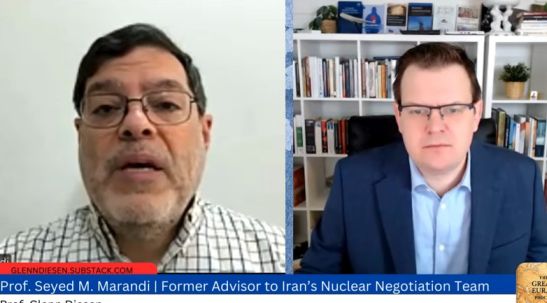
Editor’s Notes: Iran has just come under a surprise joint Israeli–U.S. attack, and in this urgent interview from Tehran, Prof. Seyed Mohammad Marandi lays out why he believes this could trigger a massive regional war that the West cannot control. Drawing on his experience as a former advisor to Iran’s nuclear negotiation team, he explains how the strikes are seen inside Iran, what kind of retaliation is being considered, and where he thinks Washington and Tel Aviv are trying to trap Tehran. He also warns how a wider conflict could devastate global energy supplies and push much of the world even further away from the United States and Israel. Finally, he argues that ordinary people worldwide now face a choice: stay passive, or actively work to contain what he calls a rogue superpower and its closest regional ally. (Feb 28, 2026)
TRANSCRIPT:
Introduction
GLENN DIESEN: Welcome back to the program. Today we are joined by Seyed Mohammad Marandi, a professor at Tehran University and also former advisor to Iran’s nuclear negotiation team. Thank you for coming on.
We see that the Israeli media reports as well as American media that within the last hour that they began attacking Iran in what they called a, quote, “preemptive strike.” And we now see explosions heard in Tehran, and if I’m not mistaken, they’re also now happening in other cities. I was wondering if you can tell us what’s happening there on the ground.
The Attack Begins: U.S. and Israel Strike Iran
SEYED M. MARANDI: Well, as we all believed, the United States and Israeli regime are completely dishonest and deceptive. And we’ve already seen that an infinite amount of time. An infinite amount of time goes to four. And we saw it during the 12 day war as we were negotiating between rounds five and six of talks, the Israeli regime and Trump. The Trump regime carried out a blitzkrieg attack against the Iranian people.
And during this period, people have been expecting that such an attack would take place. Iranians, of course, negotiated, as you and I have discussed before, both to see if a solution was possible, but also so that the international community and its own people would all feel and understand very clearly that it is not the Iranian side that’s seeking death and destruction and murder. And the talks, by all accounts, were making progress. The Omani foreign minister did an interview in the United States and spoke of optimism and progress.
Yet the Epstein class was unhappy. And they are not seeking peace between Iran and the United States or peace in our region, as the US Ambassador, I can’t say admitted. He basically openly said, and no one has condemned him or punished him in the US Government, that if the Israeli regime takes the entire region, that’s fine with the United States.
So when we have this mentality among Americans, among American officials, and when they constantly attack while they are negotiating, then the Iranians have no option but to strike back and strike back very hard. Now, I do not know, as at this moment that we speak, what role the United States is playing in this attack, if its own missiles are being used or if its own jets are being used. But without a doubt, the Iranian response against the Israeli regime will be very harsh. And people have been murdered today in Tehran and in other cities.
This is an unprovoked war. But the Iranians, as we saw when they were far less prepared eight months ago, they struck back. And ultimately it was the Netanyahu regime that sought a ceasefire. So I have no doubt that Iran will strike back and strike back hard with success.
Today the question is, what is the United States going to do? Has it played a role? I don’t know yet. Will it play a role? Because you and I both know that the Americans apparently have been seen since they have no excuse to carry out this unprovoked war, they are trying to find a scenario where the Israelis would attack. And so that would give them an excuse to attack. Now what excuse is that give them? I have no idea. Because that would be aggression. And joining in on aggression does not enhance the logic of war or enhance the logic of a just war. They enhance the or created justification for war. It is pure ugly aggression.
And it comes at a time, Glenn, when we see that in the United States for the first time, the Israeli regime has less sympathy among Americans than the Palestinians. And I think this is significant. The regime sees that time is not on its side. It sees that the world has turned against it. And even the American people who are the most propagandized people in the world, they are seeing through the propaganda, they’re seeing through the censorship of social media and the one sided propaganda of mainstream media. And that is not good news for the regime at all. So I think they are behaving in a very desperate manner.
How Will Iran Retaliate?
GLENN DIESEN: Well, in regards to the US not having a good reason, Politico had recently an article come out where they made this point that there was, well, many people in Washington, according to Politico, believed it was better for Israel to attack Iran first because then when Iran retaliates, the US then has the reason to join in on the war under the guise of defending Israel, thus not being an aggressor.
But this kind of begs the question of how do you — I know, and you’re not part of the Iranian government — but how do you expect Iran to retaliate here? Will it then strike Israel and then wait to be attacked again by the United States? Or do you think the Iranian government will not consider Israel and the United States to be two separate actors in this war?
SEYED M.
MARANDI: I don’t know because it depends on what happened. So there’s no doubt that Iran will strike the Israeli regime. That will happen shortly. Maybe happening as we speak right now, I don’t know.
But with regards to the United States, I think we’ll have to see what role the United States played. Now maybe the United States is saying this was a joint operation to provoke Iran. We don’t know. Maybe it was just the Israelis and Americans are saying we are in on it too. Or the Israelis are saying we were a part of it too. So that would make the Iranians strike the Americans and then the Americans would say the Iranians attacked us. We don’t know what games they’re playing yet. Maybe right now the commanders and the leaders of the country have figured it out. But speaking to you now, I don’t know.
So what is for certain is that Iran will punish the Israeli regime. What is unclear is what role the United States has so far played. Maybe they have played a role, maybe they’re pretending that they played a role to provoke Iran. It’s unclear. But what is clear is that the United States, that the Epstein regime, the Zionists that control so much of the United States, they want to join in on this. So we have to be very careful about what they mean. When this was a joint operation, it may have actually been an Israeli regime operation. But the Americans want to deceive Iran into striking American targets. Nothing is clear for the moment, but I think during the next few hours things will become much clearer.
What Targets Have Been Hit?
GLENN DIESEN: What do we know so far though in terms of what the Israelis have hit? Because it began with some news stories coming out that they hit Tehran, but then from what I understand, other Iranian cities have been hit as well. So do we know about the targets? Are these military infrastructure, political?
SEYED M. MARANDI: It’s unclear yet to me again because I’m sitting here with you and I’m not following up on the news that much. What I’ve seen on the Internet is that they’ve struck the Ministry of Intelligence, the Guards, possibly the leader’s office, maybe the President’s office. That’s not clear to me.
But the Iranians have been taking precautions and while they cannot completely shut down government and business as usual has to go on, it is not like it was eight months ago. So the Iranians are far less vulnerable, comparatively speaking. But at the end of the day, this is a blitzkrieg attack. When you have a blitzkrieg attack, you’re going to have casualties, you’re going to have innocent people murdered, you’re going to have government officials murdered. But I don’t think this is going to play out well for the Israeli regime at all. It’s going to be worse than the 12 Day War for them.
The big question of course is what is the United States going to do? Iran is prepared for war with the United States and we’ve discussed this earlier, but if there is war with the United States, it’s going to bring down the global economy and the Iranians are going to fight for their survival. And so people across the world have to recognize that whatever happens, it is the fault of the Trump regime, the Epstein class, the Netanyahu regime. And I think this is going to mobilize the world against the United States and the Israeli regime further.
The United States is a rogue regime. It’s strangling the people of Cuba as we speak. And US media is quiet about it because they’re all captured, they’re owned by the Epstein class. We see that the people of Venezuela are being forced to carry out policies dictated by Washington. We see that the United States ambassador is basically saying Israel can take whatever it wants in the region. And he’s not rebuked, he’s not removed, and what he says is not rejected by Washington. Why? Because that is unofficial policy. It’s not official policy, but it’s unofficial policy.
Iran’s Dilemma: Fight Israel Alone or Both?
GLENN DIESEN: Well, is it possible — I’ve seen the argument as well that Israel would attack to then provoke an Iranian attack on American forces and then that would pull in the United States. This is of course premised on the idea that the Americans aren’t aware of what the Israelis are doing. But it does put Iran in a dilemma, though, because on one hand, it will be easier just to fight initially the Israelis, but it seems very unlikely that Americans will sit this one out. So then it also loses the benefit of, I guess, not waiting to be hit first. Do you know if there’s been any — what are the policies or expectations for what Iran could do?
SEYED M. MARANDI: I don’t think there’s any dilemma at all. The Israeli regime has attacked. We will punish it. If the United States attacks, we will punish it too.
The question that I have — and this is just a personal question, maybe this is not a question for those who are in charge right now, they know exactly what’s going on — when the Israeli regime and people in media are quoting American officials that this was a joint attack, maybe what they’re trying to do is to provoke Iran to carry out an attack on the United States, thinking that this is a joint attack. That’s just my personal guess. But I think Iran’s policy is quite clear. Iran will strike the Israeli regime very hard. If the United States attacks, it’s going to be all out war.
Limited Strike or All-Out War?
GLENN DIESEN: In terms of the scope of this, do you think — given that the missiles are, well, I wouldn’t say they’re coming in slow, but do you think this is something that the Israelis might try and Americans might try to sell as a limited attack? You and I discussed this before, that they would prefer a limited attack just to hit Iran a little bit and then tell the Iranians, “Okay, we’re done. Now if you don’t retaliate.” Do you think that’s what they might be going for here, given that the US and Israelis didn’t come in with everything they have right away in a massive attack? Or if so, how do you expect Iran to respond? Do you think there’s any appetite to accept this limited attack?
SEYED M. MARANDI: If it’s just an Israeli attack, Iran will punish it thoroughly and pound it until it is beaten so badly that it begs for a ceasefire. That’s scenario A.
Scenario B, if the United States attacks Iran, then the Iranians said this is going to be a regional war, it’s going to be an all out war. So my assumption is that the Iranians are not going to play that sort of game and they will strike back very hard. And the Iranians have amassed a very powerful capability to do so. Remember, this is a war for Iran’s survival. If the United States attacks, it will be a war for Iran’s survival. For the United States it’ll be a war of choice — to help the genocidal monsters in Tel Aviv, to help ethnosupremacists, to help Israeli expansionism. That’s what it is for the Americans. Despite the fact that its own people don’t want the war and despite the fact that its own people are increasingly coming to despise the Israeli regime.
But for Iran this will be a war of survival. So it will hit back hard. But again, we’re talking about scenarios and maybe as you and I are speaking, this is being played out, I don’t know. But so far as we speak, the strike has come from Israel. They claim it’s a joint strike, but it seems to be coming from Israel. So Iran will respond to Israel. If it is indeed a joint attack, then Iran will respond to the United States and we will have a regional war. But it could be that this is an Israeli attack and Americans want to label it as American in order to provoke Iran.
U.S.-Israeli Joint Strike? Confusion in Early Reports
GLENN DIESEN: Yeah, I’ve seen in the Israeli media, Jerusalem Post, they refer to this as a US-Israeli strike. But again, as you said, it’s unclear in the earliest stages if this is just to get the Iranians to launch an attack on America. So it becomes — yeah, it’s a digressor.
SEYED M. MARANDI: But by the way, Glenn, after the show remind me to give you a couple of phone numbers just in case something happens in the days ahead. So you’ll have people to contact.
Regional Escalation and Evacuations
GLENN DIESEN: I will do. And well, many countries announced only yesterday that they have to evacuate immediately from Iran, Israel. Some also extended this to other parts of the region. I guess this is obviously also predicting the retaliation which would come. So if it turns out now that the United States, as Israeli media reports, joined in on this attack on Iran, what do you see happening in — well, not in the days coming, but
The Risk of Regional War and Iran’s Response
SEYED M. MARANDI: Today, essentially, if the United States attacks, I think that we’ll have regional war. If I was in the Persian Gulf region, I would leave immediately if it’s still possible. I don’t think that it’s smart for anyone to stay, or even in Iraq for Westerners to stay in Iraq. I think they should all leave.
But if the US attacks, I think Iran will shut down oil and gas from the Persian Gulf. Iran will strike at American targets and anything that has to do with U.S. interests. In other words, that’s a very vague position for Iran to take. It could mean anything. I assume it will depend on US targeting as well. How the United States, assuming the United States attacks Iran, the types of targets Iran chooses will depend on US targeting.
I don’t know these things, but what I do know is that if we have all-out war, if the United States attacks Iran, it’s all-out war. It will be regional war and the Strait of Hormuz will be shut down. Iran will do whatever it
GLENN DIESEN: needs
SEYED M. MARANDI: to survive this war. And all those countries in the Persian Gulf region that host US bases, they’re all complicit. Or in the Caucasus, they’re all complicit in this war. They were part of this war. They can’t have their cake and eat it too.
The Jordanian regime — it’s quite stunning that all these countries in the region, even as the US Ambassador says that it’s fine with the United States for the Israeli regime to take Jordan, Syria and parts of Saudi Arabia and Egypt — that these regimes continue to be so complicit with the United States, and of course Turkey continuing to transport oil from Baku to Netanyahu.
The Dilemma of a US Attack on Iran
GLENN DIESEN: Well, I guess the dilemma for the United States in engaging in such an attack on a large country as Iran is it needs a lot of military resources. I think they have like a hundred aerial refuelers simply because their fighters and bombers can’t reach Iran without them. But with all this military hardware in the region, it also presents Iran with a lot of different targets. So it becomes very difficult for the US, especially due to reports of them having limited air defenses because, you know, they’re also fighting in Ukraine and, well, they’re fighting everywhere now.
So how do you see the priorities for Iran? Do they have this set out — any targets they want to go for first? I mean, the Gulf states, obviously there’s been a lot of tension — Bahrain, Iran, United Arab Emirates. Again, the Iranian military command is probably not whispering into your ear, but you know, as an Iranian there in Tehran, knee deep in these issues, how do you see the likely outcome? Or do you think Iran will just launch at everything at once?
Iran’s Likely Targets and the Consequences for Global Energy
SEYED M. MARANDI: Well, again, I’m just guessing. If this is the Israelis alone, then Iran will focus on battering the regime. But if the United States gets involved, then Iran will do whatever it takes to make sure that the Americans regret attacking Iran. So I would imagine that striking empty bases would not be a priority. They would strike places where it would hurt the most — the maximum suffering.
And since all these regimes have been completely complicit, from Qatar to the Emirates — even though these two countries hate each other, they’re both American proxies. Qatar was never a supporter of the Palestinian people. Either is Erdogan or anyone else. We see how they’re all in the US camp. So Qatar, just like the Emirates, is a possible target, depending on what happens.
I don’t want to say anything right now because I don’t know what’s happening. I don’t know what the involvement of the United States is and how things will play out. But if there’s all-out war, all I can say is it will be a regional war. Iran’s allies across the region, which are powerful and many, they will engage. The Iranian missile and drone capabilities are second to none in this region by far. They will engage.
And there are so many soft targets that the United States cannot defend that can easily be destroyed. You have oil and gas installations everywhere. You have tankers and ships everywhere, and each one of these that are destroyed — shutting the Strait of Hormuz, that’s one thing. But if the assets in the Persian Gulf region are destroyed, the oil and gas and the tankers, then even if the Strait of Hormuz is open, it could take years, depending on how long the war goes and how widespread the damage is, for the oil to be exported like it was before. And that would create very, very long-term damage and misery for people across the globe.
From the Persian Gulf region, from West Asia and the Caucasus combined — if I’m not mistaken, almost 25% of the world’s oil comes from this area. Imagine what that will do to the markets. Imagine what that will do to industries. Imagine what that will do to companies, corporations, people at home, ordinary people. It will have a devastating effect from the southern tip of the Americas to the southern tip of Africa, to New Zealand. Everyone will be affected, and this will be the doing of the United States.
But until it becomes clear to me what role the United States is truly playing, I really can’t say much more. Because again, the claim that this is a joint operation sounds very satanic to me. It sounds to me — and I may be wrong — that the Israeli regime is carrying out this attack and they’re saying it’s a joint operation so that the Iranians will attack or hit something that’s American. And then the Americans can say, “Oh, they struck our target, so we’re part of this war now.” That’s basically what I think is happening.
But we have to keep this in mind, Glenn — the Omani foreign minister went to the United States and was upbeat about the negotiations and explained to people across the world what was happening and how progress had been made. And yet, despite that, just like during the 12-Day War, the United States gave the green light. That part is obvious. But the Israeli regime carried out this blitzkrieg attack.
The Logic of Justification and the Threat to Global Order
GLENN DIESEN: I think it’s a very reasonable hypothesis because obviously the United States has assisted. It’s unthinkable otherwise. But this could be a much more powerful strike if the US would be more directly involved with all its assets in the region. So the only reason one can think of why they wouldn’t — why they would only assist but not be very directly involved — is for the optics here. As I mentioned before, Politico mentioned it’s better to have Iran attack, Israel attack first, and then the US simply helping, you know, Israel’s right to exist, or these kind of narratives. But just my last—
SEYED M. MARANDI: But it doesn’t really — I mean, if anyone is sane and reasonable and logical, it doesn’t help the case. To say that, “Okay, if the Israeli regime attacks and then we attack, that will give us a justification” — it doesn’t. It actually does the opposite, because in a sane world, the aggressor would be condemned and marginalized. But they want to join in, saying that this is their justification. It’s the exact opposite. But that’s how logic works for the Epstein class.
And that is why the United States has become a threat to the world. It’s not just Iran, it’s not just Cuba, it’s everyone. All the rules have been cast aside. The United States expects Russia, China, Iran, BRICS, everyone across the world to abide by the rules. Yet they are openly and explicitly now above the law.
And that is why governments and ordinary people, from top to bottom, they have a role to play. People have to protest. People have to boycott everything American — in the markets, supermarkets, anything. Governments have to seek solutions that marginalize the United States.
Iran will play its part. If the United States attacks, Iran will hit back hard. It will be bloody, it will be brutal, it will be painful. People like me may not survive. But this is the only thing that you can do. The United States must be forced to back down. Otherwise, if the United States succeeds, there will be nothing stopping this madness.
Iran’s Regional and International Support
GLENN DIESEN: Well, as a last question, what do you see as being external support? Because Iran doesn’t stand alone either. On one level it has regional allies in Yemen, Iraq, Lebanon, Palestine. In a more global scope, it also has at least indirect support from the great powers — be it China, Russia — in terms of intelligence, possibly targeting, weapons, air defenses, these kind of things. What do you expect to see based on how this war is starting?
SEYED M. MARANDI: Could you ask the question one more time?
GLENN DIESEN: Well, what to expect to see from international support on Iran’s side? Both from the regional allies — from Yemen to Palestine, Lebanon — but also from the great powers, that is China and Russia.
SEYED M. MARANDI: Well, again, if it’s the Israeli regime, I think that for Iran, beating them back and punishing them and bringing them to their knees can be done without any intervention from any other side. Again, this is my personal understanding.
But if the United States gets involved, then all of Iran’s allies will be at war. It will be a regional war. It won’t be like an RPG attack somewhere. It will be all-out war — from Yemen, which has been preparing itself, to Iraq, where Iran’s allies have been preparing themselves, and so on. So this will be something very big and something that the US cannot manage because there are just too many people involved. Iraq is a huge country. Yemen is a huge country. The United States already lost a seven-week war to Yemen. And Yemen has now been preparing itself for the next stage.
The United States’ resources are divided in different places right now — there’s Iran, there’s resistance in Iraq, there’s Yemen, and there are others in the axis of resistance. So this will not be something that the US can manage.
And I think that the international community — I don’t know how it will play out — but I think it’s only going to make countries across the global majority tilt away from the United States, move away from the United States, because the United States is becoming increasingly dangerous. It’s truly a rogue regime.
And I think the hatred for the Israeli regime is going to just increase. I think today was another turning point where people across the world are seeing this rogue regime once again trying to slaughter people, trying to destroy attempts to bring about peace and stability, because that is the nature of the regime, and people are seeing it.
This is not the first time. They had a ceasefire in Lebanon — every day they’re murdering Lebanese citizens. They have a ceasefire in Gaza — every day they’re murdering multiple people in Gaza. They are expanding their presence in the West Bank, murdering people, stealing their homes and lands. And they attack Iran as the US and Iran were talking, and they do it once again as the US and Iran are talking and as the Omani mediators were saying that things are moving forward. Well, this is not going to end well for the Israeli regime.
The Gray Zone: Gulf States, Airspace, and Complicity
GLENN DIESEN: Sorry, a last very short question. Often you see countries want to operate in the gray zone — that is, they don’t want to be either attacking or not attacking. So for example, what does the US involvement mean, as well as the Gulf states? Because once Iran begins to retaliate against Israel, it seems very predictable that the US will help to intercept whatever Iran launches back, and in doing so they will also use the airspace of Gulf states to intercept this. In other words, then they’re participating — indirectly, directly, whatever one wants to define this as.
But how do you expect Iran to see this kind of involvement? Because that’s kind of operating in that gray space where, I guess, it allows for portraying Iran — whatever it does — as either being aggressive or weak.
SEYED M. MARANDI: You’re right, that is a gray zone. Turkey’s airspace is being used with AWACS. The US bases in Turkey are being used against Iran. The same is true in the Persian Gulf, in Jordan — they’re all being mobilized against Iran. All of these countries are complicit.
But we’ll have to see what the Iranians decide. Last time around, the Iranians focused on the Israeli regime. And despite US attempts, Iran was able to devastate the regime and force it to a ceasefire. I can’t comment on this right now because I really don’t know. But obviously any sort of cooperation by countries in the Persian Gulf region in particular, or in the Caucasus, is going to be treated differently this time around than last time. But it’s too early for me to say, and since I’m not a government official, I don’t want to say something that may be inaccurate.
GLENN DIESEN: Well, thank you for taking the time. I know things are quite chaotic and stressful there in Tehran this morning. So yes, stay safe. And let’s hope this does not get out of control.
SEYED M. MARANDI: Hopefully the Israeli regime will be defeated. But more importantly, people across the world have to start acting instead of passively. They have to be much more active.
Related Posts