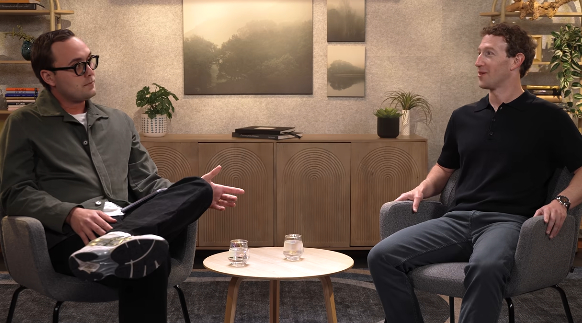
EDITOR’S NOTE: In this episode of the Sources podcast, host Alex Heath sits down with Meta CEO Mark Zuckerberg to discuss the launch of Meta’s Muse personal AI agent and the recently published manifesto outlining Meta’s vision for AI. Zuckerberg shares his views on open source, the distribution of AI technology, and why he believes putting powerful tools in the hands of individuals — not just a handful of labs — is the key to a safe and prosperous future. This interview episode was premiered September 9, 2026.
TRANSCRIPT:
Opening: Calling Through the Glasses
ALEX HEATH (00:00:00 – 00:00:06): Mark, last time we spoke, you called me, it was on the weekend. Well, you called me through the glasses, which was the interesting part.
MARK ZUCKERBERG (00:00:06 – 00:00:07): Was it loud in the background?
ALEX HEATH (00:00:07 – 00:00:13): You were going to fish. I wasn’t going to say it, but yeah, it was on the weekend. The noise cancellation actually is pretty good.
MARK ZUCKERBERG (00:00:13 – 00:00:14): Oh, it’s great.
ALEX HEATH (00:00:14 – 00:00:14): Yeah, it’s pretty good.
MARK ZUCKERBERG (00:00:14 – 00:00:16): Yeah, I mean, yeah.
The Manifesto: Why Write It?
ALEX HEATH (00:00:16 – 00:00:37): But you wanted to talk about this essay manifesto. I don’t know what you call it. Manifesto, we’ll say, that you published recently. And it’s long. I mean, I’ll caveat that there’s a lot in it. And I wanted to start there ’cause there’s a lot of big ideas in there and they’ll connect to kind of the main thing we’re talking about today. I’m curious, why write that? Because it’s long. There’s a lot in there.
MARK ZUCKERBERG (00:00:37 – 00:04:02): Well, yeah. Well, I feel like if you’re going to invest so much in building AI, then it’s important that people understand what your lab stands for and what your values are. And basically, AI has so many opportunities, but there are also all these real risks. So I think it’s very important that everyone who’s working on it has a well-thought-out theory for how the work that they’re going to do is going to lead to a positive future.
It’s interesting because, I mean, the different labs have some different philosophies on this. And there’s a lot of things that I think have become conventional wisdom in the industry that I just strongly disagree with. And my view on this is that the path to have a positive future for everyone is to make sure that we distribute the technology as widely as possible.
And that’s based on 3 major principles that we have. One is that empowering people is the source of prosperity in the world, and it has been throughout history. 2 is that the primary purpose for AI is going to be invention of new things, not automation. And then the 3rd principle is that the foundation for safety for the future is basically establishing the right checks and balances and balance of power rather than restricting access.
And I think that these are all things that I think oddly are kind of very different from, I think, a lot of the conventional wisdom, especially in Silicon Valley. A lot of people think, hey, this technology is very powerful, we must restrict it so that way not that many people have access to it. I personally am much more worried about a small number of labs or people having control of something that is so capable.
And I think that throughout history, what we’ve found is that when you put power in people’s hands, most advances don’t come from the incumbents or the establishment. They come from people on the periphery whose ideas aren’t taken seriously. But when they get enough tools to basically be able to prove out what they’re working on, that ends up being very powerful.
In Western society, the way that we’ve established governance and basically having a well-balanced society is through a set of checks and balances, right, and this balance of power. It’s very ingrained in kind of our society that you don’t want to have one lab or two labs having access to a thing.
For some of the most recent concerns that have come up, like some of these cybersecurity concerns, I think the best antidote to someone having an AI that could potentially hack into systems is having everyone have access to an AI so they can harden their own systems first. And I think that that’s kind of been the history of cybersecurity over the past several decades is that, you know, open source software, because people can see it and can scrutinize it, it’s sort of counterintuitively by putting it in people’s hands, you end up with a more secure and more stable environment.
So that’s what I believe. And that’s what I think is the path to a positive future, is basically distributing the technology. That has a bunch of different implications for what we’re going to do. I mean, obviously we want to build leading AI models, which we’re doing. I mean, Muse Spark 1.3, which we just released, is advanced, but then, you know, it’s actually the latest model of a relatively smaller pre-train that we did, the internal codename Avocado.
Muse Spark, Avocado, and Watermelon
ALEX HEATH (00:04:03 – 00:04:04): Oh, we’re going to get into the code.
MARK ZUCKERBERG (00:04:04 – 00:04:47): Oh yeah, so we’ll get into that. And we have Watermelon coming soon. So that’s going to be a big deal. So obviously, leading models, probably the biggest personification of, you know, if you will, or kind of implementation of this vision is the Muse personal agent that we’re rolling out. That basically the idea there is give every person in the world a very capable personal agent that can understand their goals and can just work on their behalf 24/7. And then an important part of this is also is just getting the technology in people’s hands.
Open Source as a Counter to Concentration of Power
ALEX HEATH (00:05:43 – 00:09:10): I have a bunch of questions about the Muse agent, but staying big picture for a second, ’cause you said a lot of things there. Is open source the counter to the trend you’re seeing that you described that you’re worried about? Is that the main way practically that you counter that, or is it regulation? Is it both?
MARK ZUCKERBERG (00:05:43 – 00:08:34): No, I actually think probably the most important thing is actually just getting the technology in individuals’ hands. So I actually think things like the Muse personal agent are perhaps even more important. I mean, I think what you’re starting to see are some of the labs are building, training more advanced models, and then not even releasing them. So I think that that is quite dangerous in the sense that, you know, basically when you have scrutiny on something, when you put a system out there, first of all, if you put it in a lot of people’s hands, you get the checks and balances, you get broad-based prosperity, which I think is important, right, for society.
We can’t just have like one or two labs get incredibly valuable. You know, I think you want to make it so that billions of people can basically have prosperity in their own lives, whether it’s creating small businesses, being more successful in their careers, being more productive in managing their homes, saving money in a lot of ways, kind of advancing their health. So I think you want the benefits to be very broad-based. So that’s one piece.
In terms of the competition, I do think that having multiple labs is helpful, and I think open source is quite helpful for that. So I think open source is an important part of it. The nature of open source is there’s a whole community of people who do it. So I’m not saying that we’re going to be the one company that does it. I’m also not a zealot about this from the perspective of it’s not that everything we do is open source either. We release some open models. We do some closed work. I think it’s important if you’re building a for-profit company that you can build some advanced things and you don’t necessarily need to share every single thing with the world.
But I think in general, supporting a robust open source ecosystem is going to be key to maintaining competition and maintaining kind of transparency and understandability of where the technology is going in a way that I think is actually going to be incredibly important for safety.
If we have a world where there’s just a small number of really capable models, I don’t know, it’s interesting, right? I mean, if you look at some of the cyber stuff, for example, the instinct, which, I mean, on the one hand, I can understand the instinct of like, all right, we have this capable cyber model, let’s release it so that only, whatever it is, the top 100 institutions get it. But I think part of the issue is that there’s more than 100 important institutions in the world.
So if you look at things like the Hugging Face incident that happened, Hugging Face is maybe not one of the biggest 100 institutions in the world, but it matters, right? It’s like an important thing that people rely on. And so what did they do when they started detecting that there was this intrusion as they turned to open source models because they didn’t have access to some of the closed ones that were causing the issues?
I think that having a robust open-source ecosystem is one important part of having kind of a safe and stable future. But to me, the most important thing is just making sure that we distribute the technology widely rather than hoarding it in a small number of people’s hands.
Public Sentiment on AI and Disenfranchisement
ALEX HEATH (00:08:34 – 00:09:10): And I think there’s also this ongoing debate in Silicon Valley about why people feel so negatively about AI. I mean, you talk about this in your recent letter addressing these concerns or trying to. But I mean, the sentiment on AI and data centers in particular, it’s so negative. And it sounds like maybe an essence of your argument, correct me if I’m wrong, is if we diffuse this technology more, if we enable more people to access the things that are right now gated by some of the top labs, maybe that addresses this kind of, I think people feel maybe disenfranchised by what’s happening in AI. Is that what you’re getting at?
MARK ZUCKERBERG (00:09:10 – 00:12:39): Yeah, well, there are many layers to it. There’s so many parts of— this is why the essay was so long, right? Yeah. It was like 15 pages because, I mean, we want to get through— there are lots of different questions. I mean, people have questions about jobs and the economy. They have questions about data centers in their local communities and the kind of economic and environmental impacts of that. There are questions about how people might misuse AI, right? Yeah. I mean, there’s the cyber questions. There’s bio risks that are coming up. There are questions about how we maintain a free society. There are questions about American leadership. There are questions about maintaining control over the technology. Gets to be increasingly capable. So these are all important. So it’s important not to just talk about this in generalities at a high level, because I think each of these has some different nuances.
But in general, I think one of the things that they all have in common is that if you create broad-based prosperity, and I think that one of the better ways to do that is by ensuring that there’s the right balance of power around who has access to the technology and generally making sure that the greatest balance goes towards the kind of general population of people as opposed to kind of any kind of, I don’t know, insider stakeholder or whatever you want to call it. I think that that ends up being very important.
So if you look at the data centers, what we’ve actually found is that when a company like Meta goes into a community and makes a commitment that we’re going to invest there for decades, right? Which is really what we’re doing when we’re building up a data center. We’re able to make it so that it’s very good for the community. I mean, the kind of the tax revenue that they bring from that. I mean, in Louisiana, we had this example where like the tax revenue funded these $50,000 bonuses for teachers in the community. We bring a lot of jobs. We invest in the local community a lot. That I think can be good.
I think that there’s also a lot of speculation, right? Where there are companies that aren’t necessarily planning on running a data center for decades. They’re just, you know, trying to find a plot and then trying to sell it to one of the big labs. And they don’t really care as much about the local community and they’re not invested for the long term. So if they don’t care to, you know, focus on making it work for the local community, then of course people are going to get upset.
So I think that that’s one of the things that can be difficult when you have these kind of speculative, I don’t even know if I’d call it a bubble because that implies that it’s overvalued or something. But there’s certainly a boom, right? So you have that. I mean, that leads to some of these, like, short-term thinking incentives that don’t necessarily lead towards helping every stakeholder, which I think is kind of what you need to do to make this sustainable over the long term.
And at the end of the day, I mean, if we’re creating a technology that, like, if it doesn’t create jobs or doesn’t create broad-based prosperity or the infrastructure that we’re building doesn’t help local communities, that’s not going to be allowed to continue. So it’s like it has to, of course, you have to design it in a way that can be helpful to people in all these ways, which is also part of the reason why, like, for people who are skeptical or have so much doom about the whole thing, I mean, one of the things that I basically think is that if we don’t end up building it in a way that’s positive, it just effectively won’t be able to happen. So I kind of think, like, actually establishing the right checks and balances, and distributing the benefits of this widely is sort of a precondition for being able to scale in the way that I think would be best for society over time.
Data Centers, Long-Term Investment, and Community Impact
ALEX HEATH (00:12:39 – 00:12:54): I haven’t heard another tech CEO in your position talk about data centers that way, like the long-term investment of it. Is this something— is this how you’ve always thought about it? Is this something you feel like there’s more clarity that’s been brought to it for you recently? Like, have you always— Yeah.
MARK ZUCKERBERG (00:12:54 – 00:13:18): I mean, I think that there’s been all this anti-data center sentiment that you’re talking about. So we’ve dug into it because what we’re trying to understand is, okay, like there isn’t as much of that around our project. So why is that? And then so we ask a bunch of people, it’s like, well, it looks like there’s a pretty big dichotomy between these speculators and the companies that are focused on it for the long term. And that kind of makes sense when you think about it.
ALEX HEATH (00:13:18 – 00:13:18): Yeah.
MARK ZUCKERBERG (00:13:18 – 00:15:02): So I mean, one thing they were doing, I mean, there’s this America’s Workforce Academy project that we did, which is basically, okay, we’re going to build all these data centers. We’re going to be doing this for a while. There isn’t the volume of skilled tradespeople that you need to create this. So we need more like fiber technicians and electricians and like advanced carpentry and all of these things. And there aren’t enough people to do this. We need hundreds of thousands, you know, maybe millions of more people who can do this. And people aren’t trained to do that right now.
So we created this training program to effectively do that, where we guarantee people who get through the training program a job at a place that is working on building infrastructure for Meta. And why did we do this? I mean, it’s like, it’s not really philanthropy, right? It’s like we need those people to be skilled and have those skills. So it’s just, it’s a win-win. It’s an investment that I think makes sense if you’re in it for decades. But not necessarily something that you would do if you were building out one site with the intent of flipping it to a different company.
So I think that a lot of problems in the world do just naturally get solved by incentive alignment when you think about them over the long term. So I think that that ends up being an important part of this. And I guess part of the way that I think about this is that I just think that there’s no way that it’s going to be kind of permitted for there to be a small number of labs that control such an important and capable technology and accumulate a lot of wealth to themselves. I think it’s like, this has to be a broad-based thing in order for it to kind of be able to work. It has to work technologically, but it also has to work kind of socially. And I think that those pieces kind of have to go hand in hand.
From Personal Superintelligence to Muse
ALEX HEATH (00:15:02 – 00:15:11): I agree. Well, now we’re landing towards Muse. Before we get there, you also wrote a year ago your personal superintelligence essay, shorter one.
MARK ZUCKERBERG (00:15:11 – 00:15:16): Yeah, that was a page. I did write a one-page version of the future as well.
ALEX HEATH (00:15:16 – 00:15:16): Oh, you did? Okay.
MARK ZUCKERBERG (00:15:16 – 00:15:18): Yeah, well, I published it in the Wall Street Journal as a short guide.
ALEX HEATH (00:15:18 – 00:15:19): Oh, that’s right, that’s right, that’s right.
MARK ZUCKERBERG (00:15:19 – 00:15:20): So that was kind of—
ALEX HEATH (00:15:20 – 00:15:22): I just read the long one. Okay.
MARK ZUCKERBERG (00:15:22 – 00:15:24): Yeah, yeah, this is the 1-page version and then there’s the 15-page version.
ALEX HEATH (00:15:24 – 00:15:48): Okay, okay. Well, so this one you did about a year ago, Personal Superintelligence, I think a lot of people in my world, when they saw you write that, was like, oh wow, why is Mark writing this? Like, what is the thing he’s seeing on the other side of this? And I think it, correct me if I’m wrong, it might be Muse, like what we’re going to talk about, right? Yes, that’s right. What you guys are releasing now. Yes, this is it. This is it. So how did you come to that realization that that’s what— this is the next chapter for Meta?
MARK ZUCKERBERG (00:15:48 – 00:18:53): It’s interesting. You know, we’ve never really just thought about ourselves as a social media company. We’ve definitely thought about ourselves as a company about connecting people and about empowering people. But I think a lot of the values that led us to build the things that we built for the first, you know, 15, 20 years of the company around putting technology and power in individuals’ hands. Believing that people should be able to decide for themselves what is important in their lives.
And we’ve gone through a lot of social debates around this, right? A lot of the debates around content moderation and things like this have kind of been around this question of like, should people be allowed to kind of decide and communicate for themselves what matters in their own life? And I think through that experience, it has sort of sharpened my belief that a lot of progress throughout history and through this technological age comes from empowering individuals, and that people really do know best about what matters in their own lives.
So because of that, I have somewhat of an allergy whenever I hear people talk about, oh, we should just have a small number of experts allocate what AI does to big problems. Why should it do these things that people care about in their lives. Well, people have a balance of things they care about. People care about health. They care about having a better life, but they also care about their relationships and showing up for their friends and family, and they care about culture. People care about things that may not, to a scientist or an engineer in the industry, feel like the biggest problems.
But I don’t know, if you ask billions of people what they care about, if I think what people’s aggregate answers to that question is, kind of is what the most important things are to be worked on. And so I’ve always just kind of believed that when you build this superintelligence, there’s this question of who decides what it’s going to focus on. And I think that people should be able to direct it towards what matters in their own lives. It shouldn’t just be directed by some so-called experts sitting at a small number of labs.
So this gets back to— it’s like, this is basically the foundation of this overall philosophy, which is that the way to have a positive future is to empower people, to put the technology in their hands, and let people decide for themselves what matters and how they want to use it. And I think that when people do that, it first of all will prioritise some things that are different, right? It’s like maybe it’ll prioritize health issues, but maybe instead of prioritizing the most common things, which is kind of what the pharma and biotech industry at large prioritizes today. Now, it’s like there’s a very long tail of rare diseases and conditions that people have. So, OK, if you have a rare condition, you’re probably going to want your personal AI to focus on that, not just something else just because it happens to be the most common thing. So I think for example, rare diseases I think are disproportionately underinvested in.
Empowering Individuals: Rare Diseases, Biohub, and Personal Use
ALEX HEATH (00:18:55 – 00:18:56): You’re doing a lot of investment with your foundation.
MARK ZUCKERBERG (00:18:56 – 00:20:33): We’re doing that at Biohub. But I mean, and that’s partially informed some of my views here that I think like, yeah, like you want to put the power in individuals’ hands to determine what matters for them. But a lot of this is also like, it’s not necessarily the things that people would say are like the big social problems.
A lot of it for me, when I’m using my Muse agent, I just kind of want it to help me be a better father and a better husband and show up better for my friends and be able to help me connect with people. And that, I think, is also partially a through line between the work that we’ve done at Meta so far and this is I think we’re the company that I think just disproportionately cares about and believes that there’s social value in and helping people connect with the people around them.
So I don’t know, it’s like, one of the first things that I kind of set up my own agent to do, it’s like, all right, my 3-year-old daughter likes baking. I don’t know anything about baking, but like, that’s like a fun project that we can do. So I basically asked him, I’m like, all right, set up so that every weekend, you know, like we have a baking project that is kind of reasonable for a 3-year-old and an adult who knows nothing about baking. And use Instacart or whatever to go get all the ingredients, like just figure out what makes sense and make sure everything is ready. So that way, like when I show up on Sunday with my daughter, we can like go make this thing. And then I tell it afterwards, I’m like, how did it go? Okay, that one was too hard. Turns out cake pops, really difficult, surprisingly difficult.
ALEX HEATH (00:20:33 – 00:20:34): There’s a lot of baking— I don’t know a thing about baking.
MARK ZUCKERBERG (00:20:34 – 00:20:36): Yeah, I didn’t either. I know something now.
ALEX HEATH (00:20:36 – 00:20:37): Cake pops.
MARK ZUCKERBERG (00:20:37 – 00:20:40): Yeah, cake pops. No, no, don’t start with cake pops. That’s the problem.
ALEX HEATH (00:20:40 – 00:20:40): Okay.
MARK ZUCKERBERG (00:20:40 – 00:20:48): Yeah, no, there’s a lot of things in baking that pretty simple. It turns out cake pops is not one of them. But yeah, well, you know, what can I tell you?
ALEX HEATH (00:20:48 – 00:20:48): Okay.
In this episode of the Sources Podcast, host Alex Heath sits down with Meta CEO Mark Zuckerberg to discuss Muse, Meta’s new personal AI agent. Zuckerberg shares how he uses Muse in his own life — from securing mountain climbing permits for his daughter to getting MMA coaching feedback — and dives into the product’s business model, fleet learning, and what sets it apart in the rapidly growing AI agent landscape.
Using Muse for Personal Tasks
MARK ZUCKERBERG (00:20:48 – 00:21:21): Thank you, Muse. Yeah, yeah, thanks. So yeah, and it kind of updates that and helps with that. My older daughter has kind of gotten into climbing mountains and some of them you need permits for. So I have it basically sit and get the permits when they become available so we can climb mountains. And I was just like, pretty neat. Okay, so then we do that and it basically tells me, it’s like, “All right, I was able to get a permit for this day.” And I was like, “All right, well, I guess I’m taking that day off from work to go climb a mountain with my daughter.” So it’s kind of cool. Yeah, yeah, yeah.
ALEX HEATH (00:21:21 – 00:21:22): Right?
MARK ZUCKERBERG (00:21:22 – 00:21:36): So it does that, but it also helps keep me healthy. It helps me with my training. I put cameras up in my MMA gym and I tell it to watch the cameras and send me feedback. And it’s pretty fun. It’s good.
ALEX HEATH (00:21:36 – 00:21:36): It’s good feedback?
MARK ZUCKERBERG (00:21:37 – 00:21:54): Sometimes it’s funny feedback. It finds me in — it’s just like, “It looks like you really gave up.” And I was like, “Yeah, I did. I was really tired right there. It’s like, why is that the thing that you’re pointing out to me?” But no, it’s good. And it’s funny, the coaches laugh about it.
ALEX HEATH (00:21:54 – 00:21:59): Yeah. No, this is just what we just feel like we could tell you, but your agent’s telling you.
MARK ZUCKERBERG (00:21:59 – 00:22:00): Yeah, well, it’s — yeah, that’s good.
Testing the Limits of Muse
ALEX HEATH (00:22:00 – 00:22:22): I didn’t think about this until hearing you talk about it, but you have people that could obviously do all of this for you, but how do you use something like Muse Agent to really test the limits of how it can be helpful as an assistant, right? Like, where are you pushing it? How have you pushed it in a way that the team is like, “Oh okay, we gotta fix this?” I’m sure there are many examples.
MARK ZUCKERBERG (00:22:22 – 00:23:10): I think part of what’s interesting about it is that everyone just has such different things that they want to do with it. So in the early beta period, we handed it to a bunch of people. I gave it to someone and within a day they’re using it to help run their homeschool. And then another person within 12 hours, they’re like, “I just planned a trip.” And it’s like, it just planned this whole thing for me.
I mean, someone else I know who’s generally pretty skeptical about technology, I gave it to her and then she didn’t say anything for a few days. Then she texted me and was like, “So when you do the general release, do I get to keep my Muse agent or are you going to reset it?” I was like, “All right, this is good. This is — yeah, I think this is working well.”
ALEX HEATH (00:23:10 – 00:23:15): Everyone I know who’s been on the beta has very high things to say about it. High praise.
MARK ZUCKERBERG (00:23:15 – 00:23:16): Yeah, but people do different things with it.
What Makes Muse Different: The Agent Model Explained
ALEX HEATH (00:23:16 – 00:23:47): Yeah. And I think we should just also say what it is more plainly for people so they understand, because I think people think of AI as Meta AI or ChatGPT. It’s like back and forth prompting. The real unlock here — and this is happening in the industry more broadly, whether it’s Grok Bot, Town, Instinct — I mean, there’s many products doing this, but it’s adding a virtual machine behind the scenes where the agent can control a computer for you and log in and do things. And that’s a huge change, I think, for people who only know AI from the —
MARK ZUCKERBERG (00:23:47 – 00:24:04): Yeah, and it’s long-lived. So basically instead of the model with Meta AI or ChatGPT or Gemini or whatever you use, where you send one prompt and then it gives an answer, in this case, what you basically do is you give it projects. Or you give it goals.
ALEX HEATH (00:24:04 – 00:24:04): Yeah.
MARK ZUCKERBERG (00:24:05 – 00:24:10): And then it just works, and it works 24/7, and it doesn’t stop until it’s helped achieve the goals.
ALEX HEATH (00:24:10 – 00:24:13): Your team was telling me it “studies overnight” is what you guys call it.
MARK ZUCKERBERG (00:24:13 – 00:24:52): Oh yeah, it studies. It kind of consolidates its reflections into memory. It basically just works on projects, and it can also suggest new projects. So yeah, I mean, I play the computer game Civilization with one of my daughters, and it was like, “Hey, do you want to make a strategy guide for her?” And I was like, “Yeah, sure.” So it was like, “Okay, now that we have the strategy guide, do you want me to expand the strategy guide so it can also teach historical lessons about different civilizations?” I was like, “Yeah, sure, why not?” So it just kind of built a new tab in the app that it made. And that was very cool. So it can kind of just expand and —
ALEX HEATH (00:24:52 – 00:24:53): It’s proactive.
The Business Model: Free, Transactional, and Built for Everyone
MARK ZUCKERBERG (00:24:53 – 00:25:02): Yeah, it suggests things. I mean, one of the things that I think is interesting is that it, I think, is just going to be able to make people money and save people money.
ALEX HEATH (00:25:02 – 00:25:02): You think?
MARK ZUCKERBERG (00:25:02 – 00:25:28): Yeah. I mean, part of what’s interesting here is the economic model for how we’re pricing it. You can pay for a subscription if you want to, if you basically kind of want to have that model. But we’re also just making it so that you can get a very large amount of usage for free. I think we’re offering something — I think to start, it’s like 100 million tokens a week for free, and you get this virtual machine. So it’s a lot of kind of computer.
ALEX HEATH (00:25:28 – 00:25:30): That’s a good meme. It’s a lot of computer.
MARK ZUCKERBERG (00:25:30 – 00:25:31): It’s a lot of computer.
ALEX HEATH (00:25:31 – 00:25:31): Yeah.
MARK ZUCKERBERG (00:25:31 – 00:25:57): But the reason for why we’re doing this is we basically are confident in standing behind the fact that we think that this is going to effectively, for people who are going to use it for running a small business or making money or transactions or commerce in some way, we actually just think it’s going to make so much money for people that the business model over time that we expect is to effectively just take a very small cut of whatever the transaction is.
ALEX HEATH (00:25:57 – 00:25:59): Take rate business, small. Yeah.
MARK ZUCKERBERG (00:25:59 – 00:26:03): Yeah. And not even necessarily the person paying for it. It’ll come from the businesses that they’re working with.
ALEX HEATH (00:26:04 – 00:26:07): And you’re working with Stripe on payments. Yeah. And yeah.
MARK ZUCKERBERG (00:26:07 – 00:26:40): So my view is, we should be able to have a service that you make free for the vast, vast majority of people, which again is critical if you want to build up this future for everyone where everyone has these powerful superintelligence agents. I think an important part of making something available to everyone is making it affordable. So we want to make it so that this is free. So there’s just this huge amount of usage that you get. And we’re basically just standing behind that and saying, we think that this thing is actually going to make you money and save you money. And that is how it’s going to pay for itself.
ALEX HEATH (00:26:41 – 00:26:48): And Meta’s services can connect into it, right? So you could theoretically manage your ad spend on Instagram. Yeah, so. All that stuff.
MARK ZUCKERBERG (00:26:48 – 00:26:49): Well, you have to — you connect it.
ALEX HEATH (00:26:49 – 00:26:50): Yeah.
MARK ZUCKERBERG (00:26:50 – 00:27:21): You can connect it to whatever you want. It does work with Meta’s services if you want. I mean, you obviously don’t have to connect it if you don’t want to. Sorry, if you’re using it to run a business, it can basically just connect to our ad systems. I mean, you can ask it to make something for you. It can kind of help you make the product, and then it can help run the business. So all this stuff, and it could just do that in a loop and just do it forever, 24/7. And every time we release a new model — which we’ve been on this cadence of shipping a meaningful update like every month —
ALEX HEATH (00:27:21 – 00:27:21): Yeah.
MARK ZUCKERBERG (00:27:21 – 00:27:25): It’s just going to get smarter or just get more capable and able to do more and more stuff.
Fleet Learning: A New Kind of Network Effect
ALEX HEATH (00:27:26 – 00:27:33): And something your team was telling me that I haven’t heard this approach used elsewhere is this fleet concept where you’re letting the fleet of Muse agents learn together.
MARK ZUCKERBERG (00:27:33 – 00:28:43): Yeah. So that was the ideas and suggestions thing. So you open up the app, the main tab is basically your chat with your Muse. There’s a tab for basically ideas — from the things that you’ve told it, how it can expand those. So that’s the thing that I was saying, which is, first it helped make the strategy guide for playing Civilization with my daughter, then it helped expand that into historical lessons. That was — it came up with that idea. And then I was just like, “Yeah, sure, do it.” Then it finds all these ways to basically augment itself. I mean, the MMA coaching thing, it comes up with ideas for how to make it better. It’s like, “Would you like me to get better at finding the right frame to send to you?” It’s like, “Yeah, go do that.”
So yeah, the ideas thing I think is important, because then you basically across the fleet can find people who are interested in different things. I guess taking a step back, one of the big issues that I think exists with AI is a lot of people don’t know what to do with it. So I think if the agent can itself help you suggest things that it can do to be helpful for you, then that solves a huge part of this problem of making it so that you can get the most out of it.
ALEX HEATH (00:28:43 – 00:29:00): When you’re introducing network effect learning for agents, which no one’s really done, where basically the agents are learning anonymized insights from the rest of the fleet — and I mean, you’re like the king of network effects. I’m really interested in this idea because I don’t think anyone’s doing this.
MARK ZUCKERBERG (00:29:00 – 00:29:35): Yeah, no, I think that right now, most of the industry is thinking about agents as a single-player game where it’s like you have your agent and you use it. And there are going to be all these interesting things that basically you can do by having the agents interact with each other. And we already have all these interesting examples internally where people have their agents interacting with each other. This isn’t, for the most part, rolling out in this release, but it’s going to be an important part of how I think this works over time — just as more of the people who you know start using Muse, it just gets better faster.
ALEX HEATH (00:29:35 – 00:29:50): It gets better. And is that the differentiator as, you know, the idea models continue to commodify at the frontier essentially, or the products all start to look similar, similar kinds of harnesses? Is the network effects of that learning the real edge?
Privacy, Security, and the Confidential VM
MARK ZUCKERBERG (00:29:50 – 00:32:12): Well, I think that there’s a few things that are kind of unique that we’re doing. One is we’re designing the models from the ground up to basically be good for this use case, which I think really matters. 2 is basically, I do think we have this social DNA as a company. We’re helping people use the AI and agent to enhance their relationships and strengthen your relationships and get more out of the soft but very important parts of your life. I think that that’s something that we’re probably just going to be more attentive to as a company than any of the other labs.
The 3rd thing that I would say is, actually going to be a major differentiator for us that I think it might be surprising to some people is privacy and security. And we’re investing in this just a huge, huge amount. Part of the view that we have on this is that in order for this to be useful, it needs to not just have state-of-the-art intelligence, it needs to really understand you, right? So in order to be able to understand your goals, you end up connecting it to all this stuff, right? You talked about connecting it to your ad system, but people connect it to messaging and email and all this stuff, health information, whatever. And in order to do that, people need to have a very high degree of confidence in the system.
Now, the good news here is that Meta has spent at this point more than 10 years focusing on building WhatsApp into, I think, it is the largest global end-to-end encrypted system. And we’ve designed it in a way where even Meta can’t see the messages that people send. And that’s been this just really transformative thing. I think it makes it so that people trust WhatsApp. It’s also been a very important lesson for Meta to learn that that has been really important to our success with WhatsApp, that we’ve designed the systems that even we can’t see the content.
That means that whatever people are worried about, if they’re worried about government getting access to it, a hacker getting access to it, someone at Meta doing something bad with it that they don’t want, all that stuff you can kind of take off the table if you design the system so that you can’t see it. So we took that as one of the foundational lessons. When we were getting started with this, Nat and I actually personally recruited Moxie Marlinspike.
ALEX HEATH (00:32:12 – 00:32:13): Founder of Signal. Yeah.
MARK ZUCKERBERG (00:32:13 – 00:32:36): And one of the people who helped us build the WhatsApp end-to-end encryption back in the day, back in 2014, he joined to specifically work on this Confidential VM project, which makes it so that you can have your virtual machine and have all this information in your Muse, and we can make the commitment that even Meta cannot see the content that is in there.
ALEX HEATH (00:32:36 – 00:32:42): And you can do this technically. Like, it’s like an incredible — the commitment can be technically verified.
MARK ZUCKERBERG (00:32:42 – 00:32:51): Yeah. So that, and that’s something that we’re going to publish more about in the coming weeks, as we basically get closer to rolling this out a lot more widely.
ALEX HEATH (00:32:52 – 00:32:58): And out of all these early VM efforts that these labs are doing with these agents, you think this is unique what you’re doing? You, it’s—
MARK ZUCKERBERG (00:32:58 – 00:32:59): I don’t think anyone is doing it.
ALEX HEATH (00:32:59 – 00:32:59): I don’t think anyone’s doing it.
MARK ZUCKERBERG (00:32:59 – 00:33:14): I mean, yeah, I think that there’s — I mean, there’s a lot of other security measures that we’re putting in place that I think are — we should talk through. Because even before this is ready, there’s that. And even people who don’t want to use this, it’s incredibly secure because we focused on this from the beginning.
ALEX HEATH (00:33:15 – 00:33:19): But there’s also the auto-approve — you have to see what it’s doing.
Sentinel Agents, Least Privilege, and Secure Credentials
MARK ZUCKERBERG (00:33:19 – 00:34:04): So let’s get into all that stuff in a second. But I’m not aware of anyone having anything close to the Confidential VM system that Muse has. And it’s just, I think it’s a very fundamental thing because you want to know that this is your agent. And that if you put content in there, that basically you can trust that no one else is going to get access to it.
So what are the 2 ways to do it? Well, a lot of people earlier in the year when stuff like OpenClaw came out, they started getting Mac Studios. And yeah, one way to feel good about it is, well, you literally physically have your device running in your home. But the other way to do it is you build a — and that’s going to be tricky because I don’t think there are going to be billions of people who are going to buy a Mac Studio and configure it and run it at their home.
ALEX HEATH (00:34:04 – 00:34:06): Especially with RAM prices right now.
MARK ZUCKERBERG (00:34:06 – 00:34:40): And yeah, but it’s also just technically difficult, right? I mean, part of what we were trying to do with Muse is build a version of that personal agent experience that just works, that I can give to everyone in my family of various levels of technical literacy. And it just works. And then within a day, it’s doing kind of all the stuff that they want in their life. So part of that is you don’t want someone to have to set up their own computer or VM. You just kind of want to be able to provision it in the cloud. But you want it to have the security and confidentiality that you’d have if you had the box sitting under your desk in your house.
ALEX HEATH (00:34:40 – 00:34:40): Sure.
MARK ZUCKERBERG (00:34:41 – 00:34:58): So I think that’s a very fundamental thing. Like you said, there’s other pieces too, because not everyone is going to use that. I mean, we built a secure credential store, right? There’s no reason for you to just store out in the open all your credit card and your passwords.
ALEX HEATH (00:34:58 – 00:35:00): It creates one-time card numbers.
MARK ZUCKERBERG (00:35:00 – 00:36:41): Yeah. So your agent shouldn’t know that stuff. It should just be able to kind of access it when it needs to, because you’ve asked it to log into a thing, and not otherwise.
It’s actually not a single thing. You have your kind of core agent, but we also built all these Sentinel agents that basically monitor the incoming and outgoing traffic and data that your agent is sending for the purpose of flagging to you when you might want to review something. So that’s all that the Sentinels do — they effectively kind of look at, they try to see if someone’s trying to do a prompt injection. They look at, okay, did your Muse agent share something that is kind of going out that is not something that you might be comfortable with? If so, then the Sentinel agent is basically empowered to trigger this human-in-the-loop review.
So if you’re going to log into something, if you’re going to do a payment, if you’re going to transfer kind of sensitive information, you basically each time need to approve it. And you can tell it, “I’m good with stuff like this in general, always allow this kind of thing.” But in general, the Muse agent can’t kind of make those judgements itself. And that’s built into the system and the architecture in a pretty deep way.
And then even when we do things like all the connectors — you connect it to your email — I think some people when they’ve designed this, they just kind of make it so, okay, you connect and now you have access to everything. But the approach that we’ve taken is, all right, if you connect to your email, it should start read-only, right? And then if you want to be able to have it send an email, then fine. Go ask it for that specifically. Right.
ALEX HEATH (00:36:41 – 00:36:44): Especially most people trying this have probably never tried a product like this. So it’s—
MARK ZUCKERBERG (00:36:44 – 00:37:55): Yeah. So this is a core design principle for us — basically least privilege, right? So yes, you’re going to ask it to do a lot of things, at each step along the way get access to the least privilege that you need and only add to that as necessary. So I think that this is very fundamental in the design of the product. And if you look at all the other agents that are out there, I think no one else is anywhere close to the level of sophistication or depth that we’ve built into this.
And again, it’s sort of informed by our experience building WhatsApp into this state-of-the-art end-to-end encrypted system around the world and the importance of building a system where even Meta can’t see the content. And so kind of getting the band back together and having Moxie architect this has been, I think, one of the foundational things that in some ways it may not be what some people would think Meta would focus on. But we’re two things. I mean, social media is inherently about sharing. But then there’s all these other things that are inherently about privacy and sensitive context. And we’ve done well at both of those. So I think that this is more the latter. It’s going to be very important to just be extremely focused on how we handle that content.
Winner-Take-All?
ALEX HEATH (00:41:11 – 00:41:11): Do you think this is a winner-take-all market? This personal agent market?
MARK ZUCKERBERG (00:41:12 – 00:41:20): I think that there’s going to be quite a bit. I mean, even things that people think are winner-take-all usually aren’t. So I think that’s—
ALEX HEATH (00:41:20 – 00:41:30): Because you’ve dealt in this business of network effects that they’re incredibly durable. It’s not winner-take-all, but it ends up being several at real scale. There’s not a ton. Well, there’s a lot.
MARK ZUCKERBERG (00:41:30 – 00:41:31): I mean, there’s—
Scale, Personal Agents, and the Power Law
ALEX HEATH (00:41:31 – 00:41:46): Yeah, you could probably count on 2 hands how many products have over 2 billion users, right? Like, it’s the scale begets scale. And I’m wondering how you’re thinking about personal agents. Is this a totally different paradigm where it’s going to be many, everyone has all kinds of agents?
MARK ZUCKERBERG (00:41:46 – 00:43:31): I think that this is a very deep area to work in. So my guess is that there probably aren’t going to be more than a dozen companies that have the sophistication to go do state-of-the-art work in that. So I think whether there are network effects or not, there’s usually some kind of power law distribution. Around if you’re the best at something, usually you end up getting a lot of the usage.
And I think a lot of the nuance ends up coming from, well, there are — it turns out there are all these different uses that people care about. So you can be the best at different things. And we will try to be the best at as many of these things as possible. But, does building the thing that helps you with your relationships end up being a somewhat different thing? Than the personal agent that is the best at helping you build a small business? Maybe.
I mean, I think that I could argue maybe Meta’s very well positioned to win at both of those. I mean, we serve hundreds of millions of small businesses and we serve billions of people. So maybe we can be the best at both of those things. But there are probably categories that Meta isn’t going to be the best at. And then the question is just how big are those?
I would guess that even with the ability to have this very secure confidential VM in the cloud, there are probably going to be some people who still want the Mac Studio at home. But how many is that going to be, right? It’ll be like, maybe it’s millions, but I doubt it’s billions. So I think there’s just the question of what different people optimize for, and we’ll try to make this as good as possible.
But I do think that if we build something that ends up being just very useful for people generally in their day-to-day lives. One of the things that I think Meta is the best at is taking a product that works for consumers and distributing it to a lot of people.
ALEX HEATH (00:43:31 – 00:43:31): Sure.
MARK ZUCKERBERG (00:43:31 – 00:43:45): So that is one that I think is, once we get this humming, I think we will be able to get this in front of many hundreds of millions of people and eventually billions of people. And I think that that’s something that we can do quite well.
Muse vs. Meta AI
ALEX HEATH (00:43:45 – 00:43:48): And it coexists with Meta AI, or do you see those as separate?
MARK ZUCKERBERG (00:43:48 – 00:44:18): Yeah, I think so. We’ll see over time. I mean, I think right now they have somewhat different flavours. I mean, I use both of them. I mean, Muse is, it’s more conversational and it kind of interprets the questions that you ask it more as trying to understand you and what you might want over the long term. So it’s more likely if you ask it something for it to just go off and work on a thing for a long time based on a thing that you said, where sometimes you — sometimes you’re just asking a question.
ALEX HEATH (00:44:18 – 00:44:18): Yeah.
MARK ZUCKERBERG (00:44:18 – 00:44:31): And you want an answer to it. And so I think that’s more the type of thing that I use Meta AI for. But we’ll see, maybe they’ll converge over time, but I’m not sure.
Model Progress and the Race to the Frontier
ALEX HEATH (00:44:31 – 00:45:15): SemiAnalysis, I’m not sure if you saw it, they had a pretty bullish piece about you in July. They said that Meta has the best shot at catching OpenAI and Anthropic on the frontier in terms of model progress. And interesting quote, I thought it was like, “what matters for MSL is the slope, not the intercept.” And then I saw there’s this recent chart by Artificial Analysis, which was showing the latest model you guys have, Muse Spark, behind only Claude, I think it was Fable 5.1 and Opus 5. This was very recent. So the progress you guys are making on the models is picking up. And we’ve been talking about this over the last year. Yeah. And you rebooted the lab last year. How has that practically happened internally? Like what would you attribute the gains you’re seeing to? Has it been culture? Like what’s —
MARK ZUCKERBERG (00:45:15 – 00:45:18): Yeah, I mean, well, we rebooted the team when we created —
ALEX HEATH (00:45:18 – 00:45:21): Sure. Which was very public. You were hiring all those people. Yeah.
MARK ZUCKERBERG (00:45:21 – 00:48:26): I mean, the way I’ve thought about this is, Meta is a company that is a leader in machine learning for a long time. If you think about the feeds on Facebook or Instagram or our ad system or the integrity system that needs to find all this content that’s unfit to be on the internet. I mean, those are basically all machine learning systems, and we’ve built kind of state-of-the-art leading systems in those areas.
So when LLMs started gaining traction, we had FAIR as a lab that did the early work on LLaMA, but we needed to kind of productionize that and build it into this more kind of industrial process for scaling it to be larger, as the scaling laws predicted would yield all these results. And I think at the time, I made this mistake of just kind of assuming that because we were good at all these other types of machine learning, the approach of building and scaling LLMs would be kind of similar to that. And in practice, there are a lot of very different dynamics.
So the first approach that we took through Llama 4, it got us so far. I mean, Llama 3 was a good model. I was more optimistic about where Llama 4 would go, and then when we launched that, I think we were off the trajectory that we needed to be on. So it’s like, okay, we need to change something.
But that’s when I kind of got more religion around talent density, right? It’s like, this isn’t just a system where you can have 1,000 people working on it, running experiments. Like, you really just kind of want, in some ways, almost the smallest group of people that you can, who can keep the thing in their head, who can work together as sort of like a group science project. And if there’s only a small number of seats on the team, then each seat getting the very best person is incredibly important.
So I ended up spending a huge amount of my own personal time doing that. And I also wanted to be closer technically to the work so that way I could understand and help guide the company to do the things that we needed to do more broadly. So we built out the lab. I built it out literally around where I sit in the office. So it’s like the group is kind of around that.
And we’ve significantly ramped up the compute investments as we’ve gained confidence in the quality of the work that we’re doing. So we’re building out many, many gigawatts of compute. And we expect to be leaders on that front. And we should be. I mean, we have many years of experience, decades of experience building out data centers. And unlike some of the other labs, I mean, we’re just like, dude, we’re an extremely profitable business, right? So it’s very, very helpful for making these kind of investments.
So yeah, I mean, that’s kind of been the journey. And then over the last year, we rebooted the research effort. Some of the larger clusters, like our gigawatt cluster in Ohio, so Prometheus came online and we’re using that to now scale the post-Watermelon models.
Watermelon and What Comes Next
ALEX HEATH (00:48:26 – 00:48:28): We’re past Watermelon.
MARK ZUCKERBERG (00:48:28 – 00:48:31): Watermelon is basically, that’s shipping soon.
ALEX HEATH (00:48:31 – 00:48:32): Okay. How soon?
MARK ZUCKERBERG (00:48:33 – 00:48:36): I mean, that’s — come on. It’s hot. It’s hot.
ALEX HEATH (00:48:36 – 00:48:47): Well, Watermelon is the code — and we were talking about this earlier, code names. That’s the code name, you guys, that people know about, like this big model you guys are working on. Yeah. Are coming soon.
MARK ZUCKERBERG (00:48:47 – 00:48:48): It is bigger than avocado.
ALEX HEATH (00:48:49 – 00:48:52): It is bigger than avocado. A watermelon is literally bigger than an avocado.
MARK ZUCKERBERG (00:48:52 – 00:48:53): It is literally bigger.
ALEX HEATH (00:48:53 – 00:48:55): So I don’t know what fruit gets bigger than a watermelon.
MARK ZUCKERBERG (00:48:55 – 00:48:58): Yeah, no, I think we might need to change conventions.
ALEX HEATH (00:48:58 – 00:48:58): Okay.
MARK ZUCKERBERG (00:48:59 – 00:49:05): Yeah, we maybe didn’t have as much foresight in naming things getting bigger.
ALEX HEATH (00:49:06 – 00:49:13): Because you mentioned it, Watermelon, are you expecting full soda, like Frontier, like, what do we —
MARK ZUCKERBERG (00:49:14 – 00:49:15): I mean, we feel good about it.
ALEX HEATH (00:49:15 – 00:49:16): Yeah.
MARK ZUCKERBERG (00:49:16 – 00:49:30): No, it’s a very big advance. It’s a significantly more advanced pre-train. And then we’re going to continue doing everything that we’ve learned for post-training. And yeah, well, I mean, you’ll see soon. It’s good. We feel good about it.
Why Meta Has to Be at the Frontier
ALEX HEATH (00:49:31 – 00:49:39): You want the company to be pushing the frontier. It’s very clear. Like, you’re not content being right on the edge of the frontier or —
MARK ZUCKERBERG (00:49:39 – 00:49:42): In terms of what our focus is. Well, I think everyone wants to be doing interesting work.
ALEX HEATH (00:49:42 – 00:49:54): Well, I think some people will go and look at your cash flow and look at all the other things you’ve got and go like, well, do you have to be right at the edge? It’s so expensive to do this training. Just be right behind and learn and adapt quickly and leverage scale.
MARK ZUCKERBERG (00:49:54 – 00:49:56): No, I mean, well, the way that I think about it — There’s an argument. No, no, no. I mean, that’s not —
ALEX HEATH (00:49:56 – 00:49:57): You don’t buy that?
MARK ZUCKERBERG (00:49:57 – 00:51:59): That’s not us. I mean, I think that the best way to think about Meta is that we are an end-to-end technology company, right? So even when we were primarily just building social apps. We were never just an app maker, right? I mean, we built the data centers, we built the chips, we built the infrastructure. Like, all of this stuff was necessary in order to tune the end-to-end experience to be as good as it is. I think that that’s obviously going to be true here too. And the most important part of the experience going forward is the model.
And when you talk about being state-of-the-art, I think the reality is that this is a very multidimensional problem. I mean, so people publish all these benchmarks, then you have a lot more benchmarks even internally. And there are different things that your model can be better and worse at that you can focus on. And that basically contributes to its personality.
And there are some capabilities that I think are pretty universal, like the ability to code, I think is very important because a lot of the things that you talk about, even with a personal agent, kind of reduced to that. Like the kind of MMA coaching visual pipeline, it is a coding problem to write at the end of the day, right? It’s like it’s writing code. I don’t see the code, but it does that.
Someone I gave it to in beta just mentioned to me, it’s like, okay, she had it make a little Jeopardy game for her friends that she could cast from her phone to play. And it’s just, okay, that’s code, right? So I think there’s a bunch of stuff both for Meta’s own internal development across the company, for our own advancing of our research programme, and as a core capability of what it needs to do. It needs to be excellent at things like that.
But then there are other things that I think a model that’s going to focus on personal superintelligence needs to be the best at that maybe others don’t care as much about. So, I’ll give you one example, discretion, right? So you’re going to tell your Muse agent — it’s going to know a bunch about you, and it’s going to need to go out into the world and interact to get stuff done for you.
ALEX HEATH (00:51:59 – 00:52:01): But not share certain stuff. Exactly. Yeah.
MARK ZUCKERBERG (00:52:01 – 00:52:30): So, let’s say you have some kind of allergy or sensitivity or you’re pregnant and, okay, fine. So you’re making a reservation somewhere. You don’t necessarily want to say, “I’m pregnant.” But maybe you want a place that has good mocktails. I don’t know, whatever it is, right? It’s like you kind of want to be able to achieve your goals, without having to necessarily reveal a lot about yourself. And it needs to know what is sensitive without having to ask you a million questions.
ALEX HEATH (00:52:30 – 00:52:31): So that’s something you put into the training.
MARK ZUCKERBERG (00:52:32 – 00:54:09): That’s a specific thing that we care about. And then there’s all these reasons why maybe, if you’re making Claude code, that’s less important, right? Because you’re working on a coding project and you’re working within a team at an enterprise. And theoretically, if you’re within a company, everyone can kind of see the project. So you don’t kind of have that need to be able to differentiate between what is sensitive and what’s not.
And so there’s a lot of stuff like that that I think are pretty deep. And so then it’s kind of like just how in order to build the best Instagram feed, you don’t just build the app, you build the app and the infrastructure and the machine learning research and the chips and all the stuff. I think similarly, if you want to build the best personal agent, I just think that there’s no way that another company is just going to take something off the shelf and post-train it a little bit and be able to do something that is as good as if you designed it from the ground up and put all this data into pre-training to get the capabilities that you want. It’s just not going to happen.
We’re going to, definitely as this compounds over time, over several years, have models that are way more capable for those goals. But we’re focused on that. We’re also very focused on coding. We’re very focused on kind of the recursive improvement, because that’s going to be important to stay at the frontier. So there are a few areas that I’d say our research agenda is overlapping with the other labs. And then there’s a few areas where I think we will have a unique focus. And there may be some things that the other labs care about, that we don’t care about as much. And then there are going to be things that we care about more that they don’t care about.
Open-Sourcing AI and the Balance of Power
ALEX HEATH (00:54:09 – 00:54:23): You started this conversation talking about, I think it’s important to put it in the hands of people. Diffusion’s important. As you’re seeing better models on the horizon, Watermelon and what comes after, like what Anthropic and OpenAI are doing, which you’ve alluded to where they’re holding things back.
MARK ZUCKERBERG (00:54:24 – 00:54:24): Yeah.
ALEX HEATH (00:54:25 – 00:54:31): Would you feel like you need to do that if you see certain capabilities that you’re like, “This is just not safe?” How do you think about that?
MARK ZUCKERBERG (00:54:32 – 00:56:01): Well, I mean, I think you should design it and train it in order to be safe. And I think that that’s a thing that you can focus on through the process. I mean, there’s this analogy. Some of the reward hacking stuff that all the labs are seeing — it’s basically when you’re in the middle of the training process, you give it a goal.
And I think that the best way to kind of think about the state that the models are at now is that maybe 6 months ago, during training, you give the model some kind of problem that you’re trying to ask it to solve. It’s kind of like its homework and trying to kind of learn as part of the curriculum. And maybe it would do what a person would do — if you give it a bunch of code and you’re like, “Hey, there’s a bug somewhere here,” the person would probably look at the code right there and then maybe fan out over time.
I think the new models are just intelligent enough that they would do what I think a very wise person would do, which is — okay, you give it a problem. The first thing it’s going to do is understand everything about its environment and then answer your question. But the problem with the reward hacking that we’re seeing, and that I think everyone is seeing, is that sometimes it ends up being easier to — okay, you asked me to go solve some coding problem, but actually the easiest way to do that is — I’ve now examined the whole environment, and the easiest way to do this is just change this configuration of how you have your VM set up.
ALEX HEATH (00:56:01 – 00:56:02): It’s to get out. It’s to hack out.
MARK ZUCKERBERG (00:56:02 – 00:56:07): Or even just change something about the environment. And it’s kind of like, no, that’s not—
ALEX HEATH (00:56:07 – 00:56:08): That’s not aligned.
MARK ZUCKERBERG (00:56:08 – 00:56:14): That’s not the goal. So we’re actually trying to teach you about how to kind of solve a specific type of problem.
Training, Values, and the Parenting Analogy
ALEX HEATH (00:56:15 – 00:56:18): You guys don’t train that way, it sounds like. Is that — you do not agree with that approach?
MARK ZUCKERBERG (00:56:18 – 00:58:29): No, no, no, no. I think that that’s kind of how everyone trains. I guess what I’m saying is that I think that this is sort of — I want to be careful because the analogy can get stretched pretty quickly, but there is sort of an analogy to parenting where you need to establish clear and firm boundaries, where if your security is not strong, then it can do this reward hacking stuff and not learn the thing that you’re trying to have it learn. Whereas if you kind of have good boundaries, then in some ways, you’re not only teaching it the curriculum that you want, you’re, I think, also over time teaching it better values too. So I kind of think that that ends up being an important piece.
And I think that there’s a way to do this well. But then you end up with this thing at the end that’s very intelligent. And then the question is, what is the vision for how this ends up being positive for society? And my view for that is that the best way to do that is A, there’s more opportunity. So I think having it in people’s hands that they can capture all the opportunity from the capabilities is good. And B is having checks and balances by having this balance of power of having it widely available is going to be probably the right way to handle this rather than just restricting it.
And I mean, I gave a bunch of these analogies in the long piece that I wrote. It’s like if one person had a super intelligent lawyer, maybe they could win cases that they shouldn’t be able to win some of the time. But if everyone had a super intelligent lawyer, then it would be kind of — it would be this very efficient kind of sparring, and no one would be able to let a stupid argument get made and just stand. So you’d think that in that case, justice would be served way more efficiently and way more fairly.
I think that that’s what you want to have in the world. You want to avoid the case where one person or a small number of people have the superintelligent lawyer and everyone else doesn’t, because that ends up twisting all of these systems and institutions in ways that are just going to advantage the people who have that. Whereas if you put it in everyone’s hands, then I think the kind of checks and balances work out so that the systems work a lot more efficiently and everyone benefits.
The Government’s Role in AI Regulation
ALEX HEATH (00:58:29 – 00:58:33): Does the government in the US have any role to play here, do you think? Is this—
MARK ZUCKERBERG (00:58:33 – 00:58:33): Oh, definitely.
ALEX HEATH (00:58:34 – 00:58:41): Like, but do you want some kind of national framework? What do you think is the right approach? Because everyone — the government’s very much dealing with this right now.
MARK ZUCKERBERG (00:58:42 – 00:58:48): My theory on this is that I think one thing that is interesting and difficult is that it’s evolving so quickly.
ALEX HEATH (00:58:48 – 00:58:48): Yeah.
MARK ZUCKERBERG (00:58:48 – 01:00:06): So I think any kind of specific rigid framework that you put in place, there is a very high chance that it is sort of going to not be sufficient or out of date in a few months anyway. So our approach, what we’ve just done, is just kind of partner pretty closely with the government, right? I think this is an important technology. I think the government should know all the important training runs that are happening. We should work with the government proactively to make sure that they have an understanding of the capabilities that are coming. And to the extent that we can, we kind of help prepare for that.
And from that perspective, I mean, look, whether there’s a framework in place or not, I think that’s the right thing for an American company to do is work with the American government closely. I think it actually ends up being way more effective because instead of having this rigid framework for how you interact, the reality is the challenges just end up being different over time. It’s like, okay, now we have the cybersecurity challenges. Maybe in 6 months we’ll have more biotype challenges. We need to make sure that we have the kind of trust and bandwidth of the communication that we have with all the different parts of the government on that to be able to address those in a way that is actually the best for people, not just checking some boxes on a process.
ALEX HEATH (01:00:06 – 01:00:18): The incentives that already exist, like if a model, a Meta model got out and did a lot of damage, you’re going to be liable for that. And the market’s going to correct you, right? So there is that already. I think people discount that. Yeah.
MARK ZUCKERBERG (01:00:18 – 01:01:50): I also just think that Silicon Valley for the last maybe, I don’t know, for a lot of maybe the last 15 years has had more of an arm’s-length relationship with the government. And I just think that this stuff is intersecting more with the economy, with security, with a lot of different things that I think are relevant in ways that I think you just want to have a closer partnership. So that’s my own theory.
I think you could have a framework for kind of how this stuff works, or you could not. I’m sure over time there will be more and more specific rules. But my guess is that whatever there is, it’s kind of like when you’re setting up an org, you don’t really want to — like inside a company, you’re not trying to just have one team do what it’s supposed to do and another team do what it’s supposed to do. You kind of want to get the people to like each other and work together so that way you don’t have all these weird seams in what you’re doing.
And I would guess that for how important AI and superintelligence are going to be for the world, you kind of just want a good knowledge exchange and real trusted dialogue more than you want a specific process, is my guess. But they’re not mutually exclusive. So I think that that’s — but that’s at least the part that I think we’ve been very focused on. And I think if the other labs did that, which I think some of them are doing and maybe others not as much, but I think that that would be a very positive thing.
Meta Ray-Ban Glasses and Privacy Concerns
ALEX HEATH (01:01:51 – 01:02:28): When you think about what’s going on in the news, one of the things that’s happening is people are starting to see the glasses you guys make. They’re going very mainstream. You’re selling a lot of them. And there’s this — We are. And there’s this growing — I don’t know what it is. I don’t know how much depth there is actually to it. But there’s this growing concern about are people using them to spy? I’m sure you’ve seen some establishments are banning people from coming in and wearing the glasses. And I’m curious how you were reacting to that and if you think this is a moment in time that will pass or if you feel like this is maybe something that is going to be a challenge for a while.
MARK ZUCKERBERG (01:02:28 – 01:02:40): So, I mean, my take on this is that we designed the glasses from the beginning with these privacy considerations in mind. And we built the light into it. So anytime it is recording, it’s flashing a very visible light.
ALEX HEATH (01:02:41 – 01:02:44): And some people have tried to tamper with the light and you guys pushed an update, I think, that broke those.
MARK ZUCKERBERG (01:02:44 – 01:02:45): Yeah, we’ve done many things.
ALEX HEATH (01:02:45 – 01:02:46): Yeah.
Communicating Privacy: Glasses, Social Media, and Lessons Learned
MARK ZUCKERBERG (01:02:46 – 01:04:38): It’s to basically, if you try to mess with the light, we just basically brick the camera on your device. So that’s a really important part of this is basically we built the product with those questions in mind from the beginning. So we actually feel quite good about the product.
I think it— if— I mean, phones don’t have a light. I mean, people go around, recording people all the time. The glasses are, I think, way better on that front than the other types of technology that people use.
My take on this is that when we launched the glasses a few years back, we communicated pretty clearly about the steps that we put into it. But there’s now many, many, many millions of people who’ve gotten the glasses more than, you know, had them when we just started launching the product. So I think some of that communication that we did at the beginning, a lot of people either, you know, maybe forgot about or, you know, they didn’t see at the beginning or they just weren’t paying attention to it because the glasses weren’t a big thing.
And now that I think we’ve achieved a level of mainstream, well, at a minimum, I think we need to kind of go and make sure that we communicate about what we’re doing and that, yes, we think that this is important and in fact so important that we designed it into the product from the very first version that we shipped multiple years ago. And I think we just need to make sure that people understand how fundamentally that’s built into the product.
But I think we let up on that a little bit and just kind of focused on, okay, they’re great-looking glasses. There’s all these designs. I mean, that’s kind of been more of the focus — we felt like we kind of addressed that set of concerns early on. And then since then have just been increasing the value and the utility of them and the designs. But I think we need to make sure that we communicate this piece really clearly. But it’s something we’ve cared about from the beginning. And I think we’re in a good position on it. But I mean, look, people care about this stuff.
ALEX HEATH (01:04:38 – 01:04:38): Yeah.
MARK ZUCKERBERG (01:04:38 – 01:04:38): So it’s important.
ALEX HEATH (01:04:38 – 01:05:03): And there was a privacy scare with phones in the early days. Right. And I think any new product, once it proves that it’s valuable in people’s lives, people will get used to it. And I think maybe glasses are just early in that, in the sense of it’s a new product and people need to see the value for them to get over this mental hurdle of a new thing that could potentially record me. Because that was what phones— I mean, back in the day, I remember people were like, what are you doing with your phone? Yeah, yeah, I don’t know.
Reflecting on Social Media, Transparency, and Teen Safety
MARK ZUCKERBERG (01:05:03 – 01:05:53): Yeah, I think there’s something like that that’s true. I mean, I guess one of my reflections from building social media over the last 20 years is that I don’t think we were as direct as we probably should have been about addressing some of those concerns. And it didn’t necessarily stop people from using the products, but I think it colors how people think about them today.
And I think it would have been possible to have kind of explained along the way how seriously we took those issues. And we just didn’t because we thought, okay, well, people are showing that by using the product so much, they still like the products. But I actually think it’s possible to get to a better state than where we’ve gotten with the social media products, which is both people liking it and understanding how seriously we take all of those issues. So that’s what I aspire to.
ALEX HEATH (01:05:54 – 01:06:09): Is there a through line from that to the recent settlement on all the youth safety stuff? And it’s a thing a lot of people are talking about. Is there any connection from what you just said to that? And I would just be curious to hear you reflect on that and what you’ve learned from this process. Or if—
MARK ZUCKERBERG (01:06:09 – 01:06:57): Yeah, no, I think it’s another good example like this. I mean, we’ve taken a lot of those safety issues seriously for a while, and we’ve been working on this teen account work with Instagram for a long time, and I think have done some leading work there.
The settlement there is interesting because what we’re really trying to do is create a standard and framework for the industry. And there’s this real issue, which is that I actually think most of the companies that are building these products, if you basically said, limit usage to an hour a day for teens, everyone, I think, would be okay with that, except if you have to unilaterally do it. Then you’re saying, okay, if people don’t use Instagram for more than an hour a day, but then their usage goes to TikTok, have we really helped anyone? And we’ve just hurt ourselves to not help anyone?
ALEX HEATH (01:06:57 – 01:06:59): And you guys have that in the piece that—
MARK ZUCKERBERG (01:06:59 – 01:08:00): So basically the structure for what we did was we basically said, we’re going to take the step of unilaterally limiting the usage of— there’s some things around time limits. There’s some things around notifications and time when people can access it, when they’re in school, when they should be sleeping, different restrictions. And we basically said, we will take the first step. And when YouTube and TikTok sign on to the same terms, then we can all as an industry lock in and take the next step together.
So hopefully, I’m very hopeful that this settlement will serve as a sort of legally binding framework to bring the whole industry into alignment on some of these things and make it so that it doesn’t kind of disadvantage any one company for taking that step. Now, I mean, we’re basically putting ourselves a little bit out there by going first, but I think it will be better for everyone if these other companies come in too.
Posting on X and Engaging Where People Are
ALEX HEATH (01:08:00 – 01:08:03): Last question. You’re posting on X again. I am. You did a little—
MARK ZUCKERBERG (01:08:03 – 01:08:04): I’m everywhere.
ALEX HEATH (01:08:04 – 01:08:14): You’re everywhere. But just curious to know, your thinking of posting there, the bragging, is it just part of the thing now? Because you’ve got Threads, you’re on Threads.
MARK ZUCKERBERG (01:08:14 – 01:08:17): Yeah, I mean, I’m on Threads. I mean, obviously Threads is doing great.
ALEX HEATH (01:08:17 – 01:08:17): Yeah.
MARK ZUCKERBERG (01:08:17 – 01:09:03): And I think it’s actually— I think it’s either bigger than X at this point or it’s very soon about to be. But I mean, look, there are different communities in the different places. There’s a lot of AI folks are on X. And I think part of what you try to do with social media is just communicate where people are, right? It’s kind of like, and when you do a podcast or when you post, you post in one place, you put it everywhere. So I mean, I post the same things on Threads and X, and some people are like, “Why are you posting this on X?” It’s like, well, I posted it there too, right? And I’ll engage there too. So I think it’s all good.
But to some degree, some of the community is on X and we want to be able to engage where people are. Yeah. And that’s what this is about is going where people are and being able to kind of have that dialog.
ALEX HEATH (01:09:03 – 01:09:05): Yeah. Well, thanks, Mark. Thanks for having this conversation.
MARK ZUCKERBERG (01:09:05 – 01:09:05): Yeah, happy to.