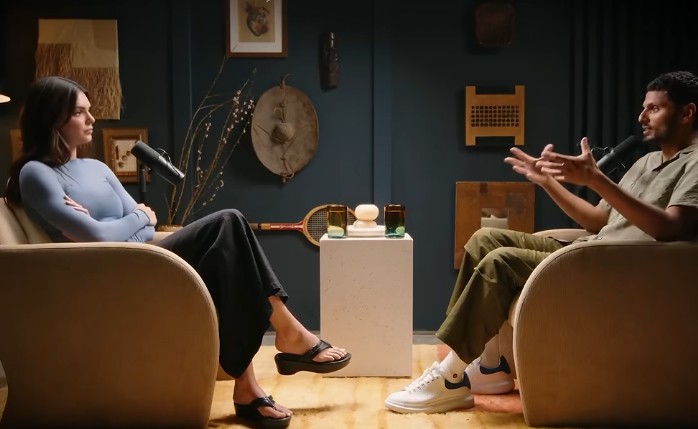
EDITOR’S NOTE: In this episode of On Purpose with Jay Shetty, supermodel and entrepreneur Kendall Jenner sits down with host Jay Shetty for a candid and heartfelt conversation about self-discovery, mental well-being, and personal growth. The two discuss everything from Kendall’s childhood discipline and love of animals to her passion for self-care practices like cold plunges and journaling. It is a rare, unfiltered look at the person behind the public persona. (September 8, 2026)
TRANSCRIPT:
How This Conversation Came to Be
KENDALL JENNER (00:00:00 – 00:00:30): Yeah, I’m not even just saying this. I literally think I manifested this. After I saw you at Simi and Hayes’s house. So that was a couple of months ago. And then a few weeks ago, I was talking to my social media girl randomly. We were just talking about a bunch of stuff and just kind of what I would love to represent, just talking about a new chapter for me and whatever. And she was like, “Who would you really want to talk to or whatever?” And I was like, “It’d be so cool to talk to Jay.” And she was like, “That would be really cool.” And then we kind of just— that was kind of the thought and whatever.
KENDALL JENNER (00:00:32 – 00:00:40): And then you hit me and I was like, “No freaking way, he’s hitting me right now.” So I was like, “Absolutely, this is perfect.” It’s the universe just putting it in perfect timing.
JAY SHETTY (00:00:40 – 00:01:06): Because that makes me so happy because it was exactly the opposite way. So I’ve for a long time had people that I’d love to sit down with, and every time I saw you do something with mental health and Vogue or any of the segments that you ever did, I was just like, “She’s amazing.” It’s incredible the way you were talking about it when you’d post about it. I’d be like, “Oh, this is incredible, to see you speaking so openly about it and vulnerably about it.” And so I’ve always wanted to do this.
KENDALL JENNER (00:01:06 – 00:01:06): Yeah.
JAY SHETTY (00:01:06 – 00:01:08): And then, but we’ve never really crossed paths.
KENDALL JENNER (00:01:08 – 00:01:09): Right.
JAY SHETTY (00:01:09 – 00:01:17): And so I’m always just a bit like— and I don’t like asking friends of friends when I haven’t met someone. And so I was like, that day I had to pluck up the courage and be like, “Look, I’m just going to ask her myself.”
KENDALL JENNER (00:01:18 – 00:01:18): No.
JAY SHETTY (00:01:18 – 00:01:21): Because it’s easier when I ask direct. And I know Christie, so.
KENDALL JENNER (00:01:21 – 00:01:21): Yeah, yeah, yeah.
JAY SHETTY (00:01:21 – 00:01:26): But I was like, it’s nicer when there’s— I told my team too, I was like, “It’s so much nicer when there’s a personal connection.”
KENDALL JENNER (00:01:26 – 00:01:27): For sure.
JAY SHETTY (00:01:27 – 00:01:28): And someone really feels comfortable.
KENDALL JENNER (00:01:28 – 00:01:29): For sure.
JAY SHETTY (00:01:29 – 00:01:30): Rather than it’s a PR thing.
KENDALL JENNER (00:01:30 – 00:01:41): No, it was so perfect. When I think back to it, I’m like, that was me just trusting the universe and not pushing for anything. And I knew it was going to kind of happen when it was supposed to, and it literally did.
JAY SHETTY (00:01:41 – 00:01:42): And it did.
KENDALL JENNER (00:01:42 – 00:01:43): Yeah, you felt it too.
JAY SHETTY (00:01:43 – 00:01:49): Yeah, I did. That means the world to me. Yeah. And I hope that this is the start of spending more time together. Yeah, off camera too.
Admiration and Curiosity
KENDALL JENNER (00:01:49 – 00:02:37): I would love that because I think also, I don’t know, I admire people like you. I admire the Michael Pollans and Michael Singers and Wim Hofs of the world. And I feel like you fit in that category for me of just people that are— because, you know, I know a little bit about your story. I’d like to actually know more, which would be really cool to actually— I know we’re obviously not here for that exactly, but for me, just personally, I’d love to know more of your story. I know that you’ve had quite the experiences and I think that’s so cool. I’m so intrigued by people with just that amount of curiosity and determination and patience. That takes so much patience to be like you or like any of those people that I just listed. It’s so cool to me, and I just— I wish. I wish for myself, but I’m working on it.
JAY SHETTY (00:02:37 – 00:02:39): No, you’re that curious, too. You’re that curious, too.
KENDALL JENNER (00:02:39 – 00:02:54): I am. It’s just, that level of patience and determination is— it’s a gift. That is a really, really amazing gift. And I’m just working on it all the time, and that’s my goal in life, I guess.
JAY SHETTY (00:02:55 – 00:03:00): Well, I think I feel the same way. About you again that— and by the way, I love all those people you just mentioned too.
KENDALL JENNER (00:03:00 – 00:03:01): Yeah.
JAY SHETTY (00:03:01 – 00:03:31): So feel very honored to be put into that group of people. And we’ve had Wim on the podcast before too, so he’s been a guest. But with you, I feel the same way back when it’s like when you see someone who is so curious, who could get away with not worrying about these things if you don’t want to, but then still being courageous enough to talk about these things and then using your platform as a space to open up these dialogues— that is as if not more important as well as doing the work and doing the path. Yeah, I mean, I can see you doing the work.
A Passion for Self-Work
KENDALL JENNER (00:03:31 – 00:05:17): I love working on myself. It is actually a passion of mine. And I just find so much comfort and joy in actually finding where I think I could better myself and being like— even if it’s physical, like my physical health or working out, or— I just started doing, speaking of Wim Hof, I just started doing cold plunges and ice baths. And even if I don’t have time to go outside. I just got a cold plunge. I did it right before I got here. It’s the best thing ever. It’s also, again, it takes so much mental— the whole thing of it is all mental.
I don’t know, just stuff like that I really love. So I’m always trying to just be the best version of me. And so I just love that. It actually makes me feel really good. I love self-care and I just love stuff like that. So it’s been really cool.
But it’s cool for you to say that you enjoy seeing that from me, because there’s always been kind of this weird part of it for me where I’m like, “Is this a pity party?” Because I don’t want it to be. I want this to feel very positive. I want to connect with people, and I guess that is my goal there, is to be like, there actually is this side of me that you may not know of. But the goal here is to connect and also not feel like I’m throwing some pity party for myself, because I want this to be a learning experience for everyone. I want this to be really positive and really well-received. I want you to look at it and actually have a positive feeling towards it.
So I don’t know, you’ll find that when I do kind of post about something or when I want to talk about something, I’m usually sharing a tip or sharing kind of a little technique, even if it’s something so simple as walking outside, taking a few deep breaths and journaling. It’s just that kind of stuff that I really like to share, because I feel like I want to be helpful.
JAY SHETTY (00:05:17 – 00:05:43): Yeah, more than anything. Absolutely. And that’s how— that’s at least how I see it. I see it not as a pity party at all, but so much more as just, “Hey, here’s a reminder. Something that I did.” And I feel like that positivity shines through too in the way you do it. So at least if that helps, whatever that’s worth from the outside, it definitely comes across that way. Cool. And this has easily been the warmest introduction to a flow of a conversation I’ve ever experienced in my entire life.
KENDALL JENNER (00:05:43 – 00:06:16): I was going to say, I was actually really nervous coming in here because this means so much to me. And I’m serious, because I’ve done a lot of interviews in my life, and when thinking about this one or thinking about that I even wanted to do something like this, it just means a lot to me. And so it made me a little nervous, and I was like, “I just want to get this right.” This isn’t me going out and promoting something or talking about something. This is something very real that we all experience, which is just ourselves and our well-being and just everything, so… Yeah.
The Podcast as a Space for Real Connection
JAY SHETTY (00:06:16 – 00:06:28): And this is— for me, genuinely, and I really do mean this, the podcast has been a great excuse, or really from my side, an intention to get to know people I really admire.
KENDALL JENNER (00:06:28 – 00:06:28): Yeah.
JAY SHETTY (00:06:28 – 00:06:36): And so for me, it’s been a great way of building new friendships and relationships, because if you can sit and talk to someone and really get along with each other, you’re like, “Oh, we should do this more often.”
KENDALL JENNER (00:06:37 – 00:06:38): And so, well, I’m honored.
JAY SHETTY (00:06:38 – 00:06:55): Yeah. So for me, it’s definitely been that. And to me, you know, you saying that and taking it as intentionally as you are— for me it’s as important. I always share this before we start recording usually, but we just flowed. And then I heard somewhere that your first job was you were a dog walker.
KENDALL JENNER (00:06:55 – 00:06:55): Yeah.
JAY SHETTY (00:06:55 – 00:07:01): And so I was thinking, do you have any lessons or anything you learned by being a dog walker? I think first jobs are so interesting.
Childhood Discipline and Early Lessons
KENDALL JENNER (00:07:01 – 00:07:57): Yeah. No, I mean, I was always a super disciplined child— I just loved— I would put myself to bed at 7 PM, be like— my mom would be playing with me and my little sister and be like, “Mom, it’s 7, I got to go to sleep. It’s time for my bedtime.” She’d be like, “Are you okay?” And so I was always that kid. And so I think I just was always really eager to work. I don’t know why. I just wanted to always have something to do, something that I felt passionate about that I really enjoyed.
And so yeah, when I was young, I put some flyers around our community and said I would walk dogs. And I ended up getting people that would let me have their dog for a few hours and take it for a walk. So I loved animals and I liked having something to do. So I spent— I was a kid that liked to be by myself with animals. I think that that was a cool, very fitting thing for me because I got to be by myself walking but then also experience all these little dogs with me.
JAY SHETTY (00:07:58 – 00:08:14): What do you think it was in those early years where you just said you were very disciplined? It sounds like you were aware of certain habits that you built then. What were some of the things that you feel confident about? How did you look for validation in those early years, and where did it come from for you?
Introversion, Solitude, and Self-Discovery
KENDALL JENNER (00:08:15 – 00:09:58): I mean, it’s interesting. So Kylie, my little sister, she was always the social butterfly. I was always— I just liked being to myself. I don’t know if that’s the Scorpio in me, so it just came naturally or whatever. I had a group of friends who I loved, but I can vividly remember just on the weekends not running to go be with my friends all the time. During the summer, I was with them, but on the weekends in between school, I would— I was really just by myself. I would love to hang out in my room. I was kind of a nerd. I loved video games and sitting on the computer and playing Sims all day. I just kind of liked being to myself. And then all day long during the summer was with my horses.
And yeah, I don’t know. I just— it just brought me joy. I don’t think I have a super long explanation for that. It was so simple for me as a kid. It was just as simple as that made me happy and that’s just what I wanted.
And it explains, I guess, a lot of me now. I went through a phase where I felt like I had to be around people. I think I live a very social life, and my job is very social. So I was kind of conditioned to want to be around people a lot. Then as the pandemic came around, you’re not around as many people anymore. Now I’m just re-enjoying being by myself, which is really cool.
I had the best day on Sunday all by myself. I got up, I went and rode my horses. Took my niece to ride her pony, just me and her. It was so nice. Brought her back home, went to my house, got in my cold plunge, went in my pool, laid out, journaled. I was having the best day, and I was just pretty much all by myself. So I enjoy it so much.
Craving Simplicity and Setting Boundaries
JAY SHETTY (00:09:58 – 00:10:13): I love that. I’m sure that’s so refreshing for people to hear too, because I feel like people may from the outside perceive a life which obviously, like you said, for work it’s busy and it’s social, and of course you have wonderful friends, but to know that you can feel comfortable in your own company, and that’s been a habit that you’ve developed over time.
KENDALL JENNER (00:10:13 – 00:10:52): I crave simple things. I love my life, and I love my job, and I feel so fortunate that I have been placed here, that for some reason I was given this life. I feel immensely grateful for that, and I have had so much fun. And I think back on just the experiences that I’ve had thus far, and it’s shocking to me. I’m like, this is so frickin’ cool that I live this life. But at the end of the day, when I am home and when I’m alone, I crave the simple things. I love a simple day. I love just a simple routine and being to myself and being around the people that I love, my small core crew.
Proudest Moments and the Self-Work Behind the Success
JAY SHETTY (00:10:52 – 00:11:21): So yeah, that’s beautiful. I mean, that’s— I think that’s what we’re all striving for, is right, that passion in our careers and our work, and then the simplicity at home. What would you say— I was thinking about this, and I’ve watched so many of your interviews and read so much too, but what would you say for you has been one of your proudest moments or greatest achievements, or something that you really feel like— and internally, I mean, for the basis of our conversation, something that really brings you joy internally when you think about it, or when you had it?
KENDALL JENNER (00:11:22 – 00:13:29): I look back and the things that I’ve accomplished, just even my job— I think I really at one point when I was younger decided I want to be a model and this is what I want to do. And the fact that I executed, because we talk about that determination— I really was 14 years old when I kind of made that decision and was like, this is what I want to do. And I went to my mom and I was like, please help me do this. And I didn’t stop until I was 24, that I was like, okay, I think I need to take it back a notch, which we can also get into because that’s a very kind of dramatic story.
But I just knew, and I think I’m proud of myself for being that kid and being determined to do that and then executing and doing it to the level that I had done it. And that I guess I still do. But I also am proud of, I think more so, the self-work that I’ve done within that process. ‘Cause there was a long period of time, I’d say the core 5 years of it, that I was extremely overworked, not my happiest, not because I wasn’t doing what I loved, but just because I was overwhelmed.
And I felt like I was saying yes to everything ’cause I felt really, really grateful and really honored to be in the position that I was in. Always saying yes, and it just took a lot out of me to the point where I just wasn’t happy anymore. And so I had to set those boundaries for myself when I was about 23, 24. I’d say like, what, a year before the pandemic? So yeah, I was probably 23. I really set boundaries for myself, and I was like, I want to continue to do this because this is what I love, but I need to start saying no when I can and prioritizing me and prioritizing my happiness and my well-being. And it has done wonders for me. I feel like I can show up better for myself and I can show up a better person for the people that get to be around me that day and that I work with on that day. So yeah.
JAY SHETTY (00:13:29 – 00:13:29): Yeah.
KENDALL JENNER (00:13:30 – 00:13:33): So that’s what I’m proud of. Sorry to give you a long answer to your question.
JAY SHETTY (00:13:33 – 00:13:52): That’s an amazing— I won’t say I was hoping for that because I’m always open to wherever anyone’s life experience goes, but there’s a part of me that loves hearing that. I really appreciate hearing that because when you’ve achieved so many incredible things in your career, which you have, to then say, well, this is the part— knowing how to navigate it or making the right choices at the right time.
KENDALL JENNER (00:13:53 – 00:13:53): Healthy balance.
JAY SHETTY (00:13:53 – 00:13:54): The healthy balance.
KENDALL JENNER (00:13:54 – 00:14:01): It’s so important. It’s important for all of us. Yeah. We have to— this is what we’re prioritizing.
The Courage to Say No
JAY SHETTY (00:14:01 – 00:15:02): Yeah. So how did you find the courage to do that at the 23 mark? As you’re saying, you’re in a competitive industry. As you said, it was overworking, it’s fast-paced. I’m guessing there’s comparison in that industry, there’s competition in that industry. Of course, it’s not an easy space to be. You’re in the top 0.01% in your industry, so it’s hard. And the reason I asked this is because I work with so many people in this space, and to have the courage to say no— I know that if I sort this out, then all of this is going to be just fine. That actually takes more courage than we recognize. We realize that when you have nothing, then there’s nothing to lose. You can actually have a lot of courage, right? But when you have everything and there’s everything to lose— and a lot of the time, at least what I’ve heard in town, older managers and agents— and I’m not saying you have any of this, but people that I know will be told, well, hey, if you don’t do this, you’ll be forgotten next year, or your career is only going to last another 6 months. How did you have that courage to say, no, no, I need to do— like, where did that come from?
KENDALL JENNER (00:15:02 – 00:16:38): I think that it’s interesting— I’ve never thought about it that way, to be completely honest with you. I just knew that if I had gone any further, that I was going to lose myself. I was at that very— I was on the teeter-totter edge of that point where had I gone any further, I was probably not going to be great. It was so important to me to feel good that I just knew that it was something that I had to do.
And I can’t say— you’re absolutely right. There were so many people around me that had told me not to say no, told me not to stop. I fought my way out of it a little bit because there were people that had worked for me that didn’t want me to stop because it might have benefited them. Of course. But I got to that point and I just knew I had to do it. I don’t know how to explain it, I guess. It was just such an unbelievable sensation that I had where I knew that if I do this, I’m going to be better for everyone. I’m going to be better for myself, which means I’m going to be better for the people around me, and I have to do this.
It wasn’t really— I want to be able to live with happiness. God forbid any of this ever went away. I think that that was a big moment for me of being like, I’m going to be okay if I don’t get this job tomorrow, and I’m going to be okay if I don’t get that job in a month. If I have to take this time to do whatever, things will come. Everything’s going to work out the way it’s supposed to, and I had to trust that.
Vulnerability, Burnout, and Stepping Back
JAY SHETTY (00:16:38 – 00:17:12): So yeah, well, to me, on from the outside— and it’s beautiful that you didn’t see it in yourself because that almost makes it even more wonderful— but the idea that, to me, from the outside, that’s a lot of courage. Yeah, thank you. It takes a lot of courage. It takes a lot of vulnerability and openness, and it takes courage at every level, whether someone’s thinking about quitting their job to do something they love, or whether someone’s trying to relocate their family and doesn’t know how, or whether someone like you is feeling success but then going, well, wait a minute. And I think in the past few years we’ve seen athletes and musicians and actors and people in all creative industries step back and say, well, I need to put me first.
KENDALL JENNER (00:17:12 – 00:17:13): Yeah.
JAY SHETTY (00:17:13 – 00:17:20): And I think that that’s empowering because I think we hear about burnout in work culture and corporate culture so often.
KENDALL JENNER (00:17:20 – 00:17:21): For sure.
Rediscovering Joy and Simple Pleasures
JAY SHETTY (00:17:21 – 00:17:30): So what was it that you started to do with that newfound time at that time? Was the curiosity always there and now you could actually follow it?
KENDALL JENNER (00:17:31 – 00:18:05): It was always there. And I had had a lot of people coming to me telling me about meditation and how it changed their life and therapy and so many different things. And I was a bit overwhelmed because I was like, oh my God, what of this is going to suit me? I think it’s a very personal experience. I think everybody has a very different version of all of that stuff. And so it was a little overwhelming. So I think I really just took the time to be off for a second. It was even the little things. It was like being able to go to my friend’s birthday party, which I wouldn’t have been able to go to before because I was working a lot.
JAY SHETTY (00:18:06 – 00:18:13): I love hearing that because I think it is those simple things— giving yourself that space, whatever it is that you needed to do.
KENDALL JENNER (00:18:13 – 00:18:13): Yeah.
JAY SHETTY (00:18:14 – 00:18:22): When you needed it. And like you said, sometimes that’s when all the subscribe buttons come up in front of you and it’s like, try this and try this. And it’s like, well, no, no, let me just take my time.
KENDALL JENNER (00:18:23 – 00:18:59): And it was also, now that I think about it, yeah, 23. I’m 26. I’ve had my horse for— so around that time is when I bought the horse that I have now, who is my— I jump her and I have 2 other horses, but they’re like retired, so I don’t really ride them the same way I ride her. So yeah, I guess it was around that time too that I was like, I’m going to do this because I love this. And I want to get back into it, and this is what I’ve loved my whole life. So it was around that time that I feel like all of that started happening, and I bought my horse, and I started taking more time for things that made me really happy.
The Pillar of Happiness and the Higher Self
JAY SHETTY (00:18:59 – 00:19:15): Yeah. What I’m noticing in you and observing, or at least from just these— no, in a good way, it’s all good. I was just saying, it feels like no matter what’s happening in your orbit, there’s this pillar of belief that it’s important to be happy.
KENDALL JENNER (00:19:15 – 00:19:15): Yeah.
JAY SHETTY (00:19:15 – 00:19:22): That’s like this core center belief in your life where it’s like, it’s important to be happy. It’s important to be happy. That has to be the goal.
KENDALL JENNER (00:19:23 – 00:20:34): For sure. And it’s not always easy. We live in such an interesting industry and in such an interesting time with social media that it can be very hard sometimes. You can fall victim to so many things that don’t serve you and that don’t make you happy. If your happiness depends on the actions of others, you’re at mercy of things that you can’t control. And that’s never where I want to be.
So I always want to live in— me and my therapist talk about my higher goddess, my higher self. I always want to live there, knowing that when I’m there, you can’t take that away from me. That’s mine. And no matter what, you can disagree with me, you can agree with me, that’s not going— I’m not changing. I’m not shifting. I’m here. I’m in my higher goddess. So I kind of— I always live by holding my happiness and not letting anyone else affect it. And though I fall victim to it at times, as we all probably do, absolutely. I strive every day to live in that place.
JAY SHETTY (00:20:34 – 00:20:42): So what are some of the qualities of your higher goddess? That kind of avatar— she’s awesome.
KENDALL JENNER (00:20:42 – 00:21:52): Like I said, I don’t love a pity party. Sometimes it feels weird to say good things about yourself, but I’ve also learned a lot about talking to myself and a lot about looking in the mirror and being like, “You’re great, you’re gorgeous, you’re amazing, you’re loyal, you’re positive, you’re so many—” I love words of affirmation. I love just sitting there and reassuring myself of who I am because that’s another thing for me.
There are so many false narratives about me, about all of us, I’m sure. So many people think they have you figured out when they don’t even know the half of it. So sitting there and being like, you get frustrated sometimes. It could feel really unfair. You could be reading something that someone is saying about you or hearing something that someone’s saying about you and being like, “That is just so unfair because that’s not who I am.” And that really gets to me sometimes, and that really sucks. But then looking at myself in the mirror and being like, “But I know who I am, and that’s all. Why does anything else matter?” And my friends know who I am, and my family knows who I am, my dog knows who I am, my horse knows who I am. Everything else is just noise.
On Identity, Perception, and Validation
JAY SHETTY (00:21:52 – 00:22:39): There’s this beautiful piece of wisdom that I always share from Charles Horton Cooley, and he wrote this in 1890, I think it was, which just shows how true this has been for such a long time, and obviously long before that as well. And he said, “The challenge today is I’m not what I think I am. I’m not what you think I am. I am what I think you think I am.” And we’ll let that blow everyone’s mind. It gives me chills every time I say it. Charles Horton Cooley said, “The challenge today is I’m not what I think I am. I’m not what you think I am. I am what I think you think I am.” And what he’s trying to say is that we live in a perception of a perception of ourselves. So if I think you think I’m smart, then I allow myself to feel smart, right?
KENDALL JENNER (00:22:40 – 00:22:41): It’s like we need that validation.
JAY SHETTY (00:22:41 – 00:22:46): We need that validation. Or if I think you think I’m not smart, then I feel hurt.
KENDALL JENNER (00:22:47 – 00:22:47): Yeah.
JAY SHETTY (00:22:47 – 00:23:32): And the challenge is I don’t know what you’re thinking at all, or especially outside in the world. And so I find that what you’re saying around like, well, what do I think about myself? How do I feel about myself? How do the people that actually know me feel about me? I think that’s really empowering.
I wanted to ask you, because I feel like from what I’ve seen and from what I’ve heard, you have great friendships, you have a great relationship with your family, as you said. What do you think have been really great habits or traits in relationships that have helped you build up good friendships and family relationships? Because I think for so many people, sometimes their friendships and their family can often be the most difficult part. But I feel like the way you communicate or the way you’re talking about it, I’m like, OK, there’s some really good habits in place here. Have there been any principles or rules that you’ve learned along the way that have been helpful?
On Relationships, Family, and Managing Overwhelm
KENDALL JENNER (00:23:32 – 00:23:59): I mean, of course, honesty. I’m a big person on keeping a really honest, healthy, communicative relationship. But I also think I find it really important to have— not feel like you’re on top of each other when you have your family around or your friends around. It’s OK to sometimes, even if you’re at a family dinner, run to the bathroom and just be like, “Let me just take a couple of breaths because this is getting overwhelming.”
JAY SHETTY (00:23:59 – 00:23:59): That’s a great one.
KENDALL JENNER (00:23:59 – 00:24:33): You know what I mean? So I just love to take a second. My feelings are valid. Sometimes my family’s a lot, which I bet everyone already knows. Everyone’s families have a sense of crazy to them. But I think that I can get really overwhelmed really easily. I am prone to just a good amount of anxiety and just being extremely overwhelmed and kind of taking everything too seriously sometimes. So I like to just step away sometimes and just be like, “This is okay, I’m allowed to feel this way, it’s valid. I’m just going to take a deep breath and I’m not going to react, and then I’m going to go back out there and I’m going to be fine.”
JAY SHETTY (00:24:33 – 00:24:34): That’s a great—
KENDALL JENNER (00:24:34 – 00:24:35): Sometimes I do that.
JAY SHETTY (00:24:36 – 00:24:41): I love that. I love how easy it is. No one needs to learn a new meditation practice or a new thing.
KENDALL JENNER (00:24:41 – 00:24:43): Sometimes it’s just as simple as that.
JAY SHETTY (00:24:43 – 00:25:14): Yeah, it’s as simple as that. One of the things that really touched my heart when I saw this, because I think when things happen in culture and everyone talks about it, but sometimes you’re like, OK, well, I can tell that there’s a real connection here. When you lost Virgil, right? When I saw your message and what you spoke about it, I was like, wow, this is someone who had a really deep connection with this individual. And going through grief is really, really tough. People who lose— and I lost 2 really close people to me during the pandemic.
KENDALL JENNER (00:25:14 – 00:25:14): I’m sorry.
JAY SHETTY (00:25:14 – 00:25:40): Thank you— one was my spiritual teacher since I was 12 years old, and he died of stage 4 brain cancer. And I hadn’t seen him during the pandemic. I couldn’t go back for his— because that was still when it was like, yeah, lockdown. I couldn’t go back for his funeral. And he’d been the person who’d been such a key piece of my life. And then the other person, pretty much in the same year, was my best friend as a monk. So he was still a monk.
KENDALL JENNER (00:25:41 – 00:25:41): Wow.
JAY SHETTY (00:25:41 – 00:26:04): And he happened to get cancer and he passed away during the pandemic. I couldn’t see him either. And he was my age. And so to lose someone that was, you know, and he was still there. And so when I saw your wonderful tribute to Virgil as well, I was like, how do you process something like that when it’s not only industry friends but genuine friendship beyond that? And just how did— yeah.
Remembering Virgil Abloh
KENDALL JENNER (00:26:05 – 00:27:27): Well, my first thought here is, why is it always the best people? Why is it always these people that are just such balls of light in everyone’s life? It’s like, so you just think about it and you’re like, “This is so unfair.” And you’re going through every emotion. And to be honest, it was really shocking because not everyone knew what he was going through and suffering from. So it was really shocking. I’ll never forget the day I found out. It just absolutely, obviously breaks your heart. You can’t help but be like, “Oh my God, did I ever say enough? Did I ever tell him enough?”
It’s really interesting to share that feeling with so many people. It feels good in a way, and you’re just like, everyone— it makes you feel so human. You’re sharing this emotion with people that knew him, people that didn’t know him, people that just loved him from afar. And it’s just a really beautiful and incredible thing to a certain degree, but then also just obviously the most devastating thing. It hits so hard when so many people are talking about it and so many people are affected by it. So it was definitely a really shocking, really sad time. Yeah, it was.
JAY SHETTY (00:27:27 – 00:27:57): And it’s really interesting what you said there is like why— and I had that with my spiritual teacher for sure. I was just like, he was, and what’s really powerful about what I could at least remember from him at that time was that even though he had stage 4 brain cancer, which means he’d lost his short-term memory and a lot of his long-term memory is impaired, if you ever met him, he would just thank you for your service to God. Like, he would just say, “Thank you for everything you’re doing for other people,” and he would just be grateful.
KENDALL JENNER (00:27:57 – 00:28:50): And I was just like, that’s exactly how V was too. He was the most positive, lived life, appreciative, wanted to say yes to everything, wanted to just be there for everyone. You could literally ask him to design a pencil for you, and he would be like, “It’ll be done tomorrow. What else do you need?” He just had so much to give, and he gave it. That was pre his diagnosis. That was just who Virgil was. To then find out what he found out at a certain point in his life and still be that person and still like, “I’m going to show up for everyone. My time here is so special to all these other people and I’m going to be here to make them feel amazing.” It’s just like unreal. Like it makes you just be like, what?
JAY SHETTY (00:28:50 – 00:28:51): Yeah.
KENDALL JENNER (00:28:51 – 00:29:02): How? How could you be that incredible and giving? Like, that is so crazy. There wasn’t a selfish bone in that man’s body. Like, he was just the best. Yeah, but I’m sorry to hear about your—
JAY SHETTY (00:29:03 – 00:29:34): Oh no, I think it’s actually nice speaking about people that we both love in a similar way, even though they’re in such different places in life doing very different things. Yeah, but to talk about someone’s— and I think that’s a big part of it for me, at least with grief, that I feel like when I talk about the beautiful qualities of the people that I lost, it gives me so much confidence that they want me to live it, and they want me to try and embody it. And how fortunate we are to have experienced that type of humanity. Yeah.
On Purpose and Legacy
KENDALL JENNER (00:29:34 – 00:30:18): And those are my thoughts of him. I think all we ever really want as human beings is to be— when we do leave this Earth, we want to be remembered so beautifully and positively. At least I do, of course. But you just want— you, of course, want to make people feel something. And he made so many people feel something. And for that, it is so special. What do they say? That we have our purpose here. And I know that he fulfilled a purpose here that he was supposed to fulfill. And I think that— I think about it beautifully. I obviously— it’s a very, very sad situation and it breaks my heart, but I have nothing but beautiful thoughts of him. And I think that’s really cool and really special.
JAY SHETTY (00:30:18 – 00:31:10): So yeah, thank you for sharing that too. And I had to ask you because I just— I feel— I love hearing amazing things about amazing people that, because I think so many of the most incredible people— I grew up reading about people that I never met, and I spent a lot of my life studying books about people that I never met. So Malcolm X and Martin Luther King and Einstein and people that I really see as people that have directed so much of my life from how they lived. And I feel like he was potentially one of those people that I never met him, but whenever I hear about him, I’m just like, for sure, oh, this is someone that we could learn from. For sure.
You spoke about purpose there. I was wondering, how has your purpose changed? You had this very confident view of, “I want to be a model.” You’ve superseded, exceeded, and continue to flourish in that world, and I always wish that you do. How has your purpose evolved as that time’s gone on?
Finding Purpose and Spreading Love
KENDALL JENNER (00:31:11 – 00:32:57): I think I’ve learned a lot. I’ve learned a lot about myself, about what I want from my life, and which is kind of what we’ve been talking about. But I’m actually really excited to get older and to learn so much more about not only myself, but the journey and the path that I guess want to take and want to be on.
So I’d say my purpose has evolved from obviously within business doing what I want to do and making sure I’m happy and finding the thing that I love and all those things. But I’ve kind of, like I said, really tuned into me. And I think my purpose, at least at this very moment, and what I’ve kind of evolved into is is my higher goddess. Like, I am determined to tune into her at all times.
But also, as I get older, I have so much that I want to connect with other people and with, aka social media and people that may not know me personally, and just, the following. Like I said, I was given this life for some reason. For whatever reason, I was placed here, and I do feel a purpose to share and connect and put a smile on people’s faces or make someone feel a positive feeling.
And so I think that within me wanting to achieve me tuning into my higher goddess, I think that also entails me being a great version of myself for other people to then experience, and my tips and my tools and whatever I can share, whatever help I can give, I really, as corny as it sounds, I want to spread love. Like, I want people to feel love. I— that’s really, I guess, the purpose.
JAY SHETTY (00:32:57 – 00:33:00): Yeah, that’s, that’s beautiful. I mean, what more could you ask for?
KENDALL JENNER (00:33:00 – 00:33:01): Yeah, right.
JAY SHETTY (00:33:01 – 00:33:08): Yeah. And, and it is funny that so much of the stuff that is corny or, whatever, that’s the stuff that’s true, right? Like, that’s the stuff. It is.
KENDALL JENNER (00:33:09 – 00:33:28): Like, there’s also just— we all just like live in such a— it’s an interesting time, obviously, and it can feel really negative. And I tend to stay off of platforms like social media platforms because it’s hard to look at sometimes and it feels really negative. So I feel like we all just need a little bit of a smile sometimes.
Retraining Our Brains Toward Positivity
JAY SHETTY (00:33:28 – 00:33:56): I agree, I agree. I post these videos every day which are just these fun silly things that happen in the world that my team will find, I’ll find, and I post them every day literally for that reason and that reason only because I’m like, I may or may not say something that makes someone smile, right? But this definitely will. Like, this, this without a doubt will bring some joy to someone’s life. And if this is the only joy that someone experienced, I want them to see good in the world and believe that there’s good in the world.
KENDALL JENNER (00:33:56 – 00:34:20): That’s one of my favorite things to see on TikTok when I sit in my bed at night and fall victim to TikTok. I love to see— there’s people that’ll post like, here’s like 5 amazing facts that have happened in the world in the last couple weeks or whatever, and it’ll be like the, pandas are not extinct anymore, and like the Great Barrier Reef is coming back and stuff like that. And so I’m like, that’s so cool, that’s what I want to hear.
JAY SHETTY (00:34:20 – 00:34:28): Exactly. And, and, if it was like it’s going down, it’s like it’s going to get a lot of likes and hits, but right, if it’s going up, it doesn’t get the same attention.
KENDALL JENNER (00:34:28 – 00:34:32): Yeah, why do we like gravitate towards the negative so much? Like, no, very interesting.
JAY SHETTY (00:34:32 – 00:34:40): We have to retrain. I genuinely believe it’s just a pattern. It’s a pattern and a habit that’s been adopted. Absolutely. So long.
KENDALL JENNER (00:34:40 – 00:34:40): Absolutely.
JAY SHETTY (00:34:40 – 00:34:40): And we have to retrain ourselves.
KENDALL JENNER (00:34:40 – 00:34:52): The click debate of it all and the whole thing, and we’re like, that’s going downhill, I need to see what’s happening. And we’re just like, we do need to retrain our brains. It’s exactly what it is.
JAY SHETTY (00:34:52 – 00:35:18): Yeah. And it starts with what you said earlier. It starts with how we see ourselves. It is all from that. If someone looks in the mirror, as you were saying earlier, or if someone just reflects on themselves, not in physically but just internally, yeah, most of us will spot all the negative things about ourselves. And then we take that out into the world and spot all the negative things about everyone else, and then we take that out into social media, right? So that just propels from—
KENDALL JENNER (00:35:18 – 00:35:20): if you ask all the reflections, it’s all—
JAY SHETTY (00:35:20 – 00:35:39): yeah, if we ask someone to sit down and write down, as you said, we feel uncomfortable taking a compliment, or we feel uncomfortable saying, saying nice about ourselves, right? Exactly. And so it all starts with our relationship with ourselves. If we were able to find 3 good things about ourselves today I promise you you’re going to find 3 good things about the person sitting in front of you, and that will—
Inner Child Work and Self-Love
KENDALL JENNER (00:35:39 – 00:37:14): Right, exactly. I do a lot of, like, inner child work with my therapist, and there’s actually a trend on TikTok that was going around, but coincidentally enough, we ended up naturally speaking about it in my session. And it was like this trend on TikTok, I guess, that was like, like a girl being like, anytime you’re being mean to yourself, just think this is who you’re talking about, and then it flashes to a photo of her as a kid.
So me and my therapist were talking about something similar. And she was like, why don’t you find like a photo of yourself and put it on your bathroom mirror so that every morning, every night, every day when you walk into your bathroom mirror, you’re looking at her and you’re remembering that if there’s anything negative that you’re ever saying about yourself, if you’re ever being mean to yourself, you’re talking about her.
And so I did that. And I went into my memorabilia closet in my house and I was looking through old photo books. And I’ve seen these photo books my whole life. I’ve literally seen every photo that’s been in here. And I like flipped to a page and there was a photo I’d never seen of myself ever. It was a Polaroid, so it was the original photo. And it was just me as a little girl with a bow in my hair and a dress on. And I have like a little alien tattoo or something right here. And I’m like, have this big cheesy smile on my face. And I was like, that’s the photo I’m putting on my thing. I can show you the photo later. I have a picture of it on my phone.
But so I pasted it on my bathroom mirror and I talked to her. And I’m always like, if I’m ever looking in the mirror and being negative towards myself or anything, I always look right over over to her and I’m like, she’s dope and I love her. And so it’s just another way of just self-love.
JAY SHETTY (00:37:14 – 00:37:22): I love that. That’s such a great tool. That’s such a great tool. My team found a kid picture of me and made an embarrassing version of that trend, so I’ll show you that too.
KENDALL JENNER (00:37:22 – 00:37:23): Oh, awesome. Okay, so you know it?
JAY SHETTY (00:37:23 – 00:37:47): Yeah, I know exactly. I know exactly what you’re talking about as well. Kendall, you were saying earlier that, you wanted to come here and you, you wanted to share and you manifested it and you— there were things you wanted to share. What is it that’s on your heart that you’ve wanted to share that maybe we didn’t go there today already? Or is there something on your mind and heart as an experience, or, any— anything that really drew you here and made this happen, right? Like, I want to honor that.
Sharing Vulnerability and Feeling Heard
KENDALL JENNER (00:37:47 – 00:38:37): I think we’ve obviously— we’ve honestly touched a lot of what I felt like I would have loved to get off my heart. I don’t know, I was really excited, honestly, to come here and share a little bit of me that I feel is very sometimes scary for me to share. And, like I came in here and I was a little nervous because this is important to me. And like, this part of, everyone’s journey and, and what we’re talking about today is— it’s so important.
I really— that was, I guess, my intention here today, was to come in and share a little bit of me. And maybe for whoever’s watching, they find some comfort in this or some joy from this, or they understand me a little bit more, you know what I mean? So I think that we’ve hit a lot of really cool points. And yeah, I mean, I feel, I feel really good.
JAY SHETTY (00:38:37 – 00:38:54): Good. I wanted to honor that. I asked that because, I think, I think when, when you feel you’re in that flow with someone— and yeah, I feel like, we’ve learned so many new things about you today, and there’s so many moments where I’m like, I just feel like you’re so comfortable and, and you’ve been so open with us. But I just wanted to honor that.
KENDALL JENNER (00:38:54 – 00:38:54): Thank you.
JAY SHETTY (00:38:54 – 00:38:57): And make sure that you feel that you’ve really felt heard and seen.
KENDALL JENNER (00:38:57 – 00:38:58): I appreciate that.
JAY SHETTY (00:38:58 – 00:39:00): Thank you. So I want to be mindful.
KENDALL JENNER (00:39:00 – 00:39:02): We all want to just be understood at the end of the day.
JAY SHETTY (00:39:02 – 00:39:15): So I think the closer you get to people, humans, the closer you get to people of different backgrounds and different walks of life, the more you start to recognize how similar we all are.
KENDALL JENNER (00:39:16 – 00:39:17): Yeah, exactly.
JAY SHETTY (00:39:17 – 00:39:37): And how many challenges we all share, despite how much money someone has in the bank, despite how much fame someone has, despite how much followers someone has. And what we find is that everyone feels their own guilt for where they are, and everyone feels their own pressure for where they are, and everyone feels their own challenge for where they are. And you just start to realize that we all have the same emotions.
KENDALL JENNER (00:39:37 – 00:39:37): Exactly.
JAY SHETTY (00:39:37 – 00:39:39): In different mixes.
KENDALL JENNER (00:39:39 – 00:39:41): Yeah. We’re all just having a human experience.
JAY SHETTY (00:39:41 – 00:39:42): Exactly.
KENDALL JENNER (00:39:42 – 00:40:03): We’re all just going day by day. I think we all need to be a little bit kinder to each other and just take it easy on some people. So because we are— we’re all— we all have our own struggles. And, I don’t know, I’m, I’m an empath, so I like feel for things and I feel for people and And, yeah, yeah.
JAY SHETTY (00:40:03 – 00:40:05): And it starts with you, the, the person, right?
KENDALL JENNER (00:40:05 – 00:40:10): Yeah, exactly. I thought you meant me. I was like, I don’t know, I don’t have that power. I was like, thank you.
JAY SHETTY (00:40:10 – 00:40:12): No, no, I meant, I meant that to our listener.
KENDALL JENNER (00:40:13 – 00:40:13): Like, it starts with yourself.
JAY SHETTY (00:40:13 – 00:40:14): It starts with yourself.
KENDALL JENNER (00:40:14 – 00:40:15): Yeah, absolutely.
The Final 5: Quick-Fire Questions
JAY SHETTY (00:40:15 – 00:40:38): If you can be kinder to yourself, chances are you’re going to be— I found that the days I stopped judging myself, I stopped judging others because it, it changed how I, yeah, saw humanity. So Kendall, we end every On Purpose episode with a final 5, which is a fast 5 round. I ask you a question and you answer it with a one word or one sentence maximum. So it’s super quick and short.
KENDALL JENNER (00:40:39 – 00:40:39): Okay, okay.
JAY SHETTY (00:40:39 – 00:40:47): And we have to whisk you away because you need to, you need to go to your next appointment. But okay, so the first question is, what’s something you’re curious about right now?
KENDALL JENNER (00:40:48 – 00:41:04): Oh, I am super curious about I was saying how I love Michael Singer, and I think what I really love— I’m reading The Surrender Experiment right now, and I’m only in the first couple chapters. So he’s basically— this is not a quick answer.
JAY SHETTY (00:41:04 – 00:41:06): It’s great. I love it though. Please, please.
KENDALL JENNER (00:41:06 – 00:41:32): He’s basically at the first part of the book where he’s talking about how he was curious about meditation and how he got into meditation and how he really just was like on a trip with his friends and his girlfriend in the woods and like sat in a corner or sat at a tree and was like, I’m going to just really dive into this and see what happens. That’s what I’m curious about right now, is just actually— like, I meditate, I do a lot of breathing work, breathing exercises, and I just really want to tap in. Yeah, like Michael Singer did.
JAY SHETTY (00:41:32 – 00:41:40): I love that. That’s beautiful. That’s a great answer. That’s a great answer. Second question: if there’s anything that you’re working on personally right now, what are you working on on yourself? Is there any?
KENDALL JENNER (00:41:41 – 00:42:03): Yes. I’m working on boundaries, and I’m working on not I’m a stressor. I can stress about things in my mind, and I overthink, and I just— so I’m really working on calming down and just letting things flow better and not being so controlling over things, especially that I can’t control.
JAY SHETTY (00:42:04 – 00:42:13): Love it. Question number 3, what’s your favorite thing about founding 818? Oh, being an entrepreneur and being a founder, probably that.
KENDALL JENNER (00:42:13 – 00:42:39): I was a model and I worked for people a lot. I kind of love being my own boss and really being able to have my own creative— a place where I can be creative and just really express my creativity and have so much fun doing all of that creative stuff. And I’ve learned so much and learning about the culture and learning about the tequila and everything. I’ve just had the best time.
JAY SHETTY (00:42:39 – 00:42:44): I love that. Question number 4, what’s something you used to value but you don’t value anymore?
KENDALL JENNER (00:42:45 – 00:42:46): Validation.
JAY SHETTY (00:42:47 – 00:42:48): Great answer.
KENDALL JENNER (00:42:48 – 00:42:49): I don’t care anymore.
JAY SHETTY (00:42:50 – 00:42:51): Great answer.
KENDALL JENNER (00:42:51 – 00:42:52): At least I’m telling myself that.
JAY SHETTY (00:42:52 – 00:42:55): Yes. Yeah, well, we have to make it a thought first, right? Yeah.
KENDALL JENNER (00:42:55 – 00:43:01): No, but it’s true. I used to care so much more about validation. I really don’t care anymore.
JAY SHETTY (00:43:01 – 00:43:09): At least I’m happy to do it. Thank you. 5th and final question: if you could create one law that everyone in the world had to follow, what would it be?
KENDALL JENNER (00:43:09 – 00:43:16): Oh, I would do like, on like a Sunday, you have to take half the day and like not look at your phone or something.
JAY SHETTY (00:43:16 – 00:43:16): That’s great.
KENDALL JENNER (00:43:16 – 00:43:16): I love that.
JAY SHETTY (00:43:16 – 00:43:19): That’s a legit law.
KENDALL JENNER (00:43:19 – 00:43:24): That’s great, right? Yeah, kind of nice. Or the full day, or the full day being really crazy. I love that idea.
JAY SHETTY (00:43:25 – 00:44:21): I love that. Kendall Jenner, everyone, this was amazing. Kendall, this— thank you, honestly. And I’m excited to catch up afterwards too, but there was just so much flow and synergy in this whole thing happening, and I couldn’t thank you more for doing this with me here on On Purpose. And I hope that this is the first of many times that we’ll do this, but I hope it’s the beginning of a beautiful friendship for sure and relationship.
And I want to— everyone who’s been listening or watching back at home, please let me and Kendall know. Tag us, letting us know what resonated with you, what connected with you. What was it that you’ve got curious about, or what was something she said that just shifted your perspective, or where you learned something new? I’d love to hear it. I know there were tons of moments for me where I was listening going, this is amazing, this is incredible, this is awesome. So any wisdom nuggets that stuck out to you, please let us know, because I love seeing doing, what made a difference in your life as well. And a big thank you to Kendall for opening her heart and opening up her mind.
KENDALL JENNER (00:44:21 – 00:44:23): Thank you. I’m honored. Thank you so much.
JAY SHETTY (00:44:23 – 00:44:40): Thank you so much. Thank you. That’s amazing.
Related Posts
- Transcript of Kate Manne Interview: “I Am Jane Doe” – Call Her Daddy
- Taimi App for LGBTQ+ Dating: Features, Community, and User Experience
- Transcript of Arthur C. Brooks Interview: Success, Family & Love – PBD Podcast #853
- Top Sites to Recharge Streaming App Diamonds
- Purebred Cats: Breeds, Traits and How to Choose the Right One