Share & Care!
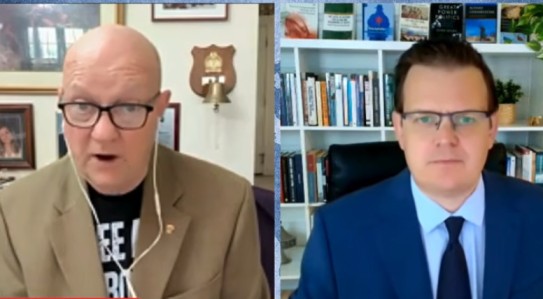
EDITOR’S NOTE: In this interview from September 15, 2026, host Glenn Diesen speaks with Colonel Lawrence Wilkerson — former Chief of Staff to Secretary of State Colin Powell — about rapidly unfolding crises across the Middle East. Wilkerson offers blunt assessments on the Houthi threat to Saudi Arabia, Israeli false flag operations, the fragile Strait of Hormuz agreement, and the vulnerability of America’s critical infrastructure networks.
TRANSCRIPT:
Introduction
GLENN DIESEN (00:00:00 – 00:00:12): Welcome back. Today is September 15th, 2026, and we have the great pleasure of being joined by Colonel Lawrence Wilkerson, the former Chief of Staff to the US Secretary of State. Thank you for coming back on the program.
LAWRENCE WILKERSON (00:00:13 – 00:00:15): Good to be with you, Glenn, even if you are a Norwegian.
GLENN DIESEN (00:00:17 – 00:01:32): Thank you for the tolerance. I appreciate it.
Well, I wanted to ask — we’ll start in the Middle East because we’ve seen the very fierce Saudi attacks on Yemen to slow down the advances of the Houthis, or Ansar Allah, as they call themselves. And we now see some retaliation, that is large-scale attacks on Saudi Arabia. That is, the Houthis are now hitting back in a big way with explosions across many cities, even Mecca. At least that’s what’s being reported, but this is happening pretty much live as we speak.
But there’s a lot of other developments. We see Iraqi troop movements near Syria. But I guess the big news is that Iran and Oman seem to have moved towards a deal to restore the traffic of the Strait of Hormuz. This was supposed to be a regional agreement. So Iran, Iraq, the Gulf states minus Bahrain, they were supposed to meet in Oman to sign this deal without the United States, but then the Saudis postponed. So a lot of news coming out. What is the significance of this, you think?
The Houthis: A Formidable Force
LAWRENCE WILKERSON (00:01:34 – 00:05:37): You’ve given me a lot to unpack. Let me start at the beginning, your remarks at the beginning anyway.
I think we’re dealing with what I call — and have told others about over the last 96 hours — some really tough people from the northern tribes of Yemen. And as I also mentioned to some of these people, I’ve been dealing with them for a long time, ever since roughly their inception as a group, a cohering group, in roughly ’89-’90 when we were doing war planning essentially for the Zagros Mountains in Iran and looking in a lot of other places too, including the vast sweep of Saudi Arabia and its environs.
And one of the things we discovered — and I discovered this in a very tactical fashion as a major at Fort Benning, Georgia, training Saudis, Yemenis, and others — was finding out the difference between what I would call the southern Yemenis and the northern Yemenis, especially those now constituting themselves as Al-Ansar, the Houthis. Very tough fighters, very smart, very into teamwork, very into one another and into the units that they belong to. That is to say, high morale, competent thinking about things that you would not think that level of soldier would be competent in, but they are.
And then I watched them as they took on that very corrupt, incredibly corrupt government that we were of course fully behind in Sana’a. And I watched how that government reacted with our assistance and with Saudi assistance, big time, against them. And I said, woe is me, this is going to be a huge problem in the future because the Saudis, and certainly not the government in Sana’a — corrupt, almost bankrupt, with us holding them up by the skin of their neck — this is going to be tough because if these tribes ever get into the fight in a big way.
And then it happened with the Minister of Defense, Mohammed bin Salman, trying to create his bona fides when he first took that position. And set himself up exclusively for crown prince and then on, made his big mistake and attacked them. And ever since then, without the United States’ assistance — assistance that I tried hard, I mean really hard, for a number of years, going up against Nancy Pelosi, Steny Hoyer, and a host of other stupid, ignorant Democrats like them and of course against the Republicans — to get us out of that stupid war because we were the essence of the Saudi ability to continue the struggle.
Whether it was extended-range F-15s with JDAM kits and bombs, whether it was — and this was key — US-provided intelligence, or all the other things we didn’t tell the Congress about that we were giving the Saudis, and yet they still weren’t able to beat them. And that was a foreboding situation because I knew when it came time for them to really exercise their valor and their talent, that they would be a threat not just to the rest of Yemen, which of course they wished to take over, but also to Saudi Arabia.
And now it’s come true. And now we’re paying the piper for that because we, the United States, in our Southwest Asia campaign against Iran, we set a lot of this up, and of course we set the Saudis up for what’s happening to them right now. And I would say there’s a 50-50 chance we’re going to see Saudi Arabia disappear as a nation-state. And I don’t know what that means. Say again?
GLENN DIESEN (00:05:37 – 00:05:38): Sorry, you said 50-50?
Saudi Arabia’s Vulnerability and Israeli False Flags
LAWRENCE WILKERSON (00:05:39 – 00:13:21): I said 50-50 chance. It depends on whether we decide we’re going to bolster them, and secondarily, someone else decides — like China, don’t think that’s coming — is going to bolster them because they don’t have much to fall back on.
Now, I think the attack, if attacks happened — I haven’t been able to confirm it — but if there were attacks on Mecca, that would be an Israeli false flag operation. 90% assured of that because they wouldn’t attack Mecca. So could be an Iraqi one too by dissident groups in Iraq, but I would put my bet on Israel.
Looking all around the region, Israel is looking for some place to conduct some kind of false flag operation in the Mediterranean to get the Turks’ attention, somewhere in Cyprus or Greece, looking all around Syria for a place for a false flag operation to get again Ankara’s attention and to teach Ankara a lesson about interfering with Israel’s attempts to essentially consolidate control over much of Syria. So Bibi’s at it. He’s not just running, he’s at it, and he’s really at it. And he thinks this is helping him in his campaign.
If I’m reading Haaretz correctly, Bibi is hurting himself, not helping himself, because one thing he’s doing is showing the Israelis — who are really angry at him now with regard to this exposure of him in terms of the 7 October attacks and his countersuit, or suit I guess, against Haaretz — and Haaretz essentially saying, “We stick to our guns, we know this is true what we said.” And this movie that’s been made by these 2 Israeli documentary makers — he’s in trouble. He’s in deep trouble, and he knows it.
When he gets in deep trouble, he tries like Trump does to deflect attention by starting other things in other areas and trying to shift attention to those other things.
The Strait of Hormuz and Oil Market Indicators
So we’re in a mess right now, not just in Saudi Arabia and environs, but of course still in the Strait of Hormuz, where I’m still unable — even with my contacts in the oil community — to really verify for myself on a 24-hour basis exactly what’s happening.
I think what’s happening is what you described. I think we have 2 very narrow channels now agreed to essentially by Oman and Iran, and those narrow channels are sort of center of mass of the old channel going south and roughly the same way out from the shoreline and right next to the flank of the one going south going north. And we have a few ships, not anything near where the total should be, going through those 2 channels slowly and surely with the blessings of the 2 littoral states. And most of that, I’m told — that is going out fully laden with petroleum products — is going to China, but I’m not sure.
And of course you’ve got all the lies coming out of the Trump administration, from Vance to Hegseth to Trump himself, about what’s going on. So all I can do is hope that my friends and colleagues in the oil industry are giving me the straight poop.
And one of the things that is indicating that they are, in some grand fashion, some composite faction, is what we found out in the petroleum disruption exercise in Beijing — the largest of its type in the world at the time. In fact, the largest that’s ever been carried out, where we had almost all the major countries in the world. We had the insurers, we had the maritime divisions of different countries, Lloyd’s of London type construct. We had all manner of people there.
We found out that WTI and Brent crude were very good indicators of what was happening globally. And now you see what WTI and Brent are doing. Held back for a while by people playing with the markets, including the overall market as well as the oil markets, but now indicating fairly substantially that there are significant problems.
And then the other thing we found was the percentage increase in the surcharges or the increases on insurance. And we found that 8% or higher was disastrous. And it’s now, I’m told, around 15%. So we’re looking at indicators that say, Donald Trump, you’re lying through your teeth. Petey, you’re lying through your teeth. Bessent, you’re lying through your teeth. All you curmudgeons — I should say criminals — are lying because what’s happening is going to be dramatically different than what you’re predicting in terms of not just global markets but in terms of the United States.
America’s Vulnerable Infrastructure
And you may have just heard — apparently I haven’t got the full details on it — we just had a major accident. I think it’s an ExxonMobil refinery that people are telling me was so bad that it’s going to take weeks, if not months, to get this refinery back online.
And the first thing I thought about, of course, was post-9/11 when we did this exhaustive survey all across the United States to see how vulnerable we were. And when we came back and briefed each other, we said, “Holy mackerel, do we have a problem.” Not only are we the most open society in the world, if we reverse planned and looked at us like we’re looking at other countries in the world to take them on in what we call network warfare — which meant going after everything from food to power to water. That’s what we put in the computer on our enemies, if you will, the war plan.
We decided we’d do it against ourselves, frankly, because the president asked us to. And so we did. We didn’t like it. It was disastrous. And I’m not revealing any secrets here because I think the rest of the world knows how open we are and how subject we would be to really talented people taking on our networks — food, finance, energy, you name it.
And I think that’s going to start. I think this may be an indicator that someone has started — either domestic or outside — someone has started taking advantage of the openness of our society. It scared the bejesus out of us when we saw the results of our modeling and how vulnerable we were.
That was one reason that we stood up the Homeland Security Department. Most of us were very much opposed to that. Most of my group at State and most of my group that I worked with at Defense were very opposed to the Homeland Security Department. Because we knew instead of consolidating and dealing with these problems, we’d spread them across a whole bunch of disparate agencies that had no similar cultures, and they’d have a secretary above them who’d be a tyrant or not anything at all — which is pretty much what we’ve had in the various ones we’ve had — and it wouldn’t be effective. We just dissipated our power in terms of doing something about this.
So we’re lying open to the world right now for anyone, terrorist or otherwise, that wants to take on our networks, which are crucial, critical to our economy.
Open Societies and the New Warfare
GLENN DIESEN (00:13:23 – 00:13:29): Yeah, this new form of warfare, it makes the open societies even more vulnerable.
LAWRENCE WILKERSON (00:13:31 – 00:13:38): Which is a comment you may regret making because that means we’re going to get leaders who want to make them less open.
Israel, the Strait of Hormuz Deal, and Islamic Unity
GLENN DIESEN (00:13:39 – 00:14:51): Yeah. Well, that seems to be the direction the world is taking, unfortunately.
But by the way, before the explosions in Mecca — I see this in the livestream here. It’s not — I haven’t seen a report confirming it. So hopefully that was an alarm. But yeah, we’ll find out.
But you mentioned Israel before. And I thought it was interesting that the Iranian spokesperson made a point or argued that when the Islamic countries fight each other, there’s only one winner, Israel. And we also saw, again, this deal to restore the traffic in the Strait of Hormuz, this big regional agreement, which was set to put everyone on the same page. Bahrain was the only one who wasn’t supposed to participate. And then it’s assumed that this was under pressure from Israel.
Why do you think Israel will be opposed to any such agreement? I guess besides the obvious, is there a concern there might be a new understanding among all these different Islamic states in West Asia?
The GCC, Iran, and the Future of U.S. Presence in the Middle East
LAWRENCE WILKERSON (00:14:53 – 00:20:38): Well, first let me say that I don’t think Bahrain probably had anybody to go. They’ve pretty much been destroyed. And I mean that seriously. They’ve pretty much been destroyed. Certainly all the Fifth Fleet paraphernalia that was kind of almost ready to sink Bahrain has been destroyed. All of our eyes and ears have been destroyed. All of our radars, all of our forward-looking stuff, all destroyed.
And I’m of the mind, and some have informed me, that a lot of Bahrainis have left, especially the rich ones. So I don’t know if they had anybody to go that would have been of any consequence. Probably would have come from somewhere else for sure if they were invited, or maybe they just didn’t want to go.
The only countries that I know that are visibly in Israel’s back pocket from time to time, depending on the issues, are the UAE and possibly the royals in Bahrain. But I don’t think that’s going to endure. I don’t think it’s going to endure with the UAE either. Because I think the pressure against them from other GCC members is significant now, just as it was when they tried to go on a separate path.
You may recall they joined the Saudis originally in the attack on the Houthis, and they got out after a while, a couple of years or so, because they saw it was a losing proposition. So little Sparta got bloodied there. And they have been reluctant to do anything since. But you’re right when you insinuate that the UAE and Bahrain might be more apt to be listening to Israel or looking to Israel for guidance. I don’t think that guidance is going to be forthcoming in any way that’s going to be helpful, though, because I think what you have now in the Persian Gulf and surrounding area is everyone realizes what the Omani foreign minister said. Twice in English that the real problem in the PG area is not Iran, it’s Israel.
So what you have is these countries trying to figure out a way, looking to the short-term future, to come up with a modus vivendi with regard to Iran, because they know Iran is going to be in the catbird seat when all this mess is over and the United States has completely retreated from the area. And I mean that, we are going to retreat from the area. There will not be any ground forces left in the area to speak of, not even in Egypt, not even for Bright Star or some other exercise like that. And there will be very little contractor presence in the region because I don’t think there’s going to be a whole lot of materiel in the region to contract for because we’re going to be missing some of these people.
What I can’t figure out, and what my friends who are much more expert in the area than I, is where these countries are going to go. We’re looking at a situation that we treated with great euphoria if we were Dr. Rice, for example, the National Security Advisor in the second term for George— or first term for George W. Bush, and then Secretary of State in the second term. When she gave her speech that Dick Cheney just hated to death, about how the Arab Spring was going to bring about all these changes and it was going to be better for the United States rather than worse, because the hint was we’ll get rid of all these totalitarian states and they don’t do us any good when we support them. A rare burst of energy and talent and skill from Condi, which she is not wont to put out very often, being a head-in-the-hole conservative.
But nonetheless, it outsafe what I think a good portion of the U.S. cognoscenti, if you will, would like to see happen. Certainly that group that is not either wink and blink and nod and nudge on the left or Donald Trump and MAGA on the right. That group that would like to see— and I think it constitutes the majority, they just don’t show their heads very much anymore— would like to see a recognition of a multinodal world, an accommodation of that world, and some decent collaboration and cooperation in that world. They really would like to see that, and they’re trying to figure out right now, how do we deal with this?
This isn’t an Arab Spring, and we saw how that busted open so quickly. This is force majeure. And these people, if they leave their tyrannical perches, are going to be compelled to leave those perches by force. Think the Houthis, for example. What does that mean? Because generally speaking, when that is the denouement of a situation like the one we’ve described since World War II, really, you have chaos afterwards, and maybe you have chaos for a long time. And there’s no one to come in and quiet that chaos.
There are countries with the capability, but they don’t want to come in and do it. And I mean countries like China and Russia and India, maybe even Turkey, but they don’t want anything to do with it. They want to sit atop it and watch it rot. And China’s got a perch now from which to watch in Persia, the best perch in the region, because it will be triumphant at the end of all of this. I don’t know where we’re going with the rest of it, Glenn, but I got a sick feeling in my gut that it isn’t going to be positive for a long time to come. Yeah.
Stephen Walt, Hegemony, and the Unconstrained Superpower
GLENN DIESEN (00:20:38 – 00:21:46): Well, before we started recording today, you and I were talking about Stephen Walt for a bit, about his warnings in the 1990s about the burdens and the challenges of hegemony. That is if you want to, when the United States was unconstrained and seemingly all-powerful in the early ’90s, the key argument was this, in all the celebrations and the optimism, he wanted to shine some light towards the threat, which is what does such a powerful country do when it’s not constrained anymore? I mean, when there’s seemingly can do anything in the world, absorb any pain. Suddenly you would assume that the leash would be taken off on the military-industrial complex and run crazy over the world. And he compared it to a 500-pound gorilla with no limitations. And it was a real problem. And I think maybe this is the same thought you have from countries like China that is bearing that crown. It’s a heavy crown. Be pulled out.
China’s Reluctance to Inherit the Imperial Mantle
LAWRENCE WILKERSON (00:21:47 – 00:23:47): China does not want it. Yeah, China does not want it. I have had many conversations with Central Party School people, with people like Hu Jintao, out of favor now if he is not dead, but I have had many conversations that convinced me the Chinese do not want the kind of imperium that we have had since 1945.
I think the Chinese would tell you, their best scholars would tell you, that had it not been for the Soviet Union, we would have shown these true colors much earlier. That we showed glimpses of them during the Cold War, how far we would go, what kind of treachery we would perpetrate. Think Henry Kissinger, think Chile, think Nicaragua. What kind of dastardly deeds we would do in the world if the Soviet Union weren’t there to sort of put a brake on some of them. Now we’re seeing the real empire. And the real empire is probably what the Chinese thought it would be once the pressure of the Soviet embrace was off. And they were right. I think they were right.
But they don’t want anything to do with that, nothing at all to do with that. If they have any tendencies towards centralization of power for their own help and good, it’s checked very, very quickly. They’re not predatory capitalists like we are. They saw what capitalism did to us. They saw what it did to the British. They saw what it did to the Dutch before them, and a host of other empires that were sort of beginning to do that. And they don’t want that. They don’t want that.
I’m not sure that the leadership of China actually knows what its ultimate goal is. But I know its ultimate goal is not to produce an empire anything like the United States of America or Britain or any of those older empires which wound up eating their own seed corn and killing themselves.
Israel’s Internal Fractures and the October 7 Investigation
GLENN DIESEN (00:23:51 – 00:25:06): Well, before you mentioned on the Middle East, you mentioned that all the countries in West Asia, all these Islamic countries, they could gradually move towards a consensus that all this fighting is unnecessary and they can find a new status quo. And well again, as the Iranian spokesperson said, it’s only Israel that benefits. But within Israel as well, though, you do see growing opposition to what Israel is doing. A few weeks ago, you had this. I think it was a signed letter by 200 prominent Israelis. It included the 2 prime ministers, some generals. I mean, this was not your average Joe. These are top-tier people in Israel, 200 of them, who condemned, this is a direct quote, “Jewish terrorism in the West Bank.” So this is a very strong thing to do, especially when your country’s locked in such a fight, not just with the Iranians but the Lebanese, the Palestinians, well, the list goes on. But what is the significance?
LAWRENCE WILKERSON (00:25:06 – 00:25:17): Front war, Bibi called it, a 7-front war. That’s what he called it in his campaign speech. What other nation in the world, he said, could manage 7 fronts at one time? Only Israel.
GLENN DIESEN (00:25:18 – 00:25:41): Yeah, but that’s a great question. They’re a very small, well, relatively small country. So for them to have a seven-front war — that’s yeah, I well, I would be worried. And again, not just making a lot of enemies abroad, but also fragmenting society within. How do you see this? Because there seems to be just more and more tensions building up here.
Netanyahu, Haaretz, and the Question of October 7
LAWRENCE WILKERSON (00:25:43 – 00:29:40): Having talked with a couple of people who know the situation much better than I. Both of them in Israel, and listening to them tell me about things like the documentary, the — what was the other thing? Oh, the investigation that’s going on now in earnest apparently of October the 7th by private sources. I guess that’s the best way to put it. And what’s happening with the lawsuit, I guess it’s Netanyahu against Haaretz. Haaretz standing by its guns, coming back at him with, “We have the evidence, we have the smoking guns, plural.”
And that tension and some other things that are happening right now, and what they’re saying to me, and these people are sort of born-again Yitzhak Rabins, if you will. You know, they were tough Zionists in the beginning, and now they see that there’s got to be a different answer. But what their point with me was is, how can there be a different answer as long as Netanyahu is in the power seat?
And then another part of them says, well, don’t you think for a moment that Netanyahu being out of the power seat won’t do anything but relieve a lot of the tension right now on Israel? But it won’t relieve it for any real reason except that Netanyahu is gone. Whoever comes in and takes Netanyahu’s place is going to continue the same policies because the majority of the Jewish Israelis are for it. And he told me, this individual said fully 85% of the Jewish Israelis are for what Netanyahu is doing. And if they have any criticism, it’s that he’s not going fast enough killing Hamas or whatever. Settling the West Bank, killing Hamas, taking over East Jerusalem, you name it. Lebanon — think he should take Lebanon, go all the way to Beirut and invest the city. Think 1982, boys.
So his point — well, to his point was that nothing’s going to change except we’re going to get this false sense of relief because Bibi is going to be gone. And they both said he’s gone, he’s toast, and he’ll probably go to jail and he’ll probably die there. But that’s going to give a sense of relief, and we’re going to lose our traction. We’re going to lose our traction completely because everybody will say, “Oh, Bibi’s gone. Everything will be nice now.” It ain’t. It’s going to be worse because these guys have the same agenda he does, only worse.
And my question to them was, “Then what are you going to do?” He said, “We’re just going to keep ahead going full bore on this lawsuit that Haaretz is fighting. We’re going to keep going full bore on the investigation into October 7th because we’re damn sure that October 7th was not a surprise at all. And we want to see the complicity in it, and we want to use that complicity to bash the hell out of the other side, if you will.”
Okay, good luck to you. Good luck. But they’ve described this situation, I think, in the kind of desperate way that it exists. Bibi is just the surface of the problem. It’s some 7 million, maybe 5 million now, Jewish citizens. And if there’s 2 million abroad, it’s a million of those that are set on this kind of course. And to get them off of it is going to take a sledgehammer, dynamite under their asses, or whatever. Or it’s going to take the dissolution of the Jewish state of Israel, which I think is forthcoming. Take your pick. They’re the problem. The Omani foreign minister was right. They are the problem.
Could Israel Come Apart?
GLENN DIESEN (00:29:41 – 00:30:04): How would Israel, I guess, come apart and, well, suicide itself? Would it be by civil war or just because, as you said, on the main foreign policy issues, they seem all to be on board with the same policies. So why — well, what is it that could tear this apart? Would it be a conventional war from abroad, or —
The Nuclear Threat: Israel, Iran, and the Samson Option
LAWRENCE WILKERSON (00:30:04 – 00:33:07): Well, first of all, you’ve got a situation right now where Iran could do it with a stroke of a pen. All they got to do is sign the thing that says destroy Israel. They have enough ballistic missiles of enough throw weight and capability remaining, and the underground capability to make even more of them as fast as they’re expending them to destroy Israel.
Will they do that? That’s the big question. And will Netanyahu, as he has said now several times, and as Katz, the defense minister, has re-echoed, use a nuclear weapon in order to stave that off, preempt, or execute immediately after it begins against him.
And how will he do that? Because I know for a fact that Iran’s targeting includes all of Israel’s nuclear facilities with very good intelligence. And that intelligence is what I call moving intelligence. It knows where those bombs are going. They’re essentially bombs, but they can’t deal, as far as I know, with the submarines. And the launch capability for nuclear weapons, small-yield nuclear weapons, off the submarines. So I don’t know how that’s going to work out.
But I do know that Netanyahu has given every hint in the world that the doomsday option, the Samson option as they call it — I think what Golda Meir called it — when the BBC reporter asked her would she use nuclear weapons were Israel in an existential position, she didn’t bat an eye. “Yes, I would.” Of course, that could have been for the Soviets and for Washington to keep them on an even keel, knowing that Israel might use nuclear weapons against the Egyptian Third Army, and therefore they needed to restrain Israel. I mean, lots of times they’ve done that. “Restrain us, please. Oh, please restrain us.”
So I don’t know, but I do know I believe Netanyahu would use a nuclear weapon against Iran. Or 2 or 3. I do believe that. And I’m not so sure, and I am convinced Israel knows, and Iran has a nuclear weapon of its own, or 2 or 3.
So what is going to happen if Iran decides to preempt 2 or 3 nuclear weapons on one of their really castle-breaker type missiles? Israel will be gone. Tel Aviv and Haifa would be gone in one fell swoop. So it is much more vulnerable in terms of Israel than Iran to a nuclear strike. After all, Iran is as big as Western Europe and has got variegated terrain that you could drop 50 nuclear weapons on Iran, and unless you were strategic to a minuscule dot as to where you put them and how you airburst it or groundburst it or whatever, you probably would not destroy the state. You will destroy Israel, and Bibi knows that.
GLENN DIESEN (00:33:11 – 00:33:50): Their options aren’t looking good, but given the vulnerable position of Israel, I mean, I’m a bit concerned, and I think one should be. There’s reasons for concern when a nuclear power is losing a conventional war and the subsequent decline. It could be existential. I think Israel knows the difficult position it’s currently in. And the prospect of nuclear war is obviously, obviously there. But do you think the US would look the other way or go “attaboy”? Or how would the US, you think, react to such an Israeli action?
Colby, Pollard, and the Normalization of Nuclear Use
LAWRENCE WILKERSON (00:33:51 – 00:34:20): That’s a very relevant question because I think the way the US would react is Elbridge Colby in the Defense Department has very strongly suggested, the US would say, Donald Trump would say, Pete Hegseth would say, “cat’s out of the bag, let’s use a few on Iran.” Yeah. No, well, Jonathan Pollard has said the same thing, and I think he was in Tel Aviv when he did that interview.
GLENN DIESEN (00:34:22 – 00:35:06): Well, all this talk about making the nuclear weapons more usable with the lower yields. I mean, as you said, when the cat is out of the bag, that implies the rest of the world will also need — well, will probably also use them. Indeed, you can make an argument why they should. You don’t want to hand over the prerogative or monopoly on using nuclear weapons to one of the great powers. So there would be almost an interest for the others to use as well, because international law and rules is about mutual constraint. If you already said you’ll constrain yourself, why would you — what negotiation power do you have with the opponent? I just — this, yeah, this is such a disaster. It’s —
LAWRENCE WILKERSON (00:35:07 – 00:36:06): Your point there is a very, very viable point. Powell was adamant about his — one of his most, I think he would have put it in the top 3, contributions as Deputy National Security Advisor and National Security Advisor to Ronald Reagan. Was the completion and seeing through the INF Treaty. And when I asked him one time — I had a suspicion about what his answer would be — but I said, “Why did you think that was the most important of all the treaties we managed to forge over nuclear weapons?” He said, “Because that’s the class of weapons most likely to be used.” He’s right.
We’re talking about medium range, medium megatonnage. Things like Pollard and Colby on our side are talking about. We’ve got them. Some of them are small. “Why don’t we use them?” Pollard actually said, “Why don’t we use them in the beginning, right off the bat?”
Trump, Hegseth, and the Concealment of Military Failures
GLENN DIESEN (00:36:09 – 00:37:27): Well, if the US would feel inclined towards moving in this direction, a good reason for the US would be also save face, I guess, to show some — it looks as if the Trump administration would rather be condemned for being overly brutal as opposed to showing weakness. And one of my concerns in this war against Iran has been Trump continues to put a positive spin. And I’m not sure how many times he’s declared victory now, but it’s to some extent normal. You keep a positive spin on the war, to preserve public support for the war. But at some point, it’s just lying and walking blindfolded into disaster.
Like the missile shortage. This is an important thing. This constrains the United States. I know why Washington doesn’t want to talk about it in public, because it shows that they have a weak hand. But when I hear Hegseth talk as well, I mean, the way this is treasonous. “Of course, we have more missiles now than at the beginning of the war.” That might have been Trump actually, but I can’t tell them apart anymore. But how do you view Hegseth’s role in this though, in terms of concealing the problems?
LAWRENCE WILKERSON (00:37:27 – 00:38:55): The way you just characterize anyone who would think about doing this matches Hegseth to a T. I don’t think he has a conscience. I really don’t. Despite his prating about Jesus Christ all the time and having prayer sessions in the Pentagon and everything.
I think the revelation of Pete Hegseth’s Christianity took place in the center courtyard of the Pentagon back in December of first year of Trump’s second term, as I recall, when Franklin Graham was on the podium in that courtyard in the center of the Pentagon with most of the people in the Pentagon who counted in the audience. And talked about the Old Testament and talked about killing women and children in God’s name and gave the examples of the Old Testament, kind of Ted Cruz-like, about what God really wanted. “If he wanted you to kill the pigs and the chickens and the animals and the goats and the children and the babies, you did it.” That’s Hegseth’s approach.
So I would be more frightened of Hegseth and the use of nuclear weapons than I would be Donald Trump. But of course, Trump’s got to say yay to it, and I could see him getting into a situation, particularly if Netanyahu had already used one, where he would say, “In for a penny, in for a pound. I’m going that route too. I’ll end this war right now.”
End Times Rhetoric and the Escalation Trap
GLENN DIESEN (00:38:58 – 00:39:54): Well, I also saw Vice President Vance. He was also making a comment during this podcast interview this month that he wouldn’t be shocked if the Antichrist was walking amongst us and we could be living in the end times. I mean, not what you want to hear. Not very reassuring from your vice president at all.
It’s just this language seems to reflect the mood now because they bet everything, it seems, on this war against Iran. And they lied and lied about how it’s going great, “we’re winning, we’re winning.” But at some point, you’re going to have to either escalate in some big way to make true what you’ve been claiming, or you’re going to have to just lose face in the biggest way. It just seems — I mean, it seems insane, but that’s where we’re going, no?
LAWRENCE WILKERSON (00:39:54 – 00:42:01): It’s not the first time either. I mean, I watched the second Bush administration and to a certain degree the first one from roughly 2004 on do the same thing on a lesser scale, if you will, in terms of existentiality or whatever. But they lied. They lied. Everything was okay. Everything was going well. It was going terribly. And we were murdering Iraqis one after the other. And we were displacing Iraqis one after the other. There’s no way you could have called that a success.
The surge, the great surge, David Petraeus lying through his teeth about most of that. That’s why I have no stomach for David Petraeus today, because as a major general on, I had to monitor his lies. Things like, “Well, the Iraqi battalions are doing really fine,” when they had a 30% AWOL rate. And didn’t know which end of a gun, a pistol or a rifle, the bullet came out of.
I mean, all of this stuff started there in terms of the neoconservatives and how they lie about everything when it’s not going their way. Now we’re dealing with it in an incredibly inflated fashion because we got MAGA added to the neoconservatives, added to the rest of the people. And no one seems to be able to recognize reality, and no one seems to be able to find a solution to what they decide to do that turns sour. Just like it did in 2004, 2005 inside Iraq on a lesser scale. But it’s the same thing repeated again.
This is what empires that are flailing around do to themselves. And the difference is, I’ve tried to point out time and time again, empires have collapsed the world over for 3,000, maybe 5,000 — 3,000 we know about — years. But none of them, not a single one, had nuclear weapons to arrest their fall. And do I think that this one, led like it is right now, would arrest its fall with a nuclear weapon or two? You bet.
Gorbachev, Imperial Decline, and the Lessons of History
GLENN DIESEN (00:42:04 – 00:42:17): It just looks like, well, the Soviets or the Russians, they walked away from an empire. Somewhat gracefully, somewhat peacefully. It’s just — Gorbachev. Gorbachev was —
LAWRENCE WILKERSON (00:42:17 – 00:42:53): He was — I can’t — I’ve read 2 books about him, and neither one of them — they’re good, but neither one of them really caught the fact that he saved his country, basically. And yet he was a pariah at the end, pretty much, because he did that. Not an uncommon thing in history. But it’s extraordinary the influence that he and Raisa had on the complex. I mean, they tried several times to get rid of him. One time down at Sochi, they tried to kill him and came damn close.
GLENN DIESEN (00:42:56 – 00:43:20): Yeah, I know in Russia they, to a large extent, blame him for all the chaos because the ’90s became a nightmare for many people, but I never feel that was completely fair because a lot of the system was quite broken before he got there. You should probably play these cards differently, which he recognized as well. But that being said, it’s not a —
LAWRENCE WILKERSON (00:43:20 – 00:43:27): They couldn’t find anybody to take his place. Yeltsin was a basket case. I mean, Yeltsin was putty in our hands.
Trump’s Information Environment and Decision-Making
GLENN DIESEN (00:43:30 – 00:44:25): Well, about on the topic of Hegseth and Trump and their — well, let’s call them semi-crazy statements. Do I assume that he can’t declare victory every week and will still believe it? But at some level, I wonder if Trump is receiving bad information or politically filtered information because I remember in this first administration we were told that some people kept the documents away from him, or there’s obviously a competition for influence and competing priorities in the White House. To what extent do you think he gets all the information he needs and makes a, I guess, a rational decision based upon this? Because do you think he believes that the US could actually win, or is this just delusion?
Who Really Controls the Message to Trump?
LAWRENCE WILKERSON (00:44:28 – 00:46:50): I have no idea how to answer that except to say that I have learned, I think fairly conclusively, that Vought at OMB and Miller at Deputy Chief of Staff for Policy in the White House are the 2 most powerful people in the administration, and that neither person, Vought being the sort of architect of Project 2025 from Heritage. Neither person wishes to surrender power before the term is up and even longer.
And that they have such control over the message that gets to Trump. No cabinet officer, the vice president, Rubio, none of those people have the access they have. And if those people give dissenting advice, by that I mean advice neither Miller nor Vought agrees with, then they just cut it off. They don’t let it get to Trump, or if it gets to Trump, they pollute it with their own follow-up.
So if we’re looking at a situation like that, think this. Think Miller is like Brzezinski to Carter, Kissinger to Nixon. That’s what Miller is. There’s no national security advisor. The closest thing to it, with access to the president anytime he wants it, more than Susie Wiles, far more powerful than Susie Wiles, is Miller. That’s the national security advisor — Kissinger-like, Brzezinski-like.
Vought is another one who has his finger on the budget and his finger on the trigger. Of the budget and can give out all kinds of money to do all sorts of things. Money we don’t have, Glenn. Money we won’t ever have, probably. And these 2 people are running the freaking government. More power than Vance ever dreamed of having. They’re running the government.
So all I can tell you is if Trump is getting a message, he’s getting it filtered by one of these 2 or both of them. And that’s not encouraging at all. And then there’s Trump himself. I just don’t think he’s very susceptible to failure as it might be presented to him in spades. I mean, he’s got it all around him. How he can miss it is beyond me, but he doesn’t do it well.
Is There Still Hope for a Regional Peace Deal?
GLENN DIESEN (00:46:53 – 00:47:54): Well, as we’re marching towards disaster here, let me ask a last question because there’s still an opportunity to put an end to this whole thing. Again, I was a bit optimistic when there was this talk about this regional meeting in Oman, which Saudi Arabia postponed. But again, it hasn’t been canceled so far. From what I understand, it’s only been postponed.
But if such an agreement could be reached in terms of how to manage the Strait of Hormuz, like a collective arrangement, once the strait opens, that would be a huge step forward. And of course, this could even be activated, as Iran said, if the United States ends its naval blockade and returns to the Memorandum of Understanding, then such an agreement could be activated and it could put an end to the whole thing. Do you, in the desperate effort of ending on a positive note, do you have any optimism about the possibility of such a peace?
LAWRENCE WILKERSON (00:47:55 – 00:49:04): Well, I can always hope, and I can always think, and I can posit that we are going to have some rational thinking here, and that the countries in the region are going to accept the fact that Iran is the — I don’t like the term hegemon, but Iran is the real power in the Gulf, that that has been established now, no matter the casualties on their side.
And that if the United States would just stand out of the way somewhat discreetly, if you will, that is to say, come back to the MOU at least in its major qualifications. I don’t see how we could do everything without Trump just falling all apart, but maybe the bigger things. And the Gulf states were to agree to that and recognize in some degree of the future Iran as the power to be reckoned with in the Persian Gulf, we could get there.
But the fly in that, I think, is not necessarily Riyadh or any of the other Arab capitals. I think the fly is Tel Aviv, Jerusalem, and Washington.
GLENN DIESEN (00:49:07 – 00:49:18): Yeah, well, ideally one would have this security arrangement, or to find a middle spot because you don’t want Iranian hegemony, but also having the entire security —
LAWRENCE WILKERSON (00:49:18 – 00:49:20): I don’t think they want it either.
GLENN DIESEN (00:49:21 – 00:50:07): Yeah, it would be too much probably. But the current former status quo, at least, that is that the main regional security architecture is essentially anti-Iranian bloc that is mimicking a bit what we have in Europe where we decided, well, what should be the European security architecture? Well, let’s have a military bloc which confronts the largest country in Europe. This was kind of our solution. And now we are up in arms that somehow this didn’t produce stability, but it’s the same in the Middle East.
You can’t have the largest power, Iran, and the whole security architecture is about confronting that power. It just, it doesn’t make any, it’s not a recipe for stability, but either that or Iranian hegemon, surely there must be an inclusive security architecture one could have. Which would preclude both of them.
The United States’ Role in Creating Regional Instability
LAWRENCE WILKERSON (00:50:09 – 00:50:50): And insanity in both regions has been created by the United States through a war of choice against Iran and through all the machinations from 2002 on with respect to Europe, teaching them, teaching them. It wasn’t difficult in some cases. It wasn’t difficult to teach Jens Stoltenberg. Or Mark Rutte.
But I got to admit, it was probably — and CIA contacts I have told me it was kind of difficult to discuss these sorts of things early on, at least with countries like Norway and Sweden and Finland. And yet look where we are now. From Finland to France, we have insanity.
GLENN DIESEN (00:50:52 – 00:52:13): Yeah, I remember back in — was it in 2008 or ’09 — where you had the WikiLeaks had released some reports from the ambassador of the US in Norway, and they were making the point that, well, the Norwegians were worried about missile defence because you’re going to need the Norwegian territory to surveil Russia because they were afraid that undermining the nuclear deterrent of Russia would lead to instability and danger.
And well, the American ambassador essentially wrote, well, we’re going to have to find a way to work around this. And so we’ll talk to our journalists, our NGOs, our think tanks, all these different assets, and also the strategy. As long as we frame it as alliance solidarity, either you repeat our slogans or you’re undermining the alliance, then the Norwegians would fall in line.
And a few months later, there’s a new cable coming to Washington from the American embassy in Norway. Yeah, the Norwegians are falling in line. They refuse to say anything that’s too similar to the Russian concerns because they can be accused of parroting the Kremlin talking points. We’re an obedient people and now our politicians are barking like mad dogs, so well done.
LAWRENCE WILKERSON (00:52:14 – 00:52:32): And now you even have, this morning I pick up the paper, I look at, Merck has discovered the Arctic. Oh my God, where were you when you were at BlackRock, dude? The Arctic’s been there for some time and Russia has the longest coastline, et cetera, et cetera. And now he wants to pick a war with Russia in the Arctic.
Closing Remarks
GLENN DIESEN (00:52:35 – 00:52:39): Yeah, I can’t make this up. Well, Colonel, as always, thank you very much for your time.
LAWRENCE WILKERSON (00:52:40 – 00:52:41): Surely, thank you for yours. Take care.
Related Posts
- Douglas Macgregor: Ukraine Endgame Is Here — West Will Fragment (Transcript)
- Jeffrey Sachs: BRICS Builds a New World – Without the West (Transcript)
- Chas Freeman: U.S. Alliances Collapse & Israel Commits Suicide (Transcript)
- Seyed M. Marandi: Houthis Expanding Fast & Iran Set to Escalate Big (Transcript)
- Professor Jiang: A Financial 9/11 Is Coming – DOAC Podcast (Transcript)