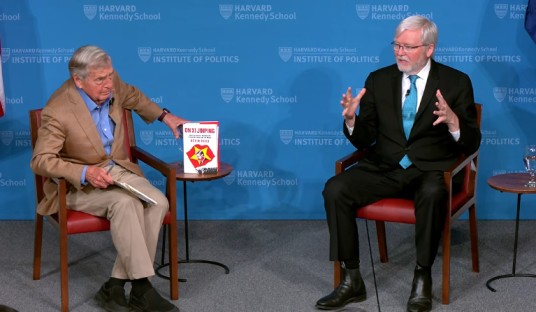
In this JFK Jr. Forum conversation at Harvard’s Institute of Politics, former Australian Prime Minister and ambassador to the U.S. Kevin Rudd joins Professor Graham Allison to unpack the U.S.-China strategic competition, Xi Jinping’s techno-industrial strategy, and the role of artificial intelligence in great power rivalry. Rudd explains his framework of “managed strategic competition,” his “shaving mirror test” for deterrence over Taiwan, and how middle powers, Europe, and the rest of the world are responding to China’s rise. Read the full transcript of this conversation which was streamed live on October 24, 2026 below:
Welcome and Introductions
LILY YAO: Thank you. Good afternoon, everyone. It is my pleasure to welcome you to the John F. Kennedy Jr. Forum here at the Institute of Politics. My name is Lily Yao. I’m a first year at the college and a member of the JFK Jr. Forum Committee. And since it’s family weekend here at Harvard, I’m especially happy to welcome my parents and many other beloved family members for our students.
Yes. Thank you all for joining us at today’s forum. Today, we have the pleasure of hearing from the Honorable Dr. Kevin Rudd, former prime minister of Australia, about the future of US China relations. Dr. Rudd has spent much of his career working on China, first as a diplomat, then as prime minister and foreign minister of Australia, and later as a scholar and policy leader.
He also served as the founding president of the Asia Society Policy Institute and Australia’s ambassador to The United States from 2023 to 2026. He currently serves as global president and CEO of Asia Society. Fluent in Mandarin Chinese, Dr. Rudd is also known by his Chinese name, Lu Kewen. He studied Chinese language and history at the Australian National University, where he earned a bachelor of arts with first class honors in Asian studies.
He received his doctorate from Oxford University in 2022, where his dissertation examined Xi Jinping’s ideological worldview. He’s the author of On Xi Jinping: How Xi’s Marxist Nationalism is Shaping China and the World, and The Avoidable War: The Dangers of a Catastrophic Conflict Between The US and Xi Jinping’s China.
Joining us as moderator is Graham Allison, the Douglas Dillon professor of government at the Harvard Kennedy School and a leading scholar of national security with particular expertise in nuclear weapons, Russia, China, and decision making. We’d like to thank the Belfer Center for Science and International Affairs for cosponsoring tonight’s event.
Now, please join me in welcoming the honorable Dr. Kevin Rudd and Professor Graham Allison.
GRAHAM ALLISON: So thank you very much. Welcome to the forum and a great opportunity to hear from one of the wisest and most thoughtful leaders about the defining international challenge of your professional lives.
KEVIN RUDD: Was looking around to see who you’re referring to.
GRAHAM ALLISON: Welcoming home Kevin is a pleasure for all of us who had the good fortune to know him over the many years.
The introduction certainly was all correct, but I just had a few wrinkles. So Kevin is virtually unique among China watchers in that he is both a real live practicing surviving politician. So he’s been in the arena of elective politics and risen to the top of that system in Australia to be prime minister, but also to be foreign minister. Also recently the ambassador to Washington.
But he’s also a full member of the analytic community, even after having been prime minister and spent a year with us here at the Belfer Center where he’s a member, a continuing member of the family. He decided, well maybe it’s time for me to get my PhD. Excuse me, you already know all this stuff. No, I think I’ll go back to Oxford. And he went back to Oxford, there he got his PhD.
We’re very proud in fact of the fact that his advisor, who was then a professor at Oxford, Rana Mitter, is now a professor here at the Kennedy School from whom you can take a course. So this is kind of all in the family.
And Kevin, let me start you off. So the plan for tonight is Kevin and I’ll have a conversation for the first bit, mainly my questions and his answers I hope. And then we’ll open it up for questions by the audience.
And let me start off by, we were chatting earlier today. You were, I guess, on Friday night at the Oxford Union in England in a debate and discussion about China. So let me ask two questions. First, Oxford and Harvard, which do you prefer? And I guess in each place you say you love whoever you’re with. And secondly, if we were… For people that don’t follow the China issues much, what are the two or three things they should know about China that you told folks at the union?
The Cracking of the Political Center and Today’s Macro Challenges
KEVIN RUDD: Well, on Oxford and Harvard, I prefer the Australian National University, but you’d expect me to say that. The… It’s great to be back, and great to be back here at Harvard, great to back at the Kennedy School, great to be here at the Belfer Center who’ve been very welcoming to me over the years when I first came to this country as a political refugee, having come second in one of our national elections. It means I lost.
Okay? Oxford, it was fun talking to the Oxford Union. How many of you been to Oxford? The… So I’ve spoken to the union a few times now, and I was talking to the bright eyed and bushy tailed people there about the cracking of the political center in… Across the democratic world.
It doesn’t matter if it’s here, whether it’s in Germany, whether it’s in Britain, whether it’s in France, Le Pen or whether it’s even prospectively in my own country. And what to do about the cracking up the center of the democratic project, the democracy project, as our institutions are tested and begin to look fragile.
At the same time, we’re relying upon those institutions simultaneously to enable us to wrestle to the ground these huge macro challenges washing over all of our shores at the same time. That is, on geopolitics, the great strategic competition between China and The United States, concerning which country and which culture will end up as the fulcrum of the unfolding international order for the twenty first century, the great geoeconomic challenge, which is often less spoken of, which is debt, debt and debt and that is the extent to which we can sustain our levels of global indebtedness without yet triggering another global financial crisis.
I was elected as prime minister as we just entered the last one. I remember what it’s like. It’s when my hair turned white, by the way. It used to be brown. So that’s what politics does to you. If we have another one, it’ll fall out.
And the third one is geotechnology, which is the rise and rise of artificial intelligence, sweeping all sectors of our society and the economy simultaneously and our pedagogy, as you guys know here at Harvard, and maximising the upside while protecting, to the extent that we can, the risks on the downside, including the security risk of frontier model agentic AI acting autonomously.
And then this quiet, slow, continuing challenge which ravages the planet each day called climate change, whether it’s politically correct or not to refer to it as such in this country. Watch the glacial collapse in Nepal and China and ask yourself whether the planet is warming or not. It is.
So what I was talking to the guys at… And girls at Oxford about was this dual set of challenges, the institution of democratic governments being fractured from within, from working families and working people unable to afford a dignified life and thereby retreating to the politics of the far right, a populist and often racist extremism, or to the far left. And at the same time, having to drive that car to deal with these macro challenges sweeping over all of us.
So I said to the generation of Oxford, and I’d say the same to this generation of bright young things here at Harvard, I think youth will face both the opportunity and the challenge of becoming yet again another greatest generation. I’m not saying I’m predicting war for you all like the greatest generation who prevailed in the last World War, but I have not seen such a wicked set of challenges unfolding simultaneously as I see today.
Why Learning the Language Matters
KEVIN RUDD: So that’s kind of what I said there, and I reflect And on it in terms of key bits of knowledge, look, I’m a bit of an old fashioned guy. If you want to understand China and you’re here at Harvard College or at the Kennedy School, wrapping your head around the language helps. It really does help.
When John King Fairbank set up the center here at Harvard from memory in the fifties and sixties, Graham, it was about the singular post war challenge for America, is creating an Asia literate, an East Asia literate in particular, generation of young Americans who could become the foreign service officers and senior public officials of The United States. That remains an imperative to this day.
And despite AI’s auto translate, there’s no substitute for you, an American, or you, wherever you come from in the world, being able to deploy the language effectively as a door, a tool to understand the way in which the other thinks, in this case, the People’s Republic Of China.
GRAHAM ALLISON: Let me stay on that one for a second and get you to drill a little further. So you’re a freshman at the college, or you’re a first year public policy student. And you’re thinking about your career, and thinking about your own personal career. So tell us a little bit about your own odyssey and what lessons you draw from it including about the language.
Let me just say another word about Kevin and for those that don’t know. So Kevin has many claims to fame, but one of which is he speaks Mandarin better than most Chinese leaders. That is not… I have been in a meeting with a person who works directly for Xi Jinping, watching Kevin speak and the person feeling very envious.
He doesn’t look Chinese exactly. He’s certainly certifiably Australian. And when he talks in English, can tell. But he mastered Mandarin. And that’s not… That served you well in becoming a foreign service officer. That served you well in becoming a foreign minister. That served you well in being prime minister and ambassador. So give us a little career advice.
Kevin Rudd’s Career Odyssey
KEVIN RUDD: Yeah. I think, well, I’ve tried to master three languages, English, Chinese, and Australian. And Australia is often incomprehensible for our American cousins, but we try our best.
I think all that I did as a kid growing up in rural Australia was form a pretty basic view that China would be huge in our country’s future. That’s all. And therefore, if you wanted to understand this unfolding phenomenon, then language was a tool to open those doors.
So I did effectively five years of modern Chinese language, classical Chinese language, and Chinese history. But we used to call in the old days the “Yao to Mao” course. Yao and Shun were the legendary founders of China in mythological times through to Mao as in Mao Zedong, “Yao to Mao.” So we used to start with the Xia dynasty, and then sort of 2,000 BC and move through to the People’s Republic over five years.
I’ve got to say the pedagogy was first class, and there’s never a day that’s gone past in whatever career I’ve had that I’m not drawing on elements of that learning in what I do in daily life. But as you know from your own career, Graham, it’s never just an even trajectory. You end up doing a range of things.
When I graduated back then in the early Mesolithic period, Graham’s a Paleolith. I’m Mesolith. The… Is that we were largely unemployable in… At those days in the eighties.
And so someone said, “Why don’t you join the Foreign Service?” And coming from rural Australia, I said, “What’s that?” And I then had to be told how you applied for these things. And to my great surprise, I was selected because I knew nobody. I mean, there’s a great testament to the meritocracy.
GRAHAM ALLISON: I think meritocracy has a lot to say for…
KEVIN RUDD: Oh, yeah. And I thought I was completely stunned that… “There you go. You’ve a job. Travel the world.” Then I’m a Chinese speaker, of course I’m pretty good by that stage. So they then sent me to Sweden. Go figure.
It’s not even, but then you reach a point as a foreign service officer where I actually, as a diplomat, got tired of writing reports for an audience of 50 or a 100 people and asking myself the existential question, have I moved the dial? Have I changed policy? Have I brought about a material result? And I actually found myself utterly dispirited.
Then I leapt off for the first time in politics, became the chief of staff to what you would call in this country a state governor. At the tender age of 30, I was running the bureaucracy of a state, a state that’s sort of a bit like Georgia in the Australian context. And then I went to the House of Representatives, and then one thing led to another.
So I suppose I’d say to everyone here, it’s never completely linear. It is in multiple directions. But the important thing to understand, I think, is what lights up your policy passion? What lights up your political passion? What lights up your personal passion?
My wife, Thérèse, who Graham’s met, is a psychologist. She always says that which you are naturally interested in, you’re going to be best at, as opposed to that which you think you should do because it’s the right thing to do. That which you are naturally interested in, you’re going to be best at.
So that’s kind of what I’ve done. So I’ve had multiple roles, but the underlying thematic of how do we prevent these 2,000 pound gorillas, The United States and China, from blowing their brains out and the rest of us along with them has been the enduring project.
GRAHAM ALLISON: So back to the sort of two or three major points that a freshman or a first year public policy student or the rest of us should know about the China challenge. I’d say the conventional wisdom that I believe is correct is that the rise of China and its impact on the international order will be the defining international issue for the lifetime of students here. So for ones that have not been following China as much, what are the two or three things you would say they should be attending to?
And let me mention this. Can we put up a slide here just for a second? For reading about it, there are two books that I would recommend by Kevin. $29.95 at the Coop. Here’s an example of one. One is about avoiding war. As he said, if we don’t succeed in doing that, you won’t have to worry about any other problems. Okay? And he’s got some thoughts about how that could happen.
And then secondly, more recently, the thought of Xi Jinping since it’s not simply thinking about China. But today, you have to think about Xi Jinping’s China since he’s the… As they say in the Chinese terms, he’s not only the CEO, the chief executive officer, he’s the COE, the chief of everything.
So Kevin, what are the… What would you say are the two or three things people should get started on if they’re going to try to live in a world in which China is the defining international challenge.
Three Things to Know: Strategic Competition, Managing It, and AI
KEVIN RUDD: So let me go to three points. One is about the underlying reality of the strategic competition which exists. Two is, can strategic competition be managed, or are we destined for it to be unmanaged and therefore utterly volatile, thereby presenting the rolling risk of crisis conflict and war? And thirdly, how does AI change the game, or does it not?
So let me just a couple of reflections about each of those. On the first, which is the nature of the strategic competition, you will hear people in The United States and in China piously say in public forums, “We’re not engaged in strategic competition with each other. We are simply doing our own thing.” Pigs might fly because the reality is within The U.S. System and within the Chinese system, there is a full blown strategic competition underway in every dimension of national political power and influence, militarily, economically, trade, in investment, in technology, in foreign policy, in ideology.
And it’s across the world. “Everything everywhere all at once,” as the movie said. And so that’s just going on.
The reason it’s going on is because China, given its history, seeks to, as Xi Jinping said just after he came to office, to bring about “the great rejuvenation of the Chinese people.” That’s what he wants. And when contrasted with China’s recent history, particularly its nineteenth century history and first half of twentieth century history, there is an enormous drive for that to occur. And it’s therefore about which of these two powers becomes, as I said before, the fulcrum for the unfolding international order.
Managed Strategic Competition
KEVIN RUDD: The second thing that for folks looking at this for the first time may wish to reflect on is if that is the nature of the beast, then can you manage it in a way which reduces the risk of it erupting into war? And that’s the burden of that book on the right there, The Avoidable War. It outlines a concept of managed strategic competition.
And I think without being sort of self indulgent about it, you see some of this language and conceptual framework reflected into both Xi Jinping’s and the current U.S. President’s framing of the relationship. The Chinese call it “constructive strategic stability.” And the Americans, through Trump, have by and large accepted that frame.
And when you parse it into its constituent elements, it’s about cooperation as being the main thread, the Chinese would say, competition within bounds, and then thirdly, managing fundamental strategic differences, open brackets, Taiwan, close brackets, but we won’t mention that explicitly, will we? And then if you do that, we have stability. That’s the Chinese frame. That’s what the Americans have broadly accepted to.
I put it slightly differently. Point one of managed strategic competition for us all to understand is how do you understand and, to the maximal extent possible, respect each other’s underlying strategic red lines, for which the biggest conflictual point is the management of Taiwan.
Two, in all other domains, compete the hell out of each other so long as it doesn’t become kinetic. So China and The United States currently engage in a massive competition about who wins the AI race. Let it unfold.
And three, are there still domains where these two countries can effectively collaborate and cooperate? For which the answer must be yes, either in terms of the next pandemic, in terms of climate once America returns to this table. And then thirdly, bilateral guardrails around, let’s call it for the moment, dangerous AI. So that’s the conceptual framework of managed strategic competition.
Xi Jinping’s Theory of Artificial Intelligence
KEVIN RUDD: And finally, I think there’s a third thing to focus on, particularly those of you who are just starting out at the college or just beginning your graduate courses, is if that’s a frame, where does artificial intelligence fit in the guts of this?
Xi Jinping’s theory of artificial intelligence is fascinating. For those of you who follow the Chinese debates, it’s called “new quality productive forces.” Xin zhi shengchanli. And if you look carefully at the ideological literature of this and the party’s theoretical journals, including articles written by Xi himself, He sees this set of technologies as radically transforming China’s ability to compete and then leapfrog The US, the West, the rest. That’s in their literature, so let’s not pretend it’s not.
What does Donald Trump say? “He who wins AI wins.” That’s what he said on the eve of this most recent Washington summit.
GRAHAM ALLISON: I think that’s what President Trump said too.
KEVIN RUDD: That’s what President Trump… Did I say Xi? I meant President Trump said on the eve of the most recent summit.
So, again, what I would encourage students of these complex questions to focus on is understanding the dynamics of the strategic competition, it’s real wrapping your head around what are the management mechanisms for it. They also are real and cogent and are seeking to be in part applied now, though I think this is a temporary management mechanism at present rather than a long term one.
And then thirdly, does AI unconstrained blow the whole show up, or is there a come to Jesus, come to Marx moment whereby they work out that frontier model, agentic AI, attacking autonomously each other’s infrastructures and systems, social infrastructure, economic infrastructure, financial infrastructure, the security of the banking system, political infrastructure, military infrastructure.
There was an attack recently and a great scooping out of information from the PLA using an OpenAI model. Well, that caused a come to Marx moment in Beijing, let me tell you. So these are the three domains I would encourage people to read about, think about and reach conclusions on.
China’s Techno-Industrial Strategy
GRAHAM ALLISON: Let me push you further on one that we were discussing at the China working group earlier today. So you gave a characterization of what you described as Xi Jinping and the Chinese government’s, I think you call it the techno industrial policy. Where basically one identifies technologies that will constitute the commanding heights of the future. And then with respect to those technologies applies the China strategy and pretty soon is the predominant producer of whatever is happening in that space.
And you could look at that in the solar story or you could look at that in the EV story or you were talking about the biotech currently and otherwise. So, as you think about that and particularly within Australia, you were involved very much in trying to get the Australian production of rare earth materials and magnets as a competitor. But if the Chinese system is working as it’s working, can anybody compete with that on a level playing field?
KEVIN RUDD: I think there’s been a fundamental transformation, Graham, in China’s macroeconomic model or its economic development model. When China acceded to the WTO in 2002 through to about 2012, you saw increasingly a China integrated into the global economy based around a set of broadly market principles and abroad imperfectly adhered to abroad and reliance often on the WTO dispute resolution mechanism systems for when conflicts arose. What did that orthodoxy generate? A decade and a half of double digit plus growth for the economy writ large.
I think what we’ve seen in the last decade or so under Xi Dada, Xi Jinping, is the following: a conclusion that this reliance on the market economy, and to paraphrase what he has said in the nineteenth Party Congress in 2017, was producing unbalanced and… Imbalanced and unfair development. And there’s a big ideological rupture which occurs in China’s economic model around about the mid teens, somewhere between 15 and 17.
One of the reflections of that has been China’s Made in China 2025 strategy launched in 2015, where Xi Jinping said to compete effectively against The U.S., The West and the rest in the future, we need to dominate the technology stack, not just the AI stack. And if you look at the 10 technology targets which he announces in 2015, we all looked at and said, “By God, that’s ambitious.”
Where is China on bio and biotechnology? Where is China on information technology? Where is China on new materials research? Where is China on aeronautical engineering and jet engines, etcetera, renewable energy? They’re all listed.
And you’ve got to say that after ten years, if you did the report card on where China got to against that techno industrial strategy, you would have to award Xi Jinping seven out of 10 because, frankly, they went from nowhere to somewhere big in the space of a decade.
And with artificial intelligence, what you see with China’s medium term to long term technology plan is an absolute determination now to do the same across the AI stack, including compute and including semiconductors, where China is probably now four or five years behind The US, and then to do the same in quantum and in nuclear fusion. The two huge, shall we say, game changers of the future, both in terms of energy, but also in what quantum then does to compute and AI writ large.
And so for a nation and a culture, which others have written, driven by an engineering culture but turbocharged by a Marxist Leninist ideology, which holds these material factors of production are capable of being driven hard through the interventions of a Leninist party to turbocharge your aggregate economic success against The U.S., the rest and the West. That’s the strategy.
Can we compete against it? You’ve got to say that China, therefore, has declared a global techno industrial strategy where, because of Xi Jinping’s parallel concern about national security and, therefore, national economic security and making China invulnerable to external assault at a time of crisis, The resolution is for China, therefore, to dominate each production chain in technology and advanced manufacturing and across general manufacturing.
So China now represents one-third of global manufacturing output. By 2030, it will be on current trajectories at least 40% and rising. The rest of the world is saying this is too much.
And therefore, The United States for a decade now has started pulling up the tariff wall against what it’s concluded to be subsidised Chinese exports to the rest of the world, taking out manufacturing across The U.S., across the West and increasingly Southeast Asia. And parallel to that, will the Europeans now act? Will the South East Asians act?
Because the big growth driver at present in the Chinese economy, given the enormous resource concentration in this techno industrial strategy, is net exports. So for those reasons, I think we’re on something of an economic collision course. And there will need to be some correction by the Chinese economic system.
Otherwise, the vulnerability to which everyone collectively signs up to is that whatever you need in the future can only be delivered through the Chinese global factory. And that is a risk which China would not accept for itself, and nor will the collective democratic world accept for itself.
Can Anyone Compete With the Chinese Manufacturing Ecosystem?
GRAHAM ALLISON: So maybe just one more footnote on that and then get ready with your questions at the various microphones. So if we… Part of the story is Chinese subsidies to the companies for production. But I’ve been drilling down on this and I’m suspicious that about how important that is.
So if you take Elon and the production of Teslas, there’s a plant in Shanghai, there’s a plant in Texas. They produce the same car. One is half the price of the other one for production. How can this be half the price?
Well, you go through all the various items. How much does it cost to get a part? How long does it take to get a permit? How long does it take to do this? How much does electricity cost? Blah blah blah, down the list. But I see the same two cars. They had all the elements. One gets produced at half the price of the other.
So if they have somehow created a manufacturing ecosystem and a production ecosystem that produces everything at half the price of the other competitors. I mean, it can’t be that everything will be made in China, but it could be a whole lot. So take us one more step or two down that road.
KEVIN RUDD: Yeah. I mean, it’s an excellent question. One, if there is a Western or American view that China is incapable of indigenous innovation, that is so passé as a view that it doesn’t pass any empirical test of looking at China’s innovative capabilities today.
Two, China does subsidise and subsidise by multiple mechanisms, the principal one which is financial subsidy through preferential soft loans and negligible taxation. And the soft loans are provided often by local banks who pay 1% interest on deposits.
The Chinese people have no opportunity to put their deposits elsewhere. You can’t speculate in the housing market anymore because the housing market’s collapsed and six years into recession domestically.
And so and then the government comes along and says, “We want you, the local bank, to provide an indefinite soft loan to these companies who are operating in our locality because we are going to be assessed from above by the central leadership in terms of our ability to grow firms, are globally active in each of these key technology sectors.” And that’s the message which goes down to local party secretaries. And so that’s the ecosystem which is at play here.
The net consequence of which is you would think if this was China continuing to move up the value chain, that it would abandon elementary production or basic production or non advanced production manufacturing, except it’s not. It’s staying active in being the world’s best sock producers as well as the world’s best and most efficient satellite producers, which creates general grumpiness in the global South because that crowds out the ability for other emerging economies to move their way through the production chain and the economic development chain. So that’s the ecosystem.
Adam Smith and the Party-State as an Economic Actor
KEVIN RUDD: The problem, though, for the rest of the world is this. Adam… Two things happened in 1776, right? You guys had a revolution. You got grumpy with the Brits. I can understand that.
We’re Australian. We never had a revolution. We thought it would disturb the weekend. So we just sort of gradually sort of reformed our way into independence. It was just a less tidy process, but we got there in the end.
The other thing that happened in 1776 is that Adam Smith wrote The Wealth of Nations and articulated core principles of price theory supply, demand, markets, etcetera ultimately dictating the most rational allocation of resources in a market economy. And so became sort of the overall doctrine of neoclassical economics, which by and large dominated the world for the next two fifty years. Britain, America and the rest, except one thing, Graham.
Adam Smith, who probably didn’t have much of a sense of humor, he was a Scot. Any Scots here that I’ve offended? That’s good. There were plenty at the Oxford Union.
He didn’t conceive of a single economic actor, a party state, acting as a monopolistic supplier and a monopsonistic purchaser in the global economy. That is the absolute power of the Chinese industrial model, the techno industrial model, which is why countries around the world are resorting to their own industrial strategies to respond in order to survive. That is where we are at the moment. The principle is, in both China and the rest, is with scale you prevail.
So what the rest of the world is now thinking through in response to the overwhelming power of this Chinese techno industrial strategy, driven by its own innovation, aided by its own subsidisation and its access still to global markets, is does the rest of the world therefore need to act in unison with each other in preventing this from dominating manufacturing across the world?
Will the European Union, for example, join the Trans Pacific Partnership economies of Asia and The Pacific in creating a combined entity in order to protect itself? If that happens, you not only join the European Union economies with what’s called the TPP 11, everywhere from Japan down to Australia, what happens if democratic India then joined as well? Because all are under the same parallel sets of pressures.
Add those three economic entities together, do you therefore begin to see the emergence of a critical economic mass capable of providing an alternative to the onslaught of the Chinese economic model? Those are the dynamics which are currently underway.
GRAHAM ALLISON: And I would say that would naturally lead to a question about whether there’s any other economic actors who might or might not be part of such an issue.
KEVIN RUDD: You mean The U.S. Of A?
GRAHAM ALLISON: Yeah.
KEVIN RUDD: I’m just assuming America’s out to lunch on this stuff because trade is not fashionable unless you’re exporting. But if the rest of the world and those three large entities were to come together, and there are dynamics at work in all capitals at the moment on these subjects driven by the exigencies of the Chinese techno industrial strategy. Post ’28, what does America do? Or do you end up with three parallel blocks effectively, the Chinese block, the democratic world block, and Uncle Sam trying to decide on its future.
Audience Q&A: What Are We Competing For?
GRAHAM ALLISON: So this… We could have fun drilling down on that, but there are too many questions waiting. Please share with them. Mic, introduce yourself and quick question and then answer.
AUDIENCE QUESTION: Yep. Oh, hello. My name is Effie. I’m from Australia.
KEVIN RUDD: Good to hear your accent. Good. Aussie, Aussie, Aussie.
AUDIENCE QUESTION: My question is, you talk about competition and how to win. My question is what do you think it is that we’re competing for? Specifically, you talk about China’s objective seems to be to rejuvenate the nation, taking at face value that doesn’t seem to be too much of a cause for concern if their objective is just to be respected by the world. Is there any indication that makes you think China wants more than that, that they’re going towards world domination, that gives us cause for concern?
KEVIN RUDD: Yeah. Think it’s a really good question because we need to look at a spectrum of possibilities and probabilities here. National rejuvenation, if you’re the leadership of China, is a perfectly legitimate objective, given China’s recent economic and political history. Some centuries of division, some centuries of weakness and many centuries of poverty and acute poverty.
And so if you’re a poor peasant in rural Hunan, back at the time of the civil war in the late ’40s, compared with where you are today, you’d actually say my lot has improved considerably. That’s point one.
Point two, though, Xi Jinping is not a status quo leader. Xi Jinping wishes to resolve the fundamental unresolved question of geopolitics, which is reunification with Taiwan. That’s clear from his declaratory statements. But also not just there, but similarly, the South China Sea, the East China Sea, the disputed islands with Japan, disputed islands with Korea and the Sino Indian border.
These are not status quo propositions. These are changing boundaries. And once you change boundaries by military force or the threat of military force, reactions ensue.
But beyond that, China’s declaratory policy also is that The US system of security alliances in the world, both in Europe and certainly in the Indo Pacific, are outdated relics of the Cold War and they should be dismantled. That’s not the view among the Allies, by the way, but that is China’s desire to change the security architecture in the region.
And furthermore, China is now the dominant military by a country mile across the Indo Pacific and second only in terms of aggregate military capabilities to The United States. That’s just a measurable empirical fact.
The final element of the equation is that vis-à-vis the future of the order writ large, if you study carefully the foundational documents which Xi Jinping has released over the last decade, many of you will have been studying them: Global Civilisation Initiative, Global Development Initiative, Global Security Initiative, Global Governance Initiative and, if you want some infrastructure, the Belt and Road Initiative. All these have a common principle, which is a new global order which increasingly has China at its centre, but also Chinese interests and values more respected at its centre.
So on the question of status quo versus change, we need to think carefully across those spectrum of changes which the Chinese are quite clear about in their official literature they’re moving towards. That is different from saying, “I, China, am going to invade New Zealand tomorrow.” That is not part of the Chinese cultural, national, or even ideological DNA. So… But these other things are material changes that I referred to.
The Role of Middle Powers
GRAHAM ALLISON: Okay. So the answer to this is that he did not learn Mandarin in order to be part of the first brigade ruling Australia. Please.
AUDIENCE QUESTION: Hello. My name is Julie, and I’m a second year MPP here. I have a question on your thoughts about countries that are not US and China within The US China competition. I believe that there are a lot of middle powers who would really like to not have to choose between the two even though The US and China would want countries to choose between the two.
And I think that there’s several countries who are now thinking of maybe they can play an active role in getting US and China to become more friendly and reduce the competition so that these countries can get the benefit of both US… Being friends with The US and be friends with China.
So I’m wondering if you think that there’s a way to reduce… Is there a possible future where US China competition doesn’t exist or reduces, is way less than how it currently exists? Or do you think this is a pipe dream for some of the countries that are thinking about…
KEVIN RUDD: Wish this was the case, that there wasn’t a binary strategic competition underway. But because of the nature of the two systems, ideologically and ideationally, plus the history of international relations, Graham has traced in his book over the last half millennium or so, this is the nature of the beast, that is, strategic competition.
Hence, I always go back to the second proposition. Can we manage it in a manner which is more stabilising than would otherwise be the case? Because in history, when there’s been no management mechanism, it’s usually ended disastrously.
The reason I wrote a book called The Avoidable War is because this bloke wrote a book called Destined for War, And we are friends and colleagues and have been that way for more than a decade. I thought we needed some different branding and labeling.
So my third point is, and you referred to middle powers, let me say something about that. Whether it’s creative powers, constructive powers, middle powers, the literature on this in the international relations theory domain is quite rich. Singapore, for example, is an exemplar of what constructive powers can do, even though it’s a small country. There are other microstates which take leadership on a range of issues in international order.
But on the fundamental security question which underpins international relations, my melancholy duty to inform you is that these ultimately involve certain binary choices between China and The United States, however we may choose that not to be… Want that not to be the case.
Secondly, however, listening carefully to Prime Minister Carney’s address at Davos in January this year on middle powers being active in creating alternative orders in the international community. There is agency for powers great and small to construct alternative economic orders, and I referred to the possibility and the potentiality of one such order before, that is the Europeans, the Trans Pacific Partnerships, the Indians.
And thirdly, there is agency and possibility for these countries also to look at governance models for artificial intelligence as it affects them, given that the market for artificial intelligence frontier models and diffusion, currently being constructed in China and The United States and diffused across the world, will have to deal with governance structures in the rest of the world. So if we wish to reduce the risks of autonomously acting agentic AI, then there is agency for middle powers to do that.
And the final thing is I’m still a pretty old fashioned multilateralist. That is, the reason we invented the United Nations in ’45 is not because we were creating heaven on earth. We were creating a system which is capable of managing effectively a whole range of international challenges, if not all of them, in order to benefit humanity.
So the role for the middle powers and others in the international system, in the UN system, is to use their resources, their capability and their budgetary resources to backstop these agencies of the UN system, whether it’s the World Food Programme, whether it’s UNICEF, whether it’s the UN OCHA, whether it’s UNFCCC on climate or whether it’s the World Trade Organisation, which still runs under MFN principles 90% of the world’s trade, to continue to prop them up at a time when The United States is withdrawing from them.
Now these are practical areas of what I describe as state activism from creative and constructive powers as well as middle powers.
How Do We Avoid War? The Three Ds and the Shaving Mirror Test
AUDIENCE QUESTION: Thank you. Hello, everyone. My name is Ricardo Dela Fuente. I’m part of the senior executive fellows program here at the Harvard Kennedy School. Yesterday, I was with my dear friend Santiago, and he told me that it’s very hard to get into Harvard. It’s even harder to get into Professor Allison’s class because he’s the founding dean of the Harvard Kennedy School.
KEVIN RUDD: Yeah, he’s a nice guy. Just send him a letter.
AUDIENCE QUESTION: And today, I had the magic of the schools. Today, I was able to sit down next to two former presidents, Dr. Alvi of Pakistan and my dear friend Jamil Mahuad, who did the peace treaty with Peru. And now I’m able to ask a question to the former prime minister. So thank you, professor Allison for your leadership for making all this possible. So…
GRAHAM ALLISON: Very fortunate to have in Kevin a great colleague and friend. Please.
AUDIENCE QUESTION: So my fellow Oxonian, I have a question for you. What is the one thing we can do to avoid war? What is the one thing we can do to end war? And what is the one thing we can do to create lasting peace?
KEVIN RUDD: I’m not the pope, so the last one. We do like Pope Bob. He is a good Catholic, so almost. Any good Catholic means they’re bad, so those of you Roman Catholics understand those questions.
I’ll go to the first part of your question, which is how do you best prevent war. It’s old fashioned, but let me tell you, if you accept the reality of strategic competition, if you accept the reality as posed to me before, the question about unresolved security dilemmas such as Taiwan, The essential ingredient here is the three Ds, deterrence, deterrence, deterrence.
May actually be critiques, critics, of what has happened in the nuclear domain since Hiroshima, but deterrence has worked across the better part of eighty years. This is no small thing. Applied in the conventional domain, but across all categories of weaponry, deterrence as it relates to stability in East Asia and the West Pacific is actually the name of the game.
People have asked me what the hell does deterrence mean? Here is my lay rendition of deterrence. It’s the Kevin Rudd thesis. It’s called SMTX. Sounds really scientific. We have a natural bend in that direction as Australians. SMTX means the shaving mirror test of Xi.
Okay. So I’m Xi Jinping. I’m having a shave in the morning, and I’m looking in the mirror, and I’m thinking, “Taiwan, can I resolve this militarily?” And simultaneously, we’d like the little voice in the left ear or the right ear say, “Not yet, comrade. It’s still too risky.” That’s what deterrence is, and that is as soon as you reach a point where you conclude that a matter can be resolved unilaterally militarily, then deterrence has failed.
So it is unromantic. It’s not saying that everyone had a seminar at a UN sponsored conference and felt warm and cuddly towards each other at the end. I’m not saying that. I’m saying that if you’re sitting in the Central Military Commission in Beijing and the Pentagon in The United States and the Ministry of National Defense in Taipei, the reality or the absence of effective deterrence is actually that which shapes whether or not we can actually continue with strategic stability and peace. And I’ll leave it to the holy father in terms of how we could turn that into a permanent peace.
Eighty Years Without Great Power War
GRAHAM ALLISON: Let me take just one footnote on this one because I think it’s a great question, and I think actually way too little discussed in the current American and international security context. So the idea that we’re living today in the eightieth, eighty first year without a great power war isn’t the most amazing thing. So this is the longest period without great power war since the Roman Empire.
This is a feature of a international order that was built mainly by American leadership and architecture after World War two. By people who lived through World War two, realized how catastrophic that was, and determined that they were on the wrong course.
So many of them, for example, a distinguished Harvard Law School graduate, Henry Stimson, had been the secretary of war in World War two. He had actually been the secretary of war in World War one. So just in one generation, we’ve gone from 25 million people killed in World War one to 50 million people killed in World War two. And we were on a path that would normally have led to a genuinely catastrophic war in another generation. But because people built an international order, we’ve had the good fortune to live our whole lives without that.
Now that international order, as Kevin has described, I think absolutely correctly, has been sagging. And then unfortunately, as the Munich security people put it this past year, we’ve entered into kind of an era of “wrecking ball” international politics. In which the great irony is that the principal architect and builder of the order appears to be the wrecking ball. So that’s a difficulty.
So I would say that reason why Kevin’s book on avoidable war is part of what should be a much broader effort is there are lots and lots of places in the world where there are conflict, where conflict could have been prevented. So conflict prevention, which used to be a big idea in terms of the renovation of the order that was built after World War two, has kinda now come to be a side shot.
And I would say therefore, there’s a great opportunity for next generation folks like you to be trying to think about how do we build and sustain an international order that doesn’t have recurring conflicts with all the catastrophic…
KEVIN RUDD: My footnote to Graham’s footnote is…
GRAHAM ALLISON: That’s right.
KEVIN RUDD: In maintaining peace and stability, which is core to everything else, the concept of deterrence about which I spoke before is in fact mutual. It is not just America and allied deterrence against China over changing the map militarily in Taiwan and the rest of East Asia. That is one aspect of deterrence.
Weishe, the Chinese term for deterrence, is also mutually applicable. That is, it’s China deterring The United States and deterring those on Taiwan from unilaterally changing Taiwan’s political status. So is a… It’s a mutual concept.
GRAHAM ALLISON: And I’m not disagreeing with the deterrence point at all, but I’m trying to put it in a bit broader context. If I just do one more element, if you go wander around the park down here, you’ll see at the entry to every park, every one of the entries, there’s a couple of columns. And on the columns are quotations from the fellow for whom this school is named, John F. Kennedy.
And he’s got a wonderful one just here between, here in the business school if you look, about the twilight struggle for mankind against the common enemies of mankind, which are “poverty, disease,” and he says ultimately “war.” So I’d say a good place to work on. Please sir.
What Drives Xi Jinping’s Ideology?
AUDIENCE QUESTION: Hello. So my name is Ray Shu Zhang. I’m a first year MPP student. And your book, your title talk about when it’s mentioned China, talk about Xi Jinping’s China. So which probably indicate that the ideology of Xi Jinping will have a huge impact on the future trajectory of China, US China relationship, and even the world.
So my question is, what is the main composition or the principal element that affect President Xi Jinping’s ideology today, whether it is, for example, the historical momentum from ancient Chinese civilization, concept like unification, or is the concept of political legitimacy, or whether it’s the one hundred years humiliation, or the Marxist Leninist ideology, or Mao’s ideology, or is it a more pragmatic approach on political issues?
KEVIN RUDD: I think being a political leader myself, I can just say this. We’re not monochrome. That is, when you ask, why did country x do this to country y, there is rarely a single answer. Okay? So therefore, we need to reflect on that reality.
Secondly, I’ve had the benefit of having had quite a number of conversations with president Xi Jinping over a number of years in different capacities. Therefore, if you ask me to answer this question, what ultimately drives President Xi Jinping, I’m not a psychologist. Okay? I’m an analyst. Okay?
I also like a glass of red wine, and so did he at the time. Well, I’m Australian. He was in my residence in Canberra. And it was a roaring winter’s night, I remember, and the log fire was burning intensely. And we talked a lot about Chinese history and because that’s my shtick as well. That’s the thing that I know best.
So I’d say two or three things. One is he is a Chinese leader, therefore he’s deeply animated by historical worldview of China’s place at home, in the region, and in the world. And if you are a student of Chinese historiography of this, from the classical historians of Sima Qian down to the present, there is a notion of China’s intrinsic greatness in its history and its civilizational continuity. Is that a factor, therefore, in the contemporary political psychology of China? Of course it is. That’s just the reality.
There’s a second driving factor as well, which is why I wrote this thing on Xi Jinping’s ideological worldview, because he’s a Marxist Leninist too. And for people who think that Marxism, Leninism, and ideology don’t matter in China, they haven’t quite got the memo because Xi Jinping would spend probably 20% of his time on ideological questions if I was to aggregate the totality of his writings on these questions.
And within Marxism Leninism, what does it mean? A view of historical materialism, dialectical materialism, about the machinery of change in the world, which is not cosmetic post facto constructions, but actually represents a belief structure about China’s inexorable rise through this machinery of history. So that’s part of his driving mechanism as well.
And thirdly, he’s a pragmatic strategic leader who understands, “My god, we’ve got Iran happening at the moment, what the hell am I going to do about it? Do I help The United States? Do I not help The United States? They created this problem uniquely at their own hands. What happens if I seek to intervene? Is it better that I don’t intervene?” So he’s a very pragmatic political leader as well.
So when I look at his posture and that of the system of which he presides, as Graham said, he’s the chairman of everything, then he is an amalgam of these traditions, including the realism of the moment.
In terms of classical realism, for those of you who are students of international relations theory, let me tell you that Chinese invented realism before we even thought about it in the West. Look at Han Feizi, look at Li Si, look at the entire Chinese canon and its description of these. Look at the seven military classics, look at Sunzi Bingfa, The Art of War. China’s realism has been around for at least two thousand five hundred years.
So that animates China’s intellectual, and therefore Xi Jinping’s posture as well. So when I said it’s not monochrome, it does draw from these traditions. The reason I wrote this book is the one that was least emphasized in the recent literature on China was the ideological Marxist Leninist view, but it’s part of an amalgam.
Rapid-Fire Questions: Tibet, Language, Europe, and China’s Neighbors
GRAHAM ALLISON: So we’re getting close to the witching hour, but we’re going to do your short questions. We’re going to take one, two, three, four, and then we’re going to… Kevin can answer altogether. But please, quickly.
AUDIENCE QUESTION: I’m Tenzin from Tibet. And just yesterday, we had another 7.0 magnitude earthquake in Tibet, so natural disaster. Dr. Rudd, how do you see Tibet as a Achilles heel for China in the broader U.S.-China strategic rivalry? And how can we bring Tibet and human rights back to the forefront of U.S.-China relations rather than allowing them to be overshadowed and overwhelmed by the economic and security interests? Thank you.
GRAHAM ALLISON: Great. Good, clear, short. Please.
AUDIENCE QUESTION: Thanks, Dr. Rudd. My name is John Rossi. My partner Kate is Aussie. She says hi. I wanted to just ask on the language piece in what way has How studying was the language?
KEVIN RUDD: You understand the Australian?
AUDIENCE QUESTION: It’s a work in progress. Okay. Yeah. But wondered how studying Mandarin has meaningfully progressed or changed the way you understand China or Xi’s politics. Or maybe put another way, what do you think gets lost in translation when American or Australian leaders are engaging with China purely through English translation? Okay. Thank you.
GRAHAM ALLISON: Great question. Please.
AUDIENCE QUESTION: Hi. I’m Anna Taylor. I’m here from Scotland actually.
KEVIN RUDD: Thank you. Great reception.
AUDIENCE QUESTION: So my question was about the…
KEVIN RUDD: I’m sorry for hurting the feelings of 1.4 billion.
AUDIENCE QUESTION: It’s okay. We’re used to it. My question was about the electro tech stack that you said China was building. As you said, businesses in The U.S. And Europe aren’t on an even playing field given the ecosystem and kind of policy environment in China is very supportive. If you were advising Europe who’s considering the Industrial Accelerator Act, do you think it’s a good idea, and what kind of… What should the European response be to this? Thank you.
AUDIENCE QUESTION: Hi. Roy Schwarzzehon. Thank you for being with us. I wanted to ask you about China’s neighbors. It seems that few neighbors could have had better relations with China, but they… For some extent, they pushed them into The US arms, specifically, I think Vietnam, Philippines, South Korea, other neighbors to some extent. Why don’t they maximize their neighbor relations? Thank you.
China’s Neighbourhood Policy
KEVIN RUDD: Well, got the doozies coming last. So the… Let me be diplomatic and nondiplomatic in answering them or trying to answer them because I think we’ve then got a wrap. Is that right, Graham? I’m going to do them in reverse.
The China’s neighborhood policy, neighbouring relations strategy, is a core element of Chinese foreign policy strategy. About every half decade to a decade, the Chinese system convenes a specific central party conference on the state of its relationships with its neighbours. These are always fascinating documents to read, primarily because they’re never released. So we don’t know what’s in them. We have People’s Daily summaries of them.
So the Chinese have sought to become the indispensable economic partner of its neighbours, with a subliminal expectation that its neighbours will therefore be respectful of China’s fundamental political and foreign policy interests. That is the sometimes less than opaquely stated subtext of China’s general neighbourhood policy.
International relations theory, you know that when states sense the rise of a major power, that they have two options in classical international relations theory. They either balance or they bandwagon. They balance against the rising power, in this case China, or they bandwagon with the rising power because they think there’s no alternative.
And you see those dynamics at play with various of China’s neighbours. Russia has bandwagoned. Other countries have adopted different postures, including, for example, Japan and the ROK.
I think for Southeast Asia in particular, and to some extent Northeast Asia and Central Asia, there is also a long residual memory, historical memory, of China’s tributary state system from through the Ming and through the Qing, five hundred years of an expectation that China would trade with its neighbours so long as its neighbours did not misbehave, and then your head would be delivered on a platter to the emperor. And so there’s a fair bit of established foreign policy history around this.
It’s an amalgam of the above, but the principal driver at present, as it was in imperial times, was, shall we say, the opportunity to enjoy the riches and largesse of the Chinese market, but with a certain political and foreign policy conditionality attached to it.
Europe’s Response to China’s Tech Stack
KEVIN RUDD: On the tech stack and Europe, thank you for the question, and the Accelerator Act, I think the structural point that I made before is that the sheer size and momentum of the Chinese techno industrial strategy is now washing so broadly across the European economy, that is inevitable that there will be a reaction.
In German manufacturing, losing 12,000 jobs a month Volkswagen, 160,000 employees sacked recently and a genuine question about the future of German auto writ large, but beyond auto, other sectors as well, is generating these reactions.
So what are the two courses of response? China could voluntarily agree not to do it. You see the slightest indication of that in terms of its recent agreement to quotas in the export of hybrid cars to Europe. But frankly, against the central drivers of what is occurring at the moment, that just won’t wash. So on the content of the European Accelerator Act, I simply regard that as a natural and normal action to protect that which you have.
Where do we get to in the end? China’s strategy is if it can simply hold on and continue to prevail, then ultimately its price structures will prevail and what some would argue would be its subsidised export price. Europeans will look at that and say, “But will there be any European manufacturing left and does that matter?” To which the Europeans would say, “Yes, it does matter, not just because of employment, but when we actually require certain essential manufacturers in the future, do we remain ultimately hostage to one single supplier in the world?”
So I think it’s an inevitable structural response to what the critics of China’s techno industrial strategy would describe as its unbalanced and therefore unsustainable economic model.
Language and Understanding Otherness
KEVIN RUDD: On the third one on language, which you asked me about, and I hope you’re learning Australian English on the way through, deepen it and broaden your mind and your sense of humour. That’s good to hear.
I think I would simply go to this question. If any of you are considering futures and foreign policy or strategic policy, the essential discipline is simply this, to understand otherness. Now that’s easy to say, but by God it’s hard to do.
The think tank that I head in the Asia Society, the Asia Policy Institute, the Centre for China Analysis, we have one discipline. Everyone has to be a linguist. Secondly, we understand China from the inside out, not the outside in. We look at the Chinese internal literature, which despite its opacity does describe an internal debate about which direction China’s going in and why. And then thirdly, we then reflect on what the rest of the world, for example the Europeans, could and should perhaps do in response. Language is a tool to reinforce the discipline of understanding otherness.
There’s a great hazard we all got which is called the English language. The Brits invented it. It was kind of a minor language over there. If you read Chaucerian English, how could that ever become a global language? It’s incomprehensible.
But it did because we had this thing called the British Empire, and then they colonised this country, which then became the largest country in the world, and they learnt English, well, sort of. And as a result, this thing called English has become the dominant global language.
There’s a hazard in this. There’s a real hazard in this, which is it carries with it a whole bunch of inherent cultural assumptions which do not provide an adequate and respectful understanding of the otherness of the world.
And in this age, when the countries and economies of the Asia Pacific, on any piece of economic mathematics will dominate the global economy by the second half of this century, it becomes axiomatic to understand from the inside out. So it doesn’t need to be Chinese necessarily, but it certainly would need to include the principal languages of the region in one form or another.
Tibet and the Dalai Lama’s Succession
KEVIN RUDD: And saving the doozy until last, which is Tibet, which, of course, is not a sensitive subject. Looking to all my Chinese friends here, looking at me with great pain and anxiety at the moment, and looking at my Tibetan friend with equal pain and anxiety.
Can I say the following, that the history has been complex, torturous and difficult? Secondly, I’ve met the Dalai Lama on many occasions in the past and often to the complete chagrin of my Chinese friends. As Prime Minister of Australia, as leader of the opposition in Australia, that’s what I did.
Thirdly, this will come to a new crisis point when the Dalai dies. He’s already 90. And so what happens with the reincarnation at that point? China has already indicated that the reincarnation will occur within China. The Dalai has said that it will occur outside of China, brackets presumably in Dharamsala, which is where the Indian government currently hosts the Tibetan spiritual leadership in exile.
And so I would hope, I would just hope, that in terms of this question of religious dignity and autonomy, we can find a way through this for the future, given the depth of Buddhist sentiment which still exists across the entire Tibetan culture and civilization and in a manner which doesn’t erupt in violence. I don’t know where the landing point is, but there must be a way through on this one. Thanks, Graham.
Closing
GRAHAM ALLISON: Oh, thank you. So what a fantastic opportunity to have our colleagues up. We’re hoping that in one of the next chapters of his life, it’ll be full time here, but not quite yet. Thanks, folks. Appreciate it.
Related Posts
- Jeffrey Sachs On Economy, Ties With China & New World Order (Transcript)
- View From India Podcast w/ Gautam Bambawale: India Walking A Fine Line (Transcript)
- Transcript: Marco Rubio Remarks at G20 Summit Press Briefing in Atlanta
- Einar Tangen: China’s New Economic Strategy vs the West’s Ideological Trap (Transcript)
- Transcript: Mearsheimer & Parsi – Will Trump & Israel Strike Iran Again?