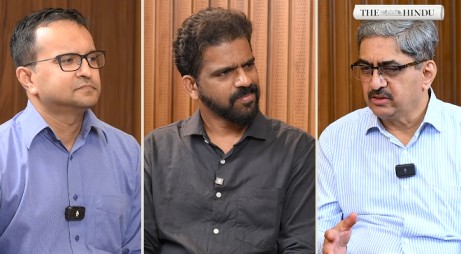
In this episode of The Hindu’s View From India podcast, former Indian Ambassador to China Gautam Bambawale joins Stanly Johny and Ananth Krishnan to talk about how India is walking a fine line between the United States and China. They cover India-U.S. ties under President Trump, the India-China thaw after Eastern Ladakh, Chinese export controls, the Russia-India-China triangle, BRICS, the SCO, de-dollarization, and where India fits in the emerging global order. Read the full transcript of this interview (October 26, 2026) below:
India-U.S. Ties Under President Trump
STANLY JOHNY: (00:01:57 – 00:03:20) Hello and welcome to The View from India. This is Stanly Johny, The Hindu’s foreign affairs editor. We are witnessing two major global conflicts, one in Europe and the other in West Asia, with implications for India’s long-term strategic partnership with Russia and its energy security. When it comes to its ties with the United States, one of the most consequential strategic partnerships of the country, India has witnessed recent challenges. And with regard to China, there is a rapprochement in the relationship, but at the same time, tensions persist, particularly when it comes to the border issue.
To discuss these issues and more, I am today joined by Ananth Krishnan, The Hindu’s correspondent in China, and Ambassador Gautam Bambawale, a scholar diplomat who had served as India’s Ambassador to China and its High Commissioner to Pakistan. Thanks for joining me, Ananth and Ambassador.
Ambassador, let’s start with India’s relationship with the United States. So we have seen several ups and downs in recent months, particularly after Trump became the president. And on trade, on the issue of trade, there are concerns that remain unresolved. And Marco Rubio, the Secretary of State, was recently in India. And how do you assess, one, Marco Rubio’s visit, two, the larger challenges that we face?
GAUTAM BAMBAWALE: (00:03:21 – 00:06:00) Yeah, that’s a very topical and excellent question, Stanly, so thank you very much for asking it. The way I see it is that there is very little doubt that since President Trump took over as the President of the United States, that there has been a clear deterioration in India-U.S. ties. There’s no doubt about that on several fronts.
One is, of course, on the trade front, where a lot of tariffs at different levels have been imposed on India. Even today, though there is a reprieve for the time being, there is very little doubt that some of the laws which have been passed recently in the United States could be used against India for levying tariffs by the United States because India imports Russian oil. So that threat is still there.
There has been the whole immigration question, and all of us in India remember very clearly how illegal Indians who had migrated or who were staying in the United States were flown back in chains and so on. So on the whole, I would say there is a very clear deterioration in the relationship.
I think what we are trying to do and achieve is trying to maintain the relationship at the lower levels. And Secretary Rubio’s visits over the last 4 months— he’s been here 3, 2 times— I think are one of— is one example of how we are trying to maintain the relationship. Also, there are other examples where we continue to work with the defense side with the United States. The PACOM commander was here in India, etc., etc.
And to go back to Rubio’s visit, what I’d like to say is that we’re trying to maintain India-US relations at that level through Secretary of State and National Security Advisor Rubio. His first visit to Delhi 3 months ago was more a political visit where he had interactions with our External Affairs Minister Dr. Jaishankar, with the National Security Advisor, also called on the Prime Minister.
This time his visit is more an economic visit to shore up the economic relationship between the 2 countries, and therefore he goes to our financial capital Mumbai and visits one of the biggest refineries that exists in India, or in fact anywhere in the world. So I think this is an effort to ensure that at other levels below the presidential level that India-US ties continue to move ahead and that this sort of partnership can be continued sometime in the future whenever that happens.
U.S.-China Strategic Competition and India’s Strategic Utility
STANLY JOHNY: (00:06:00 – 00:07:06) So let me bring in one more angle into the India-US relationship, which is China. So Xi Jinping recently concluded his state visit to the United States, and when we look at the China-US relationship from afar, what I— I may be wrong, but when I look at it, what I see is that there is a new quest from both sides to stabilize the relationship. They also talk about the strategic stability.
And in India, in many of our discussions, we have heard that India could become a counterforce against China, or rather the United States was looking at India as a counterweight to China in the Indo-Pacific region. So now that the United States and China are pushing for strategic stability, so do you think the American perspective of India is changing? Or if I put it this way, India’s strategic utility from an American point of view is declining?
GAUTAM BAMBAWALE: (00:07:08 – 00:09:19) No, that’s an excellent question, Stanly. The way I see it is that international politics today— the main characteristic of international politics is the strategic competition that exists between the 2 major powers, or the 2 superpowers if you want to call them that, which is the United States on the one hand and China on the other. So the basic relationship between these 2 powers, between these 2 countries is one of strategic competition.
One way of tackling that strategic competition is try to control it, try to have some guardrails around the competition. And we know that today this competition can be seen in the technology field, it can be seen in the trade field.
But trying to manage that competition is perhaps what President Trump and also President Xi Jinping of China is trying to do.
But I am quite confident that in the longer term, that the basic nature of international politics, of there being strategic competition between these 2 countries, will reassert itself. And when it reasserts itself, and when this attempt to build strategic stability fails— and it will fail because the nature is very different of this relationship that the importance of India will be understood. It is understood by many people in the United States even today, including by President Trump.
So, and I feel that the Indo-US relationship may have deteriorated, but there are levels at which it continues to function. If we actually arrive at a trade deal, and by all indications we are soon to arrive at at least the first stage of a trade deal between our 2 countries, which is India and the United States. It will further lay the foundation for a quick change in India-US ties if there is a change in US-China ties. And I believe that there will be a change in US-China ties because the very nature of the— that relationship is competitive.
“America First” and a More Transactional United States
ANANTH KRISHNAN: (00:09:20 – 00:10:16) Stanly mentioned the space that India kind of occupies in US thinking. If I can flip that around a bit, in terms of how we look at the US. I think I agree with you when you say that the fundamental competitive nature in China-US will change, but the other kind of trend we’re seeing is how the US looks at the region.
As you rightly pointed out, bilaterally the relationship has its own logic. There’s such a close partnership in defense, security, tech, but at the same time you’re seeing a different appetite in terms of how the US engages in Asia and wants to get involved with— in matters far away from its shores. This idea of “America First,” which probably will outlast Trump. From that point of view, do we also need to reevaluate how we look at how far the US, for instance, will go in terms of the assumptions we might have had in the past, for example, in how we deal with China or other challenges in our neighborhood and in the Indo-Pacific?
GAUTAM BAMBAWALE: (00:10:17 – 00:12:04) No, there’s very little doubt that since President Trump became president of the United States, even in the first term that the United States has become more transactional. And when we talk about being more transactional, what I mean is that there has to be give and take simultaneously. “I’ll give you this, what will you give me in return?”
So there is this change which has taken place in the United States, not entirely because of an individual, not because of President Trump, but because of the fact that the United States itself is reassessing what’s happening domestically in the United States and also how that impacts its exchanges with the rest of the world. So there is a feeling that there needs to be a restructuring of the U.S. economy. There needs to be at least some degree of manufacturing which should come back and be done in the United States, and so on and so forth, that some industries should be there which are very highly strategic industries like semiconductors should continue to be— the manufacturing, design, etc.— should continue to be in the United States.
So it is because of all these reasons that the way the U.S. deals with other nations across the globe has changed. I think we’ll just have to adjust to that. We are adjusting to it already, but we’ll have to adjust to that in order to be able to show and tell people in the U.S. that, “Look, if you give us X, then we’ll be able to give you Y in return.” So that is something all of us across the globe are getting used to. But you’re right, it is here to stay. It is not going to change because one president leaves and someone else is voted in as the president of the US by the people of that country. So you’re absolutely right there.
From the Informal Summits to Eastern Ladakh: “10 Steps Back”
ANANTH KRISHNAN: (00:12:04 – 00:12:45) And during Trump 1.0, you were the ambassador in Beijing, and there was a sense among some observers then that the unpredictability that had kind of come into the world system at that period was one among many reasons why we have this huge effort by India and China to fix the relationship. You were the ambassador when the informal summit happened and Prime Minister Modi traveled to China. It was a very significant moment in the relationship. You kind of see parallels, although the India-China relationship has shifted so much, and you can— we’d love to hear your thoughts about that, but you see some parallels to what’s kind of driving the sense of looking for predictability in the relationship between India and China now?
GAUTAM BAMBAWALE: (00:12:46 – 00:16:05) Yes, I— look, at that point of time, you will recollect, Ananth, that we have— we had had the dust-up for 72 days in Doklam, and the effort in the informal summits was to have a discussion across the board on many topics as possible between the topmost leaders of the 2 countries. So Prime Minister Modi on our side and President Xi Jinping on the Chinese side. Unfortunately, it can’t all be resolved, and understanding cannot be enhanced significantly with just one or 2 meetings.
And unfortunately, the informal summit process couldn’t continue because after the meeting in Wuhan in April of 2018 and the follow-up meeting here in Chennai in October of 2019, you had the military action that the PLA and the Chinese— I don’t blame the PLA entirely because Xi Jinping heads the PLA. So there was a political signal which was given also. So what happened in Eastern Ladakh set back the relationship tremendously.
In fact, I have described it as the— because what happened in Eastern Ladakh was not just between small numbers of troops accidentally coming face to face. So these days you’re reading about face-offs, but these are small numbers of troops. In Eastern Ladakh, there were 2 divisions of troops, 50,000 troops on both sides. So there’s a large number, and also along a whole— more than several hundred kilometers of line, the Line of Actual Control. And therefore it was a significant military action which set back the India-China relationship.
I have described it as being “10 steps back.” And since 2024, when people have described what is called a thaw in the India-China relationship, we have only taken 4 steps forward. The net result is we are still much further back than we were in 2019 when President Xi Jinping visited, and you were there in Beijing at that time too, Ananth.
There are so many things which we were doing between the 2 countries, between the governments, between the peoples, between the businesses, which are not happening today. Just as an example, there are so many economic dialogues which took place between government departments on the 2 sides which have not come back on track.
So I describe it as “10 steps back” because of the military action that was taken by the Chinese in Eastern Ladakh. And since 2024, maybe we have taken 4 steps forward in terms of resuming flights, resuming the Kailash Mansarovar Yatra, perhaps even— I don’t think we made it easier to get business, get visas, but that will come also. But we’ve maximum taken four steps forward. So the net is there is a still negative balance, and the India-China relationship today is not even where it was in 2019. So there’s a lot of work to be done there. But I would say that the main cause for this setback is the Chinese military action in Eastern Ladakh.
Is the India-China Border Stable?
ANANTH KRISHNAN: (00:16:06 – 00:16:55) Because of what you mentioned, Eastern Ladakh, there’s a— I think the public rightly will question the foundations of this normalization, because the question always is, can this happen again? Do you think that with President Xi visiting India in September and the leaders meeting 3 times in 3 years and meeting again next year, have they at least, do you think, achieved a modest kind of outcome of putting a floor or structures in place to prevent that from happening? Or is the nature of the boundary such that there’s always this chance that something could happen?
And I only ask this because in the news now, you have the outgoing DG of the ITBP saying that there have been flashpoints in Arunachal Pradesh. So how do we kind of make sense of the situation on the boundary now? Is there some stability, or is that something that you always have to be kind of watchful about?
GAUTAM BAMBAWALE: (00:16:55 – 00:19:17) No, I think it is something you’ve always got to be watchful about, and I’ll try to explain my reasons for that. If you look at the basic positions on bilateral relations, there’s a fundamental difference between the Indian position and the Chinese position. The Indian position, which has been reiterated by our External Affairs Minister Dr. Jaishankar many, many, many times in the last 5 years, is that unless there is peace and tranquility on the border, the rest of the relationship cannot move ahead. The rest of the relationship will be negatively impacted.
The Chinese, on the other hand, don’t agree with this. They say that “we have kept the border in a separate compartment,” and even if border face-offs take place, even if in Eastern Ladakh takes place, the rest of the relationship, whether in trade, technology, investment, business dealings, people-to-people exchanges, should go ahead. So that encapsulates the fundamental difference of opinion between India and China.
And I think therefore, if there is this fundamental difference in the approach to the relationship, you can— you have to be— at least India has to be very careful about what happens on the border, because the next time there’s a serious uptick on the border, there’s serious problem on the border, it will impact the relationship negatively again.
And to just finish off, Ananth, with that point about the DG ITBP speaking about what’s happening in Arunachal Pradesh. Look, I tried to make this distinction between smaller numbers of troops, which is what happens when they accidentally come face to face because there is no clear demarcation of the Line of Actual Control. So it’s quite possible that accidentally small numbers of Indian soldiers come face to face with small numbers of Chinese soldiers. That’s a different kind of thing.
What happened in Eastern Ladakh with 2 divisions of troops was well thought out, well planned, well executed military maneuver, and is a different kettle of fish altogether. But I think both things, the face-offs will definitely continue. But if we can’t completely write off a major military maneuver like what happened in Eastern Ladakh either.
Walking a Fine Line Between the U.S. and China
STANLY JOHNY: (00:19:18 – 00:20:13) So let me put together the 2 points we discussed here and get your perspective on India’s policy going forward. So one is the US and the other is China. So with China, we have ongoing concerns. You just explained about the border problem. And with the United States, we have witnessed a deterioration in our relationship with the United States.
So I’m also trying to understand this. The United States, of course, is a very important partner. And China is a challenge that we need to deal with. So how should India deal with these 2 countries? Because when you have very strong relations with the United States, we are also under a lot of pressure. There are tariffs, Americans may have unreasonable demands. And on the other side, China is a real challenge, that a day-to-day challenge that you need to deal with. So how are you going to balance between these 2, and what policy that you need to take to advance our interests?
GAUTAM BAMBAWALE: (00:20:13 – 00:24:08) Yeah, so let me put it this way, that with both these countries, which are the major powers in the world— there are other important countries also which, with which we have to deal with, but they’re not in the same boat and same league as China and the United States— so with both these countries, our approach is that we will definitely engage with them. So that’s point number one. Point number 2 is that we believe that we cannot decouple from either of them because of the nature of economic trade investment flows. So we will not be able to decouple with either one of them, but definitely with both of them we would like to de-risk.
So that’s the effort. It is— you’re walking on a string. And it’s a very difficult thing to do. You might slip and trip and fall down any moment. So I think that’s the kind of thing that is being done in these past few years. It’s not just India who is doing that. Other countries in the world are also having to walk this very fine line, like Canada, for example, which has actually said that it has brought its negotiations with the US on a free trade agreement to a close. They just stopped it.
Now as far as this relationship between India and the 2 major powers is concerned, I think we have a much closer relationship with the United States where trade, technology, flow of people is very, very important. We don’t have that with the Chinese. In fact, the Chinese are now putting more export controls on the transfer of technology from China to India.
Electric vehicles is just one example. The Chinese are telling their companies, including the biggest EV company in the world, BYD, that “you can sell your product in India, we have no problems with that, but you will not transfer any part of the technology.” Recently there is something on solar panels. So I think the nature of India’s relationship with the US, even today, even though it has deteriorated is completely different with the United States and is at a much, much lower level with China.
And let me end, Stanly, with just one point. See, you have to understand that while the 2 major powers are far ahead of the rest of the world, if you measure power— there’s no good measure of power in the world today, but what most social scientists do is they measure power using GDP. Now, if you measure the GDP of various countries in the world based on PPP terms, that is purchasing power parity, the IMF has shown that the end of 2025, number one was China with $40 trillion of GDP. The United States was second with $30 trillion GDP. Who was third? India was third with $18.5 trillion, and Russia was a far away 4th with $7.5 trillion.
So you have to understand this in the larger geopolitical context, that India is the number 3 power in the world today, and therefore both the major powers are trying to vie for our support. They’re trying to woo us, but the flip side of wooing is to pressurize you. “You better come with me.” So the US pressurizes us through tariffs. The US pressurizes us by saying “if you continue buying Russian oil, we’ll levy higher tariffs on you.” And the Chinese try to pressurize us saying “don’t take sides,” etc., by doing things on the border. So we have to understand this when— as we move ahead, that because we are the 3rd most important power in the world, in my opinion, and others may differ from that—
STANLY JOHNY: (00:24:09 – 00:24:10) That’s a very interesting perspective—
GAUTAM BAMBAWALE: (00:24:10 – 00:24:34) But we have to be ready to be both wooed as well as pressurized by both the major powers. And that’s— that makes it even more difficult for us to walk that thin line, more difficult than, say, Canada or Australia or even Japan. So we have a very tough thing to do, but I think we have been doing it quite ably over the last so many years.
Chinese Export Controls: A Wake-Up Call for Indian Industry?
ANANTH KRISHNAN: (00:24:35 – 00:25:32) You did mention these export controls that have just been put in place by China in October, which I think is quite significant, where you first had on solar manufacturing technologies and then on other— on tunnel boring machines and other high-altitude machinery, which seemed to be aimed at India given that they mentioned high-altitude usage and areas that have a dispute with China.
So is the broader message that they don’t want India to industrialize up the value chain in these areas and maintain China’s hold and keep India dependent on China? Do you think it would be a wake-up call, or is that being too optimistic given that this is something that we’ve known for years in terms of India’s dependence, but quite frankly not enough has been done in terms of identifying codependencies in a methodical way and coming up— maybe some moves have been made, but do you think this will finally serve as a wake-up call, or what do you think needs to be done to kind of address this in a long-term kind of fashion?
GAUTAM BAMBAWALE: (00:25:33 – 00:26:08) No, let me take the tunnel boring machines first. Because we know that there were— and you know this very well, Ananth, because you were based in China— that we ordered tunnel boring machines. They were to be shipped from China to India, but they were stuck at the ports for more than a year, year and a half. And I think we must thank China for having taken that step, because what has happened as a result of it is that the German company Herrenknecht has invested in India, and they have started manufacturing at least some level of tunnel boring machines in India.
ANANTH KRISHNAN: (00:26:09 – 00:26:09) Right here in Chennai.
GAUTAM BAMBAWALE: (00:26:09 – 00:27:33) Right here in Chennai, with local content, Indian content of almost 25%, and that local content will go on increasing. Now, if we had told Indian industry that you make tunnel boring machines, they wouldn’t have gone into it because it would be easier to just import them from where they were being manufactured in China. But because the Chinese stopped it. We now have that item being manufactured here in India. The local content and the amount of that being done in India will increase over time.
So I think we have to thank the Chinese for having put these— taken these measures where tunnel boring machines are concerned, because now we are getting them here in India. I hope the same thing happens with solar panels, etc. The technology aspects of it, of course, are more, much more difficult. But I have a feeling that it will push Indian industry in the direction of developing that technology either here or using some other assistance from other countries to have that technology and manufacture those panels here in India.
So if we had asked— that is, either newspapers or the government or the people of India had asked Indian industry to do that they wouldn’t have done it because it would be simpler to just bring it from elsewhere, which is mainly China. But now they’re being forced to do it here, and for that we have to be thankful to the Chinese for taking these measures.
De-Risking Dependence: APIs and EV Batteries
ANANTH KRISHNAN: (00:27:33 – 00:27:47) But you do worry that they have to wait for the next kind of crisis to do this? For example, there are other dependencies like active pharmaceutical ingredients. So is it the case that they will wait until these are stopped till we panic and realize we have to do it, or—
GAUTAM BAMBAWALE: (00:27:47 – 00:29:14) No, I think in the particular case of active pharmaceutical ingredients, we are already moving to revive some of our industry which had been killed by cheap Chinese imports. So we have a competitive advantage in manufacturing APIs in India. Only thing is that in the past they got killed by very cheap Chinese imports, and we are trying to get those same companies and the same sort of promoters to start doing that again. It’s beginning to happen, so I hope we don’t have to wait for another crisis.
But you’re right. I mean, the pharma industry is one of our major export items, is one of our major export industries. But the inputs for that, the APIs, 70% of imported inputs are from China. That is far too high a level of dependence, and we should be manufacturing it ourselves or getting it from other countries. So we need to de-risk there. I hope it happens without a crisis.
But there are other areas also where I think we will start doing this on our own as we realize that we cannot depend on Chinese technology or products flowing from there into India. Electric vehicles is one example. So the battery packs for electric vehicles, I’m sure soon we will find them being manufactured in India, maybe not at the same costs initially, but then over time as scale increases, you will— we’ll meet the same costs as the Chinese do.
The Russia-India-China Triangle
STANLY JOHNY: (00:29:15 – 00:30:24) You referred to Russia in one of your previous answers. So yeah, Indian economy is now much, much bigger than the Russian economy, but at the same time, Russia remains an important partner in defense and also now in terms of energy purchase. And we also have a very vibrant cooperation in the Eurasian area.
See, on the one side you have China, and then China and Russia are deepening their relationship, partnership. And India has different equations with these 2 countries, with China and Russia. And on the other side, India has very good ties with the United States, which we have already discussed. So I want to talk about this triangle of India, China, and Russia.
So this is a clichéd question which I ask most of my— most of our guests here. On the one side, you have a deepening relationship between the Russians and the Chinese. We have completely different equation with these two countries. So should India be worried by, let’s say, by the prospect of Russia walking deeper into a Chinese embrace?
GAUTAM BAMBAWALE: (00:30:25 – 00:31:08) Yeah. So in answer to your question, let me start by saying because for many years there has been this talk about Russia, India, China. There have also been meetings at the topmost levels between the 3 countries. But you’re absolutely right, I don’t think there’s any future for Russia-India-China for the simple reason that one of these equations— it’s a triangle— one of the sides of this triangle is very weak, which is the India-China connect. Russia-India is strong, Russia-China is strong, but India-China is very weak. So I think Russia-India-China is something which is— doesn’t much have much of a future. For as an extension of that, I don’t see much of a future for BRICS.
STANLY JOHNY: (00:31:08 – 00:31:09) Yeah, that’s
GAUTAM BAMBAWALE: (00:31:09 – 00:32:50) what I want, because RIC moves into BRICS also, and now expanded BRICS, BRICS Plus, or whatever. But our relationship with Russia has always been very, very important, will continue to be important, not only because of defense but also in technology, whether it is space or nuclear. We’ve had a lot to do with Russia, and now increasingly energy has become a very important part of this relationship. There’s also a people-to-people relationship, lots of Indian students in Russia, etc.
So our relationship with Russia is going to be important. I don’t think we are going to sacrifice the relationship with Russia despite pressure from anyone, especially at present from the United States. And we are— we have a very close relationship with them which is very important to India. And important to Russia also.
The fact that Russia-China relations are deepening is something which is a fact, but I think Russia herself wants to ensure that the Russia-India relationship remains strong so that they have some balance between the relationship that they have with China and they have with India. So the Russia-India relationship is not only very important for India, it is very important for Russia also. And because of these impetuses, I find— I feel that the Russia-India relationship will always stay strong. And even though we are buying less defense equipment from them, we are purchasing a lot on the defense side, a lot on the technology side, there’s a lot on the energy side, and the relationship is in a very good place at present.
STANLY JOHNY: (00:32:50 – 00:32:54) How do the Chinese look at Russia, as a junior partner or as a—
GAUTAM BAMBAWALE: (00:32:54 – 00:33:19) Absolutely. I think there is no doubt that not just the Chinese, the Russians also know that they are the junior partner now, which is a complete opposite of what happened in the ’60s and ’70s where the former Soviet Union was the senior partner. And I don’t think the Russians like it very much. So for them, keeping up the India relationship is going to be very, very important.
BRICS, SCO and “Non-Western, Not Anti-Western”
ANANTH KRISHNAN: (00:33:20 – 00:34:13) You did mention BRICS, and India is a member of BRICS and SCO as well, 2 groupings where of course China and Russia are present. What’s your view on how we should look at it? Often with BRICS, sometimes at least in public discussion, the expectations kind of outweigh the reality. If you have people writing about alternative economic orders and currencies, etc., etc., but yet it’s not often borne out in what’s actually happening on the ground.
But on the other hand, there seems to be some value, a very limited value at least, as a platform to engage, for example, with leaders of these countries who we might not be able to kind of engage with otherwise bilaterally. What’s your sense of how do we look at these 2 groupings and the future of it if they move towards becoming, say, anti-Western groupings as opposed to India framing it as a non-Western Global South developing country forum grouping? How do we kind of wrestle with that?
GAUTAM BAMBAWALE: (00:34:14 – 00:37:02) So you’re absolutely right. I mean, we are very uncomfortable with the— if BRICS or SCO becomes an anti-Western grouping, because our External Affairs Minister Dr. Jaishankar has said this overtly many, many times, that “India is not anti-West, it’s just that we are non-Western.” And I think there’s a crucial difference there, because for us trade, technologies, capital is very important coming from the West. So we are not anti-West, and therefore if, say, BRICS takes a turn to being anti-West, it’s not very comfortable for us. And you can see this happening in especially the expanded BRICS meetings.
But I would say that the fundamental problem in BRICS is that the India-China relationship is very weak, and that is the weakness of this grouping. Now that we have brought in other countries like Saudi Arabia and the UAE, etc., Iran, it gives us some purchase to be a member of BRICS because then we get a chance to talk to all these countries.
I think the SCO is much more important. Why? Not just because Russia, India, China are in there and the India-China relationship is again weak there, but because it gives us an entree to the Central Asians. So our relationship with Central Asia is very important, but it is weak right now because connectivity is a huge problem. We have tried so many things. You can’t go through Pakistan. We tried the International North-South Corridor. That is at a more or less standstill because of what’s happening in Iran. So at least the SCO gives us a way to deal and talk to the Central Asians. So I would say the SCO is at least serving some of India’s national interests. BRICS, I find, is less and less of consequence to us.
The De-Dollarization Debate
There’s one other topic which is always brought up whenever the BRICS summit takes place, which is de-dollarization, which President Trump doesn’t like at all. And my point there is very, very simple. If you, Ananth or Stanly, if you have a little bit of money and you have to hold it in a foreign currency, will you hold it in US dollars or in Chinese yuan? Answer is very simple— you’ll hold it in US dollars. And that’s the end of your de-dollarization, as far as I’m concerned, is the end of any de-dollarization debate.
Because as a store of value, the US dollar is far ahead of the Chinese yuan. Yes, you can use other currencies to settle trade, to make trade settlements. But that’s a small portion, as a store of value holding, countries holding foreign exchange reserves. The largest part is in US dollars, and that’s not going to change as far as I am concerned.
India’s View of the Global Order
STANLY JOHNY: (00:37:03 – 00:37:26) To conclude, Ambassador, what do you think India’s perspective of the global order? Because there are a lot of debates. Some would call it a post-unipolar order, some would call it a bipolar order with China and the US. China is rising, and some call it multipolar, or it is a complete disorder. So what do you think the Indian perspective is?
GAUTAM BAMBAWALE: (00:37:26 – 00:39:21) Yeah, so I’m happy you asked me that question because I spoke about strategic competition between the 2 major powers, how India is a factor in that strategic competition. But your question allows me to talk about what India should be doing, and I believe that over the next 10, maybe even 15 years India should keep its relationships with other countries on track, balanced, talk to all of them in order to be able to focus on our own selves, to be able to focus domestically, internally.
And we need to use this time to build up the economic muscle which we require, which will then give us also military muscle and also take us up the power rankings in the world. And if we are able to do that successfully, build up our economy— I’m not happy with the current— if you look at the period from ’91 when we fundamentally restructured India’s economy till today, the annual average GDP growth is 6.5%. I’m not satisfied with that. India must grow at 9%, maybe even 10%. But how we do that is something that we need to think of here in India. And focus on achieving that over the next 10 to 15 years.
Because if we are able to do that, we’ll able to bring down the power differential not only with China but also with the US, and it will truly become a unipolar world with India’s rise in this. So this is what I think we should be doing in India, stabilizing our external relationships to the extent we can because it is a very turbulent world, but focusing domestically and internally on ourselves in building our own comprehensive national strength. And that’s the way to go forward over the next 10, maybe even 15 years.
STANLY JOHNY: (00:39:21 – 00:39:27) Thanks for your insightful answers, Ambassador. And thank you, Ananth. Thanks for joining us.
GAUTAM BAMBAWALE: (00:39:28 – 00:39:28) Thank you.
Related Posts