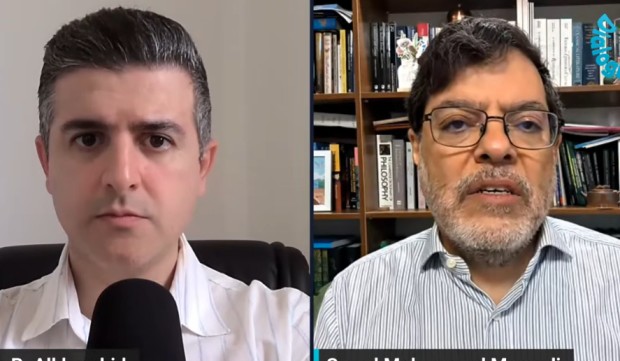
In this interview, Professor Seyed Mohammad Marandi joins Nima Alkhorshid to discuss Supreme Leader Ayatollah Mojtaba Khamenei’s meeting with senior military commanders and his order that any threat against Iran be met with an immediate response without geographical limitations. Marandi explains why he believes the next phase of the war will be decisive, why Iran will not negotiate its nuclear program until the US implements the MOU, and what a new war could mean for the Persian Gulf regimes, the Strait of Hormuz and the global economy. Read the full transcript of this interview below:
The Supreme Leader’s Meeting With Senior Commanders
NIMA ALKHORSHID: (00:00:05 – 00:00:16): Hi everybody, today’s Saturday, October 31st, 2026, and our dear friend Professor Marandi is here with us. Welcome back, sir.
SEYED M. MARANDI: (00:00:18 – 00:00:30): Thank you very much for having me. It’s always a great pleasure and a great honor. October the 31st, that means we’re very, very close. To whatever is going to happen.
NIMA ALKHORSHID: (00:00:30 – 00:01:03): Yeah, and then let me start with the senior commanders going and talking with the Iranian Supreme Leader for the first time after— in the aftermath of those attacks on Iran. And one of the main topics that was discussed during the meeting was the maximum deterrence, how Iran can achieve that and can establish that as time goes by with this war. What was the main point, considering that, between the two sides?
SEYED M. MARANDI: (00:01:07 – 00:02:29): It’s an important meeting coming at a time when the expectation is that there will be a major assault against the Iranian people by the Netanyahu and Trump regimes. He basically said that if there’s a— if the war starts, we will dictate how things play out and how it comes to an end. It won’t be the Americans. And he said that there are no limitations with regards to geography in Iran’s resistance.
He spoke of the public role and their importance, and he said that this war will lead to effectively— and correct me where I’m wrong because I read this a few hours ago— he said that this will effectively lead to the expulsion of the Americans and that we will have a new order in the region that will be hopefully led by the nations of the region. I hope, I think that’s more or less what he said. I think people, I did tweet it, so if your viewers are interested, they can go to my Twitter account and take a look.
NIMA ALKHORSHID: (00:02:30 – 00:03:09): It says that “the intelligence combat readiness for a powerful confrontation with enemies to be among the requirements of maximum deterrence and decreed that any level of and type of threat must be met with an immediate and effective response without geographical limitations.” Here is what the first part was. This, the second, I’m reading your tweet. I’m reading your tweet. I think you translated that into English. And he says—
SEYED M. MARANDI: (00:03:09 – 00:03:14): Well, I didn’t translate it. I used AI. I used DeepSeek. I cheated. But yes.
NIMA ALKHORSHID: (00:03:15 – 00:03:41): Yeah. But it says, “Ayatollah Seyed Mojtaba Khamenei stated, if the enemies once again start military and terrorist attacks, it is the armed forces of the Islamic Republic of Iran and the Iranian nation that will determine the time and conditions of its end.” This part is important together with the first part. What is your interpretation of that?
“This Is the Decisive Phase of the War”
SEYED M. MARANDI: (00:03:42 – 00:07:48): In other words, if the Americans think that they can come in for let’s say three days or seven days or ten days and carry out an operation and walk away, that’s not going to happen. This is the decisive phase of the war for the Iranians. This is the most important phase because Iran will. Break the siege in this phase. In other words, Iran will not end this phase until it gets what it wants. And come what may, the Iranians are going to hammer the Americans, their regional proxies.
You saw, I’m sure, last night a senior Iranian intelligence or military official spoke to Al-Mayadeen television. Al-Mayadeen, by the way, I think is a— it’s important to follow them both whether on Instagram or Twitter or on YouTube or wherever else they may be. Al-Mayadeen is an Arabic channel, but they also have an English website and an English Twitter account and YouTube account, because in the days ahead a lot of the news will probably be coming from Al-Mayadeen.
A senior Iranian official told Al-Mayadeen that Iran is going to hit very hard. This is going to be very different from before. And that official warned the regimes in the region, in the Persian Gulf, that their glass palaces, that their palaces are made of glass, which I think is a clear indication of where things can go. That basically means that these regimes which are bound to the United States, which are co-conspirators against the Iranians, Qatar, Saudi Arabia, the Emirates, and so on, all of them, Kuwait and Bahrain and the others like Jordan, and of course the Israeli regime. But these regimes that try to pretend that they’re neutral, they are acting as enemies of Iran, and they’ve always been acting as enemies of Iran throughout these 2 wars. The 12-day war in this war.
And so the statement by that senior official to the— they also have a Telegram channel, Al-Mayadeen. I think that your viewers can find it there. It’s an important statement made. I think it’s a very important statement that was made. It’s basically saying that Iran is going to be— is going to hit very hard this time around. It’s going to be different than before. It’s going to be very different from the 40-day war. Let alone what came afterwards.
So, I believe that this is going to be the decisive phase, the phase where the Iranians will force the Americans to end the siege and force the Americans to back down.
I don’t think that if Trump carries out the sort of attack that we seem to be close to, I don’t think these regimes will survive. The ones, especially the ones in the Persian Gulf, they won’t survive. If Senate, US Senator Murphy’s assessment of the plan is accurate and our understanding of his vague statements is accurate, I think that this is the end of Kuwait, the Kuwaiti regime. The Qatari regime, the Saudi regime, the Emirati regime, and the Bahraini regime. I think their days are numbered.
Trump’s Claims About Unpaid Armed Forces
NIMA ALKHORSHID: (00:07:51 – 00:08:50): Yeah. The other point that was mentioned in this meeting was that the Supreme Leader of Iran emphasized the strengthening of the military intelligence architecture and deepening the indigenous defense in both doctrine and tactic domains, the growth of up-to-date defense and security capabilities through the use of modern technologies, and strengthening of a spiritual foundation and jihad morale, while simultaneously making uninterrupted efforts to meet the livelihood needs and support of the armed forces.
Donald Trump, as you know, yesterday and the day before said that Iran is not paying its armed forces and their in huge problem. Even they cannot pay their military forces. What is this situation? What is— what are the signs? Is he making things up, or he has some sort of understanding about what’s going on in Iran?
SEYED M. MARANDI: (00:08:52 – 00:10:37): He’s been saying this for a number of months, if I’m not mistaken. I think he’s been saying it for 6, 7 months that the wages are not being paid, so by now everyone should be dead. I would assume. I mean, if you’re not paid for 7 months, if everyone across the country is not being paid for 7 months, then what are we supposed to be— what are we supposed to do? He talks nonsense.
Obviously, the situation is difficult, but nothing like what Bessent and Trump like to have people believe. Bessent and Trump would like to believe people are on their knees starving because they’re sick people and they come from a despicable class of people, they and their supporters, the MAGA cult. But no, it’s not at all like that. Society is functioning pretty normally. There’s inflation and some people have lost their jobs, but the government is focusing on helping the vulnerable. We are in a wartime economy now.
One thing that I wanted to add, Nima, was that I think Ayatollah Khamenei also said, he spoke about the unity of the fronts, if I am not mistaken. If you could read that, that is also important because Iraq, Yemen, and of course Lebanon and other potential fronts can be open pretty quickly, if these regimes in the Persian Gulf fall, you’re going to see the rise of new powers in the Arabian Peninsula. But what was the sentence that he said about the—
The Unity of the Fronts and a New Order in West Asia
NIMA ALKHORSHID: (00:10:37 – 00:11:32): Yeah, he says “the Supreme Leader of the Islamic Revolution, while appreciating the intelligence, steadfastness of the resistance front, in various countries considered the unity of arenas to be determined— to be a determining variable with a strategic impact on shaping the new political and security order in West Asia, and expressed hope that this new order will provide growing ground for the unity of Islamic nations and governments for the formation of a new Islamic civilization.” This is— I don’t know if you read— I think that was the—
SEYED M. MARANDI: (00:11:32 – 00:13:25): Yeah, yeah, yes, exactly. Just a couple of things. Again, I stress that people should, I think, should follow Al-Mayadeen. But also, I wanted to tell you, Nima, that your channel on YouTube is not promoted, even though I follow you. But I never get messages about your shows, and I never get messages about having new videos.
And it’s interesting, I don’t want to name names, but there is a YouTube channel and also, well, anyway, there’s a YouTube channel who’s— that I appear on, of a show that I appear on, and I just recently discovered that I’m not even following that channel. I’m not subscribed to the channel, but I get messages for all their new videos, for all the new videos, but I don’t get anything from you. I didn’t, for example, well, I don’t want to name names, but I get, but it’s okay. I didn’t know that I was not subscribed, but it was to, well, forget it.
So, but it’s strange that you, so I advise all of the viewers to try to support your channel and Danny Haiphong and all the other good friends that we have. Who are working online because it’s clear that YouTube is working against you. Again, it’s okay. I mean, it’s Mario’s channel. I didn’t know I wasn’t subscribed to it, but I wasn’t subscribed, but I get messages saying that he has new videos out. I’m subscribed to your channel, but I don’t get messages from you, which is, I think, rather bizarre.
NIMA ALKHORSHID: (00:13:27 – 00:13:27): Yeah.
SEYED M. MARANDI: (00:13:28 – 00:13:28): Rather odd.
“Iran Is Alone”: The Regional Powers and the Axis of Resistance
NIMA ALKHORSHID: (00:13:31 – 00:14:14): We have reports that people have been unsubscribed to my channel. I don’t know what’s going on, but we can do nothing basically about it. Professor Marandi, focusing on what the Supreme Leader of Iran said about the unity of the region, do you think that the latest talks between the regional powers— I’m talking about Iran, Turkey, Saudi Arabia, are they getting this message from the Iranian government, from the Iranian leadership, that their prosperity is not at the expense of the destruction of Iran, at the expense of killing Iranian people, Iranian economy? They’re going to be part of that. They’re going to be part of this destruction. The whole region is going to suffer from that.
SEYED M. MARANDI: (00:14:16 – 00:21:04): Well, we all know that none of these countries supported Iran. I mean, let’s be very blunt. When the genocide in Gaza started, none of them did anything for Gaza. It’s Iran and Hezbollah and Yemen that made the sacrifices. And of course, they took out Syria to isolate the resistance, and they brought in Al-Qaeda and ISIS, and Al-Qaeda and ISIS now they’re fine with the Israeli occupation of huge amounts of Syrian territory. They’re fine with it because that was the objective all along. They’re tools of empire.
So the sacrifices are being made by the Iraqi resistance, Lebanon, and so on. The others are not making any, haven’t been making any sacrifices. And of course, the Saudis, it was only when the Saudis began, restarted the war against Yemen that suddenly different countries wanted to go to the Saudi— to the assistance of Saudi Arabia. But when the United States and the Israeli regime waged war against Iran twice, no one wanted to have an alliance with Iran. No one wanted to support Iran. In fact, under pressure from the United States, they’ve decreased cooperation with Iran.
So, this is something that people should always keep in mind, that Iran is alone. And Yemen is alone, and Hezbollah and the resistance, they’re alone. The Iraqi resistance is alone, and the Palestinians are alone, and they have each other. But no one else has played any constructive role. And it’s just the degrees to which their roles have been negative, some more negative, some less negative. That’s the reality. That’s the reality. Whether this offends anyone or not doesn’t matter to me. I’m not here to become popular. I’m here to say what needs to be said as long as I’m able to say it, as long as I’m around to say it.
So these countries all know where things stand, and all of them want to take some sort of advantage of the situation. All of them in one way or another. But the reality is that they’re all going to lose in— to one degree or another, because when this war happens, it’s going to bring about a collapse. Their economies are not going to escape, and their societies will know that they did not play a constructive role. That they did not take the side, they were not on the right side of history, none of them. Some are more friendly than others, some less friendly, some hostile. The regimes in the Persian Gulf, all hostile.
No one should be fooled by Qatar as a mediation. No, Qatar has been very deceptive towards Iran during the last few months, and the Iranians have told the Qataris that. They come and go, bringing nothing of value to the negotiating table, and they think that that may assist them when the war starts. No, it’s not going to help them. They are assisting the United States. As we speak, drones fly from these regimes in the Persian Gulf and fly to— and today they struck 2 fishing boats. They try to monitor Iran’s air defenses. So these regimes are with the Americans. Their air bases are being used by the Americans. They host U.S. planes. They host U.S. assets. So none of them are friends. They’re all hostile.
Of course, the Iranian Foreign Ministry is going to receive their politicians because Iran is seeking a solution, but the Iranian people see them all as enemies. So some countries are playing less of a positive and less negative role, some are hostile towards it. Some of them do want to do trade and business with Iran, but when the Americans tell them to cut off ties, they resist to a degree, but you know their resistance is limited.
But they all know what’s going to happen. The Iranians have told everyone; they’ve told Americans. The Iranians have told Americans very clearly what’s going to happen across West Asia, and I think Ayatollah Khamenei’s message again: I advise people to go and follow Al-Mayadeen, and of course. Follow Nima’s channel and the channels of our other friends. But it’s very clear from his statement where he says that when he speaks about the future of West Asia, that this next phase of the war will be the decisive phase, and Iran will defeat the Americans come what may.
Yes, many of us may get killed. Many people will face great difficulty if the Americans try to take out the electricity. Children will die, infants will die. That’s the nature of the US regime. That’s the nature of the West, of Western regimes, of Western elites. They are utterly immoral. That’s why they support genocide in southern Lebanon and in Gaza and so on. But regardless of what happens, Iran will fight until the enemy is defeated. And then we’ll rebuild what needs to be rebuilt. But the enemy will be defeated. That is something that Iran is determined to do.
And we will see. It’s soon. We don’t have to wait long. And I think people should remember, we’ve been saying this for years before the 40 days, the initial 40 days of this war. Or at the beginning, they all thought Iran would be defeated. We were confident that the Islamic Republic will be victorious, just like we were confident that Yemen would be victorious and the Axis of Resistance will be victorious, whether it’s in Lebanon or in Palestine or in Iraq or elsewhere. Whoever has the honor of being a part of the Axis of Resistance, they will come out victorious. Whoever is not a part of the Axis of Resistance, it’s their loss.
Iran’s Military Readiness: “Certain Red Lines No Longer Exist”
NIMA ALKHORSHID: (00:21:06 – 00:21:34): What is the estimation on the part of the Iranian Armed Forces from what you’ve heard or you’ve seen so far? Because the 3rd aircraft carrier is getting to the region, I think on November 4th or 5th it’s going to be there, and they’re sending a lot of weapons to the region. What is Dandari, are they more prepared than they were before February 28th, or they’re at the same level today?
SEYED M. MARANDI: (00:21:36 – 00:24:03): Far more prepared. And certain red lines no longer exist. So those naval ships of the United States, it will not take much to have Iran decide to sink them. And Yemen also has assets that have not been revealed yet. Iran today is very different from Iran 3, 4 months ago, and much, very different from 7, 8 months ago. They’re very confident, extremely confident about their position and about the future.
And everyone knows that it’s going to be tough. Ordinary people know that it’s going to be tough. But people are ready wherever I go, Nima. On the streets, people— just today I’ve been out and people come up to me and speak. There are 2 criticisms, and this is something we have to cover too. There are 2 criticisms that people put out, state. One is, why don’t we have a nuclear weapon? I mean, I’m not the decision maker and I’m not in the government, but since I’m in media, people often ask me that question. The second is, why don’t we start the war ourselves? Why should we wait till they attack?
No one comes up to me and says, is there a way out of this? No one. I don’t recall a single person saying that to me. Just yesterday, someone said, we should have had nuclear weapons before this war started. I’m not saying he’s right or wrong. But the point is that the Iranians, they’re prepared. They know that we— there’s no room for retreat. There’s— retreat is not an option. Everyone knows that. You cannot appease the Trump regime because it is a criminal regime that if it— if you give it an inch, it’ll take a mile. I think that’s how they say it.
Anyway, so they’re— Iran is ready. And that was another thing I think that was in the statement last night, that where the senior commander spoke to Al-Mayadeen and said that Iran is now fully prepared. Everything is in place. We are ready for war.
Reports of a US-Iran Breakthrough and the MOU
NIMA ALKHORSHID: (00:24:06 – 00:24:53): Today, the Qatari Al-Araby Al-Jadeed, as they call it, is— it came out with breaking news saying that a breakthrough has been reached between the United States and Iran. Both sides have agreed to preliminary measures concerning Iran’s nuclear program, navigating through this Strait of Hormuz, and financial incentives for Tehran. China and Russia are said to be guarantors of the agreement. Iranian delegation has flown to Doha alongside the Qatari mediators to continue negotiations later today, based on this outlet. Is that some sort of— what is your take on that, first of all?
SEYED M. MARANDI: (00:24:55 – 00:27:05): No, it’s nonsense. And it’s been very clear. The Iranians have been very clear. About their position, and they’re not going to retreat from that. As I said, the United States has to implement the MOU. That’s it. That’s it. That’s the final position of Iran, and it’s been like that for months. So what does that mean? That means we’re not talking about the nuclear program.
Because in the MOU, there are 2 phases, as you know, and in phase 1, the United States has certain obligations, and Iran has fewer obligations because Iran won the war. And if those obligations are met or are being carried out, it’s clear that they’re being carried out, they’re being implemented. Then we move to stage 2. In stage 2, the negotiations are about removing all the sanctions, all the sanctions, and the nuclear program. So, we’re not in stage 2, we’re in stage 1. So, Iran is not going to negotiate the nuclear program.
So, Vance sent a message to Iran. Basically, he was attempting to talk about the nuclear program. Iran said no. It’s not happening. And ultimately, if the United States does move to implement the MOU, hypothetically speaking, in stage 2, it is the nuclear program and the sanctions. In other words, all those sanctions have to be removed, not just those that were signed by decree by the US president. Congress and the Senate, they have to remove the sanctions. The world has changed, and Iran has changed the world. The Axis of Resistance has changed the world. So if the United States wants a deal, they’re going to have to behave differently.
Vance’s Letter to Mohsen Rezaei and Who Makes Policy in Iran
NIMA ALKHORSHID: (00:27:07 – 00:27:52): Why are they trying to— every time they have tried to talk with the head of IRGC. They said no, let’s talk with him because that could be different, we’re going to get something else. And right now, the— it was said, as you mentioned, Wall Street Journal mentioned that J.D. Vance, the Vice President of the United States, sent a direct letter to the head of Supreme National Security Council of Iran, Mohsen Rezaei, as though he’s going to get something different from him. And because he has direct connection. Every day he’s talking with the Supreme Leader of Iran. That could bring some new changes to what’s going on. What is the perception? What is the understanding on the part of Americans the way that Iran works, in your opinion?
SEYED M. MARANDI: (00:27:54 – 00:32:45): Well, Vance, his counterpart is Dr. Ghalibaf, the Speaker of Parliament, the chief negotiator, and there’s been no change to that. So why did he send a letter to the chair of the Supreme National Security Council, it’s unclear. Maybe, I don’t know, maybe they want to pretend that there’s some sort of division in Iran, or that the Americans are very sinister, and the regime, of course, not ordinary Americans. They’re very sinister, and who knows what they’re up to. But nothing’s going to change.
We’ve had— you and I have had this conversation many times. The Revolutionary Guards, the IRGC, they do not determine policy, no matter how American think tankers repeat this day and night, that they are the ones in charge. That’s nonsense. The policy is made by the Supreme National Security Council, and if it has the approval of the leader. That’s policy. So the IRGC cannot go out and start a war or do something without consent, nor can the regular army, nor can the government carry out negotiations on its own on key strategic issues. All strategic issues, especially in time of war, go through the Supreme National Security Council.
So what they can talk to, or they can try to talk to whoever they want, it’s not going to make a difference. That is the way forward, is through the mechanisms determined by the Council. And of course, the Council has determined that the Speaker of Parliament negotiate on behalf of Iran. And the principles that the Iranians have set forth, have put forward, are those that have been announced by the Supreme National Security Council or said by people that have authorization from the Supreme National Security Council.
So, it is the MOU. The 7 Iranian demands are the MOU. Even the proposal put forward, that sandwich proposal that the Foreign Minister put forward when he was in New York, that is the MOU, but it’s just the MOU that would be carried out very swiftly. Everything is based on the MOU. Why? Because Trump signed it, because Trump agreed to it. Afterwards, he himself said, “I didn’t like the MOU and I didn’t implement it,” something like that. It doesn’t matter to Iran.
It was key that it was, it was obvious that he wasn’t implementing it from day one. From day one, he tried to undermine his own signature. How? He went and forced his proxies in Beirut to sign an MOU with the Israeli regime. Remember, we all remember that. And the Israeli regime never left Lebanon, and they continued to bomb Lebanon. But he wanted to undermine Article 1 of the MOU. Then he went and set up a corridor in violation of Article 5 through the Strait of Hormuz. Iran waited for 2 weeks and kept warning the United States not to do this.
Who assisted the United States in creating that corridor to undermine Article 5 of the MOU? Saudi Arabia, Qatar, Kuwait, the Emirates, they were all involved. They sent their ships through the American corridor repeatedly, and the Iranians warned them to stop. Why were they doing it? Because they wanted to help Trump undermine the MOU. They wanted to help Trump, who had lost the war against Iran, to defeat Iran through deception, through the ceasefire. They wanted Trump to be able to undermine Iran’s authority over the Strait of Hormuz, and then the United States would give Iran nothing, Iran would be powerless, and the tide would be turned in favor of Trump.
Because these regimes bet on the wrong horse. They bet on Trump, and they lost their— they lost. And they’ve done— then during the MOU, they helped undermine it. And they’re paying for it. And in the days ahead, they’ll— they will quite possibly pay the ultimate price, because contrary to what Bessent lusts for, Iran won’t fall and the Iranian people won’t die of starvation. But those regimes, if things go as Trump threatens he will push the situation in that direction, then those regimes will fall.
Qatar’s Mediation and the Nuclear Program
NIMA ALKHORSHID: (00:32:48 – 00:33:48): Axios reported that a diplomatic told them, told Axios that the Qatari mediators held talks with Tehran for over 12 hours in Tehran today. And I’m talking about what has happened yesterday. And the focus is on Qatar getting Iran and the United States to agree on reciprocal steps that would be implemented over a few days in real— in preparation for direct Iranian-American negotiations on the issue, including the Iranian nuclear program. You’ve mentioned that at this stage, there would be no talks on the Iranian nuclear program. And on the other hand, it seems that the only thing that the United States is insisting on is that we want to talk about the nuclear program of Iran. So how is this? Go ahead, go ahead.
SEYED M. MARANDI: (00:33:49 – 00:38:15): Yes, well, first of all, Qatar is— they talk nonsense and Al Jazeera or the other outlet, what was it? Al-Araby Al-Jadeed, or whatever, or any other, or Al Arabiya of Saudi Arabia. All of these outlets are just a waste of time. If this is the case, then why did a senior Iranian intelligence or military official last night tell Al-Mayadeen? That, and why did he warn those regimes or those despots who live in their glass palaces? Who, you know our region well. Whenever the Iranians speak about glass palaces, who are they talking about? They’re talking about these despots in the Persian Gulf. That includes Qatar.
So if everything is going so wonderfully as Qatar wants us to believe. What Qatar wants is Iran to concede to the United States. That’s basically what it wants to do. It’s saying, you do what Trump wants, and hopefully Trump will reciprocate. That’s what Qatar is saying, basically. No one should— I mean, Qatar has deceived or tried to deceive Iran throughout these months and a bunch of others, but this is not going to work. The nuclear program is not going— is not up for discussion at all until US obligations are met. And that’s final.
So as things stand, we’re going to war. As things stand, it could be not tonight. It may be before the midterms, because maybe Trump would like to launch a war quickly, declare some sort of victory, say we killed all the leaders and we destroyed everything, and now Iran is lost, and that’s the end of it. And then, I mean, that’s one hypothetical scenario. And then his voters would— supporters would come out, because his supporters are bloodthirsty, the MAGA cult. We’ve seen whenever he talks about destroying Iran how they cheer. When he talks about stealing from Venezuela, they cheer him on.
And one shouldn’t be surprised. I mean, people, Christian Zionists who believe that Christ supports genocide, or who not believe, they’re not good Christians, but those who claim that Christ supports genocide, obviously they support theft of the assets of Venezuela and death and destruction of Iran. Or genocide in Gaza and Lebanon.
So, what is the only thing that is— all that aside, the only thing that is acceptable to Iran is for the United States to back down and to carry out its obligations, obligations that Trump signed on to. Otherwise, everything else that you hear coming from these regimes, it’s just nonsense unless that the framework is accepted. So, when Qatar says you carry out, the Iranians have already said, Nima, that they’re not going to send out their enriched uranium to a 3rd country. So, whenever you hear Al Jazeera or Al Arabiya or whoever say that there’s been an agreement to send some, that’s— that means it’s fake. There’s no agreement.
And today, as I said last night, we had that senior intelligence officer speak to Al-Mayadeen, and today Ayatollah Khamenei met the commanders. His statement is clear. It’s talking about war. So obviously those 12 hours of negotiations and the Iranians going to Qatar and all that have not led to any— then what about the Al-Mayadeen interview and Ayatollah Khamenei’s statements today? They don’t add up.
NIMA ALKHORSHID: (00:38:18 – 00:38:18): Washington Post—
Ukraine and the Twin Defeats of the US Empire
SEYED M. MARANDI: (00:38:18 – 00:39:35): By the way, Nima, by the way, the war in Ukraine is coming to a turning point. And these 2 wars complement each other. Even if Trump tries to distance himself from this war, the defeat in Ukraine will be his defeat, and he will be seen as the person who brought about the defeat by his opponents. And, but in any case, the United States would still have been defeated even if it was Biden. Or someone else.
But the United States is not in a strong position. So when Iran goes after the United States and its proxies in the region, the United States will also be simultaneously losing on another front as well. So the global economy will come down. It will crash if Trump carries out his threats. But simultaneous to that, you’ll see multiple defeats for the US Empire, almost simultaneously, coming simultaneously.
The Strait of Hormuz: “The Iranians Are Showing Who’s Boss”
NIMA ALKHORSHID: (00:39:38 – 00:40:29): The Washington Post reported that the US Army’s 82nd Airborne Division is leading the mission to facilitate shipping through the Strait of Hormuz. And is running a joint operations center in the United Arab Emirates. Do you think— what is the situation in the Strait of Hormuz in the last 3 days? There were multiple tankers, supertankers in the eastern part of the strait, in the western part of the strait on fire. They’re talking about the new sort of mines that Iran is using, limpet. As the— and the article in the Financial Times yesterday said this is the first time they’ve seen these sort of mines since 2019. What is the situation of this strait today?
SEYED M. MARANDI: (00:40:30 – 00:41:12): Well, the Iranians are showing who’s boss. And the Iranians are going to keep up the pressure. And the Iranians are not going to allow much oil to get through the Strait of Hormuz except for those ships that have consent from Iran. And so all those claims made in last month, remember, in October, that the strait is open and the Americans are in control. Well, look at all those destroyed tankers that we’ve been seeing burning over the last month. So, we’re on the 31st of November (sic) [October], right?
NIMA ALKHORSHID: (00:41:13 – 00:41:14): Yeah.
SEYED M. MARANDI: (00:41:14 – 00:42:35): Throughout the month of November, this is what we’ve been seeing. In the last week or two, it’s been very intensive. So, and by the way, Nima, when the war starts, the Emirates, it is going to be devastated. There won’t be any U.S. base in the Emirates. There won’t be anything in the Emirates that’s safe.
So now Iran is pounding ships that disobey, ships from these regimes taking oil from these regimes that are co-conspirators with the United States. No one can say that— why no one can complain that Iran is targeting ordinary commercial ships. These are ships that are coming from Kuwait, from the Emirates, from Saudi Arabia, from Qatar. They’re at war with us. Not officially, but in reality, they’re at war with us. So Iran, as we speak, is hitting these ships.
When the war starts, do you think Iran is going to tolerate US forces in the Emirates? Do you think it’s going to tolerate anything in the Emirates that stands against Iran? We’re, as I said, this next phase is going to be very different from the first 40 days of the war. Very different.
A Possible US Invasion of Iranian Islands
NIMA ALKHORSHID: (00:42:39 – 00:42:59): Do you see the moment that the United States decides to capture or invade one of these Iranian islands in the southern part of the— in the southern part of Iran? Because recently we were talking about it. What is the possibility? It seems that, well, that is one of the options that the United States is considering right now.
SEYED M. MARANDI: (00:43:00 – 00:45:46): What difference would it make? Okay, they capture an island. Iran will destroy everything on the other side of the Persian Gulf. The Strait of Hormuz will be irrelevant. There will be no more oil or LNG or sulfur or helium or fertilizers leaving this region. The regimes on the other side will collapse. And new forces, new actor, political actors, new leaders will emerge. And I don’t think they’ll be pro-American. I’m pretty sure that’s not going to happen.
So, okay, they take an island for a few days. Iranians are prepared, and they’ll hammer the Americans on those islands. From where? From the mountains with their drones and missiles. They’ll be sitting ducks. I think they call it a turkey shoot in English. So what’s the point? Is it so that Trump can say, we took this territory?
You know that Iranians are known for their patience. It’s in our religious culture. It’s in our civilizational heritage. So, Iran is patient, but at the end of the day, as General Soleimani said, Iran is the nation of Imam Hussein. This is not a war that the Americans can win. They don’t have a chance. There is no path to victory. All paths lead to defeat. The longer Trump tries to push, and Netanyahu and their regional agents, the more they try to push, the worse it gets for them.
If they had ended this after the 40 days, it would have been smarter. If they had ended it with the MOU, it would have been smarter. It causes us more difficulty, no doubt, but the defeat will be greater. So we have reached the point of no return. Either the United States backs down because Iran is not going to allow the Strait of Hormuz to normalize until it’s all of its goals are met.
So we are at a point of no return. Either Trump backs down, which I don’t see happening, or we go to the next phase. And the next phase is the phase in which Iran, as Ayatollah Khamenei said, they will not be able to end this war. We will decide when the war comes to an end, and it will end only when we achieve what we need to achieve when we achieve our goals.
Unrest in Bahrain and the Fate of the Gulf Dictatorships
NIMA ALKHORSHID: (00:45:50 – 00:46:13): Yesterday there was a report from Bahrain that the situation is getting worse. The people on the street protesting, and we know that Saudi Arabia and its forces are not that capable anymore to control what’s going on in Bahrain. It seems that the Pakistani government is there to help the Bahraini government. What is—
SEYED M. MARANDI: (00:46:13 – 00:46:14): Bahraini dictatorship.
NIMA ALKHORSHID: (00:46:15 – 00:46:15): Yeah.
SEYED M. MARANDI: (00:46:16 – 00:47:55): Do you think that when the war starts, anyone can save the Saudi government? This is just the tip of the iceberg. This is the beginning. First of all, these family dictatorships, they’re already leaving. They’ve taken billions of dollars of money out of these countries. Most of their family is now in the United States and Europe. It’s only their henchmen and foreign mercenaries that are keeping things in place. But when the war starts, it’s over.
If Trump goes down the route that Murphy is speaking of, if all of this is based upon, let’s say, the Senator Murphy scenario, if it goes down that route, these regimes are gone. This is, as again, just like the riots and the protests in France. The riots, I think, have more to do with French intelligence and French police and their own provocateurs. But what’s going on in Europe is just the tip of the iceberg.
We’re going to enter a very different phase across the world. This is going to have not just regional consequences, it’s going to have enormous global consequences. And again, everyone is going to blame these genocidal regimes in Washington and in Tel Aviv. Because they are the ones who brought the world to this place.
Europe’s “Dirty Work” and the Silence of Western Elites
NIMA ALKHORSHID: (00:47:59 – 00:48:42): Today I saw the tweet of Iranian Foreign Minister mentioning what the German Chancellor was talking about. He says that the prices in Europe are going up, and the Iranian Foreign Minister responded to that, “this is the war that you supported.” You said— what is Europe today to Iran? Because as the Iranian foreign minister said, he, the chancellor of Germany, said they’re doing our dirty job against Iran, basically naming the Israelis. The Israeli attack on Iran is Europe’s dirty job. What do you make of Europe today?
SEYED M. MARANDI: (00:48:44 – 00:49:28): Unimportant. Of very little consequence. And yes, he said that “the Israelis are doing our dirty work for us.” Okay, well, now pay the price. Now you pay the price. Now you have to answer to your people. But if you notice, Nima, that no one, even those who are opposed in the political elites, I’m not talking about ordinary people, in the political, among the political elites in Washington, in across Europe, is anyone condemning Trump for what he’s doing to the Iranian people? I don’t know if you watched Obama in Michigan.
NIMA ALKHORSHID: (00:49:29 – 00:49:29): Yeah.
SEYED M. MARANDI: (00:49:29 – 00:55:02): And I watched the whole speech. I usually don’t bother, but I watched the whole speech. Did he say anything about the children in Iran who were massacred or? The atrocities. No, he was saying that this was an unnecessary war and the prices are high and that energy prices are high and life is— he didn’t talk about crimes against humanity, nor did Senator Murphy, nor does anyone else. So the criticism is because people are taking a hit at the gas pump. That’s what the Europeans are, the European elites are saying too. That is how they view the rest of the world. They don’t consider Palestinians to be human.
The Piers Morgan Debate and Israeli Atrocities
I don’t know if you saw this debate I had on Piers Morgan with the— very revealing. The person who was on the Israeli side, he had said that rape is the tool that can force Palestinian resistance fighters to raping their sisters and mothers or daughters or whatever, is the tool that can stop them. And then he tried to deny that he said this, and then he ultimately admitted that he said it. And tried to justify it. It’s so revealing who these people are.
And I gave, I mean, people should watch it. There was another young man who people should watch. He was excellent, excellent. A young Jewish writer who spoke very well. He was the star of the show. He was fantastic. And people should, I think he’s on Instagram. People should follow him. Very, very decent young gentleman and very eloquent. But in any case, I think people should watch that. It tells us what the Israeli regime is.
And this is in line with the history of the regime. And this is the regime that the West supports. They raped women when they took Palestine during the Nakba. They raped and killed them. There’s documentaries where they themselves admit they did it and laugh about it. I mean, I posted the documentary a few times. No outrage.
I went to Lebanon with a delegate, with a University of Tehran delegation a decade ago, probably maybe more than a decade ago, with— we were 4 professors or 4 academics and 9 graduate students. And we went to the— I said this on that show— we went to the Khiam Prison. Where the Israel— which the Israelis controlled when they were occupying Lebanon. And our guide was a man who was an inmate, and he said that they raped his wife in front of him so that they can get information from him. That’s what the Israelis are. And then raping the male prisoners and it’s just, this is what we’re dealing with.
“All of This Is Projection”
And then everything is projection. So when they talk about the 7th of October, they say Hamas raped all these women. A lie. There’s no evidence. There’s no footage. There’s nothing. Or for example, you know how they all, you have all these memoirs on Iran, the garbage written by, Persepolis or Reading Lolita in Tehran and all these other memoirs published in the West. Where they would say during the war, Iranian children were taken to the war fronts and they had keys, golden keys around their neck, that so when they die, they would go to heaven and they would have them run over minefields and all sorts of fake garbage. I fought that war. Why? But they demonize Iran. They try to depict Iran as abnormal.
And then they say that the Iranians and their religion, they would rape women in prisons because if they are virgins and they are executed, they’ll go to heaven. So they rape them. So, I mean, the disgusting lies that they promote about Iran. I mean, if they just said, well, they rape women in Iranian prisons, which is of course nonsense, but to say that that is their religious belief, which text? Where’s the book? Which books? Where in our religious beliefs do we have that? You don’t need evidence. All you have to do is just utter nonsense.
All of this is projection. All of the accusations made against Iran, against the Palestinians, it’s all projection. By whom? By Zionists, by the takfiri Wahhabi Salafis who are on the payroll of the Qataris and the Saudis and by, ultimately by the empire. All of this stuff is projection. But who really does this stuff? It is these takfiris. It is these Zionists. And the Zionists are the worst of the worst. People should watch that interview and they’ll see that Zionist academics, their mainstream academics, what really goes on in their minds.
“They Are the Fake Country”
NIMA ALKHORSHID: (00:55:06 – 00:55:14): The moment he argues, the guy, Israeli guy argues that Iran is a fake country. It’s just amazing.
SEYED M. MARANDI: (00:55:14 – 00:56:47): I mean, I didn’t even bother answering him. I didn’t even, I just gave, I put out what he said. I read what he said about rape. That was enough. But I was saying, what I could have said, and I was thinking about saying, but I decided not to. I said, forget it. He’s not worth it.
Marandi means from Marand. Where’s Marand? It’s in Azerbaijan. It’s near Tabriz. Khamenei. What does Khamenei mean? It means from Khamaneh. Khamaneh is a city in Iranian Azerbaijan. Ayatollah Khamenei, who was a very close friend of the most famous Azeri poet in all history, Shahriar. I mean these people fantasize. President Pezeshkian, where is he from? From Tabriz. His mother’s Kurdish. All fantasy. All fantasy by these, but projection.
They are the fake country. So they say Iran is the fake country. They are the rapists, so they say that we are the rapists, but they do it. Yet Western media deflects, they hide it, and then they promote narratives from these fake memoirs and so on, that show it to be the opposite. The reality was to be the opposite.
NIMA ALKHORSHID: (00:56:48 – 00:57:09): For me, it was amazing to watch it because you’re— as you’ve mentioned, you’re from the Turkish area, I’m from the Lur area, and both of us were under— based on his description, both of us are under the Persian oppression. The guy’s just—
“Let Them Believe Their Own Lies”
SEYED M. MARANDI: (00:57:11 – 00:58:31): I sometimes say, and I think I’ve said this to you too, I am of this belief that sometimes it’s good for these people to believe their lies because that helps, that makes them miscalculate. Maybe it’s good for our enemies not to believe the truth, to just to invest in their lies, in their propaganda. These so-called Iranians who go there and tell them what they want to hear, perhaps that’s what they need. If they were sane and rational actors, then probably we’d have more difficulty. I think that makes sense. I don’t know.
I mean, I like ordinary people to wake up. That’s why I always say I promote, I advocate, I ask people to buy Going to Tehran by Flynt and Hillary Leverett and read it so that they can see through the propaganda. These are 2 Americans, 2 American academics who worked in the White House, or Alastair Crooke’s book, Resistance. I think that’s a good book. I always, I want people to wake up, people in our region, people across the world, to see through the lies. But maybe those elites, not ordinary people, those elites, maybe those who are in power, it’s best for them to believe their own rubbish, as the British say, their own garbage, as the Americans say.
NIMA ALKHORSHID: (00:58:34 – 00:58:39): Thank you so much, Professor Marandi, for being with us today. Great pleasure as always.
SEYED M. MARANDI: (00:58:40 – 00:59:16): It’s always an honor, Nima, and people should definitely follow you and subscribe because what YouTube is doing is obviously extremely biased. So we should like your videos and follow you on Twitter and of our other friends too. All of them, those who are on the side of the oppressed and the Palestinians and who are opposed to empire.
NIMA ALKHORSHID: (00:59:18 – 00:59:19): Thank you so much.
SEYED M. MARANDI: (00:59:20 – 00:59:21): Thank you.
Related Posts
- Trump Will Hit Iran After the Midterms w/ Ian Bremmer – One Decision (Transcript)
- John Kiriakou Interview: CIA Regime Change from Ukraine to Iran (Transcript)
- Lawrence Wilkerson: America’s Retreat From Europe & Middle East (Transcript)
- DOAC Podcast: Geopolitical Strategist Dr. Sarah Paine (Transcript)
- Prof John Mearsheimer: America’s Addiction to War (Transcript)