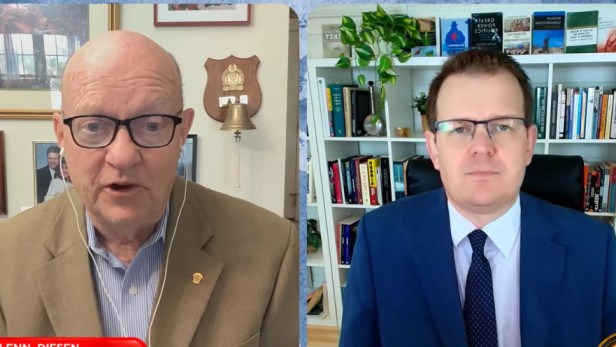
In this interview, Glenn Diesen speaks with Colonel Lawrence Wilkerson, former Chief of Staff to US Secretary of State Colin Powell, about America’s retreat from Europe and the Middle East. They discuss Marco Rubio’s Athens speech, Netanyahu’s caretaker status after Israel’s election, Trump’s choices on Iran and Ukraine, China’s rise as the world’s greatest economic power, and why Wilkerson believes NATO has been passé since the end of the Cold War. Read the full transcript of this interview below:
Marco Rubio’s Athens Speech and the Return to Primacy
GLENN DIESEN: (00:00:01 – 00:00:14) Welcome back, everyone. We are joined today by Colonel Lawrence Wilkerson, former Chief of Staff to the US Secretary of State. Thank you for coming back on the program.
LAWRENCE WILKERSON: (00:00:15 – 00:00:19) Good to be with you. You were one of the sane Europeans. They’re dwindling.
GLENN DIESEN: (00:00:21 – 00:01:49) I sadly agree. It’s— well, I’m hoping common sense will soon return. I was a little bit optimistic to see, well, 2 Scandinavian leaders actually reaching out to the opposing side— that would be the Russians— and engaging in diplomacy. So I’m hoping this signifies a return to normalcy, although I’m skeptical but optimistic.
However, where I wanted to start today though was with the US. That is, Washington appears to acknowledge now that the post-Cold War unipolar moment’s over, but still we see that much of its foreign policy seems to be designed to restore that primacy.
So one interesting development recently was that, well, back in January of last year, we heard that Marco Rubio, he argued in this interview with Megyn Kelly that unipolarity was not normal for the world. That’s the word he used, “normal,” “not normal.” And that the world had essentially now returned to multipolarity. I interpreted this as signifying a huge shift in foreign policy, that the whole post-Cold War era was over.
However, earlier this month, that is in October of 2026, Marco Rubio, he delivered a speech in Greece arguing that the US and West should, well, pretty much preserve or restore its dominant position in the world. I was just wondering, what do you make of this shift?
LAWRENCE WILKERSON: (00:01:51 – 00:07:43) First, I would comment that Marco Rubio’s speech in Athens has been ripped apart and devastated by everything from scholars of international relations to historians to people who just want to pick a bone with Marco Rubio. And I think most of their critiques, in fact, I think some of them don’t go far enough, of what he said are accurate.
And in essence, to sum it up in a broad way, they said, “Man, were you mistaken. You didn’t carry out what you were talking about.” You didn’t talk about the helots upon whom Athens was poised— the slaves, in other words. Democracy built on top of slaves, kind of like the South, if you will, in the United States, although it wasn’t quite for the economic reasons that the South did it. And some of the visceral actual beliefs of the South, I’m not sure they can be attributed to the Greeks except in a way of that was what was done at that time.
When you fought somebody and you beat them, you took their people, women, children, and everything else as slaves. And in the Greeks’ case, they brought them home and stuffed them in the basement and called them helots and occasionally brought them up. Not a very admirable practice.
And they didn’t bother to talk about Thucydides and the Melian Dialogue and Syracuse and all the rest of the things. And towards the end of Athens’ empire, if you will, how badly they treated their vassal states from Corinth to Melos, and many, many other factors.
For example, extolling all of that, it wouldn’t even be ours if it weren’t for the Arabs, because everything was lost and the Arabs restored it, principally in the library in Alexandria, but other places too, and translated it and passed it on. Otherwise, we wouldn’t even have had 2/3 of what the Greeks had done, if we do esteem them and the Romans the way we do.
And then the next point was that, and all you have to do is read The Short History of China, a really remarkable book, to understand what Rubenstein— God, I can’t speak this morning. What Marco Rubio was attributing to the Greeks in all their glory, military and otherwise, was duplicated and bettered by China several hundred, if not a thousand years beforehand.
So what an egregious speech to give, and I did not even leave out the most important contemporary point, that they have sold out to Bibi Netanyahu. He owns Athens. And he owns them from everything to doing things to disturb the Turks with regard to their traditional imbroglio over Cyprus, to getting them to do whatever is necessary to show that the Europeans are involved, although the Greeks don’t have a lot of power to show that with.
Netanyahu owns Athens in a real extent because he paid all their debt off with our tax dollars. You can’t make this stuff up for Marco. How stupid can you be to go and give a speech like that? And yet the hagiography, the euphoria, the panegyric and so forth is typical of a man who really— his culture, his knowledge, his historical wisdom is about half an inch deep, if that.
So I’ve finished my rant on Marco Rubio and his remarks in Athens, which I thought were incredibly misplaced, incredibly wrong, and not the kind of thing to be doing at this particular time. I mean, what did he gain by doing it?
And your point about— I don’t like the term multipolarity. I’m like Ambassador Chas Freeman. I think he’s right. It’s multinodality. Poles stick up. Poles have ends. Nodes are things that fit in and move around almost amorphously and connect here and connect there.
That is where we are, and nothing is proving this better than what is happening in Southwest Asia right now, particularly this meeting that just transpired, which was in the, you might say, shadow of the greatest economic power in the world, China.
So, we’re looking at a Secretary of State, number one, that is not a diplomat, number two, gives terrible speeches, and number three, was speaking in terms that, as you indicated, seem to reverse some of the incredible polish and chapeau that is over our now proxy strategy, straightforward strategy in Southwest Asia, though I don’t think Trump even knew he was participating in this game.
To reestablish, because this was the policy goal, reestablish American hegemony in the world at all costs, including using nuclear weapons. That was the neoconservative, the globalist, the behind-the-scenes deep state, whatever you want to call it. That was their goal.
That was actually the goal of the 2002 National Security Strategy that Colin Powell sort of said, “Well, this is nothing different.” And I said to him, “This something very different. We’re saying we’re going to rule the world.” That’s what we said, and that’s what we’ve been trying to do, and we’ve been failing almost everywhere we’ve been trying to do it, whether by proxy or straightforwardly, as Trump has tried in Southwest Asia. We’re failing so badly there, we are being kicked out of Southwest Asia. So there’s my tirade on it.
Greece, Israel, and Netanyahu’s Next Target
GLENN DIESEN: (00:07:45 – 00:07:59) Just to get on a little sidetrack with the Greeks and Israel. Is this essentially an anti-Turkish coalition, or how do you discern? How do you explain how the Greeks folded in this way? Or—
LAWRENCE WILKERSON: (00:08:00 – 00:10:06) This is Bibi understanding. He’s a political, and you could say in some ways a strategic genius in a very adverse sort of way, kind of like Elon Musk in the economic situation. But he understands the dynamics, and his next target is Ankara. And so build your alliances and your relationships toward that end early and quickly and strongly and powerfully while you can.
I think he also understands he’s lost the United States. Now, that may take some time to materialize politically and otherwise, but it is coming to be, and especially with 40s and under. But he’s lost the United States in the long term, I think, in terms of his big sugar daddy. So he’s got to find some other way to coat that, if you will.
And one of the ways he’s going to fight is different people in the world who might be temporarily willing to ally with him to do what he needs to do. And then of course he’ll turn on them if he needs to. That’s his way of operating.
That may have been thrown a significant setback, maybe even a permanent setback, by what just happened on October the 27th. And what went on, I’m told, all the way to 10 PM, maybe even later, as they kept the polls open because it was a historic election. More people voted than any time since ’77 or something like that, and they were still coming.
And yet those still coming and keeping the polls open did not help Bibi very much because I think he’s lost in the sense of the election. But look at what he’s got. He’s got caretaker status until they can form a new government, and in that caretaker status, he is in charge of national security, and he can wreak havoc from that position. And he’s already said he’s going to wreak havoc and named it Roar of Judea— Judea, however you want to say that. That’s the operation he started now in the West Bank, and I don’t think he’s going to stop.
Why Washington Struggles to Accept the Limits of American Power
GLENN DIESEN: (00:10:06 – 00:11:17) Well, I’ve heard some talks in Israel about the need to begin to adjust to these new realities, that in its future it might have to be able to go on without the United States. So I guess that makes sense in order to try to, well, reorganize or create some new alliance or systems in the region to make this happen.
But overall though, in the terms of not just Marco Rubio, but possibly the whole Trump administration pulling back a bit from trying to accommodate multipolarity to resisting it, I mean, you served at the highest level of the American national security establishment. Why do you think it’s so difficult for Washington to accept this kind of limits on American power? I guess it’s not just the United States. I think this is a historical issue for a former hegemon to accommodate the rising powers. But is it ideological or institutional? Economic, or how do you explain it?
LAWRENCE WILKERSON: (00:11:18 – 00:22:02) All those things, but I think we’re in a new position, and I think one of the reasons I prefer the term nodal to the term polar is just that new position. And the new position is we’re situated on a globe that has tremendous existential possibilities.
And when I say existential, I don’t mean the globe. The globe is going to be here, the planet’s going to be here probably till it burns out in the sun, 4.5 billion years from now. Maybe, I don’t know. But I’m not sure the human race is going to be here, and I’m very not sure that it’s going to be here in its present configuration or even anything resembling it, because we have 2 existential threats staring us in the face.
I went to a webinar yesterday and listened to it rapidly. People talking about essentially what’s happening that is very much outside the computer models. Very much different in a negative sense from what many of the computer models that I’ve been looking at from NASA, from NOAA, from the Europeans for now almost 20 years.
And we are not just behind the power curve about twice as badly as we thought we would be if we didn’t meet the global temperature limits, if you will. And we’re not even close. But we are developing a whole side array, fundamental array. I shouldn’t say side array, fundamental array of factors we didn’t take into consideration that are happening right now, that are deepening and widening the crisis we’re in with regard to the climate.
You call it a climate crisis, call it the planet doing what it’s done throughout its history, but without 10 billion human beings on its surface. Call it whatever you want, but it is different because of that human population. Very different.
And whether you’re looking at sea rise or you’re looking at flooding or extra powerful hurricanes, or you’re looking at winds that aren’t going to stop, they’re just going to pick up in velocity each year that goes by, exacerbating forest fires majorly and making it impossible to live on this planet. I think you probably are aware that 50,000 Europeans died this year from heat or heat-related injuries. 50,000. Well, look at that becoming a heck of a lot more over the next years.
And what I’m saying is the models we were using 15 years ago, which told us the situation was dire, particularly dire by 2065 and the years following, is now speeding up majorly because of factors we didn’t understand, we didn’t know about, and only now are discovering.
Doing things in Alaska, for example, like coring the soil, pulling out the cores and understanding that methane is coming out at much faster rates than we ever thought it would and promises to pick up even faster in terms of coming out. Methane is more deadly than CO2. And we’re looking at that possibility in other places like northern Russia, as well as in Alaska, where it’s being studied very closely right now. I’m not so sure it’s being studied very closely in northern Russia.
So I’m saying all this to say we have bigger things to confront. So adopting the traditional globalist position on losing power, understanding you’re losing power, understanding to whom you’re losing it or to what you’re losing it, it’s both really, and taking the usual imperial steps, which as you pointed out are usually failed in the long run, is stupid. To the maximum, especially when you have on the other side of the power equation a country that doesn’t seem to be bent on that sort of performance.
Whether you trust them or not is irrelevant. They do not seem to evince the kind of attitude that you would expect coming from an empire that is going to whop you very soon and take over. They don’t seem to be that sort of power, and their history, 5,000 years of it really, dictates, I think, that you understand that they’re different. They’re not like you. They’re not predatory capitalists, for example, like you are.
If you want to put it in their terms, in English, it’s, “We are capitalists with Chinese characteristics,” and those characteristics make a whale of a difference. They’re not predatory capitalists. They are capitalists who understand that if you predate, you will wipe out what you are making your money from. And so they have a very different philosophy.
Wading into that philosophy and accommodating it, a collaboration, a cooperative environment is what’s necessary, particularly with those 2 challenges confronting us. And I didn’t even talk about the second one, nuclear weapons. Makes sense. Makes immense sense to me. And most of the people with whom I deal, it makes sense to too.
But we can’t seem to find the leadership in this particular empire, fading as it is, that understands any of this and wants to do positive things about it, let alone wants to deal with that massive 2/3 of the world that is rapidly coming to hate our guts viscerally and willing to side on anybody’s side who is opposed to us and doesn’t administer sanctions, for example, and has a better financial system, which is developing rapidly even as I speak. They’re willing to accept that.
So we also have 2/3 of the world that is already saying essentially, “To save my life, to feed me, to give me a viable future, I need something like what this power is doing, China. I do not need what you’re doing to the other side of the world.”
If we don’t change that attitude and we don’t accommodate what is happening in the world in a very real, practical way and the sense of the power that’s shifting, I don’t know what we’re going to do, Glenn. I think we’re going to disappear. That’s a hell of a thing to say about 340 million people spread over the vast territory of the United States that we are, but we seem to be capable of maybe self-destruction as well as being taken on by somebody that just gives up and says, “Well, we can’t deal with them any other way.”
I think Xi Jinping took away from that meeting with Trump a measure of Trump. The measure of Trump and the measure that they already have of our political system is that Trump may be a weird dude. He may be an aberration. He may be an anomaly, but he is nonetheless reflective of the empire’s dissipation, of its incredible inability to deal with its own internal problems, of its colossal debt, and of the fact that it is badly led and has been badly led ever since the end of the Cold War, if not slightly therebefore.
And to take that kind of assessment of us and come away from it with any kind thought that you can accommodate, you can adjust, you can live in the same world, you can cooperate on some of the bigger challenges, you can do things like have a nuclear weapons regime, treaty regime that accommodates all the new nuclear weapons powers and the old ones and the aspirants and so forth.
North Korea’s Nuclear Triad and the Korean Peninsula
And I’ve really been brushing up on North Korea right now and what they’re doing in North Korea with Russian help. It is fascinating to me because North Korea is just, in my view, for the whole time I have been looking at it through all the Kims and all the turmoil, the Agreed Framework, the light water reactors, the reneging on that by the Bush administration, the Six-Party Talks and all that, I have thought this is not salvageable.
There is a reason we do not have a treaty on the peninsula after 70-some-odd years. There’s a reason we don’t have peace. It’s not salvageable because of the North. I’m rapidly learning that that’s not necessarily the case, that the Kim dynasty, even in all 3 of its compartments, if you will, all 3 of the Kims, has been trying all along to do something positive.
And the thwarting of that, with the possible exception of President— maybe the exception of the end of Clinton and Robert Gallucci and the Six-Party Talks and what came out of that with the light water reactors and then got fouled by the Bush administration. Maybe that was a genuine attempt, the first genuine attempt by the big empire to do something positive about North Korea.
But I don’t see it now. In fact, I see now, I see North Korea building out. It will have a triad very shortly. The only thing they haven’t mastered so far is undersea firing of missiles from submarines. They’re working fiercely on that. They’re getting Russian assistance on that, and I don’t doubt that very soon they will have a ballistic missile capability, incidentally, that’ll reach New York.
They will have a bomber capability. They’ll have planes that can drop really big atomic bombs. How far they can go, I don’t know yet, and they already have submarines that can launch them much the way Netanyahu does, but they are working on launching them from under the water, under the sea, and I suspect they will achieve that.
And we are not doing anything. We are not doing anything to tell them, “You need to be in this regime or that regime. You are already a nuclear power. We know that,” but we are just ignoring them except what we are doing in the South, which is majorly making the South Koreans rapidly turn off of us, especially those under 40, because what we are doing is preparing Korea to be a redoubt for an attack on China.
This is, we are just not doing the right things, Glenn. We are not even doing the right things in accordance with what you were referring to, the traditional response, as John Mearsheimer would say, of declining power, ascending power. We’re not even doing that smartly.
China as the Target and the Worries of America’s Asian Allies
GLENN DIESEN: (00:22:05 – 00:23:00) Oh, that is a strange— no, the behavior, no, it doesn’t make much sense. But it is interesting, the focus on China, because often that seems to be the main focal point. I mean, if you heard about all these ambitions of knocking out Russia using Ukrainians, as General Keith Kellogg points out, a key theme of that plan is, in his words, that “allows us to use our resources to confront China.”
And you also have the same rhetoric now. If we’re able to knock out Iran, take its oil, then look how much China is affected by this, which is also cited as a key benefit from this second blockade on Iran. So China obviously is a key target, but when a lot of its neighbors, be it the South Koreans for example, look towards what’s happening in the Middle East, they’re getting a bit worried though about what it means to be an ally, baby.
LAWRENCE WILKERSON: (00:23:00 – 00:23:03) You bet. They think they are going to be used that way against China.
GLENN DIESEN: (00:23:04 – 00:23:06) For good reasons, I can say.
LAWRENCE WILKERSON: (00:23:07 – 00:23:38) My South Korean friends say, “What are you doing? What are you and what are we doing? We are building Tomahawk missiles for you, and so are the Japanese. We are building them as fast as we can build them, and we are just adding to the peril we are putting ourselves in. Our economy is geared to China. Majorly geared to China, and to a certain extent, theirs to ours. And here we are making ourselves into a Kuwait for you to attack China. This makes no sense.”
What Is Trump Planning in Iran?
GLENN DIESEN: (00:23:41 – 00:24:40) It does not make any sense, but if this is part of the thinking, that is, well, the U.S. is losing its ability to contain China, and you know it. You can see it going two ways. One would be to escalate, to simply double down, which seems to be a very favorite approach these days, or alternatively to adjust to new realities by essentially instead of going Marco Rubio this year, go to Marco Rubio last year of accepting a post-hegemonic world.
But translating into the Iran war because I can’t really make sense of what Trump is planning in Iran. I mean, is he planning to walk away from the whole thing, essentially accept that the hegemonic era is over, or do you see him doing the opposite? That is, he’s actually preparing for war, that he will try to knock out Iran, that will weaken the Russians and the Chinese and so forth.
LAWRENCE WILKERSON: (00:24:41 – 00:30:16) That’s a huge question right now, I think, and I can’t answer it. But I can say that with Roar of Judea going in the West Bank and probably not going to be halted, that in his caretaker status, which I assume is going to be the case for some time to come, he still has national security portfolio. I don’t know the system well enough in Israel to understand what that means, but I do know Bibi Netanyahu well enough to understand what that means.
Nothing’s going to change, and he will use the time, and it might be quarterly fairly lengthy. Remember the last time they had 4 or 5 elections before they finally settled on something? But he might use that time when they’re debating who is actually going to be the coalition or whatever that runs Israel. He’s got the caretaker status, and in that status he’s responsible for national security. That’s the way I understand it.
So he’s going to go ahead with this Roar of Judea operation centered on Hebron and moving south. He’s going to probably continue what he’s doing in Syria. He’s probably going to continue what he’s doing in Lebanon and maybe deepen it. And I think he still wants to finish off Iran.
The huge question here with 3 November looming is what is going to be Trump’s political sense, if he has any left, about what it means at this juncture with a person who’s just been disenfranchised for all intents and purposes, Bibi Netanyahu, to have this kind of control and power and to go ahead, particularly with Iran.
I don’t know, is Trump going to join him? Is Trump not joining him and stating that to him going to deter him? Is he going to concentrate just on the West Bank? I mean, he’s got a big enough problem there. He could encounter some real resistance if the Palestinians ascertain that that’s what’s coming. And wind up trying to impose him with force. I mean, you could have an intifada, if you will, on the West Bank, and you could have Hamas elements feeding it out of the tunnels and caves and other places they’ve gone inside Gaza.
So I don’t know, but I don’t count this as a very healthy situation until I see some sign that Trump is done with this war in Southwest Asia and is ready to do something diplomatically. Which would be the smart thing to do. He’s got cover now.
This meeting that just occurred, I think, said a number of things, but the most powerful thing it said was to Saudi Arabia— and that essentially came from Pakistan and from Turkey and I think from the Iranians in spades— “Sorry about that, dude. You made your bed, now sleep in it. If you want us to help you then you’ve got to do the things that we say you’ve got to do,” and that’s not going to be done by Saudi Arabia, not under MBS anyway. Maybe they’ll get rid of him.
And at the same time, the whole environment, the fact that they met and they met peacefully, as it were, and at the same time Israel’s flying jets all the way into the air defense identification zone of Iran and then turning back as if what they were trying to do was to get Iran to do the preemption, as it were, and start the war. They didn’t. It didn’t work. Iran was too smart for that.
So now we’re looking at a situation where I think the message was delivered, and it was delivered as much to Pakistan and Turkey probably as to Saudi Arabia. And it was delivered by the very fact that they did what they did, where they did it, and said what they did where they did it, and that is, standing beside Iran with an irrevocable promise to not let them be defeated by the empire is the greatest economic power in the world, China.
Oh, is that all? No, Russia’s there too, beleaguered maybe, but still there and still a powerful element to be there, both of whom have signed defense agreements with Iran. And I think one of the things Xi has ensured her on is that that is not just a piece of paper. That is the kind of stock he took of Trump, I think, in his last meeting.
That was a disastrous meeting, I think. I am postulating. I am not getting a lot of input on it from my Chinese contacts, but I think it was a disastrous meeting for Trump because Xi, unlike Putin, does not have this compulsion to come to Washington and to renew relationships and so forth. He would like to have a good relationship with Washington, but he does not feel compelled to do that. And if Washington is going to do the kind of stupid things it is doing in Southwest Asia right now, his compulsion is even less.
And so he is standing up and he is going to stay there. And his promise is Iran will not be defeated. You cannot stand up to that, doll. You simply cannot stand up to that, no matter how much politically, personally, and otherwise you’re frustrated by it, if you even sense it and realize it. You can’t stand up to that, and all you’re going to do is degrade your country’s security element further if you do that. And yet, I wait with bated breath, as it were, to see what this guy’s going to do.
Netanyahu’s Caretaker Status and the Drive to Finish Off Iran
GLENN DIESEN: (00:30:19 – 00:30:57) Well, what do you see Israel— because again, they tend to be the elephant in the room here— how do you think they’re going to try to influence the US moving forward? Because they have, as you said, their own elections and their own problems.
Do you see their policies towards Iran being influenced greatly by the domestic politics, or is it about the shift in international distribution of power and I guess, well, not to overcomplicate it further, but how would the Israelis view this closing of the relationship, the close relationship between Iran and China?
LAWRENCE WILKERSON: (00:30:58 – 00:33:35) Well, you’re asking me to a sense to crawl into Netanyahu’s head and try to think like Netanyahu. I’ve given up on that. And certainly I’ve given up on crawling into that 80 or 81 or whatever percent of Jewish citizens of Israel that are still very much for everything he and Abi Hazen, God, or whomever will do in order to kill as many Palestinians as possible.
So I don’t pretend to know what Bibi, the premier supreme, I think very gifted politician, particularly in that system, which is really a difficult system to understand. I think he understands it better than anyone.
What is he going to do and what is essentially going to be, as I indicated earlier, a caretaker status where he still has the national security portfolio but probably is going to have to refer to the Knesset or others in that security panoply a little more than he would otherwise. I don’t know that. He might be just as arbitrary as a caretaker as he was as the, what, 15-plus-year leader of Israel.
But it does give him some leeway if you think about it for a moment, because he’s got to make sure that what he does do in that caretaker status is perceived by that bulk of his population as truly necessary, almost as truly existential for Israel if they don’t allow him to do it. And at the top of that agenda— well, I should say not— yeah, at the top of that agenda, I think, is Iran.
There are other things too, like the West Bank. I think he would really like to finish off the West Bank. He wants to finish it off and have it be Judea, whatever it is, Samaria and Judea. He wants it to be Israel territory, period. The only Palestinians there are those that buckle under and say, “Well, I’ll stay if you let me vote,” or whatever. It won’t mean squat.
But he wants to get a good foot in and stay in and have leverage in Syria. He wants to finish off Lebanon if possible and when I say that, I say really his prime target is finishing off Hezbollah because he knows if they throw in their lot with Iran and there’s a counterattack or even a preemptive attack by Iran, that it’s going to be devastating for Israel. So he’s got a lot of things to think about, but the main driver is still the main driver, I think, and that’s to finish off Iran.
Will the War Spread Across the Region?
GLENN DIESEN: (00:33:39 – 00:34:19) So again, I keep wondering whether or not the US will follow this, but again, we don’t have a window into Trump’s mind either. But do you worry about the war spreading though across the region? Because all of these wars are very interconnected, be it if you look at the Saudi war, the war against Iran, what’s happening in Syria.
We see possibility of Egypt getting deepening its involvement. Turkey, of course, has its own issues with Israel. Israel is linked to all of the above. I mean, how do you analyze such a situation? Or what are people such as Washington considering here?
LAWRENCE WILKERSON: (00:34:20 – 00:39:22) The first thing I would encourage— I have no idea if he’s inclined to do it. He’s probably like a little teenager right now and really smarting, particularly because he’s having to move around so much just to survive. If I were MBS, I’d meet the Houthis’ demands, particularly with Sana’a, and I’d see how far that went.
I would see if that actually stopped their very devastating attacks on Saudi facilities, which are just picking up and getting worse and deepening MBS’s peril and Riyadh and its regime’s peril. And the Houthis ask, as I understand it at least, upfront, at-your-face ask is to relieve the situation that the Saudis have caused to happen with regard to the airport and with regard to the Houthis’ use thereof.
I don’t know if that would solve it. I doubt it in the long run because I think what the Houthis’ principal objective is now, and having tracked them since 1990 and seen them go through their different iterations and different consolidations and competencies and warfighting skills, and probably quite a bit of support from China now.
I didn’t think that for a while there, but I’m coming to the conclusion now China is giving them very exquisite overhead support, for example, with their targeting and such. If you look at that and you think, well, their objective is simply to unify Yemen, and maybe even if unification goes well, extend that unification to parts of Yemen that were gobbled up by Saudi Arabia.
And so have a whole and intact Yemen, historically speaking, and one that is more or less ruled by their party, if you will. And I don’t know that that’s compatible with anything Saudi Arabia would accept. So when I say that they should get busy and accept some of the Houthis’ demands and see if that attenuates the attacks on them at all, I don’t know that that wouldn’t be just an intercession and then suddenly it would pick up again.
The End of the Gulf Monarchies?
I do think my conclusion that the Gulf states are finished, with the possible exception of Oman— and when I say finished, I mean these totalitarian regimes, because that’s what they are— that we have supported for years and years, decades, that we have kept alive, helped keep alive, that that black gold coming out of the ground has facilitated majorly because they hoarded it and didn’t let their people have it.
And now, if Aramco’s head is to be believed, it’s going to be 3 to 5 years before that comes back in the kind of quantities they’re thinking about and are used to. They’re done. I mean, with all that put together, it seems to me like this opportunity for change is going to be taken advantage of.
And I have no idea. Same thing I said when the Arab Spring was being lauded by everyone in the Bush administration, when Mubarak came down and Bahrain looked like it was going to collapse and that we saved it. But what do you do with a people from one end of the region to the other who have no legacy history of anything but tribal governance. And that tribal governance has a special flavor in Saudi Arabia. Of course, it’s allied with the most vicious Islamics in the world, the Wahhabists.
How do you take that, destroy that whole ruling fabric, drive it out, if you will, get rid of it? Maybe you keep some of the revenue if you can, and you get it restored. And build a government in its place. How do you do that? I think of 1792 in France, you get Robespierre and the Committee for Public Safety, and ultimately you get Napoleon, and then you restore the monarchy, and then go through for what, 5 republics? And Macron looks like he’s intent on another one.
So I don’t know how you pick up the pieces after that, but I do think we are not going to be there. And this will be a positive, not a negative, to help pick up the pieces. Because I think we are going to be taught, if not ingrained in our brain, that we were the biggest problem in the region. As Iran keeps saying, as others keep saying sotto voce, because they don’t want us to hear it till they understand we’re completely gone. I’m sure Baghdad would agree with this. “You’re the problem in the region. Israel is the problem because you’re the problem.”
Israel: The Fly in the Ointment
GLENN DIESEN: (00:39:24 – 00:40:33) Well, that’s— the Iranians have become very explicit about that point though. They keep making the point that, yes, well, the region is now being set on fire, but in order to fix these things, the problem is, well, they define it as the United States. They can’t have this external actor come in and try to dominate the region. That essentially they’re going to have to be the countries of the region that seeks a security structure, a security architecture to put it all in place.
I’m thinking it could be in the US interest though. I mean, if you go back to Marco Rubio from January last year, if we accept many centers of power, then surely this will be liberating for the US not to have to deal with what’s happening in Lebanon, Syria, Iraq, Iran. Well, all of them pretty much are becoming a bit problematic. So I also don’t see how the US can go back to governing that whole region, especially after what’s happened over the past few months. But I did want to just pivot a bit towards Ukraine because I kind of had the same question there.
LAWRENCE WILKERSON: (00:40:33 – 00:40:34) Let me just say one thing.
GLENN DIESEN: (00:40:34 – 00:40:35) Oh yeah, go ahead.
LAWRENCE WILKERSON: (00:40:35 – 00:41:20) You made a very important point there. Israel’s the fly in that ointment. I mean, if Israel’s the fly in that ointment, I mean, even if we accepted what you just described, and I think we’re going to have to inevitably, but then what do we do with Israel? It’s like having a lion in the arena and everyone else says, “I’m tired of watching the lion, I’m going away. Put the lion away.” There’s no place to put it. I’m sorry, go ahead, Ukraine.
GLENN DIESEN: (00:41:20 – 00:42:24) No, well, that’s a good point because, well, the US, it’s on the other side of the planet, it can pull back, but Israel is there though. And I think that’s the difficult aspect which the Iranians will also have to deal with. That is, unless they want to physically get rid of Israel altogether, when they call for an inclusive security architecture, at some point they should also have to find a way of accommodating the Israeli concerns.
I mean, and I know for many that would be a difficult proposition given that it’s the one who sets a lot of this crisis, all these conflicts on fire. But a way of managing the security competition that it also has to accommodate the Israelis. Otherwise it would be, I don’t know, a whole new set of problems might emerge. I’m not sure how these problems would be resolved. And I haven’t seen it.
The Israeli-Palestinian Confederation
LAWRENCE WILKERSON: (00:42:25 – 00:44:11) Yeah, I think we, it’s not me, I’m just a little tiny cog in it, but the Israeli-Palestinian Confederation has an answer to this. And I don’t know if you’re familiar with it, but we have just hired Vocdoni, a very, very competent Spanish firm which has done all manner of things in the world in terms of online elections and things like that.
And over the next 3 years, 2 and a half years or so, they’re going to run an election for us in Israel-Palestine, and we’re going to elect 300 parliamentarians, a vice president, and a president of a federal government that will be constitutionally founded and be in existence over any existing governments, whether it’s PA, Hamas, Israel, of course.
And over time forge a view of peace and the right roads to that peace that will create a better situation, because we’ll be the only government with legitimacy, with a constitution, with 300 parliamentarians, with a president and a vice president that is interested in peace, period.
I know it sounds like a pipe dream, but I’ve been involved with it now for quite a while. Every other Sunday we meet with people from Israel, people from Spain, people from Germany, all around the world, and we talk about this. And now we have hired this company to do this.
Trump, Zelensky, and a Settlement in Ukraine
GLENN DIESEN: (00:44:15 – 00:44:56) There are some possible solutions here. Well, let me pivot to Ukraine again. That is, if Marco Rubio’s dream of, yeah, last year, then of accepting that there will be many centers of power, then that would require a different peace than what you would demand if you’re seeking to restore global primacy.
So what do you see Trump currently pursuing in Ukraine? Because there’s been a lot of revival in the diplomatic path. Again, is this a way of prolonging the war, deception again, or do you see something fundamentally shifting?
LAWRENCE WILKERSON: (00:44:58 – 00:47:00) If Trump sticks to his guns, whatever they are, I think he’s doing what he should have done right after his inauguration, what he promised to do. He’s doing it under less than savory circumstances, you might say, but nonetheless, he’s doing it. He’s doing it 2 million dead people late, but he’s doing it.
And the biggest obstacle right now that I see to his doing it is Zelensky. And I almost feel like Henry II, “Won’t someone rid me of that troublesome—” I think I’ll dispatch a team of knights out there to take care of Zelensky. To call it unsavory, that’s certainly what the EU leadership is doing. Terrible thing to do. They’ve got €93 billion, I think, still waiting for Zelensky to tap.
But I think that’s the only way you’re going to get an end to it. And that’s going to be a fractious 10 years at least in with a DMZ, probably troops from Fiji patrolling the DMZ because you’re not going to be able to put any troops in there from any of the disputing countries, certainly no NATO troops. And Britain can demand that all day long. Tough. It’s not going to work.
But you need to get it halted. And if Trump does it and it’s ugly, so be it, as long as it halts it and halts it on some kind of basis that gives Ukraine, rump state that it will be, not such a cold winter, not such a disaster in terms of what might happen if we go on further with this, maybe access to Odessa and maybe the river in general, and an opportunity to heal and to use some of that 93 million— billion, I’m sorry— euros for rebuilding Ukraine such as it is.
Russophobia and the Domestic Politics of European Leaders
GLENN DIESEN: (00:47:03 – 00:47:57) So you think there’s still a possibility then for a diplomatic settlement? Because again, they are talking now about peace, and indeed some Europeans are indeed actually talking to Russia, which is something we haven’t seen for 4 and a half years. But at the same time, they’re miles apart.
The Russian demands are very high. They want a whole new European security architecture, which means reconsidering what we’ve done the past 30 years. They’re going to have to admit at some point to their own public, once they recognize it’s not about Russia seeking new territories, it’s also about European security. They’re going to have to explain to their public why they lied, why they let hundreds of thousands die, and boycotting diplomacy. I mean, it’s going to be impossible.
So, and if this can’t be done, wouldn’t it look more likely that the Russians would simply win on the battlefield instead? But again, I’m not sure what that would look like.
LAWRENCE WILKERSON: (00:47:58 – 00:50:35) Yeah, I’m not either, except that there’d probably not be enough Ukraine left to even worry about. I think what you’re looking at is what I used to tell my students in seminar on both campuses. Domestic politics oftentimes, and quite frequently in liberal democracies or republics that pretend to be same, makes more emphasis on and influences more significantly national security decision-making than anything else.
That is what is happening right now. From Merz to Macron to you name them, they all, the EU in particular, they all have their power base, politically speaking, on this business of Russophobia. That’s what really pushed them into prominence.
I would have said before the special military operation, with not much knowledge of what was going on from about 2014 on with regard to Ukraine, and Europeans didn’t have much knowledge on that, not accurate knowledge, that no one even considered this as being a tool for their political survival. They made it the tool for their political survival.
Couple that with the fact that we have been working on all of Europe and only failed with Spain, in my eyes. We succeeded with everything from Finland to France in getting them to be afraid of Russia so they would be more attuned to being members of NATO, or at least, if not that, sharing their territory with us for our bases and such. Succeeded to our wildest dream expectations, those 2 things made Europe undealable with in terms of diplomacy and in terms of sound diplomacy in particular.
So you’ve got to get rid of them. Germany is doing it slowly but surely with that statuesque blonde. She is doing it. And Merz looks like a fool beside her in their own parliament. Will he be able to change his mind? Probably not, because his political foundation and the coalition with him, to a certain extent, political foundation is based on what they created, and that is fear of Moscow. When those people are gone and saner heads rule, I think we’ll have a change, but you’re right. It may be extremely difficult to get to that point.
America’s Pivot to the Pacific and Europe’s Place in the New World Order
GLENN DIESEN: (00:50:39 – 00:51:56) For just the last question, what is it? I mean, let’s say the United States decides to go this route, that is to begin to pull a bit back from the Middle East because, I mean, it costs more headache than it’s worth, and begin to pull back from Europe. And on that aspect, you see it actually being done. What do you see the Europeans doing under this scenario?
Because, again, I think this is the main concern now for many of the Europeans, that is that their entire geopolitical model as well as their economy, everything has been tied up to the partnership with the United States. The slow recognition that we’re not going back to the old status quo after all of these wars.
That is, in the Middle East you’re going to have a much more central role for Iran, and in Europe there will be no more European security architecture based on perpetually expanding NATO and putting its military architecture around Russia. I mean, you can love it or hate it, but countries like Russia, Iran, China, they will have a much more profound role in the new world order, and it’s unclear what the role of the Europeans are going to be.
LAWRENCE WILKERSON: (00:51:57 – 00:56:45) That’s a very good question, Glenn, and I don’t pretend to have the answers or even remotely so. But I do think what we’re seeing in the Pacific and what we’re seeing there is the building of a line to oppose China. We call it the Second Island Chain or something like that, and it is going on even as I speak. Billions of dollars being spent on it, all the way from Guam down to Papua New Guinea.
I think we were trying to create that same thing. If you can give any attribution at all of sanity to our strategy, we were trying to create that same thing in Europe—not necessarily with NATO, though we would have taken that as the appellation that went along with. But in terms of European opposition to China through Russia.
So what’s happened, I think, is the Europeans in part, but us in major part too, have caused that to fail. Ukraine did not really work in that regard, but what it did do was get the Europeans to— what are they up to now? 5% of GDP promised for defense, that leaves them a pretty good— even if they only get to 3.5 or 4, that leaves them a pretty good fallback position.
Give the €93 billion, for example, to themselves and really create a European security architecture based on their own needs, much the way Powell and others envisioned at the end of the Cold War when we talked about the ESI, the European Security which will be separate from NATO.
What does that do in my calculus? What does that do to the approach that we would then have if everything is focused on that second island chain and using Korea and Japan majorly, and they know that now, and the Taiwans, and they know that majorly, to reinforce that island chain in the ways that they can, to fight China in China’s face.
I mean, this is going to be in China’s face, and the South Koreans are really roiled about this right now. They think they are going to be a pawn in this battle. They think it is going to be a losing battle. They think it is going to be economically disastrous for them. Just wait till we get a government that is able to put that into political practice and probably will leave the peninsula. At their request.
So people say we never made the shift we said we were going to make to the Pacific. Oh, we did. It’s all happening right now with Hegseth spending billions of dollars on it. Billions of dollars. People on the Hawaiian Islands tell me, “I don’t want to come back,” that there’s so much money being spent there by the Defense Department on things that the natives in particular, as it were, but also the haoles, think is crazy. They’re just tearing up Oahu, for example, to build all this new complex. A lot of it’s going underground and on the other side of the mountains where a lot of it already was.
All I’m trying to say is that we are finally shifting, majorly shifting. You could say it was forced on us by failure in Europe. Now the Europeans have to pick up on that failure and secure themselves. And with new governments, as I was saying, I think they might do that sanely and together rather than separately and insanely. I don’t know that, but I prefer that. And we would still offer our nuclear umbrella for whatever it is they create so they don’t have to spread the nuclear problem. Then we’re focused that way. And that’s what we’ve been saying for years.
And one of the things, Glenn, this is really interesting to me. One of the things that stopped us from fulfilling that was Southwest Asia. We kept saying we’re returning our focus to China, kept saying that, to the Pacific and everything. And we kept staying in Southwest Asia with a major troop component, major naval component, major air component. And Israel, of course.
So maybe we are finally doing what we said we were going to do, focusing on China. Now, you know what I think about that in terms of military. Okay, fine to have yourself ready, but don’t antagonize. Don’t put it in their face. Don’t make them have to build out their nuclear weapons complex to match yours, because that’s what we’re doing.
Final Thoughts: NATO Is Passé
GLENN DIESEN: (00:56:48 – 00:57:22) Yeah, it’s interesting for the Europeans though because they seem to be under the impression that the war or proxy war with Russia was going to cement the American position in Europe. It was going to make NATO stronger than ever. But again, instead it only, well, enhanced or increased the U.S. speed in terms of leaving Europe and of course bringing NATO down with it. So it’s, no, extraordinary developments. Anyways, Colonel, I already took enough of your time. Do you have any final thoughts?
LAWRENCE WILKERSON: (00:57:23 – 00:57:34) No, I would just say that I think NATO is passé, and it’s been passé ever since the Cold War ended. We just didn’t figure it out, and we’re figuring it out in a very tortured way, both of us, Europeans and Americans.
Related Posts
- DOAC Podcast: Geopolitical Strategist Dr. Sarah Paine (Transcript)
- Prof John Mearsheimer: America’s Addiction to War (Transcript)
- 4 Point Peace Plan That Could End the Ukraine Conflict w/ Jeffrey Sachs (Transcript)
- Yanis Varoufakis: US-Russia Reconciliation & European Vassalage (Transcript)
- Bharatvaarta Politics Interview: w/ Former RAW Chief Vikram Sood Ji (Transcript)