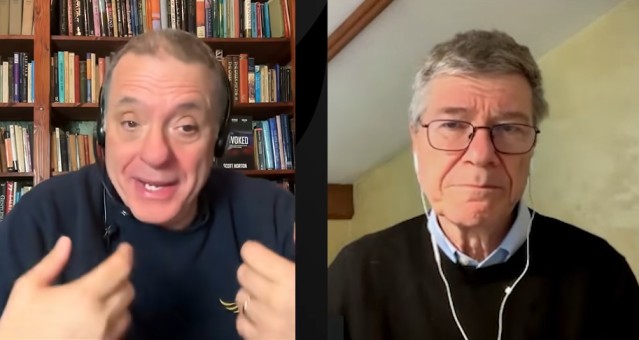
Economist Professor Jeffrey Sachs joins Alexander Mercouris and Alex Christoforou to lay out his 4-point peace plan for ending the Ukraine conflict: an end to NATO’s eastward enlargement, Ukrainian neutrality, a path to EU candidacy modeled on neutral Austria and Ireland, and an armistice line to settle the territorial question. Drawing on his firsthand experience with Gorbachev, Kohl, Genscher, and Yeltsin, Sachs traces the war back to the broken promises of 1990 and the collapse of inclusive security in Europe, and calls on European leaders, especially Germany, to say publicly what they admit in private. Read the full transcript of this interview which was premiered on October 27, 2026 below:
A War Fever in Europe
ALEX CHRISTOFOROU (00:00:00 – 00:01:37): All right, Alexander, we are here with the excellent Professor Jeffrey Sachs. I have Professor Sachs’s information in the description box down below as well as a pinned comment so you can follow all of his incredible work. Alexander, Professor Sachs, I pass it off to you gentlemen so we can discuss what is happening in the world.
ALEXANDER MERCOURIS: Fantastic. Let’s discuss what’s happening in the world, and let us also particularly begin by discussing a major initiative towards peace that Professor Sachs is taking, which I think is extremely important and very timely because one senses that in Europe we are absolutely in the middle of a war fever. Anybody who spends any time here can see it.
But that is also partly because the war itself that has been raging for more than 4 and a half years now in Eastern Europe, in Ukraine, is now boiling. It is now at a level of intensity that we have never seen. And of course we have all sorts of ideas about appointing EU representatives to conduct negotiations, which would be a good thing if it happened.
But in order to have negotiations move forward, you don’t just have to have a representative, you have to have actual ideas about how to achieve peace. And this is where I think Professor Sachs can take us. So Professor Sachs, you have some ideas about these, they’ve been articulated very eloquently by yourself, but perhaps you can help us by setting them out again in this program.
Beyond Empty Platitudes
JEFFREY SACHS (00:01:37 – 00:12:07): Well, thanks. So great to be with you. And I view our discussion as always, but especially now, as brainstorming actually, because I think ideas can make a difference right now. Of course, not only are we in war, but we are just trapped in the stupidest platitudes imaginable, as everybody knows. “We stand with Ukraine.” “We are with Ukraine as long as it takes.” “Russia must lose.” These are vacuous statements. They have no content. They don’t explain anything about what should happen, what could happen, and actually how to end the war in a way that is suitable for the parties to this conflict.
And so I didn’t do anything terribly innovative, but I have tried to write down what I think are the underlying causes of this war and how the war can end. And I actually believe that the way that a war can end is not that one side wins and the other side loses, but that there is an arrangement that is satisfactory to all parties. In fact, it can be a win-win, if you want to use the cliché, compared to the alternative, which is continued fighting. And I think such an alternative clearly exists.
The War Began in 2014, Not 2022
It obviously has a number of dimensions to it, but in my view, I think it’s yours as well, but having watched this conflict evolve over, I would say, the past 36 years, because I’ve been watching this go in the direction of conflict since 1990, which I would take as a kind of apogee of peace when Gorbachev said, “We will have peace from Rotterdam to Vladivostok, a common European home,” and when Germany was reunified in 1990. From then, we have been moving towards conflict and then open war starting in 2014, and then an escalation of the war in 2022.
And I think it’s important for everybody to remember the war did not start in February 2022, as is often said. The war started in February 2014. That’s when the killing started. That’s when the fighting started. That’s when this war started. It started with a coup that replaced a government in Ukraine. And when that government was overthrown in a coup, a violent coup, we should remember, that’s when war broke out.
Inclusive Security and NATO’s Role
Now, for me, that means that the underlying cause of this war is a failure of inclusive security. Inclusive security is a term of art in European diplomacy going back to the Helsinki Final Act of 1975. And then a number of treaties that followed that. And it means that all parties’ security should be respected in Europe, and that no country should aim to increase its security at the expense of another country, especially a neighboring country.
And to my mind, this is what this is all about. NATO got into the middle of this region in a most unpleasant and calculated way. Of course, it was a US calculation because NATO is not a military alliance. NATO is a US-led military bloc. And the United States decided in the 1990s that it would use NATO as its wedge to move eastward and increase its military, geopolitical, economic, financial power over Eurasia. And that is the root cause of this conflict.
So the root solution to this conflict is to return to the concept of indivisible security and to recognize that this conflict will end when Ukraine’s security is achieved together with Russia’s security, not at the expense of Russia’s security, and together with the European Union and other European countries’ security. This is not one against the other.
The mind-boggling idea that is stated by, oh, Baltic leaders by the hour, for example, that “Russia must lose” is a kind of insanity, by the way, that says the nuclear superpower in the neighborhood must lose, whatever that means, and somehow avoid the world being blown up in the process, which is a very unlikely idea, in fact.
And that’s why we’re heading more towards nuclear war by this kind of insanity of thinking.
I won’t use softer words because what comes out of these countries and out of the mouths of its leaders right now is horrendous. And I feel that it’s important to say that because it’s putting my children and my grandchildren at risk. And I don’t like that. I want them to shut up when it comes to escalating to nuclear war, to put it very bluntly.
The 1990 Promise: “NATO Will Not Move Eastward”
Well, to come back to the positive point, there can be inclusive security in Europe by respecting that idea. And for the first time since 1990, in actually listening to what the Russians have been saying for 36 years. And they’ve been saying it not as an excuse, they have been saying it as a cause of concern and then rising concern, then intensive concern, then open warfare concern, then now two-sided claims that we’re on the verge of total war.
So what is this concern? Well, the concern, as we’ve discussed in the past, but as people need to listen because they don’t want to listen. In Europe right now. They don’t even want things like we’re saying heard in Europe, but as people need to listen, on January 31st, 1990, the German Foreign Minister Hans-Dietrich Genscher, in the context of urging German reunification, declared in Tutzing in the Evangelical Church that NATO will not operate eastward if there is German reunification.
That was a very important, very consequential, very solemn pledge because for German reunification to occur, World War II had to end finally in 1990 because there was no treaty in 1945. And the reason there was no treaty in 1945 is that the Soviet Union said in 1945, “We must be sure that Germany is not going to come and destroy us again. We lost 27 million citizens.” And the West, unfortunately, would even then not recognize the security concerns of its ally and instead decided that there would be a one-sided division of Europe in which the Western powers would build a Germany that would be part of a NATO alliance.
Well, I don’t want to revisit the whole Cold War except to say that to end the Cold War in 1990 required an agreement among the 4 occupying powers of Germany who were still the occupying powers in 1990, the Soviet Union, the United States, France, and Britain to end the division of Europe. And the basis of ending that division of Europe was absolutely explicit.
The Soviet Union under Gorbachev said, “Yes, we want to end the division of Germany, and we want to end the division of Germany in a peaceful Europe based on inclusive security.” And the Germans and the Americans responded, “Yes, we agree with you. NATO will not move eastward.” And Hans-Dietrich Genscher said this on January 31st, 1990. U.S. Secretary of State James Baker III said it to Gorbachev’s face, said it directly to him on February 9th, 1990. And Helmut Kohl, the Chancellor of Germany, said it directly to Gorbachev on February 10th, 1990.
I knew all of these people. I was involved at that point in the economic catastrophe that was the end of this period and the part and parcel of the revolutionary changes that were going on. So I was at Kohl’s residence. I was with Hans-Dietrich Genscher. I knew James Baker III. The idea was end the division of Europe, but not take advantage of the Soviet Union by moving NATO eastward.
ALEXANDER MERCOURIS (00:12:08 – 00:12:08): Okay.
“We Won, You Lost”: The West After 1991
JEFFREY SACHS (00:12:09 – 00:35:06): Without reliving every aspect of this, this became the casus belli that led to this disastrous war in Ukraine because as soon as the Soviet Union dissolved in 1991, and I was there in the Kremlin, by the way, when that was happening, literally that day in December 1991, sitting with Yeltsin. As soon as that happened, the United States said, “We won, you lost, we can do what we want.”
And the thing we want to do is to weaken you further, not to have you as a partner, not to help you to stabilize financially, which was my neck of the woods, trying to get Western aid and failing to do that because the West didn’t want to help stabilize the situation. The West wanted to weaken and ultimately divide Russia into component parts.
And this is quite extraordinary, by the way. Brzezinski, one of the chief strategists of all of this in the 1990s, spoke openly about Russia becoming a confederation of 3 weak members, a European Russia, a Siberian Russia, and a Far East Russia. And they’ll be weak confederate states. It’s incredible what the CIA had in mind for Russia in the 1990s. And by the way, I think until this very moment as we speak, it hasn’t really changed. I think under Ratcliffe, the goals continue the same way.
Point One: NATO’s Eastward Enlargement Is Over
Well, in any event, this is what led to war and this is what needs to change to return to peace. And that is the first point of my peace proposal is that NATO say publicly and clearly that the eastward enlargement is over. Of course, it’s late in the day. They cheated so many times, first in Central Europe in 1999, and then in 7 more member states in 2004, the 3 Baltic states, Slovenia, Slovakia, Bulgaria, and Romania. The idea was surround Russia. And then in 2008 at the Bucharest NATO summit, of course, the commitment to move NATO to Ukraine and to Georgia.
Everything we have heard from the 1990s onward was Russia saying, “Don’t do this, stop this, do not surround us. Do not weaken us. Do not try to break us apart. Do not support the Chechens,” as the CIA clearly did. “Do not try to encircle us in the Black Sea with NATO,” meaning that Ukraine, Romania, Bulgaria, Turkey, and Georgia would all surround us in the Black Sea, something harking back to Palmerston and Napoleon III in the First Crimean War. “Don’t do this.”
So the first point is, let’s get this right. NATO never should have expanded. NATO promised not to expand. Countless political leaders in Europe know this to be true, but they don’t say it publicly. I know that because they say it to me privately, but they know this to be true. So the first point is, say this publicly.
By the way, this was one of the key points that Witkoff and Kushner brought to Russia at the beginning. But even the United States doesn’t say it publicly. It’s pathetic what the difference between the private whispers and the public statements are in our world, to the point of risking nuclear war. So my first point is say publicly, NATO stops its eastward enlargement.
Interestingly, I think it’s true that I saw that Zelensky said yesterday, “We reject this. We reject neutrality.” He does not represent in an iota the interests of his people, by the way. And he knows that what he’s saying is the opposite of what he himself said in 2022 and before that. I find his statements despicable, frankly, absolutely despicable. But aside from that fact, NATO must stop enlarging. Point number one.
Point Two: Ukrainian Neutrality
Point number 2, Ukraine must return to neutrality. That’s what this means. There will not be a military alliance on Russia’s border with Ukraine. That’s the whole casus belli from the start. So this is the second point, is neutrality.
Point Three: EU Candidacy as a Neutral Country
The third point, and I’m happy if there’s a way to do this, it became, I have, let me dial back a moment. Ukraine has said it wants to join the European Union. It was negotiating for that under Yanukovych. As well, although the negotiations turned absolutely putrid when the IMF started to make extraordinary demands for crushing austerity on Ukraine. And that was the immediate economic effect that caused things to completely unravel and go out of control. That’s 15 years ago.
But the point is, yes, Ukraine can join the European Union except for a major footnote these days, which is that the European Union seems to be turning itself into a military bloc. And so the question is, can you really join the European Union as a neutral country? Well, it turns out it’s possible to do so because there’s actually a precedent for that, or several precedents.
Several of the European Union member states are neutral from a military and security point of view. Ireland is a neutral country. Austria is a neutral country. Sadly, Finland and Sweden used to be, and they stupidly gave it up, not because their publics demanded it, but because they fell into line with the United States in 2022.
But be that as it may, my third point is that I say that Ukraine should be able to be a candidate for EU membership, and Russia should agree to that candidacy premised on it becoming a neutral member of the European Union modeled on Ireland or Austria. And that means that you don’t slip in the back door that you’re an EU member and suddenly you’re part of a military alliance because the premise of the peace is that Ukraine is not a member of a Western military alliance. And that can be consistent with EU membership.
Now, let me just add, it may be that Ukraine never becomes a member of the European Union, not because of Russian opposition, but because of EU opposition. There are countless member states in the EU that say, “Hell no, we’ll never take them in. They’ll threaten our farmers. They’ll undermine our own domestic politics.” So I have no idea whether Ukraine will actually become a member of the European Union. And my peace proposal is not premised on that. It is premised on the right of Ukraine to become a candidate without Russia’s objection. That’s the third point.
Point Four: The Territorial Question
Then the fourth point is quite a knotty point, not a naughty one, a knotty one because it’s hard to unravel. And that is, of course, the territorial issue. And the point I want to make about the territorial issue that people need to understand, Russia had no territorial designs on Ukraine at all, at all, from 1990 to 2014. Never raised an issue, never said, “Oh, that’s really part of Russia. Oh, that’s not a sovereign country.”
All the claims made in the West and in the Western narrative about this war being the reconstitution of the Russian Empire are false. The reason that territory came up at all was because of the coup in 2014 and what that presaged about a NATO-membered Ukraine and Russia’s national security. This is crucial to understand.
Of course, what happened with the coup was that immediately, and not in a very hidden way, the Ukrainian leaders started to opine that, “Oh, maybe Russia should leave its naval base in Sevastopol. Maybe that lease that we agreed to should be ended.” Well, that was the whole point of NATO wanting to get Russia out of the Black Sea. Again, totally reminiscent of Palmerston’s core idea in 1853, which is that the Crimean War should be fought to banish the Russian Navy from the Black Sea. So this is just a pure replay of history.
So Russia, of course, wanted and understandably wanted to secure its military core asset in the region, its naval base and Crimea, which has a long history. But the history goes back to 1783 when Catherine the Great put the naval base in Sevastopol. For the— in the first point, Crimea was retaken by the Russians after a hasty referendum. Okay, that is never reverting, by the way, because of the essence of this being this little game of the West that misplayed in February 2014. To exactly wrest Russia out of the region.
Minsk II and the South Tyrol Model
When it came to the Donbas, the Donbas immediately rebelled against the coup in Kyiv and said, “We demand our autonomy or our independence.” It wasn’t clear exactly, but “We don’t accept the overthrow of our president.” And this was quite a plausible response to a coup that had just taken place and a coup heavily backed by the United States. Let me just emphasize that point. This was not a revolution of dignity. This was a violent coup and a violent coup in which the United States had its hands all over it.
Well, Russia stepped in to call for a negotiated end to the conflict through the so-called Minsk process. And the Minsk II agreement, which was reached in February 2015, said that we don’t claim this territory, we don’t claim the Donbas, we don’t want Ukrainian territory, but this region should be autonomous within Ukraine because this is a Russian-speaking, ethnically Russian region, and it should have autonomy. And who was the champion of that, by the way? Angela Merkel.
And very interesting for me, I learned the background of Minsk II, at least some of the background, when I visited Bolzano, Italy, a couple of years ago because Bolzano is in South Tyrol, which is a German-speaking part of Italy. It’s a German-speaking part because it was part of the Austrian Empire and the Austro-Hungarian Empire, and it became part of Italy after World War I. And it created trouble, a German minority area in Italy, and especially after all the disasters of World War II, what to do with this.
And the resolution was to make South Tyrol in Italy an autonomous region, self-governing, German-speaking, but with the fiscal arrangements and part of Italian sovereignty. And it works beautifully. It’s a wonderful region. It’s very peaceful. It works as part of Italy. We had a great time vacationing there. It’s an absolutely beautiful place.
And when I spoke to the governor of the region, he told me, “Well, of course, Mrs. Merkel came all the time. She knew this region. She’s a German politician. She came to campaign with the German population in South Tyrol. And she loved the autonomy arrangement. And she built it into her contributions to Minsk II.” Very interesting. Actually. So Minsk II evolved in a discussion of Germans and Russians how to handle the Donbas.
And the point I’m making in this long digression is that Russia was not claiming the territory at that point. It was asking for peace based on autonomy following a US-backed coup in February 2014. Okay. The tragedy is that Ukraine and the United States absolutely opposed Minsk II despite signing on to it, despite it being unanimously adopted by the UN Security Council. And so they did not implement it.
Ukraine was supposed to implement political autonomy for the Donbas. It did not do so. Who was supposed to guarantee that? Germany and France in the so-called Normandy Process. They did not do so because Europe has had no foreign policy since 2008 in the Bucharest NATO Summit when they gave in to the United States. That’s the last day that Europe actually spoke the truth about anything. So when it came time to enforce the Minsk II agreement, which was the responsibility of Germany and France, they punted. They just let it go. And they blamed Russia, of course, for the unwillingness of Washington and Kyiv to honor an agreement that they had just reached.
Not a War of Territorial Aggrandizement
Okay, I say all of this to emphasize a point that I think is crucial. This has not been a war of territorial aggrandizement. This is a war that started because of the collapse of inclusive security, the expansion of the United States through NATO, many ancillary actions by the United States, most notably, by the way, unilaterally leaving the Anti-Ballistic Missile Treaty in 2002, thereby ending the stability of the nuclear arms control and putting nuclear— I’m sorry, anti-ballistic missile placements, the Aegis missile systems, into Poland and Romania.
So all of this came from a collapse in Russia’s perception of inclusive security and Russia’s state security. And there were not territorial demands that were at the core of this at all. This was not to recreate the Russian Empire.
And by the way, the phony reading of Putin’s essay on the historical unity of Russia and Ukraine is fascinating. If people who don’t read, by the way, if they would read to the end of that essay, the end of the essay says what will become of Ukraine, of course, depends on the Ukrainians. It’s their choice. And so the essay is the opposite of what people say. It’s not a claim that Ukraine doesn’t exist. It is a claim that Ukraine is being used and manipulated and the Ukrainians should make a wise choice, which they did not make, unfortunately, or were not allowed to make.
An Armistice Line
So the 4th point is territory, what to do after the war. Now, Russia has claimed, of course, Crimea, which I think is never even going to be an issue again because it is at the core of this security issue. And it has claimed 4 oblasts, the 2 of the Donbas and Kherson and Zaporizhzhia, and it says that these are Russian territories. On the battlefield, parts of Kherson and Zaporizhzhia are under Russian control, parts are under Ukrainian control. Lugansk is essentially completely under Russian control, and most of Donetsk is under Russian control, but not all of it.
What to do? What I say is a little vague, but also quite specific and to nobody’s liking especially. I say that there needs to be an end of the conflict and an armistice line. I don’t define it, and it doesn’t necessarily mean the contact line. It means an agreement that on one side there is administrative control by the Ukrainians, and on the other side there is administrative control by the Russians.
Now, this is unsatisfactory from all points of view because the Russians say, “We want de jure legal recognition of all the claims we have made.” Ukraine says, “We recognize nothing. Our de jure claim is our 1991 borders. And nothing beyond that.” And my point, not quite throwing up my hands, is to say the fighting should stop and a line should be drawn. And I don’t claim that this will be recognized juridically by either side, but that it will be an armistice line that can hold. This is not a great solution, but I don’t regard it— I could not think of anything better that would work.
Let me mention a couple of points. I do believe that borders, that legal borders matter and should not unilaterally be claimed to change. Of course, there are ways that borders can change under international law. Through various processes, referenda, and so forth. So that is a point to note. But I don’t see how the war can end quickly on a basis that is juridically agreed on both sides. Whereas I do believe that the war could end almost immediately on a line drawn that gives effective de facto control according to where that line is drawn, a so-called armistice line.
So those are the 4 points. The last one’s the toughest, but just to end, I’m so unhappy about the emptiness of the rhetoric as we slide to more destruction, to more disaster. And it is viewed as some kind of art of politics to say nothing meaningful, to engage only in backroom discussions, and to watch all of those backroom discussions add up to nothing. Except further destruction and a slide towards the most inane, dangerous, reckless rhetoric, including grabbing Kaliningrad, including, “Oh, nuclear arms are a bluff.” I mean, “Nuclear attack is a bluff.” And all the stupid things that we know from history are the fuses that light the total wars that we’re trying to avoid. So I hope that that was coherent, but that’s the proposal.
The Strategic Error of the 1990s
ALEXANDER MERCOURIS (00:35:06 – 00:35:45): It was coherent and very comprehensive, and thank you, Professor Sachs. Just a very few comments because we’re short of time. Briefly, I remember those times in 1990 extremely well, and I think one of the fundamental problems, in fact, in my opinion, the fundamental problem is that we denied agency to the Russians in what happened then. The events in 1990 happened because of decisions made first and foremost by the Russians. They decided in their own interests that they wanted to end the Cold War.
JEFFREY SACHS (00:35:46 – 00:35:47): That is exactly right.
ALEXANDER MERCOURIS (00:35:47 – 00:36:18): They wanted to do all kinds of things that— they wanted major changes within their own society and economy. It was their choice. We didn’t force these things on them. They chose to have them. That is one. Now, the result is that we came very, very close to achieving peace in Europe, something we’ve not properly had, by the way, since the end of the Napoleonic Wars. Instead of acting to secure—
JEFFREY SACHS (00:36:18 – 00:36:22): Or maybe since the disintegration of the Roman Empire in 476.
ALEXANDER MERCOURIS (00:36:22 – 00:38:44): Well, indeed. Well, exactly. But instead of working hard to secure peace. We told ourselves that we won some great victory, and instead of securing peace, we worked to consolidate that victory. Everything that has happened as a result has flowed from that fundamental strategic error, and precisely the expansion of NATO and everything.
Now, if we can get out of this, stop thinking in this way, and aim instead to secure peace, and that obviously means addressing the issue of NATO expansion, which is central to this whole topic. In other words, if we address the issue of security and peace in Europe, then everything else will follow and will fall into place. These territorial questions which look so intractable at the moment and which look impossible to solve will then become easy to solve. And that is something that people just seem to me to find very difficult to understand.
But in order for that to happen, we need to recognize in Europe and in the United States, but mostly in Europe because this is our continent at the end of the day, that we made these critical mistakes and misjudgments of the situation in the 1990s and thereafter, and that, well, you need to pursue a policy of peace through negotiation, and those negotiations, if they are to be successful, must be conducted in total good faith, which means we must stop the situation where people whisper behind the scenes and tell Professor Sachs, “We know this is all wrong, and it’s all very bad, but we can’t actually come out and say it publicly.”
We need to come out in Europe and start to say these things publicly. Political leaders who are failing to do that are abdicating responsibility and are betraying peace. Now that is my one comment, because I know you are under tight deadlines.
JEFFREY SACHS (00:38:44 – 00:38:45): Can I just ask—
ALEXANDER MERCOURIS (00:38:45 – 00:38:49): But I want you to just come in there and say what you want to say.
Germany’s Responsibility and Europe’s Private Whispers
JEFFREY SACHS (00:38:50 – 00:43:14): Totally, without even an iota of any qualification, completely correct as you described the situation since 1990. And I just want to agree with you completely, totally with your very eloquent, clear statement of why we got into this mess.
Second, I want to agree completely with the second point you said in passing. This is not about the United States at the end. This is about Europe, and it’s about peace in Europe. The US got us into this situation, absolutely. And again, I have recommended it for years and years and years. If anyone wants to understand the US mindset, read Brzezinski’s The Grand Chessboard. And he explains that Ukraine is a geopolitical pivot on America’s chessboard. And what he means by that is it’s a pawn in America’s game against Russia and against China. But the point is, this is about Europe, and Europe should have the understanding of how to make peace and how it let peace slip through its fingers.
Third point I would add, Germany could change everything. I don’t know if— I don’t think, and unfortunately it doesn’t seem like Merz has it in him to do it, but Germany is actually the principal protagonist in this. And I say that not just because it’s the largest economy of Europe, because it is at the center of this historical drama. We could go back to World War II, but I would just start in 1990. Germany promised no NATO enlargement, period. It did it for a reason, for German reunification. It was a quid pro quo, not in some sordid way, but it was the way to make peace in Europe.
Germany has the highest responsibility to set this right. And I’ve written open letter after open letter to Merz. Read your own documentary history. Look at what your predecessor, Chancellor Kohl, whom I knew, said face to face to Gorbachev. Look at Hans-Dietrich Genscher’s Tutzing speech. Take responsibility, Chancellor Merz, because you have not taken responsibility and your state has the central responsibility within Europe to get the record straight.
And the fourth point I would say is, oh, it’s what you said also. Leaders of Europe say to me, “Jeff, we can’t say that right now. We won’t have a seat at the table.” They don’t disagree with the substance, but we can’t go on this way safely. Just what you said. NATO expansion was wrong, dangerous, provocative, got us into this disaster. Leaders of Europe today know this. And they need to take responsibility before we have total disaster. That’s their job.
And saying it secretly, or even what one of them said to me, “But Jeff, that’s what Witkoff already told Putin, that NATO wouldn’t expand.” I said, “First of all, did he say it publicly?” “No, no, no. He said it in Moscow and then in Anchorage.” “Oh, did you say it publicly?” “Oh, no. It’s a little hard.” These are from leaders of Europe. So this is the breakthrough. Let them stand up and say NATO won’t expand. Let us have peace. And there will be peace.
Closing Remarks
ALEXANDER MERCOURIS (00:43:16 – 00:44:09): Professor Sachs, I think that’s been an absolutely wonderful program. I think it’s a tour de force, actually, what you laid out. And I think I saw, just very quickly, I saw that when Putin and Witkoff did meet, they agreed, and Putin has said this, that there needs to be a discussion about the security architecture of Europe. Whether anything will come of that, we shall see. But at least they’re discussing it.
And I think maybe, maybe just to say, they should also be talking to you and looking at the things that you’ve been saying. I know that you’re always there to help. I know the Russians listen to you. I know lots of people listen to you. I think the Americans and the Europeans need to start listening to you and not whispering to you in this way all the time. Anyway, thank you for coming on our programs.
JEFFREY SACHS (00:44:09 – 00:44:15): Great to be with you. See you guys soon. And thanks for all the wonderful work you’re doing every single day. Thanks.
Related Posts