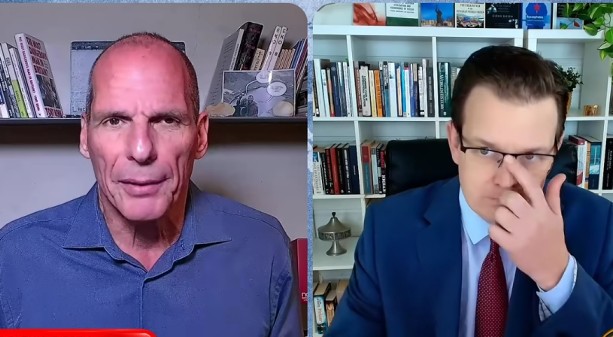
In this interview, economist and former Greek finance minister Yanis Varoufakis joins Glenn Diesen to discuss the collapse of the Atlanticist bargain between the United States and Europe, and why he believes Europe has slid from a hierarchical partnership into outright vassalage. Varoufakis explains how surplus recycling, cloud capital, and Europe’s own ruling elites drove this decline, why a US-Russia rapprochement could leave Europe a mere spectator, and what collective resistance could mean for the continent’s future. Read the full transcript of this interview which was premiered on October 27, 2026, below:
Introduction
GLENN DIESEN (00:00:01 – 00:00:17): Welcome back, everyone. We are joined today by Yanis Varoufakis, an economics professor and also the former finance minister of Greece, as well as being a founder of DiEM25, that is the Democracy in Europe movement. So thank you for coming back on the program.
YANIS VAROUFAKIS (00:00:18 – 00:00:20): Well, thank you, Glenn. Thank you for having me again.
What Unites and Divides the Transatlantic Relationship?
GLENN DIESEN (00:00:21 – 00:01:28): What I really want to discuss with you today was how you see the future of transatlantic relations. I know, of course, you’re quite eager to keep European cooperation in place. I know you’re a bit critical of the direction of the EU nonetheless, but overall with Europeans and the United States, it appears that, well, during the Cold War there was some unity based on the collective balancing of the Soviet Union. After the Cold War, I would argue that there was a lot of unity around organizing the collective hegemony or liberal hegemony, as it was often referred to.
But in a multipolar world, it appears that the interests of the US and Europe begin to diverge. I know we have a lot of focus on Trump and these kind of personalities, which drives a very deep wedge, but there seems to be some structural factors as well. So I guess my first question is just, what is it that unites us and divides us today, that is in the transatlantic relationship?
Atlanticism Was Always a Transaction
YANIS VAROUFAKIS (00:01:31 – 00:05:49): Well, this is going straight to the heart of Europe’s issues at the moment, Glenn, your question and the general problematic that you’re introducing. Because you see, to understand where we are and where we’re going, we have to have, I believe, a very serious rethink about the very origins of the Atlanticist Europe-America, US-EU relationship. What held the Atlanticist world together was never a shared civilization or a common love of democracy and free markets and all that. It was a transaction.
American security guarantees were offered to Europe’s ruling classes, in exchange for European deference and the financial loop where Europe, at least since 1971, but even before that, but let’s say from 1971 onwards, Europe recycled its trade surpluses and general financial surpluses into American deficits. You and I have discussed this before. I’ve explained that to you in previous podcasts. That was the foundation for Atlanticism.
But today, the United States relies less and less on the trade surpluses of Europe for its financing, for its federal government financing, for its real estate financing, for its stock market financing. American assets have found new ways of reproducing themselves, and it’s on the base of big tech, what I call cloud capital, now being turbocharged by AI. These developments are offering a direct way for the United States to plunder Europe’s rents.
Let me put it very simply. Amazon.com, I’m not including AWS, Amazon Web Services, only amazon.com, the retailer, has something like $55, $60 billion worth of sales in Europe and it pays zero tax. And all of it goes through the Cayman Islands to the pockets of Jeff Bezos. So this surplus recycling, which was part and parcel of the deal between the United States and Europe, is now rewritten. Still, the United States is using European surpluses, but it doesn’t need the institutional frameworks of the European Union, of NATO.
So Trump is not an aberration turning against European institutions. I think he’s simply expressing the fundamental, profound change in the architecture of Europe’s effective dependence, I would even say vassalage, to the United States.
Rethinking the European Creation Story
But Glenn, I’m one of those people who have been teaching students for decades not to believe the European creation story. Here in Europe, we wax lyrical about how we created the European Union. We didn’t create the European Union. The Americans created the European Union. There’s no doubt that it appealed to the instincts of our rulers after 1945, to our populations who wanted peace and prosperity, who didn’t want wars between France and Germany anymore.
But the idea of creating a cartel of big business with its capital in Brussels, with a commission that operates like the bureaucracy of a cartel. The cartel, remember, had a name to begin with. It wasn’t called the European Union. It wasn’t even called the European Economic Community. It was called the European Communities of Coal and Steel. It was a cartel of big business.
That idea, and you can look for the evidence in the archives of the Senate, and of Congress in the United States emerged at the same time as Bretton Woods between 1944 and 1948, ’49. And then the Marshall Aid Plan was a means of financing it. So we Europeans, we have to rethink everything, not just the future relationship with the United States, but also the past.
What Is America’s Interest in Europe Today?
GLENN DIESEN (00:05:51 – 00:07:15): Yeah, I feel like we romanticize the European story. That is, after World War I, we did the Treaty of Versailles against the Germans. After World War II, we had learned our lessons, as if that was what happened in history. So the narratives, they have to be attractive as well to have the story of the birth of modern Europe. But there are some flaws which should be addressed.
But what is the interest of the United States now in Europe though?
But today, how do you see the economic— well, the interest of the US in Europe? What purpose does it serve, and how does that translate into economic policies? Because many have been looking, for example, at the US seeking or demanding that Taiwan should transfer its industries to the US, same as South Korea. The Europeans should do the same. How does that fit into a wider logic? Because often one of the things annoys me, we always tend to say, oh, Trump, we get obsessed with these personalities, but there are other factors at play here.
Financing American Hegemony Through Deficits
YANIS VAROUFAKIS (00:07:17 – 00:14:00): Absolutely. Absolutely. Look, as I was intimating before, for decades the American political economy was being financed in the most weird and fascinating way through American deficits, the American trade deficit and the American federal government deficit. Now hear what I’m saying. The American political economy, American hegemony was being financed through deficits. That has never happened in human history before. It is an exorbitant privilege, isn’t it, to be able to finance yourself through deficits?
But that’s how it worked because once America became a deficit economy and the authorities from Richard Nixon onwards, all the way to Donald Trump, including all the Democrats in between, they took a very considered decision to increase their deficits, not to rein them in, not to go German and do belt tightening, but to increase the deficits and to use those deficits, take the trade deficit for instance, as a, I’ve said this on your program before, as a vacuum cleaner that sucks into the United States the net exports of Germany, the exports of France, of Italy, at the same time, Japan, and later on China.
And yeah, they were paying with dollars for this on the basis of the assumption, which was a correct assumption, that the German capitalists, Mercedes-Benz and BASF and Siemens and so on, what would they do with their dollars? They would have to take them back to Wall Street. And in Wall Street, they would do 3 things with them. They would buy American government debt. So effectively, think about it, the American trade deficit via German surpluses is financing and refinancing the American federal debt. So effectively it is paying for its military and for its state, the United States, Washington, by means of its trade deficit, which then becomes the net exports and surpluses of Germany, of Japan, of China.
So that was the time when globalization took place because all this financing has to release banks, especially Wall Street, from its shackles, from its regulations. So you had deregulation, really very rapid deregulation. It created neoliberalism, and it created this notion that we have a stable capitalism, which was a notion that was built on this increasing disequilibrium imbalances, the increasing enhanced deficits of the United States. It was very perverse.
So when people talk about the rules-based order and the great past relationship between the United States and Europe, that’s what they’re referring to. Now, that was sort of wedded to existential fear over the USSR, over the Soviet Union. So you had the existential fear of the Soviet Union and you had surplus recycling between the United States and Europe. That was the foundation. And Europe on the basis of that accepted American leadership, NATO command, the dollar’s hegemony.
But even during the unipolar moment, as you call it, after the Berlin Wall came down, that dynamic was preserved. Europe convinced itself that Atlanticism was a values-based partnership, not a hierarchical arrangement. It was always a hierarchy. The United States designed NATO not as a mutual defense club, but as a platform for projecting American power, for, as they’ve said so many times, “keeping the Germans down, keeping themselves in Europe, and keeping the Russians out.” This is a famous American expression. I didn’t make it up.
The Old Bargain Is Dead
And so, coming to the present now, taking my cue from your question. Recent developments have exposed that this old bargain is dead. The Europeans are refusing to bury it, but its corpse is there festering. The Trump shock is not an aberration. Even Joe Biden was using very powerful subsidies in order to attract to American soil German industry. Trump is doing it through tariffs. But the idea is the same.
So it’s a logical continuation of American hegemony by other means. It’s an attempt to maintain dominance in a world where China is now the gigantic superpower, a power which is deeply interconnected with the Global South, but also with Europe. And Washington is no longer interested in offering a false sense of security to Europe. It simply, through Trump, demands tribute.
And the tribute goes willingly. It goes willingly, Glenn. Only, what was it yesterday, day before, that Audi, the German car manufacturer that belongs to the Volkswagen Group, announced— a representative was next to Donald Trump during his campaigning for the midterm elections, announcing a multi-billion new factory for making Audi cars in the United States at the very same time that they’re closing down factories in Germany.
So already we can see that what was always a hierarchical relationship is now turning into total vassalage. Look at the way that the United States governments, all of them, Democrat and Republican have been treating international law as a private equity asset to be stripped and sold. And Europe, paralyzed by 15 years of no investment due to the euro crisis and so on, and political fragmentation, responds with the only reflex it knows, compliance.
The Protests in Europe and the American Origins of the EU
GLENN DIESEN (00:14:03 – 00:15:00): The phrase you said though, keep the Americans in, the Russians out, and the Germans down. This is the famous phrase of NATO’s first Secretary General in terms of what was the purpose of NATO in the beginning of the Cold War. As you and many point out, this is an enduring mission to a large extent.
So, but do you see this shift though in the transatlantic relationship and, I guess, the economic order of Europe as the source behind the protests going on now? Because again, France seems to be taking the lead in this protest, as its historical role has always been, it seems. But do you read more into this protest? Because it’s hard to see how they’re going to turn a corner and essentially improve the underlying problems. Or is it linked to this phenomenon you’re describing?
YANIS VAROUFAKIS (00:15:01 – 00:20:04): It is linked, but it’s linked indirectly, importantly, but indirectly. Look, let me put it very bluntly and as succinctly and with as much brevity as I can. After 1949, the Americans were very worried about maintaining their net exports. America was the net export force of the global economy at the time. They were the only country that had a functioning manufacturing sector and they had sound money and they were a creditor state and so on. And they were worried about how they would retain a level of demand for their products.
So for them, the European Community was important because they wanted to create a cartel of big business in Europe, that will be the financial and economic skeleton on which this European Union will be created so that America could dollarize it, share its currency with it, which it did through the Bretton Woods system and the fixed exchange rates and the whole gamut of the World Bank and the Marshall Aid Plan, in particular the International Monetary Fund, whose purpose was there to monetize Europe. And Japan, but mainly Europe.
Why? Not out of philanthropy, but to make sure that the Europeans had enough dollars to buy American Boeing jets and Cadillac cars and Westinghouse washing machines, which were all the rage at the time because there were no Bosch and Siemens washing machines at the time. We’re talking about now 1948, ’49, ’50.
So the Europe we know, the idea of a common market, the idea of a cartel-like bureaucracy in Brussels called the European Commission, of a common money. Now, the euro is nothing but the ultimate extension, the logical conclusion of the fixed exchange rate regime that the Americans had created for European currencies in order to keep that cartel of big business in Europe called the European Union and the European Communities of Coal and Steel, the European Common Market, whatever it is that they called it, at different points in time to keep it going.
So the Americans created it, and bluntly put, at some point they didn’t need it anymore, especially after they ditched Europe in 2 or 3 different stages. The first one was 1971, the Nixon shock, when they said, “The dollar is ours now, go hang yourselves.” That’s what they said to the Europeans. The precise words that John Connally, the Treasury Secretary of Richard Nixon, used was, “The dollar is our currency, but from now on it is your problem.” Brutal words.
Then again, it was after 2008, even though the Fed saved the European banks through swap lines, essentially they just didn’t countenance the idea of doing anything beyond that to help the European Union during the euro crisis. And that’s one reason why the American administrations during that time, they were quite positive towards us Greeks. I remember Barack Obama telling me personally in the White House that the way that the Europeans treated us was terrible and they would have no part in it. They had a part in it in the end, of course, but they were not the active agents in this crime against logic that the Europeans were perpetrating in order to save the French and the German banks after the 2008 disaster.
Europe Is Bandaging a Corpse
So essentially you have a corpse of a European Union, which is what is left of the Atlanticist equilibrium, the Atlanticist arrangement, I should say. And the Europeans have neither the will to bury it nor the will to replace it with something living. So they don’t have any plans to federate the European Union. We have federal money, but we don’t have a federal treasury. We don’t have a federal parliament.
Essentially, the European Parliament, folks out there, don’t be duped. It’s not a parliament. It’s the only parliament in the history of humanity that doesn’t have the right to legislate, to initiate legislation. It’s a rubber stamp. It’s whatever the European Council, European Commission, primarily Berlin and Paris decide with some input from the rest.
So this model was fantastic for the United States and for the ruling class of Europe while America needed it. Now America doesn’t need it. The Europeans have no plan to replace it, or to disband it. So this is where we are. Europe is bandaging a corpse.
Why Is There No Push for an Alternative?
GLENN DIESEN (00:20:07 – 00:21:28): The Europeans told themselves a story about shared Western civilization based on liberal democracy. That was the pillar that held all this Atlanticist arrangement together. And well, now it’s over. But why is it that there’s no push for any replacement? Because even people like Macron at some point warned that we can’t become vassals of the US. However, if we see how they respond to the fragmentation of the West, it’s essentially to hold on at all costs.
So for example, when the EU signed this trade agreement with the US, in which they recognize it’s a horrible deal, but it has a geopolitical component, it links America to the EU, to Europe. But even if this means a very extractive, exploitative role, is this about human beings finding comfort in what they know? I mean, the devil you know as a familiar bad situation may be better than unfamiliar.
Or how do you explain? Because I don’t understand the reaction when you see the existing house falling apart and it’s changing and there’s no effort to look for an alternative. It’s just very strange to me. How do you see them responding? What are they doing? Are they simply trying to revive the transatlantic relationship?
YANIS VAROUFAKIS (00:21:30 – 00:30:09): Oh, I think they’re like deer caught in the headlights of the oncoming truck. They’re stunned. No thinking is happening in their brains. But look, it’s a mistake. I’ll take all this back. It’s a mistake to psychologize Europe. This is not something that we can understand on the basis of how individuals behave during periods of crisis. And psychiatric or psychological explanations are not necessary here. They’re always useful. They’re not necessary because there’s a lot of money being made by very few people who happen to have all the power to have their hands on the levers by this status quo.
It’s a status quo which is pushing Europe to a century of humiliation, to a century that resembles a postmodern Middle Ages, Dark Ages. But a lot of people are making a lot of money. Just follow the money, Glenn. This is what we economists should be saying to ourselves.
Europe as an Active Collaborator in Its Own Diminution
But allow me to, before I go to Macron and what is it that they want and what they do and what didn’t they do? People like Macron. Look, the tragedy from a philosophical moral perspective, I’ll start from there before I go to the nitty-gritty of the money-making, which is the real explanation. But if you look at it from a moral perspective, from a legal perspective, the tragedy is that Europe is not a victim of the United States. It is an active collaborator in its own diminution.
Have we forgotten that European centrists spent years trashing international law alongside Washington? When Washington, George W. Bush was invading illegally Iraq and Tony Blair went along with him. Okay, France and Germany didn’t go along, but they didn’t make a big fuss about it. They effectively aided and abetted these acts of trashing international law. They trashed international law when they bombarded Yugoslavia.
Now every time they talk about, “How dare you suggest that there shall be any agreement with Putin that includes the change of international borders? How can you possibly claim or agree that international borders can be changed after bombing?” Well, that’s what you did with Kosovo, isn’t it? Who opened that door after the Second World War in the heart of Europe? It was NATO. It was the Europeans, the Italians, the Germans who were bombarding Belgrade to change international borders. What did they think Putin will think after that? Wouldn’t he think, “Well, if they can do it, I can do it too”? And all this, the moral outrage.
So now they, after themselves participating in the trashing of international law, now what they see is Trump using the resulting vacuum that they created to build his own Board of Peace to effectively replace the United Nations. To treat Gaza as his own real estate on which he can carry out any genocide he feels like. And exactly how did they push back on the Board of Peace? They didn’t. They pushed the United Nations to recognize its own demise through the Board of Peace.
Macron, Merkel and the Federation That Never Came
So that’s on the international law and moral question. But you asked me what was it that Macron did or wanted to do or actually, there’s a big chasm between what he should have done, what he wanted to do, and what he actually did. As we have discussed, I know Emmanuel Macron. I knew him before he was president. We had many discussions on those matters. It was clear to me that he understood that this euro currency of ours cannot be sustainable unless we have a federal Europe, unless we federate politically. Politically and fiscally.
And he even said to me once, we were sitting next to each other, it was somewhere in Italy at Lake Como in a conference. He said that when I pushed him, I asked him, “How can this be done?” He said, “Well, we have to tell the Germans, if you want the European Union to continue, you are going to have to agree to this federation.” So he seemed to know what needs to be done, right?
But once he became president, he never dared tell Angela Merkel at the time, at the beginning of his presidency when he had a window of opportunity, when you get elected, you have what, 6 months to do stuff. If you don’t do things within 6 months, then you’ll never do it. And he could have said to Angela Merkel, “If you want me to support the continuation of the euro, then you will have to agree to A, B, and C.”
Now, Merkel was not interested in changing anything. Her whole chancellorship was built on changing everything so that nothing changes. I think that if Macron had done that, she would’ve responded because she was a realist. She would’ve kicked and screamed, but maybe she would’ve gone along with that. Macron never, however, considered the possibility of playing tough and saying, “I’m going to go back to the franc unless we have federation.”
Now that would’ve made sense because either you go back to your national currency or you federate. There’s no third option. The third option, which they’re following, is the option of the steady decline, slide into a century of humiliation. This is what’s happening.
But the Germans have their own reasons, the German ruling class, the Bundesbank and the Treasury, they had their own reason to be very suspicious of the French ruling class because the French ruling class always wanted the Deutsche Mark. They wanted to grab the Deutsche Mark. They wanted to occupy the Bundesbank and use the hard currency of Germany, which is the euro, right? The euro is nothing more than a Deutsche Mark in different clothes. In disguise.
The French bourgeoisie wanted the Deutsche Mark in order to do French things, and the Germans were not going to give them the Deutsche Mark for the French to do. So it was a mutual clash, a mutual sort of equilibrium of discontent. Emmanuel Macron said to me that the relationship between Berlin and France, this was in 2017, he was telling me this, reminds him of the clash between the Catholics and the Calvinists, the 100 Year War.
But what does he do once he becomes president? He gives these waffly talks about a new European Union and federating and so on. But unless you are prepared to put skin in the game, unless you are prepared to say, “Okay, within 6 months, we have to agree on a glide path to federation or I’m leaving the euro.” If you were to do that, maybe something would’ve changed.
Follow the Money
But you see, these people are incapable of thinking, of acting strategically because as I was saying, and this is how I’m going to complete that segment of our talk plan, there’s a lot of money to be made while remaining in stasis. While doing nothing. Because during that period that I’m referring to, after 2015, between 2015 and 2022, the European Central Bank printed, what, 6, 7, 8, depends on everything that you count in there, trillion euros, okay? 8,000 billion euros, which was given to Macron’s mates, to big business.
And this is the reason why, Glenn, the 200 richest families in France today have seen their wealth treble, 300% up compared to what it was when Macron was elected. So let’s not psychologize. They make a lot of money through this stasis. And Europe is really very rich. We can waste a lot of money and resources and potential shared prosperity, doing nothing while the oligarchy is getting fatter and fatter.
Von der Leyen, Centralization and the War Economy
GLENN DIESEN (00:30:11 – 00:30:50): But these European leaders and the EU bureaucracy, as they now, yeah, of course, are trying to cash in, but as they see the transatlantic relationship beginning to fall apart, do you think there’s some who now regret not federating? Because when you look at the decisions of von der Leyen to centralize power and how they’re essentially treating the Ukraine war, it looks as if they’re thinking, let’s not let this crisis go to waste, that they’re using the conflict and the war to begin to centralize power. Is that to federate, or is it just a power grab, or how do you make sense of what’s happening?
YANIS VAROUFAKIS (00:30:51 – 00:33:05): They’re still making money. Look, take Volkswagen, take Renault, German and French manufacturers, 2 examples. They can’t sell cars because they haven’t invested for 15, 20 years in car making. So they can’t compete with BYD, with Tesla, and so on. But they don’t mind that much. They fire workers and they get to shift their production facilities to Rheinmetall in Germany to produce tanks that not even Ukraine wants, but they get the money. And Renault, whom I mentioned before, is now building with government money, it is building drones.
So Ursula von der Leyen offers them the narrative that Russia is about to take over Champs-Élysées and the south of France, whatever. And this warmongering, scaremongering allows the Macron government, the Merkel government to push through parliaments, their parliaments respectively, the shift of funding from social benefiting activities from the welfare state to those drones and tanks that Renault or Dassault or Rheinmetall in Germany or Leonardo in Italy are manufacturing.
So all these people who, they also own the newspapers, they own the television channels, they’re quite happy with the situation. They don’t mind the concentration of power in the office of the unelected quasi-mad, seemingly raving mad, I should say, not quasi-mad, Ursula von der Leyen, who has the audacity to go to Israel and stand in front of IDF tanks before they invade Gaza and wave them on, on behalf of us Europeans, a genocide cheerleader. They don’t mind. They make money out of it.
BRICS+ and the New Cold War
GLENN DIESEN (00:33:08 – 00:33:53): So, yeah, no, it is a bit bizarre. These are the people who are representing Europe these days. But so how do you see this shifting the wider, I guess, world order if the West is kind of fragmenting a bit? Because often the reference is to, it’s going to be the G7 versus the BRICS. But again, the G7 doesn’t seem very united, and even BRICS, it’s not a bloc who’s seeking a common Western enemy. If anything, it often defines itself being anti-hegemonic. So they don’t want the US dollar and tech to dominate, but they don’t want to fight the West, fight America. So
YANIS VAROUFAKIS (00:33:53 – 00:33:54): No.
GLENN DIESEN (00:33:54 – 00:34:23): essentially anti-American empire but not anti-American. At least that’s the impression I’m getting from most of these BRICS countries. Is this bloc politics Cold War fantasy, or do you see this is a direction, or how do you see the world moving from here on? Because this is, I guess, what the Europeans should be discussing, is what the world will look like, the post-Western world when the collective hegemony of the West has come to an end.
YANIS VAROUFAKIS (00:34:25 – 00:39:52): Well, there is a new Cold War, there is, and it was Trump who started it, and then Biden turbocharged. It’s a new Cold War. It’s taking place between the United States and China. Nobody else. You’re quite right. BRICS+ is a very interesting agglomeration of countries, very interesting set of institutions. It’s no substitute to the Warsaw Pact. As you said, they have huge difference between them. India and China, who are important parts of cogs in the BRICS+, are almost at war with one another, but they recognize what they have in common, which is what they don’t want, American hegemony, especially of the payment systems.
The payment systems, the digital payment systems based on blockchain that the BRICS+ countries have created are magnificent. And they’re not there as a replacement of the dollar. They’re there as a system to have in case they need to use this. If a crazed Trump or Trump-like president of the United States decides to shut SWIFT off or to close down the dollar system for these countries. The way that AI is being utilized in the BRICS+ countries on the basis of Chinese technology, Chinese AI is really very interesting. Now you have in places like Indonesia and Bangladesh, you have electrification that would never have been possible without the BRICS+. So this is very interesting.
The Fear of Russia as Atlanticist Glue
Now, coming back to Europe. Look, the only thing that keeps NATO somewhat homogeneous is the fear of Russia. This is the glue that is holding them together. Everybody talks about Russia as a bear that is about to, as I said, walk down the streets of Paris, which is of course utterly absurd. But it has been so far a kind of Atlanticist glue. It’s a convenient fiction to justify a NATO that exists to manage American power projection, not to defend Europeans.
But I don’t believe that it can continue to be that. Already we see that this glue, the fear of Russia, is sort of fragmenting and dissolving itself. And you know what, Glenn? I think that the greatest irony will be if it is the United States. We can already see this from Trump, but I think we will see it from other American politicians who will succeed Trump. They are going to start bringing Russia in from the cold. And then what will the Europeans do?
Greece’s Gas Corridor and the Nord Stream Question
I’ll give you an example from where I’m talking to you now. It’s important to ground the conversation in the local situation as well, I believe. So the great plan of the Greek government for becoming an energy hub, that’s what they say, that’s what they call it, is to— they’re building now, along with ExxonMobil and the United States government, they’re very keen on that. They’re building what they call the “perpendicular corridor.”
This is the idea of creating a pipeline, a gas pipeline from Piraeus, the port here, I live very close to that port, going all the way up to Bulgaria through Romania, Moldova, and in Ukraine. And the idea is to carry on huge container ships liquefied natural gas from Texas and New Mexico across the Atlantic, down to Gibraltar, bring it to Greece in order to pump it up to the north.
Now you can imagine what an ecological catastrophe that is, the waste of energy, the carbon footprint of that, immense. The price of that gas is going to be 15, 20 times what the Russian gas is, and it’ll end up in more or less the same area, just on the other side of the frontline of the war between Ukraine and Russia.
So this is, the Greek government, the European Union is completely behind that. My goodness, they are choosing to be vassals of the United States, and in a way that binds the Greek political system to the need to perpetuate the war in Ukraine. Because if the war in Ukraine ends and Russian gas starts flowing back again, this perpendicular thing, it goes. It’s so financially unsustainable that it will just be blown over in a jiffy.
Now, the funniest thing is going to be that Trump or somebody succeeding Trump can turn around at any point in time and say, “Look, you know what we’re going to do? We’re going to have a treaty with Russia and we’re going to reopen Nord Stream, Nord Stream 1, which is still functioning. And we are going to have a joint venture, America and Russia, to sell to Europeans cheap Russian gas.” Then what would the Europeans do?
US-Russia Rapprochement and European Irrelevance
GLENN DIESEN (00:39:55 – 00:41:15): Well, I heard this from many people, including the former Italian Prime Minister, that most likely Nord Stream will at some point be open, but under American administration. So essentially trade between Russia and Europe can go on, but under again the US control and making sure that they get a cut out of this. Is this the future though? That is, at some point the US and Russia will pursue reconciliation and Europeans will be spectators and vassals?
I’m thinking a bit about a thing that Macron said in 2022, because France was one of the last ones to join in on boycotting the diplomacy with the Russians. And he gave this warning that if we don’t talk to the Russians, then the future of Europe might be determined in Washington and Moscow. But he essentially fell in line, and he also stopped all talks with the Russians.
But now you see this kind of economic movements. Sorry to repeat it, but is this what you see coming? The US-Russia patching up while the Europeans become, I guess, vassals? Or how do you see this happening? Because what you’re describing with Nord Stream, that’s kind of what it sounds like.
YANIS VAROUFAKIS (00:41:17 – 00:46:06): Yeah, well, I would go as far as to say that this is not something that will happen, but something that has already happened. The rapprochement between Washington and Moscow is already in the works, but it’s not at an advanced stage. And we don’t know exactly what the Democrats will do if they replace Trump, how long it will take them to do it, but that it will happen, that rapprochement, there’s no doubt. There’s no doubt.
What has already happened, however, the segment of the argument that it has already happened is that Europe is irrelevant. Europeans are not even asked to contribute ideas about what to do with the war in Ukraine, how to end it, how to win it, how to finance it. They have not a single iota of a smidgen of an impression of what to do.
If you ask them, the only thing they’re talking about is how to use Russia’s money in order to fund this never-ending war, they will not succeed in doing that. Belgium is not going to budge on this. There’s no way Belgium will budge on that. But even if they do, the money will run out. Last year they borrowed €90 billion on behalf of Ukraine. It’s already run out. And Zelensky wants another €70 billion now. And the Europeans just don’t have the money to give it. So they are not at the table. They’re already their vassals.
And so the only question is whether Europeans will continue to— European leaders, right? I’m not talking about the people. Will continue to mistake their own subordination for significance, for partnership, or whether they will finally recognize that the Atlantic era, the Atlanticist system is over, and that European survival, European prosperity requires something completely different. It requires a kind of Europe making peace with its own people.
The War of European Elites Against European Peoples
Because for the last 20 years, Glenn, especially after 2008, after the great financial crash, the European Union institutions have turned against European peoples and they have treated them with contempt. They have imposed austerity upon them. I’m not just talking about the Greeks, I’m talking about the Irish, the Portuguese, and the French, thus the riots, and the Germans, thus the rise of the AfD. The German working class has been subjected now to 20 years of straight harsh austerity. The bottom 40%, 45% of German society are now 30% worse off than they were 20 years ago.
So there is violence being perpetrated by European elites, by European bourgeoisies, by European ruling classes upon the people of Europe. And like all authoritarian regimes that create discontent when they plunder the many on behalf of the few, at some point they turn to militarism.
So Putin did them a great favor by invading Ukraine. It’s an invasion which I consider to be illegal and should never have happened. It was provoked, but it shouldn’t have happened. If I provoke you by saying nasty things about your mother, you don’t have the right to stab me and kill me. But nevertheless, that’s irrelevant because the Europeans needed the Russian bear in order to distract their own population from the war that the European ruling elites have been waging against the European peoples.
I was in those corridors of power for a very short period of time. I saw it. They have no compunction whatsoever. The German leaders hated the German working class. The French leaders looked at the working classes with contempt. The Italian leaders were plundering them on behalf of the Italian oligarchs.
Even during the pandemic when they created that, remember the recovery fund with €800 billion? Well, what was that? It was charging German workers, money, effectively taking loans on behalf of German workers who are repaying them, to give the money to Greek and Italian oligarchs. This is a war of European elites, oligarchs, who are very united. There is no clear water separating German, Italian, Greek oligarchs. They are like that. They’re like brothers. And what really unites them is the determination to plunder their own people.
So the result now is warmongering, and we have to borrow more money, the little people, so that they can make guns and drones because they can’t sell cars anymore.
Is Europe Already Fragmented?
GLENN DIESEN (00:46:09 – 00:46:53): Yeah, not a great future for the continent. Just, last question is, because we keep talking about Europe and whether or not— well, it is already— has already become a vassal, but we speak of it almost as one entity. How do you see though Europe after that Atlanticist era? Because how long can you have again this Europe that has essentially a war against its own people, ruled by von der Leyen? And what’s keeping this bloc together besides economic interests of elites? Do you see Europe holding together in its current form or do you think it’s just going to fragment?
YANIS VAROUFAKIS (00:46:54 – 00:49:47): Oh, it’s already fragmented. What keeps it together is vested interests. Look, if you look at, for instance, a country like Serbia that had their election now, or North Macedonia or Albania or even those who are inside and not doing really very well inside the European Union. Why does the ruling class want desperately to be part of the European Union?
Well, let me give you an example from this neck of the woods again, from Greece. There are 20,000 minimum families who live directly off Brussels. They are very well educated. You go to Athens Airport, you see them flying in and out of— whenever I board a plane, I try to do it as infrequently as I can, to Brussels, those planes are packed with them. They have positions in Brussels, they’re attached to people who have positions in Brussels. It’s a Keynesian work job creation scheme. That’s what the European Union is. And a lot of them, they swear allegiance to the European flag because they’re in tears. They’re parasites. And they have jobs that shouldn’t exist.
Glenn, we are university professors, right? Now, I spent most of my years as a university professor in the Anglo-Saxon system. And I remember when I was in the United States, in Britain, or in Australia for that matter, I spent 12 years in Australia, if I wanted to apply for a research grant, I would formulate my idea, my research hypothesis, and I would try to write a good proposal to explain why that idea deserves funding and what the benefits would be from funding that idea and taking that research further.
In the European Union, somebody in Brussels says, okay, they send a circular around to European universities, you know this very well, and they say, “Who wants to research the beak of that particular kind of chicken?” Suddenly thousands of researchers are interested in the beak of that particular chicken. I’m just giving this as a very simple and basic and vulgar example of the corruption.
It’s systemic corruption that, the European ideal is brilliant. European peoples getting together, democratic, and facing collective problems in a collective way. But this is not what’s happening. This is the privatization of public resources in ways that are particularly obnoxious.
Resistance and an Alternative Future for Europe
GLENN DIESEN (00:49:51 – 00:50:23): Well, yeah, not a bright future for Europe, but honest assessment, I will say. Just squeeze in one last question. What is the best scenario though? How do we navigate out of this? What is the best situation from here on? Because we’ve kind of been tied up, well, joined at the hip with the Americans for now the past 80 years. So, well, what is an alternative future for Europe?
YANIS VAROUFAKIS (00:50:24 – 00:51:50): Well, none that our politicians are going to effect. But look, the other day, yesterday to be precise, a student union movement in Belgrade, in Serbia, one that was created spontaneously, managed to overthrow a very authoritarian government through democratic means. So collective action, resistance. If we all resist our ruling classes in France, in Italy, in Greece, all over the place, then there is the possibility of overthrowing Ursula von der Leyen and Macron and Merz. And as it happened in Serbia, to bring on a new leadership that’s going to have this conversation, the kind of conversation you and I are having.
Because you see, this is the most depressing aspect of Europe. There’s never a conversation in Europe. When they get together in those conference rooms in Brussels or wherever it is that they meet, or Frankfurt or wherever, okay? And all they talk about is this, “Okay, the rules are not working. How can we pretend that they’re working?” This is the conversation they’re having.
That way, there will be no future for Europe and Europe will continue to sink deeper and deeper into vassalage. But the students in Serbia have shown us that it is possible to overthrow them. “Resistance is existence,” as the Palestinians have taught us.
GLENN DIESEN (00:51:53 – 00:52:00): I can think of a few more governments in Europe that should be replaced. Well, thank you so much for taking the time, Yanis. I appreciate it.
YANIS VAROUFAKIS (00:52:00 – 00:52:02): Well, thank you, Glenn, as always.
Related Posts
- 4 Point Peace Plan That Could End the Ukraine Conflict w/ Jeffrey Sachs (Transcript)
- Bharatvaarta Politics Interview: w/ Former RAW Chief Vikram Sood Ji (Transcript)
- Suhasini Haidar on Modi’s Challenges – Mishal Husain Show (Transcript)
- Alexander Mercouris: Protests Across Europe & End of the Ukraine Peace Talks? (Transcript)
- Horizons Forum 2026: Jeffrey Sachs Keynote Address Transcript