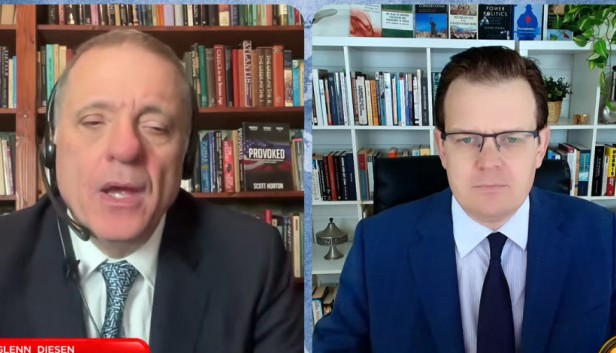
In this interview, Glenn Diesen speaks with Alexander Mercouris of The Duran about the protests spreading across Europe and the economic, political and social crisis being driven by the war in Ukraine. They discuss why Russia wants the upcoming trilateral talks to focus on a new European security architecture rather than territory, the US–Ukraine “mini divorce” over intelligence and Starlink, the shifting battlefield, and how American overextension in the Middle East is reshaping Washington’s calculations.
Europe in Crisis: Protests and Economic Malaise
GLENN DIESEN (00:00:01 – 00:00:56): Welcome back everyone. Today is October 26th, 2026, and we have the pleasure of being joined by Alexander Mercouris, the host of the popular The Duran Podcast, as well as his own with just the name Alexander Mercouris. So make sure to check it out in the link. Thank you for coming on the program. I’ve been looking forward to speaking with you. There’s actually a lot I wanted to have covered today. I wanted to ask what is happening in Europe with these protests. What are the Western misunderstandings about the diplomatic position of Russia? And of course, what’s happening on the battlefield.
So, but perhaps, yeah, we can start at the beginning. That is, Europe. You’re one of the people following this the closest. You have a lot of, well, close ties to Britain, France, as well as Germany. So, jumping into it, what is happening here? What is— because this isn’t only about France anymore.
ALEXANDER MERCOURIS (00:00:56 – 00:04:52): No, it isn’t. But first of all, may I say what a great pleasure it always is to come onto your program, and thank you for inviting me to it. So Europe. Europe is in a period of great economic stress and malaise, and it manifests itself in different ways in different countries. We see it in Germany where we’ve had elections. In Sachsen-Anhalt, in Berlin, in Mecklenburg-Vorpommern. And of course, I was recently in Germany just a few weeks ago, and I took my own soundings of the situation there. Of course, this was Rheinland-Pfalz, which is West Germany, but even there you saw the same sense of malaise.
France, I used to be very, very close to. I still have many friends there. I haven’t visited it, but again, recently, but again, maybe an even more acute sense of crisis. In fact, definitely a more acute sense of crisis in France. Living standards falling, the economy sinking, situation where people’s cost of living problems are intensifying. And of course, you asked about Britain, and you will hear all of the same things being expressed here as well.
And these stresses which in my opinion are mostly economic in the sense that people feel that their economic conditions are deteriorating with no sign that they’re going to get better at any time, but which also have other factors involved too. A sense of war fever that is sweeping Europe on the back of the crisis in Ukraine, and which is making people extremely nervous. And of course, the well-known communal issues which have been the product of the migration. All of these things are coming together and they’re making people very angry and very frustrated in every European country to a greater or lesser extent.
And the reason it is manifesting itself in the streets is because the political system in Europe is no longer responding as it once did. There’s a growing sense that you might vote for a particular political party or political leader, and at the end of the process, that leader comes in, but everything remains exactly as it was. And if you know anything about politics, particularly European politics, when dissatisfaction, discontent, anxiety, frustration cannot find a response from governments and cannot manifest itself in an orderly way through the electoral systems. Of course, it spills over into the streets. And that’s what we’re seeing in France. And that’s what we’re seeing in various European countries.
The underlying problem, the main cause of the crisis, in my opinion, including the economic aspects of it, is the fact that this is a continent at war, that as a result, Europe’s economies have been massively disrupted. We’ve had the economic war against Russia, which is going very badly. We’ve had political problems and economic problems with other major players, including China as well. And this is putting accumulating pressure on the European economies, which is leading to all the other things that I’ve just talked about.
The War as Both Catalyst and Obstacle
GLENN DIESEN (00:04:55 – 00:06:28): Yeah, I agree though that, well, this has many components to it. It seems it’s economic, it’s a political legitimacy crisis, it’s social. But the economic aspect seems to be driving it. That is, it intensifies the political and social problems. But regarding the war, though, because it does look like the war— a lot of things were unsustainable, like the debt levels, but the war definitely contributed to this. That is, the hundreds of billions sent to Ukraine, but also entailed the severing of Russian energy, the deindustrialization.
And this, of course, leads to excessive dependence on the US, which allows the US to extract concessions in terms of the Inflation Reduction Act, the EU deal von der Leyen signed with Trump, even though she recognized it was a bad deal, just because they need the US. The Greenland doesn’t even seem like a deal at this point, more of a shakedown.
But usually would have corrections, but it seems like the war is also allowed— allowing the political class to avoid corrections. As you said, they simply point to the Le Pens and the AfDs as the not being on board with the— well, essentially the public has the wrong opinion. They don’t understand as well as the political leadership why this war must be fought. So this is the logic, it seems. So there is no correction either. I was just wondering, how do you see the possible recovery here?
ALEXANDER MERCOURIS (00:06:28 – 00:09:34): Well, you’re absolutely correct about that. I mean, these problems in the economy, in European societies, have been building up for a very, very long time. Some people say, right, going all the way back to the late 1960s. So, I mean, you’re not going to turn everything around and put everything back together very quickly if you’re dealing with these very deep structural problems in Europe.
But there is one single thing which makes it impossible to change course, to improve the economic situation, or even to reduce the economic pressure in the short term, and that is the war. The war gets in the way of everything. Because you have the war, you can’t have gas coming from Russia, which of course not only prevents, or rather accelerates deindustrialization in Germany. The fact that there is no gas coming from Russia, the fact that there are these other many problems with Russia, the sanctions war, all of that is preventing action being taken which would enable the economic situation to be improved because your economic policy has now become in effect a sanctions policy. It’s all subordinated to the underlying imperative, which is to win the war in some way against the Russians.
That is what, by the way, wars do. When wars begin, they become the all-consuming obsession of those who wage them. So they cannot address these economic and social problems which are intensifying. But of course, it has another effect because as they won’t stop the war, they won’t negotiate a resolution of the war because doing so would be admitting at some level a degree of failure.
That, of course, means that the economic problems can’t be resolved, but it also means in the face of those economic problems and that social unrest that the European leadership and the leadership, the European leadership both at the centre in Brussels but in all of the other European capitals is becoming more insecure and is entrenching itself and is becoming even less willing to bend in the face of demands to change course, to rethink its policies, to adapt in the way that it once could and to start thinking strategically about the underlying problems of Europe. So the war is both the catalyst of the crisis and obviously also the obstacle to its eventual resolution.
Why Europe Isn’t Blaming Russia for the Protests
GLENN DIESEN (00:09:37 – 00:10:42): Yeah, this all-consuming aspect, I think, is, as you framed it, is interesting. That is, the leaders of the UK, France, Germany, and others, all they seem to be talking about is foreign policy. And whenever I mean foreign policy, all they talk about is war. So it’s very— at a time when there’s a lot of needs for domestic changes.
I did want to ask if you were a bit surprised by the lack of pointing fingers to Russia though, because usually when the West, in the West, when we have an election that goes the wrong way, a referendum, be it election of Trump or Brexit, whatever it is, it’s usually pointing to Russia and say, “Ah, it’s some hybrid warfare” that there’s no evidence behind. But we, they get to push the narrative out there anyways. This time around, there hasn’t really been much. I know von der Leyen, she just gave a speech where she argued that Russia and Belarus are weaponizing immigration. But besides for this, we haven’t really seen that much, I think at least. I was wondering, how do you see this? Is
ALEXANDER MERCOURIS (00:10:42 – 00:10:42): Were you
GLENN DIESEN (00:10:43 – 00:10:43): surprised by this?
ALEXANDER MERCOURIS (00:10:44 – 00:12:03): Well, I was a little, and I can say that the Russians have also been surprised judging from some comments that Putin has made. But I think there is actually an explanation, which is that the European leadership, as I said, is becoming less and less connected to the everyday reality of people in Europe. I think they are sufficiently aware of the fact that if they came out and said that it is the Russians are somehow behind these protests, that would inflame the situation with the protests.
People would say, “These people are even less interested in listening to us than they appeared to be. Instead of recognizing that we are under all this economic pressure, that we’re under all this social pressure, they’re telling us that we are agents of Moscow.” Then that will make people even more angry and even more willing to protest and will in fact, if anything, increase the instability.
So I’m going to make a guess. I suspect that this has been talked about and discussed at various levels in Europe, but a decision has probably been made to leave off this particular accusation, lest, as I said, it aggravate the situation that we have now.
Zelensky’s Red Lines and the Coming Trilateral Talks
GLENN DIESEN (00:12:04 – 00:13:31): Yeah, that makes a lot more sense actually to suggest, well, it wasn’t our fault, we’re all in the same boat, this is a horrible situation. But yeah, calling them, Russiagate-ing the whole thing might be definitely the wrong approach. It just seems like the European leaders lack some of the tools to get out of these problems because a lot of the decision-making in politics has been hollowed out on the state level, it seems, by transferring all these competencies to Brussels.
But on the diplomatic front, what do you see the Russians being after here? And also, I hear that there might be some trilateral talks between Russia, US, and Ukraine, possibly in November. So this old formula that was put on hold for more than a year. But then I see at the same time Zelensky going out on Twitter not that long ago now and arguing that he has all these red lines. So for example, what is up— not up for discussion is neutrality and any limits on its military.
Well, neutrality is the— the NATO expansion is why the Russians went to war. I’m just thinking, what is the point of negotiating if the main demand by Russia, that is restoring Ukraine’s neutrality, is not even up for discussion, to use Zelensky’s words.
ALEXANDER MERCOURIS (00:13:31 – 00:17:00): Well, absolutely. I mean, what Zelensky says, if you follow him, I mean, it shows that ultimately he is not really enthusiastic about this negotiation process. He never has been, actually. I mean, until about a year ago, he wasn’t even willing to negotiate with the Russians. He passed a decree which basically forbade it, which he has never walked back or revoked, by the way. I mean, it’s still there. Nobody pays much attention to it. But I mean, he’s never actually come out and said that this decree no longer applies.
I think there is a way to gather all the threads and to understand a little bit about what is going on, which is that I think we’ve had a very complicated and very intense period over the last few weeks. We’ve had a major intensification of the war with what the Russians are doing in the skies over Ukraine and the various attacks over Ukraine. I think the Americans, or at least some of the Americans, are now becoming concerned that the war is really not going very well. And I think that, yes, we are moving towards trilateral discussions in November. Which the Russians have been very slow to agree to. But I think they were slow to agree to them because they wanted the format of these negotiations changed.
So the negotiations that took place last year were basically negotiations between Russia and Ukraine about the conflict within Ukraine itself. I mean, there was a lot of talk about the status of Donbas and obviously neutrality and all of those things. This time round, the Russians, I think, envisage these negotiations differently. They envisage the negotiations as being between themselves and the Americans with the Ukrainians there in the background.
And Putin, and not just Putin, but Lavrov and other Russian officials, are making it very clear that what this is about is about the new security architecture. As Putin said to Witkoff, “the security situation of Ukraine, but also of Russia itself.” And Putin has actually said that when he explained this to Witkoff, Witkoff says, “That means renegotiating the entire security architecture of Europe.” And Putin has told us that he said to Witkoff, “Yes, that is exactly what it means.”
So the Russians don’t just want to talk about Ukraine in NATO. They want to talk about the whole security architecture of Europe, and they want to talk about it with the Americans. And of course, the Ukrainians have to be in the room because they are the people who are fighting the war, but as I said, mostly it will be a dialogue between the Americans and the Russians. So this changes the dynamic and the character of these discussions, or so the Russians hope. Now whether that’s really what’s going to happen is a completely different question, but if you look at what the Russians are saying, I think that is what their objective is.
Indivisible Security and a New European Security Architecture
GLENN DIESEN (00:17:03 – 00:18:46): Yeah, it shouldn’t surprise that much though, because again, the Russians have been saying more or less exactly the same thing for the past 30 years. That is, that they, after the Cold War was over, they had the Charter of Paris for a New Europe, this agreement with the West in 1990. They did have the establishment of the OSCE in ’94. All of them were based on the same principles of indivisible security, Europe without dividing lines. And then their main concern about expanding NATO was always, well, we canceled all those obligations because now we have one side expanding security at the expense of the other. So this is what they said for 30 years. This is what they said was the source of the Ukraine war. So when they said, “Let’s address the underlying causes,” this is what they’ve always been talking about.
But I’m thinking it could be seen in positive light though, because usually these wars are always seen through zero-sum, but this implies it’s not that just Europeans only talking about Ukrainian security guarantees, but also Russians saying, yeah, but also Russian security guarantees. In other words, if you have indivisible security, you have to talk about Ukrainian security and Russian security as well as European. How do you find a formula where one side doesn’t enhance its experience, its security at the expense of others? It seems this will be a positive-sum solution to the war though, so I’m hoping it won’t meet too much resistance.
But I hear that from Zelensky at least, he argues that even after the war is over and there’s a peace deal, sanctions and pressure on Russia must remain, which kind of begs the question, why? Why are they looking for an end to the war or just a temporary ceasefire in— the battle is over, but the larger war continues.
ALEXANDER MERCOURIS (00:18:48 – 00:22:01): Well, I think you’re absolutely correct. And can I just remind everybody who’s watching this program that if you want to see how the Russians have been making this point about a new security architecture for Europe for the last 30-plus years, then they should really go to your books because you chronicle it all extremely thoroughly and very, very well.
Coming back to this, of course, Zelensky is going to oppose this. I mean, he does not want a situation in which we have a new security architecture for Europe and there isn’t a collective West which Ukraine is able to join, a collective West which is separate from Russia. And undoubtedly the people who support Zelensky in Ukraine, and there are still people who support Zelensky in Ukraine, they will not be happy about this either.
He’s not the ultimate problem. If we are talking about a new security architecture in Europe, it’s not Zelensky and Ukraine who has a veto over it. It is the Americans and the Europeans who do. I mean, it’s they who have consistently refused to discuss and negotiate about this before. I mean, the last time this was seriously attempted, as you of course remember, was in December 2021, just before the special military operation began, when the Russians presented 2 draft treaties which were intended to reopen the topic of the new security architecture for Europe. And the Americans and NATO refused basically to address any of them. Serious points in those treaties.
And I have to say this, I still think that remains the case. I think there may be some people in Washington, perhaps Trump, but perhaps other people, perhaps people who are more permanent and more coherent in their understanding of what this conflict is about than Trump himself. There may be some people in the United States who are saying to themselves, “Well, renegotiating the security architecture of Europe with the Russians actually serves American interests because it pacifies and stabilizes Europe at a time when the United States has its hands full in so many other places.” I mean, I am far from sure, to put it mildly, that that is the ascendant view in the United States. My guess is otherwise.
And of course, if we are talking about the European politicians who we were talking about at the start of this program, the ones who are obsessed with the war in Europe, the ones like Friedrich Merz, the German chancellor, who say that what goes on with the German economy is less important for him than Russia and Ukraine and by extension the war. Well, they will greet this proposal with horror and they will fiercely oppose it exactly as they did in December 2021.
Rubio, Donbas and the Territorial Framing
GLENN DIESEN (00:22:03 – 00:23:44): Well, do you think the Americans understand the Russian position though? Because I heard Rubio talk a lot about Donbas and they have good suggestions. “How about we set up a buffer zone so the Ukrainians don’t have to withdraw” and all of this, yeah, all of these issues which, as you said before, focuses excessively on the territorial aspect. And indeed, I feel like in Europe at least, the European leaders are very much wedded to this idea. They have to reframe it as territory because from their argument is all based on the idea that this was a territorial conflict to begin with, that the Russians simply woke up one day and wanted to seize territory. So this is an imperial war. This is how they sold it. That’s why it was unprovoked. This is why they can’t— couldn’t have any diplomacy for almost 5 years. This is why weapons were the path to peace.
If they would shift and say, “Oh, well, actually, yes, this is about European security. Perhaps we should have talked more about this. We recognized this in the ’90s, then we just dropped the whole thing because Russia was weak.” And okay, perhaps we shouldn’t go back to it. It’s not just revisiting 30 years of European security. It’s also admitting essentially that they lied for almost 5 years, no, 12 years now to their own public about what this war was actually all about. And also the consequences of these lies. I mean, it just seems that my whole point is moving away from the territorial argument to security. This could destroy a lot of these European leaders. So I just, how do you see the Europeans digesting this framework from the Russians?
ALEXANDER MERCOURIS (00:23:45 – 00:26:36): Well, I think you’ve put this point about Rubio very well, actually, because I think Rubio does understand this, and I think he does understand how potentially destabilizing in Europe, and by the way, to some extent in the United States, this potentially could be. So what he did with those comments which he made, and I think he did this entirely intentionally, he said he knows that the Russians want to discuss the security architecture in Europe, but that isn’t what he wants to focus on. So he’s trying to reframe the entire discussion that’s going to take place in a few weeks in apparently Abu Dhabi away from the question of the security architecture in Europe and bring it back to the territorial question.
So you could see this, you could see that the Russians are talking about security arrangements and security architecture in Europe, and Rubio is saying, “No, no, it’s not about any of this, it’s all about Donbas, this small belt of territory in Donbas, which is still contested, that’s what we must focus on. We must not discuss these bigger issues.”
And I think you’ve summed up the position of the Europeans absolutely. Now, again, if there is a case for saying that renegotiating the security architecture of Europe is beneficial to the Americans, it is objectively far more beneficial to the Europeans. But when we talk about the Europeans, of course, we mean different things because we could mean the nations and peoples of Europe who would benefit from a return to peace, which a new security architecture might bring. But that would not be beneficial to the political elites in Europe who have framed this conflict in an entirely different way, as an imperialist land grab by the Russians seeking to restore the Soviet Union and to rebuild the Russian Empire.
As you absolutely correctly say, if we move on— move the discussion onto a discussion of the security architecture of Europe, then everything they have been saying for the last 12 years or longer, 14 years, even before the Maidan crisis of 2014, everything they’ve been saying is exposed as a lie. And that, of course, puts all of them collectively in an impossible political position.
Has Europe Become Addicted to War?
GLENN DIESEN (00:26:38 – 00:28:12): I even remember back in 2004 when they had the Orange Revolution in Ukraine, and even President Yushchenko referred to the EU as the “godfathers of the Orange Revolution” because of their heavy involvement into, yeah, well, I would say interference to, to put him into power. All of this has always been framed as, “Well, we just want to bring democracy,” while Russia wanted to keep it locked in under its imperial control. Suddenly, if we start to talk about all these events, well, actually there was Russians and Yanukovych who talked about an inclusive security architecture instead of forcing Ukraine to pick sides. So suddenly we have to not just visit the last 5 or 12, 14, but even the last 22 years about what we have done.
I think it could be healthy. The big threat is we have to reduce the demonization of Russia and appreciate that it also has a different view. So that’s usually how peace breaks out. But what would happen to Europe if peace breaks out now? Because, well, they don’t really have a clear economic, social, political model. Unity now appears to be no longer based on any geoeconomic foundation, but what they call geopolitical Europe, which appears to mean war against Russia. This is the boogeyman that keeps the whole thing together. It’s with all the crises coming, has Europe become addicted to war? I mean, peace breaking out, is this a threat in itself?
ALEXANDER MERCOURIS (00:28:12 – 00:31:05): Well, I mean, first of all, I mean, I completely agree with you that if we had a proper discussion in Europe today about all of the things that have led us to this point that we find ourselves in now. That will be an entirely healthy thing. It would flush out finally all of this mess and trouble that we’ve had, which has created so much confusion and strife in Europe. And of course, a return to peace in Europe whatever challenges come with that would be better than war. There is no circumstance in which the problems of peace are going to be greater than the problems of war. I mean, that ought to be obvious.
But of course, again, we come to your initial point. That may be clear to most people, to those who inhabit the chancelleries across Europe. This is not— this is actually an existential threat to them because they are the people who have pursued these policies, which were based right from the outset on a completely false premise. And who, on top of that, if they were to survive, if they were to survive this cleansing, if you like, of the atmosphere in Europe, they would then have to do exactly what you said, which is form a set of plans and ideas for how to restructure and take Europe forward and address these enormous social and economic problems that beset Europe, which is something, of course, that they show no ability to do. I mean, they’ve never entertained these ideas or thought about them in any serious way.
And one senses beyond that, that many of them are so now heavily invested in the current existing economic model and system that any rethinking of that model is something that they would find extremely difficult and dangerous for themselves. And what they would therefore far prefer not to have to do. So given that, given that choice, one could see why they might actually prefer a confrontation with Russia and an endless conflict with Russia, a war in Europe, which is the war that we are seeing, and why the demonization of Russia and all of those things actually serves a useful purpose for them.
The US–Ukraine “Mini Divorce” Over Intelligence and Starlink
GLENN DIESEN (00:31:07 – 00:32:32): But it appears we’re at a very critical stage though, because so far I think the Europeans had the luxury of fighting with Ukrainians. If Ukraine now falters, it’s going to have to— the next round of escalation would have to be direct war, one which the Americans probably will not want to join in with the Europeans, likely treat us as the Ukrainians. New Ukrainians, that is, send weapons and give statements of support while, yeah, the Europeans begin to perish.
But first, I, yeah, before I forget, you mentioned that it’s not going to be Zelensky who decides. It’s, well, it’s going to be the, sorry, the veto power will come from the Americans and the Europeans. But what is Trump’s leverage though over Zelensky here? Because it seemed it would— there was all this talk about how the US was cutting Ukraine off from intelligence and Starshield and all these things. And then, but it feels like we’ve gone through these rounds before and afterwards it just ends up with Trump escalating against Russia to show that he puts pressures on both sides, whatever. But the intelligence sharing is already back on. The Starlink, Starshield, everything is back. So how do you assess this little spat, this little, well, mini divorce?
ALEXANDER MERCOURIS (00:32:34 – 00:36:57): Mini divorce, I think, is the right word. I mean, I think there are a lot of tensions in the United States, and I think there are a lot of divisions and arguments about this within the administration and within what you might call the permanent government of the United States.
I think your point about the fact that we have exhausted the point when we can rely on the Ukrainians to carry the water for escalation for us. In other words, that we’ve up to now relied on the Ukrainians to do all the damage. I think we’re now reaching the endpoint of that. And I think some people in Europe are not perhaps as alarmed by that as they should be and think that, “Provided the Americans are there behind us, we can escalate still further. We can allow missile and drone strikes on Russia to take place from our own territory. And it’s fine because the Americans will be there behind us.”
But I think the reason, one of the reasons why we’re seeing the Americans start to rethink this and why they’re coming back and talking to the Russians again and are agreeing to negotiations with the Russians again is because they don’t want to be put in this position. I mean, the very last thing they want to do when they have an unresolved crisis in the Middle East, when they have a crisis potentially with China in the Pacific, is to be drawn into a war in Europe against a nuclear great power. So I think this is something that the Americans are very alarmed about and is probably the reason, as I said, why they want to engage with the Russians now.
As for, well, these issues about Starlink and Starshield and intelligence, I think they’re useful for us to understand this problem in one respect, because firstly, whatever the subtext of this story, it demonstrates conclusively that it is the United States that holds all the key levers. I mean, they could stop providing Ukraine with intelligence, and that would be a crisis for Ukraine, and they can stop providing Starlink which is vital to Ukraine’s communications, and Elon Musk, who is the chief executive of Starlink, has actually said if that happens, then the entire front line collapses because the Ukrainians can’t deal with Russian jamming. So it shows that the Americans ultimately retain control of all of the strongest cards.
And perhaps what we have seen over the last few weeks as they’ve tried to push the Ukrainians towards negotiations— because of course if the Ukrainians rejected negotiations it would be a problem— is that the Americans have to some extent played these cards with the Ukrainians, but they’re not prepared to play the game all the way. They are not yet ready to say this war in Ukraine is now such a major strategic liability that we have to stop providing these things, and we’ve got to let Ukraine go and face the consequent defeat that might happen.
So they take baby steps to annoy the Ukrainians a little, to unsettle the Ukrainians a little, but they’re never prepared to go, at least up to now, they haven’t been prepared to go all the way. And as you rightly say, what they tend to do instead is that when they’ve managed to extract some minor, and they’re always very minor concessions from the Ukrainians, they then demand much more from the Russians. And when the Russians don’t give it, they escalate. That has been the consistent pattern in this conflict up to this time.
The Oslo Proposal and the Shifting Battlefield
GLENN DIESEN (00:36:59 – 00:38:29): Yeah, because that’s what I thought, that this is more of a tactic. That is, “Oh, we’ll put the screws on the Ukrainians. Now we’ve got some concessions. We’ll go to the Russians and now we’re going to expect some from them. Otherwise, our goodwill will be gone.” But if they don’t, we’ll escalate. It just seems like we’ve seen this movie already.
But again, it came back from Oslo because they had this Oslo proposal and they go to Moscow. What do they bring? Are they— “Oh, we discussed security guarantees for Ukraine, ceasefire proposals, and how to rebuild Ukraine.” But nothing about European security architecture, nothing about indivisible security, no end to bloc politics. Not even mentioning security guarantees or for Russia or any of the things it has asked for. It’s just, it doesn’t seem like it is also minuscule. And then of course with this tweet by Zelensky where they essentially everything is a red line which the Russians want, where it just, it’s hard to see where this is headed.
But well, it’s going to take me to my last point. The battlefield is shifting. Decisively, it does seem. And I also read in the British media now that more or less we run out of Ukrainians. So now it’s perhaps time to start to have a no-fly zone. We’re going back to these discussions again, which is essentially a declaration of war on Russia because there is no other way of interpreting it. But how do you see the battlefield moving now? Is there a significant shift?
ALEXANDER MERCOURIS (00:38:29 – 00:41:55): Well, I think there have been very significant shifts and they started this autumn. I think that we have seen the Russians increasingly take the gloves off. They’ve begun a massive air campaign against Ukraine. They’ve blockaded its ports. They’re attacking its transport system, its energy system, its internet. They are now conducting strikes against the bridges. Ukraine has never experienced this sort of pressure at any point previously in this war. And we also see movement on the front lines. The Russians are apparently at the gates of the city of Zaporizhzhia, and they’ve made progress around the Sloviansk and Kramatorsk cities, the fortified cities in Ukraine and in Donbas.
And of course, this is important because you come back to Oslo and what happened in Oslo when Witkoff met Zelensky there and Stubb and Norway’s Prime Minister were there. And not just them, but apparently all the other Europeans were there also. They were all holding hands and helping Zelensky in all sorts of ways. And as you absolutely rightly say, they not only produced a minuscule offer, which basically shows no regard for this terrible situation, but it’s a minuscule offer that they previously made and which the Russians previously rejected. I mean, we’ve been through this whole story of buffer zones in Donbas and all of that last year. So they’re not addressing these things.
But then what happened was that Witkoff took all of that with him to St. Petersburg, actually met Putin there. And well, Putin obviously put all this aside. I mean, Ushakov, his foreign policy aide, says that none of this was useful and then says to Witkoff, “Look, we’re prepared to talk, but we’re not going to talk about any of these things that you’ve just come to me with. We want to talk about the security architecture of Europe.”
So you can see that this is a very peculiar and very, actually, a very unstable dynamic. Because both sides, in a sense, have agreed to sit down and to negotiate. But each side has a completely different idea about what the negotiations are going to be about. The Europeans, the Ukrainians, all busy drawing their various red lines. Rubio saying it’s all going to be about Donbas and the future of Donbas. It’s all going to be about territory. And the Russians say, “Look, no, it’s not really about territory. It’s really about the security architecture of Europe, which is the root cause.” That’s the word they always come back with, the “root cause” of this crisis.
So what’s going to happen, I suspect, is they’re going to meet in Abu Dhabi. And this is often the case in negotiations. They’re going to have an awful lot of trouble agreeing on the agenda. Before they even get down to substantive talks, because the agenda that each side has is completely different.
Strikes on Kyiv, the Bridges and the Dnieper
GLENN DIESEN (00:41:58 – 00:42:39): Yeah, now if we only had the diplomats who had talked for the past 4 and a half years, perhaps we could have been on the same page. But now, yeah, there’s very different understandings even about what this war is all about. But regarding the battlefield, though, I mean, you mentioned the bridges, the military logistics, you can do the economic infrastructure as well. But there seems to be other, and of course getting close to Zaporizhzhia, once that is beginning to be approached, that cuts off even more logistics. But the threat to Ukraine’s capital, I mean, this is a big thing. Kyiv was more or less spared for,
GLENN DIESEN (00:42:40 – 00:43:04): the first 4 years of this, but now this seems to be, as you said, the Russians have taken the gloves off and, well, kind of ruthless bombing of Kyiv. But how else is the war changing the way you see it? Because evacuating people, the changes in technology, this is something that also keeps changing for almost month by month.
ALEXANDER MERCOURIS (00:43:05 – 00:46:07): I mean, these are huge things that we’re talking about. I mean, the Russians aren’t just bombing Kyiv and bombing industrial facilities in Kyiv and energy facilities in Kyiv. They’re now attacking the bridges in Kyiv, which could potentially separate the two parts of Kyiv from each other. They’re attacking the potentially the bridges across the Dnieper, right across the Dnieper now. They’re attacking the bridges in Zaporizhzhia, which potentially can cut off the entire Ukrainian army on the east bank of the Dnieper.
They are attacking the railway systems and they’ve conducted strikes on the railway stations in Kyiv, particularly the one in western Kyiv, which is the one which the western visitors, the western officials use to reach Kyiv. And the Russians have told the western diplomats and the western officials, “Kyiv is becoming very unsafe, you must leave.” All of this is absolutely dramatic. And by the way, I’m probably the only one to say this, to me, it looks like when the Russians do this sort of thing, that they aren’t just applying pressure, but they are now at some point probably thinking that maybe their army is going to have to return to Kyiv in some form, something which nobody’s talking about, which I think is a mistake.
But let’s focus instead on those 2 other places that you mentioned: Donbas, where the Russians are now encircling, or in the process of gradually encircling, the Ukrainian troops, and Zaporizhzhia city. We in the West want to portray this entire discussion about a— just as a discussion about territory so that we avoid discussing the security issues in Europe. What if at some point over the coming year, the Russians control all of this territory. What territorial issues at that point are we going to discuss? Are we going to tell the Russians to withdraw even as the Russians continue to advance beyond these territories? Or are we finally at that point going to acknowledge that we have to discuss these bigger security issues.
Refusing to discuss the security issues now, all that it can do is incentivize the Russians to complete their occupation, their capture of all of this disputed territory, precisely in order to take away our leverage, which is, I mean, it’s blindingly obvious when you think about it, but it is something that nobody in the West ever discusses.
America Overextended: The Middle East and Ukraine
GLENN DIESEN (00:46:11 – 00:47:09): Well, let me ask a last question. That is, one of the things that are worrying me is if I look towards the Middle East, how these wars become merged more and more. But how does this— I mean, what is happening now in the Middle East is a bit terrifying on its own, but how does this crisis strengthen Russia’s position? Because you do see it certainly must have impacted the way the Americans calculate their priorities and how they use their resources. But this isn’t going away, it seems. So, to what extent do you think this is what is forcing the US to shift because Trump seemed to have taken a very different position before the Iran War. Once this went worse, then suddenly he kind of had to readjust again and going back to his old ways of talking about peace again.
ALEXANDER MERCOURIS (00:47:10 – 00:49:14): Yeah, we did, because of course what’s happened is that the Americans are now critically overextended. Now, I think that it was not such a pressing problem for them up to the midsummer because up to midsummer, they were telling themselves wrongly that the situation in Ukraine was basically stable and that the 2 sides were in some kind of stalemate. I don’t believe that was ever true. But no, I don’t think the Americans think that anymore.
And given that that is so, given that they can see that the situation in Ukraine is not in stalemate, they are now faced with 2 simultaneous big wars, one in the Middle East, one in Ukraine, going on at the same time. And it’s become absolutely clear that their resources are not equal to this kind of challenge. They can provide resources for one war or another and draw those wars out that way, but they can’t cope with both wars at the same time.
And at the moment, they’re finding it very, very difficult to achieve a negotiation with the Iranians and with Iran’s allies in the Middle East. So that war looks like it’s going to escalate. So of course, that incentivizes them to try and find a way to sort things out with the Russians. But at the same time, they don’t want to really talk about the security architecture of Europe, which is what the Russians are concerned about. The Americans have many problems, and those problems are getting worse. And the difficulty is that we don’t have a very disciplined, very coherent administration in Washington able to address these problems and these challenges. I mean, John Kennedy could have done it. It doesn’t look as if Donald Trump can.
Kissinger’s Lesson and the Eurasian Giants
GLENN DIESEN (00:49:16 – 00:50:10): Yeah, I remember back in 2016 when Trump was first elected, he had some talks with Henry Kissinger. And again, I was not in the room, but I can assume that, I’m guessing at least that Kissinger would’ve mentioned what they did in the ’70s. Don’t let the 2 Eurasian giants of China and Russia get too close. I mean, what you do is you reach out to the weaker one, play on possibly their fear of the others and offer a partnership, I assume. But of course, this may trump into a Putin puppet, as the lingo in the West goes. But see where we’re now though. I mean, pushing Russia, China, Iran, all of them together in this way where they would naturally otherwise have been more diversification. It’s quite extraordinary. I mean, it’s— any final thoughts before we finish?
ALEXANDER MERCOURIS (00:50:10 – 00:51:38): Well, I mean, I’m glad you brought that up because it was the late Kissinger who understood this problem then, that you don’t have the Eurasian giants coming together and that this is a critical problem for the United States when they do. And he understood that at a time when American resources relative to its adversaries were much greater than they are today. But even then, he could see that this would be a problem.
Well, what did he do? He understood that if you’re going to achieve that rapprochement with what was at that time the weaker of those 2 Eurasian giants, which was China, then you had to deal, you had to address and end the conflict which was making it impossible to establish good relations with that Eurasian giant, which is the conflict in Vietnam. And very, very toughly and cleverly, and one would— some would say ruthlessly, he took the United States out of that conflict. And he then did the deal with China. And we all know the result. But today’s United States doesn’t seem to have that level of strategic wisdom or flexibility that it had in Nixon’s and Kissinger’s day. And that ultimately is the source of the crisis.
GLENN DIESEN (00:51:40 – 00:51:51): Well, Alexander, thank you so much for taking the time. And again, for the listeners, please make sure to check out the 2 podcasts of Alexander Mercouris. Thank you again for taking time.
ALEXANDER MERCOURIS (00:51:52 – 00:51:54): My great pleasure, Glenn. Always a pleasure to speak with you.
Related Posts
- Bharatvaarta Politics Interview: w/ Former RAW Chief Vikram Sood Ji (Transcript)
- Suhasini Haidar on Modi’s Challenges – Mishal Husain Show (Transcript)
- Horizons Forum 2026: Jeffrey Sachs Keynote Address Transcript
- Jeffrey Sachs: ‘I Am a Defender of Ukraine’ – NATO Fights to the Last Ukrainian (Transcript)
- Ambani vs Musk, Trump’s Hostility & India’s Foreign Policy w/ Meera Shankar & Zorawar Singh (Transcript)