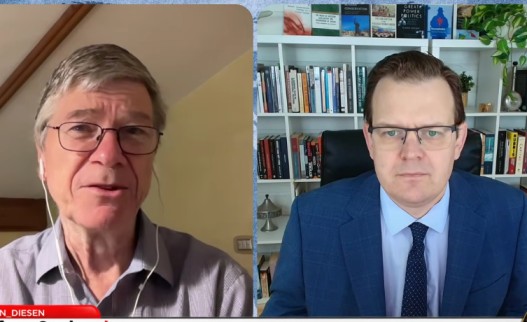
In this interview, Professor Jeffrey Sachs joins Glenn Diesen to discuss his article “I Am a Defender of Ukraine” and explains why he believes NATO and the West are fighting to the last Ukrainian. Sachs traces the Ukraine war back to NATO expansion, Brzezinski’s “geopolitical pivot” strategy, and the squandered Minsk and Istanbul agreements, while laying out his own four-point peace proposal built on indivisible security, Ukrainian neutrality, and a de facto armistice line. He also criticizes Western media for silencing debate and European leaders for leaving diplomacy in Washington’s hands. Read the full transcript of this interview which was live on October 24, 2026 below:
Introduction: “I Am a Defender of Ukraine”
GLENN DIESEN: (00:00:01 – 00:00:18) Welcome back. Today is October 24th, 2026, and we have the great pleasure of being joined by Professor Jeffrey Sachs. Well, today to discuss an article you wrote with the title, “I Am a Defender of Ukraine.” So thank you for coming on the program.
JEFFREY SACHS: (00:00:19 – 00:07:50) Oh, it’s great to be with you. Yes, indeed. I wrote it in response to a typical editorial saying I’m a Putin apologist. And of course, I’m not an apologist for anybody. I am in favor of peace and ending a slaughter that is useless and in which Ukraine is being used first by the United States for more than 30 years, and now it seems by powers in Europe And that slaughter is doing more damage to Ukraine, of course, than to anybody else.
Brzezinski, The Grand Chessboard, and Ukraine as a “Geopolitical Pivot”
The idea starting back in the 1990s, but even of course predating that to the era of the Cold War itself, was to use Ukraine as a battering ram against Russia. And Brzezinski, the strategist who was Jimmy Carter’s national security advisor and then leading proponent of American foreign policy and towards a hard line with Russia in the 1990s, gave the term “geopolitical pivot.” To places like Ukraine that the United States would use in its quest for primacy.
He wrote a whole book about this called “The Grand Chessboard,” and the idea was to teach us to think about the world as a chessboard, and there are pawns on that chessboard, and Ukraine was one of the pawns. Geopolitical pivot means a place that is not important in its own right, not a major power, not something that the United States would care about, but a place that the US can use for leverage. And in this case, Ukraine is the lever against Russia.
And Brzezinski famously said that “Russia without Ukraine ceases to be an empire.” And he paraphrased that in many, many places, but what he meant was that Russia would not be a great power without Ukraine, and therefore the United States should view Ukraine as a geopolitical pivot. And he spelled out what that meant. That meant bringing Ukraine into NATO, by the way, whether Ukraine wanted that or not, because for all of the period up until the 2014 coup, the Ukrainian people were against NATO.
So the United States had a double burden, one to get this job done in the face of promises that it had told Russia and extremely strong, clear red lines put down by Russia. And second, against the opposition of the Ukrainian people themselves, which is an extraordinary thing. In other words, Brzezinski was not thinking about Ukrainians. He wasn’t thinking about Ukraine. He was thinking about American great power play against Russia. And he spells it out very explicitly.
But he said that Ukraine should be brought into NATO in 1997. He gave a timetable, which was between 2005 and 2010. And that’s essentially the timeline that the US government followed in declaring in 2008 and forcing the Europeans to agree that Ukraine would become part of NATO. At the 2008 NATO Bucharest Summit.
Ukraine as Europe’s Front Line
So all of this is to say, Glenn, that Ukraine was used by the United States and used for more than 30 years. Now Ukraine is used by the Europeans in an utterly ghastly, darkly wrong, and cynical way I think the Europeans either believe or want to believe or want to make us believe that Ukraine is the front line in an inevitable war with Russia, but it should be fought in Ukraine, not in Germany or not in France. So it’s very important to send Ukrainians to their death and only to escalate because the alternative, it is claimed by these miserable European leaders is that if Ukraine goes down, we’re next.
Well, in any event, for me, if I may say so, for you or others to be accused of being against Ukraine for calling for peace puts things exactly upside down. I call for peace because I want to save Ukraine from being used to its death by the United States and Europe. I want this cynical game to end. I want this craziness to end.
Yes, I want an independent, sovereign, secure Ukraine. Where Ukrainians are not dying in vast numbers or freezing to death or suffering from disease because the water systems don’t work. But just to say to Russia, to the Russian government, well, the West can do whatever it wants and you have to stop, rather than saying, let’s negotiate inclusive security So that the underlying drivers that got us into this war, which was the NATO expansion and the failure to implement every possible off-ramp like the Minsk agreements, is recognized and taken off the table so that there is inclusive security, then there can be peace.
But for the West to say that anyone that calls for peace is simply against Ukraine is such a bizarre narrative. Well, all of this is to say I was attacked, as I have been over the years, for being against Ukraine. And I wanted to make very clear, from Ukraine’s independence, I actually volunteered my time to help Ukraine in its early days.
I was an advisor to President Leonid Kuchma. At various times, I have responded to requests for giving advice or any suggestions on Ukrainian economic topics. I am hardly against Ukraine. I am for Ukraine. I am for peace. And to be for peace does not mean to be anyone’s apologist.
War Propaganda and the Monopolization of “Standing with Ukraine”
GLENN DIESEN: (00:07:51 – 00:09:52) Well, the reason I think it was such an important article though is because this entire notion of helping Ukraine or being a defender of Ukraine or standing with Ukraine, it has been monopolised. And as we often see with war propaganda, the war propagandists will first seek consensus around the concept, which essentially we will all agree on, which is, we have to have empathy, we have to help Ukraine. I mean, everyone wants to help because what’s happening to it is terrible, but this concept, what exactly does it mean?
I mean, this concept is much like an empty vessel and they can fill it with any content they want. And in this war, the political media establishment have sought, I guess, complete and total narrative control and then define what helping Ukraine actually means. And as you say, being a defender of Ukraine, they have defined it as essentially using Ukraine as a pawn against Russia in this forever war. To the last Ukrainian.
And it shouldn’t be new though, because in every war we have, we appeal to the best in people to do the worst. We always look for empathy. I mean, if you really care about Afghanis, you don’t want to get— put an end to this war. If you really care about the Iraqis, people of Libya, Syria, even Iran, you surely, you want to get this war going. You want to bomb because we’re doing it for them.
I mean, it’s clever propaganda because they argue peace is not possible because it was unprovoked and Putin is Hitler. And if you contest the premise, actually it was provoked and Putin isn’t Hitler, they’re pursuing security concerns, well then you’re legitimizing, you’re excusing it, or as you say, you’re an apologist now. So it’s that there’s no way— I mean, as a propaganda setup, it’s beautifully done, but what do you argue is the Should be the pro-Ukrainian position.
The Word “Unprovoked” and the Erasure of History
JEFFREY SACHS: (00:09:52 – 00:17:43) Well, just to say it—it is so interesting and bizarre how words are used. You mentioned one of the prominent words provoked, which has become part of the lexicon of this war. When Russia launched its, the invasion on February 24th, 2022, the special military operation, which followed 30 years of very heavy debate and contention and 8 years of open war. It wasn’t the beginning of the Ukraine war. The Ukraine war began in 2014.
But when that escalation took place, immediately the word was “unprovoked.” In other words, not only was there an evil side, Russia, and a pure side, us, the West, but this came out of nowhere. And so the important thing about the word unprovoked was not only that there’s purity on our side and evil on the other side, But don’t look back before the start of this phase. Do not look back beyond February 2022. Don’t look back to the peace agreements and security arrangements that the West constantly squandered.
Do not look back to the Minsk II agreement. Do not look back to the Maidan coup. Do not look back to the Bucharest NATO summit. God forbid, do not look back to the promises that were given to Gorbachev and Yeltsin in 1990 that NATO would not move one inch eastward. Don’t do that. So unprovoked served a very rich agenda of propaganda, and it became the word of choice.
The New York Times Op-Ed That Never Ran
So much so that when I asked a research assistant to go through the New York Times for the year from February 2022 to 2023— now it’s easy to do, I suppose, with the AI tools— but we went through article by article, opinion column by opinion column, The word was used 26 times in the New York Times opinion columns during that 1-year period and never contested in any of those columns.
So, Glenn, I tried at that point, I called the, or I wrote to the editor of the opinion section of the New York Times. And I said, this is wrong. There’s history, there’s background. I was actually there personally back to 1990, and I think it’s important to have an article on the other side. Well, she resisted. I pushed again. I achieved a phone call, which was a conference call with the editorial staff of The New York Times.
And I tried to explain, and I went through the history and somebody said, “Well, we respect you, Mr. Sachs, but we disagree.” I said, “It’s not a matter of agree or disagree. It’s a matter of the evidence that I’ve just given you.” “Well, thank you very much.” So I then sent the documentary evidence with the websites, the links, the archival material to the New York Times board. Again, I got back a cursory answer. “We respect you very much, Mr. Sachs, but we disagree.” This was not a discussion, a debate. It was just a one-sided rejection.
Then I went back and I said, can I have 700 words to say once the other side? The first answer was no. “We cover this story a lot. No, you can’t.” I went back again. I had written for the New York Times countless times in the past. I said, “700 words? Are you kidding? Don’t even put it in print. Just put it online if you want, just to have the alternative view.” They finally relented and said, “Okay, you can write an op-ed.”
So I drafted an op-ed, then came back questions. Then I gave the documentary basis. Then, Glenn, immediately, interestingly, I got back an edited 700 words in the font and typescript of the New York Times. Saying, “This will run.” Well, I was delirious with joy, that I was going to get 700 words to explain the background of this war. And I bragged about it to my friends. I did it. I got in my editorial to the New York Times.
Then they called me the day before it was to run and said, “Oh, Jeff, so sorry. It’s not going to run. Someone from inside is going to write something like this in the coming weeks. So we’re not going to run your piece.” And that was the end of it. It’s unbelievable. This is unbelievable.
The Shutdown of Debate in Western Media
The inability to have a grown-up discussion of any issue. I’m having the same experience with the Financial Times. They will not run articles outside of their narrow in-house position. They won’t, because you cannot have a discussion in Western polite society anymore. And not only about this issue, about a range of issues about China or about claims about the United States economy or about the war in Ukraine.
We are in a completely narrow viewpoint of the press that says “all the news that’s fit to print.” Oh my God. There’s no discussion that’s sensible right now on these issues, and people don’t want to hear about it. And as we know, you know it very well because you are receiving the same treatment. Sensible, documented, important, critical debate is shut down and the institutions of power are cracking down even more. It’s amazing. And the policies are, of course, disastrous in the West and failing. But here we are in a spiral of decline and absolute tightening of all of the bolts so that nobody can discuss it.
Narrative Control and the Absence of Indivisible Security
GLENN DIESEN: (00:17:46 – 00:20:01) I wanted to ask you how this total narrative control is impacting now the possibility for a peace agreement, because that’s something you also work with. Well, we’ve not just worked with you. You wrote quite an excellent peace proposal, actually, which is much better than what we’ve seen come out of our actual governments.
But well, I guess the premise for my argument is, if today being a defender of Ukraine, what they have essentially said it means, it meant toppling the government in 2014 against the will of the Ukrainian people because somehow the will of the people is always, seems to conflict with what being pro-Ukrainian means. And also when they attempted to pull Ukraine into NATO between ’91 and 2014, we know that only a small minority wanted this. And we also knew that this would likely trigger a war.
Being pro-Ukrainians also meant undermining the Minsk Agreement, which made war almost uncertainly— a certainty, sorry. It meant being pro-Ukraine, it meant canceling the peace platform that 73% of Ukrainians voted for in 2019. It meant ignoring or rejecting the Istanbul Peace Agreement. And it meant, well, for what I find shocking, boycotting diplomacy for almost 5 years when we know that from the polls that most Ukrainians want a negotiated settlement.
And now that Ukraine is running out of men, we’re told that being, standing with Ukraine means we have to deport its refugees. We have to push Kyiv to lower the conscription age and also conscript women. So it’s very— yeah, it starts to look ridiculous what they’re selling as being, helping Ukraine.
But in terms of finding a peace agreement, the whole concept of indivisible security, it seems to be absent. That is, being pro-Ukrainian means that a peace agreement shouldn’t even address Russian security concerns. How do you assess this? Because for me This, I mean, this must be a first in history where we don’t even, even as we’re losing a war, we can’t address the Russian security concerns, which means there can’t be an end to the war.
Empty Slogans Instead of Peace Proposals
JEFFREY SACHS: (00:20:02 – 00:39:27) I think the first point is to say that nobody puts forward proposals in the West other than saying we stand with Ukraine, whatever that means. And Ukraine’s proposal, there is one, that Ukraine will join NATO, it will have all of its 1991 territory, it will do whatever it wants, basically. So yes, Ukraine has put forward a proposal that says there is no security issue involved in this war from Russia’s side, and we will join NATO.
Okay, now comes the United States and Europe to ask, is that our position? Ukraine, or the government that we have put in place with the coup in 2014, asked to join NATO. Is that the Western position. Even that is never stated affirmatively or to the contrary clearly anymore because there is nothing but sloganeering about all positions. “We stand with Ukraine for as long as it takes.” “Russia must lose.” Whatever it is, these are empty words. They are not positions. They are not with any clarity by design, of course.
So all of the supposed diplomacy that takes place, which is very little, but for example, has included several discussions with Trump’s envoys, Mr. Witkoff and Mr. Kushner. These are held in private. Nothing is explained. Nothing is put into the public. There is no test of any positions. We’re in the hands of a few people. We don’t see any results from this. But this is the world determined by a few people in Berlin. In Paris, in Brussels, in Washington, in Kyiv, in Moscow. And the result is a war that continues for years, killing or maiming millions of people and putting the world at risk of nuclear war.
The US Government and Europe’s Missing Diplomacy
You would think and hope that there could be some concepts, some rationality, some way out. The US government is the most incompetent government we’ve ever had, and it’s also the most peculiar in organization, which is the president is seemingly incapable or uninterested in giving a coherent speech to the American public about any concepts or any ideas or any purposes of the state. All we have are rallies and Truth Social posts. That’s all we have from the US government. On that basis, we don’t really know what is policy, what is just insider dealing, because it’s rampant and there’s massive corruption on almost any aspect of foreign policy right now. People being cut into deals, family, everything. It’s bizarre.
With Europe, there isn’t a single proposal that I know of. You would know better than I, but I have not seen from the European Union or from any government in Europe a proposal about how to reach peace. It’s only hugging Zelensky and saying, “We’re with Ukraine, we stand with Ukraine as long as it takes, whatever it takes.” In other words, totally vacuous statements.
Indivisible Security: A European Concept
So I thought I would write down what I regard as an approach actually to making peace based on the debates and the expressions of red lines, concerns, interests that now date for 36 years. So this is my attempt at an organized answer to this issue. And like you said, it starts with a concept. That is a European concept. After all, it’s not a Russian concept. It is a European concept of indivisible security.
And the idea of indivisible security in Europe, which is part of several treaties and goes back to the Helsinki Final Act and is incorporated into something that used to be promising called the Organization for Security and Cooperation in Europe, OSCE, is that Europe achieves security by all parts of Europe having security, that security in Europe is not achieved by one side or one country or one group achieving security at the expense of the other side. I take this to be the fundamental issue of the Ukraine war.
I say that because I believe that the intention of the United States from the early 1990s, and this is based on a huge documentary record that is voluminous and many, many books, including your excellent books, is that the United States should be the— have primacy or hegemonic power in Eurasia, and that Russia should be subordinate to that, and that this configuration will be brought about by the expansion of NATO, the abandonment by the United States of nuclear arms agreements, starting with the U.S. abandonment of the Anti-Ballistic Missile Treaty in 2002, on a unilateral basis, unprovoked, to the strong opposition of Russia.
The placement of US missile systems all across Eastern Europe, the Aegis missile systems, which Russia has strenuously objected to during this whole period, and the expansion of European political institutions, notably membership of the European Union, which itself would be increasingly aligned with NATO, which it is in its treaties and its internal organization now. The idea was to surround Russia and ideally to break Russia apart. These goals were not hidden. These goals were explicit.
A European War and Europe as an American Pawn
So I take peace in this war to come from addressing Russia’s legitimate security interests alongside the legitimate security interests of Ukraine and the European Union. By the way, this is fundamentally a European issue and fundamentally a European war, and the mere fact that the United States has the lead in this diplomacy is the shocking bankruptcy of European diplomacy and understanding of its own security.
Europe is inept and incompetent and handed over its sovereignty to the United States a long time ago to its huge detriment. And so ending this war in the right way is also pro-European, I want to say. Because it says that Europe should stop being a pawn or a vassal state. Maybe it’s not a pawn, maybe it’s a bishop, maybe it’s a knight, but it’s not a queen or a king on the chessboard as seen by the United States. It is a piece of the American chess game, not something of its own interest.
Sachs’ Peace Proposal: No NATO Enlargement and Ukrainian Neutrality
Well, Glenn, sorry to go on at length, but the starting point for me is inclusive security. What does that mean? It means that NATO must absolutely declare that it is not expanding eastward to Ukraine, to Georgia, and frankly to any other place, and that it returns to the commitments that it made in February 1990, explicitly, clearly, and in a legally binding way, according to judgments of the International Court of Justice, that verbal statements that are relied upon for actions such as the promise of no NATO enlargement that was relied upon by the Soviet Union to give assent to German reunification, are binding. So I want to start with no NATO enlargement, period.
Second, with Ukraine’s neutrality, which was the basis of the Declaration of Independence of Ukraine in 1990 and was Ukrainian policy until the coup in February 2014. And this is the basis of inclusive security. And just for everybody to understand, after World War II, countries that chose neutrality had their borders and their sovereignty respected, and they were safe, prosperous, secure. I’m thinking of Finland, I’m thinking of Sweden. I’m thinking of Austria.
They showed what the Soviet Union wanted after World War II, after losing 27 million dead to Hitler’s invasion, was security. And Russia, or the Soviet Union, respected neutrality, and the successor or continuation state of the Soviet Union the Russian Federation respected neutrality, and that was for the past 80 years. Austria didn’t need to be a member of NATO to have its security, nor does Ukraine. So a neutral Ukraine with NATO stopping its absolutely brazen And reckless and provocative enlargement is the basis of peace.
EU Membership on the Basis of Neutrality
Within that, I recommended 2 more fundamental concepts. One is that Ukraine can join the European Union if the European Union so wants it and Ukrainian people so want it. That is not going to be an easy process because many countries in Europe do not want Ukraine in the European Union. But be that as it may, Russia should not object to its membership if it is not a trick or a backdoor to exactly the kind of militarization of Ukraine by Europe or by NATO that this whole war has been the result.
And so it turns out that there are good precedents, that there are neutral countries in the European Union that do not join in the military commitments of the European Union. Austria is one of them. Ireland is another one. So Ukraine, I believe, should have the path to European Union membership if both sides agree, which is by no means assured or straightforward, but on the basis of neutrality.
Territory and a De Facto Armistice Line
Then the last issue, which is a significant issue, is territory. And my own view is that the territorial claims of the 2 sides will not be reconciled in the short term on a de jure basis. I don’t believe, I may be wrong, I would be pleasantly surprised, but I don’t believe that there can be a borderline drawn right now in which both sides say we recognize that line as the de jure border between Russia and Ukraine.
Russia, of course, claims 4 regions, the 2 in Donbas and Zaporizhzhia and Kherson. Ukraine rejects all of that. Crimea is, in my view, absolutely never going to be ceded by Russia for long, deep security reasons. And at the same time, Ukraine is unlikely to recognize the de jure part of Crimea being a de jure part of the Russian Federation.
So on territory, my recommendation is an armistice line, which is a de facto line. I don’t draw that line in my proposal. The battlefield will draw it in the next weeks and months. Most likely. It could be all of Donbas, it could be part of Donbas. To me, I hope that’s not the central issue. If it is the central issue of everything, I doubt that any kind of peace agreement can be reached.
I regard it as a pragmatic issue in which a line is drawn and no more fighting occurs, and the meaning of the line is twofold. One is de facto administrative control, and second, a commitment by all parties not to pursue further border changes through military means, but only through diplomatic means or through referenda or through other mechanisms.
So those are the 4 points that I believe are the essential points. There are other, many other issues that are on the table. For example, language rights, human rights, treatment of Russians in Ukraine, treatment of Ukrainians in Russia, and so forth. And I believe that those can be handled and best addressed through European-wide standards. That exist and that are part of shared treaty rights under OSCE and other European-wide conventions. So I think that those are solvable issues.
The Istanbul Agreement and Why No Proposal Is on the Table
What I would say is a little strange is my proposal is not one of 10 that is on the table right now publicly. There is no proposal on the table. Nobody puts anything down in writing for testing, verification, debate, amendment. There was one proposal on the table in Istanbul. Some of the documents were leaked in the end. The 2 sides came close to an agreement, not fundamentally different from what I’ve just outlined, by the way.
But the point is the United States and Britain stopped that agreement in April 2022. I know you were taken to task for saying that, but everyone knows that. That’s not some surprise. And may I say, if any government officials in Norway are listening, everyone knows that. Okay. That’s not some particular weird claim. The negotiators know it. I flew to Ankara, Turkey, actually, to talk to the mediators in this. I talked to them. The Ukrainians walked away from the table.
The Israeli Prime Minister Naftali Bennett, who was sticking his nose into this, by the way, but he said the Americans walked away from it. And then he said, oh yes, maybe this was a good thing. They wanted to be strong. Compared to China, but everyone knows what happened. Okay?
So, but the point of, anyway, to return, I wrote this down because there isn’t anything else. Mr. Witkoff does not write documents, at least the ones that are shared with the public for discussion. So the whole debate is bizarre, empty slogans, Millions dead and wounded, a war that continues, saber rattling, risk of escalation to nuclear war, and foolishness, recklessness of European leaders who can’t utter a sensible paragraph or write down a sensible proposition and can’t move beyond the grossest platitude. That “we stand with Ukraine as long as it takes.”
What European Leaders Know but Won’t Say
GLENN DIESEN: (00:39:30 – 00:40:18) Yeah, well, I guess that is the strange part of this whole thing, that all of this is known. I mean, this is why I find it so frustrating. For 30 years, we were discussing in Europe how NATO expansion created tensions with Russia. We had European leaders like Merkel arguing, well, we can’t allow a Europe without Russia to become a Europe against Russia.
In 2022, you had Macron. He was the last one to abandon the— well, to join in on the boycott of diplomacy. And he was making the point that the danger of not talking to Russia is that the future will be decided in Moscow and in Washington. I mean, they know all these things. And yet, I mean, that’s why I’m always curious what they actually say behind closed doors, because none of this should be controversial or none of this should even be contested.
The Overton Window and Europe’s Absence from the Negotiating Table
JEFFREY SACHS: (00:40:20 – 00:43:49) And one leader said to me recently, “Ah, Jeff, I can’t talk about certain things. If I do, I’m not at the table.” In other words, a very clear expression of what’s called the Overton window, that there is a narrow boundary of what is permissible to say If you step outside, you’re a deviant, you’re a radical, you don’t belong there, you’re not serious, you’re not part of the team, you’re not trustworthy.
And so this lockstep right now defined by Merz, Macron, von der Leyen, whoever the British Prime Minister happens to be at the time, Burnham right now, this is where we are. Again, it’s filled in by complete platitudes. No substance, not a speech, not an interesting idea. And I think that those who have interesting ideas are somehow, and it’s strange also, they’re somehow self-censoring not to express any of those ideas. And that’s viewed somehow as safe.
Nothing is safe right now. Secret diplomacy is not safe. I, the incompetency of my own country’s government is beyond anything we’ve seen. For Europe to leave it in the US hands or to beg for participation in US diplomacy is shocking. Even the fact of the last couple of days saying that there will resume 3-party diplomacy, meaning Russia, the US, and Ukraine. Are you kidding? Europe? Excuse me? Where are you? How can this possibly be the normal way? This is a European issue. Fundamentally, this is not an American issue.
And especially since it seems, though we never hear a coherent thought about it, but it seems that the United States is not interested in NATO enlargement anymore, even though it was core to the US strategy for more than 30 years. This is, if in that case, only a European issue.
So the mere fact that we’re talking about, even if it’s an evanescent and naive idea, a 3-party negotiation, again, supposedly in Abu Dhabi next month, That is Russia, Ukraine, and the US, not Russia, Ukraine, and the European Union. It’s amazing, completely amazing, and a complete failure of Europe, I have to say, and a tragic one because Europe remains the American pawn despite everything that we’ve seen.
Closing
GLENN DIESEN: (00:43:52 – 00:43:56) Well, Jeffrey, thank you so much for your time and best of luck with your important work there at the Vatican.
JEFFREY SACHS: (00:43:57 – 00:43:59) No, thank you so much. Great to be with you today.
Related Posts