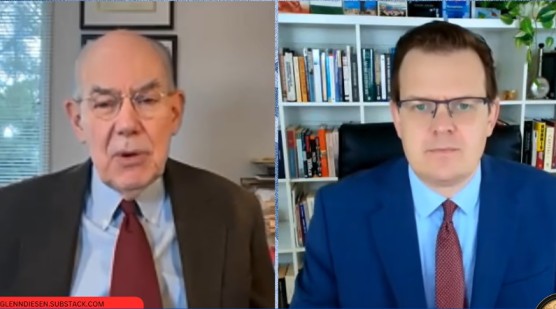
In this wide-ranging interview, Professor John Mearsheimer joins Glenn Diesen to explain how the post-Cold War promise of Fukuyama’s “end of history” gave way to multipolarity, great power rivalry, and a crisis of Western moral authority. They discuss Europe’s uncertain place in the new world order, the US-Russia diesel deal and the latest Trump-Zelensky clash, why Russia is winning the war of attrition in Ukraine, and the escalating conflicts involving Iran, the Houthis and Saudi Arabia. This interview was premiered on October 17, 2026. Read the full transcript of this insightful interview below:
From the “End of History” to a Multipolar World
GLENN DIESEN: (00:00:00 – 00:02:02): Welcome back. Today is October 17th, 2026, and we have the pleasure of being joined by Professor John Mearsheimer. Thank you for coming back on the program.
JOHN MEARSHEIMER: My pleasure, Glenn.
GLENN DIESEN: We see that a lot of things are happening in the world. That is the US-Russia diesel deal. We see the subsequent conflict between Zelensky and Trump. Russia seems to be escalating in a big way in Ukraine to put an end to the war. New strikes against Iran might be coming. Yemen might defeat Saudi Arabia.
But before we get into this, I wanted to start off with a big question for context. That is, if we take a step back at the end of the Cold War, Fukuyama argued that this was “the end of history.” The world would essentially unite under liberal, universal liberal democratic values and US leadership. And this didn’t only become an ideology, it almost became a religion, at least for the European politicians, but also, yeah, among the wider Western political class.
But now this is all falling apart, though. We see power has shifted to the East in a spectacular way. The former source of legitimacy is weakening. Our moral authority, that is, of the political West, especially after Gaza, has weakened significantly. Alliances are falling apart. Domestic governance is becoming more authoritarian. Also within the West, we have wars on our left and right, even with nuclear powers like Russia. So everything that’s going wrong, could be going wrong, appears to be going wrong.
So how do you, again, I know a big question, a lot of packed in there, but how did we go from all these promises of perpetual peace under the US liberal hegemon to the worst chaos we’ve seen now in, well, as long as I can remember. How do we explain this in a, I guess, a theoretical context?
JOHN MEARSHEIMER: (00:02:03 – 00:08:15): Yeah, I’ll give you my simple view on this, Glenn. Frank Fukuyama wrote his famous piece in 1989, just before the Cold War ended. And then 2 years later, in December 1991, the Soviet Union fell apart. So you want to understand that there was this one-two punch. One is the end of the Cold War, and then 2 is the collapse of the Soviet Union. And the principal replacement state for the Soviet Union was, of course, Russia. Which was an economic and political basket case during the 1990s.
So when Fukuyama wrote this piece, right, the Cold War was ending, but then the Soviet Union disappeared, and that just juiced up his argument. It made it look more important, more powerful than it sounded in 1989 because we were then in unipolarity. And unipolarity really reinforced the Fukuyama argument. Remember, the Fukuyama argument is made as the Cold War is coming to an end. It’s still a bipolar world. The Soviet Union is still there. But then the Soviet Union goes away, and of course the Cold War has ended. So Frank looks like he has the wind at his back, that history is on his side until it ends, that is.
But anyway, so you get unipolarity, and for much of unipolarity, it looks like Fukuyama’s argument is correct. But then what happens is the United States after 9/11 gets involved in the forever wars, and that really begins to make the unipolar moment look like a less promising world situation than many people thought it would be in the 1990s. The 1990s was the height of optimism about the Fukuyama argument. But after 2001, people began to have serious doubts, in good part because of the forever wars, but also the 2008 economic crisis, which is a significant blow to the Fukuyama vision.
But more important than all that, what happens in roughly 2017 is unipolarity goes away and we get multipolarity. And the 3 poles or the 3 great powers in the system are the United States, China, and Russia. And you want to remember that 2 of those poles are not liberal democracies. There’s only one of the 3 great powers that is a liberal democracy. That is the United States.
So this liberal international order that the United States created during the unipolar moment, and I want to be clear here, we did create a liberal international order. It was destined to fall apart. There could be no other outcome because the United States is no longer the unipole. And in a multipolar world where you have 2 out of the 3 great powers who are not liberal democracies, you’re not going to be able to sustain liberal international order. So it went away, the liberal international order. And furthermore, you got great power competition back on the table. And the end result is we are in a world today where it’s almost impossible to make the argument that we have reached the end of history. If anything, The world today looks like a giant contradiction for the Fukuyama thesis.
One final point on this. There was always a very important moral dimension to the Fukuyama argument because the idea is that liberal democracy is a positive end and liberal democrats or countries that are liberal democracies are the good guys and everybody else is the bad guys. We have moral virtue on our side.
But after what happened in Gaza, where the West basically is complicit in a genocide, and this is certainly true of the United States, it’s hard to make the argument that the West is morally superior to the rest. Not a serious argument.
So in a very important way, it’s not only these structural changes that take place going from unipolarity to multipolarity, fighting forever wars during the unipolar moment that then carry over into the multipolar world. Think of the Ukraine war that started during the unipolar moment, right? 2014 is when all the trouble started during the unipolar moment, and it’s carried over to the present day. It’s carried over into the multipolar world. And then finally, in addition to the carryover of the forever wars, and in addition to the fact that you went from unipolarity to multipolarity, you have the simple fact that the West is complicit in a genocide which undermines its claims to being morally superior.
Europe’s Place in the New World Order
GLENN DIESEN: (00:08:18 – 00:10:07): Yeah, there’s been certainly a big fall here, but what do you see now happening? What does the new world look like? And I guess more importantly for Europeans, What is the role of Europe in the new world?
Because overall, the larger development seems to be that the United States will leave Europe, at least to some extent, and at the same time treating the Europeans a bit more like vassals than they did in the past. I would say they already did that a bit under Biden, but as the power disparity shifts, that will only be more the case. And even the Europeans kind of accept this new status, it seems, as long as the US stays We can take the abuse. That seems to be the sentiment.
Meanwhile, the Russians, they are suggesting, we’ll make it clear to the Europeans that this whole goal in the 1990s of expanding NATO to push the Russians out of Europe, that’s not going to happen. And they’re organising their economy to the east, while their weapons will now point to the west to deter NATO. We see Middle East and Africa diversifying a bit away from Europe. Their influence is dying there as well.
And of course, the last would be China. I mean, they, the Europeans can’t really compete with China, but we know that we have to cooperate. So the Europeans also know that they have to diversify by working more with China. On the other hand, they want to keep the political West alive. So they want to prioritize ties with America and America says, cut your ties with China.
So how do you see a role for Europe in this new world emerging? Because the liberal hegemonic era, it was a very attractive offer for the Europeans. That is, partake in the collective hegemony, and had all the legitimacy and the ideological support which it required.
JOHN MEARSHEIMER: (00:10:10 – 00:14:53): Well, you want to remember it was not just the unipolar moment that was wonderful for the Europeans, but in a very important way, the Cold War. Was a period of great peace for the West Europeans. The continent, of course, was divided and the Soviets occupied one side and the United States occupied the other side. And the Americans served as the pacifier in the western part of Europe during the Cold War.
And then, of course, when the Cold War ends with NATO expansion, what happens is the security umbrella that the United States represents is extended over all sorts of countries in Eastern Europe as well as Western Europe. And as we’ve talked about before, from a European point of view, having the American pacifier in place is just a wonderful thing. And the American pacifier is embedded in NATO.
I mean, what NATO is really all about is having this alliance in Europe that the United States basically runs, which means that the American security umbrella, to include America’s nuclear umbrella, is firmly placed over Europe’s head. And again, during the Cold War, it was the West Europeans’ heads. Now it is the heads of almost all the states in Europe. And the European leaders consider this a wonderful situation. And they’d like to maintain that situation moving forward.
But there are 2 big problems that the Europeans face. Number one is that as a result of the Ukraine war, relations between Russia and Europe have been poisoned for the foreseeable future. And I’m choosing my words carefully here when I say poisoned. One cannot underestimate how much animosity there is in Russia towards the Europeans, nor can one underestimate how much animosity there is in Europe towards the Russians.
And of course, this war in Ukraine is going to end at some point in time, but I do not think the animosity is going to go away. It’s going to be a tremendous amount of bitterness in Europe about the final outcome because the Russians are going to win an ugly victory. There’s just no question about that. What exactly that victory looks like is hard to say, but the Russians will win and this will cause huge problems in European capitals. And you will therefore have, as I say, poisonous relations. So that’s one big problem.
The other big problem is the danger that the American pacifier will go away. Now it’s very important to understand that for the first time in American history, and I mean the first time in American history, Europe is no longer the most important area of the world strategically for the United States. East Asia is the most important area of the world, and this is what the pivot to Asia was all about.
Therefore, there is a great danger that moving forward, if China continues to rise in impressive ways, and if you were to have a crisis or conflict in East Asia, what that would likely mean is that the United States would pivot to Asia and away from Europe in a really significant way. And this, of course, scares the European elites greatly because you are in effect talking about taking away the American pacifier.
So I think from a European point of view, the real nightmare moving forward is that you find yourself in a world where you have poisonous relations with the Russians, And at the same time, the American pacifier melts away or is greatly diminished. So I think that for Europe, it’s very hard to see a way forward that leads to a world that looks as promising or rosy as the world of the unipolar moment or even what Western Europe looked like during the Cold War?
Why NATO Is Weakening Instead of Uniting
GLENN DIESEN: (00:14:54 – 00:16:09): Well, I think the ideal outcome for the Europeans in this war against Russia would be to, well, of course have victory, but, or unconditional ceasefire, whatever it might be. And then in front of us, the Europeans would have a battle-hardened Ukrainian army which hates Russia and would be very loyal to the West. While behind the Europeans, you would have an all-powerful US recommitted to Europe.
But that doesn’t seem to be happening though. That is the assumption that the Ukraine war, which everyone was saying back in 2022, this would make NATO stronger than ever before, then the US would recommit, suddenly NATO would be more relevant than before. We’re going back to the Cold War essentially. We realised that the Russians are just as evil as the Soviets, and we now had to, yeah, unify. The political West again would be revived.
And we’re not seeing this though. We’re seeing, as you said, the Americans still seem committed to reducing their commitment to Europe. And how do you explain this, that the NATO, instead of being stronger because of what’s seen as a Russian threat, that we now have a NATO possibly falling apart?
JOHN MEARSHEIMER: (00:16:11 – 00:19:22): Well, you want to understand that the Russians recognize that the Europeans want to build a powerful Ukraine that can effectively bleed Russia white. They’re well aware of the logic that you laid out behind European thinking. But the problem there, Glenn, is that incentivizes the Russians to do greater and greater destruction inside of Ukraine. They fully understand that they have to wreck Ukraine in a serious way to counter the logic that you laid out.
So, You just want to understand that what’s going on here is that the Russians have taken the gloves off and they are now committed to basically wrecking Ukraine as a functioning society. They’re interested in turning this country into a truly dysfunctional rump state. This causes huge problems in Europe because the Europeans have played a key role in encouraging the Ukrainians to get tough with the Russians. So if the Russians do take the gloves off and do serious damage to Ukraine, that is a major loss for the Europeans.
So what the Europeans are doing now is they’re pursuing a policy, in my opinion, that’s guaranteed to result in a devastating defeat, not just for Ukraine, but for the Europeans and for NATO more generally. That’s the direction that we’re heading in.
The problem that people have in the West, and I don’t have to tell you this because you know very well, is that they don’t understand that from Russia’s point of view, what’s going on in Ukraine is an existential threat. Once you realize that, you understand that the Russians are not going to lose this war. They cannot afford to lose this war. They are facing an existential threat, and they will go to enormous lengths to remove that threat. But the problem is, if they are successful, and I do believe they will ultimately be successful, it is a devastating defeat for the West.
All of this, of course, is taking place at the same time We have a president here in the United States who, number one, loathes the Europeans. Number two, wants to wash his hands of Europe and of NATO and have a good relationship with Putin. And number three is being thwarted by not just the Ukrainians, but the Europeans as well. So this is, in my opinion, a prescription for really big trouble for Europe moving forward.
The US-Russia Diesel Deal and the Trump-Zelensky Rift
GLENN DIESEN: (00:19:24 – 00:20:33): Well, some of that trouble seems to be coming now though. That is when Trump, the Trump 2 administration came back, he had that big row with Zelensky in the Oval Office. The Europeans were able to, or at least did their part in trying to mend these ties and getting Trump to take a harder line on Russia and essentially fall in line to the Biden 2.0 bit. And then Trump tried, he did this thing in Alaska, the Europeans also pushed back as well as Zelensky. So in Europe, they thought, well, now, he’s with us.
And then suddenly now after this US-Russia diesel deal, you have Tensions again flaring up between Trump and Zelensky. So I guess I have a twofold question then. Why do you think the US went for this diesel deal? Because it doesn’t seem that it’s that significant in economic terms. And second, where do you see this conflict between Zelensky and Trump going? Will it have any real significance or is this theater?
JOHN MEARSHEIMER: (00:20:35 – 00:27:30): Yeah, great question. Let me start with the big picture and work my way down. The first point to keep in mind here is before he even moved into the White House, and certainly after he moved into the White House, Trump has been deeply committed to ending the war in Ukraine and having good relations with Putin and with Russia more generally. That has been his goal from the beginning.
And there have been 3 big blowups, all of which you mentioned. But just to be clear, the first big blowup was the blowup in the Oval Office, which you mentioned, which of course was February 28th, 2025. This is just a little over a month after Trump moves into the White House. You have this big blowup in the White House with Zelensky. And as I’m sure most of the viewers remember, it was Trump and Vance together. They were sort of a tag team. That got into this big fight with Zelensky. That was the first big blowup.
The second big blowup was after Anchorage. Remember, Putin and Trump met in Anchorage on August 15th, 2025. And afterwards, what happened was that Trump tried to get the Ukrainians and the Europeans to buy on or sign on to the deal that he was trying to work out with Trump, and they refused.
So what you see here in this first blowup and in the second blowup is that Trump wants to reach some sort of modus vivendi, some sort of deal with the Russians over Ukraine. But he can’t do it because the Ukrainians, and here we’re talking about Zelensky, and the Europeans won’t play ball with him. And I should also add, there are hardliners in the United States who as well will not play ball with Trump.
So after the blowup in the White House on February 28th, The first big kerfuffle, right? Zelensky and the Europeans and part of the American foreign policy establishment push back really hard on Trump and he backs off. The same thing happens after Anchorage. Anchorage looks like an agreement, or the Anchorage Summit looks like it produced an agreement, or the broad outlines of an agreement. But then once Trump begins to push that agreement forward with the Europeans and the Ukrainians and inside the national security establishment in the United States, he gets huge pushback and the Anchorage Agreement goes nowhere.
Okay, fast forward to basically the present, the last month or so. Trump, for the 3rd time, has decided to try and work out a deal with the Russians to end the Ukraine war. But the imperative for Trump to do this now is much greater than it was after Anchorage and much greater than it was at the time of the White House meeting on February 28th, 2025. And the reason that the imperative is much greater today is because the whole question of Russian diesel fuel coming out onto the world markets and even Russian oil coming out onto world markets has all sorts of consequences for the international economy, which is under threat because of the Iran War.
So, it’s very important to see that what’s going on now is that Trump’s thinking about Russia is inextricably bound up with his thinking about Iran and his thinking about the international economy. This was not true back on February 28th of last year or on August 15th of last year. Because there was no Iran War. The Iran War is bound up with the war in Russia because those wars together have an influence on the state of the international economy. So what Trump wants to do now is he wants to settle the Ukraine war and he wants to have good relations with Putin and Russia immediately so that he can get the Russians to help him solve the problem of the international economy.
Now, I know the argument is made that the real cause of our economic problems today, the real cause of the lack of diesel fuel in global markets, is the Iran conflict, not the Russian conflict. In Ukraine. I accept that, right? But nevertheless, the fact is that the more Russian diesel you get out, the more oil you get out of Russia, the better for the international economy, and therefore the better for Donald Trump. Trump does not need a situation where the Russians are basically sending zero diesel fuel out onto global markets. So he wants to change that situation. And that’s what he’s trying to do.
And he’s trying to do a variety of things, right? Not just the diesel deal, the whole business with Starlink and intelligence and so forth and so on. He’s trying to use various coercive levers to get Zelensky to go along with him. He’s trying to coerce Zelensky But once again, what do we see happening? What we see happening is that Zelensky goes to the Europeans and he goes to those elements in the American national security establishment who agree with him, and they’re pushing back on Trump. So Trump once again is in a fight with the Europeans, with Zelensky, and with various elements of the American security establishment. Who have one heck of a lot of power, and the end result is Trump looks like he is stymied again.
Will Trump Back Down This Time?
GLENN DIESEN: (00:27:33 – 00:28:26): Well, this coercing Zelensky—it does present a dilemma, though, because Zelensky will not make any deal voluntarily, it seems. So he has to be coerced. However, if the U.S. coerces Ukraine too harshly, then the whole country could fall apart, especially if that coercion is cutting off the intelligence or the weapons. Because without American intelligence and weapons, there is no war, it seems. So, in which the US wouldn’t have much leverage in any negotiations with the Russians.
So I see that problem. But do you see Trump backing off? I mean, if Zelensky is able to rally the Europeans and American opposition and force Trump to stand down, something that might be in a better position to do after the midterms as well, It does seem a bit out of character for Trump to fall in line in such a way.
JOHN MEARSHEIMER: (00:28:27 – 00:33:33): He’s backed down before. He backed down the first 2 times. The only way you could make the argument, Glenn, that he won’t back down this time is to build on my point that he’s more desperate this time because the importance of settling the Ukraine war is inextricably bound up with the economic problems that he faces as a result of the Iran war. It’s, again, it’s a one-two punch, Iran and Ukraine.
And he may be so desperate at this point in time that he is willing to tell the Ukrainians that he will give them no more intelligence. He will cut them off from Starlink or Starshield, and he will put them in a position where they’re guaranteed to lose quickly on the battlefield. And his hope will be that this will provide enough coercive leverage for them to concede.
The problem that he faces is that if you’re playing Ukraine’s hand, let’s imagine that we’re playing Ukraine’s hand, you’re playing a remarkably weak hand. And the only thing that seems to work are these long-range drone strikes on oil and gas infrastructure inside of Russia. That looks like it works. It’s not producing instant victory or anything close to that, but it’s obviously causing the Russians a lot of trouble. So what Trump is asking the Ukrainians to do is give up the one military capability that seems to be working somewhat well.
And you can understand why the Ukrainians don’t want to do that. After all, the West is pushing the Ukrainians to continue the fight. The Europeans are certainly pushing the Ukrainians to continue the fight. Well, if you’re going to push Ukraine to continue the fight. Don’t you think you should allow them to use the one military capability that seems to be having some positive effect? That’s powerful logic.
And Trump is saying, no, you can’t use that one capability. You have to stop aiming at those refineries or those ports and those oil fields. You just can’t do that anymore. Obviously, the Ukrainians are not going to be happy about that, and the Europeans are not going to be happy about that, and large elements of American national security are not going to be happy about that, and they’re going to back Zelensky. So Zelensky is going to ignore Trump, and that’s what he appears to be doing now. He appears to be ignoring Trump.
So the question you have to ask yourself is, what is Trump going to do? And your question is, will this be the time when Trump finally stands up? Who knows for sure, but I would bet, if I had to bet, that he won’t stand up to Zelensky, that he’ll back off. He may not do away with this deal for diesel, getting diesel, Russian diesel, fuel out into global markets, he may stick to that. But in terms of cutting off intelligence, in terms of cutting off Starshield or Starlink completely, I find it hard to imagine that he would do that.
But the counter to that, Glenn, is he just may be desperate enough. We do not want to underestimate what desperate straits Trump is in. He is in really deep trouble. He has no way of getting out of the Ukraine war. And by the way, I think that if anything, the Ukrainian attacks on Russian oil and gas infrastructure is just going to get greater over time because they’re going to get more and more drones from the Europeans and from the United States. And that’s going to cause more problems for the Russians, which is going to cause more problems for Trump.
And with regard to Iran, it’s quite clear that they have no war-winning strategy there. And by the way, just look at what the Houthis are doing in Saudi Arabia, and there’s no end in sight there. It looks like escalation moving forward, and that will have huge consequences for the international economy. So that all means that Trump will be— let me put it differently. That all means that Trump is likely to be more desperate next week than he is this week, and even more desperate 2 weeks after that.
It doesn’t look like Trump has any way of turning this disastrous situation around. So who knows for sure what he’ll do with the Russians? But again, I would bet that he doesn’t cut off intelligence or Starlink in any meaningful way.
Why Russia Is Winning the War of Attrition
GLENN DIESEN: (00:33:35 – 00:34:19): Well, I think the Russians see the escalation coming. That is, the Europeans keep talking about the need for war with Russia. They’re sending more and more drones. So the Russians are also taking off the gloves now. I mean, the way they’re striking Kyiv, going after energy, well, essentially everything, trying to incentivize what’s happening now for even Ukrainians to leave the city. I mean, they seem to be planning something rather big this winter.
So, but you said that, well, Trump may have to want to settle because he sees that Russia is winning. You also say that Russia is evidently winning, but why is Russia winning? How do you measure developments? Because this is a war of attrition. How do you see what’s happening now on the battlefront?
JOHN MEARSHEIMER: (00:34:21 – 00:41:03): Well, first of all, the Ukrainian economy is being— I mean, it’s truly amazing what the Russians have been doing since they took the gloves off about 2 months ago. Ukraine is effectively a landlocked country now. They can’t use the ports on the Black Sea, and almost everybody agrees that this is having a devastating effect on the Russian economy.
Furthermore, the Russians are now tearing apart the energy system inside of Ukraine, and if anything, they’re going to jack up that campaign over the course of the winter, which will have huge consequences for living conditions in countries like Kyiv. Excuse me, for cities like Kyiv.
Furthermore, they’re tearing apart the transportation network. They’re tearing up roads, bridges, going after locomotives, going after gas stations. Making it very difficult for the Ukrainians to move goods and military equipment around the country. And we’ve seen this recent campaign with regard to bridges that could escalate, in which case they take out all the major bridges around Kyiv, Zaporizhzhia, and other cities.
Furthermore, they’re going after the communications system inside of Ukraine, taking down the internet and phone service. At different points in time. They are going after supply depots here, there, and everywhere. The Russians have excellent intelligence. They have a huge inventory of drones, jet drones, jet-powered drones now, ballistic missiles, cruise missiles, FABs. And this is This is a massive inventory of offensive weaponry that’s going up against a country that has no defensive weapons systems of any consequence left. They’re out of Patriot missiles. So the Russians pretty much have a free hand to attack Ukraine wherever they want. This is a disastrous situation. Their economy is being destroyed. So that’s point number one.
Point number 2, if you look at what’s happening up on the front lines, they are losing. They are losing slowly, but they are losing slowly because the Russians are moving forward in a very methodical fashion so as to minimize casualties. I think this cannot be emphasized enough. There’s all this talk in the Ukrainian media and the Western media about these massive numbers of casualties the Russians are suffering. But I do not believe those numbers are correct. I don’t think the Russians are suffering massive casualties.
I think they’re moving very methodically. They’re substituting firepower for manpower. This is historically what armies do when they get into wars of attrition. They do everything they can to conserve their manpower. And I think the Russians have done a very good job at that. And they’re slowly rolling up the Donbas. They’re slowly rolling up Zaporizhzhia.
And at the same time, the Ukrainians have a massive manpower problem. Almost everybody admits that. Huge numbers of people are dodging the draft. Huge numbers of people who were recruited and sent up to the front lines are leaving, going away without permission. We call that AWOL in the American military, away without leave.
So if you look at what’s happening on the battlefield, there’s no way you can claim that the Ukrainians have stymied the Russians and are pushing them back. You can’t even argue that they’ve simply stymied the Russians. The Russians are making great progress, slowly but nevertheless steadily. And when you marry that to the situation, the economic situation, it’s going to be very difficult for the Ukrainians to support those frontline forces.
And this brings us to my third point on this issue, and that has to do with Western support. Because the Ukrainian economy is in terrible shape and is in the process of being wrecked, the Ukrainians are more dependent than ever on the West for economic assistance. And the fact is the Ukrainians have come up against limits on how much aid they can get from the West.
As you know, Glenn, we gave them basically $52— the West gave them $52 billion In aid for 2026 and $52 billion in aid for 2027. Well, about a good month ago, the Ukrainians said that the $52 billion that they had for 2026 was not enough and they needed $27 billion more dollars. And the Europeans almost had a heart attack when they heard that because Where are they going to get $27 billion? All of this just tells you that the Europeans are reaching their limits in terms of how much economic aid they can give or they’re willing to give to the Ukrainians.
And then when you factor in the political situation in countries like France and Germany, where parties may win elections in those 2 countries, and those parties are opposed to continued aid to Ukraine, you see there’s a real danger that that aid to Ukraine will dry up over time in significant ways. This all at the same time the Ukrainian economy is being wrecked, and at the same time the Ukrainians are losing on the battlefield, even if they’re only losing slowly.
So my view is that the Russians are going to win this war. They’re not going to conquer all of Ukraine. They’re not going to win a decisive victory. There’s going to be a Ukrainian rump state left standing. But, but there’s no question in my mind that this will be an ugly Russian victory.
The Middle East: Iran, the Houthis and Saudi Arabia
GLENN DIESEN: (00:41:05 – 00:41:59): Yeah. Also, when Ukrainians are leaving the major cities, be it Kyiv, Kharkov, Zaporizhzhia, How’s the economy going to do without the people? It’s, though I just don’t see— I agree with what you said, the military, the economic, but of course the foreign support is critical. And as you say, it’s falling apart, but part of it is also because of the United States. I mean, this is the main contributor, has most of the capabilities, both military and economic.
So as you said, it’s very much interlinked with the wars in the Middle East. So yeah, just to finish off, how do you see what’s happening in the Middle East now? That is the US, how likely is it that we’ll go back to war with Iran? And also, will it heed the call of MBS in Saudi Arabia and also join in on the war against Yemen? Or does Trump realize that the US has become a bit overextended here?
JOHN MEARSHEIMER: (00:42:02 – 00:50:47): Glenn, can I just make 2 more points just about Ukraine, just to wrap it up? Number one, just to reinforce what you said in conclusion there, as we said earlier, that as the Ukrainians with help from the Europeans ramp up their attacks on the Russians, what that does is incentivize the Russians to take their gloves off and really pound Ukraine and in effect to destroy Ukraine. So you want to understand that what’s happening here is that the Russians have been incentivized to truly wreck this country. And that’s one of the reasons I think that Ukraine is definitely going to lose this war. The Russians are going to go to great lengths to make sure that Ukraine is wrecked.
The other point I would make to you is that there’s this woman, Yulia Mendel, who was Zelensky’s first press secretary. This was before the war broke out in February 2022. And she wrote a famous article, as you well know, making the argument that Zelensky’s policies are leading to “national suicide” for Ukraine. You just want to think about the words she’s using, “national suicide.”
And I do believe that there is a great deal of truth in what Yulia Mendel says, that by waging this war the way Ukraine has waged it, and by continuing this war at this point in time, Ukraine is in effect committing national suicide. This is an unequivocal disaster for Ukraine that cannot be stressed enough. And all these cheerleaders of the West who are encouraging the Ukrainians to keep in the fight or to stay in the fight and keep up the bombing attacks on Russia are just making a disastrous situation even worse.
So I just wanted to make those 2 points before we talked about what’s going on In the Middle East, which by the way is another disastrous situation. I mean, here we have not only the Iran war, but we have this war between the Saudis and the Houthis. And the Saudis, why they ever started this war is beyond me. This is probably even more foolish than Donald Trump starting the war against Iran on February 28th of this year. Although not by a wide margin.
But anyway, the Saudis decided that they were going to pick a fight with the Houthis, and they’ve got a fight. And the Houthis are a formidable adversary. They’re doing enormous damage inside of Saudi Arabia, and the Saudis can’t prevent the Houthis from striking all sorts of targets inside of Saudi Arabia.
And I read right before we came on the show today that the Houthis are now attacking the Saudi port on the Red Sea. It is called Yanbu, Y-A-N-B-U. They are attacking Yanbu, and that is at the end of the east-west pipeline. It is at the western end of that east-west pipeline that goes across Saudi Arabia that brings oil to Saudi oil to the Red Sea and then out onto global markets. But if Yanbu is shut down, that will have a significant effect on the flow of oil out of Saudi Arabia.
And of course, that’s just the beginning. There are all sorts of other targets inside of Saudi Arabia that the Houthis can easily hit. And here I’m talking about oil and gas infrastructure, and they are already hitting airports, and critical headquarters in places all around the country. The Saudis, of course, are retaliating against the Houthis, and the Saudis are working with their allies in Yemen to defeat the Houthis in a ground war. But if anything, it looks like the Houthis are prevailing in that ground war, which is more bad news for the Saudis.
The Americans are on the sidelines. We don’t want to get involved. Nobody wants to get involved because nobody in their right mind wants to pick a fight with the Houthis. So it looks like the Saudis are pretty much on their own, and it looks like the Saudis are going to lose. It’s hard to tell a story how the Saudis come out of this winning. So that’s that war.
And then there’s the Iran-US war. Fortunately, that hasn’t started back up again. But if you look at what the Iranians are doing, the Iranians are pounding ships that are moving through the Strait of Hormuz. They’re pounding ships in the Persian Gulf, not ships that are in the Strait of Hormuz. They’re pounding them too, but they’re also pounding ships in the Persian Gulf and they’re pounding ships in the Gulf of Oman. And it’s quite clear that the weapons that they’re using are more effective than the weapons that they have used more recently.
So we have this very interesting situation where the Houthis are causing the Americans all sorts of problems in terms of the flow of oil and gas. Out of the Persian Gulf or through the Strait of Hormuz. I mean, the Americans are talking about all the damage that they’re doing to the Iranian economy and how at some point in the not too distant future, maybe the near future, the Iranians are going to throw up their hands and surrender. There’s no evidence of that happening at all. And I believe there’s no reason to think that the Iranians are going to Quit anytime soon.
Then finally, the Americans do talk about using military force again, but this is not a serious argument. Last week they were talking about— this is the Americans, the Trump administration was talking about— “a short but intense 3-day bombing campaign” against Iran. A short but intense 3-day bombing campaign. Do you realize that we waged a 40-day intense bombing campaign between February 28th and April 8th of last year, and it failed? Not of last year, of this year, sorry. Between February 28th and April 8th of this year, we waged a 40-day bombing campaign against Iran, and it failed.
How could anybody possibly believe that a 3-day bombing campaign is going to do what a 40-day bombing campaign couldn’t do? And the answer is that there’s no way that a 3-day bombing campaign is going to end this war. We have no military option. Our economic policies that are designed to bring Iran to surrender are not working and are not going to work.
Meanwhile, the international economy is in deep trouble. This gets back to our earlier discussion about Putin. If you look at what’s happening in Saudi Arabia, you look at what the Houthis are doing to Saudi Arabia, just think about what I said regarding the recent Houthi attacks on Yanbu. And of course, the Houthis can attack the pipeline itself that goes from east to west across Saudi Arabia. And if you look at what the Iranians are doing in the Strait of Hormuz, in the Persian Gulf, and in the Gulf of Oman, You just sort of say to yourself, this situation is terrible for the international economy and it’s only going to get worse.
And we don’t seem— and when I say we, the United States doesn’t seem to have any way to shut down either one of these wars in the Middle East or the war in Ukraine. And as I said before, the war in Ukraine, because of what it means for the flow of Russian diesel and Russian oil, into global markets matters to some extent for the international, for what’s happening in the international economy.
Can the US Afford a Saudi Defeat?
GLENN DIESEN: (00:50:49 – 00:52:34): We can add though that the 40-day strike campaign on Iran, at that time the US also had a much better military infrastructure and logistics, which is now being diminished. So it’s going to be very hard to pull off something greater in 3 days, I guess, now with the current one.
But It just feels like a deal could be made with Iran and Yemen. And again, with Trump positioning himself as the great dealmaker, you would think something would work. The problem is that he’s also positioned himself as the one who would reverse the relative decline on the US, relative decline, and make the US or “make America great again” by the show of strength. But any deal would have to be a concession, that is, accept So no more blockade on Yemen, no handover, administrative control of the Strait of Hormuz to Iran. I mean, all of these deals is going to make the US look weaker, but it is required, I guess, to pull out. So I’m not sure if Trump is the right man to make the deal.
But I just want to ask a last question. That is, these deals can, well, not the deal, sorry, with Saudi Arabia, the US can’t afford to join in on the war, but Can it afford a loss? Because what does a defeat for Saudi Arabia look like? They could lose territory. The House of Saud might collapse. The other countries in the region, the ripple effects, Qatar, UAE, they could be very destabilized. Bahrain and Kuwait might cease to be independent states. I mean, there’s a lot of things that can happen here. Can the US sit this one out, or do you think they might feel compelled to join even if there’s no path to victory.
JOHN MEARSHEIMER: (00:52:36 – 00:57:06): Look, I think your description of the possible negative consequences of what is now going on between the Houthis and Saudi Arabia is right on the money, right? This is a very dangerous situation, just as you described it. But with regard to your question, What can we do? We meaning the United States. If Donald Trump calls you, Glenn, up and says, what should I do? You can talk about an ideal solution, just like you and I can talk about an ideal solution for Ukraine, but getting the warring parties to agree to the deal is extremely difficult.
Just let’s go back to Ukraine. There’s no question that Trump has not done a good job as a dealmaker, as a diplomat. He’s kind of a stumblebum. There’s no question about that. I believe with regard to Russia and Ukraine and the Ukraine war, right, Trump’s intentions are good. But he’s not been able to shut that one down, in part because he’s not very adept at dealing with diplomacy.
But at the same time, you don’t want to blame Trump for everything. The fact is that even if you were a truly sophisticated diplomat, Glenn, even if they put you and me in charge, we would’ve had one whale of a difficult time shutting down the war in Ukraine. And I think you could make a good case we would’ve failed.
Okay. And just to move over or move back to the whole Iran conflict and to the conflict between the Houthis and the Saudis, figuring out how to shut those 2 down is very, very difficult. Trump, I thought, understood on June 17th of this year when he signed the memorandum of understanding, I thought he understood at that point that we lost. We meaning the United States. We lost and we had to sign what was in effect a surrender document. And he signed it. That was the deal. But he couldn’t stick to it. Just couldn’t stick to it.
It’s very similar to what happened with him and Zelensky. He really knows what the deal is. Trump knows the Russians have won, and he’s trying to work out a deal that allows the Russians to walk away with this with a victory, but he can’t sell it. And he couldn’t sell the memorandum of understanding either.
And then you go to the whole question of the Houthis and the Saudis. I think for that one to end, the Saudis are going to just have to make huge concessions. And getting the Saudis to do that, I think, is going to be very difficult. And I think in a perverse way, I think the only hope is if the Houthis just do so much damage that the Saudis have no choice but to throw their hands up. Where MBS just says, if I don’t shut this one down now, there’s a serious chance I’ll be overthrown. I think then maybe Trump could step in and get a deal, but I’m not sure how close you are to that point. It’s just very hard for us on the outside to assess what MBS’s situation looks like.
But the fact is, Glenn, just to stick to the Houthi-Saudi case for a second. The fact is that the Houthis have the ability to inflict massive punishment on Saudi Arabia and do great damage to their economy and therefore great damage to the international economy. And this, of course, is what prompts your question, can Trump afford to let that happen? And the answer to your question, of course, is no. But then my response to you to go back over this is, What can we do about it? There are just limits to American power, as you and I fully understand. The United States is not God. And anyway,
Easy to Start Wars, Hard to End Them
GLENN DIESEN: (00:57:10 – 00:58:36): yeah, I was hoping you would say I’m too pessimistic, but it’s no, the situation doesn’t look good. There’s no good deals that could be made. My concern is that especially the Europeans will keep the Ukraine war going for as long as possible. And consumed by their own propaganda, they won’t—they will be blinded by the fact that Ukraine will be run off a cliff. And once Ukraine begins to collapse, then we wish we would be back at this point in time to make a bad deal.
Same with the Saudis. I think if they continue this for too long, if something again the front lines there can collapse quickly, the Houthis can move into. Saudi Arabia and take back some of what they consider to be their territories. That can happen quickly, the crown palace coup, all of these things. It just feels like people are always comparing the horrible deal possible in front of them with the ideal deal, but I think they’re not seeing what the terrible alternative could be.
Of course, my dream would be to have an actual deal around the European security architecture, which could be defined In positive terms, that is remove Ukraine from the front lines of a divided Europe, something everyone could gain from, and something similar in the Middle East. But I yeah, I think that’s wishful thinking by now. Anyways, do you have any final thoughts before we finish the video?
JOHN MEARSHEIMER: (00:58:37 – 01:00:20): One very quick thought. All this tells me that once again, it’s very easy to get into wars. It is extremely difficult to get out of them. I remember the Vietnam War in this regard, the war in Afghanistan, the Iraq War. We just, we remember we went into Iraq in March of 2003. We just pulled the last troops out of Iraq. What was it at the end of September? Amazing, right?
So. I think when you go to war, you want to think long and hard about how you’re going to get out of it, right? And this gets to your point about being able to think ahead, right? People, what you want to think about is if you don’t settle now, what is it going to look like in 1 year or 2 years or 6 months, whatever? People are not very good at that. They tend to focus on the moment and think that they can do something magical in many cases, but that often doesn’t work out. Sometimes it works out, but it often doesn’t.
Anyway, it’s all very depressing, Glenn. I mean, when you think about Ukraine, you think about Iran, you think about the war between the Houthis and Saudi Arabia, and we haven’t even talked about Gaza. Gaza’s kind of been pushed aside as a result of these 3 big conflicts. But if you look at what the Israelis are doing to the Palestinians, it’s genuinely sickening. So everywhere you look these days, it’s hard not to be categorically depressed.
GLENN DIESEN: (01:00:20 – 01:00:44): Yeah, I do miss the optimism of Fukuyama as we start talking about, but I do think it was delusional, a dangerous delusion, because I don’t think countries transcend the power interest, I think they only ignore them at their own peril. So, here we are. Anyways, thank you so much for coming back on. I hope to see you here again very soon.
JOHN MEARSHEIMER: (01:00:45 – 01:00:46): I look forward to it, Glenn.
Related Posts
- Seyed M. Marandi: Egypt Joins Saudi War – A Wider War Is Coming (Transcript)
- Joe Kent: Why the U.S. Proxy War in Ukraine Must End Now (Transcript)
- Transcript: Western Dominance Ended 25 Years Ago – Jeffery Sachs
- Jeffrey Sachs Interview: Europe as a Frontline in a Multipolar World? (Transcript)
- Transcript: Israel and Nuclear Weapons – A Talk with John Mearsheimer