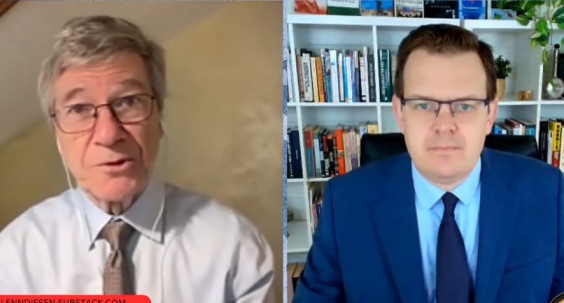
In this interview, economist Professor Jeffrey Sachs joins Glenn Diesen to discuss why Europe has failed to find its role in an emerging multipolar world. They cover Europe’s dependence on the transatlantic alliance, its broken ties with Russia and China, Africa’s rapid population and economic growth, and why Europe needs a smarter, peace-oriented strategy that looks ahead to 2050. This interview was premiered on October 16, 2026. Read the full transcript of this insightful conversation below:
Europe’s Missing Role in a Multipolar World
GLENN DIESEN (00:00:00 – 00:00:08): Welcome back, everyone. Today is October 16th, 2026, and we have the pleasure of being joined by Professor Jeffrey Sachs. Thank you for coming back on.
JEFFREY SACHS (00:00:09 – 00:00:11): Great to be with you. Thanks so much.
GLENN DIESEN (00:00:12 – 00:00:58): So I wanted to ask you about Europe’s role in a multipolar world because, well, in a multipolar world, we know that China will, of course, be a key center of power. We know that Russia has great incentives to diversify its partnerships, that is, to pivot eastwards. To be, well, less reliable on the West, that revived bloc politics after the Cold War.
We know that the US must begin to prioritize, and it will likely pivot towards the Western Hemisphere and East Asia. And well, if you pivot to somewhere, you have to pivot away from somewhere, and I think Europe is no longer the highest priority. So given that this is how the great powers are moving, what role can Europe play in this multipolar world, which is already here?
JEFFREY SACHS (00:01:00 – 00:05:04): Europe clearly has not found its role. It based everything about its future on the transatlantic alliance, which is a mistake for 2 reasons. One, as you rightly say, the supposed partner on the other side of the Atlantic doesn’t care very much about Europe. Treats Europe with disdain. And second, this is not where the action of the world is in terms of economy, technology, security issues. And it’s not where Europe’s challenges are.
Europe’s challenges are at least as great, I would say greater, in continental Eurasia. In other words, Europe’s future more than being based on the US, should be based on its relations with Russia, with China, with India, with the rest of the Eurasian supercontinent.
Of course, Europe also has real reason to be engaged with Africa, not the least of which is that Africa today is 1.5 billion people. Nearing 4 times Europe’s population. And Africa continues to grow dramatically in population and in economic size as well. By mid-century, Africa will be 2.5 billion people. And on the UN trajectory, which is not really a forecast but a kind of mechanical projection, The African population will reach 3.5 billion people by 2100, roughly a third of the world population.
So Europe, yes, has lots of directions to look. It has looked entirely in its own mind for security to the westward direction, to the United States. This doesn’t work. Europe does need a security and defense doctrine, which it lacks right now. But Europe also is cutting itself off from the lifeblood of its economic future by putting the walls down with Russia, which was an extremely important part of Europe’s economic relations up until even just the last 5 years. And Europe is now doing the same with China.
So it’s really not quite understandable what European leaders are thinking right now, except that they’re in a defensive mode. They don’t think constructively. They’re terrified of Russia, which is an irrationality that is extremely serious. They don’t understand China, and half of Europe’s growing anti-China feeling is falling in line with the United States, which has its own neuroses about China, and half is simply European pessimism and protectionism.
So all of this is to say that I just got back from a short visit to Brussels and had the same feeling that there is no direction for Europe. Of course, there is no real security or defense doctrine other than NATO, and NATO is falling apart. And Europe doesn’t understand why it’s falling apart and simply wants to somehow maintain an antiquated view of the world.
GLENN DIESEN (00:05:07 – 00:05:07): Yeah, no,
JEFFREY SACHS (00:05:08 – 00:06:01): that didn’t give you any positive side, but it gave a lot of negatives, which is that this is why Europe doesn’t appear on anybody’s list of major powers, because it’s understandable what’s happening. And there is no direction, no capacity for diplomacy.
Of course, it’s also a structural problem, which is that 27 countries after more than 60 years of trying to find unity with an expanding number, of course, making it even more complicated, has not really found a unity when it comes to external relations, either economic or geopolitical or defense.
Africa’s Rise and Europe’s Blind Spot
GLENN DIESEN (00:06:03 – 00:06:28): Regarding Africa though, I’m glad you mentioned it because when at the outbreak of World War I, there was about 130 million people in Africa. Now it’s more than tenfold, and they also have many of the fastest growing economies. So, but we still look at the African economies and population with some Yeah, some of the old stereotypes that it’s just providing natural resources condemned to poverty, but it is changing at a rapid pace.
JEFFREY SACHS (00:06:30 – 00:09:33): But just to add, if I might, to put the numbers also in perspective, at mid-20th century, Africa was 9% of the world population. Today it’s 18%. In 2050, it will be a quarter of the world population. And as I mentioned, by 2100, on something like a forecast, I want to take the numbers too seriously, but it could well be a third of the world population.
This is important in its own right, of course, but it’s also important for Europe, for economic affairs, for security issues. If today it’s a basic economic development point, if today’s vast youth population in Africa is well-educated, then Africa’s economic future is bright.
People will stay at home and build a prosperous future. If, as is true of the current trajectory, hundreds of millions of young people today don’t get a decent education, then this is actually going to be, of course, a true calamity socially for that generation ahead, but also geopolitically.
And you would think someone would think about this. And I was complaining in the European Parliament a couple of days ago that nobody thinks in any serious way about this from the European side. It’s ironic because with all of the new technologies, the capacity to expand quality education on a mass basis is greater than ever in history. But it’s not being systematically aided, I would say, in any way from Europe. That whole set of issues of development and so on has been completely shunted aside by the war in Ukraine.
But this is a mistake. If what countries, what leaders should do when they operate wisely is to think of the world a quarter century from now and the place of their part of the world in not today’s immediate crisis, but in the world at mid-century. Who in Europe is talking in this way at all? Of course, nobody in the United States is talking this way. If you go to China, that’s about all you hear, which is what China will look like in 2049. And it’s not just frivolous discussion. It’s intensive thinking and planning and looking ahead. That’s a real mark of coherence and successful strategy.
Looking Ahead: Lessons from “Emerging Asia”
GLENN DIESEN (00:09:35 – 00:09:45): Wayne Gretzky once said that his secret was he didn’t go to where the puck was, but where it was going. And I guess in geoeconomics, you do follow a similar logic. You have to adjust.
JEFFREY SACHS (00:09:45 – 00:15:59): And by the way, this is great. I remember that line, which is wonderful. This is not so hard to look ahead. And I think this is something that is completely missed in almost all geopolitics. You can make a pretty good projection of where world population will be in a quarter century from now. If you ask for 75 years from now, it’s a little bit harder, But you can make a good projection, of course, barring the ultimate calamities that we’re trying to prohibit. You can actually make a pretty good projection of where the world economy will be in a quarter century because there’s some basic principles that help you track the paths of economic development.
And I had one experience, Glenn, I just want to mention because it’s really apropos. This, and that is in 1995, I was asked by the Asian Development Bank to make a kind of economic projection for Asia for the year 2025. And I produced a study that was called “Emerging Asia,” published in 1997. And it said that Asia’s economic growth would outpace that of the West by several percentage points, depending on starting conditions of the different parts of Asia, so that we could project that by the year 2025, Asia’s share of the world economy would be 20 percentage points higher than in 1995.
Well, the study had bad timing because it was released about 2 weeks before the Asian financial crisis, And the idea of this kind of optimistic vision of Asia seemed wrong and anyway beside the point of the urgent crisis. So the book never went anywhere except onto a shelf or in the disposal bin. But 25 years later, I looked at it, actually 30 years later, I looked at it for the first time. I had to go buy a copy from eBay ’cause I didn’t even have a copy of my own book on the shelf and looked at what I had predicted in 1997 and what had turned out. It turned out that Asia’s share of the world economy had risen by 20 percentage points, actually almost to the point, a little bit lucky, but almost to the percentage point.
If you were back in the 1990s, you could say China is going to be a much bigger, much richer country. A statesman or a national leader or a strategist would think of that. But it’s hard to go back in the 1990s to any American thinking that says, yes, China’s going to grow and that’s going to be a multipolar world. And what kind of world is that going to be? And how should we shape it so that it is a peaceful and constructive world, not a world of danger?
We should be doing the same thing with 2050. Europe should be doing the same thing. It should be asking itself questions about what a region that is 450 million people right now, around 5% of the world population, and that by the late decades of this century will be under 4% of the world population. What should it be doing? Well, glomming on to the United States, which will be another 4% of the world population, is not exactly the right answer.
You can look at the numbers and you can say, no, even that transatlantic West, which was 50% of world output in 1950 is going to be 15% or less of world output late in the 21st century. That’s not a future. That is just a small part of a highly diverse world. And any region should be asking itself, what do we want to have and how can we be secure in that highly diverse world.
Russia, by the way, clearly has thought this through in a more intelligent way because Russia’s closer economic, geopolitical, military security alliance with China is not some kind of short-term marriage of convenience. That came because of mistaken US policies, though the US helped to accelerate that. It’s actually the right choice. It’s the right choice for Russia to say, “We are a Eurasian country and we are not simply a European country. We don’t have to just look to today’s European Union or to the United States for our future.”
Which is exactly what Brzezinski said Russia would have to do, which Russia would have no choice, he claimed back in the 1990s, but look westward. But Russia says, “Look, if the West closes up, if it blows up pipelines, if it doesn’t want to trade, if it makes 20 rounds of sanctions, if it doesn’t want to talk about inclusive security, we have a big, vast world. That does not depend on the 5% of the world that is in the European Union. We have a big world to deal with and we’re not going to lose out from that.” That’s a more accurate assessment.
From Unipolar Thinking to a Multipolar Reality
GLENN DIESEN (00:16:01 – 00:16:39): Yeah, well, I can understand some of the policy decisions that were made in the ’90s, though. I mean, because European policies, they, the unipolar thought manifested as NATO expansion. Yes, it redivided the continent, But the plus essentially was, you kept the US in Europe and the unipolar moment of the US essentially became the collective hegemony of the West. So, I don’t agree with it, but I understand it.
But, and also Russia then, as you said, the argument, it was for Russia, the West was the only game in town. Joe Biden even said, was very explicit in the ’90s, “whatever deal, the worst possible deal we can give to Russia is still the best deal on the table.”
JEFFREY SACHS (00:16:39 – 00:16:41): So that’s exactly the mindset.
GLENN DIESEN (00:16:42 – 00:17:56): Yeah, so they will have to adjust to new realities, so it doesn’t really matter. But now that you have a multipolar world, economy has shifted so much east, the Russian logic now is, we have to reorient our economy to the east, that is to diversify. Ideally we would have with the West as well, but it’s not possible. So now the economy will go east, our guns will have to point west to deter, to stop NATO expansion.
I mean, they have the whole logic we had in Europe. That is, we still have the unipolar thinking, but that world is gone. And even the relationship with the US now, I mean, we prioritize all economic activities around the US instead of diversifying, even as the US pursues a more extractive and exploitative relationship.
So you can look at Trump trying, well, to seize Greenland, which to some extent he has achieved, but this is not about Trump. Biden had the Inflation Reduction Act, they blew up Nord Stream, then they provide economic incentives for uncompetitive European, well, subsequently uncompetitive European industries to move across the Atlantic. I mean, it’s, I don’t think they’re seeing the world that’s coming. Instead, they’re talking about Russia restoring the Soviet Union, Putin being the new Hitler. I mean, they’re looking literally to the past.
How Europe Lost Its Way with Russia and China
JEFFREY SACHS (00:17:56 – 00:24:41): Exactly. And Europe actually had it somewhat right around 2010, I would say. European-Russian economic relations were growing, pipelines were being built. You had a growing German-Russian consistency in industrial development. German heavy industry, of course, was based on low-cost Russian energy. Russia’s industrial development was strongly supported by investments coming from Germany and other European countries. It was actually working.
And Europe had the idea that we should pioneer in the green technologies of the future. And while those had some controversy and were done in the most ham-handed way. For example, the German decision to suddenly shut down nuclear power was an absurdity and a tragedy in the actual economic effects that it had. At least the idea back in 2010 or 2015 was look ahead and champion the technologies of the future. And in that context, stronger economic ties with China would’ve been absolutely a pathway to rapid, successful technological change and innovation for decades to come.
All of that idea has been lost right now. And right now there’s no forward-looking idea anywhere to be found in Brussels. And by Brussels, of course, I mean the structured organization of the European Union. It doesn’t exist. It’s completely on the defensive, completely pessimistic, completely lifting bridges, blowing up bridges rather than trying to design them. Not thinking ahead, trying to save what can be salvaged.
And of course, at least Donald Trump is doing the service to Europe of saying you don’t even have anything you can rely on on the other side. This is having some small salutary benefit, actually, because breaking out of this mindset that the US is our security bastion and we have to follow the US pretty much blindly in wherever it leads has been the downfall of Europe because the United States, we know, practically speaking, opposed the stronger relations between Europe and Russia. That was one of the things to be fought. Germany and Russia should never get so close together because then where would the United States be in that equation?
The whole NATO expansion was viewed rather skeptically by much of Europe. And in 2008, we know that Angela Merkel herself thought that the idea of committing to NATO enlargement to Ukraine was a ghastly mistake and that it would be read in Russia, as she writes, as “tantamount to a declaration of war.” And yet she caved because it seems to have been unimaginable to Europe at that rather late stage after Ostpolitik, after German reunification, after the building relations. It was still seemingly inconceivable to the political leadership of Europe to have a European-based policy. They went with the US policy.
The US policy was completely erroneous. It was based on this claim of primacy forever, not understanding the basic dynamics of world change that were underway. It was a snapshot, not a look-ahead projection. Europe glommed onto it. Now the United States is flailing around in a pretty deep political crisis that’s not going to go away. And Europe can’t get off its old trajectory.
Groupthink and Censorship Among European Leaders
It seems very difficult for almost any European leader to think beyond this. And it’s been explained to me, Glenn, you know it very well, better than anybody, but Some European leaders have said to me, “Well, you just can’t say these things because if you say these things, you’re completely ruled out. You then lose even your seat at the table.”
So there’s a censorship among the leaders that they barely utter what they think, even when they have a feeling. That something’s wrong because the groupthink also, maybe it’s the compensation for a lack of effective institutions in Europe, but there’s a kind of fear even for those few who are thinking more clearly for saying these things.
And we had politicians like Viktor Orbán in Hungary that said 2 very, very important things. One, we shouldn’t have war with Russia. And second, we should have good relations with China. And he became, of course, the bête noire of Brussels. And they did everything possible to support the political opposition in Hungary so that a voice like that would not be heard.
So this is another problem, which is that there is, I think, not only confusion, But it’s very difficult for even more clear-thinking European leaders to express themselves right now because there are these norms to just fall into line with what is an ongoing failed policy and an ongoing drift even to outright war with Russia.
More Europe, But a Smarter Europe
GLENN DIESEN (00:24:44 – 00:25:14): Yeah, no, I get what you say though. Trump would have been the perfect wake-up call for the Europeans to shift. Because, like you said, for 80 years we’ve been in the same security model, economic model, political model, tied at the hip with the United States. But also the Europeans have a very fragile foundation for unity, so they also depend on the American pacifier. And of course we have a powerful ideology of liberal hegemony which doesn’t go away. But,
JEFFREY SACHS (00:25:15 – 00:28:37): it is a terrible issue, Glenn. I don’t know the answer to it, but Europe is failing right now. So the political opposition to the mainstream says “less Europe.” I don’t actually agree with that, but that is, of course, an understandable reaction. “Brussels is a disaster. Why should we— we need to break those bonds.” And that’s what Marine Le Pen says, for example, if I understand Marine Le Pen, if I understand correctly. And a number of the opposition parties.
This is not quite right. What is right is that, yes, Brussels’ policies are disastrous. They make no sense. They’re leading Europe downward. But I also do believe that in a multipolar world, it really would be difficult for the Western Peninsula of Eurasia just to be 27 small principalities. To me, that is not a better Europe to say we each go our own way because Brussels is so incompetent. But that is the prevailing opposition view. Again, understandable. You react against those who are making the wrong decisions.
But I actually believe Europe needs a stronger structure, one that is effective, a better vision. But we’re in a world of major powers. We are. India will be today 1.5 billion and it will be 1.7 billion people. China’s 1.4 billion people. The African Union will become more of a union. It has to. It can’t be 55 post-colonial states and get anywhere. So I believe that Africa will become more of a union. And Russia, of course, with its 17 million square kilometers, is a giant of another kind.
So for the European opposition, to the absolutely misguided European policies now to say, “Well, we need to break apart, we need our own sovereignty.” This is not also the right diagnosis, I’m afraid. Europe as 27 independent countries with no effective cooperation and coordination will be picked apart. By the US, or by— which may become the worst enemy of Europe, or by other forces in the world.
So I’m in favor of more Europe, but a lot smarter, a lot more peace-oriented, strategic-oriented, economically-oriented Europe. Yet that— there seems to be almost no place in European politics right now for that particular point of view.
Rethinking European Integration
GLENN DIESEN (00:28:38 – 00:28:52): No, well, I agree. I think Europe needs cooperation and collective bargaining power to have a role in the world. But in the 1990s, at least we have discussions, what is Europe? Because we now kind of locked into a fixed understanding. So for example,
JEFFREY SACHS (00:28:52 – 00:28:53): absolutely,
GLENN DIESEN (00:28:53 – 00:29:36): Brzezinski, he once made a point that, well, Germany and Russia cooperating is a threat to European integration, but those are the 2 largest countries in Europe. Those, you will get the 2 main pieces in place, And then you organize the rest. I mean, so it kind of shows what we mean. So when we say European integration, we talk now suddenly about establishing new militarized dividing lines, which isn’t really Europe.
And also, why would you centralize power or competencies from elected parliaments at the lower level and transfer that to Kaja Kallas and von der Leyen unless it’s necessary? It’s just— but I do agree, Europe, it does need to coordinate somehow. I just wish Some of those discussions could open up again.
JEFFREY SACHS (00:29:37 – 00:30:24): Of course, no, we were on 100% the same wavelength. This is no way to say hand it over to Brussels with this way of institutionalized behavior and these profound mistakes. And what a surprise for Brzezinski to say, being a Polish patriot, to say, “Don’t let Germany and Russia get together.” But yes, this was not exactly the right vision for Europe, nor has it proved to be the right vision for the United States. He was a very nice man and a very intelligent man, but he got almost everything wrong in the 1990s when he tried to strategize in this way.
GLENN DIESEN (00:30:26 – 00:30:30): Well, thank you very much for your time and have a great day there at the Vatican.
JEFFREY SACHS (00:30:30 – 00:30:33): Good. We’ll talk shortly then. Thanks a lot.
Related Posts