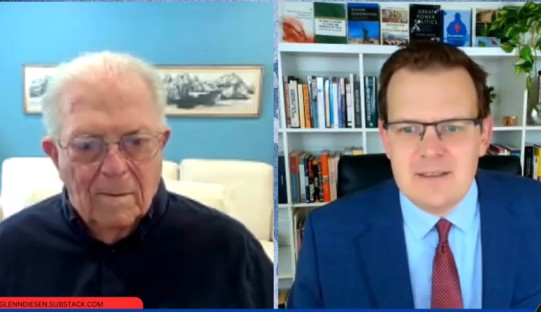
Former US Assistant Secretary of Defense and Ambassador to Saudi Arabia Chas Freeman joins Glenn Diesen to break down the escalating Trump–Zelensky conflict sparked by the Russian diesel deal, Trump’s call for elections in Ukraine, and reports that the U.S. has cut intelligence support to Kiev. Freeman discusses David Ignatius’ peace plan, Europe’s narrative trap, Mark Rutte’s shifting rhetoric, and the need for a new European security architecture to end the war in Ukraine. This interview was live on October 14, 2026. Read the full transcript of this insightful interview below:
Introduction
GLENN DIESEN (00:00:00 – 00:00:20): Welcome back, everyone. Today is October 14th, 2026, and we have the great pleasure of being joined by one of the great American statesmen, Ambassador Chas Freeman, who was the former US Assistant Secretary of Defense and also the ambassador to Saudi Arabia. So thank you for coming back. It’s always great to see you.
CHAS FREEMAN (00:00:22 – 00:00:28): It’s great to be back. I don’t rise to the level that you elevate me to, but I’m happy to be here with you.
The Diesel Deal and the Trump–Zelensky Quarrel
GLENN DIESEN (00:00:31 – 00:01:25): Well, what I did want to discuss with you today was this new, I would say very strange quarrel emerging now between Trump and Zelensky. That is, it all appears to, well, of course, derive from this diesel deal. So Trump made a deal with Russia that they would begin to export some of their diesel. And Zelensky lashed out at Trump, and then now Trump has, well, demanded elections in Ukraine. And also there’s some reports that the US has cut some of its intelligence sharing.
I’m not sure if that’s correct or not, but again, that’s why we’re speaking to you. So I guess we can start at the diesel. How do you make sense of this? It didn’t seem like a very significant deal, but that is that what started the whole thing?
CHAS FREEMAN (00:01:27 – 00:10:19): I think this reveals a whole series of fault lines that have always been there. Basically, the Trump administration and Donald Trump do not share the Biden administration’s ideological animosity to the Russian Federation, and therefore do not share the vision of using. Ukraine as a way to put pressure on Russia, or even as some Europeans like Kaja Kallas have argued, cause the breakup of the Russian Federation. They’re not anti-Russian in that ideological sense. They’re not imbued with the Cold War triumphalism that led to the effort to incorporate Ukraine into NATO.
If we go back here, we will see the Biden administration, the Obama administration before it, the Bush administration, the old one, that is the Shrub, not the Bush. These administrations all followed a similar line of animosity toward Russia and saw Ukraine as a battering ram against Russia. And indeed, in the period before the actual war broke out, between 2014 and 2022, that decade, the United States and NATO totally reorganized the Ukrainian Armed Forces, re-equipped them to NATO standards, and watched as they arrayed themselves against the so-called People’s Republics in Donetsk and Luhansk.
And this was very much an anti-Russian effort, and it was responded to by the Russians in that manner. They saw this as an existential threat forming, and the presence of foreign forces in Ukraine aimed at them, they considered to be completely unacceptable. So these, but now the Trump administration has abandoned this agenda. The Europeans now rhetorically support it, even though they have no ability to actually implement it.
And so who is left high and dry in this? Ukraine. Ukraine has been used, abused, and it has suffered terribly as a result of its incorporation, in effect, into NATO. It is not a NATO member, but it was treated in every respect as if it were, and armed as if it were, and the Russians have from the beginning seen this as a proxy war by NATO and the United States against them. The United States has basically dropped out of this.
All of this is the backdrop, and what it reveals is that there’s no longer any consensus at all between the United States, the Europeans, the Ukrainians about what this war is all about. Sorry, that update on my phone going forward.
The, so what happened was basically Donald Trump is desperately concerned about the probable shellacking he’s going to get in the midterm elections on November 3rd, which is now about 3 weeks away. And desperate to bring down diesel prices, or at least show that he could do that. In fact, diesel prices will not subside to any degree because of this deal.
But The deal to release a small amount of diesel fuel from Russia and to tell Ukraine to stop hitting Russian refineries in order to facilitate that obviously is pulling the plug out, the rug out from under Zelensky. His reaction, which was intemperate, drew the appropriately, or entirely predictable, I will not say it, appropriate, entirely predictable response from Donald Trump, and the result is a rupture.
Starlink Degraded and Intelligence Support Withdrawn
And as for the question of intelligence support, it appears that Elon Musk’s Starlink system has been deliberately degraded and no longer functions effectively to guide Ukrainian drones over long distances. Thus ensuring that Ukraine has greatly reduced capacity to strike deep into Russia or at Moscow. It also appears that intelligence support in general has been withdrawn.
By the way, that is apparently not limited to Ukraine. It has also been the case with the Republic of Korea, South Korea, on an entirely different issue that is connected to Ukraine, namely breach of protocol and secrecy with regard to the disposition of 2 North Korean prisoners of war taken by the Ukrainians. Anyway, that has produced a rupture with Ukraine and it’s produced some sort of rupture with the United States.
So anyway, I guess this is like the end of an ice age.
David Ignatius’ Peace Plan
And I know there was a very interesting article by David Ignatius in the Washington Post outlining a plan for peace based on the rupture between Trump and Zelensky, which of course recognizes that one way to war, the most efficient way to end this war, is to remove Zelensky, who is entirely dependent on the conduct of the war to retain his leadership position in Ukraine. That is not easy.
But what is most interesting about Ignatius’ column, recognizing that David Ignatius is a reliable echo of the national security apparatus in Washington, is that he basically proposes what the Russians proposed in December 2021. That is, a re-neutralization of Ukraine, writing neutrality into the Ukrainian constitution, restoring elections and democracy, giving up what remains of the territory in the Donbas that the Russians have not yet taken, and calling it all off.
Something which apparently would, with the exception of the sacrifice of territory, which people are unwilling to contemplate in Ukraine, would very much satisfy Ukrainian opinion, which is greatly in favor of a negotiated end to this war, having been battered by it for so long. So I think this is really very important.
The diesel element is minor. It’s brought about by other factors. Donald Trump blames Ukraine in the Ukraine war for its long-range strikes at Russian refineries for this shortage. But that is a complete canard. The cause is the war with Iran that he inaugurated with, at the instance of Benjamin Netanyahu and the somewhat different and dissociated war that Ansar Allah in Yemen is now conducting against the Saudis.
Which is trashing the Saudi energy infrastructure and running up a repair bill, which is probably numbered in the $2 trillion range for Saudi Arabia. And which guarantees, very good for Norway, I guess, guarantees very high prices for oil for quite a while to come, maybe indefinitely.
Anyway, I’ll stop here as usual. Well, and I didn’t give you a chance to ask a really complicated question, which you usually do, but I gave you a complicated answer anyway.
Neutrality Through Diplomacy or Through Force
GLENN DIESEN (00:10:20 – 00:11:39): Well, I’ll keep it simple. I just have one thought though. The comments of David Ignatius in his article, I mean, the fact that the security state now kind of suggests what the Russians were suggesting before the invasion. I mean, people like yourself, this is what you’ve been arguing all along, that NATO expanding into Ukraine is seen as an existential threat by Russia. It’s not going to happen under no circumstances.
Either one, one puts an end to it, restore Ukraine’s neutrality through diplomacy, or the Russians will use force. They will strip Ukraine of the territory it can’t afford to see in the hands of NATO. It will destroy the rest which can be used as a front line. I mean, this was very predictable and I remember trying to make that argument back in ’21, ’22, and it was impossible because people presented this alternative. Now either we let Russia say no expansion or we do it.
But that was never the option. It was either we accept neutrality through diplomacy or it will happen through force in which hundreds of thousands, if not millions, will die. And I mean, we will end up at that situation. And that’s why it’s so frustrating to see That’s still the narrative’s hold though. But sorry, you—
CHAS FREEMAN (00:11:39 – 00:17:08): This is, of course, the narrative in Norway. It’s also the narrative in the United States and Donald Trump and company, who really, I think, would like to end the war in Ukraine and seem to be quite prepared to see Zelensky retire to one of his villas abroad in order to do that, are confronted by the successfully propagandized opposition of many Republicans as well as Democrats. The Democrats, of course, seize on this as a betrayal of Ukraine.
I have a friend here in Exeter, New Hampshire, who yesterday cited Vladimir Zelensky as, oh, “the indomitable leader of the free world.” Well, I’m not sure there is a free world, but anyway, I’m not sure what it’s free from anyway. But there is this image of, of Churchillian image of Zelensky and incredible sympathy for Ukraine and willful misunderstanding of the issues, security issues that NATO extension to Ukraine presented to the Russians.
What Russia Demanded in December 2021
So we’re back where we started, apparently, or we’re moving back toward it. I wouldn’t say that one article by David Ignatius is dispositive, but basically what the Russians demanded in December of 2021 was either the implementation of the Minsk Accords that is protections for the Russian speakers in Eastern Ukraine, and the acceptance of the annexation of the Crimea, plus no NATO troops or Western troops in Ukraine.
Some Russians added a rollback in the Western military presence after 1997 in Eastern Europe. But it was clear that was negotiable. And they demanded the neutralization, re-neutralization of Ukraine on the basis of which they had accepted the independence of Ukraine within the former Soviet borders.
And finally, they asked for a discussion of European security architecture that would reassure Western Europeans about their intentions and capabilities and do the same for them with regard to Western Europe, which has repeatedly invaded Russia. World War I, World War II, Napoleon, Germans, Frenchmen, Europeans in the West have a record of invading Russian territory. Russia does not have such a record with regard to the West.
So I think the Russian position, which was an attempt to start a negotiation, was totally repudiated by not just Antony Blinken, the Secretary of State at the time, and Joe Biden, the President, but by the NATO leadership, by your own Jens Stoltenberg, who was then the Secretary General of NATO, and who has been succeeded by Mark Rutte, who is, if anything, even more solicitous of Donald Trump’s favor and hardline in his approach toward the Russians.
So here we are. Basically, if we want to have a peace, not just in Ukraine, but in Europe, if we want a Europe that is “whole and free,” as we have declared, we have to deal with effectively and with some empathy with Russian security concerns. And it’s the failure to do so that perpetuates this war.
Individual Realism, Collective Unrealism in Europe
I know that there are trends in Europe as a whole, maybe not in Norway, but certainly in Germany and in France, major countries, and perhaps a little bit in the UK, although it remains a mainstay of Russophobia, there is a trend toward the expression of individual, the dissociation of these countries from the European whole.
And someone has just done a study which, and which I noted, indicated that at the individual level in Europe, European politicians, there is a great deal of realism, but in the collective, they are utterly unrealistic. So the psychology of crowds, about which my great-grandfather wrote in his doctoral dissertation at Heidelberg, what, 120 years ago, is very much in operation. And those of us who have danced to a different tune have been called out for that, or worse, as you know more than I.
GLENN DIESEN (00:17:10 – 00:17:47): Well, this country here, Norway, is kind of unique on this because I think it’s the only country in the world where every single member of parliament is for sending weapons. And To the best of my knowledge, not a single one has called for ending the boycott of high-level talks with Russia. So anyone who challenges this golden consensus will be ruthlessly attacked. So it’s zero opposition.
You do see opposition though in Britain and France and Germany, the big countries, but the Scandinavians, they turned very, very hawkish during this conflict. What I did want to ask was—
CHAS FREEMAN (00:17:47 – 00:17:56): Well, you are, Americans condemn you for being socialist. Ridiculous. Anyway.
GLENN DIESEN (00:17:57 – 00:18:00): Yeah, warmongering fanatics.
CHAS FREEMAN (00:18:02 – 00:18:02): Vikings, yes.
Trump’s Shifting Positions on Ukraine
GLENN DIESEN (00:18:03 – 00:19:30): Yeah, something is coming back there. Well, but here’s the interesting thing with Trump though. He had in the beginning or during the election, he was very explicit that he was making the point that NATO expansion had triggered the war. He called for an ending the war, he would do it in 24 hours. Immediately after he took power, we had all those events like the big spat in the Oval Office between him and Zelensky.
And then something happened. He pivoted the other way. And then he seemed to, instead of ending the war, wanting to outsource it. And he never spoke about NATO expansion again or addressing these underlying causes. Indeed, you saw Marco Rubio as well. He made this interview with Megyn Kelly in the beginning of the second administration that the unipolar moment is over, this multipolarity, we’re going to have to adjust. Well, that kind of means you have to make peace with the Russians.
And now they’re kind of— he’s back to, oh, look at the successes of this 40-day strike deep into Russia, which is obviously supported by the United States. So, and now they’re pivoting back again. Is this a negotiation tactic? Making all sides feel that there’s uncertainty that they have to make concessions before the Americans switch again? Or is this just recognizing that the situation is hopeless? Or is this just Trump being angry at Zelensky for being rude about the diesel deal? I have a very hard time interpreting Mr. Trump.
CHAS FREEMAN (00:19:30 – 00:24:34): Probably all of the above encapsulated in the idea of a mentally defective president who is not in touch with reality and who makes up stuff. Look at the way this was announced. There was an announcement, Donald Trump announced there was a deal between Putin and Zelensky. There wasn’t any deal. This was something he imagined.
Who is his, who are his intermediaries? 2 real estate moguls from New York, who have a batting average of zero in terms of diplomatic accomplishment anywhere. I mean, when pushed on that, Donald Trump says, “Well, look at Gaza, that’s a great success.” But I think he’s the only person in the world who regards it as such.
So this is just confusion, ineptitude, incompetence. Diplomatic incompetence. And it is not leadership. It is followership. And as I said, if you inhale your own propaganda and become giddy over it, then you do stupid things. And this is a chain of stupid things. I don’t know how else to explain it. I mean, there’s no real purpose or strategy to all this.
What Is This War About Now?
As I indicated, the idea of the strategy in the beginning was to use Ukraine to take down Russia. Lloyd Austin in the Biden administration said the purpose of the war was to weaken and isolate Russia. And here was, that was a bit out of line to admit that, but that was the actual purpose that led to the outset of the war.
We don’t know what the war is about now. Is it about arms sales to Europeans so they can pass on the arms to Ukraine? Is it about supporting an ideological crusade against some mythical Russian ideological menace? Is it, does anybody really imagine the Russians who have bogged down in Donbas could actually invade Western Europe. They could devastate it, yes, but they could not occupy and control it. They could— against any serious opposition, and there would be opposition.
What is this about? Nobody can tell you really at this point. It is about democracy. But Ukraine is not a democracy. It’s about Ukrainian nationalism. But Ukrainian nationalism will not accommodate the nationalism of others, or the linguistic and cultural autonomy of others. It’s about punishing the Russians for a war of aggression. But the Russians started that war because they were denied the opportunity to negotiate. This, none of this makes sense.
And as I said earlier, the United States basically under the Trump administration has now broken completely with the earlier strategy of going after the Russians through Ukraine. Europeans are still on that kick, but mostly with empty talk. And not, no real capabilities. And confronting a threat that is exaggerated and more imagined, far more imagined than real.
So the only thing you can say about all this is the big loser is Ukraine. Ukraine has been turned into and is being turned into a failed state with limited territory, probably limited access to the sea. It may end up as a last landlocked bastion of revanchist ultranationalists who are the poorest and most corrupt in Europe.
No, what is the future of Ukraine at this point? Zelensky or no Zelensky? I don’t think anyone knows. So this is, Ukraine is a tragedy for everyone, for the Ukrainians, for the Russians, for American relations with Europe, for statecraft generally, which you accused me of at the beginning of your broadcast unjustly. I deny that I’m capable of statecraft.
Is There a Pathway to Diplomacy?
GLENN DIESEN (00:24:37 – 00:26:13): Fair enough. Well, I was thinking though, well, the Russian strategy now— I mean, whether they pursue diplomacy or military victory, it doesn’t really matter. It will be the same actions, I guess. That is, a Ukraine without air defenses and at least temporarily without the same level of US support The approach will be essentially continue what they were doing.
That is, this massive escalation, these heavy attacks against bridges, railroads, energy infrastructure, essentially all the things that you need to shut down the country. I mean, again, this can be used for pressure to force the Europeans and Zelensky to negotiate, but if they don’t, it’s also the pathway to victory. So the actions I think would be the same now, irrespective of what they want.
But what is the pathway to diplomacy? Do you see any pathway to diplomacy? Because surely I know that when Trump had this Alaska meeting with Putin, sorry, I’m working on big question again. When Trump had this big meeting with Putin in Alaska, then the Europeans all got on a plane to Washington and tried to explain, “No, no, we can defeat them on the battlefield. We can at least make the, Bargaining power more favorable. Let’s just keep on going a little bit more.”
Surely the Europeans must now see that there’s no rescuing the situation anymore. Surely Zelensky must see the same as well. You would think that diplomacy would, that option would be becoming more appealing.
CHAS FREEMAN (00:26:14 – 00:29:38): No, Anchorage was theater, not diplomacy. And so was the sycophantic gathering in the Oval Office. By European leaders after it. You should review the video of that and look at the face of Giorgia Meloni as this show proceeded. The again, some Europeans are realistic in private, even if in public they adhere to a united front that is. Impossible to implement.
No, I think you’re right. Let’s remember who started this business of blowing up infrastructure and whatever. I mean, this was a Western-inspired Ukrainian escalation aided and abetted by American and British intelligence, by weaponry that was supplied by the UK and others. By Ukrainian ingenuity in support of this policy, by Chinese parts for the Ukrainian drones.
I mean, so what would stop this war? A different leadership in Kyiv, one that is willing to return to the negotiating table, one that is willing to renew what was agreed at Istanbul. In March of 2022, and basically a peace that respected Russian security concerns and therefore led to an end to the onslaught. But in the absence of that, the onslaught is going to continue. And Ukraine, as you suggested, is being systematically devastated and deprived of its future by this war.
Who in Europe Would Negotiate?
So maybe in his own inept way, Donald Trump’s suggestion that it’s time for Zelensky to step down has some merit. It opens a diplomatic opportunity. For somebody, but who? The United States is diplomatically incompetent under this administration.
Who in Europe, under the current leadership, who in Europe would take on the task of negotiating the 3 things that have to be negotiated? The neutral status of Ukraine, the guarantees for minority rights in Ukraine, and the broader question of European security architecture.
Who, we’re right back to Kissinger’s infamous question. “If I wanted to get European agreement, who do I call?” EU is more an excuse for the lack of decision than it is a vehicle for making decisions on fundamental questions like this. Apparently. So maybe Mark Rutte should come forward and be the peacemaker. More improbable things have happened.
Europe’s Rhetorical Trap
GLENN DIESEN (00:29:40 – 00:31:06): Well, I think the problem with the European Union, as I said, is 27 countries, why, all with different political, economic, security interests. So how would they all reach consensus? I think that this kind of this very hardline narrative they kind of captured everyone with, that is, Russia is, it’s an unprovoked invasion, this is the new Hitler. I mean, once you kind of establish that narrative, there’s no room for dissent anymore.
And if you would start now to talk with the Russians, even a compromise, I think the Europeans will begin to fragment because that was the only, only consensus. I mean, in the literature Well, academic literature referred to it as a rhetorical trap. They did the same with NATO enlargement. They say, hey, sorry, EU enlargement. So is the EU all about democracy and freedom? It’s, yes, everyone agrees.
And then, okay, well, we kind of have to bring in some of the Eastern Europeans. And then anyone who would oppose it, they would essentially oppose spreading democracy. So it was a good— it was a way of getting everyone on board. Well, we did the same this time, but now it’s Putin is Hitler. They want to restore the Soviet Union.
No one quite explains exactly if the Russians are going to march on Paris. Forget about the capabilities to do so. What do they need? What are they going to do with Paris? It doesn’t make any sense. So it’s my, I guess my point is to just got trapped by these narratives.
CHAS FREEMAN (00:31:08 – 00:36:04): It does make sense though, in terms of In post-World War II history. I mean, what happened at the end of World War II, the Soviet Union had lost 27 million people. It had been devastated in its farms, its industry had been devastated. It was highly dependent on the supply of weaponry and equipments from the United States. And yet a narrative immediately emerged that it was about to march on the rest of Europe.
And was this realistic? One can argue about that, but I would say that this overestimation of Soviet ambition or Russian ambition and capabilities has deep roots. That was 1948, ’47. And the various things were done by the United States at the time in Europe, for example, interfering heavily in the Italian elections against the Communist Party there, which interestingly for a Communist Party was contesting the elections. It was locally based. It wasn’t subservient to Moscow as far as I know. I mean, probably sympathetic. But not subservient. Anyway, there’s deep roots to this. That’s the first point.
Capabilities Versus Intentions
The second is that we’ve inverted the normal sin of military geopolitical analysis. Normally, the problem is that we examine the capabilities of a potential adversary and then extrapolate from that and say, well, we have to match and be able to confront those capabilities. We do not look at the intentions.
So therefore, we get into things like security traps where one side is— the security dilemma where one side is arming to defend itself and the other regards that military buildup as offensive. Because we discount intentions. In this case, everything depends on intentions. Nobody really claims the Russians have the military capability to do what we’re allegedly defending ourselves against, or Europeans are defending themselves against.
So this is very strange. And you have to, I think, Forget statesmen, we need psychiatrists and psychologists to deal with this, because it’s not rooted in some external reality. It’s in our heads. So Zelensky’s the indomitable leader of the free world, the free world being the world not controlled by the Russians. Whether it’s free or not is another issue. And the Russians are 12 feet tall even when they’re military midgets. And Vladimir Putin is the devil incarnate, also known as Adolf Hitler.
And I’m all, at least in World War II, the British had the sense of humor to have a song Which I can’t sing, unfortunately, because my singing voice is not very good. But it starts off, “Hitler only has one ball. Himmler has 2, but they are very small. Göring,” I forgot. Anyway, at least they had a sense of humor about things. We have lost that.
Putin as a “Nasty Realist”
Putin is the devil. He isn’t. He’s an intelligent, hard-boiled son of a bitch. But he’s somebody that can deal with. And if you look at the— well, you were in Valdai and somehow made it back to Oslo without being arrested at the airport, unlike Ian Proud, who was detained for, what, 3 and a half hours or so. And had his laptop and phone confiscated.
Anyway, did you hear Valdai when Putin spoke? Did you hear an unintelligent, deluded man? Or did you hear a nasty realist? I think he’s a nasty realist. And I spent much of my life in diplomatic service dealing with nasty realists. You can deal with them. God save us from ideologues.
GLENN DIESEN (00:36:06 – 00:36:36): Yeah, it’s this switching positions which I find exhausting. As you said, Russia is always hopefully weak, backwards, “gas station masquerading as a country,” but it’s also all-powerful. It can, you have the Russiagate, they can take any country, they’re behind all this hybrid war. I mean, there’s no limits to it. And then, but same with the, we’ll say, oh, the Russians are weak, they’re stuck in Donbas, they can’t move forward, but they will march on Paris, so we have to prepare for war.
CHAS FREEMAN (00:36:38 – 00:36:39): Or Berlin at least.
Mark Rutte and Andy Burnham Walk It Back
GLENN DIESEN (00:36:39 – 00:37:44): Yeah, or Berlin at least. But also, yeah, Ukraine is, they should have joined NATO, then Russia would never have attacked. But oh, after they’re done with Ukraine, they’re going to attack NATO. So even Rutte, the NATO Secretary General, he kept making this point over for weeks now that facing an imminent Russian threat, and then today he stands on stage going, “Ah, well, there is no imminent Russian threat. If there is a danger that appears in the future, we’ll address it.”
Or so how? I’m assuming Trump made a call saying we need to dial it down a bit. But same as Burnham, he was the Prime Minister of Britain. He wants to walk. He wants to go back into the EU. So he’s making the statements. “Oh, Brexit was a. Russian interference,” and then you have some pushback, I think for Boris Johnson, Nigel Farage, they’re all saying, “What are you talking about? Where’s the evidence? We already had investigation. It came up with nothing. Well, what is this new evidence?”
“Oh, well, okay, well, maybe,” and then they start to walk it back. It just, they’re all over the place though. There’s no reality anymore. It’s all spinning, it feels.
The Politicization of Intelligence Services
CHAS FREEMAN (00:37:45 – 00:41:26): You have put your finger on a particular problem that we have. And that is the politicization of the intelligence services, their willingness to supply spurious claims based on no evidence of behavior that we find objectionable. This is a disgrace. I mean, MI6 had, has had a reputation for objectivity. Which it is diluting in the face of expediency, basically political expediency.
So what is Mark Rutte’s motive in doing what he does? I think his whole purpose is to keep the United States involved in the defense of Europe. And protect the transatlantic relationship. And he’s willing to go to extraordinary lengths, brown-nosing Donald Trump to do that. He’s also willing to zigzag doctrinally, change his rhetoric to suit the, that cause, regardless of what happens. I would not see him as a serious analyst of a Russian threat or any other threat.
And from a European point of view, the instability of the American policies toward Europe is a far greater threat than anything emanating from Moscow, which has not changed its tune since since this war was brewed up, it has been consistent. It has not expanded its objectives.
It has created some problems for itself. For example, constitutionally incorporating Donetsk and Luhansk as well as Zaporizhzhia and Kherson was a mistake because now the constitution of the Russian Federation binds the Russians to war objectives that probably are unattainable, or if they are attainable, are attainable only at exorbitant cost. But nobody’s claiming that Russian policy has been sensible on this.
But certainly the opportunity for diplomacy, to go back to your question, have been almost Infinite, constant, and yet repudiated by the West, which won’t even talk to the Russians.
So, and we now have a trial going on in Germany of some Ukrainian who is accused of having carried out the Nord Stream 2 sabotage. Which is very improbable. But I guess the good news from a Norwegian point of view is it lets Norway off the hook in terms of involvement in it. So Norwegian divers were not there, I guess. That’s good. And we should all be happy. But I mean, basically, we’re living in a world in which theater rather than diplomacy is the modus operandi of more and more governments.
Are We Entering the Endgame?
GLENN DIESEN (00:41:29 – 00:42:13): Yeah, everyone seemed to forget about Seymour Hersh’s article, and well, not for me to remind everyone. I did want to ask you though about how, where’s this headed now? How do you see this? Are we entering the endgame here? Because I mean, I’ve been quite surprised. I thought that the Ukrainians would have folded a long time ago.
I did not expect that resilience, but also the willingness of Zelensky and NATO to continue to shovel men into a war that couldn’t be won. But also you had the introduction of new technologies, the drones. I mean, all of this has extended it far beyond what I thought. I mean, I thought after around year 3 that it would they would begin to break. But,
CHAS FREEMAN (00:42:14 – 00:45:00): but now anybody has— I don’t think anyone has really distinguished themselves in terms of the military analysis of this conflict. Ukrainians have indeed proved far more resilient and innovative than anybody thought they would do. NATO has proved to be a bigger sucker than many people thought it would be, and in terms of backing the Kiev establishment.
Vested Interests in the War’s Continuation
Zelensky and the people in power in Kiev have vested interests in this war’s continuation. They have profited enormously from corruption, which is a normal consequence of war everywhere, but which has been particularly notable in Ukraine. They are in the rear. They are Not on the front lines. They have managed to do in the Russian Orthodox Church, the press, freedom, democracy, elections. All these things have been set aside in favor of authoritarian rule.
This is pretty good from their point of view. If they, like Trump, care more about themselves than about the country they lead, things aren’t so bad. So I think we need to acknowledge that there are vested interests that very powerfully support the continuation of this war.
And probably on the Russian side, that’s true too. I mean, the prestige of Vladimir Putin is completely invested in this war. Those Russians who think the war was a mistake or believe it should be ended without taking the last bit of territory in Donbas, are isolated, ostracized, or worse.
There is a heavy toll on both sides, worse on the Ukrainian side, but still terrible on the Russian side in terms of dead young men, and now in Ukraine, women, since they have scraped the bottom of the barrel in terms of men and are now fielding women on the battlefield. Anyway, I mean, it’s a horror, but you’re right. It is a surprising horror. I don’t think anyone could imagine it would go on for 5 years, which it has done.
The Broken European Security Architecture
GLENN DIESEN (00:45:02 – 00:46:20): But I’m thinking if I was on the Russian side, even if I have the ability now to defeat Ukraine, push NATO out to give 100% sure that they won’t return, All of this, all the military goals— get regime change, get the Banderas out of Kiev, restore this, the human rights, political rights of Russian speakers— I mean, all these objectives, this key was still one key problem though, that is the source of the whole war, that is the broken European security architecture.
Is right European security still going to be based on stability deriving from NATO continuous expansion towards Russian border? Are we still— because we have other problems we fight over Kaliningrad, over Belarus, Moldova, Georgia. I mean, there’s no Arctic, there’s no— as long as this is the problem, we haven’t figured out the new pan-European security architecture, that victory might be hollow. It is.
I mean, if we do accept that the Ukraine war is simply a symptom of a larger conflict, surely the Russians would want to address that larger conflict. I’m just thinking From a Western perspective, wouldn’t we have some bargaining power if we can bring in the European security architecture into discussions there?
CHAS FREEMAN (00:46:22 – 00:49:03): I think we would. I think the Russians very much want that, and I think they reason strategically. The issue for them is not so much Ukraine, it’s exactly the one that you described, that is the breakdown of and the kind of catastrophe that the absence of an effective European security architecture has produced.
And I think the real questions we should be asking ourselves at this point begin with what sort of Ukraine is there going to be and how is it going to fit into a future European security architecture? If it is a failed state full of revanchists, how do we deal with that? What are we, what are we trying to produce in terms of security for Western Europe, for Europeans generally, we also worry about the Russians. What is it that would keep the Russians from once again going to war over security issues in Europe?
Ukraine and the EU
And these are all the questions we should be asking, and the answer to them is not the one that we, that is bruited about, which is Ukraine goes into the EU. Ukraine is not qualified to go into the EU. If it went into the EU, it would be the bad apple that spoils the rest.
It is impoverished. It is corrupt. It is undemocratic. It is militarist. It is a revanchist. It has no qualifications. It has territorial disputes. With others, latent or actual. I mean, actual clearly with the Russians, latent with the Poles, with others. What is the future of that country?
And I mean, it was possible once to imagine it as a bridge and a buffer between Russia and the rest of Europe. It can’t perform those functions now. So where does that leave us? And I don’t think anybody’s asking the right question. They’re asking, how can we defeat the Russians? And the answer is we can’t because we’re not willing to put up with the losses, financial and in terms of blood, that would be required To defeat the Russians in Ukraine if we could, and fighting to the last Ukrainian is hardly a decent answer to this mess.
A Shift in World Order: Russia Turns East
GLENN DIESEN (00:49:05 – 00:50:44): That’s why I find this war to represent almost a shift in world order because for the Russians they looked for a pan-European security architecture for a long time. You can go back to 1975. Of the Helsinki Accords. And then they had Gorbachev’s arguments for “common European home.” They had the Charter of Paris for a New Europe in 1990 that the OSCE developed in ’94.
And then once they expanded NATO, yes, this was all set back. But both Yeltsin and Putin suggested, well, we could join NATO. Medvedev proposed during his presidency a new security architecture. Putin proposed that EU EU Union. I mean, they tried over and over again, and something that clicked in 2014 was many thought in Russia perhaps incremental integration will work over time.
But when you— the toppling of Yanukovych, it kind of signified no. Yeah, that killed the dream because that was Ukraine will not be a bridge, it will be a front line. And what— why I call this a shift in world order is because ever since Peter the Great, over the past 300 years, they look towards the West for economic development and modernization.
But now As China rises and we burn down that bridge between the West and Russia, that is Ukraine, now their whole economy is being reoriented towards the East, towards China. And there’s not much reversing this. I mean, yes, they can diversify and rebalance, but it’s a massive shift at the time when the US is most worried about China. We hand them over an entire Russia over to their ledger. I mean, it’s their side of the ledger. It’s just shocking.
Turkey’s Reorientation and America’s Compounding Errors
CHAS FREEMAN (00:50:45 – 00:53:59): No, it makes no sense at all. And of course, as we’ve discussed before, a similar evolution is taking place with regard to Turkey, a very important Eurasian country which attempted to Europeanize itself and encountered opposition that was very off-putting and is now reorienting itself toward the West Asian region that it inhabits, the Horn of Africa, Africa, Central Asia, and Pakistan, Saudi Arabia, Turkish entente to replace the American domination of Persian Gulf affairs is coming into being.
So from a strategic point of view, Post-Cold War era has been an absolute disaster from the point of view of the people of my country, the United States, in my view. And we’re compounding errors. We applied a policy of no diplomatic intercourse and maximum pressure to North Korea with a brief intermission during which Donald Trump did a bit of theater at Panmunjom. But we pushed the North Koreans to develop a nuclear ICBM that could strike us. We’re doing the same with the Iranians now.
And we don’t have any answer for any of the problems that involve us in combat with other nations. We tried to put down Ansar Allah, the Houthis. And we failed. And now they’re back battering Saudi Arabia in ways that are absolutely disastrous for the Kingdom of Saudi Arabia, but also for global energy supplies, for inflation, for anyone who imports hydrocarbons from the Persian Gulf.
We don’t have an answer to the end, how to end a war with Iran. The West has discredited itself morally with its posture on Israel-Palestine. And the United States, which was the manager of Western unity and of global affairs, now has a word that has been shown to be valueless, whether it’s with the Iranian nuclear deal, The Gaza deal, Lebanon, Syria, Ukraine.
I mean, the United States has been utterly inconstant. And how Europeans can imagine that somehow this is of no consequence and does not require Rethinking on their part is very difficult to understand. Very, very difficult to understand. You’re a European. Maybe you can explain it to me.
How Significant Is the Intelligence Cutoff?
GLENN DIESEN (00:54:00 – 00:54:46): I don’t. I don’t understand. I often make the point, I understand the Russians. They see this as an existential threat. I understand the Ukrainians as well to a large extent. This is also an existential threat for them. I can get the American PowerPoint. We can use the Ukrainians to knock out our. Russia from the ranks of great powers. It doesn’t work. Okay, we’ll outsource it to the Europeans. I mean, this all makes sense.
I don’t understand the Europeans though. It doesn’t— even if you’re a cruel realist, put that aside. Where’s the— I don’t understand the Europeans. Just the last small question: the US cutting off Ukraine of intelligence— again, I’m not sure if that will be over tomorrow or next week or a month or whatever, but How significant is it in terms of Ukraine’s capabilities to fight?
CHAS FREEMAN (00:54:47 – 00:55:42): I think it’s very significant, but far more important in the sense that it tells the Ukrainian military that they need to get rid of Zelensky. Basically, Zelensky is defined as the problem that has caused this rift. And what’s been done is all a suspense, not an end of support to Ukraine.
So that is the case with the Starlink, Elon Musk systems. It’s the case with the long-range targeting intelligence for Ukrainian weaponry that to strike the Russian refineries. Basically, I would say that it puts Mr. Zelensky in a very dangerous position.
GLENN DIESEN (00:55:45 – 00:55:54): Yeah. Well, Ambassador, thank you very much for your time. I think we already ran out the clock a bit. So yeah, thanks for your insights and hope you come back soon.
CHAS FREEMAN (00:55:56 – 00:55:57): Well, have a good day. Bye-bye.
Related Posts
- Transcript: Russia-Ukraine War Update and Perspectives from NATO Member Countries
- Alastair Crooke: Insurrection & Regime Change Coming to Saudi Arabia – A New Middle East Emerging (Transcript)
- Transcript: How the New Middle East Was Made w/ Simon Sebag Montefiore
- Col. Lawrence Wilkerson: Did Trump Approve an Israeli Nuclear Strike on Iran? (Transcript)
- Ivana Nikolić Hughes: AI Meets Nuclear Weapons (Transcript)