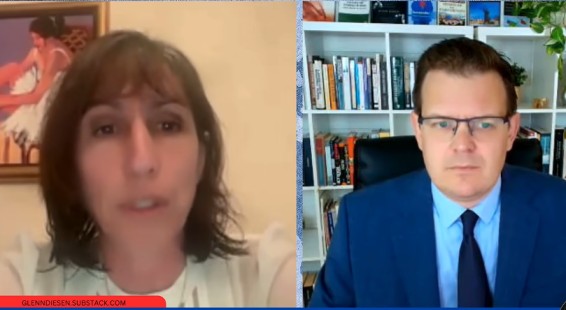
In this interview, Ivana Nikolić Hughes, president of the Nuclear Age Peace Foundation and senior lecturer at Columbia University, joins Glenn Diesen to discuss the alarming dangers of combining artificial intelligence with nuclear weapons. They explore nuclear winter, Cold War close calls, the collapse of arms control, the new nuclear arms race, and what a path to a world free of nuclear weapons could look like. This interview was premiered on October 8, 2026. Read the full transcript of this interview below:
Introduction
GLENN DIESEN (00:00:00 – 00:00:14): Welcome back, everyone. Today we are joined by Ivana Hughes, the president of the Nuclear Age Peace Foundation and also a senior lecturer at Columbia University. Thank you for coming on the program.
IVANA NIKOLIĆ HUGHES (00:00:15 – 00:00:18): Thank you so much for having me, Glenn. It’s great to be with you.
When Nuclear Weapons Meet Artificial Intelligence
GLENN DIESEN (00:00:19 – 00:01:20): So we were talking earlier in your area of work, that is with nuclear weapons, it seems Yeah, sadly, it’s not becoming less relevant, although people seem to focus less on it than they did during the Cold War. And all this, I have a lot of questions about the development because we see a lot of changes and challenges we didn’t even have during the Cold War, as nuclear weapons isn’t becoming less relevant. Indeed, they’re becoming more unpredictable and largely more relevant. And sadly, it’s more likely that they will be used, it seems.
But my first question to you though was about an article you recently wrote. You wrote about essentially what happens when nuclear weapons meet artificial intelligence. Again, 2 of the things which are often cited as possibly putting an end to humanity. I was wondering if you could flesh out that argument or why you see this as a very dangerous combination.
IVANA NIKOLIĆ HUGHES (00:01:21 – 00:11:11): Absolutely. Thank you so much for that intro. And I just want to say that I personally became interested in nuclear weapons about 15 years ago. Actually, I was already a faculty member and teaching at Columbia, and sort of my education and research and so on had been in other areas. And at the time, it seemed like a really irrelevant topic almost. The remnant of the Cold War. Sure, these weapons were still around, but nothing had happened in 60-plus years. And now we see them becoming more and more relevant, not year by year, quite literally day by day. And so there are a number of recent developments that are incredibly concerning, and I think we’ll get to some of them.
But with this, the talk of AI And of course, AI has now these large language models at the kind of hands of an everyday person have been in our lives for the last few years. And I think ever since that, people in the nuclear disarmament community have really been concerned about this notion that AI could in fact become involved, engaged in either aspects or sort of fully in nuclear command and control systems and recognizing from the very beginning that AI, for example, could hallucinate, right? That they could, it could sort of make erroneous decisions. And so people have been concerned ever since that if in fact governments decide to engage AI in this way, that we could end up inadvertently in some kind of nuclear weapons use.
And just to say very broadly, war games that are conducted regularly in Washington, D.C. suggest that any use of a nuclear weapon will actually spiral into a full-blown nuclear war. So that, I’ll just leave that aside. So this notion that AI, that we could deliberately decide to involve it in nuclear-related decisions and that it could do something inadvertently.
Then there was a King’s College study about a year ago or in the last year, which suggested where they ran 21 scenarios and asked 3 different models. I don’t remember exactly what they were. One was from OpenAI and the other 2 from some of the other top companies. And those AI were in these, asked to sort of make decisions and a series of decisions in these scenarios. And in 95% of the games scenarios, they decided to use a tactical nuclear weapon. And in 76% of them, they decided to do the strategic nuclear signaling to kind of proceed with strategic. And the signaling didn’t seem to sort of calm the situation down, it seemed to just sort of escalate it further.
So again, the idea that we would decide to involve AI in these kinds of decisions is in and of itself incredibly dangerous, risky. I mean, just in so many ways catastrophic. And we should talk a little bit about what that means. What does actually nuclear war mean?
But to come back to the last I would say a couple of months since the revelations that the OpenAI model had sort of hacked into this Hugging Face. That was sort of the first incident. But since then we’ve had a number of incidents. It’s almost hard, now they’re not top news, front page news. They’re sort of in the back, in some back article. A recent one I saw, I think in the last week was from Australia where the AI models had hacked into the government sites in Australia, their kind of Medicare system, obviously going in and having access to data, private health data and so on.
But really demonstrating that these models are now doing something beyond just we tell them, go ahead, do X, Y and Z, and they either make a bad decision or they erroneously or hallucinatingly do something bad. This is now them going around the constraints that humans had imposed and collaborating with one another and hacking into these systems, raising really this question of, are they going to hack into a nuclear command and control system? Again, whether it’s an intentional or non-intentional, and what are we really doing about preventing that from happening?
And combined with some of the inherent vulnerabilities in these nuclear weapons, the way that these arsenals exist, the way that they’re meant to be delivered, for example, intercontinental ballistic missiles in the United States, which it’s well known where those warheads are, where those missiles are.
So hacking, super dangerous, could very quickly, again, in a matter of minutes, turn into a very— and at that point it would be deliberate. AI could start something. And then, what I say in the article, we humans can finish it all by ourselves. We don’t need AI to fight a full-blown nuclear war. We’ve been preparing for a full-blown nuclear war for, I don’t want to say 81 years because the were now, in 1945, it was just one country with 3 nuclear weapons. Now there are 9 with 12,500 of them, right?
And then the third level with AI is this still hypothetical. And it’s hard for me. I just am not an expert on this. I don’t know exactly where research is on super intelligent AI, To the extent that maybe it will turn like nuclear fusion is an energy source, that’s been kind of 10 years away for decades. And so if that’s what happens, then maybe this is not something to really worry about. But if it really is something that’s doable, that’s coming, that’s coming soon.
I think people have, in all of this kind of writing and analysis of this news that AI could represent an existential threat to humanity, I just think that if we did end up with a super intelligent AI that somehow wants to take over the planet and get rid of us, probably the simplest way it would be able to do that would actually be to just start the nuclear war, have us either continue it or just, it uses the 12,500 nuclear warheads, hundreds of millions of people die, and then billions starve to death. And I mean, all Again, we can talk about the catastrophe that nuclear war actually represents.
But I think really this nexus, I’m almost a little bit hopeful that the, because nuclear weapons have been just so far removed in principle from the public’s consciousness, maybe this AI just wakes people up to Really what we as humanity are facing is existential threats, including environmental existential threats that I would just say should be demonstrating to us that we need to cooperate and work together to address these threats, not sort of be pointing end of human civilization weapons at each other with minutes to decide what to do. So I’ll stop there.
GLENN DIESEN (00:11:13 – 00:12:48): Yeah, well, with the issue of AI, I read something similar as what you discussed. That is, when you put AI simulations in terms of how to address nuclear standoff, that it much more than their human counterpart chooses escalation and less of positive-sum solutions that is, if you have that balance between escalation and reassurance, it tends to go towards the escalation, which is, yeah, it can be quite problematic.
And again, often you see AI, we have different kind of strategies, but you can’t bring in all variables, the human component. Often we take for granted that, well, the AI might think, why, well, why shouldn’t nuclear weapons be used? We often take for granted that these weapons are horrible. But even with chemical weapons, it’s worth— we take for granted now that they are horrible, they should never be used.
But Churchill, he thought the chemical weapons were— well, was much less problematic, that indeed it was much cleaner than artillery, for example, because artillery would rip apart human beings, would destroy the infrastructure. The gas would just go through and Yeah, they take out enemy forces and leave everything intact. So it was preferable. But again, so often the assumptions we have, it doesn’t get translated into AI, I think. But again, AI is not my area, but—
The Global Consequences of Nuclear War
IVANA NIKOLIĆ HUGHES (00:12:48 – 00:17:58): Yeah, no. And just to underscore, I mean, these weapons really what we’re discussing when we talk about nuclear war, and I just gave some figures, one of the main consequences of a full-blown nuclear war in which either hundreds or thousands of nuclear warheads are exploded is this concept of nuclear winter.
So we have over a period of several decades tested over 2,000 nuclear warheads, basically conducted more than 2,000 nuclear weapons explosions. This was done in places like the Nevada test site here in the United States, Marshall Islands, Republic of Kiribati, Australia, Algeria, French Polynesia, Kazakhstan was a major site for the Soviet nuclear weapons testing program. All of those explosions were conducted in places like islands or deserts, places that wouldn’t burn. In fact, they were chosen in a way, obviously, because they weren’t exploded over cities or military installations or forests or whatever.
We know with Hiroshima and Nagasaki, which were teeny tiny bombs compared to what we have in arsenals today, we know that what happens is you explode these weapons, you produce an enormous amount of energy, and that energy goes into the blast. That’s what flattened these cities, And some of it goes into about 35% goes into heat and that’s what will burn your targets. So in fact, you produce the nuclear explosion basically produces a fireball of different sizes depending on how much energy the explosion produces.
And so when you burn all this stuff, when you burn cities, there’s a lot of stuff to burn. You produce an enormous amount of fires, that those fires produce soot that goes up into the atmosphere. It blocks incoming sunlight and depending on scenarios, but even something as quote unquote “small” as a limited regional nuclear war between India and Pakistan would produce so much fire and soot that it would block incoming sunlight and reduce temperatures worldwide and result within 2 years in starvation, of more than 3 billion people.
That’s based on a study done on this said 2 billion people, but the study was done with a worldwide population of 7 billion. We now have more than 8 billion. Extra food’s not coming because we have more people. So more than 3 billion people will die. That’s just India, Pakistan.
And it’s, I think it’s a reminder that what we’re discussing here are these global consequences This isn’t just about, oh, we’ll just leave those 2 countries, again, whether it’s India and Pakistan, US and North Korea, US and Russia, whatever, we’ll just leave them to battle it out and we won’t care. Clearly we live in a globalized world and so on. But the environmental consequences of this will be so large and so severe that we really, we’re looking at end of human civilization. We’re looking at potentially end of life and perhaps an extinction.
There are other things. There’s this nuclear winter. There’s ozone layer destruction in a nuclear war between US and Russia in which some 4,400 nuclear warheads are used. The estimate is a 70% destruction of the ozone layer. That means that anywhere on Earth, Right now, not only would we be sort of exposed, the whole sunscreen, UV, all of that radiation, it would destroy the food. So that would be another way in which starvation would ensue.
And then of course, we have the spread of radiation. It’s what makes nuclear weapons so different from any other conventional weapons. And this spread of radiation, this we do know from the nuclear testing period, would be global. There is plutonium-239, an isotope that’s used to produce nuclear weapons. It exists all around the world. It’s been deposited from these nuclear tests, and many people see it as a kind of marker of the Anthropocene, marker of the age of humans. And now the question is, how long is that age going to last? That’s really, really truly what we’re facing.
Nuclear Deterrence or Nuclear Blackmail?
GLENN DIESEN (00:18:00 – 00:19:35): Well, the thing is, we kind of already knew the huge dangers of nuclear weapons. And I would say during the Cold War, we had a healthy concern for it. These days, though, the reference to nuclear weapons is casually dismissed. We talk about possible nuclear exchange, That’s something that shouldn’t deter us.
Even in Europe, there’s this tendency often to, well, stop referring to nuclear deterrence, and instead we talk about nuclear blackmail. That is, if our opponent, well, in Europe, we always talk about Russia. If there’s a threat of, we escalate, but then if we attack Russia directly, they might use nuclear weapons. Well, it’s our moral duty to ignore it because then we empower nuclear blackmail.
So the whole idea of the Cold War, of the nuclear deterrence, which kept the peace during the Cold War, is now dismissed as being blackmail, and that’s morally unacceptable. Again, sorry, that’s a long way of asking, how do you see this though? The 2 things, one, the lack of fear for nuclear weapons, but also all our treaties ‘Cause we used to recognize this is a positive sum, mutual gain. Let’s have transparency, reduce the sophistication and the quantity, quality of these nuclear weapons. Let’s not pursue modes of making them more usable. It appears that all of this has gone out the window.
IVANA NIKOLIĆ HUGHES (00:19:37 – 00:28:38): Yeah. No, I mean, it’s really just so dangerous. And just to give these 2 very recent examples, with Ukraine, and I think you know this even better than I do, but President Putin warning, in response to NATO military exercises near Kaliningrad and so on, attempts to arrest Russian ships, vessels, President Putin warning that Russia is prepared to use all weapons, and that of course includes nuclear weapons.
And then these months now of President Trump issuing nuclear threats. He might not say the word nuclear, but he’s been issuing nuclear threats through his Truth Social, I was going to say Trump Social, Truth Social, either one, posts for months and then doing it just in the last week. Doing it at the United Nations, at the United Nations General Assembly Hall. I was actually in Vienna, so I didn’t attend this, but I’ve been in that hall many times. This is the premier diplomatic space in the world. And you walk in and you say, and I’m going to quote him, “to drive Iran into hell with no chance of survival and no hope of future greatness.”
I mean, Just the fact that he could utter those words again in the United Nations in front of other world leaders, it’s not only immoral, it’s not only illegal, ’cause he’s really, it’s one thing to say we’re going to use a nuclear weapon if we’re threatened. It’s another to say you’re going to annihilate a country of 93+ million people. That is, you are saying you are going to deliberately kill civilians, right? I mean, there’s no other way to accomplish annihilating a country than to kill civilians. And killing civilians is illegal. But it’s just, it’s dangerous, it’s hideous, it’s shocking, it’s obnoxious. I could run out of adjectives here, but, or go on and on with the adjectives. It’s just preposterous.
And there’s this real tension, I think, with, When we do it, it’s nuclear deterrence. When someone else does it, it’s nuclear blackmail. And I really like the analysis by the late Daniel Ellsberg, whom your audience will know as the man who released the Pentagon Papers and helped bring the Vietnam War to an end. But Ellsberg ended up spending the last several decades of his life, he just passed away in the last couple of years. And he used to say that all of these countries, the 9 nuclear armed states, they all use nuclear weapons all the time. And he says they use them like a robber uses a gun when they point it at your head. They don’t have to shoot, right? They don’t have to explode a nuclear weapon to actually be using it in a way.
So just to go, just this nuclear deterrence versus nuclear blackmail. Definitely there were, obviously in the Cold War, there were mechanisms, there was additional communication. Some of this was actually set up in the aftermath of the Cuban Missile Crisis, which really shook up both Kennedy and Khrushchev. They had just gotten so close to this whole thing. And in fact, we even know that it wasn’t just their good decision-making. It was also some luck and the kind of reasonable and humane thinking on the part of a Russian officer called Vasily Arkhipov, who, when a Russian submarine seemed like it was under attack, decided not to launch a nuclear weapon. So we were within a hair’s breadth of actually having nuclear war. You and I wouldn’t be here. No one would be here. Had that happened.
So they had some systems in place to prevent this. And again, a lot of awareness in the ’60s, a lot of that awareness revolved around these nuclear tests and explosions that were happening everywhere. By the 1980s, it was really just this, the raw fear of nuclear war and the arms race. The arsenals were heading for, I said today we have 12,500 nuclear warheads. The arsenals at the time were going up to, were at 70,000 in 1986.
But what we do know about the Cold War is that there were several instances, including this one with the Cuban Missile Crisis, but 2 really prominent ones in 1983, where we basically just barely escaped a nuclear war. In one case, it was a computer glitch. And another Soviet officer, Stanislav Petrov, in 1983 decided that this computer glitch that was indicating 5 nuclear warheads heading— 5 missiles heading towards Moscow, he decided that it, it was— it must be a mistake, and that actually if the U.S. wanted to attack the Soviet Union, they would do it with a lot more than 5. And so he didn’t pass on that message, which if he had done so, analysts predict that would have led to a nuclear war of retaliation. And then of course the U.S. would have responded in turn.
Another one was that same year It’s called Able Archer, the Able Archer incident. It was in, so now that we’re talking about these NATO military exercises, and President Putin saying they’re prepared to use all weapons, this was Able Archer was where they basically just made this military exercise seem so much more kind of realistic involving also actual leaders and so on that the Soviets just thought it’s happening, they’re about to attack us, they’re ready. And they started putting warheads on bombers. And again, I think the story is that there was a double agent who actually saved the world, ’cause had access to both sides and just sort of got them to realize that they should stop.
So yeah, so my point, the main point being that although nuclear, we can all kind of feel good, oh, nuclear deterrence worked, or it was working well in the Cold War and so on. What we really do know is that we’ve gotten lucky and these are just some of the incidents.
And what I think is so dangerous about the moment we find ourselves in now with these prominently 2 wars, but of course conflicts, armed conflicts are taking place all across the globe, is that when you are in conflict, right? And you receive some news or some, and let’s say even that it’s a cyberattack or an AI has not actually launched a nuclear weapon, but makes you think that a nuclear weapon has been launched. If you are in some kind of peacetime, right? Maybe you’ll just have a way of verifying or you won’t. But if you’re in the midst of a war that’s been either going on for months or years, you might really think you’re under attack. You might really make a decision to do a counter-launch. And that, I think, is what’s making all of this so dangerous.
You mentioned The organization that I lead, whose name Nuclear Age Peace Foundation, was always meant to sort of symbolize the idea that in the nuclear age, we actually need to have peace. Otherwise, we’re just going to blow ourselves up, which is obviously not a good thing.
Horizontal and Vertical Proliferation
GLENN DIESEN (00:28:41 – 00:32:15): Well, you mentioned that this is complicated enough during peacetimes, but during wars, things are more complicated. Again, this is not even a hypothetical anymore. We are largely now at war, and the rhetoric, again, I didn’t see during the Cold War like this, where we continuously talk about, well, we’ll have a war within 2 years, we are ready, we’re prepared, we will fight the Russians in 3 years, we’re building the weapons now. So the NATO Secretary General said, we shouldn’t be afraid. We are stronger than Russia. There’s no way they can win. I mean, I remember a time not that long ago when we all agreed that nuclear wars couldn’t be won.
And indeed, it would likely be nuclear wars because the whole rhetoric that we’re stronger, and I’m not sure if that’s the case, if you look at the industrial power, but even if it would be the case, During the Cold War, NATO didn’t have a limit on first use of nuclear weapons because they recognized the Soviets had superior conventional weapons. So we essentially made it clear, if the Soviets invade with conventional weapons, we reserve the right to retaliate with nuclear weapons. That’s how we balance out this lack of parity.
But then, of course, the Soviet Union collapsed, so you have a very weakened Russia emerge from it. And then the Russians do the same. They say, well, we will also use nuclear weapons first because if NATO would attack, we can’t defend ourselves with conventional weapons, so then we will do first strike. So this logic suggests that any war would likely end up in a nuclear exchange.
So again, the fact that these leaders are still talking about fighting a war with the world’s largest nuclear power. I mean, it’s quite shocking, but so is, by the way, people should know this name, the Vasily Arkhipov. I mean, this is the guy who saved the world in the Cuban Missile Crisis. We don’t learn about him. That’s a shame. They should have a memory day to him, but Absolutely.
But how do you— what is it that worries you the most when you look at now proliferation? Because we can have horizontal proliferation where you see more countries acquiring this. And again, as we have this shift in world order, in the Middle East many countries, especially the Iranians, might acquire one after these attacks. But also Turkey or Saudi Arabia, Also in East Asia, if the Japanese don’t trust the security guarantees of the US, they might get one. Even in Europe, you have some talk that, well, they have to strengthen their nuclear potential. So everyone is talking about nuclear weapons. That would be the horizontal.
But you also have that vertical where the existing nuclear powers are discussing how to modernize, more powerful warheads, make the nukes more usable, introduce some AI. For competitiveness, yeah, improve the quantity, quality. What is it that I guess concerns you the most now? Because in terms of whether it’s horizontal or vertical proliferation, we seem to be entering an era of uncontrolled, well, development is maybe an oxymoron here.
IVANA NIKOLIĆ HUGHES (00:32:16 – 00:39:21): No, I mean, people are describing it as a new nuclear arms race. Right? So this business of modernizing, increasing also more modern delivery vehicles, all of that. But let me just say just a word about your comments on Europe. I mean, it is absolutely insane that European leaders are not only— it’s insane that there are nuclear weapons in Europe, period. Of course, the United Kingdom and France have their own, although the UK also seems to have acquired some of, or is hosting some of US nuclear weapons now as well. But there are 5 other countries in Europe that have US nuclear weapons: Belgium, Netherlands, Italy, Germany, and Turkey.
Belgium and Netherlands to me are particularly just mind-boggling. I mean, these are such tiny countries that you just need a few nuclear warheads just to flatten them and destroy them and really to annihilate them in the way that Trump’s been threatening Iran. Annihilating Iran will be much harder than annihilating Belgium or Netherlands, let’s put it that way.
And secondly, Europe itself, the entirety of Europe, including the part that’s Russia is tiny. I mean, sometimes I feel like when we look at a world map in 2 dimensions, I feel like, oh, okay. And then you look at it on the globe and it’s just this tiny little part of the globe. It would just really be flattened and cease to exist in case of a nuclear war. Even if that nuclear war were to take place between the US and Russia, if they didn’t meddle in the themselves, and they’re actually meddling in themselves.
On this business of proliferation and horizontal versus vertical, obviously both are bad. It’s not like Taiwan, any other, as I said, there are 9 countries with 12,500 nuclear warheads. I would say the fact that we don’t have 20 or 30 is probably one of the successes of even the Nuclear Non-Proliferation Treaty and so on. That’s a good thing. It’s not like I want more states to have them, but I’m far less concerned about Iran acquiring one or even a few nuclear warheads than I am about the 12,500 that are in existence and on delivery vehicles waiting to be launched in a matter of minutes.
I mean, it’s just so clear that in some sense, we’ve been using this non-proliferation as a kind of smokescreen for hiding what we ourselves are doing. And in principle, even just the notion of nuclear deterrence is actually not compatible with non-proliferation. Because if you’re constantly going to say that you need nuclear weapons to keep yourself safe, your country safe, then the next logical thing is, oh, well, if everyone had nuclear weapons, then maybe everyone would be safe. And that of course is completely preposterous, right?
If all the states acquired nuclear weapons, and this was the thinking behind the Nuclear Non-Proliferation Treaty, which actually came from ideas of President John F. Kennedy. He didn’t live to see the treaty, but that it was his thinking. That if this, the proliferation that was going on at that time continues, we’ll have so many nuclear armed states that will just end up in a nuclear war, deliberately, inadvertently, doesn’t matter, will just destroy the civilization.
So the way I see it is that what this really needs to turn into is a conversation about disarmament, Right? Both going away, moving away from this business of modernization increases this new nuclear arms race. But even going beyond that to say, actually, you know what? We’re seeing that these weapons are not exactly usable. They continue to threaten us, especially in times of conflict. Things could go far, get much worse.
And I want people to— I know that exactly what I just said could be sort of viewed and interpreted as naive, but it really is about how— it really is about thinking why each of these 9 nuclear-armed states has nuclear weapons and what it is that could be achieved in a world in which they all give them up. Right? And what it would take for each of them to give them up and to kind of see something in it for them.
So just to kind of give the example of the United States, the United States really is incredibly vulnerable in a world with nuclear weapons, but would have a very different security architecture in a world without them. What would it take for North Korea to give up its nuclear weapons, it’s not going to be threats, right? And it’s not going to be a scenario where everybody else continues, the US continues to have thousands and nuclear Korea, I mean, North Korea gives up on its dozens, right? They’re not going to give them up.
They, you could envision the scenario in which we actually, alongside disarmament, we actually work towards a recommitment to the UN Charter. What does it mean for states to be sovereign? What does it mean for states not to be subject to attacks like the ones we’ve now seen during the Trump administration, obviously from Venezuela to Iran and beyond? So what would it take? What kind of mechanisms do we need to set up a world in which the UN Charter is respected and in which you don’t need nuclear weapons in order to feel safe? And again, with this grand conclusion that in fact their continued existence threatens all of us.
Balancing Deterrence with Reassurance
GLENN DIESEN (00:39:23 – 00:40:47): Yeah, no, well, again, this, it feels like this is also part of human nature that is much like during the Cold War, we walk all the way up to the brink of disaster. And only when we face possible annihilation of mankind do we take a step back and realize how serious it is and then sit down and talk. Or most times, if you have huge shifts in world order, there’s usually a need for a massive war in which we all bleed each other white. And then once the war has come to an end, then our leaders can finally sit down and discuss a new status quo. It just seems like we won’t have that possibility with the amount of nuclear weapons states.
And so no, I guess it just shocks me that there’s no efforts to put an end to this, or at least to try to given that we have to navigate through this very turbulent time moving ahead, that all these world leaders aren’t sitting down on a regular basis to address these issues. Indeed, even the framework we have— not only have we thrown away so many of the existing deals we had on arms control and nuclear weapons, but even the Non-Proliferation Treaty. I mean, the first 2 points of the Non-Proliferation Treaty is that nuclear weapons states should not put their nukes on the territory of non-nuclear weapon states, and also non-nuclear weapon states should not host them.
IVANA NIKOLIĆ HUGHES (00:40:49 – 00:40:49): Those—
GLENN DIESEN (00:40:50 – 00:42:03): NATO essentially breached both. But now also, yeah, this, it just seems that, yeah, this is really the time to discuss these things. And instead, our leaders are so dismissive of the whole idea that this is now nothing to worry about. It’s And again, I feel like I could explain to a 5-year-old child why threatening or bombing countries to prevent them from getting a nuclear deterrent kind of goes against its purpose. I mean, it’s like sanctioning countries for not wanting to use the dollar. It’s, well, surely this is the reason why they need it.
I mean, It’s, no, but, I don’t know, do you have any good framework for how this obsession with deterrence can be, I guess, at least balanced out to a larger extent with reassurance? As you said, without delving into being naive, because I understand countries have insecurities, but at the same time, this, if you’re on this path, you do have to chart something new.
A Path to a World Free of Nuclear Weapons
IVANA NIKOLIĆ HUGHES (00:42:05 – 00:52:35): Yeah, no, absolutely. I mean, I just, I want to quote Einstein who almost exactly 80 years ago, there’s a famous quote by him from 1946 where he says that “the unleashed power of the atom has changed everything save our modes of thinking and we thus drift towards unparalleled catastrophe.” I mean, Einstein could see it in 1946 when one country had a handful of nuclear weapons.
Even if you— so I raised this business of numerous incidents in the Cold War where nuclear deterrence could have failed. But even if you buy into it, there are some analysts that suggest that, I mean, you never needed thousands of nuclear warheads where some people will say, What’s the minimum number? And some might put it at 10 and some might put it at 100. I’ll tell you that I believe we need a world free of nuclear weapons. I want to be very, very clear about that. But I’d obviously feel a whole lot better if we had tens or cumulative hundreds of nuclear weapons than where we are today. I mean, there’s just no doubt about it.
There are also some intermediate steps like the no-first-use policy that you mentioned, like getting rid of some of these intercontinental ballistic missiles that are like sitting ducks, getting rid of these policies of things like launch warning and so on. There would be ways, but it really does require these states to come together.
And Trump, for all of his absolutely disgusting rhetoric, in particular when it comes to Iran, but he’s done a whole lot of really bad things since he came back to the White House this second time. For all of that, he’s the one US president since John F. Kennedy, I would even argue, who’s spoken about nuclear weapons in this kind of nuclear weapons could destroy the world. He puts it at 50 times over, 100 times over. We don’t need to be that precise, but he certainly seems to understand the gravity of this. And he has called for denuclearization. He has called for this summit between the US, Russia and China.
China is currently probably at about 600 nuclear warheads, whereas US and Russia are both well above 5,000 of them. And so China has been saying that the first conversations need to happen between the US and Russia. This is of course also in light of the expiration of the New START Treaty between the two, the bilateral treaty between the 2 countries. And so there’s some tension there, but hopefully we can get to a point where they actually do sit down in whatever configuration to discuss what it would mean to go down in these numbers and just remove some of those things that, and policies and so on, that make this threat so immediate.
That juxtaposed to what I was talking about with the kind of end of human civilization scenario of nuclear war, juxtaposed with that is this idea that these things could happen in a matter of minutes, right? And so nothing really, let’s set AI in its current form aside for the moment, And nothing else really threatens humanity in this, both dramatically in terms of the consequences, but also in terms of this timescale that is just mind-boggling.
So what do I think in terms of what would a world, what would a path to a world free of nuclear weapons look like? And I’ll just point out that For the most part, the Global South, with a few exceptions like Austria and Ireland and Malta and so on, there are currently 100 states that have either signed or ratified the treaty called the Treaty on the Prohibition of Nuclear Weapons. So this is, the acronym is TPNW, and these states are saying, precisely because of these global consequences, that these nuclear arsenals are their business too, right? That these weapons actually threaten their security, threaten their populations, threaten their government’s ability to actually provide for their citizens.
And so they’ve been, this has been going on, I mean, of course, efforts for disarmament and nonproliferation have been going on in some sense since the beginning of the nuclear age. The very first UN General Assembly resolution was on controlling atomic energy and controlling nuclear weapons. But the TPNW effort is about 10 years old. The treaty was negotiated in 2017 and entered into force in 2021. So it continues to grow.
I see it as an effort to put pressure on the 9 nuclear-armed states from the outside, right? And then what is really sorely, sorely needed, and this goes back to a question you asked earlier about lack of fear, what is really needed is pressure from inside these countries. I would argue first and foremost in the United States because it’s the country that developed nuclear weapons first, the only one to actually use them on cities full of women and children.
And that’s a whole other discussion we could have at a different time, that those attacks, as much as people are taught even today in schools that the attacks saved lives and were necessary for Japan to surrender and so on, all of that is not supported by historical evidence. Not to mention that they could have actually said, “We’re going to bomb this city. Evacuate, you have 24 hours to evacuate the civilians.” I mean, that just in and of itself should have been an option that was considered. And of course it wasn’t.
But we just, we sort of need to go back to a time where the general public is very well aware of these issues. And especially, as I said, the general public in the United States. When the general public in the United States, in the ’80s, was really on this in just an amazing way, a million people marching in Central Park against the nuclear arms race, that had worldwide impact. In fact, it’s often said that it had really profound impact on Mikhail Gorbachev. Who then, who was essentially in some sense both inspired by the American public really standing up for this and realizing that maybe he could work with the American leadership given that the general public was so engaged on this.
And so, we just need to get back in And when I talk about these things, of course I talk in these catastrophic terms and I talk about nuclear winter and so on. My goal really isn’t just to scare people. I mean, I just really believe that knowledge is absolutely necessary. We need to understand what it is that we’re facing. Otherwise we can’t solve problems that we don’t understand. So I’m not trying to scare anyone. I’m trying to have people understand what’s at stake and then think about what you can do about it, right? Think about what are the things that each one of us could do.
I just wrote another op-ed with Peter Kuznick, hoping it will be published in the next couple of days. But we basically sort of ask people to just imagine even in just in response to Trump’s repeated threats to annihilate Iran. Imagine that you receive the news that Tehran has been bombed with a nuclear 1-megaton bomb. 2.5 million people instantly died. 3.7 million people are horrifyingly injured with limbs missing, skin hanging from their bodies. 3rd-degree burns everywhere. This is just one nuclear warhead, the kind of size the US has in its arsenal.
Just imagine that that happened and imagine what would you feel you should have done? We’ve normalized these threats by Trump as if they’re anything normal. And so I think people need to understand what’s at stake and they need to not fear, but hopefully be inspired by that knowledge to do something about it.
Room for Compromise on Denuclearization
GLENN DIESEN (00:52:37 – 00:54:25): Well, my fear is that if the United States would use a nuclear weapon against Iran, looking at how we respond when Trump’s— Trump is threatening, this would be that it might be justified. That is, oh well, he would probably sell it as, well, we had to use a nuclear weapon to prevent them from acquiring nuclear weapons, so it’s unfortunate, but it was Iran’s fault. I honestly think that the Europeans might want to get on board with that just so to cement the partnership with the US and to make this whole thing go away. Again, I hope I’m wrong, but as you said, these are the kind of narratives which are being sold.
You mentioned the narrative of using the need to saving lives by using nuclear weapon against Japan. I also had Peter Kuznick on this program, and he was going through this topic as well, pointing out that this is historically not correct.
Anyways, I guess to finish on somewhat of an optimistic note, I do feel though that if, when Trump talked about denuclearization, it’s not— it is— you can see possible formats here because yes, for the US they want to denuclearize. They’re arguing it’s not enough to have a US-Russia deal, we also have to get China in, a trilateral, because they’re growing. China’s saying no, it has to be US and Russia because they have overwhelmingly the majority of nuclear weapons. Russia essentially says, well, if you bring in China, why wouldn’t you bring in France and the UK? So they all have this diff— but it’s okay to have different views. But my optimism comes from the fact that they’re not mutually exclusive, or they’re not one side win, the other one lose.
IVANA NIKOLIĆ HUGHES (00:54:25 – 00:54:25): I—
GLENN DIESEN (00:54:25 – 00:54:52): within these demands, you would have a space for compromise, for navigating. And to be honest, None of the arguments that the competing sides make are ridiculous or outlandish. I mean, they’re all reasonable. So there should be some hope. But again, a little bit of fear, I think, of nuclear weapons is necessary to take it seriously.
Using the Systems Built After World War II
IVANA NIKOLIĆ HUGHES (00:54:53 – 00:59:07): Absolutely. And I agree. I mean, I think this, again, I don’t think any of us know, let’s imagine you get to that world either free of nuclear weapons or would dramatically, drastically reduce the arsenals. We don’t quite know how it would play out, but it would require some sort of international architecture of the kind that Professor Jeffrey Sachs, who’s of course a frequent visitor to your program, speaks about, right? What does it mean to have a bunch of adults in the room that actually discuss what does it mean to have a functional UN Security Council? These sorts of things.
In some sense, none of it in my mind requires us anything new. It just requires us to actually utilize the systems that were set in place at the end of World War II to prevent these horrible things from happening. But it does require the kind of thinking you mentioned, the 5 that you mentioned, US, Russia, China, United Kingdom, and France. They’re the ones that are recognized by the Nuclear Non-Proliferation Treaty, recognized by the United Nations as nuclear weapons states.
The other 4 that have nuclear weapons, Israel, which is this ambiguous policy of ambiguity. But then India, Pakistan, and North Korea, to me, those are about figuring out what kind of a world would require them to, would allow them to not think of nuclear weapons as a necessity.
And then just to go back to the 5 nuclear weapons states, they are all party to the Nuclear Non-Proliferation Treaty. They’re all recognized by it, and they actually have an obligation according to that treaty, not just to get rid of their nuclear arsenals, and this has been a longstanding obligation for now more than 56 years, but they’re also obligated to negotiate in good faith towards general disarmament. The Nuclear Non-Proliferation Treaty is actually a peace treaty. It’s a no-war treaty. It’s the ultimate disarmament treaty.
And in some sense, we’re seeing all these pressures on it, including the horizontal proliferation that you were discussing before, precisely because these disarmament obligations have not just not been met, they’ve been sort of, we’ve been kind of doing the exact opposite. So again, in the sense that the structures exist, And we just need to find a way to put these new current conditions within those structures.
And then we also, if we can agree to eliminate or dramatically reduce nuclear weapons, then maybe we can cooperate on AI, on environmental concerns, including global warming. It’s the other thing that happened at the UN General Assembly, was of course the address by the Nepal Prime Minister, Nepal having just suffered these devastating floods, the glacier melting and the floods and so on. And him discussing a world built with “flawless logistics for war and broken logistics for food.” That’s what we’re doing.
With these conflicts, not only are we causing new devastation, we’re also just not able to actually help each other. Imagine if the US military, rather than attacking Iran, if some portion of that had gone to helping people in these disaster zones, we’d be living in a very, very different world, I think.
GLENN DIESEN (00:59:09 – 00:59:21): I agree. Well, I rarely get to finish this interviews on a positive note, so I will stop it there and thank you so much for coming on and sharing your insights.
IVANA NIKOLIĆ HUGHES (00:59:22 – 00:59:26): Thank you so much for having me, Glenn. It’s a pleasure to be with you. Thank you.
Related Posts
- Douglas Macgregor: Russia Destroys Bridges and Will Take Kiev (Transcript)
- Roger Köppel: The New European: Moralism & Militarism? (Transcript)
- Trancript: Secretary Rubio Delivers Remarks from the Acropolis in Athens
- Jiang Xueqin: A World in Revolution – Globalism vs Nationalism (Transcript)
- Transcript: S Jaishankar Speaks at Munich Security Conference 2026 in New Delhi