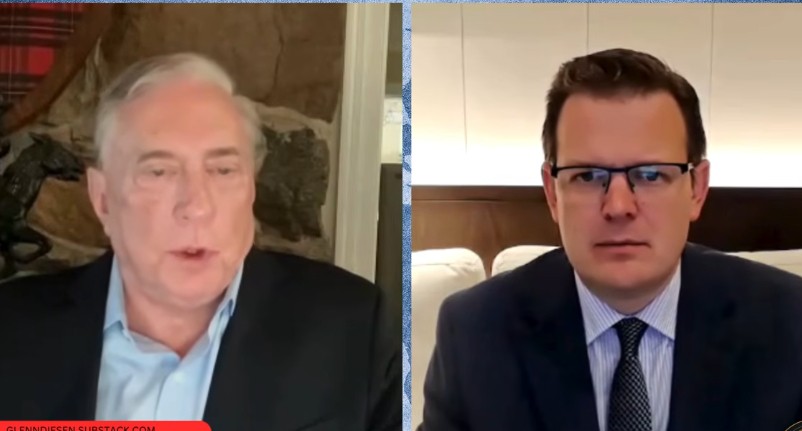
In this interview, Glenn Diesen speaks with Colonel Douglas Macgregor, former advisor to the US Secretary of Defense, about why Washington’s proxy wars fail to produce lasting peace, from Napoleon’s invasion of Russia to today’s wars with Iran and Russia. Macgregor discusses Russia’s plan to destroy the bridges along the Dnieper and move on Kyiv, the return of General Surovikin, corruption in the Russian military, Europe’s political crisis, and the economic limits of endless American wars. This interview was premiered on October 9, 2026. Read the full transcript of this interview below:
How Do Washington’s Proxy Wars End?
GLENN DIESEN: (00:00:00 – 00:00:38): Welcome back. We are joined today by Colonel Douglas Macgregor, a former advisor to the US Secretary of Defense, a combat veteran, and also an author. And well, one of the articles you authored, the most recent one, has the title “How Do Washington’s Proxy Wars End?” And I thought, yeah, this is a good question, and it deals with the problem of I guess translating battlefield victories into an actual peace, something Historically, it’s been very difficult. I was wondering if you can explain why this is, 2 different things, why it’s difficult to translate these minor victories into a sustainable peace.
Napoleon, Russia, and the Limits of Battlefield Victory
DOUGLAS MACGREGOR: (00:00:39 – 00:06:01): Well, it’s always a difficult task. You can start a war, you can fight a war, you can even win it on the battlefield and still have no peace. And that’s particularly true when you’re dealing with large continental powers. Bonaparte marched into Russia without really understanding, despite his extraordinarily high IQ and remarkable intelligence, he did not understand what he was dealing with.
And his goal made sense, which was destroy the Russian army and then the czar will be compelled to capitulate, which wasn’t far off. Ultimately, if you could destroy the army, then by all means capture the czar.
The problem was that He had been warned by his aide-de-camp, Major General Caulaincourt, that Caulaincourt had ridden over to Vilnius and spoken directly to the Tsar and said, “You realize, sire, that unless you’re willing to end this trade with England, that the Emperor is going to go to war with you.” And he said, “What’s he going to do?” He said, “He’s assembling the largest army ever seen. To march into Russia.” He said, “Well, we’ve been through this before.” He said, “We’ll do what we’ve always done.” And he said, “What’s that?” He said, “We’ll withdraw into the interior and you’ll have to follow us.”
And you’re talking about hundreds and hundreds of miles through very difficult terrain, very few roads. “And by the time you reach us, you may not be in a position to defeat us.” And that, with that, the Tsar said goodbye, got into his carriage, and rode away. And Caulaincourt went back and told Napoleon. Napoleon scoffed, said, “What’s he talking about?” He didn’t understand because he knew very little about Russia.
The other thing is that Napoleon had another problem. He had large numbers of Poles encouraging him to invade. Sound familiar? And they were the largest non-French contingent that he had in his army. And the Poles are very good soldiers and they stayed with him throughout. They stayed with him to the bitter end. But the point is that he was, he made the mistake of listening to the Poles.
Well, you have a similar situation with Trump listening to the Israelis. Like the, excuse me, like the Poles, the Israelis wanted this war with Iran and they wanted us to fight it for them. And he didn’t understand he was dealing with a large continental power. And you could drop as many bombs as you like on it. The probability of success is very low doing that unless you can go in on the ground.
But we have no strategic interest at stake that would justify a massive invasion. We have no army to do it. Our army is a little bit better than what you’ve got on the ground in most of Europe, but it’s a shadow of its former self. It certainly can’t carry the fight very far. You add the Marines to the army, you’ve got about 23,000, 24,000 Marines in infantry regiments. So you put them It’s not going to change the equation very much.
So right now, I think what’s happened is that we’re discovering that, all right, you can sink whatever ships the Iranians have, you can blockade them, you can bomb them, and you can declare victory, which I think Donald Trump has done several times. It’s completely meaningless. What you really want is an end to the war. And by the time Napoleon gets to Moscow, that’s what he wants. He wants to end the war, but he can’t. Doesn’t know how to do it.
Same thing was true with the Wehrmacht, with the Germans in World War II. In fact, when you read the accounts, they’re so similar to Bonaparte’s experience, and what we’re going through is another manifestation of it. It’s astonishing that anybody would have been as stupid as we were to go into war with Iran, but we’ve done it.
And the thing that’s most concerning to me at this point is that we’re going to go back and try again, and when that fails, there are people that are actively promoting the use of nuclear weapons in Washington. And that would change everything. That would be a catastrophe for the world because it would then open the door to the use of nuclear weapons against us and against our friends. That’s something we ought to be smart enough to avoid, but then again, we weren’t smart enough to avoid this to begin with, so I’m a little concerned that we won’t be smart enough to avoid that either.
Iran’s Strategy: Driving the US Out of the Region
Bottom line is that Iran, in order to win this thing, has to drive us out of the region.
Once you’ve driven us out of the region, we have nowhere to go. What does Israel do? You see, that’s the key. The Iranians are betting that if they can drive us out, that Israel, without anybody in the region to support and defend them, Will simply give up and go away. I’m not sure that’s true, but I think that’s what they’re betting on heavily.
And now they have some friends. They may not be formally allied, but clearly Pakistan and Turkey or Türkiye are both aligned against Israel. And I think this Mecca agreement is really at its heart an anti-Israeli agreement.
The Serbian Model and Its Failures
GLENN DIESEN: (00:06:04 – 00:06:57): Yeah, well, we had this forever wars over the past thirty plus years, and. But they were kind of unique. That is, the West had, well, especially the United States, had escalation control. So it didn’t have to escalate out of control unless the US wanted it to. And also it had the ability to contain it so it wouldn’t spread.
Now, with larger states, especially Russia as a great power, but also Iran, one doesn’t have that luxury. It’s not stable is what I’m trying to say, is both these wars keep escalating and they’re widening as well. It’s not like Afghanistan. We don’t have the luxury of keeping this going for 20 years. It’s going to be a very different war by that time. How do you see that changing the dynamic though? Because we do have to put an end to it, otherwise we’ll lose control of it.
DOUGLAS MACGREGOR: (00:06:58 – 00:10:36): Well, I think we’re seeing the Serbian model applied across the board. Remember, Serbia was a country, or is a country, of what, 6 million people, 7 million people at the most? And bombing the Serbs into submission, provided the Russians did not support them, which is what turned out to be the case. The Russians pulled support from Serbia, and that’s why the Serbs finally agreed to leave Kosovo. Meant that you could bully a small nation into submission.
That hasn’t solved the problem. It hasn’t resolved any of the disputes. Things in the Balkans, as you and I speak right now, I think are unraveling in both Bosnia-Herzegovina and in Kosovo. So there’s going to be more fighting there because we can’t impose a solution from the outside. This is the other problem.
The other problem is that when we move into an area, regardless of where it is in the world, we distort all the regional dynamics. And since we’re not planning on living there, we’re not colonizing it, we’re not staying, it’s bound to fall apart.
Well, we applied the Serbian model unsuccessfully in Iraq and Afghanistan. You could argue it’s semi-successful in Libya, except that Libya continues to live on the edge of chaos. Slave markets that are in operation. I mean, if you want to call that success, so be it. Venezuela was a sort of a semi-Serb-like operation, but we see now we’ve had what, a refinery destroyed or oil wells or something blown up. We’re far from in control of Venezuela.
And now you turn your attention to Russia and Iran. We tried the Serb model on Russia. This time we built up Ukraine as our proxy force. We equipped them and they posed a serious existential threat to Russia. They still do. And our goal was to essentially, at the expense of Ukrainian life and survival, was to what? Bring down Russia, bring down the regime so that we could then move in, strip it of its resources, divide it, exploit it. Hasn’t worked.
We’re now interested in something very similar with Iran. Ultimately, we’re treating the Israelis to some extent as our vanguard because the Israelis have this thing called the Greater Israel Project, which surprise, surprise, would give us control of virtually all the oil resources of significance in the region, which is really what we’d like to have, or that’s what we think we’d like to have.
It isn’t working, and I don’t see any evidence that it will work. In fact, I think it’s reawakened great powers from a lengthy sleep. One is Persia, the other is Turkey. I think the Turks and the Persians are going to roar back into action in the region over the years ahead.
The Wolfowitz Doctrine and US Hegemony
But this is something that has its roots with our friend Dr. Paul Wolfowitz, who wrote this policy paper in 1991. Which said, “We’re going to make sure now that we have all the power at our disposal and we’re invincible, invulnerable, no one can touch us, that nobody else is going to be allowed to compete with us. Anyone who looks like they could challenge us will be beaten into submission.”
And at the same time, under the guise of democracy, we’re going to spread our influence and power, put puppets into governments and ensure that we rule the world for effect, for all intents and purposes. We call it the rules-based liberal international order, which is really a gobbledygook of terms that mean U.S. military, financial, political hegemony. That’s it.
GLENN DIESEN: (00:10:36 – 00:10:36): That’s all.
A New Middle East and the Greater Israel Project
DOUGLAS MACGREGOR: (00:10:38 – 00:15:08): So it’s all about power, and it never had anything to do with justice or democracy or human rights. That’s all nonsense. The world has figured it out. Sadly, people here in this country haven’t. There are still people that think that’s something good. It’s not. It’s something very bad, and it’s precipitated all of these alliances against us.
What I was trying to get across in the paper is that now the Iranians, they’re answering the question. We’ve got to drive everybody out. We’re effectively going to promote the liquidation of all these little statelets in the Arabian Peninsula that are a legacy of British imperialism and then have been sustained subsequently by us since we effectively stepped into the British shoes. They’re not going to be allowed to survive, certainly not in their current form and not with the current leadership.
We are struggling to figure out how we can prevent all of this from falling apart. I don’t think we can. And there are other issues now roaring into action. The Yemeni problem, which has its roots going back into the 1930s and even earlier. This is not a problem we can solve, and we shouldn’t be involved in underwriting and supporting mass murder of anybody, whether it’s Israeli or Saudi.
So I hope we stay out of it, but I think we’re already partially involved. The British have now sent refuelers from Great Britain to help the Saudis. It’s a losing proposition. I, these places are on the path for extinction and they probably should. Nothing that people do not build themselves survives. Anything that is imposed from outside or created with help from outside fails. That’s the lesson of history.
So I think everything is going to fall apart. You’re going to get a very new Middle East. The question is, how long do we continue to fight the inevitable? How long do we underwrite the Greater Israel Project? Right now we’re the Israel First administration, and the Israelis know they have complete control of our government and our armed forces.
And President Trump seems to be willing to put our financial solvency and stability at risk in order to achieve Israel’s ends, no matter what it takes. And now he said that this morning in the Oval Office. He said, “We’ll stay with this as long as it takes.”
Now, there is a very high probability that things could come unglued in the financial world for us. We’ve already seen the bond yields rise. Inflation is up. That can come into play in a big way. We just don’t know how that’ll work. There’s a multitude, if you will, of black swans, in Nassim Taleb’s words, that could take off. Nobody can predict that with complete accuracy.
And then there’s the other problem that this time around, the Iranians have missiles that are even more precise with longer range that are going to reach further and do more damage. And that’s why you’re back again to this ugly question of the use of nuclear weapons. The Israelis absolutely, positively want the destruction of Iran. If they cannot destroy Iran, the Greater Israel Project is off.
And at the same time, on the sidelines, you have the Turks. And they are violently anti-Israeli at this point. And it wouldn’t take much to bring them in, particularly in Syria. Syria has been a part of the Ottoman Empire for hundreds of years. They’re uncomfortable with what the Israelis are doing there. They’re encroaching on it.
So, and then we’ve weaponized the Kurds against the Turks, as the Israelis have. We’ve tried to use the Kurds against the Iranians. The Kurds have been used by everybody for all sorts of reasons. That just adds fuel to the fire with the Turks. They’re angry over that because that poses a threat to them and they’re tired of it. And all of these borders are a pain in everybody’s neck. Nobody likes them. They’re, again, they’re a product of foreigners that came in and redrew the maps.
So you put it all together and I don’t see any end in sight. Somebody said, “Well, how long could this war last?” I think that’s the financial question is how long can we hold our financial system together? If you think we can hold it together for another six months, a year, then I guess we could drag this out. But if we can’t, then I think it’ll fall apart. That means the war will end.
Russia’s Conclusion: The Regime in Kyiv Must Go
GLENN DIESEN: (00:15:10 – 00:16:04): Well, it just seems like there’s a million ways this war can continue and spread. Let’s say the Saudis are able to convince Syria to send troops to Yemen, then. The Iranians might strike Syria. It just seems like, yeah, this is spinning very quickly, yeah, out of control.
But I did want to ask though, one of the— as I said, one of the problems was the lack of escalation control. And I know that Trump said they will likely strike Iran now after the midterms, hoping that, I guess, Iran will sit by idly and wait to be hit as opposed to striking first. But if we shift to Russia, it’s, they also have, after 4 and a half years, soon to be 5, of fighting this war, it looks like they’ve also lost some patience in terms of not believing anymore in the diplomatic path.
DOUGLAS MACGREGOR: (00:16:04 – 00:21:02): And— Well, if we stop and look at Russia right now, the Russians, I think, have concluded that they cannot win this war unless they eliminate the regime in Kyiv. There’s no way around that. They also can’t win this war and secure the peace afterwards unless not only a new government in Kyiv comes to power, but they’re going to have to control Odessa, the south, all the way to the border with Romania and Moldova.
Now, where do you draw that line above Odessa? I don’t know, but you’re going to end up having to control that southern portion of the country. That means that Ukraine goes back to what it has historically always been, a landlocked region. What does that rump look like? I don’t know.
But I mean, if you’re a Russian right now and you look at the battlefield, you’ve got 2 problems. What slows Russian progress? Well, the Russians don’t want to take casualties that they don’t have to. And I have always paid tribute to Putin as probably the first leader in Russian national history who has been more concerned about the lives of his soldiers than anybody else. And I think that’s a good thing.
The problem is that you’re dealing with large numbers of these FPV drones that come flying out of all over the place that you have to defend against. Now, the Russians have gotten pretty good at it, and they’ve gotten very good at finding the controlling stations that control the drones. The problem is it’s not difficult to stand up a new station and build more drones, particularly when the components are coming to you from Great Britain, France, primarily I think Great Britain, Poland, and Germany, and maybe parts, some of it from the Czech Republic.
That’s aggravating. So what do you do about that? Do you attack these places in NATO? Well, you don’t want to because you don’t want this war to widen.
Germany, Poland, and the Istanbul Agreement
And the British seem to be in the forefront of pushing this. So does this man Merz in Germany. The good news is that the German public’s view of Merz is about as bad as it can get. I think there’s a growing awareness that they need a new government. The Germans will eventually get around to doing it. I don’t know when, but I think it’s coming. The AfD will have to be part of that coalition.
I’m told that the person who’s going to be the next Speaker of the House in American terms will be from the AfD. We’ll see. There has to be a new government because the German population is completely disinterested in going to war.
By the way, so are the Poles, but their government, this man Tusk and his friends, are crazy. They continue to go out of their way to provoke. And then everything that’s happening, they try to construe whatever’s going on as the Russians are behind it. The truth is that that doesn’t stack up when you look at the evidence. I have a friend in Poland and he and his friends go out and look at all these downed drones that they find. And they say all the components are non-Russian. They’re from the West or Poland or Ukraine, but they’re not from Russia.
So maybe part of the answer is that Putin, as unpopular as this idea is, should wait a little longer for things to fall apart in Western Europe. We see that in France. It’s going to happen in Great Britain, and I think it’ll find its way to Germany. When it happens in Great Britain and France and they take decisive action against the multitudes of non-Europeans living inside their country, then the Germans will feel more comfortable taking action to protect their own population. But they won’t lead this. It’ll be led by the French and the British.
And as these things happen, then perhaps new governments will enable some sort of agreement that is something like Istanbul. The Istanbul Agreement was a pretty reasonable outcome in my judgment. People complained because they wanted a Russian representative on the Ukrainian National Defense Council.
Well, the Russians did that initially in Vienna when they gave the Austrians neutrality. They said, “We’re going to keep this Russian general on the council until further notice.” It became pretty clear within the first decade there was no, there was really nothing for him to do. And I suspect you’ll have something similar in Ukraine if you can go down that road.
I think the Ukrainian people would welcome neutrality and get over this business. The problem is that we take one step forward and 2 or 3 steps backwards. And Trump has turned into this sort of pathological liar. He says one thing one day and something that contradicts everything he said the day before the next day. And I think that the Russians have given up on him and on his administration.
Contradictory Messages from the West
GLENN DIESEN: (00:21:04 – 00:21:56): Well, that’s some of the contradictory messages we get. That is, I saw Marco Rubio make the comment that, well, NATO expansion to Ukraine is now, it’s not on the table. But then, and I thought, okay, this would have to be the foundation of any peace agreement according to the Istanbul Formula. But then you see now, for the first time in eight years, you have members from the 32 NATO countries all coming to Kiev to show their solidarity and support for Zelensky.
So which way is it? Is NATO going to scale back, or are they going to step even further forward? And then same as with Merz, he made a comment: “We are ready to talk to Russia again after four and a half years.” But then he also makes speeches arguing that Russia is at war with us, and. This kind of. So it’s very difficult to pinpoint where they’re actually standing.
DOUGLAS MACGREGOR: (00:21:57 – 00:23:10): But well, then you also had Putin who talked about Egon Bahr, a name that none of us have heard for many decades. And he paid tribute to Egon Bahr’s performance during the Soviet period and leading to Entspannungspolitik, and then ultimately to reunification.
Look, I think it can all happen, but this German government in Berlin must be removed. They’ve got to install new leadership. Then they can sit down and talk intelligently and honestly with the Russians.
The Poles are a different matter. Even though the population wants nothing to do with the war, the Poles are going to resist, I think, anything that resembles normalization, which is unfortunate. Nawrocki was viewed as somebody that might do that. I think he’s disappointed a lot of people.
And then you have the Lithuanians, the Latvians, and Estonians, more little powers trying to drag the United States and everybody else into war for them, just as Israel has dragged us into war for Israel. We’re just not led right now in the West by particularly capable and thoughtful people. We just aren’t.
General Surovikin and the Dnieper Bridges
GLENN DIESEN: (00:23:12 – 00:24:11): What you said about Putin’s comments on the EU, I was in Moscow last week at this Valdai meeting, and Putin was actually asked about the EU, whether or not Russia should try to break it up. And he said, “Well, what’s the point? They’re destroying themselves with their own policies.” So I thought that was quite telling.
But they have lost their patience now with Ukraine and this, the whole Ukraine war, I mean, and they They’re stepping up in a big way. And again, in the news today, you have that General Surovikin, also known as General Armageddon, who, because he’s quite, well, he’s leaning very heavily towards a more strong-handed approach, yeah, he’s been put back into the game and also has been told to knock out all the bridges along the Dnieper, something they already started with, by the way. How significant do you see this? I mean, you talked about this before. You’re quite preoccupied with logistics, as people should be.
DOUGLAS MACGREGOR: (00:24:13 – 00:29:26): Well, there are 2 things that we ought to take into consideration right now in Russia. Whether you talk to a fighter pilot in Russia or a battalion commander on the ground or his soldiers, You pretty much get the same message. “This thing has gone on too long. We need to act decisively and crush these people. Get on with it, even if it costs casualties.”
And you remember the speech that Putin gave to a room in the Kremlin, was filled with people, and he said, “I think it’s time to be bold. We need to be more bold.” Well, he got a standing ovation. Everybody said, “Yes, absolutely.”
Now, Again, back to the other issue of casualties. These drones are a pain in the neck. If you try to attack on a grand scale in the wintertime, it’s very difficult to hide thermal signatures. You have very little vegetation on the trees or in bushes on the ground, and so you can’t conceal yourself easily.
And what the Russians have been doing very effectively is they’ve moved incrementally, slowly, methodically, taking very few, almost no casualties in most cases. Then they’ve established their air and missile defense to the best of their ability. And eventually over time, they end up encircling, strangling, and then destroying the enemy.
Everybody wants this to speed up, but if you try to speed it up, you are going to take more casualties because they will put more and more drones in the air. These things are more than mosquitoes. They carry 20, 25 kilogram warheads. They can kill a lot of people. And so there’s a question here. How do you go forward and lose fewer people?
And right now the winter, which normally would be a good time, I mean, if you get hard ground, everybody says, “Oh, that’s great for tanks and mechanized forces,” but it’s not very good if that means you’re going to be more easily identified and precisely attacked. I don’t know what the Russians will do on that.
And now Surovikin, Surovikin is someone who got into trouble because he was seen as endorsing Prigozhin. And if you go back and look at Prigozhin, many of your viewers may or may not remember him. He wanted action. He wanted more decisive action. He said, “Look, we’re not waging this war the right way.” And indeed, I think he was right at that time.
If they’d gone further, faster, earlier, they would’ve had less trouble than they’re going to have now because Ukrainians are benefiting from all of this. Western technology infused into them. And then they’ve been innovative on their own and improved on these drones and so forth. So now it’s more problematic than it was 2 or 3 years ago.
Prigozhin, or excuse me, Surovikin is the right man for the job. He was brilliant when he set up the defense in depth. He understood the ISR strike capability. He’s the right man. There’s no question about that.
Corruption in the Russian Military
But there’s another problem, and they’ve got a big corruption problem that’s now come into view. And I’m told that they’ve arrested 8 general officers in the Russian army, most of them involved with logistics, and they’re being arrested because they have been taking cash, presumably from the Ukrainian sources, to reveal troop concentrations, logistical hubs, and concentrations in eastern Ukraine. That’s treason. And the Minister of Defense has already said that he is asking for the death penalty. And I’m sure these people will be treated accordingly.
We’re also finding out that most of these people have relatives in the West. In other words, children going to school or living in Western Europe. That may be part of the problem because these children, daughters, sons, grown people, but nevertheless offspring. They may be hostages as far as the West is concerned, and these general officers that have their relatives there are acting the way they are because of that. We don’t know. We’ll find out.
One of the people arrested was a deputy, a woman working closely with the former Minister of Defense, Shoigu. So we don’t know how high this reaches. So that’s one problem, corruption. And most of the Russians will tell you they’re in uniform. “Well, this has lasted too long. It’s been too static. And over time, this promotes corruption.” And that may be true. I don’t know.
I think there’s something else though. And I think that there is a determination now to definitely strike back and end this as quickly as possible. But I don’t think it’s going to happen in the winter. I think it’ll happen probably in the spring. And we’ll see where the world stands at that point in Western Europe. That may be helpful. But you cannot cut a deal at this point because you’re leaving this infection in Kiev in power. It cannot be allowed. So they’re stuck. They’ve got to act.
Will Russia Go After Kyiv?
GLENN DIESEN: (00:29:27 – 00:29:34): But if they take out the bridges, do you see that as an indication that they will go after Kyiv? Because that’s our—
DOUGLAS MACGREGOR: (00:29:34 – 00:31:50): Yes, that’s not an issue. First of all, they should have taken out these bridges and rail connections a long time ago. I don’t know why it wasn’t done. And again, there’s a lot of frustration with this man Gerasimov, the Russian General Staff Chief of Staff. He is about as popular as a mud. Nobody likes him. Nobody wants him around.
There’s a feeling there are too many holdovers from the Soviet era that are holding things back, slowing things down, and contributing to the corruption. So they want, a lot of people would like to see him gone. I think probably a lot of people would like to see Surovikin take that over. That’s another matter that people, whoever is going to sit in Moscow is going to be part of that staff has got to be somebody that Putin personally trusts and knows. So that’s another decision that has to be made.
But there’s this view that this has gone on too long and hasn’t been waged properly. There is too much corruption. And now’s the time to clean house, put the right people in charge and get it over with.
Now, if they down these bridges and destroy these rail connections, it’s going to be very hard on the Ukrainians to survive. They’re going to be isolated. And right now they’re still holding on to 2 of these so-called fortress cities. They may not control all of them, but they’re still there. When you cut off the logistical support coming from the south or from the west, those things are definitely going to fall. There’s no question about it. They’re going to be out of ammunition, food, water, everything else.
But the Russians, if they’re good at one thing, they have always been very good at crossing rivers. They have inexhaustible quantities of ribbon bridges. They can put a bridge over that river very quickly to replace the ones they’re destroying if they decide to go west.
My impression is if they do go west, it’s to secure Odessa in the south all the way, as I said, to Moldova and the Romanian border, that strip of land down there. And they will cross inevitably, eventually into Kyiv. They will have no choice. Because that’s the only way they can get rid of that regime. That’s the view. Now, things could change and that may not be necessary. Let’s hope not. But that’s where they are now.
The Prospects for Diplomacy
GLENN DIESEN: (00:31:52 – 00:32:49): How do you see that, as the war will likely change its dynamics now moving forward? That is, as you said, they cut off the logistics along the Dnieper at the same time as the manpower problem grows, as the lacking air defences, I mean, across the board, all these problems are piling up all at the same time now, which is possibly why they’re going after the bridges.
But what does that mean for the possibility of diplomacy? Because you would assume that the Western countries would be more interested in a political settlement if they see a key strategic territory falling quickly towards the Russians, and But again, I don’t see the Europeans being willing to get out of Ukraine. And I’m also getting the impression that Russia doesn’t have much faith left in diplomacy or negotiations, at least with the West.
DOUGLAS MACGREGOR: (00:32:49 – 00:34:32): No, that’s right. At the moment, there’s no reason for them to. And the globalist class that is ruling primarily Western, but not only Western Europe, As long as they’re there, there will be no change. And the most important capitals where there is a requirement for fundamental change are Berlin, Paris, and London.
Now you have the Swedes, for instance, which baffles me to no end, flying reconnaissance flights over the Black Sea and reconnaissance flights up and down the border. Why the Swedes want to drag themselves into this catastrophe is beyond belief, but It’s the globalist class that’s in charge.
So you’ve got to get those people out of power. They’re not going to give up on the war because they see the war is helping to justify their positions of power and influence. They’re not going to stand up and say, “We made a terrible mistake. We’ve destroyed our economic foundations. We’ve destroyed prosperity. We’ve opened our borders and waves of criminality are sweeping over us. Gee, I’m really sorry I made these mistakes.” That’s not going to happen.
So they’re going to stick with, I mean, Merz said, “More immigration is vital to Germany’s health.” Really? There’s nobody in Germany that thinks that way. At least I haven’t seen any. And when you go to Great Britain, they just brought in surreptitiously in the middle of the night Somalis. This kind of thing is insane.
So it’s all going to blow up. The question is when and how, but the globalists are not going to give up easily. They’re going to hold on to the bitter end. So that’s part of the problem. You’ve got to get them out. Once they’re out, everything can change. I think the Russians know that.
Germany as the Pivotal State in Europe
GLENN DIESEN: (00:34:35 – 00:35:25): Yeah, well, that’s the thing though. And if you want the Europeans, because they, the problem when you have a war going on for so long is you dig yourself in this position, you can’t really maneuver out of. And the Europeans really dug themselves into a war which they know— they must know that the Russians can’t back away from this.
It just seems like if the Germans, as a key gravitational force in Europe, if they would move closer, start talking with the Russians, try to agree that some concessions will have to be made, that would break the consensus. Some of the— many of the other Europeans would follow them. It’s just very unfortunate that the most radical government now is the German one. Because they seem to be the ones who hold the key to, yeah, put an end to this thing. But yeah, it’s not forthcoming, it seems.
DOUGLAS MACGREGOR: (00:35:25 – 00:38:04): Germany has been the once and future great Europe since the fall of the Roman Empire. I mean, let’s be blunt. That’s always been true. And Europeans have spent a lot of time keeping Germany divided or weak. That’s how you got the Holy Roman Empire, which was neither holy nor Roman. And consisted of some 75, 80, at one point 110 different states.
The Germans finally united and unfortunately they overreached in the Second World War. World War I, we came in and robbed them of victory. And in retrospect, I think that was a tremendous mistake on our part. But now the Germans are still the pivotal state. And I think they will eventually act. The question is when and how. I don’t know, but looking at France in Britain, and knowing you’ve got a similar problem festering in Germany, seems inevitable to me that these governments are going to change. They can’t stay the way they are. Now, I don’t know when, but I think that’s got to happen.
The problem is for the Europeans that we are now almost focused myopically on the Middle East. I think I mentioned to you that I Maybe I didn’t. I listened to Professor Mearsheimer bemoan the fact that we did not have a carrier battle group ready to defend Taiwan or something. Well, I don’t see any evidence for any need for any of that nonsense, but I think the point that should be taken is that we are spread too thinly and we can’t commit large forces to anything in Europe.
And our ground forces that we have sitting over there, I don’t know what they’re doing, but I don’t think they’re going to go anywhere and do anything. I don’t see any evidence for anybody who’s willing to do that despite stupid comments about “we can take Kaliningrad in 48 hours” and all this kind of business. I just don’t see any evidence for that.
So even the Polish chiefs of staff generals have said repeatedly, “The Russian military is very strong, very competent, very well-led. Stop this nonsense about Russia’s weak and we should join the disaster.” So I think there are sober-minded people. The further away from Ukraine that you get, the crazier people are because they don’t know what they’re talking about. They don’t have any idea what they’re talking about. So the bad news for the Europeans is we’re not going to be there for them. We just aren’t.
The Economic Cost of Endless War
GLENN DIESEN: (00:38:07 – 00:38:43): Yes, if that was clearer, I think the— for example, the Swedes would behave a little bit different. The assumption is always that the Americans standing behind you, so you can get away with anything. The whole traditional balance between deterrence and reassurance, all of this is thrown out because it’s assumed that, yeah, US all-powerful is standing there.
A key problem though in this war is, just my last question is, usually it’s the economics that gets you at the end when you’re overstretched. How do you, do you see any developments, The reason that is cause of concern?
DOUGLAS MACGREGOR: (00:38:44 – 00:41:39): Well, the $1.5 trillion defense budget that Donald Trump wants to implement, I think is pie in the sky. We looked at some expenditures recently, and between 9/11 and 2023, we spent $8 trillion on defense. Now, this is on everything. Remember, when you spend money, you’re not just sustaining a force and building equipment. You’re taking care of veterans and families. You’re paying medical costs, living costs, research and development costs. I mean, we just go down the line.
So we’ve spent $8 trillion in that timeframe alone. And somebody said to me, “Well, what’s 1% of that?” I guess, well, it’s about $180 billion. And we all said, “Well, I wonder how much, how many hospitals, trauma centers, medical support centers could have been built across the United States.”
We figured depending upon whether the hospital was extraordinarily brilliantly equipped, or you’re just talking about local trauma centers, particularly in the Midwest where you don’t have as many people, but they don’t have as many medical support establishments. You’re talking about 900 to 1,400 hospitals and medical centers that could have been built in that timeframe with that money. It’s absurd. It’s crazy.
I don’t think that $1.5 trillion budget will make it. We’ve got to scale back dramatically. It’s called for. And again, I go back to the British Empire because we are most like the British. We’re a maritime and naval power, maritime and aerospace power. We’re not a land power. Neither were the British. And when did the British leave India? Well, when their debt-to-GDP ratios shot up suddenly to 240%.
So go back, look at the markets, look at the bond yields, look at inflation and the costs involved. Nobody ever brings up sulfur, copper. If you don’t have sulfuric acid and 40% of it comes out of the Gulf, how do you smelt? How do you refine rare earths and all these other things? Well, you can’t. And all of these things are starting to go up and up and up. Food is rising very rapidly. Everybody understands diesel is responsible for your transportation for trucks.
It’s all going to come to a head at some point, Glenn. And everybody wants you to look into the— wants us to look in the crystal ball and say, “I’ve got it. It’s 10 November.” I can’t do that. I don’t know, but you cannot go on like this much longer. We’re losing airspeed and altitude quickly.
Lessons from Vietnam
GLENN DIESEN: (00:41:41 – 00:41:59): It just seems if we know an economic crisis is coming our way, that this would be the time to try to solve the Iran war and the war against Russia. On somewhat acceptable terms. I think that’s going to be a luxury we won’t have once the economy begins to unravel. But yeah, here we are.
DOUGLAS MACGREGOR: (00:41:59 – 00:42:53): Well, what happened when we left Vietnam? Nothing. We left. And if you go back and look at what people said in 1968, ’69, ’70, “Well, if we don’t fight them here, we’ll be fighting them in Los Angeles.” Now, there are some very good Vietnamese restaurants in Los Angeles, but I don’t see any other problem.
So my point is, this is craziness. And that’s the sort of thing that you continue to hear from people. It’s just ignorance on stilts, but that’s where we are. But when it hits the pocketbook, everything stops. And once again, remember, most Americans don’t feel the impact of these wars. That’s another problem. They don’t share it. They don’t really understand that that $8 trillion I mentioned was borrowed.
GLENN DIESEN: (00:42:57 – 00:43:00): Well, Colonel, as always, thank you so much for taking time.
DOUGLAS MACGREGOR: (00:43:01 – 00:43:03): Okay, thank you, Glenn. Bye-bye.
Related Posts
- Ivana Nikolić Hughes: AI Meets Nuclear Weapons (Transcript)
- Roger Köppel: The New European: Moralism & Militarism? (Transcript)
- Trancript: Secretary Rubio Delivers Remarks from the Acropolis in Athens
- Jiang Xueqin: A World in Revolution – Globalism vs Nationalism (Transcript)
- Transcript: S Jaishankar Speaks at Munich Security Conference 2026 in New Delhi