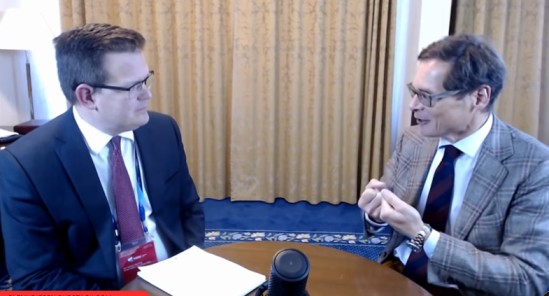
In this wide-ranging interview, Glenn Diesen speaks with Roger Köppel, Swiss journalist, former politician, and editor-in-chief and owner of Die Weltwoche, about media conformism, the “disease of moralism” in Western politics, and the rise of militarism in Europe. Köppel explains how NATO expansion, the Ukraine war, and the shift to a multipolar world are reshaping Europe, and makes the case for Swiss-style integral neutrality, diplomacy with Russia, and a return to realism over moral grandstanding. This interview was premiered on October 7, 2026. Read the full transcript of this interview below:
Who Is Roger Köppel?
GLENN DIESEN (00:00:00 – 00:00:16): Welcome everyone. Today we’re joined by Roger Köppel, a Swiss journalist, former politician, and editor-in-chief of Die Weltwoche, a publication I myself have written in. So an excellent one as well. So thank you very much for coming here.
ROGER KÖPPEL (00:00:17 – 00:00:18): Thank you for having me.
GLENN DIESEN (00:00:18 – 00:00:25): So again, in Switzerland, I think everyone knows who you are, but okay, who is Roger Köppel?
ROGER KÖPPEL (00:00:26 – 00:01:53): Well, I’m unconventional Swiss. I’m a journalist. My father was entrepreneur in the construction business, so I somehow got a bit derailed biographically. I began early as a journalist. I was a sports journalist for many years. I worked for the, you could say, for the big Swiss newspapers: Tages-Anzeiger, Neue Zürcher Zeitung.
I became editor for the first time in 1997 from a supplement magazine, and then I it went then from there. I was employed by Die Weltwoche. Die Weltwoche at that time. Was owned by somebody else. Now I’m the owner and Die Weltwoche is a very old Swiss weekly newspaper. It’s over 90 years old and we had a lot of difficulties back then and we could pull it back into the profitability.
Then I was hired in Germany. I was editor of Die Welt in Berlin for 3 years, and then I got back to Switzerland. I could buy Die Weltwoche, so I’m now the editor-in-chief and the owner. And probably what is special about Die Weltwoche, it’s an unconventional newspaper. That means we always take our liberty to look at things from a different point of view than others. It’s no strict political line. We have left-wing and right-wing writers, but always going against the grain.
Media Conformism and the Essence of Democracy
GLENN DIESEN (00:01:54 – 00:02:40): Yeah, well, that’s one of the things I’ve always found fascinating with you. That is the different points of view because these days we talk about media independence, but really there’s not so much because we see, if it’s any foreign affairs, any conflict, be it Iran or the Ukraine war, there’s always which side are you cheering for essentially? So if you’re pro this side or pro that side, then there’s a certain amount of talking points you have to go through.
What I found interesting with the Weltwoche is sometimes you present, well, this is what the Ukrainians of course are worried about, or this is what the Russians say. It’s very strange because we— it shouldn’t be strange. This is how it should be, I guess. But how do you see the climate of media independence? Because it is strange that you have to fall in line, it seems.
ROGER KÖPPEL (00:02:41 – 00:04:33): Yeah, it’s a strange mechanism of, you could call it self-conformism. It’s not a conspiracy or dark forces. Urging the journalists to follow a certain line. I made the observation in all the fields actually I’ve worked in, be it in sports, I was a film critic during my university years, and even there it was clear, these are the good directors, you have to find them the greatest, and everybody who has a different view, probably who likes Hollywood movies, he’s considered to be an outsider.
And this is now especially since the invasion of Russia into Ukraine, this has become extremely, almost totalitarian. I think that the free discourse, the dialectical discussion of different views, different arguments to analyze a problem, to view it from different sides, I mean, this is the essence of democracy. This is our strength. But now we have turned ourselves into some kind of amputated, one-sided, lopsided democracy, which is probably not a democracy after all.
So I would say that’s very important, that that’s the prime duty of journalists to challenge the mainstream, always challenge the mainstream, challenge the so-called majorities in order to present a broader view of things so that the people can build a better picture of reality. And in democracies, of course, they have to decide. They have to decide on issues. And it’s important you see all sides of it and not just one side. So it’s dangerous if everybody walks into the same direction.
The Disease of Moralism
GLENN DIESEN (00:04:35 – 00:05:33): Yeah. I feel like another way countries might lock them, well, media might lock themselves into a position is if you, whenever you talk about pro-something or anti, because often you come up with, at least politicians, a concept everyone can agree with. That is, oh, well, we have to work with the United States. So you have to be pro-American. But what does pro-American mean? They— it’s like one concept and they fill it up with whatever they want. So that means you’re for them trying to preserve a global empire. You have to support this.
The same as with Ukraine. “Are you pro-Ukrainian?” “Yes. Well, of course.” “Well, then you have to support fighting the war. Don’t call for diplomacy because then you’re betraying them.” If it doesn’t matter if most Ukrainians want peace. Nonetheless, we will not talk to the Russians, and we will instead go to Kyiv and ask them to conscript women. It’s very strange, the concepts we come up with. And it helps to dumb it down, it seems, the discourse, because we just talk who is pro this or anti that.
ROGER KÖPPEL (00:05:33 – 00:07:25): It’s totally absurd.
It’s like a, I call it the disease of moralism. You turn every issue into a kind of moral crusade and it doesn’t matter anymore. For example, what are the consequences of a certain decision. What is the price if you take this or that path? No, it’s only who are the good guys and who are the bad guys? And the people are working with these kind of methods, they’re always the good guys, of course.
And this is moralism. This is using morals in order to dominate, in order to sort, to dominate, to dictate the way how we should discuss, and I think this is utterly unacceptable. We should go away from this moralism more to a realism. And when I’m critical about moralism, I wouldn’t say, I mean, morals being the rules for a good common understanding, for a good cooperation, for a good life, nothing against that.
But moralism is this kind of megalomania, this grandstanding. It’s people who use values in order to promote themselves. In theology, we would say “they talk about God, but they mean themselves.” No, but well, that’s the thing.
The Narrative Trap of the Iran and Ukraine Wars
GLENN DIESEN (00:07:25 – 00:08:21): I think most people would say we do need more morals in politics, but as you say, it messes up the discourse because if you talk about the, in international affairs, if you look at foreign policy, the main thing we would always look at is the security competition, how the US and China would compete for security. If you have security for one, it could be insecurity for another. Well, if you measure security in missiles at least.
But when you talk about it in terms of morals, everything is always framed, as you said, as good guys, bad guys. And I feel the same when I look at the Ukraine war and the Iran war. When the Americans started bombing Iran, I saw politicians in my country say, “Oh, now they’re going to have freedom, the regime will be gone.” It’s like, so really this is why they’re bombing, is it? That they wanted to give freedom? So it’s very hard to have any critical assessment, if everything is good and evil though, how do you see this, I guess, narrative trap of the Iran War and the Ukraine War?
ROGER KÖPPEL (00:08:21 – 00:10:59): It’s the inevitability and the inability to differentiate also. I mean, this behavior, if you’re arguing always in terms of on which side are you on, or are you with the good guys or with the bad guys, this basically shows that people who talk like that, they are already deeply into the war. I mean, they’re in the propaganda, they’re above the shoulders. I mean, they’re actually warring parties. I mean, this is the way warring parties speak.
I mean, if I’m in war with my country, with Switzerland, with another country, of course, we demonize the other country, we attack them, et cetera. We think we are on the right side. But if we are not part of that, we should not use this language. And in diplomacy, this is extremely detrimental because with these demonizations we see, with these double standards, they go along with it, of course, you don’t help to improve the situation.
And this is the great concern that I have, especially in Europe. I would say the Middle East is probably a bit of a special case. I would say for me, much more concerning is the war in Ukraine because we see there on European soil, an escalation taking place before our eyes. On the one side, the Russians who think they’re absolutely right in what they’re doing. These are their legitimate security concerns. They’re existentially threatened by the other side.
And as convinced on the other side, the Europeans who are embarking in a confrontation they are not up to. I mean, they kind of celebrate a militarism without military. And I mean, if we have one lesson to learn from the last century, it’s that we should do our utmost to make these conflicts smaller and not larger.
But when politicians in Europe come along, for example, the former Hungarian Prime Minister Viktor Orbán, who said, “We have to talk to President Zelensky, to President Putin,” what happened in Brussels at the epicenter of peace, at the peace project EU. I mean, he was vilified totally. He was treated as a criminal. This shows you the strange ways we are in. And I’m only a journalist. My duty is to counteract, to display, to shed light on this kind of absurdity, which is a very dangerous absurdity.
Indivisible Security and NATO Expansion
GLENN DIESEN (00:11:00 – 00:12:42): Well, you contrasted this security competition with ideology to some extent, and a key concept in international security and peace would be the concept of indivisible security. That is, if you recognize there’s always security competition, usually the way we enhance security is if we look for a way which enhances the security of both sides, so one side doesn’t increase security at the expense of others. So essentially the opposite of bloc politics.
I found it a bit interesting that we all recognize this principle, but within the West, when we talk about NATO, for example, we say— we still say that it’s indivisible security because we say, well, NATO, an anti-Russian military bloc seeking to create a Europe without the Russians, and still, if it expands to Russian borders we say, “Well, it is indivisible security because we’re bringing democracy and the human rights and stability, so they will benefit.”
I don’t know, often the, if we— when I talk to Russians, they think they’re just lying to our face. “They know this is nonsense. Of course they know that expanding a military bloc to our border would be unacceptable. Why are we allowed to put missiles in Mexico?” But I— and I, to be honest, I also thought the same, but when I talk to people in the EU Parliament and all, and they say, oh no, no, they believe this. They are completely genuine. That is, if you arm Ukraine to the teeth, put CIA bases along the borders, NATO all the way, they should be happy. And again, so is this authentic to the core? Or I’m not sure if they’re manipulating or if they’re genuine.
ROGER KÖPPEL (00:12:43 – 00:16:41): I think this is just, I mean, I’m not, I would say I don’t tend to attach bad motives to actions I don’t like. I mean, sometimes there are bad motives and bad actors, we shouldn’t be naive. But I would say history is a— world history is a series of profound misunderstandings on each side. I mean, this is, if you look at history, all parties, all countries, all blocs always misunderstand each other.
We have this big moral grandstanding against Russia at the moment, on the side of the Europeans especially, but we also have this moralizing attitude on the Russian side vis-à-vis Europe and the United States of America. I think it’s better to attest or attach to the other side that they are acting in good faith and that they think they’re doing the right thing.
Let’s look at the psychology behind NATO enlargement, which I think was of one of the greatest stupidities of foreign policy in the last 30 years. And I mean, famous American diplomats, many of them in your program have pointed that out. But we have to understand the psychology of the Americans.
Do you know the book “The Quiet American” by Graham Greene? It’s a fantastic novel about the Vietnam War where the old European colonial powers, especially France, they leave Vietnam and then America steps in in the ’50s, impersonated, embodied by this young, dynamic American. What does this American do? He takes the Vietnamese girlfriend from the English protagonist who symbolizes, of course, the old world. And then the newcomer comes and he takes away his girl, so the takeover of the country impersonated by this woman, by this girl.
And what does the American say. He doesn’t have a bad conscience. He doesn’t apologize to the English guy. He is full of idealism. He says, “You know, I know it’s hard for you if I take away your girlfriend, but you have to understand, it’s in our best mutual interest. I mean, you are old, she’s beautiful, I’m young, we can be good friends.”
And this is exactly the position I saw in many statements concerning NATO east enlargement. They were saying, “What are your worries in Russia? I mean, we are the Americans. We are a force for good. I mean, and if we expand our goodness through not NATO, I mean, you can’t be against us because every sane person is for us.” Otherwise he has a problem. He’s a bad guy or he doesn’t understand it. So this overshooting idealism is somehow a structural problem in the Western world epitomized by the Americans.
And of course the Russians underestimated this. They have probably a bit another view of reality. But now one has to find a solution. And if the Russians start to bunker themselves into their own bitterness and the grandstanding, the moralism on the Western side proceeds and progresses, then we have an insoluble solution.
So I always try as a good Swiss to find some kind of common understanding and common ground. And to enlighten about those misunderstandings. But probably John Mearsheimer would say, this is hopelessly naive what I’m trying to achieve here. There are tough interests at play, which is true of course. But I would always say there is always room for compromise and never underestimate the role of misunderstandings, of profound misunderstandings, which can be sorted out as soon as we start to discuss with each other.
Greenland and the Three Sides of the Ukraine War
GLENN DIESEN (00:16:42 – 00:17:33): I actually saw a comment made just now by Marco Rubio. He was arguing that, well, we have gotten a deal which over Greenland which will be in perpetuity. And he said “never again will any of America’s adversaries be allowed to have any economic activity on Greenland.” This is only for us now. And he says this will also be good for the Europeans, this old new world, taking the girlfriend essentially. And this will be good for them.
Of course they needed to use threats of annexation to get this deal. So you have to ask, how good was it for the Europeans given that this was almost set up their own colonial possession? But I did want to ask about the, yeah, the Russia-Ukraine war, because again, you belong to a breed of journalists we don’t see often anymore who can see both sides of this case.
ROGER KÖPPEL (00:17:33 – 00:17:35): Try to see both sides.
GLENN DIESEN (00:17:36 – 00:17:48): So how do you see the competing sides? Again, you can have 3 sides. You can have Russia, Ukraine, and then the political West. How do you see them misunderstanding each other? Because I know everyone has some flaws to them.
A Multipolar World and the Death of Diplomacy
ROGER KÖPPEL (00:17:48 – 00:22:18): I think I try to look at these issues not so much, for example, in terms of values and all those words we hear a lot also in the news. I would say it’s always about interests in international affairs and in human affairs. Look, where is the fundamental interest?
And my view of the whole picture is the following. In 1945, it’s like now with Vladimir Putin when he’s asked what are the reasons for the Ukraine war, then he starts in the Middle Ages. I start with 1945. I mean, this was when the British and the Russians, the Soviet Union, the Americans started to divide the world among themselves. This held until 1989. Then the Soviet Union went bankrupt. We had the unilateral moment of the United States of America. They were at the zenith of their achievements and they were so strong they could almost rule alone the country.
This was the heyday of international law. I never believed in international law or Völkerrecht because this law is never made democratically by the peoples. It’s implemented by some kind of hegemons or mutual co-hegemons, whatever. I’m not so much believer into international law. I think it’s important that you try to have some kind of rules, but don’t rely on them. We see now you can’t. They’re not reliable, these rules. They’re up for grabs and up for interpretation.
So this fell apart. The Russians recovered. They got stronger. The Chinese are extremely strong. So the Americans are still a very strong force, but they’re not as dominant as before. And President Trump has realized the US are too weak to make peace in Europe. I mean, he says, “I want to make peace in Ukraine,” but he has to make peace in Ukraine because he has realized that if the United States overstretch themselves in all these wars, it will destroy their empire, their country, as it was the case with Great Britain, which was with the great Winston Churchill who wanted to save the empire. He won all the wars, but he lost Great Britain basically because they were over-engaged in all these wars. And the Americans tried to avoid this.
But of course, now we are in a situation that these huge powers, they somehow divide the world anew, not on a conference after a war, but this is now sorted out. This is the so-called multipolar world we see, the world of the predators, you could argue. And this is a very dangerous situation. I think it’s the natural state of history. It’s the jungle law between those powers until they find a new equilibrium.
But this is a very difficult ocean we are navigating in, and we are coming from small countries, Norway, Switzerland, and we have to be very sure what are our national interests, which are the conflicts that we are really touched by, what are the conflicts we want to take part of or not. And I would say in this world, it’s extremely important to follow national interest, to invest a lot in diplomacy.
And this is the big mistake at the moment in Europe. We see the death of diplomacy, which is almost absurd. And we are in the strange situation that the American president, which is an outsider, he has to explain to sophisticated Europeans that there is something such as diplomacy also vis-à-vis Russia. So that’s a bit the situation. It’s a new sorting out of some kind of world order, of new equilibrium. And it’s a very difficult environment.
And we should try our utmost to make these conflicts smaller and not bigger. Switzerland and Norway, we cannot decide these questions, but we can be of help if we don’t take part in this, in the overall hysteria, or Switzerland, if it would go back to its integral classic neutrality, could be of help as a mediator and as a therapy station for these international tensions.
Where Does Europe Belong?
GLENN DIESEN (00:22:19 – 00:24:20): Well, what you described though is kind of my main concern. That is, whenever you have massive shifts in distribution of power, that’s when you have instability. So you go from having a kind of global hegemon to it all dissolving to a multipolar system. And as you say, a new equilibrium will have to establish itself, but that means all the former arrangements are gone, creating vacuums. Yeah, all these tensions.
But I can kind of understand where the main players are going. That is China. They would like to be a key center of power. You see the Russians, they see an opportunity because they saw the unipolar moment as an existential threat because it manifested itself in NATO expansion. They saw this would be something that could destroy them, so they now lean 100% towards China.
I can see the Americans as well. What you do if you, as you say, you want to avoid the imperial overstretch? Well, yeah, some places you pull back, others you do buck passing where you make sure others pay for your empire, essentially. So you hand over the Ukraine war, you hand it over to the Europeans, they can pay for it. You tell the Gulf states, you try to make them fight for you. It’s a bit more difficult there. But also, in the Western Hemisphere, just make sure the Panama Canal, Greenland, everything kind of falls under US. So I’m not condoning this, I’m just saying I can understand it.
But where does Europe belong in this world? Because when it was a unipolar moment, it looked like the EU mission, European mission, was “we’ll have a collective hegemon. We will just stand with Americans, be their junior partners, and together it will be the political West instead of the US dominating.” And that was kind of the EU’s role, I think, collective bargaining to have some equality with the US.
It’s what happens now? Because where do we go? Because typically we put, we bet everything on America, but for good reasons, as well as what Trump says all the time, but it’s not just him. They’re not that interested in Europe anymore. They have to make priorities. We’re not that important. So what do we do?
ROGER KÖPPEL (00:24:20 – 00:28:26): Well, never underestimate the American interest in Europe. I mean, they have fought for this continent as well in the Second World War, and the Russians too, and they both got separated in Berlin. There was the line of the Cold War, and the Americans had their foot on the ground and the Russians had them too.
So the Americans always have an interest in Europe, but the situation of course is the last 60, 70 years, the Europeans said, “Okay, all the military expenditure, the Americans should do it. We get rich, we invest in our welfare states, we have the golden hammock here, and the Americans, the cavalry will come when we are in difficulty.”
And now the Americans actually, I mean, they fostered this mentality. I was in Berlin at the time, and of course the Americans were not interested that the Germans would have too strong an army, etc. There’s a lot of hypocrisy. Today that the Americans wanted to dominate. They wanted to call the shots here. That was their situation. There was no relevant military there, so they were the dominant force. And in the East, it was the Soviet Union.
But now the money is running out. So what we see now is, and this is now from the Swiss perspective, we are in a crisis, we are in a recession, and this is the moment when reality strikes back. And in the last 30 years, due to the huge success of this unipolar world, I mean, Europe was so rich, we could solve all the problems, we could drown all the problems in money, which was printed basically at the European Central Bank. But now that’s over, it doesn’t work anymore. We finally have to solve the problems.
I mean, look at the decisions that were taken in the last 15 years. I mean, a climate policy which brought a near-death experience to the German car industry. We saw a migration policy which was totally moralized. I mean, I’m pro-asylum and refugees who are really threatened by their life, we should find always a place in Europe. But this kind of mass migration, it doesn’t add up. Corona, was also imperial overstretch by our government. And soon as we had that behind us, there was this Ukraine war. And now again, they’re coping or trying to suspend reality with some irrational scenarios.
So we see all these crises, the European Union cannot solve them, and we see, and this is the good news to me, we see some kind of democratic rebellion of the people who say, “We want other parties, we want change, we don’t trust in this development of politics.” And so this is the situation of Europe. It’s in a very disoriented state.
But as a Swiss coming from a direct democracy, we always say, you can have trust in the people and the people are not stupid and they start to wake up and we will see, I believe, a lot of political changes on the European landscape. There is a return of conservative thinking and you see it in different countries that the tide is turning towards more realism, a bit away from that moralism.
But our continent, we could say our world, is in a bad state because of the success we had. And if you are very successful, if you are very rich, you make the most mistakes. It’s also in companies, it’s also like this. If you have, as Goethe said, “Nichts ist schwerer zu ertragen als eine Folge von guten Tagen.” “Nothing is harder to bear than a series of good days.”
The Return of the Nation-State
GLENN DIESEN (00:28:28 – 00:29:57): I like that. Well, I also like what you said about the security arrangement with the US because often it’s seen as free riding, which it was, let’s be honest. Definitely. But yeah, yeah, of course. But as you said, it was also quid pro quo, I think, because when we outsourced security to the US, they also wanted this. And the quid pro quo is, you pay for our security and we do what we’re told, oversimplifying. But if someone looks after our security, it’s a bit like in Japan. If they look after security, you will have political influence. That is the trade, if you will.
But I guess my question with the Europeans— yes, I know the US will always have an interest there, but, well, I guess twofold. If the US has less interest and wants to wind down, what happens with Europe? Do we have a Europe? Because there’s a common idea that the Europeans need the Americans in Europe because they are the pacifier. If not, the Germans, the French, the British, they will— who will lead us? And you already see some squabbles emerging.
And again, when the Germans now say, “Oh, we’re going to be most powerful army,” not everyone is that comfortable, because tomorrow maybe the Russian issue is gone and then the German army is still there. I mean, we don’t transcend history. So where do you see this Europe going?
ROGER KÖPPEL (00:29:59 – 00:34:49): The European nations, especially the Germans, are now confronted with the demons of their history because in the western part of the country, they said for the last 80 years, “Nationalism, the national state, the nation-state, we have to get rid of it. Now it’s the time of supranationalism, supranational institutions, the European Union.”
And now Switzerland is an example, by the way, like the United States of America or Great Britain. We are a classical liberal nation-state. I mean, in our history, nationalism and liberalism have merged peacefully. In Germany, in Italy, in France, this didn’t happen. They morphed into some kind of fascism or also leftism, whatever you had it.
And so what we see now is the return of the nation-state as the fundamental actor on the world stage. And the European Union is built on the idea that the nation-state can be overcome by these kind of institutions. But the problem is these overriding institutions didn’t deliver. I mean, they promised they could preserve peace, they could preserve prosperity, they could that they could secure the borders. But now you see that this glorious European Union is the source of many problems in the concrete reality of people.
And in Switzerland since the ’90s, this is why we have never joined the European Union, our Euroskeptics, they always said the European Union is an intellectual misconception. Why? Because everybody is responsible for everything and nobody is responsible for something specific. You don’t know who is responsible for what, in the European Union. It’s a construction which doesn’t work. And we see it as far as the euro is concerned. You cannot make a singular currency over so different diverse national economies. You see it with the common borders, they can’t be secured.
So what we see now is the return of the nation state. And this is especially a difficult experience for the Germans, and Germany is a very important nation state. So they have to find in a way a new identity. They have to come to terms with themselves.
So I would suggest that in Europe, as many countries as possible should embark on the Swiss way. They should become permanently neutral. They should say, it’s a blessing that we all failed as great powers. Europe is the graveyard of former superpowers, and this actually is an advantage. Because we are relieved from the duty of shaping world events. Europe could become a series of big Switzerland’s mediating between these behemoths and leviathans, between these Godzillas and King Kongs of nations who are still working in the vocabulary of power politics.
And the absurdity is that even in Brussels, we hear now these fantasies. “We should be strong. We should play a military role. We should be a geopolitical factor.” I don’t believe in this. As a Swiss, I’m deeply convinced small is beautiful. And if every country would be neutral as Switzerland once was, we wouldn’t have any wars.
I mean, I don’t think it’s acceptable that Russia says, “Ukraine, this gets out of hand. NATO is in there. They have a civil war. Now we have to intervene.” On what right does— I mean, what has Russia today to do with the sovereign state of Ukraine? Should Switzerland intervene in southern Germany if we think that the left-wing parties overdo it? They start to discriminate the entrepreneurs and are not so friendly, for example, with the tax situation in Switzerland. We got attacked regularly by the European Union, by Germany. Should we invade because we think it’s a threat?
So this logic of the big power states, I mean, I understand it. Of course, that’s the rule of history. But as a Swiss, I cannot accept this kind of thinking. But we should not make the same mistake. We should try to be ready to defend ourselves. But besides, Europe should be a bridge between East and West and North and South.
Swiss Neutrality Under Pressure
GLENN DIESEN (00:34:50 – 00:36:12): Yeah, it’s interesting what you said about power because we are sitting here in Moscow and as the Russians are now pivoting to the East, that is, well, at least shifting their economic connectivity to the East, they’re discovering something interesting. That is because in Europe they’re always this massive giant, and the impulse is always to balance it. So my point is, often the instinct is, the more power, the more security. But in Europe, you always see this, yeah, demonization, the balancing.
Now they go into Asia and they’re not that big anymore. You have the Chinese, and they notice that the behavior is different because no longer are they looking to balance the Russians. Instead, even before the invasion of Ukraine, you had the Japanese thinking, “Oh, we probably want the Russians to be a little bit neutral between us and China. Don’t make them too dependent on China.” So suddenly they start to look, put the territorial disputes aside and try to cooperate with them. And the Indians, they’re like, “Oh, you can’t only have China in the Arctic, you have to welcome us.” Now Indians can be an Arctic power.
I mean, you have all this. So suddenly it’s accommodated as a way of making sure China doesn’t get too powerful. So it’s a very, like you said, it’s not always big, it’s not always a mess, I guess. But again, you’re Swiss, you just mentioned the neutrality. That’s what we most associate with Swiss, as well as secret bank accounts and great chocolate. But let’s focus on the neutrality.
ROGER KÖPPEL (00:36:12 – 00:36:22): We have also a great industry, very innovative universities. There are a lot of things we can offer. Norway, by the way, has also a lot of trump cards.
GLENN DIESEN (00:36:23 – 00:37:11): Yeah, I shouldn’t delve too hard into the stereotypes, but the neutrality thing is interesting. Because at least the direct democracy and— but neutrality is quite interesting. And we used to not just have that with Switzerland in the Cold War. We had a belt of neutral states going from the north to the south.
How do you see this now? Because neutrality has become almost seen as something negative, criminalized. If you listen to the Swedes, for example, they now refer to, “Oh, when we were neutral, this was— we were naive. We have to fight evil,” and then neutrality has become immoral in this new moral language we have. That also affects your country, though, Switzerland, because you were the beacon of neutrality. How do you see this shifting and the consequence of it?
ROGER KÖPPEL (00:37:11 – 00:42:12): This is a big problem, and if we speak about neutrality and Swiss neutrality, in my view, but at the moment we don’t have a consensus in Switzerland about this, but if you look at history, the Swiss neutrality is a very special neutrality. It has 3 elements.
It is permanent, means not from case to case, not opportunistic. It’s permanent in peacetimes and in wartimes. You’re neutral. It is armed, means we need to have a strong army that no potential aggressor could feel tempted to go in. For example, in the Second World War, the Germans thought for a moment to attack France through Switzerland, but it was seen that because of our Alpine fortress and of course also the limitations of the territory, it would’ve been too difficult to bring all these divisions through.
So the military aspect is important, but also what they say integral neutrality. All-encompassing neutrality, which means we don’t interfere, we don’t take part, we remain neutral in all conflicts which are not directed at us militarily, economically, and diplomatically.
And this neutrality has been suspended by our government, also under the pressure of morals, when Russia started this military special operation, as they call it. We took the EU sanctions against Russia, which means we are now a war party in economic warfare against the atomic superpower Russia. And this of course is a breach of neutrality.
We just had a national referendum about it. I was part of a group launching an initiative to reestablish and write in the constitution this traditional understanding of neutrality, but 70% of the voters rejected it. They said, “No, we are not against neutrality, but we are for flexible neutrality. We don’t want our government to be tied up.” And this has to be respected, this decision by the people. So it doesn’t go into the constitution, but the discussion what neutrality really means, this goes on.
And if this war escalates and comes closer to Swiss borders, which is not out of the question, I mean, if you see if the Russians would start to attack the supporters of Ukraine, you could see easily that the Russians could be in Poland or in Germany even, which is directly at the borders of Switzerland. Then I think shocked by this, the Swiss would return to integral neutrality. But I deplore this decision. I was on the other side. But of course, as a good Swiss, you have to accept it. But we will still continue to argue for this neutrality.
But what you’re describing is exactly— was exactly the argument by the opponents. They said Swiss neutrality in that sense is a pro-Putin neutrality. Which is totally absurd because when the Germans with 1.5 million soldiers invaded Poland, Switzerland said, “We remain absolutely neutral,” which means no differentiation between aggressor and attacked. These are all war parties. We refrain from any kind of comment. We do not interfere militarily, diplomatically, or with economic sanctions.
It was the case that in the ’30s, when the League of Nations wanted to sanction Italy for attacking Abyssinia, Switzerland, as a member of the League of Nations, should have taken these sanctions too. And Mussolini said to our government, “If you are sanctioning us, we will invade Switzerland.” And that was the shock in the ’30s which brought Switzerland back to integral neutrality, to the classical neutrality, which they had suspended before too because they were at the League of Nations.
So this is very important to understand that neutrality is not support of the aggressor. It’s also not, you could say, as a Swiss, the government has to pursue neutrality. The citizen, he’s totally free. I can have my opinion. I can say Russia is doing the right thing, or I can say Putin is the greatest criminal. This is not touched by neutrality. I can say whatever I want, but the government, the state, has to refrain itself, has to restrain itself. And this has been lost. This understanding has been lost due to the factors you have mentioned.
How Do We Change Course?
GLENN DIESEN (00:42:13 – 00:44:05): Let me just finish off with one last question, because I like the way you explain how we kind of get trapped with narratives and seeing everything through this lens of moralism. How do you course correct here? Because we can kind of see where this is headed. You said we have militarism without a military. We’re going to go to war with Russia. Nobody says what does victory look like against a nuclear power. No one says what does this war look like? Are we going to be bombing Moscow? Are we going to put troops in Ukraine, go into the trenches? Well, what exactly does this war mean? No one discusses these things.
And also it’s very hard to even have a normal discussion because if you say, “Well, listen, actually Russia’s winning on the battlefield,” you can use subjective indicators to argue this. Well, they said, “That’s a pro-Russian argument.” If you say, “Okay, well, Ukraine is taking a lot of casualties,” “That’s a pro-Russian argument.” “The sanctions aren’t working,” “That’s a pro-Russian argument.”
So objective realities— I mean, there’s no reason why saying sanctions aren’t working should be considered pro-Russian, but I think it’s all seen through this lens that, well, you’re delegitimizing the efforts, which means you undermine it, and now that’s what Putin wants. So now you’re taking their side. So objective reality is kind of gone. We all have to chant the same narratives from our same script.
So how do we course correct? Because we can see where this is going to go. It’s not pretty. And I say that because yesterday you were on a panel and everyone— I heard some comments, “We should just nuke Germany, send them a message, restore deterrence.” And you had the— often it becomes a bit gloomy, and I have to be honest, I go that same way sometimes where it looks very dark. But you had message of peace and hope. I must say, that was the best of all comments at this conference. So I do appreciate it. But how do we change course?
ROGER KÖPPEL (00:44:06 – 00:49:04): Well, at the end of the day, I’m an existential optimist. I mean, from a personal perspective, everyone’s life ends, but I mean, we have been given the gift of our existence without our doing. I mean, this is amazing. I mean, the fact that we can sit here and have a discussion, I mean, this is absolutely amazing. I mean, we have been given the gift of our lives and we have been endowed with certain capabilities and certain errors.
And human beings have been constructed by whoever did it, whatever power did it. We can survive. We have, our sheer existence is the triumph of life over death. I mean, the probability that there is nothing in the universe is presumably much higher than the probability that there is some life and there is a planet with human beings, with nature, everything works out fine. So this should give us a certain degree of hope that all these things we are discussing, are in the range of human errors, misunderstandings, bad characteristics of human nature, et cetera. We can sort them out.
And what is for me at the moment a reason for optimism, this moralistic attitude is basically an attitude of weakness. It’s an attitude which is not serious. It cannot be taken seriously. I mean, I had this discussion in Germany when I talked some of these grandstanding guys, the Germans, they can be very self-confident and say, “But we have to defend our values on the battlefields of Ukraine.”
And then I usually say, “Okay, where is your uniform? Where are your children? Are they in some boarding school in the United States or in Great Britain? Are they wearing the uniform too? Are you ready to send your children on the battlefields of Ukraine to defend the freedom of Europe?” And then I can assure you the discussion quickly ends because nobody would be able and would be willing to risk his life. This displays the fundamental unseriousness. They don’t take it seriously what they’re saying, and this is the weakness of the position. That’s the first reason to be optimistic. It’s not so hard to deal with these moralists.
And the second thing is, there I’m inspired by Tolstoy and his book “War and Peace.” In his last book, it’s fascinating, he explores his view of history and he says, it’s not the Napoleons and the Alexanders who are shaping the course of the world. It’s actually the sum of the individual wills of the people. And when the people are in a warlike mode, then you will have war. But if the people are not in a warring mode, then it’s very hard in our world today to get a war.
And this is something that gives me hope. I say China went through hell in the last 150 years. Russia, I mean, was breaking down, going bankrupt, had the terrible ’90s. They have now a certain degree of wealth. I mean, this is a huge achievement by the current president, how he could pull Russia out of this swamp, out of these terrible ’90s. They have had war, they have had enough deaths. And look at Europe, this graveyard of ambitions of crazy politicians in the past. And don’t underestimate the collective memory of peoples. And I just don’t see these masses of people who would go into war. I just don’t see them.
And I see a growing number of politicians with a sense of responsibility, and they are mandated by a growing number of people who think we should stop sleeping, we should stop sleepwalking. We have to engage in politics. We have to engage in dialogue.
I’m doing a speech tour in Germany, and you see in Eastern Germany, you see big advertisements somewhere in the landscape. It just says, “Freedom, peace, and partnership with Russia.” This is the protest of the people against the madness of their elites, and this gives me room for qualified hope and optimism.
Defeating Propaganda Through Dialogue
GLENN DIESEN (00:49:05 – 00:50:14): It. Yeah, often the instinct— well, the— what’s often taken as common sense these days is, “Oh well, the Russians bad, so we don’t talk to them.” And I like your approach more because people should go and watch this. You go to Russia and you— or, and you speak to Solovyov, and it’s denounced in Europe and sanctioned as a propagandist for Russia, so we don’t talk to him, which is a weird thing to do because all studies in propaganda suggest you defeat propaganda not by censoring, but you bring it out and you talk and you go out and you guys argue and you battle it out. And surely if you don’t disagree, if you disagree with someone, that’s how it’s done.
So I, it shouldn’t be a controversial thing. And if your thesis is right that there are problems caused by misunderstanding, then, yeah, I’m glad you’re in Moscow. You get to share perspectives and hopefully try to reduce some of these tensions because it’s otherwise not going anywhere positive. But you’ve finished on such a positive note, I don’t want to step on it. So thank you very much for coming on.
ROGER KÖPPEL (00:50:15 – 00:50:21): Thank you, Glenn, and keep up also your international world-encompassing dialogues.
Related Posts
- Trancript: Secretary Rubio Delivers Remarks from the Acropolis in Athens
- Jiang Xueqin: A World in Revolution – Globalism vs Nationalism (Transcript)
- Transcript: S Jaishankar Speaks at Munich Security Conference 2026 in New Delhi
- Transcript: War Secretary Pete Hegseth’s ‘State of the Force’ Address
- Transcript: Professor Jiang Part 2 Interview With Jack Neel – Government’s Secret Plan to Control