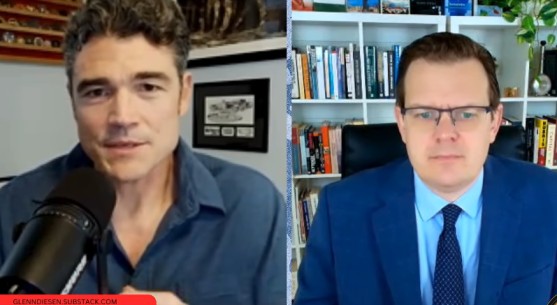
Former National Counterterrorism Center director Joe Kent joins Glenn Diesen to explain why the U.S. proxy war in Ukraine must end now, and how the intelligence and defense bureaucracy keeps it going despite President Trump’s pledges. Kent also assesses the risk of renewed war with Iran ahead of the midterms, the Saudi-Houthi conflict in Yemen, and the ripple effects that could reshape the Gulf and the wider Middle East. This interview was premiered on October 17, 2026. Read the full transcript of this interview below:
Trump’s Shifting Stance on Zelensky and the Ukraine War
GLENN DIESEN (00:00:00 – 00:01:09): Welcome back. We are joined today by Joe Kent, the former director of the National Counterterrorism Center, who was assigned to this position by President Trump and resigned in March of 2026 due to the war against Iran. So thank you for coming on the program.
I really want to ask you about developments in the Middle East, but first, maybe start off with Europe because this is quite interesting, the developments. That is, well, Trump was going to put an end to the Ukraine war. That was the big campaign promise in order, which positioned him very firmly as the America First peace president.
But since then, maybe it’s unintentional, but it seemed instead that this has become his war to some extent. And now there’s this sudden reversal again as he’s going after Zelensky, criticizing him in a big way, while Zelensky is also going after Trump. Even to some extent rallying support from Europeans and those in the US committed to the war with Russia. Again, maybe I’m reading it wrong, but how are you assessing this, the new shift in the Ukraine war?
JOE KENT (00:01:11 – 00:04:36): It’s always hard to tell what’s going to result in a real policy change versus what’s just kind of the way the president is expressing frustration. I think from day one, he’s been very frustrated. That he couldn’t settle the war quickly. I think he just saw through Western eyes that there had been lots of casualties on both sides and that both sides would rationally want to end this and that he could get the deal.
I think I’ve discussed this before with you. What unfortunately President Trump didn’t do a good enough job of doing is making sure that our intelligence apparatus, our defense apparatus actually shut off the funding, shut off the intelligence sharing and the capabilities we were giving the Ukrainians. So every time President Trump tried to get both sides to the negotiating table, those mechanisms were not turned off in a meaningful way that showed Putin and showed the Russians that we were serious about it.
So because Trump made all the right noises, Putin went up to Alaska, he had the summit, but at the same time he saw that the support, the real support that actually matters, the targeting, the sophisticated weapon systems we’re giving them, that that didn’t turn off. I think Putin was just like, “Okay, well, if Trump’s going to pay me lip service, then I’m just going to pay him lip service as well.” And I am going to continue on with my war objectives because to the Russians, this war is existential. It’s obviously existential as well to the Ukrainians.
The Ukrainians, I think, realized when this war kicked off against Iran that they were going to be one of the initial losers in the conflict, that they weren’t going to get the attention and the resources that they needed. And so I think they attempted to accelerate the war in a meaningful way by targeting Russian energy infrastructure.
Now President Trump is facing the reality of the commodities markets and the fact that you can kind of fudge things here and there, but at the end of the day, there really is only so much diesel out there. And with the Ukrainians continuing to hit Russian energy infrastructure, now we’re in a pinch. And so I do think Trump is motivated to end the support to Zelensky in an effort to get him to stop hitting the diesel supplies and driving up the cost so he can kind of deal with one crisis at a time.
I do fear that perhaps he may have been tempted to say to the Russians, “Hey, if you stop giving the Iranians any kind of support, then we’ll stop supporting the Ukrainians.” And I think that makes tactical sense. I think Trump should end all of our support to Ukraine anyways because I just don’t think that war is in our national interest. But I fear that he may have an overinflated sense of what the Russians are actually providing to the Iranians thinking it’s going to be a silver bullet. And then we get even more deeply entrenched.
So this is all very complicated. If he doesn’t stay very diligent and on top of our own intelligence apparatus and really exert a lot of pressure too, on NATO, who I don’t think is going to be on board with this, then I think this unfortunately will fail as well. And Zelensky’s going to continue to do what he’s going to do, and that war will continue to accelerate at the same time the war in the Middle East does, which is going to pinch us even harder here on the energy markets, which is what he’s trying to avoid in the first place.
I mean, all of this big picture to me just speaks to why we shouldn’t be involved in these proxy wars that are far, far away from our shores just because of the ramifications. We’re always ending up having to rob Peter to pay Paul, support this group to back the other group. We’ll talk about the Middle East, the same things are taking place there. But it’s quite the mess we’ve gotten ourselves into.
Can the Bureaucracy Run Circles Around Trump?
GLENN DIESEN (00:04:37 – 00:05:20): But how, again, do you think this cut— because we had heard some cut about of the cutoff from the intelligence, or at least some of the early warning of Russian strikes— do you see this actually lasting?
JOE KENT (00:05:22 – 00:08:01): Unfortunately, the president has failed to really get into the details. I think there’s times where he has said— I know there’s times where he said, “Stop giving support to the Ukrainians, stop deliberate intelligence sharing.” This is where he and his close team of trusted people need to micromanage our intelligence and our military apparatus because the devil’s always in the details.
Okay, stop support. Does that mean we’re not going to reappropriate money? Because if you’re in the military or the intelligence community, you could say, “Well, that’s him talking to Congress, not us, because this money, this equipment that we have right now in our inventories, well, it’s already been allocated. There’s already a legal document that says that we can give this to the Ukrainians.”
So there’s a lot of wiggle room there in the bureaucracy that Trump has never been very interested in or really gotten wrapped his arms around fully. So I think there’s a lot of play in there for the bureaucracy to do what the bureaucracy’s going to do. They want this war to continue both on the US side and on the NATO side too, because a lot of these programs we have where we give things, we are giving it also to some of our NATO partners.
So this could be another case where, “Okay, well, technically we didn’t give the Ukrainians support. We gave it to the Brits who then gave it to the Ukrainians.” There’s just so much in the bureaucracy where they can just run circles around Trump if he doesn’t actually micromanage it in a meaningful way.
Another issue too that we will run into is I think we, to a certain extent, will always be somewhat obligated to tell any country if they’re about to be hit. It’s called duty to warn. We do have to warn them, but a lot of those same systems that we would use to warn the Ukrainians of an impending strike. And then technically too, I mean, the Russians, if their civilian infrastructure is going to get targeted, we’re supposed to warn them as well. So we kind of pick and choose when we use this protocol.
So again, there’s a lot of legal framework there where we can kind of mess around, and I think the bureaucracy can run around the president. The key thing is just pulling away any of the advanced targeting that we’re giving to the Ukrainians.
But again, this is the problem too with surrogate warfare, and I dealt with this in Special Forces and the CIA. Once you’ve been training any of these groups and you’re mildly competent at your job, which we’re actually pretty good at our job, there does come a time when they actually don’t need you that much. And so you’ve kind of created this Frankenstein that even though you want it to stop doing that thing that you trained it to do, you actually lose a lot of your capability to do that.
I still think there is a lot of high-end, high-tech support that we’re giving to the Ukrainians that if we were really deliberate about going in and saying, “We have to shut these things down,” they would make a difference in actually ending the war. But I just, again, I just don’t know if Trump actually has the patience or the people around him that are going to go and figure out what those systems are and take them away from the military and the intelligence community.
Is the War Being Outsourced to Europe?
GLENN DIESEN (00:08:03 – 00:09:05): Well, it seemed that part of the concern though from the Trump administration was by continuing this war, 2 things would happen. One, the US would exhaust a lot of its resources, and second, it would make an enemy out of Russia, which would otherwise seek to reach out to the US to balance its relations with China.
But instead of ending the war, again, many are wondering whether or not the US is simply outsourcing it, because then it kind of achieves both. So Trump now makes the point that, “We make a lot money of this, we’re selling weapons, how wonderful.” And also it allows the US to start to mend ties with the Russians without necessarily putting an end to the war.
How do you see this argument that this being— war is being outsourced to the Europeans as opposed to ending it? Because even now, I mean, when Trump says, “Okay, well, Zelensky is horrible, kind of, we can’t deal with him,” and then you hear on the other side Europeans saying, “Well, this is just going to make us support Ukraine even more.” I mean, if the objective is to hand the war over to the Europeans, then this is a good move, it would seem.
JOE KENT (00:09:07 – 00:10:28): Yeah, I mean, if we’re trying to have it both ways where we say that we washed our hands of it, we cut off Zelensky, and it’s not us that’s doing it, it’s the Europeans that are doing it, I think at the end of the day that sounds good here in America and that might make for a good talking point.
But again, I think this is why Putin doesn’t take us very seriously because I think Putin is just going to look at us and say, “Okay, you guys are NATO. You’re funding, you’re putting in the most funding into NATO, you’re the most dominant country.” If you’re saying that you’re just kind of walking away and now the Europeans are going to handle it and they’re still supporting Zelensky and they’re still accelerating the war, then I think to a certain extent he is going to view that as us just basically having a different public relations strategy, but not an overall different strategy.
This is where I think to truly end this war, it would have to be twofold where we do meaningfully take away the support that we’re giving to the Ukrainians directly, but then we would really have to change our relationship with NATO and exert our role as the dominant force in NATO and say, “No, this actually is the policy. If any of you countries want to pursue something differently unilaterally, you’re doing it outside the scope of NATO.”
And again, that would be a very big diplomatic move. He’d get a lot of pushback in Europe, obviously a lot of pushback in America. And I just don’t know if right now he has the political will or strength for that fight.
Trump’s Negotiating Style and Growing Frustration
GLENN DIESEN (00:10:29 – 00:11:48): Well, I said it early on last year, we had that incident in the Oval Office. That is, Trump was scolding Zelensky, making the point that, “You’re playing with World War III here.” Again, we are fighting a nuclear— the world’s largest nuclear power, so there’s reason for concern. Then he went to Alaska, it didn’t go anywhere, and then you have people like Marco Rubio expressing a lot of enthusiasm for this 40-day strike, which turned out more than 40 days. And now suddenly Trump is going back again to that Oval Office mood of going after Zelensky.
I was just wondering, how do you— what is it that explains? Do you think it’s the Trump personality that Zelensky was too critical of the diesel deal? Is it the strategic environment shifting that we now see that Ukraine is on its last leg? Or is it just a negotiation tactic that is make all sides seem, recognize that the US position is, well, unpredictable by this side. That is a swing strategy that you better make a deal, make concession today because you don’t know where we’ll be tomorrow.
In other words, if it marries itself too heavily into Zelensky and Europeans, then well, then no sides will have much interest in making big concessions to the U.S. I don’t know. I’m just a bunch of different hypotheses. I’m just wondering how do you see this?
JOE KENT (00:11:50 – 00:14:40): Yeah, I mean, some of this is obviously the way that Trump prefers to negotiate. And I think in domestic politics and probably in some of his business ventures that worked out well, and maybe even before wars reached the kinetic phase, that could work. For instance, what he did with the North Koreans. But now you have these very, very hot wars that are existential for many of the players.
And I think a lot of what we’re seeing right now is frustration from President Trump. He thinks that because we’re America, we’ve actually paid into NATO the most, we’ve paid the most for this war, even though it would happen primarily under the Biden administration, that he should be able to grab, invite one leader to a conference, have the other one come to the Oval Office.
And you heard him just yesterday when he said, “Oh, I announced a ceasefire.” Zelensky and Putin said, “We haven’t heard of a ceasefire.” And the media asked him, “What about the ceasefire?” And he’s like, “Well, if there’s a ceasefire, because I said there was one.” And I think in his mind he says that we’re the dominant power, we should be able to exert our will in this fashion.
But now if you look at everything that’s taken place with just the commodities market that now directly affects, I mean, America. Now he’s frustrated because not only can he not get the peace that he wanted, hoping to get a Nobel Peace Prize, but actually this war and its acceleration and the war on Iran, it’s really going to hurt him going forward in the midterms because people in America are like, “I don’t know why we’re in this place called Ukraine. I don’t know why we’re in this place called Iran, but I know I can’t afford gas and groceries,” and they’re blaming the president for it.
So I think you’re seeing a lot of frustration right now. And again, I think there is an opportunity where if he was willing to really focus on why he hasn’t been able to extract us from these 2 predicaments and he was willing to focus on within the US intelligence and defense apparatus, I think he would be able to shut a lot of these down and make very big diplomatic moves with NATO, with the Israelis, et cetera.
So if he’s willing to take the bold action in the right places, it could work out even though the clock is really running out towards the midterms. Then potentially if the midterms don’t go well, he may just be in a political bind with the House and with the Senate.
The problem is he’s gotten us into these situations that he thinks he can control, but the factors and the forces are just so big. Everything with Russia is just such a— there’s just such major implications in terms of how much they control the resource market. They’re a nuclear power. Same thing with Iran. We’ve underestimated Iran at every single phase of the war.
I’m sure we’ll talk about it here more, but it’s just like we always kind of assume that they’re this simple country that we can go smack around and bend them to our will. And we’re almost on 8 months now of that and it hasn’t worked really. We’re on 70 years of it and hasn’t worked. So until he gets realistic and sees where our actual leverage is and what our true interests are, we’re going to be stuck in this predicament. And I think that’s pushing us towards a much more volatile situation.
What Does “Defeating Russia” Actually Mean?
GLENN DIESEN (00:14:42 – 00:16:05): Well, that seems to be the new era we’re in because for the past 30 years, when I say we, all the NATO countries who were fighting these small to medium-sized weak countries in these forever wars, but now we’re moving into the great powers. Again, I never thought of Iran as a great power, but many would, in academia, would define a great power as one that’s able to withstand all the pressures of the most dominant or leading state in the international system, which would be the US. And it seems to be throwing everything at Iran.
So it’s maybe, well, I’m not sure if I’ll put it in the category of a great power, but it’s certainly able to, well, to take a lot of pain and push back in a massive way. But I guess on that topic of great powers, because we tend to speak in a lot of clichés these days. So when we talk about this fight against the Russians, at least Europeans are quite devoted to defeating Russia.
But what does that mean though to you? How does that translate into actual policy? I mean, what does it mean to defeat the world’s largest nuclear power? Are we looking to defeat on the battlefield? Are we regime changing it? Are we breaking it into many pieces like the EU foreign policy chief, Kaja Kallas, advocates? What do you see as the plan? I mean, right or wrong, if we decide defeating Russia is the only goal here, the only acceptable outcome, what exactly would that mean?
JOE KENT (00:16:07 – 00:18:45): I just see it as insanity. I mean, I see it as a very immature strategic view. And I think most people who say it, as you said, they know the soundbite and they’re like, “Well, let’s just say our goal is to destroy Russia,” without asking the obvious next question, which is, “Okay, so what does that mean? What do you mean destroy Russia?”
Just take a look at the— we in America, we have a hard time looking at maps and seeing, why would Iran be a problem? Well, look at the map. And the same thing, Russia, plus the natural resources, plus the nuclear weapons. It’s like, what do you mean you want to destroy Russia? What does that actually mean? Because obviously it’s just such a massive landmass, such a huge demographic of people, you actually can’t destroy them.
So do you mean make it so chaotic it breaks up into several— I don’t even know what it would be. Would it be 10, 20 different little satellite states? Because to me, that sounds pretty chaotic and awful. And every time we’ve seen major countries or even smaller countries— Libya is tiny compared to Iran, it’s tiny compared to Russia certainly. But when Libya fractured, that had massive implications on the Middle East, on Africa, on Europe. And really even Iran or Russia would be that times 10, times 100? I don’t even know.
So I just think that whole concept of we’re going to destroy Russia or to use the old Lindsey Graham rhetoric of, “We just want to keep killing Russians,” until they do what? Until they use a nuclear weapon? Do we really think that these guys are just going to let themselves get put in that situation?
So now if we do what we should do, but we always fail to do here in America, is we think like the enemy, we think like the adversary. I don’t think that Russians are our enemy. But if we’re going to treat them as the enemy, we should at least take a minute to think like them. If you’ve got all of NATO and you’ve got the Americans saying our goal is to kill Russians, to destroy Russia, then, well, that’s pretty existential.
And all the actions that we’ve taken since the fall of the Soviet Union have been pretty adversarial towards Russia, pretty aggressive. That’s how we got in the Ukraine war. So you’re going to say, “Okay, well, what deterrence do we actually have beyond the conventional war that we’re waging right now?” Well, you have nuclear weapons, and that’s why you— that’s why countries have nuclear weapons.
So this is how we push this thing into a nuclear scenario. So I don’t think Russia would take it lying down. I think this is how you do end up in some form of a nuclear exchange, which really isn’t much of an exchange. It’s really just significant portions of the world destroying each other. And again, for what?
So I mean, I do like it that more people are questioning this narrative, but it has been the dominant narrative now for quite some time in America. So I think the more that we can talk about it, I think hopefully we can avoid catastrophe.
Reading Russia’s Real Intentions
GLENN DIESEN (00:18:46 – 00:19:55): Yeah, I sometimes wonder if the USSR fell apart too peacefully because it kind of set the expectations for us that we can engineer something similar, a bit like Venezuela. It went a bit too successful. I think it created expectations that emboldened the invasion of, or attacks on Iran.
So, but you said maybe we should try to think like them, that is the Russians in this instance. How do you assess the Russians’ intentions here though? Because sitting in Europe, the leaders here talk about the Russians wanting to more or less march on Berlin. Especially if you listen to this NATO Secretary General Mark Rutte, they keep making the point that Russia is threatening us and that they will take European territory, but they never flesh out that argument.
What exactly are they going for? Are they restoring the Soviet Union? Are they going to take all this land and people who don’t want to be a part of Russia? I mean, what for? What’s the purpose? Who would support it? How do you see or read the Russian intentions in this conflict?
JOE KENT (00:19:57 – 00:22:41): Well, I mean, I think the way that we continued to push NATO up onto Russia’s doorstep, there was going to be a backlash at some point regardless of who was in power. We like to vilify Putin. I don’t think it really matters who was in charge inside Russia. At some point, some Russian leader was going to have to say, “You guys have got to get off our border.” And so I think this war, especially just geographically looking at where Ukraine sits, it was a natural place for this flashpoint to happen.
But we always look at, in the military and the intelligence community, we always look at 2 things when you’re assessing an adversary up front, it’s intent and capability. So the argument I like to make with the folks who say that we have to stop Putin now, otherwise he’s going to be in Paris by Christmas time or some nonsense. I always say, look, even if Putin wanted to do that, we now have several years of data on how the Russian military fights and maneuver warfare is not their thing.
Maneuver warfare in this modern era is pretty tough. Maneuver warfare right now from the American perspective, it’s not our thing either. In the era of drones and ballistic missiles and the battlefield being fairly leveled because of technology, if you’re trying to maneuver and take over a country with maneuver warfare or even a sustained air campaign like we’re trying in Iran, it’s pretty challenging to do.
So right now, even if Putin was this cartoonish villain that he’s portrayed to be, that he did want to just continue to expand beyond the Russian Empire, et cetera, I would just say I don’t think he can do that. And I would say if most of these NATO countries invested in drones and ballistic missiles in the way that the Iranians have, they’d basically make it so that isn’t even possible.
But then you look at his actual intentions. I don’t think there’s anything that indicates that the Russians want to continue to expand this war. I think they’ve always been pretty deliberate and upfront when they have said that they don’t want NATO pushed right up onto their border. Putin, even in the early 2000s, was attempting to join NATO himself. So I think there’s a lot more diplomatically that we could work out.
I think really this war, especially the Ukraine war, but everything that’s taking place too in Iran, it does show how interconnected all of our international systems are. So I don’t think it’s a far cry to say, hey, if we could take down the tensions, which is why I advocate so heavily for the US aggressively pulling out our support for the Ukrainians, if we could take down the tensions, get out of the shooting war phase, I do think there’s lots of pragmatic deals that can be cut.
I mean, Russia has lots of resources. NATO and the West, we need those resources. There’s a way that we can have commerce that basically assures we don’t get into these fights, and when we do get into these fights, they’re very, very limited. And it’s in everyone’s interest not to fight in the way that we have been for the last several years.
Risk of Renewed War with Iran Before the Midterms
GLENN DIESEN (00:22:43 – 00:24:14): Yeah, well, I guess yeah. Besides the, well, no one in Moscow expressing any intentions of marching on Berlin. There’s, as you said, there’s no capabilities either. But even if you look at the political support, I mean, I can’t imagine anyone in the Russian public supporting such an endeavor. Ever of marching on Berlin. And even Russia’s friends and allies, be it China, India, none of them would ever support anything like this.
I mean, I think most of them look towards Ukraine, what’s happening there, and can reach the same conclusion as you do, that the Russians have been warning about this for 30 years. “Please don’t do this, this is an existential threat.” So they maybe don’t agree with what Russia has done, but they at least understand that Russia sees this as a defensive action. But to try annex France into some Russian empire. For me, this becomes fantasy.
But yeah, let me pivot a bit to the Middle East here because you of course have been— well, will we see the possibility of renewed hostilities there as well? I read about this 3-day strike plan by Trump, which he asked the Pentagon to do this 3-day intensive strike. Again, I haven’t seen it verified. I’m not sure if these are rumors. Some say that the Israelis, the US might ask the Israelis either to attack or join in on an attack. Again, a lot these days is rumors and unverified reports. I was wondering, how do you see the possibility now building up to yet another round of war?
JOE KENT (00:24:16 – 00:27:31): Well, we’ve got ourselves in quite the predicament. I mean, Trump has said that he wants to get out of this every time he’s had an opportunity to get out with the MOU, et cetera. We’ve allowed the pro-war lobby, the pro-Israel lobby in America to force our hand back into it, but that’s how we got out of the MOU. And so now we’re in this situation where the Iranians know that we’re up against a hard deadline of the midterms.
And so the Iranians have played their hand very well. They played their hand very well, I think, throughout the entire war. But by ratcheting up the way that they’re targeting the oil-carrying vessels out of the Strait of Hormuz, they’ve continued to put a lot of economic pressure on us even while Trump is saying, “Okay, I just don’t want to strike them before the midterms.”
But then of course Trump can’t stop. And so he says, “Well, just wait till after the midterms, then we’re really going to hammer them.” And he goes to the UN General Assembly and he says, “We might annihilate them,” or something to that effect, “but I hope we can get a deal,” after threatening once again to wipe out their entire civilization.
So we always try to— it seems like Trump is always trying to project what he wants onto the Iranians, thinking that the Iranians will remain static. But now we’re in this position where I’m sure we’re— I don’t have access to intelligence anymore, but I’m sure we’re getting a lot of just common sense intelligence that says, well, the Iranians right now are calculating that because they think they’re going to get hit at some point, that they might as well go ahead and hit first. And so then that puts us back in this predicament of, “Well, do we let the Iranians hit us first or do we hit first?”
The Israelis also have an election coming up. Benjamin Netanyahu has benefited quite a bit from having Israel in a constant crisis, in a constant war. And so we’re probably also hearing from the Israelis, “Well, we might hit.” And that puts us right back in the predicament that we are in in late February where we allowed ourselves to believe that the Israelis were going to hit. And so therefore we better hit them first.
It’s kind of how we got in also the same fight with the Houthis in 2025. We were worried the Israelis were going to hit, so we better hit them first too so we look like we’re leading. So we’ve just set the conditions as such where it’s almost like a Looney Tunes cartoon. It’s like, “Well, I know that you know that I know.” So it’s like we’ve put ourselves in this trap and I don’t know how we get out of it.
So I do think there is obviously a potential of renewed hostilities ahead of time, ahead of the midterms that are coming up here at the very beginning of November. So we’re less than 3 weeks away. And so I think the Iranians know if they can just hold until the last minute and then launch some kind of an attack, that that attack is going to have such political impact that it’s actually going to give whatever attack that they conduct against us much more of a punch, much more of an oomph against us because of just the political ramifications back here in America.
And we’re already seeing that the Houthis, because MBS and the Saudis couldn’t help themselves, they had to start that war again. And so now you have a whole nother front that’s almost uncontrollable as well. And the Saudis are saying, “Hey, can you come help bail us out?” So potentially even the Iranians could wait for us to attempt to go give MBS a hand and then hit us while we’re helping him.
So we’re spread way too thin and the stakes are just way too high right now. So I hope to be wrong. I hope this all passes over, but if I were the Iranians, I’d be looking at making the first move.
Iran’s Options: Ships, Bases and Proxy Pressure
GLENN DIESEN (00:27:33 – 00:28:38): Well, on the possibility of them making the first move though, if the US is now talking about striking, they’re going to have to build up their regional capabilities to do so. And you hear all this chest beating referring to the mother of all bombs, this should be used. Again, I’m not sure if it’s to bluff the Iranians or just show some force strength? Is it for domestic audience, foreign? Inevitably, unavoidably, I guess it goes to both.
But if the US is building up such capabilities and the logistics now is not what it was before, that is, the base structure is weakened, and the Iranians are watching this thoroughly, and Chinese and Russians are watching this, concerned about their Iranian friends. Well, how— if the Iranians want to make a first move, how do you see this? How many— how great would the opportunity be for the Iranians to find the opportune moment to go for the strike first to either preempt or prevent an American attack?
JOE KENT (00:28:40 – 00:31:29): They have lots of options because we have stayed somewhat in the region. There’s still static bases. They’ve proven they can hit into Jordan. So even some of the bases that we’ve gotten immediately out of the Gulf, they’ve proven they can hit.
It seems like, I don’t know for sure, but it seems as if we are keeping our ships out of their reach after the Iranians got really close to one of our carrier battle groups, obviously because we’re worried about those capabilities. So it seems to me that the Iranians probably have the capability that if they concentrated on hitting one of our ships with a ballistic missile, that they could if they chose to escalate that way.
I think a much more calculated and measured way that they probably will escalate, and we’re already kind of seeing this, is that they’ll just step up the strikes that they’re doing on the vessels that are trying to leave the Strait of Hormuz with oil, knowing that that’s going to constrain our economic environment over here even more, forcing us then to take some sort of a strike.
Now, knowing that the Iranians have done a very, very proficient job at spreading out their capabilities, so if we did take another strike and we used a MOAB or something like this to make it look like we’re oh so powerful and we hit so hard. I mean, the Iranians know that more than likely that’s not going to hurt them that badly. And then they can just go right back to steady pressure hurting us economically.
Everything that’s taking place right now with the Houthis, they could have the Houthis shut down the Red Sea, Bab el-Mandeb. They’ve proven that they can even conduct strikes up into the northern Suez. You’ve also got a lot of different proxy options as well there. So if the Israelis are going to start taking actions as well in the lead-up to the Israeli election, either in Lebanon or even something offensive against Iran, I think then you could potentially have Hezbollah open up a front in Lebanon. You can have the Iraqi militias help the Houthis like they have been from time to time with putting accurate fires on the East-West Pipeline.
So if the Iranians wanted to, I do think they could put even more economic pressure in just kind of a steady burn campaign against President Trump. Or they could escalate and they could try to target one of our ships or one of our bases. Or they could say, if we did something like a MOAB, they could say, “Okay, well, that’s all the justification that we need now. Now we’re going to target even more Gulf energy infrastructure.”
Okay, America, maybe they’re not even going to play the game of trying to hit us. They’re just going to start taking out more and more Gulf energy infrastructure, support Shia uprising, support the Houthis going into Saudi Arabia, support Shia uprising in Bahrain, Kuwait, more pressure on the Iraqi militias.
Again, this is just an environment where they have a lot of power. We may be the great power, but we’re in the regional power’s backyard. And so what Trump I don’t think has fully absorbed is that they actually have a lot more options than we do if we keep playing according to their rules in their backyard.
Trump’s Options: Walking Away from the Region
GLENN DIESEN (00:31:31 – 00:32:25): Yeah, no, I keep thinking what cards the Iranians might play. As you said, they might just strike the ships. They— well, what makes this more complicated this time around is in the previous rounds, the Houthis or Ansar Allah was sitting this one out in Yemen, which kind of undermined a bit the argument that they were mere proxies. But now that they’re engaged in the war with Saudi Arabia, you can assume that, yeah, there would be more coordination. They might cooperate more closely if there’s not a round of war with the US.
But what are the options of the US now? I mean, if Trump would now begin to rethink some of his decisions and pick up the phone and call you again, ask, “Okay, maybe we went down the wrong path here. Where do we go from now on?” What are Trump’s options?
JOE KENT (00:32:26 – 00:35:27): If he stays in the region, he’s just going to find himself in the same predicament. And if we get sucked back into more strikes, then there’s nothing that guarantees that the Iranians won’t escalate in a way that we can’t back off again. All those scenarios that we just discussed would be catastrophic and be very challenging for the president to exert any kind of pressure that gets us out of those scenarios.
So that’s why, I mean, I’ve always advocated for him walking away, getting our troops out of the region saying, “Hey, we’re done here.” Even domestically, Trump could say, “I won this thing. It’s over. I won. I won it ahead of the midterms.” Just list off all those accomplishments, but pull our troops, all of our targets out of the region.
We’d have to meaningfully restrain the Israelis. That’s going to be very challenging to do right now. But I think as long as we were very deliberate about it, very strong about it, we were cutting off the aid, we were taking away a lot of the air defense that we give them so they have to use all their capabilities to defend their own skies. And we make it public and say, “This is what we did because we want to end this war. This war is not good for the world. We are going to exert our status as being the dominant superpower and do what’s right for the world economy.”
I think if Trump message that, then he could easily go to the Iranians and say, “Look, we need to get the oil flowing back through the straits again. We’re willing to play ball with unfreezing assets. We’re willing to play ball with taking the sanctions off. We just need to get the straits open back up again.” And then the ball is really in the Iranians’ court.
I think it was a big missed opportunity when the Iranians came to the UN General Assembly and they even backed off of the MOU parameters a little bit and said, “Hey, we’re willing to do a ceasefire for 7 days to move more oil out if you guys are willing to put your serious foot forward with peace talks.” And Trump threw it back in their face and basically said, “No, I might just annihilate you guys instead.” I think the best move there would’ve been to go in and say, “You got a deal,” shake their hands, and now the ball’s in their court.
The Iranians have been very deliberate throughout this entire process. They’ve also shown that they’re very conscious and aware of how the world perceives them. So I think if we were to leave, we were to do all the things I just talked about that showed that we are moving away from this aggressive posture, I don’t think the Iranians have any incentive to continue to attack any of their neighbors, to attack ships in the Strait of Hormuz.
Yeah. Are they going to charge a fee? They’re probably going to charge a fee. A lot of countries charge fees to pass through their waterway, but if the Iranians made it exorbitant, then they’re only going to end up hurting themselves. I think the free market would kind of take care of matters there where the Iranians would find out what the market will bear, and then they’re going to be able to recoup some of their losses.
And I think we’d be moving towards a position where again, we’d take down the tensions from the shooting and we’d find a way that economically everyone can do commerce and do business with each other and solve disputes that way. That would be my advice for the president.
But if he doesn’t restrain the Israelis, none of that will happen. I think that’s a big reason why we ended up getting out of the MOU was because we basically gave the Israelis the permission slip to go back into Lebanon and to break the parameters of the MOU that we had just signed.
Saudi Arabia, the Houthis and the Yemen Quagmire
GLENN DIESEN (00:35:29 – 00:37:23): Yeah, I think the one issue which is often ignored is, yeah, what you touched upon there, that it’s important for the Iranians how they’re seen around the world. I mean, about 20 years ago or 25, Joseph Nye was writing a lot about soft power, how the United States, a lot of its power derives from the mere— yes, the mere soft power, how the world is attracted to it. But that kind of reputation became tarnished more, he argued after the Iraq War. I would argue after the Iran War much more.
But my point is that Iranians seem to have discovered this one because they’ve been very demonized and hated for many, many decades now, and suddenly they notice that the world has taken— we become much more empathetic to them. They— and my point is that this has a value for the Iranians. So if one wants to make a deal with the Iranians, their desire to keep that reputation to be seen as being a reasonable actor, one that’s quite rational, willing to make deals to keep the peace. I mean, I think that could be used. So I don’t think that they would, this idea that they would just betray any agreement, I think, yeah, it’s possible to work with them.
That being said, you mentioned before that Trump might pursue the idea of bailing out the Saudis. I know MBS has asked more than once, “Come help us out, we’re dying here.” He hasn’t done that yet. Do you think the US might go down that direction, get involved in the Saudi-Yemen war as well? And if they do, what are the likelihood of success here? Because that’s a quagmire I wouldn’t want to get involved in.
JOE KENT (00:37:24 – 00:40:53): No, I mean, people forget, but in 2025, we tried to throw the kitchen sink at the Houthis, and that’s when we were only fighting one war, and it didn’t work out for us. I mean, the Houthis endured. We dropped a lot of bombs. I’m sure we killed a lot of guys, but at the end of the day, we ended up just kind of walking away from it, and the Houthis said, “Okay, we won’t shoot at your ships anymore.”
MBS has gotten himself into quite the predicament, just in the same way that Trump got himself into this predicament with Iran. Why exactly he decided to kick the war back off again with the Houthis, I have no idea. But a huge problem that he’s potentially going to have is if the Houthis do start moving into Saudi Arabia, into some of those southern provinces that are up there on the Yemeni northern border, Jizan, et cetera, that then there’s going to be a threat against the beating heart of Saudi Arabia.
And that puts us in a real bind because the president then basically he’s got no good options. It’s he either lets the Houthis continue to take that ground, to potentially march on major Saudi cities, to take major Saudi oil fields, potentially to take Mecca, Medina, which I don’t think is as likely. I don’t think the Houthis are going to drive all the way in to take the beating heart of Saudi Arabia. But if they start taking those provinces, that’s going to be the threat.
And then Trump’s going to have to make a decision, do I go and bail out MBS? Because if he doesn’t go and bail out MBS and the Houthis are able to plant the flag and start taking territory, then there potentially is going to be a palace coup. MBS could lose some power or potentially who knows what happens. Some of the Saudi royal family could flee, et cetera.
But then that’s also going to signal, I think, to a lot of these other groups, the Bahraini Shias, the Kuwaiti Shias, a lot of the groups that are not coming under the fold of the Iraqi government in Iraq that, hey, this kind of is our time. There is a ripple effect that could take place. So I think Trump would be briefed on all that and he would say, “Okay, well, and now I do have to do something to at least put the Houthis back in a box,” and he doesn’t have a lot of good options.
I think a big reason we haven’t intervened so far, it’s maybe not even because we don’t want to, it’s literally because we really can’t. I mean, there’s always some things that we can do, but in a meaningful way, I mean, we tried to bomb the Houthis into bending them to our will via air power before, and it didn’t work. So our options haven’t changed. As a matter of fact, they’ve only gotten worse because we’re spread so thin.
So I mean, I think this is another hot button scenario that doesn’t have a military solution. We’re hearing all kinds of crazy talk about maybe the Syrians will send some of their foreign fighter brigades down to help out the Saudis. I just don’t see any of these scenarios as working. I think they’ll make things much worse. There’s a terrorism factor there that makes us less safe here at home, but he doesn’t have a lot of good options.
I mean, I think we should be doing everything we can right now to bracket that conflict back in, to put it back in the box, to end it. The Houthis, again, as much as we villainize them over here in America, they have proven to be pretty pragmatic. We were able to end that conflict in 2025 with them and keep it under wraps for quite some time. For a while there, the Red Sea and the Bab el-Mandeb, it wasn’t a big issue for us because we had ended the conflict with the Houthis. Now, we still couldn’t take the Navy back into the Red Sea because of the capabilities that the Houthis have.
But I think now is the time for us to, again, to be working towards diplomacy. But MBS doesn’t seem to be interested in that. He seems to kind of just be following the pattern that Trump followed in Iran, where he’s just going to continue to try and apply more and more military solutions, just kind of hoping and praying for a better, a different result.
No Return to the Old Status Quo
GLENN DIESEN (00:40:54 – 00:41:49): Well, it seems what the commonality between the, or the problem with the war with the Houthis as well as the war with Iran, actually you can put Russia in the same category, is there’s no going back to the old status quo. That is, after we fought this, there is, with the Iranians, it didn’t work. Okay, well, we can put an end to it, but the Iranians demand administrative control over the Strait of Hormuz, so this won’t happen again.
The Houthis, they will demand that the Saudi blockade on Yemen comes to an end. A bit like Russia, they also argue, “We will not accept any NATO in Ukraine,” and they have to make territorial concessions. So there’s no old status quo to go back to, which makes it more difficult. But with the Houthis though, if they would accept these terms to end the blockade, well, what would be the long-term consequences here? Because it would be a very powerful Yemen potentially.
JOE KENT (00:41:51 – 00:44:12): It would be. But again, with the Houthis, their intent and their capabilities, they’ve never— the Houthis have never really intended to control much outside of what’s always traditionally been their area, Saada to Sana’a, that northern Yemen, what traditionally was northern Yemen, that area, maybe arguably even down to Taiz. I don’t know if the Houthis really in the long run would maintain true control over that. I think it would be a series of tribal arrangements, which is kind of the way it has been, the way that Yemen has always ran.
So this, again, this idea of there being some sort of Houthi superstate that’s going to threaten every single one of its neighbors in the long term, that hasn’t proven over time. That hasn’t been the way that the Houthis have conducted themselves. They have the capability now because of drones and ballistic missiles and how sophisticated they’ve gotten with them to hit ships on the Red Sea.
And so yeah, I think they’re going to want to exert some control over the Red Sea in the way that they wanted to exert control over the highlands of Yemen where they’re from. I mean, they view this as their territory as well, but because they were able to come to some sort of informal agreement with us in 2025, again, they’ve proven to be rational actors.
So I think a world exists where especially MBS being an Arab tribesman, if he were to cut a tribal deal, which usually don’t make a lot of sense to us Westerners, but it usually involves some form of patronage, some forms of mutually assured destruction to a certain extent and some form of everybody making sure that everyone’s getting paid and is taken care of. I think there’s an arrangement that we can come up with here.
We kind of have this pride where we say that that’s not the legitimate government. Well, they’ve been occupying Sana’a since 2014, so it’s like, they are the government. We can dislike it. We’ve tried to dislodge them. I think at this point we might as well just accept it and say, “Okay, if you guys control Sana’a, you’re at least in charge of the territory that you have right now.”
What’s our interest? Our interest is Bab el-Mandeb. Our interest is the Red Sea. Let’s cut a deal. Yemen has not been a unified country for quite some time. What happens kind of out in the east or what historically was southern Yemen, we can deal with that later. There’s ports there, Aden, Mukalla, et cetera, that are strategic as well, but we can deal with the people who are from that area. I don’t think there’s any reason for us to stay in an aggressive posture towards the Houthis or to be supporting the Saudis to do so.
GLENN DIESEN (00:44:14 – 00:44:26): Yeah, I feel a common theme here again is this possibility to make a deal in all these conflict zones, but those deals can’t be dictated. So essentially the hegemonic era is over. We’re going to have to make some compromises.
JOE KENT (00:44:26 – 00:44:26): Yeah,
Ripple Effects Across the Gulf and the Islamic World
GLENN DIESEN (00:44:26 – 00:45:04): it’s a different way of making deal. Just let me ask last question. You mentioned before that Saudi Arabia, they risk they could be defeated, be it on the battleground, their economy could fall apart, you could have a palace coup. Indeed, I hear there’s a lot of opposition growing now to MBS. What, and you refer to ripple effects, just as a last question, what specifically might they be? Do you see Bahrain and Kuwait essentially falling as states, or what would happen to Qatar or the United Arab Emirates? Well, essentially, what are the ripple effects?
JOE KENT (00:45:05 – 00:48:23): Well, I think the countries that have sizable Shia populations, I think if the Houthis were to start making advances up to the north, I think you would see a lot of activity. I think a lot of it would be organic. I’m sure the Iranians would try to help out here and there. I don’t think it would be coordinated. I think it would be a true ripple effect like we saw during the Arab Spring where one event leads to another.
I think the Shia populations in Bahrain, they might say, “Okay, well, if the Saudis are too busy taking care of their own problems with the Houthis, now is our time to rise up,” because the Bahraini leaders were almost overthrown during the Arab Spring. The only thing that saved them was the Saudis coming their rescue. So there’s a potential there. Momentum has a way, success has a way of breeding more success.
Kuwait, same thing. You’ve got a very large Shia population. A lot of Kuwaitis right now, a lot of them are frustrated that their government has been working with us against the Iranians just next door, brought them a lot of pain economically, brought them a lot of military strikes on their own border. They have close relationships, not just with the Iranians, but also with the Iraqis. And there’s a lot of capability there with the Iraqi Shia militia groups, Kata’ib Hezbollah, et cetera.
So I do think that’s a major ripple effect. I think that’s the most obvious one where you would see, hey, the Shias kind of rise up and say, “This is a war against— by the Israelis and the Americans and all these Sunni Arab royal families. Now’s our time to go after them.” I think that’s the most obvious.
I do think there’s something else that’s changing kind of below the surface that maybe we’re not seeing in a quantifiable way that we like to see things in the West. I think that because of the way that the Israelis have conducted themselves for a very long time, but in particular in Gaza, and then us supporting the Israelis, and then the way that we’ve conducted the war in Iran, and the way that you’ve had everyone from the Houthis to the Iranians to a lesser degree, but still a degree that matters, the Hamas and the Palestinians fighting and resisting against the West, against the Israelis.
I do think there is a lot of people in the Sunni community who are going to say, “Actually, this isn’t a Sunni-Shia thing anymore. This is the Islamic world against these outsiders.” And then so the real resistance is against them.
So I think a scenario could unfold where you would see Mecca and Medina retaken, not necessarily by the Houthis. Maybe in some way it would be a low-grade civil war, or it literally is just a unification of the Arabs of the region, the Arabs and the Muslims of the region who are not aligned with the royal family, who are not aligned with the Israelis, who bottom line with the Americans, kind of ushering in a new era.
I think because of the way that we’ve conducted ourselves, the Israelis have conducted themselves, the somewhat moral high ground the Iranians and their proxies and their partners, which is kind of what Ansar Allah is, the way that they’ve been able to conduct themselves and send out their messaging to the Arab and to the Muslim world and really to the rest of the world as well. I think that this is something that we’re not— it’s hard to track, but it’s just a feeling I get when I look at foreign social media and the way that at least the messaging is taking place coming from the Iranians, coming from the Houthis, et cetera. So I don’t know. I think we’re approaching an era of major uncertainty.
GLENN DIESEN (00:48:25 – 00:48:59): Yeah. Well, that’s an interesting point though, the unification of the Islamic world. I mean, if the US alliance system organized around Iran now not begins, but is already disintegrating, the Israeli posture has, well, created another adversary. I think the Iranian foreign minister made that point that when Islamic countries go to war against other Islamic countries, only Israel gains. And of course, Gaza, it would change the regional dynamic. But yeah, Joe Kent, thank you so much for your time. I always appreciate and enjoy speaking with you.
JOE KENT (00:48:59 – 00:49:01): Great chatting with you. Thank you.
Related Posts
- Seyed M. Marandi: Egypt Joins Saudi War – A Wider War Is Coming (Transcript)
- John Mearsheimer: Russia’s Existential War & the Rise of a Post-Western World (Transcript)
- Transcript: Western Dominance Ended 25 Years Ago – Jeffery Sachs
- Jeffrey Sachs Interview: Europe as a Frontline in a Multipolar World? (Transcript)
- Transcript: Israel and Nuclear Weapons – A Talk with John Mearsheimer