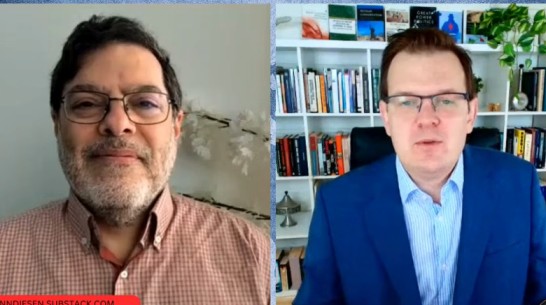
In this interview, Glenn Diesen speaks with Professor Seyed Mohammad Marandi of the University of Tehran about Egypt’s possible military intervention in the Saudi-Yemen war, and why Egypt, Turkey and Pakistan may not be able to change the balance of power. Marandi also discusses the threat of a new US attack on Iran, Saudi Arabia’s internal fractures, and how the wars from Ukraine to the Indian Ocean are pushing the global economy toward collapse. Read the full transcript of this interview below:
Egypt Considers Military Intervention in the Saudi-Yemen War
GLENN DIESEN (00:00:01 – 00:00:16): Welcome back, everyone. Today is Sunday, October 18th, 2026, and we are joined by Professor Seyed Mohammad Marandi, a professor at Tehran University and also a former advisor to Iran’s nuclear negotiation team. So thank you for coming back on the program.
SEYED M. MARANDI (00:00:17 – 00:00:24): Thank you very much for having me, Glenn. It’s always a great honor, a great pleasure, and it’s great speaking with your audience.
GLENN DIESEN (00:00:26 – 00:01:56): Whenever we speak, a key theme is how this conflict or war now keeps spreading, how it’s difficult to contain it. Often, people make the point that the world is interconnected, we’re mutually dependent, this will cause peace. But the counterargument is often that it makes it easier to pull in other countries.
And well, today I want to start with the war, which has of course spread to Saudi Arabia and Yemen, which you and I have spoken about before. It’s not going very well for the Saudis. The US doesn’t seem to be in a position to enter the fight against Yemen, and there’s no good way out for the Saudis. And now we see that Egyptians might intervene militarily. That is President Sisi of Egypt. He has requested a parliamentary vote today, I would add, being on Sunday, October 18th.
And again, we don’t know how the vote’s going to go, but no matter how the vote goes, it does suggest that more countries are being pulled into this war. And Egypt would be, this is not a small country. This could spread the war in a big way. I was wondering, how do you interpret this situation? That is, what kind of help are we talking about and how might this actually develop? Because the problem of escalation is everyone assumes escalation control, that there won’t be any unforeseen consequences. But again, That’s, as we’ve seen, that’s opposite of what’s been happening.
SEYED M. MARANDI (00:01:59 – 00:10:11): Well, the irony is that Egypt once went into Yemen and fought these people and lost. And ultimately that contributed to its defeat against the Israeli regime in 1967. They weakened themselves. And they carried out atrocities as well. And to no avail.
Right now, you’re absolutely correct. The situation is getting more dangerous. I think the entire globe is sleepwalking towards a catastrophe because if Trump does carry out the assault on Iran that he is claiming that he is going to do, or he is implying that he will carry out, then I think that we will have that global economic catastrophe that we’ve been talking about for the last 7, 8 months.
In the case of Yemen, it is quite strange how the war expanded. Because this expansion actually didn’t have to happen. The Saudis provoked Yemen because of a passenger plane that was returning to Yemen from Iran, taking back a delegation that took part in Ayatollah Khamenei’s funeral. As the plane was about to land, an Iranian passenger plane with men and women as well on board, they bombed the airport and the plane was in a very dangerous situation and it was forced to leave for another airport. And interestingly, the Saudis did send a delegation to the funeral themselves.
So whether the Saudis themselves started this or the Americans provoked them, because many believe that the Americans Many who have knowledge, I’m not saying it’s out there, they’re definitely correct, but it’s multiple sources that say the Americans pushed the Saudis to carry out this airstrike on the airport. So this expansion of the war didn’t even have to happen.
When the Americans attacked and the Israelis attacked Iran during the 12-Day War, Yemen did not get involved. When the Americans and the Israelis launched their massive attack against Iran with the support of Saudi Arabia and Qatar and the Emirates and so on, Yemen didn’t get involved. So this expansion of the war was their own doing. Now, what were they thinking? Who knows? Because we’ve been discussing this together for a very long time now, that if Yemen gets involved, there’s nothing that Saudi Arabia could do to stop their assault.
And Yemen at the moment is not pushing into Saudi Arabia. It’s only taking territory from Saudi proxies, and it’s firing back at Saudi Arabia, striking its energy installations and its airports in response to the siege on Yemeni airports and the bomb and airstrikes on Yemeni airports and ports too. So, but still this constitutes a major escalation and expansion of the war.
Personally, I think that Egypt is going to hurt itself more than anything else by even talking about getting involved. Turkey, the government, and Pakistan, they are facing lots of backlash, both at home and abroad, because they’ve never done anything, their governments, for the people of Gaza, for the people of Lebanon, for the people of the West Bank. Now, huge territory in Syria has been taken by the Israeli regime since the fall of the previous government in Syria. They haven’t done anything for that.
And then suddenly, They come to the aid of Saudi Arabia against Yemen, Yemen, which is a victim of Saudi Arabia, a victim of Yemen, 11 years of genocide, or at least let’s say 7 or so years of genocide. And during the last 3 and a half years, the Saudis have maintained the siege on women and children across most of Yemen, the northern parts of Yemen.
So they are going to the aid of an aggressor.
Whereas it was Yemen, Ansarullah, or what in the West they call the Houthis. It was they, the Ansarullah, the armed forces, the Yemeni government that stood up against the Israelis when the rest were complicit. Turkey was transporting oil from Baku. And yet Yemen was being bombed by the Israeli regime. Its prime minister was murdered along with cabinet members. And also the Americans waged war against Yemen because it was implementing the Genocide Convention.
So Yemen is seen as heroic across the region and beyond. And whoever turns against Yemen is only discrediting itself and Egypt in particular, because Egypt is right beside Gaza. And during this entire ongoing genocide, especially during the height of the genocide, people across the region and across the world were pleading, including Egyptians themselves, were pleading for the Egyptian army to move into Gaza to stop the genocide, and they did nothing. So, and they allowed the starvation siege to continue.
So when Egypt make— if Egypt makes this move, it’s going to look terrible for them, and it’s not going to really change much on the ground because the logistics of such an operation are extraordinarily expensive and complicated. And Turkey and Egypt and Pakistan just don’t have those capabilities.
And Saudi Arabia doesn’t have as much money at its disposal as many people seem to think. Saudi Arabia has spent many hundreds of billions of dollars on the genocide in Yemen, on these mega projects that got nowhere, on a military that’s obviously useless. And the military in Saudi Arabia is divided into different pieces and they watch one another to prevent a coup. So it doesn’t have an effective fighting force. And then the Saudis have hurt themselves through the siege on Qatar, which was silly and foolish.
In any case, Saudi Arabia doesn’t have the sort of money that it had once upon a time, and it consumes a huge amount of money. And now that it’s got involved foolishly in the war against Iran, it is hemorrhaging badly as well. So I don’t see this as something that will change the balance of power. I don’t think so far at least Turkey and Pakistan are taking any serious measures. Egypt is very poor. And as I said, it is right beside Gaza. It would look even worse than it did for Pakistan and Turkey to even talk about getting involved, let alone getting involved in the fighting. But we’ll have to see. Anything can happen in the mad world that we live in today.
What Can Egypt, Turkey and Pakistan Actually Do?
GLENN DIESEN (00:10:13 – 00:11:29): Fair enough. Well, I think that’s a good point. Well, not just that unpredictable escalation, but what you said about what they chose not to do, that is, they stood on the sidelines during the atrocities in Gaza. And of course, they had nothing to say about what happened in Syria, Lebanon. And now they’re going to intervene with limited means.
But what could be the consequence here? I mean, when they say intervene, do you see, will they simply take a defensive position in Saudi Arabia, defend the Saudis with intercept ballistic missiles and drones coming out of Yemen? Will they try to unlock the Red Sea, that is the blockade, naval blockade on the Saudis? Will they go directly, send troops into Yemen, attack them? And how do you expect, how might Yemen really respond to this? Because they have their own critical infrastructure, the Suez Canal for one. I mean, we’ve seen before what happens if one ship simply gets stuck. It just seems like, yeah, as I started off saying, the room for unpredictable consequences, some of them should be predictable perhaps. So how do you see this?
SEYED M. MARANDI (00:11:32 – 00:17:19): That is a very important question. If they want to get involved, let’s say, and they do take this foolish step, what can they do? Unless they sent troops into Yemen. And during the 7 years of genocide, the genocidal war that the Saudis and the Emiratis carried out against Yemen, at a time when the Saudis and the Emiratis were much better off than today, economically speaking, and at a time when Yemen was much weaker than it is today, Yemen gradually under— during this genocidal war, during the siege, group became more powerful and created its own indigenous drone and missile capabilities.
No doubt Iran supported it, but in any case, it’s indigenous. They are the ones managing it. Obviously, missiles are not going into Yemen from Iran. They’ve created that capability. So today Yemen is destroying key elements in Saudi infrastructure. And Saudi Arabia only has one important thing to preserve itself, and that is the oil industry. So Yemen knows what to hit. They have the means to hit and they know what to hit.
So Saudi Arabia today, which is much weaker than what it was during the— during their war against Yemen, and the same is true with The Emirates. What are they— how are they going to defeat Yemen? Because back then they were funding tens of thousands of foreign fighters or Yemeni mercenaries as well. Both the Saudis and the Emirates at the height of their wealth, or at least in the case of Yemen, it was— in the case of the Emirates, it was definitely the height of its wealth.
Now that— now both countries are treading very dangerous waters because of Iran. Because if Trump attacks Iran and carries out this military assault, then Iran will obviously strike back at these countries because they are deeply involved. So they are in a very bad situation.
And what would happen if, so on the one hand, the only thing I think that, let’s say, Egypt could do is send ground troops. Can it block Yemeni missiles? Well, only the Americans have that capability, and the Americans have run out of missiles. If the Americans could block the missiles and drones, they would do so, but they’re running out. Turkey does not have that capability. Egypt does not have that capability. Pakistan does not have that capability.
If they want to protect Saudi ships in the Bab-el-Mandeb, again, they don’t have that capability. The Americans who have, or at least had, that capability have lost most of their missile defenses. So I don’t see how they can protect Saudi oil assets. And that is the key thing, because if Yemen decides to hit harder and hit more of these oil installations of Saudi Arabia, then the regime would go down very quickly because they’re completely dependent on the export of these goods.
And again, we have to always remember Saudi Arabia and these countries in the Persian Gulf— Qatar, the Emirates, Kuwait— they are consumer societies. They consume a lot of goods. Their lives are heavily subsidized. So a lot of money has to always be injected into these countries on the one hand. And on the other hand, Saudi assets in the United States are in stocks and bonds. Are the Americans going to allow Saudi Arabia to sell their stocks and bonds and assets in the United States, what remains of them, under these circumstances where the US economy is facing such a critical situation? I personally don’t think that any of these countries are ever going to see the bulk of their assets in the United States, but we’ll see.
So unless they send in ground troops, I don’t see any real effectiveness in their participation. And if they do send ground troops, they’ll give lots of casualties. It will be very costly, and I don’t think it’s going to lead to any sort of victory.
In fact, I’ve heard from very well-informed sources that Pakistan and Turkey’s troops that are in Saudi Arabia are based around Riyadh for the most part. And their objective is basically to protect Mohammed bin Salman and the crown more than anything else against potential uprisings, instability, a potential coup, the tribes rebelling, that sort of thing. Otherwise, they have not moved into any offensive positioning near the border with Yemen.
Outsourcing Wars and What Is at Stake for Saudi Arabia
GLENN DIESEN (00:17:22 – 00:19:06): I wonder, again, wild speculations, to what extent the US has been pushing Egypt to do more, because there’s this concept in international relations called buck-passing or outsourcing your wars. So for example, if you want to confront the Russians, you build a Ukrainian proxy. When this doesn’t work well, hand it over to the Europeans, make them pay the price, take over the fight against the Russians.
I feel like they’ve been looking— not feeling, we see that they’ve been looking for something similar in the Middle East, but there’s no real powerhouse there. I mean, well, what army can be sent to fight, for example, the Iranians or Yemen? Saudi would be Well, you could say they’re the strongest one, but they don’t really have a great army. They got great equipment, I hear, but not necessarily the capabilities to use it.
And one can look at different proxy forces, but whatever one wants to do, if one wants to send Syrian troops into Yemen, that would cause new problems. So there’s no good solutions. One can look at the proxies, the Kurds, for example, using them against Iran. You and I spoke about that before, but Egypt seems like an interesting large country to try to throw into the mix. But it just, yeah, this looks like a disaster waiting to happen.
But you talked about the Saudi campaign, the pressure on MBS. I hear that from many places, actually. And I think we can safely say that the Saudi war on Yemen now has been a huge mistake and is failing. But what is at stake now for the Saudis? I mean, And not to make predictions for exactly what will happen, but what could happen here if they go down this wrong path?
SEYED M. MARANDI (00:19:09 – 00:27:59): Well, one of the problems that I think, first of all, people, at least from what I’ve been hearing, are not really taking into account in the case of, let’s say, Egyptian involvement or even Turkish or Pakistani involvement, is the global economic situation. Their economies are in very bad shape because like everywhere else, the price of energy, the price of fertilizers, LNG, everything has gone through the roof. And just like we see in the United States, life is more difficult. Life is more difficult in these countries as well, especially since in the case of Egypt, it’s a very impoverished country with a very large population.
So I’m not sure if that will, that will not cause instability in Egypt itself, where billions of— because again, Saudi Arabia, how much money are they going to spend or are they going to give to Egypt? And at what cost is this going to— is this escalation going to be? And then again, as I alluded to earlier, Yemen could increase the tempo of its missile and drone strikes on Saudi Arabia, thus making the global economic situation worse and Saudi finances immensely worse very swiftly.
And this, I think, it sort of leads to the answer to your question. If Yemen pushes very hard and continues to strike, then if this goes on for a very long period of time, I think Saudi Arabia will gradually move towards instability. The tribes are already, many of them are unhappy and they are in contact with entities outside of Saudi Arabia. At least some of them are, that I know. And this unhappiness actually is not all that new.
And I personally have some anecdotal evidence of this because a group of foreigners linked to an investment company went to Saudi Arabia a while back. And one of the people who was there, who was a part of the delegation, told me that they were going to— they were thinking about a major investment, and they met one of these, some of these tribal leaders, and they spoke to them in private, and they were saying that the situation is not good in Saudi Arabia now. This was, I think, before the 12-Day War. This isn’t something that goes back 2, 3, 4, 5 months ago or a year ago. I think this is at least a year and a half ago, or if not 2 years ago.
So things were not ideal back then, but now when the tribes are looking and seeing that their country— the country is being wrecked because of the obsessions of Mohammed bin Salman, which reminds one of the obsessions of Trump, the behavior both are strikingly similar. Those tribes will get— can get increasingly angry.
Or Mohammed bin Salman’s family, who are no fans of his. We all remember, at least those of us who are a bit older, when he first came to power, that he took his— right after an international investment conference, a few weeks later, he took his extended family to the Ritz at that very same hotel where the investment conference was and tortured them and forced them to hand over assets. So I’m pretty sure, although I don’t have any anecdotal evidence on that front, but I’m pretty sure his extended family does not love him.
And the Wahhabi clerics, and Wahhabis are the ideology of ISIS and Al-Qaeda and Boko Haram is the same as that of Saudi Arabia and Qatar, the 2 Wahhabi countries in the world. Those clerics that have been well fed and well protected and well funded by the Saudis for decades until Mohammed bin Salman came to power, they’re probably not very happy with him either. And so Saudi Arabia, which has all these fractures, that those, it could only be managed, this tribal society with a lot of money. And that money is disappearing. So I don’t think this is going to end well.
And then this is without taking into account, Glenn, the fact that war between Iran or let’s say a new wave of aggression by the United States and perhaps the Israeli regime can be imminent. The Iranians, as we speak, are waiting for the United States to attack. The armed forces are on full alert on the islands. Schools are now online. And I think on some places on the mainland near the islands, some schools are online. So the government, the country, the armed forces, they’re waiting for the United States to assault. The Americans have put everything that they need for a major attack on Iran, like the 40-Day War, they put them in place.
So if that starts, obviously Iran is going to wreck Saudi Arabia for 2 reasons. One, because the Saudis, are involved in this war. They are aggressors alongside the other regimes because they collaborated with the United States and the Israelis during the 12-Day War and this war. Because during the 12-Day War, American refueling planes took off from their bases and refueled American and Israeli jets. And it was free fuel. Along with a lot of free stuff, other free things that they were, Americans were given and continue to be given by these governments. So Iran considers them an aggressor.
But in addition to that, ever since D-Day, ever since Bessent said that he’s going to strangle the Iranian people and bring the people to their knees and destroy Iran, mimicking Trump and his Secretary of War, Hegseth, basically was saying that he’s going to crush over 90 million people. In response, the Iranians said that “we’re going to retaliate and we are going to retaliate by destroying US assets, those assets that belong to the United States and those assets that are linked to the United States.”
Assets that are linked to the United States in the Persian Gulf region, that would include almost everything. Everything is somehow related to the United States and Saudi Arabia and the Emirates and Kuwait indirectly or somehow. So basically Iran can destroy everything. So at a time when the Saudis are already going downhill very fast, and while the Strait of Hormuz is increasingly being narrowed down by the Iranians and the missiles from Yemen are striking very sensitive targets. If this war happens, I think it will be very, very bad for Saudi Arabia.
And again, Saudi Arabia is not Iran. Saudi Arabia is not Egypt or it’s not Yemen or it’s not Iraq. It’s not a civilizational state. It does not have roots in history. It’s a country named after a family and full of tribes. If it becomes shaky, the whole thing could fall apart. There’s no collective identity in Saudi Arabia. The Saudi— the Saud family has only been in charge for a brief period of time, relatively speaking, when we look at history books.
Iran, Yemen and the Threat of a New US Attack
GLENN DIESEN (00:28:02 – 00:29:31): But how would that— again, as you point out, and I think it’s a great point, if this conflict there was isolated, the Saudi-Yemen war. But of course, this is all happening while the US is threatening to do yet another round of attacks against Iran. We know Iran has been preparing itself. How might the Iranians lean in on backing the Houthis then? I mean, not only in relation to the Egyptians maybe intervening, but well, you made the point before that, and I think that’s a very valid point that the Houthis are not proxies of Iran.
I mean, the Houthis or Ansar Allah sat this one out in the previous rounds because, well, they’re a different entity, but there are overlapping interests. For example, both Iran and Yemen are being attacked by many of the same countries. So if the US decides to have this massive new round of attacks on Iran, what might Iran do to assist Yemen in this instance? Or will they be kind of 2 separate theaters? Because when these wars are widening, more countries are pulled in, We see, for example, that the Ukraine war and the war against Iran kind of begins to merge to some extent, some of the logic behind it. And one would assume that the same logic would apply to the war between the Saudis and Yemen.
Three Lanes on the Road to Hell
SEYED M. MARANDI (00:29:33 – 00:35:35): So how I see it is that if the United States attacks— US policy towards Iran is like a highway. I think I mentioned it once before, with 3 lanes or 3 lines. The fast lane, which is massive escalation, that leads directly to hell because Iran will carry out massive retaliation. And the United States strikes Iran’s critical infrastructure. Iran will destroy the critical infrastructure of the Persian Gulf. That’s finished, Yemen wins the war because Saudi Arabia is finished. It won’t last. Neither will Kuwait.
None of these countries will last if their critical infrastructure is destroyed because they’re just deserts. They’re nothing. They’re tribes in the pocket, let’s say, bound to the United States, very vulnerable. They participated in this aggression and they’ll pay the ultimate price.
So if Trump goes, attacks Iran and starts bombing Iran’s infrastructure, then I think depending on how extensive it is, that will be the fast lane towards hell. And I mean hell, it means, I mean the global economy too, because when that happens, I think a global economic depression will be very swift. I think the markets will immediately recognize that the catastrophe has happened. The red lines have been crossed.
Then there’s a second line where Trump carries out some sort of, you can’t say token when he, if let’s say he uses the so-called mother of all bombs, the Iranian response would be massive. But let’s say it is a lesser sort of assault on Iran. Not this all-out assault, then Iran still is going to strike back very hard. It’s going to shut down the Strait of Hormuz and destroy lots of infrastructure on this other side because this would still be an assault on Iran and Iran’s infrastructure. So that would be on the same road to hell, but a slower lane that would severely weaken Saudi Arabia. And meanwhile, Yemen will be hammering away at the regime. And the economic crisis across the world, including in Egypt, including in Turkey, including in Pakistan, will just get much, much worse.
Then there’s the third line or the third lane, and that is what we have now. And what we have now is still the same road to hell, but it’s just slower. The global economy is getting worse. We see the impact on the US elections. A lot of people are not going to vote for Trump’s candidates. Well, some of them because they have a moral compass, but some of them because the price of diesel and gasoline and other products such as fertilizers have gone through the roof. And so they may not care about Palestinians, some of his supporters, they may not care about kids in our region, but they sure do care about the price of diesel.
So he’s already hurting badly because of the current situation. Well, this, if this continues, Iran is not going to open the Strait of Hormuz. The Strait of Hormuz, at best, it’ll be something like what we already have. So that is also going to grab at a more slow pace, drag the globe towards a hellish situation. And that includes Saudi Arabia because Saudi Arabia cannot export its oil. It cannot export its petrochemicals. It’s fighting Yemen simultaneously. It’s just going to get worse and worse.
Who, which side is tougher? It’s Yemen. Which side has, can tolerate more pain? No doubt, Yemen. Can Saudi Arabia tolerate pain? No, not much. Nor can any of these other regimes. Very vulnerable, very reliant on huge amounts of wealth, and very popularly— I mean, at the popular level, they probably are not legitimate in the eyes of the majority, especially now under these circumstances. And after 3 years of genocide in Gaza, because no doubt that across the region and across these countries, people are quietly opposed to their policies on Palestine. But because they’re absolute monarchies, no one is allowed to say anything.
I mean, I’m sure you recall when Saudi Arabia and the Emirates besieged Qatar. Who was their ally? They, together, they were funding ISIS and Al-Qaeda and doing all these horrible things together. And both bound to the United States. When they imposed the siege on Qatar, I remember the Emirates put this law in place where if anyone said anything good about Qatar, they’d go to jail for 10 years. And they’d have to pay a fine of $300,000.
So these are the— so I mean, your viewers can look this up, but this is the sort of situation that people in these countries are dealing with. Obviously they don’t have a voice, but if the regimes become less stable, the future becomes more uncertain, then I think we’re going to start hearing people speak out, and then things could change very rapidly.
A War Front From Ukraine to the Indian Ocean
GLENN DIESEN (00:35:38 – 00:36:23): Well, just a last question on, yeah, the rapid escalation and the widening. If now we see the Saudi-Yemen war widening, and of course the United States will seemingly seem to have decided already to go for another round of war with Iran, What, is there any of the other actors on the board here you are really paying attention to? Because we have Iraq, we have Turkey, we have Pakistan, Syria, Israel, Qatar, UAE. I mean, which, these are all different actors with different interests which would play different roles. Is there anything that stands out in terms of how you think the war might develop from here on?
SEYED M. MARANDI (00:36:25 – 00:42:34): Well, one thing I forgot to mention now that you asked this question is that I think you’re absolutely correct that the Americans are pushing Egypt, although I have no evidence for this. They’re pushing Egypt to get involved. Why? First of all, as I said earlier, from the sources that I have a lot of trust in believe that Americans push Saudi Arabia. But also, a couple of weeks ago, I think it was Trump told reporters that he’d like to see Turkey get involved in Yemen and on the side of Saudi Arabia. I think he said that in response to a journalist who put the question to him. So the Americans are, they are already spreading the flames of war.
I think that what you said earlier about Europe and West Asia merging is a valid point. The war in Ukraine is raging, and regardless of how you interpret Trump’s behavior towards Russia these days, This is definitely a sign of defeat against Russia for Trump to shift policy, whether he’s successful or not, or whether he can, because we already see how weak he is against Zelensky. Now we have to see again how things play out in the days and weeks ahead, and he may get the upper hand in this conflict that he now has with Zelensky.
But the point is that all of these are signs that the war, as we always, we always knew that the war is not going well at all. And the escalation that Zelensky initiated was a catastrophic mistake. And Trump, by the way, supported that escalation. So the United States is losing the war in Europe.
And I think that This, we can sort of see this front going from the northern tip of Ukraine to the Indian Ocean. This is a war. It’s not 2 armies fighting on 2 sides of a battlefield, but there is this war going on from Europe to the Indian Ocean. And it’s not sustainable. The globe cannot continue this way. The global economy is hemorrhaging. The US economy, European economies, this is not going to continue forever.
So I think that while it can get, it can expand further, I think we’ve reached a point where the real question is perhaps not whether it’ll expand much further, meaning adding new countries, But whether the whole system will begin to crash. And if the global economy tanks, if we head into a Great Recession or a Great Depression, will the United States even be able to keep troops in our region to continue the fight? Or will they have to start emptying out the hundreds of military bases that they have across the world just to maintain stability at home.
The events in Europe right now, in France, I think are, should be warning signs for Trump and for all leaders in Europe and North America and their other allies that the current situation is not sustainable. And while it would be catastrophic for everyone, for the entire global economy and for Iran— war is definitely not a good thing for Iranians as well, but the Iranians know what they’re fighting for. They’re on the— they’re defending themselves, so they’re going to be more steadfast. Yemen knows that it’s defending itself, but these countries, their people were against the war and they’re against the genocide, and they’re going to see that the war and the genocide has been brought upon them by Zionism, by Israeli firsters, by Trump, by Netanyahu.
This is not going to end well, in my opinion, if this continues for much longer. Now, how much longer can the system continue? I have no idea. I always ask people who I think know a thing or two about the economy. A couple of them are your own guests. And they say that it’s not possible to say. And so it could be days away, it could be weeks away, it could be months away, it could be more than a year away. But from what I’m seeing and from what I’m hearing, there is a general consensus among people who I respect that the system will collapse.
So whether Egypt comes in or not, or Turkey or Pakistan on behalf of the United States and indirectly on behalf of Israel, because this is one alliance, it is only going to— this is only going to act as a catalyst to make the situation worse. They’re going to have more problems at home and then Ansar Allah is going to have to go And hit the Saudis as hard as possible in order to bring, inflict so much punishment that the regime backs down. And that would mean, I think, an increase in the number of missiles and drones. And that is assuming that there’s no war between Iran and the United States, because if that happens, then I think, so if it’s a major war, I think Saudi Arabia is finished.
Trump, Ukraine and the Collapse of Trust
GLENN DIESEN (00:42:37 – 00:43:25): Yeah, well, this is, you can see kind of, of course you can look at the possible countries joining in, but when you add to the mix the world economy, which is falling apart and all these wars which begin to merge, it is profoundly problematic. You don’t see any good outcome here. And even when you see some reference to diplomacy, It’s very shallow and deceptive. Even now, you mentioned Ukraine, that Trump is shifting his position. But why? Is he genuinely putting an end to the war? Because I was, he was fully back, fully behind Zelensky’s efforts to escalate in this big way, to do this 40-plus strikes into Russia.
SEYED M. MARANDI (00:43:25 – 00:43:28): At the NATO conference.
GLENN DIESEN (00:43:28 – 00:43:58): Yeah, but when it didn’t work now and it’s backfiring, well, what does he do? He essentially says, “Oh, well, Ukrainians are reckless, we’re distancing.” So when the consequences come, he takes a step back and makes sure that, okay, at least they won’t result in a Russia-US war, that this is— the Russians will take it out on the Ukrainians and perhaps the Europeans, but for the US to step back. It doesn’t mean anything. He’s not going to actually finish the war. Sorry?
SEYED M. MARANDI (00:43:58 – 00:45:25): I think it’s more cynical than that. I think it’s just about his election. I think he, the only thing that’s important for him is to see if he can just bring down the price of diesel just enough so that he will not perhaps lose the Senate. I think it’s that bad. And that if he is able to get by, he’ll just continue with the same policy in our region and until the economy crashes.
And the thing is that I think I know enough about Russia, not nearly as much as I should, but the Russians are not stupid. They’re not foolish. They regularly say that “we’ve been deceived by Trump too many times.” I’ve heard it from many Russians. And experts. And I’ve heard it from those who are— who’ve been traditionally Atlanticists, not those who’ve been or who’ve always been critical of the United States. I’ve been hearing it from those who’ve been working hard during previous decades to build bridges with the West.
They’re saying that “we just can’t trust these people because they’re constantly shifting their position. And ultimately, if they can, they’ll go back to trying to undermine us.” So Trump is not going to be able to build any trust with the Russians regardless of what he does.
Closing Remarks
GLENN DIESEN (00:45:27 – 00:45:52): Yeah, no, that was a point. That’s all this— more countries get drawn in, we escalate, the large conflicts merge. We all see at the same time diplomacy has kind of lost its credibility. There’s no trust. It just looks like a recipe for, well, a world war, to be honest. But Well, let’s hope not. Thank you very much for discussing these very depressing topics with me on a Sunday morning. I very much appreciate it.
SEYED M. MARANDI (00:45:54 – 00:46:14): Thank you very much for having me, Glenn. It’s always a pleasure. And the good thing is that people across the world are waking up and that’s what gives me hope and the fact that there is a God and hopefully we will see better days at some point.
Related Posts