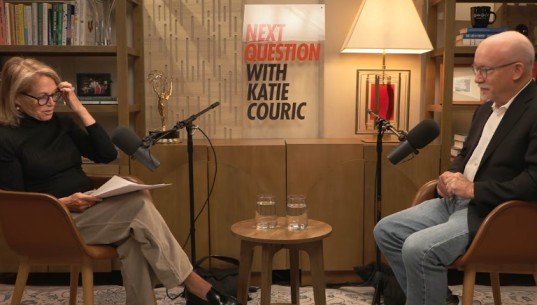
Oscar-winning documentary filmmaker Alex Gibney sits down with Katie Couric to discuss Musk, his four-year HBO documentary on Elon Musk, the world’s richest and most polarizing man. Gibney unpacks the myth of Musk as a visionary founder, the fallout from DOGE and the USAID cuts, the risks his data and money pose to the 2026 midterm elections, and why he sees Musk as a dangerous “confidence man.” Read the full transcript of this interview below:
Introducing Musk
KATIE COURIC: (00:00:00 – 00:00:52) Alex Gibney has built a remarkable career exposing the secrets of some of the world’s most powerful and controversial figures, from Henry Kissinger and Steve Jobs to Elizabeth Holmes and the Church of Scientology. Now the Oscar-winning documentary filmmaker is focusing his lens on Elon Musk, the world’s richest man and one of the most powerful and polarizing figures on the planet.
His new film, Musk, takes a hard look at the trillionaire’s— yes, trillionaire’s— carefully cultivated image as a visionary genius, the reality behind some of the most celebrated accomplishments, and his increasingly consequential role in American politics. It also raises troubling questions about the enormous power Musk has accumulated and how he’s chosen to wield it. Take a look.
(VIDEO CLIP)
KATIE COURIC: (00:03:17 – 00:03:20) Alex Gibney, great to see you. Thank you so much for doing this.
ALEX GIBNEY: (00:03:20 – 00:03:21) Great to see you, Katie.
KATIE COURIC: (00:03:21 – 00:03:33) Listen, I’m such an admirer of your work, and I imagine that every time you put a documentary out in the world, you feel like you are giving birth. This birth must have been particularly complicated.
ALEX GIBNEY: (00:03:33 – 00:03:34) It was.
KATIE COURIC: (00:03:34 – 00:03:36) How are you feeling about this project?
ALEX GIBNEY: (00:03:36 – 00:03:37) I needed an epidural.
KATIE COURIC: (00:03:37 – 00:03:39) Maybe 5.
ALEX GIBNEY: (00:03:39 – 00:04:46) Maybe 5. Yeah. It took 4 years. We thought we were finished in the spring of 2024. And I was going to— I had a 2-hour film. It was going to be released for the fall festivals, but then Trump was nearly assassinated. The day of or the day after, Musk officially hitched his wagon to Trump, and my pals at HBO said, “You’re not done. Keep following the story. Keep going.”
So they were right, but I gulped and kept going, and ended up being the reason the film is as long as it is, because some of the patterns that we discovered in the first iteration ended up— the patterns just exploded in the later sort of political aspect of the story. So there was an advantage in a way to showing how the issues got bigger and bigger and bigger.
Why Elon Musk?
KATIE COURIC: (00:04:47 – 00:04:51) Why did you want to set your sights on Elon Musk in the first place?
ALEX GIBNEY: (00:04:53 – 00:05:00) Yeah, to be honest, I wasn’t sure I wanted to. Some people came to me and said, “You should do the film on Elon Musk.” I thought, well, maybe.
KATIE COURIC: (00:05:00 – 00:05:01) Easy for you to say.
ALEX GIBNEY: (00:05:01 – 00:05:13) Yeah, exactly. But there was a part of me that was intrigued by him. I was really into his solar or his electric car mission. And I owned—
KATIE COURIC: (00:05:13 – 00:05:16) In fact, right, you had a Tesla.
ALEX GIBNEY: (00:05:16 – 00:05:46) I had a Tesla. That’s a Tesla Powerwall, right? And I was really into that. There were issues with it that I would discover that had to do with his business, but at the time I didn’t know. So he was an intriguing guy, and by that time he was already the richest man in the world.
But a pal of mine said, “No, you should really do it because it’s a story about 21st century power.” And he was right. I just didn’t know how powerful that 21st century figure was going to become.
Threats, Safety and Big Tech’s Pushback
KATIE COURIC: (00:05:47 – 00:06:20) When he first caught wind of the fact that you were setting your lens on him and doing this documentary, I mean, he took to X and he called you, among other things, a crackpot, an idiot. Someone for whom dog shit is worth more respect.
And I thought it was funny when you said— when he wrote something like— and you put this in the beginning of the film— because he— “Alex Gibney is a douche.” And I thought your comeback was so funny. You said “douché” on X.
ALEX GIBNEY: (00:06:20 – 00:06:36) Yeah, well, that was actually the earlier— some of the quotes you made were more recent, but virtually the very first thing he said as we were trying to engage with him was, “Gibney is a douche.” But yeah, later came the dogshit.
KATIE COURIC: (00:06:36 – 00:06:58) Early on, did it give you any pause about doing this? Because you have acknowledged, quote, “you’d be a fool not to be concerned, given that he’s the richest man in the world and also because he has the ear of a president who has turned the Department of Justice into an instrument of revenge.” Do you worry about your personal safety, Alex?
ALEX GIBNEY: (00:06:58 – 00:07:47) I do. I do, and there are certain precautions I’ve taken, but I think in a way the biggest precaution is to hide in plain sight and to be forcefully critical because the purpose of a bully sort of threatening is to make you shut up, and Elon Musk assiduously safeguards his image. And the one thing he can’t abide is somebody messing with that image.
But I think all of us need to, because if we don’t, he’ll continue to accrete more power without any sense of responsibility. So I feel like being public about the critique is a kind of protection.
KATIE COURIC: (00:07:47 – 00:08:22) We’re going to talk about your approach to the film and how you worked around the fact that he would not do an interview, not surprisingly.
ALEX GIBNEY: (00:08:22 – 00:09:10) I do, but it’s a little bit more insidious than that. It’s not like the executives of all the big firms sit in a room and say, “Okay, let’s examine this one and we’re going to censor here and censor there.” What they do is to put in place a system that’s designed to forestall criticism and particularly designed to forestall criticism of them and the way they do business. And they define it as political if you criticize them. How convenient.
And in a way, it’s kind of like what Jeff Bezos did to the editorial department or the op-ed department at the Washington Post. “We shall no longer be running articles that are critical of wealthy people or business.” It’s like, really? That’s how weak you are?
KATIE COURIC: (00:09:11 – 00:09:17) Was he that overt about that? I thought they just couldn’t write op-eds endorsing a candidate.
ALEX GIBNEY: (00:09:17 – 00:09:33) No, no. I think I may be wrong about this, but I’m pretty sure that if you go back and look, that he was objecting to the idea that there were op-eds or editorials in The Washington Post which seemed to be, in his view, anti-business.
KATIE COURIC: (00:09:33 – 00:09:34) Right. Anti-capitalism.
ALEX GIBNEY: (00:09:34 – 00:09:35) That’s right.
KATIE COURIC: (00:09:35 – 00:09:41) Right. And he wanted to kind of shift. I didn’t know if he had said it as overtly as you said.
ALEX GIBNEY: (00:09:41 – 00:10:24) Well, he probably— I said it a little bit more directly than he may have done. He may have used some euphemisms that felt more comforting to people. But I think that switch from his position during the first Trump presidency when the Washington Post under Marty Baron was really a sort of a beacon in terms of cutting through the bullshit and really trying to get to the truth.
So I think that there’s a kind of inchoate sense among the tech oligarchs that they’re going to limit debate, limit speech, so that the culture at large only hears what they want them to hear.
KATIE COURIC: (00:10:24 – 00:10:30) Or because they don’t want the government coming after them and hurting their business, right?
ALEX GIBNEY: (00:10:30 – 00:10:55) I think that’s right, but I think it’s gone beyond fear. I think that with Donald Trump, they understand that if they pay him or if they flatter him, they’ll get what they want. And so I don’t think they’re defending their brand of capitalism because they’re afraid of Donald Trump. I think they see Donald Trump as a means to protect their financial interests.
Universal and the Legal Threats
KATIE COURIC: (00:10:56 – 00:10:59) Let’s talk about the squishiness of the Universal stuff too.
ALEX GIBNEY: (00:11:00 – 00:11:01) Sure. They—
KATIE COURIC: (00:11:01 – 00:11:15) You’ve kind of ironed this out, I understand, but Universal has the international rights to your film. Correct. And they were kind of being a little weird about it. They were. What happened?
ALEX GIBNEY: (00:11:16 – 00:12:20) They— it had gone kind of silent because we were hoping for everybody to come and be ready to release this fall, and Universal was really not engaging. When we went to the Venice Film Festival, they didn’t want their logo on it. And I still don’t know exactly what happened. Was it— were they really concerned about the legal issues? I mean, maybe, but did they want to see how a 3-hour and 45-minute film was going to perform at the Venice Film Festival? Maybe. In any event, they’re on board now.
I was dismayed though, and also in an environment, to your point, in an environment where Donald Trump and his FCC commissioner had made it so clear how they’re going to punish critics, maybe that was an issue, thinking in a larger corporate sense. “Do we really want to adversely impact the bottom line in order to be able to tell the truth?”
KATIE COURIC: (00:12:20 – 00:12:21) You think?
ALEX GIBNEY: (00:12:21 – 00:12:24) Just saying.
KATIE COURIC: (00:12:24 – 00:12:28) Yeah. Tell us about the legal issues that are floating around now.
ALEX GIBNEY: (00:12:29 – 00:12:51) Well, I mean, he’s threatened to sue. He, of course, without having seen the film. That seems typical. His lawyer Alex Spiro, when an article was written about the film even before its premiere in Venice, threatened to sue over something that we didn’t say. They claimed that we said, but we didn’t say.
KATIE COURIC: (00:12:51 – 00:12:52) So what did they claim you said?
ALEX GIBNEY: (00:12:53 – 00:14:03) Well, they claimed that we said in the film that he interfered and in the 2024 election and change votes. We never said anything like that. We did show some texts from Elon Musk to his lover, Ashley St. Clair, when they were talking about how quickly Elon Musk was certain that Trump had won long before anybody else had called it. And he sent her some texts saying, “I found an anomaly in the matrix. I have 10,000 lasers in space.” And as a way of telling her, that’s why I know that the election is going to go our way.
So he— as if he had some sort of special knowledge. Now, we don’t know for sure whether he was bullshitting her or what that even meant or what that even— well, we know it referred to Starlink, right? That’s what the lasers in space is all about. But he seemed to be implying that he had special access to information that other people didn’t have. And so that he knew before other people, everybody else, that the election was going to go Trump’s way. That’s what’s in the film. But it doesn’t say that he switched votes.
The Simulated Interview
KATIE COURIC: (00:14:04 – 00:14:16) Let’s talk about your approach. I liked your director’s note about not allowing Elon Musk to be the master of the narrative, which is sort of his MO, right?
ALEX GIBNEY: (00:14:16 – 00:15:25) Yeah, I think he’s the writer, producer and director of his own movie story, right? And he assiduously guards the image that he wants to portray as a kind of a modern Leonardo da Vinci who’s also trying to save civilization. So I think that if you allow him to project that narrative, you buy into something that’s a fiction.
He once said, what did he say on Twitter, I think in 2020, he said, “He who controls the memes controls the universe,” a kind of play on the line from Dune about spice. And he’s very interested in the memes that he represents, which is interesting in a way because I think particularly Tesla has long been a meme stock, and that’s kind of the utility of it too. He creates an image of himself that is really not accurate in order to be able to persuade people to invest in some mythical future that he’s going to provide.
KATIE COURIC: (00:15:25 – 00:15:41) I’m going to talk to you more in a few minutes about kind of the conning he does to sort of advance his goals. But first, the fact that he didn’t do an interview, wouldn’t do an interview, made it difficult for you in a way.
ALEX GIBNEY: (00:15:41 – 00:15:44) Yes. He’s the central figure, and he’s not going to talk to me.
KATIE COURIC: (00:15:44 – 00:15:54) Exactly. So you did something really interesting as a result. Talk about how you came up with this idea and how you executed it.
ALEX GIBNEY: (00:15:55 – 00:16:40) Sure. So, okay, we’ve got a problem. I want to do a film about Elon Musk, and Elon Musk won’t sit down to talk. Okay. We got a clue for where we might go as we were doing our research, and over and over and over again in the archival clips he kept saying, “I’m almost certain that we’re living in a simulation.”
The idea that we’re the product of some future AI or alien being who’s exfiltrated all knowledge from planet Earth, and we’re now being played as a kind of existential video game. This is a kind of sci-fi trope that comes from other people, but he evinced the idea that he really did believe it.
KATIE COURIC: (00:16:40 – 00:16:45) That was a real head-scratcher for me, by the way. Yeah, I was like, what the fuck is he talking about?
ALEX GIBNEY: (00:16:45 – 00:16:51) Well, I think that there are people who, there’s a guy named—
KATIE COURIC: (00:16:51 – 00:16:53) That we are living in a simulation, basically.
ALEX GIBNEY: (00:16:53 – 00:18:08) That’s right, that’s right, that it’s an AI concept in a way, and there’s a guy named Nick Bostrom who sort of postulated this, and he has a very elaborate theory. Elon Musk’s version of it is a lot more reckless, but, or careless, but he believes it. So I thought, okay, let’s take him at his word because he’s also obsessed with gaming, video games, and so I thought, well, what if we do a simulated interview? That might be amusing and interesting.
And so what we did is we accumulated a massive database of everything he had said, either on video or audio, sometimes outtakes from documentaries. And as we were constructing our story, whenever it seemed appropriate in the cut to go to an interview with Elon, we would look up options for something he had said on that subject, and we’d place it there.
And then when we got very late in the game, when we had it close to our lock cut, we thought, okay, now we’re going to have him speak to us as if it’s an interview. And we designed a set, we designed an outfit for him, black leather jacket in a gamer chair.
KATIE COURIC: (00:18:09 – 00:18:10) And he’s looking pretty buff.
ALEX GIBNEY: (00:18:10 – 00:19:22) I thought he’d look good. I mean, but as the director of the film, I want my star to look good. So, and he’s looking directly at camera, which I thought was important because actually the real Elon Musk is always going like this. It never really engages you or looks you in the eye. I thought this Elon Musk is going to look us in the eye as if we’ve got special access to Elon Musk. After all, it’s my simulated interview.
So we played with a whole lot of idea, and also we played with this idea, and we reveal it in the film, the device. It’s also an idea that seemed relevant to a lot of the themes in the film, both what is real and what is unreal, and also this kind of uncanny relationship that we’re beginning to develop with the LLMs. We ask them questions and they’re very solicitous, and we start to project our own feelings on these LLMs.
And I’m told that people who watch the film, over the course of the film, forget it’s a simulation and began to lean into it. So for all those reasons, it felt like an earned cinematic way to get at something. That was part of the story.
KATIE COURIC: (00:19:22 – 00:19:41) But obviously you’re making an editorial call, Alex, right, on what you believe, given all of his previous responses or conversations, interactions, etc., what he would be saying about a certain something. Was that decided by AI? Did you know?
ALEX GIBNEY: (00:19:41 – 00:20:10) So that’s an editorial choice. Well, but think about it. So let’s say somebody, for example, there’s a version of the origin story of Tesla as spoken by Martin Eberhard, the real founder of Tesla, and I thought, well, what would Elon say in response? Let’s have him push back. So we go to the archive and we want him to push back. “Give us your view, Elon.”
KATIE COURIC: (00:20:11 – 00:20:22) And so, and he has talked about that in the past. You don’t necessarily jam sort of sentences together to make him say what you want him to say.
ALEX GIBNEY: (00:20:23 – 00:21:19) You were using his actual words to make him say what he would want to say. In other words, if I’m channeling Elon, I’d say, “Okay, give it your best shot, zing back, Elon, with something that’s tough.” There’s a couple of rants he has about sort of moral calculation that in some abstract way can be extremely compelling, and I put them in not because they were ham-fisted but because they were compelling.
And you’re like, “Give us your best shot, give us your best argument,” and that was what we would do in the cutting room, like where did he address this in the most convincing possible way? Let’s put our Elon hats on. So that’s how we did it. It wasn’t like that— for the same reason I didn’t want to make him look bad in the simulation. Like, let’s put him at his best. Let’s see the best and most effective version of Elon and see if it holds up.
The Myth of the Visionary Founder
KATIE COURIC: (00:21:21 – 00:21:44) Regardless of what people think of his politics or his behavior, I think many still view him as a brilliant inventor in the mold of Thomas Edison or the Wright brothers, just this extraordinary visionary, an entrepreneur. How does the reality— I mean, I feel like nobody knows Elon Musk better than you at this point, Alex.
ALEX GIBNEY: (00:21:44 – 00:21:50) Yeah, I don’t know about that, but well, I spent a lot of time, spent 4 years thinking about him.
KATIE COURIC: (00:21:50 – 00:21:52) Well, you know more about him than the average bear, right?
ALEX GIBNEY: (00:21:52 – 00:21:53) Certainly that’s true.
KATIE COURIC: (00:21:53 – 00:22:01) So how does the public perception differ from the man that you uncovered in the course of making this?
ALEX GIBNEY: (00:22:02 – 00:24:15) Well, first of all, let’s say some positive things about Elon Musk. I mean, as an entrepreneur, as a fundraiser, as a guy who was determined to have his businesses succeed, as somebody who was also able to create a sense of mission for his companies, for Tesla, this idea that electric cars are going to help us solve climate change. SpaceX, we’re going to take over from the sort of bloated efforts of NASA to find an efficient way to get to space and back. These things he did accomplish, but the idea that he is this kind of Leonardo da Vinci-like figure is a fake.
He wants to be seen as an engineer, but he’s not a trained engineer. He wants to be known as the founder of Tesla, and that’s a kind of an interesting story because I interviewed Martin Eberhard, who along with his partner Marc Tarpenning, they were the real inventors of Tesla. They were the founders. They were on the founding document.
They were the ones who came up with the lithium-ion battery pack that powers the Tesla and makes it go so fast, and also came up with the business plan for starting at the top of the market as a luxury car, and then as people adopt and get— and more and more people want to buy, you drive the cost down. All that was Martin Eberhard, not Elon Musk.
As Tesla, and Musk was the— an early investor, not an inventor, and he was spending most of his time at SpaceX. He and Martin Eberhard come to blows. He fires Eberhard and then refuses to pay Eberhard what he thought he was owed. So Eberhard sues, and the lawsuit only gets settled when Elon insists that in the settlement, it has to say that Elon Musk is— was what he wasn’t, which was a founder of Tesla.
Now, that is a guy who insists on a lie in order to be able to settle the lawsuit, but it’s a lie that begins to write the first part of the script of how Elon wants to be perceived, not as a businessman but as an inventor.
KATIE COURIC: (00:24:15 – 00:24:19) And yet another example of his ability to master his own narrative.
ALEX GIBNEY: (00:24:20 – 00:24:20) Correct.
KATIE COURIC: (00:24:20 – 00:24:20) Right?
ALEX GIBNEY: (00:24:20 – 00:24:21) That’s right.
KATIE COURIC: (00:24:21 – 00:24:41) And I think in this world, certainly of tech oligarchs, as you call them, and these people in this whole new universe of technology, part of the mission and the sales job is how the public perceives you, right?
ALEX GIBNEY: (00:24:41 – 00:24:43) “We’re saving humanity.”
KATIE COURIC: (00:24:43 – 00:24:48) In that case, he’s quite shrewd, to say the least.
ALEX GIBNEY: (00:24:48 – 00:25:14) He’s shrewd, and he also— I think one of the interesting things about the film, and it’s a question I pose early on, is how did he get so much power and why did we let him get it? And I think the why goes to Elon’s ability to exploit flaws in our system that we’re not as aware of as we should be.
KATIE COURIC: (00:25:14 – 00:25:14) Like what?
ALEX GIBNEY: (00:25:15 – 00:25:51) Well, how money affects politics. That would be one. But also the kind of fake-it-till-you-make-it con of Silicon Valley. The idea that you can create a myth that you’re this founder of this extraordinary technology and for that, enormous riches should be bestowed on you.
And from that notion comes this idea that you’re— the founder is the only person that matters. Forget about the engineers at the companies. Forget about the workers at the factories. All of those things are meaningless. It’s only the founder. It’s winner-take-all capitalism.
Con Artist or Confidence Man?
KATIE COURIC: (00:25:51 – 00:26:01) It’s not only sort of mythology, though. Also, your film, I think, illustrates he’s kind of a con artist.
ALEX GIBNEY: (00:26:01 – 00:26:19) So when you say con artist, it’s a really interesting term because the term I would prefer to use is confidence man. And the reason I say that is twofold. One is, I interviewed his first wife, Justine Musk, and I did—
KATIE COURIC: (00:26:19 – 00:26:20) Heartbreaking, by the way—
ALEX GIBNEY: (00:26:20 – 00:26:35) Heartbreaking interview. But very perceptive interview. And one of, I asked her, “What was it you found so intriguing about him when you fell in love with him?” When they were, they met in college in Canada.
KATIE COURIC: (00:26:36 – 00:26:45) She was very besotted, clearly. Yes. You could see in every picture she’s just sort of, yeah, so in love with him.
ALEX GIBNEY: (00:26:45 – 00:27:39) Yes, she was. And she said, well, it was his enormous confidence, right? And that was very attractive to her, and also the determination to make his dreams real. She also says, though, that she learned about gaslighting from him and the idea of making her believe something that wasn’t true by force of his personality, by force of his confidence.
And in that, he shares something with Donald Trump. You prosecute a lie through enormous confidence. You just don’t back down. You keep saying it over and over and over again until people start to believe it. They back down. There’s a peculiar psychological, I think, flaw in our makeup where when somebody approaches you with enormous confidence, there’s a kind of, “Gosh, maybe he’s right.”
KATIE COURIC: (00:27:40 – 00:27:48) But it feels like it’s more than a confidence man to me, Alex. I feel like he has stepped into the con artist territory. He’s crossed the line.
ALEX GIBNEY: (00:27:48 – 00:27:51) Well, but I think that’s what a confidence man is. In other words, a confidence man—
KATIE COURIC: (00:27:51 – 00:27:55) Yeah, I was going to say, what is the difference? Isn’t that just a nice con artist?
ALEX GIBNEY: (00:27:55 – 00:28:30) Well, no, no, I don’t think it’s just a— that’s where the myth comes from. I mean, a con artist, confidence man, it’s the same thing. I just like the word confidence because a con is simple. But the con comes from the confidence. In other words, that’s how you get over.
That’s how Elizabeth Holmes did it. It’s looking to you in your eye, unblinking, and saying, “Yes, this machine, this Edison machine, is going to save humanity.” And guess who? Larry Ellison signed up. Rupert Murdoch signed up. I mean, all of these very cynical men. It’s like, “I’ll give you hundreds of millions of dollars.” How does that happen?
KATIE COURIC: (00:28:30 – 00:28:59) Well, I think, yeah, I don’t want to belabor the point, but confidence man sounds a lot less malevolent than con man. And let me give you an example of why I would conclude he’s a con man.
You show footage from a deposition in which a company engineer at Tesla reveals that a promotional video claiming to show a Tesla driving fully autonomously was staged, and 65 deaths have been linked to car crashes where Tesla software was a contributing factor.
ALEX GIBNEY: (00:28:59 – 00:29:00) Yes.
KATIE COURIC: (00:29:00 – 00:29:01) Isn’t that a con man?
ALEX GIBNEY: (00:29:02 – 00:29:04) Well, it’s worse than a con man. Now you’ve—
KATIE COURIC: (00:29:04 – 00:29:05) It’s criminal.
ALEX GIBNEY: (00:29:05 – 00:29:37) It’s criminal. And by the way, the Department of Justice was looking into that as a criminal act, because that’s where— but that’s why it’s important to start at the beginning. There’s a phrase that I often use called noble cause corruption, where you think that it’s okay to lie, cheat, or steal in the service of a higher ideal. But soon, that corrupts you, so much so that you’ve lost your tether to any sort of moral compass.
KATIE COURIC: (00:29:37 – 00:29:49) And he also did it with this battery-changing operation, right? It’s like, look over here, yeah, we’re going to change this battery in the undercarriage of the Tesla, and you can change it like you’re doing it with a flashlight, I think you’ve said.
ALEX GIBNEY: (00:29:49 – 00:29:52) Well, yeah, and the battery of a Tesla was— is 1,000 pounds.
KATIE COURIC: (00:29:52 – 00:29:54) And so, and it just—
ALEX GIBNEY: (00:29:54 – 00:31:17) And he— and by doing that, he convinced the government of California to give him, I think it was $100 million in credits. And not only that, but they consciously made the range on Teslas fake so that it was this fake range for the first 50%, but because they didn’t want you to run out of juice suddenly under 50%, it drops like a stone to the real range.
And when people called to complain, they had a boiler room, sort of like Glengarry Glen Ross or something like that. And basically they were there to talk to the people and say, “Okay, well, we’ve examined your Tesla via internet,” because it’s all hooked up to the internet, “and your car is fine.” So even if your car was broken, they’re telling you it’s fine because they don’t want to have to pay for anybody to come in for service and they certainly don’t want to reveal that your car is lying to you.
So yeah, these were cons and the cons get bigger and bigger and bigger until they start to have life-and-death consequences like for full self-driving where, if there had been a brake flaw at General Motors and 65 people had died, there’d be congressional hearings.
KATIE COURIC: (00:31:17 – 00:31:20) Why does he get away with it, or how does he get away with it?
ALEX GIBNEY: (00:31:20 – 00:31:48) Well, that’s a good question, and that’s one of the questions that the film poses, because I think for a lot of time, people weren’t willing to hold him to account. He was doing something good, and he comes at people with a lot of bluster. But I think that our inability to hold him to account for the smaller stuff is what allows that con, or that con artist, or that con sensibility to sort of metastasize like a cancer.
SpaceX, Starlink and Ukraine
KATIE COURIC: (00:31:49 – 00:31:54) Talk to me about SpaceX, because Alex, I don’t really get SpaceX.
ALEX GIBNEY: (00:31:54 – 00:32:45) Well, I mean, honestly, there’s an aspect of SpaceX which is magnificent. He didn’t invent this idea of reusable rockets, but he perfected it, and he perfected it in a way that is not only magnificent to watch, and we show some of the footage, but also way cheaper than anything that some of the big contractors that were working with NASA were going to be able to accomplish. So I think it’s great.
I mean, does it change our everyday lives? I’m not sure, but it also gave rise to a business for him, which is Starlink, being able to cheaply put satellites in orbit, which then has a kind of alternative sort of internet for people in remote areas, which has been helpful, right, for a lot of people.
KATIE COURIC: (00:32:46 – 00:32:49) Starlink, would you say, is a core development?
ALEX GIBNEY: (00:32:49 – 00:33:03) If you live in an urban area, fiber is much better, but if you’re living where I live in Maine, Starlink is better, and now it works great for the airlines, and by the way, it worked really well for the Ukrainian army.
KATIE COURIC: (00:33:03 – 00:33:06) I was going to ask you, I mean, it was used in Ukraine.
ALEX GIBNEY: (00:33:06 – 00:33:06) Yes.
KATIE COURIC: (00:33:07 – 00:33:21) For a good reason, right, to help the Ukrainian military. And which is interesting given that Trump seems to have a hard-on for Putin and hate Zelensky.
ALEX GIBNEY: (00:33:21 – 00:33:22) Right.
KATIE COURIC: (00:33:23 – 00:33:37) I can’t believe the things I say on this podcast, by the way. So that was a positive thing too. I’m— I appreciate you’re trying to paint the whole picture of Elon Musk because God knows he’s flawed.
ALEX GIBNEY: (00:33:37 – 00:33:44) Well, because I think it’s too easy to say white hat, black hat, good guy, bad guy.
KATIE COURIC: (00:33:44 – 00:33:45) Well, that’s what we do today, right?
ALEX GIBNEY: (00:33:45 – 00:34:42) We do, I know, but I think also, to some extent his image depends on you seeing him in one way and only remembering that and then allowing him to do something that is untoward.
Because even in the case of Ukraine, the problem then becomes that because the U.S. government has given up on launching satellites in space or having its own internet system or not maintaining sufficient control over a private company, now you have an individual very wealthy and powerful individual who can decide when to turn Starlink on or off on the battlefield.
He can have a conversation with Putin and Putin says, “Well, maybe I’ll drop an atomic weapon.” So suddenly, the Ukrainians don’t have access to Starlink in Crimea, on the eve of attack. Well, that’s the kind of power that a private individual should not have over a nation’s foreign policy.
Musk’s Romance With the U.S. Government
KATIE COURIC: (00:34:43 – 00:35:15) Agreed. Let’s talk about this romance between the U.S. government and Elon Musk. Yes, he could not do what he does without the support, the enthusiasm, the financial backing of the U.S. government. Talk about that relationship and how he was able to cultivate it. And is that why, Alex, he suddenly had an epiphany and decided he wanted to support Donald Trump after that assassination attempt? He was like, “I need them.”
ALEX GIBNEY: (00:35:15 – 00:35:30) I think he’s always been a reward hacker at— for the government. He understood early on that his businesses could not survive without government subsidies or loans.
KATIE COURIC: (00:35:31 – 00:35:33) And was getting them with Tesla, right?
ALEX GIBNEY: (00:35:34 – 00:35:38) Very much so. Well, with Tesla and SpaceX, particularly from the Obama administration.
KATIE COURIC: (00:35:38 – 00:35:38) Right.
ALEX GIBNEY: (00:35:38 – 00:37:07) The Obama administration was very friendly to Elon Musk. But I think we have to remember too that we have to set this in context and say, I mean, strictly speaking, I’m not necessarily opposed to certain government subsidies that steer industry in a certain direction. Elon Musk though would— the image of Elon Musk is that he was a lone entrepreneur, doing it on his own without help from the government. It’s sort of the libertarian fantasy.
SpaceX was by all accounts, for most of its life until very recently, a socialist enterprise. It only had one customer and that was the US government. And for Tesla, between the loans Tesla was given and also the EV credits it was given and the carbon credits it was given to sort of gas-guzzling car producers could sell carbon credits, Tesla. And his empire is unimaginable without that kind of government support, which sort of makes what he did to DOGE, what he did at DOGE, so galling.
But to your point about Trump, I do think that when it came time to put his weight behind Trump, he saw an opportunity to make nice with somebody who was going to be the most transactional president in American history.
DOGE, the Chainsaw and USAID
KATIE COURIC: (00:37:09 – 00:37:16) Let’s talk about DOGE, since you mentioned it. I think for many people, the image of him with that chainsaw—
VIDEO CLIP BEGINS:
ELON MUSK: (00:37:21 – 00:37:28) This is the chainsaw for bureaucracy. Trade’s off.
VIDEO CLIP ENDS:
KATIE COURIC: (00:37:29 – 00:38:00) This sort of glee and cruelty— there’s a strain of cruelty, I think, in performative cruelty. Performative cruelty, but also personal cruelty. If you look at his relationships with Justine and others, right? And we can talk about that in a moment, but talk about Elon Musk and DOGE, why he was so gleeful with that chainsaw and the role these kind of 20-something minions played in these massive government cuts.
ALEX GIBNEY: (00:38:00 – 00:39:21) There’s an aspect of him that really does enjoy that performative cruelty. Some people who are bullied develop a greater sense of empathy, and some people who are bullied become bullies themselves. And I think Musk definitely falls into the latter camp.
And what he did at DOGE with the chainsaw, or with USAID, as he said, throwing it into the wood chipper, it’s a repeat of a playbook that he established at Twitter, where he went in and some of his friends were saying, “Sharpen up your blades, boys,” and they were joking about how they’re going to cut 50%, 60%, 70%, 80%. Now, these are people’s lives.
And you can agree that sometimes you want to make a company more efficient, but there was a sort of gleeful aspect to their firing people which actually ended up being quite destructive because sometimes they fired— it’s like firing pilots while they’re flying the plane. At Twitter, there was a lot of damage done, and the whole service almost went down because they fired the wrong people. So, but over all that was this kind of video game-like joy of sort of shooting the demons, right?
KATIE COURIC: (00:39:22 – 00:39:38) And that’s what he was doing by getting rid of, ultimately, not making government so efficient, but getting rid of anyone who would oppose him or he viewed as an obstacle to his goals of world domination.
ALEX GIBNEY: (00:39:38 – 00:40:09) That’s right, that’s right. And they made terrible mistakes. They fired all of the people in charge of nuclear safety and then thought, “Oh whoops, we made a mistake.” But who does that? Like, for somebody who’s supposed to be a genius, why would you summarily fire all the people in charge of nuclear safety and then realize, “Oh, I guess we made a mistake there”? Or why would you cancel all the funding for Ebola, and indeed, just to return to USAID for a second.
KATIE COURIC: (00:40:10 – 00:40:11) Yeah, I was going to ask you about that.
ALEX GIBNEY: (00:40:12 – 00:41:18) So the issue with USAID was they cut it without any sense of amelioration or warning. Now, there was a study in The Lancet where there was an estimate that what he did by so suddenly cutting USAID would cost, through disease and also starvation, as many as 14 million lives. That’s a pretty big body count.
Now, even if you discount that by an enormous amount, we know that within about a year of those summary cuts at USAID where they were literally burning food that had already been paid for that was going to starving children. 500,000 children died. So this is really, if you ask me, a crime against humanity. But he does it, he makes a joke about it. He said, “I put USAID into the wood chipper.” Well, what he put into the wood chipper were children.
KATIE COURIC: (00:41:21 – 00:41:21) And he just doesn’t care?
ALEX GIBNEY: (00:41:23 – 00:45:45) He bristles when you criticize him about it, and he just says, “I’m here saving civilization.” But he turns it on its head and said, “No, they’re just accusing me of this because they’re corrupt.” But he never provides any evidence. This is going back to the whole idea of the confidence man. He said USAID— he goes on Rogan and says USAID is “the most corrupt organization ever.” Well, Rogan doesn’t ask him for any evidence and he doesn’t supply any. He just asserts it.
And so for people who are part of the MAGA world, they’re like, “Yeah, go Elon, get it,” because it becomes tribal. Like, what I’m doing is I’m going after those woke people. And it— but it’s— if you step back and actually examine the truth, what he’s doing is killing people.
The con for DOGE is to say that it was about waste, fraud, and abuse. And all of us, I think, would agree it would be better if the government could do things in a more efficient way. After all, the government, which is our government, is using our tax dollars. And if there’s waste, it should be rooted out. Of course, there’s a lot of waste in the private sector too. Nobody seems to care about that. But still, waste, fraud, and abuse. Okay, good mission.
But that’s kind of like, watch me pull a rabbit out of my hat. It’s like, watch this thing over here when the real mission of DOGE was not that. The real mission of DOGE was to destroy the regulatory state. And by the way, much of the regulatory state he goes after first are the general accounting. Well, yes, but also USAID, NASA, places that are regulating him, and all the inspectors general are shut down.
So suddenly, all the constraints that may have been— and by the way, running into the election, he was facing many federal investigations on all of his companies, from workers’ rights, abrogating workers’ rights, putting them in danger, pollution, and a criminal case revolving fraud at Tesla. So, and he jokes with Tucker Carlson, “I wonder how long my prison sentence is going to be.” And everything with Elon is both serious and a joke always at the same time.
So I think that the DOGE was an attempt to destroy the regulatory state, and he was doing it for him and also these other tech oligarchs. He destroys AI regulation. He destroys stock market regulation, and he doesn’t save any money. In fact, he massively expands the deficit because by cutting all of these heads at the IRS, it means that revenues are dramatically reduced. And estimates are he exploded the federal deficit by about $500 billion. So there’s that.
And then the other real motivation, I think, for him for DOGE was— you mentioned these 20-somethings that all come from Tesla or xAI or SpaceX or sometimes Palantir. They go into these agencies and they have no clue what these agencies do, and they don’t really care. I mean, let’s be honest. And if you like, we can talk about USAID in a second. Which is the real moral crime that kind of parallels what happened at Tesla.
But what these kids were very sophisticated about was understanding how to access the data at these agencies, data that is purposefully siloed both to protect against classified information from being revealed and also protecting all of us for our private data from being revealed. Well, suddenly through DOGE, this agency which is controlled by Elon Musk has complete and total access— what I’ve been told is super admin access to all our data.
Do we know that it was transferred to SpaceX? We don’t know for sure, but I would surprise— be surprised if it weren’t because the ability to do so would have been as easy as taking a computer file and putting it in a folder.
Data, AI and the 2026 Midterms
KATIE COURIC: (00:45:45 – 00:45:48) What does that mean for election tampering?
ALEX GIBNEY: (00:45:48 – 00:46:21) Well, that is the question that Geoffrey Hinton poses in the documentary. Geoffrey Hinton being the father of AI, the godfather of AI, right? He said if you were to train an AI on all that data, you have massive weapons to be able to influence and/or interfere with the 2026 midterm elections.
And now we see Elon Musk, at the very least, we know he’s contributing massive amounts of money to various campaigns. How he directs those campaigns may be directly influenced by what he learned. Where do you put your money?
KATIE COURIC: (00:46:22 – 00:46:22) Why?
ALEX GIBNEY: (00:46:22 – 00:46:59) Who do you— what kind of messages do you surface? All of that. So, and that goes back to thinking about what Ashley St. Clair revealed with those texts about anomaly in the matrix and an interest in elections, because I think he sees elections as being protective.
He hitches his wagon to the Trump train because he wants to be protected from investigations. And even now, he knows if the Democrats get power, they’re going to come after him hard because he’s likely been committing crime after crime.
KATIE COURIC: (00:47:00 – 00:47:13) Now that you’ve really examined this, how concerned are you and what do you anticipate some of the methods of election interference might be in the upcoming midterms?
ALEX GIBNEY: (00:47:14 – 00:48:27) So I can only hazard a guess because I don’t know. I don’t know that he has the data and I don’t know that he’s trained an AI, but I think it’s likely that that has happened. And I think there are 2 concerns. One is that he’s using that data to train an AI to focus resources on— focus resources and arguments on trying to win.
My bigger concern may be, ’cause I suspect, and we’ll see on November 3rd, I suspect that it’s going to be a wipeout for the Republicans, that the Democrats will take the House and the Senate. My concern is that there will be a disinformation campaign about whether or not the elections were free and fair. That’s an old Trump tactic, but now it’s undergirded possibly by power from Musk because he’s in the disinformation business.
The confidence man will try to con us one more time, and I think it’s really important for all of us to resist that kind of cheap— the kind of cheap insinuations that the elections weren’t free and fair.
“Elon Doesn’t Lie”
KATIE COURIC: (00:48:29 – 00:49:00) Michael Lewis writes about his ill-fated attempt to massively scale down the government with DOGE in a new book called Blockers, which you should read. I love Michael Lewis, and I interviewed him a few weeks ago, and this is what he told me. “You talk to people who work with Elon, and they say with great sincerity. You have to understand, Elon doesn’t lie. Elon thinks he may be saying something that’s not true, but he believes it’s true when he says it.” What do you think of that assessment?
ALEX GIBNEY: (00:49:00 – 00:49:10) I agree with Michael Lewis, and I’ve seen a number of people in films I’ve done in the past who are like that. Elizabeth Holmes was like that. Lance Armstrong was like that.
KATIE COURIC: (00:49:10 – 00:49:12) O.J. Simpson, maybe.
ALEX GIBNEY: (00:49:12 – 00:49:17) O.J. Simpson. Another good one. The boys at Enron were like that.
KATIE COURIC: (00:49:18 – 00:49:21) They tell themselves a story so much that they start to believe it.
ALEX GIBNEY: (00:49:22 – 00:50:31) That’s right. And by the way, L. Ron Hubbard was like that, the founder of Scientology, so that by the time he got to the end of his life, he started Scientology as a tax dodge. By the time he gets to the end of his life, he’s asking somebody to literally plug him into this, to socket so he can shock out the body thetans.
And so I think that when Elon Musk, that’s why you see him get all teary when people are burning Teslas, because he can’t understand why anybody would want to hurt him or hurt his company, even though, he’s looked objectively, he’s caused such enormous pain.
But I think, yes, the end result those early cons is that start— when you start out thinking that the end justifies the means, so it’s okay to lie, pretty soon it’s okay to imagine the world differently than what it is because you are a savior, so what does it matter? It becomes— the unreal becomes real for him, so I do think that Michael Lewis is absolutely correct.
Life After Trump
KATIE COURIC: (00:50:31 – 00:51:01) After Trump exits the stage, if that ever happens, and ultimately it will, will Elon’s power, Elon Musk’s power diminish? You talk about Obama supporting him early on when he seemed to have sort of more noble aspirations, right? But now that he is— some people don’t believe he is a force for good, if you will, right? What happens? Does the rug get pulled out from under him, Alex?
ALEX GIBNEY: (00:51:02 – 00:51:32) The question is, can he shapeshift for whoever takes power next? I think this time he’s made so many enemies, and committed likely so many crimes that I think there should be payback. And when I say payback, I don’t mean cheap anger payback. I mean proper investigations into whether or not he broke the law. Because if nobody holds him to account for what he’s done, then we’re in a serious problem and we’re going to allow it to happen again.
Childhood Wounds and Errol Musk
KATIE COURIC: (00:51:33 – 00:51:47) Tell us about his childhood and how it shaped him. We know he had a difficult one. He suffered from abuse from his father Errol, who appears in your film. I’m fascinated with childhood wounds.
ALEX GIBNEY: (00:51:47 – 00:51:47) Yes.
KATIE COURIC: (00:51:48 – 00:51:58) And a lack of unconditional love or any love and how it shapes a person and drives them and motivates them. How did it do that for Elon Musk?
ALEX GIBNEY: (00:51:59 – 00:52:02) Well, we can’t be sure, but we know that Elon—
KATIE COURIC: (00:52:03 – 00:52:05) You’re a documentary filmmaker, not a shrink.
ALEX GIBNEY: (00:52:05 – 00:53:17) Right, exactly. And so, but it’s clear that between the way he was bullied by other kids, which may have been caused by to some extent his own performative cruelty, but also that the way he was at least psychologically abused by his father, caused great wounds for him. He talks about it, his brother Kimbal talks about it, and when I spoke to Justine Musk about it, she said, the wounds from that period were real. And also he’s living in a very violent world, apartheid South Africa.
So I don’t doubt that he was bullied and that he was sort of psychologically abused or gaslit by his father, though. And so the— but the question is, how do you come out of that? And that goes back to what we talked about before. Some people who are bullied develop an extraordinary sense of empathy for others, and some people who are bullied become bullies themselves. And I think Elon definitely falls in that— He wants to see himself as a victim, as many powerful people often do, but in fact he’s the victimizer.
KATIE COURIC: (00:53:18 – 00:53:24) And didn’t his father marry his— wait, wasn’t there something weird?
ALEX GIBNEY: (00:53:24 – 00:53:50) Yeah, I didn’t deal with it in great length because it happens after the family, after the 3 kids that he has with Maye Musk, who’s was Musk’s father. But there was a rather long article in the New York Times about possible sexual abuse from Errol Musk and also marrying his stepdaughter. Yes, that’s right.
KATIE COURIC: (00:53:51 – 00:53:52) Stepdaughter, right?
ALEX GIBNEY: (00:53:52 – 00:53:52) That’s right.
KATIE COURIC: (00:53:53 – 00:53:55) He sounds like one weird dude.
ALEX GIBNEY: (00:53:55 – 00:55:06) Well, he is, and he also seems very comfortable with violence. I mean, I did interview him for the film, and I asked him about this famous event where he killed 3 intruders who came into his house. And I asked him the question because I was curious, but I was surprised at the glee with which he answered it. He went on at great length describing the different colors of blood that were flooding the floor, as he killed the 3 men with a .357 Magnum. So that comfort with violence was something that was uncomfortable to listen to and watch.
He also describes an interesting story about Elon, and with him you never know to what extent it was or wasn’t true, but he said that Elon was always very much into his books and his comic books. And that they went on a trip someplace out into the country. And during the trip, unfortunately, he says, “Unfortunately, one of my friends died in the car. And while we were attending to him, Elon just kept reading his comic book.”
A “Legion” of Children
KATIE COURIC: (00:55:10 – 00:55:16) I mean, there’s so much weirdness. I don’t even know where to start.
ALEX GIBNEY: (00:55:16 – 00:55:19) Well, you could go straight to the babies, right?
KATIE COURIC: (00:55:19 – 00:55:23) Well, that’s what I was going to head to next. I feel like we’re having a Vulcan mind meld here. I agree.
ALEX GIBNEY: (00:55:24 – 00:55:25) Rocking each other.
KATIE COURIC: (00:55:25 – 00:55:44) Musk has 14 publicly documented children, some conceived in romantic relationships, others in what seems to be a more transactional method. Why does he seem so intent on reportedly having what he calls a “legion” of children?
ALEX GIBNEY: (00:55:45 – 00:57:04) Isn’t it interesting that he uses a military term? It’s as if he’s sending his sperm out to engage in battle, that there’s a job ahead in the future, and if Elon’s DNA is spread all over the planet, it’s going to be a better place. He’s on a mission to literally spread his seed, and it’s— of course, he has a number of children. We know for a fact he has at least 14, but many people close to him say it’s way more.
And there’s a strange sort of businesslike aspect to this. And one of the reasons we know about that is that we have the testimony of Ashley St. Clair, a woman who was his lover for a period, conservative influencer who was with him during the 2024 campaign. She has a child with him.
As soon as she has the child, she’s given a lot of paperwork, and there’s a financial contract which, over 21 years could have been worth about $40 million— significant amount of dough. But along with it comes an NDA, which says that you can never reveal, nor can your child ever reveal, that Elon Musk is the father.
KATIE COURIC: (00:57:06 – 00:57:06) Which—
ALEX GIBNEY: (00:57:06 – 00:57:40) So he’s turned this pronatalism into a kind of psyop that’s designed to keep it secret at the same time he wants to keep doing it. And by the way, he also engages with women on X or Twitter, DMing them, or they DM him, and they engage in discussion about having children, and then semen will be sent along with an NDA and a financial contract. Yeah, it’s mind-boggling, and this, by the way, is the guy that Pete Hegseth has now entrusted with the future of war.
KATIE COURIC: (00:57:41 – 00:57:42) Good Lord.
ALEX GIBNEY: (00:57:42 – 00:57:42) Good Lord.
KATIE COURIC: (00:57:46 – 00:58:02) What is his relationship like with his children? Does he spend time with them? Does he see them as just little Elons running around ready to go off and battle, whatever that looks like? I remember seeing, obviously, the kid at the White House.
ALEX GIBNEY: (00:58:02 – 00:58:09) That was little X, who is a— whose mom is Grimes, Claire Boucher. Right.
KATIE COURIC: (00:58:10 – 00:58:16) And basically bossing the President of the United States around a little bit.
ALEX GIBNEY: (00:58:16 – 00:58:18) Right. And he’s—
KATIE COURIC: (00:58:18 – 00:58:19) This little kid.
ALEX GIBNEY: (00:58:19 – 00:59:12) This little kid who he travels with as kind of a prop. I mean, it was uncomfortably like the Mike Myers film. He feels like he’s sort of Mini-Me. But also while he’s doing this on X, Grimes is desperately tweeting, “Bring back my child, you’ve taken our child away and I didn’t give you permission to do that, what are you doing parading him around in public?”
And he’s meanwhile, he’s popping him up and down on his— and he’s letting him walk around the Oval Office or bouncing him on his knee in an interview with Tucker Carlson as a kind of sort of Mini-Me joke. So it’s discomforting. I mean, I can’t say that I know behind closed doors except by talking to Justine or—
KATIE COURIC: (00:59:13 – 00:59:14) Well, he had 5 kids with her.
ALEX GIBNEY: (00:59:15 – 00:59:17) He did. He did. 6, actually. One of them died.
KATIE COURIC: (00:59:17 – 00:59:25) One of them died, right. Which was so sad, and she talks about that. Then they have twins, and then they have triplets, right? All boys.
ALEX GIBNEY: (00:59:25 – 00:59:26) That’s right.
KATIE COURIC: (00:59:26 – 00:59:38) And I wondered, because I was thinking, well, those kids must be teenagers now, right, at this point? And I wondered if they have any relationship with their father.
ALEX GIBNEY: (00:59:40 – 00:59:50) It’s of varying degrees, and so, but I’m not privy to all of the details.
KATIE COURIC: (00:59:50 – 00:59:51) Yeah, I was just curious.
ALEX GIBNEY: (00:59:51 – 00:59:58) The one with whom he does not have a relationship is Vivian Jenna Wilson, who transitioned to be a woman.
KATIE COURIC: (00:59:59 – 00:59:59) Right.
ALEX GIBNEY: (00:59:59 – 01:00:02) And that was—
KATIE COURIC: (01:00:02 – 01:00:05) That was Justine, her mom?
ALEX GIBNEY: (01:00:05 – 01:00:06) Yes, correct.
KATIE COURIC: (01:00:06 – 01:00:14) Oh, that is a very, very rancorous relationship, right? And he’s been very cruel towards that child.
ALEX GIBNEY: (01:00:14 – 01:01:21) He said publicly, “My son Xavier is dead.” Now Justine, very movingly in the film, says Vivian Jenna Wilson is not dead. She’s very much alive. And why would he say someone is dead in a kind of cheap metaphor when we actually went through the death of a child together?
And she says, as a good mother or a good parent would do, Jenna grows up. Well, that’s what happens. But Elon wanted control more than anything else over his child. And Justine very movingly says, look, children grow up, they become their own person. That’s what happens. And we as parents have to accept that, and still love them. Elon then sends a message to Justine saying, “Tell Jenna I will always love her.” And then the next day he canceled her health insurance.
How Dangerous Is Elon Musk?
KATIE COURIC: (01:01:25 – 01:01:44) Elon Musk has accumulated, as you point out, an unprecedented amount of power and is currently the richest person in the world. But incredibly, you come away questioning whether he actually even knows what he wants to do with all that power.
ALEX GIBNEY: (01:01:45 – 01:02:33) That’s the most disquieting thing for me about it. I mean, there is an interview which we put very late in the film where somebody asks him, Elon’s talking about sort of the global integration of his massive empire. And somebody asked, “Well, Elon, why is that important?” And he can’t answer the question.
And in order to cut down the film, in order to get it under length, we actually shortened the exchange. But it’s an uncomfortably long moment where he keeps saying, “Why? Hmm, why?” It reminds me of that moment when somebody asked Ted Kennedy why he was running for president, and it was— it stumped him.
KATIE COURIC: (01:02:34 – 01:02:36) Well, that was Roger Mudd.
ALEX GIBNEY: (01:02:36 – 01:02:59) That was Roger Mudd, thank you. And yeah, and Elon can’t answer the question. So here you have a guy who’s psychologically unstable, he’s performatively cruel, and he doesn’t understand why he’s accumulated all this power. So, but he’s being put in charge of the future of war. That’s just terrifying.
KATIE COURIC: (01:03:01 – 01:03:29) My final question is, how dangerous is Elon Musk? He’s clearly powerful. I’m not sure if the film answers why we have ceded so much power to Elon Musk. People will have to watch it and find out. But now that you’ve examined this life and his behavior and his ambitions and successes, how dangerous is this guy?
ALEX GIBNEY: (01:03:30 – 01:04:09) He’s extremely dangerous because he’s so chaotic and unpredictable and performatively cruel and so without constraint. And I think we all need to acknowledge that we allowed him to concrete this much power by exploiting flaws in our system. And honestly, it’s up to us to take that power back.
Power to the people, that’s a phrase that we should all believe in. And even Elon Musk used to say “vox populi, vox Dei,” voice of the people, voice of God. It shouldn’t be “vox Elon, vox Dei.” We need take that power back.
KATIE COURIC: (01:04:10 – 01:04:23) Alex Gibney, this has been a really interesting and disturbing conversation. I was going to say fun, but it’s hardly been fun, but incredibly enlightening. So thank you so much.
ALEX GIBNEY: (01:04:23 – 01:04:24) Thank you, Katie.
Related Posts
- Transcript: Ben Affleck Interview at Bloomberg Screentime 2026
- Transcript: Conan O’Brien Interview at Bloomberg Screentime 2026
- Transcript: Lulu-Garcia Navarro Interviews Sylvester Stallone
- Transcript of Rick Rubin Interview: The Only Skill That Matters – DOAC Podcast
- Transcript: Druski Interview on Diary Of A CEO Podcast