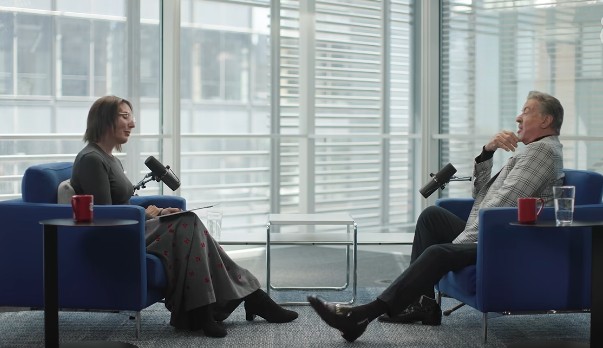
EDITOR’S NOTE: In this episode of The Interview from The New York Times, Lulu Garcia-Navarro speaks with Sylvester Stallone, 80, about his new memoir, The Steps, and the abusive, painful childhood behind the tough-guy persona of Rocky and Rambo. Over two conversations, Stallone speaks candidly about his parents, his anxiety, his struggles with his body, the loss of his son Sage, and the ups and downs of his career. He also reflects on regret, forgiveness, and his shift toward being anti-war. (September 26, 2026)
TRANSCRIPT:
Introduction
LULU GARCIA-NAVARRO: (00:00:08 – 00:00:37) I’m Lulu Garcia-Navarro, and today I’m interviewing Sylvester Stallone. At 80 years old, the star of Rocky is telling his own against-all-odds story in a new memoir, The Steps, an allusion to one of Rocky’s most iconic scenes. In the book, Stallone details an abusive and tortured childhood, and how that fueled his success in some of Hollywood’s most well-known franchises.
LULU GARCIA-NAVARRO: (00:00:43 – 00:00:56) What became clear in our conversation is that behind that tough guy exterior he became famous for, there were deep struggles with his emotions, his body, and his family. It’s a Sylvester Stallone you’ve never seen before.
It has been 50 years. It’s hard to believe, I’m sure, since the movie that started it all, Rocky, came out. You’re now 80 years old, which I’m sure is also hard to believe.
SYLVESTER STALLONE: (00:01:30 – 00:01:30) It is.
Revisiting a Painful Childhood
LULU GARCIA-NAVARRO: (00:01:33 – 00:01:55) In reading this memoir, one of the things that struck me is that some of these memories are quite painful for you. And you wrote in the book that at difficult moments in your life, you told yourself to, quote, “put those memories away in a box and avoid them. Just move forward.” What was it like to go back and revisit some of these things for this book?
SYLVESTER STALLONE: (00:01:55 – 00:02:46) It was some mixed emotion. There’d be some tears. There’d be some laughter. There’d be some anger, bitterness. And then I thought, maybe in one way that was the motivation to do something extraordinary as opposed to just being very languid and, “Oh, I had a nice relationship growing up, but I have no angst inside of me,” that fuel. So I’ve always been on that cusp. The guy punched you in your mouth, but did he do you a favor? Because now you go to the gym and you become a tough guy. Those things, I truly believe that the parents are the mold makers. They’re sculptors. They don’t realize it, but they’re sculptors. They’re Rodins. And they’re sculpting their masterpiece or their disaster.
The Day He Was Born
LULU GARCIA-NAVARRO: (00:02:46 – 00:03:05) Yeah. I want to start actually at the very beginning because you came into the world in many ways how you have inhabited it, which is with a lot of turmoil, a lot of drama. It was a rough entry. Can you tell me about the day you were born?
SYLVESTER STALLONE: (00:03:06 – 00:03:51) Well, it was my mother really. She also came from a lot of turmoil and she really wasn’t mother material. And she had grandiose plans for her life. So her pregnancy with me was a big-time interruption. And I don’t think she wanted to really believe it was happening, even though it was in the 9th month and she was finally on a bus and she goes into labor and she said, “I want to have it here.” It was bad.
And then we just happened to be near a medical center, you might call it, like a charity ward. There weren’t even doctors there. It was just mainly interns and one doctor. And that’s my first breath on Earth.
LULU GARCIA-NAVARRO: (00:03:51 – 00:04:03) Yeah. Here in New York City, it was a bus. It was a bus right here. And the people who delivered you used forceps, and they partially paralyzed your face, right?
SYLVESTER STALLONE: (00:04:03 – 00:04:17) Could have been worse. Because sometimes you get brain damage from it. Maybe that happened too. I don’t know. But it was a terrible thing growing up because I slurred and I mumbled. And it was 10 times worse than Rocky. It was rough.
LULU GARCIA-NAVARRO: (00:04:18 – 00:04:21) Did you see yourself back then as having a disability when you were young?
SYLVESTER STALLONE: (00:04:21 – 00:04:37) Yeah, it was. You’re not aware of it. Even if you have a lisp or stutter, you’re so familiar with it. But other people, “What? What? Jesus, say anything. What language is that?” Yeah.
Raised by Strangers
LULU GARCIA-NAVARRO: (00:04:37 – 00:05:25) Oh, God. In the book, you seem to suggest that both your parents saw your arrival as having ruined their ambitions in some way. You wrote, “Can you really make people proud who never wanted you in the first place?” And when you were very little, you were sent to go live in a boarding house. You were very little. And your parents only visited you once a month. I’ve got to say, this is by modern standards, pretty extreme stuff. And it’s very clear that when you were young, you never got the love, you never got the support that most children need. How did you understand that as a kid? How did it make you feel?
SYLVESTER STALLONE: (00:05:26 – 00:05:51) I don’t know if there was some preventative thing or some blockage of being completely abandoned or forlorn or whatever. I just was raised by strangers in a boarding house. And it became sort of a natural environment. And my parents really were never nurturing. So this was actually a bonus compared to where I was living.
LULU GARCIA-NAVARRO: (00:05:52 – 00:06:06) I think if you are emotionally deprived when you’re younger, you learn to lock things away, which is why I started with that quote about you locking things away. Do you think it made you tough?
SYLVESTER STALLONE: (00:06:07 – 00:07:03) In the wrong way, yeah.
Because I was so consumed with not being another bum from the neighborhood. I was very, very competitive, like a pit bull. That’s what got me going. It’s not healthy. And I would have conversations with my wife and my brother, anyone at the time, about why I was so competitive. But then again—
LULU GARCIA-NAVARRO: (00:07:04 – 00:07:04) It made you who you are.
SYLVESTER STALLONE: (00:07:05 – 00:07:05) Yeah.
His Parents’ Divorce
LULU GARCIA-NAVARRO: (00:07:05 – 00:07:18) And you’ve had quite a life. Your parents had this very hostile and violent marriage in many ways. And they divorced when you were about 11 years old. Is that right?
SYLVESTER STALLONE: (00:07:19 – 00:07:20) Yeah. 10, 10 and a half, 11.
LULU GARCIA-NAVARRO: (00:07:20 – 00:07:28) Yeah. What do you remember about that separation? And how did they decide to split you and your brother up?
SYLVESTER STALLONE: (00:07:28 – 00:07:51) It was traumatic. I’m not sure about how my brother reacted, but when she goes, “I’m leaving, I won’t be living here anymore.” And I go, “Where are you going?” She goes, “I’m just going to live somewhere else. I’m moving out.” I remember holding on to her leg and being literally dragged to the— “Hey, Mom, come back.”
LULU GARCIA-NAVARRO: (00:07:51 – 00:07:53) And this is when you guys were all living together?
SYLVESTER STALLONE: (00:07:53 – 00:08:08) Yeah. And she pulled the leg away. Out the door, and that was it. And my brother came home a little bit after that, and there was nobody there. I guess my father took me to the shop or something. So he was abandoned, and he never got over that, ever.
LULU GARCIA-NAVARRO: (00:08:09 – 00:08:13) I’m so sorry, I just want to linger on it, of just you holding—
SYLVESTER STALLONE: (00:08:14 – 00:08:14) It was rough. It was—
LULU GARCIA-NAVARRO: (00:08:14 – 00:08:15) I’m telling you, your mother’s—
SYLVESTER STALLONE: (00:08:15 – 00:08:23) Those things where your legs buckle, you drop down, you grab around the leg. Try to tackle her.
LULU GARCIA-NAVARRO: (00:08:23 – 00:08:24) What was going on?
SYLVESTER STALLONE: (00:08:24 – 00:08:56) I don’t know, because she never was a loving person. I know I’m not alone in this, that there’s a connection at birth that some people have that’s so palpable that no matter what, you cannot break away from this ability or need to have this person’s attention. It’s like electric and then being deprived and put into the dark. It’s a terrible syndrome. It really is.
LULU GARCIA-NAVARRO: (00:08:56 – 00:09:00) It’s 100% true. You can never get rid of the connection to your parents.
SYLVESTER STALLONE: (00:09:00 – 00:09:14) So is it blood thicker than water? I used to say, “No, it’s just stickier.” But it is thicker. There’s something there that is quite painful. Really, it is.
Living With His Father
LULU GARCIA-NAVARRO: (00:09:16 – 00:09:32) You go to Maryland and you end up living with your dad. He loved horses. He played polo. But what was it like living alone with your dad? Because we’ve talked a little bit about your mom, but that didn’t sound like a great time either.
SYLVESTER STALLONE: (00:09:33 – 00:10:54) It would be, I guess, these constant bombastic explosions and then total silence. Because if he were talking and then he said, “I don’t know if I agree with that,” he’d start spinning his fork. And suck his teeth, and you knew what was coming. And next thing you know, wham! He had very big hands. You just learned to duck a little bit.
But there were some times I’ll never forget. I didn’t put a lot of stuff in the book because I didn’t want a pity party, but it was insane. For example, it’s church. Before we go to church, “Go to the store, which is a block away, buy some bread.” Okay, I go down there, I see a couple of my friends. “Oh, I’ve got to get back.” And I bring home sandwich spread, not bread. And he kicked me in the stomach and hit me and laid me out, got in the car and went to church. I’m there in the street, tie like this, with mayonnaise. It’s unbelievable. It’s unbelievable.
LULU GARCIA-NAVARRO: (00:10:55 – 00:10:59) Did you ever fight back?
SYLVESTER STALLONE: (00:11:02 – 00:12:05) This is going to sound very, I guess, Greek tragedy kind of thing. When I was, say, 43, 44, and he was 25 years older than me, he goes, “Yeah, you’re doing this, you’re doing that. Is there anything left in your life that you like to do?” I said, “I wish you and I could be the same age, 3 minutes.” And he goes, “Wow.” I said, “Because I’d like to give you some of your own medicine and you would know what it’d be like to have your ass kicked.” He takes off his jacket, he goes, “Don’t wait, let’s bring it on right now.” This is on Sunset Boulevard. Pulled the car over. He said, “You don’t have to wait. Come on.” He was ready to go at 68 years old. So when people go, “Where do you get the ferocity to play Rambo?” I go, “Genetic.”
A Competitive, Abusive Father
LULU GARCIA-NAVARRO: (00:12:08 – 00:12:12) Your dad was not only abusive, but he was competitive with you.
SYLVESTER STALLONE: (00:12:13 – 00:12:13) Oh, yeah.
LULU GARCIA-NAVARRO: (00:12:14 – 00:12:36) He often tried to one-up you, sort of humiliate you. You talk about what you’ve just discussed, him beating you up in front of church. But also, you became a very good polo player. And at a polo match in front of everyone, he dragged you off the horse and beat you up in front of everyone. Why do you think he was that way with you?
SYLVESTER STALLONE: (00:12:36 – 00:12:38) I don’t know.
LULU GARCIA-NAVARRO: (00:12:39 – 00:12:39) You never asked him later?
SYLVESTER STALLONE: (00:12:39 – 00:13:39) I don’t know. You keep going, well, his father was like this. His father was a very stoic barber with the mustache. They say a fly sitting on a ton of cow s*** thinks himself a king. So he was like, “Yes, I’m the king of the street.” And so he had this sort of imperiousness, and I think he was cold as hell. So my father was very, very cold and tough.
For example, there was a cat just making noise outside the house. He went inside and went out, got the cat, took it into the laundry room, shot it, and left it in the washtub. Now I think he did that to impress me: “Holy crap, you’ll never be as tough as your old man.” And I won’t. There’s no chance. That’s a whole other league.
LULU GARCIA-NAVARRO: (00:13:41 – 00:13:43) It’s funny, though. You keep on using the word tough.
SYLVESTER STALLONE: (00:13:43 – 00:13:44) Yeah.
LULU GARCIA-NAVARRO: (00:13:44 – 00:13:46) And I don’t hear tough. I hear messed up.
SYLVESTER STALLONE: (00:13:47 – 00:13:56) You’re right, because I’m using tough as a masculine banner for something much more perverse and weird and dark. Oh, yeah. Yeah.
LULU GARCIA-NAVARRO: (00:13:56 – 00:14:02) With all that drama and all that violence, was there any love between you two? Did you feel any love?
SYLVESTER STALLONE: (00:14:03 – 00:15:10) Only on his deathbed. That’s about it. My mother never, and my brother will attest, hugged me ever, ever. There was never a “hold you to the breast” kind of a thing. Kissing, forget it. Nothing. It was always an air thing. And my father wasn’t any better at all.
But I’ll never forget, I was maybe 9 years old and he would always have me take care of his horses, feed his horses, but never ride his horses. And so we were coming back from the barn. He’s driving, and I kind of fell asleep. So he put my head on his knee and his hand on my head. I never got over that. That was the epitome. I went, “Wow, that’s what it feels like.” Just a simple stroking of your child’s hair. But that was it. It was one and done.
LULU GARCIA-NAVARRO: (00:15:10 – 00:15:12) So much so that you remember it.
SYLVESTER STALLONE: (00:15:12 – 00:15:12) One and done.
The Psych Ward at Devereux
LULU GARCIA-NAVARRO: (00:15:15 – 00:15:32) You went to many different schools during this period. And one of the ones that you talk about is for kids that needed discipline. You got sent to sort of reform school, it sounds like.
SYLVESTER STALLONE: (00:15:32 – 00:15:33) Devereux.
LULU GARCIA-NAVARRO: (00:15:33 – 00:15:55) Yeah. And you talk about being put in a psych ward. And I have to tell you that this was one of the most chilling things that I have read. Can you tell me that story and why you included it?
SYLVESTER STALLONE: (00:15:57 – 00:17:47) As an adult, I saw One Flew Over the Cuckoo’s Nest, and it looks like a bunch of kind of eccentric old guys having a good time. No. At this school, there were 5 different departments for different ages. And in my age would be the teenagers. If you ever snuck out to see a girl or do something like that, you’d be reprimanded by taking to a place called Park Lodge, or the Snake Pit, which on the outside looked like a big old Tudor home from the ’20s. And then you walked inside and you now entered the heart of insanity. The smell, the filth, people running around naked and clawing, hands tied, drooling. And this is what they thought would impress you never to break the rules again.
And then they marched me, and they’re clawing. And this is called the lifers, where these people, there’s no going home ever. Everyone had straps that’d be tied down at night. The windows were covered with bars or grills, and they took me to a cell and it was a padded cell. And I’ll never forget, it was that high. So you could never get off your knees. And inside, I’d look up right here and you’d have these elements like dust constantly falling down. And you see it’s been clawed at and clawed at by the predecessors of this particular dungeon.
LULU GARCIA-NAVARRO: (00:17:48 – 00:17:49) And they left you here how long?
SYLVESTER STALLONE: (00:17:50 – 00:18:07) I was there for a couple of weeks. It was wild. But this to me was one of the better things that happened too. I said, “I know they’re going to try to break me.” I was attacked there. They almost tried to rip my groin off. It was bad.
LULU GARCIA-NAVARRO: (00:18:08 – 00:18:10) What do you mean tried to break your groin? They assaulted you?
SYLVESTER STALLONE: (00:18:10 – 00:19:51) Yeah, a guy named Jaybird. Actually, he was the son of an actor named Lloyd Nolan. And he was put in there. He was big, had no hair, always naked, just rotten teeth. And he made sounds. And they called him Jaybird because he’s always naked as a jaybird. And I go into the bathroom on the way to the food mess hall, which was really just a bunch of troughs. And I’m there and he comes in. This f***ing smelly bear comes around me and he’s ripping on my throat and he’s going into my pants and he’s grabbing my groin. And I luckily got around to do this stuff in the face. And then the 2 guards come in and beating the crap out of him with razor straps. And I go, “What the hell’s wrong with him?” “You’re in a crazy house, boy. Nothing’s wrong with him. He’s crazy.”
And I went, “Wow.” So let me just get to the point. I won’t be labored anymore. When I came out of there and I was standing before the school president, I mean, the principal, because you learned your lesson. I said, “I learned a lot more than that lesson. Much better lesson. You can’t break me. You can’t break me.” So when I got to the city and everything that came after that, I always felt I was unbreakable in that way. My heart could be broken, all that kind of stuff, like every human being. But I’m talking about will.
Usher, Writer, Dreamer in New York
LULU GARCIA-NAVARRO: (00:19:53 – 00:19:58) You end up showing up here in New York City in your 20s.
SYLVESTER STALLONE: (00:19:59 – 00:19:59) Yeah.
LULU GARCIA-NAVARRO: (00:20:00 – 00:20:29) And you have dropped out of college at this point. You have backpacked around Europe. And you have no money. And you have a dream, though, that you want to become an actor. And you take a job as an usher at a movie theater. And I have to say, this was so interesting because what comes through is what an obsessive you became. You start writing down dialogue from your favorite films. What were you trying to do there? What was going on?
SYLVESTER STALLONE: (00:20:29 – 00:21:42) I was really trying to learn. I said, “I’m nonexistent. I put on this monkey suit.” And people don’t even see you, but you’re in really a temple of wisdom in cinema. You can see what the audience reacts to, where they laugh, where they don’t, who gets up, why do they get up. You listen to them talk about the film, and every day was different. And then I started to record it, write it down, and I lived literally in almost like a cell. It was a very tiny, maybe 8 by 9 foot room. So I’d sit on my bed. That’s all we had. And I’d have these old record albums of Traffic and Blood, Sweat, and Tears, and that was my desk. And I would just translate notes and notes and notes.
And sometimes I go, “Ooh, what if this is it, Sly? You’re sitting in the middle of a bed like a fool doing something that sounds so stupid to anyone else. What are you just postponing the inevitable?” Then that fear would come. I said, “Put that away, goddamn it.” It’s like the thing in the psych ward. “No, don’t go there. Take the fear, swallow it, and move on.”
LULU GARCIA-NAVARRO: (00:21:42 – 00:22:05) Yeah. You had an apartment where there were blacked-out windows where you would write scripts for days on end. It’s just this absolutely kind of manic intensity. And in this period, you were also getting into altercations. You were living rough. But you were also spending your days not only writing, but going to MoMA.
SYLVESTER STALLONE: (00:22:06 – 00:22:06) All the time.
LULU GARCIA-NAVARRO: (00:22:07 – 00:22:13) And you had this deep appreciation for art. How did you understand these 2 sides of yourself?
SYLVESTER STALLONE: (00:22:13 – 00:23:18) I don’t know. It just seems like if you’re open, really open to different experiences, I just go by this place and I look in there and for some reason I go, “Wow, the energy of the art.” And you’re looking at Léger and all these incredible drawings and Monets and Starry Nights. I’m going, “What makes them so special? I could do that.” Then I go, “No, you can’t. Look at it closer. Look at it closer.” And it just started to invigorate me. And then I developed this unbelievable thirst for art, which is to this very day. And I started to paint.
And I went there so many times, I didn’t even pay anymore. I just knew everybody: “Ah, come on in, get out of the cold.” It’s almost as though you were going to the church of the brain. The most wisdom in the world is right here. And if you were walking around in a fog, “What am I going to do with my life?” Go in there. You might find something that will give you a little spark and interest that gets you going in that direction.
The Cauldron and the Rambo Breakdown
LULU GARCIA-NAVARRO: (00:23:19 – 00:23:46) You wrote in the book, “At my core, there is this simmering cauldron of emotion that can overflow with volatility, but it can also be directed towards deep artistic purpose.” And I was thinking about those two sides of you, the “I’m going to hit you if you hit me,” but “I’m also going to go to MoMA,” and “I’m also going to sit there and pray at the cathedral of cinema.” Do you think you ever learned how to control that cauldron?
SYLVESTER STALLONE: (00:23:47 – 00:24:45) It’s very, very explosive. I’ll tell you the truth. Sometimes in certain moments, in cinema, even as an adult, at the end of First Blood, there’s this big nervous breakdown, and it wasn’t written that way. I hadn’t written it that way, but it came out. I said, “This is coming from that cauldron,” and it’s a self-indignation of being run down, dismissed, because that’s the way I felt.
The worst thing you can say to me, the worst. You call me ugly, call me this, call me short, don’t call me stupid. Because that is what my father used to say. And literally, it would turn me into a maniac to prove I’m not stupid. And I would just work and work and work. For example, this morning, I’m 80 years old. I’m up at 5 in the morning studying my dialogue that I don’t have to do for a month.
LULU GARCIA-NAVARRO: (00:24:46 – 00:24:56) It’s funny that you mention that scene in Rambo, which is just an iconic scene. I was just watching it again yesterday.
VIDEO CLIP BEGINS:
SYLVESTER STALLONE: (00:24:58 – 00:25:10) Yeah. And nobody would help! No one helped me. “Please, I want to go home. I want to go home.” He keeps calling my name. “I want to go home, Johnny. I want to drive my Chevy.” I said, “Well, why? I can’t find your f***ing legs!”
VIDEO CLIP ENDS:
LULU GARCIA-NAVARRO: (00:25:11 – 00:25:15) You are just filled with rage and grief.
SYLVESTER STALLONE: (00:25:15 – 00:25:15) Yeah.
LULU GARCIA-NAVARRO: (00:25:17 – 00:25:27) And it just translates viscerally onto the screen. It wasn’t written that way, though. You just were tapping into that culture?
SYLVESTER STALLONE: (00:25:27 – 00:27:07) Yeah. The way it was written is I’m supposed to commit suicide in a very cool manner. I go, “No, wait a minute.” There’s thousands and thousands of men missing parts of their bodies, that literally actually thought they were doing something worthwhile. They were following the rules and orders of their country. Then when they come back, they’re looked at as aberrations, Frankensteins, monsters. Then I started to identify that’s what I felt like growing up. And this kind of rage that they must feel, that it’s not their parents, it’s their country that is scorning them. Their real parents, the ones they literally lost blood and friends and died for and were mutilated. And you can’t say “nice try, thank you,” nothing. So I really identified with this dismissive attitude that I grew up with all the time.
And when I look at that footage, I look distorted. It was the eyes. I was gone for a few seconds. And you’re lucky enough sometimes in acting or painting or writing or anything where you just subliminally lose yourself. You do not know where you are. People say, “Oh, maybe it happens in sex for 2 seconds where you’re literally blanked out.” Well, when you have that moment in acting, is it over?
LULU GARCIA-NAVARRO: (00:27:09 – 00:27:10) Was it one take? Or was it—
SYLVESTER STALLONE: (00:27:10 – 00:27:13) One take. Wow.
Writing Rocky
LULU GARCIA-NAVARRO: (00:27:15 – 00:27:48) Just to come back to this period that you were in your apartment with the blacked-out windows, and you’re trying to make it as an actor. You get a lot of rejections because of the way you look. And you write Rocky for yourself. And the studios are very excited for the script. And it’s well known, this story, that the studio ended up trying to pay you more and more money not to be in the film. They wanted James Caan. They wanted Ryan O’Neal. But they give it to you because you hold out again, because you had this sense that this was your last chance?
SYLVESTER STALLONE: (00:27:49 – 00:28:58) This was it. I was done. I had less than $100, $106 in the bank. And there was something. And I don’t know if it was spiritual, but I said, “God, man, I know in my heart that I will regret this for the rest of my life, and I will be more of a broken man than if I had never done this in the first place.” And I don’t know why I knew, because I had no success. I was green, really green, and they had every right not to want to use me. If someone came into me and did the same thing and looked like me and slurred and all that, I’d say, “Come on, man. You’re not acceptable to a lot of different people in this country.” But I don’t know why. I just knew that this is the crossroad. This is the bridge. And if you don’t cross it, man, then jump off it, because I’m not going to have someone else do it. Because I know I hate myself. I’d kill myself. I really would. Emotionally, that is.
Casting His Father in Rocky
LULU GARCIA-NAVARRO: (00:28:58 – 00:29:11) No, I get it. I get it. Can I ask you just about this thing that happened during Rocky. This is your big break. You have sacrificed everything for it. They give you the part. You’re a nobody.
SYLVESTER STALLONE: (00:29:13 – 00:29:13) This is—
LULU GARCIA-NAVARRO: (00:29:14 – 00:29:41) Everything’s riding on the movie. And you cast your dad as the timekeeper who rings the bell in the climactic boxing match. This is what the whole movie is going towards. And you bring in someone with whom you’ve had this incredibly difficult relationship. And it turned into a mess. Why did you let him back in? I don’t know.
SYLVESTER STALLONE: (00:29:41 – 00:30:35) It’s just, “I just want you to love me for a little bit. A little bit. Look what I did. Share it with me. I know you thought I was a fool my whole life, but here we are. This is not a joke.” And he didn’t ring the bell properly. And I kept fighting and fighting and fighting. When everything’s choreographed, it’s a 1, 2, 3, 4, bell. Not 6, 7, 8, 9, 10. So Carl Weathers is like, “What’s going on?” You’re throwing punches and you’re trying to ad-lib, and then it looks really fake. I go, “Ring the bell.” Whoever yell at me. And he’s like— it became, I said, “Oh God, they’re really bad Italian trauma.” And of course, it ended up in an altercation by the end of the round. It got really nasty. But for a moment, I thought, “Jesus, he’d be proud.”
His Mother, Jackie Stallone
LULU GARCIA-NAVARRO: (00:30:36 – 00:30:38) And later, you end up inviting your mom to the Oscars.
SYLVESTER STALLONE: (00:30:39 – 00:30:39) Yeah.
LULU GARCIA-NAVARRO: (00:30:40 – 00:30:51) For Rocky. So then you call her up and you say, “Hey, this film, I might win an Oscar for it.”
SYLVESTER STALLONE: (00:30:51 – 00:30:53) “Who’s in it? I can’t be in it.”
LULU GARCIA-NAVARRO: (00:30:53 – 00:31:39) And she blows you off. Can I ask you about your mom specifically? Because as we’ve discussed here, she was difficult. This is putting it lightly. You’re quite scathing about her in the book. And then in the 1990s, she becomes a celebrity psychic.
VIDEO CLIP BEGINS:
JACKIE STALLONE: I’m Jackie Stallone, psychic astrologer to the stars. I have predicted fame and fortune from movie stars and celebrities all over the world.
VIDEO CLIP ENDS:
And I just wondered, to jump a little later into your life and your relationship with your parents, how did you manage the dynamics when she sees proximity to your fame as a financial opportunity? That must have been a hard dynamic to manage. Very hard.
SYLVESTER STALLONE: (00:31:39 – 00:32:11) Very hard. It was very hard because she had been married 3 more times. And then, I saw her posing as a psychic with a turban and rhinestones and this overinflated sense of buffoonery. Or she would go on Howard Stern and mock my father and call him terrible things. And then they’d get on the phone, and I had my father and mother fighting on Howard Stern. I’m going, “What other guy has to go through this?”
LULU GARCIA-NAVARRO: (00:32:12 – 00:32:14) Yeah, this was 1992. They had this horrible on-air argument.
VIDEO CLIP BEGINS:
UNIDENTIFIED SPEAKER: (00:32:16 – 00:32:23) But you two produced a movie star, let’s say. Say you guys did produce a movie. No help from him. Any guy could have done the job in 3 seconds. He didn’t even want Sylvester.
UNIDENTIFIED SPEAKER: (00:32:23 – 00:32:24) He tried to get me to have an abortion.
VIDEO CLIP ENDS:
SYLVESTER STALLONE: (00:32:24 – 00:34:06) Really? It’s unbelievable. “Why would you go on and humiliate yourself? Well, you’re humiliating me, my children. Stop. I’ll pay you anything to do whatever you want. The finest restaurants, anything. Just live your life and just try to be proud.” He goes, “Why aren’t you proud of me?” I went, there it is. I’ll never forget.
And I asked her, I said, “Have you ever done anything wrong? Do you have any regrets?” She goes, “No. Why?” I went, “Wow.” I live on regrets. I can make a castle out of regrets. When people say, “I have no regrets,” I go, “B*******. Come on. Really? You’re that perfect?” And that’s just the way it was to the day she died.
And the last effort at the Oscars, I thought, 10 months earlier, I was basically homeless. Now we’re with incredible competition and you don’t want to go. See, here it is. I’ll put it in a nutshell. She never wanted to be alone with me, ever. And she didn’t go. And she stuck to her guns. And it really hurt me hard. I won’t go there anymore. But it does affect you. My wife always says, “I know it’s hard to get over it.” It’s very nagging. It’s a nagging scar that won’t fully close. And every now and then it weeps and you go, but again, that’s your cross to bear. Maybe that’s why you had this certain sort of selective rage.
Anxiety and Therapy
LULU GARCIA-NAVARRO: (00:34:07 – 00:34:08) Did you go to therapy later in your life?
SYLVESTER STALLONE: (00:34:09 – 00:34:35) No. I said, “It’s not going to help.” It’s just not going to help because it doesn’t go away. You cover it with all this subterfuge and ideology and intellectual this and that and breathing and meditation until that moment late at night, and you’re right back. And now you’re in anxiety. You ever have anxiety?
LULU GARCIA-NAVARRO: (00:34:36 – 00:34:36) Oh yeah.
SYLVESTER STALLONE: (00:34:37 – 00:34:41) All that anxiety everyone has, it’s coming from something that was so deep-rooted.
LULU GARCIA-NAVARRO: (00:34:42 – 00:34:43) Tell me about when you first suffered anxiety.
SYLVESTER STALLONE: (00:34:45 – 00:35:46) The first time I did is when I was 36, and I was watching dailies, and all of a sudden I stood up and the hair on my neck went up. I started getting hot. I go, “I’m dying. This is it. I’m on my way out.” Heart banging. Down I went, took a knee, crawled, rolled over. And then now I’m in this dark movie theater. I go, “I’m on my way out. Where the f*** did this come from?” And then it happened again and again and again. Then it went away for 5 years. And then it always seems to happen as you’re ready to go on the Today Show. “Oh, boom,” 8 seconds. And you feel it coming on. “Anybody got a Xanax?” It’s too late. So you’re just sitting there holding the chair going— I feel for it. It’s not a joke. Anxiety.
LULU GARCIA-NAVARRO: (00:35:46 – 00:35:52) I think people would find it very heartening that you have experienced that.
SYLVESTER STALLONE: (00:35:52 – 00:36:56) Oh my God. Especially as I got older. And it was weird. When I’m in a crowd, I’d be with my wife at an art exhibition and the room is filling up. It’s getting more and more and more. And then I go, “I’m going. I’m going down.” And she goes, “Let’s get out of here.” And literally I just make it to the alley. Boom. Get down on one knee. Did it again. I was at the mayor’s office in Philadelphia receiving some award and everyone sort of crowded me in the corner. I said, “I can’t, I have to go. Thank you very much.” And I just made it out of there. And I go, “What is that indicative of? It never bothered you before.” So there’s something still bubbling inside, festering. It’s a marvel, for example, that we still have magma and lava 4 billion years later in the center of the Earth. How long does it take to cool an egg? My God. So the same thing, our emotions are always on the verge of eruption.
Fatherhood and the Loss of Sage
LULU GARCIA-NAVARRO: (00:36:58 – 00:37:09) Despite having such a— I don’t even know the word anymore— upsetting upbringing, you’ve become a father of 5.
SYLVESTER STALLONE: (00:37:10 – 00:37:10) Yeah.
LULU GARCIA-NAVARRO: (00:37:11 – 00:37:17) What did you learn about being a good parent, considering you didn’t really at all have role models for that?
SYLVESTER STALLONE: (00:37:18 – 00:38:27) I really wasn’t a very good parent. My wife, Jennifer, is the greatest woman ever born. Seriously, she’s just my guardian angel. I would’ve been dead 3 times, for real. And she just is the most giving. I don’t have that gear of just abandonment of your own personal self for someone else. It’s really unbelievable. And she raised my daughters that way.
In my first marriage, it wasn’t like that. And I was in my warrior mode. I was like, “Oh, let’s conquer the world. This is your moment.” And everything fell by the wayside. And it was just a measly manner of existence. Reality was the movie set. The surreal world was my life. I have no control out here. I’m at everyone’s beck and call. I don’t like it. I couldn’t wait to work again. It’s terrible to say that, but it’s true.
LULU GARCIA-NAVARRO: (00:38:31 – 00:38:44) You suffered an unimaginable loss in 2012 when your eldest son Sage died. He had an undiagnosed heart condition that killed him when he was only 36. And I just want to say, I’m so sorry.
SYLVESTER STALLONE: (00:38:45 – 00:38:45) Thank you.
LULU GARCIA-NAVARRO: (00:38:48 – 00:38:50) I imagine that must have profoundly changed you.
SYLVESTER STALLONE: (00:38:51 – 00:39:29) Oh, the thing is, you have so many episodes of guilt. “What could I have done? Should I have been there? If I did that, if I went right or went left.” I had no idea that— it was stunning. I’ll never forget. It was so cold. My mother’s new husband, I never met, was a doctor. I get a phone call Friday the 13th. He goes, “Sly, Steven, he’s gone.”
LULU GARCIA-NAVARRO: (00:39:31 – 00:39:31) Who’s gone?
SYLVESTER STALLONE: (00:39:31 – 00:39:42) He goes, “Sage, he’s gone.” “Gone where?” “He’s died. He’s gone. I’m sorry.” Click. I said, “Is this possible?”
LULU GARCIA-NAVARRO: (00:39:43 – 00:39:44) That’s how you found out?
SYLVESTER STALLONE: (00:39:44 – 00:41:16) That’s how. Yeah, that’s how. “He’s gone. He’s gone dead. Sorry.” And it goes to the funeral, it goes to all the— again, dealing with the mother, dealing with your life in the present. And it just takes you into a whole other world. I’ll never forget. I go, “Wow, I’m holding it together. When’s it going to happen? When?” And then about a week later, I was all alone in my room and a wail came out of me I’ve never heard before since. It was just such pain and grief and guilt. It was not human. It really wasn’t.
But all I can say is that he was a very kind kid. He had a great mother, and we would have done wonderful things in the future. I just had no idea that he had something that you would expect a very advanced adult to have. But no, you don’t get over that. No. I’m sorry.
Overnight Fame
LULU GARCIA-NAVARRO: (00:41:20 – 00:41:21) Back to Rocky.
SYLVESTER STALLONE: (00:41:22 – 00:41:22) Back to Rocky.
LULU GARCIA-NAVARRO: (00:41:25 – 00:42:27) It got 10 Oscar nominations. It ended up winning Best Picture. And it’s not just the film, but you end up capturing the public’s imagination because it was this fairy tale story. And I’m very interested in you looking back at this transition from becoming a struggling actor to suddenly becoming the hottest star in Hollywood. Because in the book, there is this picture of you, which is very poignant. And the caption reads, “My last day of being anonymous.” And I thought, what an interesting thing to put in a book. That you can delineate that moment where you could walk the streets and no one would know Sylvester Stallone. And then after that was never going to be the case again.
SYLVESTER STALLONE: (00:42:28 – 00:43:35) No, it was a tsunami. The movie started at 12 noon, and at 2, people started coming. They saw me, and it was a deluge of being completely obscure for 30 years, just walking through being a non-entity, to now being this celebrity and someone who has tapped into their hearts in more than just a movie. Not “Hey, that was a great action film.” It was like, “That’s my story, that’s this, that’s that.” I went, “Oh my God.” And I could hear the applause. Applause in a movie theater? It was like an event. And I’m looking at my brother, he goes, “Oh, you’re in for it now, pal.” And it really was just overnight. It’s never happened again, obviously. It’s the rarest combination of obscurity to fame in a matter of 2 hours that’s documented. Whoa.
LULU GARCIA-NAVARRO: (00:43:37 – 00:43:53) Did you look at fame as something in the same way as the psych ward? And let me try to explain what I mean, which is, “This isn’t going to change me.” Or did you look at it as, “This is everything I’d ever wanted”?
SYLVESTER STALLONE: (00:43:58 – 00:44:02) Well, I don’t know if it changed me.
LULU GARCIA-NAVARRO: (00:44:02 – 00:44:05) But fame breaks some people.
SYLVESTER STALLONE: (00:44:05 – 00:45:08) Well, it didn’t break me. What it did is it made me combative. It made me very “I told you so,” revengeful, spiteful. And all the rejection, everything else, oh my God, I was so insufferable. I really was. Even with the New York Times, and I go, “Madame Bovary, anyone could write that.” I became a petulant child. I really did. And years later, I despise myself. I’m surprised I’m still here. I managed to alienate the entire press. I really did. And people that believed in me and so on, I just was not humble. There was no humility whatsoever. Again, it’s just childhood eruptions coming to the surface at the most inopportune times.
Rivalry and Friendship With Arnold Schwarzenegger
LULU GARCIA-NAVARRO: (00:45:09 – 00:45:26) I want to talk about some of the people you worked with and came across in the ’80s. And of course, we’re going to start with Arnold Schwarzenegger, who you’re now friends with, we should say. But he was a huge action star back then. And you’ve said you couldn’t stand to be in the same room.
SYLVESTER STALLONE: (00:45:26 – 00:45:27) No.
LULU GARCIA-NAVARRO: (00:45:28 – 00:45:33) Why did you hate him so much? What was it though? Take me back before the friendship.
SYLVESTER STALLONE: (00:45:33 – 00:45:52) Because he was a challenge. I thought I had something going on, and then I could see this guy, this immovable force, a very confident human being. I think even more so than me, and more psychological in the way he would manipulate and do things very cunningly. And not in a negative way, but just shrewdly.
LULU GARCIA-NAVARRO: (00:45:52 – 00:45:52) Smart guy.
SYLVESTER STALLONE: (00:45:52 – 00:46:05) Where I was blunt force, he would— Machiavellian, cool. And I went, “God damn it.” And he’s winning these awards, and he’s a bodybuilder. And I consider myself somewhat more of a—
LULU GARCIA-NAVARRO: (00:46:05 – 00:46:05) A thespian.
SYLVESTER STALLONE: (00:46:05 – 00:47:03) A thespian, a dramaturge. A peripatetic dramaturge just wandering the country acting. And I went, “Wow. This is my guy. This is the guy I know I’m going to have trouble with, period.” And sure enough, we did. We were just going at each other, which turned out to be fantastic. And I’ve had some moments with him, and I’m regretful for some of the things I’ve said about him, but he antagonized me in a creative way, and I did to him. I was a thorn in his side. He was a thorn in my side, but it just forced us to keep moving higher and bigger guns, louder movies, more action, more bodies, everything. Until I think we really carved out a niche that’ll never quite come around again. That certain ’80s over-the-top action genre that he and I sort of pioneered.
LULU GARCIA-NAVARRO: (00:47:03 – 00:47:04) You did?
SYLVESTER STALLONE: (00:47:04 – 00:47:04) Yeah.
LULU GARCIA-NAVARRO: (00:47:05 – 00:47:07) It’s like a creative marriage in a way.
SYLVESTER STALLONE: (00:47:07 – 00:48:01) It is. It’s like Ali and Frazier. You need that. That thing that brings you to the surface that more than any other person, it’s not even hatred. It’s this guy, he won’t go away. I dream about him. It’s like I’m on his mind, he’s on my mind. That’s very rare. Men get it. I’m sure women get it too, but 2 alpha men who I can only relate to, you can’t wait to go against him. And then he does better than you, and then he just gloats on it. “Oh, I see that Stallone’s film didn’t perform very well.” And then vice versa. And then eventually we end up working together in Expendables, and I go on the campaign trail for him. Unbelievable.
LULU GARCIA-NAVARRO: (00:48:01 – 00:48:09) When was the moment that you two thought, “We put this to rest”? Did it just come with age and him moving into politics and just sort of—
SYLVESTER STALLONE: (00:48:09 – 00:48:54) Yeah. Yeah. Yeah. At first, I thought, “Come on. Actors in politics. This is oil and water.” Actors are really very, very self-absorbed. And politicians, if they’re really good, should be just the opposite. Publicly absorbed. So I saw there’s a conflict there. But he was definitely sincere about it. And I don’t know why, but he asked me, we’re at a cigar place, “Would you like to be at an event?” And I went, “Yeah.” I go, “Why did I say that?” And then sure enough, then we hit it off. And he’s very unique. He’s one of a kind. Forget it. I’m sorry.
LULU GARCIA-NAVARRO: (00:48:54 – 00:48:57) So until that moment, you really hadn’t spent time with him. You didn’t know if you even liked him.
SYLVESTER STALLONE: (00:48:57 – 00:49:06) I’m telling you, we always came to blows. It was when we were at Planet Hollywood, we couldn’t stand to be in the same arena.
LULU GARCIA-NAVARRO: (00:49:07 – 00:49:16) Right. Because in the early ’90s, you founded with Bruce Willis as well Planet Hollywood, and you were in business together, but you couldn’t stand being in the same room.
SYLVESTER STALLONE: (00:49:16 – 00:50:05) Oh my God. I’ll never forget. There’s a picture of he and I dancing, and it was, I think, Total Recall or something? And it was at the Hotel du Cap in the afternoon. It’s festive and everyone is there. “Oh no, take a picture. Okay, slide. Take a picture together.” He goes, “Director, why don’t you come in here and get in the middle?” I went, “Oh man.” And then I grab him and we’re waltzing. To me it’s the greatest picture because I said, “Let’s stop. Let’s just do this dance because that’s what it is.” But there’s never going to be— you could do a movie about this, for real. You really could.
LULU GARCIA-NAVARRO: (00:50:05 – 00:50:23) All right. We don’t have much time. That’s why I’m going like that. And I’m upset because I have so much to ask you. So I’m going to skip asking you about working with Sandra Bullock in Demolition Man and Sharon Stone in The Specialist. So we’re going to move on.
SYLVESTER STALLONE: (00:50:23 – 00:50:24) Bye, ladies.
LULU GARCIA-NAVARRO: (00:50:24 – 00:50:26) Yeah. Bye, ladies, indeed. Sorry.
SYLVESTER STALLONE: (00:50:26 – 00:50:27) Sorry.
His Body, Bulimia, and the Toll of Stardom
LULU GARCIA-NAVARRO: (00:50:27 – 00:50:30) Yeah. What I do want to ask you is about your body.
SYLVESTER STALLONE: (00:50:31 – 00:50:32) Body?
LULU GARCIA-NAVARRO: (00:50:32 – 00:50:33) Body. Yes. Your physique.
SYLVESTER STALLONE: (00:50:34 – 00:50:35) Oh, now you’re getting personal.
LULU GARCIA-NAVARRO: (00:50:35 – 00:51:06) Because at several points in your career, you were exceptionally muscular, which wasn’t your build before Rocky. And I was really curious how your relationship with your body has changed over time. How you saw yourself and then when you turned into this big action star with the big muscles and everyone was sort of venerating that, how did you see yourself? How did your relationship with that change over time?
SYLVESTER STALLONE: (00:51:06 – 00:52:53) It became very intimate, you might say. It was my armor. I looked at Rocky, very smooth, very normal-looking guy. And then I said, “If we move on, I think the character would start to become a bit more vain.” And then Rambo, you’re playing a warrior, you’d be a little bit more animalistic. You wouldn’t be so smooth. So I started to think, design your body like a jaguar, a cat, not big like Arnold, but more feral and aggressive and very limber and move and athletic. And then it became an obsession really bad. It became to the point where I became bulimic. You didn’t know that? Okay. You heard it here first.
Because you would eat. I got down to 2.6 body fat when I was doing Rocky III in the opening scene. Literally hollow. And I couldn’t hold anything down. Or if I did, I didn’t want to keep it down because I became so obsessed at staying at that point of fitness. And then finally, I just broke the cycle, but it got to me, literally an obsessive body worship kind of a thing.
And nobody does it without additives and drugs, period. I don’t care who says that b*******. But then again, it isn’t as though you’re a junkie, but if you’re going to work and try to stay in shape for 6 months straight and you’re eating yogurt and pudding, and it’s not happening, just like these athletes.
LULU GARCIA-NAVARRO: (00:52:53 – 00:52:54) So you’re taking steroids, you’re saying?
SYLVESTER STALLONE: (00:52:54 – 00:53:15) Oh my God, you have to. But you do it in a way, 6 weeks on, 6 weeks off. And people go, “Oh, you don’t get that way naturally.” No, you don’t. You don’t unless you’re just a freak of nature. So everyone who says it, I can see them a mile away. What is obvious? But that also took a terrible toll. Terrible toll.
LULU GARCIA-NAVARRO: (00:53:16 – 00:53:20) And emotionally too, because it affects your moods and everything.
SYLVESTER STALLONE: (00:53:20 – 00:53:58) It wasn’t until I did Cop Land where I had to divest myself of that and play the weakest guy in the room, partially deaf, overweight, everything, that I really felt somewhat liberated. Then things went sideways. And I just fell out of grace with Hollywood. But yeah, the body has played a part. But I’ve abused it. I’ve had 9 back operations, 2 shoulder operations, 3 neck fusions. Everything is held together with baling wire. But I still have that want to stay in good shape.
LULU GARCIA-NAVARRO: (00:53:59 – 00:54:00) Do you still see it as your armor?
SYLVESTER STALLONE: (00:54:02 – 00:54:04) No, no, no, no.
LULU GARCIA-NAVARRO: (00:54:05 – 00:54:06) Because you’re still fit. You’re 80.
SYLVESTER STALLONE: (00:54:06 – 00:54:29) I’m sort of fit. But I take a lot of pills to keep going. It’s come at a terrible price. If I could do it over again, I would say, let someone else carry the banner. Don’t do your own stunts. I don’t know what it was about just hurting myself all the time. All the time.
LULU GARCIA-NAVARRO: (00:54:29 – 00:54:30) Is it masochistic?
SYLVESTER STALLONE: (00:54:30 – 00:55:06) Yeah, very masochistic. It’s not like I’m self-flagellating, but if someone’s going to dive onto the canvas in Rocky, they take a hit full force and go backwards, and land, thud, because there’s no padding. You’re landing on a board with a little thin canvas. It just jars you and jars you, but you go, “I can do better. I can do better.” And this is all going back to Dad and back there in the polo field. “No, you’re not going to break me.” But you do get broken a little bit physically, not mentally.
Regret and Forgiveness
LULU GARCIA-NAVARRO: (00:55:07 – 00:55:13) We’re going to talk again. But I want to end with something that you said about regret.
SYLVESTER STALLONE: (00:55:14 – 00:55:14) Yeah.
LULU GARCIA-NAVARRO: (00:55:16 – 00:55:23) And that you don’t get to be your age at your career without a mountain of them. And we’ve kind of touched on that a little.
SYLVESTER STALLONE: (00:55:23 – 00:56:18) Yeah. It’s horrible. It’s horrible. It really is. Because it’s the fog of war, the war of trying to succeed. And you can blame it on that. Or just self-pity, self-absorption. And I go, “Wow.” And it is painful, but yesterday is dead. The future is unknown. All we’ve got is today. You keep going back to that philosophy and you go, “Forgive yourself.” No, we forgive yourself for being a bastard. Yeah, no, you just regret. “I wish I hadn’t done that. Wish I hadn’t done that.” So I’m not going to do that anymore. But God, because what you did, you hurt yourself. You really did. Yeah, you denied people your love and this and that, but you also did worse to yourself.
LULU GARCIA-NAVARRO: (00:56:19 – 00:56:20) Have you forgiven your parents?
SYLVESTER STALLONE: (00:56:27 – 00:57:33) I’ve accepted that they are who they are. To forgive, I guess you could say, yeah, I do. It’s definitely a delicate peace treaty, but yeah, I have to. What are we going to do, walk around yelling at ghosts? “Come back here. We’re not finished.” I can’t. That’s about the regrets. So all I can do is cherish every second because let’s face it, I can see the light at the end of the tunnel. There it is.
And I’m incredibly fortunate to be doing Tulsa King. It’s a gift. And David Glasser giving me this new breath of life and a whole new character. Imagine playing, “Oh yeah, we’re doing Rambo at 80.” Oh my God. Who’s he fighting? He’s fighting Mr. Arthritis. I go, “What are you— you’re kind of out of opponents. You’re fighting— oh, yeah, brain disease. Okay.”
LULU GARCIA-NAVARRO: (00:57:37 – 00:57:40) We’ll end here for now. Sylvester Stallone, thank you so much.
SYLVESTER STALLONE: (00:57:42 – 00:57:44) Thank you.
Day Two: Vulnerability and Facades
LULU GARCIA-NAVARRO: (00:57:44 – 00:58:02) Ciao. On The Interview, we talk to our guests twice. So the next day, I spoke with Sylvester Stallone again. And he told me about his evolution from being an avatar for war in the Rambo movies into becoming personally anti-war. Hi.
SYLVESTER STALLONE: (00:58:03 – 00:58:14) Hi. Back from war? What is wrong with you? I give you my word, though, you have the most in-depth interview I’m ever doing. So take that to the bank.
LULU GARCIA-NAVARRO: (00:58:15 – 00:58:37) Well, actually, I wanted to thank you so much for your candor yesterday. You have always been this person who has exuded invincibility. That’s been your persona in your life, and that’s been your persona in many of your roles. And so it’s kind of astonishing to see you be so vulnerable.
SYLVESTER STALLONE: (00:58:40 – 00:59:28) Even though I put on this facade of having armor. When you see Rocky, and I’m writing for Adrian, I really have a lot of empathy for people that just didn’t get a break in life. And I’ve always thought, boy, there are so many stories in these people, but they’re never going to get out. So that’s why I think Rocky was such a success, because everyone has that character that very few people get recognition for. They live in quiet suffering. They’re never going to get any recognition. “I’m just here filling space. I’m just another seat on the bus.”
Cop Land and Hollywood Comebacks
LULU GARCIA-NAVARRO: (00:59:29 – 00:59:45) You’ve been in so many iconic films, franchises: Rocky, Rambo, The Expendables, now Taylor Sheridan’s Tulsa King. You were nominated for another Oscar for Creed in 2016. What’s your most underappreciated performance, do you think, that you’re most proud of?
SYLVESTER STALLONE: (00:59:46 – 01:01:01) Cop Land, for sure. Because I had been basically reduced to a lump of meat, like, “You’re not that smart. You’re an action guy.” And I’ve always looked at action, when it’s done well, as modern mythology. We don’t have scribes running around and carving on stone tablets about Hercules and so on and so forth. So I decided to delve in that by accident because First Blood, I never imagined, would transition me into more physical life because I wasn’t born this physical specimen at all.
And it just became so frustrating that things were slowing down. I was 50 years old. It was 1996. And I thought, “I’d like to go into the arena of the guys, the top guys, the top actors, and see how we bounce off of one another.” And it became that kind of challenge. There was definitely a dichotomy between the serious actor and that guy, meaning me. And I really welcomed it. I really did. I did the whole thing for free because the experiment was well worth it.
LULU GARCIA-NAVARRO: (01:01:01 – 01:01:56) In our first conversation, you also talked about how no one would return your calls in Hollywood for a period of years in the late 1990s. When things were pretty rough for you there. And this was a period when you had movies that didn’t do well: Judge Dredd, Daylight, Get Carter, Driven, D-Tox, Avenging Angelo. And I came across an interview you gave to The New York Times in 1992, just as you were filming Cliffhanger. The article quotes one prominent Hollywood agent, and I’m going to quote here, who said, “I think he’s a diminishing asset. With every film he does, he goes down a little further. He’s the new Burt Reynolds.” And Cliffhanger then went on to do really well. And it seems like there were these number of moments in your life when Hollywood was trying to write you off, and you kept having these comebacks. How did you deal with this thing of having to keep proving yourself to this industry?
SYLVESTER STALLONE: (01:01:59 – 01:03:18) Actually, I took it as somewhat invigorating because now I had a purpose. It’s one thing to sit there and be, I guess slowly, your image is diminishing right before you. You’re evaporating. But for some reason, I just said, “This is a call to arms.” And what am I going to go back to? I’m going to write another Rocky at 60 years old. And it was just the most ridiculous, a 60-year-old boxer, like a 120-year-old can-can dancer. It just doesn’t work.
But I was able to get out the portion of what people go through as they’re going into their later years, which is grief, the sense of loss. It had nothing to do with boxing anymore. And I just felt like, “God, this is the perfect opportunity now.” And of course, it was rejected everywhere. I had studio heads actually say, “Rocky’s done, and so are you, Sly. You’re done. Just go off fishing.” I said, “Okay, I get it.” And I go through rewrites after rewrites. But I’ve always had this sense that you have to go down swinging.
LULU GARCIA-NAVARRO: (01:03:19 – 01:03:26) How do you explain this period of not-so-great films? Did you know the films were bad at the time? Was it a quality control issue?
SYLVESTER STALLONE: (01:03:26 – 01:03:59) Yeah, it really was. I didn’t apply myself to the actual quality and who were the components. So even though each project had a great ability to be successful, I don’t think I really focused on the fine strokes, which is what art is made about. In other words, the right director, the right co-star, the right advertising, the right theme song. These are things that I used to really apply myself to, and I suppose I just got lazy and it started this whirlpool.
LULU GARCIA-NAVARRO: (01:04:00 – 01:04:06) It makes me wonder what it does to the soul of an artistic person to make movies that aren’t good.
SYLVESTER STALLONE: (01:04:06 – 01:05:26) Oh, boy. It’s a death in the family because it’s not as though you didn’t sell a vacuum cleaner today. It’s all over the world. And there is a part of human nature that revels in that. And again, I don’t take it personally. I think that quite often human nature says, “Okay, he’s had enough time. Let’s bring on the new generation. Okay, move over, Sly. Stop hogging the screen.” So I get it. When you reach a certain age in this business, it becomes a very, very, very competitive, delicate, and tenuous career. It doesn’t take much to ba-boom.
So that’s why I think it’s a very neurotic business at times because the product is you. It isn’t like, “Oh, you rejected my leather jacket.” No, “We don’t like you.” But I realized, I go, “Oh, here you go again.” You have to do it for yourself. You have to go out there and find the firewood and start the fire. No one is going to knock on the door and go, “Here’s an Oscar-winning script. Love ya.”
LULU GARCIA-NAVARRO: (01:05:27 – 01:05:27) No.
SYLVESTER STALLONE: (01:05:28 – 01:06:31) And so it really did help me because when you finally hit bottom, you have 2 choices. You can’t go any lower and you just eventually stop breathing. And I’ve always said the artist dies twice. The second death is the easiest one compared to the career death, which is being dismissed. But it just woke me up and I was so invigorated starting to write.
The hardest and the proudest moment by far in my life is Rocky Balboa because nobody wanted it. I was done. And when I say done, I mean agent fired me, managers fired me. I was done. I go, “Okay, this sounds very familiar. Let’s start over again. Let’s see if you can do it at 60.” So it was a fantastic voyage into the unknown. I said, “This sounds very familiar. When you were 29 years old, same thing. This is it.”
Rocky Balboa and the Fall of Rambo
LULU GARCIA-NAVARRO: (01:06:31 – 01:06:52) Listening to you talk about this, can you articulate your relationship then to the character Rocky Balboa? Because that character has saved your career, launched your career. You are defined by it. In many ways, America is defined by it.
SYLVESTER STALLONE: (01:06:53 – 01:08:06) Rocky is kind of my imaginary male role model. It’s my father. It’s what I wish I could be. So, when I created him, I put every component in there. This self-effacement, this kind of humbleness, the ability to also take loss, how he’s very philosophical about life is very difficult. And so I adapted that, and it always came to the rescue because it just pours out of me. Really, it does.
Writing other things, especially if you’re writing something like Rambo, which is very difficult because he’s monosyllabic, his lack of expression, Rocky’s is everything he’s thinking comes out. “It’s not about how hard you hit, it’s about how hard you can get hit.” All these things that most people would never talk about. So I found this to be a therapeutic beyond anything I’ve ever— you asked when you go to therapy. That was my Sigmund Freud right there.
LULU GARCIA-NAVARRO: (01:08:07 – 01:08:38) I have another question about Rambo. As we had discussed, the first movie was quite complicated. This vet that was discarded by his country who had PTSD. And you told this incredible story about how the last scene comes about with the movie ending with him being arrested. But then the character, over time, turns into this avatar, right? This classic action movie hero, perhaps with a little less depth than the original character had.
SYLVESTER STALLONE: (01:08:38 – 01:09:35) You’re absolutely right. And that’s my fault. It’s my fault. This is where this kind of vainglorious pomposity, “Now if you’re like that, wait till you see this.” And I didn’t really focus on the depth of what he was still going through while trying to save POWs. He’s trying to save his own soul. We never got into that. It’s just bravado, bravado, bravado, bulletproof. And that’s all me. That’s all me. That was a problem. This is when you get really hung up on kind of clandestine narcissism. It works its way in there. And then you realize, “Hell, this is a lot easier than showing your soul, flexing your muscles.” And it was terrible. Kind of like a cartoon.
Anti-War and Politics
LULU GARCIA-NAVARRO: (01:09:36 – 01:10:04) It came to define also this projection of American power. And I’m going to quote you to you. In an interview in 1985, when you were talking about your view of war, your politics, you said, “If you have the power like the United States, if you’re going to talk tall and carry a big stick, eventually you’ve got to use it, or they’ll think you’re bluffing.” Does Rambo represent a part of your worldview at that point as well?
SYLVESTER STALLONE: (01:10:04 – 01:11:08) It did. And now I realize all war is futile. It’s stupid. It’s a mechanism to make tons of money for the War Department and manufacturers. And these kids just going out there into a gristmill being chopped up, and then when they come back with no arms, “Oh, sorry, you’re on your own.” I hate it. I hate it. And I’m bitterly opposed to it. But at one time, I was truly gung-ho, really gung-ho. And I don’t know if I was just trying to go against the current. In Hollywood, there’s a certain dynamic, as you know. But again, I admit I think it was just naivete, really. Because I’ve read a lot, especially after First Blood, and I go, “Wow, this is brutal. This is horrible.” There’s no glory in war. None. None. Just—
LULU GARCIA-NAVARRO: (01:11:08 – 01:11:10) When did you become anti-war?
SYLVESTER STALLONE: (01:11:11 – 01:11:44) Look, if you’re under attack, of course you have to defend yourself. But I don’t want to get into politics now, but all wars basically destroy both sides. It really creates this horrible history. And a lot of people don’t get over it. They just don’t. Grudges are held and continents are just— countries are destroyed and lines are redrawn. For what though?
LULU GARCIA-NAVARRO: (01:11:45 – 01:12:04) I know you don’t want to talk about politics, but I am interested in something you just said, which is this idea of Hollywood being liberal and you being seen as a political conservative. Did that put you at odds in what was perceived as a liberal industry? Or is that perception actually wrong?
SYLVESTER STALLONE: (01:12:05 – 01:13:45) It is wrong because I totally understand why the perception is indelible. When Rocky came out, I was so naive. I’d never even voted. I was pushing 30 years old. I didn’t even know the difference between a Democrat and Republican. I functioned in another universe. But when Rocky wrapped himself in a flag and that sort of thing, and every movie we were up against at that time in competition was very, very heavy, very political. Just extremely erudite and intellectual. And Rocky was not that. It was emotional. And I think that right away put me over here.
And then when I did First Blood, again, I had no idea that there was such a chasm between the left and the right. And me being jingoistic, “He’s a saber rattler.” It was, again, naivete on my part. But yes, it caused a major rift. And I wish it wasn’t like that because I really think a lot of these actors have great empathy, great heart, and they’re really more for the working man. They’re just down in the trenches. And that’s where I live. But I’m not considered that. And sometimes you say things that you don’t realize the long-range effects.
Tulsa King, Mortality, and Loneliness
LULU GARCIA-NAVARRO: (01:13:47 – 01:13:53) So you’re currently in Tulsa King, which is a Taylor Sheridan series. It’s coming up on its 4th season.
SYLVESTER STALLONE: (01:13:53 – 01:13:53) That’s right.
LULU GARCIA-NAVARRO: (01:13:55 – 01:14:06) At this point in your career, what keeps bringing you back to the screen? This is no longer that you have anything left to prove. This is now—
SYLVESTER STALLONE: (01:14:06 – 01:14:06) It’s not about proving.
LULU GARCIA-NAVARRO: (01:14:07 – 01:14:08) Well, not proving, but this—
SYLVESTER STALLONE: (01:14:08 – 01:14:41) No, but I know exactly what you mean. “What do you have to prove?” It’s like a racehorse. You just keep going until it falls down. It doesn’t know how to walk. It knows how to run. And it’s almost like breathing. I talk to Al Pacino, De Niro, these guys. You are that animal. You cease to exist without this format. It’s what gives you life.
LULU GARCIA-NAVARRO: (01:14:43 – 01:15:05) You said something in our first interview that really caught my ear. You said, quote, that you can “see the light at the end of the tunnel,” which I took to mean sort of the end of your life. And I was wondering how you feel about death and how you feel about that there is less time in front of you than there is behind you.
SYLVESTER STALLONE: (01:15:05 – 01:16:07) Yeah. In panic mode. Really? Well, because that’s what I said before. I built a castle with thousands of stones made of regrets, and I’m trying to make up for it in my own petty way. And I don’t know if there’s enough time. And then I go, there is not enough time. What I have to do is just focus on the ones that really need me and the ones that I want to go on and have their own life and legacy. And I’m at the point now, at 78, you’re kind of like, “Ciao.” It’s where the insurance company goes, “That’s the average.” So I’m 2 years on borrowed time and I’m making up for it as much as I can. You’re never too old to be in love, never too old to dance with the great memories that you’ve had and not wallow in the worst swamp of all, which is the swamp of loneliness. That is truly premature burial.
LULU GARCIA-NAVARRO: (01:16:08 – 01:16:14) Well, thank you for the gift of all those characters, and thank you for your time, Sylvester Stallone. I appreciate it.
SYLVESTER STALLONE: (01:16:14 – 01:16:16) I appreciate it. Keep punching.
Closing Notes
LULU GARCIA-NAVARRO: (01:16:20 – 01:17:21) That’s Sylvester Stallone. And a note, we reached out to Devereux for comment after this interview, and a spokesperson replied that while they’ve not read the book, they respect Mr. Stallone’s right to tell his story his own way, take his account seriously, and are sorry for any trauma he remembers experiencing. His memoir, The Steps, will be published on September 29th. This conversation was produced by Seth Kelley. It was edited by John Woo. Mixing by Sofia Landman. Original music by Dan Powell and Marion Lozano. Photography by Philip Montgomery. The rest of the team is Priya Matthew, Wyatt Orme, Paola Neudorff, Joe Bill Muñoz, Eddie Costas, Mark Zemmel, Gaby Contreras, Kathleen O’Brien, and Brooke Minters. Our executive producer is Alison Benedict. Next week, David interviews Chris Rock. I’m Lulu Garcia-Navarro, and this is The Interview from The New York Times.
Related Posts
- Transcript: Ben Affleck Interview at Bloomberg Screentime 2026
- Transcript: Conan O’Brien Interview at Bloomberg Screentime 2026
- Transcript of Rick Rubin Interview: The Only Skill That Matters – DOAC Podcast
- Transcript: Druski Interview on Diary Of A CEO Podcast
- Transcript of Alanis Morissette Interview: Anger, Attachment, & Postpartum – Call Her Daddy